




Abstract
Elections do not always advance democratisation, yet they can. We outline a democratisation-by-elections model according to which the opportunities for political change opened up by each electoral round build on previous election-related democratic progress. We focus on Nigeria, interpret the recent executive turnover in light of previous elections, and set the country within the comparative context of Africa's democratisation. Using a new Africa Leadership Change dataset, we use election-related events to examine the diverse routes that African regimes have taken since 1990. The analysis highlights two major syndromes: democratic stagnation and recession. In a sizeable group, however, the institutionalisation of democracy has been making gradual progress. While there is no predetermined way to advance democracy, the reiteration of elections can be instrumental in such advancement.
The Nigerian election of 2015, in which the country's citizens cast their ballots for a fifth consecutive round since the establishment of the Fourth Republic, again demonstrated how important elections can be. Marking an unprecedented watershed in the history of Nigeria, opposition candidate Muhammadu Buhari soundly defeated incumbent president Goodluck Jonathan. Africa's most populous country and largest economy joined the limited number of sub-Saharan states whose voters had been able to oust a sitting president and hand power to the opposition. While political continuities are bound to hamper Nigeria's political renewal and its tortuous progress towards democratic politics, the achievement of a government turnover via elections represents a new cornerstone upon which to continue building. Its full importance is best understood when interpreted in light of the electoral path that the country has followed since 1999, and compared with the trajectories experienced by other African countries over the past 25 years.
Africa's political landscape has changed dramatically since the end of the Cold War. Following the collapse of old regimes, African countries embarked on transitions to multi-partyism that were initially welcomed as the beginning of a continent-wide wave of democratisation. Hopes ran high that political power would be depersonalised through the introduction of regularised procedures for leadership selection and replacement. However, Africa's reforms confirmed that elections do not always equate to democracy, as political transitions soon took various divergent routes. In several cases, change only affected the surface of politics, with old and new incumbent elites maintaining their grip on power. In other cases, elections did advance democratisation, even when voting was at times flawed, by favouring the rooting of a logic of free and fair competition.
Voting does not always propel democratisation, but it sometimes does. But how do elections advance democratisation, if and when they do? Theory remains rather inconclusive on this point, with scholars stressing either the reiteration of elections or their role as focal points of agency. These alternative views should be reconsidered within a more comprehensive explanatory framework. In particular, we suggest, the opportunities for democratic progress that each electoral round raises are, to some extent, shaped by previous election-related achievements.
In the first two sections of the article, we review the role of elections in Africa's democratisation and present our approach to explaining how the former can favour the latter. We identify precise election-related events that we interpret as both indicators of democratic progress and potential drivers of further advancement. We then focus on the Nigerian case. First, we illustrate the path that Nigeria has followed since the 1999 transition to multiparty politics, election by election. We then analyse the 2015 electoral outcome in light of previous electoral rounds and emphasise how the former built on the latter. We broaden the scope of the analysis in the fourth section by comparing contemporary sub-Saharan African regimes on the basis of electoral achievements and identifying some clusters of countries that capture the divergent paths of “democratisation by elections” that these countries have followed. In the final section, we discuss whether and how the presidential election and alternation in Nigeria represented decisive events in the country's path towards democracy.
Elections and Democratising Electoral Outcomes in Africa: Beyond the Third-Wave Reforms
After the third wave of democratic reforms reached the shores of Africa in the early 1990s, the vast majority of countries on the continent embarked on political transitions that soon took divergent directions. A number of valuable efforts have been made to pin these processes down, using either regime (sub)types or democratic gradations. These attempts have invariably been confronted with the composite nature of democracy and the complexity of the African context. Regime types tend to crystallise the more fluid and dynamic situation that characterises African third-wave polities. Subtypes are often idiosyncratic, and recording the level or degree of democracy on a yearly basis risks overemphasising ephemeral changes. In a region in which democratisation is better understood as a “protracted” process (Barkan 2000), scholars' efforts to track and explain sub-Saharan political trajectories have increasingly focused on elections, which are the sole common denominator of all African regime transitions since the early 1990s.
Elections do not equal democracy, even when they are periodically repeated and open to opposition parties (Schmitter and Karl 1991). In a famous critique, Carothers concluded that “elections are in and of themselves largely insignificant to democratization” (2002: 16). Brownlee considered elections to be “symptoms, not causes” (2007: 10), whereas Levitsky and Way argued that “multiparty elections are not by themselves an independent cause of democratization” (2010: 22). Other authors have seen a causal relationship but disagreed on the exact nature of the election effect. There is ample evidence that incumbent autocrats can use popular votes to overcome the weaknesses of more traditional forms of dictatorship, thus turning them into outright tools of authoritarian rule (for a review, see Gandhi and Lust 2009). Even more troubling is the fact that voting in Africa has frequently been associated with violence (Fjelde and Höglund 2016).
However, elections are indicators of democracy and even potential drivers of democratic progress. Although there is little doubt that full democratisation requires political developments that go well beyond elections, no contemporary nation that does not go to the polls on a regular basis has ever been deemed democratic. Moreover, when new democratic advances are attributed to a country, this is typically in relation to electoral rounds, whether because the latter marked the end of dictatorial rule, because their freedom and fairness was improved, because the opposition gained political strength, or because peaceful handovers of power took place.
Most importantly, elections can also advance democratisation. Lindberg (2006, 2009) found that elections in Africa have been largely beneficial to democratisation. The reiteration of elections, even when flawed, can imbue “society with certain democratic qualities,” raising the cost of repression and reducing the cost of tolerance (Lindberg 2006: 139). Lindberg's heartening thesis has been at the centre of a heated debate. Critics have noted that empirical evidence of the democratising effect of elections is weak, especially outside Africa, and they have highlighted the risk of theoretical inconclusiveness (Bogaards 2014). Schedler (2013) contended that elections represent arenas of struggle rather than causes of actor behaviour. To the extent that incumbents have successfully managed to skew the playing field in their own favour, elections have a regime-sustaining effect. Elections can also have a regime-subverting effect and favour democratisation (Hadenius and Teorell 2007), but this remains largely contingent upon a number of intervening factors (Morse 2012; Bratton 2013).
Rather than viewing the self-enforcing and conditional variants of “democratisation by elections” as alternative to each other, we maintain that Schedler's view of elections as stand-alone focal points for possible change can be integrated with Lindberg's emphasis on the periodic reiteration of elections. Elections can be drivers of and springboards for further democratic achievements. As focal points of agency, they periodically open up windows of opportunity for political change. Crucially, however, the opportunities for political change that each electoral round opens up are not fully independent from each other, but typically build on previous election-related democratic progress, if any exists.
Democratic progress through elections occurs with the achievement of “democratising electoral outcomes” (cf. Howard and Roessler 2006). The spectrum of possible democratising electoral outcomes (DEOs) ranges from the expansion of civil liberties to more procedural accomplishments. While DEOs do not necessarily correspond to full democratisation, are no guarantee of long-term improvements, and cannot prevent future reversals, they represent key steps towards the institutionalisation of political democracy – a process of “transforming the set of democratic rules and institutions agreed upon in the transition phase into regular, acceptable, and predictable patterns” (Doorenspleet and Kopecky 2008: 702). Without dismissing the salience of civil liberties, which are a key dimension of democracy and a requisite for citizens' political empowerment and genuine pluralism, our focus here is on procedural achievements. We deem these to be of primary importance on a continent that has historically suffered from a lack of regularised mechanisms for leadership change and an inability to enforce them, as evidenced by as many as 41 rulers who stayed in power for between 20 and 42 years, and by a string of 94 military coups d'état between 1960 and 2014. Procedural election-related achievements include the introduction of multiparty voting; the survival of electoral rule; the enforcement of constitutional rule of law, including compliance with term limits; and executive changes, from intra-party succession to turnovers. To the extent that these events represent gradual moves away from unstable or non-democratic political practices towards a stable and institutionalised pluralist system that can be reasonably expected to last into the future, they ultimately count as true – if only basic and incomplete – democratic progress.
The introduction of elections marks the potential demise of dictatorial regimes (Bratton and van de Walle 1997). The repetition of voting at regular intervals is crucial for turning elections into an established, broadly accepted pattern (Bratton 1998). Time-limited mandates establish an endpoint for a leader's duration in power (Posner and Young 2007). Power transfers denote a separation between political office and individual office-holders (Jackson and Rosberg 1982). Executive turnovers deserve particular consideration. We do not consider alternation in office to be a necessary or sufficient condition for democracy (Przeworski et al. 2000; Schedler 2013). For example, despite half a century of uninterrupted rule by the same political party, Botswana is widely considered democratic. However, a country undergoes a crucially important step in its democratic development when elections result in an incumbent accepting defeat and peacefully handing over power to an opposition leader. This is especially true in Africa, where the pre-1990 politics were overwhelmingly dominated by a combination of rulers overstaying their time in power and their frequently violent and unregulated removal from office. Executive turnovers represent rather unequivocal signs of acceptance of democracy as “a system in which parties lose elections” (Przeworski 1991: 10). Second episodes of alternation are further powerful signals, as they show that both sides of the political spectrum abide by the rules (Huntington 1991). Unsurprisingly, a growing number of analysts have raised concerns about the uninterrupted dominance of the African National Congress in South Africa and its negative implications for the state of the country's democracy.
When and How Do Elections Foster Democratic Progress? The Mechanisms at Work
Any democratising effects that elections have are not systematic or predetermined and are seldom linear. The possibility of a democratising electoral outcome remains largely contingent upon a combination of exogenous conditions and agency, in the absence of which elections may prove to be tools of autocracy. Unfavourable economic performance, linkages to the West, and international conditionality may weaken an authoritarian incumbent ruler (Reuter and Gandhi 2011; Levitsky and Way 2010; Donno 2010) and force her/him to abide by the rules. However, in order for a democratising electoral outcome to occur, much depends on the strategies and choices of the contending actors – notably, the incumbent, the ruling elite, and the oppositions – as well as on the attitudes and behaviours of citizens. At the very least, for example, executive turnovers require the opposition to succeed in gaining citizens' support, some members of the current winning coalition to defect, and the incumbent ruler to concede defeat. In principle, therefore, any single election – including “founding” votes – can result in a democratising electoral outcome such as adherence to a constitutional end of tenure, a leadership succession, or an executive turnover. 1
In some cases, founding elections have coincided with an end to the incumbent's tenure. Under the rules established for regime change in their countries, for example, transitional leaders Gyude Bryant, Michel Kafando, and Catherine Samba Panza were not eligible to run for office in the presidential elections of Liberia (2005), Burkina Faso (2015), and the Central African Republic (2015–2016), respectively.
In practice, this is not completely random. We argue that the likelihood of a similar result is to some extent influenced by a country's electoral record, if it has one. Previous elections and election-related achievements can shape “the dynamics of the nested conflict between government and opposition” that take place in a subsequent election (Schedler 2013: 146). Thus, previously achieved democratising electoral outcomes are both evidence of democratic advancement and sources of further progress. They mould the perceptions, constraints, vulnerabilities, and opportunities that contending actors face in a given election, and ultimately their strategies, thereby increasing the likelihood of further democratic progress. The democratising effect of elections and election-related events unfolds as a combination of path dependency, habituation, and learning mechanisms.
When voting turns into a recurrent practice and compliance with crucial rules of the game becomes manifest (for example, when leaders step down as a term limit is met, if only to allow for intra-party succession), a clear pattern is established, at least at a procedural level. While no election-related achievement marks a “point of no return,” they all play a crucial role in shaping an overall direction. Subsequent deviations from the established path become increasingly costly and difficult to justify for those in power. As the actors' stakes in the system and expectations grow hand in hand with established practice, violations may disappoint not only voters and the opposition, but also members of the ruling elite – perhaps only due to personal interest and ambition – and other powerful players, such as increasingly professionalised soldiers. One by one, election-related achievements raise expectations. This increasingly forces incumbents to remain on the path, even when facing an electoral defeat.
The mere repetition of elections is fully compatible with the survival of a non-democratic regime. Likewise, compliance with other formal rules of the game is not necessarily a deterrent to the hegemony of a single party. The actual achievement of a democratising electoral outcome, such as an executive turnover, largely rests on the actions of the opposition. Building on previous elections, opposition groups can refine their own strategies. Incumbent vulnerability peaks when opposition parties overcome their coordination dilemmas, form pre-electoral coalitions, endorse a single presidential candidate, run ambitious political campaigns, and commit to standing united and boycotting in response to electoral fraud (Magaloni 2010; Gandhi and Reuter 2013; Bunce and Wolchik 2010; Smith 2014). Previous defeats can help these opposition parties learn how to overcome the obstacles created by the ruling party, and how to correct their own mistakes (Rakner and van de Walle 2009).
Finally, a mechanism of mutual habituation between ruling and opposition parties is triggered by the periodic reiteration of elections. On the one hand, repeated confrontation may lower the stakes of the electoral competition, making a defeat more acceptable. On the other hand, it may induce disaffected members of the ruling party to defect and endorse an opposition candidate.
Thus, our democratisation-by-elections model focuses on elections and election-related events as milestones and drivers of a country's democratic progress. An “electoralist” approach does not account for the multifaceted character of democratic politics. However, the narrow approach that we adopt to capture a country's democratisation progress, starting from straightforwardly observable facts, also has evident advantages in terms of focus, clarity, consistency, and reliability.
And the Winner is … Nigeria's Surprising Presidential Election
In March 2015, the long-standing dominance of the People's Democratic Party (PDP) in Nigeria came to a sudden and somewhat unexpected end, “shattering the myth of political incumbency” (Owen and Usman 2015: 16) under the “least likely” circumstance of a non-open seat election (Cheeseman 2010). Nigerian politics has long epitomised many of Africa's political syndromes, including the militarisation, ethnicisation, and patrimonialisation of politics (Joseph 1999; Lewis 1996). The democratisation of this complex nation is far from settled and will no doubt continue to be thorny. Nonetheless, Nigeria's recent alternation in power was a remarkable democratising outcome that was made possible by the electoral window of opportunity of 2015 and favoured by contingent circumstances that weakened the incumbent. It was also decisively built on the progress that the country had made, election by election, since the 1999 transition to multiparty politics.
After a botched transition to multi-partism in 1993, Abuja eventually joined Africa's wave of democratic reforms at the end of that decade. A fragile and uncertain democratisation process gradually gained strength, punctuated by five consecutive electoral rounds whose integrity followed a U-shaped pattern, with the 2007 vote widely considered a low point preceding marked improvements in subsequent polls. However, no single election under the Fourth Republic was actually devoid of progress, since each successive vote somehow built on previous accomplishments and represented an opening for new, potentially democratic steps.
The founding elections of 1999 led to the official inauguration of a civilian administration headed by former general Olusegun Obasanjo, a southerner, and the newly created PDP. Obasanjo and the PDP were confirmed in power four years later. While their second mandate was obtained in a flawed poll, the 2003 vote marked the survival of electoral rule and the regularisation of electoral cycles in Nigeria, a valuable outcome that no one could have taken for granted. In 2006, in accordance with the historic vote in which the Senate blocked the proposed removal of constitutional term limits, the president hand-picked a successor from the north, Umaru Yar'Adua. The highly criticised 2007 presidential election was notoriously marred by grave irregularities, including multiple and underage voting and falsification of results (Suberu 2007). Nevertheless, it led to power being transferred for the first time from one civilian to another, even if both belonged to the same party.
Leadership succession was grounded on an underlying national political pact – known as “zoning” – whereby the presidency and other key offices would rotate among distinct communities. The pact came to a sudden end when Yar'Adua died in office in 2010. His deputy, Goodluck Jonathan, an Ijaw from the Niger Delta region, was sworn in. However, bringing the presidency back into the hands of a southerner created strong resentment among the political establishment from the north. The ensuing 2011 poll confirmed Jonathan in power and turned out to be much more transparent and better organised than the previous one, although it was still one of the most violent in the country's history (Lewis 2011). For the first time, the PDP share of the vote fell below 60 per cent.
In 2015, Nigerians prepared for the fifth round of national elections. More than ever, the presidential vote was a two-horse race from the outset, with the newly created All Progressives Congress (APC) and Muhammadu Buhari, a Fulani and a former military dictator who solidly won the primaries, posing a powerful challenge to PDP rule. Even a run-off would have been unprecedented in Nigeria, which operates a qualified plurality/qualified majority voting system envisaging the possibility of as many as three ballots. After a controversial six-week postponement, the election eventually proceeded much more smoothly than most people anticipated, although not without violent incidents, reported irregularities, and technical problems (particularly concerning the functioning of biometric card readers at polling stations). Trailing by approximately 2.5 million votes, Jonathan graciously conceded defeat as soon as the election outcome appeared clear, opening the way for Buhari to take office as Nigeria's first-ever election-winning opposition candidate with no need for a run-off.
No single overarching factor explains this outstanding outcome. A constellation of contingent circumstances that weakened the incumbent played a role, as did conditions created by Nigeria's 15-year experience with multiparty politics that related not only to the opposition and ruling elite's strategic moves but also to essential improvements in electoral administration.
The influence of contingent causes, such as the growing unpopularity of Jonathan and the PDP, and their perceived inability to cope with the most urgent challenges the country was facing, should not be overlooked. Widely respected for his anti-corruption stance, Buhari was taking on an incumbent who had been badly weakened by the deepening Boko Haram crisis and by deteriorating economic conditions, with the middle class hit by the depreciation of the naira and the poor having to cope with cuts in services. Over time, moreover, the PDP had become synonymous with rampant corruption and the prolonged marginalisation of the north (Hoffmann 2014). With the ruling party no longer able to accommodate interests and manage internal disputes – as in the tightly controlled and much criticised presidential primary – its continuation in power increasingly appeared to threaten Nigeria's fragile political equilibrium (Owen and Usman 2015).
Beyond contingent conditions, the election outcome also fundamentally built on previous electoral progress. This was the first time that the ruling PDP had faced an opposition front that had successfully united and become more coherent. The two competing parties to some extent reflected Nigeria's north–south divide, increasingly exacerbated by a growing economic distance, by the Islamist insurgency of Boko Haram, and by the breakdown of the zoning pact. However, the APC also received crucial support from the south-west. Launched in 2013 with the former governor of Lagos, Bola Tinubu, as a pivotal power broker, the APC resulted from the merging of four parties, including the Congress for Progressive Change and the All Nigeria Peoples Party, both primarily rooted in the north, and the Action Congress of Nigeria, with its main strongholds in the south-west. The inclusion of key southern politicians enabled Buhari, a northerner, to make massive inroads into the south-west, where part of the dominant Yoruba community felt politically ignored by Jonathan. Belying many observers' predictions, the APC did not implode after the presidential primary convention, whose live television broadcast actually helped convey a message of internal democracy, organisational capacity, and political strength. The APC was increasingly perceived by many voters as a unique chance for political change and, given its fairly positive administrative record in Lagos and other places, for improved government performance. In the meantime, a remarkable number of defectors from the ruling party joined the APC, including five state governors, some 21 deputies, and nine senators. By the end of the 2011–2015 parliamentary term, over 40 per cent of MPs in the House of Representatives and as many as 14 state governors had joined the new opposition party.
It was not only the opposition that showed a decisive ability to learn from previous failures and gain new consensus. Buhari's victory would have been impossible under blatantly fraudulent conditions. After the grossly flawed vote of 2007, electoral correctness in Nigeria drastically improved, although it was still far from perfect. A reform of the Independent National Electoral Commission (INEC) to make its budget and the appointment and tenure of its members genuinely autonomous from government interference had been advocated for years (Sklar, Onwudire, and Kew 2006; Akhaine 2011). While this was something Obasanjo was not prepared to concede, Yar'Adua had acknowledged the “shortcomings” in his election and initiated an overhaul of the electoral process. Jonathan went further, pledging credible and competitive polls and appointing Attahiru Jega, a widely respected academic from Kano, to replace the discredited head of INEC. Jega quickly built on the organisation's capacity and autonomy, particularly by compiling an entirely new biometric-data-based voter register that helped remove name duplications and ghost voters (Omotola 2010). As a result, while the 2011 election was tarnished by violence, it proved much more open than had previously been the case and came to be seen as the freest and fairest in the country's history. By 2015, INEC had adopted further technical improvements to reduce vote tampering during the collation process. Jega's personality was instrumental in the commission's weathering of criticisms and political attacks, first when the decision to delay the election was taken, and then when an opposition victory began to loom.
The turnover in power depended on yet another crucial factor: Jonathan's readiness to acknowledge defeat and peacefully leave office. This was arguably a contingent factor hinging not just on the president's will. Several African leaders, in a context of young or weak electoral arrangements, had been defeated at the polls but then more or less successfully tried to subvert the outcome and hold on to power; examples ranged from Robert Mugabe in Zimbabwe in 2008 to Robert Guéï and Laurent Gbagbo in Côte d'Ivoire, in 2000 and 2010, respectively. These incidents remind us that political will largely depends on the quality and solidity of the institutional environment within which decisions are made. Jonathan's choice arguably reflected a certain rootedness of multiparty contests and the process of mutual habituation that Nigerian political adversaries had gradually undergone. Examples of similar developments include the PDP's acceptance of a reduced margin of victory back in 2011, and the Abuja Accord signed before the 2015 election, under the aegis of the UNDP and former UN Secretary-General Kofi Annan, in which the major competitors pledged to accept the electoral outcome (Luehrmann 2016).
It was against this backdrop – a combination of weak government performance, an improved and autonomous electoral administration, a strongly organised and united opposition, and the incumbent's readiness to accept defeat – that turned alternation in office from an ex ante possibility into an ex post actual fact.
Sub-Saharan Trajectories of Democratisation by Elections
Nigeria's recent history suggests that democratic progress, in the form of a democratising outcome such as executive turnover, can build decisively on previous election-related achievements. We now expand the scope of the analysis to the broader sub-Saharan context. Setting the country in a comparative framework, while acknowledging the peculiarities of the Nigerian case, can illuminate the differences and similarities among uncertain sub-Saharan routes towards democratic progress. The purpose of this analysis is not to test the generalisability of the model of democratisation by election that we have outlined. We also refrain from assuming that democratisation is a shared goal or a point of no return. For mainly descriptive purposes, we use elections and election-related accomplishments as indicators that make it possible to bypass the dispute between demo-optimists and demo-pessimists and to examine the possible signs that a process of institutionalising democratic rules is under way, with no implicit assumption concerning the completion of this route in specific countries.
Consistent with the analytical framework outlined in the first section, we record information on the following events: transitioning to an election-based regime (that is, the introduction of founding elections); making the vote recurrent (holding second elections in due time, as evidence of an at least incipient pattern); establishing an endpoint for executive mandates (term limits are abided by, or violated, if they exist); transferring power within the same party (electoral intra-party succession, as the rooting of a conception of government as a non-personalised temporary office); and handing government over to the opposition (alternation in power occurs), which subsequently does the same (that is, a second alternation takes place, in line with Huntington's two-turnover test).
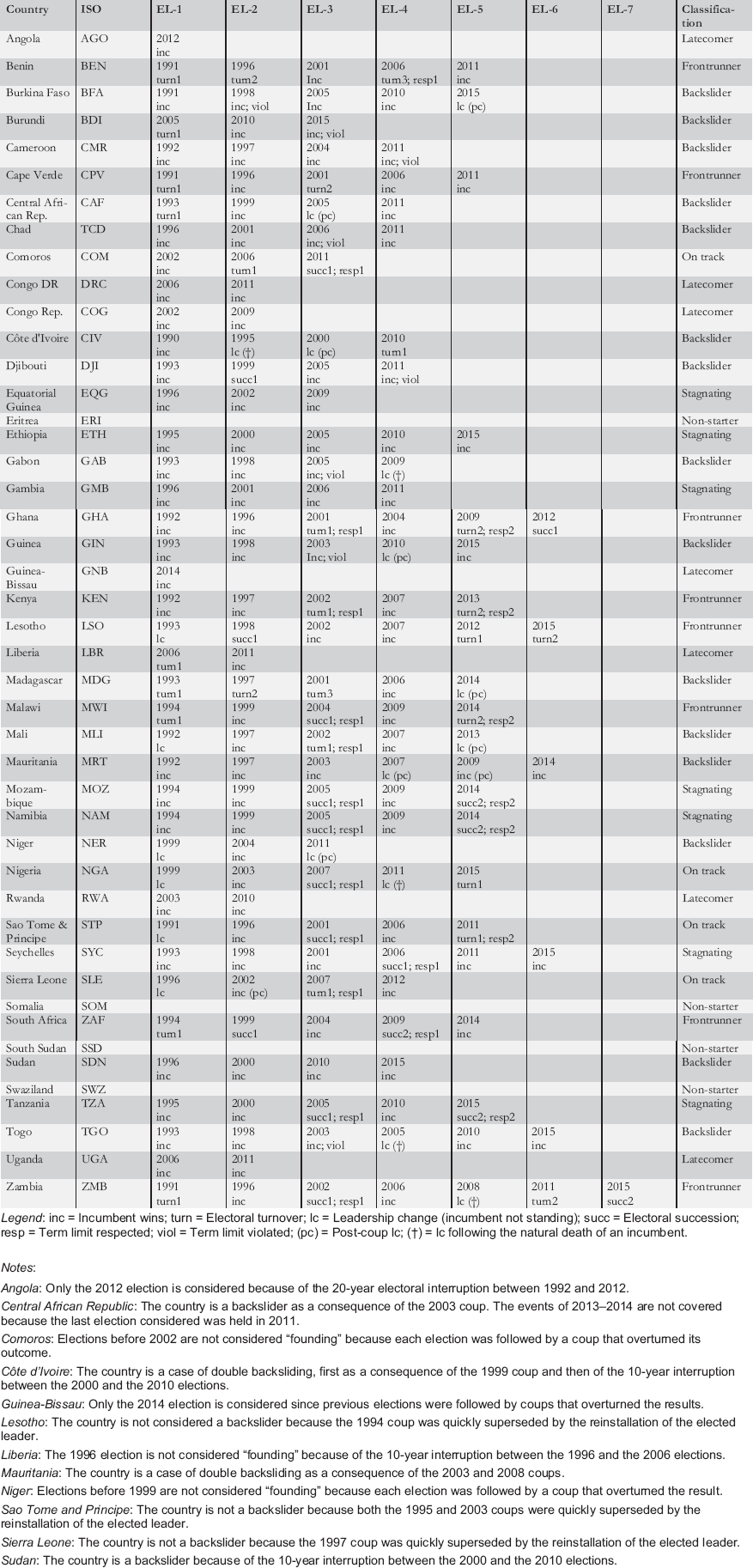
We have drawn our data from an original Africa Leadership Change dataset (Carbone and Pellegata 2016) and focused on the post-Cold War period, when the vast majority of sub-Saharan countries (re)introduced competitive elections. Thus, our sample excludes countries with longer traditions of elections, such as Botswana, Mauritius, Senegal, and Zimbabwe. Each country is observed since the year of its “founding election,” by which is meant the first of an uninterrupted series of at least two elections. Voting is minimally competitive when “opposition is allowed, multiple parties are legal, and more than one candidate is allowed on the ballot” (Hyde and Marinov 2011). We obtain a cross-section of 39 cases (plus six cases with either one or no elections), with variables recording what happened in each state at the time of its first, second, and subsequent elections, respectively. An appendix reports more detailed information for all our cases.
Based on the above criteria and data, we identify six clusters of countries: frontrunners, on track, stagnating, backsliders, latecomers, and non-starters. Rather than representing regime categories or levels of political freedom, these clusters capture third-wave African countries' various experiences with elections, as of 2015. The labels should be interpreted with specific reference to the comparative context of our descriptive analysis. They translate the recorded performances into different paths of democratisation through elections. For each cluster of countries, Figure 1 illustrates the existing configurations of election-related democratic steps. Each tile refers to the achievement of a specific democratising electoral outcome, as indicated by the vertical axis. As in a Tetris puzzle, however, the tiles do not necessarily match. We allow enough flexibility for countries belonging in the same cluster to display slightly different combinations, or stocks, of election-related achievements. Likewise, the same stage of democratisation through elections can be attained via different paths.
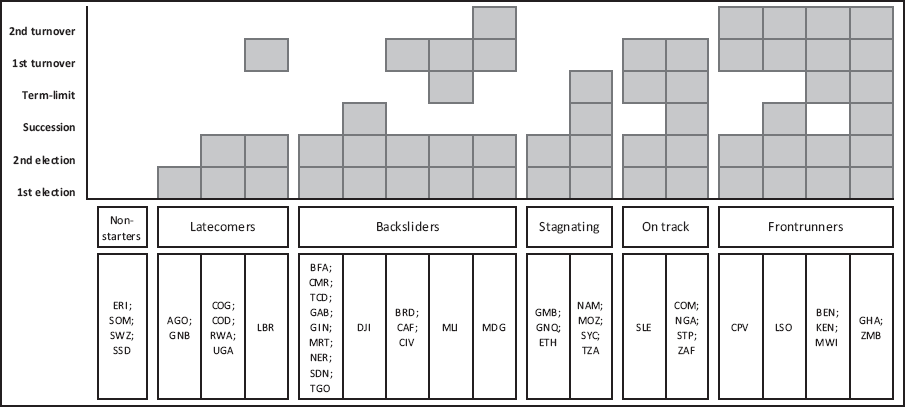
Election-Related Achievements in Sub-Saharan Africa, 1990–2015
We clarify this point in Figure 2, which plots the paths followed by five representative states. Cumulative scores (vertical axis) are assigned election after election (horizontal axis), as countries achieve one or more of the election-related democratising outcomes already singled out in Figure 1. Countries are given a first point when they hold founding elections, and another point is assigned if a second election is held in due time. Additional points are granted only in the case of leadership changes. Electoral intra-party successions yield one point. Alternation in power grants a two-point increase, but only the first two episodes are counted. These additional points can be assigned in correspondence to any election – first, second, and subsequent ones. Hence, a country can gain up to three points at the time of its founding election if the party or the dictator that had been in power until the transition ran but lost the election (for example, Madagascar in Figure 2). Because it always corresponds to an episode of leadership change, compliance with a term limit does not improve a country's score. Violations, on the contrary, lead to a one-point downward correction, as do cancellations or long postponements of elections (as was the case in Sudan between 2000 and 2010). Coups d'état cause any route to stop abruptly. If elections are restored, a country's sequence (and score-count) restarts from the beginning (for example, Madagascar in Figure 2). Short-lived coups that are quickly ended with the reinstallation of the elected incumbent are not considered (such as Lesotho in 1994).
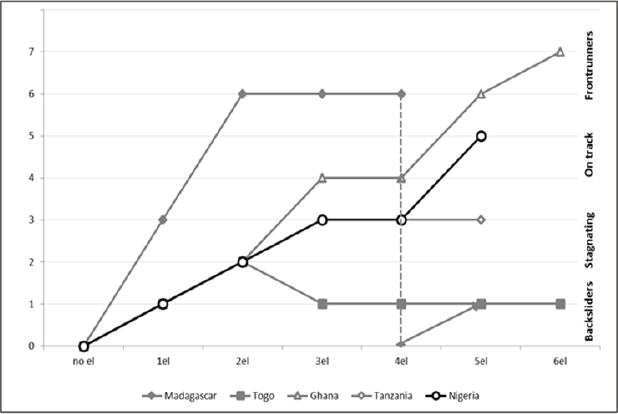
Pathways of Democratisation by Elections in Selected African Countries, 1990–2015
A first group of “non-starters” includes those few countries that have never employed multiparty elections in the post-1990 period. Cases like Eritrea remind us that there is no reason why a country should necessarily embark on processes of electoral opening up, even at times when all the others seem to be doing precisely that. “Latecomers” are those states that have only held two consecutive elections. It is difficult to evaluate their actual democratic advancement, even when these recent elections fulfil basic standards of freedom and fairness, as in the case of Liberia. We have also included countries such as Angola and Guinea-Bissau, which have recently held elections with the potential to become “founding.”
At the opposite extreme of Figure 1 is a modest but sizeable number of African “frontrunners.” Being a “frontrunner” simply indicates that a country has achieved more DEOs than other countries; it does not necessarily correspond to fuller democratisation or democratic consolidation. These countries have already gone through the main electoral steps of democratisation, including a double-turnover test. Figure 2 tracks the electoral path that Ghana has followed since its 1992 founding elections. Ghana had a timid debut with multiparty politics, with a presidential election that confirmed the former military dictator Jerry Rawlings in power, leading to an opposition boycott. But Ghana subsequently developed into an incubator of democracy in Africa, with a stable party system and two successful power handovers in less than a decade. Importantly, the first episode of alternation occurred in 2000, when John Kufuor defeated the ruling party candidate in an open-seat election, following Rawlings' decision to step down in compliance with the constitutional two-term limit. In line with the premises, other countries in this group remind us that, despite previous accomplishments, the electoral pathway towards democracy remains fraught with uncertainties. Kenya is possibly the most controversial case. Beyond the country's cumulative record of electoral achievements, including two episodes of turnover, the last two voting rounds – most notably the 2007–2008 one – were flawed, which complicates the prospects for fuller democratisation of the country.
Next is a small group of countries – including the Comoros, Sierra Leone, and Sao Tomé and Principe 2 – that appear comparatively “on track” in terms of democratisation by election in Africa. In these polities, elections are now routine, chief executives broadly comply with the rules of the game, and at least one episode of alternation in office has already occurred. Again, the cumulative record of past electoral achievements in this group should not be misinterpreted as evidence of democratic dynamism. South Africa experienced alternation in office at the time of its 1994 transition, and a first intra-party electoral succession due to Nelson Mandela's decision not to run for a second mandate in 1999. Despite this, democratisation in the country is arguably stalling, if not regressing, under the continued political dominance of the African National Congress.
As a semi-presidential system, the country has experienced several turnovers at the parliamentary level, as well as situations of divided government, with the prime minister and the president belonging to different parties.
The middle of Figure 1 represents a “grey zone” of democratisation by election, made up of two conceptually distinct clusters. One category comprises “stagnating” regimes. Some of these countries have stalled any electoral progress beyond the periodic reiteration of voting. For instance, the lack of restrictions on executive mandates or their delayed introduction has helped the respective ruling parties build hegemonies in Gambia and Equatorial Guinea. In other stagnating regimes, ruling elites have maintained their grip on power by winning up to four consecutive elections while also showing some respect for the rules – for instance, by favouring intra-party leadership successions when a term limit has been met. This is the case in Mozambique, Namibia, Tanzania, and the Seychelles.
The other category refers to African “backsliders,” which comprise by far the largest group in our sample. Among them are countries in which the institutionalisation of elections as the method for leadership selection has proved an ephemeral achievement. Togo, in Figure 2, is a typical case of a pseudo-democracy whose façade was openly revealed in 2002, when President Gnassingbé Eyadéma decided to have the constitution amended so that he could seek re-election once again. In roughly one-fifth of these cases, incumbents have removed, eluded or violated presidential term limits (see Appendix).
Burundi has recently joined the group, while the Republic of the Congo and Rwanda are likely to do the same in the near future. 3 These cases confirm that respect for even merely procedural prescriptions should not be taken for granted on a continent with a long tradition of “life presidencies.” Indirectly, they justify the importance that we assign to cases of compliance with the rules of the game. However, backsliding can occur in multiple ways and affect a rather heterogeneous array of countries. As mentioned above, being a frontrunner does not rule out the risk of reversal. Progress can grind to an abrupt halt even in countries with substantial experience of elections and alternation, as was the case in Madagascar following a 2009 coup d'état (Figure 2).
Paul Kagame of Rwanda had his country's term limit removed in 2015, but he has yet to run for his third mandate.
Backsliding and stagnation emerge as the most common patterns of (de-)democratisation by elections in Africa. It is difficult to say whether one is more harmful than the other for a country's prospects for democracy – that is, to determine whether removing term limits is better or worse than not introducing such constitutional provisions in the first place. A case-by-case assessment is critical. In general, neither backsliding nor stagnation are irreversible conditions. Madagascar was able to return to multiparty politics in 2014. Most importantly, prior to its latest election, Nigeria displayed many symptoms of a stagnating democratic path. As diverse as Tanzania and Nigeria are, until recently they both demonstrated one-party dominance in the context of some basic compliance with the rules of the game. Then 2015 came. John Magufuli was elected Tanzania's new president, which led to another succession at the helm of a state undisputedly controlled by the ruling Chama Cha Mapinduzi party. Buhari's opposition victory in Nigeria led the parallel trajectories of the two countries to part ways, as Figure 2 vividly depicts. The 2015 election crossroads marked a qualitative jump forward for Abuja, demonstrating that leadership change via multiparty elections was not only, or no longer, a theoretical possibility in Nigeria. With some delay, Nigeria appears to be following in the footsteps of countries such as Ghana.
Conclusions: Alternation in Power as Democratisation in Africa
We have examined the Nigerian case and the recent episode of executive turnover by framing them through a model of democratisation by elections, according to which democratic electoral progress can build decisively, albeit not exclusively or necessarily, on previous election-related achievements. The mere repetition of elections does not guarantee democratic progress. However, when a country successfully exploits the openings periodically created by a multiparty election – whether it is only to foster constitutional rule or electoral cycles, or to allow for intra-party leadership successions – it also lays the foundations for further democratic steps to be made in subsequent elections. We then set Nigeria in the broader comparative context of African third-wave countries' experience with multiparty elections. The analysis has highlighted both the merits and drawbacks of our focus on elections and election-related procedural achievements. With the limitations of this electoralist approach in mind, we have identified a plurality of divergent trajectories. Some of these paths appear more successful, or promising, than others. Virtually none proceeds in a linear way. The bad news is that in the vast majority of African countries democratisation is either stagnating or backsliding. The good news is that there is no unique or predetermined way to advance democracy. Nigeria has shown that positive political change remains possible even after years of apparent stagnation.
Our research adds to the lively debate on the democratising potential of elections. We start with the assumption that elections have different impacts on democratisation in different countries but do not aim to demonstrate how frequently elections advance democratisation; we try, more modestly, to illustrate how they can do it. Even more importantly, we explain an electoral outcome that would otherwise appear surprising, to a large extent. Electoral turnover in Nigeria's latest election did not come by chance, nor was it only the consequence of circumstances contingent on the phase the country was going through at the time of voting. Instead, it should be interpreted in light of the country's electoral record. In Nigeria, previous electoral rounds proved fundamental to instilling respect for term limits, to experiencing presidential successions, to improving electoral administration, and to gaining familiarity with the game of ballot-box competition.
The critical remaining question is what lies ahead for Nigeria. The country's first-ever constitutional transfer of power to the opposition, following the electoral defeat of an incumbent president, is an unquestionable achievement and sets a precedent whose significance can hardly be underestimated. Its import should also be evaluated in light of the relative rarity of similar events in the region. While the reforms of the 1990s engendered a huge rise in multiparty polls, electoral turnovers have only occurred in a minority of no more than 18 countries. In most of these cases, moreover, opposition leaders were able to win office only under the fluidity of founding elections. Nevertheless, it would be naïve to consider the outcome of the latest election as a verdict of successful democratisation.
We do not know whether Nigeria will be able to remain “on track” and consolidate its recent democratic gains. Several African states have shown that backsliding is a concrete possibility, even after years of genuinely democratic experience. Whatever the democratic advancement that Nigeria may have reached, it certainly does not rest on solid ground. Endemic communal tensions, political instability in the north, the fiscal woes caused by the oil price fall, corrupt and poorly accountable state governments (Albin-Lackey 2012), and the cohesion of the new ruling party are only a few of the challenges that the country faces. However, similarly to other democratising electoral outcomes, executive turnover is not only evidence of democratic progress but also a potential driver of further achievements. The replacement of an underperforming government at the polls can renew democratic legitimacy (Bratton 2004). Alternation in power can also have a positive moderating effect on citizens' perceptions of the stakes of political competition (Moehler and Lindberg 2009). More concretely, democratic progress can help a country like Nigeria overcome several of its current political and socio-economic challenges – such as corruption (Kolstad and Wiig 2016), growth (Carbone et al. 2016), and human development (Kudamatsu 2012; Harding and Stasavage 2014) – even if democratisation remains incomplete and fragile (Cassani and Carbone 2016). This could trigger a virtuous cycle.
Finally, some potentially favourable conditions for further democratic development are present in Nigeria, including its emerging party system. Holding APC-like multiregional alliances together will be difficult. However, the fact that the APC is politically, socially, and organisationally rooted in the parties that have merged into it implies that electoral competition in 2015 somehow rested on established patterns. The Nigerian party system is not a typical inchoate system, prone to electoral volatility and uncertainty, suffering from the weak organisation, authority and social linkages of its component parties. Although the two main parties are primarily rooted in distinct areas of the country, both are broadly “national” in scope. These factors may dissuade the new government from seeking illicit advantages to remain in power – for instance, by manipulating ethno-regional qualms (Mainwaring and Torcal 2006; Wahman 2012). Political developments will not go smoothly in Nigeria, but the establishment of democracy is seldom a linear process. Even in the history of Western Europe, setbacks and failures were integral parts of long-term progress (Berman 2007: 38–39). The 2015 election lifted Nigeria out of the marshes of democratic stagnation and marked the zenith of its entire democratic history. With all the necessary caveats, Abuja made a remarkable jump forward, although where exactly the country will land will remain uncertain for quite some time to come.
Footnotes
Appendix
| Country | ISO | EL-1 | EL-2 | EL-3 | EL-4 | EL-5 | EL-6 | EL-7 | Classification |
|---|---|---|---|---|---|---|---|---|---|
| Angola | AGO | 2012 inc | Latecomer | ||||||
| Benin | BEN | 1991 turn1 | 1996 turn2 | 2001 Inc | 2006 turn3; resp1 | 2011 inc | Frontrunner | ||
| Burkina Faso | BFA | 1991 inc | 1998 inc; viol | 2005 Inc | 2010 inc | 2015 lc (pc) | Backslider | ||
| Burundi | BDI | 2005 turn1 | 2010 inc | 2015 inc; viol | Backslider | ||||
| Cameroon | CMR | 1992 inc | 1997 inc | 2004 inc | 2011 inc; viol | Backslider | |||
| Cape Verde | CPV | 1991 turn1 | 1996 inc | 2001 turn2 | 2006 inc | 2011 inc | Frontrunner | ||
| Central African Rep. | CAF | 1993 turn1 | 1999 inc | 2005 lc (pc) | 2011 inc | Backslider | |||
| Chad | TCD | 1996 inc | 2001 inc | 2006 inc | 2011 inc; viol | Backslider | |||
| Comoros | COM | 2002 inc | 2006 turn1 | 2011 succ1; resp1 | On track | ||||
| Congo DR | DRC | 2006 inc | 2011 inc | Latecomer | |||||
| Congo Rep. | COG | 2002 inc | 2009 inc | Latecomer | |||||
| Côtc d'Ivoire | CIV | 1990 inc | 1995 lc (†) | 2000 lc (pc) | 2010 turn1 | Backslider | |||
| Djibouti | DJI | 1993 inc | 1999 succ1 | 2005 inc | 2011 inc; viol | Backslider | |||
| Equatorial Guinea | EQG | 1996 inc | 2002 inc | 2009 inc | Stagnating | ||||
| Eritrea | ERI | Non-starter | |||||||
| Ethiopia | ETH | 1995 inc | 2000 inc | 2005 inc | 2010 inc | 2015 inc | Stagnating | ||
| Gabon | GAB | 1993 inc | 1998 inc | 2005 inc; viol | 2009 lc (†) | Backslider | |||
| Gambia | GMB | 1996 inc | 2001 inc | 2006 inc | 2011 inc | Stagnating | |||
| Ghana | GHA | 1992 inc | 1996 inc | 2001 turn1; resp1 | 2004 inc | 2009 turn2; resp2 | 2012 succ1 | Frontrunner | |
| Guinea | GIN | 1993 inc | 1998 inc | 2003 Inc; viol | 2010 lc (pc) | 2015 inc | Backslider | ||
| Guinea-Bissau | GNB | 2014 inc | Latecomer | ||||||
| Kenya | KEN | 1992 inc | 1997 inc | 2002 turn1; resp1 | 2007 inc | 2013 turn2; resp2 | Frontrunner | ||
| Lesotho | LSO | 1993 lc | 1998 succ1 | 2002 inc | 2007 inc | 2012 turn1 | 2015 turn2 | Frontrunner | |
| Liberia | LBR | 2006 turn1 | 2011 inc | Latecomer | |||||
| Madagascar | MDG | 1993 turn1 | 1997 turn2 | 2001 turn3 | 2006 inc | 2014 lc (pc) | Backslider | ||
| Malawi | MWI | 1994 turn1 | 1999 inc | 2004 succ1; resp1 | 2009 inc | 2014 turn2; resp2 | Frontrunner | ||
| Mali | MLI | 1992 lc | 1997 inc | 2002 turn1; resp1 | 2007 inc | 2013 lc (pc) | Backslider | ||
| Mauritania | MRT | 1992 inc | 1997 inc | 2003 inc | 2007 lc (pc) | 2009 inc (pc) | 2014 inc | Backslider | |
| Mozambique | MOZ | 1994 inc | 1999 inc | 2005 succ1; resp1 | 2009 inc | 2014 succ2; resp2 | Stagnating | ||
| Namibia | NAM | 1994 inc | 1999 inc | 2005 succ1; resp1 | 2009 inc | 2014 succ2; resp2 | Stagnating | ||
| Niger | NER | 1999 lc | 2004 inc | 2011 lc (pc) | Backslider | ||||
| Nigeria | NGA | 1999 lc | 2003 inc | 2007 succ1; resp1 | 2011 lc (†) | 2015 turn1 | On track | ||
| Rwanda | RWA | 2003 inc | 2010 inc | Latecomer | |||||
| Sao Tome & Principe | STP | 1991 lc | 1996 inc | 2001 succ1; resp1 | 2006 inc | 2011 turn1; resp2 | On track | ||
| Seychelles | SYC | 1993 inc | 1998 inc | 2001 inc | 2006 succ1; resp1 | 2011 inc | 2015 inc | Stagnating | |
| Sierra Leone | SLE | 1996 lc | 2002 inc (pc) | 2007 turn1; resp1 | 2012 inc | On track | |||
| Somalia | SOM | Non-starter | |||||||
| South Africa | ZAF | 1994 turn1 | 1999 succ1 | 2004 inc | 2009 succ2; resp1 | 2014 inc | Frontrunner | ||
| South Sudan | SSD | Non-starter | |||||||
| Sudan | SDN | 1996 inc | 2000 inc | 2010 inc | 2015 inc | Backslider | |||
| Swaziland | SWZ | Non-starter | |||||||
| Tanzania | TZA | 1995 inc | 2000 inc | 2005 succ1; resp1 | 2010 inc | 2015 succ2; resp2 | Stagnating | ||
| Togo | TGO | 1993 inc | 1998 inc | 2003 inc; viol | 2005 lc (†) | 2010 inc | 2015 inc | Backslider | |
| Uganda | UGA | 2006 inc | 2011 inc | Latecomer | |||||
| Zambia | ZMB | 1991 turn1 | 1996 inc | 2002 succ1; resp1 | 2006 inc | 2008 lc (†) | 2011 turn2 | 2015 succ2 | Frontrunner |
Legend: inc = Incumbent wins; turn = Electoral turnover; lc = Leadership change (incumbent not standing); succ = Electoral succession; resp = Term limit respected; viol = Term limit violated; (pc) = Post-coup lc; (†) = lc following the natural death of an incumbent.
Notes:
Angola: Only the 2012 election is considered because of the 20-year electoral interruption between 1992 and 2012.
Central African Republic: The country is a backslider as a consequence of the 2003 coup. The events of 2013–2014 are not covered because the last election considered was held in 2011.
Comoros: Elections before 2002 are not considered “founding” because each election was followed by a coup that overturned its outcome.
Côte d'Ivoire: The country is a case of double backsliding, first as a consequence of the 1999 coup and then of the 10-year interruption between the 2000 and the 2010 elections.
Guinea-Bissau: Only the 2014 election is considered since previous elections were followed by coups that overturned the results.
Lesotho: The country is not considered a backslider because the 1994 coup was quickly superseded by the reinstallation of the elected leader.
Liberia: The 1996 election is not considered “founding” because of the 10-year interruption between the 1996 and the 2006 elections.
Mauritania: The country is a case of double backsliding as a consequence of the 2003 and 2008 coups.
Niger: Elections before 1999 are not considered “founding” because each election was followed by a coup that overturned the result.
Sao Tome and Principe: The country is not a backslider because both the 1995 and 2003 coups were quickly superseded by the reinstallation of the elected leader.
Sierra Leone: The country is not a backslider because the 1997 coup was quickly superseded by the reinstallation of the elected leader.
Sudan: The country is a backslider because of the 10-year interruption between the 2000 and the 2010 elections.