



Abstract
In Africa, a seemingly growing number of attempts by presidents to overcome or abrogate term limits, or make them otherwise ineffective, has ignited a debate about the significance of constitutional engineering, and its implications for the rule of law, democracy, and the nature of politics in general. In light of recent instances of “third-term bids,” we revisit the hypothesis about the institutionalisation of power in Africa and challenge the assumption that, over the past two decades, African politics have experienced a fundamental change away from “big man” rule towards the rule of law. Based on a comprehensive stocktaking of the state of play of term limits and third-term bids, we analyse broader trends and outcomes of legal and constitutional engineering. We argue that an analysis focusing exclusively on formal institutions and procedures misrepresents the extent of political change by ignoring power and authority in many African countries. While the growing salience of formal institutions is undeniable, we suggest that they matter more as a legitimisation of the power of political leaders than as a constraint to it.
In August 2015 Pierre Nkurunziza was again sworn in as president of Burundi. His successful attempt to secure a contested third term has plunged the country into a severe crisis, in which so far approximately 500 people have been killed and more than 280,000 forced to flee. Only months later, in December 2015, a constitutional referendum allowed Paul Kagame in neighbouring Rwanda to seek another term in order to continue his rule as president beyond the end of his second term in 2017. In April 2016 Congo-Brazzaville's president Denis Sassou-Nguesso was re-elected amidst violent protests over a constitutional amendment that had abolished both term limits and the age restriction for the president. Since 2015, tensions in the Democratic Republic of the Congo (DRC) have grown, as President Joseph Kabila, in the opinion of many, has been manoeuvring to secure a prolongation of his rule in the face of term limits.
These and other events mirror a fundamental controversy that has recently reverberated across sub-Saharan Africa – namely, how often presidential incumbents can be candidates to their own succession. 1 The controversy over “third-term bids,” attempts by rulers to stay in power beyond the constitutionally prescribed maximum number of terms, matters. Politically, there is a perception that a growing number of African incumbent presidents seek to extend their rule via varieties of constitutional engineering to circumvent or abrogate term limits. This runs counter to the 1990s, when Africa's democratising political systems embraced presidential term limits as an antidote to the often calamitous long-term presidencies of autocratic rulers. For example, in Benin, the country that led Africa's third wave of democratisation, the post-authoritarian constitution of 1990 introduced term limits after the demise of long-term ruler Mathieu Kérékou, who had been in power since 1972. The preamble of the new constitution alluded to the country's past by stressing the people's “fundamental opposition” to “dictatorship,” the “confiscation of power,” and “personal power” (constituteproject.org n.d. a). Some countries, such as the DRC, went even further by enshrining term limits in their constitutions in perpetuity to guard against long-term personal rule (constituteproject.org n.d. b). The rejection of personal rule and the support for term limits is perceptible at the level of public opinion. A recent survey across 34 African countries found that 73 per cent of citizens favour term limits (Dulani 2015), perhaps partly because elections offer only slim chances to oust incumbents, making term limits all the more relevant (Bogaards 2013; Maltz 2007).
Two caveats: We consider only sub-Saharan Africa, thereby excluding Algeria, Morocco, Tunisia, Libya, and Egypt. Our analysis is limited to presidential systems.
Analytically, the term-limit debate can serve as a window into a much larger question concerning the institutionalisation of political power – that is, the extent to which government is restrained by formal institutions, including laws and constitutional norms. It overlaps with and is a key element of the rule of law to the extent that the state is subordinated to law (Versteeg and Ginsburg 2017; Møller and Skaaning 2014; VonDoepp 2005: 37–39). Compliance with the extant legal regime, including the constitution, is a major test case of institutionalisation.
Term limits are a particularly relevant indicator in this respect. Not only are they constitutional norms and thus a key part of the legal regime, but their aim – limiting the duration of office for a president – goes to the very core of political power. Therefore the apparent frequency of “third-term bids” raises doubts about the extent of institutionalisation of political power in Africa. If the constitutional engineering that takes place is essentially reflecting the political will and power of the executive, the efficacy of the separation of powers and the ability of other institutional mechanisms meant to circumscribe executive power to actually do so can reasonably be thrown into doubt. By analysing third-term politics, we are interested in the actual exercise of power and the question of what one particular politically salient phenomenon – term limits and third-term bids – reveals about incumbency politics and power in present-day Africa and the extent to which they are restrained by institutions. 2
For an interesting early take on the role of former incumbents in national politics in the broader context of democratisation and term-limit politics, see Southall and Melber (2006).
The article is organised as follows: First, we briefly sketch the debate about political institutionalisation. In the second section, we provide a comprehensive stocktaking of the state of play of term limits and third-term bids across sub-Saharan Africa, categorising all instances (cases) from 1990 to 2016 in which rulers approached the end of their second term, thus facing the choice between leaving office (term-limit compliance) and seeking an extension of power via term-limit circumvention. The third section offers a typology of three pathways that these incumbents use to evade term limits. In the fourth section, we explore possible factors that induce autocratic incumbents to formally respect term limits (rather than simply flouting the respective constitution). The fifth section analyses the relationship between term-limit compliance and the democratic quality of regimes. Finding that term-limit violators are almost always autocrats, we offer a cost–benefit analysis that seeks to explain why they seek to formally comply with term limits, when the substance of their action is to circumvent them. We conclude that the institutionalisation of power is broadly limited to democratic states. The example of term limits suggests that sub-Saharan autocrats are resilient and skilful in manipulating formal institutions to entrench and legitimise their power. 3
The authors would like to thank Andrea Sperk for her research assistance and the reviewers for their constructive suggestions. We also thank Pierre Englebert for his feedback on previous versions of this paper and for his generous help with the statistical analysis.
Term Limits and the Institutionalisation of Power Hypothesis
The spreading of political liberalisation across Africa since the early 1990s has in many countries proven conducive to the flourishing of formal institutions of political life, and sometimes even to the rule of law (Cabanis and Martin 1999). In a pioneering article, Posner and Young (2007) described this process as the “institutionalisation of power.” The term serves to describe a shift away from the clientelistic, opaque decision-making of “big men” rulers in Africa's presidentialist, neo-patrimonial systems. In such systems formal political institutions were insignificant, as rulers had the discretionary power to ignore or override formal institutions and laws, turning government into a highly personalised exercise, guided by the interests and whims of the ruler and his entourage. Posner and Young argue that significant political changes since 1990 have subjected African rulers to more constraining formal institutions such as competitive elections, judicial institutions, constitutions, laws, and regulations than they faced in the past, in terms of both politics and policymaking.
The most obvious manifestation of the institutionalisation of power is the way in which political leaders come into office or leave power. The spread of multiparty elections in Africa indicates that political elites by and large accept the necessity to periodically acquire political legitimacy through the ballot box. The larger point is that politics is progressively regulated through formal norms and procedures. Posner and Young show that formal rules have replaced violence and other extraconstitutional means as the most important way of coming to, staying in, and leaving power. In their study of 46 African countries, they find that between the independence era of the early 1960s and 2005, the number of presidents that left power through unconstitutional means (coup, violent overthrow, assassination) decreased over time. By the 1990s, these cases had become a minority. Between 2000 and 2005, more than 80 per cent of African leaders left power through natural death, resignation, or electoral defeat (Posner and Young 2007: 128–130). This trend, they argue, is best explained by the fact that leaders are more constrained by formal rules, driving them to accept electoral defeats even when they prefer to stay in power (Posner and Young 2007: 137). Posner and Young also show that those incumbents bent on extending their rule did not choose to violate constitutional rule; instead, they changed or circumvented constitutions. Posner and Young interpret this as evidence of a substantial change in African politics, away from arbitrary rule and towards formal constraints on executives (Posner and Young 2007: 138).
This proposition has been contested. While many observers concede that formal rules and institutions in Africa have become more important over time, considerable scepticism persists as to the scope and extent of the transformation (Akech 2011; Lynch and Crawford 2011: 283–285; Joseph 2014; Nwosu 2012). For most researchers, politics in Africa remains characterised by the coexistence of informal and formal institutions: “big men politics” on the one hand and some progress towards more rule-bound politics on the other, although the former is often assumed to dominate the latter. 4 The tension between the two is put into relief by studies that explicitly address the rule of law (Fombad 2016; Stroh and Heyl 2015).
Among a vast body of relevant literature, see, for example, Diamond (2008); Bates et al. (2012); Englebert and Dunn (2013); Cheeseman (2015). See also Englebert (2009); Prempeh (2008); Albaugh (2011); Piccolino (2014); and Van Cranenburgh (2008), as well as the contributions in Bach and Gazibou (2012), especially those by Gazibou and Van de Walle.
In the following section, we examine the empirical record of term-limit compliance or subversion in Africa since 1990.
Taking Stock: Presidential Term Limits and Constitutional Change
By considering all formal democracies in the period between 1990 and 2016, we have identified a total of 39 instances of an incumbent president reaching the end of his last – usually second – constitutionally permitted term. 5 He (all were men) had then to decide whether to step down in conformity with the constitution or find another way to stay in power. 6
Our sample consists of all formal democracies. We exclude Eritrea, as its constitution, including the regulation of term limits, has not been implemented since its ratification in 1997; Mauritius, as its president is only ceremonial; Comoros, because it has a rotating presidency; and Ethiopia, which has term limits, but where de facto power sits with the prime minister. The Gambia, Guinea-Bissau, Lesotho, South Sudan, and Somalia do not have constitutionally fixed term limits.
The same country and even the same president can count as more than one case, such as Compaoré in Burkina Faso, who tried twice to overstay his terms (successfully in 1997, unsuccessfully in 2014) or Namibia's Nujoma, who rewrote the constitution in 1999 but stepped down in 2004. However, we count Burundi's president Nkurunziza's recent third-term bid as a single case, although he undertook two distinct attempts to force it: first in 2014 and then in 2015.
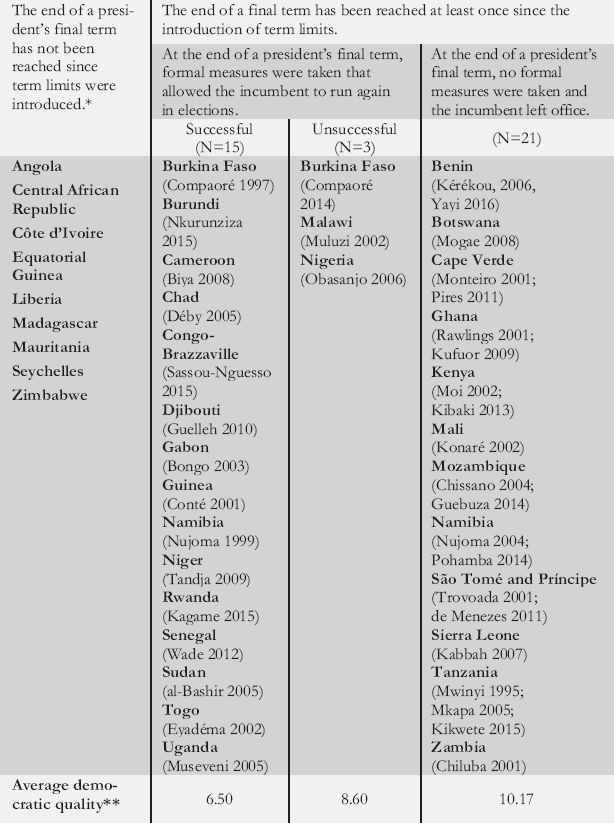
Figure 1 contains the 39 cases in which an incumbent reached the end of his last term. It also contains the nine countries where the constitution stipulates term limits but where these have yet to be reached by an incumbent (left column).
Sub-Saharan African Countries with Term Limits
We classified the 39 cases in three groupings. Our criterion is whether in any given case in which an incumbent reached the end of his final term, formal measures were taken to allow for a prolongation of rule. By formal measures we mean the submission of a constitutional amendment or an entirely new constitution for approval by competent institutions (parliament, senate) or mechanism (referendum). By resorting to this formalistic approach, which has the advantage of permitting objective coding, we exclude cases that were not clear cut – for example, Benin under President Boni Yayi, as the incumbent did not take formal measures to evade term limits, although the public seemed to be convinced that he was keen to launch a third-term bid.
We do not assess whether constitutional engineering was deliberately undertaken in order to permit a president to extend his rule. In some cases, amendments allowed for the prolongation of rule without touching term limits. This was the case, for example, in Senegal in 2012 and Sudan in 2005. Arguably, the Sudanese constitution that came into effect after the secession of South Sudan was not primarily introduced to allow incumbent President al-Bashir a prolongation of his rule. However, it had the same effect, as it permitted a “reset” of his tenure. Our definition of formal measures includes cases in which incumbents have filed an official appeal with a constitutional court to examine their eligibility for a third term, a legal prerequisite for the incumbent to run again. This included Burundi and Senegal, where it was contested whether a previous mandate by the incumbent counted as a term or not, which could have barred him from running again. When one or more formal measures permitted the incumbent to do so, we code the case as successful in circumventing term limits. Cases in which formal measures were submitted but failed to find approval through competent political or judicial institutions are defined as unsuccessful. If one institution opposed the bid for a third term but another endorsed it (e.g. in Burundi, where parliament rejected a constitutional revision but the constitutional court declared President Nkurunziza eligible anyway), we consider the case as successful. 7
This makes for a somewhat different coding than the one that Posner and Young (2007) used. For example, we do not code Zambia (2001) as an unsuccessful attempt. Although President Chiluba arguably planned to amend the constitution to allow himself a third term, he never officially submitted an amendment. Also in contrast to Posner and Young, we consider Niger (2009) a successful case, as President Tandja not only held (and won) a referendum, but had the referendum legalised against all odds by an (arguably puppet) constitutional court.
The first observation is that only in just over half of all cases (21 out of 39) did a president choose to step down after his final term without attempting to rewrite or reinterpret the constitution (right column, Figure 1). In other words, nearly every second incumbent in Africa is not prepared to respect his country's constitutional term limits. The fact that this proportion has not changed since 2005 (Posner and Young 2007: 137) indicates that the institutionalisation of power has made little or no progress over the past decade. 8
Dividing the past 15 years into five-year periods, we find that the share of third-term violators hovers between 40% and 44%.
Moreover, the vast majority of these attempts (15 out of 18) were successful. This hints at a substantial incumbent advantage in managing and controlling the process of circumvention. It suggests that obstacles to amending constitutions are relatively easy to surmount, whereas the costs of political-legal engineering are low compared with the envisioned return. Also noteworthy is the fact that every single incumbent who was successful in circumventing or modifying constitutional term-limit provisions also won the subsequent polls (bar one: Senegal's Wade). 9 In other words, electoral victory is virtually guaranteed once an incumbent has overcome constitutional obstacles to his candidature. Favourable outcomes of third-term elections might be explained by the incumbency advantage (including both fair and unfair means to run elections) or the fact that voters might put more trust in incumbents than in the opposition despite their support for term limits (Grömping and Martínez i Coma 2015; Bishop and Hoeffler 2014; Logan 2008).
Niger is an exception, as elections had not taken place before President Tandja was ousted by a coup in February 2010.
Overall these observations suggest that sitting presidents, if they decide they want to stay in power, can be confident that they will meet their objective. This concerns both the move to change or otherwise circumvent the constitution and a successful re-election.
Interestingly, the 21 instances where term-limit compliance was observed are distributed across just 12 countries. If we narrow our focus to the countries where term limits have been respected at least twice (a sign of the consolidation of the norm), a group of eight countries remains, with a combined number of 16 cases of compliance among them. Consequently, if term-limit provisions have become a broadly continental phenomenon, with 38 African countries having them included in their constitutions at some point since the 1990s, the effectiveness of the norm is limited across the region. A second observation is that in all cases where presidents sought to extend their power, they circumvented term limits by resorting to legal mechanisms and procedures. We have recorded 15 cases in which the circumvention of term limits was successful.
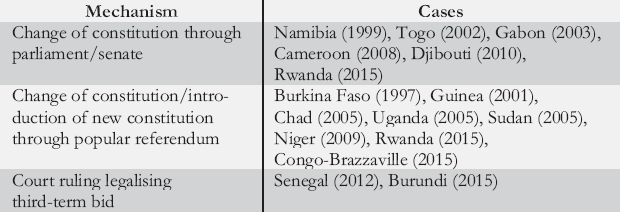
In two cases (Senegal 2012, Burundi 2015), incumbents exploited legal ambiguities and constitutional loopholes – that is, third-term eligibility was “legalised” through the decision of a constitutional court (see Vandeginste 2015, 2016). In both cases, this followed parliament voting against a constitutional amendment. Though in the case of Burundi the court decision was in no small part a result of political pressure, it underscored the desire of President Nkurunziza to remain within the boundaries of law.
In the remaining 13 cases, constitutional amendments were validated by lower and/or upper houses of parliaments, popular referendum, or both. In five of those cases the constitution was changed through a parliamentary and/or senate vote, and in seven of the cases the constitution was changed or a new constitution introduced through a popular referendum. In Rwanda, the constitution was changed through votes of both parliament and senate and subsequently endorsed by referendum (see below). The 2009 third-term bid of President Tandja of Niger is an especially contested case where a referendum was used, given that it was held amid a state of emergency, a dissolved parliament, and an opposition boycott. Even so, it is striking that Tandja made efforts to remain within formal rules, though of course these were radically changed in his favour.
The fact that all presidents manoeuvred within formal rules rather than acting through extraconstitutional means supports the proposition by Posner and Young that constitutions and institutional frameworks have gained significance compared to the pre-1990 period when unconstitutional tactics were common. 10 Apparently, present-day rulers have a keen interest in being perceived as complying with rules and laws.
This is not to say that presidents did not resort to altogether questionable means as a complementary strategy. In many cases, demonstrations were brutally suppressed, opposition politicians killed, etc.
Figure 1 also indicates that Francophone countries are far more likely to witness third-term bids than the rest of Africa. Among the 21 presidents who arrived at the end of their second mandate and did not try to change the constitution, only three hail from Francophone Africa: Kérékou and Yayi (Benin, 2006 and 2016) and Konaré (Mali, 2002). While the proneness of Francophone countries to abrogate term limits is difficult to explain, it is tempting to assume that it may be linked to the particular nature of the political system inherited from colonial rule, especially a particular brand of presidentialism. Perhaps as a flipside to the Francophone and largely West and Central African bias just discussed, it seems remarkable that half of all compliant cases are situated in East Africa (Kenya, Tanzania) and Southern Africa (Botswana, Mozambique, Namibia).
A second obvious proposition emerging from the cases is the power of political precedent in shaping the decisions of incumbent presidents. As already noted by Posner and Young, not a single incumbent has tried to change the constitution if a precedent of term-limit compliance had been set in his country (Posner and Young 2016: 13). The outstanding example is Tanzania, where two presidents (Benjamin Mkapa in 2005 and Jakaya Kikwete in 2015) have stepped down at the end of their second terms, following the example set by President Ali Mwinyi in 1995. The fact that Mwinyi's predecessor, Julius Nyerere, had also relinquished power – though unrestrained by term limits, but as one of the few African leaders to step down before the 1990s – may be part of a wider story that underlines the potential influence of precedent in terms of norm setting and socialisation. These cases are the clearest evidence of effectively restraining term limits.
We conclude that term-limit compliance is a phenomenon that divides the universe of African cases into two parts: roughly half of all leaders who arrive at the end of their second term step down in conformity with the constitution, whereas the second half sets out to circumvent term limits, most often successfully. The fact that presidents almost always win the subsequent elections could, if nothing else, testify to the power of incumbency that term limits seek to minimise. In other words, the ease with which presidents manage to extend their duration in office underscores the main argument in favour of term limits – namely, incumbents' overwhelming advantages at the polls. 11 Without term limits, they manage to stay in power by virtue of controlling institutions and electoral outcomes.
Unfortunately, we are not able to determine whether elections in these cases were free and fair. Relevant databases often show considerable gaps in regard to African cases.
Thus, term-limit compliance since 1990 certainly marks important progress compared to the pre-1990 period. But the empirical record does not suggest that formal institutions have displaced informal ones and that these formal institutions effectively restrain the power of incumbent rulers. The evidence that every second president is not prepared to respect the constitution and does manage to circumvent term limits clearly exposes the vulnerability and limited effectiveness of constitutional norms. What is more, this has not improved over the past decade. It could be argued that formal rules of power extension apply more than before but not in a restrictive way. This is the case despite the fact that legal engineering provides a formal façade.
Leadership Duration despite Term Limits
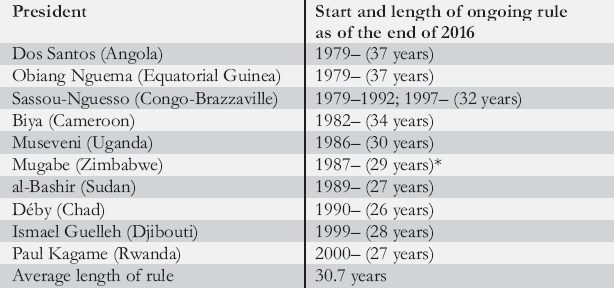
At the time of writing (2016), the presidents of Equatorial Guinea, Angola, and Congo-Brazzaville had been in power since 1979; the former two have ruled their country continuously for the past 37 years, while Sassou-Nguesso's rule in Congo-Brazzaville was briefly interrupted between 1992 and 1997. Cameroon has not changed its president for 34 years. Uganda's president has been in office for 30 years, and Zimbabwe has had the same head of state for 29 years. Sudan's president has been in power for the past 27 years, his counterpart in neighbouring Chad for 26 years, and the Djiboutian president for 17 years. Rwanda's president has been in power since 2000 and will theoretically be able to rule the country until 2034, which would amount to 31 years of uninterrupted presidential tenure. Burundi will have had the same president for 15 years in 2020 if the incumbent Nkurunziza reaches the end of his current term. 12
President Blaise Compaoré ruled Burkina Faso for 27 years, until a political crisis led to his downfall in 2014.
These countries present something of a puzzle. On the one hand, they are ruled by some of the longest-serving presidents worldwide. Africa's ten longest-serving presidents have been in power for an average of 30.7 years (Figure 3). And yet all of them have introduced term limits at some point in time since the early 1990s. 13 These cases illustrate a tension between the continent-wide spread of constitutionally enshrined term limits throughout the 1990s and their apparently limited impact. We observe a coexistence between de facto personal rule and a formal rule meant to depersonalise (thus formally institutionalise) political rule. The depersonalisation of term limits has two dimensions: Concerning its application, the norm is depersonalised in the sense that it should be applied universally, to all individuals. In terms of substance, the norm seeks depersonalisation as it aims to separate rule from ruler: no single individual should be allowed to rule for more than a fixed number of years. As a result, there is a wide gap between the constitutionally prescribed maximum number of terms and the political reality, reflected by remarkable leadership duration. How is this possible?
In most countries, presidential terms last either five or seven years.
How Incumbents Circumvent Term Limits
Long-Term Presidents despite Term Limits as of 2016
To address this question, we have categorised the cases into three groups. First, there are cases where term limits were scrapped the very moment they would have forced the incumbent to resign. This was the case in Djibouti, Cameroon, Chad, Uganda, Guinea, Gabon, Togo, and Niger. In all of these countries, term limits were introduced in the early or mid-1990s before they were scrapped between 2005 and 2010. Take the example of Chad's president, Idriss Déby. Following his successful coup d'état in 1990 and a transitional period lasting six years, Chad's new constitution was adopted through a referendum in 1996, which prescribed a limit of two presidential terms (five years each). Déby was re-elected in 2001. In light of rising domestic and international concerns over the questionable circumstances under which these elections were held, Déby sought to appease the concerned parties by promising to respect the constitution: to not seek a third term in 2006. In 2005, however, the increasingly repressive government called a referendum that endorsed the removal of presidential term limits, enabling Déby to be re-elected in 2006 and again in 2011 by a wide margin and amid boycotts by opposition parties. During the 2016 presidential elections, Déby won a lopsided first-round victory, handing him a fifth consecutive term in office. By the end of the current mandate, Déby will have been in power for 31 years.
Second, in some cases incumbents managed to prevent term limits being applied to them. In Angola, Equatorial Guinea, and Zimbabwe, term limits were only introduced in 2010, 2011, and 2013, respectively, a point in time when the presidents of these countries – Dos Santos (1979–), Mugabe (1987–), and Obiang Nguema (1979–) – had already been in power for more than two decades. Since newly introduced term limits were not applied retroactively, these presidents may have potentially many years in office ahead of them. In Equatorial Guinea, a limit of two seven-year terms was introduced, only two years after President Obiang's re-election (2009). This enabled him to serve out his term before the new term-limit rule could apply, beginning with the mandate in the wake of the 2016 elections. Hence, Obiang is currently serving the first (2016–2023) of two possible terms and can stand again in 2023, in which case a re-election until 2030 would mean that he has served for 41 years. 14 In Sudan, term limits were introduced in 2005 with the adoption of a new constitution after the secession of South Sudan. Due to a five-year transitional period, President al-Bashir only officially ran in the 2010 elections. He could thus run again in 2015, although he has already been in power since 1993. President Compaoré of Burkina Faso is a more complex, but similar example: Compaoré took power in a coup in 1987. After having been scrapped in 1997, term limits were reintroduced in 2000 due to internal and external pressure. On the same occasion, presidential terms were reduced from seven to five years. Compaoré, who had won the 1998 elections, thus finished his seven-year term, as the new legislation did not apply retroactively. This enabled him to win elections in 2005 and 2010. The recent decision by Burundi's constitutional court to allow Nkurunziza to run for another term in 2015 represents yet another variety of term limits that are written down in law but do not play out in the political reality. Nkurunziza had been ruling the country for ten years. Constitutionally speaking, however, he had served only one five-year term, considering that for the first term he was not elected by universal suffrage but by parliament and senate.
It is somewhat incongruous that while President Obiang has consistently won above 93% of the vote, when term limits were introduced via a constitutional referendum the move was endorsed by an even larger majority of voters (97%).
Third, it needs to be emphasised that in some cases constitutions and term limits have neither been scrapped nor ignored. Rather, tailor-made solutions for incumbents were deployed the moment term limits would have forced them to leave office. A particularly striking case is Rwanda. After having served as an interim president between 2000 and 2003, Kagame was elected for a full seven-year term in 2003 and re-elected in 2010 for a second term due to expire in 2017. In November 2015, a constitutional revision was approved by both houses of parliament and later endorsed by a popular referendum. The revised constitution maintains a two-term limit, but reduces the length of a term to five years. However, before coming into force, the new provisions will be preceded by a “transitional presidential term” of seven years (2017–2024) for which any presidential candidate, including President Kagame, will be eligible (Article 172) to stand. Thus the amended presidential two-term limit will only take effect after the end of the next (“transitional”) seven-year term. In other words, President Kagame, who has already declared his readiness to run again, could theoretically rule Rwanda until 2034. “No law stops him,” the speaker of the Lower House told a news conference after the chamber's approval of the revised constitution (Unwiringiyimana 2015). Thus although Rwanda's former and current (revised) constitution both foresee a two-term limit, Kagame would be able to rule the country for a total of 31 years in full compliance with the law.
Namibia and Congo-Brazzaville were precursors to the approach taken by Rwanda. Namibia's 1990 constitution, which contained term limits, was changed in 1999 to allow President Nujoma, in power since 1990, to run for a third term. However, the two-term limit was not scrapped, but amended for Nujoma only. All subsequent presidents have since been limited to two terms. Nujoma stepped down in 2004 because his party did not want to change the constitution again. In Congo-Brazzaville, long-term president Sassou-Nguesso was allowed to run again in 2015 not because term limits were scrapped, but because the number of terms was extended to three and, equally important, the upper age limit for a presidential candidate (70 years) was abolished. Therefore, the rule of the now 72-year-old president, which began in 1979, continues.
Performing Institutions: A Cost–Benefit Analysis
As mentioned before, the vast majority of African countries introduced term limits under the impetus of the “third wave” of democratisation. While it is obvious that this has not led to democracy in many places, the question about the relationship between term-limit compliance and democracy remains potentially important to exploring why some countries comply with term limits while others evade them. 15 For instance, Cheeseman has advanced the hypothesis that the democratic quality of a political system influences the likelihood that incumbents will stand down at the end of their second term (Cheeseman 2016). The proposition sounds plausible but has not been examined systematically. 16
We define a “democracy” as a political system in which citizens enjoy basic political and civil rights and get to vote in free and fair elections.
Posner and Young (2007: 137) have deliberately eschewed this question.
We tested the democratic quality of the political systems in the countries under consideration before incumbents arrived at the end of their mandate. 17 Using Freedom House data for each country, both for political rights and civil liberties, the comparison of democratic quality across our three categories of cases provides statistically significant results that reveal a clear and important pattern. Countries where no third-term bid was made were significantly more democratic in the preceding five-year period than countries where the attempt to change the constitution was successful. 18 Thus, the state of democracy in a given country is a very strong predictor of whether an incumbent president will launch a third-term bid or not. The separation of powers and other checks and balances are likely to be more solid in more democratic countries and may thus impose stronger restrictions on a ruler who is considering his options. 19 Importantly, it also suggests that democracy renders term limits effective in a context of powerful presidentialism and the many advantages of incumbency. In other words: Africa's political landscape is divided between formal term limits and binding term limits, and this distinction corresponds with the democracy variable.
To have greater confidence in the overall democratic quality of a country and to minimise the impact of specific single events that may influence the scores, our comparison takes into consideration the democratic quality of a country over the five-year period preceding the decision point. For each five-year period, we then calculated the average values of the inverted sum of Freedom House's political rights and civil liberties before computing the average score for each category of cases.
The first group averages a combined score of 10.1 on an inverted cumulative political rights and civil liberties Freedom House score, while the latter averages 6.5. The difference of 3.6 is statistically significant at the 1% level, suggesting the variance between the two groups largely exceeds the variance within each category of regime. An analysis of variance using three groups (no attempt, unsuccessful attempt, and successful attempt) yielded an F value of 9.2, also significant at the 1% level.
Our democracy test also shows that those countries where third-term bids are launched but fail are significantly more democratic than those countries where these attempts are successful.
If our test of democratic quality demonstrates that autocrats are highly unlikely to respect term limits, it still does not tell us why these rulers seek to legally circumvent term limits, rather than simply ignoring or suspending potentially constraining constitutions. In a way then, it could be argued that they perform formal rules and institutions in a theatre-like fashion – that is, they do not comply with constitutional norms in substance, but manage to change or circumvent these norms. This permits them to formally stay within the boundaries of laws and constitutions and thus give the impression of legality (Figure 2).
Why do they make these painstaking efforts? We suggest that incumbents formally respect institutions simply because they can afford to do so – that is, they successfully manipulate these institutions in the sense that they evade the constraints that these are meant to impose and even turn them to their advantage. We also posit that a cost–benefit analysis tells autocrats that these considerations are closely interconnected: the perceived necessity for rulers to perform institutions and rules cannot be decoupled from their ability to control the political process, once they decide to submit themselves to formal rules and institutions.
First, if the willingness of autocrats to play by third-term rules is determined by their ability to get their way (in terms of term-limit evasion), their expectation in that regard is largely correct. Our data show that autocratic incumbents have a successful track record, with only three out of 18 incumbents having failed in their attempts to change constitutions (Burkina Faso, Nigeria, Malawi). Of course, this success rate (83 per cent) could be misleading, as it may be the case that incumbents launch third-term bids only if they are overwhelmingly confident that they will succeed. However, we find little evidence of this in our data. Only two autocratic incumbents in our sample did not pursue a third-term bid (Mwinyi in Tanzania in 1995 and Moi in Kenya in 2002). All other autocrats launched third-term bids and were successful, both in terms of circumventing term limits and in winning re-election. Conversely, among all successful third-term bids, only Namibia was a democracy at the time of the bid (1999). In other words, any autocratic ruler is very likely to launch a third-term bid, and this is so because he is highly likely to succeed. We thus posit that there is a causal link between being an autocrat and the prospect of a successful third-term bid.
Second, the likelihood of success means that the costs of circumventing or otherwise manipulating institutions and rules are low. Local and external third-term opponents have little leverage to hold incumbents to account inasmuch as they can claim to adhere to their country's laws and constitutions. This legalism is evident in third-term bids that did not involve the outright scrapping of term limits, but where legal arguments (e.g. Burundi) or constitutional engineering (e.g. Rwanda) provided the judicial cover for term-limit evasion. Burundi is particularly illuminating inasmuch as President Nkurunziza stressed the constitutional legality of his third-term bid whereas his opponents were forced to resort to political arguments (Vandeginste 2016).
Third, the benefits of playing by the rules are high to the extent that formal compliance provides rulers with a degree of legal and ultimately political legitimacy that is rarely questioned. 20 For example, neither in Burundi nor in other cases did donors play a major role in effectively pre-empting or sanctioning a third-term bid. It is true that Western donors have recently articulated their opposition to third-term bids, occasionally even in outspoken fashion (Stewart 2014; Mugisha 2015). But for all their rhetoric, to our knowledge, not a single incumbent has been the target of some form of sanctions related to his third-term bid (for example, a suspension of development aid). 21 Whereas outright violations of constitutions such as coups are now likely to provoke muscular responses from regional and international actors, formal engineering to evade term limits does not.
Burkina Faso is the obvious recent exception. It is also an example that a third-term bid can indeed serve as a rallying cry for opponents.
Sanctions by various donors against Burundi were driven by human rights violations, not by the third-term bid, though arguably the two were interconnected.
Conclusion
We interpret the resulting picture as evidence of the remarkable resilience of Africa's autocratic rulers and their strong capacities of adaptation to changing environments. These rulers are extremely successful not only in staying in power, but in maintaining power through legal means and, since 1990, in a new democratic context. This resilience belies the assumption that the exercise of power is in the midst of a transition to more rule-based politics that restrain autocratic powerholders as opposed to democratic rulers. This should not come as a surprise. Africa's autocrats have demonstrated their adaptive skills in the face of changing and often adverse circumstances for many decades, whether in the context of the Cold War, the economic crisis of the 1980s and the concomitant structural adjustment programmes, or in terms of their adaptation to “democracy” in the early 1990s (Van de Walle 2001; Englebert 2009; Cheeseman 2015). Thus, term-limit evasion is another manifestation of historical continuities. And as in previous periods, African autocrats have not just proven their skill in softening or eluding political pressure – it is fair to say that these rulers have turned these threats to their advantage, in the process legitimising and entrenching their power. If it has been noted that autocratic rulers have managed to turn democratic institutions such as elections or parliaments into tools of political domination, the same conclusion can be drawn with respect to the term-limit challenge in that it has strengthened their power vis-à-vis both outside donors and local foes (Haggard and Kaufman 2016: 127; Albaugh 2011: 394–395). 22
For a discussion on the lack of “true competitiveness” in African elections, see Cho and Logan (2013) and Bogaards (2013).
The use of formal institutions such as law and legal processes is not new. For example, Akech (2011) has convincingly demonstrated that such formal institutions have always been important tools in political contests. Arguing against the dichotomous account of African politics as either informal and neo-patrimonial or formal and rule-based, he finds that the existence of neo-patrimonialism and “imperial presidencies” is not evidence of the absence or failure of formal law. Rather, they are enabled and facilitated by formal law, as it is in fact the “breadth of formal power” that “facilitates informal and unaccountable uses of it” (Akech 2011: 97). Similarly, Englebert (2009: 62) argues that it is ultimately “legal command, that is, the capacity to control, dominate, extract, or dictate through the law” that is the enduring feature of African states. Law thus has a double function in African politics: it is the most important foundation of politics and subsequently the means to bypass or hollow itself out. While African politics and administration are characterised by a prevailing legalism, it is largely bereft of the normative substance of the law. To a large extent, legal command is thus an autonomous source of power, but this does not preclude the necessity for autocratic rulers to adapt to a changing international context in which donors may call for formal compliance with certain norms. That even the most despotic among Africa's rulers see the need to formally comply with constitutional term limits, as evidenced by their practice, leads us to presume the existence of external constraints, but ones that autocratic rulers skilfully handle through legal-political engineering reminiscent of Bayart's “strategies of extraversion” (Bayart 2000).
The fact that autocrats see a political usefulness in performing institutions and rules should not be construed as evidence of institutional constraints. The ease and success with which they manipulate these institutions (here: term limits) suggests that these same institutions are used to maintain rather than constrain power. In social science terms, institutions require a certain degree of stability in order to influence beliefs and actions and, ultimately, outcomes. To disregard the fact that Africa's dictators have an impressive success rate in bending institutions to their will is to ignore the fact that the concept of institutions has been stripped of its core substance (Przeworski 2004).
We have described a sharp division between two types of cases (and countries): In a group of 18 cases (across as many countries), incumbents were not prepared to respect the constitution and launched bids to evade term limits. In a second group, comprising 21 cases across 12 countries, term limits were respected, sometimes repeatedly – for example, in Tanzania and the small island states of Cape Verde and São Tomé and Príncipe. As regards institutionalisation, this is encouraging as it suggests that respect for the constitution may be more engrained in those countries, perhaps as a result of precedence, norm setting, and institutional learning. Importantly, we have seen that the democratic quality in a given country is a very strong indicator of whether a president will launch a third-term bid. While incumbents in more open political systems tend to be governed by institutions (binding term limits), autocratic rulers are very likely to be term-limit evaders, even if they pre-empt outright violations by taking recourse to legal engineering – that is, changing the constitution before the restraint on leadership duration can bite.
If we use term limits as an indicator, Africa's autocrats are arguably not more constrained by institutions post-1989 than they were before, in contrast to the region's democrats. These autocrats continue to prove their capacity to adapt to different institutional and political settings (Van de Walle 2001; Levitsky and Way 2010; Cheeseman 2015). Africa's autocratic states do not seem to be transitioning to more rule-based politics, even if the façade is suggesting just that.
The ease and success with which autocrats have their way is the starkest and most obvious evidence that power trumps institutions. By tailoring constitutions to suit their personal preferences, the very notion of the rule of law (or institutional constraints) – abstract, universally applicable, and independent of individuals – is undermined. Thus, while the number of unconstitutional changes of government has sharply dropped in Africa since 1990, the instrumental use of the law, regarding term limits in particular, points to the legitimisation of autocratic power rather than institutionalisation through rules and regulations. This is obvious in countries where long-term presidents did not even need to scrap term limits altogether (e.g. Rwanda) as well as in countries where term limits were introduced and abrogated various times at will to serve the hold on power of the incumbent (e.g. Uganda). In such places, focusing on the mere existence of formal institutions tells us little about the actual exercise of power. Worse, it may actually prevent us from understanding the resilience of authoritarian regimes that use certain institutions such as term limits, elections, or parliaments as “instruments of authoritarian domination” (Haggard and Kaufman 2016: 127).