



Abstract
This study assesses the Cybercrime Act 2015 and its implications for online press freedom in the liberal authoritarian state of Nigeria. Specifically, the study examines how the character of political leadership in Nigeria leads to wrongful application of the act to undermine the independence of the press. The study shows that Nigeria's online press freedom index has consistently worsened since the introduction of the Cybercrime Act in 2015, and it recommends the promotion of a holistic democratic project that recognises economic and political freedom as being inextricably linked.
Press freedom, as part of freedom of expression, is protected by Section 39 (1) and (2) of the 1999 Constitution of the Federal Republic of Nigeria (amended). Subsection 1 provides that “every person shall be entitled to freedom of expression, including freedom to hold and to receive and impart ideas and information without interference.” Subsection 2 goes on to say that “without prejudice to the generality of subsection (1) of this section, every person shall be entitled to own, establish and operate any medium for the dissemination of information, ideas and opinion.” Subsection 2, however, states that private ownership of a television or wireless broadcast station for any purpose whatsoever must be authorised by the president.
The popularity of online journalism in Nigeria can be attributed to the rise in internet access. Since the deregulation of the telecommunications sector in 2001, internet access in Nigeria has grown exponentially. In 2005 internet penetration stood at 45.1 per cent, and data from the International Telecommunication Union (ITU), World Bank, and United Nations Population Division show that there were more than 148 million subscribers with 106 per cent teledensity in Nigeria by the end of March 2016 (Okunoye and Ilori 2017). Also, mobile internet subscription in Nigeria, according to the Nigerian Communications Commission (NCC), topped 95 million as of January 2016, representing a penetration rate of 51 per cent. Traditional journalism in Nigeria has been greatly influenced by the internet revolution; almost all nationwide newspapers have an internet presence targeting online readers.
Press freedom in Nigeria, as in all known modern democracies, is not absolute. Section 45 of the 1999 Constitution (amended) places limits on the freedom of the press provided in Section 39. Section 45 legalises any law that censors press freedom if said law is determined to be in the interest of national security or if it is necessary to protect the rights or freedoms of other persons. The restriction of press freedom on these grounds is applicable to print, electronic, and online media. The existing legislations in Nigeria that regulate press freedom for the reasons spelt out in Section 45 of the Constitution are the Criminal Code and the Cybercrimes Act. While the Criminal Code places limits on traditional press (print and electronic) freedom, the Cybercrime Act was introduced in 2015 as a result of the difficulties associated with the prosecution of cyber-related offences such as cyberstalking. The focus of this study is the assessment of the Cybercrime Act of 2015 and its implications for online press freedom in the liberal authoritarian state of Nigeria.
Cybersecurity and the Establishment of the 2015 Cybercrime Act
The advent of digital technology gave birth to modern communication hardware, internet access, and computer data-processing systems. Cyberspace has created geometric growth by accelerating opportunities for business through the removal of economic barriers (Ehimen and Bola 2010). People from diverse areas of human endeavour can now freely access and utilise the advantages offered by the internet.
Online press or journalism is one of the many profitable economic activities that have become popular as a result of the rise in internet accessibility in Nigeria. It is a contemporary form of journalism where editorial content is distributed via the internet as opposed to being published via print or being broadcast on radio or television. Online journalism allows for connection and discussion at levels that print and traditional broadcast media cannot offer. It represents a revolution in terms of how news is consumed by society – for example, consumers can comment on articles and start discussion boards to talk about articles with other consumers (Cohen 2015).
However, despite the benefits online journalism offers its readers, it has also posed some serious challenges to cybersecurity in Nigeria. It is now possible for anyone who is internet-literate to write articles and post them online. The average person can now have an impact in the news world through tools such as blogs, and it is increasingly difficult to sift through the massive amount of information coming in from the digital area of journalism (Ornebring 2010). In the digital media world, it has become common practice for users to ridicule, harass, or insult those who disagree with their point of view. This, according to Maho (2016), has led to frequent damage to people's reputations online. The absence of any form of mandatory registration or demand for strict compliance to any ethical and professional standards makes the regulation of articles published though the online press more difficult (Maho 2016).
The Cybercrime Act of 2015 is the first legislation in Nigeria that deals specifically with cybersecurity. It was signed into law by former president Goodluck Jonathan on 15 May 2015. The act provides an effective, unified, and comprehensive legal, regulatory, and institutional framework for the prohibition, prevention, detection, prosecution, and punishment of cybercrimes in Nigeria (Cybercrime [Prohibition, Prevention, etc.] Act 2015). Cybercrimes are crimes in which a computer is the object of the crime or is used as a tool to commit an offence. Offenders may use computer technology to access personal or commercial information, or use the internet for exploitative or malicious purposes (Okoh and Chukwueke 2016). Section 24 in part III of the Cybercrime Act is aimed at regulating the latter.
The Cybercrime Act prohibits cyberstalking in order to effectively regulate the spread of false stories and sometimes also indecent or unethical images online. Section 24 (1a) of the act states that any person who knowingly or intentionally sends a message or other matter by means of a computer system or network that “is grossly offensive, pornographic or of an indecent, obscene or menacing character or causes any such message or matter to be sent” has committed an offence under the act and shall be eligible for prosecution. Also, Subsection 1b provides that any person who knowingly or intentionally spreads messages or other matter by means of a computer network system that “he knows to be false, for the purpose of causing annoyance, inconvenience, danger, obstruction, insult, injury, criminal intimidation, enmity, hatred, ill will or needless anxiety to another or causes such a message to be sent” faces the same possibility of punishment.
The role of the internet, particularly social media, in influencing voters' participation and the outcome of the 2015 presidential election in Nigeria as observed by experts such as Omojuwa (2015) and Reid (2015) is an indication that the internet has become an influential source of information and social mobilisation. Thus, there is a need to tackle cyberstalking – that is, the spreading of false information and/or images on the internet aimed at discrediting or defaming another person's character. Maho (2016) noted that because anyone with basic knowledge of internet usage can become an untrained online journalist with potentially thousands or even millions of followers, it is imperative for the government to control the kind of stories published online. In the age of online journalism and extensive use of social media in the redistribution of news, this provision in Section 24 of the act has immense implications not only for online press freedom in Nigeria, but also for freedom of expression in general. However, to better understand these implications, the connection between liberal authoritarian democracy and press freedom in postcolonial states such as Nigeria needs to be explained.
Liberal Authoritarian Character of the State and Press Freedom
The idea of democracy is presently very strong at the global ideological level, and very few authoritarian rulers would actively defend traditional, authoritarian modes of rule (Nadia 1996). However, according to Ake (1996), the liberal perception of democracy is misconstrued by African leaders to mean civilian rule. Liberal democracy in postcolonial African states such as Nigeria reduces the meaning of democracy to rule of the market based on the forces of supply and demand and reliance on the ballot box (Ake 1992).
While the number of “electoral democracies” has increased steadily in Africa, the number of developed liberal democracies remains almost unchanged, with the quality of democracy deteriorating as a result of the authoritarian character of leaders in African states. The implication of this is that democratic transitions in postcolonial states are developing into a hybrid form of democratic-authoritarian system in which the tenets of liberal democracy such as a free market economy and periodic election are generally followed, but in response to mounting social unrest, rule is more by decree than consent, media outlets critical of government are harassed in various ways, and power is maintained through corruption, intimidation, and force (Payne 1996).
With regards to Nigeria, the return to civilian rule in 1999 ushered in a renewed hope that Nigeria's human rights record, which was badly damaged by frequent and extensive periods of military rule between 1960 and 1998, would improve. Sadly, the character of the postcolonial state of Nigeria has fundamentally remained the same, with successive civilian governments exhibiting the same authoritarian tendencies that characterised the Nigerian state under military rule. Although Nigeria has been active in signing and ratifying international human rights treaties that protect individual and press freedom, tolerance of contrary political views to those of the government at all levels remains low, often leading to unlawful detention of citizens and journalists.
The low level of political tolerance for views critical of government policies and actions under democratic rule in Nigeria means that the press continues to be a subject of scare tactics and intimidation. Journalists are sometimes threatened and arbitrarily taken away to be imprisoned.
Table 1 shows some of the cases of government attacks on press freedom in Nigeria under civilian rule before the passage of the Cybercrime Act. Government reasons for these arrests were based on frivolous claims, as all of the stories published or reported by the affected journalists were accurate. Despite the democratic experimentation, political leadership in Nigeria continues to cut off the citizens from knowledge about the activities of those who exercise real power because of the lack of civil liberties. The authoritarian character of the government is one that fosters illiberal democracy in Nigeria – that is, a liberal society whose government has a poor record of accountability to the people.
Selected List of Journalists Illegally Arrested for Publishing Factual Stories Critical of Federal/State Government Actions under Civilian Rule before May 2015
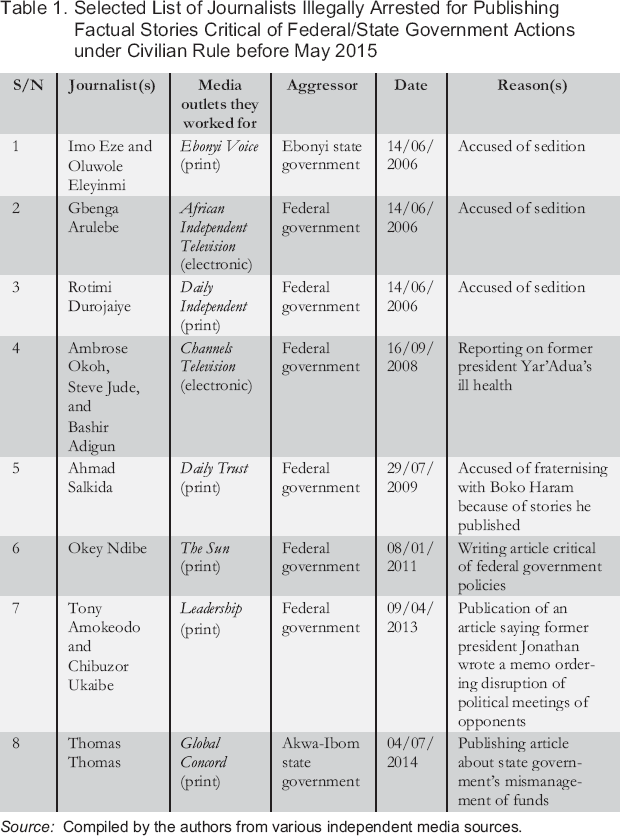
Source: Compiled by the authors from various independent media sources.
An authoritarian government in a liberal society is unwilling to carry out any substantive reform that promotes freedom of information, as was the case of the Nigerian state that, despite high domestic and international pressures, took more than a decade after return to civilian rule to pass the Freedom of Information (FOI) bill into law. Also, laws aimed at protecting and promoting individual and press freedom in authoritarian liberal states such as Nigeria are often ambiguously stated, resulting in arbitrary interpretation by the state to suit its authoritarian character. It is in this sense that this study explains the link between the Cybercrime Act of 2015 and online press freedom in Nigeria.
Section 24 of the Cybercrime Act and Repression of Online Press Freedom
Section 24 of the Cybercrime Act 2015, which was signed into law by former president Jonathan on 15 May 2015, addresses offensive and annoying statements on the internet. The section talks about cyberstalking and prescribes punishment of a fine ranging between NGN 7 million and 25 million, as well as imprisonment ranging between one and ten years, depending on the severity of the offence.
The government has abused this section of the act to “silence” opposition views in the online media. First, stories published online have been deemed “offensive,” “obstructive,” “insulting,” or “annoying” with actionable consequences under Section 24 of the Cybercrime Act even when the stories are factual. Second, some stories published through traditional media outlets (print and electronic) that were never sanctioned by the government have been attacked by the same government upon being rebroadcast or republished through online platforms. The government considers these reports “offensive” and libelous because of the rising influence of online platforms in Nigeria as major sources of information dissemination.
In this way, authorities in Nigeria have used the accusation of cyberstalking to harass and press charges against online journalists for expressing views that are considered unfavourable to the government. According to the 2016 and 2017 Freedom House reports on Nigeria, internet freedom declined due to an unprecedented pattern of arrests and prosecutions against bloggers after the passage of the Cybercrime Act in 2015.
Table 2 shows that internet freedom in Nigeria declined due to an unprecedented pattern of arrests and prosecutions against bloggers after the passage of the Cybercrime Act in 2015. Most of these arrests never led to criminal charges in court and the few prosecuted were dropped by the government due to the weaknesses of their claims. While cyberstalking is aimed at controlling false news online, the law has been used to prosecute online reporters and media outlets even when their stories are factual. Despite the 2011 passage of the Freedom of Information Act, which guarantees the right to access public records, non-governmental organisations have criticised government agencies for routinely refusing to release information sought (Freedom House 2016). Online reporters who use the internet platform to (at least attempt to) cover sensitive issues such as official corruption are regularly subject to criminal prosecution.
High-Profile Arrests and Harassment of Online Journalists in Nigeria for Alleged Cyberstalking since 2015
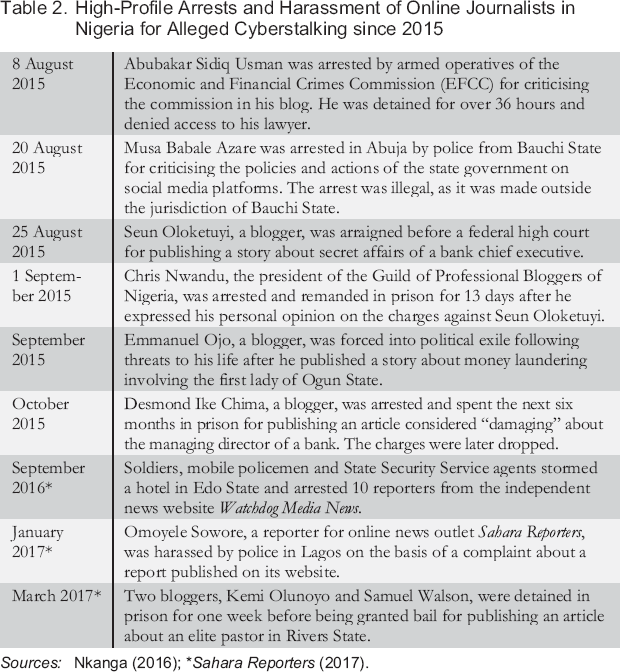
Sources: Nkanga (2016)
Sahara Reporters (2017).
A press freedom index in Nigeria showed significant improvement after the FOI bill was signed in 2011. Nigeria began to experience a steady decline in the press freedom index after the 2015 Cybercrime Act was signed. The implication of this is that Nigeria is presently ranked alongside countries hostile to free press such as Afghanistan, Chad, the Philippines, Zimbabwe, and Colombia. An article published by Sahara Reporters on 26 April 2017 noted that violent attacks and intimidation of journalists by the State Security Service in Nigeria undermine press freedom and make it nearly impossible to cover stories involving politics. Journalists are denied access to information by government officials and agencies.
The authoritarian character of the Nigerian state is one that favours arbitrary interpretation of Section 24 of the Cybercrime Act by the government. Almost every article critical of the government online is interpreted as cyberstalking irrespective of the accuracy of the stories. The coercive apparatus of the state is used to censor online media reporting of day to day governmental activities, with security forces habitually arresting or intimidating online reporters. The relative autonomy enjoyed by online journalists in terms of what they publish on the internet, in contrast to traditional journalists, is seriously threatened by the authoritarian appearance and exercise of political power in what should be a liberal or free Nigerian state. The repression of online press freedom is worrisome when we consider the newly important role of the internet in Nigeria as a major source of political mobilisation. As noted earlier, the internet was crucial in influencing the outcome of the 2015 presidential election in Nigeria in favour of an opposition political party for the first time in the country's democratic history; authoritarian censorship of online press freedom in a liberal society such as Nigeria undermines the basic principle of freedom of expression.
Conclusion
The authoritarian character of political leadership in Nigeria favours excessive state restriction of online press freedom because of the potency of the internet as a platform for galvanising political support and its role as an easily accessible source of information about the day-to-day activities of the government. This restriction manifests in the forms of police and army intimidation, harassment, and unlawful arrest of online journalists. In light of these findings, there is a need to promote a democratic project in Nigeria that views economic prosperity and political freedom as being inextricably linked. Several studies have shown a strong link between economic stagnation or underdevelopment and political repression in postcolonial states. The importance of promoting liberal democratic tenets in postcolonial authoritarian states such as Nigeria also becomes imperative for ensuring online press freedom.