



Abstract
There is a growing recognition of the dangers of electoral violence. Yet, the theoretical foundation for systematic research and for adequate policy is still underdeveloped. This article aims to develop the theoretical understandings of strategies to manage and prevent electoral violence. This is accomplished by integrating research conducted within the two academic discourses on democratization and conflict management and also by drawing on the experiences from the conflict-ridden province KwaZulu-Natal in South Africa. The five strategies identified are monitoring, mediation, legal measures, law enforcement and self-regulating practices. In the article, the functions and mechanisms of the strategies are discussed. In addition, we analyse the limitations and usefulness of each of the strategies in turn and also provide suggestions on how to improve electoral security.
How can electoral violence be prevented and managed? Electoral violence has received increasing attention due to the devastating effects of outbreaks of violence in Kenya, Zimbabwe and Côte d'Ivoire in relation to elections. Yet we know surprisingly little about the different strategies that can be used to address such violence. This article identifies and analyses strategies used to manage and prevent electoral violence and suggests how these strategies can be improved. 1
The authors have contributed equally to this article. A first draft of it was presented at the 7th Pan-European Conference of the ECPR Standing Group on International Relations, September 2010, Stockholm, Sweden. The authors are grateful for constructive comments made by discussant Wolfgang Merkel and other participants in the conference. We acknowledge generous financial support from Sida/SAREC, the Swedish Research Council, and Riksbankens Jubileumsfond, which has made the research possible.
Being violence-free is a defining criterion of “free and fair” elections. However, for several reasons violence can be an attractive option to influence the electoral process and outcome. We conceive of electoral violence as a sub-category of political violence, and we pay special attention to violence during transitional processes (Höglund 2009; Höglund, Jarstad, and Söder-berg Kovacs 2009). Violence in democratizing and war-torn countries must be understood in the wider context of the transition from authoritarianism to democracy and from war to peace. Such transitions challenge power relations in society as well as the worldview of both incumbents and oppositional parties. Violence may be used to both cling to power and bolster the strength of opposition parties. The strategies to manage these processes and to consolidate peace and democracy are thus intimately linked to both the short-term and long-term efforts to improve electoral security (Basedau, Erdmann, and Mehler 2007; Diamond 2002; Elklit and Svensson 1997; Jarstad and Sisk 2008; Paris 2004; Schedler, Diamond, and Plattner 1999).
In instances where violence is still an option for political parties, what strategies are applied to improve electoral security and what are the mechanisms involved in mitigating electoral violence? Based on an analysis of how international and domestic actors have sought to manage electoral violence in the conflict-ridden region of KwaZulu-Natal in South Africa, we identify and analyse five types of strategies, which rest on different functions and mechanisms:
Monitoring mainly performs the function of supervising and information-gathering. The central mechanism at play is the watchdog with the potential of public “naming and shaming” in cases when violence is used in relation to electoral processes.
The main mechanism of mediation is to create trust in a situation of uncertainty.
Legal measures have the function of institutionalizing standards and norms essential for electoral security.
Law enforcement is pivotal to ensure that such standards are upheld, via the mechanisms of deterrence and measures to hold perpetrators of violence accountable.
Self-regulating strategies mainly work through the mechanisms of moral commitment to non-violence and long-term cultivation of political tolerance.
By identifying the different strategies and analysing their respective limitations and benefits, this article addresses an important gap in the research on electoral violence. 2 While both those working directly in the field and academics are increasingly acknowledging the importance of electoral violence, this issue is often analysed in two different academic strands: The democratic discourse has brought attention to monitoring activities, electoral management bodies and the rule of law, whereas mediation and security has primarily been analysed within the strand of conflict management. This article seeks to bridge this divide theoretically by using existing theoretical and empirical insights about the different strategies (as applied in democracy promotion or conflict management) and new insights from the KwaZulu-Natal case. This province is particularly interesting from an electoral security perspective since the Independent Electoral Commission (IEC) has, together with political parties and civil society, deliberately developed strategies to mitigate the violence. KwaZulu-Natal has been the focus of rivalry between the Inkatha Freedom Party (IFP) and the African National Congress (ANC), and violence remained high in the post-1994 period. We draw especially on insights from the 2009 election, but where relevant we highlight developments from 1994 onwards.
There are several policy documents and practical guides emerging in the field which testify to the importance of the topic. See, for instance, USAID (2010) and UNDP (2009). On the policy and practice of monitoring by the AU, see African Union Panel of the WISE (2010).
This article is divided into three sections. We begin by giving an overview of elections in South Africa. In the second section, we analyse the management of electoral violence in KwaZulu-Natal and discuss the benefits and problems related to the strategies. Next, based on the limitations identified, the strategies are reconsidered and improvements suggested. The article concludes with a few remarks on research gaps in electoral security that should be addressed in the future.
Elections in South Africa and in KwaZulu-Natal
South Africa held its first democratic election in April 1994 after an extended period of negotiations to end minority rule. The transition period, which commenced after the release of ANC leader Nelson Mandela in 1990, turned out to be the most violent phase in the history of the conflict. Between 1990 and 1994, an estimated 15,000 people were killed in politically motivated violence. During this period, South Africa suffered from a range of different types of violence (Guelke 1999; Du Toit 2001). At the fore was the intense rivalry between the ANC and the Zulu-nationalistic Inkatha movement. During the transition, Inkatha transformed into a political party, the IFP. The ANC had an armed wing – Umkhonto we Sizwe – which was forced into exile, and both the Inkatha movement and the ANC created self-defence units within the country.
Violence in the KwaZulu-Natal province must be understood in relation to how regional and national dynamics of power and conflict affected the local context. Issues related to geography and identity have created triggers for violence. The KwaZulu homeland, established in the early 1970s, consisted of pockets and enclaves of land and was not a clearly defined or contiguous territory. Given the structure of homeland politics, which were part of the Apartheid structure, incentives were created to play on ethnic affiliation to gain access to power and resources. The affiliation of Inkatha with homeland politics resulted in a power struggle with the ANC, dividing not only politics but society in general, and became the basis for violent mobilization (Bonnin 2004; Freund 1996; Maré 1993). The development of two marginalized classes under Apartheid – the migrant workers living in hostels and the squatter communities – also created a volatile situation. The violence among the black communities included
generational conflicts between radical youth and traditional elders, disputes over chiefship succession, crime, economic rivalry (as in the so-called “taxi” wars) and cycles of vendetta-like clan conflict (Johnston 1994: 188). 3
See also Du Toit 2001.
When the Apartheid government and the ANC began to negotiate in the early 1990s, the conflict worsened because Inkatha felt increasingly marginalized in the peace process. Many residential township areas were transformed into no-go areas, where opposition supporters were not allowed to enter. In addition, the battle for land was central in the KwaZulu homeland and Natal province, as many South Africans wanted a plot of land for subsistence farming. The conflict was centred in the Midlands (north of the Natal province) but spilled over to the southern parts of the province and to Gauteng (formerly Transvaal) in the north. In addition, the “third force” – a network of parts of the security forces and right-wing elements – was partly responsible for the rise in violence in KwaZulu-Natal in the 1990s. The unreformed police and South African Defence Force were also involved in political violence. This further exacerbated the culture of violence (Johnston 1994).
The run-up to the 1994 election was fraught with violence. Nonetheless, the election came to mark the end of Apartheid and created a democratically elected platform for revising the constitution. Initially, the IFP boycotted the 1994 electoral process, but at the last minute they were convinced to participate. In the national election, the ANC gained a majority in seven of the provinces, but in KwaZulu-Natal, the IFP was able to secure a majority with slightly over 50 per cent of the vote. Besides ANC–IPF violence, the main threat came from the white, right-wing Afrikaner movements (Friedman and Atkinson 1994, Johnston 1994).
Electoral violence has been sharply reduced since 1994. Yet, the South African elections are not violence-free, and the areas where such violence has continued are primarily in the KwaZulu-Natal province. The 1995 local elections in KwaZulu-Natal were finally held in 1996 after having been postponed for seven months. While violence substantially declined in relation to the national elections of 1999 and even more so in 2004, political killings, along with threats and intimidation of political activists, political candidates and voters, still occurred (see e.g. Mottiar 2004; Piper 1999; Taylor 2002). Compared to the 2004 national election and the 2006 local elections, the 2009 national election was considerably more violent. In this election, the ANC gained power in KwaZulu-Natal for the first time. The violence during this election came about partly as a consequence of the ANC's attempts to make inroads into IFP strongholds, but there was also substantial intra-party violence (Bruce 2009).
Strategies for Preventing and Managing Violence
What mechanisms are at play when electoral security is promoted? What is the underpinning logic of different strategies? By drawing on theories on the conflict-generating aspects of elections, theories on the causes of political violence, and theories concerning conflict resolution mechanisms, our analysis of strategies has two main points of departure. First, we assume that the strategies applied are chosen for their expected efficiency. For this reason, it is important to consider the underlying mechanism which would explain the logic of its appliance: How is a particular strategy expected to influence the context of violence? Second, we acknowledge that there are certain moments during an electoral process when the risk of violence increases, such as during the registration of voters, campaigns, election day, the transport and counting of votes, and the announcements of election results (Fischer 2002). Grounded in these assumptions, we identify five main strategies, summarized in Table 1.
Strategies to Manage Electoral Violence: Functions and Mechanisms
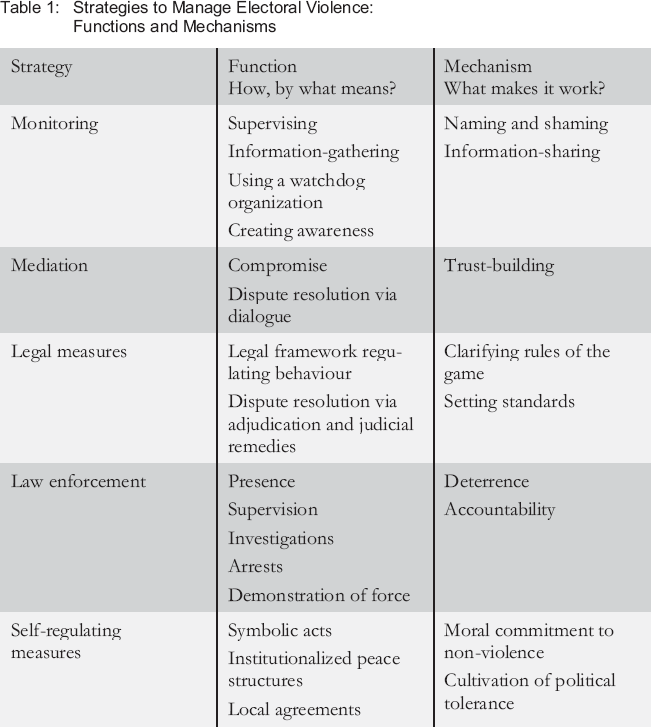
We will next discuss each strategy separately by analysing the functions and mechanisms at work. We will also identify the relevant actors who apply the strategy, and we will discuss the benefits and limitations of each strategy.
Monitoring: Supervision and Shaming
One strategy to prevent and manage electoral violence is to monitor election-related violence. Electoral monitoring missions seek to ensure the impartiality and professionalism of actors involved in elections: the voters, the election workers, the political parties and the electoral administration (Abbink and Hesseling 1999; Elklit and Svensson 2007; Lopez-Pintor 1997). 4 While electoral monitoring missions hold a number of functions, we are mainly concerned with the observation and reporting of violence. 5 Such monitoring's main functions are to supervise and to gather information. Information-sharing allows the agencies involved in managing violence to analyse the conflict propensity and the adequacy of measures to manage violence. In addition, observers serve as watchdogs for the political parties’ professionalism and their compliance with non-violent behaviour, with the possibility of “naming and shaming” perpetrators and instigators of violence.
In most of these studies, it is the electoral procedures (rather than political violence) which are the focus of the monitoring process.
Political violence has been monitored under not only election monitoring missions, but also human rights missions and ceasefire observer missions.
Both the international monitoring missions and domestic organizations have elongated the duration of their stays in the areas they cover. While international missions have more focused tasks, domestic organizations usually have broader mandates that may also include observation of voter registration and voter education. A range of different regional and international organizations have been involved – for instance, the United Nations (UN), the European Union (EU), the Organization for Security and Cooperation in Europe (OSCE) and the African Union (AU).
Monitoring activities are also carried out by domestic organizations, consisting of non-partisan civic associations or networks. Many of these are funded by international donors. Regional organizations are gradually playing a more important role.
South Africa's groundbreaking 1994 election drew massive international election-monitoring efforts. The election date had been announced in July 1993 after a long period of negotiations, but the Independent Electoral Commission Act had been passed only toward the end of October, making the preparation period for the election rushed. However, it would not have been politically acceptable to postpone the election. Thus, a new institution – the Independent Electoral Commission (IEC) – was created to administer the 1994 election. It was also given the mandate of issuing monitors. Given its recent formation and the politicized context, foreign observers came to play an important role.
In successive elections, monitoring was moved outside of the IEC to ensure the independence of the observers. Civil society representatives have dominated both national and local monitoring. 6 Election observation in South Africa is a regulated activity, with the IEC mandated to accredit observer status to organizations carrying out this function (Electoral Act 73 of 1998, Part 5: 84). For instance, in the 2009 election, a range of different organizations deployed electoral missions in KwaZulu-Natal, which again had been declared a volatile region. The international community was represented by the AU and the Southern Africa Development Community (SADC). There were a number of civil society initiatives (such as the Kwa-Zulu-Natal Democracy and Election Forum), and the African Alliance for Peace (AfAP), under the leadership of South African NGO ACCORD (African Centre for the Constructive Resolution of Disputes) deployed an observer mission whose monitors consisted of conflict-resolution experts from the African continent and students from the University of KwaZulu-Natal. The monitoring mission was a direct result of actions taken by the provincial legislature. ACCORD was mandated with the task of deploying an observer mission after a special deliberation in the legislature on 21 February 2009. The purpose of the sitting was to discuss the issue of political intolerance, and it had the support of all the political parties (ACCORD 2010).
In the 2009 election, 1,350 domestic monitors from civil society were deployed by the IEC, as well as 130 lawyers, who added technical support (Interview with IEC official, 9 November 2009).
The main usefulness of this strategy is that monitors reportedly play an important preventive role. Another benefit of monitoring is that the information gathered can be used to alert relevant actors to take action in conflict management. For instance, it was reports about violence in Nongoma in early 2009, including an attack on the ANC office, which resulted in a massive security deployment in the region during the election. High-level involvement was instrumental for the AfAP mission to take action, which included holding direct talks with the president and alerting the police when incidents occurred (Interview with AfAP monitor, 9 November 2009). International observers add an additional beneficial dimension to election-monitoring – namely, external verification, which can have a conflict prevention function due to “awareness of the fact that the world is watching” (Laakso 2002: 440; see also Carothers 1997). In addition, international monitors create international accountability and legitimacy for domestic electoral processes. In South Africa, this function was especially important in the 1994 election, when the country had transitional institutions in place and the IEC could hardly claim to have established impartiality and legitimacy.
However, there are several problems and limitations associated with monitoring activities. One issue relates to the domestic legitimacy and ownership of these interventions. This problem is especially acute in relation to international monitoring activities. Election-monitoring is by its very nature political because it questions state sovereignty and legitimacy (Laakso 2002). Such tensions between domestic and international legitimacy were apparent even in the 2009 election: The elections were perceived by some contenders as a way of imposing “white ideas” on society. In Nongoma, traditionally a stronghold of the IFP (for historical and cultural reasons), Zulu traditions are particularly strong. There, one international observer was physically attacked under the accusation that it was people like him “who came with the white problem” (Interview with international observer, 4 December 2009). A related problem is that many domestic missions function only through international funds.
A second limitation is the short-term focus of observer missions. Although there have been improvements such as longer deployment periods and more encompassing tasks for monitoring missions, the majority of observers are deployed on a short-term basis focused on election day. In the 2009 election, the civil society organization tasked with observing violence in KwaZulu-Natal before the election had only 20 people to cover the entire province. Several civil society organizations have serious problems sustaining monitoring activities in between elections due to a lack of resources (Interview with KwaZulu-Natal Christian Council (KZNCC) representative, 19 November 2009).
A related limitation is that the main focus is on general elections. In South Africa, local government elections and by-elections for local government structures have an important democratic function. By-elections, conducted on approximately a monthly basis (or on a needs basis), are known to be particularly associated with violence, especially when such elections can alter the power balance. Yet, monitoring is less common in these and other local elections, and when it does take place, domestic monitoring agencies bear the responsibility for these elections, and international monitors are no longer present. 7 Ultimately, the effectiveness of monitoring depends on the credibility, integrity and independence of the observer missions. The monitors may have strategic interests in endorsing fraudulent elections or avoiding calling elections fraudulent, since this may have a destabilizing effect (Carothers 1997; Kelley 2009; Kelley 2010; Nevitte and Santiago 1997).
The same applies to the 2000 Zimbabwean presidential election, in which international presence was important in order for the opposition to be able to campaign. However, the following by-elections were fraught with threats against and intimidation of the opposition, and the incumbent party won. See Laakso (2002).
At the same time, elections must be assessed based on what can reasonably be expected given the country's history and recent experience of democracy and conflict.
Mediation: Transfer of Trust to a Third Party
A second strategy to prevent and manage violence is through mediation. Mediation is a mode of negotiation in which an external actor seeks to engage the parties in a process where the function is to solve a dispute or conflict via dialogue and compromise. In volatile situations, the mechanism underlying mediation is trust-building. When the actors engaging in electoral disputes or violence do not trust each other, it may still be possible for them to trust a third party committed to facilitating the process. Mediators can attempt to acknowledge all actors’ concerns, seek compromises and succeed in getting the actors to commit to a change in behaviour.
Mediation around elections is carried out by a range of different actors: The electoral management bodies can deploy mediation teams; local NGOs and/or community organizations can support and organize mediation efforts; and international organizations or states can be involved in more high-level mediation between the disputing parties. High-level mediation was, for instance, used in the AU-led effort to solve Kenya's post-election crisis in 2008 (Juma 2009).
South Africa has a long-standing tradition of domestic mediation emerging from industrial relations. In 1979, when black workers gained more rights, mediators were needed since the black movements were themselves unwilling to engage directly with the government. In response, a group of academics, trade unionists, and business representatives institutionalized mediation in 1983 with the formation of the Independent Mediation Service in South Africa (IMSSA) (Anstey 1993; Hirschsohn 1996). The services of IMSSA were later extended to include disputes in other areas, and it also became involved in the peace committees established under the National Peace Accord. The accord was signed in September 1991 and established peace committees at local, regional and national levels, which by 1994 numbered 250 local peace committees, 11 regional committees and a national committee.
Building upon the long-standing tradition of mediation in South Africa, the IEC coordinates several bodies to organize mediation and other interventions to address violent conflicts in connection with elections. These joint activities serve the dual purpose of 1) sharing information to craft adequate responses to election-related conflicts and 2) solving disputes. The Joint Operation Committee, which includes the Police Service, the Metro Police, the Traffic Police, the National Defence, the National Prosecuting Authority, and the Intelligence, channels information to the IEC on potential conflict areas (EISA 2004: 88). The Party Liaison Committees (PLCs) at the national, provincial and municipal levels, which were established in the Electoral Act of 1998, “serve as vehicles for consultation and cooperation between the Commission and the registered parties concerned on all electoral matters, aimed at the delivery of free and fair elections” (Regulations on Party Liaison Committees 1998). The PLCs are the main platform of the national and provincial authorities for solving and preventing election-related disputes and violence. In the 2009 election, PLCs held consultations across the nation and appear to have widespread legitimacy among the political parties. Only 100 of the 19,726 presiding officers were challenged by the parties during the recruitment process (Moepya 2010: 149).
The IEC has also established Conflict Management Panels on all levels, which include conflict management specialists, religious representatives, panelists from the legal service, and civil society representatives (EISA 2004). In 2009, 25 mediators − 12 religious leaders and 13 lawyers – were linked to the provincial IEC office. The mediators were selected based on their legitimacy and standing in the local community, and they underwent two days of training at the commission on, for instance, the Electoral Act and on the kinds of disputes to which they could be deployed.
A major advantage to mediation is that it is accessible and cost-effective – especially compared to many other types of interventions – in managing and preventing electoral violence. It is especially useful when there is a lack of trust in the legal instruments and during transitional periods when major transformations are taking place.
However, there are a number of problems associated with mediation. The main problem with mediation is that it requires the willingness and participation of the parties themselves. Those involved in mediation activities can point to numerous examples when parties have been reluctant to come to meetings, and to engage constructively once there. 8 Mediation can also be misused as a way for parties to stall the resolution of a dispute or for other “devious objectives” (Richmond 1998).
Interviews with representatives of civil society organizations such as Diakonia (11 September 2008) and KwaZulu-Natal Democracy and Election Forum (KZNSEF) (12 September 2008 and 19 November 2009).
Another limitation is that if mediation is to be effective, timing is essential. Even when mediation is institutionalized and there are people to deploy, sometimes the response is too slow to be efficient. Although potentially rapid to use (especially compared with other interventions), sometimes agreeing to mediation and a specific mediator takes time, which means either that parties may solve the conflict before an appropriate mediator is found or the conflict escalates. To overcome the difficulty in finding an appropriate mediator that is acceptable to all parties, mixed expertise in mediation teams can be useful for solving disputes and preventing disputes from arising.
Legal Measures: Setting Standards
A third strategy to mitigate electoral violence is through legal measures stipulating the judicial standards. The most important mechanism underlying this type of strategy is that the legal provisions set the standards for political activities and make the rules of engagement clear to all. This strategy is open and public to ensure that the judicial standards are well known by politicians and citizens alike. It provides a legal framework for regulating behaviour and it contributes to dispute resolution via adjudication and judicial remedies.
The main judicial framework to manage electoral violence is often laid out in the electoral law. Such a law can define the legal constraints on the use of violence, the mandate and powers of the election management bodies, and regulations on who may stand in elections. Furthermore, this law can stipulate an electoral code of conduct, which can involve an agreement to avoid hate speech and other activities that may spur violence and polarization (IDEA 2010).
In South Africa, the electoral law regulates both the administration around the elections and the context in which elections take place. In order to ensure fair elections, there are several rules regulating, for instance, registration, polling stations, election officers and the transport and counting of votes. In addition, arrangements are made to ensure that elections are free from violence and/or manipulation. It is, for instance, prohibited to display weapons at political meetings, in demonstrations, and at rallies (Electoral Act 73 of 1998). However, the electoral law does not include any provisions barring violent actors from participating in elections as candidates, activists or voters. Rather, emphasis is placed on amending the electoral law to facilitate political participation. Recently, the law was amended to allow people to vote wherever they are located in the country. This measure was introduced to facilitate voting for migrant workers who are working far from home and have difficulties travelling to their home community to vote. This opportunity was allegedly misused in the 2009 election by political parties to increase support in certain areas by bussing citizens to registration and voting places in areas controlled by opponent parties. This perceived practice caused a lot of tension (Mercury 2009e).
A pivotal institution for implementing the judicial standards is the electoral administrative body. In South Africa, the electoral arrangements can be changed by the IEC to reduce the opportunities for violence. This can be done, for example, by shortening the opening hours of polling stations in contentious areas (after consultation with the political parties). 9
Interview with IEC official, 9 November 2009.
A further means for preventing electoral violence is through court orders. In South Africa, there is an electoral court, but it only rules on procedure. Cooperation between the IEC and the Department of Justice has served to speed up the legal processes:
We have observed the formation of a forum that seeks to fast-track litigation around election and political violence-related matters (IEC official cited in Mercury 2009f).
To address electoral violence, the courts can prohibit rallies in certain areas at certain times. In the run-up to the 2009 election, the ANC had taken the IFP to court because the IFP had scheduled a rally in Greytown the same day as the ANC was to have a rally in the nearby town of Msinga. However, before the court decision, the IFP changed the date voluntarily (Mercury 2009d). Another example is when the Pietermaritzburg High Court enforced an order prohibiting the IFP from holding an election rally within 5 kilometres of an ANC rally, in Richards Bay. Despite the order, the IFP held its rally less than a kilometre away on the same day (Mercury 2009b).
The main benefits with strategies relating to legal measures are that in a context where the judicial system is considered legitimate and fair, and where these judicial institutions are responsive, the legal measures provide a measure of predictability for what behaviour is acceptable and can thus serve to deter unacceptable behaviour. In addition, when functioning properly, judicial processes are central to electoral dispute resolution.
There are some problems concerning this strategy. First, as with all laws, the lack of implementation can be a problem. Second, the South African Electoral Act is very permitting when it comes to who can stand in elections. For instance, perpetrators of violence are not barred from becoming candidates, and the law does not provide sanctions to prevent future campaigning if weapons are brought to political meetings or rallies. There have been requests for the IEC to take a harder stance against those using violence – there should be “tougher penalties” (Daily News 2009). While the electoral law does not provide for such sanctions, the IEC has started to look into possibilities to prolong the period during which the code of conduct for political parties is applicable. Third, law reforms to facilitate participation in elections can be misused to alter the political landscape. This creates uncertainty with regards to the electoral outcome in areas that previously had stable political support for one party or another. Such uncertainty can increase the risk of violence.
Law Enforcement: Deterrence and Accountability
A fourth strategy to prevent and manage electoral violence is through enforcement of the electoral laws and through security measures. Without the enforcement of electoral laws, the legal constraints on the use of violence are toothless tools. The police, and in certain instances other security forces, ensure that the electoral laws are upheld by presence, supervision, investigations, arrests, and shows of force. When national capacity for security is low, or when domestic security forces are themselves involved in violence, international peacekeepers and police can act as external guarantors. In other cases, domestic security forces – police, military police, intelligence agencies, etc. – can play important roles in preventing violence around elections. The main mechanisms underlying this strategy are deterrence and accountability. Accountability is especially crucial in countries which have experienced conflict and where a culture of impunity has become more or less omnipresent.
The police serve a central role in law enforcement, but in many countries the police are weak, biased or corrupt. With regards to South Africa, there are conflicting views on the performance of the police, and the country has faced several challenges in the post-Apartheid era. The police have had to transform from their previous authoritarian role of containing black violence in townships to addressing violence in all parts of society. At the same time, the police have been tasked with combating increased levels of crime (Shaw 2002). The transformation of the police has been uneven and some functions have been more difficult to transform than others. Not only was the police force for a long time used as a political tool, but it is also often inadequately equipped and lacks the numbers necessary to deal with large-scale criminal networks and gang violence. 10
For more on the transformation of the police, see Amtaika (2010).
In order to ensure fair elections free of manipulations, threats and/or violence, the police, the judiciary and the electoral commission typically need to cooperate. When tensions arise in a specific area in South Africa, the IEC and the local police commanders have on occasion had frequent and direct contact with one another. Due to perceptions about a biased police force, especially locally, the national police have sometimes been brought in as a more neutral force to manage violence. So was the case in KwaZulu-Natal around the 2009 elections. In some areas, it has even been deemed necessary to involve the army to secure peaceful elections. 11 In the wake of violence and political tensions between the ANC and IFP in Nongoma in 2009, the already hundreds of police deployed in the area were reinforced by the army. The locations of deployment were decided after consultation with the IEC. The police sought to deter people from using violence by making public statements:
The security forces involved in the 2009 election included the police, the army, the National Intelligence Agency, the emergency services, and the local traffic police. The intervention was coordinated from Pretoria under the National Joint Committee, directed by the Deputy National Police Commissioner. See IOL 2009a.
We would like to issue a stern warning to those bent on disrupting the election process: “Expect no mercy from the SAPS, irrespective of your position or political affiliation” (Mercury 2009f).
The police even stated publicly that they were to act in a decisive and impartial manner:
Police officers who do not perform will face consequences (Deputy Commissioner Fanie Masemola, cited in Mercury 2009g).
The main benefit of this strategy is that it directly deals with security and prevention of violence. However, there are a number of potential problems related to the strategy. First, there may be problems of coordination between, for instance, monitors and security forces. In addition, while the risk of corruption and impartiality may be reduced when outside police are brought in, in South Africa this also meant that the IEC and local monitors could no longer make use of their close contacts with the police that had been built up over years of collaboration. 12 A second problem is that this strategy largely ignores the victims of violence. Third, police and army interventions are very costly. Fourth, professionalism, competence, training and resources may vary across different sectors of the security forces and between different units within one part of the security bodies. Such shortcomings, in particular in terms of professionalism, compromise the legitimacy of the security forces.
Interviews with KwaZulu-Natal Christian Council (KZNCC) representative, 19 November 2009, and IEC official, 9 November 2009.
Finally, heavy security presence might incite rather than prevent violence. Individuals and groups may feel threatened by armed, uniformed personnel. Others may feel that the police should not interfere in their neighbourhood. A show of force can also be provocative, especially in situations when the security forces are politicized and misused by those in power (Cawthra and Luckham 2003). Around election times, security deployments can be a way of controlling territory to win elections. In South Africa, the security forces have been carefully watched, especially around elections. In the 2009 election, the IFP felt that security deployments in areas like Nongoma were mainly used to strengthen the ANC (Mercury 2009a). There was also the perception among IFP supporters that the security forces were used to intimidate their supporters and voters (IOL 2009b).
Self-Regulation: Cultivation of Political Tolerance
A fifth strategy to mitigate electoral violence is development of self-regulating measures. Such measures serve to cultivate democratic norms of tolerance and moral commitment to non-violence in society at large. Several different types of actors, such as political parties and community-based associations – commercial cooperatives, religious organizations, civil rights organizations, etc. – can play decisive roles as agents of violence prevention from below (Jeong 2002; Sentama 2009).
The strategy of self-regulation includes jointly agreed-upon consultations and local agreements between electoral stakeholders. With this strategy, the parties participating in the election seek to regulate their own and others’ behaviour. In South Africa, this bottom-up, community-based strategy has been developed into institutionalized peace structures (see section on mediation).
One example of a self-regulating measure is the symbolic act of signing a code of conduct. In South Africa, this public ceremony is arranged by the IEC, but it very much relies on the support of grass-roots organizations and media. Ahead of elections, every political party must be present to sign the code of conduct, as stipulated in the electoral law. Peace pledges are typically televised and bring together religious and civil society leaders. The IEC also encourages journalists to participate in this event and to hold politicians accountable. In this way, the openness and publicity aims to uphold the standards of free and fair elections. While such ceremonies did not exist in the 1994 election, they have gradually become common. In early March 2009, all political parties participating in the April election in KwaZulu-Natal signed a peace pledge in Durban's International Convention Centre. The code of conduct is not legally binding, but is still believed to be instrumental as a moral and public commitment to non-violence. Nowadays, peace pledges also take place at the local level. In 2009, local political leaders were brought together for public signings in all of KwaZulu-Natal's 52 municipalities.
In addition, the IEC works closely with a range of organizations for the purpose of consultation and increased transparency. The churches, which played important roles during the transition, including in the Truth and Reconciliation Commission, continue to play an important role as peacemakers. All over KwaZulu-Natal, peace prayers have been held in support of peace and reconciliation (e.g. KwaZulu-Natal Christian Council 2009). In 2009, a special prayer was dedicated to the election:
We pray for all electoral officials, that they will remain impartial and exercise their responsibilities with efficiency whilst instilling a sense of peace and calm wherever they work […] and that new levels of tolerance and acceptance of diversity will become evident among the people of South Africa (Diakonia Council of Churches 2009).
There is a growing appreciation of the importance of working for peace also in between elections. This rests on the notion that the people affected by violence can best find the most appropriate solutions to prevent it (Paffenholz 2010). Failure to address the victims of violence increases the risk of long-lasting traumas and the creation of a climate of fear which hinders democratic development. There is also a risk that victims of electoral violence become perpetrators, which leads to a deteriorating spiral of violence (Höglund and Piyarathne 2010). One example of efforts to promote peace between elections took place at a peace rally in Greytown in November 2009, where a sermon focused on turning victims of violence into ambassadors of peace, urged perpetrators to stop the killings, and called for forgiveness. The role of the government in peacemaking was also addressed in the sermon. The idea of a “peace desk” within parliament was launched, which would also work together with traditional and religious leaders (Kumalo 8 November 2009). 13
For more on the importance of traditional leaders in KwaZulu-Natal, see Williams (2010).
Self-regulating strategies include activities and programmes focused not only on political activists, but also on the voters. By community, voter and media training, this strategy seeks to foster democratic values and acceptance of political diversity and electoral loss. The main utility of this strategy is that it is broad and includes different parts of society. This gives legitimacy to the process and provides a basis for long-term changes in attitudes and behaviours toward a situation where political and electoral violence is seen as abnormal and an unthinkable part of political life.
However, this strategy also entails a couple of problems. Grass-roots organizations have few tools available to punish perpetrators of violence, which makes it difficult to uphold the moral commitments. In addition, the leaders of political parties are often afraid to take disciplinary measures against followers who use violence, even if they have signed the pledge (Daily News 2009). The reasons may be that they are afraid of losing votes or that they themselves fear becoming targets of electoral violence. There is also a risk that self-regulating measures will be misused. During the 2009 peace pledge in Durban, the political parties were given time to make a speech. Some parties used this opportunity to attack the other parties. For instance, the ANC attacked the IFP for not letting them campaign freely in parts of KwaZulu-Natal (Mercury 2009c). In addition, it is difficult to measure success since it takes time to change attitudes, which in turn makes it difficult for organizations engaged in such activities to get sufficient funding. This means that it is difficult to sustain the programmes, which include self-regulating practices.
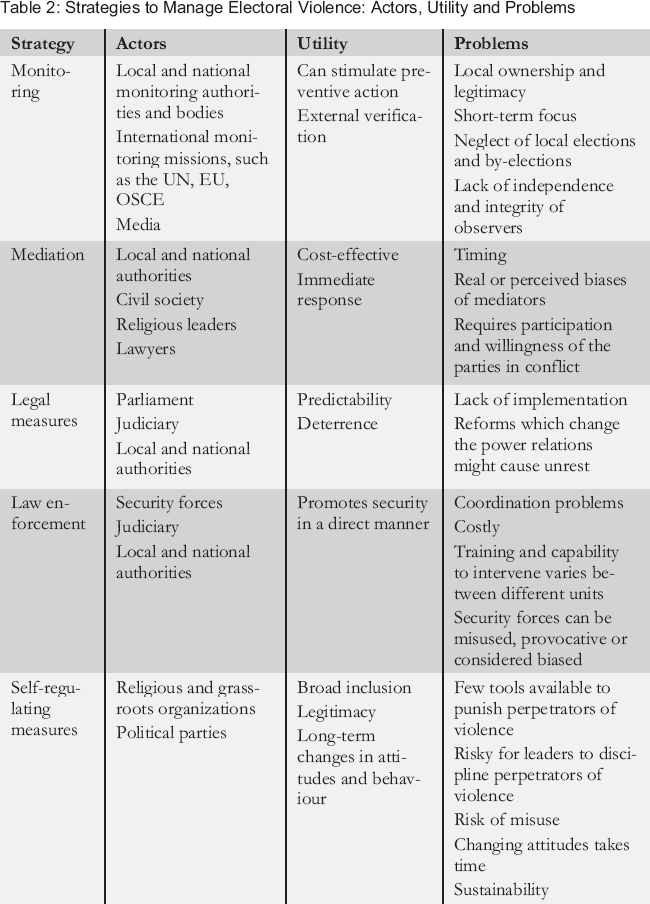
The five strategies are summarized in Table 2 below, outlining the actors involved in each strategy, and potential benefits and limitations. The strategies identified in KwaZulu-Natal are to a varying degree applied by different actors. The bodies involved in these activities range from public authorities, political parties, religious organizations, civil society NGOs, and traditional authorities such as chiefs or clan leaders.
Strategies to Manage Electoral Violence: Actors, Utility and Problems
Reconsidering Conflict Management Strategies
The five strategies identified and discussed in this article – monitoring, mediation, legal measures, law enforcement and self-regulation – together play an important role in managing and preventing electoral violence. It is pivotal that these strategies work in tandem in order that they not undermine each other or create negative consequences in the long term. When analysing the strategies as a whole, and considering the experience of KwaZulu-Natal, four points stand out as central for improving electoral security, which we elaborate on below. 14
The four suggestions on how to improve the strategies and the rationale for those improvements also appear in a policy brief published by the authors (Höglund and Jarstad 2010).
Engaging the Victims of Violence
One way to improve electoral security is to award more attention to the victims of violence. While the self-regulating strategy entails components of this, the other strategies focus solely on potential perpetrators of violence. The risk of not having a comprehensive approach to support those affected by violence is twofold:
Victims of violence may develop negative attitudes toward the political system and democratic practices, thus hampering the consolidation of peace and democracy.
Without coping mechanisms to deal with the trauma created by electoral violence, victims may themselves become perpetrators, contributing to a seemingly endless cycle of violence.
Strategies to address victims of violence must be included in the analysis of how to prevent electoral violence, and the different needs (material, physical and psychological) of various affected groups must be assessed in the development of efforts by concerned actors. Since it might be difficult to clearly distinguish between politically and criminally motivated violence, it is important to have strategies to prevent groups from being targeted by any acts which have negative political consequences.
Continuous Monitoring and Education
The experience of KwaZulu-Natal is that electoral violence needs to be continuously addressed. Violence may occur at any time during the electoral cycle, and in many places politicians are constantly under the implicit or explicit threat of violence. Moreover, monitors need to consider violence in connection to local elections more carefully. National and international authorities, as well as other organizations, are very much geared toward national and general elections and therefore concentrate their efforts – such as voter and party education, as well as monitoring - to such elections. However, local and by-elections are in many countries especially violence-prone due to dynamics related to local power struggles. For this reason, actors involved in democracy promotion must do significant groundwork to prevent election-related violence – including supporting media and educational programmes that target both voters and parties. Monitoring of hot-spots is required not only during the election period, but also in the interim periods. This is because information-sharing and “naming and shaming” may prove to be very useful mechanisms in between elections, as well.
Electoral Design to Promote Conflict Mitigation
The strategy involving legal measures to set the standards for political activities constructs incentives and disincentives for electoral violence. In reforming the institutions to prevent electoral violence, not only the political system and electoral laws must be taken into consideration; care must be also taken to create an institutional design that facilitates the implementation of the legal framework and that, in extension, serves to combat impunity. However, in countries emerging from a long-standing violent conflict, there must also be mechanisms supporting the transformation of former warring parties to political actors. While legal punishment of all those implicated in violence during the war may not be realistic, other means of regulating violent behaviour can be attempted. For instance, activities such as signing peace pledges can encourage actors to know and respect the code of conduct.
Balancing Deterrence and Confidence-Building
During some elections, where the risk of violence is omnipresent, heavy deployment of troops and police may be necessary to deter perpetrators of violence. However, as the KwaZulu-Natal case indicates, the actions and even the mere presence of security forces can be seen as provocative. For this reason, a focus on law enforcement and security presence must work in tandem with efforts to build trust and confidence. In situations where the security forces have limited legitimacy, at least among certain parts of the population, a network of other actors has to be activated to promote respect and tolerance and to build confidence between groups in conflict. Such networks may include a mix of traditional and religious leaders, as well as respected civil society groups. A comprehensive approach encompassing the involvement of a multitude of actors is demanding from a coordination perspective. A potential danger is that different activities undertaken to improve electoral security undermine each other. The KwaZulu-Natal case indicates, for instance, that the deployment of security personnel to places where they had little local knowledge undermined collaboration between local monitors and police, which had been established over the course of many years.
Concluding Remarks
Preventing and managing political violence is a multifaceted task. Challenges such as reminiscences of warlordism, inter-party competition and intra-party disputes require a variety of tools. This article has identified five strategies used to improve electoral security by drawing on previous research on conflict management strategies, insights about democracy assistance and experiences from KwaZulu-Natal.
The strategies to address election-related violence cannot be separated from the efforts to reduce conflict and promote democracy in transitional societies. In many instances, we can expect that the conditions conducive for efficiently managing and preventing electoral violence are often lacking. This is because electoral violence is a symptom of a malfunctioning democracy, or of an authoritarian system which nonetheless holds elections. In such political systems, electoral violence is part of a larger political conflict, where different methods to defeat contenders are used. For this reason, the strategies identified here must also be studied under conditions that may undermine their success. For instance, the mechanisms of information-sharing can be misused to control the opposition. In South Africa, many institutions, including the churches, are politicized, and the IEC has allegedly been biased in favour of the ANC. In a country where a liberation movement has transformed into a dominant party, there is a risk that critique of contemporary politics is portrayed as a betrayal of the cause, thus constraining the room for pluralism. Under such conditions, the strategies identified here may fail to prevent violence. Electoral security can be fully realized only in a situation where elections are not seen as a zero-sum game and where there is an acceptance of the rules of the game by most parties and voters. Such a context is created by reforms to improve the legitimacy of the political system and state institutions as well as by efforts to rebuild the social fabric in societies torn by conflict (Ohlson 2008; Sisk and Paris 2009).
Consequently, there is a need for more research in this field. The integrated framework developed here can be applied to single case studies, as well as to comparative work – cross-national or across locations – to identify the conditions under which the mechanisms and strategies identified in this article operate, and also to identify conditions that prevent the management of electoral violence. Future research on electoral security would also benefit from a more nuanced analysis of different types of violence that may occur in relation to elections, as well as an analysis of why different strategies are used by different actors under varying circumstances.
Interviews
Interview with international observer, December 4, 2009.
Interview with AfAP monitor, November 9, 2009.
Interview with Diakonia representative, September 11, 2008.
Interview with IEC official, November 9, 2009.
Interview with KwaZulu-Natal Christian Council (KZNCC) representative, September 12, 2008 and November 19 2009.