



Abstract
This paper takes a critical look at the view that the Internet can serve as a laboratory of political experimentation for reconfiguring the repertories of political actions. The overall discourses on information and communications technology (ICT) are too often focused on technology and infrastructure, when the question of its use should be central. In order to comprehend how ICT can serve as a democratic enhancer, this paper critically examines the African anthropology of the state and of the public sphere. It captures the African endogenous productions of political modernity and the subsequent way ICT is appropriated and indigenized by African local instances. African states and civil societies do not fit into prescriptive Western paradigms. In order to encourage the effective use of new technologies, this paper has developed the so-called “African model of ICT practice”, which proposes a set of hypotheses that aim to enable the effective usage and integration of ICT within the democratic process in the context of an African self-defined political reality.
Since the 1990s, the prospect of using information and communications technology (ICT) to improve accountability, transparency, fairness, and effectiveness of authority has attracted general optimism (UNCTAD 2006). In 2005 in Zimbabwe, for instance, New Zimbabwe.com had a higher readership than the country's largest daily newspaper, The Herald (Ndlela, 2009). Johwa (2007) has noted that
with draconian media laws in Zimbabwe, online agencies have become an increasingly important source of alternative information.
Overall, however, the current discourse around ICT is overly optimistic and simplistic regarding the capacity of ICT to regulate the specific problems of developing countries. Most ICT analysis grants ICT a normative and telicessence, therefore throwing the analysis into a myth of technology (Diallo 2007; Djossou 2007; Randall 1999) that distorts reality. Other analyses of ICT in Africa tend to be overly pessimistic (Dahou 2005) and offer a stigmatizing view of the African reality. Inherited from the colonial ethnology and maintained by ignorance and disinterest, the prejudices about Africa run rampant (d'Almeida-Topor 2006). Among the common prejudices is the idea that African societies are frozen in tradition and resistant to modernity. The following quote, taken from a speech delivered in Dakar by French President Nicolas Sarkozy in 2007, illustrates this plainly: “The tragedy of Africa is that Africa has not entered history” (cited in Gassama 2008). Hence, the cultural biases against the homo africanus and African states are constitutive parts of the wave of Afro-pessimism.
This paper adopts a philosophical approach (in the critical sense) of politics in Africa, which helps to: (1) understand the changing trajectory of the African state; (2) capture the African endogenous productions of political modernity and stress how politics and the public sphere are places where the effectiveness of practical reason can operate; and (3) highlight that there is a nascent African individual who deploys strategies to mobilize material and symbolic power in order to act as an agent of change within the public sphere. As a result, the “African Model of ICT Practice” is elaborated (Figure 1). This model takes into account the African anthropology of ICT in order to make the democratic usage effective. It is based on the underlying presumption that the emergence of a civil society of individuals is correlated to a type of state that constitutes the individual as responsible.
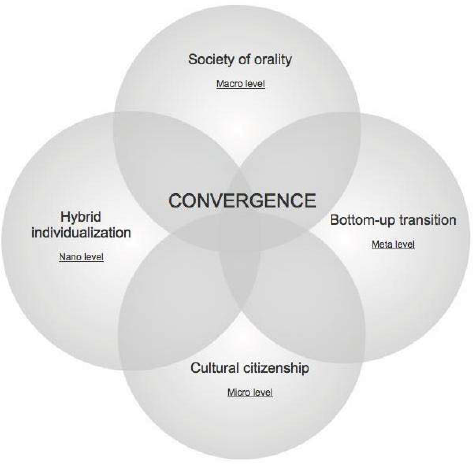
The African Model of ICT Practice
ICT, Citizen Agency and Democratic Governance in Africa
Penetration Rate of ICT
The penetration rate of ICT in Africa is a good starting point for assessing the levels of supply and demand of informational requirements. Whenever seeking to objectively assess data, one has to be aware of the constant analytical fallacies that aggregate data introduces, due to the fact that it is a combined dataset that does not account for variation. Africa is still behind the rest of the world in terms of ICT penetration and usage. This limits the opportunities to include the poor (Sciadas 2005) and therefore negatively affects the democratic potential of ICT. The gap in terms of broadband subscriptions and Internet usage between Africa and the rest of the developing and developed world continues to leave Africa largely behind other regions. Indeed, in terms of the broadband divide, in 2010 in Africa 0.2 of every 100 inhabitants had a fixed broadband subscription, whilst in Europe and the Americas the correlating numbers are, respectively, 23.9 and 15.5 (ICU, 2010). In terms of the number of Internet users, in 2010 in Africa 9.6 of every 100 inhabitants used the Internet; in Europe and the Americas, respectively, 65 and 55 did (ICU, 2010). Added to this very low penetration rate, the financial burden is another obstacle to wider Internet use. Indeed, even for the few segments of the population who can access the Internet, their usage is constrained by the high costs of international bandwidth. The average retail price for basic broadband in sub-Saharan Africa is 190 USD per Mbps/m, compared to between 6 and 40 USD in India and between 12 and 40 USD in Europe (Hoffman and de Wet 2011: 178). Furthermore, people who have access to computers often also depend on offline sources for information about governance and for engaging the government (Albert 2008).
ICT as a Tool of Citizen Agency
According to Mundy and Sultan (2001: 12), “information is useful only if it is available, if the users have access to it, in the appropriate form and language”. Comprehensible information should be accessible, and every individual should be offered the opportunity to search for and obtain information in a reliable and affordable manner (Rajani 2008). Within the process of democratic governance, information is an essential leverage tool for monitoring political authorities. In order to help get information out, ICT must be used by citizens to monitor public authorities and resources. Examples of ICT as information and monitoring tools are grouped as follows:
monitoring authorities (e.g. Bunge SMS in Kenya, Mzalendo in Zanzibar),
crowdsourcing tools (e.g. BongoHive in Zambia, Ushahidi in Kenya),
participatory media (e.g. AFTIDEV, Global Voices), and
platforms for debate in local languages (e.g. JamiiForums in Tanzania).
Additionally, the use of ICT can also increase the coherence of information, since it enables citizens to cross-reference and link pieces of information, making it easier to understand patterns of governmental actions and policies. Finally, ICT can also help reduce the asymmetry of information between elected officials and the electorate, and between bureaucrats and elected officials.
For Rajani (2008), “citizens' agency is not only aimed at enhancing development and democracy, it is also their most effective tool”. These people can be activist citizens, engaged in writing scripts and setting the scene, or active-passive citizens, who follow scripts and participate in scenes that have already been written (Isin and Nielsen 2008). For citizen agency to function, people need to fulfil some qualities defining human capital, such as health, education and morality, and they should also be able to access information and express themselves in a telic manner in order to produce change. Without the actions of active citizens, it is not possible to imagine social transformation or to understand how people become claimants of justice, transparency, rights and responsibilities (Isin and Nielsen 2008). The African Charter and Commission on Human and Peoples' Rights proved that without the consistent and active participation of African civil society, a ghettoization of the Commission within the African Union would have occurred.
Nevertheless, one limitation on the use of cyberspace as a form of expression of citizen agency is related to the many and continuous structural challenges faced by African states. Elements ranging from power shortcuts to the illiteracy rate (70 per cent of the total African population) to the need to develop the “human factor” (Adjibolosoo 2005), are all serving to limit access to the use of ICT. As shown by the AFTIDEV (Africa, Technology, Information and Development) project launched by the United Nations Development Programme (UNDP), ICT has not solved the basic problems of local populations – namely, AIDS, the high rate of illiteracy, and the need to prioritize survival before any democratic concern. Hence, the introduction of ICT confronts Africa once again with the question of its underdevelopment.
ICT as a Tool for Institutional Democratization
According to Thompson (2008), increased participation by citizens in web-based forms of interaction results over time in a corresponding growth in a culture of openness and also increases transparency. The leaked 2004 Kroll report into corruption in Kenya illustrates the power of ICT-based forums as sources of publicness and political accountability. ICT has also been extensively used in Kenya and has created an unprecedented ability on the part of the citizens to interact around and to criticize the operations of the state. Likewise, due to the lack of access to mainstream radio, pro-democracy movements advocating regime change in Zimbabwe have turned to alternative radio stations, sometimes referred to as “clandestine radio”, defined as “unlicensed radio stations designed to create political change within countries targeted by their transmission” (Nichols and Soley 1987). There are also auspicious signs that involvement in e-government initiatives can result in improved state–society relations. For example, in her study of the developmental impact of e-government initiatives in India, which she finds to be questionable, Madon (2005) nonetheless points to an “increased sense of trust and reciprocity developing between citizens and the state”. It appears from the above examples that there is significant opportunity for further strategic thought about the ability of the ICT sector to foster higher standards of democratic accountability and openness. Nonetheless, there are significant questions concerning the inclusiveness and availability of cyberspace. Indeed, whether connected urban elites are able to use ICT to drive greater accountability for the benefit of the disconnected rural majority and how this process could be monitored remain open questions.
Understanding the Nature of African State and of the African Civil Society
The Metamorphosis of the African State
Overall, Africa suffers from a multiplicity of narratives about its history, and scholars have failed to provide an analysis that is “systematic enough to situate human misfortune and wrongdoing in a singular theoretical framework” (Mbembe 2002: 239). Unless the endogenous dynamics of the African state are understood and accommodated, reform strategies for enhancing the use of ICT within the scope of democratization are unlikely to be successful. The African state continues to evolve in its own process of construction within a trajectory that differs from that of the Weberian European state. In order to explain the nature and changing patterns of the African state today, it is useful to apply the approach of the continuous formation of state, based on Tilly's axiom that war-making equals state-making. Hence, instead of considering the many inter- and intra-state conflicts as causes of the weakening of the African state, these should rather be seen as transformative and constructive devices accompanying the changing nature of the state. The deliquescence of the African state does not mean that there is no politics, or that a structured organization of power relations is lacking. Instead, it means that the state can no longer be considered the core analytical unit for defining the emerging and actual political dynamics. Hence, there is an increased need to analyse the state within a larger ensemble, in which civil society is the pillar.
As a consequence of this changing nature of the state, democracy itself becomes an analytical object that needs to be decoded through the multiple endogenous adjustments of senses that it covers. Schaeffer (1998) argues that the way in which the legitimacy (and democratic nature) of the authority of the state is constructed goes through local interpretations and statements. In order to capture the sense that Africans are assigning to the concept of democracy, scholars have to undertake empirical research. Along these lines, the Afrobarometer, an opinion-polling project, aims to understand individual opinions in time and space concerning democracy. To conclude, the analysis of democracy in Africa cannot be deduced from a universal essence (a Eurocentric one). Instead, one needs to study the plurality of representations in an inductive manner. This is the main condition for being able to exploit ICT to further democracy.
The African Anthropology of the Public Sphere
The public sphere is defined as “a discursive space in which individuals and groups congregate to discuss matters of mutual interest and, where possible, to reach a common judgment” (Hauser 1998). Essential to the public sphere is citizen agency, which enables civil society to exist and to function. The concept of civil society was first transferred to Africa in the wake of the wave of democratization under the Washington consensus. In reality, structural adjustment policies have had a negative impact on the lives of ordinary Africans. Hence, as Abrahamsen (2000) has argued, the wave of democratization and the emergence of civil society and popular protests in Africa should not so much be seen as the result of the democratizing aspects of political liberalization policies that are part of structural adjustment but should instead be considered a result of the negative economic effects of structural adjustment and the concomitant growing levels of poverty among African populations. Abrahamsen's analysis challenges the democratization diffusion theory, which attributes democratization to internal factors such as protests and the reduced legitimacy of African regimes.
Under the wave of democratization, civil society emerged as a programmatic ideal for African states to the extent that it is seen as both a counterweight to bad states and a replacement for failed states. Harbeson (1994: 1–2) highlighted that
civil society is a hitherto missing key to sustained political reform, legitimate states and governments, improved governance, viable state– society and state–economy relationships, and prevention of the kind of political decay that undermined new African governments a generation ago.
This suggests that Africa does not have a civil society. This assumption is also reverberated in development policy reports by aid agencies such as the Civil Society Challenge Fund of the DFID, 1 which broadly states that most Civil Society Challenge Fund projects involve a partnership based on the applicant helping to build the capacity of the Southern partner to empower the poor (cp. DFID 2010).
Department for International Development, United Kingdom.
However, the assumption that Africa did not have a civil society before the wave of democratization is a Eurocentric view that narrows the definition of civil society to an institutional arena and fails to acknowledge the historiography of the African political reality. Indeed, by setting a formalistic and Weberian definition of what civil society ought to be, many civil society organizations in Africa have not been considered instances of counter-power. This history by analogy which assumes that
civil society exists as a fully formed construct in Africa as in Europe, and that the driving force of democratization everywhere is the contention between civil society and the state (Mamdani 1996: 13)
obscures the analytical lens of Western academics. The modernization paradigm which posits the West as the fulcrum of global history and development should be put in Trotsky's dustbin of history. Instead of conceiving of civil society as a programmatic and prescriptive tool, the concept should be used as an analytical and historical device. Along those lines, Mamdani has advocated for
an analysis of actually existing civil society so as to understand it in its actual formation, rather than as a promised agenda for change (1996: 19).
For Mamdani (1999), the history of civil society in Africa is long and he considers anti-colonial movements as perfect examples of African civil society organizations which later established themselves as governments. Mamdani is not the only Africanist who advocates the need to look at the existing civil society instead of transposing a prescriptive concept of civil society in Africa. Indeed, Ekeh (1975) argues that the Western experience of a unified public sphere is not reflective of the African social space; similarly, Maina (1998) and Comaroff and Comaroff (1999) have argued for the need to broaden the concept of civil society to reveal a broader spectrum of associational life.
The analysis of the African state together with the reconsideration of African civil society within a contextual and historical frame helps us to reassess the analytical approaches, to break with the discourse of confinement, and to question the logic of African modernity. From this epistemic point, the next section moves on to provide a theoretical framework for how ICT could be used to further the democratic function of citizen agency.
Providing African Solutions to African Problems
The Anthropology of ICT in Africa
The question of how to effectively introduce ICT into the democratic channels of communication is generally viewed through a technical lens. Hence most discourses concerning ICT fail to include the central analysis of how theses technologies are used (International IDEA 2002). Ntambue-Tshimbulu states that
the importance of the cultural participation challenges the subjacent inequalities in the transfers of ICT in Africa (2003: 59).
In order to thoroughly assess the democratic potential of ICT in Africa, we need to measure the quantity of African content produced in Africa for Africans, as this is a good indicator of the mode of appropriation of ICT. Indeed, saying that a technology remains marginal as long as the local culture has not appropriated it is not an ideological statement but the expression of reality. For Coulibaly (2007: 134),
as long as Africans do not develop knowledge and data meant to be useful to the rest of the world, the monologue between the North and the South will continue to dominate discourses and practices.
The current works relating to ICT other than the Internet in Africa show how the development of satellites has reinforced the weight of foreign productions, thus contributing to the continued domination and disproportionate impact of non-African companies on the content of the Internet (Tudesq 2002). Especially since the Bamako meeting in 2000, it has become clear that interactivity can exist only if there are spaces of dialogue and creativity which are in constant contact with the world citizenry. ICT should provide answers to problems clearly expressed by Africans. Samba, a manager of a project on ICT usage in Senegal, draws attention to the need to be aware of the cultural and material context of Africa. 2 Printed versions of newsletters continue to be much more accessible than online versions. Given the socio-cultural context of Senegal, the radio has a much stronger impact than the Internet.
See archives of the AFTIDEV forum (www.aftidev.net), which took place in 2000 and covered the question of the social use of ICT.
The problem is that ICT is seen by most political elites, policy makers and international organizations as a device for instigating a democratic revolution without seeking to assess the social and human consequences of this particular belief (Breton 1992). The use of ICT is accommodated by dynamic habits that are linked to a hierarchy of values. In Africa the habits and hierarchy of values are those of a society of orality. On this account, it might prove useful to turn back to the developmental sociology that has examined the failures and impacts of the introduction of technology within a given sociocultural context. ICT is not an agent of change, but an instrument of it, and as such it should take into account the local context and the informational needs of the targeted populations.
Upgrading the Use of New Technologies: The African Model of ICT Practice
At the basis of the African model of ICT practice is a set of four hypotheses that aim to enable the effective usage and integration of ICT within the democratic process and within the emergence of a new type of citizen:
at the macro level, a society of orality exists → enables a digital “palabre”;
at the meta level, African states are following a bottom-up transition → opens space for citizen action;
at the micro level, a cultural citizenship comes into effect → takes into account the endogenization of Africa and enlarges the Habermasian public sphere; and
at the nano level, a hybrid individualization occurs → comprises a form of individualization respectful of the interests of the wider community.
Orality is considered a modality of civilization, by which cultures ensure their social cohesion. In Africa, orality has persisted throughout the centuries. A perfect illustration of this is that the radio has played a great role in Africa especially since the liberalization of 1990 (Tudesq 2002). Radio is an interactional device (because it is usually listened to in groups and provokes discussions) and therefore constitutes a good tool for exercising the participatory and democratic skills of citizens. In Africa, the democratic transition is made from the bottom up (Bayart et al. 1992). Hence, it might be argued that Africa is moving toward a developmental democracy where citizens are given the status of co-creators and main active actors of social and political changes. In Senegal, the digital palabre tree took root through the use of web space (e.g. forums, chats) as a democratic leverage instrument – the Internet played a crucial role during the presidential elections in 2000, leaving Abdou Diouf defeated. However, the interventions of this new digital era remain very selective. The problem is mainly located within the design of the Internet. Hyperlinks obey an aggregative logic, hence available resources have an affinitive relation. This affinitive relation, or homophily, arises from the potential lack of disagreement because of the polarization of like-minded individuals and information into cyber-ghettos of homogenous interests. It also limits the scope of the public space, characterized by a process of well-structured deliberation with a significant representative basis, spanning divergent and contradictory opinions. Second, ICT has not penetrated enough households. Therefore, the horizontalization of hierarchical structures (Trudel 2002) is a prerequisite for reducing the marginality of different segments of society.
By enlarging the Habermasian concept of the public sphere to include the religious dimension, LeBlanc (2009) and Gomez-Perez (2005) are interested in the process of individualization taking place within public debates. Especially in Mali, Senegal and Burkina Faso, young Muslims are becoming social and political actors. Yet, one limit to the widespread use of ICT for democratic purposes is related to the urban/rural divide, acknowledged through the fact that “the fabric of a new Africa is the city, for the better and for the worse” (Balandier 1985).
The genesis of the modern state is correlated to the process of social individuation and to the way the latter impedes conceiving of the destiny of the individual separately from the destiny of the state (Ruby 1991). The question of individualization in Africa is particularly relevant for assessing the growing potential of the public sphere. Overall, African individualization is hybrid – it is not synonymous with the Western, consumerist version, in which individualization equals egoism. The African individual remains anchored within his functional status and therefore serves the purposes of his community and ensures the social function of associativeness (Ela 1998). The emergence of individuals and groups on the political scene created a pluralist system. Indeed, especially in Nigeria, with the Movement of Young Republicans acting extensively through the web, the construction of a public space in the institutional sense has durably reconfigured the relation between state and society (Gazibo 2005, 2007). Succinctly, by adapting the use of ICT to the African reality that constitutes a normative unit of its own, the “African Model of ICT Practice” (Figure 1), helps ICT become a tool for mobilizing citizens.
Conclusion
The nature of ICT can only be instrumental; therefore it is extremely flexible and adaptable to the dynamic behaviour of its environment. Hence, as Sauval (1996: 104) has argued,
the solution to the problems of humanity is not a problem of technology. It is a problem of politics. The Internet will not resolve what needs to be solved through a political revolution.
This paper has revealed that the African continent is in motion and that it innovates and invents, by choice and often by necessity. The democratic trajectory of the African state is en rupture with Weberian and other rational axioms and has therefore defined itself within the context of African anthropological nature and dynamics. Africa is undergoing a hybrid process of democratization and individualization. As such, the introduction of ICT as a tool of democratic leverage should take into account the endogenous character of Africa.
Further research might consider the importance that education plays within democracy. As Proudhon affirmed, “democracy should first endorse the sense of demopedy, a system of education of the people” (1962: 164). By educating the African people according to the requirements of a democratic society, Africans will become empowered with regard to their usage of ICT. Overall, understanding and trying to expand the democratic use of ICT for civil society will prove very useful for future development strategies of bi- and multilateral aid agencies in Africa.