




Abstract
In South Africa, local government elections are held every five years, with the next ones scheduled for 2016. During the last local government elections in 2011, much media coverage was given to political parties’ manifestos and slogans. They are frequently layered with social and political references, and the terms used are often emotionally resonant across a broad spectrum of the electorate. One term frequently found in such rhetoric is “community.” This article explores the term as it was used in a number of different political parties’ manifestos during the 2011 local government elections. The authors utilise research methods that allow a neutral interrogation of the manifestos.
During the build-up phase to South Africa's last local government elections, held on 18 May 2011, significant coverage was given by media outlets to political parties’ manifestos, slogans, and advertisements. In contemporary, postmodern times the mediation of such messages plays a very significant part in how such ideas are understood by the electorate. Norris (2000) offers a historical schema in which the political communication aspect of elections can be understood to be operating in three key periods: premodern, modern, postmodern.
In premodern times campaigning techniques were activist-based. They made extensive use of and were organised by civil-society groups such as guilds, trade unions, trade associations, and small political entities. During the modern period there was a gradual decline in individual and group activism as the mass media became dominant as a way in which people associated with one another and experienced the world. The larger social range of the mass media resulted in national issues becoming more significant in determining people's election choices. Consequently, elections came to be won (or lost) on national issues rather than local issues. However, in postmodern times we have witnessed the emergence of social media, forms of networked media, and the significant growth of the use of mobile phones. Norris (2000) understands this technological impact as resulting in a new age in which the activist is important again.
Activists and individuals assist in the mediation of political messages to a far greater degree now than they ever have. Consequently, the text contained in manifestos, slogans, and advertising is mediated and individualised to a far greater degree than it previously was. Moreover, we have witnessed an increased professionalisation of the various forms of political communication (Papathanassopoulos et al. 2007). Parties’ employment of internationally based professional political strategists, consultants, and pollsters to more efficiently orchestrate campaigns and better exploit various social research methods (such as focus groups and surveys to determine the public's reaction to political messages) has resulted in far tighter and far more measured forms of political communication. Simenti-Phiri et al. (2014) argue that South African politics has changed significantly in recent years and is now far more professional than before, drawing heavily upon an approach to campaigning popularised in the United States. The type of political rhetoric examined here (manifestos, slogans, and advertisements) is designed for and calibrated to specifically appeal to the South African voter, the target audience.
Manifestos, slogans, and advertisements are a key ingredient in election campaigns. They are frequently layered with social and political references and the terms used often resonate emotionally with a broad share of the electorate. One term frequently found in such campaign language is “community” (or its plural, “communities”). While “community” is generally understood to refer to the set of interactions and human behaviours in the context of everyday, lived experiences within societies, the term also has very significant political resonance and is often found within political manifestos. The question arises as to whether the use of the term in political manifestos differs from its use in everyday life. In this article, the commonly used terms “community” and “communities” are explored in a number of different examples of political-campaign rhetoric disseminated during the local government elections of 2011 to explore how the term was used.
Origin and Use of the Term “Community”
The term “community” has its roots in Old French and Middle English. It originates in the Latin words communitas, meaning fellowship, and communis, meaning common, public, or shared. Indeed, “community” and “communication” share their Latin root (Webber 1964).
The topic of community was of significant interest to sociologists and philosophers in the nineteenth and early twentieth centuries. Ferdinand Tönnies’ work on the concepts of Gemeinschaft and Gesellschaft (Gemeinschaft und Gesellschaft [Community and Society], published in 1887) represents a continuation of Hegel's distinguishing among forms of association. Gemeinschaft (community) should be understood as a living organism, while Gesellschaft (society) should be understood as an artificial and less authentic grouping of people (Averweg and Leaning 2011: 22). Such interpretations became integrated into political discourse.
Community has long been a topic of mainstream political interest and there has been a large amount of popular comment upon the issue. Currently, “community” is undoubtedly a key political value and the term is widely used in a range of popular and academic debates – such as in the emerging discipline of Community Informatics. Whilst one cannot possibly begin to do justice to the wide variety of perspectives that have been used to study community, one can discern a broad schema in how the term is understood.
One popular approach to the term advocated by authors such as Willmott (1989), Lee and Newby (1983), Crow (1997), and Crow and Allan (1994, 1995) recognises three distinct interpretations of “community”:
Community is conceptualised as a “locality.” Here the “commonality” or the essence of community between people is the physical space in which they reside. This approach to the study of “community” has been used to examine a number of topics such as the impact of architecture and geography upon “community.”
Community between people emerges from a shared interest or experience – this category provides a means by which many forms of association that emerge from a shared set of practices or interests may be conceptualised as a community.
Community is used to understand the feeling of commonality that occurs between people around certain topics, beliefs, or spiritual values. Thus one can talk of a feeling of “community,” or of a link between people in a heightened spiritual or emotional state such as sharing a religious experience or being part of a crowd at an exciting soccer match.
“Community” in South Africa
In South Africa, the term “community” was originally used as a euphemism for race (Bosch 2003: 108). However, its meaning has become increasingly vague with its rhetorical use in politics. In post-Apartheid South Africa, communities occupy a “legitimate” space in the regulatory framework of the state. Bosch (2003: 110) notes that it is “communities” that can make claims for land restitution and land distribution, and the term “formerly disadvantaged community” refers to racial groups dispossessed of land, an entity on whose behalf a struggle was waged. In the South African media, the term “community” is prevalent. Bush Radio (the oldest community radio project in Africa) creates community by being deeply connected to the various communities it serves – the concept of community pulsates as its central life force (Bosch 2003). Murkens (2009) studied the “special interest” and “geographic” models of community radio in meeting the needs of the community. The perceived failure of local government to deliver services and the delayed response to the concerns of communities has resulted in the “collective trauma of the paradoxical new democracy” in South Africa (Mogapi 2011: 124).
Local community protests have spread across South Africa since 2004, with a dramatic upsurge in 2009 and 2010. These community protests have been “against poor service delivery, corruption, and the lack of consultation with communities by government” (von Holdt 2011: 5). In South Africa, the provision of services is viewed as the prerogative of the local sphere of government (Gumede 2009; Kagwanja et al. 2009; McLennan 2009). Community protests and xenophobic violence are a last resort strategy to express grievances in South Africa, particularly over inadequate service delivery. In von Holdt et al. (2011), the term “community protest” occurs 79 times, and a search string for “communit” to locate either the term “community” or “communities” generated a total of 642 “hits” (“community”: 558 hits; “communities”: 84 hits). It is evident that the term “community” continues to have significant resonance across a broad population and remains ingrained in South Africa's collective psyche.
Given the recent violent, xenophobic attacks against foreign nationals, the term “community” has again gained prominence in South African media. For example, James Nxumalo (mayor of eThekwini, Durban, South Africa) states in the local government publication (METRO ezasegagasini 2015) that “leadership met affected communities“ and that “Our City [Durban] will go all out in helping displaced foreign nationals to be reintegrated into their communities“ (emphasis added).
Community is a complex concept that can be described from many points of view in the South African context. The ongoing economic divisions characteristic of the post Apartheid era are typically those between different black communities in South Africa – in discourse, one very rarely hears the term “white communities.” The terms “community” and “communities” are also prevalent in the South African political landscape, manifesting in political parties’ extensive use of the terms “community” or “communities” in their manifestos, slogans, and media advertisements in the 2011 local government elections. This rhetoric sets the tone of a political party's election campaign.
2011 Local Government Elections in South Africa: Survey Method and Data
The ruling African National Congress appears to still rely heavily on loyalist politics (Mogapi 2011: 123). The case studies in the aforementioned July 2011 research report “seem to suggest that the development of democratic local government has been marred by the unresolved trauma of Apartheid” (Mogapi 2011: 124) and the building anger over the failures of the African National Congress. Furthermore, local government appears to be failing to listen and responding to the concerns of aggrieved community leaders.
Extracted from the Independent Electoral Commission (IEC) website (www.elections.org.za), Table 1 reflects the 2011 local government election results for the ANC, COPE, DA, and IFP. The voter turnout for this election was 57.6 per cent. The total percentage of support obtained by these political parties was 91.6 per cent.
2011 Local Government Election Results, Number of Seats Won, and Percentage Support
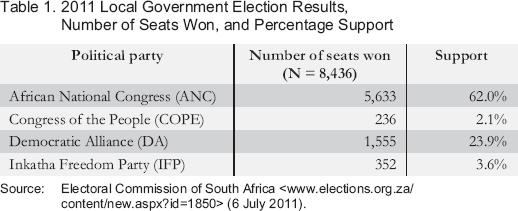
Source: Electoral Commission of South Africa www.elections.org.za/content/new.aspx?id=1850 (6 July 2011).
The analysis of political manifestos has long been conducted through the application of the critical discourse method (Fairclough 1989, 1995). Critical discourse method is rooted in, and owes much to, the progressive cultural studies and critical theory that emerged from the counter-hegemonic movements of the 1970s, 1980s, and 1990s in Western Europe and North America. As such it seeks to identify the ways in which power is articulated through text. Since the intention of this article is not to overtly criticise any political party's manifesto but merely to report upon the usage of the term “community,” the authors sought to apply research methods that would allow a neutral interrogation of the manifestos. The method to survey and report upon the number of incidents of the use of the term “community” was derived from the work of Tetlock et al. (2008).
The first stage was to secure key documents that would be used in the analysis. This involved a search of available online documents on the websites of the four “major” political parties contesting the local government elections: (in alphabetical order) the African National Congress (ANC), Congress of the People (COPE), Democratic Alliance (DA), and Inkatha Freedom Party (IFP). These “top” four political parties are all represented in the South African legislature – collectively, they currently occupy 379 (94.8 per cent) of 400 parliamentary seats.
Once secured, websites were subjected to an electronic scan using the search string “communit,” which was used to locate either the term “community” or “communities” in each political party's manifesto published on the internet. For each scan, a tally was taken of the number of occurrences of the term “community” and “communities.” A second-pass inspection was made of the occurrences of the terms “community” and “communities” in the manifestos, and a tally was taken of instances where either term formed part of a composite phrase (e.g. community activism, community gardens).
A scan and search of slogans and media advertisements containing either the term “community” or “communities” was also undertaken in available print media (daily South African newspapers) for a period commencing two months prior to election day on 18 May 2011.
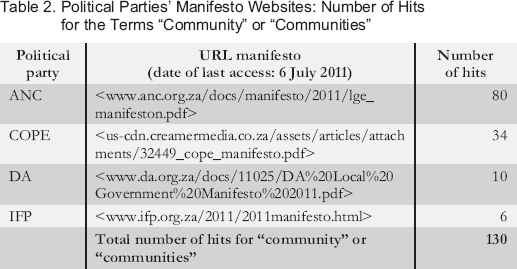
From a scan of the four political parties’ manifesto websites containing the terms “community” or “communities,” the results of the survey are reflected in Table 2.
Political Parties’ Manifesto Websites: Number of Hits for the Terms “Community” or “Communities”
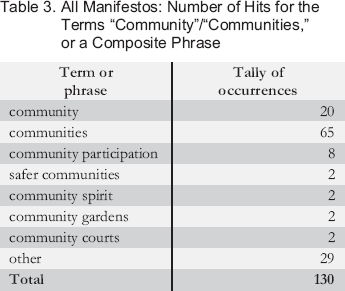
A second-pass inspection was made of the occurrences of the terms “community” and “communities” in each of the manifestos, and a tally was also taken of each instance that either term formed part of a composite phrase. A summary is reflected in Table 3.
All Manifestos: Number of Hits for the Terms “Community”/“Communities,” or a Composite Phrase
A scan and search of slogans and media advertisements containing the term “community” or “communities” in daily South African newspapers showed only one result for an ANC advertisement in the Daily News (22 March 2011), which used the following slogans: “Together we can build better communities”; “Across our country the face of communities has changed”; “We have given communities a voice and the opportunity to be active participants in the areas where they live”; “in the 2011 local government elections, because working together we can continue building better communities”.
Concluding Remarks
During the 2011 local government elections, the ANC deployed the terms “community”/“communities” to a far greater degree than its competitors – twice as often as COPE and eight times as many as the DA. However, our research design and data do not afford us grounds to postulate about why this occurred. We advocate that research be conducted on the political manifestos and campaign material for the municipal elections in 2016 to explore the deployment of the terms, as it will no doubt be interesting to see how the major current political parties make use of them. This may provide future research opportunities for this sociological construct.
Pursuant to this, we suggest that, in the study of political communication within a South African setting, “community” be recognised not as a universal good but as a locally contingent position in possibly much wider debates taking place in society. Invoking “community” in the practice of a particular activity will situate that activity in opposition to activities that are not “community”-orientated. This positioning is often locally and politically determined – to be pro community is not an absolute value but one tied to a position in a conflict or debate, as is currently being witnessed in South Africa, especially in regards to xenophobic violence. The 2016 elections will offer fresh opportunities for “community” to be deployed and articulated within party campaigns. We contend that “community” will be used to situate political parties within particular frames of reference and larger societal debates concerning the future social fabric of South Africa.