




Abstract
The discourse on indigenous knowledge has incited a debate of epic proportions across the world over the years. In Africa, especially in the sub-Saharan region, while the so-called indigenous communities have always found value in their own local forms of knowledge, the colonial administration and its associates viewed indigenous knowledge as unscientific, illogical, anti-development, and/or ungodly. The status and importance of indigenous knowledge has changed in the wake of the landmark 1997 Global Knowledge Conference in Toronto, which emphasised the urgent need to learn, preserve, and exchange indigenous knowledge. Yet, even with this burgeoning interest and surging call, little has been done, especially in sub-Saharan Africa, to guarantee the maximum exploitation of indigenous knowledge for the common good. In view of this realisation, this paper discusses how indigenous knowledge can and should both act as a tool for promoting the teaching/learning process in Africa's public education and address the inexorably enigmatic amalgam of complex problems and cataclysms haunting the world.
Societies across the world depend on their indigenous knowledge to solve their day-to-day socio-economic problems, address various environmental challenges, and adapt to change. Yet, the term “indigenous” knowledge, just like the term “indigenous” itself, has prevailed as a generic term, though it is not without problems. The term has been vilified and criticised particularly since the beginning of formal decolonisation projects across the globe such that it has now assumed a diversity of meanings, as I will show in the ensuing discussion. Some scholars, such as Paulin Hountondji (1997) and David Turnball (2000), view it as pejorative and sneering when a group of people are referred to as “indigenous” or their ideas, beliefs, and practices as “indigenous knowledge”. For this reason, even the United Nations is hesitant to use it. Rather, the UN has developed what it calls a “modern understanding” of “indigenous” (and, by proxy, “indigenous knowledge”) based on the following tenets applied to a given person or group of people: self-identifying as indigenous and being accepted by the community as a member; demonstrating historical continuity with pre-colonial and/or pre-settler societies; evincing a strong link to territories and surrounding natural resources; having distinct social, economic, and/or political systems; having a distinct language, culture, and/or beliefs; comprising a non-dominant part of society; and resolving to maintain and reproduce ancestral environments and systems as distinctive peoples and communities (United Nations Permanent Forum on Indigenous Issues n.d.: 1).
Whereas much discussion has already started regarding indigenous knowledge and the status of contemporary African development (The World Bank 1998), the current chapter resuscitates the debate, examining it in the context of public education in Africa. The paper explores the role that indigenous knowledge could and should play in public educational systems across Africa, and how this role could possibly influence the three principles of pan-Africanism – namely, collective self-reliance, self-sustaining development, and economic growth. The focus is on the potential role of indigenous knowledge in motivating, raising interest, and promoting both innovative thinking and a sense of self-consciousness in learners. The paper begins with an exploration of the concepts of indigenous knowledge and intangible heritage. This conceptualisation of terms is followed by a discussion on how indigenous knowledge can have a positive impact on learners and on some areas of schooling and society.
Understanding Indigenous Knowledge and Intangible Heritage
Indigenous Knowledge
For many indigenous populations of Africa, Latin America, and Asia, the term “indigenous knowledge” or what others have called the natives’ ways of knowing, is positively associated with the creativity and dynamic ways in which residents of a particular locality have understood themselves in relation to their natural environment (see Semali and Kincheloe 1999: 3).
In view of this understanding, the term indigenous knowledge has, over the years, enjoyed different definitions and conceptualisations (see Altieri 1995; Melchias 2001; Odora Hoppers 2001, 2002; Mawere 2012, 2014; Ocholla 2007; Mapara 2009; Shizha 2013). Emphasising the different definitions of indigenous knowledge over the years, Warren (1991) described indigenous knowledge as being synonymous with traditional, local knowledge to differentiate it from the knowledge developed by a given community from the international knowledge system, sometimes also called the “Western” system, which is generated through universities, government research centres, and private industry. This definition by Warren is limited in that when indigenous knowledge is described as traditional, it is presumed to be static. Hobsbawm and Ranger (1983: 4) have argued that being “traditional” does not preclude something being innovative or changing up to a point as new tradition can be born out of an old one (what they have referred to as “invention of tradition” [see Mammo 1999: 16]). By contrast, this article refers to indigenous knowledge as a set of ideas, beliefs, and practices (some of which have indigenous religious underpinnings) of a specific locale that has been used by its people to interact with their environment and other people over a long period of time.
Intangible Heritage
This is a term used to describe aesthetic, spiritual, symbolic, and other social values that people in a given geographical location may associate with a particular site. The social values include language, oral traditions, taboos, rituals, music, dance, knowledge forms, art, folklore, riddles, idioms, and cultural spaces (see also Deacon 2009; Chabata and Chiwaura 2014). Intangible heritage is part and parcel of the realm of indigenous knowledge given that these values can only be manifested through local ways of knowing such as traditions, customs, and practices. I should also underscore that since heritage becomes heritage only if society attaches value to it, intangible heritage, just like indigenous knowledge (of which it is part), is as important as indigenous knowledge, in many similar ways. In addition, given that intangible cultural heritage is a constituent element of indigenous knowledge, it suffered the same historical imbalances as the latter. For this reason, I will look at the importance of both indigenous knowledge and intangible heritage to the learning process of the African child at the same time. Yet, I should point out that while there are overlaps between indigenous knowledge and knowledge from the academy (what others, such as June George [1999], sometimes refer to as “conventional science”), there are also differences between the two. Below, I spell out some of the major differences between indigenous knowledge and conventional science.
Differences between Indigenous Knowledge and Conventional Science/Academic Knowledge
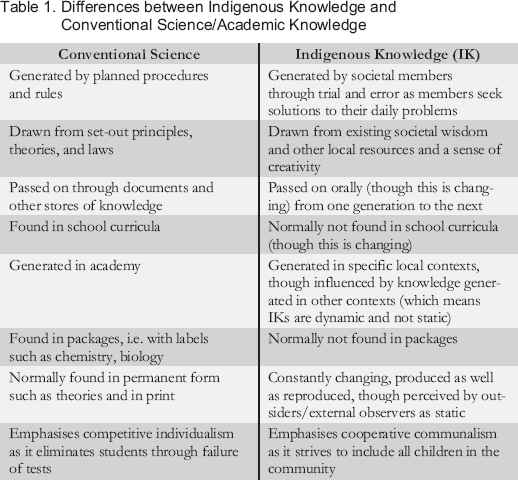
Differences between Indigenous Knowledge and Conventional Science/Academic Knowledge
In the sections that follow, I look at the role that indigenous knowledge could and should play in the teaching/learning process in the various educational systems.
Indigenous Knowledge in Educational Systems: What Role Can it Play?
Mazrui (1978: 13) advanced a critique of the ideological foundations of African education in which he regards neocolonial cultural dependency as a threat to African psychological autonomy and sovereignty, reporting,
Very few educated Africans are even aware that they are also in cultural bondage. All educated Africans […] are still cultural captives of the West.
Ngugi wa Thiong'o (1986) and Julius Nyerere (1968) opine along similar lines. These scholars realised that a racialised curriculum is a new form of imperialism – a neocolonial instrument of manipulation – to control knowledge production in the world. In view of this realisation, I argue in consensus with UNESCO (2003: 17) that
local languages are the means for preserving, transmitting, and applying traditional knowledge in schools. A bilingual or multilingual education allows the full participation of all learners; it gives learners the opportunity to confront, in the positive sense, the knowledge of their community with knowledge from elsewhere.
Rattray (1927: ix), in a sort of wake up-call to the African, had this to say:
Guard the national soul of your race and never be tempted to despise your past. Therein I believe lies the sure hope that your sons and daughters will one day make their own original contributions to knowledge and progress.
Promote Innovative Thinking as It Provides the Basis for Problem-Solving Strategies for Local Communities
As Busia (1964:17) puts it, “Traditional education sought to produce men and women who were not self-centred, who put the interest of the group above personal interest”: men and women who were innovative and represented “think tanks” of the society. This means that the inclusion of students’ prior knowledge into educational curricula promotes and enhances innovative thinking and constructivism (to use Jean Piaget's sense of the word) in the learners. This is because learners will be afforded the chance to abstract understanding from their personal experiences, their understanding of the local conditions, and what they already know from their respective communities. In Nigeria's Jigawa State, for example, one young Nigerian has invented a natural refrigeration system that does not require electricity, gas, or paraffin to operate. The system, also known as the “pot-in-pot cooling system,” is said to be as efficient as the modern refrigerator. The system can keep perishable foods fresh for up to one month. Further, it is said that three-quarters of the people in Jigawa have adopted the system, which has also helped farmers keep their perishable foods for longer periods, along with curtailing the movement of people from rural areas to towns. This reinforces the point that indigenous education was practical and relevant to the needs of society. Fafunwa and Aisiku (1982: 9–10), for instance, note that the focus of education in pre-colonial Africa was social responsibility, political participation, work orientation, morality, and spiritual values. Learning was by doing, which involved observation, imitation, and participation in all or many of the individual's societal activities. For Kenyatta (1965: 119), such education had the merit that “knowledge acquired is related to a practical need, and […] is merged into activity and can be recalled when that activity is again required.” In view of this, I argue that the invention of the pot-in-pot cooling system by the young Nigerian could have been a result of the abstraction of his understanding of a refrigerator and what he knows from experience at home (cf. Mawere 2014).
Evaluate the Effectiveness of Conventional Science and Indigenous Knowledge
Intangible heritage, the part of indigenous knowledge that deals with belief and practices, could be used by learners in science classes to evaluate the effectiveness of indigenous knowledge and conventional science in real life. Through the inclusion of indigenous knowledge into the curriculum, students are afforded the opportunity to compare and contrast different forms of knowledge for their own good and that of the society of which they are part. In fact, upon careful analysis, one notices that many so-called “traditional” communities have the same content areas as those found in formal education. For instance, many communities teach their members about beliefs and practices related to plant growth, human nutrition, childbearing, pregnancy, food preparation and preservation, medicine, animal husbandry, and others. All these areas are also taught at school in science and agriculture, which means that indigenous knowledge represents an important component of the so-called “global knowledge” on different issues. With indigenous knowledge and conventional science in the curriculum, learners are, therefore, better empowered to shake off the chains of imperial domination, make their own decisions, and chart their own destiny based on what they learn both at home and at school.
Motivate and Generate Interest in Learners
Since indigenous knowledge is knowledge that arises directly out of the children's real-life experiences, its incorporation into the school curriculum can motivate and bolster the intellectual fortunes and interests of the learners as students realise that recognition is given to what they already do, know, and say in their own communities. This resonates well with the adage “From the known to the unknown,” which suggests that indigenous knowledge, being knowledge that the learners have before they enter the academy, will no doubt inspire and stimulate their minds to abstract and even seek solutions to their daily problems using locally generated solutions. In western Mozambique, a traditional method of brewing beer (tototo) similar to the distillation system students learn in science at school, has also been invented. On realising that their fruit trees (mango, citrus, and banana) produce more than they can consume, the Mandau people of Western Mozambique have devised a traditional beer-brewing system through which they make use of the over-ripe fruits: The fruits are put into a big clay pot, where they are then boiled, turning the contents’ liquid into steam before the steam is condensed to form a colourless liquid. The liquid is a traditional beer with an alcohol content allegedly much higher than similar products manufactured commercially. Thus, in instances where students go into learning the science of distillation already understanding the tototo beer-brewing system, abstraction is much easier to achieve, and motivation and interest in technology and development issues is generated.
Teach Language and Instil a Sense of Self-Consciousness and Cultural Identity
Indigenous knowledge could also be used to teach language, recount history, reclaim humanity and dignity, and promote a sense of self-consciousness and cultural identity in learners. This is critical, as people are people because of culture. In fact, we are distinguished from other ethnic groups through our distinct cultures. Even our learning will contribute more to our society if what we know and experience on a daily basis is incorporated into our school curricula. As Busia (1964: 31–33) reports, there was a widespread expectation among many Africans before and after independence that “education should be rooted in Africa's own cultural heritage and values and have relevance to African societies.” Busia therefore felt that schools could only preserve and transmit this culture by maintaining African languages. This point was made even more forcefully by Moumouni (1968: 275), who claims that “real literacy […] can only be taught in an African language and should extend to the entire population.” Woolman (2001: 41) emphasises the same when he says that the
cultivation of oral and written fluency in local African languages is important in building self-esteem, preserving culture, and advancing the literary output and identity of African Peoples.
For him (ibid.),
the importance of African-language development is further underscored by the historical reality that early nation-building in Europe was closely linked to the cultivation of vernacular languages and literature.
Under the broadened concept of inclusive curricula and teaching materials promoted by UNESCO (2005), the local community is encouraged to contribute to active learning that responds to the cultural and physical environment of the school. Inclusive education also implies a relevant and responsive curriculum that takes into account indigenous languages along with other languages. As stated in a UNESCO Position Paper (2003: 17),
the requirements of global and national participation, and the specific needs of particular, culturally and linguistically distinct communities can only be addressed by multilingual education.
Through the study of African indigenous knowledge systems, learners can easily appreciate their language, cultural identity, and the wisdom and contribution to knowledge and technological advancement of their ancestors. In fact, the “re-evaluation of traditional education is part of a process of reclaiming cultural identity with deeper roots in authentic African traditions” (Woolman 2001: 31). The teaching of indigenous knowledge such as children's traditional games, for example, helps youths not only to be creative, morally sensitive, and innovative, but also to appreciate the contribution of forebears’ creative genius and indigenous epistemologies in the world of language, games, and physical education. Yet in schools across Zimbabwe, for instance, only non-African games such as chess, tennis, netball, and others feature. Reversing this situation in Africa is more urgent now than ever if the African people are to be mentally liberated. As Steve Biko (1970: 51) notes, African cultures were “battered out of shape by settler-colonialists” through Western education.
Promote Dissemination of Indigenous Knowledge across Cultures
The inclusion of indigenous knowledge in school curricula will no doubt help different cultures/societies to share their knowledge with each other. This is because people from different cultural backgrounds will be made to share and interact with indigenous knowledges from other cultures in a way that will allow them to appreciate and emulate them where necessary. A good example is that of the Washambaa people of the Usambara Mountains in Tanzania, who developed a land-use system emulating the climax vegetation of the deciduous natural forest through multi-story cropping, integrating annuals and perennials on the same plot. The principles were transferred to Nyabisindu, Rwanda, to be utilised in a project assisted by the Deutsche Gesellschaft für Internationale Zusammenarbeit; special multipurpose contour bunds with trees, shrubs, and grasses were added to the system and re-transferred to the Washambaa once dense population and demand for firewood had depleted the soil cover (cf. The World Bank 1998: ii; Mawere 2014).
Promote Cultural Dimension of Development
Every culture is known for something distinctive and inimitable to it. The people of the honorific name (chidawo) Chikonamombe, also known as Mashayamombe, who are of the totem Mhara (impala), are well known for their leather-tanning skills and expertise in manufacturing dyes. As revealed by Chigwedere (1980; 1982), they would rustle cattle, slaughter them, and quickly dye the hides. When questioned by the people who lost their cattle as a result of these activities, the answer that came was one seemingly showing empathy: “Mashayamombe!” In other examples, the Chopi people of Mozambique are well known for their cultural dance, timbila; the Shangaan/Hlengwe people of the Zimbabwean Low Veld are well known for their initiation rites (chinamwari/khomba), which, besides having caused a furore among imperialists and Eurocentric scholars especially during colonialism and some years after independence, has of late come to be appreciated as helping reduce the chances of HIV/AIDS infection; and the Shona people are well known for their mbira/thumb piano music normally used to accompany mbakumba dance. They are also known for their stone sculptures such as the Zimbabwe Bird and stone work such as the Great Zimbabwe Monuments. The Kalanga are well known for mat craft. All this knowledge is important in its own right. As emphasised by the World Bank's 1998/99 World Development Report, knowledge, not capital, is the key to sustainable social and economic development. Building on local knowledge, the basic component of any country's knowledge system, is the first step to mobilising such capital. Moreover, there is a growing consensus that knowledge exchange must be a two-way street. A vision of knowledge transfer as a sort of conveyor belt moving in one direction from the rich, industrialised countries to poor, developing ones is likely to lead to failure and resentment (cf. The World Bank 1998, 1999). Sharing indigenous knowledges such as those mentioned above could not only enhance cultural dimension of development but also help reduce poverty (cf. The World Bank 1998). For instance, instead of spending money on circumcision in the “modern” hospitals, one could opt for a traditional one, such as the one performed during khomba initiation rites.
Promote Interpersonal Relationships and Reciprocal Obligations
As noted by Woolman (2001: 31),
traditional education integrated character-building, intellectual training, manual activities, and physical education. The content included all of the activities, rituals, and skills required to sustain the culture and life of the family and community.
This means that traditional education placed great importance on interpersonal relationships and reciprocal obligations. Fafunwa and Aisiku (1982: 9-10) recall,
In old Africa […] the man who combined good character with a specific skill was adjudged to be a well-educated and well-integrated citizen of his community, as trades were learned by the apprenticeship system.
This marks the distinction between Western education, which emphasises competitive individualism as it eliminates students through failure of tests, and African education, which emphasises cooperative communalism as it strives to include all children in the community. Yet the task of education as a force that promotes interpersonal relationships remains critical. Busia (1964: 59), for example, notes that
the tasks of […] achieving a new social unity and cohesion can only succeed if the citizens share a common set of values and standards of public morality which are supported by law as well as public opinion.
He calls on schools to integrate groups in ways that foster associations, inter-group understanding, and cooperation. Jomo Kenyatta (1965) once observed that individuality is the ideal in life for Europeans, whereas for Africans, the ideal is good behaviour and relations with other people. As Woolman (2001: 42) observes:
In the West today, schools as well as corporations are concerned about teaching human relations, teamwork, and interpersonal skills. This has come about because of a breakdown in family and community that, sadly enough, is also a result of modernisation in Africa.
This connotes that indigenous knowledge that emphasises interpersonal relationships and human values is more urgently needed in contemporary education than ever before.
Conclusion
Indigenous knowledge, including intangible heritage, can contribute immensely to the learning process of the African people as long as value and a modicum of respect are accorded to them. In fact, the relevance of indigenous knowledge and intangible heritage to the learning process of the African child cannot be underestimated. Yet, the full realisation of indigenous knowledge can only be recognised if it is fully implemented in education curricula and if its importance is popularised. Makinde lamented over those that discard indigenous knowledge and write it off as nonsense, noting how very many African medical doctors trained in the West seek to tarnish and discourage African traditional medical doctors by painting them as having no standard, even though it was through “traditional medicine” that “many of them were safely delivered, nurtured, and successfully treated until they grew up to be medical doctors” (1988: 106). This critique of colonial and postcolonial education together with a quest for identity has prompted some African intellectuals to re-examine the objectives, methods, and outcomes of so-called “traditional,” pre-colonial education. Such studies will no doubt offer valuable insights into postcolonial education that may become a guide for reformed and constructive education in Africa. Therefore, as long as indigenous knowledge fails to find full recognition within and real integration into curricula and the mainstream knowledge discourse, the lofty pan-African ideals of collective self-reliance, self-sustaining development, and economic growth will remain an unrealised dream.