




Abstract
In the exploration phase of Uganda’s oil project, controversy arose regarding the drilling of wells on the grounds of important shrines of spirits of the adjacent Lake Albert. While the oil companies and the state looked at the market value of the land, the claimants emphasised its cultural heritage value, building a link to an international heritage discussion. This article argues that, while they have been barred from political influence on the oil project, cultural institutions such as the Bunyoro Kingdom and the claimants in the village near the controversial well used cultural heritage as a vantage point to get their voices heard and to gain negotiating power in the project. The article shows how widening of the definition of cultural heritage – which means dropping a bias for built infrastructure – has put culture alongside politics, economics, and the environment as an important factor to consider in extractive projects.
Introduction
In Kaiso, a fishing village on the Ugandan shores of Lake Albert, the Irish oil company Tullow Oil became embroiled in allegations regarding the destruction of a cultural site during its drilling of the Ngassa oil wells. 1 After drillings in 2007 and 2009, a faction of the village’s residents started claiming the wells had destroyed a shrine or site of cultural importance and angered the resident spirits. This article considers the case of Kaiso in detail and sheds light on the asymmetric power dynamics in extractive industry projects, but also the potential power cultural heritage claims can extend to marginalised groups by giving them another framework under which to make their voices heard. Rather than viewing these claims as foreign to the politics and economics of oil projects, this article considers them as a way to take part in negotiations that usually marginalise the people living on the profitable land. 2 In essence, we argue that the controversies over cultural sites go beyond the question of the protection of the cultural but are connected to quests for domination over the land and the question of who should make decisions about it and the kind of stakeholders involved.
Uganda is an up-and-coming oil producing state, with 6.5 billion barrels of oil where exploration has led to frictions and struggles over land. Oil deposits were discovered along the Albertine Graben in the Western parts of Uganda, especially in the Hoima and Buliisa districts. Unlike many extractive projects, the pace of development has been slow, as the oil project is caught in an enduring latency or “not-yet-ness” (Witte, 2017, 2018). More than a decade after the first discoveries in 2006, no oil has yet been produced. Among the claims raised by affected residents of the oil region 3 against the oil companies during their operations are those of destroyed crops, houses, and sites of cultural importance. While the compensation for crops and houses can be based on market values, the compensation for the destruction of sites of cultural importance is more difficult since the assessment of cultural heritage claims is not a straightforward task.
First of all, Uganda is a country with a diversity of cultures as there are diverse tribes, clans, and sub-clans (1995 Constitution: Third Schedule). 4 Second, cultures are not stable entities but are open to change and are constantly in the making. Some researchers have suggested that neoliberalism in Uganda has brought about cultural re-engineering, and capitalist tendencies have fundamentally reshaped values (Wiegratz, 2010: 123–136). Third, Christian churches have an influence on the legitimacy of claims based on traditional and non-Christian spirituality. Finally, from a legal perspective, the parameters of what should be protected as cultural are not clearly discernible in law and fact. The Constitution of Uganda sets out that the state shall promote and preserve cultural values and practices as long as these do not challenge fundamental rights and freedoms, human dignity, or democracy (1995 Constitution: Objective XXIV). The recognition of cultural heritage claims implies rights to compensation. These rights can come into conflict with cost calculations of the oil project. As a result, the right to culture, as provided for in the Constitution (1995 Constitution: Article 37), may be curtailed, highlighting the power dynamics inherent in oil projects.
In the following, we first describe our methodology and then set out the conceptual frame by situating the case in contemporary research on extractive projects and cultural policies. We then take a look at Uganda’s land tenure system and the process of land acquisition. This will provide the background against which we can analyse the case of the Ngassa wells in detail. In a final step, the article analyses these claims as part of cultural politics of land worldwide that seek and sometimes succeed to include cultural heritage as a factor into the calculations of large infrastructural projects next to politics, economics, and environment.
Methodology
This article is based on an interdisciplinary collaboration between a lawyer and a social anthropologist. Therefore, the methodology is qualitative, with a combination of anthropological research and the doctrinal legal analysis, commonly used in law. The doctrinal legal research uses the law as a framework of analysis, mainly focusing on laws (statutory and more), legal theories, and decided cases. The methodology covered desk review of literature and fieldwork. Furthermore, one of the authors is a commissioner who actively participated in activities of the Commission of Inquiry into Lands. 5 This experience added perspective to this analysis, since the Commission’s investigations and hearings exposed the pertinent issues concerning (compulsory) land acquisition. The ethnographic fieldwork was done between 2012 and 2015 from Hoima, with many visits to the communities on the shores of Lake Albert. The research encompassed interviews with politicians at the LC1 level, workers in the oil industry, and cultural leaders, as well as interviews at the district level with chairmen LC5 and at the national level with the Petroleum Department of the Ministry of Energy and Mineral Development and the oil companies active in the region and, most importantly, the company involved in the case of the destroyed cultural sites. Additionally, the research involved participant observation during many workshops and conferences organised by civil society, during which claims surrounding the use or expropriation of land and the destruction of cultural sites were often raised.
Negotiating Values of Land in Extractive Projects
This article contributes to research on extractive projects by focusing on the values of land in resource exploitation. An oil project can be seen as an “arena,” (Bierschenk and Olivier de Sardan, 1997), in which different stakeholders, through their interactions and negotiations, influence the present and future developments of the oil, and thus effectively “make” the oil. 6 The oil arena is not a stable entity but it is a social space constituted by the relationships between the actors. New actors can be drawn into the arena or others can decide to leave it. Some can join together as strategic groups to push their agenda and influence the negotiation. Actors bring their own interests and power registers to the arena. One such register is the speech act of claiming the cultural heritage value of the land.
Jannik Schritt (2016) has described the speech acts of naming, blaming, and claiming for the oil arena in Niger as the seizing of oil as a new idiom by well-established political actors who speak on behalf of the subaltern. We build on this understanding of claiming as a speech act by which all actors, not only politicians, emphasise their interests and the rights they assume to have. 7 Claiming cultural heritage sites can be seen as actors mobilising a register in their negotiation in the oil arena. Interestingly, these are actors that are less powerful than the state or the oil companies.
Seeing cultural sites as registers does not mean that they are merely tools and it does not discount or diminish the value people ascribe to them. We understand value not as something inherent to an object but as a process of ascription by individuals or groups (Boholm and Corvellec, 2011: 178). However, whether people truly believe in the sites or not is of less concern to this article than what people do by claiming that it is an important site to them.
Generally, it is hard to overestimate the importance of land for livelihoods and its key role in social and cultural functions in the lives of many (Nakayi, 2015). In Africa, approximately 75 per cent of land is untitled (Wily, 2013: 12) and these lands are often presented by politicians or investors as “empty land” waiting to be developed (Cotula, 2013: 86–87). While land without title may suggest that it is also without users and owners, this idea of emptiness is not true now, nor was it ever, as most of these lands were and are still owned by communities. Officially, in other jurisdictions, these unregistered lands are often owned by the state or the government, granting use rights to the customary owners (Wily, 2013: 13). In such cases, the state can assert its sovereign title/rights against individuals/communities, but it is much harder for these individuals/communities to retain their right to the land vis-à-vis a nation state in developmental gear. Unfortunately, the state does not always effectively represent the interests of the resident communities, especially when the market value of the land has increased due to the prospects of a large extractive project.
In extractive projects, both the state and operating companies are seen to be responsible for the safeguarding of citizens against the negative effects of oil exploration and exploitation. Therefore, there are standards of land acquisition that include a process called an environmental impact assessment (EIA) or environmental and social impact assessment (ESIA) (Cotula, 2013: 99). EIAs or ESIAs signify a (rediscovered) awareness of the implications that such large infrastructure projects have for the people and the environment in which the project is situated. The implementation of EIAs is founded on increasing international pressure on companies to act socially and environmentally responsible as part of their corporate social responsibility (CSR). 8 CSR is a common corporate practice in capitalist countries of the global “West” or “North” that emerged in the 1990s and is closely linked to shareholder activism and financialisation (Welker and Wood, 2011). CSR has gained currency in the developing world, with debates on it becoming pertinent in efforts to boost business, industrialisation, and the extractives (Visser, 2008). However, CSR is a practice that can only superficially display responsibility, while at the same time extending corporate power by reframing social questions in line with corporate business agenda (Rajak, 2011: 13). 9
During the exploration for oil, vast stretches of land have to be surveyed in order to determine appropriate places for test drilling. These seismic surveys involve a temporary disturbance of the people who live on this land, as security measures prohibit them from working their farms or fishing during the surveying. Many studies have shown how communities suffer from oil exploration through the destruction of their environment, which is usually the basis for their economic activities, especially farming and fishing (Breglia, 2013; Reed, 2009; Sawyer, 2004). However, responses by the state are mostly characterised by a desire to ease oil exploration activities at all costs.
In this context, claiming cultural heritage sites could also be seen as a part of the “weapons of the weak” (Scott, 1985). The subaltern, subdued by more powerful actors and ignorant of the detailed and complicated contracts, procedures, and processes of oil projects, draw on means closer to them to fight the negative impacts of such projects. While strikes or protests are known from other countries, such as Nigeria, the claiming of cultural heritage emerges in the case discussed in this article as another way of seeking attention, respect, and support from more powerful actors. However, it is necessary to note that the concept might slightly romanticise the unity on both sides of the power spectrum. The weak or subaltern in this case are less powerful than the state or the oil company, but they are quite a diverse group including well-connected national civil society activists and even the King of Bunyoro. 10 Furthermore, comparing the claiming to a strategy of foot dragging or sabotage to gain marginal (material) gains could mean undermining the cultural and religious value of the sites to the people claiming them. Nevertheless, the concept helps show that extractive communities are not entirely disempowered, passive, and hopeless and that they can join in the resource-making and connect to international discourses by invoking cultural heritage and CSR to improve their position in the oil arena.
While CSR and ESIAs pay attention to the environmental and social repercussions, a factor that is still only partially represented is the cultural value connected to land – especially landscapes that lack architectural cultural manifestations. Therefore, such sites are at risk of being destroyed unintentionally during seismic surveys or drilling.
UNESCO not only protects (built) cultural sites but also protects cultural landscapes. Since 1992, UNESCO has recognised cultural landscapes as protection-worthy since they represent the “combined works of nature and of man” (Article 1 of the World Heritage Convention) and they show the interrelated development of natural environment and human social, economic, and cultural forces. Cultural landscapes refer to sites that showcase a specific technique of land use and sustain biological diversity or are associated with beliefs and customs. In order to protect such relations between humans and their environment and the pertaining cultural practices, cultural landscapes were inscribed in the World Heritage List. 11
The definition, given in Annex 3 of the World Heritage Convention, states further that the term covers a diversity of manifestations of such interactions between the humans and the natural environment. It stresses not only the sustainability of land-use practices that have evolved over time but also the spiritual relation with nature (UNESCO, 2008: Annex 3). Examples of such landscapes are the Uluru-Kata Tjuta National Park in Australia or the Khomani Cultural Landscape in South Africa. 12 Masquelier (2002) described such sites as “mystical geography,” in which physical landmarks are not neutral but constitute “a complex phenomenal reality anchored in people’s active involvement with the invisible forces that surround them” (Masquelier, 2002: 839). The cultural sites named in the Ngassa case that this article discusses could potentially fall under the third category of the World Heritage Convention: the cultural landscape. These sites may include landscape considered to be sacred that is not visible to an unknowing eye. As the principal private secretary of the Omukama, the King of Bunyoro, put it in an interview with Witte in 2012: “Our cultural sites are not of stones like cathedrals in Europe. People know to which stone to pray to. African history is not in ruins or rubble.”
The case we discuss in this article looks at the role that cultural sites play in the negotiation of rights to compensation by an extractive industry project in Uganda. Cultural sites or shrines have long been a feature of settlement and an important part of making claims on land, as Lentz (2013: 16–17) showed for Ghana and Burkina Faso. A major question that arises when defining cultural landscapes in Uganda is who has the authority to attest spiritual relations between humans and nature.
The next section considers the legal framework in which claims to land (and hence compensation) can be made. This legal background is important in order to understand the framework in which the negotiations of the extractive project and the different acts of claiming the economically and culturally valuable land took place.
Uganda’s Land System
The biggest challenges of Uganda’s landholding system arise from the existence of multiple tenures and various layers of rights on the same piece of land, coupled with the lack of documents of title to land for some people, especially those holding land under the customary land tenure system. The current reforms under the 1995 Constitution and the Land Act of 1998 resurrected the previously impugned tenures and also reformed the law on leaseholds. The land system now recognises four land tenures: customary, leasehold, freehold, and mailo.
Mailo land dates back to an agreement signed in 1900 between Buganda and the British government during colonialism (Joireman, 2007). Under customary tenure, a specific class of people holds land on the basis of customary rules acceptable to its members, allowing for local customary regulation and communal ownership and use in perpetuity (Land Act: section 3). Uganda’s freehold tenure has its origins from the English freehold system. It is a tenure that allows for perpetual holding of land or for a period less than perpetuity on set terms and conditions (Land Act: section 3(2)). Leasehold tenure arises where the landowner(s) grant(s) another person the right to exclusively possess land for a period of time on set terms and conditions (Land Act: section 5). Except for Mailo land tenure, which is predominantly in the Buganda region, it is common to find more than two types of tenures in a given geographical area, such as Bunyoro (Troutt et al., 1992: 16–17).
This multiple tenure system creates ample opportunities for land grabbing, mainly through fraud where certificates of titles are made on land already titled as mailo, or where freehold certificates of title are issued to persons other than the customary owner and occupiers of land without any sort of title (Mwebaza, 1999: 6). It has been argued that customary tenure cannot completely disappear even where it is converted into freehold, “customary tenure is associated with many customs and taboos that may continue to apply even after the land has been converted to freehold” (Mwebaza, 1999: 6). The “customary practices and beliefs” (Mwebaza, 1999: 6) do not easily change with the changes in the registration status of the land. The dual claims to the same land have been a great contributor to land grabbing and land disputes, as revealed by the ongoing investigations on reported cases before the Commission of Inquiry into land. 13
Major reforms have aimed to redress the above-mentioned challenges (McAuslan, 2013; Shivji, 1998: 62). There have been two major land reform regimes since independence: the Land Reform Decree under President Idi Amin in 1975 and the 1995 Constitution through the Land Act of 1998 under current President Yoweri K. Museveni. The Land Reform Decree envisaged promoting easy transferability of land (through periodic leases) such that it could facilitate economic development (Land Reform Decree, 1975; Mugambwa, 2007: 44). Under the 1975 land law regime, land became a public commodity vested in the State and managed by the Uganda Land Commission. Therefore, perpetual rights to land, which arise in freehold, mailo, and customary tenures, were replaced with periodic leaseholds with development conditions. The effect of this was that individual claims of rights to land would easily be defeated by development imperatives.
The above reforms in the Land Act, the 1995 Constitution, and the situation on the ground have led to a multiple tenure system for Uganda, which promotes diversities in rights and obligations for land owners (and users) depending on the tenure under which one holds land. There are also diversities in the law applicable, where written law applies mainly to the Mailo, freehold, and leasehold landholding systems, whereas customary law applies to customary tenure. The relatively different institutional framework among some tenure systems, coupled with different norms and applicable rules, means differentiated treatment in situations of compensation. Compensation is easier to prove entitlement under tenures such as mailo, freehold, and leasehold (where there is registration) than under the customary system. Until the discovery of oil in Bunyoro, customary tenure was highly informal and less documented by certificate of title and therefore hard to prove.
Oil discovery in 2006 led to increased application for freehold titles in 2006, 2007, and 2008 (Naringiyimana et al., 2019: 165, 188) and to land conflicts (Augé and Nakayi, 2014: 12). The discovery of oil brought about large-scale land acquisitions in Bunyoro, bringing about what Niringiyimana et al. called a “curse of land dispossession” (Naringiyimana et al., 2019: 166). This is the dispossession of genuine landowners of their land without compensation, where compensation that is paid to those with fraudulently acquired titles to land has increased. A 2011 study by the NGO consortium Uganda Land Alliance claimed that almost half their respondents had reported land encroachment and land grabbing and that land disputes had increased by almost one-third since the discovery of oil (CRED, 2015: 5). The next section of this article looks at the role of land in Uganda’s oil project and particularly at the process of compensation for land or temporary land use.
Land Acquisition and Uganda’s Oil Project
Under its Vision 2040, Uganda aims to move out of the category of low-income countries by concentrating on the extractive sector of oil and gas as well as on tourism and on infrastructure development (National Planning Authority, 2013: iii). Oil exploration and infrastructure development all require land that is held either by the government or by private persons. This land can be obtained through compulsory land acquisition processes, as stipulated by the law (1995 Constitution, Article 26(2): Land Acquisition Act). As in other big extractive projects, the oil companies active in Uganda – Tullow, 14 Total, and CNOOC – ran ESIAs to consider their impact on society and the environment before starting land acquisition for drilling wells and establishing a camp site. Generally, the process of land acquisition starts once the ESIA grants its approval. The acquisition of land in Uganda for the oil project, whether for these surveys or the construction of infrastructure, involves measurement of the land and the filling of consent forms before compensation is paid. However, the reality of compensation is less straightforward.
Uganda’s legal framework on land acquisition is dispersed in a number of laws and policies, including the 1995 Constitution, Land Acquisition Act, Land Act, and the Uganda Land Policy. The Land Acquisition Act provides for the processes and procedures by which land may be taken over by government. Processes of government land acquisition or temporary use of private land in the public interest require efforts to balance the various functions of land and divergent stakes on it, including private rights. These processes and outcomes are highly shaped by political imperatives (Meinert and Kjaer Mette, 2016). Several can be characterised as land grabbing.
Furthermore, the Land Acquisition Act is relatively outdated. A recent legal challenge to it led to a declaration that it was void insofar as it does not provide for payment of adequate compensation prior to the government’s taking land from a person, as required under the 1995 Constitution. 15 In this case, the act of taking land for the construction of the Kaiso–Tonya Road in the oil region prior to compensating its owners was found to be contrary to the Constitution. 16 Article 26(1) and (2) of the 1995 Constitution embeds principles of fairness in cases of land acquisition, under its. The article emphasises that the taking should be for a public purpose, with adequate compensation paid before taking property, and the person deprived of property should have access to courts of law in case she/he feels aggrieved in the process.
Compensation is at two levels: compensation for the land itself using values set by the chief government valuer, and compensation for developments on land and crops set by the District Land Board. Among the functions of the District Land Board under section 59(1(e)) of the Land Act are setting rates and adjusting them periodically depending on the reigning circumstances or taking rates of inflation into account. Disputes on compensation rates were intended to be resolved by District Land Tribunals (Land Act: section 76(1(b)) using a guiding framework for computing compensation set in section 77 of the Land Act. The framework makes a distinction between values for buildings in urban areas (at open market rates) and rural areas (“depreciated replacement cost”). Also, customary land is rated at open market value. The District Land Tribunals do not exist in reality, and their intended roles are fulfilled by Chief Magistrates Courts. The compensation rates were an issue of contention throughout the oil region in 2012 and 2013 because old compensation rates had been used. Given the level of inflation in Uganda and the increased demand for land in the oil region, the compensation sums could not buy another similar piece of land.
According to public statements by government officials and the oil companies at civil society conferences, cultural sites should also be compensated. A good example of this was when an official from the Petroleum Exploration and Production Department 17 stated during a civil society conference that people should get compensated for cultural sites “up to the level of the disturbance” 18 . The Petroleum (Exploration, Development and Production) Act 2013 states to the effect that a landowner is entitled to fair and reasonable compensation for any disturbance or deprivation of use of the land (The Petroleum Exploration and Production Act (PEPA), 2013: section 139(1a)). Such compensation has to be made within four years from the date it accrued (PEPA, 2013: section 139(3)). Contrary to public reassurances, there is no stipulation for compensation for “cultural sites” as such. Compensation in the above law is for land or disturbance on land and it is not clear whether this extends to cultural sites. If an ESIA mentions cultural sites, however, they are supposed to be circumvented or the people claiming these sites should be assisted in transferring their valuable items.
Cultural sites have not been defined in any law of Uganda, although the Uganda National Culture Policy recognises their value for socio-economic development (Ministry of Gender Labour and Social Development, 2006: 8). This policy recognises that cultural sites can be natural or man-made. The policy promotes participatory approaches to the preservation of cultural sites that include the private sector, communities, and civil society organisations. Among the challenges in the promotion and protection of cultural sites in Uganda are the limited efforts to have all of them documented, well maintained, and popularised (PEPA, 2013: 8–10).
The cultural sites discussed in this article fall under the Kingdom of Bunyoro. The cultural leaders of Bunyoro have no official political say on what happens on “their” land in the process of oil exploration. 19 Nonetheless, cultural leaders in Uganda, including Bunyoro, demanded a share in the oil revenues. However, they cannot, as of right, claim pecuniary advantage from oil revenues. Under the laws of Uganda, minerals, petroleum, and other resources are vested in the government to hold and exploit for the people (1995 Constitution, Article 244). Under the Oil and Gas Revenue Management Policy, oil revenues are shared in a transparent manner with the local governments in the areas where oil activities take place; these are entitled to 7 per cent of the revenues since they are most likely to suffer the social consequences of oil activities (MFPED, 2012: 26). While cultural institutions are not recognised as entities entitled to a percentage directly from the government, local governments can decide to allocate a share of the royalty to recognised cultural institutions (MFPED, 2012: 28). Therefore, allocation of any revenue is not mandatory but at the discretion of the local government and the Ministry.
While cultural institutions had no official rights and were supposed to be politically abstinent, officials of Bunyoro Kingdom were present in dialogues held by civil society and the oil companies in the oil region. Furthermore, the oil companies participated in events like the empaango, an anniversary of the coronation ceremony, in Bunyoro. This is indicative of the fact that the companies recognised the cultural entity as one worthy of relating with for the “social licence to operate.” 20 So, although Bunyoro was blocked from politically participating in the oil arena, the affirmation of cultural values and the revival of cultural practices still had the potential to influence the oil-making. Indeed, the Bunyoro Kingdom supported the push for compensation based on cultural heritage claims. In the next section, we describe in detail the case of the Ngassa well, which revolves around the recognition and compensation of cultural sites.
The Case of the Ngassa Well
On the shores of Lake Albert lies the small fishing village of Kaiso. Through the oil project, the village was finally connected by tarmac road to Hoima and Kampala. The community hosted a camp by Tullow Oil that was fenced off from its surroundings and, despite its closeness, was difficult for its neighbours to access. 21 The Ngassa well was (it has since been re-naturalised in accordance with contract obligations) situated on the outskirts of the village and could be reached along a narrow sand road. The road was built with a special technique that allowed heavy machinery to pass without making a permanent road that would be difficult to re-naturalise. 22 The well itself was fenced off and guarded, and during the time of the first research visits, a Christmas tree 23 was standing in place (see Figure 1).
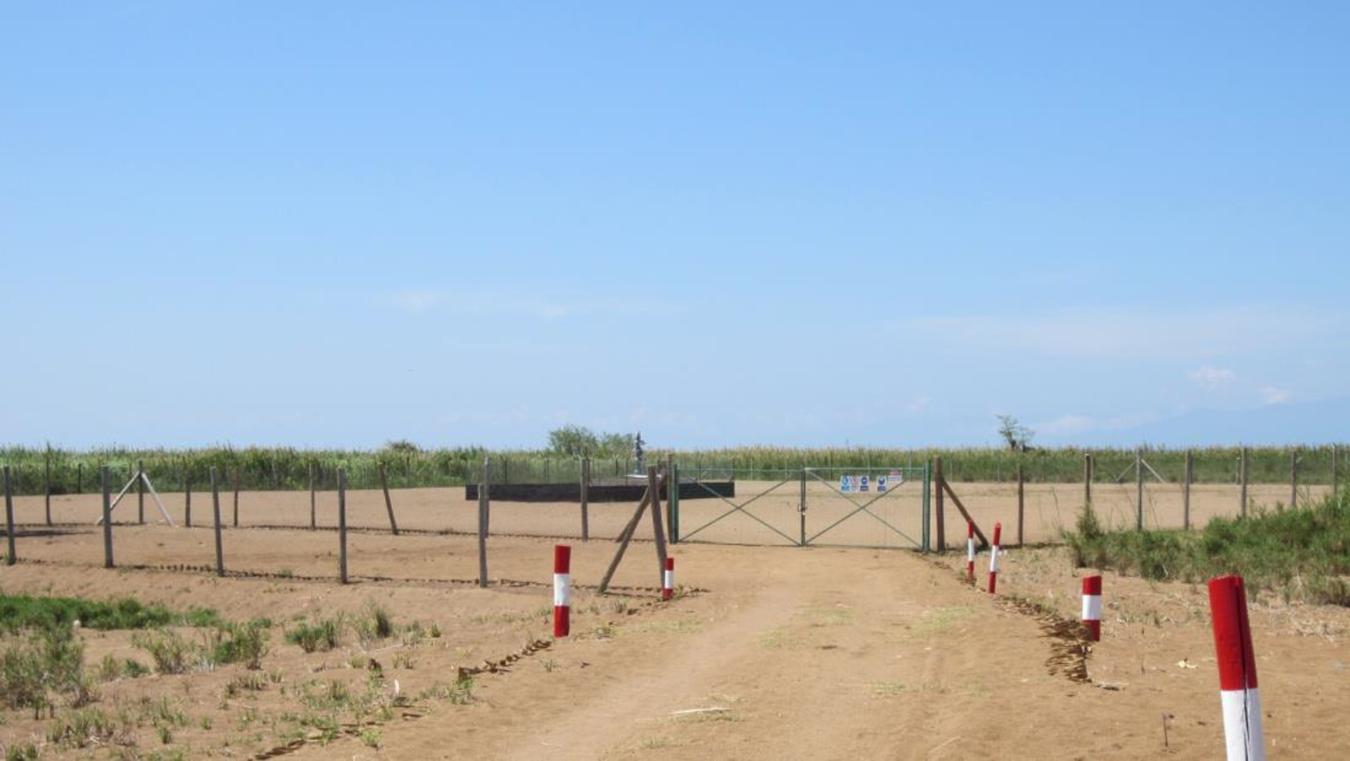
The Ngassa Well in Kaiso (Picture copyright Annika Witte, 2013).
In order to drill the Ngassa test wells in Kaiso, Tullow conducted an ESIA, which in accordance with the local leadership (here the LC1 of Kaiso) allowed for the drilling on this site. 24 The well was meant to tap into oil pockets that extended under the lake. However, after the drilling, the Abayaga 25 and Abayagakati 26 clans started making claims on that site, saying Tullow had destroyed several cultural sites, including one named after the spirit Ijomuka. 27 It is understood from interviews that the site did not involve any buildings but consisted of certain stones and was generally known to be a place of worship, although it was not visible to an outsider. The clan had raised the issue several times with the community liaison officer (CLO) of Tullow before finally putting their claims in writing. They wrote two letters of complaint, one in July 2009 and another in November 2011, which were shown to Witte by one of the complainants, who was also involved in other compensation claims around the construction of the new road. The complainants expressed their sorrow that the spirits had been enraged and that the leaders could not perform appeasing rituals because the area was fenced off. The complainants demanded that Tullow restore the site and compensate them or at least give them monetary assistance to perform a ritual for the spirits.
In interviews with Witte, some cultural leaders – that is, locally recognised custodians of tradition of the community – claimed that the spirits appeared to them in their dreams and that people had already died due to the angry spirits. Even in neighbouring Kyehoro, it was said that there were deadly accidents on the lake due to the destruction. However, it is important to note that these claims were only supported by a faction of the village, while another faction, including the Chairman LC1, insisted the sites no longer existed. They claimed that the demands were purely economically motivated while the supporters of the sites alleged the denial were caused by a general dismissive stance towards traditional beliefs.
The angered spirits not only affected the locals. The cultural leaders claimed they had also caused trouble for the oil company at this well. The cultural leader of Kaiso asserted that they would never get oil at that well and that their machines would always break down and that millions would be wasted. As it happened, Tullow did have problems drilling the Ngassa well (Tullow Oil Plc, 2007: 3). In 2014, Tullow decided to abandon the well, claiming it to be uneconomic due to complex geology, despite the company’s high expectations and having spent US$67 million on it. In August 2015, the well and the sand road that led there were closed and the “natural” or former state was restored or simulated. Overall, the oil industry had started slowing down and a drop in global oil prices has meant also a decline for Tullow, a company that is heavily dependent on the financial market (Witte, 2018: 202).
In the end, it seems the prophecies became true and the spirits won back their realm. With the closure, the cultural leaders abandoned their compensation claims, even though they had not received any compensation for the destruction. Although the site was now open to public access, Witte was told that the cultural leaders had not performed any ritual there. This inactivity was perceived by the faction opposing the cultural sites claim as evidence that the concern had been motivated by economic gains all along. 28
A cultural leader from the neighbouring village of Mbegu agreed with the claims made by the cultural leader from Kaiso. He asserted in an interview with Witte in 2013 that the Chinese – most likely BGP, a Chinese company that did the seismic survey – had destroyed cultural sites during a seismic survey for Tullow. The leader explained that the Chinese had come with their own spiritual powers and that they had destroyed many places of spiritual importance but had failed at Ngassa, where the stronger Ugandan spirits had prevailed.
Tullow’s reaction to these claims was to delegate responsibility to the state and to weaken the claims. The Stakeholder Engagement Manager of Tullow, who was the former CLO of the concerned area, said in an interview with Witte in 2013 that the company was aware of the issue but that the government should verify whether any cultural sites had been destroyed before Tullow paid compensation. Furthermore, he stressed that the site was not noted during the ESIA, when many consultations had been made but no one had mentioned it. However, he agreed that it was true that the site had been a cultural site decades ago, “where they would go and perform their cultural stuff.” He added that these religions had been abandoned. [T]hat sort of behaviour, those cult-like […] religion was abandoned. But with the advent of oil and gas they try to say ‘Aah, this used to be our site.’ There is nothing which was found there anyway. But they’ll always tell you that ‘This was desecrated’. But besides there is real need to have genuine claims. We have worked at previous sites where real tangible things are seen and […] the people have been supported to transfer their valued what? Items. There was nothing to transfer that site, ok? Just to claim that ‘We used to go there’. That’s it. People trying to make some quick money […] and they are saying ‘We had a cultural site here and we want’. You could, if you allow even that now, you could end up with a thousand cultural sites coming up with every small house becoming a cultural site. So you need to go slow over that to really establish which one, which one exactly where. […] But with the advent of Christianity also many of those former old cultural practices have died out.
In brief, a lack of clarity in the approach to designating and recording cultural sites in Uganda’s history to date and the absence of a comprehensive database allow for conjecture on matters of cultural sites. This problem cannot be delinked from land use planning. If the country had a comprehensive land use plan, land used for cultural sites would be demarcated, limiting arguments about their existence or non-existence. Attention to land use planning is something of recent times, revived during the passing of the Uganda National Land Use Policy in 2006, which declares the whole country a planning area. Therefore, no land use plans are available that could corroborate claims of land having or having had spiritual importance such as the discussed cultural sites in Bunyoro (Ministry of Lands Housing and Urban Development, 2006). Furthermore, as the LC5, quoted above, stated: easy acceptance of claims could lead to a proliferation of cultural sites that would either cost a lot of money or even stall the exploration completely.
Indeed, there are intentions to turn the whole of Lake Albert into a sacred site. In 2015, a report was submitted to the African Commission of Human and Peoples’ Rights funded by the European Union. The study highlights how communities in Hoima and Buliisa are “reviving their traditional practices and customary governance system for the protection of sacred natural sites around Lake Albert” (Chenells and Nadal, 2015).
Before we turn to a broader discussion, let us take a more detailed look at the positions these actors have taken in the oil arena and the registers they draw on. First, on the side of the claimants, incorporating the arrival of oil companies and widespread oil exploration into the belief system by representing a seismic survey as a war between foreign and local spirits can be seen as an indicator of the gravity of disturbance. Reports of the coming of foreign spirits is nothing new in Bunyoro where, for example, certain spirits called Enjungu had been attributed to the Europeans after their first arrival (von Weichs, 2013: 91). Concern over the expected loss of traditional culture that is aired by the leader of Mbegu has also been voiced by many Banyoro, although in this case the local spirits came out victorious having forced the foreign spirits out.
Notably, in his interview statement, Tullow’s manager did not entirely reject the claims. Indeed, he agreed that the sites did actually exist once but he defended Tullow’s position from three angles. First, he deflected blame from Tullow to the government. The government was to decide as it was ultimately Uganda’s money that would be used for compensation. Stipulated in production sharing agreements, the oil companies pay first but then recover that money later through oil production. Second, the Tullow manager projected the importance of the sites into the past by saying that the sites had been real at some point in time but that people had stopped using them. This argument relates to a common discourse in Uganda shaped by widespread Pentecostalism against traditional beliefs, labelling them as backward, harmful or even criminal (Vorhölter, 2014: 163–164). Nevertheless, beliefs in witchcraft are common and serve as one possible explanation for misfortune and disaster (Behrend, 2007). Third, the manager sought to delegitimise the claims based on a specific understanding of cultural sites that only recognises tangible items.
The manager did point out correctly that the village was divided on the question of the relevance of the cultural sites. Not all residents still believed in their importance. Since the sites were not noted in the ESIA, it is likely that dissenting voices were not raised or not heard. This points to a serious challenge with these assessments, as they presume communities to be whole entities that can uniformly decide on such questions. They disregard internal struggles for power and underestimate the contentious nature of land and cultural values, even within one community. Therefore, the representativeness of these assessments relies heavily on the impartiality of those undertaking it and their ability to create committees that balance all the factions that any village, whether in Uganda or elsewhere, necessarily has.
The oil exploration activities were widely publicised and this provided a platform for voices in defence of cultural sites in the oil region in Bunyoro, and an opportunity for revived consciousness about them. Together with cultural leaders, including the Omukama, the Ugandan NGO National Association for Professional Environmentalists created a map of cultural sites in Bunyoro (NAPE, 2012). As mentioned in the conceptual frame, such culturally loaded landscapes or “mystical landscapes” (Masqulier, 2002) are recognised or recognisable by the UNESCO heritage listing. Even in the public hearing of the ESIA report for the Kingfisher oil field in June 2019, Bunyoro’s Culture Minister Hajji Bruhani Kyokuhaire reminded the audience, which included the oil company CNOOC that important cultural sites of Bunyoro, such as royal tombs and burial grounds, were under threat of destruction (Okello, 2019). Therefore, the controversy speaks to the politics of oil but also to discussions of human and cultural rights (Bergs and Peselmann, 2015; Hauser-Schäublin and Bendix, 2015).
In the following, we discuss this case in comparison with other cases of attempts of establishing cultural sites or landscapes in Uganda and elsewhere. We show how these claims are not mere attempts at money-making but reveal power dynamics centred on the value of the right to land and possibilities of enforcing it. We analyse the speech act of claiming of cultural sites as a register used to influence power dynamics in the oil arena.
Land, Cultural Heritage, Power
The speech acts of claiming discussed in this article and the struggles of the communities must be viewed in the wider context of the effects of oil operations on host communities and how the state responds. For example, in Uganda, there have been various attempts to amend the Constitution Article 26 to relax the requirement for adequate fair compensation for land prior to taking it from its owner(s) (World Bank, 2017: paras 37 and 43). The argument is that this requirement leads to delays in the inception of government projects due to lack of funds for compensation. The denial of cultural sites then becomes a convenient way to dispense with obligations that may arise from the recognition of such sites like having to pay compensation.
The statement made by Tullow’s manager, cited above, that there was nothing valuable at the Ngassa well and that hence all the claims were unfounded and mere money-seeking, builds on an old-fashioned understanding of cultural sites. Recognition as a cultural site or cultural landscape is a negotiation process, which brings to the fore argumentations of what is considered valuable and worthy of protection. The definition of what is “valuable” may differ between insiders and outsiders of a community and even within one community, as the case of Kaiso shows.
In a study on the destruction of a ceremonial landscape in the United States, Stoffle et al. (2004) described how Native Americans did not get their site acknowledged before the construction of the Hoover Dam. In the 1990s then, an environmental impact study was conducted for potential sites of new bridges across the Colorado River that should reduce traffic on the Hoover Dam. Next to the EIA, the US Federal Highway Administration consulted Native Americans. However, it was not satisfied when they claimed that all proposed options for the siting of the bridge would destroy a ceremonial landscape. Despite the results of the EIA, the construction of the bridge went ahead. Only later were the sites recognised as “traditional cultural properties” (Stoffle et al., 2004: 138). In a reanalysis of this case, Boholm and Corvellec (2011: 184) illustrated how the definition of what is a risk is contingent on who considers what to be of value. Economic interests prevailed over the risk narrative of the Native Americans. This highlights the importance of power dynamics and the registers that marginalised groups can draw on to get a say in big economic projects on their lands. In this case, the public authorities did not recognise the value of the ceremonial landscape and therefore also rejected the idea of it being at risk (of destruction).
In the Ugandan case, the fact that the wells were drilled and the reactions from Tullow and the state show that they did not recognise the sites. While the Abayaga and Abayagakati sought to convince all relevant parties in the village and the government that the cultural sites were at risk and that their destruction carried risks for both the communities and the oil project, their narrative was rejected. While that case was lost, the mentioned attempt of converting the whole of Lake Albert into a sacred site points to the ongoing role of cultural heritage claims in the politics of Uganda.
However, there have been successful cases where cultural heritage claims were accepted and risks connected to their destruction were taken seriously. Cultural heritage plays an important role in Uganda but currently the only cultural heritage site is the Kasubi Tombs of Buganda kingdom situated in Kampala. Recognition of cultural sites is not an automatic process. Below, we look briefly at another case of cultural sites that were destroyed during an infrastructure project to draw out the differences that recognition of cultural sites can make. While the case of the Ngassa well is based on ethnographic data, we do not have these kind of data for these other cases. Although we can only reconstruct the cases from what is known in the public domain, we think it is important to consider them as they are legal precedents and can have a decisive impact on future infrastructure or extractive projects in Uganda.
This can be seen in the preservation of Embuga Ya Nsereko Kalamazi Basajja Subi Namwama, which is the ancestral place for the Kkobe clan of Buganda (hereafter “Embuga Ya Nsereko”) (UETC and SMEC, 2011: 132). In order to increase electricity supply in Uganda from 5 per cent to 15 per cent and also be in position to sell electricity to Rwanda and Tanzania, Uganda constructed the Kawanda-Masaka 220-kV power line under a project funded by the World Bank (UETC and SMEC, 2011: 1). The line was to pass through cultural sites. Some of the people who would be affected agreed to the idea of relocating their sites as long as such processes were preceded by rituals for appeasement of the spirits (UETC and SMEC, 2011: 38). The general belief was that if the rituals were not performed, no activity would take place on the sites; the spirits would be a stumbling block similar to what has been claimed by the cultural leaders in Kaiso since, if not appeased, spirits fight to guard their territory. Beliefs that spirits have potential to curtail projects or activities conducted on land without their approval are not new. For example, bulldozers that were brought to work on the extension of the Masaka West substation in Kabukero village broke down, purportedly due to spirits (UETC and SMEC, 2011: 38).
Eventually, Mbuga Ya Nsereko, together with some 23 commercial cultural shrines and 81 burial sites, were protected despite not being listed as cultural sites by UNESCO or appearing on any national listing. The power line was diverted to save the site. In effect, the line, which would be 135 km as per the 2006 feasibility study, ended up being 137 km, as a result of the diversions. Given the genuine concerns, couched in the language of culture, implementers of the Kawanda–Masaka 220-kV power line found it more convenient to divert the line rather than relocate the sites or compensate. The logic behind the success of this is that there would be no equivalence between the loss suffered as a result of destruction of the site and the money paid in compensation.
The examples in this article point to the fact that the Buganda Kingdom has, more than any other traditional entity in Uganda, achieved recognition of cultural sites and their preservation. Among the factors that may explain this is Buganda’s historical political and geographical position within Uganda as well as good mobilisation strategies that draw on notions of cultural belonging. Furthermore, in the case of the power line, the World Bank, which may have more rigid standards on protection of cultural sites, was involved. Additionally, a change of the geographical positioning of the line might be more easily achieved than the drilling of a well. Seismic surveys usually identify the most promising position to drill, and changing this could be more challenging and could even defeat the purpose of the entire drilling exercise, as compared to adding a few kilometres to a power line.
In this section, we have shown that the controversies over cultural sites go beyond the question of the protection of the cultural but are connected to power dynamics and quests for domination over the land and the question of who should make decisions about it and the kind of stakeholders involved. Land is as much a political as an economic resource. Staking claims, as the Abayaga and Abayagakati did in conjunction with Bunyoro kingdom and NGOs, is a political act in the oil arena. They can be read as demands for the participation in the oil revenues but couched in cultural terms. In this way, the kingdoms in Uganda that have been banned from politics and delegated to the cultural realm re-enter the political arena. They may not be part of the political landscape if politics are narrowly construed, but if we understand politics more broadly than Uganda’s division into politics and culture, as is a common perspective in social anthropology, we can see in this case how the cultural dimension of land is emphasised to stake claims on it and therewith on the political and economic development of the country.
Conclusion
This article has offered an example of the politicisation of economically profitable land through cultural means. By analysing a controversy over the destruction of cultural sites during oil exploration in Uganda’s oil region, we have shown that cultural institutions, which have been barred in Uganda from taking on political roles, have re-entered the political arena through speech acts of claiming cultural heritage sites on land in the exploration areas. This re-entry of the cultural institutions subverts the superficial division between culture and politics. In Kaiso, on the shores of Lake Albert, the oil company Tullow Oil drilled exploration wells that were later claimed by resident cultural leaders to have destroyed important shrines of local spirits. This article has shown how claiming cultural sites is another register in the oil arena with which less powerful actors can have a say in the negotiations. While this claim did not enjoy the full support of the whole community and was perceived by some as being motivated by economic gains, the claimants could draw on a shift in the perception of world heritage to include landscapes, thereby dropping a “Western” bias towards material cultural evidence. This widening of the definition of cultural heritage sites has made culture – next to politics, economics, or the environment – a relevant factor to consider in big infrastructural projects such as oil exploration and production.
Footnotes
Declaration of conflicting interests
The author(s) declared no potential conflicts of interest with respect to the research, authorship, and/or publication of this article.
Funding
The author(s) received no financial support for the research, authorship, and/or publication of this article.