



Abstract
On 20 May 2014, Malawi arranged tripartite elections for president, parliament and local councils. The elections were remarkable for several reasons, seen from both an African and a Malawian perspective. Despite an uneven electoral playing field, the elections were highly competitive, ultimately leading to the country's second turnover of power when opposition challenger Peter Mutharika defeated the incumbent president, Joyce Banda. The electoral results also show a return to regionalistic voting patterns and a continuing weakening of political parties, as independent candidates emerged as the largest group in parliament. Although the results were generally credible, the election remains controversial. Several stakeholders questioned the general integrity of the process, and significant logistical problems on election day might have harmed public trust in the electoral authorities.
Malawi held elections for president, the national assembly and local councils on 20 May 2014. This was the country's first ever tripartite election and the fifth set of general elections since the introduction of multipartyism in 1994. High levels of competition and uncertainty characterized both the presidential and parliamentary contests. For most of the campaign period, the presidential election was generally regarded a four-horse race contested by incumbent Dr. Joyce Banda of the ruling People's Party (PP), Professor Peter Mutharika of the Democratic Progressive Party (DPP), Dr. Lazarus Chakwera of the Malawi Congress Party (MCP) and Atupele Muluzi of the United Democratic Front (UDF). Ultimately, the election led to a turnover in power as Banda was defeated by Mutharika. This is the second time in the history of the Malawian multiparty republic that an incumbent president has been voted out of office. 1 The turnover is remarkable given the high level of incumbent advantage enjoyed by sitting Malawian presidents (Smiddy and Young 2009; Rakner and Svåsand 2013). Parliamentary elections were highly fragmented and resulted in a hung parliament, with independent candidates winning more seats than any of the main parties. Both the parliamentary and presidential elections reveal a return to a highly regionalized party system where geography has resurfaced as a fundamental predictor of vote choice (Kaspin 1995; Ferree and Horowitz 2010). According to assessments by external election observers, such as the European Union (EU) and the African Union (AU), the final results for the parliamentary and presidential elections are generally credible. Nevertheless, the elections demonstrated several shortcomings in electoral management and revealed persistent problems of assuring a level electoral playing field. As a consequence, the elections remain controversial and were challenged by several stakeholders. Most notably, the defeated president, Joyce Banda, tried to declare the election results null and void but was overruled by the high court. 2
The first being the electoral defeat of Kamuzu Banda in the 1994 founding election.
We are grateful to Daniel Chapman for his excellent research assistance. Michael Wahman wishes to thank the Swedish Research Council for its financial support (VR DNR 2012-6653).
Background
Malawi experienced a peaceful transition to multipartyism in 1994. The founding election led to a historic defeat of the ruling MCP party and its incumbent president, Kamuzu Banda, and to a victory for the opposition UDF and its candidate, Bakili Muluzi. Whilst party dominance has been strong in relatively stable and prosperous countries like South Africa, Namibia and Botswana, Malawi has historically exhibited high levels of competition and electoral uncertainty. Nevertheless, political parties still lack institutionalization, and political coalitions are usually highly fluid, as manifested by, for example, party-switching in parliament, a high number of independent MPs and two governing parties created ex nihilo by presidents leaving their own parties (Hartmann 2014).
A stable, three-party system emerged from the two first general elections of 1994 and 1999, with the UDF, MCP and AFORD (Alliance for Democracy) each having its respective stronghold in one of the country's three different regions. However, the stability of the party system was clearly challenged in subsequent elections (Rakner et al. 2007). After a failed attempt by the then-president, Muluzi, to amend the Constitution and remove the presidential term limit, severe succession struggles rocked the ruling UDF party, resulting in important defections. Fragmentation of parties also occurred within the MCP and AFORD over whether to support the attempt to change the Constitution (Khembo 2005).
Since 2004 very little institutionalization of political parties has taken place. Lack of intra-party democracy, especially in the process of succession within political parties, has persisted (Magalowondo and Svåsand 2009). The Malawian voter has shown low confidence in political parties by increasingly voting for independent parliamentary candidates. The 2004 election revealed high fragmentation, as Muluzi's successor, Bingu Mutharika, won with only 35 per cent of the vote. Mutharika's reform agenda began with his “zero tolerance for corruption” campaign, which was an implicit threat to his mentor, Muluzi. The gulf between Muluzi and Mutharika began to grow, and Mutharika's expulsion from the party seemed imminent. Before the party made any such move, Mutharika formed the DPP with members of parliament “poached” from the other parties (Patel and Tostensen 2006).
In the following elections in 2009, the DPP swept the polls on the basis of good economic performance, securing 112 seats in parliament and 60 per cent of the national vote in the presidential election. Mutharika won the 2009 election with Joyce Banda as his running mate. In 2011 Mutharika appointed his brother, Peter Mutharika, as president of the party, thereby sidelining Banda. As a result, Banda formed the PP. She, however, retained her constitutional right to remain in office as vicepresident. When Bingu Mutharika passed away in April 2012 from cardiac arrest, Banda was set to take control of the presidential office. Bingu Mutharika's inner circle, led by Peter Mutharika, concealed the president's death and allegedly plotted a coup to ascend to power. 3 However, the alleged coup failed and constitutional order prevailed, paving the way for Joyce Banda to take over the presidency. The floor-crossing legacy continued with about 40 MPs from the DPP defecting to the PP, the new incumbent party (Young 2014).
A Commission of Inquiry was set up to look into Mutharika's death and the alleged attempted coup to prevent the vice-president from taking over power. Full report available at www.nyasatimes.com/2013/03/07.
Joyce Banda started on a positive note, trying to rectify the mistakes of the previous government. Her first moves were to address the problems of low fuel supply and an overvalued currency, repeal some of the draconian media laws put in place by the DPP government, and mend relations with traditional external partners, particularly the United Kingdom. However, this progress came to a halt with the surfacing of a grand corruption scandal, usually referred to as “Cashgate”, involving several senior government officials. It was alleged that a number of officials accused in the Cashgate scandal were close to the president's party and made donations to the electoral campaign. The president's adamant refusal to declare her assets despite mounting public pressure worsened her public image at the 2014 polls.
According to the Constitution, local elections are supposed to be held every five years; yet, as of 2014, local elections had only been held once (in 2000). In 2010 the Mutharika government promised to hold local elections and the Malawi Electoral Commission (MEC) demarcated wards, reducing their number from 861 to 462. The government, however, abruptly reversed its own promise and unilaterally closed down the MEC based on allegations of fraud. The same year, a constitutional amendment was passed that severely curtailed the powers and role of the ward councillors.
Candidates, Parties and Campaigns
The 2014 presidential election was contested by 12 candidates, and 17 parties participated in the parliamentary election. However, only four candidates and parties were seen as nationally viable. Joyce Banda, the incumbent president, competed on the PP ticket, a party that, despite being in office since 2012, was still not clearly established and lacked the organizational capacity of earlier incumbent parties. Peter Mutharika, the brother of the late Bingu Mutharika, was the candidate for the DPP party. Although he distanced himself somewhat from his late brother's legacy, it is a commonly held view that Mutharika's campaign benefitted from some of the pro-agricultural policies set in place by the old DPP government, especially in rural areas. Mutharika remains a controversial figure due to the alleged conspiracy to unconstitutionally succeed Bingu Mutharika upon his death in 2012. Lazarus Chakwera, previously the president of the Malawi Assemblies of God, emerged somewhat surprisingly as the presidential candidate for the MCP. The selection of Chakwera, who was new to national politics, signalled a break with the past for the MCP and a chance to distance itself from its image as the old party of the one-party state. Lastly, the UDF nominated Aputele Muluzi, son of Bakili Muluzi, as their candidate. Aputele Muluzi was the youngest of the candidates and campaigned on a message of change.
The elections were not contested on a level playing field. Incumbent advantages remain substantial in Malawian elections (Smiddy and Young 2009). Results from the Malawi Election Monitor Survey verify that Banda and the PP routinely used state resources in campaigning. These resources benefitted not only the incumbent president but also PP parliamentary candidates, especially during presidential constituency visits. Furthermore, the national broadcaster, the Malawi Broadcasting Cooperation, remained biased in favour of the incumbent.
There is no consensus on why Malawians voted the way they did in the 2014 elections. The list of factors used to explain vote choice corresponds well with the general African politics literature (e.g. Bratton et al. 2012), and includes explanations such as ethnicity/regionalism, retrospective voting, issue-based voting and patronage. More research is needed to assess to what extent these different factors influenced vote choice. However, a common assessment of the 2014 election was that the campaign was more issue-based than earlier contests. One potential explanation for the increased emphasis on policies was the introduction of the first-ever televised presidential debate. All presidential candidates, with the exception of Joyce Banda, 4 attended the debate. The themes were strengthening the rule of law, combatting corruption, restoring integrity in the civil service, securing economic self-sufficiency and normalizing relations with traditional external partners. The real emphasis was on the dire state of service delivery, especially in the health sector.
Banda claimed to be busy with other campaign activities (Daily Nation, 30 April 2014).
In parliamentary elections, the trend towards higher party fragmentation at the constituency level (Wahman 2014) endured, with an average of 6.7 parliamentary candidates contesting in each constituency. Similarly, the proliferation of independent parliamentary candidates over time (Ishiyama et al. 2013) continued, with the average constituency having 2.2 independent candidates on the ballot. 5 For the parliamentary elections, civil society organizations were instrumental in arranging local parliamentary debates where local candidates were able to interact with constituency voters.
Calculations based on the official results presented by the Malawi Election Commission.
The 2014 local elections were the first to be held concurrently with national elections. A recurrent problem in the 2014 election was that candidates standing for parliament frequently campaigned on issues mainly within the local councillors’ control, such as creating boreholes and roads and providing services.
Results and Voting
Election day was marked by severe logistical problems, as the MEC failed to deliver election materials in time to a number of polling stations. As a consequence, according to a report by the Malawi Election Information Centre (2014), only approximately 30 per cent of all polling stations had opened at 6 a.m., when voting was supposed to start. Problems were especially severe in the Southern Region, particularly in Blantyre District. Poor election management ultimately harmed the credibility of the elections, and voters in some affected areas resorted to limited use of violence. To accommodate voters in affected areas, voting was extended to the next day at some centres. Nevertheless, concerns have been raised that voter turnout was affected, as voters deserted polling centres that were not open on time. Indeed, turnout dropped from 78 per cent in the 2009 election to 71 per cent in 2014. As totals were reported back from the centres, ZodiaK radio station reported preliminary results. The early announcement of results was controversial, as voting was still ongoing in some centres. The preliminary results soon revealed an early lead for Mutharika, with Chakwera as the runner-up and Banda performing surprisingly poorly, lagging considerably behind in third place.
As the MEC delayed the announcement of the official results, allegations of irregularities spread, especially as a few centres reported incidences of over-voting (the number of votes cast exceeding the number of registered voters). A dramatic turn of events occurred on 24 May, when President Banda made a public statement on national radio declaring the elections “null and void”, calling for new elections to be held within ninety days. In the statement, Banda referred to her presidential powers and cited electoral irregularities as the reason for nullifying the election. She also guaranteed that she, herself, would not participate in the fresh elections. However, as the MEC took the issue to court, they received a court order confirming that the president had no legal ability to nullify the election through a presidential directive. Although Banda's attempt to nullify the elections was legally dismissed, further controversy surrounded how to handle the issue of possible tabulation errors. The trailing MCP, PP and UDF demanded a manual recount of the vote, which would significantly delay the announcement of the official results. Several members of an apparently split MEC publically endorsed the demand for a recount. The recount was, however, effectively stopped by the High Court, which acknowledged the MEC's authority to undertake a full recount but also referred to the MEC's legal requirement to announce the official results within eight days of the election.
Presidential Election Results
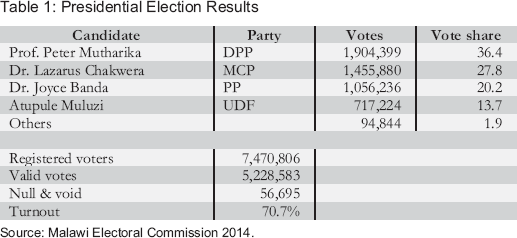
Source: Malawi Electoral Commission 2014.
The final results for the presidential election were announced on 30 May 2014. The results confirmed Mutharika as the winner with 36.4 per cent of the vote; Chakwera came in second with 27.8 per cent, Banda came in third at 20.2 per cent and Muluzi fourth with 13.7 per cent. Despite all the controversy regarding vote tabulation, the final results closely matched the results from the independent Parallel Voting Tabulation exercise carried out by the Malawi Election Support Network and were also surprisingly close to the pre-election polls carried out by the Afrobarometer. The EU and the AU, as the main external monitors, have also expressed their confidence in the official election results. The election of Mutharika and the removal of Banda is a significant event in African politics, as incumbent defeat is still a relatively rare occurrence (Uddhammar et al. 2011). For Malawi, this is the second instance of a presidential turnover.
The partisan breakdown of the parliamentary results roughly resembled that of the presidential election, resulting in a hung parliament. The DPP emerged as the largest party in parliament with 50 out of 192 seats, and the MCP captured 48 seats after a strong showing in the Central Region. However, the most notable result of the 2014 parliamentary election was the general success of independent candidates. Independents emerged as the largest block in parliament, securing as many as 52 seats. The high number of independents can be interpreted as a general sign of the weak party system and in many constituencies reflects controversial local party nominations where popular parliamentary candidates lost nominations and contested the election on an independent ticket.
Parliamentary Results
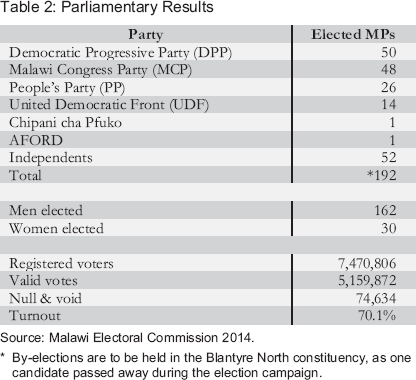
Source: Malawi Electoral Commission 2014.
By-elections are to be held in the Blantyre North constituency, as one candidate passed away during the election campaign.
The 2014 election constituted a step backwards in terms of equal gender representation, as only thirty women were elected as members of parliament, compared to forty in the 2009 election. The decline in the number of female MPs is troubling, especially as an ambitious campaign with the aim to bring female representation in parliament up to 50 per cent was rolled out before the election. Several pundits have also questioned whether the incumbent president's gender played a role in her poor performance at the polls, as voters subscribing to more traditional gender roles might have decided not to support a female candidate.
A second notable feature of the election results, for both the parliamentary and presidential election, is the re-emergence of highly regionalized voting patterns (Ferree and Horowitz 2010). Figure 1 shows a map of presidential election results by district, revealing how support in the 2014 election clustered. Mutharika won a strong majority in the South, which was not surprising, as the South is the DPP's original home region. The Bingu Mutharika regime was also able to cultivate more nationwide appeal and make major inroads outside the South. While strong support for the DPP in the South was anticipated, many analysts had expected a more fragmented Southern electorate, where the UDF and PP would also receive a significant percentage of the region's support. Ultimately, Peter Mutharika's victory can be attributed to his having a more nationwide appeal than the other candidates; Mutharika not only won the South, but also came in second in both the Northern and Central Regions. The MCP maintained its stronghold in the Central Region, a region that has remained loyal to the old dominant party since the introduction of multipartyism. Being the home region of Kamuzu Banda, the post-independence president, the Central Region was generally regarded the primary beneficiary of the long-lasting MCP rule (Kaspin 1995). The UDF received most of its support in the eastern part of the Southern Region; it is widely held that the fact that the UDF presidential candidate was a Muslim benefitted the party in that area, which is predominantly Muslim. Banda and the PP had their strongest showing in the North. Banda had been able to align with several important Northern politicians; she had also initiated several development projects in the region. Furthermore, her marriage to a Northern man might also have been a factor in the party's success there.
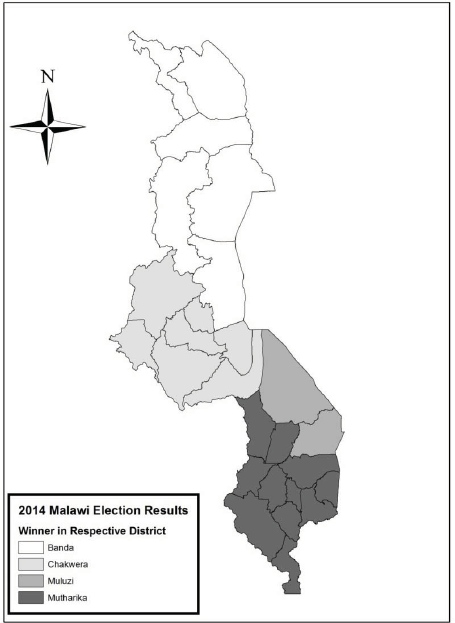
Malawi Presidential Elections 2014: District Winners
The local elections received much less attention from most major stakeholders than the parliamentary and presidential elections did. The election results broadly resemble those of the parliamentary election.
Aftermath
Peter Mutharika was inaugurated as the Malawian republic's fifth president on 2 June 2014. He will have to manoeuvre through a delicate political landscape, as he lacks a majority in parliament. It was made clear from the get-go of the new presidency that parliament intends to play an active role as opposition to the executive branch. The DPP's first heavy defeat in parliament came with the election of the speaker of the national assembly, as opposition candidate Richard Msowoya from the MCP defeated the DPP nominee. Since the defeat in the speaker's election, the DPP has made several attempts to improve its strength in parliament. Shortly following the event, 19 independent members of parliament crossed the floor to join the ruling party. This move shows a continuation of the highly controversial practice of floor-crossing, which has been embraced especially by independent members and those representing smaller parties (Young 2014). The defection to the ruling party was often explained by defecting MPs as a strategy to increase development in their home constituency. In his campaign, Mutharika had pledged to announce a “lean” government, thereby ending the patronage politics of his predecessors. In keeping with this promise, only 25 ministers were included in the initially announced government. However, the government later came under heavy criticism for the appointment of several special advisors, with critics arguing that these advisors have replaced the role of ministers in order to mask the real size of the administration. The most notable appointment in the new Mutharika government was the naming of the UDF's Atupule Muluzi to head the Ministry of Energy and Mining. The inclusion of a former rival presidential candidate in the government can be seen as a strategy to increase the government's standing in parliament. However, the UDF has insisted that they are not in coalition with the DPP.
Local Government Results
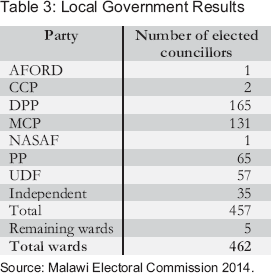
Source: Malawi Electoral Commission 2014.
The practice of firing, suspending or transferring loyalists of the previous government continues under the Mutharika government. An important case in point is that of the chief of the army, Commander Henry Odillo, who was much applauded for the role he played in the 2012 constitutional crisis where an attempt was made to cover up the death of Bingu Mutharika in order to stop Joyce Banda from taking over the presidency. One of the first moves of the Peter Mutharika government was to fire Commander Odillo on the basis of his involvement in the Cashgate scandal.
A total of twenty parliamentary election petitions were submitted to the High Court. The most controversial case was that of Lilongwe City South East, where a defeated MCP candidate had challenged the victory of the candidate standing for the DPP. After a court order, a full recount of the constituency's election results was due, but was ultimately made impossible after a suspicious fire occurred in the MEC warehouse that housed all the constituency's ballots.
Potential Reforms
The election has sparked several debates on possible changes to Malawi's electoral institutions and electoral law. Serious criticism has been levelled against the organization of the MEC, and there have been calls for a complete overhaul of the Commission. Since 1999, there has been little consistency in the MEC in terms of its personnel and its operations. As of early 2012, the MEC chairperson was the only appointed member of the commission; several commissioners whose terms had expired had not been replaced. The MEC relies mainly on apportions by parliament and aid from development partners. The funds allotted by parliament are channelled through the Ministry of Finance. This is contrary to the Electoral Commission Act's stipulation that the MEC shall control its own funds.
There has also been an important debate on corruption in electoral campaigning. With the exposure of massive corruption and embezzlement of public funds in the last two governments, demands for increased campaign-funding regulation have been getting stronger. Another oft-repeated demand is for better enforcement of laws regulating handouts of money and goods during election campaigns, a strategy that was used systematically in the 2014 election (European Union 2014).
Finally, the electoral outcomes have intensified debates on possible changes to the electoral system. The fact that the president was elected with the support of only 36 per cent of the vote has renewed calls to adopt a two-round system for presidential elections, where a simple majority would be needed to secure a victory. For the parliamentary elections, calls have also been made to consider other electoral formulas that would more efficiently break down the regional voting patterns.