




Abstract
This article, based on 16 months of anthropological fieldwork between 2005 and 2012, examines the relationship between work and masculinity among artisanal miners, or creuseurs, in Katanga, the southeastern province of the Democratic Republic of the Congo. It argues that men's involvement in artisanal mining should be considered not only as an economic survival strategy but also as an attempt to experiment with new ways of being a man in a context of economic crisis and changing gender relations. Furthermore, the article criticizes the tendency to downplay or underestimate the complexity and diversity of processes of masculine identity construction in Africa's artisanal-mining areas. In order to do justice to the intricacy of these processes, the article proposes using concepts and insights from the field of masculinity studies and distinguishing between a levelling and a differentiating trend in artisanal miners’ masculinity practices.
Since the beginning of the 1990s, artisanal and small-scale mining (ASM) has become an important source of livelihood in several parts of sub-Saharan Africa. The International Labour Organization estimates that ASM is currently providing direct employment to at least five million Africans (Hilson 2011: 1034). In the Democratic Republic of the Congo (DRC), the number of people working in ASM is staggering. According to a 2008 World Bank report, 500,000 to two million Congolese are directly involved in the artisanal extraction of minerals, with artisanal mining making up the largest segment of the country's mining sector and accounting for approximately 90 per cent of its total mineral production (World Bank 2008: 56). The province of Katanga, situated in the southeastern part of the DRC, is home to between 110,000 and 150,000 artisanal miners, or creuseurs 1 (Pact, Inc. 2010: 21). Most of these creuseurs are involved in the exploitation of copper and cobalt ores, which can be found in large quantities in the mineral-rich southern part of the province.
Throughout this article, the terms creuseur, artisanal miner, miner and digger will be used interchangeably.
In the growing body of literature on ASM, three explanations can be found for its enormous expansion in sub-Saharan Africa. One group of scholars has emphasized the importance of so-called “pull” factors, portraying ASM as a rush-type industry, which typically attracts adventurous young men who want to “get rich quick”. In their view, people's involvement in ASM is largely self-chosen (e.g. De Boeck 1998; Omasombo 2001; Walsh 2003). According to another group of authors, however, rural Africans’ decision to branch out into ASM is more often the result of so-called “push” factors. These researchers believe that becoming involved in artisanal mining activities is usually a matter not of choice but of necessity. Many smallholder farmers in sub-Saharan Africa have been forced to diversify their livelihood portfolios because an exclusive reliance on agriculture is no longer economically viable due to a series of changes brought about by structural adjustment programmes and a wide range of economic liberalization policies (e.g. Bryceson and Jonsson 2010; Maconachie and Binns 2007; Maconachie and Hilson 2011). Finally, a third group of authors has suggested that part of the explanation for the growth of ASM may also lie in the fact that certain areas in sub-Saharan Africa have a long history of mining. Since many of the inhabitants of these areas are already very familiar with working in the mines, it seems only logical that, in times of need, they become involved in ASM in order to stay afloat (e.g. Hilson 2010; Rubbers 2004; Geenen 2013; Perks 2013).
The aim of this article, which is based on 16 months of anthropological fieldwork in the area around Likasi between 2005 and 2012, is not to assess whether and to what extent Katangese men's massive involvement in ASM is due to “push” or “pull” factors or to the long history of industrial mining in the region. Instead, I contend that men's participation in artisanal mining can also be seen as an attempt to retain a sense of individual achievement and masculine working pride in a context of economic crisis and rapidly changing gender relations. By spending their days in isolation, I will argue, miners are able to experiment with new masculinities – that is, with new “cluster(s) of norms, values and behavioural patterns expressing explicit and implicit expectations of how men should act and represent themselves to others” (Lindsay and Miescher 2003: 4). The article will also show that it is possible to distinguish between two trends in the masculinity practices of Katangese artisanal miners: a levelling one and a differentiating one. I use the expression “levelling trend” to describe the efforts of Katangese miners to become a distinct social group with a number of shared characteristics in terms of masculinity. In the course of this article, evidence will be given that miners try to distinguish themselves from other men in Katangese society by displaying what they themselves consider as a distinctive kind of behaviour. In doing so, they aim to establish a collective social identity: They want to create the impression that they make up a separate category of men. When I use the expression “differentiating trend”, I refer to the fact that, despite their efforts to foster a common social identity, miners are still very well aware of differences amongst themselves. They all develop their own styles of masculinity and they all have their own ways of dealing with the masculinity ideals that exist in the immediate environment of the mines.
It might be argued that the aforementioned insights are not entirely new. First of all, it is true that there is already a large body of scholarship on African postcolonial “youth cultures”, which are frequently characterized by mixtures of local and globalized images, beliefs, symbols, ideas and (linguistic) practices, and which have been coupled with the emergence of transgressive, defiant and sometimes even criminal styles of behaviour (e.g. Honwana and De Boeck 2005; Abbink and van Kessel 2005; Selikow et al. 2002; Stroeken 2005; Biaya 2005). As Diouf has pointed out, the emergence of these youth cultures can be attributed to the fact that “excluded from the arenas of power, work, education, and leisure, young Africans construct places of socialization and new sociabilities whose function is to show their difference, either on the margins of society or at its heart” (2003: 5). The lifestyles of Katangese artisanal miners are in many ways similar to those of East African hip hop artists (Ntarangwi 2009), West Africa's Rastafarians (Savishinsky 1994), and South Africa's tsotsis (Hurst 2009), who are all trying, through the creation of counter-cultures, to construct their own identities, to carve out spaces for themselves, and to lead meaningful lives in environments dominated by poverty, adversity, inequality and oppression.
Second, several authors have already highlighted the male-dominated nature of both the industrial and the artisanal components of the mining industry across the globe (e.g. Ballard and Banks 2003: 302; Heemskerk 2000; Lahiri-Dutt 2011). Moreover, since the early 1990s, anthropologists studying mining issues in sub-Saharan Africa have become increasingly aware of the fact that miners tend to develop their own forms of masculinity that are sometimes different from those of the outside world. There is a growing recognition that individuals’ participation in so-called “mining cultures” has a strong impact on the way they think and behave as men. Several anthropological studies of mining environments in Africa have hinted at the parallels between staying in a mining camp or compound and going through a male initiation ritual (Harries 1994; Moodie 1994), or have argued that miners share the same habitus (De Boeck 1998; Grätz 2003) and the same consumption patterns, leisure activities, risk-sharing arrangements, moralities and modes of communication, which are all believed to have a profound influence on the ways miners express and act out their manliness (Walsh 2003; Werthmann 2003; Grätz 2009).
Having said this, in my opinion, many of the existing studies on the relationship between mining and masculinity in sub-Saharan Africa have one major shortcoming: They create the erroneous impression that, within a given mining community, there can be only one style and one ideal form of masculinity. Cros and Mégret, for example, have suggested that the orpailleur (gold digger), a man attracting attention because of his propensity for risky behaviour, ostentation and extravagance, is the only ideal of masculinity in the artisanal gold-mining area of southeastern Burkina Faso (Cros and Mégret 2009: 149–152). Likewise, in an otherwise brilliant ethnography of the world of artisanal diamond-mining along the Congolese–Angolan border, De Boeck has stated that he believes “the construction of masculinity and male identity by the bana Lunda 2 to be modelled upon a whole habitus of male person- and elder-hood that is deeply rooted in longstanding moral matrixes and practices that are also exemplified by the hunter” (De Boeck 1998: 793).
Bana Lunda literally means “children of Lunda”. The term is used to designate a group of young Congolese who travel to the Angolan province of Lunda Norte to dig for diamonds. Most of these diamond diggers belong to the Lunda ethnic group.
Arguments like these fly in the face of a growing body of evidence from the field of masculinity studies that shows that there can be multiple and competing masculinities within one and the same cultural setting (Cornwall and Lindisfarne 1994; Miescher 2003; Lindsay 2003), that it is important to pay attention to changing power relations between different masculinities (Connell 2005; Morrell 1998, 2001), and that scholars should be aware both of the hybridity and context-dependent character of masculinity practices (Demetriou 2001) and of the role played by variables such as race, class and age (Morrell et al. 2012). By applying concepts and insights from the field of masculinity studies and by making a distinction between a levelling and differentiating trend in the masculinity practices of Katangese creuseurs, I intend to highlight the dynamics, diversity and complexity of processes of masculine identity construction in Africa's artisanal mining areas.
The rest of the article is structured as follows: In the first part of the text, I will show that the rise and decline of industrial mining in Katanga have had a profound impact on the relationship between work and masculinity. Whereas, during colonial times and the early years of Congolese independence, Katangese men knew they could earn respect, admiration and prestige by performing wage labour for big companies like the Union Minière du Haut-Katanga (UMHK), since the 1970s the economic crisis has made it increasingly difficult to achieve the male breadwinner ideal. In the second part of the text, I will show that, thanks to their involvement in artisanal mining, large groups of Katangese men have been able to develop new ideals of masculinity and have managed to construct new masculine identities.
The Changing Relationship between Work and Masculinity in Katanga
In many places in the world, paid work constitutes an important source of masculine identity, status and power. Men's personal success in the workplace is very important for the construction of their gender identities. Moreover, men who are lucky enough to be engaged in formal employment enjoy the advantages of having access to economic resources, skills and experience, career progress and positions of power and authority (Collinson and Hearn 2000: 62–63).
The Rise and Decline of Industrial Mining
In Katanga, the arrival of industrial mining during the first half of the twentieth century gave rise to the emergence of a male breadwinner ideal among workers of the UMHK, the colonial predecessor of the parastatal mining corporation currently known as La Générale des Carrières et des Mines (Gécamines). For several decades, UMHK employees and the members of their households were able to enjoy various types of social benefits such as food rations, healthcare and education, which were offered to them as part of the company's welfare policy (Dibwe dia Mwembu 2001; De Meulder 1996). An important implication of this policy was that it contributed to a gendering of social rights. The benefits and privileges granted to the workers and their spouses were shaped by assumptions about their respective gender roles. While men were treated as family providers, women were considered as “the ones who were provided for” (Cooper 1996: 467–468). 3 Several generations of Katangese boys grew up with the idea that, in order to be recognized and treated as real men, it was absolutely essential for them to get access to paid work, or kazi. They were taught that men's dignity and respectability depended to a very large extent on their ability to secure the livelihoods of their household members.
See also Powdermaker (1962) for an analysis of the impact of industrial mining on gender relations in Northern Rhodesia.
However, as a result of the gradual decline of the industrial mining industry during the reign of President Mobutu, 4 it has become increasingly difficult for Katangese men to be reliable breadwinners. Unlike their fathers and grandfathers, they could no longer be sure they would have access to salaried employment and be able to take care of their wives and families. They were forced to engage in various sorts of informal economic activities to make ends meet, and had no other option but to allow – and even encourage – their spouses and children to find additional sources of income as well. As Petit and Mutambwa pointed out in their analysis of the current living conditions in the Katangese capital of Lubumbashi, the economic crisis had “tremendous effects on everyday life, especially on gender and age relations, since heads of households lost their central role in the economic activities of the household” (Petit and Mutambwa 2005: 471).
For a detailed analysis of the different factors that contributed to the decline of the industrial mining industry in Katanga, see Rubbers 2006.
The anxiousness and despair of Katangese men in the face of a wide range of unemployment-related difficulties are nicely illustrated by Mambo Inanipita (“I am overcome with problems”), a play by the Lubumbashi-based theatre troupe Mufwankolo. 5 In Mambo Inanipita, Mufwa, a company worker who has just been fired, tells the bad news to his wife, who responds dramatically: 6
The Mufwankolo troupe is very popular in Katanga because their plays are performed in Shaba Swahili and because they portray local life in a funny but realistic manner (Fabian 1990).
The transcript of this play was found on the website “Archives of Popular Swahili”, www.lpca.socsci.uva.nl/aps/vol6/mufwankoloentretiensketch.html (20 August 2010).
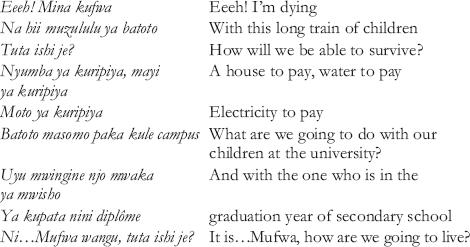
Much to his dismay, Mufwa notices that his sudden dismissal causes an avalanche of financial problems. His children are expelled from school because he is unable to pay the school fees, his wife – who has just given birth – is not allowed to leave the hospital because he fails to cover the expenses, and at home he has no electricity or running water because unpaid bills continue to pile up. While one of Mufwa's daughters is so desperate that she restores her relationship with a wealthy ex-boyfriend (who she thinks is capable of taking care of her financially), Mufwa himself decides to sell several expensive electrical appliances to a friend in order to satisfy the most urgent financial needs of his household members. Katangese citizens who go through difficult times themselves know that Mambo Inanipita paints a fairly realistic picture of the types of problems unemployed men are facing. There are more and more cases of men who find themselves humiliated and scorned by their household members because of their inability to perform the role of reliable male breadwinner (André and Godin 2012; Rubbers 2013).
Artisanal Miners Experimenting with New Ways of Being a Man
Many Katangese men have tried to overcome the difficulties associated with the decline of the industrial mining industry by becoming involved in the artisanal mining sector. The beginning of artisanal mining's popularity in Katanga dates back to the end of the 1990s, 7 when the government of the late President Laurent-Désiré Kabila decided to legalize ASM in Katanga in order to alleviate the negative consequences of the decline of industrial mining. The authorities in Kinshasa hoped that by giving the Katangese population free access to certain mining concessions, it would be possible to avoid large-scale social turmoil.
The artisanal mining of gold and diamonds in other parts of the country witnessed a dramatic expansion in the early 1980s. This was the result of a liberalization programme initiated by Mobutu in 1981 and 1982 (see Kennes 2002: 604).
Their hope proved justified. In the months and years following the official recognition of the artisanal mining sector, tens of thousands of men, women and children moved to the mining areas to find new sources of income. Today, creuseurs are working in two different places: either legally, in concessions granted to them by Gécamines per the instruction of the Congolese government, or illegally, in concessions belonging to private companies or to Gécamines. Organizing themselves in teams of four to six, the creuseurs supply minerals to middlemen, or négociants, who, in turn, arrange for the transport of the minerals from the mines to the warehouses of maisons (buying houses) established in Kolwezi, Likasi and Lubumbashi, Katanga's three main mining hubs. Only the maisons are allowed to sell minerals on the international market (Rubbers 2004: 34).
The Levelling Trend in the Masculinity Practices of Creuseurs
During their stay in the mining areas, Katangese artisanal miners live on the fringes of society, in both a literal and a figurative sense. Not only do they work in places far away from villages and cities, but people outside the mining business also consider them as marginal figures (see also Fisher 2007; Tschakert and Singha 2007). As a result of this, artisanal miners have decided to follow the example of marginalized youth in other parts of sub-Saharan Africa (Honwana and De Boeck 2005; Abbink and van Kessel 2005) by creating their own counter-culture and by defining themselves as a separate category of men, whose lifestyle is radically different from that of other men in Katangese society. Borrowing the terminology of Victor Turner (1967), one could describe them as “liminaries” or “edgemen” who are in a position of “betwixt-and-betweenness” and who feel that society's rules and conventions do not apply to them because they live and work in conditions that are out of the ordinary (see also Grätz 2009: 14; Mégret 2011: 392; Nyota and Sibanda 2012: 138).
Creuseurs take pride in the fact that they are doing a very dangerous type of work. Digging mineshafts tens of meters under the ground without wearing helmets and without having the necessary equipment to shore up their tunnels, they realize that they run a serious risk of injury or even death. One digger I met in the course of my fieldwork described his emotions upon going down the mineshaft as follows:
When we go down into the mineshaft, it is as if we are already dead. We don't know if we will be able to get out again. 8
All the interviews with Katangese artisanal miners were conducted in Shaba Swahili and recorded with a tape recorder. I am greatly indebted to Santa Katwe-Teba, Numbi Kaboto and Jerry Kalonji, each of whom assisted me during the interviews and helped me with the translation.
Diggers describe the mine as a “place of danger” (fwashi ya danger), where they stare death in the face. Considering themselves as “condemned men” (condamnés à mort), they encourage one another to be courageous and to put their lives at stake. Every digger knows that he can earn respect from his fellow workers by displaying bravado and behaving stoically in dangerous circumstances.
Creuseurs know they might be digging their own graves, and they are convinced that their chances of survival depend, to a large extent, on their own preparedness to work together as well as possible. An expression often used in this context is kazi ya creusage ni mapendo or “the work of digging is (a matter of) love”. In the narrow, subterranean space of the mineshaft, there is no room for disagreement, only for perfect harmony. As Grätz noted in an article on artisanal gold-mining in northern Benin, “friendship relations […] help to reduce complexity in an uncertain context, and to create a minimum of trust […] and hence the basis for everyday interaction” (2004: 96).
Each time a deadly mining accident occurs, diggers take to the streets en masse in order to join the funeral procession. They have the habit of singing a series of songs filled with lewd remarks (matouches) called “fetish songs” (chansons fétiches) or “riot songs” (mimbo ya fujo). From the names of these songs, it can be gathered that they are intended to upset and scandalize ordinary people attending the fu, neral.
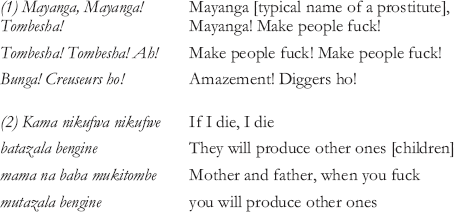
The funeral procession is a unique opportunity for the participants in the Katangese mining subculture to present themselves as a distinctive group of people, living together in isolated places and sharing a wide range of ideas, experiences and practices. Creuseurs want to show the outside world that, because of the harsh and dangerous conditions they work under, they have the right to behave like crooks. 9
The deviant behaviour of creuseurs during funerals is less exceptional than one would think. Several authors have pointed out that during funerals people in sub-Saharan Africa do not have to obey the rules and regulations that apply in daily social life (see De Witte 2001; De Boeck 2008).
As a matter of fact, diggers describe deviant behaviour vis-à-vis the outside world in terms of impoliteness and delinquency. A person displaying deviant behaviour is called impoli (impolite) and described as a voyou (rascal). The umbrella term kivoyou – which can be translated as “the style of being deviant or of behaving like a rascal” – refers to an extensive register of acts and types of conduct such as swearing, wearing eccentric or expensive clothes, cross-dressing, drinking excessively, being disrespectful towards senior members of society and using hindubill – a kind of tongue-in-cheek “underworld” slang derived from French, English, Swahili, Lingala, Luba and other African languages (see also De Boeck 2004: 36–39) which serves as an “anti-language” (Nyota and Sibanda 2012) or Foucauldian “counter-discourse”, aimed at “clearing a space in which the formerly voiceless might begin to articulate their desires” (Moussa and Scapp 1996: 88). Since there is a considerable degree of group pressure to behave like a rascal, it seems appropriate to consider the kivoyou style as a cornerstone of the levelling trend in the masculinity practices of artisanal miners. According to some of the artisanal miners interviewed by the Belgian anthropologist Rubbers during his fieldwork in the Likasi area, the voyou mentality is like a virus that “contaminates” people and has the capacity to transform even the most well-behaved, responsible and law-abiding individuals into troublemakers (Rubbers 2013: 224–225). One of Rubbers’ informants uses the term voyou-cratie as a synonym for kivoyou (ibid.: 223), thereby not only highlighting the power of creuseurs’ behavioural style as a “weapon of the weak” (Scott 1985), but also underlining its inescapability: Apparently, it is very difficult for an individual digger to avoid participating in kivoyou.
Of course, there is quite a bit of variation in how people take part in kivoyou. Those who seem to get most pleasure from posing as “crooks” are young men in their teens and twenties attempting to present themselves as youthful and priding themselves on not being accountable to anyone. One of my informants, who preferred to be called Johnny Walker as a tribute to the famous whisky brand, explained his own behaviour as follows:
Mujinga [an older digger standing next to Walker as the latter was speaking] will have some consideration for his children. But, personally, I don't bother about that. I need to make a lot of money myself. If I earn a lot, I feel good. He will have compassion for other people and stuff. That's a difference. […] I will find me a prostitute, dress well, smoke drugs, drink lutuku [artisanal whisky] (laughs). That's all!
Youngsters like Walker jokingly say they are living according to the “daily rate” (taux du jour), a moneychanger's expression intended to capture the idea of living from day to day. In mining areas where a lot of money is circulating, diggers often compete with each other about who has the nicest clothes, who is the biggest spender on alcohol and who goes to the hookers most frequently. Jean-Pierre, a young digger who spent some time working in the mine at Milele, 10 described his memories of this atmosphere of wasting money (kuchoma makuta: “to burn money”) and being competitive in the following terms:
Milele is a mine site in the territory of Lubudi, situated approximately 120 kilometres northwest of Likasi.
We got totally absorbed by the ambiance, wasting money. You know, there you had “proving”. You saw what another digger was doing, you imitated him and you tried to outdo him. […] For instance, your friend bought shoes worth 25,000 francs. He wore clothes worth 450 dollars. You wanted to show that you surpassed him and so bought clothes worth 650 dollars.
Although the prices mentioned by Jean-Pierre obviously need to be taken with a grain of salt – it seems highly unlikely that diggers are actually capable of spending as much money as he claimed – his testimony does give a good impression of the importance given to ostentatiousness in areas like Milele. An interesting synonym for the word “proving”, incorporated from English, is the Swahili verb kuvimba, which means “to swell”. According to another interviewee, Papi, who had started working as a miner in 1997, kuvimba is to be interpreted as the authoritarian conquest of public space by behaving like a big shot:
You pretend to be very important, although you don't have any money in your pocket. Even if you only have a little money, you will start swelling, you will even knock over other people. You make it clear that you'll spend all the money you have. It's like walking around with the [Congolese] state in your pocket.
It is, of course, not a coincidence that Papi associates the boasting of a cash-strapped digger with the Congolese state. Apart from making a cynical comment on the situation of the Congolese treasury, he also wants to highlight the necessity of taking part in the mining community's daily festivities to keep up a good front. In Papi's opinion, it clearly makes sense to invest a lot of time and energy in putting up a beautiful façade for yourself, even if you know that terrible ruin is hidden behind it.
Many people identifying with the style of kivoyou tend to justify their own wastefulness by saying “my body is my capital” (maungo yangu ni capital). This expression serves not only to indicate that they consider their body as an instrument that helps them earn money whenever they want, but also to point out that they can use their body to present a certain image of themselves to the people around them. From this perspective, it is important to take good care of one's body and “make it happy” (kufurahisha maungo) by eating a lot, wearing expensive clothes and drinking alcohol to relax one's muscles.
The monetary habits described above bear strong similarities to the patterns of what researchers have termed “frivolous squandering” in gold-mining camps in Burkina Faso (Werthmann 2008), “daring consumption” among sapphire miners in northern Madagascar (Walsh 2003) and “ostentatious spending” among diamond miners in southwestern DRC (De Boeck 1998). Nevertheless, what is different in Katanga is that revenues generated by resource extraction are not considered ill-gotten wealth. 11 Mining money is not believed to damage people's well-being or social relations. If many creuseurs have developed the habit of squandering their money, this is mainly because they want to distinguish themselves from other men in Katangese society, including their fathers and grandfathers, who, during their own childhood and adolescence, were taught to become responsible male breadwinners. Today's artisanal miners like to create a distinct profile for themselves as liminal figures who are experimenting with new ways of being a man and who are therefore handling their money in unconventional ways.
Shipton (1989) coined the term “bitter money” to describe how Luo farmers in eastern Kenya believe that certain ways of earning money are evil and bring bad luck. Many artisanal mining communities around the world have similar beliefs about mining revenues being dangerous and destructive (see, e.g., Clark 1993; High 2013).
The Differentiating Trend in the Masculinity Practices of Creuseurs
That said, while creuseurs tend to behave like a special group of men with a number of shared characteristics (cf. the kivoyou style), they are also conscious of the differences amongst themselves. As the following section will show, they distinguish between different types of masculinity, associating each of these types with a fixed configuration of practices. One gets the impression that miners use these masculinity types as templates or models upon which to construct their own masculine identities. This confirms the observations of Cornwall, who has argued that it is better to focus on “attributes persistently associated with idealized versions of being a man” than to concentrate on the gender identities they describe, and who has also pointed out that “particular ideals of masculinity may be enacted and identified with in different ways by different men” (Cornwall 2003: 234). Just like the Ghanaian teachers studied by Miescher (2005) or the Nigerian railway workers examined by Lindsay (2003), Katangese artisanal miners construct their masculinities by mixing practices from various origins, by giving personal interpretations to the ideals they identify with, and by changing their attitudes towards these ideals according to the situations they are in and the interests they are pursuing at particular moments in their lives.
Creuseurs displaying a hedonistic lifestyle are called “children” (batoto) because they do not seem to shoulder the responsibility for the livelihoods of other people. In most cases, they are not married and they do not have children. A masculinity type often associated with them is that of a “heat swallower” (meza moto). Usually, the term meza moto is used to designate a daredevil, someone who is fond of dangerous situations (mpenda hatari), who does not mind putting his life at stake and does not seem to consider the consequences. A meza moto does not shrink away from asking for money from a large number of people at the same time, even if he knows perfectly well that he will be unable to settle his debts. Each time he arrives at a mine, he follows the same pattern: First, he wins the confidence of the people he wants to collaborate with, then he pockets their money, and, as soon as he notices he is about to be cornered by his creditors, he travels to another mine to repeat the strategy. Victims of a meza moto – such as moneylenders failing to recover their capital or ex-teammates saddled with the task of cleaning up the financial mess – realize it is useless to file a complaint against such a swindler (escroc) because the authorities lack the capacity to track him down.
André, a creuseur working in the copper mine of Kalabi, is in his late thirties and loves to act as a meza moto, a daredevil who has debts with a large number of people. After a short career as an employee of a butter company in Lubumbashi, he became involved in artisanal mining, first digging for diamonds in the border area between Congo and Angola and then moving to the Likasi area in order to mine for copper and cobalt ores. In the mine, he usually works stripped to the waist, wearing a baseball cap with the visor turned backwards. To anyone who is prepared to listen, he will tell long and wild stories about his time as a boxer, bragging about the fact that he used to be feared for the number of punches he could throw per minute. He is also proud of his nickname, Changaipondo, which, according to him, refers to his habit of mixing different types of alcoholic drinks and to the fact that he once tried to seduce both a mother and her daughter during a night out in the bars close to the mine.
Among Katangese artisanal miners, the meza moto, the form of masculinity enacted by André, is one of the dominant or “hegemonic” (Connell 2005; Morrell 1998) ways of being a man. There is a great deal of admiration for men who are experts in beating the system and outwitting their opponents through the use of trickery and shrewdness. The economic crisis and the daily struggle for survival in Katanga have given rise to the revalorization of trickster behaviour. It is increasingly considered acceptable to violate state laws and to deceive or steal from the rich and more powerful, especially if the latter are not prepared to share their wealth with the less fortunate. In the same way as people in Katanga in precolonial and colonial times used to admire the cunning hero in their traditional folk-tales, today's creuseurs admire the guile and craftiness of the meza moto (Petit and Mutambwa 2005: 481).
The term pomba – which is considered synonymous with expressions like “burly fellow” (costaud), “big digger” (creuseur munene) and “muscleman” (muntu mwenye nguvu) – is used to describe a second ideal of masculinity in Katanga's artisanal mining community. A pomba is someone with great power, dynamism and stamina. Creuseurs maintain that only hard work allows the pomba to obtain a good body (maungo ya bien) and to swell (kuvimba). In order to impress people in his environment with his muscled arms, a pomba will often wear a sleeveless shirt called a “broken arm” (bras cassé). The popularity of the pomba ideal highlights the importance of bodily aspects of masculine identity construction. In a study on the construction of masculinities among Canadian prisoners, Ricciardelli has demonstrated that in hypermasculine environments such as prisons, where physicality and aggressiveness play a crucial role in daily interaction, individuals tend to associate muscularity with strength and physical prowess. Muscled men are seen as tough, powerful and dominant – in other words, as people who are “not to be messed with” (Ricciardelli 2013). 12 Although in Katanga's artisanal mines physical fights do not occur all that frequently (and certainly not as often as in the Canadian prisons studied by Ricciardelli), creuseurs still find it important to signal to their fellow workers that they are no pushovers, that they know how to stick up for themselves and that they are capable of performing the harsh physical labour expected from them in the mines.
For a similar analysis with regard to the role of violence in the construction of masculinities among South African gold miners, see Breckenridge 1998.
The third ideal of masculinity that can be found in Katanga's artisanal mines relates to the qualities of ostentatiousness, generosity, sociability and capacity to share. When a miner has a lot of money and is considered successful, he is called mubinji and expected to regularly treat his fellow workers to drinks. If he manages to meet this expectation, people will say that he is a merrymaker (ambianceur) 13 and that he behaves like a wrestler (catcheur) – that is, like a generous person, someone who “allows his money to see the sunlight” (yake inaonaka jua) and who “fights with open hands”. The mubinji is thus admired not only because of his capacity to show off, but also because of his preparedness to respect a number of sharing obligations and reciprocity norms, which constitute vital components of the moral economy of Katangese artisanal miners (see also Grätz 2004: 103–104; Walsh 2012: 239).
For a historical analysis of the notion of ambianceur and a discussion of its roots in the Congolese urban culture of the late 1950s, see Biaya 1996.
Artisanal miners advocating a more ascetic lifestyle are called “adults” (bakubwa). They usually try to achieve a fourth masculinity ideal in the mining environment: that of the responsable, someone who tries to cut back on the expenses for personal amusement so that he can send his wife and children enough money to buy food rations. The responsable prides himself on not spending money in a disorderly fashion (kutosha makuta mu désordre) and on drawing up an estimate of near future costs (kufanya programme). To criticize the lack of generosity of a responsable, people sometimes accuse him of being a boxeur: literally, a “boxer” –somebody who fights with his hands closed – in other words, a miser. Nevertheless, although some of the practices of the responsable may be criticized, overall there is still a considerable degree of respect for this way of being a man. The explanation for this paradox probably lies in the fact that the responsable constitutes “an inverted hero form of masculinity” (Warin 2006: 532). Presenting himself as the exact opposite of the big spender or mubinji, the responsable is held in great esteem by his colleagues because he dares to resist the kivoyou style of behaviour. As Warin writes, “the concept of resistance itself has connotations of strength and courage, qualities traditionally associated with masculinity” (ibid.).
Marcel, who is in his early forties, has worked in several artisanal mines throughout South Katanga. He is married to a woman from Mafuta, a working-class neighbourhood in Likasi. The couple has four children and has great difficulties to make ends meet. Having dropped out of high school at an early age, Marcel used to operate as a trader of second-hand shoes and clothing on several markets in and around Likasi, before finding a job on a farm owned by an engineer working for Gécamines. Thanks to the help of the engineer, he got a contract with Gécamines, which hired him to work in its Shituru processing plant. Unfortunately, in 2004, Marcel was fired after being caught stealing cobalt products from the plant. Shortly afterwards, he decided to try his luck as an artisanal miner. Since then, he has been trying to behave as a responsable, doing everything he can to send money to his family on a regular basis. His parsimonious lifestyle does not make him very popular with his teammates, who have difficulties understanding why he rarely joins them for drinks after working hours.
Masculinity labels are distributed in accordance not only with the way men handle their money, but also with their capacity to adapt to the insecure living conditions in the mining sector. A miner who is streetwise (kuona clair: “to see clearly”) and prudent or longsighted (kuona mbari: “to look far ahead”) and who has little trouble coping with unexpected events (kuwa souple: “to be supple, flexible”) is often referred to as a “skull” (crâne). The crâne can be seen as a fifth ideal of masculinity in Katanga's world of artisanal mining: It refers to a person who is believed to be very knowledgeable about the mining business (connaisseur/mujuamingi/mwenye-kujua), because he has visited many different mines and is therefore more experienced than his co-workers. He is not easily fooled during negotiations with mineral buyers or public servants, stands up for his rights when necessary and also possesses a solid ability to reason (raisonneur). Thanks to this capacity, he is able to warn his colleagues about certain imminent dangers of which they would not usually be aware themselves.
A miner able to find a solution for every problem that presents itself in the mine is called a bouliste. Typical characteristics of the bouliste, a sixth ideal of masculinity among Katangese artisanal miners, are that he is able to hold his ground in negotiations with mineral buyers and members of government services, and that he is generally capable of obtaining a better deal than the one originally proposed to him. Just like a crâne, a bouliste thinks a lot about the best way to organize his personal activities. Instead of placing all his bets on the mining sector, he also tries to generate revenues through other activities in the informal economy.
The 43-year-old Léon is married with three children. Although his fellow workers in the mine admire him for his pomba characteristics – he is very strong and muscled – Léon prefers to put up an image of himself as someone who is an expert in evaluating risks and who therefore deserves to be called a crâne. He spreads risks by handing over part of his mining revenues to his wife, who then uses the money to fund her activities as a trader of second-hand clothing. In addition to this, he also has the habit of keeping aside some savings in order to survive in case of an emergency, such as health problems, injuries or unexpected work interruptions in the mine. Nevertheless, realizing that it would not make him very popular if he behaved too openly as a responsable, Léon makes sure to go out with his fellow workers every now and then, buying them drinks and thus acting as a mubinji.
Léon's case serves as a perfect illustration of what Demetriou has called the process of “constant hybridization”: a never-ending effort of uniting practices from diverse masculinities (2001: 348). Although most of the time Léon tries to behave like a crâne and a responsable, this does not prevent him from acting like a mubinji every once in a while, in order to avoid criticism from his younger colleagues. The case of Léon also suggests that, in the course of their career, creuseurs may identify with different types of masculinity, depending on the situations they find themselves in and depending on their interests and priorities at specific moments in their lives. It is possible, for instance, for a digger who normally behaves like a responsable to temporarily act like a mubinji if he has just started working in a new mine or wants to make himself popular.
Conclusion
In this article, I have argued in favour of a different approach to the study of masculinity in the artisanal mining sector in Katanga. Instead of treating artisanal mining as merely an economic activity, driven by push or pull factors and influenced by the level of people's familiarity with mining activities, I believe it is more useful to consider it as a gender-specific lifestyle, a way of life currently very popular among Katangese men because it allows them to rethink and reshape their relationship with work and masculinity. Just like the youngsters from Alexandra Township near Johannesburg, whose experiences have been examined by Liz Walker, artisanal miners working in Katanga's copper and cobalt mines “want and need to be […] different from their fathers, different from many of their peers – young men attempting to reclaim and remake their lives” (Walker 2005: 236). Whereas during colonial times Katangese men were able to derive prestige and respect from their access to salaried employment in the formal economy, nowadays a substantial part of the male Katangese population has decided to become involved in ASM in order to regain a sense of masculine working pride.
Although the literature widely acknowledges that, just like elsewhere in the world, artisanal mining in Africa is a male-dominated profession, and although there is already a considerable body of scholarship on the emergence of mining cultures and the latter's impact on men's thinking and behaviour, there is still a disturbing tendency to downplay or underestimate the complexity and diversity of processes of masculine identity construction. All too often the impression is created that, in Africa's artisanal mining areas, there is only one style and ideal of masculinity, which all miners embrace unquestioningly. In this article, I have tried to correct this image by using insights and concepts from the field of masculinity studies. My analysis has shown that the construction of masculine identities in the Katangese mining subculture is probably best conceived of as a never-ending yo-yo movement between blending in and standing out. Much as Katangese creuseurs enjoy the feeling of being “one of the lads”, they still strive to preserve a sense of masculine uniqueness. By making a distinction between a levelling and a differentiating trend in the masculinity practices of artisanal miners in Katanga, this article has highlighted the existence of a dialectic in the latter's gender identity constructions. On the one hand, there is the pursuit of intra-group sameness, with creuseurs seeking to emphasize the distinctions between themselves and people who do not belong to their group, and, on the other hand, there is the search for intra-group differences, which implies that creuseurs find it equally important to underline the distinctions between different ways of being a man within the mining subculture. The present research has revealed the coexistence of several competing ideals of masculinity in the Katangese mining environment, simultaneously drawing attention to the hybrid and context-dependent nature of creuseurs‘ masculinity practices.