Abstract
This article presents representations of oil in Chad which have been drawn from ethnographic interviews with a variety of actors, most notably with local oil workers and inhabitants from the oil-producing areas of the country. It reveals that a decade of oil exploitation in Chad was sufficient enough time for a collective imaginary to emerge regarding the implicit and explicit effects of oil. Expectations about the impact of the extractive industry on local development have not been met, which has led communities to develop sometimes paradoxical feelings towards, beliefs about, and representations of oil. What began as a belief that oil is a gift from god to help to alleviate poverty has given way to a disappointed sense that oil is in fact a curse. This has seen people use metaphors involving fire, the devil, disease, animals, and cursed money to express the harsh realities of Chad's mining industries. These myths, representations, and discussions about oil embody and explicate the resource curse theory.
For over a decade, the heart of Chad's economy has beat to the rhythm of oil-price fluctuations. It was in 2003 that Chad opened the sluice gates to the first oil well in southern Doba. Crude oil is exported by an oil consortium via the Kribi facility in Cameroon through a pipeline that is over a thousand kilometres long. The Chad–Cameroon oil pipeline project, also known as the Chad Development Project, is supported by the World Bank. The scheme stirred up hopes that it would help the country to develop and to alleviate poverty. “The overall objective of the project was to ensure that oil revenues will be used to fight against poverty and the expenditure will be made under the Act” (Hicks 2015: 48). 1 Since the first decade of the twenty-first century, multinational companies have continued to trample through Chad in order to prospect for or exploit the country's oil – sometimes doing both.
As a requirement of the World Bank's loan agreement with Chad, a law entitled Law No. 001 was passed in 1999 and revised in 2006. It dictates that oil revenues should be distributed across what they consider to be priority sectors: education, health, water, and security. In short, it is designated for poverty alleviation. This law was inspired by a Norwegian legal model for oil revenue distribution, which has been a success in terms of driving local sustainable development and retaining transparency.
Esso Chad (a consortium composed of US and Malaysian companies), the China National Petroleum Corporation, Caracal Energy (Canadian), and Glencore (Anglo-Swiss) are amongst the oil giants that control the economic chessboard and shape the lives of oil workers in a dozen companies in the extractive industry in Chad. Oil revenue accounts for 73 per cent of revenue and 90 per cent of exports, totalling USD 12 billion since 2003 (La Lettre du Continent 2015). Oil production has economic, political, and social consequences. Access to oil revenues, or a lack thereof, affects people's circumstances. Through their practices, multinational oil companies leave footprints on natural and human resources, which prompts communities to develop social constructs, especially myths and representations. 2 Jodelet (1989: 53) defines “representations” as “une forme de connaissance, socialement élaborée et partagée, ayant une visée pratique et concourant à la construction d'une réalité commune à un ensemble.“ 3 Thus, we must ask ourselves, what representations of oil exploitation do local populations and oilfield workers in Chad produce?
In this article I define a “social myth” as “une représentation collective hybride, bénéfique ou nuisible, baignant dans le sacré, commandée par l'émotion plus que par la raison, et porteuse de sens, de valeurs et d'idéaux façonnés dans un environnement social et historique donné “ (“a hybrid collective representation, beneficial or harmful, bathing in the sacred, controlled more by emotion than by reason, and carrying meanings, values and ideals fashioned in a particular social and historical environment”) (Bouchard 2013: 68).
“A form of knowledge, socially developed and shared, with a practical aim and contributing to the building of a common reality.”
Social constructs and representations regarding oil are the subjective expression of the positive and negative realities of oil exploitation in Chad. They reflect the expectations, satisfactions, and disappointments experienced by local people and workers. In this article I present the social myths and mystical-/magical-religious representations that I uncovered during my investigation in the oil-producing areas of Doba and Koudalwa. By using interviews and observation analysis I aimed to (i) reveal the ways in which members of the Chadian community and oil workers appropriate oil exploitation and (ii) interpret these representations in the context of the institutional models and legal innovations designed to ensure that oil projects bring about development and alleviate poverty in oil-producing areas. Of relevance here are travelling and local appropriation models, which – according to Behrends and Hoinathy (2014) – explain how the translation of and meanings within theoretical models vary depending on the various actors’ perspectives and contexts. For the group of actors I studied, the meaning attached to oil production is revealed by comparing the positive or negative oil exploitation myths with the expectations for local development that were attached to oil production.
This analysis is based on observations and interviews I carried out while working on the Doba and Bongor oilfields between 2002 and 2008 and while working as a researcher in the same areas between 2009 and 2014. 4 The interviews I conducted as an oil worker were informal and unstructured and covered oil-related themes with people whom I met whilst visiting or working on the oilfields in Doba, Bebedja, and Satan Village and spending time in the towns and cities in the oil production areas. Some of these people were oilfield employees and some were not. For this article, I reconstructed some of the interviews based on what I could remember. These workers considered me to be one of them, so they did not hesitate to answer my questions. If they had known about my position on the company's management team, they would have distrusted me and likely suspected me of wanting to betray them to their bosses.
I held the following posts in the oilfield with a number of different companies: administrative assistant, travel coordinator, administrator, and logistician. My work as a researcher took place while I was a student at the University of Geneva, Switzerland, and later at the University of Neuchâtel, Switzerland.
To address these issues, I carried out direct in situ observations and semi-direct interviews with members of civil society organisations – such as the Group for Alternative Research and Monitoring of the Chad-Cameroon Petroleum Project (GRAMPTC), the Oil Permanent Local Committee, and the Commission Permanente Pétrole de N'djaména (CPPN) – oil workers, local authorities, people on the ground, the oil company's management team and subcontracting companies, local residents, and anybody else who could provide relevant information. The open questioning used in these semi-direct interviews allowed respondents to give their opinions on oil exploitation in Chad, the use of oil revenues, multinational policies, and the advantages and disadvantages of extractive activities in oil production areas (specifically, the Chad Development Project in Doba and the Rônier Project in the Bongor region).
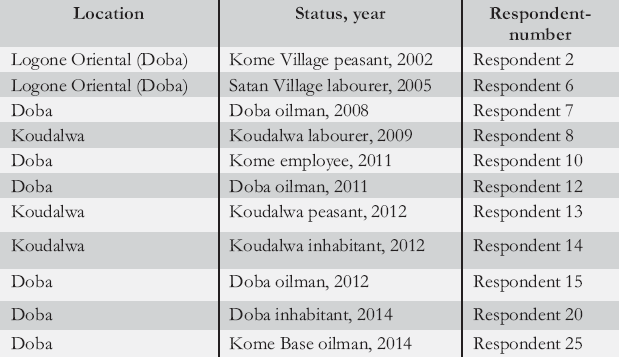
I compiled a database composed of more than 30 interviews on the issue of oil in Chad. For this article, I used 10 that I considered to be most relevant. Some respondents feared reprisals due to the nature of the information they provided and the sensitivity of the question of oil in Chad; therefore, they were identified anonymously as “Respondent” and allocated a number (see list of interviews, page 83). Whether interviews were recorded depended on each respondent's preference. I employ qualitative research and a discourse analysis, drawing on interviews and field observations. 5 In many host communities in oil-rich countries, inhabitants still believe that subsurface resources come from an invisible world beyond their control. This explains why they associate underground and subsurface resources with the world of ancestors, devils, darkness, taboos, or God. As Gordon (2012) states, spirits still matter in postcolonial Africa, which continues to be influenced by the rituals and beliefs of the precolonial period. Some Africans see their realities as being controlled by invisible agents or spirits which take on different forms, manifesting themselves as gods, animals, diseases, or simply as evil. Despite the prevalent point of view in local communities that oil is something that is extracted from an invisible world (i.e. a mythic resource), policymakers ignore this. Sometimes, this creates frustration and leads to confrontation amongst people in the local communities. Below, I discuss the manifestations of those contradictions. 6
This study is therefore not based on a representative sample but on conversations held with some of my interlocutors and on informal conversations carried out on oilfields in Chad.
I would like to thank my colleagues from the Summer School in Lasdel, Niger, class of 2014, to whom the first version of this article was presented, and who went to great lengths to provide useful criticism and commentary. I am also grateful to the anonymous reviewers at the Africa Spectrum whose insightful criticism helped me to improve this article.
Representations of Oil as Heaven-Sent Manna
Since Chad gained independence, oil exploration activities carried out by foreign companies have uncovered oil reserves in the basins of Lake Chad, Erdis, Doba, Bongor, and Doseo in the south. The exploitation of these reserves began in 2000 in the Doba basin by a consortium consisting of ExxonMobil, ChevronTexaco, and Petronas. In 2006 the China National Petroleum Corporation started extracting in the Bongor Basin, and in 2011 the Caracal Energy Consortium (acquired by Glencore in 2014) began work in the Dosea basin. As is the case with all mining and oil extraction activities, this required significant mobilisation of financial, human, and material resources, including cutting-edge technology. The extraction work had economic, social, and environmental impacts on the areas where the sites were located and for the local populations. While I was working there, I saw how the natural vegetation of this region gave way to the landscape of the extractive industry in one year. Strewn with cars, cranes, rigs, derricks, and containers, it became an “oil city” in a rural setting. It is worth adding that this was the first time that an extraction project in Chad had mobilised such a significant amount of human and material resources.
For my interviewees in the oil-producing area of Doba, oil was seen as manna sent from heaven. One respondent, a peasant whom I met in the Kome oil region, declared that “God sent us oil” (Respondent 2, 2002). Another, from the Koudalwa area, said that
it is a blessing to have oil under your land. Why else would we have found oil only in Doba and Koudalwa, and not elsewhere in Chad? (Respondent 14)
The above statements reveal a belief amongst these people that because they have been chosen by God to receive the gift of oil, it is therefore their right to enjoy all the benefits that ensue from oil development in their area. This idea of a divine promise of wealth can also be found amongst the people of the oil-producing Niger Delta in Nigeria. According to Adunbi (2015: 4), they too claim ownership over the natural resources in the region and the right to benefit from them. According to widespread mythology in both Chad and Nigeria, oil is a legacy of wealth that is passed on from ancestors to their descendants.
Although the interviewees lack a clear understanding of the oil exploitation process and of how oil is sold, their responses make it clear that they know that, either directly or indirectly, the oil production chain leads to money. As one peasant explained,
this is our oil, oil from our land. We are not begging. We just want our money after the oil has been sold; it belongs to us. (Respondent 20)
The Entente des Populations de la Zone Pétrolière (EPOZOP) is an unofficial advocacy network that was set up to represent the interests of inhabitants in the oil-producing area (Petry and Bambé 2005: 167). During my conversations with Respondents 12, 14, and 20, I learned that oil exploitation offered several benefits, such as revenue from selling land to multinationals, regular income from working in the oilfield, and monetary handouts from multinationals. Some interlocutors (Respondents 2 and 8) rejected the idea of non-governmental organisations (NGOs) granting credit to local people. According to them, everything should be given freely because the oil that funds all these benefits comes “from their land, the land of their ancestors” (Respondents 2 and 8). In his study on the oil-producing area of Logone Oriental, Moutédé-Madji (2012: 5) finds that the credit-granting project in the Doba oil-producing area flopped because the repayment rate was under 40 per cent. We can also question whether it was this same concept of oil as “manna from heaven, given to the producing region” which is the basis of the Norwegian oil revenue management system – currently considered to be the best model for oil revenue management in the world. Indeed, the Norwegian model distributes oil revenues in a way that values local human resources and development without compromising future generations. A fund has also been established for future generations. It is this philosophy that the Chadian government has adopted to secure the support of both the international community and a section of the national community in their quest to exploit Chad's oil. In fact, the Norwegian model's influence on Chad's oil revenue management policy was formalised in Law No. 001, which states that 5 per cent of oil revenues should be used to develop the oil-producing region. Other countries similarly distribute a percentage of oil revenues to oil-producing areas: Bolivia, 13 per cent; Brazil, 17 per cent; Nigeria, 13 per cent; Indonesia, 6 per cent; and Ghana, 2 per cent (Arellano-Yanguas and Mejía-Acosta 2014: 4).
The texts used here present the reality of oil production in Chad – which has witnessed ten years of oil exploitation and the establishment of institutions that govern oil revenues – and its impact on local people. In Doba, despite the completion of various infrastructural projects (a stadium, schools, the electrification of the city, paved roads) financed by oil revenues, it seems that oil wealth has not been a blessing. Local people have not seen the development that they were promised or even experienced an improvement in their living conditions (Mabali and Mantobaye 2015). In fact, the level of monetary poverty has been exacerbated due to the inflation that has inevitably accompanied oil exploitation. In 2011 a group of civil society organisations filed a complaint with the World Bank on behalf of local farmers and other community members affected by the Chad–Cameroon Petroleum Development and Pipeline Project. 7 The complaint, which was judged to be admissible, outlined some of the negative impacts of the project: increased poverty levels, land grabbing, loss of livelihoods, water and environmental pollution, inadequate compensation, and a lack of appropriate monitoring and evaluation mechanisms. This paper sheds light on why characterisations depicting the project as a curse abound in the oil-producing area.
The World Bank has set up a stakeholder mediation mechanism for projects financed by itself or by its partners. For more details, see <www.cao-ombudsman.org/about/whoweare/index.html>.
Sin Cities: Representation of Satan Village and Moudadoigne as Revivals of Sodom and Gomorrah
In the oil producing area around the Doba oilfields, spontaneous settlements emerged. Comprised of houses built from makeshift materials gleaned from the oilfields and seccos (grasses used to construct fences and roofs) (see Hoinathy 2013: 164), these settlements are inhabited by both local residents and those oilfield workers who are not permitted to sleep in the camps built by the oil companies. 8 Due to their appearance, the fact they are guarded, and the rules in place there, Chadian oil workers have compared the camps to Guantánamo (Coll 2012: 350 cited by Hicks 2015: 52).
The camps built by oil companies are intended for expatriates and Chadian workers recruited from outside the oil-producing region.
The Satan Village settlement is located next to Kome Base, which is home to most of the oil companies and acts as the hub of Doba's crude oil exploitation. Respondents 2, 6, and 12 explained that the village began to develop in 2000, following the start of the Doba Oil Project. The first people who came in search of employment built makeshift houses in front of the oil camp and slept there in the hope of finding work. Those who managed to secure employment, mostly labourers, continued to live in the settlement despite having jobs on site. Gradually, the settlement grew as workers brought their families, and as others arrived to take advantage of the opportunities there. This led to drinking establishments and restaurants being set up and the emergence of prostitution in the area. Satan Village provided oil company employees, both locals and expatriates, with access to various activities and services. Initially, Western expatriate workers were free to leave the camp and visit Satan Village. Over time, however, they faced increasing restrictions until leaving the camp was eventually strictly forbidden, allegedly for security reasons. Moudadoigne, another settlement, overlooks Kome 5 and is about ten kilometres from Kome Base. Literally translated, the local-dialect term “moudadoigne“ means “the vagina will bite you,” which is a reference to the extensive prostitution in the village (Hoinathy 2013: 164).
Because the materials used to construct the dwellings in the settlements are highly flammable, there have been a number of fires. During my time as an oilfield employee, I saw Satan Village go up in flames three times between 2002 and 2006. However, the settlements are typically rebuilt within a week because they are vital to the working population. Respondents 2, 6, and 15 speak about the settlements and the fires that happen there in a way that challenges the concept of oil as a blessing and puts forward the concept of oil as a curse. They do not consider life in the encampments, which is rife with alcoholism and prostitution, to be a good life, and they blame oil exploitation in the area for this. Some respondents (6, 12, and 20) went so far as to compare Satan Village and Moudadoigne to the biblical cities of Sodom and Gomorrah. 9 Respondent 6 (2005), a resident of Satan Village, said that “the recurring fires in the village are simply a reflection and translation of this divine punishment.”
Sodom and Gomorrah are two cities in the Old Testament where the unethical or blasphemous behaviours of the inhabitants attracted the anger of God, who inflicted a fatal punishment on them: fire.
Today, more than a decade after the start of oil exploitation in Doba, the statements made by those I interviewed, and the views held by Chadians in general, are clear: “Le pétrole ne nous a rien apporté de positif sinon des problems“ 10 (Le Temps 2014; Hicks 2015). These declarations of failure create fertile ground for myths about oil exploitation. It is thus unsurprising that the content of my discussions with respondents on the investment of oil revenues in priority sectors such as security, education, and health contrasts with that issued by the authorities. For instance, while oil workers and Chadians talk about biblical punishment, the vice president of Doba's 5 per cent Committee argues that they have
“Oil has not brought us anything positive, it has only brought problems.”
done a lot of agricultural development, improving access to drinking water, reclaiming farms and helping to improve animal husbandry. Those things really make a difference. (Hicks 2015: 53)
The Elephant with Black-Gold Tusks: Wounded in Chad but Died Elsewhere
In some of the interviews (10 and 15), it was clear that the exploitation of oil certainly brings advantages, but they are considered to be insufficient when compared to the profits made by foreign partners. According to a report by the Extractive Industries Transparency Initiative (EITI), extractive companies paid the government of Chad over an estimated USD 2 billion in 2012 (EITI 2014). Experts roughly calculate that the amount of profit being made by extractive companies is even larger than that made by the government; however, this is only an estimate as the concession agreement that governs the project has not been made public. In his book examining ExxonMobil, Steve Coll (2012: 369) provides us with an insight into where these revenues go, explaining that the oil project enabled
ExxonMobil and its partners to generate several billion dollars of topline revenue, to forge a path to profitability just as world oil prices spiked, and to embed themselves with Déby's regime, position the corporation for additional oil deals beyond those covered by the original bargain.
Critics have pointed out that oil exploitation has a detrimental effect on the local community, highlighting a whole litany of disadvantages: environmental degradation, growing inequality, criminality, and prostitution. According to Frank and Guesnet (2010: 41) and Hoinathy (2013), the arrival of immigrants and expatriate workers has also driven up the cost of living, making life even more difficult for local people. The oil-project benefit most widely cited by respondents is employment opportunities on the oilfields for Chadians. Nevertheless, despite the Esso Chad consortium employing more than 5,000 Chadians, complaints persist that foreign workers are prioritised over locals (Hicks 2015: 71). Respondents 8, 10, and 20 complained that expats earned much more than them for the same role – something various respondents attributed to Chad's inexperience and poor negotiation skills when drawing up the oil trading contracts. A former accounting department executive who dealt with the salaries of both expats and local employees (Respondent 10, 2011) claims that expatriates can earn over USD 15,000 per month more than their Chadian counterparts. This executive explains that the astronomical differences between local and expatriate wages is due to the fact that expatriates are paid according to the pay scales of their companies in their home countries and also receive many bonuses linked to their expatriate status. He also reveals that expatriates are additionally given per diems (which are sometimes equal to the full salaries of local employees) to cover everyday on-site expenses. The Chadian authorities and multinationals justify this situation of wage inequality by pointing out that wages are given according to salary scales and the cost of living in employees’ own countries. According to Respondents 12, 15, and 20, however, many oil-producing countries have collective agreements governing the oil sector and are therefore not faced with such large wage differences. Expectedly, they question why Chad cannot do the same. Oil workers interpret this situation as an injustice towards them.
With non-Chadians enjoying more benefits from oil exploitation through subcontracting or consultancy work, local respondents mentioned feeling like everything was stacked against them. To illustrate this injustice, in parts of Chad, particularly in Doba, people use the metaphor of the elephant with black-gold tusks that was wounded in Chad but went to die in Cameroon – in other words, it is Chad's neighbours and other foreigners who benefit most from Chad's oil reserves. Respondent 20 cited this metaphor to describe how experienced and competent Cameroonian negotiators involved in the Chad–Cameroon Pipeline Project drove up the cost of the right to transport oil on their territory, ensuring that their country's profits were high compared to those made by Chad. 11
See Mbodiam, Brice R. (2013), Le droit de transit du pétrole tchadien sur le territoire camerounais revalorisé de 195 à 618 FCfa le baril, in: Africatime.com , online: http://fr.africatime.com/tchad/articles/le-droit-de-transit-du-petrole-tchadien-sur-le-territoire-camerounais-revalorise-de-195-618#sthash.8JczoXcc.JbLLfvDf.dpuf; (12 December 2015).
The contract between Chad and the consortium is based on the Convention for Exploration, Exploitation, and Transportation of Hydrocarbons and its 1988 amendments. The agreement provides Chad with an oil royalty rate of 12.5 per cent, which some observers consider to be much lower than the oil royalty rates of many other African oil-producing countries (Gary and Reisch 2005: 38). The fact that this is a concession contract (which offers more benefits to companies than to the government) instead of a production-sharing contract (which allows the state to be a shareholder in the exploitation of its resource) also perpetuates the narrative that the Chadian government is poor at negotiating contracts. Chad did, however, raise its oil royalty rates to 14.25 per cent in 2014. Some of the interviews seem to reveal that some people confuse the crude and refined oil used in oil lamps in the poorer neighbourhoods. They claim not to have even seen or benefitted from the crude oil extracted by US companies. 12
The oil from the rônier fields in Chad – operated by the Chinese company China National Petroleum Corporation – is refined in Djermaya, Chad, and marketed in Chad, whereas the oil from the Doba Project is exported as crude oil.
A complex system of oil exploitation set up by multinationals and misunderstood by some local interviewees has led to conversations that are focused on the unequal distribution of oil – a resource claimed by communities who consider it their right to benefit from the sale of oil on the world market.
Ephemeral Wealth: Oil Sector Salaries Perceived as the Devil's Money
Oil workers are amongst the highest paid workers in Chad. According to the salary scale of the Chad–Cameroon Constructors Company, a labourer in category 1.1 earned a monthly salary (excluding bonuses) of XAF 59,995 in 2003 – twice Chad's guaranteed minimum wage (salaire minimum interprofessionnel garanti, SMIG) of XAF 30,000. 13 According to Moutédé-Madji (2004), in 2003 semi-skilled and skilled oilfield workers earned at least XAF 120,000 per month, which excluded the various bonuses that could double or even quadruple their basic salaries. 14 The attractiveness of oilfield wages has caused departures of employees from non-oil sectors. For instance, a large number of teachers in the Doba and Bebidja regions, particularly English teachers, have abandoned their public-sector positions to find jobs on the oilfields as translators or as skilled employees. Moutédé-Madji (2004: 16) explains the repercussions of this trend,
The SMIG in Chad was raised to XAF 60,000 in 2011.
Unskilled workers were paid about XAF 2,000 per day.
par ailleurs, les travaux sur le chantier trouble quotidiennement le monde paysan aussi. A la fin des travaux de construction en 2003, on a évalué le nombre de Tchadiens employés à 7000 personnes pour une masse salariale totale de 23 milliards de francs CFA. Il faut noter que plus de 50% de ces emplois sont temporaires. Il s'agit des paysans recrutés dans la zone du projet pour les travaux manuels, ce qui pousse beaucoup de paysans à abandonner leurs champs au profit des travaux mieux rémunérés. Il en est de même pour les maîtres communautaires qui ont abandonné les écoles, entraînant leur fermeture. 15
“Moreover, work on the construction site also disrupts peasant life. When construction was completed in 2003, it was estimated that the number of Chadians employed was 7,000 for a total payroll of XAF 23 billion. It should be noted that over 50 per cent of these jobs are temporary. Most are peasants recruited in the local area to do manual labour, prompting many farmers to abandon their fields in favour of these better-paid jobs. The same happened with community teachers who left their schools, bringing about the closure of these schools.”
Oilfield workers, known locally as “oilmen” (which in Chad's poorer neighbourhoods refers to anyone employed by a multinational directly or by a subcontractor), directly benefit from oil exploitation. Although their salaries only represent a small proportion of oil revenues, oilfield workers earn significantly higher wages than do their peers in the public sector. For instance, a graduate working in the Ministry of Education earned about XAF 250,000 in 2000, whereas an executive with the same degree could earn more than XAF 500,000 in the oil sector. It should be noted, however, that Chinese oil companies are not considered to treat their employees as well as other subcontractors do in Chad (Yorbana 2014: 122). Nevertheless, oilmen in Chad enjoy a high standard of living, and their material wealth enables them to purchase real estate, means of transportation, or anything that might be perceived as a status symbol. In fact, some lead rather ostentatious, debauched lives. Their financial power and status can even extend to their spouses. According to one respondent, oilmen “run after the most beautiful women, and the women wear jewellery made out of gold or other expensive materials as an external indication of their wealth” (Respondent 7, 2008). During my fieldwork in Doba, I myself observed that the spouses of oilmen wear better quality and more expensive clothing as well as jewellery whether at the market, out socially, or for more formal occasions. Furthermore, unlike the wives of peasants and public servants, the spouses of oilmen do not haggle at the market when it comes to purchasing staple products like fish or chicken; this reflects their high social standing and, more specifically, the fact that they have enough money to buy anything they like.
Some of the oilmen that I interviewed were aware of the nature of their lifestyles. One explained to me that
oil is ephemeral wealth that goes hand in hand with the devil. Oil money does not last; it is cursed money. The devil is in charge when you spend it. (Respondent 25)
Another said, “sometimes we spend foolishly, buying expensive clothes or cars just so that we can be seen in them,” before adding that “only the devil would allow this to happen” (Respondent 12). Some oilmen consider oil to bring about easy money and consumer goods, with the devil acting as a guiding force. So if you buy a piece of paradise with oil money, you will discover that it is just a mirage. According to Miankéol (2010), community members in the villages of Maikeri and Poutouguem made the same observation: oil is easy money and, therefore, problematic. This association between easy money (oil money) and the devil can also be found in Colombia (sugar cane plantations) and in India (mines) (Taussig 2010). According to Taussig, workers in these sectors speak of making a pact with the devil when they start working on the plantations or in the mines but not when they are working their own land. Taussig (2010: 13) contends that
as peasant cultivators became landless wage labourers, they invoked the devil as part of the process of maintaining or increasing production. However, as peasants working their own land according to their own customs they do not do this.
In the case of Colombia, Taussig interprets this phenomenon as a result of the capitalist conquest in South America, which led to proletarisation and speculation. The capitalist system brought about alienation and, therefore, deprivation and thus created relations of production which did not previously exist in Colombian culture.
Before the exploitation of oil in Chad, there were rich farmers, in particular cotton farmers. They certainly did not associate their wealth with the devil, because they produced and also sold their own products – a point that reinforces Taussig's (2010) argument. But oil development led to the establishment of a capitalist mode of production which resulted in farmers being dispossessed of their land and becoming workers within the new relations of production. In these capitalist relations easy money and the devil intervened. The notion that oil revenue is easy money may stem from the fact that speculation in natural resources generates a lot of money, making it seem that money can be acquired effortlessly, whereas before the oil era, respondents were accustomed to working the land to make money, and money only came about through hard work.
My interviews reveal that people both living near the oil exploration sites and throughout Chad had high expectations at the beginning of the oil exploitation project. They had been promised by the highest government authorities that the project would benefit the whole nation and would be implemented through local or regional development plans (Gary and Reisch 2005: 76). But today, a decade after the first barrel of oil was extracted in Chad, opinions are not so positive. Respondent 13 (2012), a peasant from the village of Koudalwa, told me that “oil is a cursed resource”, referring to the environmental damage and social problems caused by oil exploitation in the area. The negative social and environmental impacts of the Doba Oil Project are striking. As Gary and Reisch point out (2005: 32–33), poor waste management, land grabbing by multinational companies, inadequate compensation policies, pollution, and limits to freedom of movement all affect the local population in the oil areas. The expectations and disappointments of Chadians are so well expressed by Frank and Guesnet (2010) in the title of their report, We were promised development but all we got is misery.
Referring to this sense of disappointment, one respondent (12) told me that oil money is cursed and is therefore squandered quickly. He did not understand why he was squandering his salary and why he could not make good investments, so he went to consult a witch doctor. From the oracles he was given, he said he saw his money in the hands of the devil and understood that the devil is a bad advisor. In short, for my respondents, oil is a cursed resource, and the money that ensues from it cannot have lasting beneficial effects. As one oilman put it, “everything is ephemeral and in vain” (Respondent 8, 2009). Similarly, Behrends (2011: 81) speaks of the harmful consequences of oil, showing the harsh working conditions of the guards who take care of the oil installations day and night in the bush. One security guard based in Doba said, “oil is shit”, pointing out that oil money is being used to finance the war in eastern Chad instead of funding development.
Those surveyed consider the negative effects associated with the use of oil revenue to exceed the benefits. It is this that fuels the narrative of the oil curse, which is symbolised by images of the devil and dirty money.
Long-Term Effects: Oil Characterised as Ringworm or Indelible Ink
Some respondents (8, 12, and 15) believe that the exploitation of oil in their regions has had marked, perhaps even ineradicable, consequences. The harmful effects of oil production are etched in the memory of the inhabitants in those regions as though written in indelible ink. They told me that during the oil era, they “have seen all the colours” – which is an expression that means they have faced many challenges. According to them, the sizes of their fields have been reduced, their cultural sites have been destroyed, and the cost of living has increased. Their statements point to the work of Hoinathy (2013), a Chadian social anthropologist who compared oil exploitation to ringworm, a fungus that can leave a scar even after being treated. 16 Reyna (2011) – who interviewed locals in the Doba region in 2002, 2003, and 2007 – also claims that his respondents unanimously declared that the exploitation of oil had caused them severe suffering. According to Reyna (2011: 153), generally speaking, only senior state officials in the region qualify oil extraction in Doba as a success; for the majority, oil exploitation has had an indelible effect on local communities and their traditional ways of life. According to my respondents, the lack of concrete positive outcomes resulting from oil revenue led the Mongo people in the Doba region to organise a forum in April 2015 in which they called for money generated by oil extraction to be invested in the region and for local people to be involved in the administration of the region and, in particular, oil revenue management.
See rfi AFRIQUE, Remadji Hoinathy sur RFI: Pour les Tchadiens de Béro, le pétrole est “une teigne,” 17 November 2013, online: www.rfi.fr/afrique/20131117-remadji-hoinathy-rfi-tchad-bero-petrole-teigne-esso; (13 December 2015).
Conclusion
A decade of oil exploitation, initially presented as a way out of poverty, has had rather mixed effects in Chad. Despite early optimism, the interviews show that poverty levels actually increased amongst large parts of the populations in the oil-producing areas and that oil production only benefitted a minority: the financial elite and the oilmen. Eventually, disillusionment set in.
Mythology and metaphors involving the devil, elephants, Sodom and Gomorrah, and disease featured in the statements of interviewees. The religious imagination of the local population in Chad successfully portrays the paradoxes of oil exploitation and, indeed, the resource curse. It confirms the spiritualism surrounding oil extraction and the effects of oil as a subsurface resource. The institutions that were supposed to ward off the resource curse seem to be ineffectual, and this puts into question the efficacy of the ready-made solutions proposed to developing countries by major international powers or institutions. Such capitalist-based solutions have shaken the lifestyles and beliefs of workers and local residents in the mining areas in southern Chad. It is timely that Behrends and Hoinathy (2014: 78–79) state that the World Bank's oil management model has not found fertile ground amongst the population of the oil-producing areas in Chad; these people have a different understanding and interpretation of the institutional model of Chadian oil. The myths mentioned above clearly reflect not only the anxieties, sensibilities, and beliefs of local residents and Chadians with respect to oil exploitation (a booming activity which Chadians must continue to deal with) but also their hopes and ideals. In this context one should mention Watts (2001), who – when studying the communities of the oil-producing regions in the Niger Delta and in Ecuador – discovered not only that oil exploitation transformed the lives of those communities but also that those communities too experienced oil revenues as easy money, as something mystical and ephemeral. These representations of oil also come to the fore in the beliefs expressed in the interviews I conducted with the local community members and oil workers in Chad.
Oil determines the strengths and weaknesses of our contemporary techno-industrial society. Looking beyond its practical uses, can we consider oil to be a mysterious resource? The mystical-/magical-religious representations of oil expressed by the local populations and oil workers in Chad, Nigeria, Ecuador, and Venezuela seem to stand the test of time and persist. Might we say that these representations are a form of protest and resistance against the capitalist process of alienation, which is embodied in the extractive industry and in the international institutions that extract the local resources of communities that are still considered to be in need of being “developed”? Is it not yet time to think about how to address those social imaginaries and representations which swing oil between extractivism and spiritualism or between blessing and curse in order to reverse the resource curse theory which has persisted over time?
List of the Author's Interviews in Chad, 2002–2014