




Abstract
This article explores the significance of amateur football for the changing patterns of circular migration in post-Apartheid South Africa. Even after the end of Apartheid, the abolishment of the migrant labour system has not brought a decline of circular migration. The state-institutionalised system has merely been replaced by an informal system of translocal livelihood organisation. The new system fundamentally relies on social networks and complex rural-urban linkages. Mobile ways of life have evolved that can be classified as neither rural nor urban. Looking into these informal linkages can contribute to explaining the persistence of spatial and social disparities in “New South Africa”. This paper centres on an empirical, bi-local case study that traces the genesis of the socio-spatial linkages between a village in former Transkei and an informal settlement in Cape Town. The focus is on the relevance of football for the emergence and stabilisation of translocal network structures.
This article explores the nexus between football and livelihood organisations in South Africa. Yet it is not about professional football, as one might assume in the year of the FIFA World Cup 2010. Instead, it looks into the significance of amateur football – one of the most popular leisure activities of male South African youths – for the changing patterns of circular migration in the post-Apartheid era.
After the end of Apartheid, the abolishment of the state-controlled “migrant labour system” has by no means brought a decline of circular migration. It has merely been replaced by an informal system of translocal livelihood organisation. This system fundamentally relies on social networks that span great distances between different localities. The search for livelihood security has led to complex, informal, rural-urban linkages. Mobile ways of life have evolved that can be classified as neither rural nor urban. Enquiring about these informal linkages can contribute to explaining the persistence of spatial and social disparities in “New South Africa”. In this paper I will argue that informal structures are generated by and perpetuate the precarious circumstances of marginalised rural and urban population groups.
I apply an actor-oriented perspective to investigate how this new form of migrant labour functions. It centres on an empirical, bi-local case study that traces the genesis of the socio-spatial linkages between a village in former Transkei and a township in Cape Town. The focus is on the relevance of football for the emergence and stabilisation of translocal network structures.
First, this article intends to illustrate and exemplify an analytical model of translocality (Steinbrink 2009). Hence it is a migration study. Yet, because of its focus on amateur football, it might as well be read as a contribution to the recent debate in social science and the humanities about the role of this sport in African societies. 1 The new academic interest in African soccer was sparked by the 2010 World Cup, which thrust the topic into the global spotlight like never before (cf. Alegi 2010; Haferburg and Steinbrink 2010). Moreover, research into football migration is growing (Dietschy and Poli 2006; Darby 2007; Poli 2006, 2010). Yet, most of this research explores transnational football migration and “commodity chains”, while this article analyses football in the context of processes of translocalising social capital, labour migration, and livelihood security within South Africa.
See e.g. Armstrong and Giulianotti (2004), Baller (2010), Alegi (2004, 2007, and 2010), Alegi and Bolsmann (2010) and Vidacs (2010). Also refer to Afrika Spectrum, 41, 3/2006 (“The Other Game: The Politics of Football in Africa”) and Politique Africaine, 118, 2010 (“Les terrains politiques du football”).
The research is based on field work the author conducted in a rural and in an urban study area in South Africa from 2002 to 2006. 2 Taking a bi-local approach, inspired by George Marcus' (1995) multi-sited ethnography, the research design comprised qualitative and quantitative methods as well as components of social-network analysis.
The project “Land-Stadt Verflechtungen als Überlebenssicherungssystem in Entwicklungsländern” was funded by the German Research Foundation (DFG).
From Migrant Labour to Translocal Livelihoods
Social inequality is one of the most conspicuous features of South African society. The World Bank classifies South Africa as an “Upper Middle-Income Country”. Yet, when one examines a few wealth indicators, it becomes apparent that the average value behind this classification conceals the reality of a major part of the population: The HDR (Human Development Report) for South Africa assumes that approximately 50 per cent of the South African population lives below the poverty line (UNDP 2003). The Gini coefficient is the third-highest in the world: In 1995 it was 0.596 and even increased to 0.72 by 2006 (cf. UNDP 2003, SSA 2008). While the richest 10 per cent of the population has 50 per cent of the total income at its disposal, the poorest 40 per cent of the population shares 7 per cent, and the poorest 20 per cent receives only 1.5 per cent of the total income (cf. SSA 2008).
These economic disparities are reflected in very distinct spatial patterns. A comparison of the income situation across the nine South African provinces reveals strong spatial inequalities at a national level: Those provinces that comprise the homelands that were reintegrated in 1994 are significantly poorer than the others. The Limpopo Province today covering the former homelands Lebowa, Venda and Gazankulu, and the Eastern Cape Province, now including Transkei and Ciskei, are by far the lowest-income provinces. In contrast, Gauteng and Western Cape, those two provinces whose territories do not include former homelands, are the wealthiest. 3
Approximately 30 per cent of the total population live here, yet they dispose of 55 per cent of the total income (cf. Leibrandt et al. 2004).
Within the provinces, social inequalities are reflected in clear geographical patterns as well: Besides the regional disparities in those provinces that include the once-“white” administrative areas as well as the former homelands, there are also strong intra-urban inequalities that shape the fragmented structures of South African cities. The boundary lines between wealthy and poor areas still highly correspond with those of the Group Areas during Apartheid (cf. Smith 2005: 13ff, SACN 2006). Geographic structures of inequality have persisted.
In light of what has been described so far, the structure of disparities in South Africa suggests a historical interpretation. The extremely unequal spatial distribution of wealth and poverty still reflects the social order of the Apartheid era. Even today, skin colour and life chances are strongly related in South Africa. The black population (80 per cent of the population) has approximately 40 per cent of the total income at their command, whereas the white population (9.2 per cent of the population) owns approximately 45 per cent of the total income. The enormous socio-economic differences between these groups are even greater than the described spatial disparities. Thus, inequalities in contemporary South Africa must be seen as a structural legacy of Apartheid.
The former state-controlled migrant labour system can be identified as one of the driving forces behind persisting structural inequalities. The migrant labour system formed the backbone of the Apartheid state's political economy. It was based on circular migration between the rural areas of the homelands and the urban-industrial centres. The Apartheid regime created an institutional setting of politics and legislation that rendered the absorption of labour force from the non-capitalist sector possible. Black workers from the homelands were, by law, only permitted to stay in urban areas for the time of temporary contracts. Owing to the precarious situation of peasant farming in the bantustan areas, migrant workers' households were highly reliant on remittances. The migrant labour system allowed for the externalisation of reproduction costs for the labour power needed in the urban-industrial centres of the country. So, wages were artificially kept low. This form of super-exploitation (cf. Wolpe 1972) was the incentive for the alliance of state and capital to control the migrant labour system. It is this system that must be held accountable for the growing poverty in the homelands, for the marginalisation of urban townships, and for unequal development on the whole (cf. Magubane 1975).
Apartheid legislation – and with it the formally controlled migrant labour system – was abolished 20 years ago. Nevertheless, socio-economic inequalities have in no way decreased since then. Also, it is notable that after the political transformation, migration patterns did not change in the way they were expected to. Broadly speaking, politics, science, and the South African public all anticipated that after the end of Apartheid an enormous migration wave would build up in the disadvantaged former homelands and roll over the cities. It was generally assumed that the abolishment of movement restrictions would eventually “normalise” migration patterns: Permanent settlement was expected to supersede circular migration and become the norm (cf. Gelderblom/Kok 1994, Posel 2003). Yet, internal migration flows in South Africa today can hardly be squared with such a “normalisation theory”: In an international comparative study, Anderson (2005), for instance, illustrates that both the actual increase in urbanisation and the rural-urban migration rates have to be appraised as moderate. Her study puts into perspective the virtually apocalyptic prognosis after the fall of the Apartheid regime, and it elucidates how rural-urban migration flows are in fact increasing far less dramatically than had been forecasted. Posel (2003) shows how migration movements have even developed qualitatively differently from expected. She refutes the simplistic idea that circular migration in a free “New South Africa” will vanish and that migrants and their families will instead settle permanently near their workplaces. Having analysed different national household survey data sets, Posel (2003) concludes that circular migration has by no means decreased. In fact, she substantiates that both the number and share of “black” rural households with at least one member being a labour migrant has even increased.
Circular migration has undoubtedly remained a major phenomenon in South Africa. Yet, after the end of Apartheid, the legal and institutional framework changed. Today, all citizens have the constitutional right to free movement and free choice of residence. However, despite this, the serious spatial disparities within South Africa notwithstanding, most citizens either stay where they are or do not stay where they go, and many return to where they originally came from. Circular migration persists, yet in a different form: What has changed is the way the households organise migration. Internal migration and circularity in South Africa can no longer be explicated by direct state intervention, but now needs to be analysed in relation to individuals' and households' agency.
It thus seems appropriate to explore internal migration as an integral part of livelihood organisation embedded in a larger, informal, rural-urban nexus. As described above, a high proportion of the South African population – both in the peripheral rural regions and on the fringes of the large cities – are confronted with existential risks and uncertainties. In an effort to cope with and adapt to these conditions, many poor people organise their livelihoods across vast distances between rural and urban areas. This can be conceptualised as “translocal livelihood”, i. e. a livelihood system of households whose members do not all reside at the same place at the same time. These types of households can be termed “translocal households” (cf. Lohnert and Steinbrink 2005; Steinbrink 2009). 4
Translocal householding comprises the coordinated use of material and intangible resources at different localities and the coordination of the strategic actions of the members in order to satisfy individual and collective needs and to sustain long-term livelihood security. These livelihood systems are based on migration, translocal redistribution, and cooperation.
After the end of Apartheid, the informal organisation of translocal livelihoods replaced the state-enforced migrant labour system. The difference between the two systems is primarily marked by the importance of translocal social networks. They have become a central regulatory element and their function has replaced the formal organisation of labour migration.
The following bi-local case study serves to illustrate what has been discussed so far. To start with, I will investigate how the population of Nomhala, a rural village in former Transkei, adapted its livelihood organisation to the new conditions after the end of Apartheid. I will seek to demonstrate how the informal translocal livelihood system has replaced formally organised migrant labour. The focus will be on the role of football. The study will elucidate how this sport induces and stabilises translocal networks between Nomhala and the township called “Site 5” in Cape Town. It will also show how, vice versa, the translocal way of life is manifest in amateur football itself.
A (Football) Field Study on Translocal Livelihood Systems
The settlement of Nomhala is situated in the Eastern Cape Province in the so-called “deep rural” area of the Transkei, the largest of the former homelands. Even after 16 years of democracy, the region is still structurally one of the most disadvantaged in the country. Nomhala is located about 45 kilometres from Mtata, at the southern foothills of the Drakensberge. The village belongs to the local municipality of Mhlontlo (a merging of the former districts of Tsolo and Qumbu) and is situated within the area of jurisdiction of the O. R. Tambo District Municipality. The residential population of Nomhala is estimated to be approximately 1,100 people, but this number is subject to substantial fluctuations during the course of the year due to the mobility of the population.
During Apartheid, the population was deeply involved in the institutionalised system of labour migration. The young male workers were recruited by the Recruitment Office run by the state agency TEBA (The Employment Bureau for Africa) in Tsolo. Owing to the precarious economic situation, there were more than sufficient numbers of men ready to work for low wages under tough conditions. They were mainly sent to the industrial and mining sites around Johannesburg (Vaal Triangle) and lived in the barrack-like migrant hostels for the period they were under contract.
In this region, the long history of migrant labour led to the development of what could be termed a “culture of migration”. The walk to the mines became an integral part of the male role model (cf. Mayer and Mayer 1971: 91f). In a number of interviews, this walk was compared with a male rite of passage. In retrospect, the interviewees perceived the labour migration in that era in the context of “rural traditional” cultural paradigms. In this sense, men migrated as household members to fulfil certain social duties, which meant either to support their homestead (umzi) or to a found new one (ukwakha umzi). 5
The umzi (isiXhosa, pl. imizi) is a homestead and forms the centre of rural subsistence production and reproduction of labour. The emic household formation of isiXhosa-speaking groups is termed ikhaya. It is not co-residence that determines membership, but rather birth or marriage. Hence household affiliation is independent from the factual place of residence. Therefore the emic concept of ikhaya corresponds to the analytical concept of a translocal household (see above).
The population of Nomhala was extremely dependent on migrant labour at the time. The political, economic and legal framework forced the households to adapt their livelihood systems to the requirements of the regime. Labour migration was as much a part of strategic action as were migrants' investments in the rural imizi (homesteads). Remittances were a main aspect of the livelihood system of the households at the time of Apartheid; without such transfers, survival would not have been possible in the overpopulated rural homeland areas. Structurally, remittances formed a cornerstone of the exploitive system since they in turn constituted the precondition for the externalisation of reproduction costs for the labour needed in the industrial capitalist sector.
A look at Nomhala's situation today clearly demonstrates that migration and remittances are still central aspects of livelihood-securing. Agricultural production is far from being a sufficient economic basis for the population. De-agrarianisation (see Bryceson 1993) has greatly advanced. Nomhala's residents increasingly depend on non-agricultural monetary income. Yet only 10 per cent of them (21 per cent of those capable to work) are in fact employed and contribute to a cash income. This locally earned income constitutes approximately 40 per cent of the total income in Nomhala. The major part of the total income is made up of 36 per cent social welfare grants and 23 per cent of remittances. For more than 70 per cent of the residential groups, social welfare payments and remittances constitute more than half of their financial means. Approximately one-third of the residential groups completely rely on these payments. Especially the poorest are extremely dependent on remittances.
The substantial influence of migration is undoubtedly reflected in demographic structures as well. More than 60 per cent of the people of Nomhala are school children or have not yet reached enrolment age, and nearly 10 per cent of the population has reached the age of sixty or older. The major part of the economically most-active age groups reside in urban areas. More than 80 per cent of the interviewed households (n=82) indicated that at the time of research, at least one member lived in the city. The mean size of a household amounted to 9.2 persons including all absent members; on average 6.4 members were present. That means that on average 3 members per household do not reside in Nomhala; most of them stay in urban areas.
Most migrants maintain close contacts with their relatives. About 75 per cent of them visit their village of origin at least once a year. Nearly 80 per cent of the employed migrants transfer money back to Nomhala more or less regularly. The average monthly remittance is about 300 ZAR (around 20 per cent of an average monthly income). Mobile telephones are gaining in significance for translocal contact. On average, migrants phone their relatives six times a month.
These results already explain why simply investigating the livelihood system of the village population separately from the one of the migrants in town falls too short. Still today, most job-seekers do not migrate to leave their villages behind, but to contribute to the rural homestead's income. Even after their movement, they remain a part of their households that are then organised translocally. Task-sharing 6 across rural and urban places leads to the emergence of a translocal livelihood system that enables the combination of various economic strategies and the seizing of various opportunities in the different places. Due to the social networks, the opportunity structures at the different localities merge into the one opportunity structure of the translocal social space.
Task-sharing across rural and urban areas is characterised by function-sharing across different places of residence rather than by a strict division of work among household members, since they often live both in townships and rural areas in varying intervals. The rural and urban household locations in turn are characterised by specific functions: Urban household locations allow access to the labour market and to monetary income. Moreover, they facilitate access to conventional medicine and secondary education; they mean gaining a foothold for arriving migrants. In contrast, rural household locations are where children are brought up and receive primary education. Here, the elderly or sick household members are also cared for. Agricultural-subsistence production contributes to the household's food security. In times of lasting unemployment, the migrants return to their rural homesteads to reduce their costs of living. The imizi are of ritual importance (weddings, circumcisions, funerals) and moreover they facilitate access to traditional and spiritual healing techniques. During periods of crisis or conflict, both the rural and urban residences can be a refuge for the family members (for more details, cf. Steinbrink 2007, 2009).
The end of Apartheid certainly brought new opportunities for the population of Nomhala. However, since the economic situation in the village has not substantially improved, opportunities have not evolved in the local context. In order to take advantage of new opportunities, migration is still a prerequisite and thus remains a vital livelihood strategy. Furthermore, though the migration risk has changed, it has not decreased. During Apartheid, labour migrants were integrated into the formally organised system. Once the labour contract was signed in the recruitment office, the individual migrant had to care for neither transport to nor accommodation at his destination. Amount of income, length of stay and date of return were known to him as well as to his dependent rural household members. This meant at least a minimum of security in terms of planning reliability. Nowadays, rural-urban migration is often a journey into the unknown. Migration is no longer labour migration as such, but rather a migration in hope of employment and that in turn explains the necessity of adapting migration behaviour and livelihood organisation.
Since the abolishment of the formal migrant labour system, the importance of social-network relations for migration decisions and destination choices has been growing constantly. Informal support through contact persons who already live in town and know how to gain access to housing and employment is the only assistance arriving migrants can rely on. Migration flows are hence sustained and channelled by these network processes and concentrate on specific destination areas (chain migration) in which local supportive networks evolve often based on the idea of common origin – a phenomenon well known and studied all over the world. 7
In the context of isiXhosa-speaking groups, these migrant networks are called “abakhaya groups” (cf. Mayer and Mayer 1971). On the relevance of abakhaya groups for translocal livelihoods cf. Steinbrink (2007, 2009).
In Nomhala, the abolition of migration restrictions has also changed the direction of migration flows. Subsequent to the mass retrenchments in the mining and industrial sector, the focus of the migration stream steadily shifted from the Vaal Triangle towards Cape Town in the 1990s (Map 1). Meanwhile, approximately 40 per cent of the rural-urban migrants from Nomhala live in the Cape Town metropolitan area. Nearly half of them live in a settlement called Site 5. This township is located near Fish Hoek on the southern Cape Peninsula. The settlement was initially planned as a site-and-service project for 5,000 inhabitants in the early 1990s. Meanwhile, 25,000 people live there in cramped conditions and mostly without legal title deeds. The majority of migrants from Nomhala maintain close contact with their village. These network relations are existential for livelihood security on both sides of the translocal system.
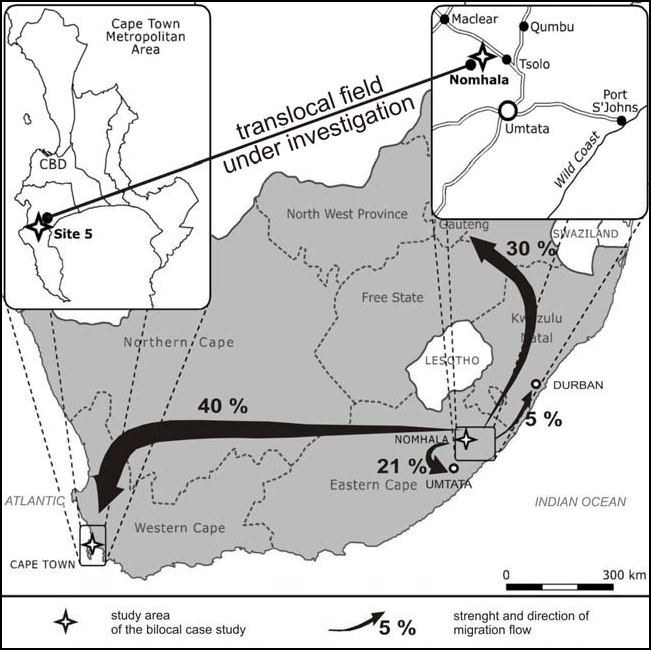
Main destination of rural-urban migration flows, study areas and translocal field under investigation (source: own survey 2006)
In the next section, I will demonstrate how translocal links between Nomhala and Site 5 have emerged and what football has to do with it.
Gaining Ground: Football in Nomhala
There aren't many options for recreational activity for the youth of Nomhala. For male adolescents in the village, football is of vital importance and an integral part of their male behavioural role. The sport is particularly central for the boys' integration into their peer group where their social position strongly relies on their football performance. One could draw a parallel between the functions of football and those of stick-fighting for masculine identity formation in former times (cf. Mager 1998).
You know, soccer is very important. Everybody in Nomhala plays the soccer. You must. […] You see, if you play the soccer, you meet all the friends and you show you can play the soccer. It's very important. (17–year-old male in Nomhala.)
Often, matches against neighbouring villages are organised on weekends. These are important events in rural social life, and up to 200 spectators come to support their teams. Football contributes to building and producing a local identity.
There are two football pitches in Nomhala, one in Mfolozi, the eastern part of the village, and one in Emangezimeni in the western part (cf. Map 2). They are used as training grounds as well as game venues. The teams recruit their players from their neighbouring village areas.
Nearly every afternoon, the boys and young men meet on the converted grazing land for a kickaround. Here friendships are built and maintained, or, in other words: This is where social networks are created. Information and news are exchanged here and, as we will see in the following sections, this is not only about village buzz. We shall see how these network relations actually shape processes of translocalisation between Nomhala and Site 5.
Local Short Passing and Translocal Crosses: Football and Translocality
The sociological concept of social capital is currently being heavily criticised due to its instrumentalisation by international organisations. 8 Yet, despite well-founded criticism of the concept's use in developmental discourse, it is a valuable approach or at least an adequate metaphor for highlighting the social aspect of economic action as well as the economic aspect of social action. From a network perspective, the term is useful to describe the resource character of social relations. 9 The concept also helps to explain processes of translocalisation: Though social capital is intangible, it is nonetheless relatively bound to space. One may say that social capital is located where those people are situated between whom a strategically beneficial relationship exists. If these people sojourn at the same place, this can be termed “local social capital”, otherwise we can speak of “translocal social capital”. This simple differentiation proves useful for describing the emergence of migration networks like in the case of Nomhala/Site 5.
Ever since Loury (1977) introduced the term into academia, “social capital” has been gaining considerable ground in social sciences. Yet it cannot be regarded as a coherent or consistent concept, since, depending on the discipline, it is applied with varying underlying meanings. Owing to these conceptual uncertainties, scholars have repeatedly suggested handling social capital with great caution. Fine (1998) even goes as far as to assume a causal connection between the analytical uncertainties and the popularity of the “chaotic” social capital approach. As a matter of fact, the notion of social capital has meanwhile become a constituent part of developmental discourse. Especially among the international donor organisations (such as the World Bank) social capital has become a leading concept. It is considered the missing link in the resolving of very different developmental problems, ranging from “poverty” to “bad governance”. Within the social capital discourse, the positive effects are over-emphasised and the potential of the networks as resources of the poor is overrated. Hence, structural pressure on and the constraints within social networks are literally programmatically neglected, cf. Peripherie, 2005, 99 (“Sozialkapital – Kapitalisierung des Sozialen”).
Hereafter and following Pierre Bourdieu (1986: 248), social capital is to be comprehended as a resource of individuals: Social capital is “the aggregate of the actual or potential resources which are linked to possession of a durable network of more or less institutionalised relationships of mutual acquaintance or recognition”.
When looking at the spatial distribution of the imizi of those migrants who moved from Nomhala to Site 5, it becomes apparent that they are distributed very unevenly within the village (cf. Map 2). They are all situated in Emangezimeni, which acts as a sort of “catchment area” of the western football pitch.
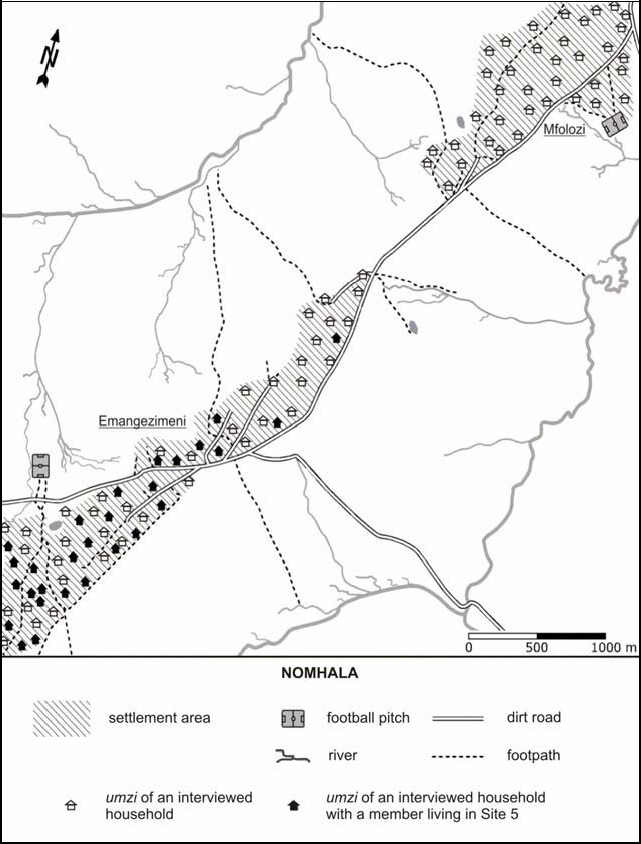
Nomhala and the locations of the imizi of the interviewed households (source: own survey 2006)
This uneven distribution lastly results from the significance of spatial proximity in everyday interaction in the village. Most communication is face-to-face and proximity is an essential factor for the high density of contact and communication within the neighbourhoods. Correspondingly, this high density of local social linkages leads to a local accumulation of social capital. This plainly means that the probability is extremely high that an inhabitant of Emangezimeni will build relationships with other inhabitants of Emangezimeni and can fall back on these in times of need. This applies especially to adolescents, whose radius of everyday mobility is usually restricted to relatively few nearby places, among them the football pitch.
In the early phase of translocalisation processes, it is mainly the young males in their football primes (18 to 25 years old) who migrate. One of the two very first migrants to leave Nomhala for the area near where Site 5 was later built was Linda (male, 19 years old at the time). A former schoolmate from a neighbouring village had told him that extensive housing areas near Fish Hoek were being developed for “whites” and that there were good chances of finding “piece jobs” (small jobs doing this and that) on the building sites. In mid-1989 Linda travelled to Fish Hoek and found piece jobs as a hodman. Given that he was a passionate football player from Emangezimeni it was not surprising that many of his friends were football players as well and lived in his former neighbourhood. So when Linda migrated to Site 5, many of the relationships with his friends from Emangezimeni translocalised and, with that, the inherent social capital as well (translocalisation of social capital).
Linda spent his December holiday (1989) with his family in his rural umzi and, as usual, met his peers at the football pitch. He told them about the job opportunities in Fish Hoek. Inspired by Linda's stories, his friend Dolly (male, 19) decided to accompany Linda in January 1990. In mid-1990 Sitembele, another football pal, followed them to look for work in Fish Hoek as well. Linda and Dolly helped him find piece jobs. After the three friends' next December holiday at home, another two football pals, Vabaza and Zulu, decided to leave Nomhala in early 1991 to look for jobs in Fish Hoek. At the outset, the five friends shared provisional shelter in a wetland area close to the building sites. In 1993 they moved to the new site-and-service project area (Site 5).
The migration biographies immediately reveal the relevance of social ties for migration processes. They illustrate how the translocalised social capital of Linda's football pals Dolly, Sitembele, Vabaza and Zulu was utilised to move to Site 5. Their migration to Site 5 led to a relocalisation of the social ties between the migrants in the target area (relocalisation of social capital). For arriving migrants, social ties with other migrants from Nomhala form an initial stock of local social capital in Site 5. This social start-up capital opens up access to housing and the labour market, and is a key prerequisite for their migration. On the other hand, the movements of each migrant, in turn, result in the translocalisation of numerous social ties which those left behind can then again potentially use for their own movements.
Figure 1 illustrates the impact of the five football friends' movements on the development of the migration network between Nomhala and Site 5 in the course of time (1989 to 2005). The lines between the symbols (actors) indicate who the respective first person of contact was for the arriving migrant.
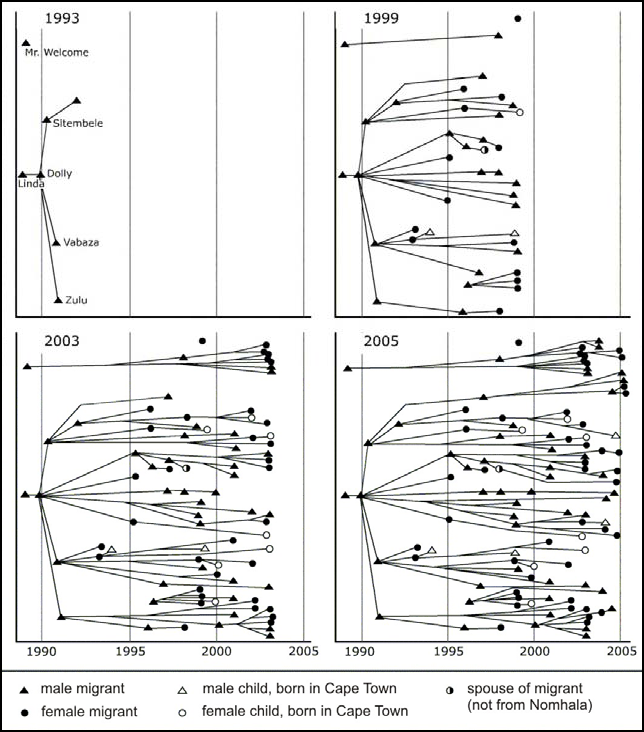
Chain migration to Site 5 (1989 – 2005) and use of translocal social capital (source: own survey 2006)
Over 80 per cent of all migration from Nomhala to Site 5 can be traced back to Linda in not more than five steps. 10 In Nomhala, the source area of the migration flow to Site 5 is still congruent with the western football pitch (cf. Map 2). Evidently, also non-footballers from Nomhala live in Site 5 nowadays, but the impact of local density of social ties in Emangezimeni on migratory movements is clear. 11 From the perspective of the Emangezimeni inhabitants, the local concentration of social ties in Emangezimeni leads to a local accumulation of translocal social capital in Site 5. As is typical for the dynamics of chain migration processes, every migratory movement tends to increase the attractiveness of the destination area (here Site 5), since a support network develops that is held up by several people on which the inhabitants can fall back on when needed. In this sense, the phenomenon can be regarded as a cumulative causation of translocalisation (cf. Massey 1990). Translocality of livelihoods can be described as the outcome of a self-sustaining process of translocalising and relocalising social capital. Figure 2 summarises this idea at a general and schematically simplified level.
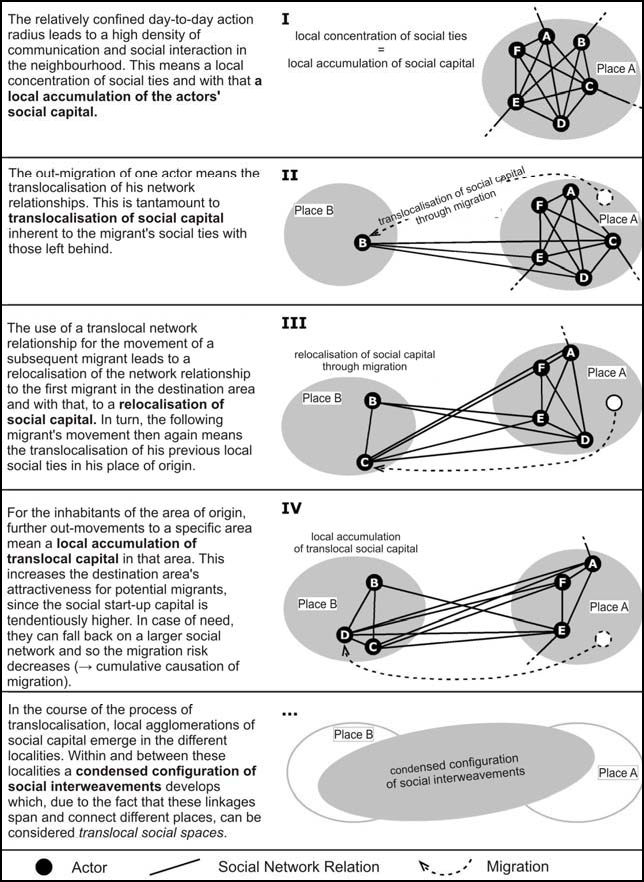
Translocalisation and relocalisation of social capital as a cumulative process
Mr Welcome (45 years old at the time) moved to the area the same year as Linda. Yet there was no evidence of a connection between his and Linda's migrations.
Also, when migrants draw on kinship relationships for their movements to Site 5, they usually contact household or kin members from Emangezimeni residing in Site 5.
In the specific case of Nomhala and Site 5, the starting point of the translocalisation process can in fact be directly traced back to football in Nomhala. Evidently, the football pitch is a place where essential bonds are built and where migrants meet potential migrants to exchange information on which migratory decisions are made, the basis for the development of the translocal nexus. In this sense, the slogan “football unites” also gains a (socio-)spatial dimension.
“Team Spirit”: Football in Site 5
Like in Nomhala, football is a also major leisure activity of male migrants in Site 5. As early as 1995 (two years after the establishment of the site-and-service project), a well-organised football league was founded there. Today, around 20 squads compete in this league. Most of them recruit their players from groups of migrants of the same rural origin.
It is not surprising that the first migrants from Nomhala (Linda, Dolly, Sitembele, Vabaza and Zulu) joined one of these clubs. First they played for the Cape Town Visitors, a team formed by migrants from the neighbouring districts Tsolo/Qumbu and Engcobo. Later, when the number of migrants from these regions gradually increased in Site 5, the team split into different teams, each formed by players originating from the same rural area.
But when the time passed we saw there were a lot of people from our side, so we can make our own soccer club. You see, the more people come, the smaller gets the area one club needs to build a team. (Migrant, about 35 years of age.)
So in 1998, the migrants from Nomhala founded their own club and called it the Mighty Doves. In 2003 this team had 14 male players from the village.
Football in Site 5: The Mighty Doves (photo: M. Steinbrink 2003)
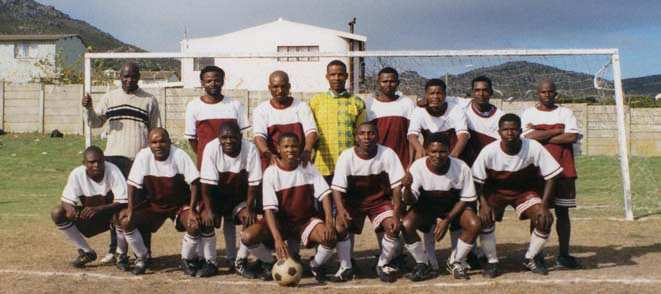
Several interviewed players stated that the Mighty Doves were more than a mere sports organisation. They described how team solidarity also induced mutual support and cooperation outside the pitch. Moreover, they stated that this, for example, had a strong impact on facilitating access to jobs:
If you are playing for example for the Mighty Doves and 50% of the people are working, these 50% are supposed to organise a job for the others who are unemployed. You know, when there is a team, you have an executive, the officials. So they sit together with the people of the team and say: “Guys, we are here in Cape Town, we are from the Eastern Cape and we are one team. The reason why we are here is the job. That is the most important thing. First one is the job, the second important thing is the sport! So we have the team, that is fine, but unfortunately there are some guys in our team who are unemployed. If somebody of you knows that there is a job, the first thing you have to think about are your team members – is your team! Don't look for other people, think of the guys of your team, who don't have a job.” You see, we try to organise the jobs for the team, because we are brothers there. When we are a team, we are brothers. (Migrant, about 25 years of age.)
Joining a team not only means engaging in a favourite hobby; team affiliation nurtures and may satisfy hopes of belonging to a system of mutual support. Especially the end of the interview passage above indicates that reciprocal ties within the team ought not be restricted to an instrumental tit-for-tat posture: The relationships between the team members are equated with the bonds of brotherhood and, with that, are lifted to a level of culturally loaded and symbolically charged meaning. In the context of vulnerability, joining a team can thus be considered a strategic action to establish a social network in order to gain improved social security and better job opportunities. This kind of networking can be seen as an aspect of rational action to adapt to existential risk and insecurity. 12
Classical studies of Wilson and Mafeje (1963) and Mayer and Mayer (1971) indicate that the mutual aid within organised groups of migrants in South African townships is not a novel phenomenon, but one rooted in the long history of oscillating rural-urban migration in South Africa.
On the other hand, the football-playing migrants cannot decide independently which team to join. There is a clear group expectation that they join the team of their origin and no other:
One thing I gonna tell you! The time you come here and you meet me and I'm in this team, […] now you have no work, so I must support you. I must give you food and then you can go and […] look for job. But if you come and you don't want to belong to my team, then I don't want to give you food. Why should I give you food, when you belong to the other team and not to our team? Why must I give you, when you are against us? This is how it works. So you must play in that team, because this team is from your home. And also on the Easters, when it is the holidays the team goes to Eastern Cape – with one Kombi – and then we are going to play there. We are going home, because we belong there. (Migrant, about 35 years of age.)
Since the majority of arriving migrants depend entirely on informal support, they can hardly risk deciding against joining their “home team”.
Keeping It Tight: Football as a Stabilising Medium of Translocality
What has been described so far shows how strongly football in Site 5 is interwoven with notions of togetherness and cooperation on the one hand and the idea of a shared place of origin on the other. Playing football and belonging to a team are powerful media for generating a shared social identity that contributes to intensifying and stabilising (local and translocal) social networks.
The people here enjoy soccer and they are keeping their relationship. Nobody can separate them because of the partnership of soccer, and they look after each other. It unites the people from the same rural area. (Migrant, about 25 years of age.)
The teams' names – the Mighty Doves and the Cape Town Visitors – already suggest certain interpretations as to underlying self-concepts of the teams as social groups: 13 First of all, it is noteworthy that the naming does not refer to football as such, but to a migratory aspect. Yet it is remarkable that this migratory aspect does not directly relate to a shared area of origin, but instead to a translocal way of life: The name Cape Town Visitors obviously implies that its members are just on a visit to the city, but in fact live elsewhere. The name Mighty Doves alludes to migration as well: Mighty doves are birds that cover long distances, always know where they come from, and always find their way back. This name also indicates the concept of a shared home and the idea of return and hence generates a sense of community. Collective identity is constructed around the idea of a shared way of life that is translocal, but not “spatially adrift”.
For other research on football team names and identity formation refer to Baller (2010: 117–118, 144), Mbaye (1998) and Poli (2003).
It is rather insightful that the team in Nomhala (in Emangezimeni) is also called the Mighty Doves. They adopted this name as late as 2000; before then, they did not have a name at all. So the name was imported from Site 5. A possible interpretation could be that the Mighty Doves players in Cape Town became identification figures for the young males in the village: Many of them want to join the Mighty Doves team in Cape Town and want to play in a regular league with unitary football jerseys, decent football boots, chalk lines and goals with real nets. This wish alone is surely not a reason for leaving the village. However, two aspects of the male role model do in fact coincide here: migration and football. To the village youngsters, the football-playing migrants (especially when they return to Nomhala in December well-dressed and with money in their pockets) are idols and impersonate “wayfarers on the right track” whose (translocal) concept of life is conceived as a worthwhile goal. 14 In this sense the import of the name indicates that the young football players are ready to “turn into mighty doves” and to head for Cape Town themselves. It suggests that a culture of transmigration exists and that translocal mobility is part of an accepted life concept.
Football shapes the image of urban migrant life: Though the boys know that dreaming of a professional football career is unrealistic, they do not cease to dream on. And football in Site 5 is at least closer to the Kaizer Chiefs or to Bafana Bafana than the pleasantly disorganised kicking around on Nomhala's grazing lands.
So it is not only the football pitch in Site 5, but the pitch in Emangezimeni as well where translocal identities are constructed and adopted even before the very first migratory experience. Accordingly, this social identity is not built in an urban or a rural context, but in a translocal nexus. Football is a medium for institutionalising and traditionalising. Football reproduces community, the idea of a shared origin and the self-concept of male migrants as “migrant workers”. Hence football stabilises rural-urban linkages and contributes to the functioning of translocal livelihood organisation.
Conclusion: Trapped Offside after Free Kick
This article described the links between football and livelihood organisation in South Africa. Surely, the author was partly motivated by an ethnographic pleasure resulting from exploring a subject matter dear to his heart – football – with a perspective on the game's significance beyond the football pitch. And certainly, football is only one small aspect of the larger framework in which it was set here. The football field study aimed to exemplify a model of translocality, which helps us to understand the processes, dynamics and effects of rural-urban migration and rural-urban linkages that have a long history in many African countries.
Yet, for the South African case, the facts described here support the superior line of argument: Labour migration still persists unabatedly in post-Apartheid South Africa. What has changed is how it is organised. The formal system has been replaced by an informal one. Translocal livelihood organisation today can be regarded as a system within which the recruitment of labour, the provision of housing, and essential aspects of social security are now organised in the informal sphere.
In this context, translocal social networks play a decisive role: At the actors' level they form main pillars of livelihood systems and bases of livelihood organisation; politically and economically, though, they are regulatory elements of larger-scale systems of dependencies whose dynamics perpetuate the prevailing socio-economic disparities in South Africa. The political institutional coercions during Apartheid have been replaced by self-organisation and rational agency of judicially free citizens. Yet in view of the factual poverty conditions in South Africa, the actual constraints on the freedom of action come to light. Considering the imbalance in the distribution of power and the restrictions on the freedom of action in the context of structural vulnerability, there is no reason to be euphoric about social-networking or to celebrate “social capital” as the sustainable resource of the poor. Translocal social networks are no means to overcome poverty. On the contrary, they are often a manifestation of live-in poverty and of people's strategies to cope. Though the powerless use their “social capital”, those who capitalise on it are others.
At first glance, the total sum of remittances sent by the rural-urban migrants appears to be a strong regional-balancing monetary flow from wealthier regions in support of structurally weaker regions. Yet, when we break the perspective down to a local scale, the monetary flow turns out to be a redistribution of resources between structurally weak localities. Or to put in South African jargon: The distribution flows occur between previously disadvantaged areas – that is, between the former black townships and the squatter camps on the one hand, and the locations in the deep rural areas of the former bantustans on the other. The described form of translocal structures should not be understood as a medium of social redistribution between the poor and the rich. The capital flows between (previously) disadvantaged people – the vulnerable give to the vulnerable.
It can be assumed that the system of translocal livelihood reproduces and enhances social and spatial inequalities in South Africa. The differences between rural and urban costs of living are a major reason for translocal household organisation. Due to the lower costs of living in the villages, a translocally organised household can make use of this “comparative cost advantage” if a number of the household members (especially those not employed) remain in the rural area (Greiner 2008). However, the structure of the South African labour market encumbers households from economising on these savings: Owing to the high unemployment rates, many job-seekers are structurally forced to accept extremely low earnings. As a result, wages are approaching a minimum-income threshold, just enough to uphold the workers' and their family members' subsistence level. So the savings achieved through translocal organisation function like informal subsidisations of labour costs. The savings realised through rural-urban cost differentials enter into the added value that is skimmed off by those who can hardly be classified as the previously disadvantaged. In this respect, and despite the far-reaching political changes in South Africa, the system of translocal livelihood remains reminiscent of the migrant labour system as described by Wolpe (1972) and other authors. The new system persists in the context of a modern democracy that explicitly claims to be grounded on equality and liberty. It continues to operate in a free South Africa whose constitution is considered to be one of the most progressive in the world. Labour migration and translocality are no longer based on direct state control or racial oppression, but they result from a political-economic context within which the old economic disparities are perpetuated.
Even after the national free kick in 1994, many South Africans have not succeeded in breaking the political economic off-side trap. Linda's, Dolly's, Sitembele's, Vabaza's and Zulu's translocal cross-field passes bring relief, but they do not change the course of the game.