



Abstract
South Africans voted in their country's fourth democratic general election on 22 April 2009. The African National Congress (ANC) again secured a substantial victory. It might seem that the 2009 Elections proved to be “business as usual”. Yet such a conclusion is unjustified, for events had conspired to generate excitement about this particular contest, which rivalled that leading up to the “liberation election” of 1994. The reasons for this were several, but the most important revolved around Jacob Zuma, who had risen to the presidency of the ANC in December 2007, and the formation of a new party of opposition, the Congress of the People (COPE), by dissidents from within the ANC. In the elections, however, the ANC reasserted its dominance. Even so, the results of the 2009 election at national and provincial level indicate change. The ANC has maintained its electoral dominance, yet its grip on the electorate has been somewhat weakened, while the opposition – although remaining very much in the minority – has consolidated.
On 22 April 2009 over 18 million South Africans went to the polls to vote in their country's fourth democratic general election. That the African National Congress (ANC) would once again secure a substantial victory was never in doubt, and the electorate duly responded by again returning the ruling party to power. At the national level, the ANC secured 65.9% of the votes cast and a total of 264 seats in the 400 member National Assembly. Although this represented a loss of 15 seats and 3.8% of the total vote, the result was hugely impressive.
Elections 2009, it might seem, had proved to be business as usual. Yet such a conclusion is unjustified, for events had conspired to generate excitement about this particular contest, which rivalled that leading up to the “liberation election” of 1994. The reasons were several, but most importantly they revolved around one singular, remarkable man: Jacob Zuma. More particularly, the electoral context was shaped by how Zuma's rise to the presidency of the ANC at the ANC's 52nd National Conference in December 2007 at Polokwane, and the subsequent “recall” of Thabo Mbeki from the state presidency in September 2008 (following a court judgement which indicated executive interference in the long saga of Zuma's prosecution for alleged corruption) had helped prompt the formation of a new party of opposition, the Congress of the People (COPE), by dissidents from within the ruling party who reserved their political loyalty for former President Thabo Mbeki. 1
This draws together excerpts from Roger Southall, Zunami! The Context of the Election, and Roger Southall and John Daniel, The National and Provincial Electoral Outcomes, both in Roger Southall and John Daniel (eds.) Zunami! The 2009 South African Election, Auckland Park: Jacana 2009. The book was financially supported by the Konrad Adenauer Foundation and the Humanities Faculty Research Committee of the University of the Witwatersrand.
A Challenge to ANC Dominance?
At the outset, there was a widespread feeling that the 2009 election might prove to be a political watershed. Analyses of the three previous democratic general elections had been broadly optimistic. Building upon the euphoria of the “founding election” of 1994, the succeeding contests of 1999 and 2004 were presented as important steps upon the road to democratic consolidation. The broad consensus was that the holding of successive elections which were competently run and “free and fair” indicated a legitimization of electoral competition as the accepted way of selecting governments. Even so, optimism was qualified by disturbing questions: Was South Africa's electoral system the most appropriate one, or had the adoption of national list proportional representation minimized the accountability of politicians to their electorate? To what extent was the electoral dominance of the ruling African National Congress (ANC) responsible for the undermining of parliament and the subordination of the legislature to the executive? Most of all, was the perception of “democratic consolidation” actually an illusion, for what would the ANC do if it were to meet a serious challenge at the polls? Whilst the ANC might accept electoral results which delivered it overwhelming victories, it might prove less tolerant of unfavourable outcomes.
There was no serious suggestion during the 2009 election campaign that South Africa would have to confront the “turnover test” – the willingness of an incumbent government in a new democracy to hand over power if defeated at the polls – which theorists consider the ultimate test of democratic consolidation. Nonetheless, it was reckoned that this fourth contest would present a major challenge to the country's democratic ethos. In the previous three elections, the ANC had been confronted by a clutch of opposition parties which, broadly speaking, were fragmented along racial lines, none of them able to match the ruling party's claim to non-racialism and inclusiveness. However, by 2009 the situation had changed dramatically. On the one hand, the Democratic Alliance (DA), the largest opposition party, had sought to build upon its reputation for competence by moving away from its historical positioning as primarily a representative of white interests. But more particularly, the ANC faced the challenge from COPE, a party which had developed out of the bitter struggle within its own ranks.
The launch of COPE challenged the ANC's claim to be the representative of the true interests of “the people”, and appeared to give substance to popular discontent with its rule. Importantly, too, it was widely canvassed that COPE's emergence would erode the ANC's political dominance, notably by undercutting its chances of securing the two-thirds majority which would provide it with the unilateral capacity in parliament to amend the constitution, as well as threatening its rule over key provinces, notably the Western Cape.
The ANC's reputation as the party which had defeated apartheid had provided the foundation for its political dominance and provided the basis for its impressive performances in the elections of 1994, 1999 and 2004. These had been conducted under a national list system of proportional representation (PR) for the National Assembly, the lower house of parliament. Simultaneous parallel elections had been conducted for the 425 members of unicameral legislatures within all nine provinces, the number of seats in each provincial legislature being proportionate to the number of voters in each province, (although there is constitutional provision for the national and individual provincial elections to occur at different times). The particular system of PR used admits no threshold for parties, thereby allowing for the maximum spread of party representation within national and provincial legislatures, thus offering full expression of racial, religious and political diversity.
The three elections for the National Assembly prior to 2009 had provided the ANC with successively larger majorities: 63.1 percent in 1994; 66.4 percent in 1999; and 69.7 percent in 2004. Inevitably, at provincial level, there were regional variations, albeit revolving around the same theme of overall ANC dominance. The two provinces which deviated significantly were KwaZulu-Natal and Western Cape. In the former, a “negotiated result” saw the IFP secure 50.3 percent of the vote in 1994, and hence achieve provincial office, a result which was deemed necessary to secure peace in a region which had featured a bitter war between the IFP and ANC since 1990. Thereafter, the ANC secured a plurality in 1999, and became the senior partner in ANC/IFP coalitions. In the Western Cape where the Coloured population outnumbers Africans by 2:1 and whites constitute a sizeable minority, the National Party (which soon thereafter renamed itself the New NP) secured 53.3 percent of the vote, and assumed provincial power in 1994, before its declining share of the vote (38.4 percent) saw it forming a coalition with the Democratic Party (11.9 percent) in 1999 to block the ANC (42.1 percent). Subsequently, a game of musical chairs saw the ANC (45.3 percent) entering office at the head of a coalition with the NNP (10.9 per cent) to exclude the DA (27.1 percent) in 2004. In short, the ANC was in sole or predominant control of a minimum of 7 out of the 9 provinces from 1994.
Criticism of the ANC's dominance has become so widespread that its benefits have been too easily overlooked. In a country previously wracked by racial division, political conflict and low level civil war, the ANC's cocktail of unity in diversity, national reconciliation, non-racialism and black advancement, together with an emphasis upon equality and democracy, has offered a foundation for a common society, notwithstanding many mixed messages. At the same time, ANC dominance has provided a framework for economic stability and growth which has provided a welcome contrast to the downward spiral of the economy from the early 1970s through to the early 1990s. Even so, the costs of dominance have become evident and widely debated; critics have given voice to concerns about the consequences of an ANC “party state”. Principal complaints refer to a politicization of the public service through the “deployment” to state office of party functionaries, thereby undermining the liberal democratic tenets of the country's constitution. Likewise, there are well documented criticisms about a concerted subordination of parliament to the executive; the erosion of the independence of supposedly neutral public institutions (such as the South African Broadcasting Corporation); a decline (since the heady days of 1994) of accountability of those in power; an effective collapse of “delivery” of key government services (notably education and health) as a consequence of the emphasis on “racial representativity” over merit and efficiency; and the associated favouring of political loyalty over ability, mediocrity over excellence, and opaqueness over transparency. Above all, what has most shaped popular perceptions of the negative aspects of ANC dominance has been evidence of a cancer-like spread of corruption throughout the body politic, with attainment of office within the ANC being viewed as a route to wealth rather than the pursuit of public service. In addition, while there were many sound reasons for Mbeki's centralization of power under the presidency, not least his concern to control party infighting and coordinate implementation of policies, this was an aspect of his rule which was to fuel much of the resentment which propelled the Zuma coalition, for it rendered government distant from the grass-roots and encouraged those in power to become arrogant. Nonetheless, founded by some of those who were defeated at Polokwane, COPE's problem was always going to be that it looked like a coalition of losers; their promise of a new beginning compromised by their entanglement in the Mbeki legacy.
The Electoral Outcome
At first sight, even after all the considerable drama of the events leading up to polling on 22 April, the results of the 2009 election seemed to indicate that South Africa had returned to business as usual. Indeed, the return of the ANC to power with nearly 66 percent of the vote and its outright win in eight out of the nine provinces was indicative of an overall level of continuity. From this perspective, even if the ANC fared rather less well than in 2004, it remains hegemonic, its standing amongst the electorate likely to withstand any assault upon its control of state power which even a restructured and revitalized opposition might launch in the fifth general election, expected in 2014. However, while an initial glance at the electoral results suggests overall continuity, a more careful analysis indicates that the 2009 general elections have also introduced significant change.
The National Electoral Outcome
The bare statistics of the election outcome indicate that the ANC won its customary decisive victory. The winning margin for the ANC was fully 34 percent over the efforts of the combined opposition. Even so, the results also indicate that, apart from winning the Western Cape in the provincial election, the DA increased its support nationally, from 12.37 percent to 16.66 percent, acquiring an extra one million votes along the way, and consolidating its status as the national opposition, even in the face of the new threat posed by the emergence of COPE.
For its part, COPE while falling considerably short of the targets which it had set for itself when, in the heady days of its launch, it threatened to lead a major breakaway from the ANC by taking 7.42 per cent of the national vote, nonetheless performed far better than previous newcomers to the electoral arena (notably the United Democratic Movement (UDM) in 1999), securing a significant minority presence in the National Assembly, while establishing itself as a presence in seven of the country's nine provinces. Furthermore, the election results indicate a marked trend towards consolidation of the opposition, with the joint performance of the DA and COPE squeezing the smaller parties into relative insignificance. While the IFP was thrown back onto its core vote, the smaller parties were reduced to little more than flag wavers for values (the African Christian Democratic Party, ACDP), historic allegiances (the Pan-Africanist Congress, PAC; the Azanian People's Organisation, Azapo; and even the United Christian Democratic Party, UCDP), and ethnic and interest representation (FF+, ID and MF). While the 2009 election actually returned more opposition parties to parliament (12) than did the 2004 contest (11), the smaller parties secured considerably fewer seats: they were padded down from 43 seats in 1994 to just 21.
These statistics offer the bare bones of the outcome, yet it is in the flesh and blood of the contest that a more complex picture lies, highlighted not only by the personal triumph of Jacob Zuma but also by the improbable fact that the second most influential politician in the country is a white woman, Helen Zille, whose leadership of the DA has taken her out of parliament into the premiership of the Western Cape. It is worth investigating this in more detail.
The ANC: Winning Big, But Losing a Little
At the beginning of the campaign, following the emergence of COPE, there were numerous predictions that the ANC's performance would suffer. The defeat of Mbeki at Polokwane in December 2007, his recall from the Presidency in September 2008, the appointment of an interim President, Kgalema Motlanthe, who at times appeared to have neither the appetite to do the job nor the freedom to act independently of Luthuli House (the ANC headquarters), all made evident the clear divisions within the ruling party. In addition, while Mbeki himself avoided openly identifying with COPE and declined to campaign for the ANC, there was perpetual speculation about the extent to which he was associated with a new arrival on the scene that threatened the ruling party's hegemonic grip upon the voting affections of the African population. Meanwhile, Zuma himself began the campaign under the continued threat of prosecution for corruption, and faced the prospect that even if he became President (as was never in serious question), he might find himself brought before the courts. Yet during the course of the campaign, there was a remarkable transformation.
First, all those who deemed Zuma an electoral liability were dumbfounded when evidence of political intervention in the legal process led to the NPA announcing it would no longer be pursuing its case against him. Indeed, Zuma rapidly proved himself to be a major asset to the ANC. He was a man who proved able not merely to mobilise extensive support amongst the majority poor, but who also went out of his way to cross racial, ethnic and class lines by variously appealing to diverse communities, from poor whites to Indians, while simultaneously assuaging fears of business and farmers. Above all, from this perspective, Zuma gained because he manifestly was not Mbeki, of whom most South Africans had grown tired, as was symbolised by the appearance of Nelson Mandela at key election rallies. Where Mbeki appeared to signify that the ANC had become a party of racial exclusion and middle-class paramountcy, Zuma announced that it remained a party of inclusion, open to all South Africans.
Second, far from seriously weakening the ANC, the birth of COPE had the reverse effect of energizing it, of revitalizing its structures, and mobilizing a level of activism amongst its membership which exceeded anything seen since 1994. It also capitalized upon its massive cash advantage over its rivals, spending at least R400 million in a campaign in which it
“outspent, out-thought, outworked and outmaneuvered the opposition muscling them out of every millimetre of public space. It also outsang and outdanced them, capturing the hearts and minds of the youth by making politics cool and sexy again” (Sunday Times 26 April 2009).
By the time the country voted, the ANC appeared – and was – a much more united and coherent party than six months previously. Overall, in 2009, the ANC polled 8.7 million votes more than the DA, just over 6 million more than the combined opposition, and nearly one million more than in 2004.
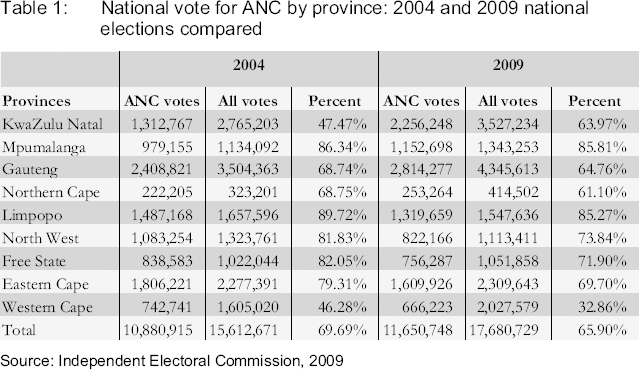
Nonetheless, the ANC did not have everything its own way. While, towards the end of the campaign, the ANC appeared hopeful of repeating its 2004 triumph of achieving a two-thirds majority, in the end, it failed to do so, albeit by a whisker. Furthermore, while it had overridden earlier fears that a significant slice of the electorate would “punish” it – for failures of delivery, for the risk that it might change the constitution – and that its vote would fall to around 60 per cent, the ANC vote revealed significant fault lines. This was not an untarnished triumph, as indicated by the fact that not only had the party's percentage of the poll dropped by 3.8 percent, but also by the fact that its proportion of the vote dropped in every province bar one:
The exception was of course KwaZulu-Natal, where its proportion of the vote jumped from 47.5 percent in 2004 to 63.97 percent in 2009. This was largely a result of the “Zuma factor”; namely, the rise to the head of the ANC of a Zulu, with deep roots in the province, whose candidacy neutralised the IFP's appeal on grounds of traditionalism and ethnicity. To be sure, even if the ANC had been headed by another candidate such as Motlanthe, it is likely that it would have increased its majority in KwaZulu-Natal in line with its incremental improvements in the province since 1994, for it has made major effort over the years to erode the support base of the IFP by focussing upon “delivery” and emphasising its status as the party of power and patronage. Nonetheless, without Zuma, the ANC's performance in KwaZulu-Natal would not have been so convincing, and without it, the ANC's overall majority nationally would have been reduced to the lower 60s.
The second fault line is indicated by the ANC's loss of ‘Coloured’ votes, and – despite Zuma's bid to rebrand the party as a “home for all” – the flight of minorities to the DA and COPE. The most pronounced losses were in the Western Cape, where the ANC lost for two reasons. First, the Coloured vote abandoned the ANC for the DA. Although there had always been a significant block of ANC supporters within the Coloured community which had hitherto remained loyal, in 2009 this was shattered. In Mitchell's Plain on the Cape Flats, for instance, where the ANC had secured 23 percent of the vote in 2004, their support slumped to just 7 percent in 2009. Likewise, in the Coloured areas of Gauteng, like Ennerdale, Eldorado Park and Riverlea, where around a third of Coloureds previously stuck with the ANC, the proportion supporting the DA grew in every district. To be sure, it might be argued that the ANC's losses in the Western Cape were a self-inflicted disaster, a result of a vicious factionalism which took on a racial form, and that the party is unlikely to enter future elections in the province so thoroughly divided, demoralised and unorganised. Nonetheless, it remains the fact that in 2009, despite Zuma's message of inclusiveness, the ANC lost support across the array of racial groups and that, unwittingly, it is becoming a party with an increasingly African identity.
The Parties of Opposition
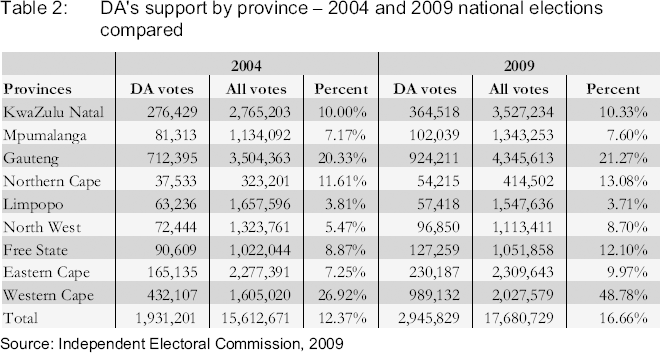
It was widely suggested at the time of COPE's emergence that the real story of the 2009 election would be the fight for second place. By the end of the campaign, it had become evident that the DA would win this particular race, even if the margin of its victory remained a matter of considerable speculation. In contrast to COPE's various misfortunes, the DA ran an efficient and focused campaign, headed by a vigorous and effective woman leader who made it clear that the party saw itself as a serious national contender and was determined to build upon its status as the official opposition. Its message was summarized in its two campaign posters, “Vote to win”, and at the end of the campaign, “Stop Zuma” – the latter highlighting its adopted profile as the party of constitutionalism. Yet for all the promising razzmatazz of its campaign, and Zille's high profile efforts to promote her party among disaffected African communities, the DA failed to make significant progress towards its becoming a party representative of all South Africans. To be sure, the latest contest saw it continuing its upward trajectory. Compared with its dismal performance in 1994, when its predecessor, DP, secured just 1.7 percent of the vote, its capture of 16.7 percent of the vote in 2009 represented a considerable triumph. Furthermore, as indicated by Table 2, it increased its proportion of the vote in every province, with the exception of Limpopo (where it suffered as a result of the appearance of COPE).
National vote for ANC by province: 2004 and 2009 national elections compared
Source: Independent Electoral Commission, 2009
DA's support by province – 2004 and 2009 national elections compared
Source: Independent Electoral Commission, 2009
Overall, while its vote increased by over a million over 2004, these came from overlapping groups. First, it would appear to have attracted the large majority of those nearly 260,000 voters who voted for the now defunct NNP in 2004 (only around 10,000 of them opting for the FF+). Second, as noted, it drew significant support from Coloured voters around the country. Third, it gained overwhelmingly from the return to the polls of whites, many of whom had absented themselves in 1999 and 2004. In short, while in 2009 the DA made considerable strides forward, its lack of support amongst Africans suggests that it may have reached its glass ceiling, even though its aim is to break through that by demonstrating, through its capture of the Western Cape provincial government, a superior record of delivery to poor communities, thereby leaving behind its unwanted image of the party of the rich.
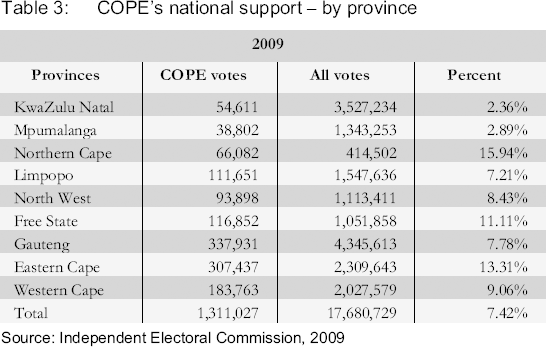
The further way forward for the DA may be by forging a restructuring of the opposition, and much emphasis is placed by some upon the potential of its combining with COPE. This, it is said, would provide a combined opposition with a genuinely non-racial basis, not least because the new party appealed across racial lines, and in terms of composition, may be the most genuinely representative of all the political parties in racial terms. However, the evidence of 2009 suggests that – while the profile of a restructured opposition may be more inclusive than that of the DA – the immediate gains would be limited. For its supporters, COPE's restriction to 7.4 percent of the vote was an undoubted disappointment. For observers, this may represent something of an achievement given the difficulties it conjured up, its lack of organizational muscle, and the money it did not have, not least because unlike other new parties previously, it avoided the fate of becoming a de facto regional party. As Table 3 indicates, its principal locus lies in Gauteng and Eastern Cape, and its support is spread across the country, with the exception of KwaZulu-Natal and Mpumalanga.
COPE's national support – by province
Source: Independent Electoral Commission, 2009
In addition, COPE may be able to lay claim to having changed the mould of post-apartheid politics, notably by providing the de-aligned ANC voter with an alternative. This may indeed hold out some considerable promise for a restructured opposition. However, the danger for the opposition would be that, while such a new party would undoubtedly present itself as centrist, the ANC would present it as a party of the right. This could well prove fateful for COPE, and the more likely prospect may be that – for all the insults that may be traded in parliament – the ANC will seek to heal the breach within the family.
The Provincial Outcome
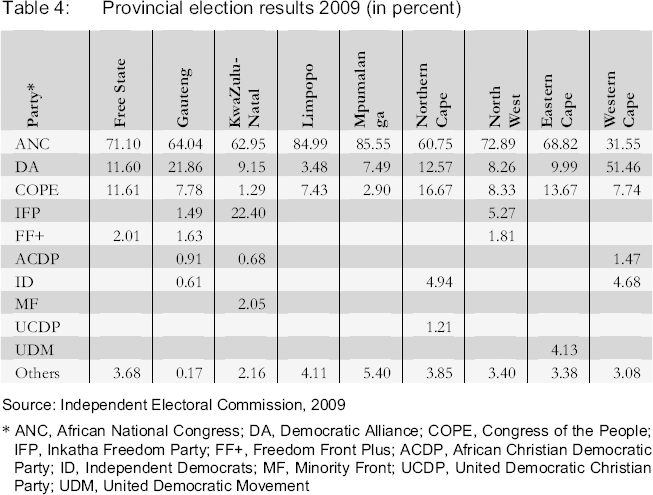
As noted, the ANC won outright in eight out of the nine provinces, consolidating its grip on the machinery of government. Despite its broad sweep, the ANC's loss of the Western Cape was monumental, providing the major chink in its armour of party dominance, while providing the DA with the opportunity to prove itself as a party not merely of opposition but of office. Yet the drama and importance of that individual provincial result highlights another factor of importance: the growth of strategic voting, as exemplified by voters splitting their preferences between parties at national and provincial level. This happened to a degree in a number of provinces, but it was in KwaZulu-Natal and the Western Cape where its extent and outcome was most dramatic.
Provincial election results 2009 (in percent)
Source: Independent Electoral Commission, 2009
ANC, African National Congress; DA, Democratic Alliance; COPE, Congress of the People; IFP, Inkatha Freedom Party; FF+, Freedom Front Plus; ACDP, African Christian Democratic Party; ID, Independent Democrats; MF, Minority Front; UCDP, United Democratic Christian Party; UDM, United Democratic Movement
In KwaZulu-Natal, the ANC polled 63,732 votes fewer in the provincial poll than it did nationally, while the IFP polled 53,715 more provincially than at the national level. This suggests that a significant proportion of the province's voters opted for the “100 per cent Zulu” nationally while backing the IFP provincially (as, to the chagrin of the provincial ANC, Jacob Zuma had invited IFP loyalists to do). Meanwhile, in the Western Cape a significant minority of voters voted differently at provincial level to keep the ANC out and put the DA in. Whereas the DA obtained 989,132 votes, or 48.8 percent, in the Western Cape in the national election, it won 1,012,568 votes, or 51.4 percent in the provincial election. Although this was an increase of a mere 23,436 votes, these extra votes appear to have been drawn overwhelmingly from COPE, with perhaps some even coming from the ANC itself. To be sure, the picture is complicated by nearly 60,000 fewer votes being cast in the province for the provincial election than in the national election, a factor which probably arises from voters registered in another province being physically located in Western Cape on election day. Under electoral law, this meant that they were restricted to voting nationally. Nonetheless, the fact that COPE polled nearly 30,000 votes fewer in the provincial election than in the national one, and the ANC over 45,000 fewer, indicates that strategic voting was a reality.
The other notable fact about the provincial contests arose as a consequence of the ANC's Polokwane resolutions, which removed the power to appoint premiers from the President whilst committing the party to attempting to achieve gender parity amongst those premiers appointed. The new practice entailed a change in party dynamics, allowing provincial parties more say in the selection of premiers, for they were now entitled to put up three candidates, from whom the ANC's NEC was expected to select one. Furthermore, it was widely expected within ANC structures that election to the chairpersonship of provincial organizations would enable provincial party chairs to lay claim to the premiership. Yet there was an inherent tension between the ANC's commitments, resulting in the NEC intervening to disappoint a number of party chairpersons by appointing women to the premiership in four out of the eight provinces in which the ANC formed governments.
Conclusion
The results of the 2009 election at national and provincial level indicate change within a pattern of overall continuity. The ANC has maintained its electoral dominance, yet its grip on the electorate has been somewhat weakened, while the opposition – while remaining very much in the minority – has consolidated. Even so, predictions that South Africa is moving towards a two- or three-party system are premature. While the decline of the small parties suggests that their supporters are increasingly inclined to make their vote count by opting for a larger party, rather than just having their views represented, the uncertainty surrounding the future of COPE renders the tea leaves difficult to interpret. If COPE prospers, it could emerge as the core of a non-racial opposition to the ANC. However, if it fails to live up to its aspirations, or if it were to make its peace with the ANC, its vote could well drift back to the ruling party rather than fleeing to other opposition parties. Much will depend upon the character and performance of the new government and parliament.