



Abstract
For generations, immigrants from other African countries have comprised a significant minority of residents in Brazzaville, capital of the Republic of Congo. These immigrants constitute several distinct “stranger” populations within Congolese society. While they play a significant role in the Congolese economy, they also encounter discrimination in their daily lives and face hostility from indigenous Congolese. Popular discourses in Brazzaville widely represent African foreigners as a malevolent presence and a threat to Congolese interests. Such discourses fit into broader conflicts over identity, belonging, and access to resources on the continent. This paper, based on ethnographic and survey research carried out in Brazzaville, examines the case of that city's immigrants from the West African Sahel. It situates tensions between them and their hosts in the context of contemporary political and economic dynamics in post-colonial Congo, and specifically links them to exclusionary place-based identity as a political force in contemporary Africa.
African Nations and African Strangers
Political transformations since the late twentieth century have fostered ever more localized constructions of identity in many parts of the world, often at the expense of national or cosmopolitan identities. The proliferation of autochthony-based claims to rights and belonging has been observed around the globe, including in Western Europe, and has been particularly visible in sub-Saharan Africa, where it appears to undermine post-colonial nation-building projects (Ceuppens and Geschiere 2005; Geschiere and Jackson 2006). In privileging certain criteria of belonging over others, social and political movements predicated on autochthony call into question the very concept of national identity based on equal rights for all citizens.
Yet the population flows which fuel these autochthony movements can also create perceptions among Africans of international immigration as a problem in their own societies. Large-scale migrations across national boundaries alter dynamics of identity construction in migrant-receiving countries, with the potential to strengthen discourses about rights and belonging at the national level. The presence of significant immigrant populations in African societies also opens the door to economic, social, and political tensions, even when those immigrants are Africans themselves; friction may emerge around questions of national as well as ethnic or local origin.
Every society is home to strangers – people who are part of society but perceived as external to it due to their foreign provenance. “In spite of being inorganically appended to it, the stranger is yet an organic member of the group,” wrote Simmel (1950: 409) of the stranger's complicated structural position vis-à-vis members of the native population. While strangers play important and lasting roles in the host society, they are not seen to belong fully since their people were not members of it “from the beginning”; the stranger's true homeland lies elsewhere. While European Jews were once the archetypal stranger group, analogous populations exist in societies around the world (see Bonacich 1973; Karakayali 2006). Strangers in sub-Saharan African societies have been the object of scholarly interest for decades. Skinner (1963: 308) documented the existence of “permanent stranger communities” in African history, groups which often benefited from European colonial rule and served as economic or political intermediaries between colonizer and colonized (see also Shack and Skinner 1979). Fortes (1975: 245) described strangers in West African societies as “inassimilable aliens”, the opposite of kinsfolk because they were exempted from the host societies' moral economies and webs of mutual obligation. More recent research has focused on issues of autochthony, the dynamics of exclusion, and the “intensification of the politics of belonging” at the local level (Geschiere and Nyamnjoh 2000: 423), as concern mounts in tandem with democratization processes in various parts of Africa to distinguish between “genuine” and “false” citizens.
Contemporary problems of belonging in Africa neither bypass the nation state nor foreshadow its eclipse. Even in weakened and divided nation-state contexts, shared ideas about membership and rights can coalesce around explicitly national identities. African states may lack the power and strict border policing of states in other regions of the world, but modern concepts of nationhood and citizenship nevertheless remain central to the process of defining identity in the region. As in many societies around the world, immigrants in Africa today are scapegoated for local problems. The inclusive rhetoric of pan-Africanism, while continuing to infuse official discourse, often holds little sway in the face of this exclusionary tendency.
This paper analyses one current instance of tension between immigrants and hosts. Its focus is the city of Brazzaville (capital of the Republic of Congo) and its population originating in the West African Sahel. 1 Most of my informants (or, in some cases, their parents or grandparents) migrated to Congo from Mali, while others came from Guinea and Senegal; nearly all could speak Bamanan or another language of the Mande family (especially Soninke). It is important to note that Brazzaville's West African population has long included migrants from throughout West Africa, most notably Nigeria and Dahomey (now Benin); in the city's Poto-Poto neighbourhood are streets named for both Dahomey and the Hausa ethnic group of northern Nigeria and Cameroon. Today, however, Sahelian West Africans and especially Malians are the most visible and numerous members of this population, with an estimated 20,000 people from Mali alone living in the city. My analysis therefore concentrates on Brazzaville's present-day population of immigrants originating in Mali, Guinea, and Senegal. 2 Congolese do not normally differentiate among these strangers by nationality or ethnicity, but rather refer to them simply as “Ouest Africains”. When I refer to West Africans below, I specifically mean the members of this multi-ethnic and multinational group.
This paper stems from five months of ethnographic fieldwork which I conducted in Mali between 2002 and 2006, and 12 months of fieldwork in Brazzaville from 2005 to 2006. In Brazzaville I lived in the neighbourhood of Poto-Poto, traditionally home to the largest concentrations of immigrants, where I carried out daily participant observation and interviews with West Africans. With one Malian assistant, I collected more than 130 interviews in French and in Bamanan, which I learned while working in Mali from 1997 to 2000.
I use the term “immigrant” to describe individuals born outside their country of residence, as well as individuals (second- or third-generation immigrants) whose parents or grandparents emigrated from their country of birth.
Harvey (1993: 4) writes that “territorial place-based identity […] is one of the most pervasive bases for both progressive political mobilization and reactionary exclusionary politics.”
My goal in this paper is to map the contours of this latter dynamic and interpret its importance as a social and political trend in Congo today. In trying to account for the current state of relations in Congo between people defined as natives and those defined as strangers, I consider the West African stranger population's historical and sociological roots, the problems its members encounter in the larger host society, and the attitudes of “native” Congolese toward the West Africans in their midst. I then expand my focus to examine host-stranger relations on the African continent more broadly.
Background: The Historical Generation of Difference
Brazzaville's population of immigrants from Africa's western Sahel region is as old as the city itself. In the latter half of the nineteenth century, French explorers and colonizers recruited manpower on the Senegalese coast for their expeditions to equatorial Africa. West African personnel known as laptots or more generally as Sénégalais were indispensable to France's gradual takeover of what eventually became French Equatorial Africa: they acted as messengers, porters, clerks, sailors, and most importantly as soldiers providing security for French officers (see Brunschwig 1966). In 1880 the first French detachment posted at M'Foa, the future site of Brazzaville on the north bank of the Congo River, consisted of two West African laptots and a recruit from the Gabonese coast. By the 1890s Brazzaville had its own village sénégalais (nicknamed “Dakar”) adjacent to the French administrative centre; this neighbourhood was later relocated to a low-lying floodplain known as Poto-Poto, 3 where West Africans composed one of seven ethnically delineated quartiers (Balandier 1985). During the period when the colony was parcelled out to private concessionary companies, from the 1890s to the 1920s, some of these firms had nearly as many Senegalese as European employees (Coquery-Vidrovitch 2001). Throughout the first decades of colonial rule West Africans served primarily as military personnel; as late as the 1930s, the French colonial administration required large numbers of West African troops to quell popular uprisings in Brazzaville's “native” district of Bacongo (Gondola 1996). But West Africans also worked for the colonial police force, post and telegraph service, public works department, and railroad. Their ranks included personnel recruited not only in Senegal but also in Dahomey, Togo and the West African interior, and even in Sierra Leone and the Gold Coast (see Martin 1995: 25 ff).
The name “Poto-Poto” comes from the Bamanan word pòtòpòtò, meaning “watery mud”.
By the 1940s the West African role in Brazzaville had begun to shift away from colonial service and formal-sector employment. Although Senegalese, Dahomeyan, Togolese and other West Africans continued to dominate salaried jobs in French Equatorial Africa into the 1950s (Balandier 1985: 68), many colonial military and administrative personnel (particularly Sahelians) stayed on after completing their contracts to go into commerce. Some brought wives from their home communities to join them, while others married locally. Gradually the city's West African population became less dependent on the French administration, more settled and more engaged in entrepreneurial activity. In short it became a typical stranger community or “middleman minority” (Bonacich 1973), a political and economic buffer group between the French colonizers and the Congolese. Its role of filling the “status gap” between French and Congolese is apparent in the words of one of my interview subjects, the Brazzaville-born son of a man who came from Mali in the 1940s. “In our father's time, after tubabuw [whites], West Africans. After West Africans, locals,” he told me, explaining that West Africans enjoyed certain prerogatives which locals did not:
White people had been in West Africa for a long time and knew it well; they respected our fathers. Our fathers could take the vedette [speed boat] over to Leopoldville [later renamed Kinshasa] at midnight and go dancing then return at 5 a.m. The boat was driven by white people.
West Africans provided many goods and services required by the French, and in return they were granted higher status than members of the majority. West African merchants in Congo established early dominance over the trade in imported wax-print cloth, and ultimately dominated the wholesale and retail sale of many imported goods. A select few were also engaged in the illicit diamond trade, for which Brazzaville became a regional hub (Bredeloup 1994).
Upon independence in 1960, Congo had a small population (fewer than 800,000 people) which was rapidly urbanizing. Rates of schooling were relatively high 4 and most educated Congolese found jobs in new government offices. For decades the Congolese state fostered the development of a “bureaucratic bourgeoisie” (Clark 2005: 107) concentrated in the capital city: the civil service became the backbone of the national labour market, and the state's economic role expanded further with the discovery of offshore petroleum in the 1970s. By the late 1980s, the zenith of Congo's public sector, there were 85,000 government employees, and a third of all Brazzaville households were headed by civil servants (Dorier-Apprill et al. 1998). With government employment the norm for Congolese, the private sector became the domain of strangers – French, Lebanese, and African immigrants. West Africans in particular flourished as shopkeepers in the markets of Brazzaville and other Congolese towns, supplying imported clothing, foodstuffs, and other goods to an urban population with increasingly cosmopolitan tastes. Malians increasingly came to dominate Brazzaville's West African population, and by the 1980s census data showed that they far outnumbered immigrants from Senegal and Benin (RGPH 1984).
Congo's primary school enrolment rate reached 57 per cent in 1955 (Wagret 1963); an equivalent rate in Mali was only achieved after 2001.
Even as fellow dark-skinned Africans, West African strangers in Brazzaville were set apart from the host population as a visible minority. This fact was due in large part to religious distinctions: almost exclusively, strangers from the western Sahel practised Islam, a faith alien to Central Africa. In contrast to Congolese, they wore Muslim garb, worshipped at mosques, abstained from alcohol, and established private Qur'anic schools. Anxious to minimize the host society's influence on their Brazzaville-born offspring, many West African parents also sent these children “home” to their West African communities of origin to be fostered out to grandparents, uncles, and aunts (Manchuelle 1987). In this manner West Africans maintained a distinct space for themselves in Congolese society over several generations, neither assimilating into it nor separating themselves from it. Their interactions with Congolese were largely contained within the commercial sphere, from which they remitted a share of their profits back to kin in the Sahel.
This division of labour (West Africans selling imported goods to Congolese bureaucrats and their families) worked smoothly until the early 1990s, when dwindling oil revenues and growing state indebtedness sent Congo's bureaucratic bourgeoisie into a steep decline. Government budgets were slashed in accordance with fiscal austerity measures. Civil service salaries were cut or went unpaid, and school and university graduates found themselves with no prospects for employment. A failed transition from one-party rule to democracy was followed by recurring waves of political violence (mostly within Brazzaville), as factions organized along ethnic and regional lines to compete for state resources, pitting northern Congolese against southern Congolese (Eaton 2006; Yengo 2006). The result was a dramatic regression of quality of life: real per capita income in Congo for 2003 was only 70 per cent of what it had been two decades before, and rates of school enrolment, immunization and nutrition all fell correspondingly during this period (IMF 2005).
Surprisingly, perhaps, Brazzaville's West Africans have not abandoned the city. Indeed, they were among the first to return after the bloody civil war of 1997 that forced most residents to flee; several West Africans living in Brazzaville told me proudly that they had helped to resuscitate the shattered city's economy at a time when the rest of the world deemed Congo too risky for investment. Within days of the end of fighting, these strangers began returning from their refuges in the Congolese interior, across the river in Kinshasa, or back in their ancestral communities in the western Sahel. “After the war, no Europeans, Americans, or Asians came here to work; the city was burned and completely destroyed. It was West Africans who came to rebuild the city,” one informant told me. Many returnees were the children or grandchildren of previous generations of immigrants and possessed Congolese citizenship. Others were first-generation immigrants and sojourners looking to recoup their losses. New immigrants also continued to arrive despite the city's recent turbulence. By 2003, when I first travelled to Brazzaville, the markets of Poto-Poto and Bacongo were once again open for business, even if business was not as good as it had once been. But the West Africans I spoke with there, irrespective of their nationality or ethnicity, were uneasy about the antagonism they faced from Congolese.
Perceptions of Discrimination in Daily Life
I did not originally intend to study host-immigrant tensions in Brazzaville, as my primary focus was on the transnational connections immigrants maintained with their places of origin (see Whitehouse 2009). Yet it became difficult to ignore West Africans' troubled relations with Congolese, as this was a subject of perennial discussion and complaint among my informants. The most banal form of hostility West Africans encounter in Brazzaville is verbal harassment, which I could witness routinely on the streets and in the marketplaces.
“They call us wara, you see that's an expression for all the Senegalese and Malians here […] If they see you well-dressed or riding in a car, wara it's a way to insult you,” a young second-generation immigrant named Mamadou told me. He was born in Brazzaville and had only Congolese citizenship, but still bristled at the constant verbal abuse he encountered. He said he could never feel at home in Brazzaville. “I really don't want to spend all my life here,” he stated. “Because it's too hard, there are some people who don't want you. Every day you hear things you've never heard before.”
The rule of law has long been tenuous in Congo, a problem exacerbated by the recent civil war. Police and other agents of the state regularly extort bribes from ordinary citizens and immigrants alike. Many West Africans express the opinion that they are singled out for such abuse because of their foreign origins and appearance. One elderly informant, the Congolese-born son of a West African father and a Congolese mother, mischievously recounted the selective harassment he faced from policemen whenever he went out wearing a boubou, a loose-fitting garment which in Brazzaville is commonly associated with West African Muslims. “When I feel like having some fun,” he told me, “I go out in a boubou, and that's when they stop me; then I come back and change into trousers and go back out, and they don't stop me.”
Other informants described incidents of arbitrary arrest and detention (usually terminating in bribe payments) at the hands of police, who they believed victimized them solely because they were foreigners. One such incident which occurred during my Brazzaville fieldwork turned deadly: a young man with dual Malian and Congolese citizenship was killed by police at a traffic stop without provocation.
Congolese authorities also make regular visits to local businesses to collect fees, taxes, and other payments of dubious legitimacy. West African shopkeepers' most prominent complaint is the incessant demands for bribes from government officials merely to let them go about their normal business; after many hours of observation in the marketplace I concluded that this is indeed a serious problem. West Africans consequently perceive Congolese society, and particularly the state, as thoroughly corrupt, and while they often resist attempts to extort money from them, they feel they have little choice but to comply with many demands from regulatory officials, tax collectors, and law enforcement personnel. They believe they are forced to carry far in excess of their normal fiscal burden because of their alien status, and that Congolese businesses are exempt from these burdens.
This perception of an unfair penalty upon strangers extends to all areas of activity. “Let's suppose you're a Congolese,” one West African woman said in an interview. “You go to buy some cloth; the vendor tells you it costs 10,000 francs (roughly USD 20). You tell him 5,000 francs. But if I tell him even 6,000 francs he'll insult me. Congolese can propose any price, but if you're a foreigner and you propose that price they'll make an issue out of it.”
West African informants had countless such stories of double standards working in favour of “native” Congolese, from the marketplace to the corridors of government. They believe that whenever a West African and a Congolese come into conflict, the West African will always be found to be in the wrong, regardless of the truth of the matter – whether in court, in business affairs, or in relations between neighbours.
Possessing Congolese citizenship (automatically granted to anyone born on Congolese soil) is not seen as an effective solution to these problems. Given the corrupt nature of state bureaucracy, official documents carry little meaning: anyone with a little money can purchase a Congolese birth certificate or other false papers, even through legitimate channels. The very institution of citizenship has become devalued, and Congolese often see West African strangers' claims to Congolese citizenship as suspect. Mamadou, the second-generation immigrant quoted above, told me he was frequently interrogated by Congolese authorities who doubted his Congolese citizenship because of his foreign (and clearly Muslim) name. “When they stop and check your documents,” Mamadou reported, they'll say “A Congolese named Mamadou, who's heard of that?” An individual bearing Congolese papers but a West African name may have those papers confiscated as forgeries by Congolese authorities. Therefore, many of my West African informants saw little use in obtaining such papers, even legitimately. One Malian interviewee said she would never accept Congolese citizenship “because if they give you papers, one day they'll come take them away from you. Some might give you false papers. You can't do anything with them.”
West Africans in Brazzaville feel their stranger status acutely in nearly every aspect of their lives, and many attribute the problem to the inhospitable nature of the host society. During casual social encounters as well as interviews, West Africans, especially women, repeatedly expressed the opinion that Congolese simply “do not like foreigners” and are closed-minded toward other cultures. West Africans often depict xenophobia as a Congolese cultural trait and see no way to remedy it. Many harbour fears that their lives in Brazzaville could be upended at any moment, that all their gains and property could be taken away from them by the Congolese government because they are strangers. While I find their broad critique of Congolese hospitality undeserved, their fears are not entirely irrational, as I will show in the following sections.
Congolese Attitudes toward West Africans
In late 2005, toward the end of my stay in Brazzaville, I conducted a survey of 279 undergraduate and graduate students enrolled at the Université Marien Ngouabi, a state-run institution which remains Congo's lone university. My objective with this survey was not to gauge the opinions of a “representative sample” of Brazzaville's population but rather to elicit the ideas of a select subgroup. I chose university students for two main reasons. On a practical level, students were easily localized on the university campus and could fill out questionnaires unassisted, making the survey process much simpler than it otherwise would have been. Just as importantly, however, these students represented Congo's future haut cadres or upper-level civil servants, its next generation of decision-makers and political leaders. Some were officers in the armed forces getting training to advance their careers, and nearly 10 per cent of respondents were current civil servants enrolled in graduate-level courses at the university's Ecole Nationale de l'Administration et de la Magistrature, the professional school for Congolese government officials and members of the judiciary. As such, their opinions about West African immigrants would likely have more social and political significance than those of the general population. Students completed the French-language questionnaires under the supervision of their regular instructors; I was never present when the survey was administered, and students were not told who had designed it. Surveys included some open-ended questions to which respondents could volunteer their own answers, as well as statements to which respondents were asked to rate their reactions (see Table 1).
Congolese Respondents' Attitudes toward West African Immigrants
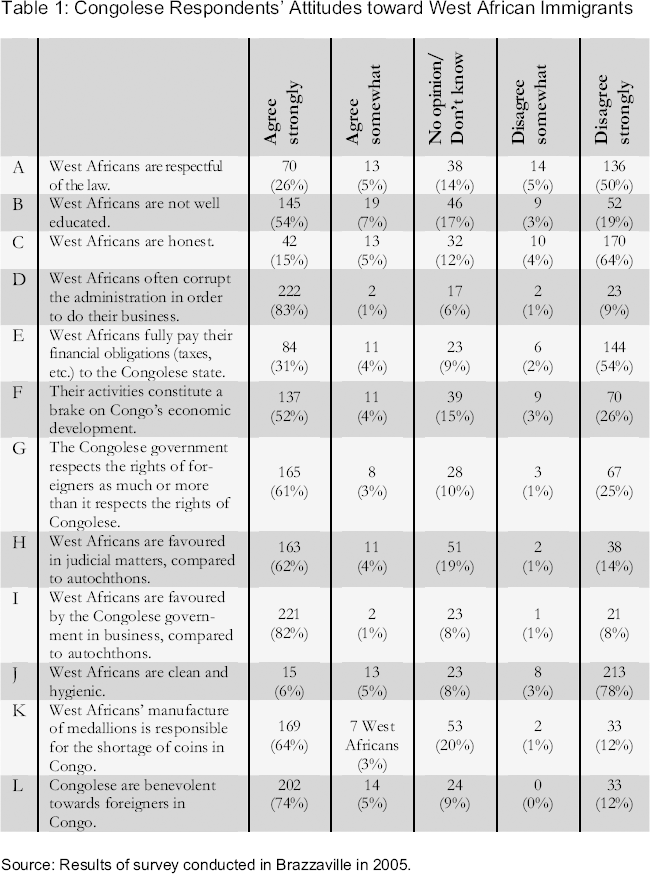
Source: Results of survey conducted in Brazzaville in 2005.
The survey data show that respondents' views of West Africans and their place in Congolese society are almost diametrically opposed to the views held by my West African informants described above. Respondents are likely to portray immigrants from West Africa in unflattering terms: for example, students who disagree with the statement “West Africans are respectful of the law” are twice as numerous as those who agree with it (Panel A). Respondents overwhelmingly perceive West Africans as uneducated, dishonest, corrupting, and negligent of their fiscal obligations to the state (Panels B, C, D, and E). And by a two-to-one margin, students describe the activities of West Africans as hindering Congo's national economic development (Panel F).
Also evident is a pervasive notion among respondents that, far from being burdened with official discrimination, West Africans in Congo are actually favoured over the local population by the Congolese administration (Panel G). More than four times as many students agree as disagree with the statement “West Africans are favoured in judicial matters, compared to autochthons” (Panel H). For the statement “West Africans are favoured by the Congolese government in business, compared to autochthons”, the ratio of supporters to dissenters is ten to one (Panel I). In open-ended questions and pre-test group discussion, some students expressed the opinion that their government grants credit to foreign businessmen, while Congolese businessmen have no access to such loans. West Africans are suspected of buying off Congolese officials to establish commercial monopolies and fleece the Congolese public, then sending their profits out of the country via remittances home. Thus emerges a composite picture in respondents' minds of national despoliation by greedy outsiders (who happen to be Africans) exploiting Congo's riches.
In addition to being perceived by members of the host population as lying, corrupt, and a drain on the economy, Brazzaville's West Africans are furthermore described as unclean. The ratio of students who disagree with the statement “West Africans are clean and hygienic” to those who agree is nearly ten to one (Panel J). When respondents list stereotypes Congolese commonly hold about West Africans, the largest category by far is composed of examples involving dirtiness, with 110 cases. 5 This stereotype stems in part from Muslim men's frequently public ablutions before prayer: to become ritually pure, they must rinse their hands, mouth, nose, face and scalp, ears, forearms, feet, and ankles with water. (Muslim women do the same ablutions but usually in private.) Some Congolese believe this is the only way West Africans wash themselves. Others see West Africans as unclean because they use water instead of toilet paper after defecating; toilet paper is a staple for most Brazzaville households, and many Congolese see using it as cleaner, more hygienic, and more civilized than using water.
The next largest categories of stereotype were lawlessness/ corruption, with 41 cases, and méchanceté or wickedness, with 39 cases; other categories included violence and racism.
In response to an open-ended question on a pre-test questionnaire about West Africans' impact on Congo, one student wrote that West Africans brought about the country's shortage of coins by using them to “make their medallions”. Throughout 2005 it was a chronic nuisance to get change in Brazzaville: everyone, Congolese and foreign, complained that market vendors lacked enough coins to break even a 500 CFA franc note (roughly equivalent to USD1). Upon hearing similar rumours from Congolese acquaintances, I added the following statement to the survey's final version: “West Africans' manufacture of medallions is responsible for the shortage of coins in Congo.” 176 respondents agree with it, all but seven of them strongly, while only 35 disagree; another 53 don't know or have no opinion (Panel K).
Finally, despite the frequently negative opinions and stereotypes they expressed in the survey, respondents agree by a seven-to-one margin with the statement “Congolese are benevolent toward foreigners living in Congo” (Panel L). They minimize the role of prejudice in their relations with outsiders in their society, and unlike West African immigrants, they do not perceive xenophobia to be a problem in Brazzaville. Or more accurately, they do not perceive it to be their problem: in their answers to open-ended questions, a few respondents do volunteer the opinion that West Africans are guilty of racism or xenophobia. If there is tension between hosts and immigrants in Brazzaville, as far as these Congolese are concerned, it stems from the immigrants' unwillingness to integrate into the host society.
Increasingly, attitudes similar to those evinced in the survey find expression on Congolese news websites. Journalists and bloggers write of Congo's “invasion” by immigrants, not only African but Chinese as well. They decry the lax enforcement of immigration laws and lament the government's unwillingness to address the problem. Some allege widespread discrimination against Congolese in favour of foreigners by the Congolese state, and grimly forecast a day in the not-too-distant future when Congolese will be a disempowered minority in their own country. In the face of this perceived threat, the words of one writer demonstrate the potential for anti-immigrant discourse to unite even a deeply fractured Congolese nation: “This debate transcends the north-south rift in the country. It is at the heart not only of unemployment in Congo but also, and above all, of Congolese identity.” 6
A quand le droit à l'immigration choisie pour le Congo?, Mwinda.org, 27 Dec. 2008, online: http://www.mwinda.org/index.php?option=com_content&task=view &id=579&Itemid=5. See also: Oyo-Owando, des marchés à 5 milliards, .org, March 20, 2006, online: http://www.mwinda.org/article/obele 3.html.
The Dynamics of Contemporary Anti-Immigrant Scapegoating
Xenophobia and the scapegoating of immigrants is not a new problem in sub-Saharan Africa. In fact, such phenomena predate political independence in the region. From Gabon in 1953 to Côte d'Ivoire in 1958, conflicts between hosts and immigrants set the stage for periodic violence and expulsions during the post-colonial era (Pérouse de Montclos 2002). Xenophobia swept Brazzaville in September 1962, when a football match between the national teams of Congo and Gabon sparked a riot resulting in nine dead and 30 injured; this event ultimately led to both countries expelling thousands of each others' citizens (Gray 1998). Over the next few decades, the victimization or forced repatriation of foreigners became a common means for post-colonial African leaders to deal with internal economic and political pressures (Peil 1971; Bredeloup 1995; Pérouse de Montclos 1999; Pambo-Loueya 2003; Whitaker 2005). In September 1977, for example, the Congolese government carried out a mass expulsion of West Africans from its territory. According to statistics gathered by the Malian state newspaper, nearly 6,400 West Africans were deported within a few weeks, including 2,737 Malians, 2,364 Senegalese, 577 Beninese and 489 Mauritanians. 7 The government nationalized their businesses and distributed their property to Congolese citizens. It took years for West Africans to trickle back into Congo and resume their economic activities there.
Expulsés: Une indemnisation promise mais difficile à confirmer, in: L'Essor (Bamako), no. 7723, 1 November 1977, p. 3.
While African governments have often played a secondary role in demonizing foreigners on their soil, with regimes turning anti-immigrant unrest to their own advantage, they have at times played a more active role. Congo's 1977 expulsion of West Africans, for example, occurred in the absence of popular anti-immigrant unrest. The measure was probably precipitated by Congolese political patrons' need to appropriate resources for their clients in the face of waning oil revenues and rising food prices; politicians simply chose to extract these resources from a vulnerable immigrant population. In Gabon, xenophobic mob violence has long been tolerated and periodically instigated by the state, providing “the central ingredient to the formation of Gabonese ideas of citizenship” (Gray 1998: 390). But host governments have learned, to their cost, that the mass deportation or victimization of foreigners seldom solves underlying economic woes and frequently exacerbates them. Moreover, the African Charter on Human and People's Rights expressly forbids the mass expulsion of any national, racial, ethnic or religious group, and the practice has become less politically viable since the charter came into force in 1986.
Today the impetus for anti-immigrant action is more likely to come from the bottom up, from disaffected citizens rather than governments. In Congo and several other African states, economic restructuring and mounting indebtedness since the mid-1980s has sharply reduced the state's ability to offer employment and services to its people, and overall quality of life has been in decline. Under such conditions popular resentment tends to build up against aliens – with and without documentation – whose economic success on one's national territory is constructed as an affront to citizens' modern sense of entitlement. African foreigners provide the softest and most prominent target in Brazzaville, and draw attention away from more politically sensitive areas.
The coins-into-medallions rumour reported above deserves closer examination in this regard. While I cannot speculate on the true causes of Brazzaville's coin shortage, the myths about it serve a clear sociological purpose. Their very absurdity speaks to the manner in which immigrants can be blamed for even the most unlikely problems of the host society. When survey respondents characterize West Africans as disorderly, criminal, corrupt, violent, aggressive, and ethnocentric, they list the major ills of their own society and project them onto the stranger population appended to it. Rumours of vanishing coins embody inchoate fears among Congolese that foreigners are making off with their country's wealth. 8 These fears are actually quite justified, but the culprits in question are not petty traders; they are high-ranking government officials, along with the European, American and Asian executives and owners of multinational oil conglomerates, banks, offshore investment firms, arms exporters, timber companies and the many other global enterprises with which the Congolese regime does billions of dollars worth of business every year (see Global Witness 2005; Harel 2006).
Loungou (2003: 256) describes a similar “myth of economic spoliation” operating against African immigrants in Gabon.
Given the risks of overtly criticizing their own authoritarian government, Congolese find in West Africans a convenient proxy: unlike the real plunderers of the country's riches, West Africans are both near and visible to Congolese in their everyday lives, and have little ability to defend themselves against the allegations perpetuated against them. White strangers, by contrast, are unlikely to be victimized: most come from countries whose governments could impose real penalties on Congo, such as suspending bilateral aid or barring visits from top Congolese officials, if their citizens were mistreated. 9 West African governments have no such leverage in Congo, or indeed most anyplace else. And white strangers can violate immigration laws with apparent impunity: of the 2,600 Europeans with “irregular” immigration status in Gabon in 1993, for example, none was subjected to deportation (Loungou 2003).
While identification spot checks are a daily occurrence for my West African informants in Brazzaville, during a year of fieldwork in the city I was only asked once by police to show my identification and travel documents.
We can understand survey respondents' stereotypes of the “dirty West African” in terms of what Geschiere and Nyamnjoh (2000: 441) call “metaphors of cleanliness and defilement”. Host societies around the world show a persistent tendency to cast strangers as impure, unclean, and posing the danger of contagion – a tendency linked to deep-seated psychological constructions of purity and pollution (see Douglas 1984) and to the frequent association between strangers and “dirty jobs” (Karakayali 2006). Since, as Bauman (1997: 10) points out, strangers defy dreams of purity and normative expectations of order, it is not surprising that “locals” associate them with dirt or even call for their elimination as a hygienic measure.
When Congolese cast West African immigrants as parasites, they are not necessarily motivated by irrational prejudice or by culturally generated xenophobia; their society's structural relationship with this “middleman minority” population is a key factor. The interests and goals of the stranger group have been described as fundamentally incompatible with those of the host society (Bonacich 1973: 589–592), and such structural tension makes it difficult for Congolese to acknowledge the positive roles strangers play in their country. Even when immigrants contribute to the host society, many Congolese dismiss these efforts as exceptions to the rule. Ignoring the millions of francs West African businesses pay every year in taxes and various fees (both legitimate and bogus), they believe that foreigners are getting a “free ride” in their country, then use this belief to justify harassing and levying exactions on immigrants. Immigrants respond to this treatment by further isolating themselves from Congolese society, convinced that their hosts are xenophobes seeking only to exploit them. Thus a process of “oppositional florescence” is perpetuated (see Roth 2002: 140), in which members of both populations strategically select cultural markers that heighten perceived differences rather than commonalities between their groups.
There is some evidence, in Congo at least, that government responds to popular calls for restrictions on immigrants' economic activity. In late 2005, the Congolese parliament passed legislation barring foreigners from certain petty trades (including driving trucks and buses, operating bakeries, and sidewalk vending). 10 Such measures are largely symbolic, however, given lax enforcement and the fact that these trades have long been held in disdain by members of the host society. Moreover, Congolese have grown sceptical of the state's ability to address issues relating to immigration and the economy justly. As my survey results show, many Congolese think their government officials actively favour West Africans over Congolese in legal and business matters; they see their country's political leaders and bureaucrats as beholden to foreigners and in league with them to pillage the nation's resources. Such popular frustrations open the door to the possibility of anti-immigrant violence in the future. Many Congolese would represent such violence not as xenophobic but as a justified struggle against foreign oppression, a blow against parasites feeding off their national wealth.
Ngoubangoyi, J. (2006), Travailleurs étrangers indésirables et indispensables, in: Syfia Info, 20 January, online: http://www.syfia.info/index.php5?view=articles&acti on=voir&idArticle=4298. Similar legislation was enacted after the mass expulsion of West Africans in 1977.
It is vital to stress that Muslim West Africans are neither the only African strangers nor even the most likely to meet hostile reactions in Brazzaville. Even immigrants from neighbouring countries have faced violence and expulsion in the past. People from the Democratic Republic of Congo (whom most Brazzavillois still pejoratively call Zaïrois) make up Brazzaville's largest immigrant group and are especially vulnerable to harassment from police and government authorities, who attribute Brazzaville's problems of petty crime, prostitution, and AIDS to them (Fassin 1994, Bazenguissa-Ganga 1998). These strangers often share some of the same ethnicities, worship at the same churches, and speak the same languages (Lingala and Kikongo) as native Brazzavillois. Yet the process of “oppositional florescence” underway even turns slight differences of pronunciation into markers of national identity, and feeds on anxieties about Brazzaville's cultural, political, and demographic domination by Kinshasa, its much more populous sister city. The collective demonization of “Zaïrois” in Brazzaville shows how relatively minor inter-group distinctions in Africa can be magnified into irreconcilable differences when national identity intercedes.
Conclusion
The effects of globalization over the last several decades – including increasing cross-border population flows, the implementation of neo-liberal economic policies, and the contraction of the public sector – have brought about a situation in which Brazzaville Congolese believe their national identity and security to be under threat. There are widespread perceptions of corrupt national leaders and foreign business interests conspiring to cheat Congolese citizens out of their share of the country's wealth. Rather than engage with the most powerful of these threats, Congolese confront the most proximate and perceptible manifestations of their country's interconnectedness with the global economy: the African immigrants who dominate the city's commercial sector. The unease Congolese experience with regard to the foreigners in their midst resonates across the continent, and the anti-immigrant violence that raged in South Africa in May 2008 is only the most visible recent manifestation of this sentiment. Since 2005 hundreds of West African migrants have been subject to arrest, mistreatment and deportation, often in contravention of existing laws, from Equatorial Guinea to Libya and from Morocco to Mozambique. 11 Whether by government authorities or local mobs, African migrants on the continent routinely face robbery, violence, and rape.
BBC, Morocco expels migrants to Mali. 12 October 2005, online: http://news.bbc.co.uk. Dicko, A., La chasse aux Maliens en Guinée-Equatoriale. Les Echos, 22 March 2006, online: http://www.malikounda.com/nouvelle_voir.php?idNouvelle=6662. Daniel, S., Tripoli expulse des centaines de Maliens. RFI, 13 November 2008, online: http://www.rfi.fr/actufr/articles/107/article_74778.asp.
While West Africans have lived in Brazzaville since that city's founding, members of the host population nevertheless view them as latecomers, distrusted for their enduring ties to West Africa and for their historical association with the Sénégalais of the colonial military. In countries like Congo, as global capitalism has shifted from freeing up to immobilizing labour (Geschiere and Nyamnjoh 2000) and as governments have lost leverage over their national economies, the initial anti-colonial and pan-Africanist wave of nationalist sentiment of the 1960s and 1970s appears to have been eclipsed. “In the context of diminishing resources,” write Dorman et al. (2007: 4), “defining the boundaries and meaning of citizenship is considered an issue of paramount importance in many countries.” Hence the brand of nationalism emerging in response to immigration is heavily influenced by nativism, anchored in the citizen's “ability to enjoy a home [and] to exclude foreigners from this enjoyment” (Mbembe 2002: 266). Amid ongoing struggles to delineate the rights and privileges of citizens of the post-colonial nation state, modern bureaucratic definitions of citizenship based on official documentation have lost ground to claims of autochthony. A burgeoning scholarly literature has shown how primordialist constructions of identity trump nationality in these struggles. As my research illustrates, however, it is also true that primordialist constructions of nationality can trump legal constructions when cross-border immigration becomes a factor.
Can this exclusionary dynamic be reversed? Some African intellectuals advocate a more inclusive direction for the construction of identity on the continent. Mbembe (2002: 266), for example, critiques what he calls “the cult of locality” in post-colonial Africa, while Appiah (2006) opposes localist and nativist discourses with an impassioned plea for cosmopolitanism. Human beings can overcome their longstanding fascination with cultural purity by recognizing that they can express multiple ancestries and belong to multiple places. It remains to be seen what hold such inclusive modes of thought may have in contemporary African societies. The experience of Brazzaville's West Africans suggests that they will encounter stiff resistance.