



Abstract
Most organizational stigma research focuses on preexisting stigma, leaving largely unexplored the question of how the stigmatization process unfolds. The few studies on the stigmatization of organizations have not explored the dynamics between the stigmatizer and the stigmatized or the role of the government. I address these voids by explicating the process of top-down stigmatization of Russian NGOs after the passage of the 2012 foreign agents law. Through an inductive approach relying on archival data, online sources, and interviews, I uncover an authoritarian government’s deliberate stigmatization of select NGOs by assigning to them the resurrected historical label of “foreign agent.” I present a three-phase process model of stigmatization: stigmatizing label emergence, stigma enforcement and contestation, and stigma propagation. I also detail the iterative manner through which the government used burdening, isolating, and intimidating enforcement tactics and how the stigmatized organizations devised coping strategies: persist, adjust, dispute, and evade. The outcomes of the process were the broadening of the scope of targets and criteria for stigmatization and the NGOs’ destabilized existence. I highlight the critical roles of power imbalance, limited action by international authorities, and lagged media attention. I conclude by discussing how these findings may generalize beyond authoritarian regimes.
What would you do when, after managing an organization for months, years, or even decades, an authoritarian government assigned a stigmatizing label to it? This is the question that non-governmental organizations (NGOs) in Russia faced after the passage of a foreign agents law in 2012. 1 The “foreign agent” label resurrected by the Russian government is stigmatizing, since in Russian society the label has historical connotations from the Soviet period indicating that one is a traitor or enemy of the state (Amnesty International, 2014). According to this law, NGOs are acting as foreign agents and must be listed in a public foreign agents registry if they have (a) received funding from foreign sources and (b) engaged in political activity (Federal Assembly of Russian Federation, 2012). After the law was passed, NGO leaders faced great uncertainty: they did not know if or when their organizations would be included in the foreign agents registry, the definition of “political activity” was ambiguous, and the enforcement tactics that would be used against foreign agent NGOs by the government were not yet clear. This was the early stage of the stigmatization process initiated by an authoritarian government, a process that, over the next decade, spread from NGOs to the media and then to individual citizens.
The distinction between the terms “stigmatization” and “stigma” is important. Stigma refers to a “label that evokes a collective stakeholder group-specific perception that an organization possesses a fundamental, deep-seated flaw that deindividuates and discredits the organization” (Devers et al., 2009: 155). Thus, it is an outcome, a perception already held by an audience. Stigmatization, in contrast, is a “collective and social process and act of stigmatizing, of socially enacting stigma, the social realization (making real as a social fact) of stigma” (Hudson et al., 2022: 1902). This distinction between stigma as an outcome and stigmatization as a process is critical. In the absence of a discrediting condition (characteristic, action, or category membership), the validity of a newly introduced stigmatizing label is an open question (Link and Phelan, 2001). Disagreement about the label’s validity allows the stigmatized social actors (individuals or organizations) to resist stigma as it emerges and, at the same time, allows the stigmatizer to adjust enforcement tactics. The process of stigmatization can even lead to the establishment of a new stigmatized category that expands beyond the initial target.
Organizational studies on the stigmatization process are rare, and they examine how this process unfolds from the bottom up without explicitly considering the role of the government (e.g., Wiesenfeld, Wurthmann, and Hambrick, 2008; Devers et al., 2009; Wang, Raynard, and Greenwood, 2021). Exploring this issue is important because stigma and stigmatizing labels are ubiquitous. They are also powerful: once established, they concretize “the way things are” (Link and Phelan, 2001: 367). As Link and Phelan stressed in 2001, we urgently need research on the production of stigma and the processes that allow one group’s stigmatizing views to dominate the views of those being stigmatized. Echoing this point, two decades later, Zhang et al. (2021) continued to highlight the lack of research on the emerging stages of stigma. Some notable recent exceptions to this gap focus on how transgressions or stigma by association lead to bottom-up stigmatization (e.g., Wang, Raynard, and Greenwood, 2021; Dong et al., 2023). Stigma, however, can result from deliberate attempts from the top to exert control over undesirable social actors, as when governments propagate stigma. How this top-down stigmatization process unfolds and the actions and reactions of the government and the stigmatized actors remain unexplored. Therefore, my research question is, how does an authoritarian government stigmatize?
I focus on an authoritarian government because authoritarian regimes are globally on the rise, and about 38 percent of people worldwide live in “Not Free countries” (Repucci and Slipowitz, 2022: 1). 2 Moreover, researchers warn that inaction by democracies to resist such regimes can lead to the prevalence of the authoritarian model, which is “grounded in autocrats’ shared interest in minimizing checks on their abuses and maintaining their grip on power” (Repucci and Slipowitz, 2022: 3).
Due to the lack of systematic research on government-initiated stigmatization, I conducted an inductive qualitative study (Strauss and Corbin, 1994). By analyzing archival documents and online sources, as well as conducting interviews with foreign agent NGOs’ representatives, I devised a three-phase process model of stigmatization, each phase of which was triggered by a precipitating event (Wiesenfeld, Wurthmann, and Hambrick, 2008; Lashley and Pollock, 2020) that resulted in a period of civil unrest. The model shows that during the early phase, stigmatizing label emergence, the resurrection and justification of the foreign agent label assignment to NGOs resulted in split reactions. Some NGOs immediately protested, whereas others opted for a wait-and-see approach. The second phase, stigma enforcement and contestation, was rife with actions. As the NGOs’ coping strategies—persist, adjust, dispute, and evade—emerged and evolved, so did the government’s burdening, isolating, and intimidating enforcement tactics. The final phase, stigma propagation, was the period in which the scope of stigmatization broadened. During this phase, the government applied the stigmatizing label through a broader set of criteria and to a broader set of targets, including mass media and individuals, for whom the law was not originally intended. An outcome of this top-down stigmatization was that in its attempt to exert formal control over so-called foreign agent NGOs, the Russian government’s actions resulted in NGOs’ destabilized existence. The NGOs’ activities became more muted and secretive, taking place beyond formal organizational boundaries and behind the scenes. By the end of this study, the general public’s views of these foreign agent organizations were divided; thus, the top-down stigmatization process had not yet achieved generalized, bottom-up stigmatization.
This study contributes to organizational research on stigma by presenting a process model of top-down stigmatization. It highlights that stigmatization does not necessarily begin with the presence of a widely accepted discrediting characteristic or transgression by the stigmatized actor (Wang, Raynard, and Greenwood, 2021). Instead, an authoritarian government’s definition of what constitutes transgressive behavior can change. This process is akin to what Durand and Khaire (2017) referred to as category creation, whereby a new label is ascribed to a group of organizations whose preexisting attributes are reframed and reinterpreted by authoritative actors. I explicitly focus on the dynamics between the stigmatizer and the stigmatized and explore repertoires of enforcement and coping strategies. I also explicate the varying roles of third-party stakeholders, such as the media, government-sponsored non-governmental organizations (GoNGOs, described below), and NGO partners, as some actively assist the stigmatizer, others side with the stigmatized organizations, and yet others distance themselves from the process. I conclude by discussing the dangers of bystanders’ silence during stigmatization, the critical role of the power imbalance between the stigmatizer and the stigmatized organizations, limited action by international authorities, and lagged media coverage. Though an authoritarian regime presents an extreme case of top-down stigmatization, I discuss how my findings may translate to more-democratic contexts.
Theoretical Foundations
Stigma as an Outcome
Organizational stigma is usually ingrained in moral aspects of traits or conduct (Lashley and Pollock, 2020; Ruebottom and Toubiana, 2021); therefore, it triggers holistic and largely subconscious emotional audience responses to the perceived violations of upheld values (Pollock et al., 2019). Stigma is sticky as it becomes intricately tied to the essence of an organization. This could be due to an organization’s membership in a stigmatized industry, such as cannabis growers (Lashley and Pollock, 2020), grappa distillers (Delmestri and Greenwood, 2016), or arms manufacturers (Vergne, 2012). It could also result from controversial or immoral organizational activities and practices, such as fraud or scandals (Piazza and Jourdan, 2018). Stigma may even be an outcome of a one-off anomalous negative event, such as an unanticipated industrial accident (Petriglieri, 2015) or bankruptcy (Wiesenfeld, Wurthmann, and Hambrick, 2008).
Stigma is an important construct in organizational research, as stigmatized organizations face sanctions from various stakeholders and encounter difficulties in accessing needed resources (Hudson, 2008; Pontikes, Negro, and Rao, 2010; Vergne, 2012; Zhang et al., 2021). To cope with such discriminatory conditions, stigmatized organizations engage in strategies including boundary management, information management, conformity, reconstruction, and dilution (see Pollock et al., 2019 and Zhang et al., 2021 for reviews). These strategies create opportunities for ongoing support from loyal stakeholders and help stigmatized organizations to survive (Hudson and Okhuysen, 2009; Lashley and Pollock, 2020; Ruebottom and Toubiana, 2021; Wang, Raynard, and Greenwood, 2021), to reduce stigma (Adams, 2012; Lashley and Pollock, 2020), or in some cases, to remove stigma altogether (Hampel and Tracey, 2017).
Despite the strides made in defining organizational stigma, uncovering stigma management strategies, and assessing the consequences of stigma, organizational studies have largely focused on examining preexisting stigmas (Devers et al., 2009; Wang, Raynard, and Greenwood, 2021), viewing stigma as a taken-for-granted outcome with which organizations must cope and whose consequences they must endure. Yet, stigma is a result of a purposeful stigmatization process that unfolds through interactions among the stigmatizer, the stigmatized actors, and the audience (Ferns, Lambert, and Günther, 2022).
Stigmatization as a Process
Research on stigmatization as a process is scant; empirical studies on the topic have only begun to emerge. This research has broadly articulated two stages of stigmatization: labeling and enactment (Hudson et al., 2022). Scholars have theorized that labeling is mainly triggered by an organization’s traits, conduct, or events that audiences view as transgressing social norms (Wiesenfeld, Wurthmann, and Hambrick, 2008; Wang, Raynard, and Greenwood, 2021). Yet, labeling can also be a matter of relationships (Goffman, 1963). A powerful agent of social control can bestow a stigmatizing label as a “designation or tag” on an organization engaging in a practice that stands in opposition to existing values and norms (Kraatz and Zajac, 1996; Link and Phelan, 2001: 366). The label helps to distinguish the “dangerous deviant” from normal members (Devers et al., 2009: 162). Importantly, the assignment of a stigmatizing label can be detached from the organization’s category membership, activities, or events. Labeling thus can serve as an impetus for the stigmatization process rather than as an outcome of organizational actions, traits, or category membership. This point is supported by Devers and colleagues, who theorized that labeling was a critical part of stigmatization (Devers et al., 2009). It thus shifts the focus regarding the beginning stages of stigmatization from the stigmatized actors’ wrongful actions to the labeling by the stigmatizer.
The second stage of the stigmatization process, enactment, or continuous use of stigmatization tactics by the stigmatizer, has received relatively less attention (Ferns, Lambert, and Günther, 2022; Hudson et al., 2022; Dong et al., 2023). Most related studies have focused on stigma management without giving explicit attention to the dynamics among the stigmatizer, the audience, and the stigmatization target (Wang, Raynard, and Greenwood, 2021). Furthermore, studies on stigmatization have implicitly focused on the bottom-up stigmatization process triggered by organizational transgressions (Wiesenfeld, Wurthmann, and Hambrick, 2008; Wang, Raynard, and Greenwood, 2021), without considering the dynamics between the stigmatizer and the stigmatized actor or top-down stigmatization by the government. But stigmatization takes place within a broader sociopolitical context; thus, the study of the stigmatization process is more complete with explicit focus on a key political actor: the government (Parker and Aggleton, 2007). Knowing how a government strategically attempts to achieve devaluation and discrimination of a previously normal target is critical for the broader research on stigma and specifically for studies about the stigmatization of organizations.
Role of the Government in the Stigmatization Process
Government plays a critical role in maintaining social order. It does so by setting regulatory and normative standards (Haveman et al., 2016; Zhang, 2022) and providing or withdrawing resources to enforce those standards (Inoue, 2020; Chang-Zunino and Grodal, 2024). The government relies on organizations, which have greater proximity to citizens than the government itself does, to shed light on pressing issues that must be addressed in order to maintain social order (Simons and Ingram, 2003). In many societies, this reliance results in mutual interdependency between the government and organizations.
Yet, in authoritarian regimes, in which “leadership is chosen by undemocratic means, that is, by means other than free and fair elections” (Frantz as quoted in Kim and Siegel, 2024: 137), the state uses organizations to achieve its political ends (Inoue, 2020) and eradicates organizations that challenge it (Yue, Wang, and Yang, 2019). This challenge is particularly pressing when the authoritarian government views organizations as threatening its monopoly on violence, as was the case with the mafia in Italy (Simons and Ingram, 2003). The challenge is also evident when social actors undermine the legitimacy of the government’s authority by providing an ideologically opposing social order, as reflected in the kibbutz communities in Israel (Simons and Ingram, 2003). Such regimes view order-providing organizations as rivals. Therefore, to preserve control over a social order, authoritarian governments aim not only to keep their monopoly on violence but also to control and suppress activities of organizations that may threaten the existing social order (Simons and Ingram, 2003). To establish desired social norms and maintain social order, authoritarian regimes may engage in the stigmatization of undesirable actors.
Governments’ ability to weaponize stigma against their rivals (Scambler, 2018) is accompanied by an “intensification of stigma production from above” (Tyler and Slater, 2018: 727). Beyond being a stakeholder involved in the stigmatization process, the government can actively use stigma as a tool to produce social inequality, to “‘nudge’ people into desired patterns of behaviour” (Tyler and Slater, 2018: 732) and to justify the use of violence from above (Wacquant, 2008). In this way, stigmatizers can preserve their advantageous status; defend their values, norms, and positions of power; and “diminish the moral status of the threatening actors” (Siltaoja et al., 2020: 995).
Whereas the more frequently studied bottom-up stigmatization process is driven by public opinion and societal norms, stigmatization by an authoritarian government is a top-down process driven by the state’s desire to maintain control and eliminate threatening social actors. Despite the authoritarian government’s critical role in the stigmatization process, it remains under-examined in organization studies. Due to scarce empirical work on organizational stigmatization by authoritarian governments (Zhang et al., 2021), I conducted an exploratory qualitative study to answer my research question.
Methods
Research Context: NGOs and the 2012 Foreign Agents Law in Russia
I chose to study authoritarian government-initiated stigmatization in the context of NGOs in Russia under the 2012 foreign agents law. The term “non-commercial organization” was first included in the jurisprudence of the USSR in 1991. After the collapse of the Soviet Union, it was re-established in the Civic Code of the Russian Federation in 1994. In January 1996, then-president Boris Yeltsin signed the federal law on non-commercial organizations. Although formal registration of NGOs in Russia began in 1994, some of the oldest NGOs had operated since the 1980s, including Memorial, a recently liquidated human rights organization that chronicled political repression in the Soviet Union and in current-day Russia and won the 2022 Nobel Peace Prize.
During the 1990s and 2000s, the Russian third (i.e., nonprofit) sector thrived, including over 200,000 NGOs and employing over 600,000 people by the mid-2010s (TASS, 2016). These organizations’ activities varied from conducting sociological research to defending human rights, protecting the environment, and organizing educational and cultural events, among others. In 2012, an estimated 458 Russian NGOs received over 4 billion rubles in foreign funding (Elkina, 2015). These numbers grew to 4,322 NGOs and 71.8 billion rubles in 2016 (Rustamova, 2017). By 2018, approximately 4,000 NGOs in Russia relied on foreign funding in the form of grants and donations, which reached approximately 80 billion rubles annually (BBC, 2019). Major donor countries included the United States, Germany, Norway, Belgium, and the United Kingdom (Rustamova, 2017; BBC, 2019). In contrast, NGO funding from federal grants in 2014 was only approximately 2.7 billion rubles (Elkina, 2015), and in 2016, presidential grants for socially oriented and human rights NGOs in Russia were only at 4.59 billion rubles (TASS, 2016). Overall, by the 2010s, thousands of Russian NGOs worked on social, environmental, and human rights issues, and many of them relied on foreign funding.
The stigmatization of Russian NGOs began in 2012 with the early public mentions of the term “foreign agents” in relation to NGOs. Accompanied by publicly expressed fears from government officials that some NGOs received foreign funding and thus were acting in foreign interests, discussions of the possibility of passing a foreign agents law emerged. This took place within the broader sociopolitical context in which in May 2012, Russian president Vladimir Putin was re-elected to his third term, which was for six instead of four years. Some people viewed these elections as illegitimate and unconstitutional, which resulted in massive protests, followed by increased interrogations and searches of opposition leaders (Goncharenko, 2012). The proposed law was justified as being similar to the Foreign Agent Registration Act (FARA) passed in the U.S. in 1938. After a brief period of public debate, the foreign agents law was signed by Putin in July 2012.
The law required NGOs acting in the capacity of foreign agents in the territory of the Russian Federation to be registered in the Ministry of Justice’s new registry of foreign agents. The two criteria for designating foreign agent status to an NGO were that the NGO (1) received funding from foreign sources and (2) engaged in political activity. The law articulated neither the required amount of funding nor the definition of political activity (Federal Assembly of Russian Federation, 2012). Furthermore, whereas FARA requires a declaration of the principal on whose behalf the foreign agent is acting in the U.S. territory, the Russian foreign agents law did not have this stipulation. Neither did it require establishing a connection between foreign funding and political activity. The law did, however, require NGOs designated as foreign agents to use discernible indicators of their foreign agent status in all online and printed materials as well as to mention it in all audio and video materials and online posts. It also required foreign agent NGOs to adhere to a different, more stringent set of reporting and auditing rules.
Inclusion of an NGO in the foreign agents registry and assignment of the foreign agent label were stigmatizing. This label has deep historical roots. According to Russian linguist Nikolai Pertsov, the first mention of the term “foreign agent” in Russia dates back to an 1831 letter from foreign minister Nesselrode to Count Kapodistrias. In that letter, the term was used in reference to “secret employees who are plotting something against Russia” (Pertsov as quoted in Palveleva, 2012). Therefore, said Pertsov, “for a long time there has been a negative connotation, a negative interpretation” associated with the term (quoted in Palveleva, 2012). During the Cold War, the term “foreign agent” was synonymous with being a spy or a traitor (Amnesty International, 2014).
The passage of the foreign agents law and the use of the stigmatizing label marked the beginning stages of the stigmatization process and resulted in high levels of uncertainty for Russian NGOs. First, there was lack of clarity about the two criteria necessary for a foreign agent designation. Second, the procedures for inclusion in the foreign agents registry were not articulated. Third, the consequences of the inclusion were not specified. This setting thus allowed me to develop theoretical insights into how the government-initiated stigmatization process started and how it unfolded over time.
Data Collection
To examine this process, I used online and archival data sources, including websites, blogs, videos, media articles, academic reports, and published interviews. To gather further insights into the process, I conducted interviews with representatives from NGOs that had been labeled foreign agents. I did not conduct interviews with government representatives due to the potential personal repercussions that such attempts might entail. 3 I began attending to general information about the law and the political climate in Russia in 2014 after Russia’s invasion of Crimea. I stopped almost all data collection activities (with the exception of viewing YouTube videos and the two interviews that I conducted in March and April, 2022) after Putin began the war in Ukraine on February 24, 2022. I describe the process of data collection from various sources in more detail below.
YouTube channels
To better understand the context and gather insights into the process of government-initiated stigmatization of so-called foreign agent NGOs in Russia, I relied on online sources. I regularly watched videos on four YouTube channels: Alexei Navalny (@NavalnyRu) and NavalnyLIVE (@NavalnyLiveChannel), both led by now-deceased opposition leader Alexei Navalny and his team; vDud (@vdud), a channel by Yuri Dud, a Russian journalist who conducts in-depth interviews with Russian political activists, researchers, actors, athletes, and so forth; and Ekaterina Schulmann (@Ekaterina_Schulmann), a Russian political scientist who extensively covers various topics related to the political situation in Russia. I chose the first two sources because they represented prominent voices of the political opposition in Russia, which allowed me to get a sense of the political climate in the country. I chose Yuri Dud’s channel due to its prominence and the depth of his interviews. I followed Ekaterina Schulmann’s channel as she provides weekly analyses of current events in Russia.
Interviews
To understand the dynamics between the government and the NGOs, I started conducting interviews with foreign agent NGOs’ representatives in November 2021. The interviewees shared their personal experiences, including the enforcement tactics used by the government and the repertoire of coping strategies they devised. I used a semi-structured approach to the interviews, relying on general questions about the effects of the foreign agents law on the interviewees’ NGOs, but leaving flexibility to allow for other themes to emerge during the conversation (Lashley and Pollock, 2020). In Online Appendix A, I provide the English translation of the introduction email or message that I sent to potential interviewees via Facebook or WhatsApp and the six general questions I asked them during the interviews. I used follow-up questions as necessary.
I identified interviewees through the comprehensive foreign agents registry that I compiled based on the data sources described below. I used contact information from the websites of the foreign agent NGOs and emailed them with a request for an interview. I also relied on snowball sampling. During this process, I sampled NGOs from different regions in Russia, not only from Moscow and St. Petersburg, the two most populous cities with over one-third of foreign agent NGOs. I aimed to sample well-established as well as young NGOs. Furthermore, to address survivor bias, I reached out not only to functioning foreign agent NGOs but also to NGOs that were removed from the foreign agents registry and the ones that were liquidated. Finally, I made sure to reach out to NGOs from various sectors.
During November 2021 to April 2022, I contacted 70 NGO representatives, 25 of whom agreed to be interviewed and the rest of whom did not reply. I compared the NGOs whose representatives agreed to participate in the interview to those whose representatives did not reply or decided to withdraw their interview (43 and 2, respectively) on two characteristics: age and location, specifically whether they were located in Moscow or St. Petersburg versus in other regions of Russia. The two sets of NGOs did not differ significantly in terms of age (p = 0.4027) or location (p = 0.8875). I conducted the 25 interviews via Skype, Zoom, WhatsApp, Facebook Messenger, and Signal. The interviewees actually represented 33 foreign agent NGOs, because some interviewees were affiliated with more than one such NGO. I provide interview descriptions, including the types of NGOs and interviewees’ positions in these organizations, in Table 1. I stopped the interviews when the gathered data reached the point of theoretical saturation (Glaser and Strauss, 1967). The interviews lasted between 30 minutes and 2 hours 44 minutes, with an average interview time of 68 minutes. All interviews were conducted in Russian, recorded with the participants’ consent, and transcribed with Sonix, an automated transcription software (www.sonix.ai). To organize the interview recordings and transcripts as well as other collected data, I used MAXQDA2022 (www.maxqda.com), software that enables organization and analysis of various types of qualitative data.
Interviewed NGOs †
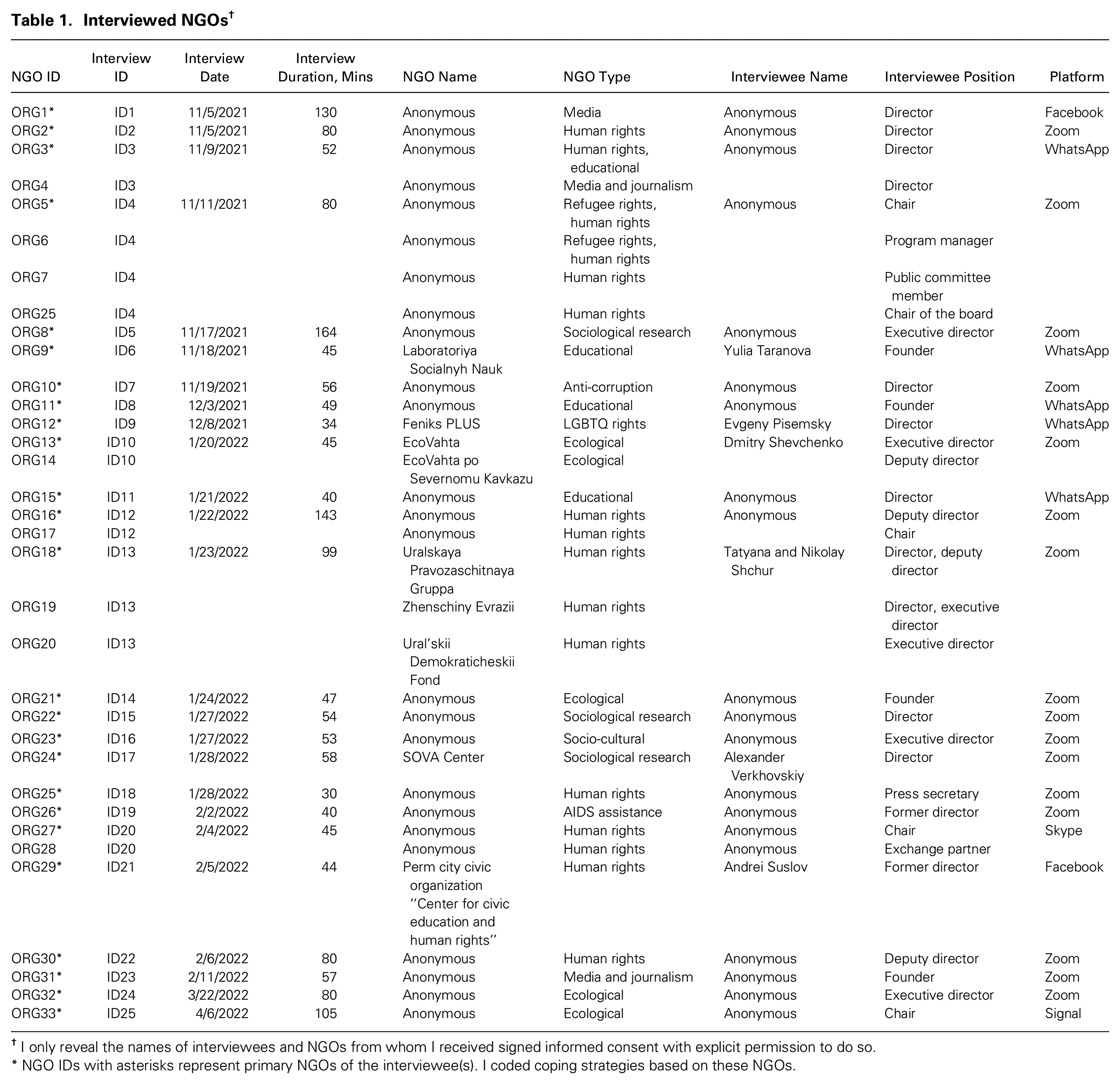
I only reveal the names of interviewees and NGOs from whom I received signed informed consent with explicit permission to do so.
NGO IDs with asterisks represent primary NGOs of the interviewee(s). I coded coping strategies based on these NGOs.
Online and archival sources
To gather more-detailed data on the topic, I conducted a comprehensive search of the term “foreign agent” in NexisUni, a database of over 17,000 news, legal, and business sources, which is frequently used in academic research. Neither this database nor others available through my university had a depository of comprehensive news coverage disseminated within Russia in the Russian language; rather, these databases contained news about Russia covered by international media. Therefore, to focus on sources within Russia, I collected archival data concurrently as I conducted the interviews, during which I learned from the context experts about reliable archival data sources. This way, for instance, I learned about the joint complaint filed initially by 11, and later by 61, NGOs to the European Court of Human Rights (ECHR), and I searched online for the text of that complaint; I learned about studies by Levada-Center, an organization that conducted and published sociological research and regular public opinion polls in Russia; I learned about OVD-Info, an independent human rights defense media project that compiled a database of foreign agents and periodically updated it. I relied on reports, public opinion polls, NGOs’ websites, Facebook pages of the NGOs and their representatives, and public documents from legal proceedings published online, all of which provided insights into the stigmatization process of so-called foreign agent NGOs. I saved and coded these documents (1,011 pages) in MAXQDA2022.
Finally, I used various sources to create a comprehensive list of NGOs that had ever been listed in the foreign agents registry. The first source was the foreign agents NGO registry posted on the website of the Ministry of Justice, which became inaccessible from the U.S. after Russia’s invasion of Ukraine. 4 Although initially the Ministry of Justice publicized a list of all foreign agent NGOs on its website, it later started listing only current foreign agent NGOs, excluding those no longer in the foreign agents registry due either to their liquidation or their removal from the registry. I therefore complemented the Ministry of Justice’s registry data with a 2017 report on foreign agent NGOs by Article20.org, “a non-profit, non-political information project on the observance of the right to freedom of assembly and association in the world.” 5 I also relied on the foreign agents report by OVD-Info. 6 I summarize the types and amount of data collected as well as their purpose in Table 2.
Description of Data
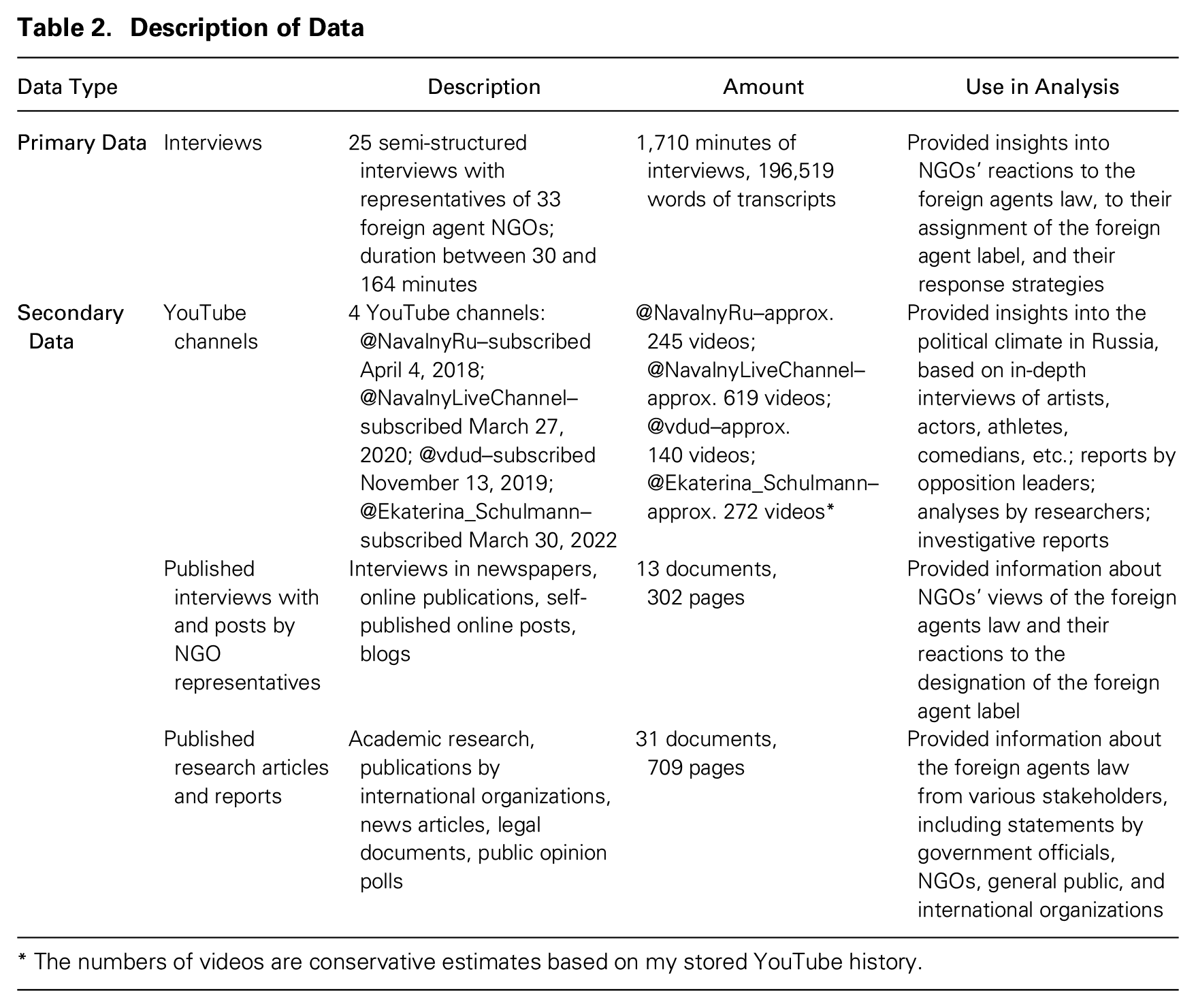
The numbers of videos are conservative estimates based on my stored YouTube history.
Data Analysis
My main method of data analysis was a qualitative inductive approach (Glaser and Strauss, 1967; Gioia, Corley, and Hamilton, 2012). I analyzed the collected data in four steps. First, I relied on the process analysis method, using temporal bracketing (Langley, 1999). I began by establishing the chronology of key events surrounding the passage of the foreign agents law and its subsequent development (illustrated in Figure 1). I paid attention to “discontinuities” that allowed me to delineate specific phases, within which the observable processes were “fairly stable” or contained “linearly evolving patterns” (Langley, 1999: 703). As depicted in Figure 1, this analysis revealed three distinct phases of the stigmatization process, each of which varied by the amount and types of actions taken by the government, NGOs, and other stakeholders. These phases were delineated by three changes related to the foreign agents law: (1) the first mention of the “foreign agent” term in post-Soviet Russia and passage of the foreign agents law, (2) delegation to the Ministry of Justice of the authority to forcefully include NGOs in the foreign agent registry, and (3) broadening of the foreign agent label assignment criteria and of the scope of targets from NGOs to mass media to individuals. These changes to the law took place within the broader sociopolitical context and occurred around the time of three key events, depicted as lightning graphics in Figure 1: (1) Putin’s re-election to a third presidential term in 2012, viewed by some as illegitimate and unconstitutional; (2) Russia’s annexation of Crimea in 2014, which was met with criticism by various prominent individuals and organizations; and (3) Putin’s re-election to a fourth presidential term in 2018. All three events were associated with periods of civil unrest in Russia. The darkening arrow in the middle of Figure 1 denotes the broadening of the scope of stigmatization targets and criteria. These three phases formed the basis of the structure of the stigmatization process model, which I discuss below.
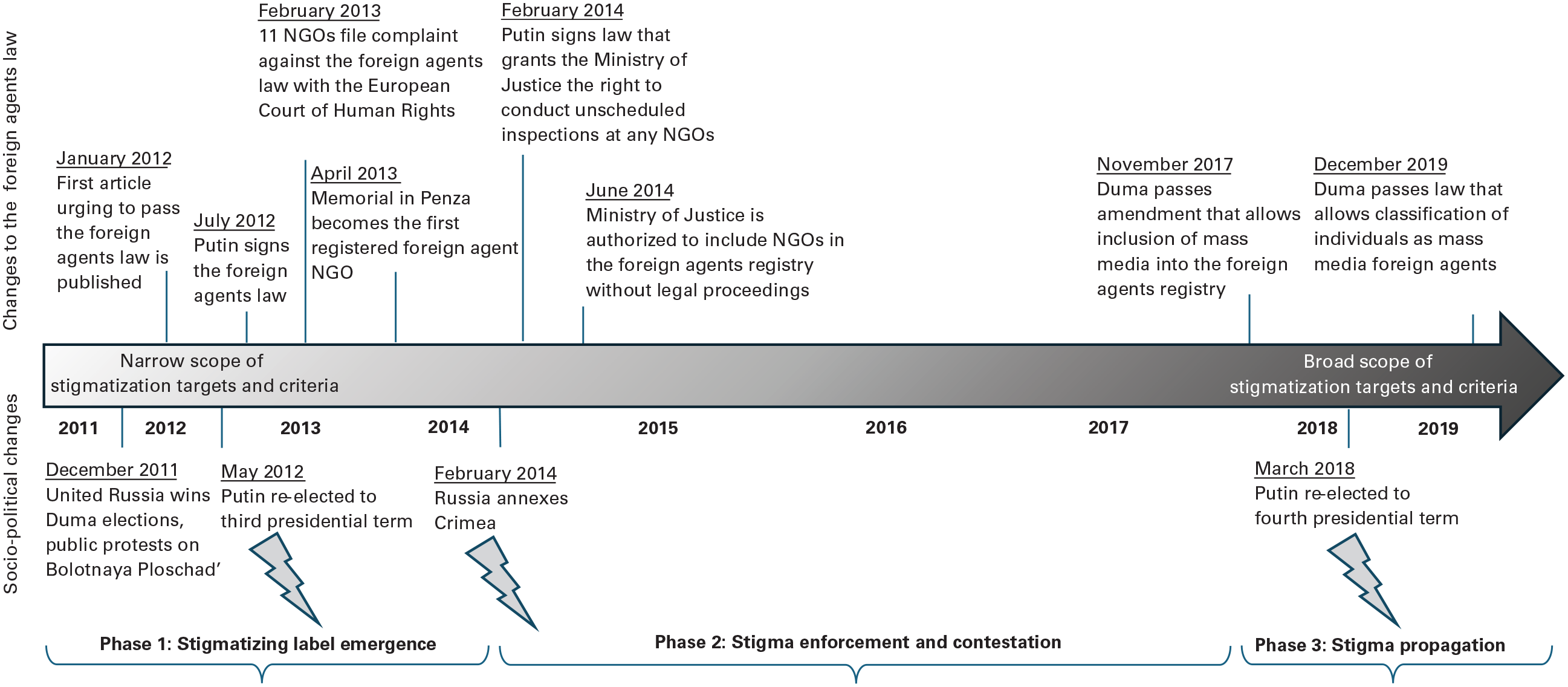
Timeline of Key Events
The second data analysis method I used was through MAXQDA2022, to conduct open coding of key first-order categories. To do this, I inductively coded, sentence by sentence, each data source (interview transcripts, reports, and articles), identifying common concepts that emerged from the raw data. This coding process resulted in 88 first-order categories. I then used axial coding to uncover higher-order themes that connected these categories. During axial coding, I relied on a constant comparative method (Glaser, 1965) by identifying a broad spectrum of core concepts that emerged from the data, reflecting on how they related to existing stigma research, and writing down the theoretical insights that emerged from the data. I moved back and forth among the data, research on stigma, and my emerging framework. For instance, whereas prior stigma research identified engagement in an illegitimate practice (Devers et al., 2009) or a pervasive transgression (Wang, Raynard, and Greenwood, 2021) as triggers for stigmatization, in the context of this study I found that prior to being labeled foreign agents, NGOs had not made any changes to their activities. Behaviors that had been viewed as normal were now labeled as norm-transgressing. The stigmatization began as the government resurrected a stigmatizing label with negative historical connotations and assigned this label to select NGOs. The assignment of the foreign agent label was frequently unexpected by the NGOs, since they had not made any changes to their activities, did not view their actions as political, and thus interpreted the law as not applicable to them. I also discovered the myriad tactics that the government used to enforce the law and to continuously stigmatize the NGOs, and it became evident that the stigmatized organizations were actively devising and using coping strategies that mapped on to four broad stigma management strategies. As a result, I realized that the process of stigmatization was dynamic: as the NGOs devised new coping strategies, the government harshened its tactics. Another insight that emerged from the data was that although the government continuously engaged in top-down stigmatization, most stakeholders did not see so-called foreign agent NGOs as deviant or deeply flawed (Devers et al., 2009). Overall, I uncovered 26 second-order themes.
I then aggregated second-order themes into higher-order theoretical dimensions. An insight that emerged from this process was that existing research on stigmatization is mostly silent about how the process of government-initiated stigmatization unfolds. 7 As I was moving between theory and data, keeping the developed timeline in mind, I focused on the various actors and their actions during the stigmatization process. I recorded how the actions of the stigmatizers and the stigmatized organizations changed over time. Online Appendix B provides a summary of first-order codes, second-order themes, and aggregate theoretical dimensions that emerged from the data.
When appropriate, I complemented the qualitative analyses with quantitative analyses (e.g., when I compared the characteristics and coping strategies across various NGOs in the foreign agents registry). To do this, I conducted t-tests for mean comparisons, by using the ttest command in Stata17.
Establishing Data Trustworthiness
I established data trustworthiness in several ways. First, I triangulated data by using several data sources to ensure that the emerging interpretations were based on multiple sources (Guba and Lincoln, 2005). For example, when one interviewee mentioned a collective appeal by NGOs to the European Court of Human Rights, I verified this information by finding a copy of the case document. When I read a book about various survival strategies devised by so-called foreign agent NGOs (Kanevskaya, Olenichev, and Cherniaeva, 2018), I verified this by conducting interviews with NGOs’ representatives and reading reports by international agencies, such as Amnesty International. When I learned from interviewees about the involvement of third-party stakeholders, such as legal firms and GoNGOs, I verified this through news media articles. Second, I verified emerging themes with interviewees, NGO leaders who had “intimate knowledge of the setting” (Wang, Raynard, and Greenwood, 2021: 1850). Third, I discussed my findings with two organizational researchers, Royston Greenwood and Tim Pollock, experts in qualitative research methodology, who were neither familiar with the setting nor involved in the project (Lashley and Pollock, 2020). Finally, I shared the first full draft of this study with several interviewees, some of whom provided valuable feedback, which I incorporated before submitting the draft to the journal.
Findings
The only thing necessary for the triumph of evil is for good people to do nothing.
I present the findings of my analyses in Figure 2. This figure illustrates three distinct phases of the stigmatization process and their connection to the developed timeline of key events: stigmatizing label emergence, stigma enforcement and contestation, and stigma propagation. Each phase is triggered by a precipitating event associated with a period of civil unrest. In the first phase (2012–2013), which started after Putin’s re-election to a third presidential term, the “foreign agent” label was resurrected and the law was passed. Some NGOs followed a wait-and-see approach, whereas others began to work together on a collective appeal to international authorities, in this case, the European Court of Human Rights. The second phase (2014–2017) began during Russia’s invasion of Crimea, with the delegation of authority to the Ministry of Justice to forcefully include NGOs in the foreign agents registry rather than allowing NGOs the option to self-register. This phase was accompanied by a wave of additional inspections, some of which were unannounced, with numerous NGOs across Russia raided and labeled as foreign agents. During this phase, the NGOs were devising their coping strategies, and the government was harshening its enforcement tactics. At the same time, a broader set of third-party stakeholders, in addition to the stigmatized NGOs and the government, started to get more actively involved in the process by assisting the stigmatizer, assisting the stigmatized, or distancing themselves from the stigmatization process. The third phase (end of 2017–2022), which started right before the presidential elections of 2018, began when the targets to which the foreign agent label was assigned broadened from NGOs to then include mass media and, later, individuals. The criteria of stigmatization also broadened. One outcome of this phase was that the activities of foreign agent NGOs were destabilized and took on a muted form, with NGOs continuing their work but in a more informal, secretive manner.
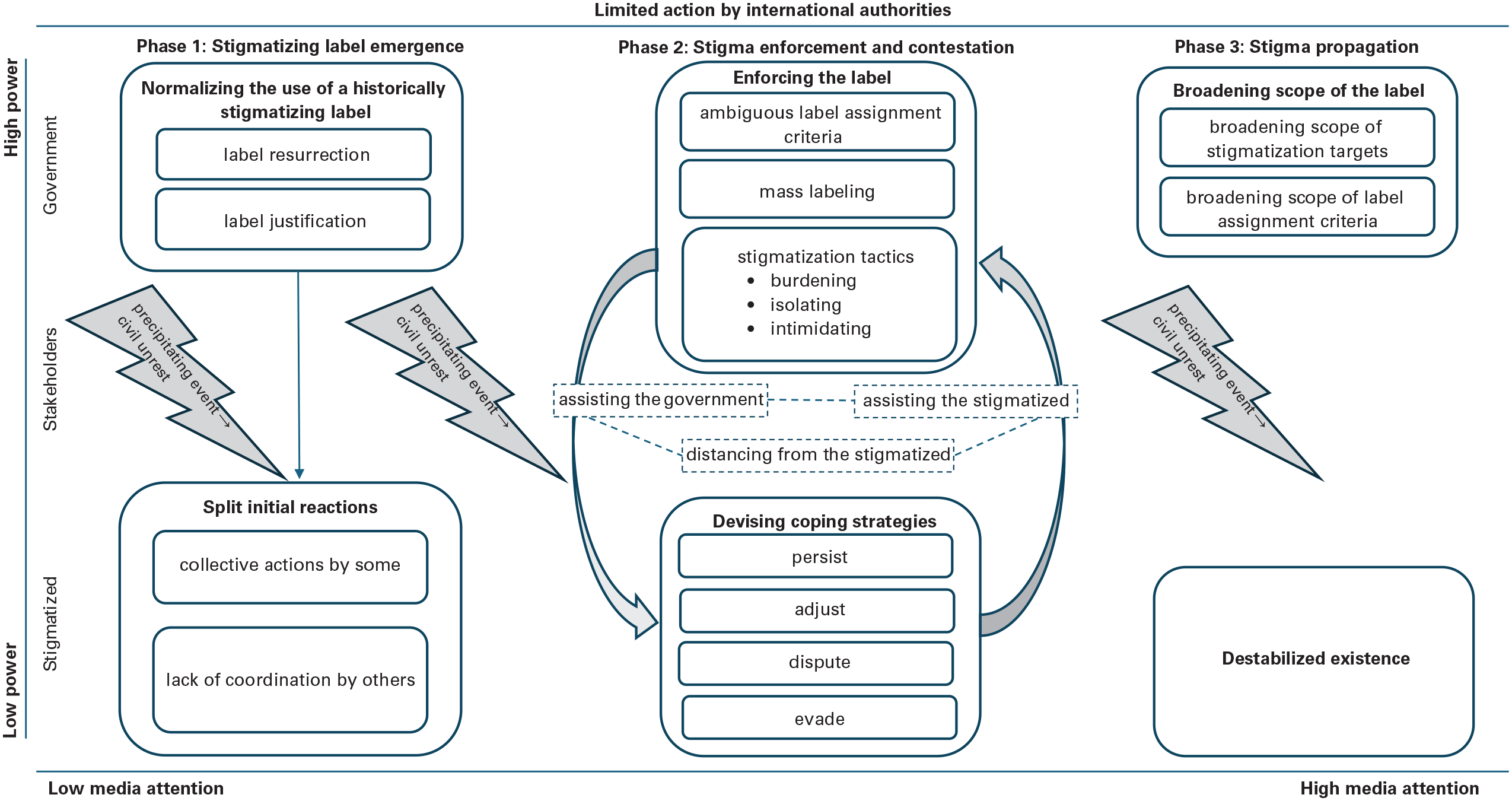
The Process Model of Stigmatization
By February 3, 2022, 218 NGOs had at some point been labeled foreign agents. Of those, 107 were liquidated, 43 were removed from the registry, and 73 remained in the registry (see the left y-axis of Figure 3 for registry inclusion and liquidation trends). 8 Over one-third of the foreign agent NGOs were from Moscow or St. Petersburg, with the rest scattered across the country (see Figure 4). The average official age of the NGOs at the time of inclusion in the foreign agents registry was 11.4 years, with the youngest being less than one year old and the oldest 24 years old; 129 of them (60 percent) were more than ten years old when they were included in the registry. 9 Below, I explain in more detail the dynamics observed during each stigmatization phase presented in Figure 2, and I situate my findings in the broader research on stigmatization.
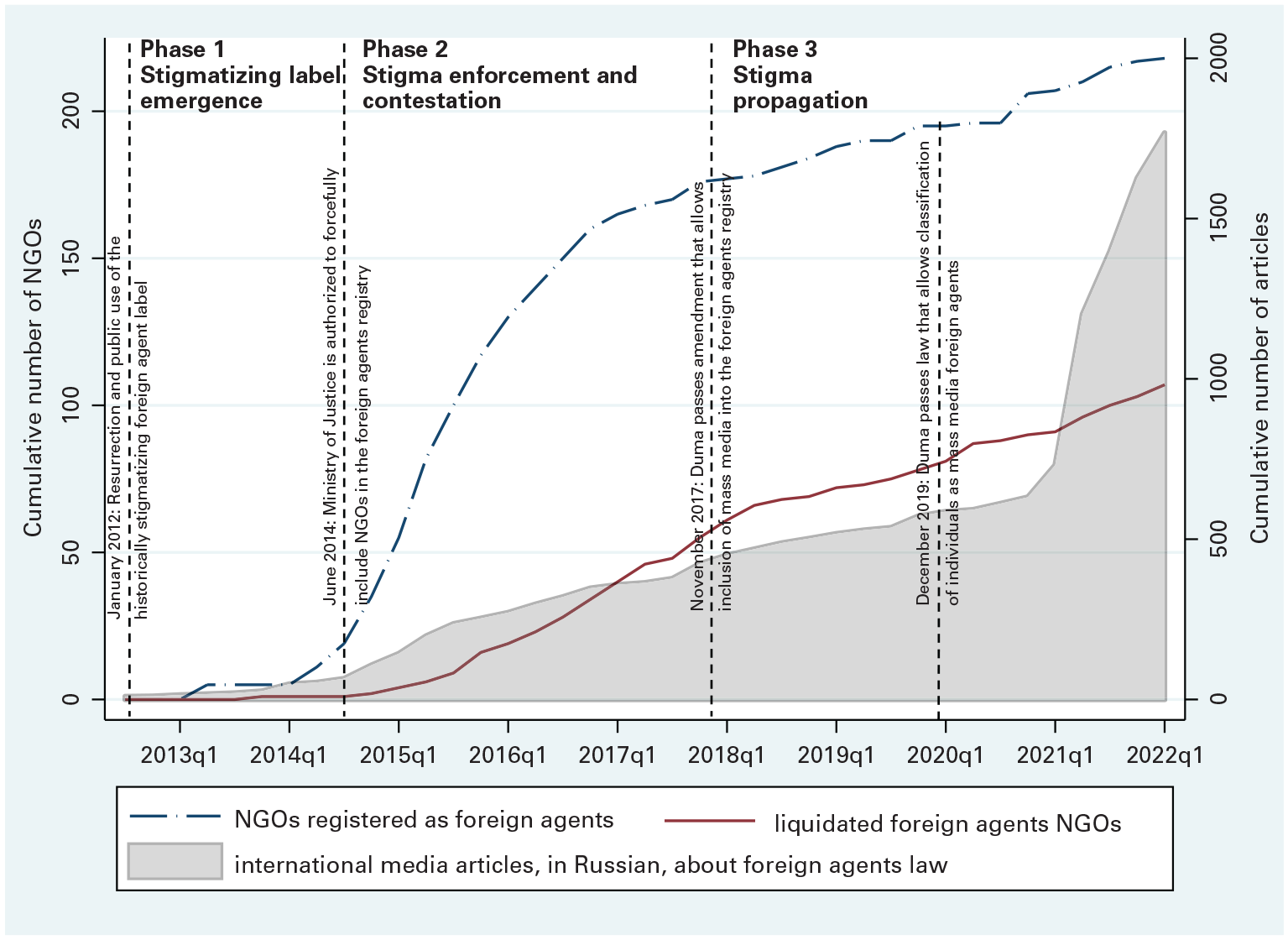
NGOs’ Trajectory from Stigmatizing Label Emergence to Stigma Propagation
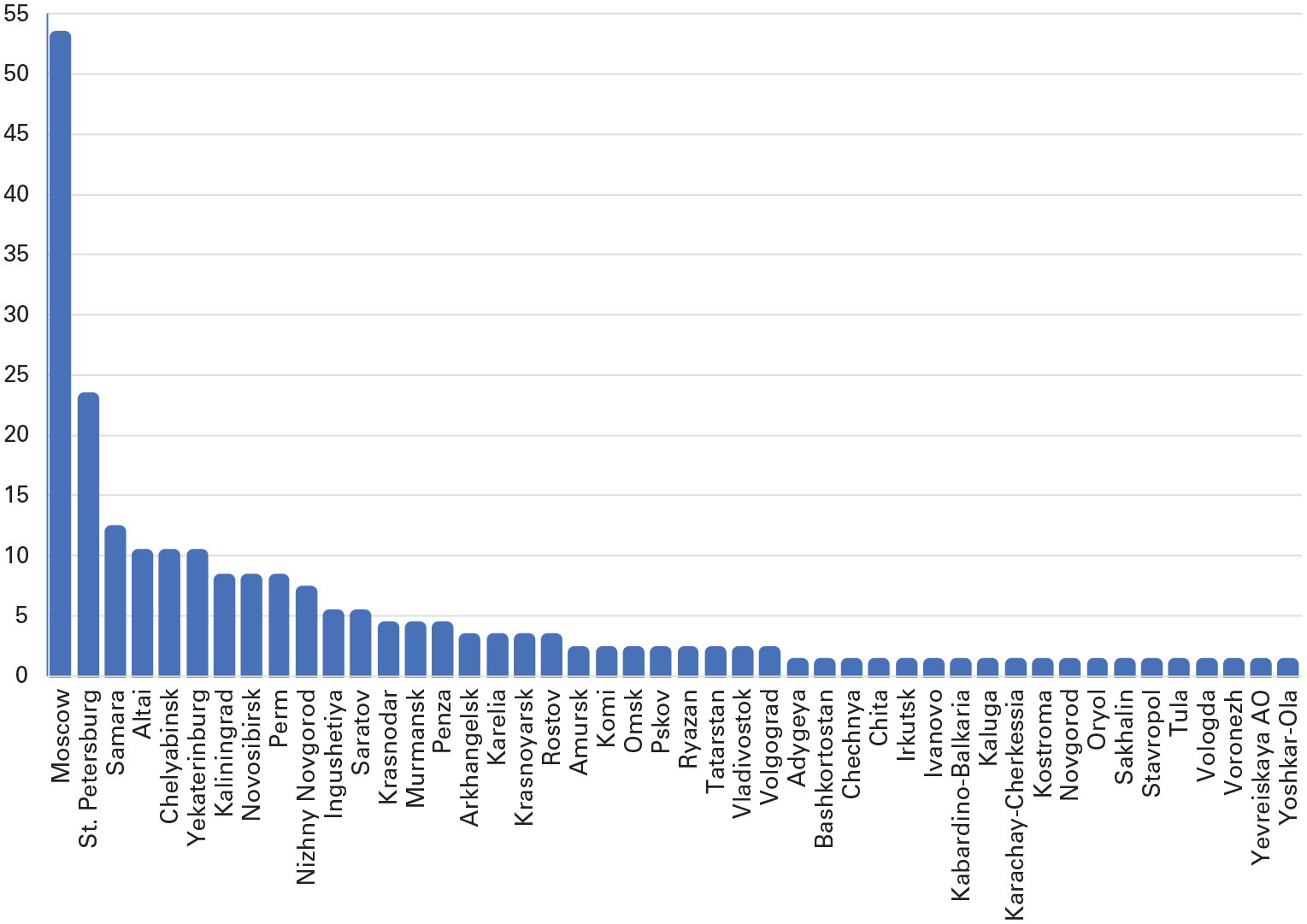
Geographical Distribution of Foreign Agent NGOs*
Phase 1: Stigmatizing Label Emergence (2012–2013)
Government normalizing the use of a historically stigmatizing label
The first stage of NGOs’ stigmatization in Russia began in 2012 with the normalization of the government’s use of the stigmatizing label—or the resurrection of the historical label, its increasing mentions in the public sphere, and the justification of its use. At that time, after the self-proclaimed victory of the United Russia party in the elections, the country experienced a wave of mass protests in favor of fair elections. Officials then stated that “the protests were financed from abroad” (Rustamova, 2017: 4).
Label resurrection
The resurrection of the “foreign agents” label in modern Russia began with its introduction into the public sphere in January 2012 by Veronika Krasheninnikova, director general of the Institute of Foreign Policy Research and Initiatives. She was the first person, on record, to propose the passage of the foreign agents law in Russia by directly comparing it with FARA in the United States and similar laws in other countries. The proposal urged the establishment of a registry of NGOs acting as foreign agents in Russian territory (Krasehninnikova, 2012). 10
Why was the label stigmatizing? In Russian collective memory, it dates back to the USSR and the term’s use to anoint enemies of the state: Conjuring up memories of the Stalinist repression and purges of the 1930s–early 1950s and Cold War era propaganda, the “foreign agent” label has a negative connotation of “spies” and “traitors.” It fits well within the discourse promoted on TV screens and in the government-controlled media evoking distrust in “foreign” connections and ideas. (Amnesty International, 2016: 4)
NGOs were acutely aware of the stigmatizing nature of the resurrected label. As one respondent mentioned to me, “When it was all just beginning, just the term ‘foreign agent,’ of course, was shocking. That is, immediately there is fear and everything; it’s demoralizing” (ID20). 11 Public opinion polls showed that Russian citizens associated the term with “clearly negative connotations,” such as “foreign spy” or “CIA agent” (Levada-Center, 2017). Table 3 provides more illustrative quotations.
Illustrative Quotes for First-Order Codes*
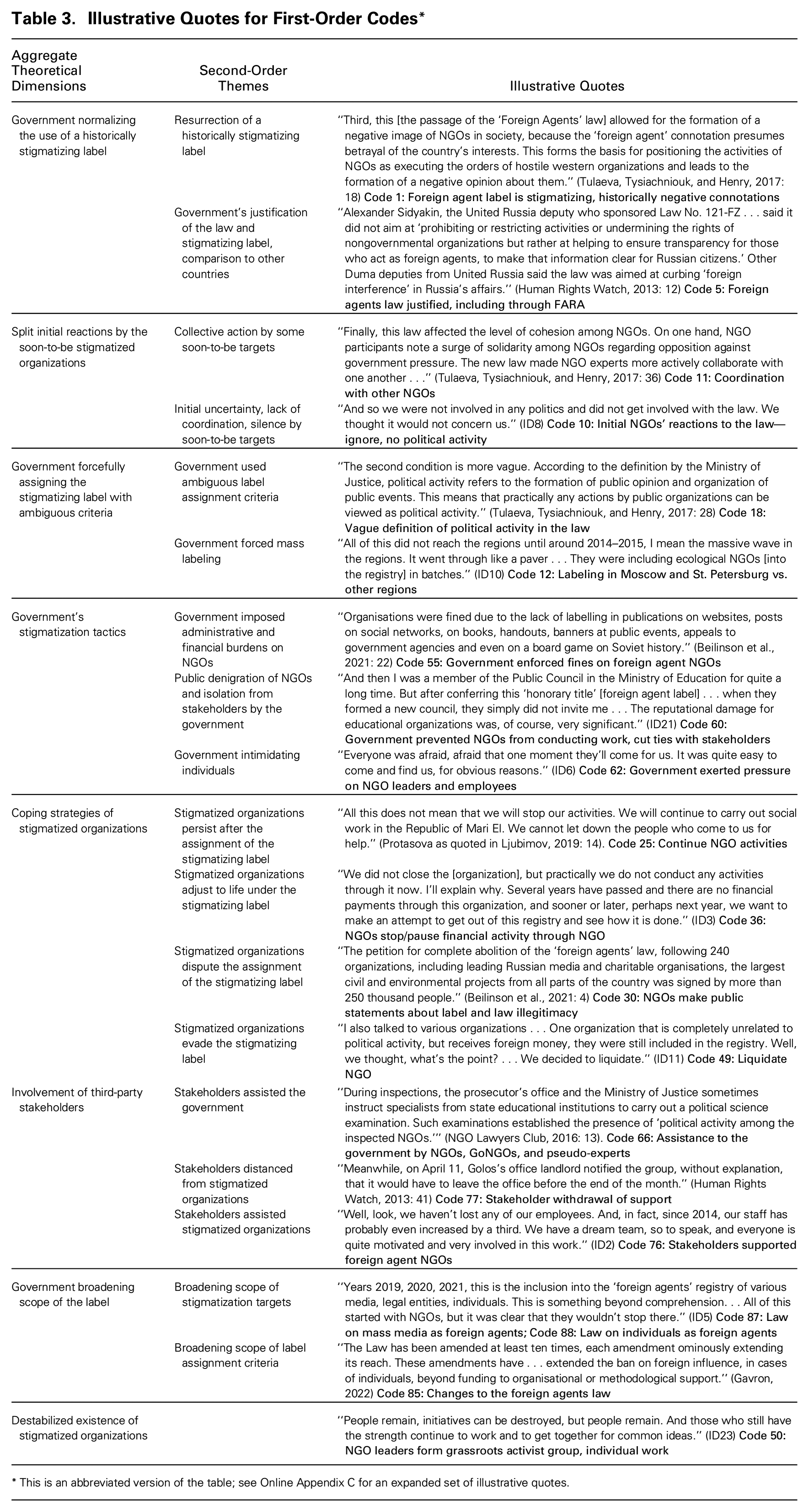
This is an abbreviated version of the table; see Online Appendix C for an expanded set of illustrative quotes.
Label justification
Commenting on the need for the registry of foreign agent NGOs, Putin stated, “Foreign influence on our domestic policy is unacceptable. We must not allow someone from abroad to stealthily influence it through funding. We must know who these people are” (Interfax, 2012). Various government officials characterized the term “foreign agent” as neutral, arguing that the law was needed to “increase transparency of NGO financial activities” (Vasilenko, 2014: 10; Ecozaschita et al., 2018; Kondrashev, 2021) and that it “does not restrict the rights of those who get into the relevant lists” (Beilinson et al., 2021: 5). Some argued that “the government had a right to know which NGOs engage in internal political activity through foreign funding” (Tatarinova, 2013). And some experts published reports justifying the foreign agents law by comparing it to similar recently passed laws in other countries, including “Australia, Hungary, and Israel” (Kondrashev, 2021: 18).
Split initial reactions by the stigmatized organizations
During the first phase, NGOs had split reactions: some foresaw the dangers of the foreign agents law and engaged in collective coordinated actions to oppose it; others were uncertain about the law and whether it would apply to them.
Collective actions by some
The NGOs in the first group acted collectively to dispute the legitimacy of the law and the stigmatizing label and to forewarn others about the law’s potentially dangerous consequences. An executive director of a sociological research NGO mentioned to me that collective action was their way of regaining some control: In the beginning, it was, perhaps, the main instrument to get control of the situation. This communication, organized by lawyers, seminars to which people from various NGOs were invited, those who were already foreign agents or those who were concerned to become ones, consultations. These organizations contacted one another, shared information . . . mutual assistance emerged. (ID5)
Some interviewees I spoke with held educational seminars about the law or launched t-shirt campaigns to stage public protests against the use of the label (ID5; ID7): We even had a t-shirt campaign: “I help people—I’m a foreign agent,”“I fight against corruption—I’m a foreign agent,”“I help the environment—I’m a foreign agent.” And in the beginning, we thought that if we collectively fought back, then we naïvely thought, we would prevail. (ID7)
Through their collective actions, the NGOs reached an important milestone in February 2013, seven months after the passage of the law, when 11 Russian human rights organizations filed a joint complaint with the European Court of Human Rights against Russia, stating that the foreign agents law “violated their rights to freedom of association and expression protected under European Convention of Human Rights” (Gorbunova, 2013: 22). It took over ten years for the European Court of Human Rights to issue a decision on this case. It did so in March 2022, after the start of the war in Ukraine, ruling that “Russia’s legislation on ‘foreign agents’ violated the rights of the groups designated as such and ordered Russia to pay many of them compensation” (Reuters, 2022).
Lack of coordination by others
Some NGOs, however, were not as concerned about the law during the first phase. They did not believe that the foreign agent label applied to them and opted for silence and inaction. The following quotes illustrate the sentiment among some NGO leaders I spoke with regarding their initial reactions to the resurrection of the stigmatizing label and the law: We thought that [the law] would not concern us, as we are a philanthropic organization. All our activity is to support civil initiatives . . . we provide grants to local citizens, local organizations, other NGOs . . . We thought that our activity absolutely did not fit the definition of political activity. Because the law states that there should be foreign funding and secondly, political activity. Well, we’ve always had foreign funding . . . And we’ve never engaged in any political activity, didn’t collaborate with political parties, politicians, etc. This is why we thought that this would never concern us. (ID16) At that moment, it seemed that it was just a warning; and that it did not concern such organizations as ours, that deal with AIDS. We thought that it would concern those who actively work at election sites, for instance, I don’t know, and use all means possible to call for an overturn of the existing political order, with the use of foreign funding. That’s why at that moment I was skeptical about this law. Of course, life showed that I shouldn’t have been so light-minded. (ID19)
The first phase of the stigmatization process can be characterized as calm before the storm, as some NGOs collectively disputed the resurrected stigmatizing label and others quietly observed how the law enforcement process would unfold. During this phase, inclusion in the foreign agents registry was voluntary. No NGO representative that I interviewed volunteered to be included in the registry or thought that their organization had engaged in political activity. As a result, this phase was associated with the labeling of only a few NGOs, so that by the end of 2013 only five were listed in the foreign agents registry. The perception of the label as inapplicable or irrelevant to NGOs contributed to their lack of coordination and led to the next, more dynamic phase of stigmatization.
Phase 2: Stigma Enforcement and Contestation (2014–2017)
Government enforcing the label
The calm ended on February 21, 2014, when, during Russia’s invasion of Crimea, Putin signed a law that granted rights to the Ministry of Justice to conduct additional inspections of any NGO on the same basis as the one they would use to investigate foreign agent NGOs. On June 4, 2014, the procedure for NGOs’ inclusion in the foreign agents registry was delegated to the Ministry of Justice, which now had the right to forcibly include NGOs in the registry (TASS, 2016). Andrei Suslov, a former director of the Perm city civic organization Center of Civic Education and Human Rights, described to me how the beginning of this phase was perceived inside their organization: I think that 2014 was the inflection point after the events in Crimea, first and foremost, and some waves of tightening the bolts. It appears that there was a harsh order to local Ministries of Justice and the order . . . as far as I understand, the way people who have access to information reported this, there was an order for each region, as to how many NGOs in each region to assign the foreign agent status. (ID21)
Enforcement of the stigmatizing label was accomplished through the use of ambiguous label assignment criteria, mass labeling, and application of stigmatization tactics. I discuss each in turn.
Ambiguous label assignment criteria
This phase was rife with forceful assignment of the stigmatizing label, which was possible due to ambiguity regarding the two criteria: acceptance of foreign funding and engagement in political activity. Although acceptance of foreign funding could be proved through NGOs’ financial records, it was unclear what amount of foreign funding was necessary to meet this criterion and from which countries the funding would be considered foreign (e.g., it was unclear whether funding from Belarus, Kazakhstan, or other former Soviet republics would meet this criterion). Furthermore, what constituted engagement in political activity was unclear. For instance, the law defined an NGO, excluding a political party, as one that engages in political activity “if, independent of its goals and tasks listed in the official documents, it participates (including through funding) in organizing and holding political actions with the goal of affecting the passage of government decisions, aimed at changing government policies, as well as forming public opinion along these goals” (foreign agents law, Federal Assembly of Russian Federation, 2012). Experts noted that this definition of political activity with the term “political actions” was tautological and unacceptable (Korneichuk, 2013; Kondrashev, 2021). Some people therefore expressed concerns with this definition due to its ambiguity (ID15; Vasilenko, 2014), which could lead to broad interpretation and application of the law: The concept of “political activity” is formulated very vaguely and tricky and covers activities that are not political in the general meaning of the word—for instance, elections observation, public appeals to the authorities, conducting polls or “spread of opinions about decisions taken by state bodies and the policy they pursue.” (Beilinson et al., 2021: 7)
In addition to the ambiguity regarding label assignment criteria, the government continued comparing the foreign agents law to FARA without mentioning critical differences between the two. For instance, unlike FARA in the United States, which the Russian government used as a reference to justify the law, the Russian foreign agents law did not require establishing that foreign funding was directed toward political activity. A representative of a human rights NGO used the following analogy to describe why their organization did not deem itself to be a foreign agent: [W]e tried to prove for a long time that we are not engaged in political activity. That’s the truth, because we do not engage in politics; we consume it. I’ve always used an example: as a consumer I come into a restaurant, for instance, and order food. I want to receive high quality food and, as a consumer, I have the right to express my opinion about this food. It does not mean that I want to join their kitchen and start cooking borscht myself . . . The same goes for politics; we are its consumers. Moreover, we are those who order these policies, we are the people, and NGOs represent people. (ID4)
Other people expressed a similar sentiment (see more quotes in Table 3), indicating that the ambiguity regarding the assignment criteria of the stigmatizing label allowed for various NGO actions to be categorized as political activity and, thus, for potentially any NGO to be included in the foreign agents registry.
Mass labeling
The ambiguity of the label assignment criteria likely helped the government to avoid early resistance and allowed the enforcement apparatus around the law to strengthen. What followed was the move from voluntary inclusion in the registry to forceful inclusion by the Ministry of Justice. A wave of additional, frequently unannounced inspections that had begun in 2013 spiked in 2014 (NGO Lawyers Club, 2016; ID2). For instance, [I]n June 2014, at the initiative of the First Deputy Head of the Russian Government, Sergei Prikhodko, mass inspections of NGOs involved in preventing the spread of HIV/AIDS began in the country. During the summer months of 2014, the Ministry of Justice checked such NGOs in Moscow, St. Petersburg, Tatarstan, Kirov, Kursk and Tyumen regions. (NGO Lawyers Club, 2016: 5)
A representative of the Human Rights Resource Center, an NGO that was included in the foreign agents registry in 2014, recalled in a published interview, When we were recognized as “foreign agent,” there was not a single day free from inspections. We had been watched all the time. We were trying to prevent inspectors entering our office. We were coming to the office at 9.30 am—before inspectors were showing up—and were leaving after 6pm when they finished. We even held our windows shut. Blinds were always closed in our basement room. (Kanevskaya, Olenichev, and Cherniaeva, 2018: 16)
One of the interviewees I spoke with shared a similar experience: We had inspections. These were from the prosecutor’s office, immigration services, fire department also. They come and start asking questions . . . Once, we were holding a press conference when all of a sudden people, one in a bulletproof vest, the other one without, came in and said that they were looking for a bomb . . . They did not find anything . . . Then four more people came in and restarted the inspection. All this while the press conference was still taking place. (ID1)
These inspections were disruptive and interfered with the day-to-day operations of the targeted NGOs. During this phase, in four years 168 NGOs were registered as foreign agents (see the dashed line in Figure 3). As Figure 3 shows, compared to the small increases in registered foreign agent NGOs during phase 1 and phase 3, the labeling during phase 2 was more intensive.
Phase 2 was also associated with the development of enforcement tactics by the government against these NGOs and their leaders. In this phase, NGOs actively devised coping strategies in response to the changes in the law, and the government harshened its enforcement tactics. Third-party stakeholders started to get involved in the process.
Government's stigmatization tactics
During the stigma enforcement and contestation phase, NGOs were no longer expected to voluntarily include themselves in the foreign agents registry; instead, the Ministry of Justice forcibly did so after inspections. NGOs could be subjected to an inspection “if citizens or organisations complain that [NGOs] perform the functions of a foreign agent, but have not submitted an application for inclusion in the relevant list” (Beilinson et al., 2021: 9). Although the names of some of these citizens and organizations were included in the inspection documents, others served as anonymous informants (Tulaeva, Tysiachniouk, and Henry, 2017). As one respondent noted, this was “the beginning of a witch hunt” (ID24). What followed the designation of a foreign agent status during this phase was a series of punitive enforcement tactics enacted by the government. I identified three categories of such tactics: burdening, isolating, and intimidating. 12
Burdening stigmatization tactics
The first category of government enforcement tactics included burdening tactics. Burdening tactics consisted of imposing administrative and financial hurdles, and they made the NGOs’ day-to-day operations difficult, deflecting attention and resources from implementing their intended strategies and achieving their stated missions. For example, NGOs that were forcibly included in the foreign agents registry faced automatic administrative fines (usually 300,000 rubles, or approximately USD $4,000 to the NGO, and 100,000 rubles, or approximately USD $1,300 to its director) for having failed to register voluntarily (Federal Assembly of Russian Federation, 2012). Foreign agent NGOs also had to submit quarterly, rather than annual, financial reports and had to undergo a required annual audit at their own expense (Koroteev, 2018). In addition, they had to declare their plans for activities, including meeting agendas and lists of participating members, one year in advance. Meeting these requirements was not feasible. “[M]alicious refusal of NGOs to submit required documents for their inclusion as a foreign agent in the registry” was considered a criminal offense with a maximum penalty of up to two years in prison (TASS, 2016: 3–4; Kondrashev, 2021). For NGOs that followed the new reporting requirements, the burden was unreasonably heavy, as a director of one sociological research NGO shared with me: You receive notifications of unscheduled inspections, and you are required to provide all the documentation for three years. For three years! Well, how can I explain what they are asking for, roughly . . . it’s 40 kilograms of paper. It’s huge! They need all the documentation about the project, those polled among the respondents. Can you imagine, for our poll? If we polled 2,000 people, then it is necessary, accordingly. . . . That’s hundreds of interviewers working. If we have 150 projects per year. Can you imagine what a pile of paper it is? We had to deliver this within a week. This is crazy work! It’s just that our accounting department could do nothing but sit and prepare these absolutely crazy mountains of paper . . . This is some form of demonstrative mockery. (ID15)
Foreign agent NGOs and their leaders were subjected to other forms of pressure beyond the legal requirements, including interruption of public events by police officers (ID1), disruptive inspections by various government agencies (e.g., unannounced fire inspections) (NGO Lawyers Club, 2016: 15), or numerous phone calls and office visits by FSB (i.e., federal security service) officers “to combat extremism” (Beilinson et al., 2021: 45), which made NGOs’ work nearly impossible. As early as 2013, at the dawn of these burdening practices, in his address to the Permanent Council of the Organization for Security and Co-operation in Europe (OSCE), U.S. Ambassador Ian Kelly noted, “These inspections and searches launched against the Russian and international NGO community seem to be aimed at intimidating and disrupting the work of civil society and run counter to Russia’s OSCE commitments. These raids, taken together with the recent package of legislation that restricts the operations of civil society constitute a disturbing trend” (Kelly, 2013). Many people referred to these enforcement tactics as “repressive” and “suffocating” (Gorbunova, 2013: 19; Gritsevich, 2018: 5).
Isolating stigmatization tactics
The second type of enforcement tactics, isolating, aimed to cut the ties between NGOs and their stakeholders either by directly prohibiting work with foreign agent NGOs or through public denigration of these NGOs. One legal requirement for NGOs with foreign agent status was to use discernible indicators of being a foreign agent in all their materials published online and in print as well as during any recordings or online streaming (Beilinson et al., 2021). Given the stigmatizing nature of the label, some stakeholders started to be cautious about their affiliations with these now publicly tainted NGOs.
Another example of an isolating tactic was the limiting of access to key stakeholders. Various government agencies stopped responding to or collaborating with so-called foreign agent NGOs: “experts from various foreign agent NGOs were denied to participate in public councils and other structures that worked with state authorities” (Tulaeva, Tysiachniouk, and Henry, 2017: 35); some NGOs stopped receiving presidential grants from the government (NGO Lawyers Club, 2016); and “regional municipal authorities broke lease agreements with such NGOs” (Kanevskaya, Olenichev, and Cherniaeva, 2018: 12; Beilinson et al., 2021). As the chairwoman of Man and Law, a foreign agent NGO, Irina Protasova noted in a published interview, “[S]ome of the leaders told us that they received information that they could no longer work with us. They simply invited us for a conversation and said: ‘We are forbidden to work with Man and Law after you became a foreign agent’” (Ljubimov, 2019: 4). NGO representatives who I interviewed also noted the withdrawal by state organizations, including public schools, state universities, and courts, all of which had formerly been their partners: “All officials denied access, although there is no law to justify it. But no matter what happens, in order not to get into trouble, schools wouldn’t let us in, universities wouldn’t let us in” (ID8).
Today, none of the Russian state organizations will ever issue any grants to us, because although there are no formal prohibitions prescribed in the law, nevertheless, everyone understands that “they are already outcasts, and you can’t have any relationship with them now.” (ID3)
To further isolate foreign agent NGOs from their stakeholders, in May 2015 Putin signed a law that designated an “undesirable” status to foreign organizations “on national security grounds” (Federal Law 129-FZ, Federal Assembly of Russian Federation, 2015). Collaboration with such organizations was punishable by fines and up to six years in prison. These organizations were long-term partners of Russian NGOs, and some feared that the introduction of the undesirable status and ban of such organizations would “squeeze the life from civil society” (BBC, 2015). By 2016, this legislation regarding “undesirable organizations” resulted in “a massive refusal by international donors to finance the projects of Russian organizations that ha[d] supported Russian civil society over the past two decades” (NGO Lawyers Club, 2016: 3). Several people I interviewed noted the adverse effects of this amendment on their NGOs’ financial well-being (ID5, ID17, ID18).
Intimidating stigmatization tactics
The third set of stigmatization tactics used by the authoritarian government against the stigmatized NGOs involved intimidating. These tactics were targeted at individual members and leaders of NGOs rather than organizations themselves. For example, one LGBT activist who worked at the Centre for Independent Social Research was invited to meet with Russian immigration services, only to “discover upon arrival that he was in fact meeting with police from the Federal Security Services who he said requested that he inform on his friends working in LGBT activism” (Pollack, 2018). Another NGO representative reported instances of direct threats by the authorities toward the NGO’s employees (Gritsevich, 2018). Yet another representative mentioned in his interview with me that their interviewers had been detained while conducting public opinion polls (ID15). NGO Lawyers Club (2016: 26) reported, “Local branches of the Ministry of Justice of Russia increasingly began to draw up protocols on administrative offenses in parallel against both officials of organizations and the organizations themselves.” One of the most prominent cases during this phase took place in 2016; after a search of the NGO Union of the Don Women, the authorities opened a criminal case against its founder and chair, Valentina Cherevatenko. If found guilty, she could have faced up to two years in jail (the case was dropped in 2017). This case set a precedent of criminal persecution of human rights activists (Amnesty International, 2016).
Stigmatized organizations devising coping strategies
In response to the authoritarian government’s enforcement tactics during the second phase, the NGOs devised a diverse repertoire of strategies to cope with their foreign agent status. Based on the coded data and recent reviews of stigma and stigma management research (Pollock et al., 2019; Zhang et al., 2021), I group these strategies into four categories: persist, adjust, dispute, and evade.
Persist
After being included in the foreign agents registry, some NGOs decided to stay the course and persist in their activities. They continued to receive funding from foreign sources, emphasized the values and missions of their organizations, and focused on continuing their operations as usual (Kanevskaya et al., 2018: 66–67; Agency of Social Information—Chelyabinsk, 2018). For these organizations, it was a “principled position” to continue their work “for as long as possible” (ID2). As one interviewee shared with me, But from the standpoint of the content of our activities, we did not fundamentally change anything. We believe that we are doing everything correctly, teaching correct journalism, teaching how to obtain information, how to check information, how to conduct an investigation in order to be able to then present the results of the investigation to the public. (ID3)
Adjust
While some NGOs persisted in their activities after having been assigned a foreign agent label, they also adjusted to the new reality by implementing symbolic and substantive changes to their missions and operations. Some formed a new, clean NGO that did not have the foreign agent status. One respondent from an ecological NGO mentioned that after they were denied a regional grant to care for homeless animals, they were explicitly told, “Well, if it’s for your organization we wouldn’t give you a kopeck . . . Go ahead and register a separate organization” (ID24). Some NGOs made changes to their activities so that they were not viewed as political. Among the NGOs that changed their activities, stated goals, or mission was a human rights organization whose representative I interviewed. The founder said that they did not want to shut down while losing (referring to the assignment of the foreign agent status as a loss). Instead, they changed their activities “from focusing on human rights to supporting alternative member initiatives” (ID20). For other NGOs, the changes had a more symbolic nature. These NGOs continued their work but in a more careful, if not secretive, manner: Now the times are much more dangerous than they were when we began our work . . . Now we must be more . . . careful to not let down the people who work with us. We won’t publicly call on people to come study with us, no. But those who need this, will come quietly and we’ll tell them what they need to do. That’s it. They’ll understand us. (ID13) You experience, of course, a lot of fear as the head of an organization. You feel that a lot depends on your words and your actions. There is a feeling that you can blurt out something superfluous . . . I remember at that moment that I started . . . that is . . . I actually introduced censorship . . . I was reading some conference program that we were holding and thinking about the name of the conference, I started crossing out all the political words or sharp language. (ID5)
Many NGOs accomplished the adjustment strategy through adherence to the new legal requirements of regular audits, inspections, and quarterly reporting. Some NGOs “stopped collaborating with Western partners” (ID15) or refused foreign funding in hopes of being removed from the foreign agents registry. This, however, was not deemed a sustainable strategy as “with the decrease in financial support comes loss of operational efficiency” (ID2).
Dispute
The third set of coping strategies, dispute, consisted of NGOs actively resisting the stigmatization and publicly undermining the legitimacy of the foreign agents law and the assigned stigmatizing label. For some NGOs, the resistance involved publicly contesting the label in the required markings in print and online publications. Alexander Verkhovsky, director of the sociological research NGO SOVA Center, shared with me in an interview, So, for the time being, we write on our website that we were included [in the registry] on such and such date, but that we do not agree with this and are disputing it. Because until the trial in Strasbourg [location of the European Court of Human Rights] takes place, we are still contesting. (ID17)
For other NGOs, the resistance was more involved. In 2013, 11 NGOs filed a complaint about the foreign agents law with the European Court of Human Rights. By 2018, 61 NGOs had joined the effort (Memorial, 2018). In addition, various NGOs appealed the assignment of foreign agent status and disputed the associated fines in Russian courts, arguing that the inspections that had led to their inclusion in the foreign agents registry did not have legal grounds (NGO Lawyers Club, 2016; Tulaeva, Tysiachniouk, and Henry, 2017: 2). Yet, as some reports indicated, NGOs frequently spent time and resources for legal proceedings in vain: According to experts’ calculations carried out in 2015, the average expenses of an NPO for appealing fines in court or being put on the list were 75 thousand rubles. At the same time, for the entire time of the existence of legislation, we know only about four organisations that managed to get an exclusion from the list in court, and only in two cases it was a decision of the court of first instance. Thus, when new people or organisations get included in the lists of “foreign agents,” they face the question—is it worth it, to get distracted from work and invest effort and money in a long process, in which almost no one has managed to achieve justice? (Beilinson et al., 2021: 11)
As one respondent summed it up, when “on the other side are government representatives, [the courts] stand with the government” (ID21).
Evade
The fourth set of coping strategies, evade, entailed NGOs’ departure from the context in which they were being stigmatized (a strategy that, for instance, stigmatized marijuana dispensaries used by seeking distant and safe locations; Khessina, Reis, and Verhaal, 2021). NGO leaders who used strategies in this category left the country or liquidated their organization and worked outside of its boundaries. One respondent said that “when we made the decision to liquidate, we immediately considered the second item on the agenda, we considered registration somewhere abroad, the same exact organization of the same type” (ID6). Another respondent elaborated on the reasons for leaving Russia: “If they don’t let us work in Russia, we won’t work, in Russia . . . We’ve followed all their rules while it was possible and acceptable for us. And now, well, they’ve ousted us, simply ousted” (ID9). A third respondent shared, “We just decided that it makes no sense to continue with this organization. We filed for liquidation” (ID14). Liquidation, however, did not always mean ceasing activities: Relinquishing the status of a legal entity does not mean that we changed our views. We continue to believe that the perpetuation of the memory of the victims of political repressions, the publication of the historical truth about the scale of the crimes of the totalitarian regime in our country are important components of building an open democratic society. (Kropachev as quoted in Gritsevich, 2018: 2)
Variance in use and effectiveness of coping strategies
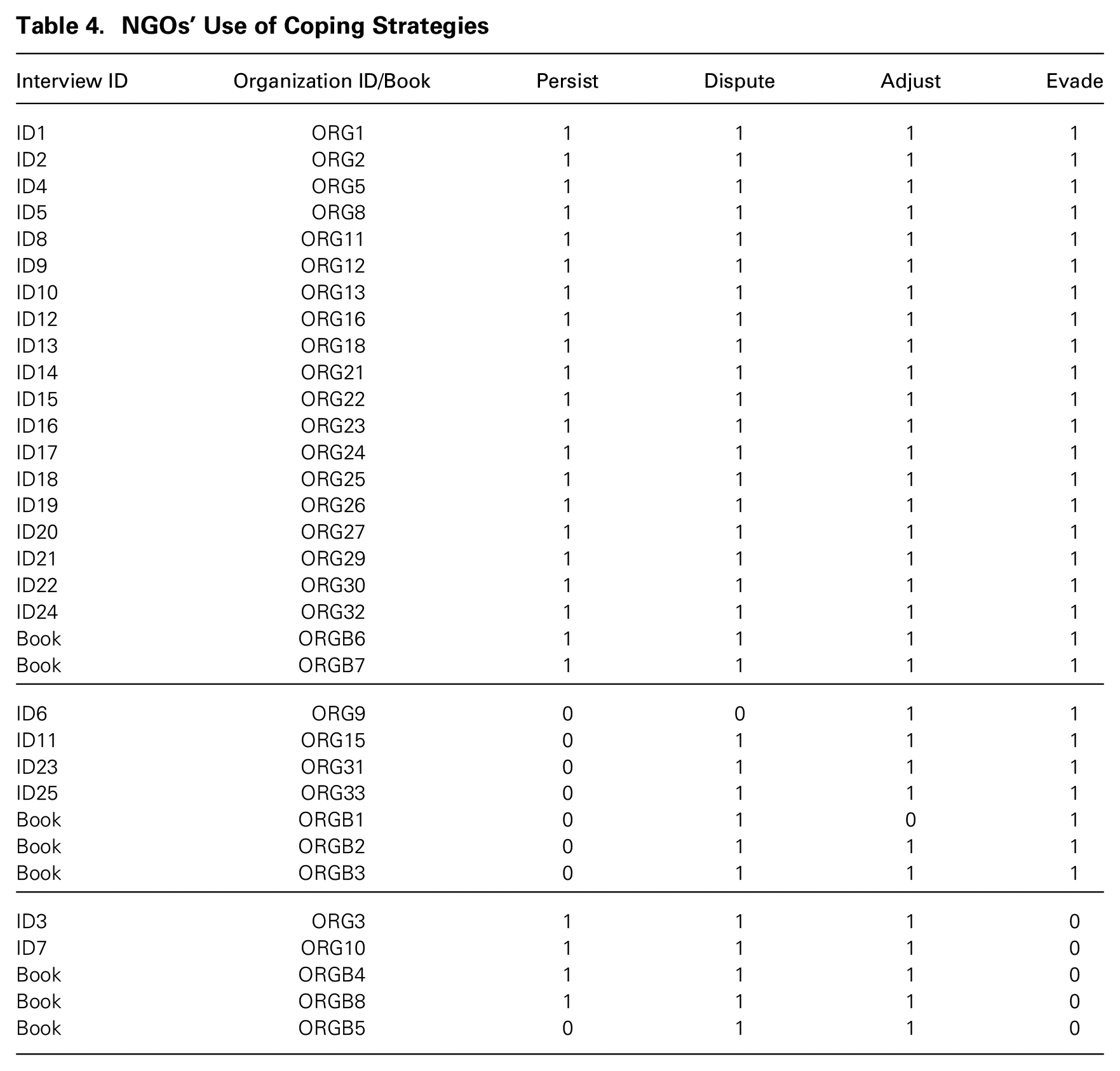
To more systematically examine the variance in the NGOs’ use of coping strategies, I analyzed the transcripts of the 25 interviews I conducted and the texts of eight NGO interviews from a 2018 book (Kanevskaya, Olenichev, and Cherniaeva, 2018). 13 I hand-coded each transcript for mentions of each of the four coping strategies. I used a binary indicator for each strategy, equal to one if an NGO representative indicated use of a particular coping strategy (persist, adjust, dispute, evade) and zero otherwise. Table 4 illustrates the NGOs’ use of these strategies. Table 5 depicts the frequencies of NGOs’ use of these strategies by the organizations’ listing date in the foreign agents registry, location, liquidation, and delisting. As this table shows, the dispute and adjust strategies were used most frequently, followed by evade and persist.
NGOs’ Use of Coping Strategies
Frequencies of NGOs’ Use of Coping Strategies by NGO Characteristics
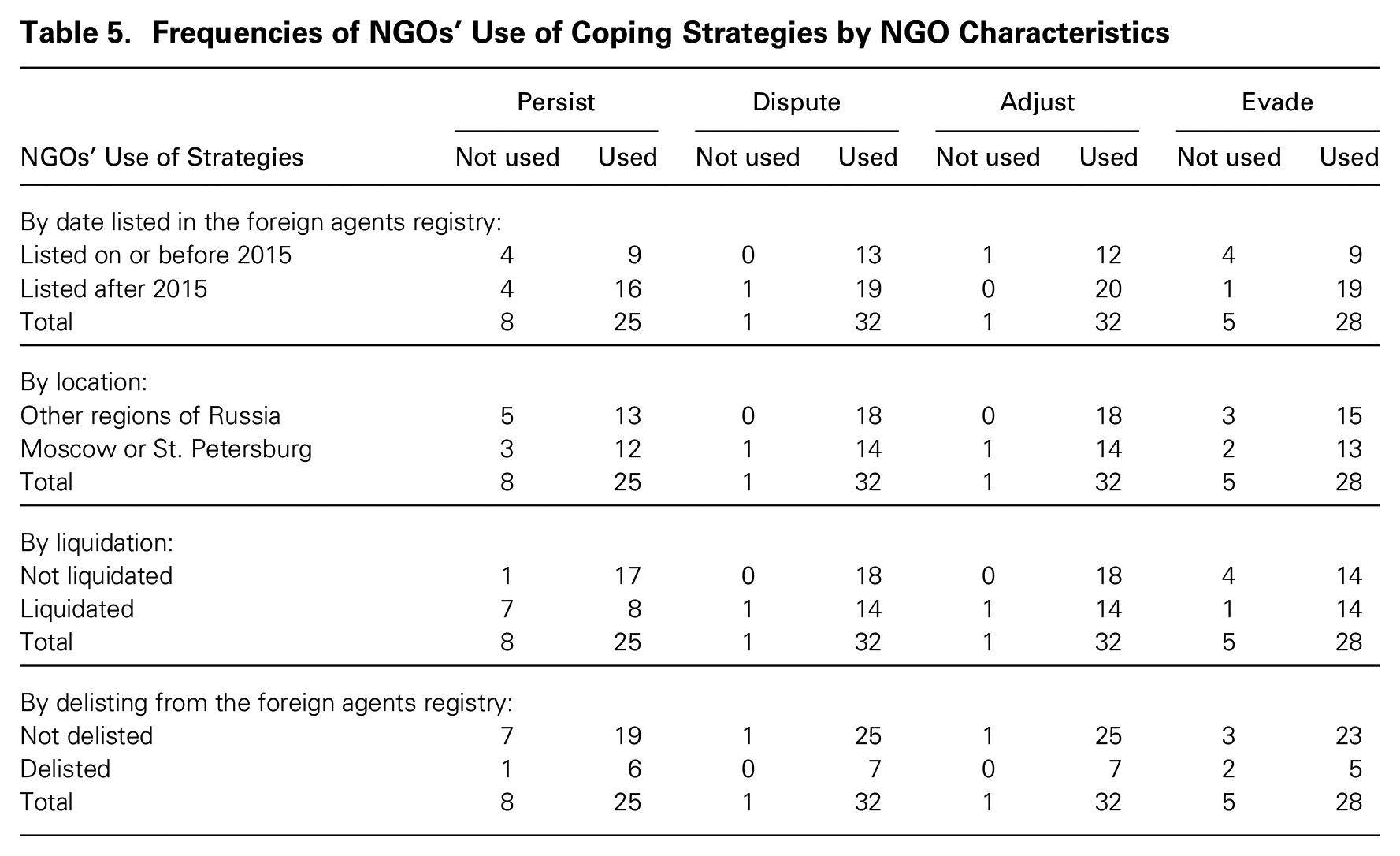
To more formally examine the variance and effectiveness of NGOs’ coping strategies, I ran a series of t-tests to compare the means of each of the four strategies based on two NGO characteristics: whether it was listed on or before 2015 (mid-point of phase 2) and whether it was located in Moscow or St. Petersburg versus in other regions of Russia. Although the choice of any of the four strategies did not vary significantly by NGO location, it did vary by the listing date. Compared to the NGOs that were included in the foreign agents registry on or before 2015, NGOs included in the registry after 2015 were more likely to use evade strategies (p = 0.0451); they did not differ in their use of persist, adjust, or dispute strategies. I also correlated the NGOs’ age with the four coping strategies. The correlation matrix showed that older NGOs were more likely (p < 0.05) to use the persist, dispute, and adjust strategies.
To test the effectiveness of the coping strategies, I compared the use of the four strategies by liquidated versus not liquidated NGOs, using mean t-tests. Liquidated NGOs were less likely to persist in their activities (p = 0.0049) but did not differ in their use of the other strategies. Finally, I compared the use of the four strategies by NGOs that were delisted from the foreign agents registry to those that were not delisted, but I found no significant differences. Delisted NGOs did not differ by age from those that stayed in the registry, either. NGOs located in Moscow or St. Petersburg were less likely to be removed from the registry than were NGOs located in other regions of Russia (p = 0.0054).
Dynamics between the government and stigmatized organizations
The second phase of the stigmatization process was rife with dynamics between the government and the stigmatized NGOs. I illustrate them in Figure 5 but should note that these dynamics were not always linear, as some NGOs decided to liquidate or leave the country soon after having been included in the foreign agents registry (ID6). For NGOs that chose the adjust or dispute strategy, the stigmatization dynamics unfolded in a manner similar to the one depicted in Figure 5. This figure shows that as the government devised enforcement tactics, NGOs came up with new coping strategies, which were met, in turn, by newly revised enforcement tactics from the government. Though there was no clear evidence of systematic variance in NGOs’ use of coping strategies by phase of the stigmatization process, government tactics harshened from phase to phase. They evolved from the creation of the foreign agents registry in phase 1, to the imposition of fines and administrative burdens in phase 2, to the confiscation of private property and imprisonment of individuals in phase 3. 14 NGOs that did not immediately liquidate persisted or adjusted based on the government’s tactics used against them. One respondent described this phase: “All our strategies are from the scenario: we are running, they are catching up” (ID2).
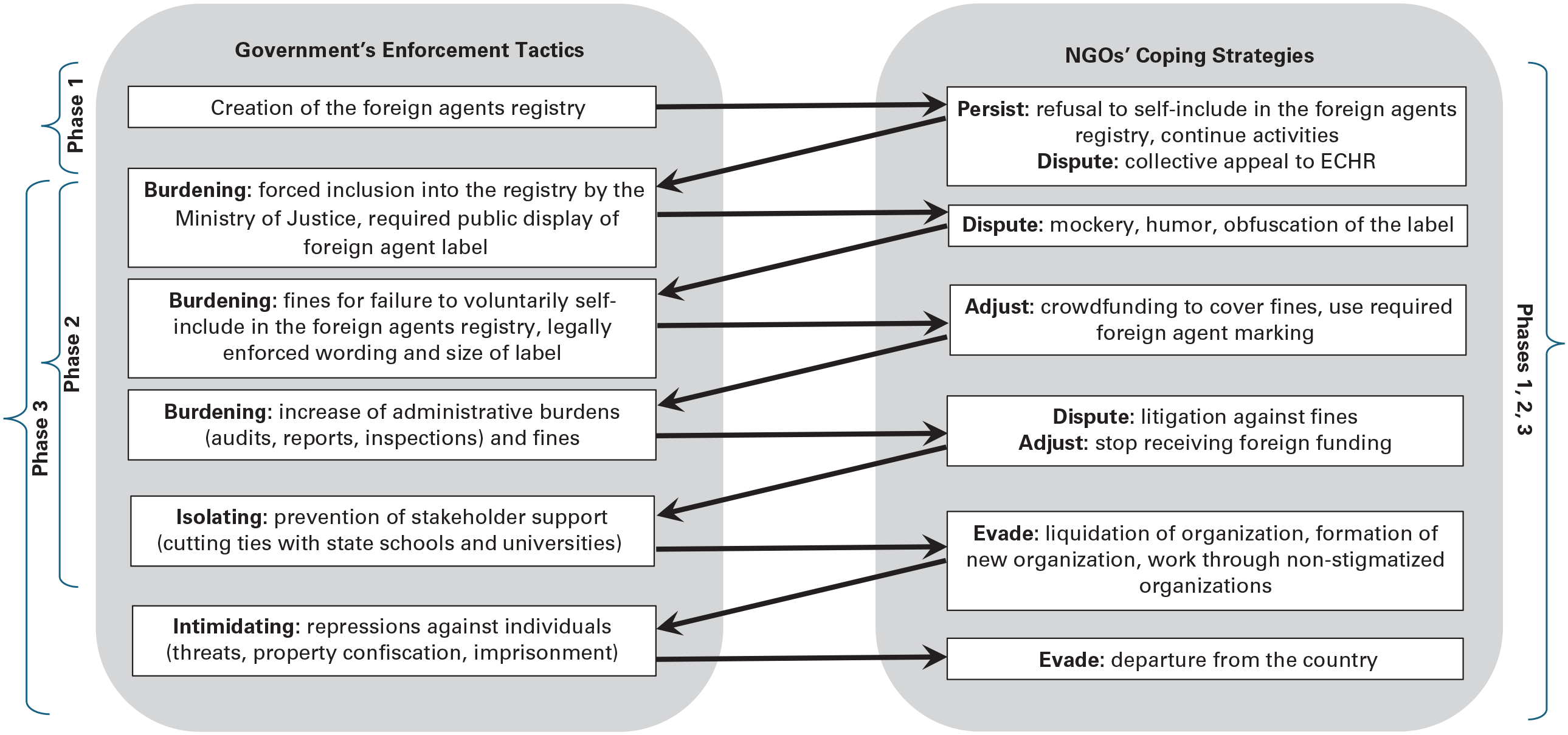
Dynamics Between the Government and Foreign Agent NGOs
Involvement of third-party stakeholders
During the stigma enforcement and contestation phase, third-party stakeholders began to get involved in the stigmatization process (Aranda et al., 2022). The center of Figure 2 represents this involvement. Some stakeholders assisted the government, some distanced themselves from the stigmatized NGOs, and some stakeholders actively supported the stigmatized NGOs.
Stakeholders assisted the government
Stakeholders in the first category included, for example, Russian journalists, who engaged in “smear campaigns” through public “slander and defamation” (ID15) of foreign agent NGOs. Some of these stakeholders provided anonymous tips to the authorities regarding specific NGOs’ political activities or use of foreign funding (ID19; ID24). The foreign agents law was amended to “include norms on ‘snitching’” so that the Ministry of Justice could check the tips made by “state bodies, parties and public associations, the Public Chamber, the media, citizens and organizations about those who, according to them, should be included in the register” (BBC, 2022). Another type of stakeholder that assisted the government was the so-called GoNGOs. These were government-sponsored non-governmental organizations that were “mimicking” NGO activity (Kanevskaya, Olenichev, and Cherniaeva, 2018: 69) but, in reality, were formed with government support as “clones,” frequently with names identical to those of existing NGOs (ID4). One such GoNGO, for instance, launched a newspaper in which it published so-called expert opinions that nuclear waste in their region was disposed of properly. This statement contradicted the conclusions reached by an NGO that was well established in that region (ID25). GoNGOs served the interests of the government and created an “illusion of a healthy civil society” (Amnesty International, 2016: 34). Finally, academics were involved in conducting expert evaluations of foreign agent NGOs’ activities, evaluations that supported government agencies’ rulings about the presence of political activities in these NGOs (NGO Lawyers Club, 2016).
Stakeholders distanced themselves from the stigmatized organizations
The second category of third-party stakeholders were those who started distancing themselves from the stigmatized NGOs, including long-term partners (NGO Lawyers Club, 2016: 28; ID17), citizens who had previously worked with these NGOs (Tulaeva, Tysiachniouk, and Henry, 2017: 35), NGO members (Kanevskaya, Olenichev, and Cherniaeva, 2018: 36; ID7), and donors. As one respondent noted, “leaders of organizations were afraid to collaborate. Although formally no one would punish for this, they were still afraid to do so” (ID21). Another respondent recalled that “there were several cases when we were refused to reserve venues, business centers or hotels, twice in Novosibirsk, once in St. Petersburg this happened, without any explanation or reasons why. We had the opportunity and now we don’t” (ID3).
Stakeholders assisted the stigmatized organizations
The third category of third-party stakeholders that emerged during the second phase were the supporters of the stigmatized NGOs. The most public of these supporters were lawyers and legal organizations that provided assistance to the so-called foreign agent NGOs. Such organizations as Agora, NGO Lawyers Club, and Club of Third Sector Lawyers, among others, represented foreign agent NGOs in Russian courts and assisted with the European Court of Human Rights complaint (NGO Lawyers Club, 2016: 9; Koroteev, 2018). Some members of the public were also supportive. For example, to pay their fines, many NGOs used crowdfunding and received support from individual citizens: “We asked Sakhalin’s residents for financial support and many of them supported us” (Lisitsyn, as quoted in Kanevskaya, Olenichev, and Cherniaeva, 2018: 40). A wildlife protection NGO, Dront, shared in a published report by Amnesty International how they received help, in addition to financial support, from volunteers and the media: Dront also works on many other aspects of environmental monitoring and on health issues. Its effectiveness and public support became clear after news spread that Dront had been labelled a “foreign agent” and given 300,000 rouble fine (around USD 4,800); people in Nizhnii Novgorod quickly collected the money to support the organization. This support went beyond the financial; not a single regional media outlet published a negative article about them and volunteers continue to support their environmental work. (Amnesty International, 2016: 11)
Furthermore, some NGO representatives mentioned that they had received informal support from select government officials in the form of information sharing prior to formal hearings (ID23), issuance of awards to recognize NGOs’ prior achievements (ID22; ID13; ID24), and invitations to participate in public meetings (Mukarova, 2018). In rare instances, government officials defended foreign agent NGOs, and some judges even ruled in their favor (Vasilenko, 2014: 47; ID20; ID12).
Overall, stigma enforcement and contestation was an iterative and dynamic phase, with the government amending the law and its stigmatization tactics and NGOs trying to continue their work by devising new coping strategies. The emergence of stakeholders on different sides of the stigmatization process is in line with insights by Wang, Raynard, and Greenwood (2021), who highlighted that stigma emergence is not always associated with a convergence of stakeholder judgments but may, instead, reveal divergent stakeholder views.
Phase 3: Stigma Propagation (End of 2017–2022)
First they came for the socialists, and I did not speak out—because I was not a socialist. Then they came for the trade unionists, and I did not speak out—because I was not a trade unionist. Then they came for the Jews, and I did not speak out—because I was not a Jew. Then they came for me—and there was no one left to speak for me.
The third phase of the stigmatization process, stigma propagation, began several months before the 2018 presidential elections, when Putin was re-elected to his fourth presidential term. This phase was associated with a broadening scope of the stigmatizing label and NGOs’ destabilized existence.
Government broadening scope of the label
During this phase, the foreign agents law became more “dynamic” (ID5). This phase was associated with the government’s strategic broadening of the foreign agent label by expanding both the stigmatization targets beyond NGOs and the label assignment criteria.
Broadening scope of stigmatization targets
The beginning of the third phase of the stigmatization process was marked by the passage in late 2017 of an amendment that expanded the targets for the foreign agent label assignment criteria from NGOs to mass media outlets (BBC, 2019: 7). This amendment was passed right before the 2018 presidential elections as retaliation to the inclusion of the Russian government-sponsored Russia Today–America TV channel into a U.S. foreign agents registry. One of the first organizations included in the Russian foreign agents registry of mass media outlets was Voice of America (Inoteka, 2021: 2).
At the end of 2019, another amendment was passed, which allowed the classification of individuals and unregistered public associations (e.g., groups of individuals) as mass media acting as foreign agents (Kondrashev, 2021: 3). This amendment allowed any individual with a social media account who received any form of foreign funding (e.g., attended a conference sponsored by a foreign organization) and who posted online content deemed political by Russian authorities to be included in the foreign agents registry and persecuted accordingly: The expansion of the number of types of foreign agents . . . led to the emergence in December 2020 in Russian jurisprudence of individuals recognized as foreign agents and foreign agents represented by unregistered public associations, as well as to more and more-disproportionate restrictions of the constitutional right to assembly. (Kondrashev, 2021: 97)
Reflecting on the passage of this amendment, one of my interviewees noted, “indeed, when the law was extended to individuals and journalists, it became wild” (ID20). Describing this amendment, another NGO leader I interviewed expressed her fury with the changes: You see, I don’t know what’s going on in their heads, to declare a living person “mass media foreign agent.” Lev Ponomarev, a person with two arms, two legs, a head, who you can touch and even beat up (because he was beaten up in the past, and was under administrative arrest for demonstrations), so this Lev Ponomarev is now declared “mass media.” And now in anything he posts he has to write “Lev Ponomarev, individual-mass media, foreign agent.” Where is common sense in all of this? (ID4)
15
Broadening scope of label assignment criteria
During this phase the criteria for inclusion in the foreign agents registry were also expanding. Starting in 2018, NGOs that received funding not only from foreign sources but also from Russian organizations with foreign funding could be included in the foreign agents registry (BBC, 2019). This change implied that NGOs would know about the funding sources of Russian organizations before accepting their donations or assistance, which presented an infeasible level of scrutiny.
In July 2022, Putin signed into law the formation of a unified registry of foreign agents of all types—NGOs, mass media, and individuals—and removed the foreign funding criterion from the inclusion requirements. After that point, a foreign agent could be anyone who, “from the point of view of the Russian authorities, fell under foreign influence . . . [which] would include any form of assistance—for example, ‘scientific and technical’ or ‘in other forms’” (BBC, 2022). This broad formulation of the law strengthened the government’s ability to include any legal entity or individual in the foreign agents registry, thus intensifying the stigma propagation. As of September 17, 2024, this registry contained 1,058 NGOs, media organizations, and individuals.
Destabilized existence of the stigmatized organizations
For NGOs, the stigma propagation phase was associated with destabilized existence. As foreign agent NGOs liquidated or changed their legal forms from registered NGOs to public associations, grassroots initiatives, or volunteer groups, the activities of some of their members did not stop. Rather, they shifted from being conducted under the formal status of an NGO to an informal activity (Tulaeva, Tysiachniouk, and Henry, 2017).
Specific NGOs’ stories support this point. For instance, after the liquidation of Memorial in Krasnodar, work to restore the names of the victims of repression continued. Commenting on the liquidation, historian Aleksandr Selitskii remarked, “We, historians, know very well that everything depends on a person, on an individual. It is not important whether there is a legal entity or not” (Selitskii, as quoted in Gritsevich, 2018: 4). A director of an educational NGO I interviewed similarly noted, “We continue to work, but without using the NGO form. That’s the general picture” (ID21). Tatyana and Nikolay Shchur, directors of a human rights NGO, shared a similar story: “Now we cannot engage in our activities openly [emphasis added] . . . Because the toxicity that is prescribed to us by this law can spill over onto others” (ID13). A deputy director of another human rights NGO shared with me that “the activity of [our organization], although it has been liquidated, has not wrapped up. It continues, but kind of through guerilla tactics, after the loss” (ID22). Such tactics include “enthusiasts’ use of personal resources, individuals writing [about the law] in their personal public pages . . . discussions of human rights issues at union meetings” (ID22).
As the NGO Lawyers Club (2016: 62) predicted, “It is likely that such initiatives, which act without registration as legal entities, may become prototypes of new NGOs, that are capable of renewing civil society in Russia.” The ironic outcome of the stigmatization process has been that instead of exerting formal control over foreign agent NGOs, the authoritarian government has contributed to NGOs’ secretive existence, as these organizations have shifted their activities behind the scenes and farther from the government’s formal control.
Critical Elements of Top-Down Stigmatization
When examining this case of top-down stigmatization, I noticed three critical elements, which are depicted around the perimeter of the process model in Figure 2: the relative power of the government over the stigmatized organizations, limited action by international authorities, and lagged media attention. All three were important for enabling stigma propagation and broadening the scope of the stigmatizing label.
Relative power
In the context of this study, stigmatization gained traction due to the more powerful position of the stigmatizing authoritarian government over the stigmatized NGOs. In line with previous conjectures that the relative power of the stigmatized actors may play an important role in the process of stigmatization (Hudson, 2008; Devers et al., 2009; Hudson and Okhuysen, 2014), the Russian government’s ability to set and change the rules limited the ways in which NGOs could react, particularly in the later stages of the process. As access to stakeholders and resources continued to be cut off (Beilinson et al., 2021: 39), NGOs’ contestations with the government grew more burdensome, even for the oldest and most resourceful NGOs. Furthermore, the government’s ability to control the narrative about so-called foreign agents in the national news led to the development of distrust among some people toward these NGOs.
Limited action by international authorities
The second characteristic that enabled the scope creep during the stigmatization process was limited action by international authorities. While the process was unfolding, several international agencies analyzed the Russian foreign agents law and expressed concerns about its intent and implementation. For example, on June 27, 2014, the European Commission for Democracy through Law issued a statement calling “the use of the term ‘foreign agent’ . . . highly controversial” and characterized its practical implementation as one that “gives rise to concerns” (European Court of Human Rights, 2017: 7). In 2016, Amnesty International issued a report titled “Agents of the People,” in which the organization condemned the use of the foreign agents law, which aims to “undermine and discredit a range of effective and active NGOs,” and concluded that the law had led to “an atmosphere of suspicion and intolerance” (Amnesty International, 2016: 33). During the same year, U.S. State Department spokesperson John Kirby (2016) publicly criticized the law, urging the Russian government “to abolish this legislation today and uphold its international human rights commitments.” In their conclusion about the law’s effects on Russian civic society, the European Human Rights Advocacy Centre (HRAC, 2018: 3) stated, “The Foreign Agents Act has been widely condemned, including by Amnesty International, the Venice Commission and the Commissioner for Human Rights of the Council of Europe.”
These statements by international authorities, however, were accompanied by limited action. Those involved in the process emphasized that more-active intervention by international authorities was critical. The NGO Lawyers Club (2016) noted that interference by international human rights institutions could improve the climate for NGOs. They specifically highlighted, In such conditions, the support of NGOs and activists is extremely important: they need to be trained to acquire new skills and knowledge in constantly changing conditions; emergency assistance programs for civil activists are required (including in Russia and abroad; legal and social support); more active influence of international institutions on the human rights situation in Russia. This must be done to prevent the emergence of a new “iron curtain” that may soon be erected in Russia. (NGO Lawyers Club, 2016: 56)
Notably, the initial complaint filed by 11 NGOs with the European Court of Human Rights did not receive a response for several years: From the time of the first application . . . until the start of the communication four years had passed. By then, everything that the NGOs wrote about in the complaint in 2013 had already occurred. Even if the decision is in our favor it would have a lesser effect than it would have had if the process had started right after 2014. (Koroteev, 2018)
As the European Court of Human Rights (ECHR) case grew, dozens of Russian NGOs were added to it, and during the interviews many expressed their hopes for a fair ruling. HRAC (2018) highlighted the importance of the ECHR ruling: “A judgment from the European Court finding these violations will send a strong message to regimes around the world which have, or have planned to introduce, legislation which restricts civil society access to foreign funding, including in Hungary, Kyrgyzstan and India.” Yet, the European Court of Human Rights did not issue a ruling on the case until March 2022. At that point, Putin’s army had begun the war in Ukraine and Russia publicly denounced the European Convention on Human Rights (United States Department of State, 2022).
Lagged media attention
The third critical element of the stigmatization process in this context was lagged media attention to the foreign agents law. Media coverage of the law and the corresponding stigmatization of NGOs were noticeably low during the first two phases of the process, and this silence allowed for the scope of the stigmatizing label to broaden and to later include mass media and individuals. Some interviewees pointed out to me that media attention to the stigmatizing label increased only after the expansion of the foreign agents registry to include mass media and journalists. One respondent noted that when the law was passed in 2012, “the journalists did not cover it much, because they thought that it was not a big deal, until it affected them directly” (ID1). As a result, the stigmatization process was unfolding “in complete silence, or almost complete silence, from the press, who were not very worried” (ID1).
I examined the extent of media coverage of the Russian foreign agents law from the beginning of 2012 through the first quarter of 2022. To do this, I used NexisUni and searched for variations of the Russian term “foreign agent” (inostrannyi agent), limited the search category to News and the language to Russian, and turned on the duplicates detection option. The search, conducted in April 2024, resulted in 1,767 articles published in international sources. These results provided insights into the cumulative amount of media coverage about the law over time (depicted in Figure 3 as the gray shaded area, right-hand y-axis). 16 As Figure 3 shows, the significant increase in media coverage began in 2021, nine years after the law was passed. By then, nearly half of the foreign agent NGOs were liquidated. As one respondent summarized, “lately, because more mass media and journalists have been included into the registry . . . the wave of resentment has risen” (ID19). This statement resonated with others I interviewed.
Media coverage was important as it informed the public about the law and shed light on its development, albeit from different angles. Some media outlets justified the law as a way to increase transparency, whereas others highlighted its repressive and discriminatory consequences. As one interviewee pointed out, They cover it differently on different platforms. Naturally, if this is, say, a state media outlet, then it says that [the law] is still, well, neutral . . . or with such big bias, accusations of espionage almost. But at the same time, recently, due to the fact that more and more media outlets as well as individuals acting as media began to be included in the “foreign agents” registry, a wave of indignation arose, mostly among active liberal parts of the society. (ID19)
Regardless of the tone of media coverage, however, the lagged media attention toward the foreign agents law allowed the stigmatization process to unfold seemingly unnoticed and unscrutinized by the broader public in Russia. As the scope of the label began to broaden, targeting not only NGOs but other types of organizations and ultimately individuals, awareness of it finally grew.
Assessing Success of Stigmatization
Was the top-down stigmatization process targeted at so-called foreign agent NGOs in Russia successful? To assess the extent of stigma, some studies analyze the tenor of media articles toward the target of stigmatization (e.g., Helms and Patterson, 2014; Wang, Raynard, and Greenwood, 2021). Other studies use exemplary quotes from the media (Hampel and Tracey, 2017), relying on the assumption that media coverage is a representative reflection of public opinion. In the context of this study, capturing the extent of stigmatization proved challenging. I first sought to analyze the content of media articles used to produce Figure 3. These articles, however, were obtained through a search of a U.S.-based database, skewed toward Russian-speaking audiences outside of Russia. I could not find a comparable database of articles published within Russia. Furthermore, Russian state-owned media sources were biased against the foreign agent NGOs, thus not reflecting but aiming to form public opinion about the stigmatization targets.
I therefore turned to two public opinion poll centers, VCIOM and Levada-Center, which independently conducted polls related to the foreign agents law, each on a representative sample of respondents. 17 Although the questions varied across the polls, the overall trend showed an increase in public awareness about the law. In 2016, 73 percent of respondents had not heard of the law, but by 2021 this number was only 45 percent (Levada-Center, 2017, 2023). In 2016, 56 percent of respondents said that the goal of the law was to limit the negative influence of the West on Russia, and 26 percent thought that the law was a form of pressure on independent civic organization. By 2021, these numbers were 37 and 40 percent, respectively (Levada-Center 2017, 2021). By 2022, 59 percent of respondents had negative associations with the term “foreign agent,” such as “spy,”“traitor,”“enemy of the state,”“one against Russia,”“one against the government,” and “one who harms” (VCIOM, 2022). Finally, when asked how their opinion of an NGO, politician, or mass media agency would change if those were included in the foreign agents registry, 34 percent of the respondents said that it would worsen, 5 percent said it would improve, 47 percent said it would not change, and 15 percent said it was difficult to answer (Levada-Center, 2023). These polls point to increased awareness of the stigmatizing label yet split stakeholder reactions toward the stigmatized. By the end of this study, the authoritarian government continued to use its top-down stigmatization tactics, but this has not yet resulted in self-sustaining, bottom-up stigmatization.
Contributions and Future Research Directions
By studying how the Russian government stigmatized NGOs under the 2012 foreign agents law, I uncovered an alternative stigmatization process, not one that originates from the bottom up and results in widespread and self-sustaining vilification of targets but one that originates from the top and requires continued reinforcement. In the context of this study, a stigmatizing label was used as a tool for an authoritarian government’s deliberate attempts to suppress and eradicate select organizations while inducing fear in others. The study makes several contributions to research on stigmatization. First, it illustrates that stigmatization does not have to be triggered by transgressions committed by the stigmatized actors but, instead, can begin through the government’s redefinition of what constitutes norm-transgressing behavior. Second, the study reveals stigmatization tactics used by an authoritarian government against the stigmatized actors. Third, it uncovers the dynamics that unfold between the stigmatizer and the stigmatized actors during the stigmatization process. Finally, it articulates the critical elements that enable the stigmatization process to unfold along the depicted trajectory. Below I detail how these insights contribute to stigma research, and I offer directions for future studies of stigmatization.
Stigmatization Trigger
In the context of this study, the stigmatization trigger was not an act of deviance or transgressions that “inflicted discernable damage to primary stakeholders” (Wang, Raynard, and Greenwood, 2021: 1843); rather, it was an assignment of a label, which was “contested and challenged” by various stakeholders (Galvin, Ventresca, and Hudson, 2004: 75). This study illustrates a government-initiated stigmatization, the process of how a stigmatizing label moves from speech to law to sanctions against the stigmatized actors. It also reveals that using a stigmatizing label with deep historic roots allowed for stigmatization to gain traction, since the resurrected label resonated in the collective consciousness as a negative one, contriving the deviant nature of those who received it.
This research, however, is a qualitative study limited to the context of one country. Future research on stigmatization should continue exploring different contexts in which stigmatization unfolds, including the types of triggers that spark this process. Beyond internal factors, such as transgressions by the stigmatizer or assignment of the stigmatizing label by the government, it is possible that external factors are just as critical for inciting stigma. When stigmatization takes place in a broader sociopolitical context, increased conflict between countries, for instance, may serve as a trigger for stigmatization of different social actors within them.
Tactics of the Stigmatizer
This article answers Dong et al.’s (2023) recent call to provide a more complete picture of stigmatization by examining not only stigma emergence but also the ongoing process of stigmatization. I showed how an authoritarian state takes over stigmatization processes to eradicate unwanted organizations that may challenge its legitimacy. By deliberately activating a stigmatizing label, the government tries to “nudge people into desired patterns of behaviour” (Tyler and Slater, 2018: 732). And by using burdening, isolating, and intimidating tactics, it aims for “the maintenance of stigmatization” (Zhang et al., 2021: 209).
To build on and extend these findings, organizational researchers can focus on the repertoire of stigma-enforcement strategies used by various types of stigmatizers, beyond governments. Whereas this study focused on the tactics used by an authoritarian government, which presented difficulties in obtaining data directly from the source, future studies could examine the tactics used by other types of stigmatizers, including democratic governments, corporations, and professional associations. As Siltaoja and colleagues (2020: 995) noted, stigmatization arises from situations in which “those in power are under attack”; thus, it is possible that powerful social actors who foresee their demise may use stigmatization tactics to preserve their status and diminish the moral status of those they perceive as a threat (Sutton and Callahan, 1987). Whether and how the repertoire of stigmatization strategies differs based on the type of stigmatizer remains an open question.
Dynamics Between the Stigmatizer and the Stigmatized Organizations
By focusing on the enforcement strategies employed by the government, I was able to detail the dynamics between the stigmatizer and the stigmatized organizations and reveal the continuous enactment of stigmatization (Dong et al., 2023: 1057). These dynamics resulted in the harshening of enforcement tactics and suffocation of the NGOs over time, while the scope of stigmatization criteria and targets broadened and the enforcement apparatus strengthened. In a way, the initial application of the label to NGOs allowed the government to test how the stigmatizing label would be perceived by the public, to experiment with its application and revision of enforcement tactics, and to then apply it to more-powerful actors, such as the media and prominent individuals, including famous opposition leaders, actors, scientists, comedians, and journalists. This finding highlights the danger of bystanders’ silence in the early stages of the stigmatization process, silence that later enables the broadening of stigma scope. An important implication of this finding is that it is critical for various social actors not to stay neutral during the early stages of others’ stigmatization.
To uncover the intervening forces that may disrupt these stigmatization dynamics, future studies could focus on the sequence of moves used by the stigmatized organizations (persist, dispute, adjust, evade), since my data did not allow me to uncover this temporality with precision. Another promising angle for future research on the factors that may disrupt stigmatization involves comparing the emergence of the same stigmatizing label across different contexts. Organizational scholars have pointed to the context-dependent nature of stigma (Devers et al., 2009; Hudson and Okhuysen, 2009), but why in some contexts the dynamics between the stigmatizer and the stigmatized actors result in persistent stigmatization whereas in others these dynamics result in its failure remains unexamined. Recent examples of variations of the foreign agents law that gained traction in some countries (e.g., Hungary and India) and failed to pass in others (e.g., Georgia in 2023) suggest that the success of the emergence and application of stigmatizing labels depends not only on the strategies used by the stigmatizer and the stigmatized actors but also on the involvement of other third-party stakeholders. I suspect that the level of civic engagement and civil society’s willingness and ability to organize is one factor that can disrupt the top-down stigmatization process explicated in this study.
Critical Elements and Boundary Conditions
A final contribution of this article is that it highlights the crucial roles of power, international authorities, and the media. The high power of the Russian authoritarian government over the NGOs; the engagement by international organizations such as the European Court of Human Rights, Transparency International, and Amnesty International through sanctions limited to public condemnations; and the relative silence of the media during the early stages of the stigmatization process before the law was applied to them appear to have contributed to the maintenance and propagation of stigma.
At the same time, these critical elements may be viewed as boundary conditions that are relevant in this specific setting. Therefore, exploring the application and importance of these boundary conditions can shed new light on the process of stigmatization in other settings. Future research on stigma could, for example, benefit from problematizing the role of power between the stigmatizer and stigmatized actors and from exploring the role of different types of government during different stages of stigmatization. Since variance in institutional environments has been identified as a key reason for divergent treatments of stigmatized organizations, ranging from tolerance to active condemnation (Hudson and Okhuysen, 2009), examining how democratic versus authoritarian governments, for instance, enact stigma or intervene in the stigmatization process initiated by others is important. It is possible that we may see similar processes of normalizing the use of a stigmatizing label as well as reliance on burdening, isolating, and intimidating tactics against ideologically opposed organizations in democratic countries (e.g., abortion clinics in the United States or immigrant communities in Europe). Future research could examine how the stigmatization process uncovered in this study might be similar or different in other, more democratic contexts.
Future research on stigma can also benefit from further exploring the role of international authorities, such as international agencies, multinational organizations, and global corporations. Prior studies of organizational stigma have contained theorizing within the boundaries of one country (e.g., Hudson and Okhuysen, 2019; Lashley and Pollock, 2020; Wang, Raynard, and Greenwood, 2021); yet, the insights from this study suggest that international actors may play a critical role in alerting the broader public to stigma emergence, informing international media and regulatory bodies of the potential repercussions of such changes, and imposing consequential sanctions against repressive regimes. For example, international economic sanctions imposed on Russia and withdrawal of numerous corporations from the country after Putin’s invasion of Ukraine in 2022 (Chief Executive Leadership Institute, 2024) were a much stronger signal of disagreement with the government’s actions than were the verbal expressions of condemnation issued before the war. Future research is therefore needed to explore the varying roles of international organizations during the stigmatization processes in different countries. Finally, it remains to be examined whether and how high levels of media scrutiny early in the stigmatization process can alter its development. It is possible that timely and widespread media coverage of the foreign agents law early on might have tipped the power scales between the government and the stigmatized NGOs.
Conclusion
Suppression of stigmatized foreign agent NGOs in Russia can reduce the society’s ability to voice and address diverse issues. Given the rise of authoritarian regimes around the world (Repucci and Slipowitz, 2022) and their use of stigma as a tool to eradicate undesirable individuals and organizations, it is critical to understand how top-down stigmatization unfolds and how it can be disrupted. As variations of the foreign agents law expand across the world (International Federation for Human Rights, 2021), I hope that this article will help to warn of the far-reaching consequences of this spread, inform future research on stigmatization, and give voice to those being stigmatized.
Supplemental Material
sj-pdf-1-asq-10.1177_00018392241297379 – Supplemental material for Stigmatization by an Authoritarian Government: Russian NGOs Under the 2012 Foreign Agents Law
Supplemental material, sj-pdf-1-asq-10.1177_00018392241297379 for Stigmatization by an Authoritarian Government: Russian NGOs Under the 2012 Foreign Agents Law by Anastasiya Zavyalova in Administrative Science Quarterly
Footnotes
Acknowledgements
I thank associate editor Siobhan O’Mahony and three anonymous reviewers for their support and guidance throughout the review process. I also thank Royston Greenwood, Tim Pollock, and Cindy Devers for their constructive feedback on earlier versions of this paper. I acknowledge the many helpful comments by the participants of the University of Maryland 2022 summer paper workshop and Rice University’s 2023 Emerging Markets Conference, attendees of the 2023 Academy of Management and Strategic Management Society annual meetings, participants of Oxford University’s Centre for Corporate Reputation 2023 Annual Reputation Symposium, and faculty and students of the University of Texas at Dallas and Zhaw University’s School of Management and Law. Finally, I am extremely grateful to the NGO representatives who entrusted their stories to me. All remaining errors are mine alone.
Supplementary Material
1
Some scholars refer to NGOs as NPOs (non-profit organizations) and NCOs (non-commercial organizations). For consistency, I use the term NGO throughout the study except in direct quotations.
2
This number is based on the 2022 “Freedom in the World” report that “evaluates the state of freedom in 195 countries and 15 territories during calendar year 2021. Each country and territory is assigned between 0 and 4 points on a series of 25 indicators, for an aggregate score of up to 100. The indicators are grouped into the categories of political rights (0–40) and civil liberties (0–60), whose totals are weighted equally to determine whether the country or territory has an overall status of Free, Partly Free, or Not Free” (Repucci and Slipowitz, 2022: 34).
3
Conducting a study in an authoritarian context presented challenges due to limited access to government data sources; therefore, I had relatively more data on the strategies of the NGOs compared to the enforcement actions of the government.
6
7
I thank the associate editor and three anonymous reviewers for highlighting this point during the review process.
8
The sum is larger than 218, as five organizations were removed from the registry prior to liquidation.
9
Some NGOs were older than their registered age, as they had been functioning in Russia since the late 1980s but were officially registered after the collapse of the Soviet Union.
10
Institute of Foreign Policy Research and Initiatives: invissin.ru. During 2006–2011, Mrs. Krasheninnikova was the president of the Trade and Economic Relations Council in New York. As the council acted on behalf of the authorities of St. Petersburg, Russia, it had to be registered as a foreign agent in the U.S. Information that I obtained from the U.S. Department of Justice indicates that to comply with FARA, Mrs. Krasheninnikova herself signed the documents filed on behalf of the council.
11
I cite all statements from primary data sources, interviews that I conducted, by indicating the ID number of each interviewee (e.g., ID1, ID20). All other citations indicate secondary data sources.
12
I thank the associate editor and an anonymous reviewer for their assistance in devising this typology of stigmatization tactics.
13
The book contains interviews with ten NGO representatives, two of whom I interviewed personally. I therefore coded eight interviews from the book to avoid duplication.
14
15
Lev Ponomarev is the director of For Human Rights NGO and a human rights activist. He was included in the foreign agents registry in 2020.
16
Although these data, collected through a U.S.-based database, provide some insights into the changes in Russian-language media coverage of the foreign agents law, they are limited to international sources and therefore are not representative of the spectrum of news sources available in Russia.
17
VCIOM: www.wciom.ru; Levada-Center: 