




Abstract
Drawing from Goffman’s original observations on stigma and the consequences of interactions between the stigmatized and supportive or stigmatizing audiences, we conduct a 20-year review of the diverse literature on stigma to revisit the collective nature of stigmatization processes. We find that studies on stigma’s origins, responses, processes, and outcomes have diverged from Goffman’s relational view of stigma as they have overlooked important relational mechanisms explaining the processes of (de)stigmatization. We draw from those conclusions to justify the need to study stigma as a collective phenomenon. We develop a relational perspective on stigma based on understanding how attributes are stigmatized (or not) by audiences in their interactions. We argue that to advance stigma research, it is necessary to build on Goffman’s theory to include the stigmatizers (i.e., the normal) and supporters (i.e., the wise); how they create, sustain, or remove stigma; and how they relate to the stigmatized (i.e., the targets). Accordingly, we provide a research agenda on stigma as a collective phenomenon that theorizes a relational perspective, proposes a typology of how audiences relate to stigmatization, and identifies patterns of relations between audiences. We thus offer a missing piece to existing accounts of stigma by focusing on the key role of audiences (i.e., stigmatizers or supporters of the stigmatized) rather than on the targets of stigma (i.e., the own).
Goffman (1963, p. 3) described stigma as “an attribute, behavior, or reputation which is socially discrediting in a particular way,” spoiling the image and casting those actors marked with it to the margins of society. Audiences can subject those with perceived devalued attributes or those that associate with them to stigmatizing evaluations to varying degrees, leading the stigmatized and those associated with them to be socially disapproved and ostracized (Link & Phelan, 2001; Pescosolido & Martin, 2015). In this sense, a stigma exists in the nexus of social interactions among diverse social audiences and is associated with deviance from socially established norms (Kvåle & Murdoch, 2022b; Roulet, 2020). Although Goffman (1963) focused on individual-level stigma, scholars have built on this foundational work to examine stigmas at different levels of analysis, such as organizations (Hudson, 2008), practices (Clemente & Roulet, 2015; Helms & Patterson, 2014), professions (Wang et al., 2020), categories (Hsu & Grodal, 2015, 2021; Piazza & Perretti, 2015; Vergne, 2012), or industries (Aranda et al., 2020; Durand & Vergne, 2015; Khessina et al., 2021; Lashley & Pollock, 2019). Like Goffman’s (1963) original assertion, and regardless of the level of analysis, stigma is most often detrimental to the survival and performance of the stigmatized (Pollock et al., 2019; Zhang et al., 2020).
Our work is motivated by the observation that traditional research and recent literature reviews on stigma (Pollock et al., 2019; Zhang et al., 2020) have focused on the targets of stigma and on their strategies to manage stigma. While it is important and unavoidable to discuss those that are the subject of stigma and the contested nature of the attributes that mark them, a target and attributional focus runs the danger of reifying stigma or of making stigma appear a concrete and objective evaluation rather than a subjective and contextual evaluation by audiences. These “unidirectional approaches are akin to studying only one dancer in a duet, rather than looking at the synergies and interdependencies between the two dancers” (Mikolon et al., 2016).
Indeed, attributes or labels are not stigmatizable per se but are stigmatized based on the perceptions and interactions between audiences in a given place/time (see, for example, Augustine & Piazza, 2021). In other words, stigma is not assigned by the target being stigmatized but by the audiences doing the stigmatizing evaluation. In this sense, we follow Helms and Patterson’s (2014, p. 1456) understanding of audiences as “diverse but key individuals and organizations with whom (. . .) actors must interact or risk the withdrawal of their necessary support.” Despite being subjective, the attributes stigmatized by audiences can have objective consequences for targets. That is, while stigma is subjective, the practices it surrounds vary in the social harm they cause. For example, governments tightly restrict and control the founding of organizations involved in Schedule 1 drugs because of the perceived harm that they cause, leading to the marginalization of entrepreneurs engaged with these substances (Lashley & Pollock, 2019). Meanwhile, other narcotics (i.e., opioids) have had higher legitimacy. Despite having a broader negative social impact than illicit drugs, their prescribed consumption does not lead to the widespread marginalization of pharmaceutical companies. We thus assert that while stigmatizing processes vary in the harm they cause, it is important to understand how stigmatizing judgments shape the evaluations of audiences and how targets are treated.
Shifting the focus of stigma research toward audiences’ perceptions and evaluations is particularly crucial. Goffman (1963) defined stigma as a process of attribution and argued that focusing on targets and their attributes was somewhat limiting as what is stigmatizable depends on culturally embedded definitions and judgments by stigmatizing audiences: The term stigma, then, will be used to refer to an attribute that is deeply discrediting, but it should be seen that a language of relationships, not attributes, is needed. An attribute that stigmatizes one type of possessor can confirm the usualness of another, and therefore is neither creditable nor discreditable as a thing in itself. (Goffman, 1963, p. 3)
From Goffman’s (1963) symbolic interactionist perspective, stigma arises, persists, and is altered when stigmatizing audiences, those they stigmatize, and supportive audiences interact in society. In Goffman’s (1963, p. 23) words, stigmatization is based upon mixed-contacts, those “moment[s] when stigmatized and normal are in the same social situation.” Therefore, while we agree with the importance of differentiating stigma from related concepts (Pollock et al., 2019) and investigating stigmatizing attributions across multiple levels of analysis (Zhang et al., 2020), we find that prior research has overemphasized the boundaries of stigma by focusing on a given level of analysis (e.g., profession, organization, category, or industry). Yet, as a phenomenon, stigma is tied to attributes (e.g., practice or clientele) that permeate the boundaries of any given organization, profession, category, or industry and those that engage or transact with them in broader society. We thus argue that the empirical focus of theory development on the mechanisms underlying stigma must extend beyond targets and their attributes to incorporate those stigmatizing audiences and relationships that collectively give rise to stigma and those involved in its maintenance and reduction. This is central to our understanding of stigma, given its permeating and relational nature. Without this broader view, researchers risk losing sight of the numerous interactions involved in the emergence of stigma, so stigma cannot be understood as stemming from the audiences relating to and evaluating targets.
We follow previous scholars in defining stigma as “a fundamental, deep-seated flaw” tied to a core attribute (i.e., “who it is, what it does, and whom it serves”; Hudson, 2008, p. 253) used by stigmatizing audiences to deindividuate and discredit the target and its supporters. Stigma is thus the basis for imposing “harmful social and economic sanctions on them” (Devers et al., 2009, p. 157). Because stigma is associated with how audiences relate to a contested practice (e.g., sex work) or clientele (e.g., ex-offenders), it permeates the boundaries of the stigmatized organizations, professions, categories, or industries to impact not solely those that closely engage with them (e.g., sex work professionals or ex-offenders) but those that work on their behalf to provide them with resources (e.g., strip clubs, social work agencies, etc.) as well as their consumers or customers (e.g., purchasers of sexual services, organizations that hire ex-offenders). Thus, we conceptualize stigma as a collective phenomenon to better capture its relational and permeating nature. Mainly to capture stigma’s origins and effects, not only for targets but also for supporting audiences (i.e., stigma by association) as well as stigmatizing audiences whose evaluations create and spread stigmatizing labels.
In this sense, the transferability of stigma, what Goffman (1963) calls stigma by association—whereby those that interact with the stigmatized and share the stigmatizing attribute(s) to varying degrees are also penalized with stigma—is crucial to understanding collective stigma as a phenomenon that affects “entire sectors of the economy” (Augustine & Piazza, 2021, p. 624). In other words, given stigma’s transferability, its effects spread across and within collectives so that it can be multilevel (permeating, to different degrees, organizations, professions, categories, and industries engaging with stigmatized attributes). Hence, our goal is to capture the relational origins of stigma better and foster a deeper understanding of stigma as a collective phenomenon.
To enable a relational research agenda on stigma as a collective phenomenon, we deem it necessary to review the existing literature on stigma utilizing Goffman’s (1963) original observations as an entry point for the following reasons. First, with the emergence of social media and a growing distrust of institutions by audiences who generate or remove negative evaluations, the role of external audiences in producing and maintaining stigma has become a more common and essential component of the evaluation process than is currently conceptualized. Second, there is rapidly growing theoretical interest in audiences who work with stigmatized or marginalized actors and, therefore, may experience stigma transfer (Bruyaka et al., 2018; Desai, 2011; Hudson & Okhuysen, 2009; Janney & Gove, 2011; Pontikes et al., 2010; Pozner, 2008). Overall, the interest of scholars in understanding and serving the marginalized (Tracey & Phillips, 2016), and the democratization of social media audiences with the ability to project negative labels and accounts (Roulet & Clemente, 2018) which can have significant implications for businesses and society (Kvåle & Murdoch, 2022a), and the extraordinary and increasing impact that social evaluations like stigma have (Pollock et al., 2019) ensure the persistence of stigma studies.
Drawing from our key observation that current work underemphasizes Goffman’s (1963) key point of stigma being relational in nature, we propose broadening the study of stigma to focus not only on its stigmatized targets—defined by Goffman as its own—but also to conceptualize the broader audiences of stigmatizers who influence the emergence and effects of stigma, called by Goffman (1963) the normal, and the supporters of the stigmatized who may themselves experience stigma transfer, called by Goffman (1963) the wise. Goffman (1963) differentiated between the own—those who recognize that stigma is assigned to them; the normal—those that vary in the degree to which they negatively perceive, label, and interact with owns; and the wise—those who are not directly stigmatized themselves but may be advocates for or supporters to those that experience stigma and thus may suffer stigma transfer. In what follows, to delineate the relevant audiences in collective settings more clearly, we use the labels used by current work on stigma (i.e., target, stigmatizers, and supporters, also known as network partners; Hudson & Okhuysen, 2009) instead of Goffman’s (1963) labels (i.e., own, normal, and wise, respectively).
Using Goffman’s (1963) relational framework, we can thus offer the missing piece to existing accounts of the processes of stigma (Pollock et al., 2019; Zhang et al., 2020). This is based on the premise that “forms of behavior per se do not differentiate deviants from non-deviants; it is the responses of the conventional and conforming members of the society who identify and interpret behavior as deviant” (Franzese, 2009, p. 7). As others have asserted, stigmatizers see their efforts to identify and label stigma as a duty to society (Devers et al., 2009; Roulet, 2020) and use various types of interactions to carry out that duty. Thus, our relational research program broadens the study of stigma as a collective phenomenon by clearly delineating the roles played by audiences that (de)stigmatize their interactions in shaping both the antecedents and the outcomes of stigmatization.
Assessing the Existing Literature on Stigma
We assert that a review of the existing literature on stigma is necessary to ground our research agenda on the relational aspects of stigma for two reasons. First, the study of stigma emerged as a micro-level, social–psychological construct rooted in perceived deviance (Link & Phelan, 2001; Pescosolido & Martin, 2015). Yet, stigma is empirically prevalent and increasingly relevant in organizational settings (Devers et al., 2009; Hudson, 2008), and empirical evidence of its importance continues to increase (Pollock et al., 2019). It is thus essential to understand how the literature has built on Goffman (1963) to differentiate how stigma shapes collective interactions differently than other social evaluations. Second, the implications of stigma are different from those of other social evaluation constructs as stigma is grounded in general perceptions of deviance (Mishina & Devers, 2012), which leads to harmful social and economic sanctions that have the power to deprive the stigmatized (and, by association, those who support them) of critical resources and capabilities. In what follows, we first conceptualize the influence of Goffman’s work and then describe our method before reporting the findings of our review. Next, we uncover the pathway of stigma from its antecedences to its consequences and finalize by proposing a future research agenda.
Conceptualizing the Influence of Goffman’s Work
Although several sociological perspectives have undeniably advanced work on stigma (Douglas, 1966; Durkheim, 1982; Grattet, 2011; Tyler, 2020; Tyler & Slater, 2018), we have chosen to focus on Goffman (1963) because his foundational work has shaped stigma research like no other. Furthermore, by addressing Goffman’s (1963) relational framework, we get more significant insights into Durkheim’s (1982) emphasis on deviance and observations of the societal origins of stigma as well as Tyler’s (2020, 2018) later observations on stigma’s implications for those in the broader society. Overall, we focus on Goffman (1963) because, in contrast with other sociological perspectives, his influence on the stigma literature has been unequivocal, if also controversial, providing a unifying lens for understanding the literature and identifying areas of research that are yet to cross-pollinate.
Our Method of Review
We conducted our systematic review of the literature in several steps. We first chose the start of our observation window to include works published after Goffman (1963). The second step was to retrieve all academic papers that cite Goffman (1963). For this purpose, we conducted a naïve search using the keyword stigma in Web of Science and EBSCO. We also searched for articles published in all journals listed in the Financial Times (FT) 50 explicitly mentioning the word stigma in the title, abstract, or keywords. Combining these searches resulted in 355 articles from 156 different management, sociology, and psychology journals. We read all these papers’ abstracts to exclude articles focused on stigma as an individual-level experience. To further categorize relevant studies, we focused our efforts on identifying articles at the organization, category, industry, field, or occupational level of analysis, where stigma was either a central construct of study or central to the conceptual argument presented (we excluded those simply using the word stigma in a simple non-academic manner). This approach yielded a final sample of 94 studies published in 32 journals, comprising the last 20 years (see Figure 1).
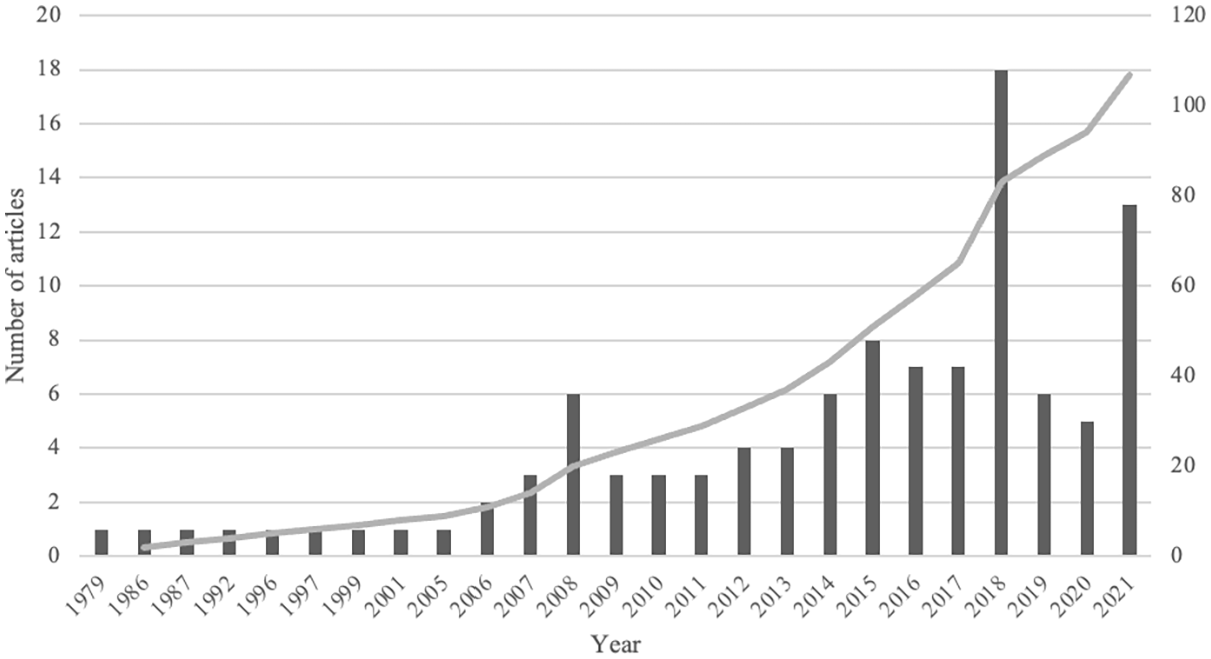
Stigma Studies.
After finalizing our sample, we coded each paper along several dimensions: (a) type of research; (b) level of analysis; (c) theoretical perspective; (d) empirical setting; (e) definition of stigma, type of stigma, and measures of stigma; (f) relevant audiences (e.g., stigmatizing or supporting); (g) (de)stigmatization; and (h), sources (i.e., predictors) of, effects (i.e., outcomes) of, and responses to stigma. Specifically (Item viii), the sources of stigma are the basis on which audiences evaluate the attribute. Effects are the outcomes that targets (the stigmatized) and supporters experience due to being stigmatized. Responses are how targets, stigmatizing, and supporting audiences act to enforce or alleviate stigma.
Review Findings
Definitions of Stigma
It is crucial to recall that Goffman’s (1963) original work focused on individuals rather than collectives. An individual-level definition that has been widely used is that of Link and Phelan (2001, p. 367): “we apply the term stigma when elements of labeling, stereotyping, separation, status loss, and discrimination co-occur in a power situation that allows the components of stigma to unfold.” Management scholars building on the work of Goffman (1963) also define stigma as an attribute that is deeply discrediting such that “stigmatized organizations are evaluated as possessing objectionable traits that make them inferior” (Pollock et al., 2019, p. 452). For instance, Delmas and Grant (2010, p. 35) found that “some consumers stigmatize organic wine, dismissing it as an inferior product.” Hence, in both instances, stigmatization is the labeling based on continued negative evaluations “stemming from external audiences’ collective perceptions that an actor possesses deep-seated flaws (Goffman, 1963) or violates socially constructed norms” (Bruyaka et al., 2018, p. 446).
As scholars extrapolate the insights from individual-level stigma to broader levels of analysis, assumptions differ along three dimensions “the types of conditions that stigmatize, the prevention and removability of a stigma, and the pervasiveness of stigmatizing categories” (Devers et al., 2009, p. 158). These differences provide further evidence of the importance of bringing Goffman’s (1963) relational view to the forefront of stigma research as they make it clear that the evaluations of audiences vary across contexts and over time. For instance, most studies in our review do not necessarily recognize that the targets of stigma could be more or less stigmatized under different contexts or in the eyes of different audiences whose judgments, perceptions, evaluations, power, and standing in social hierarchies vary (see Hudson & Okhuysen, 2009 for a notable exception). Recognizing that social judgments are not universal, meaning not all audiences constantly stigmatize the same attributes or use the same labels, is necessary for developing a relational view of stigma.
Theoretical Lenses of Stigma
The foundations of stigma lie outside the management field, as most work builds not only on the work of Goffman (1963) but also on advances in sociology (Link & Phelan, 2001; Pescosolido & Martin, 2015) and psychology (Crocker & Lutsky, 1986; Katz, 1979). Researchers have utilized these individual and group foundations to examine how organizations experience stigma (Devers et al., 2009; Hudson, 2008; Hudson & Okhuysen, 2009). In the articles we identified, several lenses have been used to study stigmas, such as labeling or signaling (Helms & Patterson, 2014; Xia et al., 2016), institutional theory (Lamin & Zaheer, 2012; Roulet, 2015), dirty work (Armstrong, 2019; Ashforth et al., 2007; Blithe & Wolfe, 2016; Phung et al., 2020; Rivera, 2015; Weitzer, 2018; White & Gilstrap, 2017; Wolfe & Blithe, 2015), identity (Garcia & Barbour, 2018; Khessina et al., 2021; Kreiner et al., 2006; Major & O’Brien, 2005; Tracey & Phillips, 2016), communication (Garcia & Barbour, 2018; Singh et al., 2015; Wolfe & Blithe, 2015), marketing (Argo & Main, 2008; Harmeling et al., 2021; Ndichu & Rittenburg, 2021; Valor et al., 2021), impression management (Carberry & King, 2012; Warren, 2007), social capital (Wurthmann, 2014), stereotyping (Leslie et al., 2014), categories (Durand & Vergne, 2015; Vergne, 2012) and networks (Fernandes et al., 2019; Jiang et al., 2017). What we find interesting is that some of these, peripherally applicable to the concept of stigma, such as networks, naturally focus more on existing attributions or the targets of stigma. In contrast, others are closer to the roots of stigma as a mechanism of social control that is manifested whenever audiences express negative evaluations against others (Piazza et al., 2022). Therefore, identity or labeling theories are better equipped to provide an interactionist perspective on the study of stigma by bringing the focus to audiences as either actively engaging in stigmatizing (Khessina et al., 2021) or advocating for the stigmatized (Ashforth et al., 2017; Tracey & Phillips, 2016).
It is also worth noting that, theoretically, stigma belongs to the broad field of social evaluations, which can be either positive or neutral in valence. To bring clarity to this field, Hudson (2008), Devers et al. (2009), and Pollock et al. (2019) have attempted to distinguish stigma from other types of social evaluations. Despite the accumulation of efforts, the boundaries between some social evaluations are not sharp, and at times, these concepts can be confounded—especially so when they share the same valence, as is the case for stigma and illegitimacy (Ashforth, 2018; Devers & Mishina, 2019; Hampel & Tracey, 2019; Helms et al., 2019; Patterson et al., 2019). In this sense, opportunities remain to differentiate stigma from negative concepts such as disapproval, deviance, misconduct, and wrongdoing (Grattet, 2011; Piazza & Augustine, 2022; Reuber & Fischer, 2010), as well as showing how they are related to stigma (Kassinis et al., 2022; Naumovska & Lavie, 2021). We believe that such efforts can bring essential insights into the study of social evaluations and enrich prior work with the opportunity to uncover the mechanisms by which social evaluations have tangible effects on targets and by revealing the relational antecedents to different types of social evaluations (see e.g., Zietsma & Winn, 2007). Specifically, a fruitful way to differentiate stigma from related concepts is to dig deeper into its interactionist roots, as the conditions that lead stigmatizing audiences to negatively evaluate a target and the ability of the stigmatized to remove stigma with (or without) help from those who support them are unlike other social evaluations. This is because stigma, unlike other social evaluations like legitimacy, is an entirely negative evaluation with only a neutral (not positive) counterpart.
Stigma Across Levels of Analysis
Research on stigmatized actors, such as organizations (Carberry & King, 2012; Hampel & Tracey, 2017; Hudson & Okhuysen, 2009; Sutton & Callahan, 1987; Tracey & Phillips, 2016), professions (Toubiana & Ruebottom, 2022; Wang et al., 2020), categories (Barlow et al., 2016; Hsu & Grodal, 2021; Pedeliento et al., 2019; Piazza & Perretti, 2015; Pontikes et al., 2010; Siltaoja et al., 2020), markets (Shantz et al., 2019), or industries (Durand & Vergne, 2015; Lee & Comello, 2019; Oh et al., 2017; Roulet, 2015; Vergne, 2012), is yet to recognize that the sociocultural understandings of what is stigmatized transcend levels of analysis (Zhang et al., 2020). Despite the importance of integrating stigma research across levels, the historically target-oriented focus of much of this literature (Summers et al., 2018) has left critical gaps and unaddressed questions. Taking a relational perspective on stigma research is essential to enrich our understanding because the process of (de)stigmatization “takes place horizontally within levels and vertically across and between levels” of analysis (Zhang et al., 2020, p. 189). As several audiences at different levels of analysis have the power to stigmatize targets, a multicategorical stance that is not informed by the relations across audiences that operate at varying levels of analysis is bound to offer an incomplete view of stigma.
Diverse Methods of Analysis
Our detailed examination of the literature indicates that research on stigma uses a broad range of methods. Scholars studying stigma at the individual level primarily took a conceptual approach (Crocker & Lutsky, 1986; Kreiner et al., 2006; Link & Phelan, 2001; Major & O’Brien, 2005; Pozner, 2008; Tourish & Robson, 2006; Warren, 2007). As could be expected, initially, theory development outpaced theory testing. Building on these insights, there has been exponential growth in empirical work in management over the past years, with a strong preference for qualitative research using interviews and archival or observational data (Ashforth et al., 2007; Hudson & Okhuysen, 2009). Surprisingly, despite the myriad opportunities provided by qualitative data to uncover stigma as a relational process, the focus has overwhelmingly remained on the targets of stigma.
Recently, management scholars have started to employ quantitative methods based on diverse data and have used a variety of measures in their attempt to capture stigma (Aranda et al., 2020; Naumovska & Lavie, 2021; Piazza & Perretti, 2015; Vergne, 2012). For instance, some studies have used membership or inclusion in a particular industry as a measure of whether members are stigmatized (Oh et al., 2017; Piazza & Perretti, 2015), whereas others have used media articles as evidence of stigma (Carberry & King, 2012; Diestre & Santaló, 2020; Durand & Vergne, 2015; Piazza & Perretti, 2015; Vergne, 2012). It is worth noting that in studies on entrepreneurship (Mahieu et al., 2021; Ruebottom & Toubiana, 2020) or top management teams (TMTs), standard measures of measuring stigma include CEO demotion (Semadeni et al., 2008), CEO departure (Marcel & Cowen, 2014; Schepker et al., 2018), financial restatements (Gomulya & Boeker, 2014), or firm failure/bankruptcy (Anbil, 2018; Jiang et al., 2017; McKinley et al., 1996; Neu & Wright, 1992; Shepherd & Haynie, 2011; Xia et al., 2016). More recently, critical online reviews (Barlow et al., 2016; Hsu et al., 2018, 2019) or experiments (Jones et al., 2018; Lee & Comello, 2019; Rodell & Lynch, 2016) have opened the door to new ways to measure stigma. However, opportunities remain to uncover the use of social media data as a powerful force for targeting and stigmatizing audiences (Illia et al., 2022). Fortunately, recent natural language processing tools that combine quantitative and qualitative methods (such as topic modeling [Hannigan et al., 2019]) could further facilitate the study of stigma from an interactionist perspective by allowing researchers to capture the evolution of the different strategic frames used not only by stigmatizing audiences but also by the stigmatized themselves.
(De)stigmatization
Within work on stigmatization, or the process through which stigma is constructed and maintained, some attention has been given to how audiences succeed or fail in their attempts to stigmatize (Wiesenfeld et al., 2008), how some audiences come to accept or even advocate for the stigmatized (Helms & Patterson, 2014), how the stigmatized interact differently with the stigmatizers (Ashforth et al., 2017), or why audiences stigmatize and the motivations behind such actions (Roulet, 2020). Despite the importance of uncovering the relational mechanisms of stigmatization (Paetzold et al., 2008), only a few studies have addressed the stigmatization process of individuals in organizations (Kulik et al., 2008; Ragins et al., 2008; Wiesenfeld et al., 2008), of the organizations themselves (Hudson, 2008), or of practices (Helms & Patterson, 2014) and professions (Wang et al., 2020).
Research has recently also focused on destigmatization, defined by Hampel and Tracey (2017, p. 2175) as targets becoming “normal” according to “those who originally stigmatized them.” Their conceptualization is in line with Mishina and Devers (2012), who argue that destigmatization refers to the means used to eradicate stigma so that the stigmatized are no longer disapproved of among stigmatizing audiences. Recently, Negro et al. (2021, p. 3) defined destigmatization as “collective processes that ameliorate the harmful effects of stigma in a given context.” It is worth noting the variety of terms that have been used to capture this process (i.e., removal, reduction, and dilution), pointing toward the inherent difficulties of assessing whether complete destigmatization has occurred (Aranda et al., 2020; Lashley & Pollock, 2019) or is even possible. In all, prior work suggests that destigmatization results from a process by which the stigmatized reduce or eliminate their association with stigmatizing attributes or labels or stigmatize others to protect themselves (Hampel and Tracey, 2017; Kang et al., 2016; Lashley & Pollock, 2019; Shantz et al., 2019; Siltaoja et al., 2020). Reflecting on the studies presented, we find that research has begun to examine the spillover effects associated with (de)stigmatization (Aranda et al., 2020; Naumovska & Lavie, 2021).
This shared focus on the stigmatized has fueled the growth of stigma research. On the contrary, a critical issue arising is that current research does not account for distinctions between audiences that stigmatize and those that support stigmatized targets, nor does it account for differences between targets that seek to avoid or lessen their stigma (Hampel & Tracey, 2017), those that find it unavoidable (Hudson & Okhuysen, 2009) or even admirable (Helms & Patterson, 2014), and audiences that aid or hinder the target’s destigmatization efforts (Patterson et al., 2019). Therefore, one path left to consider is uncovering the simultaneous audiences that aim to stigmatize and those that seek to destigmatize targets and, by doing so, may become themselves the targets of stigma.
From Stigma’s Antecedents to its Consequences
The Origins of Stigma
Goffman (1963) posited that stigmatization occurs because of physical marks, behaviors, or group membership. In line with this premise, scholars have theorized that stigma has its origins in cognitive processes (Crocker & Lutsky, 1986) and is triggered by the violation of social principles and norms (Hampel & Tracey, 2019) or values (Pollock et al., 2019). In line with this, Devers et al. (2009, p. 155) posit that “stakeholder groups utilize organizational stigmas as a means of social control to define, clarify, and enforce collectively held values and norms.” Moreover, Piazza and Perretti (2015) argue that Similar to individuals, organizations may be stigmatized because of their: (i) appearance, as in the case of “dot-com” firms after the bursting of the Internet bubble (Glynn & Marquis, 2004); (ii) behavior, such as in the case of organizational misconduct (Greve et al., 2010); or, (iii) group membership, as in the case of the arms industry. (Vergne, 2012)
Although variations in the sources of stigma can be identified from the different theoretical lenses used, three things are common: (a) the normative drivers of social audiences’ evaluations are essential (Kvåle & Murdoch, 2022a) to uncover the origins of stigma; (b) key audiences such as the media and the government play a critical role (Hampel & Tracey, 2017; Reuber & Fischer, 2010; Roulet, 2015, 2020) in directing the public’s attention toward or away from the stigmatizing attributes (Piazza & Perretti, 2015; Vergne, 2012); and (c) power is the mechanism through which a stigmatizing label is enacted as a means of social control (Hudson, 2008; Hudson & Okhuysen, 2014; Link & Phelan, 2001).
In line with stigma arising from various sources, Zhang et al. (2020) have recently conceptualized the non-mutually exclusive origins or sources of stigma as sixfold: physical, tribal, moral, servile, emotional, or associational. Their work builds on the initial distinction in the nature of stigma proposed by Hudson (2008). On the one hand, there is event stigma, the consequence of an anomalous event such as an accident or fraud. On the contrary, core stigma results from core attributes such as practices or clientele. Taking a step further, Hsu and Grodal (2021, p. 91) have discussed how event and core stigmas may be combined by considering how audiences come to stigmatize targets “not just as a result of high-profile negative events but for their core attributes, outputs, and routines.” For example, in e-cigarettes, audience perceptions of discrete adverse events by certain manufacturers diffused into broad censuring and invited further scrutiny of their core attributes (Hsu and Grodal, 2021). This illustrates that one of the main origins of stigma is stigma by association because, as mentioned above, stigma transfers across linkages between audiences and the targets of stigma (Amankwah-Amoah, 2014; Kvåle & Murdoch, 2022b). For these reasons, “managing the transfer of stigma to partners is also an essential aspect of the life of core-stigmatized” (Hudson & Okhuysen, 2009, p. 148), and recent work has begun to uncover the conditions under which stigma transfer can be avoided (Phung et al., 2020).
From the above, we know that stigma is an attributional mark of deviance that is imposed by external audiences, so uncovering the role of the stigmatizers and supporters of the stigmatized and their perceptions in the emergence of stigma is crucial to understanding the processes that give rise to it, the underlying reasons that explain why some targets become stigmatized while others are not, and the contexts in which stigma emerges. Specifically, given that stigma arises from the perceptions, labeling, and actions of stigmatizing audiences that have the power to influence the evaluations of other audiences, a relational research agenda on stigma could significantly broaden our understanding of the concerns associated with the negative evaluations that originate stigma by giving more attention to the role of the stigmatizers (Garcia-Lorenzo et al., 2022). Our purpose is thus to broaden how we conceptualize the emergence of stigma, not to ignore that although some stigmatized targets may internalize their stigma (Helms & Patterson, 2014), they neither stigmatize themselves (i.e., auto-stigmatization) nor are they able to remove it unilaterally.
Instead, external audiences (de)stigmatize based on their perceptions, as in the case of climate activists stigmatizing the fossil fuel industry (Ferns et al., 2022) or the media stigmatizing mass travel in Victorian Britain (Hampel & Tracey, 2017). Hence, overemphasizing the stigmatized targets when trying to understand the origins of stigma provides limited insights into the varying standards used by audiences to evaluate a given stigmatizing attribute and sheds no light on the origins of the stigmatizers. Moreover, solely focusing on the targets limits our understanding of the origins of stigma transfer and the mechanisms at play that make some types of stigma more transferable than others. Finally, given that current work mainly focuses on the origins of stigma transfer, opportunities remain to understand the origins of stigmatizing and supporting audiences.
How to Manage Stigma
While Goffman (1963) primarily conceptualized how the stigmatized attempt to pass as normal, scholars have typically focused on the different strategies used by the stigmatized to protect themselves from stigma. Similar to individual-level work (Pescosolido & Martin, 2015), a great deal of attention has been directed toward the different approaches that the stigmatized use to manage stigma (Helms & Patterson, 2014), which Hampel and Tracey (2017) summarize as straddling, co-opting, and shielding. To bring clarity and coherence to the field, Zhang and colleagues (2020) outline six nonexclusive stigma management strategies: boundary management, dilution, information management, reconstruction, co-optation, and emotion work. In short, research has focused on revealing the efforts of the stigmatized to manage stigma (Carberry & King, 2012)—which are driven by their desire to be accepted and increase approval within their context (Sandikci & Ger, 2010) or at least ameliorate its worst effects (Hudson & Okhuysen, 2009). For instance, the Sicilian Mafia strategically leveraged ambiguity to avoid being stigmatized (Cappellaro et al., 2020). More recent strategic lenses have examined the targets’ efforts to manage stigma or utilize it to their advantage. For instance, in officially approved student organizations focused on sexual fetish in U.S. universities, the strategies used to manage stigma shifted from the eradication of the stigma or trying to render it opaque to recognition or embracing the stigma—accepting it and making it part of their identity (Coslor et al., 2020).
It is important to note here that targets may use a combination of the strategies suggested by Zhang and colleagues (2020) to manage different stigmatizing audiences and that their active stigma management may reinforce their stigma by playing into existing stereotypes (Mikolon et al., 2021). It is also worth mentioning here that there is an emerging debate on the targets’ transgressive versus conformist nature. We find little evidence on whether and when all stigma targets seek acceptance or remain transgressors. The assumption guiding most prior work is that the targets want to become normal or at least be seen as such, but this need not be the case. An increasing amount of research has found that targets can positively relate to stigma and seek to utilize stigmatizing labels to their advantage while attempting to minimize or not suffer the social penalties of being stigmatized (Campana et al., 2022; Coslor et al., 2020; Helms & Patterson, 2014; Khessina et al., 2021; Roulet, 2020).
Overall, the insights of prior work on stigma management broadly suggest the need to move beyond the actions of only the stigmatized toward uncovering the multi-audience and coordinated efforts necessary to reshape negative evaluations, avoid the adverse effects of stigma, or avoid stigma in the first place (Dioun, 2018; Humphreys, 2010; Scaraboto & Fischer, 2013; Shantz et al., 2019; Siltaoja et al., 2020). Moreover, the focus on targets has limited our ability to thoroughly understand how to reduce the harm of stigma or how to manage it, as neither the role of supporters in advocating for the stigmatized nor the strategies of the stigmatizers to counter or slow down the attempts of the targets to manage their stigma have been acknowledged. For example, the target-centered nature of current work has focused on disengagement as the primary mechanism to address stigma transfer (Hampel & Tracey, 2017). However, this begs the question of whether and how stigmatizers can foster stigma transfer despite disengagement. We consider these critical areas that need to be developed to understand further how targets either succeed or fail in their attempts to pass as normal (Goffman, 1963).
The Outcomes of Stigma
The study of the consequences of stigma is rapidly developing. In line with Goffman’s (1963) original assertions, stigma has been posited to have a negative influence on survival (Jiang et al., 2017), restricted access to resources and capabilities (Armantier et al., 2015; Hampel & Tracey, 2017; Hudson & Okhuysen, 2014), and loss of social support (Tracey & Phillips, 2016). Building on Goffman (1963), Sutton and Callahan (1987) show that after a stigmatizing event, organizations are selected out, meaning they suffer from adverse reactions such as disengagement of relevant audiences or denigration. In the TMT literature, CEO replacement has been a critical consequence (Gomulya & Boeker, 2014; Pozner, 2008; Schepker et al., 2018). In the categories literature, stigmatized categories suffer from disapproval (Piazza & Augustine, 2022; Tsui-Auch et al., 2022; Vergne, 2012), disengagement of audiences protecting themselves from stigma transfers (Barlow et al., 2016), and segregation into specialist organizations (Augustine & Piazza, 2021). These have been shown to harm performance (Oh et al., 2017) and trigger skepticism concerning corporate social responsibility (CSR) efforts (Lee & Comello, 2019). These findings are somewhat in line with those studies that have shown that stigma results in the disidentification of relevant audiences (Kreiner et al., 2006; Warren, 2007) and adverse performance outcomes (Leslie et al., 2014) because of “social and economic sanctions” (Devers et al., 2009, p. 157). Recent conceptual work has also argued that the extent to which stigma adversely affects the target depends on its characteristics, such as concealability, controllability, centrality, disruptiveness, and malleability (Zhang et al., 2020). Yet, stigma is also relational, so these characteristics highly depend on how targets interact with each other, with other audiences, and with their environments. This interaction is a necessary and undertheorized area of stigma research. Naturally, the efforts to limit the harmful effects of stigma on targets (Crocker et al., 1998; Link & Phelan, 2001) need not be coordinated at all times, as indicated by Hudson and Okhuysen (2009, p. 145): We found no evidence of overt coordination between the statutory regulators and the bathhouse. Their activities resulted in a performance where each party willingly enacted its part independently, but the result appeared to be coordinated. This activity was a sort of contredanse, a form of dance in which dancers partner with one another but where the steps and sequences are defined beforehand. When properly executed, a contredanse gives the illusion that the dancers are creating it at the moment, despite its highly choreographed, predetermined, and independent nature.
A Relational Research Agenda for the Study of Stigma
Drawing from Goffman (1963), we reviewed the broad literature on stigma and found that current work on stigma does not incorporate his initial observation that stigma is a relational phenomenon. While it is linguistically necessary to identify stigma by the focal attribute, we assert that by itself, this places too great a causal emphasis on the attribute and the target’s management of it, which is based on a false assumption: “an attribute that stigmatizes one type of possessor can confirm the usualness of another, and therefore is neither creditable nor discreditable as a thing in itself” (Goffman, 1963, p. 3). This is to say, its origins, persistence, and outcomes, rather than solely stemming from the discrediting and discreditable (Goffman, 1963) nature of attributes themselves, result from the mixed-contacts between those targets with the attribute and those audiences that relate to them and attempt to manage its implications in their contexts. Specifically, our review reveals that as scholars have sought to understand stigma in different settings and at diverse levels of analysis (e.g., focusing on a range of organizational, professional, categorical, and industry stigma), there has been an overly narrow focus on the targets’ management of stigma and the perceptions of their attributes. Hence, we propose a relational model conceptualizing and distinguishing the audiences that vary from context to context in how they relate to stigma and its targets.
To bring the future study of stigma in line with Goffman’s (1963) original argument that while stigma refers to “an attribute that is deeply discrediting,” it “should be seen that a language of relationships, not attributes, is needed,” we argue that it is essential to broaden the research to define the audiences from which stigmatizing evaluations emerge and are maintained as well as those that support the targets. In what follows, we provide the groundwork for an initial language of relationships for the study of stigma by drawing from our literature review to present an initial typology defining the audiences whose relationships influence and shape collective stigmatization processes. Based upon this initial typology, we identify undertheorized relationships between audiences that play a vital, if not primary, role in stigma’s origins, management, and outcomes. In so doing, we emphasize not simply how audiences relate to, and work with, stigmatized attributes but how relationships between audiences shape targets. Table 1 provides our typology of six audiences defining the mixed contacts that are the foundations for stigma.
A Typology of Stigma Relations.
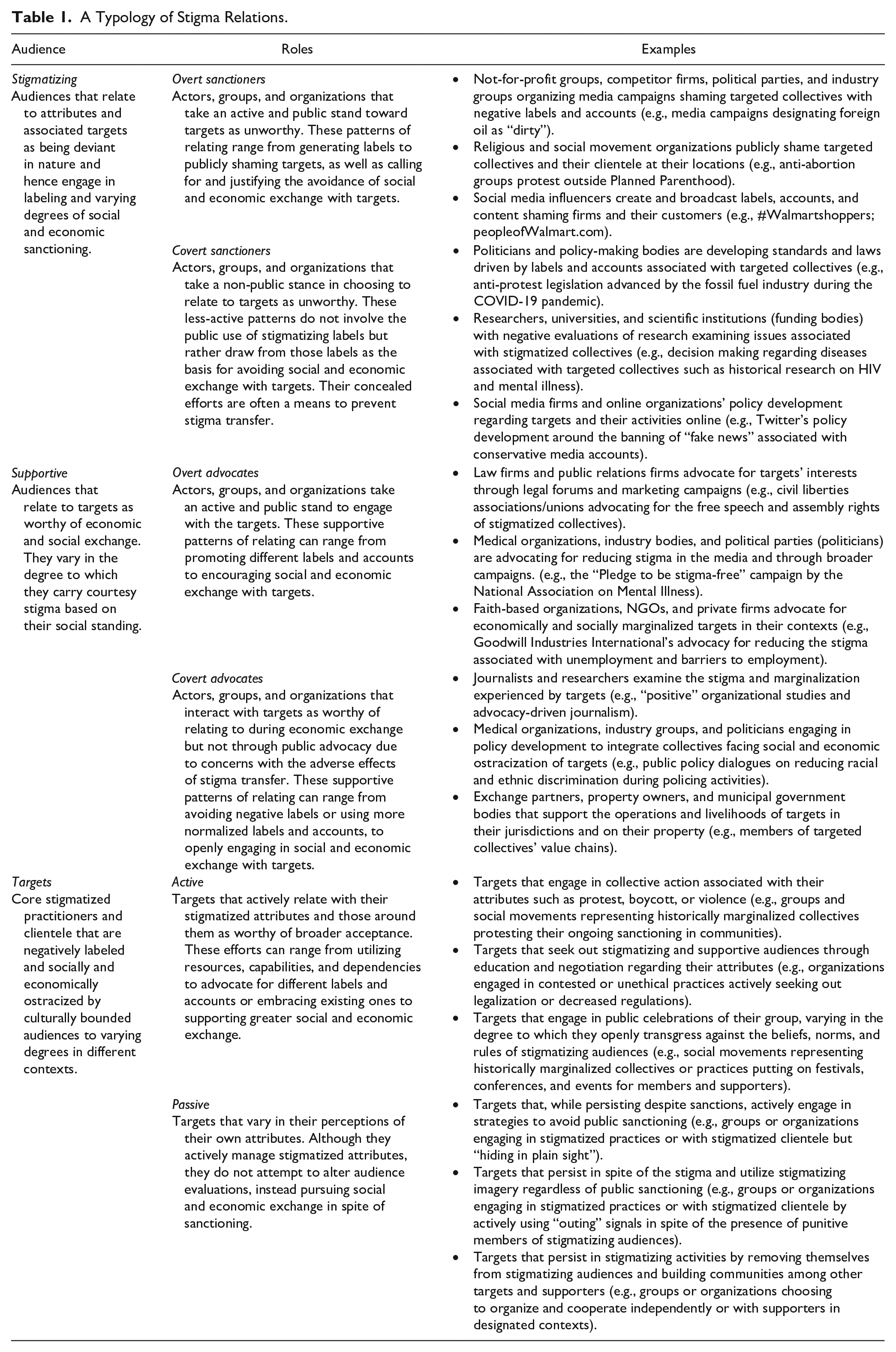
A Relational Typology of Stigma
To fully uncover the role of audiences in the origins, management, and outcomes of stigma, it remains essential to understand whether and to what extent they stigmatize or support those with a given attribute. We know from our literature review that targets depend upon diverse audiences for social and economic resources and capabilities (Suchman, 1995), vary in how they relate to others in their contexts, and have different economic, social, and political motivations. In what follows, we use these insights first to provide two general categories of audiences: stigmatizing and supportive audiences. Following Goffman’s (1963) original observation that audiences vary in how actively they stigmatize or support the stigmatized, we further categorize these audiences based on how overtly or covertly they help or stigmatize targets.
Stigmatizing Audiences
Stigmatizing audiences are vital for stigmatization processes as they are the ones whose labels and sanctions define who and what is stigmatized in each context. Some audiences negatively relate to targets, and, at times, even those that support targets (Pontikes et al., 2010) may use stigmatizing labels to define them (Sutton & Callahan, 1987). As argued by Devers and colleagues (2009, p. 157), stigmatizing audiences vary in the degree to which they “actively impose harmful social and economic sanctions” on the stigmatized and their supporters. We find it crucial to conceptualize the critical role of stigmatizing audiences who target the stigmatized with labels and sanctions. At times, they also transfer stigma to the audiences that support the stigmatized. Significantly, we recognize that although moral or normative motives often play a key role in explaining the labeling actions of stigmatizing audiences, less is known about other reasons to justify their activities, such as economic, political, or competitive gains. Similarly, there is also a paucity of knowledge examining situations in which the stigmatizers may stigmatize to avoid stigma transfer to themselves and to safeguard the benefits of their social standing. For example, Hudson and Okhuysen (2009) discuss how some members of the gay community stigmatized bathhouses for moral reasons and because they were seen as a threat to the acceptance of gay men in society. These underexamined areas represent exciting avenues for future work.
Stigmatizing audiences take on two roles that differ in their active sanctioning of targets: overt and covert, as detailed below.
Overt Sanctioners
On the one hand, overt sanctioners stigmatize audiences that take an active and public role in labeling targets (and their supporters) as less worthy of economic and social interaction. These patterns of relation range from creating and spreading stigmatizing labels to publicly shaming and calling for others to ostracize or avoid social and economic exchange (for a more extensive list, see Hudson, 2008, p. 257). Examples of such sanctioning activities are politicians speaking out and developing laws (Helms & Patterson, 2014), the protests and boycotts of social movements (McDonnell & Pontikes, 2018), and journalists writing editorials utilizing labels to publicly characterize targets and their supporters as deviant (Roulet, 2015).
Covert Sanctioners
On the contrary, covert sanctioners do not openly display their calling for the ostracization of targets and their supporters. Instead, they engage in more passive forms of ostracization by intentionally but quietly avoiding social interactions and economic exchange with the targets of stigma. Their concealed patterns are illustrated in, for example, research on banks’ treatment of those targeted with the label of bankruptcy (Sutton & Callahan, 1987) and work on networks of elites evaluating executives involved in failures, bankruptcy, and scandals (Wiesenfeld et al., 2013). This less public shunning and isolation extend to those that have socially or economically engaged with or supported the target (Jonsson et al., 2009; Tian et al., 2022). Future work on these two types of stigmatizing audiences may consider which sanctioners can be more impactful, given how they influence targets differently.
Supportive Audiences
Supportive audiences are key for (de)stigmatization processes and the continued existence of targets. They ignore and defy stigma labels and sanctions to engage with targets, providing them access to resources and capabilities. Rather than conforming to the evaluations or judgments of stigmatizing audiences, these audiences support targets (as well as others who support them) by relating to them as worthy of economic and social exchange. Supportive audiences range from certain professions or industry associations (Durand & Vergne, 2015) to other organizations (e.g., supply chain providers; Hudson & Okhuysen, 2009). Despite the importance of explaining how the stigmatized survive and even thrive, little is known about the motivations of supportive audiences, which likely play a crucial role in guaranteeing the existence of targets. Future research opportunities could uncover whether support is primarily motivated by self-serving reasons, economic or financial considerations, or more altruistic goals. As a result of working with those with the tainted attribute, these audiences are sometimes targets of stigma transfer by stigmatizers (Helms & Patterson, 2014; Hudson, 2008). Key to conceptualizing the (un)concealed nature of their support is understanding how they relate to the potential of stigma transfer that arises from their association with the targets (Kvåle & Murdoch, 2022b; Naumovska & Zajac, 2022).
Supportive audiences vary in two ways, depending on how publicly they express their support for targets: overtly or covertly, as detailed below.
Overt Advocates
On the one hand, overt advocates actively and publicly stand and engage with targets, despite fears of stigma transfer. These supportive patterns of relating with targets range from seeking to manage the detrimental labels and accounts (e.g., antistigma campaigns) to developing policies enabling social and economic exchange with the stigmatized (Aranda et al., 2020; Cowden et al., 2022; Goodrick et al., 2022). For instance, studies in other fields, such as mental health, criminology, and substance abuse, have examined the work of professionals to dilute stigma on behalf of the targeted groups they serve (Pescosolido et al., 2008). Some overt supporters actively experience stigma transfer from stigmatizing audiences because of their sympathy toward the targets but may be somewhat resilient to its adverse effects because of their legitimacy or power (Helms et al., 2019). For others, the experience of stigma transfer may be endured simply due to economic necessity (e.g., suppliers and buyers) or the lack of alternative options.
Covert Advocates
On the contrary, covert advocates are those that interact with targets through economic exchange but not through public social advocacy (Jarvis et al., 2019; Tsui-Auch et al., 2022). Their support can range from avoiding negative labels in their work with targets to using more normalized labels and accounts. Supportive audiences are motivated to obtain social and economic benefits from their interactions with targets (Helms & Patterson, 2014). Yet, they do not take visible and salient support positions most likely to avoid stigma transfer (Kvåle & Murdoch, 2022a). As noted, while some supportive audiences have the legitimacy and power to overcome efforts of stigmatizing audiences, others do not. For example, new organizations seeking to provide needles and safe spaces for intravenous drug users (to prevent the spread of disease) may focus on providing resources and capabilities rather than taking public stands to fight the stigma of the practice. They do so covertly, for they are wary of stigma, the implications its transfer has for themselves, and their ability to continue supporting the target. Surprisingly, despite Hudson and Okhuysen’s (2009) original observations of buffering networks providing covert support to the stigmatized, little research has pursued these networks of enabling audiences.
Targeted (Stigmatized) Groups
Our review shows that prior work has gone a long way in conceptualizing the targets of stigma. Our focus has been predominantly on defining those audiences that relate to stigmatized targets in sanctioning or supportive manners. Yet, we argue that future efforts should also focus on conceptualizing how targets make sense of their stigmatization and relate to others who share their spoiled identity. Naturally, targets vary in how they positively or negatively respond to stigma (Wolfe & Blithe, 2015) and how they relate to stigmatizing or supporting audiences (Craig & Richeson, 2016). Drawing from our literature review, we assert that targets of stigma take on two roles varying in their acceptance of stigma: active and passive.
Active Targets
First, active roles are adopted by targets seeking to actively relate to both stigmatizing and supportive audiences so that they are recognized as worthy of social and economic exchange. Examples of these defiant responses include advocating for different labels and accounts among audiences (Lashley & Pollock, 2019), embracing and taking ownership of existing labels (Khessina et al., 2021), or engaging in political processes to encourage public acceptance of social and economic exchange (Weitzer, 2018). Regardless of their nature, their efforts actively seek the approval of their practices and clientele and their significant normalization and integration into their contexts.
Passive Targets
Second, passive targets take a more latent public role, either by choice or due to the sanctions levied against them. Hence, unlike active targets, which aim to convert negative social evaluations into positive ones, passive targets do not attempt to alter audiences’ evaluations; instead, they pursue social and economic exchange despite sanctioning. This is not to say that they do not manage their stigma, as there is extensive knowledge on how targets do, to some extent, try to actively manage the sanctions associated with being stigmatized (Zhang et al., 2020). We instead argue that their responses vary in the degree to which targets react to stigmatization. This response can range from covertly hiding their customers and activities from sanctions (Hudson & Okhuysen, 2009; Pheterson & Azize, 2005) to pursuing emancipation from their narrow contexts (Ruebottom & Toubiana, 2020) or openly using stigmatized images not as an act of transgression but as a basis for attracting social and economic transactions (Wang et al., 2020). Hence, passive targets manage their stigma by seeking not to alter the stigmatized evaluations held by sanctioning audiences. Indeed, it is important to remember that despite their efforts, the targets of stigma are broadly devalued in society, so we can expect that their reactive strategies to garner resources and capabilities and to alter the perception of attributes are also degraded by stigmatizing audiences.
Future Research Directions
Having conceptualized the different targets and audiences that define stigma at the collective level, we move to identify the broader relationships between them. Specifically, we now focus on examining the relationships between audiences with different goals and within more general contexts, which we consider essential for a more realistic understanding of stigma’s origins, responses, and outcomes. Specifically, building on the arguments by Devers and colleagues (2009) and Hudson and Okhuysen (2009) that stigma can lead to the simultaneous sanctioning and allocation of support to targets by audiences, we propose a research agenda focused on isolating and studying three undertheorized relationships to frame future work on stigmatization processes.
Relations Between Stigmatizing and Supportive Audiences
The presence and threat of suffering from stigma transfer due to audiences’ association with an attribute have been undertheorized. Consequently, there is little knowledge of the conditions under which supportive audiences emerge to support targets as the risk of stigma transfer lingers. Focusing on the relationships between stigmatizers and supportive audiences with an emphasis on their dependencies, network ties, power imbalance as well as comparative resources and capabilities is necessary for understanding, not simply the dynamics of stigmatization or the transferability of stigma among them but the underlying mechanisms of (de)stigmatization.
The (de)stigmatization of targets is primarily determined by how they are labeled, sanctioned, or supported by the efforts of audiences to sanction, defend, or provide resources and capabilities. For example, Uber drivers encouraged their users’ stigmatizing taxi drivers in France to take over the market (Roulet, 2020). Thus, we assert that conceptualizing the relational dynamics between stigmatizing and supportive audiences is critical for understanding whether and how they (de)stigmatize or support targets or one another.
To begin with, stigmatizing and supportive audiences vary in the degree to which they depend on one another. These existing and changing dependencies, whether financial, economic, or power-based, influence the degree to which audiences stigmatize or provide support to targets. For example, changes in power can lead to stigmatizing laws that withdraw immigration support or restrict opportunities for migrant workers (e.g., U.S. Executive Order 13769, known as the “Muslim ban”). At the same time, the election of supportive politicians can lead to a reduction in stigmatizing rhetoric as well as social and economic sanctions. Hence, comparing the (non)mutual dependencies of supportive and stigmatizing audiences is crucial to understanding their influence over one another and the success of their efforts on behalf of or against stigmatized targets.
In addition to the dependencies between stigmatizing and supportive audiences, their relationships also vary in their network ties. While Hudson and Okhuysen (2009) propose the key role of social and transactional links between targets and supportive audiences in buffering targets, less is known about how the ties between supportive and stigmatizing audiences shape stigma and the sanctions associated with it. For example, government officials and medical professionals seeking to support those harmed by Schedule 1 drugs vary in their considerations on how organizations operating in such industries should be regulated or how open they are in public regarding their positions. Following this example, one can imagine that the relationship between supportive and stigmatizing audiences strongly influences whether audiences experience changes in how they approach attributes and treat them in contexts. In this sense, it is also worth considering that audiences can alternatively be stigmatizing or supporting, depending on the context or the type of stigma involved. For instance, politicians may overtly stigmatize specific audiences to gain support from their constituents while covertly supporting such audiences in their private lives. As noted in our review, examining and studying the relationships between supportive and stigmatizing audiences is essential to delineating how and whether stigmatizing audiences engage in labeling contests to transfer stigma to supportive audiences and, by doing so, contribute to the perdurance or the removal of stigma.
Relations Between Supportive Audiences and Targets
Targets of stigma persist and, at times, thrive due to the assistance they receive from audiences that support them. Targets and supporters can seek out one another to provide and garner resources and capabilities and work together to mitigate the risk of stigma transfer. Drawing from the logic that supportive audiences should influence stigma reduction or amelioration and significantly influence stigma’s adverse effects on targets, we assert that the key to understanding stigma is conceptualizing their resource dependencies, comparative resources and capabilities, and connectedness with targets (Wacquant, 1993).
First, supportive audiences and targets vary in the degree to which they depend upon one another. While research has traditionally emphasized the dependency of targets on supportive audiences, this is not always the case. Targets can form self-sufficient communities and not become dependent upon the resources and capabilities of others. At the same time, supportive audiences (such as not-for-profits or social movement organizations) require access to communities that may neither trust them to work on their behalf nor want/require their engagement. These dependencies shape and influence the success of the stigma management strategies of targets as well as the ability of supportive audiences to ward off stigma transfer and the willingness to do so (Cowden et al., 2022).
Second, targets and supportive audiences have different resources and capabilities for navigating stigma. While research has focused on the work of targets to reduce the negative consequences of stigma, less attention has been paid to the resources and capabilities of supporters and how they vary in their ability to buffer or assist targets in dealing with social and economic sanctions. For example, while many supportive organizations bring intangible resources and capabilities in antistigma campaigns on behalf of targets, marginalized targets may need financial or material support to address the economic and social sanctions on their livelihoods. Some targets may be entirely dissuaded from interacting with overt supportive audiences due to the visibility and salience (i.e., public attention) their efforts bring. In contrast, other targets may evaluate these actions differently and be less susceptible to such attention.
Finally, it is essential to conceptualize the relationships between targets and supportive audiences to understand the extent, motivations, and outcomes of their connectedness. While supportive audiences may altruistically want to help others, their efforts to work with targets may reflect a phantom acceptance, in which that support is contingent upon the targets’ conformity to the norms of supporting audiences. Meanwhile, targets may not trust supporters, their intentions, or their efforts enough to establish relationships with supportive audiences. Hence, the importance of scrutinizing the relationship between supportive audiences and stigmatized targets to advance the conceptualization of stigma.
Relations Among Stigmatizing and Supportive Audiences and Targets
Following our assertion that stigma’s origins, management, and outcomes stem from the stigmatizing and supportive labeling, accounts, and sanctions of audiences, we argue that essential to understanding the intensification or reduction of stigma is studying the simultaneous interactions of targets with both stigmatizing and supportive audiences.
Drawing from our observation that targets and supportive and stigmatizing audiences are diverse and vary in how they are related to each other, we assert it is essential to question the assumption about the homogeneous nature of these audiences and instead recognize that there is diversity within each of these audiences as well. For example, some audiences may strongly stigmatize tobacco companies for producing smoking products. In contrast, other audiences may find tobacco companies less stigmatizable as long as the companies do not advertise to children and youth. Similarly, some supporters of marijuana legalization may work with dispensaries selling marijuana for medical purposes but abstain from engaging with those selling marijuana for recreational reasons. Yet, other supportive audiences may support the practice of smoking marijuana for pleasure. Hence, it is important to recognize the heterogeneity within audiences because stigma is also divisive among those audiences that occupy organizational contexts (Wacquant, 1993).
Another aspect to consider is how stigmatizing and supportive audiences are diverse in how overtly and covertly they advocate or attack the targets of stigma. For example, while politicians find it easier to stigmatize the public agendas of their opponents overtly, regulatory agencies that interact with targets may be less likely to do so. Meanwhile, supportive audiences vary in their approaches to stigma, with some publicly advocating for reducing the sanctions tied to stigmatizing labels. In contrast, others seek to provide support in less public settings. To illustrate, advocacy organizations for drug use versus doctor groups seeking to provide services to those seeking rehabilitation have very different approaches to serving illicit drug users (D’Aunno et al., 1991). The relationships and interactions between overt and covert audiences thus have substantial implications for the survival and performance of stigmatized targets.
Finally, following our observation that targets are diverse in how they respond to stigma, it is important to understand how they relate to other targets and the degree to which they contest or seek compliance. The united or fragmented efforts of targets to collectively manage stigma are critical to conceptualizing their capacity to manage stigma and encourage others to either become supporters or move away from being stigmatizers. Hence, the key to theorizing (de)stigmatization processes is examining how targets work together to influence others around them and their approaches toward stigma in different contexts.
Conclusion
In this article, Goffman’s (1963) understanding that stigma is relational serves as a foundation for analyzing, reviewing, and expanding the literature on stigma as a collective phenomenon. Goffman’s (1963) work has been widely utilized and has informed most of the current work on stigma. However, our review shows that a crucial pillar of his arguments has been overlooked: His approach relied on a relational perspective. Rather than seeing stigma as an attribute, he argued that stigma stems from audiences with different deeply embedded values that evoke judgments and evaluations of the given attribute. Hence, stigma results from an adverse judgment of deviance that spreads through labels that reach a “collective level required for a specific result to spread across a particular context” (Devers et al., 2009, p. 162).
One direct consequence of Goffman’s (1963) focus is that it emphasizes stigmatizing and supporting audiences and their relationship with the stigmatized targets, which has notable implications. We explore how turning the scholarly field’s attention to a relational perspective is crucial to inform and further expand our understanding of stigma as a collective phenomenon. This relational perspective emphasizes the role and interrelations of the stigmatized with audiences in different contexts, bringing about the essence of stigma as a method of social control and a social construction process (Piazza et al., 2022). By focusing on relations, we put audiences’ interactions back in the center of the study of (de)stigmatization processes; we contribute to understanding the implications of stigma. Thus, our work helps to situate firmly within the stigma literature the diverse audiences that, in varying contexts, label, sanction, harm, support, buffer, and otherwise influence stigmatized targets, both historically and contemporarily, to have a more accurate understanding of stigma and the roles of different audiences in (de)stigmatization.
Footnotes
Declaration of Conflicting Interests
The authors declared no potential conflicts of interest with respect to the research, authorship, and/or publication of this article.
Funding
The authors received no financial support for the research, authorship, and/or publication of this article.
