




Abstract
While organizational stigma has emerged as an important and vibrant area of study, yet the processes of stigmatization have not been as thoroughly examined. Specifically, this study explores the subsequent, ongoing stigmatization processes beyond stigma emergence that are triggered by stigma transfer. To do so, we draw on a qualitative case study of an American university selling the naming rights of its newly built football stadium to a company that runs for-profit prisons with a history of human rights violations. We find that the stigma transfer through an exposed association can lead to amplifying stigmatization of both the source and target organizations, featuring a reverberation process fueled by both rhetorical and material stigmatizing practices. Even after the stigmatizing association ceased, stigmatization of the target organization, though muffled, lingered and required further management. Through developing a model of amplifying and muffling stigmatization after stigma transfer, we offer contributions to scholarship on ongoing stigmatization and stigma transfer. We also open the opportunity to understand the temporal dimensions of stigmatization.
Keywords
Stigmatization may occur when organizations are perceived to violate institutionally and socially constructed norms and values. When an organization is marked as deviant, it often experiences ostracism, strong disapproval and public shaming from external and even internal audiences in an effort to bring the organization back into alignment with those norms and values (Devers, Dewett, Mishina, & Belsito, 2009; Hudson, 2008; Tracey & Phillips, 2016). Stigmatization entails both collective labeling (Devers et al., 2009) and the social process of enacting and manifesting the negative social evaluation (Pescosolido & Martin, 2015) to pressure the organization to either renounce its stigmatized attributes and conform to socially accepted behavior, or to sustain the ostracization and criticism it faces. Previous studies mainly examine the processes of stigma emergence (e.g. Devers et al., 2009; Garfinkel, 1956; Wang, Raynard, & Greenwood, 2021; Wiesenfeld, Wurthmann, & Hambrick, 2008), but little is known about how subsequent stigmatization processes evolve after emergence. A better understanding of stigmatization beyond stigma emergence would provide a more complete picture of the role stigma plays in organizational life.
One trigger of active, ongoing stigmatization is stigma transfer. That is, previously nonstigmatized organizations are targeted and punished by audiences due to their association with a stigmatized actor (Hudson & Okhuysen, 2009; Kulik, Bainbridge, & Cregan, 2008). For example, the Lego Group was stigmatized due to its partnership with Shell Oil by Greenpeace, an environmental campaign group, as part of its effort to ostracize Shell due to their ‘unacceptable practices’ such as plans for Arctic oil exploration (Vaughan, 2014). While some past research has examined empirical cases of stigma transfer, focusing on managing it by terminating or hiding stigmatizing associations (Hudson & Okhuysen, 2009; Jensen, 2006) or minimizing their negative consequences (Tracey & Phillips, 2016), how stigmatization processes evolve after stigma transfer remains under-explored. In this paper, we ask: How do subsequent, ongoing stigmatization processes evolve after stigma transfer between organizations?
To address this question, we use a qualitative case study involving two organizations, the GEO Group (GEO), a for-profit prison and detention center management company that was stigmatized due to its core operations as well as its history of alleged human rights abuses, and Florida Atlantic University (FAU), both located in Boca Raton, Florida, USA. When FAU announced that it had sold the naming rights of FAU’s (American) football stadium to GEO, a student-led protest movement at FAU calling itself ‘Owlcatraz’ emerged to resist the sale. Despite this protest, the deal was not abandoned, and stigma was transferred from GEO to FAU.
We make three contributions to organizational stigma literature. First, we build a model of amplifying stigmatization triggered by stigma transfer, featuring a reverberation process fueled by both rhetorical and material stigmatizing practices. Rather than focusing on the labeling processes occurring during stigma emergence (Devers et al., 2009; Wang et al., 2021; Wiesenfeld et al., 2008), we explicitly demonstrate another phase of stigmatization by examining the subsequent processes beyond that emergence as well as collective efforts that are meant to re-establish and reinforce social norms. Second, we contribute to the understanding of stigma transfer by highlighting that it may not only impact the target of such transfer but can also lead to active stigmatization of the source. Third, we explore the temporal dimensions of stigmatization by showing how audiences revive past transgressions, project current stigmatization into the future, and bring both into current stigmatization to exert social control.
Organizational Stigmatization and Stigma Transfer
Stigmatization
Organizational stigma is a perception by certain audiences that an organization has a ‘deep-seated flaw that deindividuates and discredits the organization’ (Devers et al., 2009, p. 157; Goffman, 1963; Hudson, 2008; Sutton & Callahan, 1987). Thus, stigma is not a property of an organization but is a socially constructed evaluation of the organization. Stigma denotes a perceived violation, deviance, or transgression against some established and institutionalized social norms and values (Devers et al., 2009; Hudson, 2008) and thus a threat to social order (Douglas, 2002). As stigmatized organizations potentially suffer isolation from their network partners and others, scholars have mainly focused on how organizations manage stigma by rebutting it (Hampel & Tracey, 2017), deflecting or ameliorating its effects (Hudson & Okhuysen, 2009), or by utilizing stigmatization to attract resources from alternative core audiences, such as customers (Helms & Patterson, 2014).
Despite the growing literature on stigma management, little is known about how stigmatization unfolds once the perception of stigma emerges (Wang et al., 2021). Stigmatization includes the social processes of enacting and manifesting negative social evaluation (Pescosolido & Martin, 2015). In other words, stigmatization involves both the processes of individual and collective labeling (Devers et al., 2009; Kitsuse, 1962) in the stigma emergence phase, and the subsequent practices that seek to re-establish and reinforce social norms, functioning as a form of social control that nudges organizations into preferred or socially acceptable patterns of behaviors (Devers et al., 2009).
The stigmatization occurring during stigma emergence as labeling process has been examined. For example, Wiesenfeld et al. (2008) demonstrate how stigmatization develops from the declaration of a corporate failure through arbiters assigning blame and disseminating their judgments and interpretations. Devers et al. (2009) highlight a two-stage stigmatization model that involves individual-level perceptions of generalized value incongruence with the target organization, thus vilifying it, followed by a social process that aggregates the collective perceptions and vilification of the target organization. These studies highlight two key labeling processes by stigmatizers, tainting the organization and disseminating the negative evaluation across various audiences to achieve consensus.
The subsequent practices of ostracization and criticism that constitute ongoing stigmatization have received less attention. Devers et al. (2009) mention that after collective labeling of the organization as possessing ‘a fundamental, deep-seated flaw’ (p. 155), stigma becomes ‘persistent and self-sustaining’ (p. 162), suggesting that stigmatization can be ongoing after the collective labeling phase (Bullinger, Schneider, & Gond, 2022). In a recent study, Hampel and Tracey (2017) demonstrate stigmatization is a ‘longstanding condemnation’ process and that stigmatizing activities continued after stigma emergence (p. 2194). Wang et al. (2021, p. 1865) empirically examine the stigmatization of a profession, also showing how different stakeholders’ actions or inaction impact the dynamics of stigmatization during and after labels were formed, indicating that stigmatization may still unfold after stigma emergence.
Previous studies do not show how stigmatization is continuously enacted, reactivated and translated into practices as an ongoing effort to reinforce social norms. However, it seems likely that the stigmatization processes occurring after emergence should be different from those observed during the stigma emergence phase.
Stigma transfer
Stigma is contagious. It can transfer to another entity due to an association with – or similarity to – a stigmatized one (Hudson & Okhuysen, 2009; Vergne, 2012). Goffman (1963) calls this courtesy stigma, denoting that the otherwise nonstigmatized could be stigmatized due to an association with the stigmatized and that the negative effects of that stigma could also apply to those targets of courtesy stigma. In some contexts, even temporary, superficial relationships (e.g. people being seen sitting together) have the potential to produce stigma transfer, as some audiences are quite sensitive to negative information (Skowronski & Carlston, 1989). Previous studies examining stigma transfer at the organizational level recognized the potential of stigma transfer and discussed ways to avoid it or minimize its negative outcomes (e.g. Durand & Vergne, 2015; Hudson & Okhuysen, 2009; Phung, Buchanan, Toubiana, Ruebottom, & Turchick-Hakak, 2021; Vergne, 2012). However, with a few exceptions (Roulet, 2015, discussed below), little is known about how stigmatization processes evolve after stigma is transferred from one entity to another.
Extant research implicitly suggests there are two distinct types of stigma transfer: transfer between actors who share similar traits or characteristics but that may not be associated in any practical way, and transfer between actors who are practically associated but dissimilar. These may lead to different stigmatization and stigma management processes.
A stigma source can contaminate a group of similar peers. When the discrediting features of the stigma source become salient, stigmatizing audiences might generalize discrediting features to other similar organizations, particularly if they are deemed to be core to these organizations (Paruchuri & Misangyi, 2015; Roulet, 2020; Vergne, 2012; Yu, Sengul, & Lester, 2008). For example, Roulet (2015) demonstrates how organizations in the finance industry suffered from devaluation due to the shared values with other stigmatized organizations. To fight against similarity-based transfer, organizations often dilute audiences’ attention to the similarities they share with the stigma source (Durand & Vergne, 2015; Phung et al., 2021; Vergne, 2012; Wolfe & Blithe, 2015), or confront the stigmatization of the core attribute directly (Khessina, Reis, & Verhaal, 2021).
Yet stigma can transfer from a stigmatized source to a dissimilar, separate entity through an exposed association (Kulik et al., 2008; Pedeliento, Andreini, & Dalli, 2020; Pontikes, Negro, & Rao, 2010). Associations with stigmatized entities deviate from or transgress socially constructed expectations about the target of the stigma transfer and how that target should act (i.e. isolating the stigma source). This paper concerns a case of association-based transfer.
Previous studies show that to minimize the possibility or the effects of association-based transfer, the previously nonstigmatized organizations may terminate their relationships with the stigmatized entities (e.g. Jensen, 2006). When withdrawal from the association is not feasible, organizations might engage in hiding strategies or other stigma management efforts. For example, Hudson and Okhuysen (2009) show how men’s bathhouses buffer their suppliers and regulators from such transfer or its effects, and how suppliers and regulators limit public exposure of their associations for the same purpose. Tracey and Phillips (2016) examine how a social services agency, which suffered from transferred stigma due to serving refugees, challenged the stigma attached to the refugees while justifying their engagement with them, allowing others to see the organization positively.
The distinction between similarity-based and association-based stigma transfer is likely important to the unfolding of stigmatization processes for two reasons. First, it seems probable that an association would be easier to obscure or publicly account for than similarity. An association can also be terminated. Thus, stigmatizers are more likely to initiate the stigmatization processes aiming to dissolve the relationship and terminate stigma transfer than to shun or have organizations exit their category. Second, similarity-based stigma transfer entails organizational audiences which are more likely to be shared with both the stigmatized source and target organizations than would be the case with association-based transfer, where distinct organizational audiences would manifest in different perceptions, expectations and public discourses and practices produced by audiences’ recognition of a stigmatizing association. It seems likely that these differences would affect the stigmatization processes differently.
Yet, given the paucity of attention paid to the stigmatization processes beyond stigma emergence, it is unclear how the ongoing actions and practices used by audiences to manifest that stigmatization might unfold following audiences’ recognition of a stigmatizing organizational relationship. Thus, to restate our research question, how do subsequent, ongoing stigmatization processes evolve after stigma transfer through an exposed association between organizations?
Methods
Research setting
FAU is a public research university in Boca Raton, Florida, USA. In 1999, FAU initiated an effort to transform itself from a commuter school into a more traditional residential university. Improving their football team and building a football stadium on campus was key to this transformation (Palm Beach Post, 9.10.2003). 1 For years, however, university officials were unable to generate the necessary funding for a new stadium. Early in 2009, a plan for a $70 million stadium finally received approval, $44.6 million of which came from a bank loan (Palm Beach Post, 21.7.2010). The loan was considered risky, but officials were confident of repaying the loan by selling tickets for games and by selling the stadium’s naming rights to a corporate sponsor (Palm Beach Post, 23.7.2009). Construction began in 2010, and the stadium opened in October 2011. However, after two seasons in the new stadium, ticket sales fell well below the projections. Worse, for over a year, the stadium did not attract any corporate sponsors (Palm Beach Post, 12.8.2011). Then, in 2013, the GEO Group offered to purchase the naming rights for $6 million.
GEO is the second largest for-profit, publicly traded prison and immigration detention center management firm in the United States, operating prisons and detention centers in multiple countries. George Zoley founded GEO after receiving a Bachelor’s and Master’s degree from FAU. After graduation, Zoley continued to engage with FAU, both as a long-time member of the FAU Board of Trustees (governing board), even serving as Chairman, and as a member of the FAU Foundation Board responsible for FAU’s endowment.
Privately managed prisons are a highly stigmatized sector in the US as they profit from incarceration. Many find this morally objectionable (Anderson, 2009), given the tension between what many believe are or should be core goals of prisons – rehabilitation and stewardship of inmates’ well-being – and the imperatives created by a for-profit approach to incarceration. Moreover, for years, GEO has drawn press attention due to grave operational failures, including the murder of inmates, riots, sex between guards and inmates, deaths in juvenile detention centers, and detaining immigrants unjustly. Thus, GEO has been actively stigmatized by prison reform activists (Delco Times, 4.1.2009), local community members (Daily Record, 6.2.2012) and immigrant-related associations (McClatchy Newspapers, 5.10.2012). These stigmatizing efforts have also been discussed in GEO’s Annual Reports as a risk to manage, stating it ‘may negatively impact our ability to retain existing contracts and obtain new contracts’ and acknowledging that ‘our business is subject to public scrutiny’ (GEO, 2012, 2011, 2010, 2007).
On 19 February 2013, FAU announced that GEO would pay $6 million over the next 12 years ($500,000 per year) to name the stadium the GEO Group Stadium. At the announcement, Zoley and other FAU officials touted the firm’s local ties to the community and its relationship with FAU. Initially, a few faculty members and some local media supported the deal as necessary to secure FAU’s finances. Most, however, felt that the agreement hurt the school’s image and that it was dangerous for the university to partner with GEO. Both FAU and GEO became the target of intense public scrutiny that resulted in fierce criticism of the university’s willingness to accept GEO’s offer. The very public association of FAU with the stigmatized GEO represented a stigma transfer event, creating a crisis, including severe public criticism and negative media attention, that lasted several months. It was this prolonged stigmatization that drew our attention as an appropriate case to better understand the stigmatization processes after stigma transfer.
Data collection
We rely mainly on news media, as it reported the stigmatization processes and captured the perceptions and actions of various audiences (Clemente & Roulet, 2015; Wiesenfeld et al., 2008; Yu et al., 2008). We collected articles from the archives of newspapers, mostly from the Palm Beach Post (PBP) and the Sun Sentinel (SS), the two leading papers in the community where both FAU and GEO’s world headquarters, as well as their primary stigmatizing audiences, are located. As stigmatization is a localized experience, these two newspapers have more interest in following and reporting the activities. They also had good local access that enabled them to document key events, such as university trustee meetings and student protests, and conduct timely interviews with the main actors and with stigmatizing audiences. We were particularly interested in media articles and items that included direct quotes or interviews from FAU or GEO employees or leadership, and from FAU students, as well as commentaries from external audiences and observers, which helped us capture audiences’ perceptions and activities and these organizations’ reactions to them (see Table 1).
Data summary.
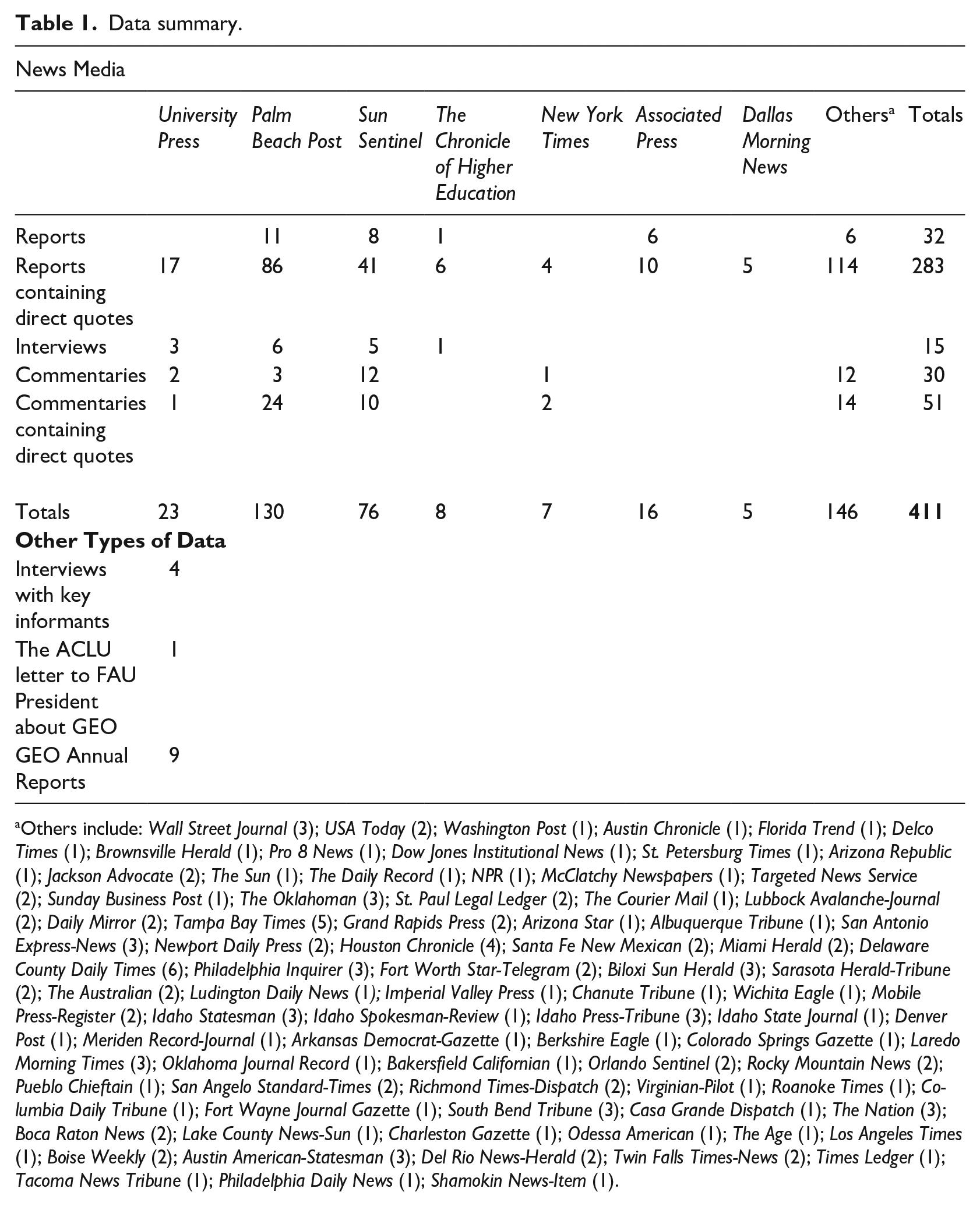
Others include: Wall Street Journal (3); USA Today (2); Washington Post (1); Austin Chronicle (1); Florida Trend (1); Delco Times (1); Brownsville Herald (1); Pro 8 News (1); Dow Jones Institutional News (1); St. Petersburg Times (1); Arizona Republic (1); Jackson Advocate (2); The Sun (1); The Daily Record (1); NPR (1); McClatchy Newspapers (1); Targeted News Service (2); Sunday Business Post (1); The Oklahoman (3); St. Paul Legal Ledger (2); The Courier Mail (1); Lubbock Avalanche-Journal (2); Daily Mirror (2); Tampa Bay Times (5); Grand Rapids Press (2); Arizona Star (1); Albuquerque Tribune (1); San Antonio Express-News (3); Newport Daily Press (2); Houston Chronicle (4); Santa Fe New Mexican (2); Miami Herald (2); Delaware County Daily Times (6); Philadelphia Inquirer (3); Fort Worth Star-Telegram (2); Biloxi Sun Herald (3); Sarasota Herald-Tribune (2); The Australian (2); Ludington Daily News (1); Imperial Valley Press (1); Chanute Tribune (1); Wichita Eagle (1); Mobile Press-Register (2); Idaho Statesman (3); Idaho Spokesman-Review (1); Idaho Press-Tribune (3); Idaho State Journal (1); Denver Post (1); Meriden Record-Journal (1); Arkansas Democrat-Gazette (1); Berkshire Eagle (1); Colorado Springs Gazette (1); Laredo Morning Times (3); Oklahoma Journal Record (1); Bakersfield Californian (1); Orlando Sentinel (2); Rocky Mountain News (2); Pueblo Chieftain (1); San Angelo Standard-Times (2); Richmond Times-Dispatch (2); Virginian-Pilot (1); Roanoke Times (1); Columbia Daily Tribune (1); Fort Wayne Journal Gazette (1); South Bend Tribune (3); Casa Grande Dispatch (1); The Nation (3); Boca Raton News (2); Lake County News-Sun (1); Charleston Gazette (1); Odessa American (1); The Age (1); Los Angeles Times (1); Boise Weekly (2); Austin American-Statesman (3); Del Rio News-Herald (2); Twin Falls Times-News (2); Times Ledger (1); Tacoma News Tribune (1); Philadelphia Daily News (1); Shamokin News-Item (1).
We accessed articles using online archives and the newspaper database LexisNexis. We selected articles published between February 2013 (the date of the announcement) and October 2013 (the point at which we found newspapers stopped mentioning the FAU/GEO deal to any meaningful extent), which led us to the articles published in the national press such as The Chronicle of Higher Education (TCHE) and New York Times (NYT), as well as a video clip of The Colbert Report (TCR) 2 in which the host Stephen Colbert commented on the naming deal. Additionally, we collected articles from the University Press (UP), FAU’s student newspaper, which covered the crisis from the perspective of students, faculty and staff.
To understand the conditions under which the deal had been reached, we also collected articles about GEO from 2004 (the year the company changed its name to GEO) to 2013 (the year the deal was announced) that detailed its controversial past, and articles from 1999 to 2013 that detailed the difficulties of constructing FAU’s football stadium. This gave us a total of 411 newspaper articles, of which 15 articles contained full interviews and 283 articles contained direct quotes that we used to create quote databases from different key audiences and events. We also collected GEO’s Annual Reports published from 2004 to 2013 to understand how GEO perceived its stigmatized industry and how the scandalous history impacted its operation.
To verify the descriptive validity and our interpretation of the data, we conducted four semi-structured interviews with FAU faculty that were identified in the media as having played prominent roles in different episodes in the case. They were involved due to their positions in key university governance committees and were privy to negotiations or were asked to mediate talks between the school administration and students about the naming deal. Interviews lasted an average of 45 minutes. Officials from the FAU administration and from GEO declined our requests for interviews.
Data analysis
Given the limited understanding of how subsequent, ongoing stigmatization unfolds beyond stigma emergence, we relied upon grounded theory methods to inductively analyze the data (Corley & Gioia, 2004). Using the constant comparison technique, we analyzed the data as we collected it (Glaser & Strauss, 2017). We stopped the data collection when no new data on the crisis was available.
We started by immersing ourselves in the archival data to develop a comprehensive understanding of FAU and its plan to build a stadium, GEO and the industry it operates in and its stigmatized history, the interactions between FAU and GEO, and under what conditions FAU accepted GEO’s proposal, as well as deal withdrawal. We then wrote a detailed account of the key events related to the deal and other prominent events discussed in the newspapers during this episode, such as student protests and other FAU incidents, paying special attention to catalog and temporally order the relevant data and events. This allowed for a rich description of the events. GEO eventually withdrew from the deal, after which the attention on GEO faded while FAU continued to suffer criticism from key audiences. Thus, we specifically focused our attention on the stigmatization activities that led to the deal withdrawal and the remaining stigmatization efforts after it.
Once we had the rich description of the events, each author independently coded the text following the coding procedure of grounded theory. We then met to discuss and triangulate to arrive at a cohesive interpretation of the codes. Specifically, we coded the text that described efforts and practices from the audiences of both FAU and GEO, tracing their reactions from when the deal was announced to when it was no longer mentioned. We also coded the responses from FAU and GEO during this process. First, we conducted open coding. We named relevant incidents that described these processes. By cycling through these incidents and comparing them, we collapsed them into 14 first-order codes that capture stigmatization practices and organizations’ responses.
Second, we looked for relationships between our first-order codes. Cycling iteratively among the data, emerging themes and the stigma literature, we identified nine theoretically informed themes, highlighting the dynamics of stigmatization and organizational responses. We then integrated the second-order themes into three aggregate theoretical dimensions (see Figure 1). 3 While we identified these patterns, we drew on temporal bracketing to develop a process model (Langley, 1999), separating our case into distinct phases, especially the amplifying stigmatization phase triggered by stigma transfer and the muffling stigmatization phase after the deal, and highlighting how organizational responses impact the subsequent stigmatization processes. We used our second-order themes to build provisional models and refined them over several iterations until we agreed on our final model (see Figure 2).
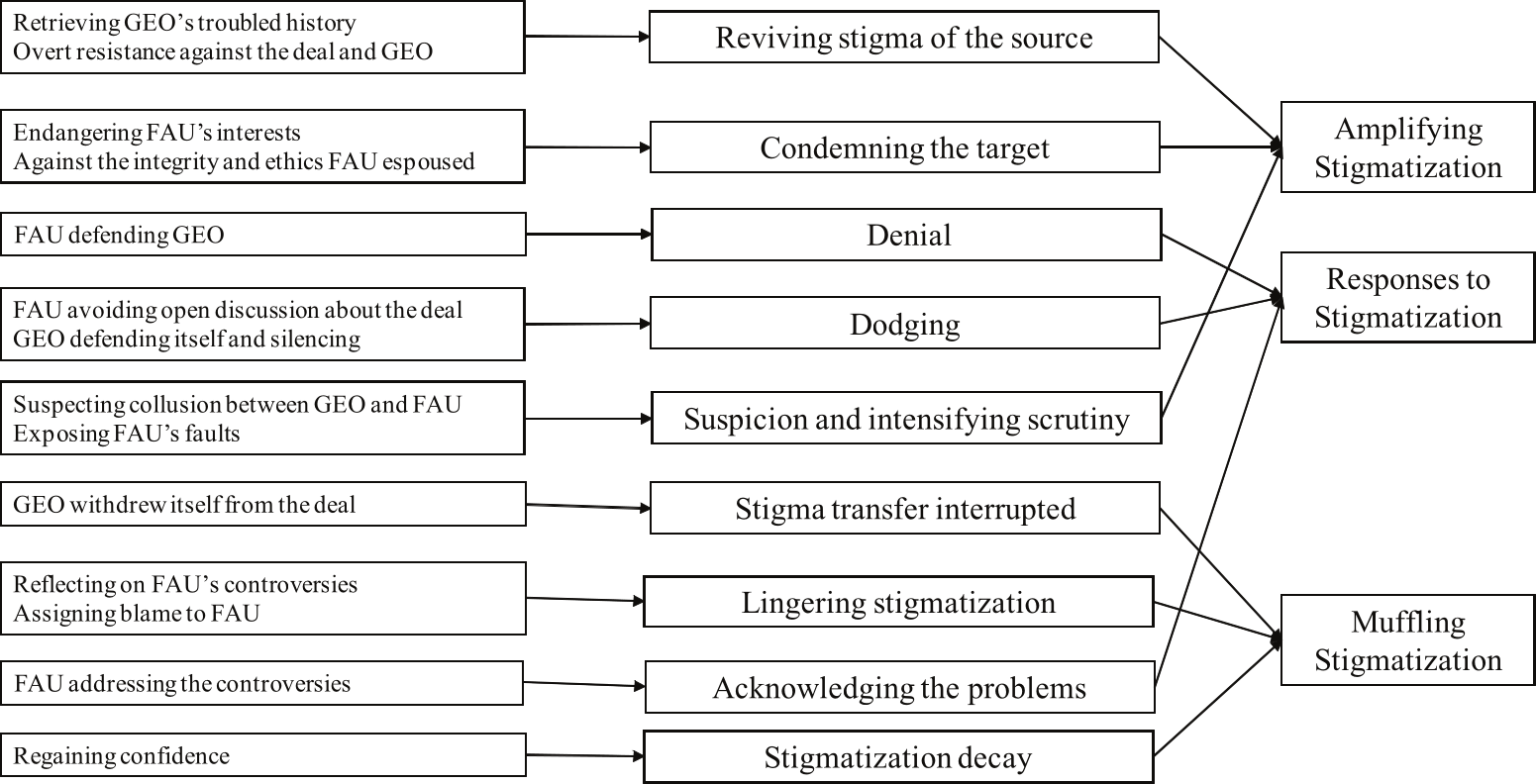
Data structure.
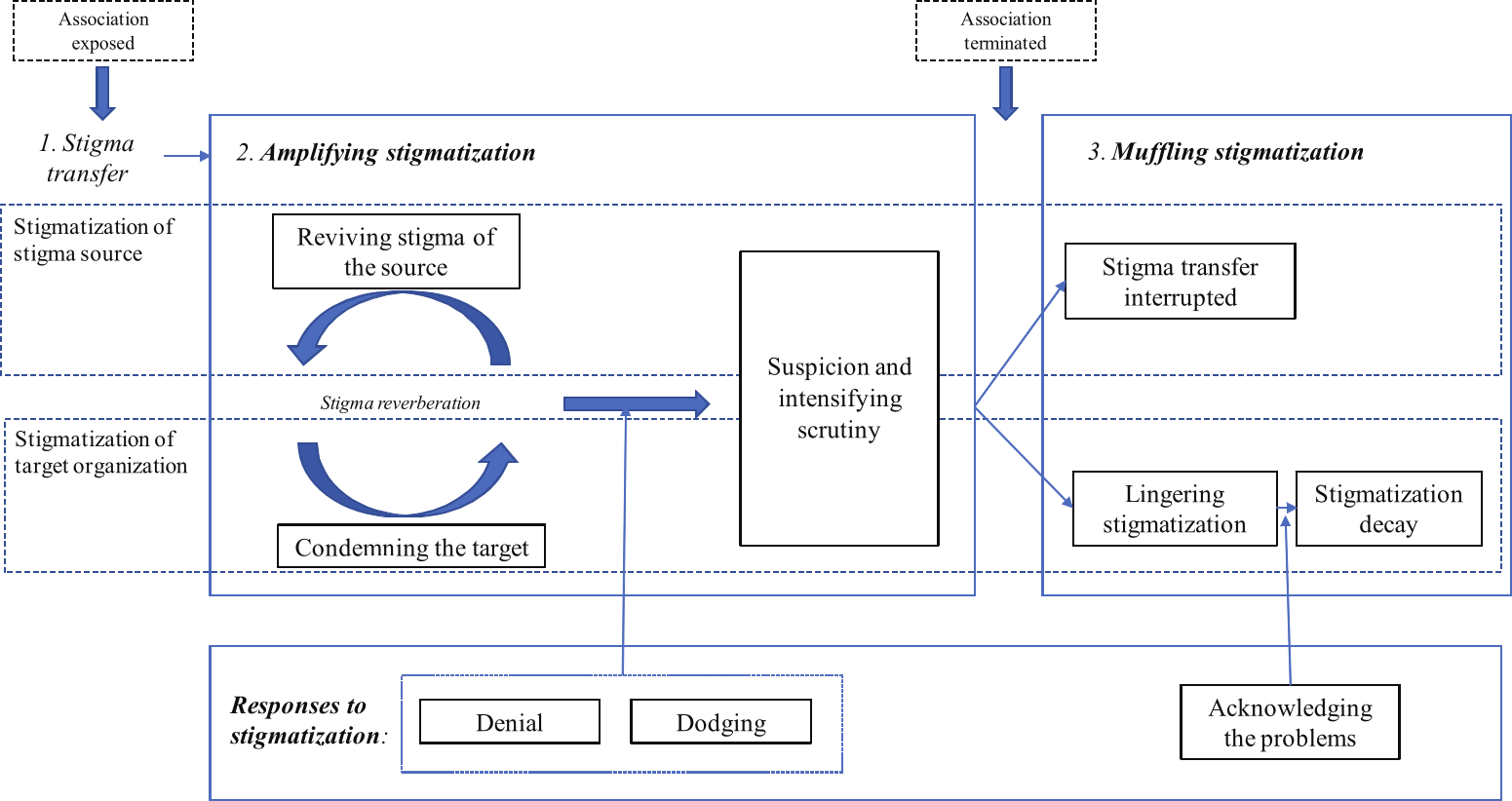
A grounded model of amplifying and muffling stigmatization.
Owlcatraz: Amplifying and Muffling Stigmatization
Our process model discloses how association-based stigma transfer triggers amplifying stigmatization with the expansion of stigmatizing audiences, increasing scrutiny, and intensified vilification of the source and target organization, and how such amplifying stigmatization later becomes muffled. Below, we first elaborate on the stigma transfer event. Then we present the main findings on the subsequent amplifying and muffling of stigmatization processes of FAU and GEO.
Stigma transfer: The announcement of the deal
How does a private company that depends on government contracts and taxpayer dollars for business turn around and use $6 million to put its name on a college stadium?. . . How many FAU football fans are going to see GEO Stadium and think, ‘Oh, next time I need to find someone to run my immigrant detention center, I’ll definitely give them a call!’. . . Besides all the jokes, FAU administrators open themselves to criticism about taking money from a firm that has been targeted by government regulators, human rights activists and lawsuits for its treatment of prisoners and employees. (SS, 21.2.2013) Taking the money at the expense of the school’s ideals and integrity as an academic institution would be a huge step in the wrong direction, and would undermine FAU’s credibility on a national scale. (UP, 22.2.2013)
After its announcement on 19 February, the FAU-GEO deal immediately attracted significant attention. Initially, a few reports praised FAU’s efforts in closing the naming rights deal after a prolonged search (PBP, 22.2.2013). However, much of the public seemed surprised that FAU, a higher education institution, accepted money from a for-profit prison operator, despite Zoley’s existing relationship with the university. It tainted and discredited FAU’s image and sparked strong disapproval.
The media reported that some students and immigrant rights activists were angry that FAU accepted the deal from GEO. As one informant described, ‘very quickly, we started seeing students getting involved and petitioning to get rid of it’ (FAU professor 1). Indeed, after the deal’s announcement, students proposed a new name for the stadium: Owlcatraz, a clever combination of the university mascot’s name, Owsley the Owl, and one of the most notorious prisons in US history, Alcatraz.
On the national comedy show The Colbert Report (21.2.2013), Stephen Colbert sarcastically ridiculed the deal:
That’s right. A private prison company is sponsoring a sports venue. . . Folks, it’s about time we started embracing for-profit incarceration. . .what is the point of taking homicidal maniacs off the street if no one’s making a coin off it?
Similarly, a newspaper sarcastically commented:
Shouldn’t they replace the seats being called sections and turn them into cell-block numbers? How about a new nickname to boot: Jailbirds? And the FAU band to perfect ‘Jailhouse Rock?’ And visiting teams to be strip-searched on their way into the locker room? (SS, 20.2.2013)
As one informant stated, ‘We were on newspapers and we were on [The] Colbert Report. . . We were national’ (FAU professor 1).
At this point, both FAU and GEO were under the spotlight of their key audiences. Stigmatizing actions towards both organizations occurred almost immediately.
Amplifying stigmatization
This criticism is just one of the downsides of paying millions of dollars to have people pay attention to your company [GEO]. . . People start asking ridiculous invasive questions like ‘so the money you’re using to pay for these naming rights on a school building came from profits you made locking up children and occasionally abusing them? Brazen sexual misconduct?’ Well, that’s a natural fit with football! (TCR, 21.2.2013)
Triggered by association-based transfer, the stigmatization of both organizations was amplified, driven by a reverberation process featuring different audience groups providing various stimuli that fed into and intensified their initial negative reactions. Not only the audiences who had previously stigmatized GEO, such as the American Civil Liberties Union (ACLU), social activists, and the media, but also many FAU students and faculty members started to criticize FAU, GEO, and their association.
Reviving stigma of the source
The highly publicized association with FAU emphasized GEO’s stigma such that more audiences started to pay attention to it and to initiate both rhetorical and material practices to criticize GEO. First, audiences engaged in a rhetorical stigmatizing practice of bringing attention to past stigmatizing information about GEO that had passed out of public awareness. As the FAU University Press (22.2.2013) described, ‘GEO’s older harmful record of human rights violations, physical and sexual abuse, and neglect has received considerable media attention in recent days.’ By 2013, GEO had been the defendant of over 100 lawsuits in the previous seven years (UP, 28.2.2013). After announcing the deal, stigmatizing audiences, including the media, shared information from previously published news articles covering GEO’s past accusations. For example, FAU University Press (28.2.2013) wrote:
According to The Palm Beach Post, last June, the federal Occupational Safety and Health Administration proposed fines totaling $104,100 for violations at a GEO prison in Meridian, Miss. And in 2007, USA Today reported inmates staged a two-hour riot at a GEO Indiana prison.
Furthermore, the ACLU, which had often challenged GEO over their previous scandals, joined the collective effort to resist the deal. In a public demonstration against the deal attended by around 100 people, an ACLU attorney read a statement accusing GEO of abuse and neglect of human rights. Quoting a previous court order, she described one of the GEO-run facilities for minors and teenagers as ‘a cesspool of unconstitutional and inhuman acts and conditions’ and ‘a picture of such horror as should be unrealized anywhere in the civilized world. . .brazen staff sexual misconduct and brutal youth-on-youth rapes’ (PBP, 26.2.2013). Retrieving and sharing GEO’s past transgressions re-established and strengthened the link between GEO and discrediting, stigmatizing labels like ‘human rights abuse’ (Tribune Business News, 25.2.2013), and made its stigma salient to concerned audiences.
Second, the stigmatization of GEO was further amplified through material stigmatizing practices such as student-led protests, which attracted more attention to the deal and GEO by publicly demonstrating resistance against them. FAU students from multiple organizations, including Students for Justice in Palestine, Lambda (LGBT) United, FAU Feminist and Occupy FAU, formed the ‘Stop Owlcatraz Coalition’ and embarked on a campaign against the deal. During several demonstrations, protestors held signs and chanted messages such as ‘Profit from pain is inhumane’ and ‘Say no to GEO Group’ (SS, 26.2.2013; UP, 26.2.2013). At one significant demonstration, students and non-student activists also held a march and sit-in outside of the University President’s office with these signs, demanding the deal be rescinded (PBP, 26.2.2013). The entire episode was reported on by local and national media, further amplifying the stigmatization.
The announcement of the deal made GEO’s stigma and past scandals salient. The rhetorical and material stigmatizing practices directed at GEO brought these past scandals into the present such that GEO was actively targeted and vilified by not only its own stigmatizing audiences but also FAU’s key audiences, leading to the amplifying stigmatization of GEO.
Condemning the target
The deal with GEO created an association between FAU and GEO’s stigmatizing labels such as profit from incarceration and human rights abuse (NYT, 19.2.2013). As some professors said, ‘the university’s choice was distasteful and short-sighted. . .FAU aligns our students, as well as our community and other supporters of our athletic program, with a company plagued with human rights abuse allegations’ (Tribune Business News, 25.2.2013). With the amplified stigmatization of GEO, FAU’s students and faculty members increasingly worried that the partnership with GEO would threaten FAU’s interests in the future, thus actively vilifying the deal and FAU’s decision. Additionally, GEO’s main stigmatizing audiences, such as the ACLU, also criticized FAU, stating that it should not associate with a ‘terrible company with a well-publicized track record of abuse and neglect’ (PBP, 22.2.2013). These stigmatizing rhetorical practices which condemned FAU over its affiliation with GEO were rooted in claims that the relationship endangered FAU’s interests and violated the integrity and ethics FAU espoused.
First, although the money offered by GEO would allow FAU to resolve some of its long-term financial problems, due to GEO’s troubled history, audiences contended that FAU’s interests would face future criticism if GEO behaved in the same way in the future. As a student said: ‘Over the next 12 years, every time GEO continues its cruel practices, FAU will have a black eye. . .you cannot put a price on human rights, nor can they buy reputation or integrity in this manner’ (PBP, 2.3.2013).
Another rhetorical practice engaged in by audiences was expressing worries that associating with GEO also contradicted FAU’s advocacy of diversity. FAU boasted of the diversity of its student body – including a large Hispanic population – while GEO was running detention centers for undocumented, largely Hispanic, immigrants (PBP, 4.3.2013; SS, 20.2.2013). During a Faculty Senate
4
meeting documented in a newspaper article, a member said:
. . . regardless of that whole issue of whether GEO is doing illegal practices or not, the prison industry in itself is extremely violent, and it is an industry that targets our students – immigrants, minorities, people that we want to reach out to. (UP, 2.4.2013)
The press also expressed the same worry:
Since Saunders praises the diversity of FAU’s student body, what about the charges that GEO has mistreated Hispanic immigration detainees? What about GEO’s comments that immigration reform that grants legal status to detainees could be bad for business? (PBP, 4.3.2013)
A student, who identified as Mexican-American, was reported as: ‘saying “my name is going to be tarnished with this” . . . her voice quavering’ (PBP, 2.3.2013).
By projecting GEO’s possible future trajectories of actions based on its previous violations of human rights and its detention of immigrants, students and faculty demonstrated how the deal with GEO could go against the long-term interests of FAU, further amplifying the stigmatization of both.
Second, audiences also highlighted that, as an institution of higher education, FAU was expected to take ‘the responsibility to stand up to the systemic racism, corruption and human rights violations that define the prison-for-profit system and advocate instead for equality and human rights’ (UP, 26.2.2013). As one graduate student said, ‘prisons are full of under-educated people. . . It is where our society locks up the poor, the minorities. Taking this money from GEO is reprehensible. It sends the message that money overrides all moral and ethical considerations’ (PBP, 26.2.2013). An ACLU staff attorney shared a similar view and told a newspaper that ‘FAU should be ashamed’ to be associated with GEO (PBP, 22.2.2013). The ACLU’s website provided a link to an online petition calling on FAU to drop the GEO name.
Students also complained that FAU should stand for ‘integrity, ethics, and honor’ and they hoped it could ‘restore that faith’ (UP, 26.2.2013) by terminating the deal. As one FAU alumnus wrote in a public letter:
Moving forward with this deal would be disastrous from both ethical and public relations perspectives. While the revenue on the table is considerable, partnering with an organization that conceals evidence of its own unethical conduct would directly contradict the ideals of the university. (UP, 22.2.2013)
Students and faculty who had devoted their efforts to actively protecting human rights also expressed their objections against FAU’s decision. A news article documented a professor’s concerns in a meeting:
One of my biggest issues is a focus on social justice with my students, in ethics and policy, and to teach and look out the window and see GEO on the stadium across the street. . . I have a big problem, this makes a hypocrite out of me as a faculty member and opposes what it is I try to instill in our students at FAU. (UP, 2.4.2013)
To sum up, the stigma transfer resulting from the association led to aligned stigmatizing efforts by rhetorical and material practices to pressure FAU into dissolving the association through reviving stigma of the source and condemning the target. The more past scandals of GEO were discovered and highlighted by both groups of stigmatizing audiences, the more exposure, scrutiny and stigmatization GEO attracted, which in turn provided more evidence that audiences could present and develop various interpretations to stigmatize FAU, amplifying the stigmatization of both GEO and FAU.
Responses to stigmatization
When things went bad, when news reports documented GEO’s record at the prisons and detention centers the company manages, when students protested, FAU held a master class in denial and stonewalling. (PBP, 3.4.2013)
The amplifying stigmatization directed at FAU placed the university in a challenging situation and put GEO back in the spotlight. The organizations reacted to the stigmatization in ways that exacerbated the public condemnation, with FAU denying GEO wrongdoing and dodging open discussion about the deal, and GEO responding primarily by remaining silent.
Denial
On FAU’s part, first, it responded to the stigmatization by denying GEO’s wrongdoing. In public speaking and interviews, when asked about GEO’s past scandals, Saunders claimed that ‘the company’s record has been distorted’, and the criticism towards GEO was based on ‘incomplete facts and a fundamental misunderstanding’ of GEO’s past incidents (SS, 26.2.2013). Six days after the deal announcement, 50 protestors staged a two-hour sit-in at Saunders’ office, only after which she came out of her office to speak, telling coalition leaders she would hold a question-and-answer forum for students and faculty (TCHE, 25.2.2013).
Held three days later, the forum was even more tumultuous than the sit-in. Local journalists reported a chaotic scene, as about 250 students, faculty and community members filled the room well beyond its capacity (UP, 1.3.2013). When students challenged Saunders about FAU’s acceptance of GEO’s money, Saunders responded, ‘I don’t believe in America today we’re ever going to have a big, complex organization without problems’ (PBP, 3.3.2013).
Furthermore, Saunders underlined on different occasions that ‘what brought us to this is a love of FAU. . . . This gift was given with love’ (SS, 2.3.2013). She claimed that the money from GEO would go towards mortgage payments on the stadium and athletic scholarships, which aligned with the best interests of students and the university (PBP, 2.3.2013). Also, Saunders described GEO as ‘a wonderful company, and we’re very, very proud to be partnered with them,’ and Zoley as ‘our own graduate who has been successful. . .[and] wanted to be part of FAU and its wonderful athletic program’ (SS, 2.3.2013).
Saunders painting GEO in a positive light was perhaps due to Zoley’s two FAU degrees and his service on FAU’s Board of Trustees. GEO also had recruited many FAU graduates and had donated to FAU for years. Further, FAU indeed needed the money. Yet, it seemed to many that Saunders’ defenses of GEO’s scandalous history were disingenuous and cynical (PBP, 4.3.2013). One informant stated:
If it would have just been some independent prison operation, we would have turned that down [in] a second, I’m sure. It’s coming from a former Board of Trustees, who was giving a ton of money to the university anyway. If it wasn’t the name of the prison that was going on in the university, we’re getting a favor done by an FAU supporter essentially. (FAU professor 1)
Dodging
FAU also attempted to dodge the discussion of the deal. For example, when students asked for a meeting with Saunders to discuss the deal, she described the meeting as a wonderful opportunity to think about the impact of privatizing prisons and our immigration laws (UP, 26.2.2013). When students and the media took further steps to challenge her by illustrating more specific details about GEO’s previous scandals and asking whether FAU considered them when accepting the offer, Saunders conceded, ‘I don’t know everything about this company’ (PBP, 26.2.2013) and ‘it’s not my job to talk about the inner workings of any company’ (PBP, 3.4.2013).
Further, during the Q&A forum, when students asked whether it was possible to refuse the offer from GEO, Saunders again dodged the question by responding that it was a done deal (SS, 2.3.2013). The Chairman of the University Board of Trustees, also in attendance, further added that ‘there is no exit’ (SS, 2.3.2013). Moreover, many students who participated in the Q&A forum told the local press that it was extremely difficult to hear anything from Saunders (PBP, 4.3.2013). Two informants that we interviewed, who were also at the forum, mentioned the same problem and wondered why the committee had not prepared a microphone for Saunders. Another told us that the committee from the university administration who planned the forum did this on purpose:
The [planning committee] meeting was to discuss how they wanted the Friday forum to go forward. The decision was no microphone because they didn’t want Saunders’ words to be heard. They wanted it to just disappear. It was all absolutely intended to make it as frustrating as possible for the audience so that there would be no content rather than negative content. (FAU professor 2)
After the meeting, the Board Chairman quickly took Saunders out of the room and away from reporters.
Clearly, FAU’s strategy is to talk past questions and wait for the controversy to die down. To a degree, that may work. Ironically, though, FAU never will get totally past the controversy because of that very prominent placing of GEO’s name. (PBP, 4.3.2013)
On GEO’s part, it also dodged by rarely responding to public criticism. If it did, it simply defended itself about the past scandals and stated that the deal would benefit FAU. Our data show that GEO has historically refrained from addressing its past scandals, and that official spokespersons generally address the public through the media via press releases. In the past, GEO’s refusal to comment on their scandals directly led the media to report: ‘GEO officials declined to comment on the lawsuit’ (Associated Press, 16.11.2010), ‘GEO spokesman did not respond to an e-mail seeking comment for this story’ (Delco Times, 4.1.2009) and ‘GEO declined repeated requests for comment on the escapes or any of the issues raised in this story’ (Arizona Republic, 9.8.2011).
During the Owlcatraz episode, our data show the same pattern. We could find only two instances when GEO responded to the renewed attention to past controversies in our data set: replying to an email in the Palm Beach Post and an accepted invitation to speak to the FAU student government body. On these occasions, GEO also ‘didn’t directly address students’ demands that FAU returns the money’ but defended themselves by highlighting that the incidents cited in the reports are not accurate, suggesting that people should ‘look at the totality of a company’s record when judging the quality of a company,’ and ‘we’re not getting any positive publicity from this, we’re doing this to help the university’ (PBP, 3.3.2013; UP, 29.3.2013). As in past crises involving GEO, despite its lack of responses to the vilifications, the active audience stigmatization caused by the deal was well documented by the press.
To sum up, FAU responded to the stigmatization by denying GEO’s record, justifying the deal, and dodging or avoiding addressing questions about how and why FAU decided to accept the deal. GEO also defended itself but mostly remained silent, despite a variety of audiences actively further stigmatizing GEO.
Amplifying stigmatization (continued)
It’s not just the football stadium. It’s that you’ve got almost conspiracy theory going on so that these things start becoming linked. . . It sounds like all the craziness is going on and FAU is out of control and the people who run the university must be the ones who are letting it get out of control. (FAU Professor 3)
Suspicion and intensifying scrutiny
The next phase of amplifying stigmatization was marked by suspicion and intensifying scrutiny, resulting in discovering and targeting more defects of both organizations and new interpretations of their association beyond merely providing financial support. The denial and dodging from FAU and GEO contradicted or simply evaded audiences’ negative evaluation of GEO, criticism towards the deal, and concerns about the deal’s impact on FAU in the future. These sense-breaking events riled audiences and triggered suspicion such that audiences moved from attacking the deal to suggesting that there may have been a covert motivation behind the deal and the real relationship between FAU and GEO.
GEO and FAU call the stadium deal a ‘philanthropic’ contribution. It’s more like a $6 million attempt to improve GEO’s image as the company and others push for more prison privatization in Florida. The more FAU ducks the issues, the worse the deal looks. (PBP, 1.3.2013)
Furthermore, the responses also motivated increasing information searches and intensified scrutiny that further stigmatized FAU for incidents that were unrelated to the deal.
First, audiences engaged in rhetorical stigmatizing practices by shifting from criticizing both organizations for the deal to suspecting a potential covert relationship between GEO and FAU. As a newspaper commented, ‘since FAU has only its own talking points, some of which sound like GEO’s, the university has its own credibility problems in defending the stadium deal’ (PBP, 1.3.2013). Students expressed similar views during some interviews, ‘Look how much ridiculousness came out of her statements. Saunders was primed to say this by the GEO Group’ (UP, 1.3.2013). One indicator that stigmatization continued to intensify was students’ continuing promises in interviews to initiate more protests against the deal (SS, 2.3.2013).
Worse, due to FAU’s opaque decision-making process and its dodging of questions related to the deal, audiences expressed their suspicion of the deal and the relationship between FAU and GEO. One newspaper asked:
Did GEO approach FAU? Did FAU approach GEO? Either way, did FAU at any time investigate GEO’s record or wonder whether GEO should be the university’s highest-profile corporate partner?. . . GEO says the company has ‘supported the university’s scholarship, educational, and athletic priorities for well over a decade. . .’ We wanted details of that support. (PBP, 13.3.2013)
The ACLU also put further pressure on GEO and FAU, filing a public records request with FAU seeking all documents related to GEO’s $6 million pledge (PBP, 12.3.2013). They suspected GEO of having a covert agenda, trying to make ‘inroads into the Florida corrections system,’ as ‘Florida operates the third-largest prison system in the United States’ and it ‘would indeed be a major business boon for the GEO Group’ (PBP, 12.3.2013). This was perhaps because GEO was once accused of ‘lobbying the federal government and different states throughout the country to increase immigration enforcement to benefit its bottom line’ (The Sun, 5.9.2011). An ACLU attorney told the public:
We’re filing this request to identify what FAU officials knew about GEO, when they knew it, and why they insist on repeating GEO’s defenses of its horrendous record of abuse and neglect. . . What facts are FAU censoring and what are they hiding, as part of their contract with GEO?. . . Sunlight is the best disinfectant. (PBP, 12.3.2013)
Meanwhile, as FAU didn’t address the concerns appropriately, faculty members also questioned FAU’s seemingly irrational decisions. They had not been involved in the discussions of the deal and had only been informed about it after the announcement. One informant stated, ‘there are sexual abuses and all kinds of horrible things in [GEO’s] private prison pipelines. . . The larger issue was this was just decided and presented without any discussion, without any evaluation’ (FAU professor 3). Clearly, the stigmatization of GEO and FAU intensified and was further amplified.
Second, under such close attention and intense scrutiny, audiences targeted subsequent incidents at FAU beyond the deal. In a meeting of the Board of Trustees documented in a news article, one member acknowledged, ‘We have a problem. We can gloss over it, but we have a problem. . . The problems happen on a small level and keep getting bigger and bigger. There is something that’s not going right within the university’ (PBP, 5.5.2013). On 22 March, student protestors engaged in another material stigmatization practice by surrounding Saunders’ car in a campus parking lot. When driving away, she struck one of the protesting students with her car’s side mirror. The student was subsequently treated at a local hospital for a ‘blunt impact injury’ and was photographed by the police (SS, 26.3.2013). The local media instantly published photos of the injury along with details of the incident. The injured student told newspapers that, ‘Saunders failed to check on her safety,’ and the student’s mother blamed Saunders, claiming that such a ‘thoughtless, selfish act should at least result in an apology and at best her arrest’ (SS, 26.3.2013). However, the chairman of the Board of Trustees believed that the student protestors ‘owe Saunders an apology for their unacceptable, inappropriate actions,’ because Saunders ‘felt verbally accosted and feared for her safety’ when surrounded by them (SS, 28.3.2013). This escalated into another public relations hit that kept FAU and the deal in the spotlight, prompting further rhetorical stigmatization.
Another blow to FAU occurred on 24 March and was immediately reported on and targeted by audiences. A student told a local newspaper that he was penalized for refusing to complete an in-class assignment, which was to write ‘Jesus’ on a piece of paper and put it on the ground and stomp on it (SS, 26.3.2013), which of course, as expected by the exercise, most students could not bring themselves to do. This was a textbook exercise demonstrating the power of cultural norms (TCHE, 5.4.2013). This incident was misinterpreted as ‘college students . . . being taught to scorn religion,’ despite the instructor identifying as a ‘strong Christian’ (NYT, 15.4.2013). FAU initially defended this assignment and suspended the student, alleging that he threatened the professor, which the student denied (SS, 28.3.2013). After public criticism, FAU apologized and promised to ban the exercise. FAU’s bumbled response was considered by many as mismanagement, like FAU’s response to the deal, which ‘made the situation worse’ (TCHE, 5.4.2013). Moreover, this episode attracted the attention of the state governor, who asked for ‘a report on how (the incident) was handled and a statement of the university’s policies to ensure this type of “lesson” will not occur again’ (PBP, 28.3.2013). While not related directly to the deal, this episode drew further scrutiny of FAU’s internal decision-making processes and thus further stigmatization.
In sum, the reactions of denial and dodging from both organizations, especially FAU, inflamed stigmatizing audiences. Rather than stigmatizing both organizations concerning the association, audiences started to interrogate GEO’s real intentions and its previous relationship with FAU, and even initiate formal investigations as part of stigmatizing efforts. The intensified scrutiny also went beyond the GEO/FAU association and made other FAU mishandled incidents public immediately. As a result, the stigmatization of FAU and GEO was, at this point, continuously amplifying.
Muffling stigmatization
Amid the amplifying stigmatization, and to the surprise of most observers, FAU announced that GEO had called off the deal. As the deal with FAU renewed public interest in GEO and its previous scandals, GEO appeared to dissolve the association to avoid further amplification of stigmatization of both organizations.
The canceling of the association of the two organizations stopped the stigmatization by unified audiences targeting both organizations simultaneously that aimed to dissolve the association, thus muffling (dulling or deafening) the amplifying stigmatization of each organization, though GEO retained its own stigma. FAU audiences paid less attention to GEO, allowing stigmatization related to the deal by these audiences to gradually fade. The stigmatization of FAU, however, lingered as FAU’s main audiences attempted to make sense of how FAU made the decision that created the association and to resolve the negative interpretations about FAU that developed during it, such as its mishandling of a series of subsequent incidents. The stigmatization of FAU only began to decay when the organization later acknowledged its mistakes.
Stigma transfer interrupted
On 1 April, the day of GEO’s first scheduled $500,000 payment, FAU announced: ‘GEO has informed FAU that in the best interest of the university, the gift has been withdrawn and the stadium no longer will be named GEO Stadium’ (UP, 1.4.2013). The press also released an announcement quoting GEO’s George Zoley: ‘What was intended as a gesture to assist the university has evolved into an ongoing distraction to both organizations. We take pride in running a well-respected company and are proud of our support of the university’ (UP, 1.4.2013). In the announcement, the company still pledged to donate $500,000 to the university, despite pulling out of the deal.
Even before the deal, GEO highlighted ‘public scrutiny’ and ‘adverse publicity’ as risk factors in its annual reports that need to be carefully managed (GEO, 2012, 2011, 2010, 2009, 2008, 2007). As mentioned above, the stigmatization of GEO was continuously and further amplified by the deal and by FAU’s other controversies, as media coverage of FAU’s problems also referred to GEO and the deal. Without walking away from the deal, GEO might have remained under intensified public scrutiny and stigmatization even longer. After the withdrawal, the scrutiny and stigmatization of GEO related to the deal subsided. Although GEO’s original stigma remained, the company was rarely targeted again for the deal by local newspapers. However, the negative media coverage and stigmatization of FAU did not fade away with the deal withdrawal.
Lingering stigmatization
After GEO’s withdrawal, the association that caused the stigma transfer no longer existed. The deal withdrawal was celebrated by protestors (SS, 3.4.2013). Interestingly, however, the scrutiny and censure of FAU initially caused by associating with GEO did not stop there.
Some said FAU’s failure to anticipate the GEO controversy is part of a pattern of administrative missteps. ‘There have been a series of things that create the impression that we don’t have our act together,’ said an FAU professor. (SS, 3.4.2013)
Stigmatization of FAU for its decision to associate with GEO and its mishandling of other incidents continued. Even though the deal was off, some of GEO’s main stigmatizing audiences, such as the ACLU, continued to scrutinize and stigmatize FAU by reflecting on its controversies and assigning blame for them.
First, the media kept targeting FAU by reflecting on both the deal and other recent incidents, seeking explanations for its seemingly irrational decisions and mishandling.
Saunders admits she never saw the furor over the deal. The same could be said about controversies involving the instructor who asked his students to step on a piece of paper with Jesus written on it. Or the protest that led to Saunders clipping one of the students with her car. (SS, 3.4.2013)
The media also expanded on FAU’s mismanagement. For example, after the 2012 Sandy Hook elementary school shooting massacre in Connecticut, killing 26 people including 20 children, a year before the deal an FAU professor had suggested in his personal blog that the massacre may have been staged by the government (PBP, 8.4.2013). When later reporting on the blog post as part of the coverage of the deal, local newspapers specifically highlighted that, although FAU distanced itself from the statement, it did not take any action to manage the potential consequences, just as it had failed when managing the negative reactions caused by its relationship with GEO and other incidents before the termination of the deal (SS, 17.4.2013).
Furthermore, although the deal was off, the press continued to seek explanations from Saunders about the decision-making leading to the deal and the management of the criticism itself. Despite Saunders specifically highlighting recent FAU good news, including research and accreditation success, the press insisted on asking for explanations of the recent controversies, especially the GEO deal. Saunders responded that ‘everybody is craving the good stories as well as the controversial ones to be covered’ and FAU ‘must do a better job with public relations’ as it has ‘so many good stories’ (PBP, 8.4.2013). This statement was cited critically several times by news articles on FAU published after the deal: ‘In fact, FAU believed that the GEO deal would be a good story when it was announced six weeks ago. Apparently, no one at FAU believed that the story could make the university look so bad so quickly’ (PBP, 3.4.2013). Following this comment, this article reviewed all the controversies discussed during and after the deal, condemning FAU for failing to forecast the consequences of accepting the deal and to adequately respond to criticism.
Second, by reflecting on FAU’s incidents during and even before the controversy, audiences such as the press, faculty and protestors assigned blame to a more ‘deep-seated flaw’ (Devers et al., 2009, p. 157) of FAU, something inherent in the management and decision-making processes. An informant told us:
We had Stepping on Jesus and we had the GEO. So there were all these horrible things. . . [FAU] didn’t investigate it properly. It shows a pattern of mishandling. Interestingly, all these things happened at the same time, which I guess is poor leadership at the time. (FAU professor 3)
During this period, President Saunders herself was specifically targeted by the media and the public. Surprisingly, the data show that Saunders had not been involved in the negotiation of the deal. However, as audiences did not have full information about past and ongoing controversies, Saunders, as the main spokesperson of FAU, became the primary target for blame. Even though the deal was off, tensions remained, and the situation was so volatile that Saunders had to be escorted by bodyguards on campus over concerns for her safety (SS, 17.4.2013). Other FAU members were also targeted and threatened by aggressive protestors. A Board of Trustees member alleged that she was being harassed by an unidentified student (SS, 23.4.2013). Other faculty members also ‘received literally thousands of threatening emails’ related to the recent incidents (SS, 21.4.2013).
The perception that FAU was at fault also impacted the public’s view of FAU’s other actions. When news broke that the student injured by Saunders’ car and another six students who provided statements to the police regarding the incident were being investigated for possible code of conduct violations one day after the deal withdrawal, FAU was immediately accused of ‘retaliating against these students’ (SS, 6.4.2013). The ACLU responded: ‘We are concerned that FAU is targeting these students because of their involvement in student protests against the GEO deal, and because they reported what they believed to be unlawful conduct by President Saunders to the FAU Police Department’ (SS, 10.4.2013).
In sum, after the deal withdrawal, the attention and scrutiny created by the deal and the press’ attempts to make sense of FAU’s controversial decisions, as well as its mismanagement of other incidents, motivated continued engagement in rhetorical stigmatizing practices about FAU. The press continually reported on FAU’s controversies before the deal and continued conducting interviews with Saunders to show that FAU should be blamed and take responsibility. As a result, FAU continued to be scrutinized and stigmatized.
Acknowledging the problems (responses to stigmatization during the muffling stigmatization)
After GEO withdrew from the deal, FAU was targeted due to only one source of stigmatization (FAU’s mishandling of several events), rather than the two (the transferred stigma and the mishandling). To recover from its lingering stigmatization, and unlike its previous responses of denial and dodging, FAU finally admitted its mistakes openly and worked to fix its spoiled image. In an interview on 26 May, the new Acting President of FAU mentioned that his mission was to repair the damages that FAU suffered recently: ‘We’ve made some mistakes over the last few months. . . We need to be getting our message out there, being more responsive and making sure we’re decisive and transparent in our answers’ (SS, 26.5.2013).
Specifically, FAU began to admit the problems and tried to address them. For the controversies that media targeted and criticized, discrediting the university, FAU attempted to address each raised concern. For example, concerning the ‘stomp on Jesus’ incident, FAU initially promised to remove the exercise from the syllabus, causing faculty concerns over threatened academic freedom (TCHE, 5.4.2013). Now, FAU addressed it by holding open discussions on civility and academic freedom with faculty members, and providing faculty training on how to deal with student complaints to ‘ensure an understanding and appreciation of the sensitive nature of some classroom exercises’ (SS, 15.7.2013). The governor, who had criticized FAU’s previous responses, praised these: ‘The board at FAU has taken this matter seriously. The actions will ensure a more sensitive campus environment. I am hopeful that FAU will ensure that such incidents never happen again’ (PBP, 16.7.2013).
Although Saunders had earlier claimed that she was secure in her job (SS, 4.4.2013), she resigned on 15 May. In a letter to the FAU Board of Trustees, Saunders wrote:
There is no doubt the recent controversies have been significant and distracting to all members of the university community. The issues and the fiercely negative media coverage have forced me to reassess my position as the President. I must make choices that are the best for the university, me, and my family. (PBP, 16.5.2013)
The FAU Board of Trustees Chairman said that while the Board accepted her resignation, it had not pressured Saunders to resign and that she did not deserve all the criticism she had received (PBP, 16.5.2013). However, some trustees acknowledged privately that Saunders did not handle the crises well and wanted her gone (SS, 16.5.2013).
Stigmatization decay
Saunders’ resignation helped soften audiences’ hostility towards FAU as she was considered by many the one to blame for the GEO deal and the mismanagement of the controversies (PBP, 16.5.2013). Most importantly, newspapers reported that when FAU began to search for a new president, it began to ‘discuss with students, faculty, alumni, and community members what they want(ed) in a new president’ (SS, 16.5.2013). As a result, the tone of the press coverage became less hostile towards FAU and the media started to soften its condemnation.
Eventually, the criticism gave way to some neutral and even positive news. For example, the media began to report the progress that FAU made rather than just sticking to past incidents:
Instead, correctly, he [the Acting President] delivered an FAU highlights speech, from the academic to the practical: the new project on civil discourse, the project on social justice (much more credible without ‘GEO Group’ on the stadium), the record number of students (more than 30,000), the fact that all of the accounting scholars graduated with jobs, the accomplishments of faculty who conducted research, the faculty raises and the opening of a new parking garage. (PBP, 22.9.2013)
While FAU was recovering from its stigmatization, another incident happened. Two members of the football coaching team acknowledged illegal drug usage (SS, 31.10.2013). Unlike previous delayed reactions, FAU immediately investigated the charges and accepted the resignations of both within two days. Its actions were praised by the press (PBP, 5.11.2013).
This time, the administration handled things very well. There was no waffling. No flip-flopping. No mixed messages. No allowing a bad situation to fester. No cover-up or stonewalling. No hiding from the media. It will certainly take a while for the university and the football program to get past what happened this week, but FAU’s leaders showed they have learned lessons from past missteps. (SS, 1.11.2013)
To sum up, at this phase, FAU admitted its previous administrative mistakes, addressed specific concerns of key audiences and came up with solutions that satisfied audiences. When a new potentially stigmatizing incident occurred, FAU responded very differently than it had earlier, satisfying audiences that it had developed the capability to deal with crises. Thus, not only did the lingering stigmatization of FAU begin to decay, it eventually dissipated and gradually faded away.
Discussion
We began with the under-explored question of how subsequent, ongoing stigmatization processes evolve after stigma transfer by drawing on a case study of an American university selling the naming rights of its football stadium to a highly stigmatized sponsor. The outcome of our analysis is a process model that explains how audiences can amplify stigmatization caused by stigma transfer, how organizational responses or lack thereof impact this process, and how such stigmatization becomes muffled (see Figure 2). Our model of amplifying and muffling stigmatization responds to the call of exploring ‘the dynamics of the stigmatization process’, rather than only examining how actors respond to stigma (Zhang, Wang, Toubiana, & Greenwood, 2021, p. 193). By doing so, we explicitly highlight the range of stigmatization to refer to both the labeling processes and the subsequent, ongoing stigmatization beyond the phase of stigma emergence. In this section, we elaborate on our model to articulate three contributions.
Model and theoretical contributions
As can be seen in Figure 2, our model begins with a stigma transfer event that may unite different groups of audiences of two organizations who aim to dissolve the association. The model then delineates two phases of stigmatization: the stigmatization activities that attempt to terminate the association and also the remaining stigmatization efforts after it. We label the first set of stigmatization activities – reviving stigma of the source, condemning the target and suspicion and intensifying scrutiny – as amplifying stigmatization. During this phase, if the involved organizations respond to stigmatization through denial and dodging, the stigmatization will likely continue to amplify. However, at the end of this phase, if the association that causes stigma transfer terminates, the second phase of our model may be engaged. This second phase features muffling stigmatization, containing stigma transfer interrupted, lingering stigmatization and stigmatization decay. This phase shows that if the termination of the association disrupted the stigma transfer, the target organization may yet experience lingering stigmatization. When the target finally responds to it by acknowledging the problems, then stigmatization dissipates. By developing this model, we contribute to stigma literature in three ways.
Ongoing stigmatization
Our study draws much-needed attention to the processes of stigmatization subsequent to stigma emergence. Previous studies mainly illustrate the labeling processes occurring during stigma emergence (e.g. Devers et al., 2009; Wang et al., 2021; Wiesenfeld et al., 2008), highlighting the achievement of a collective, cognitive consensus. Our case demonstrates subsequent, ongoing processes facilitated by collective practices meant to re-establish and reinforce social norms after the stigma has already been cognitively anchored in the perception of audiences.
The amplifying stigmatization seen in our model was driven by the mechanism of reverberation, much like the cheers and chants reverberating across a large stadium, resulting in the swelling of voices of fans and foes alike, generating reinforcing feedback loops that inflame the stigmatization toward both organizations. In other words, to pressure organizations to re-conform to social and institutional expectations or to desist, audiences exchange negative cues and information about both (or all) organizations involved that fuel and validate each other’s rhetorical and material efforts to gain increasing attention and mobilize relevant audiences. Furthermore, nourished by the organizations’ responses, beyond merely criticizing the source and target for forming the association, audiences may increase their suspicion and intensify scrutiny, during which they may develop new, negative interpretations and meanings that increase the perceived threats caused by these organizations (e.g. suspected collusion between GEO and FAU) to mobilize audiences and exert further pressure on them. This is similar to what Goffman (1974) called ‘lamination’, which captures the processes of developing new interpretive frames when responding to another’s frame. As part of this process, audiences may target other events unrelated to the original stigma transfer (e.g. stomp on Jesus) that further stimulate ongoing stigmatization, thus further amplifying it.
In addition, the amplifying stigmatization in our model, featuring the reverberation process fueled by both rhetorical and material stigmatizing practices, highlights how collective actors shape stigmatization processes. While previous studies demonstrate the facilitating role of claim makers with higher status or arbiters with significant social, legal and economic resources in disseminating negative evaluations (e.g. Devers et al., 2009; Wiesenfeld et al., 2008), our case demonstrates that various groups of audiences, as a collective, echo each other’s rhetorical and material practices to amplify their influence after stigma transfer. In other words, to respond to the emerging and evolving situation, audiences can continuously ‘engage patterns and repertories from the past, project hypothetical pathways forward in time, and adjust their actions to the exigencies of emerging situations’ (Emirbayer & Mische, 1998, p. 1012). Such collective efforts are facilitated by the established negative social evaluation that enables audiences to selectively focus on and exchange negative social cues in the reverberation process. It demonstrates one possible dynamic of stigmatization wherein collective audiences mobilize resources to gain increasing attention and mobilize others to exert social control.
Stigma transfer
Our study contributes to the stigma transfer literature by theorizing how a stigma transfer event triggers stigmatization targeting both the source and target organizations. Our model shows that, unlike the current literature that implicitly assumes stigma transfer is a single event and examines its impact on the target (Hudson & Okhuysen, 2009; Pontikes et al., 2010; Tracey & Phillips, 2016), stigma transfer may trigger ongoing, amplifying stigmatization of both the source and the target due to their own and each other’s attributes or practices.
Furthermore, the lingering stigmatization observed in our case also contradicts the assumption that stigmatization will cease when an association is dissolved (Tracey & Phillips, 2016, p. 758). It might be subject to the social influence of organizational responses. If the initial responses align with audiences’ expectations and the association is quickly terminated, the source of stigmatization is removed and the responses may be seen as a sign of goodwill, and thus stigmatization may cease. Our case suggests that when the responses contradict audiences’ expectations for cessation of the association, this may represent a sense-breaking event, creating meaning voids that require sensemaking (Bishop, Treviño, Gioia, & Kreiner, 2020), which facilitates the lingering stigmatization although the association itself has been terminated. As a sensemaking social arbiter (Wiesenfeld et al., 2008), the media might engage with information about an organization retrospectively to explain deviant behavior. Due to the media’s function of disseminating information and of conveying their understanding to the public, it may keep the ongoing stigmatization alive and salient by reflecting on the controversies and assigning blame.
Thus, rather than waiting for stigmatization to fade away, our findings suggest that organizations suffering from stigma transfer need to manage its effects even when the stigmatizing source is no longer involved. Indeed, our findings suggest that it is only when the target accepts and accounts for past mistakes that stigmatization finally begins to dissipate. This appears in keeping with situational crisis communication theory (Coombs, 2007), perhaps lending some needed empirical support.
Temporal dimensions of stigmatization
While previous research has called for exploring the temporal aspect of stigmatization (Wiesenfeld et al., 2008), little has been done to date. Temporality refers to the ‘ongoing relationship between past, present and future’ (Schultz & Hernes, 2013, p. 1). In this paper, we identified rhetorical practices that capture the temporal dimensions of stigmatization by exploring how stigmatizers retrieve the past and imagine the future to support their present stigmatizing activities and strengthen their influence. The majority of stigma research focuses on the management of stigmatization in the present, with a few notable recent exceptions. Garcia-Lorenzo, Sell-Trujillo and Donnelly (2022) discuss responses to stigma by the long-term unemployed, implicitly bringing time into the discussion. Among other studies, past has been mentioned in the empirical contexts, implying that strategically and selectively mobilizing past instances can facilitate stigmatization. Ritvala, Granqvist and Piekkari (2021) show that opponents use past human rights issues at the Guggenheim construction site in Abu Dhabi to stigmatize Guggenheim in Finland. Siltaoja et al. (2020, p. 1008) suggest that new organic farmers wanted to repudiate the association of ‘a return to the past’ as part of their efforts to prevent stigmatization. Our findings resonate with aspects of the existing literature, but also extend them by explaining how stigmatizers rhetorically link three temporal dimensions simultaneously.
Rhetorical stigmatization selectively directs attention to the past, present, or future in the present moment to reinforce and add new meanings and to exert pressure on the involved organizations. First, audiences revitalize past transgressions to validate their present stigmatization. This collecting and re-evaluating of past transgressions in the light of the present one magnifies both past and present transgressions, resulting in an intensified stigmatization. Second, audiences take the current stigmatization and rhetorically project it into the future, imagining and illustrating potential future problems caused by the present association. Hampel and Tracey (2017, p. 2200) show a similar process when elites’ fear of potential ‘proletariat uprisings’ in the future underpinned the present stigmatization of a travel agency. Third, audiences engage with likely future transgressions based on the organization’s past, thus fueling present stigmatization. Rather than simple retrospection and anticipation, stigmatizers exert pressure through retrieving a problematic past and painting a worrying future that enrich present stigmatizing themes, forming a coherent story that translates into collectively intensified stigmatizing practices, exerting stronger pressures on stigmatized organizations. As our case shows, stigmatization can only be captured in its full complexity if it is situated within the flow of time.
Additionally, previous studies have highlighted how organizations strategically use their history to advance agendas such as legitimating future courses of action and constructing organizational identity (Hatch & Schultz, 2017) and how activists use past success to justify divestment as a readily applicable solution to resolve a similar problem (Ferns, Lambert, & Günther, 2022). Our study shows that historical instances are not only resources for actors to advance their agendas, but also a liability for organizations involved that can be strategically useful for their stigmatizing audiences.
Future research directions
One opportunity for future research is that, while we explore stigmatization triggered by an association-based stigma transfer, obviously, stigmatization may unfold differently in a similarity-based transfer. More research into the how and why of stigmatization processes in such cases is needed. Other future research could examine the processes by which stigmatization dissipates if the association is dissolved immediately. Also, while our model explores the stigmatization dynamics after association-based stigma transfer, does post-labeling stigmatization triggered by other events follow different dynamic processes? Not only do some organizations engage in misconduct or other forms of transgressions, unintended mistakes also frequently occur in organizations. Can strategies such as ‘house cleaning’ and ‘scapegoating’ be applied in such situations? How stigmatization can be managed and made to dissipate after such mistakes deserve further attention. Furthermore, we mainly focus on the collective efforts during stigmatization to exert social control, but clearly fear of the future draws the attention of stigmatizers. Future research could explore the emotional dimensions of stigmatization and their dynamics.
Last but not least, we distinguish association-based transfer from similarity-based transfer, both of which have been referred to as stigma transfer in previous studies. This distinction helps clarify the sources of stigma and how they impact target organizations as well as their responses in different ways. For example, Phung et al. (2021) demonstrate that stigma transfer was avoided by deflecting audiences’ attention from the similarities between a stigmatized category and the new entrants and by highlighting their distinctiveness. However, there, Uber drivers were perceived to be in the same stigmatized category as taxi drivers, resulting in category stigma. It is not clear whether Uber drivers were at risk of being stigmatized due to stigma transfer or were at risk due to the perceived membership in that stigmatized category, as depicted in Vergne (2012). Goffman (1963) applies courtesy stigma only to the ‘wise’, those not in the same category as the ‘own’. Notwithstanding widespread usage in the literature (see Roulet, 2020), further conceptual and empirical work on the different mechanisms of stigma transfer and category stigma might prove useful to better define and understand these forms of stigmas.
Conclusion
Unlike stigma that focuses on the evaluation of an organization, stigmatization highlights the processes and practices that audiences use to attempt to exert social control of target organizations to either ostracize or isolate organizations or to nudge them into preferred patterns of behavior. By highlighting the amplifying stigmatization triggered by association-based transfer, we believe our findings contribute to the understanding of general stigmatization processes and stigma transfer by capturing audiences’ efforts and the dynamics facilitated by them. We hope that future researchers will find our model useful when exploring this important area of inquiry.
Supplemental Material
sj-docx-1-oss-10.1177_01708406231162000 – Supplemental material for Amplifying Stigmatization: Owlcatraz and the naming of a football stadium
Supplemental material, sj-docx-1-oss-10.1177_01708406231162000 for Amplifying Stigmatization: Owlcatraz and the naming of a football stadium by Lin Dong, Bryant Ashley Hudson, David Moura and Lee C. Jarvis in Organization Studies
Footnotes
Acknowledgements
We would like to warmly thank our editor, Claudia Gabbioneta, and three anonymous reviewers, for their extremely constructive feedback to help us develop this paper. We are grateful for the insightful comments from Elizabeth Goodrick, attendees of the Paris Organization Theory Research Group and the departmental research seminars at the Bayes Business School, IÉSEG School of Management, and the University of Edinburgh Business School. We would also like to thank the participants at the 2022 Alberta Institutions Conference and the 2021 European Group for Organizational Studies Colloquium for their helpful feedback.
Funding
The author(s) received no financial support for the research, authorship, and/or publication of this article.

Supplemental material
Supplemental material for this article is available online.
Notes
Author biographies
References
Supplementary Material
Please find the following supplemental material available below.
For Open Access articles published under a Creative Commons License, all supplemental material carries the same license as the article it is associated with.
For non-Open Access articles published, all supplemental material carries a non-exclusive license, and permission requests for re-use of supplemental material or any part of supplemental material shall be sent directly to the copyright owner as specified in the copyright notice associated with the article.
