



Abstract
Through an ethnographic study of decision making in a rape crisis center, I explore how institutional logics come to be through interactions. Zooming in on storytelling interactions and slowing down to follow their evolution, I find that collective cognitive, political, and emotional elements mediated the narration of logics into effect. While the interactions unfolded within a space of possibilities determined by logics, co-narrators still put much cognitive effort into negotiating which logic was relevant and how it implicated specific ways of understanding and responding to events. Narrators’ subject positions and their perceived interests and emotions also mediated the work of logics on the ground. Decisions were determined by degrees of coherence across these cognitive, political, and emotional elements. When there was high or moderate coherence, the decision followed the resolution implied by the narration. When coherence was low, decision makers rejected the decision implied by the narration. Coherence, then, constrained people’s agency to invoke institutional logic. These results offer compelling new theory about how institutional logics work: logics are neither deterministic nor freely manipulated but instantiated through collective and situated dynamics that set limits on their strategic use.
Keywords
Organization theory is going micro. Within diverse theoretical conversations in areas like strategy (Foss and Pedersen, 2016), accounting (Power, 2021), and institutional theory (Haack, Sieweke, and Wessel, 2020), scholars have set out to explore how macro-level phenomena emerge out of micro-level dynamics among individuals and how, at the same time, such phenomena structure these microdynamics (Felin, Foss, and Ployhart, 2015). This trend complements macro-level studies that offer sophisticated conceptual tools for understanding organizational and interorganizational phenomena. In particular, studies of microfoundations have explored the black boxes buried deep within macro-level models (Barney and Felin, 2013; Powell and Rerup, 2017). Observing and theorizing interactions between people, scholars offering theories of microfoundations have helped to close the gap between our abstract models and people’s experiences (Bechky, 2011). Soderstrom and Weber (2020), for example, explored how social structures emerge out of interactions between individuals; Reinecke and Ansari (2021) uncovered how interactions produce collective action-frames; Felin and Foss (2009) showed how daily routines in part serve to construct broad and abstract strategies.
Studying institutional logics is a case in point. While theorizing institutional logics as influencing multiple social levels (Thornton, Ocasio, and Lounsbury, 2012), scholars have tended to focus on either the macro (society, field) or meso (organizational and intraorganizational) levels (Ocasio, Thornton, and Lounsbury, 2017). At these levels of analysis, institutional logics are usually conceived as given—existing on the societal level, independent of the people who make up their constituency, and either forcefully determining social life or serving as resources to be used strategically by agentic actors. 1 Moreover, qualitative studies that zoom in on organizational and intraorganizational dynamics of institutional logics tend to explore discourses, rhetoric, and frames as standalone phenomena, thus forgetting that these are “residues or echoes of prior social interactions” (Leibel, Hallette, and Bechky, 2018: 154). Consequently, theories of the basic layer of institutional logics are incomplete. It is still unclear how institutional logics take part in daily organizational life (Zilber, 2013; Gray, Purdy, and Ansari, 2015; Furnari, 2020).
Joining recent efforts to “move closer to the action at a micro level” (Cornelissen and Werner, 2014: 219), I study interactions, “the beating heart” of institutions (Hallett and Ventresca, 2006: 215), in board decision-making processes—a pivotal organizational activity in which institutional logics are played out (Thornton, Ocasio, and Lounsbury, 2012: 95–96; McPherson and Sauder, 2013)—in a rape crisis center governed by multiple institutional logics. While such interactions reflect the feminist, therapeutic, and administrative logics that dominate the organization, they also reflect the board members’ efforts to narrate abstract institutional logics in relation to specific issues and decisions. I found that narrating institutional logics into effect was mediated through collective cognitive, political, and emotional elements. Cognitively, narrators and co-narrators engaged in a joint effort to select which institutional logics would be used: the feminist, therapeutic, or administrative. They also struggled to concretize these logics, negotiating how the logic implicated specific ways to understand, evaluate, and react to events., In political terms, narrators claimed authority to their stories through their subject position as feminists or veteran volunteers, therapeutic training, or managerial expertise. The audience looked for the narrators’ perceived interests, which may have strengthened or weakened the narration. Emotionally, narrators cast themselves and others in particular roles, creating personal involvement and the story’s emotional arc. 2 The degree of coherence across the cognitive, political, and emotional aspects, specifically how tightly they went together, determined the decision made.
Through this study of institutional logics in decision-making interactions, I make two theoretical contributions. First, my ethnographic inquiry advances the study of the microdynamics of logics by empirically showing how logics get invoked in relational decision making on the ground. Whereas previous scholars moved from reified to strategic to enacted conceptualizations of institutional logics, I show how they are instantiated and negotiated interactionally. This collective, distributed, and unfolding process involves cognitive, political, and emotional elements that mediate the specific meanings and actual impact of logics. Second, my study highlights constraints on the use of logics. Viewed from up close, institutional logics are not a resource that agentic and strategic actors can readily deploy (e.g., McPherson and Sauder, 2013). I show that the expectation of coherence in the narration of logic across cognitive, political, and emotional elements limits the agency involved in the work of institutional logics on the ground. Institutional logics are thus not deterministic and also not freely used strategically. Instead, they are locally instantiated, fine-tuned, and selectively implemented within a space of possibilities limited by coherence. These findings speak to the broader puzzle in the study of culture under the influence of the tool kit metaphor (Swidler, 1986).
I start by reviewing the literature on institutional logics, highlighting how the connections between institutional logics and lived experience are still a black box. These connections are assumed to exist but, in fact, have remained quite underexplored and certainly undertheorized. I offer narrative as theory-of-practice because it allows us to study institutional logics in action. After detailing the case study and methodology, I present how people instantiate institutional logics in the stories they tell in decision-making interactions and the dynamics of and limits on this process of bringing institutional logics into effect. I conclude by discussing the broader theoretical implications of my findings for our understanding of institutional logics.
Theorizing the Interface Between Institutional Logics and People
Institutional logics are “the socially constructed, historical patterns of cultural symbols and material practices, assumptions, values, and beliefs by which individuals produce and reproduce their material subsistence, organize time and space, and provide meaning to their daily activity” (Thornton and Ocasio, 1999: 804). They are social constructions, both symbolic and material, that are “made durable through practices” (Ocasio, Thornton, and Lounsbury, 2017: 512) and “are invoked in the generation of micro interactions,” so that “social actors and interactions are actively involved . . . in the combinations, translations, and adaptations of more macro institutional logics” (Thornton, Ocasio, and Lounsbury, 2012: 101). In empirical operationalization of institutional logics, until recently there were two distinct understandings of the location and nature of logics, both of which reify the logics.
Institutional Logics as Given
The study of institutional logics moved from exploring how they affect organizations to how organizations cope with the pressures from multiple institutional logics (Greenwood et al., 2011). In early studies, institutional logics were assumed to be given, dominant, and deterministic. They were conceptualized as given, that is, existing independent from their constituencies. One monolithic logic governs a social space at any time, and this dominating logic directly and automatically affects all constituencies. Most of these studies examine how a logic shift influences field or organizational structures and practices. More-recent studies of institutional logics focus on how actors cope with multiple logics and use them as resources. According to these studies, institutional logics are not as deterministic because multiple logics are always at play. Which logic will govern is mediated through the agency of actors, who use institutional logics as “a tool kit” (Thornton, Ocasio, and Lounsbury, 2012: 135–136). Both streams treat institutional logics, deterministic or not, as given. One logic may replace another, or logics may be used strategically, but either way, the logics themselves are given in that their effect is direct and automatic, independent of the people affected by or using them.
Inquiries of institutional logics in decision making exemplify what has been gained and what is still missing in these two understandings of institutional logics. Early on, scholars treated the result of decision making as a proxy for institutional logics. For instance, Thornton and Ocasio (1999) looked at decisions regarding executive succession, documenting the transformation from an editorial to a market logic in the higher education publishing industry. The unit of analysis was the organization as a whole, and decisions were inferred from succession events. Other studies highlight how institutional logics affect decisions about acquisition (Thornton, 2001), structure (Thornton, 2002), and governance (Shipilov, Greve, and Rowley, 2010). Such studies corrected previous models of organizational decision making that ignored their cultural contexts (Thornton, Ocasio, and Lounsbury, 2012: 95) by demonstrating that institutional logics deeply affect organizational decision making. Yet, these studies reified institutional logics by focusing only on the final results of decision making.
Later, scholars started looking at actual organizational dynamics, including decision-making processes, but again focused on results rather than the process. In a pioneering paper, McPherson and Sauder (2013) analyzed how actors creatively used institutional logics in drug court decision making. They identified four logics that actors used, each associated with a different professional group. By showing that participants sometimes creatively hijacked logics associated with another professional group to push the court toward their desired decision, McPherson and Sauder (2013) thus enriched our understanding of the creativity and agency involved in institutional logics work on the ground. Yet, they, too, offered a limited view of the microfoundations of institutional logics. While their study showed that logics are strategically used, they are taken to be clear-cut and given, ready for actors to use. Further, despite the authors’ reliance on rich ethnographic observations of actual discussions, the participants’ interactions were reduced to narrowly defined aspects: which logics were used and the final decision made. The study presented no data on the unfolding of the discussions and attempted no theorization of the process. A quantified representation of logics makes an appealing argument, but this reduction comes with a price: we hardly understand how institutional logics are worked out in everyday lives in organizations. More broadly, then, most studies of institutional logics treat them as exogenous to social dynamics. The logics are “analytically removed” (Lounsbury, Ventresca, and Hirsch, 2003: 72) or “cut loose from their moorings” (Hallett and Ventresca, 2006: 215) in the day-to-day interactions between people within organizations.
Institutional Logics as Instantiated in Interactions
A new wave in institutional theory—going micro—criticizes macro- and meso-level approaches by questioning their depiction of institutional logics as static packages of meaning. The critique is carried out under a multitude of labels: institutional work (Lawrence and Suddaby, 2006), inhabited institutions (Hallett and Ventresca, 2006), microfoundations of institutions (Powell and Colyvas, 2008), coalface or working institutionalism (Barley, 2008, 2019), practice-driven institutionalism (Smets and Jarzabkowski, 2013; Smets, Aristidou, and Whittington, 2017), and communicative institutionalism (Cornelissen et al., 2015). Beyond their differences, they all invite a new focus on the “lived experience of organizational actors” (Lawrence, Sudabby, and Leca, 2011: 52) and move from entity-based to process-based, situated, and interactional understandings of institutional logics. Instead of conceptualizing logics as existing and ready-made, these approaches see them as relational, their potential materialized through interactions.
Interactions are central to human action. Embedded in the institutional order, interactions may sometimes serve as channels through which institutional logics spread and may be mere reflections thereof. At the same time, interactions have transformative potential (Cornelissen et al., 2015; Furnari, 2020), as they are inherently creative and emergent (Sawyer, 2003). Interactions unfold between at least two people who share the seemingly same reality (e.g., governed by the same institutional logics) yet may understand and act upon it differently. Through interaction, they co-create an unfolding, dialogic reality (Sawyer, 2003; Furnari, 2020). Thus, interactions have a non-predictable, sum-more-than-its-parts quality (Furnari, 2020) that accounts for their ability to adhere to but sometimes evade institutional pressures. Interactions, then, both reflect institutions and imbue them with “local force and significance” (Hallett and Ventresca, 2006: 213). While acknowledging the importance of interactions to institutional dynamics, “institutional scholars rarely focus on actual interactions” (Hallett and Hawbaker, 2021: 8), and thus our understanding of the relational work of logics on the ground is very limited.
Exploring Institutional Logics in Storytelling Interactions
Directed by the data, I focus on storytelling interactions. While observing board meetings, I became aware of the many stories told in board decision-making processes. Following a Labovian tradition (Labov and Waletzky, 1967; Labov, 1972), I define a “story” narrowly as a unique kind of text composed of “(a) an orientation, which set the scene, (b) a series of complicating actions . . . ending with one that serves as denouement, and (c) an evaluation, which could appear at any point in the story, establishing the importance of the events related” (Polletta and Lee, 2006: 707). The series of events constitute the plotline, “the means by which what would otherwise be mere occurrences are made into moments in the unfolding of the story” (Polletta et al., 2011: 111). Each story may include various characters, including a protagonist who undergoes a transformation (Prince, 1987) and is assisted by a supporting hero (Gabriel, 2000).
I became intrigued by how the stories told in board decision making related to the institutional logics dominating the organization. Decision making through stories at board meetings is an ideal site to examine the work of institutional logics at the micro level as participants negotiate the right line of action based on what is conceived to be an accepted, taken-for-granted understanding of the situation (Thornton, Ocasio, and Lounsbury, 2012: 95–96). Such interactions are thus a middle ground between individuals and institutions (Cornelissen et al., 2015). In these circumstances—in a condensed here and now—the power of the institution is at stake. Further, stories are central to the spread of institutional logics (Thornton, Ocasio, and Lounsbury, 2012: 162) and decision making (Abolafia, 2010, 2020; Gibson 2011, 2012). Beyond their theoretical and empirical centrality, story and storytelling offer a rich conceptual and methodological apparatus for the study of the microfoundations of institutions. Specifically, stories are (1) collective social constructions narrated in interaction between storytellers so that (2) these stories can act in the world and (3) are related to both the macro and micro levels. Let me elaborate on these aspects of storytelling that make it an ideal unit of data for studying institutional logics on the ground.
First, telling a story is a collective and interactive social action (Mandelbaum, 2013). Stories are told by interested actors in specific contexts (Mumby, 1993; Gartner, 2007), presenting a particular depiction of the past, present, and projected future (Garud, Schildt, and Lant, 2014). Still, listeners are not just “speaker[s]-in-waiting”; speakers and listeners, by interchanging roles, jointly construct the story (Cornelissen et al., 2015: 13). Tellers indicate that they are about to tell a story, yet they need the recipients to agree and allow them to keep telling (Mandelbaum, 2013). During the telling, listeners intervene by asking questions, adding details, correcting, and expressing emotions (Monzoni and Drew, 2009: 198–199) that may further develop or change the emerging story’s trajectory. The telling of stories ends only once the recipients acknowledge it, or they may offer affirming second stories (Arminen, 2004) or competing counterstories (Lundholt, Maagaard, and Piekut, 2018).
Second, telling stories is constitutive (Vaara, Sonenshein, and Boje, 2016). Stories do not report on events but construct reality. Tellers communicate their stance toward what they are telling (Stivers, 2008) through a “normative point” (Polletta et al., 2011: 111), which comes to be through the selections tellers make (Spector-Mersel, 2011): omitting, connecting, and arranging events as causes/effects chains and assigning specific roles to characters. Further, these narrative constructions not only deliver content but also act in the world (Polletta et al., 2011; Zilber, 2018). People tell specific stories to “do something—to complain, to boast, to inform, to alert, to tease, to explain or excuse or justify” (Schegloff, 1997: 97).
Third, a concrete story is always based on meta-narratives, the cultural repertoire of stories available to the narrators. These meta-narratives (Zilber, Tuval-Mashiach, and Lieblich, 2008), which give the story its “persuasive power” (Polletta and Callahan, 2017: 395), are “systems of beliefs” that provide the “means for understanding, evaluating and constructing accounts of experience” (Linde, 1993: 163–165). 3 Meta-narratives are thus quite equivalent to institutional logics as they “condition actors’ choices for sense-making, the vocabulary they use to motivate action and their sense of self and identity” (Thornton, Ocasio, and Lounsbury, 2012: 2). Like institutional logics, meta-narratives are not individual mental structures but, rather, cultural, collective constructs that are spread and shared across various social spheres. Still, meta-narratives are not universal but culture-specific. Each culture has a specific repertoire of meta-narratives. Both meta-narratives and institutional logics “operate as a filter through which a group understands its world,” and “both structure and limit what can and can not be seen” (Fligstein, Brundage, and Schultz, 2017: 880; Meyer and Hammerschmid, 2006). Just like institutional logics, meta-narratives act “as unnoticed yet very powerful coauthors when we attempt to simply tell ‘what really happened,’” and they thus have the power “to shape what we say and think” because “their abstract nature typically leads to their being unnoticed and especially ‘transparent’ to those employing them” (Wertsch, 2008: 142). 4 This broader cultural basis of situated and local stories directly relates to the new theoretical effort to articulate the connection between interactions and institutional logics.
Stories, storytelling, and narrative theory thus offer a new lens to analyze the construction, collective agency, and micro–macro dynamic in the work of institutional logics on the ground. Using ethnographic research and examining storytelling interactions as possible formative moments in which institutional logics are instantiated, I ask how institutional logics work and are worked out within interactions. What are the mechanisms involved in the work of institutional logics in interactions, and what are their affordances and limitations?
Methodology
Case Study: Storytelling in Decision-Making Processes at a Rape Crisis Center
I explore how institutional logics are instantiated through storytelling interactions in decision-making processes. I do not strive to make “statistical generalizations” from a sample to a population but, rather, “analytic generalizations” (Schwandt, 2015: 128–130; Tsoukas, 2009) about how people work out institutional logics on the ground. Decision making serves as an extreme case in which the dynamics of institutional logics on the ground are more explicit. My case study is a rape crisis center (henceforth RCC) in Israel. At the time of data collection, the RCC had operated for 17 years. Its activities included support for victims of sexual assault through a 24/7 hotline and individual and group meetings. The RCC also offered educational activities for high school and university students, as well as for police, medical personnel, and lawyers from the Office of the State Attorney because victims might encounter them if they filed a complaint. The RCC also lobbied for legislative change. Volunteers did most of this work. A few paid staff members and an elected board ran the organization.
Board meetings at the RCC were social events in which participants were co-present in the same space and engaged in face-to-face interactions. The board met almost every two weeks during the study period. The board members were five volunteers, chosen annually by the larger body of volunteers. Staff members (between four and six during my fieldwork) were usually present and actively participated in the discussions. 5 Board meetings were dedicated to various organizational functions (Schwartzman, 1989: 7), including exchanging ideas, solving ad hoc problems, negotiating agreements, developing policies and procedures, and making decisions. Decisions were made by consensus and related to a vast array of issues. These included setting new employment and work procedures, brainstorming and approving fundraising initiatives, managing the RCC and its space (e.g., allocating funds to buy new air conditioning), engaging with volunteers (e.g., determining how many training courses to open each year or how to celebrate special initiatives by volunteers), relating with external stakeholders (like the Association of Rape Crisis Centers in Israel or the municipality), and setting for the first time an annual plan for the board and the staff.
Shared cultural meaning systems influence board meeting processes in various ways (Lehmann-Willenbrock, Allen, and Meinecke, 2014). The RCC was embedded within Israeli culture, and since data were collected in 1995–1996, my interpretations consider the local cultural context of that era.
Data Collection
Throughout my fieldwork, the board met 33 times. I observed 23 of these meetings, taking verbatim notes. Sixteen meetings were also recorded. The data at the heart of this study are transcripts of audio-recorded board meetings and participant observations (all quotes are translations from Hebrew). I complemented the recordings and field notes from board meetings with extensive data collected during 19 months of ethnographic fieldwork in the RCC. During fieldwork, I spent about two days a week at the organization. I conducted in-depth interviews with 36 individuals, who represented one-third of the RCC population, including volunteers, staff, and board members. I attended regular board and staff meetings and numerous events and activities and collected a wealth of organizational texts, while keeping a detailed field journal. The combination of recordings of lived interactions and ethnographic field materials is especially rich (Wasson, 2016) and suitable for studying the tacit and complex work of institutional logics (Hallett and Meanwell, 2016; Zilber, 2020, 2021). I was thus able to situate the detailed interactional data within my extensive knowledge of the participants, their relationships, the organization as a whole, and the institutional logics that governed it.
Data Analysis
The analysis emerged through a back-and-forth process between the field materials and various analytical steps. As I engaged with the data, what was a messy and open-net exploration developed, with time and iterations, into a more-focused endeavor, which can be portrayed as three layers of analysis, each building on the previous one and adding a different focus: starting with narrative analysis, moving to capture institutional logics, and finally exploring the role of coherence. Together, these analytical layers expose how institutional logics work on the ground.
Narrative analysis
When I first read all the transcripts and field notes from my observations, I became aware of the many stories told in the 23 board meetings I documented. Many stories did not relate to any decision making, but some did, and this early observation directed me to use narrative analysis.
Identifying decision making through stories
Most stories in my data are small (Georgakopoulou, 2007; Bamberg and Georgakopoulou, 2008), meaning that people tell them spontaneously and interactively in everyday organizational life (Ochs and Capps, 2001); they do not always appear in full (Boje, 1991). Still, storytellers usually use “a variety of linguistic devices to effect a transition to the separate time and place of the story . . . : indications that a story is about to be told; an orientation to the time and place of the story; or a shift in verb tense” (Polletta and Lee, 2006: 703). To better identify these small stories, a trained research assistant and I read the transcripts, and the inter-judge agreement between us was very high. When we disagreed, we discussed and reached an agreement.
Once I marked down these stories, I checked their immediate inter-text before and after the storytelling to discern their function in the interactions. Some stories were told to convey information, and the board noted the information and moved on to another issue. Sometimes, participants told stories and accompanied them with reasons and arguments, which served as the basis for decision making. At other times, stories elicited counterstories, and the entire discussion revolved around the stories, as board members disagreed on the facts themselves, let alone their interpretation. In these cases, various stories were competing to be accepted by board members as the right story. I labeled these instances as “decision making through stories.” I focused on them because they serve as extreme cases in which negotiation and co-construction dynamics are more readily apparent. I found ten such instances in the data. Some of them spanned multiple board meetings.
The stories
Building on the comprehensive narratological apparatus (e.g., Prince, 1987; Gray, 1992; Beaty, 1997; Gabriel, 2000; Herman, Jahn, and Ryan, 2005), I treated the final stories as my text and looked at various narrative components, like the setting, plotline (complication and resolution), characters, and the lesson or moral stance of the story.
The process of narration through interaction
I focused on how the stories evolved within the exchange in the board meeting, turn by turn, word by word (Gibson, 2008). Building on previous studies of narratives in interactions, I gave special attention to two dimensions. First, I explored the sequence of stories. A primary story is told first in the interaction, creating specific possibilities for subsequent stories (Cobb and Rifkin, 1991). The primary story may be followed by a second story that echoes it (Arminen, 2004) or by a counterstory that offers a competing version of the reality discussed (Lundholt, Maagaard, and Piekut, 2018). I noted how many stories were told in each instance of decision making, what kinds of stories, and in which order they were told.
Second, I explored the interactive evolution of each story over time. Narrators and co-narrators negotiated the content of stories. Taking inspiration from the Discussion Coding System (Schermuly and Scholl, 2012), I noted the impact of facial expressions, body posture, and gestures, which are paralinguistic and behavioral acts, as these were documented during board meetings in my field journal. I also noted how tellers offered a story in terms of reenactments, direct quotations, and demonstrations (Holt, 2000; Mandelbaum, 2003; Sidnell, 2006). Further, I explored whether and how the other participants’ responses shaped the stories. Following Stivers (2008), I noticed whether recipients aligned with a teller by accepting that a story was progressing and ceding the floor. I also noticed when recipients dis-aligned with a teller by undermining the teller’s license to keep developing the story, ignoring the story, or competing for the floor. I also followed recipients’ (dis)affiliations with the teller’s conveyed stance by displaying support or rejection of the teller’s stance toward the described events. Finally, I noticed questions raised by participants who might thereby direct the story trajectory (Halvorsen, 2018). All the stories told in the ten instances of decision making I explore in this article emerged out of negotiations between narrators and co-narrators. They are collective achievements. However, for reasons of brevity, I refer to each story by the name of its lead narrator.
Capturing institutional logics in the stories and storytelling
Capturing logics in empirical data, in texts (in my case, stories) and in the interactional process of their production (in my case, storytelling), is challenging. Institutional logics are taken for granted and thus invisible; they are not explicit in the text or action but, rather, underlie them as an “assumption of shared understandings” without which “the activities of justification and persuasion would be impossible, and indeed incomprehensible” (Gibson, 2016: 399). Institutional logics underlie both the stories and the storytelling interactions. To capture them in the stories, I took cues from the method developed within narrative psychology to capture “the language of the unsayable” (Rogers et al., 1999: 77), which heightened my sensitivity to the linguistic traces of that which is not said explicitly. I also used a set of questions developed to capture meta-narratives, meanings that inform stories yet are not always expressed explicitly in them: “What are the meaning systems that give sense to this story? What do we know, or believe, that makes this story sound plausible to us?” (Zilber, Tuval-Mashiach, and Lieblich, 2008: 1054). To detect institutional logics in the storytelling interactions, I took a comparative approach (Reay and Jones, 2016). Looking across the ten decision-making instances helped me to identify patterns in decision making through stories and how they instantiate institutional logics. As I analyzed the data, I came to focus on the cognitive, political, and emotional elements that underlie the role of institutional logics in the stories and in the interactions through which stories were constructed. These are all collective and distributed dynamics at the group level.
Cognitive elements
My analysis of the data suggests that the board was attempting to find which institutional logics were relevant and how exactly each abstract institutional logic was relevant to the decision at hand. These efforts were collective, as board members—narrators and co-narrators—negotiated the content and plotlines of the stories. To explore these cognitive efforts at meaning-making, I noted how many stories were told and which institutional logics they echoed. Further, I examined how institutional logics were molded and concretized into a story through a series of conscious or unconscious selections the narrators made “from among a range of alternatives potentially available” (Spector-Mersel, 2011: 173) and how recipients’ or co-narrators’ responses affected these choices in a recursive process of narrative negotiation. I focused on the emergent plotline, how the problem and the solution are constructed (Hallett and Meanwell, 2016), and on characters, how the protagonist’s and supporting heroes’ actions are portrayed and evaluated (Gabriel, 2000).
Political elements
The data clearly show that the instantiation of logics was not a neutral process. People debated the stories, told stories and counterstories, and raised voices, and it seemed like the stakes were high. To unpack this political element, I built on what we know about the politics of storytelling (e.g., Mumby, 1993). Narrators built on various resources available to them. These resources gained significance and legitimacy from the dominant institutional logics they related to (e.g., a feminist identity claimed by a volunteer could be used as a resource because it fit the feminist institutional logic dominating the RCC). I noticed the narrators’ subject positions (Phillips and Hardy, 2002): who told stories, what resources they used, how the status of tellers affected how much time they were granted, and how others perceived their story (Gibson, 2008). I also noted how the audience perceived the interests behind the stories (Schegloff, 1997). These perceptions were evident through direct comments during board meetings, informal talk during breaks or after the meetings, and interviews with participants.
Emotional elements
My data analysis also shows that participants at board meetings were emotionally engaged with the stories and their negotiation. Emotions often revolve around how stories cast the narrator and the audience in specific roles and how participants respond to the roles the story assigns to them (Zilber, 2007; Gross and Zilber, 2020). Like the stories’ content and politics, emotions were also related to the institutional logic dominating the organization (Zietsma and Toubiana, 2018). I mapped the emotions conveyed by each story and their collective storytelling. Following Liu and Maitlis (2014), I familiarized myself with existing emotion models and coding guides (PANAS, see Watson, Clark and Tellegen, 1988; the circumplex model, see Russell, 1980) and borrowed from works exploring emotions in interactive texts (e.g., Edwards, 1999; Samra-Fredericks, 2004; Boudens, 2005). I marked each narration’s emotional arc by identifying the various emotional cues in the stories and interactions. In some cases, narrators related explicitly to emotions, using words like “humiliation,” “frustration,” or “empathy.” But more often, detecting the emotions in the narration entailed an interpretative move, using both structural and linguistic means as indicators of emotions, like evaluations and metaphors.
Exploring coherence: The interrelations between institutional logics and decision making through stories
Trying to connect the instantiation or narration of logics (e.g., stories and storytelling) and final decisions, I found that decisions were made based on a coherent narration, one in which the cognitive, political, and emotional elements all aligned strongly or moderately. Each of these elements—plotline (cognitive), subject positions and interests (politics), and the roles the story assigns to the narrator and audience (emotions)—relates to a logic but not necessarily the same logic. I defined three levels of coherence: high, moderate, and low. When all three elements of the narration were tightly aligned, instantiating the same logic, I considered it high coherence. When all elements were in disagreement with each other, I marked it as low coherence. Anything in between was considered moderate coherence (e.g., the narrator’s perceived interests did not match the logic underlying her story, or the narrator’s subject position was not grounded in the institutional logic that underlay the content of the story). My findings suggest that the decisions that board members reached closely related to the coherence of the narration. When coherence was high or moderate, the board accepted the decision the narration implied. When coherence was low, the board rejected the decision implied by the narration.
Through this extensive three-layered analysis, I realized that stories and storytelling did not merely reflect various institutional logics. Rather, narration instantiated specific versions of logics, which came about through collective cognitive, political, and emotional elements and were judged by the coherence across these three elements. In the following section, I exemplify how institutional logics were instantiated in decision making and theorize the process.
Findings: Instantiating Logics Through Stories in Interaction
Decision-making interactions at the RCC’s board reflected, in their taken-for-granted rules and norms, common understandings of the feminist, therapeutic, and administrative logics that governed the organization. While institutional logics structured the interactions, my micro-level analysis shows that much work was required to apply an institutional logic and bring it to bear on the issue to be decided. This interactive process by which participants narrated broad and abstract institutional logics involved cognitive, political, and emotional elements. Coherence, the level of alignment between the cognitive, political, and emotional elements that underlie the instantiation of logic, constrains people’s agency to strategically use logics as a cultural tool kit. Thus, as I will show, logics were not given or easily used as resources but, rather, instantiated through interactive, situated narration that limited the agency of all involved.
The institutional logics that governed the RCC are related to its origin. The center was established in 1978 in Israel by dedicated feminists as a grassroots, not-for-profit organization based mainly on volunteers. Its goals and services reflected their feminist understanding of the gendered power relations within society and their aspirations for equality. With time, therapeutically oriented volunteers joined in. These volunteers held a psychological worldview, emphasizing individuals’ inner states and therapy. Thus, feminist and therapeutically oriented volunteers acted as institutional carriers (Scott, 2003), and the organization became embedded in feminist and therapeutic logics. Later, the institutional complexity became even richer as a third logic began to govern many aspects of the RCC’s operation. Like many other grassroots and social-change organizations, it grew bigger, relied more on public funding and legitimacy, and became somewhat coopted (Selznick, 1949). With this change, an administrative logic emphasizing formal, standard practices and procedures that ensure efficiency became more salient.
Institutional logics are ideal types (Thornton, Ocasio, and Lounsbury, 2012). In real life, however, they have various versions in diverse social spaces and levels. The ways in which RCC staff, board members, and volunteers understood the three institutional logics within the RCC positioned these logics as competitive, and their coexistence caused constant debates. Whereas the feminist logic was understood as attempting to change society, the therapeutic logic was understood as striving to fix the trauma of sexual abuse within the suffering individual alone. The administrative logic was understood as trying to enforce due bureaucratic processes in managing the organization. All this created a complex situation. People strove to manage the growing organization in efficient ways that were predictable and based on formal rules rather than on personal relations and preferences. Yet, they also wanted to remain faithful to feminist and therapeutic sensibilities, like inclusiveness, sisterhood, and attending to emotions and personal circumstances. At the time of data collection, the three institutional logics governed how organizational members thought and acted. They were embedded in common discourses, structures, and practices (Thornton, Ocasio, and Lounsbury, 2012), like the understanding of sexual harassment, the non-hierarchical organizational design, the methods of support taught in the training course and practiced by volunteers (Zilber, 2002), and decision making. Table 1 presents the characteristics of the three institutional logics.
The “Elemental Building Blocks” of Institutional Logics at Play at the RCC*
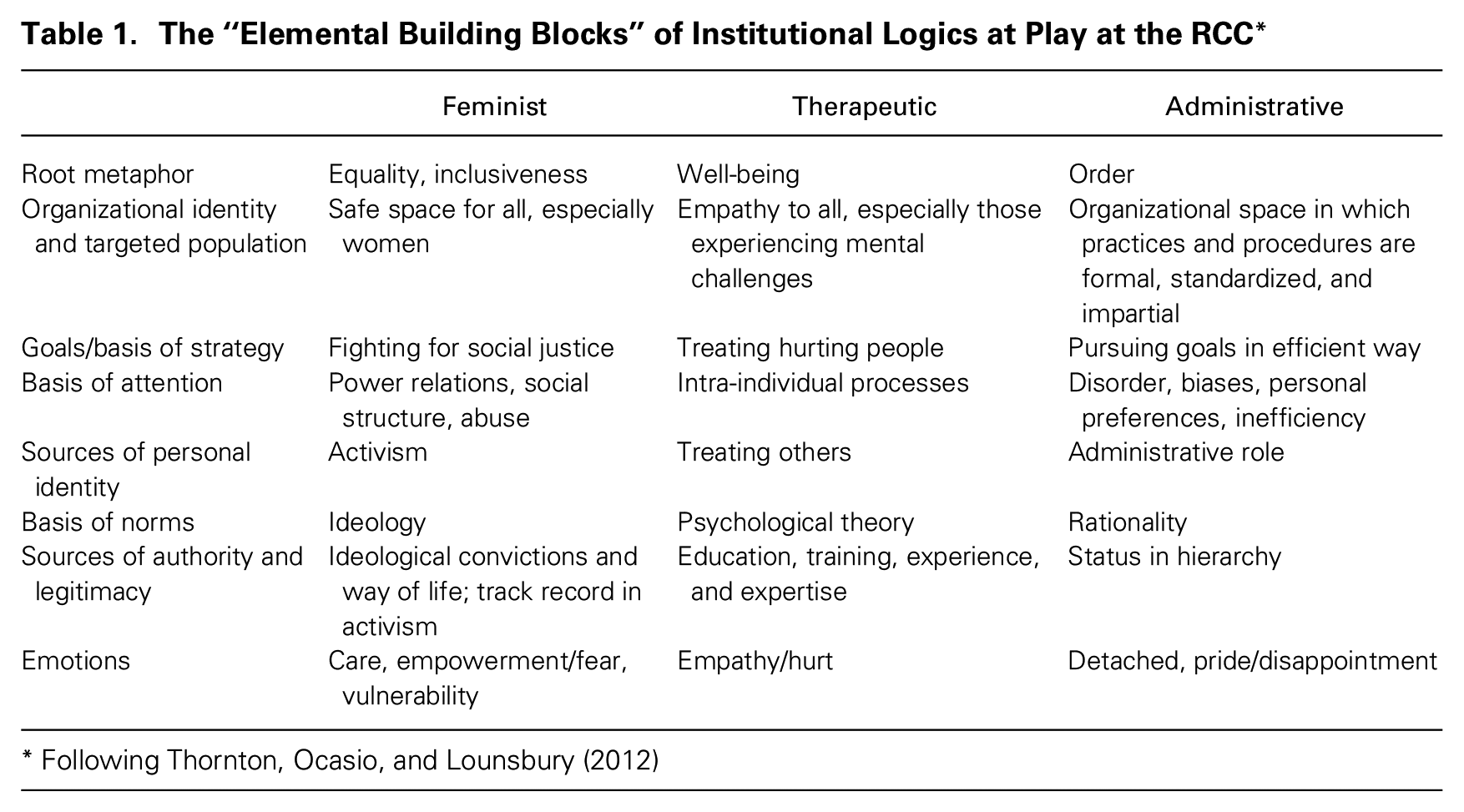
* Following Thornton, Ocasio, and Lounsbury (2012)
Board decision making at the RCC unfolded within interactions that reflected common understandings of the feminist, therapeutic, and administrative logics that governed the organization. The interactions reflected an administrative logic, as all participants assumed that board meetings entailed decision making and that the discussion was supposed to be timely and follow an agenda. Typically, board meetings were held in the RCC, and a designated board member assembled the agenda and kept the time. Still, as part of the RCC’s goal to implement feminism in its organizing, and as in other feminist organizations (Martin, Knopoff, and Beckman, 1998), decision making at board meetings was consensual. There was no formal management; the board collectively managed it and made consensus-based decisions. Discussions lasted as long as it took to arrive at an agreed-upon conclusion. All participants could voice their opinions as many times as they wanted. Although staff members could not vote formally, no votes were taken in board meetings, so they were as active and influential on the board as the volunteers were. While the board meetings had a formal, predetermined agenda, it was customary for participants to raise impromptu issues for discussion. Further, the therapeutic logic entailed much attention to participants’ and groups’ emotions. Hence, feminist, therapeutic, and administrative language and considerations were prevalent, legitimate, and competing in determining how the board discussed and made decisions.
My micro-level analysis of decision making highlights, alongside the influence of institutional logics in structuring interactions, the cognitive, political, and emotional elements involved in participants’ narrating institutional logics into specific lines of action. The negotiations over storied institutional logics were consequential, for each narration implied a particular decision. While different people spoke in the name of (their version of) different logics, their ability to strategically invoke logics was limited as others expected a certain coherence across cognition, politics, and emotions. I first exemplify how institutional logics worked on the ground by walking readers through a detailed analysis of one instance, a 29-minute discussion of one decision, which most clearly illustrates how people brought competing institutional logics into being through their storytelling interactions. While this “long data excerpt approach” (Reay et al., 2019: 209–211) is not common in our discipline, it is essential for showing the trail of evidence to support my argument. After elaborating the details of this one case, I use multiple examples to present my main analytic insights, exemplifying the move from abstract logics to concrete stories through cognitive, political, and emotional elements and how these instantiations of logics are constrained by an expectation for coherence, which determines the final decision.
Deciding on “Feminism from A to Z”
The interactions I detail below occurred at the beginning of a board meeting attended by four volunteers and four paid staff members. As the meeting started (late, as usual), Daphne, a veteran volunteer and board member, asked to raise an issue for discussion. She referred to a public event that had happened a week earlier, titled “Celebrating Feminism from A to Z,” in which representatives of various feminist organizations described their activities. Gilad, a male volunteer, represented the RCC and its male hotline and was to speak about men’s role in feminist activism. Apparently, Gilad said that since things may be very confusing and it is hard to know what a woman means when she says “no,” men should be extra careful and, in case of doubt, seek another partner for sex.
Most board members had not attended the event, and they narrated three different stories about Gilad’s actions. One story was led by Daphne and two by a new staff member, Moran. The three stories offered different understandings of what had happened at the feminist gathering: different plotlines, different protagonists cast in different roles, different ways of framing the problem and the desired solution. None of these stories was told in full as a monologue. Instead, they were crafted by the narrator and co-narrators, who were jointly struggling to select which logic was relevant to the specifics of the issue and how to implement it. Each story was built on—and reconstructed—a different institutional logic. Table 2 summarizes the stories told in this case. While all the stories are relational, emerging through the negotiations between narrators and co-narrators, for reasons of brevity I mark them by the name of the lead storyteller (e.g., Daphne’s story).
Narrating Institutional Logics: “Celebrating Feminism from A to Z”
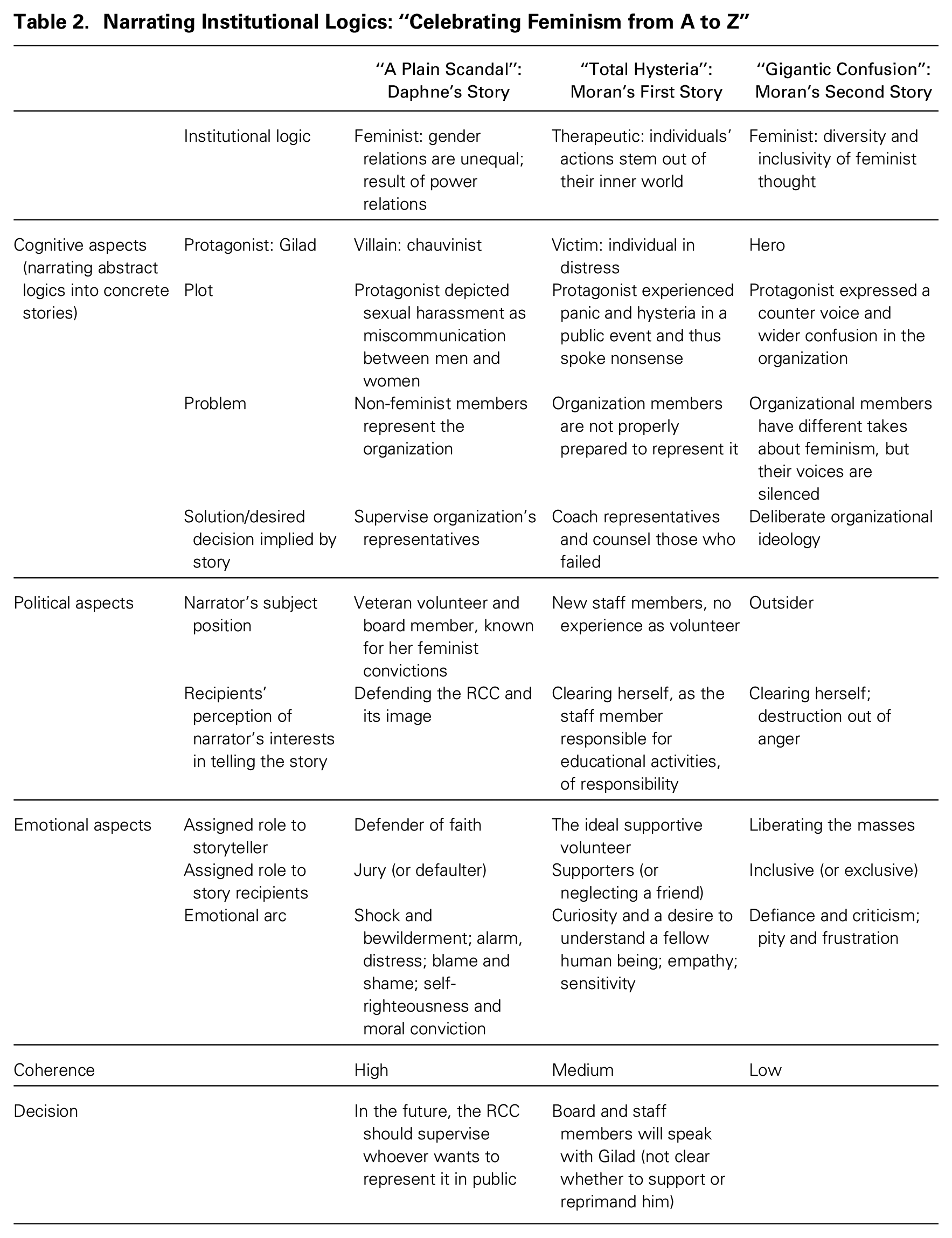
Daphne’s story: “A plain scandal.”
Daphne told the first story, co-narrated with the help of many interventions by other participants in the meeting: 6
(veteran female volunteer and board member): I wanted to raise another issue before we start. I don’t know who attended the feminist gathering last Friday, never mind, but Gilad gave a presentation there, and there is a little, there is something very problematic with the lectures.
(male volunteer and board member): What did he talk about?
About the male hotline and [the role of] men in the feminist struggle. So, Gilad started very well, and then, suddenly, the guy slipped off, and I thought, I just wanted to go up there and didn’t know what to do.
(female, staff): He was in a panic, Daphne—
How in panic?
He was in panic—
(veteran female volunteer and board member): That’s what she thinks—
Okay, I’d like to explain then what he said, if you think it’s okay.
He was in a total panic, Gilad, right Hagar?
Okay, just a second—
(female, staff): Let her finish, and then we’ll respond.
All right, describe in a few words what he said.
I’m trying.
Okay [smiling].
There are some issues, from my point of view, it is just unacceptable that someone who represents the RCC will talk like that. It is a scandal. Because he, this guy, stands up and starts talking, saying that men must help and that that’s part of men’s struggle, “men can stop rape” and such things, super-duper, great. 7 And then he explained . . . that today, in the twilight zone, it is terribly hard to figure out when a girl means “no,” and when she actually doesn’t want.
Daphne’s story instantiates a feminist institutional logic. Her shock, distress, and alarm with Gilad, indeed, her very characterization of his deeds as wrong does not make sense if one does not share the understanding of feminism reflected in Daphne’s story. Gilad’s presentation hinted that rape results from miscommunication between a man and a woman, a widespread perception of rape that sharply contrasts with a feminist understanding (Schwendinger and Schwendinger, 1983). By doing so, he deviated from the feminist stance of the RCC while formally representing it. Generally, within the RCC, as explained in the training course and expressed in various meetings and interviews I conducted, feminism is understood to focus on structural power relations. It holds that women’s subordination results from the social, cultural, and political construction of gender and gender relations rather than from any individual’s personal traits or life circumstances. Rape is understood as reflecting and further constituting these power inequalities. While this version of the feminist institutional logic had been well established in the RCC, what this logic meant in terms of framing Gilad’s behavior at the “Feminism from A to Z” event was not given. Rather, storytellers and recipients had to concretize these abstract ideas into a specific story, including who the protagonist is and how he is portrayed, the plotline (what they believe happened), the problem, and a reasonable solution.
This effort to narrate a logic into a story was apparent as Daphne’s story evolved. In particular, participants’ questions and comments, which seemed to imply that they disagreed with her stance (Stivers, 2008), drove the emerging story to be more extreme, portraying Gilad in harsher ways. Through their interventions, board members took an active role in constructing the story and the institutional logic to which it alluded.
And then he explained . . . that today, in the twilight zone, it is terribly hard to figure out when a girl means “no,” and when she actually doesn’t want.
(female, staff): Who said that??
Just a second, Gilad—
—Gilad said these things??
Just a second—
—I don’t—
—This is nothing yet.
It isn’t fair.
Let’s hear the words.
And then he said—
—Let Daphne finish first. Please finish.
And then he said—
—I just have a request, if you can [tell us] not only the problematic parts but in three–four minutes to summarize the whole [talk].
He only talked for three–four minutes.
He said, okay, he started to say that men must take upon themselves responsibility, that they must acknowledge their ways of thinking, and try and influence other men because they are responsible for rape and violence, I try to squeeze it into three minutes [laughter], and [he said] we [men] were always the powerful in society, and that they [men] need to overcome their thoughts and overcome their aggressive behavior as well. That was super-duper, great. But then he started to slip off and began to say that when girls say “no,” they don’t exactly say “no,” and we don’t really know what’s happening, and then,
(female volunteer and board member): “We don’t know?” That’s what he said??
Yes, and then I, as a man, should do the balancing and ask myself which is better. Since a terrible misfortune might happen, a rape might happen. So it’s better for me not to fuck that night. [laughter]
It isn’t fair—
—What’s not fair? [People talk together, loud voices.]
Let her finish.
He was in a total panic. [People talk together, loud voices.]
It’s better for me not to fuck that night, to lose a fuck, to go home and lie down by myself, and the next day I will get up and find someone else and fuck her. [laughter]
That he didn’t say—
—Excuse me! If you think the guy should go to schools and talk like that, and you don’t think. . . . [And you think] that he was simply in panic and it’s just all right, then I don’t know what we are doing!
Beyond the weight of Gilad’s argument, which was, given the prevalence of a feminist ideology in the organization, enough to raise criticism by the board, Daphne portrayed Gilad as the opposite of a feminist. She used blunt words—those are, she claimed, Gilad’s original terms—to refer to intimate sexual relations (“fuck”). Even if those were Gilad’s words, using them in public in the RCC was uncommon. During my 19 months of fieldwork, I never heard anyone using such terms to describe sexual intercourse. Further, such words do not appear in the activity log in which volunteers reported on support talks with victims of sexual attacks. The tendency to talk about rape without referring to its physical reality was based on a feminist understanding of rape. It is a crime of violence, not of desire. Moreover, it was common knowledge in the RCC, mentioned in the training course and several interviews, that female victims tended to talk in detail about their feelings and refrained from talking about what happened to them. The reverse was believed to be true for male victims, who tended to provide very graphic descriptions of what happened and hardly ever talked about their feelings. Hence, when Daphne cited Gilad using “fuck,” she associated him with a non-feminist, even chauvinistic, point of view that further underscored his transgression. Recipients’ responses drove Daphne to instantiate the feminist institutional logic into a straightforward, black-and-white story.
Daphne’s story, building on a feminist logic, also framed the problem and offered a solution. It depicted Gilad as the villain whose talk undermined the feminist worldview. Thus, board members were asked to decide what should be done in the future when the RCC sends one of its members to represent it. Daphne wanted the board to decide on new measures that would allow it to control who speaks on behalf of the RCC and what such representatives are allowed to say:
I want to say something about the board and the decisions we need to take. It is unacceptable that we choose spokespeople, and someone’s name will be printed on paper in relation to the RCC, and that person doesn’t know how to talk. Or that he will say such things. Or that there is a concern that, God forbid, he will say such things. In that case, I prefer that he will not open his mouth at all. I am terrified that he stands before schools, and youth, and will say such a thing. How much damage it can create. We must decide that whoever represents the RCC must consult two people beforehand if he talks on our behalf.
This was an important decision in an organization striving to run without hierarchy. Until then, whenever the RCC needed a representative, staff members would approach the body of volunteers, and whoever wanted would get the job. One board member called Daphne’s suggested new restrictive policy “a little bit totalitarian,” reflecting how such an open use of control by board members over volunteers was hardly acceptable in this alternative organization. Since all use of power was understood to be related to the abuse of power in sexual harassment, such use was perceived to be against the RCC’s values. Hence, only the most severe event could legitimize such controlling steps. This solution was aligned with a feminist logic in terms of a need to protect the core feminist identity of the organization, which operated within an environment perceived to be hostile and undermining.
Moran’s first story: “Total hysteria.”
Moran’s first story, emerging from the collective efforts of Moran and her co-narrators through their questions and comments, offered a very different understanding of what had happened at the event. It was likewise co-narrated, initially intertwined with Daphne’s story and developing from sporadic criticizing comments (“it isn’t fair,” “he was in a total panic”) to an explicit alternative account based on a therapeutic institutional logic:
Daphne, can I respond now? Look, I was there just like you.
So?
I must say, he really started on a very good note and with bravery, and he finished, in my opinion, it was total hysteria.
Why?
Yes, why?
Now, where did the hysteria come from? First of all, I am familiar with Gilad’s opinions, as we work together quite a lot in the educational activities—
—I’m familiar with his opinions as well.
No, but this issue, for example, “what do you mean when you say ‘no,’” we’ve opened quite a broad discussion here, and that caused some confusion to people who used these words without really understanding them. But I had the feeling that he [Gilad] was in panic. In the beginning, I said [to myself] what a jerk, what is he talking about? and then,
But Moran, so what? We are not—
—But why was he in panic?
Why?
Talking like that? When representing the RCC? [He can] talk in our inner circles and express whatever opinions he has, but not as a representative, not as [our] spokesman. What the hell is this??
I think he was confused and hysterical, and he didn’t prepare on a piece of paper what he was going to say, he just talked along, and in my opinion, he just didn’t know how to finish.
These are [just] argumentations for punishment.
Moran told a tragic story, portraying Gilad as becoming “confused” and that he “just didn’t know how to finish,” apparently becoming anxious standing in front of a room full of feminist women. Her story makes sense only if one shares the therapeutic institutional logic it instantiates. The therapeutic logic was understood in the RCC to be focused on individuals rather than on broader sociocultural systems, emphasizing inner processes like thoughts, emotions, and motivations and assuming that self-reflection, awareness, and a talking cure are preconditions for well-being. Under this logic, Moran’s interest in Gilad’s inner psychological state, portraying him as a victim of the circumstances, and her forgiving attitude make sense.
This narration of the abstract therapeutic logic into a concrete story, which framed the situation on an individual level, focusing on Gilad and his mental state instead of the RCC and its public representation, evolved out of the interaction. Given repeated interruptions, including from Daphne, who continued to develop her story, Moran built her version of the event based on an extreme instantiation of the therapeutic institutional logic. This is apparent, for example, from her use of code words invoking a therapeutic logic. Moran not only used therapeutic jargon but chose to depict the situation as “a total hysteria” and referred to Gilad being “in panic.” These two mental disorders were stereotypically associated with women and were thus considered “feminine maladies.” 8 In contrast to Daphne’s story, which associated Gilad with aggressive masculinity, Moran’s story associated Gilad with femininity, the kind of femininity as victimhood commonly encountered at the RCC.
Further, the solution was framed in therapeutic terms, focusing on Gilad (and not the RCC). This framing left a narrow space for disciplinary actions, offering instead support, perhaps a one-on-one talking cure with Gilad to help him work through the trauma:
I don’t know what the reaction should be. I mean, if this discussion is aimed at thinking about what we should do differently, then I believe that what we can do differently is to comment to Gilad about—
—I will speak with him. I’m meeting with him tomorrow.
. . . I will call him and give him exactly the slap-in-the-face that I personally want to give him . . .
(female, staff): Maybe, first of all, to speak with Gilad. He has a particular character, Gilad, and Moran works with him and knows that usually [he is different]. So, maybe to speak with him, to ask him for an explanation for what had happened there, and to check—
—I meet with him tomorrow—
—Whether he panicked—
—And to check whether he really thinks that way, I think he thinks totally different things.
. . .
Okay, I think we can’t excommunicate a person. I believe that a proposal was raised, that someone should sit down with him and talk.
Moran’s therapeutic story seemed to gain momentum as it resonated with board members who followed her in focusing on Gilad’s inner emotional state rather than on the ramifications of his talk for the RCC. During the conversation that evolved, Daniel said, “there is something anarchist in him,” and Debbie remarked, “Gilad likes to be provocative, and that’s okay.” Daphne, by contrast, claimed, “it is not the first time that Gilad says such things . . . [out of his confusion] his true opinions came out.” Further, some members continuously questioned the reasons for Gilad’s “hysteria” and “panic,” thus dismissing Gilad’s inner state as consideration for “punishment.”
Moran’s second story: “Gigantic confusion.”
While Moran’s second story was there from the beginning of the discussion, it was shaped by the continued skeptical reactions to her first storyline. As the interaction unfolded, a different framing of what had happened emerged:
In the lecturers’ workshops, some very complicated and unresolved issues come up. I mean, if you think, Daphne, that [out of these workshops] you can get someone who says exactly what you think, you are wrong. Just a minute, I can explain that because I, based on my own feelings, based on my own encounters with these guys, they are very confused people, they come to the RCC, receive here some feminist ideas according to which they think they ought to behave, and they start to get confused.
. . .
I can tell you that this discussion came up here, here, in the lecturers’ forum, in the secure space, as to “when you say no, what you mean.” For two minutes, more or less, everyone said we need to say that when you say ‘no,’ you mean ‘no,’ when you say ‘no’.” Suddenly, after five minutes of running out of all the catchwords, everyone admitted they actually do not understand that phrase.
What’s that???
I wasn’t alone. I started it. Everyone was in a state where this phrase was far from clear to them. And the men were even more so.
. . .
They are all confused, aren’t they?
Moran’s second storyline still referred to emotions and the psychological state of confusion of Gilad and others, thus resonating with a therapeutic logic. It primarily built, however, on a different understanding of the feminist institutional logic. Daphne’s story built on a radical understanding of feminism as social justice, highlighting issues of hierarchy and power relations between the genders and including references to rape and sexual harassment (Jaggar, 1983; MacKinnon, 1989). Moran’s second story built on standpoint feminism, which highlights issues of diversity and inclusiveness, including the acceptance of different standpoints and feminist convictions within the feminist community. Against talking on behalf of a social category in a monolithic, hegemonic voice, standpoint feminism acknowledges that hegemonic voices serve the elite’s interests and thus strives for multiple voices to be heard and respected (e.g., Gilligan, 1997; Harding and Hintikka, 2004). This version of feminist institutional logic, less prevalent in the RCC, was narrated into a concrete story in which Gilad’s acts expose the variety of feminist voices within the RCC and the confusion they create. Only under the standpoint version of the feminist logic does it make sense that Gilad was portrayed as a brave hero who went against the hegemonic feminist voice within the RCC.
Moran’s second story, building on a different version of a feminist logic, framed a new solution:
But if this truth [about the multiple voices and confusion concerning the organization’s feminist identity] exists in the RCC and no one ever talked about it, or no one gives it legitimacy, for me, this is much more interesting than what he said at that event.
According to Moran’s second story, “Gilad expresses a confusion that exists here among men in general,” probably among female volunteers as well, and efforts to ignore this confusion are problematic. The only solution is to hold an honest dialogue with the entire body of volunteers in which the RCC’s ideology will be critically explored. Based on openness to diverse versions of feminism, this third narration (Moran’s second story) called for organizational soul-searching.
The board co-narrated three stories about what had happened at the “Feminism from A to Z” event. Each story built on a different institutional logic or a version thereof. The two institutional logics used by the tellers were well established in the organization and its environment. Yet, what these logics mean and how they are relevant to the issue is not given. Instead, narrators and co-narrators had to transform these abstract logics into concrete stories that articulated who the protagonist was, how he was portrayed, the plotline (what “happened”), the problem, and the desired solution. While a lead narrator initiated each story, the stories came about through a collective effort of negotiation and construction, as people’s reassuring or undermining reactions shaped the emerging narration.
Decision
After 29 minutes, Debbie, who chaired the meeting, felt the discussion had exhausted itself. She thus tried to summarize the lines of possible resolutions:
I request that we will end [the discussion] now. Like, it seems to me that the conclusion should be to talk with Gilad, like you [Moran] said, and also that every person who represents the RCC should go through some checking. And what was the other resolution?
I would suggest raising the issue for discussion because I think that this issue, at least from what I see [with the educational instructors] if it is important at all, I believe there is some distress, and I think we should maybe do something more serious and interesting with it.
We can write it down as a topic [for discussion], but this meeting, we have two significant issues [on the agenda] which we didn’t even get to.
Yes. So let’s start with the budget, with the annual plan.
The board arrived at a decision that blended parts of the solution implied by Daphne’s story and parts of the solution implied by Moran’s first story, entirely ignoring Moran’s second story. The board accepted Daphne’s argument that the RCC should regulate people who speak on its behalf. Simultaneously, the board accepted Moran’s first story by deciding that Moran and Daphne would talk with Gilad. It was not entirely clear, though, what nature these conversations would have. Daphne promised to speak with Gilad and “give him exactly the slap-in-the-face that I personally want to give him.” Moran, by contrast, was inclined toward a supportive talk. Debbie failed even to mention the third proposed resolution based on Moran’s second story. She seemed to hint at this missing resolution by asking, absent-mindedly, “and what was the other resolution?” with no reply from other members. Moran had to restate her position that the board needed to initiate a more inclusive conversation about feminism. Hagar responded with a suggestion that would bury the resolution by postponing the discussion on ideology to an unspecified date (which never materialized during my fieldwork).
How can we explain this decision, and what does it teach us about how institutional logics work on the ground? Based on my systematic analysis of the entire data set, I will now dissect the process into its elements.
From Logics to Stories: Cognitive, Political, and Emotional Elements
A systematic analysis of all ten cases of decision making through stories, involving 28 stories, reveals that putting institutional logics into work on the ground followed a similar pattern. First, board members negotiated which institutional logics were relevant and how they were relevant. This negotiation unfolded through the collective narration of various stories, instantiating different logics through cognitive, political, and emotional elements. Once the stories had stabilized, the board was ready to follow the decisions implied by the stories they found most convincing. In choosing which story to accept, the board was influenced by the stories’ level of coherence across the cognitive, political, and emotional elements. Stories with high or moderate levels of coherence across these elements were more influential, and the lines of action they implied were accepted by the board. Figure 1 shows these dynamics.
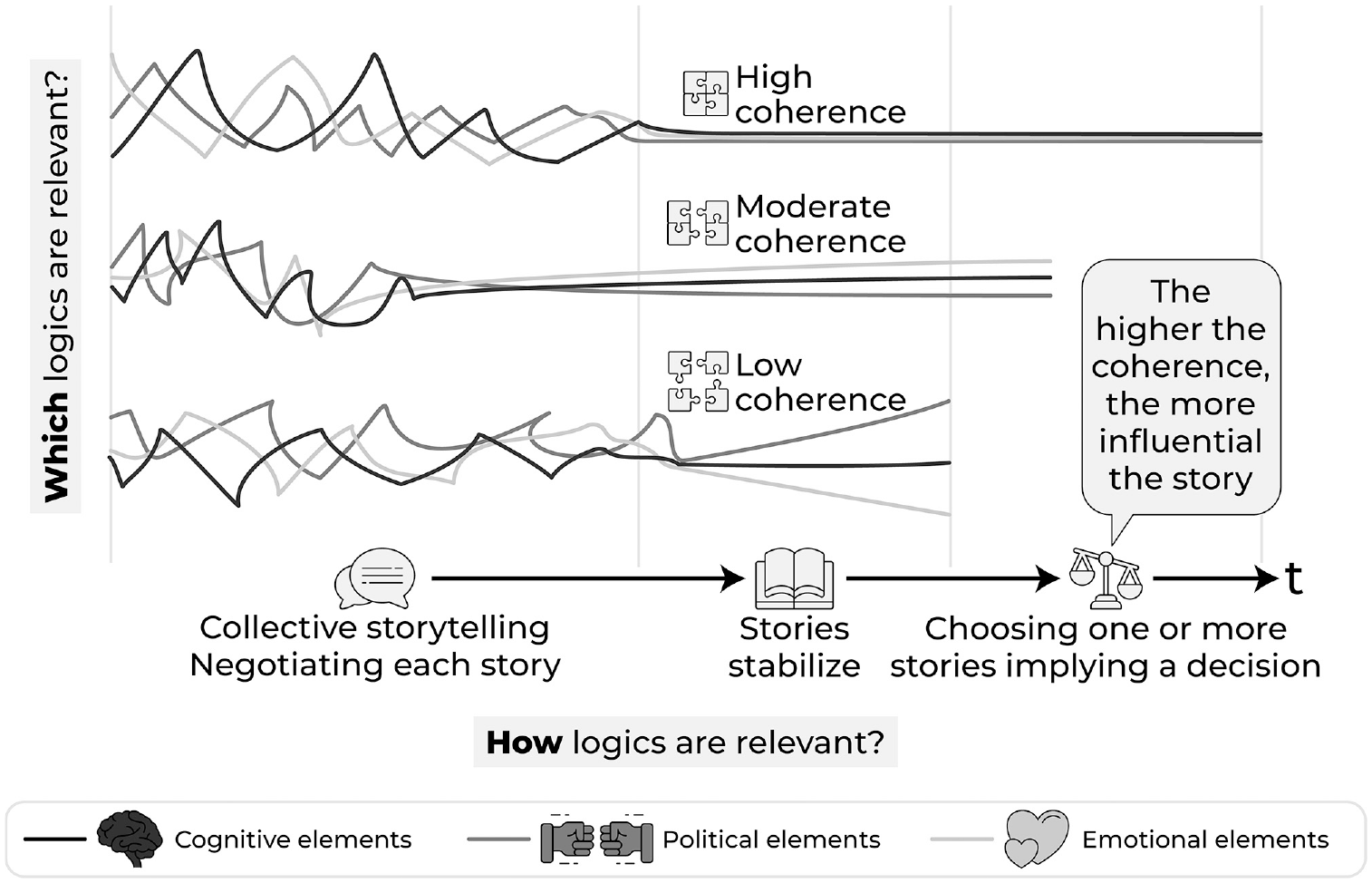
Narrating Institutional Logics into Effect
The issues board members decided upon varied. Still, the repertoire of institutional logics was limited. An administrative logic was involved in nine of the ten cases and was narrated into 11 stories. A therapeutic logic was involved in nine cases and was narrated into ten stories. A feminist logic was involved in six cases and was narrated into seven stories. Table 3 details the ten instances of decision making through stories, the narrations and the logic they instantiated, and the narrators.
Instantiating Multiple Institutional Logics in RCC Decision Making
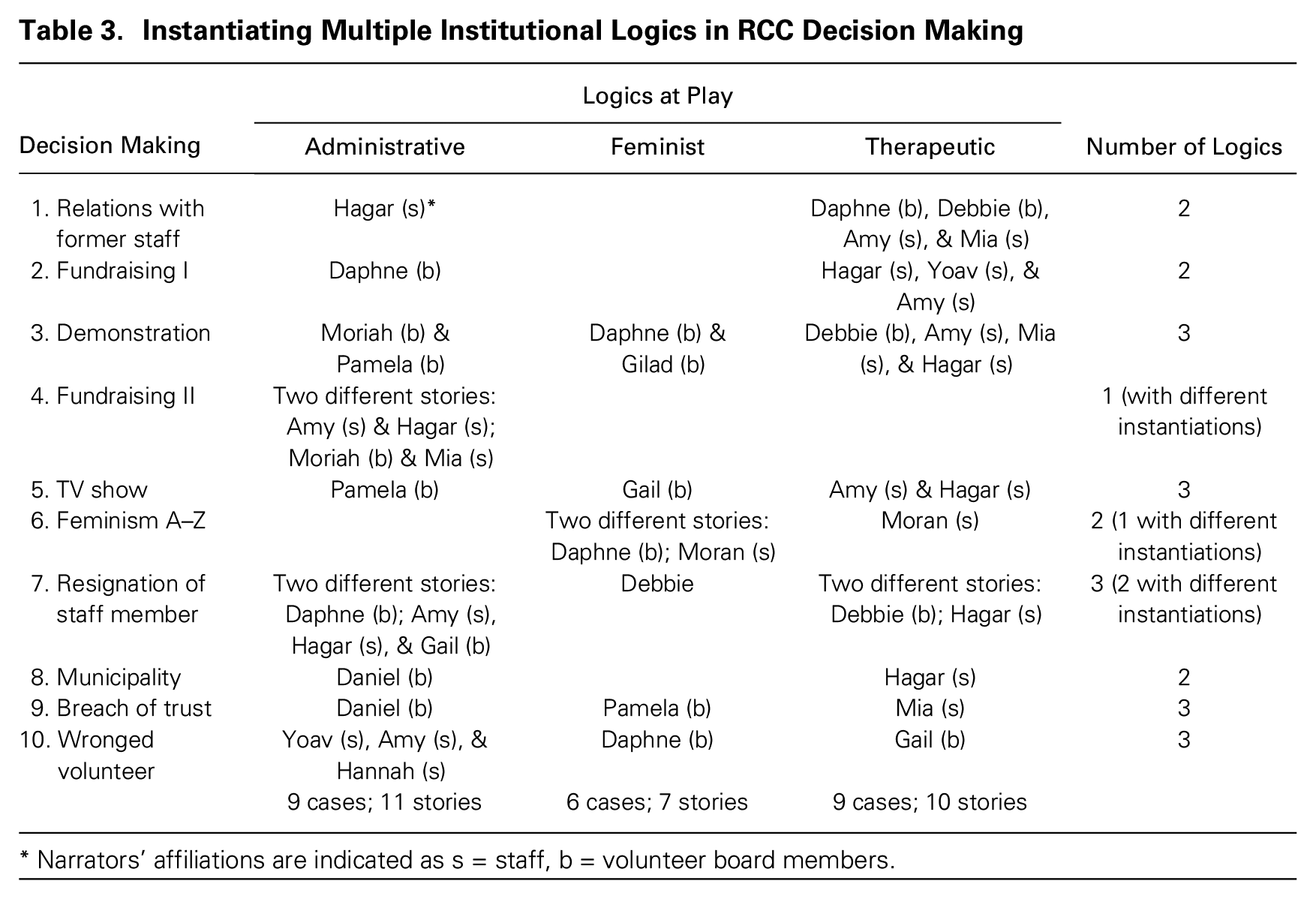
Narrators’ affiliations are indicated as s = staff, b = volunteer board members.
My interpretation of the data suggests that logics do not enforce themselves on their constituencies in a direct and deterministic way. Beyond the influence of storytelling skills that may affect persuasion (Mandelbaum, 2003), I focus here on three elements underlying the process of narrating logics into decisions: cognitive, political, and emotional elements. First, the cognitive element involves narrators and co-narrators negotiating which logic is relevant and how it is relevant. This is a collective, group-level cognitive process of selecting a logic and then concretizing it. Second, narrators tell stories from a specific subject position and given particular interests. Thus, politics affects the way in which institutional logics are instantiated. Third, people get personally involved in the stories. By casting both narrators and recipients in specific roles, the stories elicit emotions that affect further narration and acceptance of the stories. These collective-level elements—cognitive, political, and emotional—are inseparable in the interaction. For clarity, I present them here as analytically distinct. Together, they instantiate institutional logics. Institutional logics, then, are not given but must be worked out on the ground.
Cognitive elements: Negotiating logics and their relevance
In all ten cases, decision makers struggled to select which logic was relevant and to concretize it, that is, to determine how it was relevant. This is cognition as “interpretative meaning-making that occurs in response to organizational disruption” (Hallett and Hawbaker, 2021: 19). This cognitive effort unfolded through narrative as a mode of thought (Bruner, 1986). This was not an individual endeavor carried out in people’s heads or by a charismatic leader. Instead, the cognitive element was ongoing, collective, distributed, and situated in the interactions between decision makers as they engaged with the issue they were facing. This collective cognitive effort, not necessarily conscious or motivated, centered around two challenges: selecting which logic was relevant and concretizing it to the issue at hand.
While three institutional logics dominated the RCC, not all were invoked in all cases. Yet, in all cases, two or more stories were told, building on various institutional logics. That different stories based on different institutional logics were told concerning the same issue reflects actors’ effort to determine which logic was relevant to a specific issue. Further, board members, narrators and co-narrators, worked to concretize the relevant logics into specific stories, including a protagonist and a plotline that connected a problem and a solution, which implied a decision to be made. The need to translate logics into concrete details of a specific issue was especially apparent in cases when two different stories were told based on the same logic. In one decision-making event, the board needed to decide how to react to the resignation of a staff member (see Table 3, #7). To that end, participants told five different stories that offered different understandings of the reasons behind the resignation and implied different avenues for response. Two stories were based on an administrative logic, two were based on a therapeutic logic, and one was based on a feminist logic. Each story evolved in interaction, reflecting the board’s effort to decide which logic was relevant and how. The fact that two different stories could be told based on the same logic means that the logic included general themes that could be and needed to be instantiated in various ways. A fine-grained analysis revealed that the precise instantiation of an institutional logic emerged in interaction, as recipients’ reactions and comments moved narrators to refine or stress parts of their stories. These modifications indicate, once again, that institutional logics are not given. This process of negotiation through which the stories emerged took time. It should have been a short interaction if narrators were telling stories that they individually pre-conceived entirely. The data show that stories emerged from negotiations between narrators and co-narrators, which usually lasted 30–60 minutes.
In the decision Fundraising II (Table 3, #4), the board debated whether to work with a hired fundraiser, who would take a portion of the funds raised for their pay. Three staff members and one board member met with the fundraiser in two separate meetings and conveyed their impressions to the board through two stories built on seemingly the same administrative logic. Amy, a staff member, led the narration of the first story (also on behalf of Hagar, another staff member). After a long process of collective narration in which board members shaped the story through their questions and comments, the story stabilized as follows:
I am not an event organization expert, but it seems that one needs to start from the amount of money one hopes to raise and then work backward to decide on the audience, venue, and kind of event. He [the fundraiser] could not answer how much we can make, how much will be the cost of each ticket in each scenario, whether we do it with this known artist accompanied by The Raanana Symphonette or that known artist hosting another artist. He said nothing concrete. Really, it made me crazy. He came up with no ideas. We had to bring up ideas. It was frustrating. He wanted us to write a letter to the City Fund and ask for their cooperation and help. He spoke like a production consultant, not like a producer.
Moriah (board member), who had met the fundraiser together with Mia (staff), had a different impression (again, represented here in a concise version, summarizing the collective negotiations through which the story emerged):
We believe he can do a great event. He seemed very practical. He actually already met with the mayor and told him he would be receiving a letter of request from us. He may not have a big office with human resources, but he has the connections. With my experience, I believe I can judge, and I think he can do it and help us. This will be a good learning experience for us.
Both narrations were based on an administrative logic yet applied different criteria for evaluating “professionalism.” Amy’s story highlighted the expectation that a hired fundraiser would provide a concrete action plan, whereas Moriah’s story reflected an expectation for a network of connections. Given these different concretizations of the administrative logic, each portrayed the fundraiser in different ways that, in turn, implied different decisions. Yet, the negotiations over the right story were not cognitive alone. Note that Moriah, a board member who ran her own business, ended her story with a reference to her expert judgment (“With my experience, I believe I can judge”). These stories show that narrators have different understandings of which logic is relevant and how it is relevant, and they call on their political resources to push the collective narration in their direction. I now focus on these political elements.
Political elements: Subject positions and interests
Narrators tell stories from a specific subject position (Phillips and Hardy, 2002), building on their status within and outside the organization. In the RCC, those subject positions were often related to the three prevalent institutional logics. Like Daphne in regard to “Feminism from A to Z,” some narrators anchored their authority to speak on behalf of feminism by building on their involvement in the RCC as volunteers, board members, and staff members. Others highlighted their therapeutic experience, either by vocation (a social worker, a psychologist) or based on their training in the RCC and experience as volunteers on the hotline (like Mia, a social worker by training and a veteran volunteer-turned-staff member). Some narrators spoke in the name of an administrative logic, especially those with a relevant background as managers or businesspersons (like Moriah in the fundraiser example above).
At times, narrators, whether leading the narration of a complete story or intervening and contributing through comments, were explicit about the subject position from which they spoke. As noted, in her story about the fundraiser (Table 3, #4), Moriah mentioned her managerial experience. She explicitly claimed that based on that experience, she was in a position to evaluate the fundraiser. Daniel, a senior executive in the not-for-profit sector, often referred to his managerial experience in his stories. Yet, more often, the subject positions were not stated so bluntly but were known, as decision makers had known each other for a long time, as reflected in audience remarks either accepting or rejecting the narrator’s subject position. For example, in the discussion of Gilad and his conduct (#6, the extended example above), when Nechama offered observations about Gilad and his character (“—And to check whether he really thinks that way, I think he thinks totally different things”), people accepted her interpretations because they knew her to be a perceptive psychologist (Debbie, accepting Nechama’s authority: “Okay, I think we can’t excommunicate a person”). In contrast, when Moran, with no therapeutic experience, not even as a volunteer, referred to Gilad’s “panic” or “hysteria,” people constantly questioned her observations (Moran: “He was in panic, Daphne—”; Daphne: “How in panic?”; Moran: “He was in panic—”). Debbie, who acted as the moderator in that meeting, seemingly expressing respect for Moran’s take (Debbie: “That’s what she thinks”), actually undermined her opinion as idiosyncratic, further highlighting the political elements involved. Subject positions within the RCC corresponded with its repertoire of institutional logics. Claiming a subject position could confer legitimacy on a narrator and their story but could also be questioned.
In responding to emerging stories, recipients also looked for the interests behind them. Participants sometimes accepted the stories at face value, believing they genuinely expressed the narrators’ point of view and knowledge. For example, participants never wondered whether Daphne was genuine in her feminist beliefs. While they may have countered her story in interviews and small talk before and especially after board meetings, they expressed confidence that Daphne was motivated by no other interest except to serve the RCC according to her beliefs. At times, however, participants were suspicious that narrators had vested interests and told stories that served those agendas. For example, in the Fundraising I decision (Table 3, #2), two stories were narrated about a fundraising event that went sour. The event was organized by a dedicated volunteer with the help of the staff and took place in a club. This was unusual for the RCC. According to the first story, told by three staff members, the event went sour because a relative of the club owner demanded some of the proceeds, and when the staff refused, they took the money by force. This story instantiated the therapeutic logic, portraying the staff members as victims of aggression and calling upon the board to support them as they processed the traumatic experience. Daphne narrated a counterstory, instantiating an administrative logic, according to which the end of the fundraising party was merely the last in a succession of mistakes in planning and executing the event. Daphne’s story portrayed the staff as “unprofessional” and implied that the board needed to establish a binding procedure for fundraising events. The board was suspicious of the first story, feeling that the narrators cast themselves as the victims of aggressive behavior rather than taking responsibility for their unprofessional conduct. In another instance, the board had to decide whether to hire a fundraiser to produce a fundraising event in the city (Table 3, #4, mentioned above). Participants were suspicious that staff members who were against it feared the extra work that would fall on them. Board member Debbie commented, “If it will raise a lot of money, it is okay that we will have extra work.” In yet another instance, three stories were told to explain why the staff had overturned the board’s decision, without consulting the board beforehand, to join a demonstration against sexual harassment initiated by a coalition of feminist organizations. The discussion revolved around how the RCC should respond to criticism from the feminist coalition (Table 3, #3). Three staff members and one board member told a story initiating the therapeutic logic to describe how on the same day that the demonstration was held, the city suffered a terror attack. Thus, the narrators felt the need to show solidarity with the wounded Israeli society and believed it inappropriate to attend the demonstration. Their story called upon the board to support them after the fact. Daphne and Gilad instantiated a feminist logic, stressing the need to work in sisterhood with other feminist organizations, and suggested that the RCC should apologize. Moriah and Pamela, both board members, who were not consulted about the decision, told a different story, instantiating the administrative logic to demand that all board members be consulted before the staff was allowed to overturn board decisions. Moreover, Moriah and Pamela expressed clear suspicion of the therapeutic story. They seemed to believe that the staff overplayed the trauma to bypass the fact that they had overturned the board’s decision. Toward the end of the discussion, Moriah and Pamela managed to shift the focus of attention:
I want to get back to the previous issue. We need to set a minimum number of board members who should be consulted to overturn an earlier decision, even in emergencies.
It’s hard to reach everyone.
[Looking at the staff members] Did you even try?
You should at least try to reach all board members, not only the convenient ones.
You assume they didn’t try.
I am not sure we tried hard enough.
In these and all other instances, participants carefully assessed the narrators’ interests and considered them when responding to their evolving stories.
Emotional elements: Roles
Institutional logics are embedded in and affect emotions (Zietsma and Toubiana, 2018), as collective, relational, and intersubjective phenomena (Bericat, 2016). Narrating logics into stories that imply a specific decision is thus not only a cognitive and political process but also an emotional one. At the RCC, narrators cast themselves and recipients in specific roles, which made the stories very personal. The repertoire of roles was limited and related to the institutional logics prevalent in the RCC. Narrations of a therapeutic institutional logic usually cast themselves or others as either victims or supporters. These roles were well known in the RCC, as it trains its volunteers to identify and respond to the needs of victims of sexual harassment. Failing to support a person in need was considered a severe failure, so much so that when predators used the helpline to engage in sexual talk to satisfy themselves, volunteers had a hard time protecting themselves by hanging up lest they be mistaken and fail to help someone in need (Zilber, 2002). Narrations of a feminist logic usually cast both narrators and recipients as guardians of feminism, in sisterhood, as critical and reflexive thinkers, or—should they fail to make the right decision—as betraying feminism. Narratives of the administrative logic usually cast narrators as professional and responsible board members and recipients as either responsible board members or at risk of acting irresponsibly should they make the wrong decision.
Given that the stories cast narrators and audiences in specific roles, it is no surprise that many narrated decision-making instances were fraught with emotions. The repertoire of emotions invoked by the stories and expressed by narrators and recipients was usually linked to the logics prevalent in the organization. This was especially apparent when board members negotiated the roles and emotions embedded in their stories. For example, when Amy strongly opposed working with a hired fundraiser (Table 3, #4, and detailed above), Moriah got agitated, changed seats, and crashed heavily into the sofa. She then said,
I put my hands up [gesturing surrender].
He does not confer confidence that he knows enough. I felt like he was building the roof with no foundations.
This is the third time we are talking about him. Can we make a decision?
Yes, we have to decide today.
I think we should go for it. But there is so much antagonism!
This is not antagonism. This is fear.
At the RCC, fear, humiliation, guilt, vulnerability, and powerlessness were well accepted, and all relate to the therapeutic institutional logic. These are emotions that victims of sexual assault often express, and volunteers are trained to empathize with them. In contrast, anger, agitation, domination, and outrage do not relate to the therapeutic, feminist, or administrative logics (Zilber, 2002). They were thus less legitimate. This is why Amy rephrased “antagonism” as “fear.” In the “Interview incident” decision-making event (#5), the board discussed an interview held with a survivor of rape, supported by the RCC, as part of an investigative TV news magazine. The interview was held at the RCC, and Moran, then a new staff member, seemed to have handled it poorly, in ways that might hurt the RCC. Pamela, a veteran board member and volunteer, who ran her own PR firm, was angry.
An experienced PR agent would have reacted differently. . . . I am very angry at Moran!
[Turning to Pamela] I hear you, and it is okay.
[Even more angrily] I know! I do not need your permission [to be angry]!
I am not trying to give you permission, but I want to help you feel better because the next thing I want to say is that we all learn from our mistakes.
No need to bring therapy into the discussion.
We are angry at ourselves.
Again, everyone tried to help Pamela transform her anger (illegitimate emotion at the RCC) into a legitimate emotion that connected more directly with the institutional logics dominating the RCC (in this case, a therapeutic institutional logic). In the negotiations around the “Feminism from A to Z” event (#6, detailed example above), Daphne seemed to be angry at Gilad for what he had said. Still, she framed her emotions as shock and bewilderment, which were acceptable in the way the feminist logic was understood in the RCC.
Thus, the invocation of logics is mediated through interconnected cognitive, political, and emotional elements that may be more or less coherent, that is, they may be more or less in sync. This coherence, to which I now turn, is pivotal to decisions and limits the strategic use of logics.
Coherence: From Stories to Decisions
It may seem that narrators and recipients were free to choose among institutional logics and freely narrated an institutional logic into a concrete story as they liked (see left-hand part of Figure 1). Analyzing who used which institutional logic to tell stories reveals that participants were quite flexible in using various logics. There is no immediately noticeable pattern connecting specific logics with specific participants or groups of participants who share an organizational role (e.g., staff versus volunteers) or background (e.g., therapists, managers). Still, according to my interpretation of the data, the final decisions seem to have been determined by the degree of coherence among (1) cognition, or the efforts involved in selecting and operationalizing logics into concrete stories, (2) politics, or narrators’ subject position in association with a relevant institutional logic plus recipients’ perceptions of narrators’ interests in telling the stories, and (3) the emotions raised in relation to the roles the stories assigned to narrators and recipients. The content and structure of a story reflect a meta-narrative/institutional logic. The story is told by a narrator who speaks from a specific subject position and interests based on what is considered legitimate and respected under the jurisdiction of a particular institutional logic. And the story invokes certain emotions that are part of an emotional repertoire of a particular logic. However, these elements do not necessarily go together, especially when multiple logics are available, like in the RCC. My analysis suggests that whether there is coherence across these elements relates to the decision made (see right-hand side of Figure 1).
To exemplify the various coherence levels and how they relate to decisions, let us go back to the “Feminism from A to Z” decision making through stories (#6, extended example above). Recall that after hearing three stories, the board decided to follow the decision implied by Daphne’s feminist story and partly the decision implied by Moran’s first therapeutic story. The board decided to regulate who was allowed to represent the RCC and to talk with Gilad, though the content of the talk was left vague. Moran’s second story, echoing a different version of feminism, and the decision it implied (to initiate an open and inclusive conversation about feminism) were ignored. These decisions are related to the coherence of the various stories co-narrated during the discussion. In cognitive terms, Daphne made selections and negotiated with her co-narrators, resulting in a detailed story that resonated well with a feminist logic. In political terms, she told the story from the subject position of a feminist and veteran volunteer and board member, which all resonated well with a feminist logic. Her story assigned her and other board members the role of ideologically committed volunteers, a respected role in the RCC (hinting that they may turn into defaulters should they neglect their duty). Gilad was cast as a villain, but no board members (except Moran) were to share the blame for his behavior. In emotional terms, the story and these roles invoked many emotions, all part of the feminist institutional logic: shock and bewilderment, alarm and distress, self-righteousness, and moral conviction. The three elements—cognitive, political, and emotional—all aligned very tightly. Daphne’s narration was thus highly coherent across the cognitive, political, and emotional elements.
Moran’s first story was less coherent. In cognitive terms, Moran made selections and negotiated with her co-narrators, resulting in a story resonating with a therapeutic institutional logic. All participants except Moran were volunteers, some with training and experience as therapists. Hence, they found the therapeutic story compelling enough. In emotional terms, the therapeutic story invoked a support-relations script in which the audience found itself in the known, experienced role of support givers, invoking institutionalized emotions like empathy and sensitivity. Yet, Moran had no therapeutic training, not even in the RCC’s training course for volunteers. She had no experience in supporting victims of sexual assault. As was apparent from board members’ questions and comments during the collective narration and as indicated in my informal conversations with them after the meeting, board members questioned Moran’s self-positioning as the most familiar, caring, and empathetic person toward Gilad. Some of them thought Moran’s story was self-serving, aimed at clearing herself, because she worked as the head of the educational team with Gilad, from any responsibility for his actions. The roles the story assigned to board members (emotions) aligned with a therapeutic logic but did not align with Moran’s subject position, her perceived interests (politics), and the role she assigned to herself (emotions). The coherence across the cognitive, political, and emotional elements was moderate.
Moran’s second narration was even less coherent. Moran’s narrative selections and negotiations with her co-narrators resulted in a story that reflected a standpoint version of the feminist institutional logic. In political terms, it aligned with Moran’s status as a newcomer, enriching the RCC with a fresh standpoint. Yet, board members were suspicious that Moran was trying to downplay her responsibility for the fiasco. In emotional terms, board members believed that Moran’s second story was critical of the RCC and them personally, and even defiant and destructive, reflecting her temper. It positioned the audience as a dominating elite, who were negligent if not manipulative, which invoked feelings of frustration. This emotional repertoire seemed to resonate with another institutional logic of rebellion or uprising. The coherence among the cognitive, political, and emotional elements was thus low.
No wonder, then, that the decision implied by Moran’s second narration was neglected, and the final decision, to supervise whoever spoke on behalf of the RCC and to talk with Gilad, blended the decisions implied by the highly coherent narration of Daphne and by the moderately coherent first narration of Moran.
Another example of how final decisions relate to the coherence among the cognitive, political, and emotional elements underlying the instantiation of institutional logics involved the board’s discussion of relations between the RCC and the municipality (Table 3, #8) and how to react to the mayor, who had repeatedly postponed a meeting with the RCC to discuss funding. The RCC had been trying to persuade the mayor to raise the city’s financial support. Recently, the RCC had demonstrated against the municipality at a public event, and the demonstration was favorably covered by local newspapers. Two stories were told. 9 Hagar, a staff member responsible for financial matters, offered the first story, narrated in negotiation with other participants. According to this narration, a staffer from the mayor’s office had just called and informed her that the mayor had lost his voice and could not meet the following day. The mayor’s aide claimed that since the center “said everything they had to say to the press,” the mayor had lost interest in meeting. Hagar stressed that the mayor’s assistant was rude and aggressive. She felt personally attacked and humiliated as the mayor disregarded the RCC’s service to the city.
I just got a call from the mayor’s office. . . . We spoke for about 20 minutes. The humiliation was simply, no, No! I had never experienced anything like it.
Participants were very supportive, asking for more details and exclaiming with empathic remarks (“poor you!”). Amy (staff) even got up, walked toward Hagar, stood behind her, and said,
Hagar, you spoke unbelievably. Really, really! To stand up against this pressure, you were terrific.
Throughout Hagar’s narration, Daniel, a volunteer board member, voiced criticism and eventually managed to counter Hagar’s story with another story, which was much more detached and rational, as if expressing the voice of pure reason. He started by saying,
I want to say a few words, and I know I will make you mad, but I think I can contribute to the discussion. I will speak from the point of view of the establishment. I have been living within the establishment for years. Not that I think they are always right, but they have their own way of behaving. First, people in these positions are always playing power games. This is true by definition, so we should not be surprised. Those who are not authoritative and dominant do not get these jobs and fail in their political career.
In this narration, which emerged in negotiation with all participants, Daniel explained that given the differences between the RCC and the municipality, the RCC should not engage in a power struggle with them but rather choose a humbler strategy, using flattery and appealing to their mercy. Daniel brought two examples of other organizations: one that tried to break the mayor, to no avail, and another that swallowed their pride, played their role as kiss-asses, and got the money. Hagar intervened with new bits of her story, which were loaded with sexual innuendos:
In other words, Daniel, you want me to prostitute. We know he tastes disgusting, but we have to get down anyway because we need him. This is so apparent, disgusting.
The exchange became so heated and tense that, as often happens in organizations (e.g., Hatch and Ehrlich, 1993; Hatch, 1997; Jarzabkowski and Le, 2017), board members used humor to diffuse it.
(staff): As the saying goes, one must start where the client is, right? If he is hurt over the newspaper [article criticizing the municipality for not supporting the RCC], then we need to be with him where it hurts. [laughter]
. . .
It is clear to me that we are talking about a strategy of sucking up . . . seems to me we will engage in freestyle sucking up. [laughter] It looks like he likes it.
Once, in the gossip column of the newspaper, there was [an anonymous] item about a public figure who was found tied naked in bed, remember? It was the mayor [laughs].
In cognitive terms, through the selections made in the process of co-narration (e.g., focusing on feeling insulted and having difficulty acting in the situation), Hagar’s story instantiated a therapeutic logic. Because the story started by stressing the power relations with the mayor’s office and Hagar’s positioning of herself as a victim, it could have developed to become a feminist story, one of a victim who reads the power dynamics and resists or surrenders to them. However, audience reactions directed the story toward a therapeutic logic. When Amy got up to support Hagar, she took the role of a supporter (and not a sister in activism). Even the humor later built on therapeutic understanding when Mia used a known slogan in social work, “as the saying goes, one must start where the client is.” So, overall, while the story echoed some feminist ideas (e.g., power relations), the collective cognitive effort of selecting a logic and putting it to work resulted in a narration instantiating a therapeutic logic.
In political terms, Hagar was a former volunteer, trained in support, so her subject position as a therapeutically oriented narrator resonated with the therapeutic logic. Further, the board did not suspect self-interest behind her story. Finally, the story cast Hagar as a victim and board members as supporters, invoking emotions like humiliation, hurt, and empathy, which resonated with the therapeutic logic. Thus, there was high coherence across the cognitive, political, and emotional elements of the therapeutic narration.
Daniel’s story was also highly coherent for an administrative narration. In cognitive terms, through the selections made in the process of co-narration (e.g., focusing on the known tension between the municipality and not-for-profit organizations that seek financial support), Daniel’s story instantiated an administrative logic. Daniel spoke out of his experience as a senior manager in a not-for-profit organization, stressing this subject position by sharing examples of other organizations and their attempts to get funding from the city. The board did not suspect self-interest behind Daniel’s story. His story invited everyone to act professionally, invoking feelings of detachment. Hagar’s narration implied that the board needed to support her, both in the here and now of the board meeting and in future encounters with the municipality. Daniel’s story suggested the need to change the approach and consult with experts about how best to interact with the city. Given that both narrations were highly coherent, the board arrived at a blended decision and accepted the course of action implied by both stories: to support Hagar in future encounters with the municipality but to wait and consult with a PR expert before going forward.
Similarly, a fine-grained analysis of the discussion and the final decision made in each of the ten cases suggests that participants at board meetings accepted or rejected stories and the decisions they implied based on coherence: the fit (or misfit) between the concrete story instantiated (cognitive elements), the subject positions of the narrator and their perceived interests (political elements), and the role the story assigned to the narrator and the recipients (emotional elements). The level of coherence across the various elements of the instantiations of logics varied (see Table 4). Conclusive final decisions, drawing clearly on one instantiation of an institutional logic, seem to be related to high levels of coherence (#2, #7, #10). As is often the case in organizations dominated by multiple logics (Greenwood et al., 2011), many board decisions reflected some blend of the resolutions implied in the instantiations of more than one logic (#1, #3, #4, #5, #6, #8, #9). However, in all these cases, decisions also drew on stories with either a high or moderate level of coherence. No decisions were made based on instantiations with a low level of coherence. Whether the final decision was conclusive (based on the decision implied by one narration) or blended (integrating decisions implied by multiple narrations), the level of coherence among cognitive, political, and emotional elements in the instantiation of institutional logics seems to explain the decision made.
Coherence and Decision Making
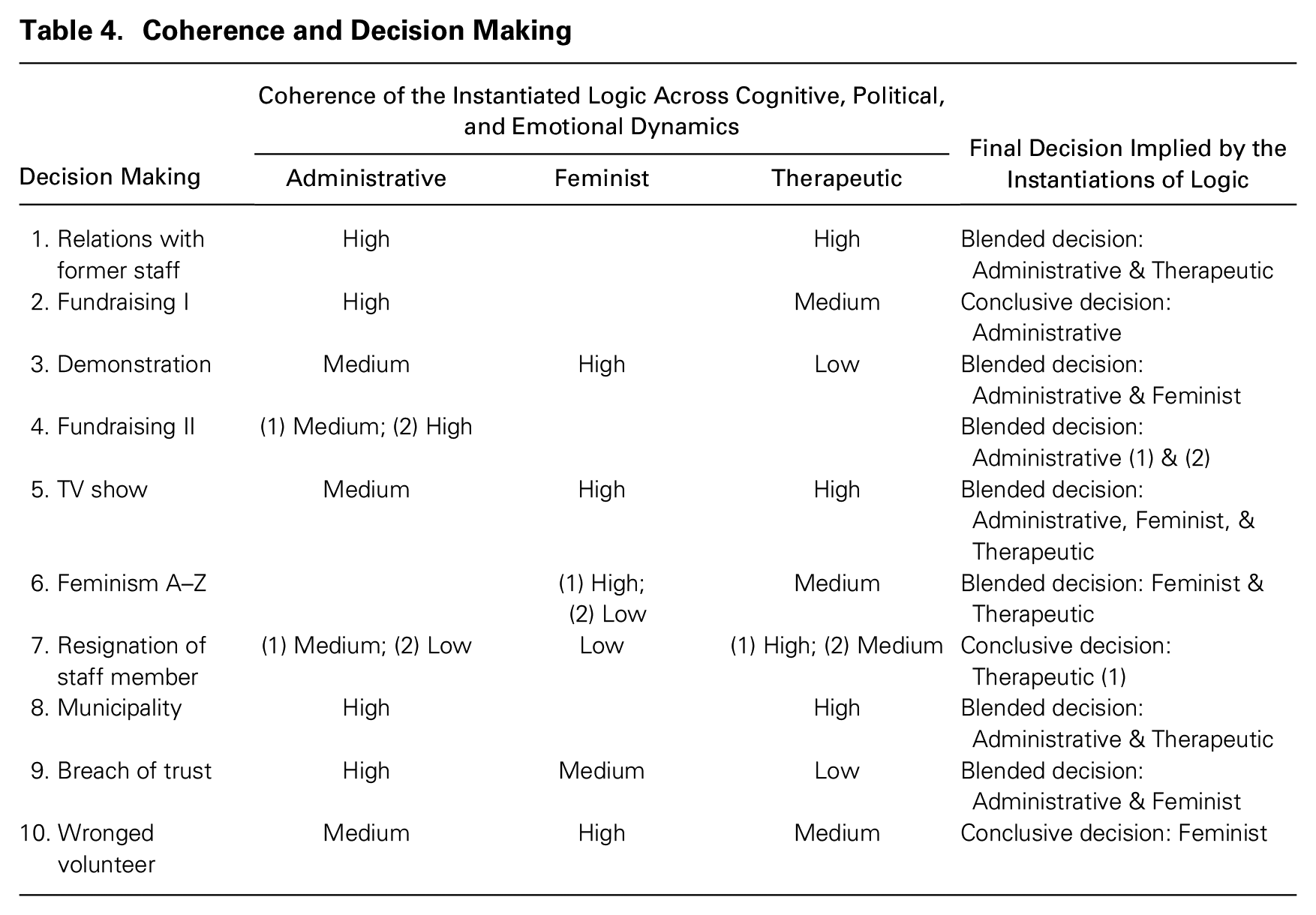
Discussion: Bringing Institutional Logics into Effect
In a critique of Geertz’s famous theory of culture as webs of meanings, Obeyesekere (1990: 285) poignantly observed, “[I]n reading Geertz I see webs everywhere but never the spider at work.” My study joins a longstanding effort in anthropology, sociology, psychology, and organization theory to explore how cultures are worked out by their “spiders,” people residing within their regimes (e.g., Swidler, 1986; Schudson, 1989; Sewell, 1992; Ridgeway and Smith-Lovin, 1994; Eliasoph and Lichterman, 2003; Lounsbury and Glynn, 2019; Lichterman and Dasgupta, 2020). By zooming in on decision-making interactions, slowing down to follow their sequential and relational details, and looking at them in their immediate and more-distant contexts, I shed new light on the process by which institutional logics come into effect on the ground.
My ethnographic inquiry makes two contributions. First, by analyzing institutional logics in interaction, I point to specific collective elements—cognitive, political, and emotional—that mediate the instantiation of institutional logics. Second, the inquiry into such instantiations highlights the importance of coherence in narrating logics into effect. Thus, it uncovers the constraints on actors’ ability to strategically use institutional logics.
Instantiating Institutional Logics Through Cognitive, Political, and Emotional Elements
In decision-making processes at the RCC, institutional logics were brought into effect through negotiating stories, specifically their cognitive, political, and emotional elements. Whereas previous studies have assumed that logics enforce themselves on people and organizations or are used strategically, my study shows the cognitive effort involved in using institutional logics on the ground. Logics must be selected and concretized in a specific situation. This is challenging, given the multiplicity of institutional logics and their taken-for-grandness. The cognitive effort to select a logic and concretize it—achieved collectively through mundane storytelling by all co-narrators involved, though not consciously motivated or strategic—which underlies narrating logics is not enough. The stories must convince others, which also relates to political and emotional elements.
That the work of institutional logics involves power is well accepted, yet most studies relate this work to episodic power, focusing on the interests of discrete actors (Lawrence and Buchanan, 2017). My study joins efforts to highlight more-systemic power, the “power that works through routine, ongoing practice to advantage particular groups without those groups necessarily establishing or maintaining those practices” (Lawrence and Buchanan, 2017: 480; Jakob-Sadeh and Zilber, 2019), and especially the work of both episodic and systemic power. The narration of institutional logics into effect involves both these kinds of power. Narrators speak from specific subject positions (Phillips and Hardy, 2002), a position within the social system. Subject positions implicate various degrees of discursive legitimacy (Hardy and Phillips, 1998), the right to speak on behalf of broader populations or ideas. This affects narrators’ ability to produce influential texts that participate in organizational and institutional dynamics (Phillips, Lawrence, and Hardy, 2004). Stories reflect the subject position of their narrators and are judged by them. Institutional logics are intrinsic to these political dynamics, as narrators may be carriers of institutions (Scott, 2003) and derive some of their legitimacy from that subject position (Dacin, Munir, and Tracey, 2010; Amis, Munir, and Mair, 2017). For example, in the RCC, given the centrality of the feminist logic, known feminist volunteers and board members were respected, and their attempt to speak on behalf of feminism was well accepted. Collective storytelling is also shaped by power relations among co-narrators or audiences (Mumby, 1993; Gartner, 2007), which are more episodic. In addition, narrators have various interests, some of which may be hidden, relating to both systemic and episodic power, and these interests shape the stories they tell (Schegloff, 1997). All these faces of power, partly systemic and partly episodic, mediate the instantiation of logics on the ground.
Finally, institutional logics are embedded in emotions (Zietsma and Toubiana, 2018). My study shows how emotions as collective phenomena, grounded in their cultural context, relational and intersubjective (Bericat, 2016), are involved in the grounding of institutional logics. While institutional logics shape the emotional repertoire within the organization, emotional dynamics associated with interactions (Collins, 2004) or relational sensemaking (Maitlis, Vogus, and Lawrence, 2013) and stories (Schneider, 2005; Polletta, 2006; Herman, 2007) shape the narration, i.e., instantiations, of logics. Emotions are cognitive in the sense that they partake in meaning-making. Emotions are also political, grounded in power and hierarchy (Manzoor, Nocker, and Boncori, 2022). Indeed, the cognitive, political, and emotional elements that mediate the instantiation of logics on the ground are inseparable. In practice, they are all interrelated. 10 Further, in the ongoing, collective process of instantiating institutional logics, these elements are interdependent and judged together, through an expectation for coherence, to which I now turn.
Coherence: Constraints on Agency in Bringing Institutional Logics into Effect
My second contribution is to balance current depictions of agency in relation to institutional logics by highlighting the role of coherence. Previous research on institutional logics moved from conceptualizing them as given and deterministic to understanding them as resources that participants can readily use (e.g., McPherson and Sauder, 2013; Giorgi, 2017; van Werven, Bouwmeester, and Cornelissen, 2019). This was a radical change in our understanding of people’s agency in relation to institutional logics. Within this new conceptualization, conceptions of agency were first driven by the multiplicity of institutional logics and the tensions and contradictions between them (Seo and Creed, 2002). McPherson and Sauder (2013) offered an empirical example, highlighting actors’ agency in hijacking logics. Later, the locus of agency moved inward, characterizing institutional logics themselves as decomposable (Thornton, Ocasio, and Lounsbury, 2012: 7). Given this decomposability, people can selectively mix and match elements from different institutional logics.
In a sense, conceptualizing institutional logics as a tool kit was an overcorrection of deterministic understanding. Institutional logics, like other kinds of resources, do not become resources “until action is taken” (Feldman and Worline, 2011: 630). Moreover, “how the potential resource is used determines what kind of a resource it becomes” (Feldman and Worline, 2011: 630). Slowing down to appreciate the relational and sequential aspects of the process and its outcomes, my interpretation of the data suggests that the process is less individually strategic and more socially distributed and negotiated. In this process, the expectations for coherence limit participants’ freedom to strategically invoke institutional logics in decision making.
For example, hijacking logics was not as easy as McPherson and Sauder (2013) documented in a drug court. In the RCC, a narration invoking a therapeutic logic (cognition) told by a narrator who had no therapeutic training within or outside the RCC was met with suspicion, as board members questioned the subject position and interests behind it (political elements). Such narration was less coherent, and the decision it implied was usually rejected. Thus, coherence limited the narrators’ ability to freely and strategically harness institutional logics in the service of a decision they wanted to promote. Looking at the instantiation of logics through a relational lens exposes the negotiated nature of their use. People told all kinds of stories, but their attempts were sometimes blocked or diverted since the narration is a collective endeavor. Moreover, the stories were evaluated by others, who expected coherence across the narration’s cognitive, political, and emotional elements. The eventual narrations that emerged from this interaction were less strategic and motivated and less open and free. The expectation for coherence across the cognitive, political, and emotional elements draws the boundaries of how and by whom institutional logics can be used.
Indeed, decision making by the RCC’s board differed greatly from decision making in the drug court. Many of the issues that the RCC’s board discussed were ambiguous, and the board perceived them as unique and unprecedented. In a sense, the discussions may be understood as efforts to strip ambiguity away, as is often the case with narratives, employed when the problem is in some way ambiguous or still not acknowledged (Zimmerman, 1992: 438–439). Such uncertainty and ambiguity create space for more framing contests within organizations (Kaplan, 2008). Thus, the struggle over which logics are relevant and how they are relevant may have to do with the high levels of ambiguity at the RCC. In other situations, such as in a drug court (McPherson and Sauder, 2013), participants may have more precedents to build upon, the level of ambiguity may be lower, and hence, institutional logics may be conceived as more straightforward and be used more strategically. Further, in the drug court, the discussions and negotiations involved participants acting from their professional identity. Volunteers and staff at the RCC, serving as board members of a non-profit organization, operated out of their personal and social identities. Identities may have directed, for example, their attention to some issues, how embedded they were within various logics, or the importance they assigned to the decision being made (Thornton, Ocasio, and Lounsbury, 2012). Ambiguity, precedence, and identity dynamics may be among the conditions that account for instantiating logics in interaction.
While the logics define the space of possibilities for narrators to mold them into characters, plotlines, subject positions, interests, and roles, the expectation for coherence across the cognitive, political, and emotional aspects of the instantiation of logics constrains their use. The agency involved in instantiating institutional logics is a more mundane kind of agency. In the RCC, the work of institutional logics involved ordinary decision-making processes “aimed at interpretation, alignment, and muddling through,” and its effects were “subtle, not particularly abrupt,” and not clearly apparent in the immediate present (Powell and Colyvas, 2008: 277). No heroic actors were involved (Lawrence and Suddaby, 2006) and no strategic planning but, rather, a group of people jointly trying to agree on a story and the decision it implicates. In the process, their distributed agency (Garud and Karnøe, 2005) brought logics into effect.
Hence, zooming in on the microfoundations of institutions helps us better understand the conditions under which agency can be exercised and is limited, and this focus strikes a middle ground between the over-deterministic and over-strategic approaches to institutional logics (and see Lounsbury et al., 2021). More generally, my study helps move the theorization of institutional logics away from the heavy imprint of the tool kit metaphor that has dominated cultural sociology since Swidler’s (1986) work.
Why Decision Making Through Stories? Varieties of Instantiations of Institutional Logics
Not all decision making at the RCC required hand-tailoring through narrations and lengthy deliberations. In many decision-making junctions, institutional logics were ready to wear (Creed, Scully, and Austin, 2002), as the board did have ready-made understandings and arguments that smoothed the decision-making process. This raises the question, when would the instantiation of logics require such collective negotiations?
The ten cases of decision making through stories revolved around various organizational issues (as detailed in Table 3). None of these decisions involved human lives or large amounts of money. Still, they were all critical enough for board members to dedicate much time and effort to understand what had happened and what decisions they needed to make. Many of these decisions were conceived as delicate: some touched on conflicts between staff or board members, and others involved conflict between the staff (or board) and RCC’s volunteers or critical external stakeholders. Often, these were people everybody knew and cared about. It was important to the board to reach what they perceived to be the right decisions both in organizational and personal terms. In other words, these were decisions grounded in both emotions and organizational politics.
I focused on instances of decision making by stories. However, institutional logics were involved in other decision-making instances in which stories were not told or were only in an embryonic stage and thus did not spark discussion. Protostories (Gabriel, 2000), or antenarratives (Boje, 2001), are narrative fragments that may or may not be developed into a complete story. They are usually emotionally and symbolically charged, and whether they will develop into a full story has much to do with power relations and issues of legitimacy and credibility (Gabriel, 2016). Protostories may relate to proto-institutions (Lawrence, Hardy, and Phillips, 2002) and serve as accounts that determine proto-institutions’ development into institutions (Hensel, 2018).
More generally, then, while my study focuses on the cognitive, political, and emotional elements relating to the narration of logics, it also draws attention to various factors that mediate the work of institutional logics on the ground, which may relate to the organizational context, personal identities, and the issue at hand. Further research is needed to unpack these factors and the relations between them.
Limitations
The study is limited in scope given that I examined only one organization. The RCC has some unique features that may limit the generalizability of my findings. It relied on volunteers, it was non-hierarchical, and decisions were made by consensus. The majority of the RCC board was women, and the setting of board meetings was feminized. The organization was established to create a safe space for women; many of the issues discussed involved women; and the setting was structured in a way that encouraged personal, emotional, and emphatic kinds of talk, which are usually associated with women (Polletta and Chen, 2013). It may be tempting to attribute the ubiquity of stories and decision making through stories to “women talk” or decision making by consensus. However, previous research has documented storytelling in decision making in masculine and hierarchical settings as well, like Kennedy’s National Security Council during the Cuban Missile Crisis (Gibson, 2011, 2012), the U.S. Federal Reserve’s Open Market Committee (Abolafia, 2010, 2020), and emergency medical teams (Myers, 2022). Still, specific organizational culture or contextual conditions may relate to the way logics are instantiated, and thus a comparative approach that examines such instantiations across various organizations may be fruitful to our understanding of the work of logics on the ground.
Finally, my ethnographic study is limited in its ability to reconnect the microfoundations of logics with their operation on other social levels. If logics are instantiated in micro-level interactions, one can assume that micro-level changes in the construction of logics may scale up to changes in field-level logics (Smets, Morris, and Greenwood, 2012; Gray, Purdy, and Ansari, 2015). Yet, my ethnographic methodology does not allow me to follow this lengthy process empirically. Building on mixed methods, future research may be able to “look both ways at once” (Haedicke and Hallett, 2016: 99; Zilber, 2020) to use the insights stemming from a close examination of ongoing micro-level processes and connect them with longer, macro-level processes.
Concluding Remarks
Thinking of institutional logics as instantiated in interactions does not mean we need to abandon their study as deterministic or strategic resources. 11 We may take a “quantum approach” (Hahn and Knight, 2021: 362) and acknowledge that they are both inherent and socially constructed. Moreover, institutional logics operate on multiple social levels. They thus may look somewhat different from different social and analytical viewpoints (Cornelissen et al., 2015: 22). Institutional logics have “‘social fact’ qualities” as well as a “bidirectional and recursive nature” (Purdy, Ansari, and Gray, 2019: 409). Their ontology may be conceived pragmatically in relation to the social site, the analytical question at hand, and the methods used. When we study institutional logics on the societal or field level by using macro, positivist, and longitudinal approaches, it is fruitful to think of them as given and focus on their consequences. When we study institutional logics on the organizational level by using post-positivist and qualitative approaches, it is productive to think of them as resources people use. When we study the microfoundations of institutions by ethnographic observations in vivo and in situ, it is fruitful to think of them as potentialities that evolve within social interactions. All these views are valid, offering pieces of the rich, complex puzzle of institutional logics and their impact on organizations and our lives.
Footnotes
Acknowledgements
I am grateful to members of the RCC who opened their organization and generously shared their time and insights with me. I thank Editor Christine Beckman and the anonymous reviewers for insightful and developmental guidance throughout the review process and Yehuda C. Goodman for ongoing conversation on this project. Finally, I thank the Recanati center in the Hebrew University Business School for its generous support.
1
A similar critique applies to studies within the institutional work perspective. Originally aiming to close this gap and follow institutional dynamics on the ground, most empirical research focuses on categorizing various types of institutional work, performed by group “actors,” and inferred from their results, rather than following the actual institutional work carried out by people in “the messy day-to-day practices” within organizations (Lawrence, Leca, and Zilber, 2013: 1029).
2
I use “story” and “narrative” interchangeably, notwithstanding some different definitions and uses in literary theory and other disciplines.
3
Meta-narratives are also termed grand narratives (Lyotard, 1984), frames (Fligstein, Brundage, and Schultz, 2017), narrative templates (Wertsch, 2008), generic space (Romano, Porto, and Molina, 2013: 85), or deep stories (Hochschild, 2016; Polletta and Callahan, 2017).
4
While there are many similarities between institutional logics and meta-narratives, there are also significant differences. “Meta-narratives” was developed within a tradition of narratology and relates specifically to the hidden tides beneath stories, in particular to their content. The concept has not been applied to understand storytelling and social action and interaction. “Institutional logics” was developed within institutional theory and has been implemented in relation not only to meanings but also to behaviors, structures, materiality, and other modalities. The conceptualization and application of meta-narratives is much narrower than those of institutional logics, and thus I use meta-narratives and narratology to complement the institutional logics perspective and contribute to it, not the other way around.
5
In one meeting, only board members met with an organizational consultant to discuss their personal and work relations with each other and with the staff.
6
Transcription conventions: . . . means omission by author quoting; — means no interval between speakers, overlapping speech; [text] indicates the author’s description of participants’ nonverbal expressions based on audio-recording or author’s field notes; [text] indicates the author’s explanatory additions; unbracketed text in italics indicates the speaker’s emphasis.
7
“Men can stop rape” is a slogan used in an anti-rape campaign launched by the Israeli Coalition of Rape Crisis Centers.
8
Hysteria is a mental disorder characterized by emotional outbursts and symptoms like paralysis that mimic the effects of physical disorders. In common language, it refers to “any frenzied emotional state, especially of laughter or crying” (Collins Dictionary). The term comes from the Greek in which it means “suffering in the womb, reflecting the Greeks’ belief that hysteria was peculiar to women and caused by disturbance in the uterus” (Random House Webster’s Unabridged Dictionary). In modern times, Freud adopted the term to describe a disorder that he mainly encountered in his female patients; hence, it was perceived as a “female malady” (Micale, 1995; Dmytriw, 2015). Panic is an anxiety disorder, characterized by “a sudden overwhelming fear, with or without cause that produces hysterical or irrational behavior” (Random House Webster’s Unabridged Dictionary). Epidemiological studies have found gender differences for panic disorder. Being female is considered a risk factor (Grant et al., 2006).
9
These stories were retold and discussed in two other board meetings as the relations with the municipality evolved and the board needed to make more decisions.
10
My findings also further expand what we know on how words—frames, rhetoric, discourse, or stories—act in the world (Lockwood, Giorgi, and Glynn, 2019). What I term “cognitive elements” resembles plausibility (or verisimilitude). What I term “emotional elements” is close to emotional resonance, the degree to which the story strikes a chord with the audience (Lounsbury and Glynn, 2001; Giorgi, 2017; Lounsbury and Glynn, 2019). Finally, what I term “political elements” is related to narrator’s voice, which confers a story with legitimacy and authority (Herman, Jahn, and Ryan, 2005; Herman and Vervaeck, 2007). However, and this is where my work extends previous understandings, plausibility, resonance, and authority are usually studied as attributes of texts (e.g., frames), ignoring the process by which these texts were constructed (Leibel, Hallett, and Bechky, 2018; Lockwood, Giorgi, and Glynn, 2019). My study, based on ethnographic data of word-to-word board decision-making discussions, focuses on the process of narration that brings institutional logics into being. This focus exposes that the cognitive (in narratology: plausibility), political (authority), and emotive (resonance) elements are negotiated collectively in an ongoing process.
11
If, indeed, we accept that institutional logics are emerging and do not simply exist but are, rather, floating potentials, waiting to be instantiated, the question arises, why do we give an existential status to other entities, most centrally to the actors, or people, whose interactions bring logics into being? Indeed, another option would have been to follow Barad’s Agential Realist Ontology (2001,  ), conceptualizing “intra-action” rather than interaction, and thus assuming that institutional logics, actors, time, and place do not pre-exist but, rather, are all constituted within interactions. In this article, I focus on institutional logics and thus hold all other entities as relatively fixed, stable, and outside of further scrutiny.