




Abstract
Although some scholars propagate cross-sector partnerships (CSPs) as a panacea for addressing the grand challenges of the 21st century, scholars also acknowledge that this type of collaboration faces significant barriers since the institutional logics of partners such as business, civil society, and government potentially have contradicting interests and future visions. This inductive longitudinal case study on integrating skilled migrants into the German labor market examines the institutional work by which CSP members, particularly government actors, deliberately rein in contradictory logics to reproduce the dominant government logic, and in doing so, establish a high level of institutional coherence. In disclosing the processes by which the dominant logic maintains its hegemony, I contribute new insight into the institutional dynamics within government-sponsored CSPs. I identify various actions and I illuminate CSP tensions and dark sides.
Refugees’ and migrants’ access to the labor market, which ensures their employment, is paramount to re-establishing their livelihoods and integrating them into host societies (Phillimore & Goodson, 2006). Yet, labor markets and the institutions involved could be drivers of persistent inequality (Amis et al., 2018). To elicit “welfare-enhancing systemic change in institutional arrangements” (Austin & Seitanidi, 2012, p. 952), over the past decades, policymakers have increasingly initiated cross-sector partnerships (CSPs) to address challenges of considerable scale and complexity. These challenges go beyond individual societal sectors’ sphere of influence (van Tulder & Keen, 2018), or even result from the societal sectors’ failures (Kolk et al., 2008). What makes the CSP so successful in tackling complex socioeconomic and environmental challenges, the inclusion of partners from different sectors of society (i.e., business, civil society, and government (Blockson, 2003; Selsky & Parker, 2005)), is in fact also its Achilles heel, namely the plurality of potential meanings and visions for the future that differing social institutions provide (Berger & Luckmann, 1967).
Partners in CSPs need to combine distinct institutional logics (Thornton et al., 2012; Vogel et al., 2022) applied in business, civil society, and government, as divergent guidelines condition the partners’ objectives and their actions and evaluations for governance. Consequently, the partners need to accommodate the tensions (Ahmadsimab & Chowdhury, 2021; Ashraf et al., 2017; Gillett et al., 2019) and dynamics (Hesse et al., 2019) emerging from such different institutional logics. The variety of institutional logics competing in a given context can be classified according to their level of institutional coherence (Gray & Purdy, 2018; Rein & Stott, 2009; Vurro et al., 2010; that is, “the extent to which the dominant institutional logics are able to provide sufficient guidance to the behavior of actors in the field”; Vurro et al., 2010, p. 44). Depending on the level of institutional coherence, conflicting demands of logics can either lead to change or, through coercive pressure, to conformity and further stabilization of the prevailing institutional order. To date, however, limited empirical attention has been paid to the institutional coherence levels in CSPs. Previous studies (Hoffman, 1999; Reay & Hinings, 2005) have highlighted this situation, where one logic dominates others, yet the processes by which the logic maintains its hegemony have remained obscure. After all, to reproduce themselves, CSPs rely on their members’ actions over time (Berger & Luckmann, 1967) as “it takes work to remain unchanged, as much as it takes to change” (Smets et al., 2017, p. 371). Therefore, my research is guided by the following research question:
Research Question 1 (RQ1): Why is the dominant institutional logic able to guide the behavior of the other members in the CSP?
RQ1 emerged from an exploratory inductive case study of a long-standing CSP aiming to integrate skilled people with a migration background into the German labor market. In 2005, the government initiated the CSP as a labor market policy instrument for reactive, but also preventive, influence on events in the labor and vocational training market. Indeed, one can hardly envisage successfully integrating skilled people with a migration background into the German labor market with its dual education system and long apprenticeship culture, without some cross-sectoral collaboration between business, civil society, and government organizations. Due to the migration issue being politically contentious (Arzheimer & Berning, 2019), government actors primarily aim to pursue cross-sectoral collaboration without conflict, failure, or further conspicuity. In other words, government actors strive to establish and maintain a high level of coherence to ensure minimal conflict between different institutional logics by having the actors align with prevailing (governmental) norms. Yet, maintaining the status quo in view of rising migration flows, such as during the inward flow of refugees in 2015, requires ongoing change in the actions of the three sectors of business, civil society, and government. This study builds on the strengths of process analysis (Langley, 1999) and examines the institutional work (Lawrence & Suddaby, 2006) by which CSP members, particularly government actors, deliberately rein in contradictory logics to reproduce the dominant government logic, and in doing so, establish a high level of institutional coherence. Thereby, this study enhances our understanding of institutional dynamics in government-promoted CSPs in urban contexts (Hesse et al., 2019) and offers multiple scholarly contributions. I identify different kinds of institutional work to maintain the institutional hegemony of the governmental logic and the findings shed light on the dark sides of CSPs.
The remainder of this article is structured as follows: After reviewing the relevant literature, I elaborate on the research methods. Next, I present the findings, discuss their implications, and finally note the limitations.
An Institutional Approach to CSPs
CSPs arise as “new forms of organizing in response to changing conditions within institutional fields” (Gray & Purdy, 2018, p. 36) to tackle grand challenges such as poverty alleviation (Rein & Stott, 2009), combating pandemics (Arslan et al., 2021), or refugee integration (Hesse et al., 2019). Such fields are shaped by evolving and often contested institutional orders with shared or conflicting interpretations of purposes and goals (Fligstein & McAdam, 2011), since fields are “the locus of relations of force—and not only of meaning—and of struggles aimed at transforming it, and therefore of endless change” (Bourdieu & Wacquant, 1992, p. 103). Thus, various member organizations within a CSP assess and evaluate the limits of current institutional orders in an attempt to create new institutional orders (Seo & Creed, 2002) that will maintain (Zietsma & Lawrence, 2010) or disrupt (Pache & Santos, 2010) existing orders in defining solutions for the issue at stake. This could require reconciling the partners’ competing frames of reference regarding the CSP’s future design (Gray & Purdy, 2018). The institutional logic perspective allows an analysis of these different frames of reference that condition partners’ actions and evaluations (Thornton et al., 2012). Although some scholars tout CSPs as a kind of magic bullet (Rein & Stott, 2009), others also acknowledge that this type of collaboration faces “collaborative inertia” (Huxham & Vangen, 2004, p. 30) and significant barriers and traps (Couture et al., 2022) due to potentially adverse interests and visions for the future rooted in the institutional logics (Ahmadsimab & Chowdhury, 2021; Gillett et al., 2019).
Institutional Logics
Institutions are composed of institutional logics (Friedland & Alford, 1991) that are produced and reproduced by actors (Berger & Luckmann, 1967). As “socially constructed, historical pattern of material practices, assumptions, values, beliefs, and rules” (Thornton & Ocasio, 1999, p. 804), institutional logics provide guidelines for actions, interactions, and interpretations of organizational reality within a field, which can create a sense of shared purpose and unity. Fields emerge through processes that accommodate the most powerful actors. Consequently, the dominant logic reflects the assumptions, values, and rules of these actors (DiMaggio & Powell, 1983), even if two or more institutional logics coexist (Thornton & Ocasio, 1999). Most scholars agree that while facing multiple institutional logics might be challenging and even burdensome for actors, multiple divergent logics can coexist (Dunn & Jones, 2010; Reay & Hinings, 2009). Also, contradictions in logics can subside when one of the logics becomes dominant over the other (Hoffman, 1999; Reay & Hinings, 2005), an opportunity for institutional change arises when alternatives to the dominant logic, the status quo, become available (Rao et al., 2003; Seo & Creed, 2002), or failure may occur due to incompatibility between the institutional logics (Pache & Santos, 2010).
Institutional Coherence and Institutional Work
The level of institutional coherence determines to what extent the dominant institutional logics are able to sufficiently guide the behavior of actors in the field (Vurro et al., 2010). A high coherence level implies low conflict between the different institutional logics because the acting organizations agree on their general direction, and the actors adapt to the prevailing norms, leading to a condition in which stability prevails (Gray & Purdy, 2018; Vurro et al., 2010). In contrast, a low level of coherence implies more maneuvering room for actors trying to shape the prevailing institutional logics to serve their interests, since no single institutional logic holds the necessary level of consensus to drive behavior toward conformity (Gray & Purdy, 2018; Vurro et al., 2010). Recent research on institutional logics in CSPs, however, has focused on the tensions (Gillett et al., 2019) and dynamics (Hesse et al., 2019) between the institutional logics in CSPs, or on processes through which CSPs could reconcile their institutional differences (Ahmadsimab & Chowdhury, 2021; Yin & Jamali, 2021). There is little discussion of the coherence that could be observed. In addition, actions that reinforce the enduring dominance of one institutional logic (Besharov & Smith, 2014) need to be empirically identified (Vurro et al., 2010), as we know surprisingly little about how actors within CSPs balance the dynamics and tensions of institutional logics in their institutional work. Ostensibly, these actors strive to maintain or challenge the prevailing institutional order that either serves or fails to serve their interests in the field’s future functioning.
Institutional work in CSPs is a “worthwhile avenue of study” (Hesse et al., 2019, p. 699) because it shifts attention toward the actor’s role in institutional processes. Various players’ actions that either alter or maintain institutions (Lawrence & Suddaby, 2006; Zilber, 2013) are “always shaped by available and accessible institutional logics” (Thornton et al., 2012, p. 180). Institutional maintenance work appears to be integral to achieving coherence and stabilization of meaning structures. Yet, the processes through which institutional norms, structures and processes are supported and maintained remain “a relatively understudied phenomenon” (Lawrence & Suddaby, 2006, p. 234).
Method
Given the relative paucity of existing research on institutional work aiming for a high level of institutional coherence across the divides of the three institutional logics of business, civil society, and government, I conducted an exploratory case study and took a process research approach to appreciate analytic patterns with nuances of semantic richness and the particularities of the case (Cornelissen, 2017). The case study design (Yin, 2014) allows a holistic understanding of complex phenomena “by digging deep into the rich details provided by the respective institutional context” (Crane et al., 2016, p. 5). Taking this approach, I adopt the process ontology in which observable things are reifications of processes (Tsoukas & Chia, 2002), (i.e., temporary instantiations of ongoing processes), to also capture the processual dynamics of stabilization as “active work is required to maintain practices, organizations, and institutions” (Langley et al., 2013, p. 10).
Research Context
Immigration to Germany has increased significantly in recent years, also due to refugee movements. On starting this research in 2019, around one in four people in Germany had a migration background due to either voluntary or forced migration. People with a migration background are more frequently unemployed or in occupations not appropriate to their education, which poses challenges for both the migrants and the host society. Many migrants have professional degrees or qualifications that are not recognized in the German labor market which has a dual education system and a long tradition of apprenticeships. Labor market policy is one of the most important policy areas in the Federal Republic of Germany, therefore labor market successes and failures are regular election campaign issues. The German government, thus, supports regionally active partnerships in each of the 16 partially sovereign federal states which link as many actors as possible from different sectors in society to facilitate migrants’ access to the labor market by their policy instruments and the process of credential recognition.
To improve our understanding of institutional dynamics within government-promoted CSPs in urban contexts (Hesse et al., 2019) I selected one such partnership active in one of the city-states. The institutional context had to be considered to “appreciate the creativity actors use in constructing their positions and resources” (Zilber, 2013, p. 89). The selected case has been active since 2005. In 2019, the CSP consisted of 10 organizations with actors from each of the three sectors of society. These included the relevant ministry, a teaching hospital, the chamber of crafts, a trade union association, and several other civil societal organizations. The state ministry coordinates the partnership. The chamber of crafts, for example, offers supplementary training toward full credential recognition with relevant firms’ support. Similarly, the civil society organizations advise refugees and migrants on employee rights, educationally adequate employment, or deal with biography-specific challenges. The relevant Federal Ministries fund this regional partnership, which means that different funding phases, focal points, and consequently organizational compositions came and went over the years. Since 2015, refugees have been included as an additionally focused target group. The fifth funding phase started when I entered the research field in 2019 allowing me insight into the end of the former funding phase and the beginning of the new one.
Data Collection
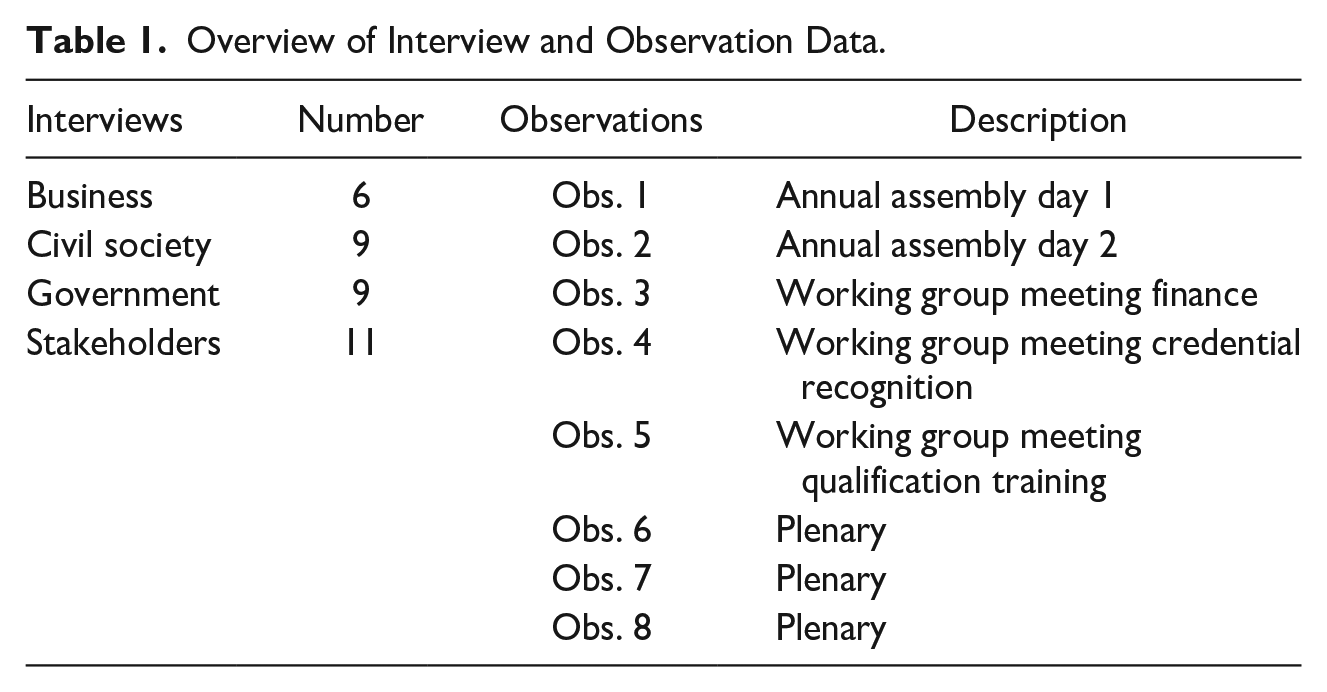
I employed a grounded-theory approach to data collection and analysis (Corbin & Strauss, 1990), collecting three types of data: (a) observations at partnership events (i.e., plenary or working group meetings); (b) interviews with members and stakeholders of the partnership; (c) documents issued by the CSP (i.e., protocols of meetings, publications) and external documents (i.e., press releases). The data collection took place from February to December 2019. Importantly, through documents and retrospective elements in the interviews, the data cover a period from 2005 to 2019, since “tying institutional actions with their consequences require[s] a retrospective research design” (Zilber, 2013, p. 88). Table 1 provides an overview of the interview and observation data.
Overview of Interview and Observation Data.
Observations
I attended eight partnership events and workgroup-specific meetings as an observer capturing “not only overt behavioral patterns but also the subjective experiences of organizational reality and the ongoing negotiations between members and subgroups over the interpretations and understandings of this reality” (Zilber, 2002, p. 237). At these events, I noticed that problem perception and management, and the resulting patterns of interaction and behavior varied according to sectoral affiliation. The first partnership event was a plenary, therefore a general meeting, during which I could identify all project leaders and staff. I could also inform them about my research project and intention to recruit interview partners. Immediately afterward, I typed up field notes covering the event. In total, I spent 29 hr observing partnership-specific events.
Interviews
To deepen my understanding of how certain actions gained and maintained institutional hegemony despite institutional and environmental demands, and to understand the institutional logics associated with these actions, as well as the members’ and stakeholders’ reactions, I interviewed 35 actors. I interviewed representatives from 9 of the 10 member organizations and through the interviews identified relevant stakeholders. In total, I conducted 24 interviews with members and 11 interviews with external stakeholders of the partnership, including the responsible Federal Ministries and the Federal Employment Agency. The interviews lasted between 54 and 131 min, averaging 83 min per interview. With interviewees from various hierarchical levels and areas of responsibility, ranging from Federal Ministry staff to the individual clerks and operational staff who work with the target group daily, I had access to different perspectives for my analysis. Table 2 gives a full list of interviewees with their main functions. Since I conducted semi-structured interviews, I covered the same set of topics with all interviewees, namely (a) motivation and intentions of being members in the partnership, (b) challenges of the working constellation concerning different self-understandings, (c) ways of working and demands, (d) the handling of demands, and (e) changing and adapting these actions to ensure smooth collaboration. All interviews were conducted in German, tape-recorded, and transcribed verbatim.
List of Interviewees.
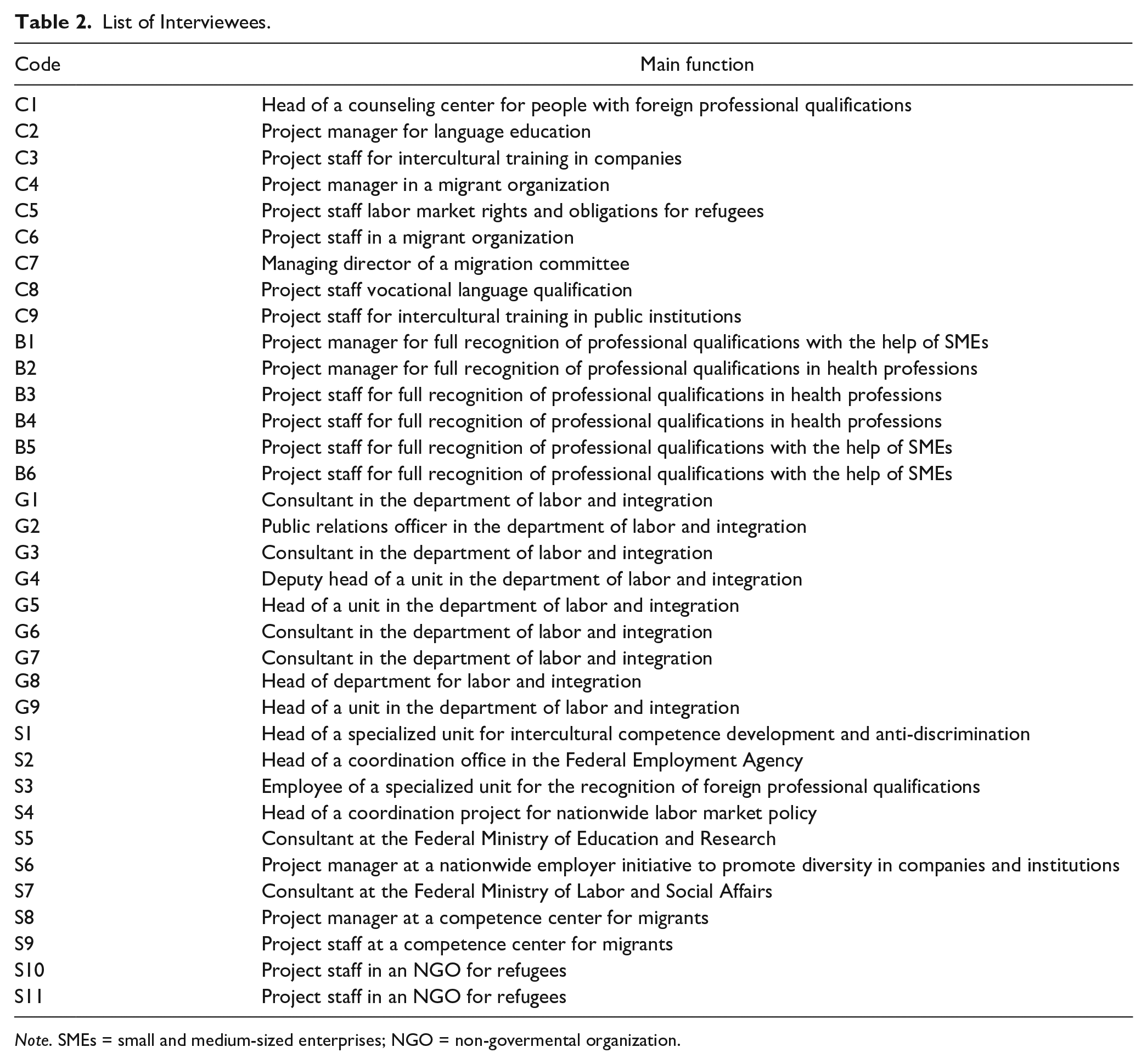
Note. SMEs = small and medium-sized enterprises; NGO = non-govermental organization.
Documents
I triangulated observation- and interview-based findings with information in a wide variety of documents the partnership published internally, such as meeting minutes, invitation texts, and policies. Aiming to capture a comprehensive picture of communication with and through different stakeholder groups, I included further documents that the partnership published for external purposes, such as reports, fact sheets, or website presentation texts. Following that, I focused on documents and media reports on or concerning the partnership, including for example minor legislative interpellations.
Data Analysis
The first step in the analysis, open coding (Strauss & Corbin, 1998) to identify empirical themes, began during my initial analysis of the observations and continued iteratively during the collection of interviews and documents. In the process of open coding, I developed some broad codes and some very specific codes. During this inductive phase, my analytical work was guided by broad questions that focused on the characteristics of the three institutional logics and the tensions that members faced. The questions further focused on the characteristics of the external demands and environmental pressures, the actors involved, and the actions taken to gain, maintain, or challenge institutional stabilization, their antecedents and consequences. The next step, axial coding (Strauss & Corbin, 1998), identified relationships between the empirical themes and combined them into higher-order conceptual categories which are grounded in empirical evidence but also anchored to the theoretical literature. I reached a level of theoretical saturation through multiple rounds of iteration by moving back and forth between broad and specific codes of the institutional work initiated by the (dominant) members of the CSP. My analysis moved from in-depth analysis of the data, through developing conceptual categories, to linking these actions to the existing literature.
Second, given my interest in how the CSP’s coherence is stabilized and maintained through the identified actions, based on the foregoing axial coding step, I developed a detailed, chronological description giving contextual details of events and experiences, actions, and responses, as well as actors’ interpretations and meanings of them. I used this narrative to better understand the interplay between specific events, choices, and activities, taking into account the external demands and environmental pressures, and thereby revealing the underlying plot and dynamics. Based on this narrative, I linked the actions to (a) focal actors undertaking these actions, (b) the adopted elements of institutional logics, (c) the underlying institutional work, and (d) the causes and consequences of these actions.
Third, by breaking down the narrative into temporal brackets (Langley, 1999) I examined how actions taken during one phase over time led to changes in the context that affected actions in the following phases to aggregate categories. During this analysis, I identified two inflection points of which the first was in 2011 when the Federal Recognition Act was enacted to regulate and standardize the procedure for recognizing foreign professional qualifications. This is intended to attract skilled migrants and support their long-term integration. The second was in 2015 when Germany recorded one of the largest influx of refugees since the German reunification, and business, civil society, and government actors had to adapt their courses of action. Figure 1 shows the data structure as it developed through the data analysis.
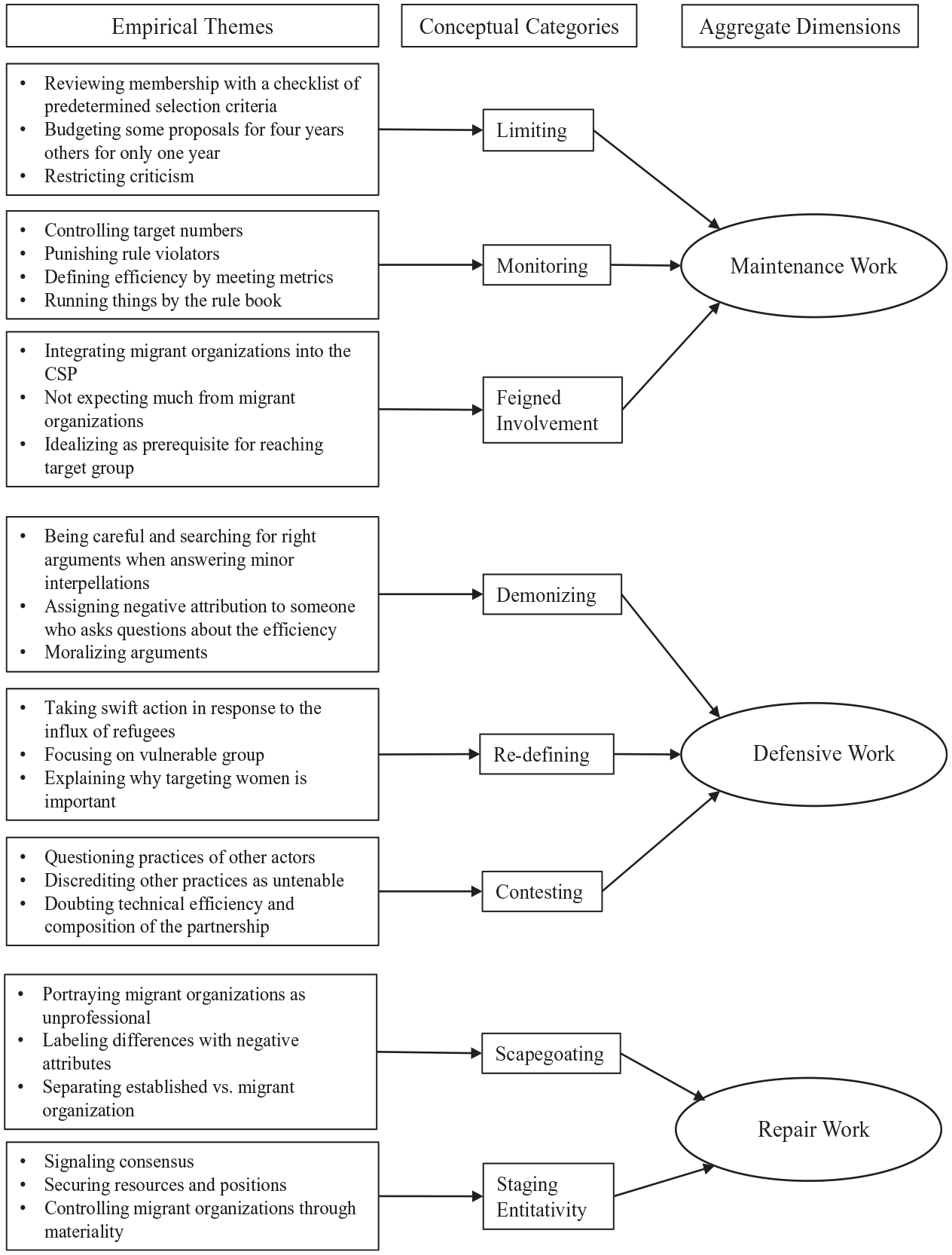
Data Structure.
To indicate the origins of the data, I mark interview quotes as “Int.” Furthermore, I label statements from business representatives as “B,” those from civil society as “C,” from government as “G,” and from stakeholders as “S.” Insights and verbatim extracts from observations are marked as “Obs.” Table 3 presents the data supporting interpretations of these actions.
Data Table.
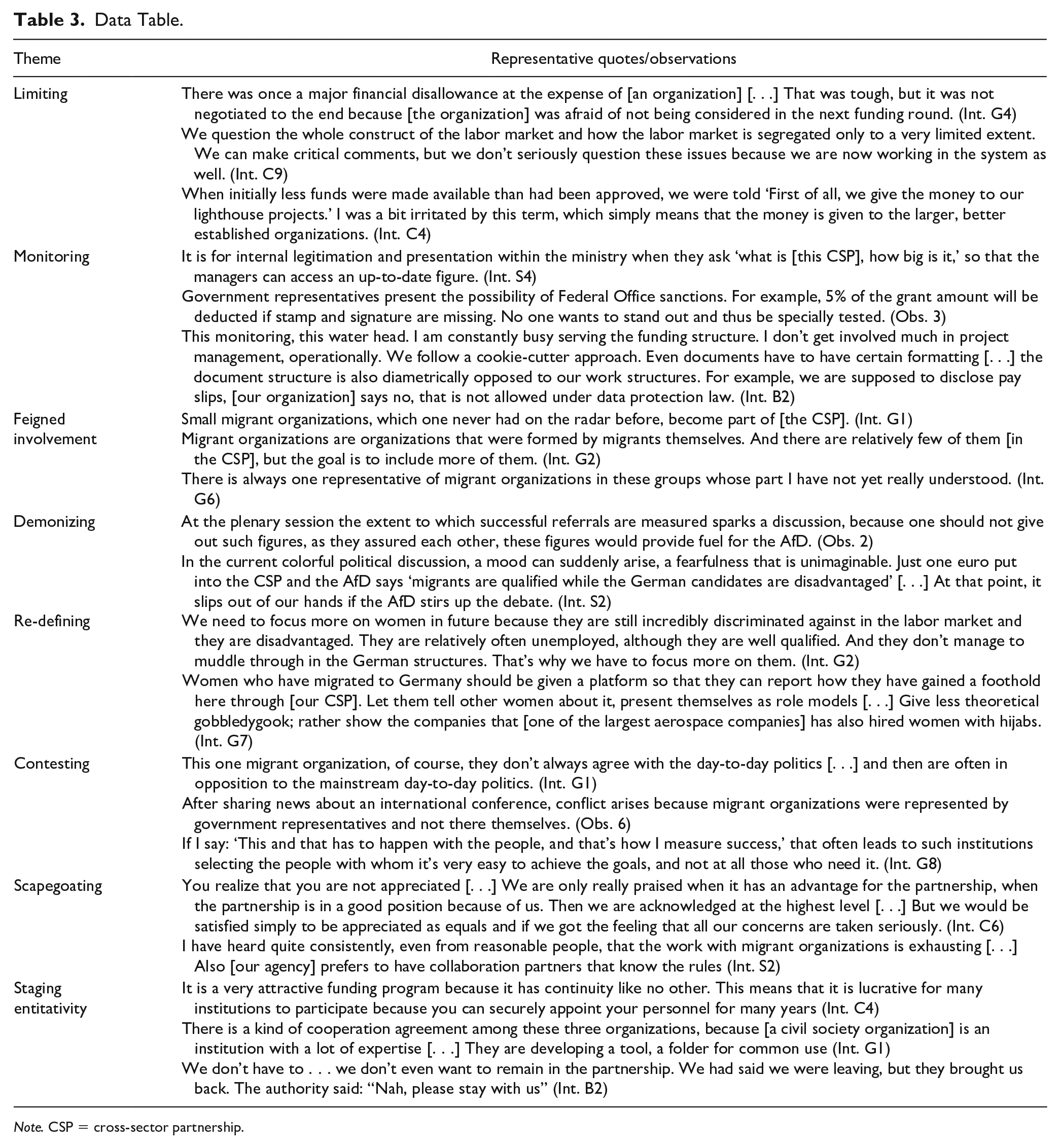
Note. CSP = cross-sector partnership.
Findings
I first outline the CSP characteristics and how the three institutional logics are materialized (see Table 4). My analysis reveals that an institutional hegemony of the government logic characterizes the CSP and CSP’s members, particularly government actors, were able to maintain this institutional hegemony despite institutional and environmental pressures by engaging in: (a) maintenance work; (b) defensive work; and (c) repair work.
Materialization of Institutional Logics of Business, Civil Society, and Government.
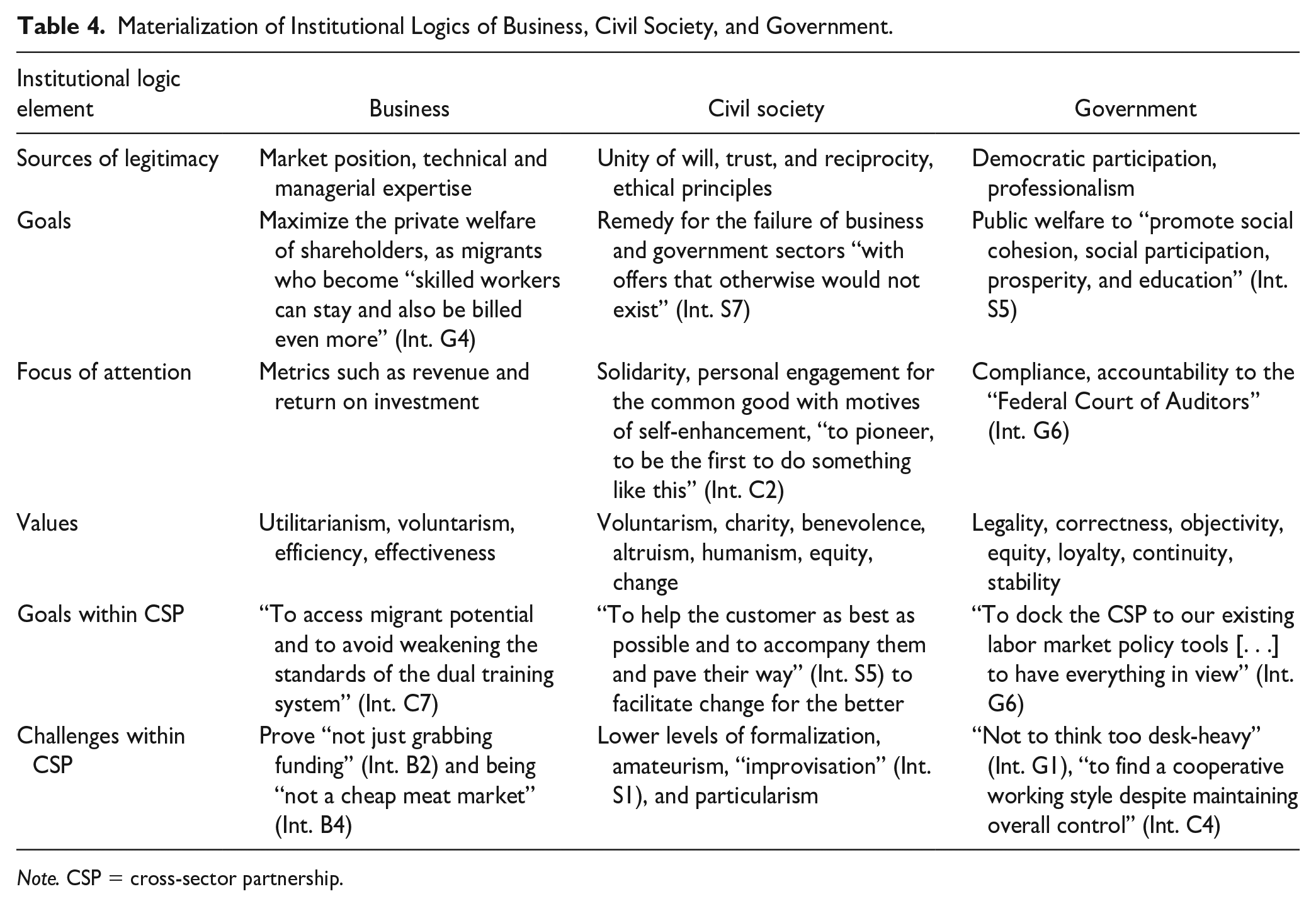
Note. CSP = cross-sector partnership.
Characteristics of the CSP and the Manifestations of the Three Institutional Logics
As instruments of joint action, partnerships are artificial entities whose maintenance is not self-evident, but rather problematic and threatened, in three respects. First, the CSP is fragmented by the bounded rationality of its members’ behavior, as they are unable to orient themselves with all-encompassing rationality and instead resort to institutional logics appropriate to their sector.
[These are] individual logics [. . .] which are not always compatible. And that sometimes makes our collaboration with government actors difficult [. . .] that is one of the major issues when it comes to collaboration between NGOs, government, and business. Who talks to whom and who has which interests. (Int. C7)
Second, the normative integrative power of the CSP objectives can repeatedly be undermined and its recognition challenged by the partner’s pursuit of interests, goals, and values inherent to their institutional logic as contending logics interpenetrate the CSP. Third, the CSP is characterized by resources being limitedly substitutable. However, not all resources are of equal value, which leads to relations of autonomy and dependence between the actors. Business organizations are more autonomous than civil society organizations in this CSP because they are less substitutable.
Unlike many civil society organizations, we do not offer orientation; we qualify, we create manpower. We serve the labor market—that’s a completely different position. (Int. B2)
Government agencies and authorities are designated dominant actors within this CSP since labor market projects intersect with various executive systems and are embedded in a system connected across jurisdictions with vertical flows of government funding.
The partnership has been in existence since 2005 [. . .] But it became much bigger and more prominent as a result of the Recognition Act. Since then, the whole legislative process has been coordinated by our ministry in the federal government [. . .] as we finance these structures. (Int. S5)
Although the partnership was initiated by the German government to create a solid framework for offering migrants educationally adequate employment, my analysis reveals that this partnership primarily serves to demonstrate government’s capacity to act, to shift the discourse on integrating migrants into the German labor market to a new platform—the CSP. Primarily to gain time, to set the policy agenda early on, “to keep an eye on things at an early stage and get things right straight away” (Int. G7), and to circumvent lengthy political consensus-building processes because “one is vulnerable the moment one discusses it and makes it public” (Int. G7).
The federal government is spending a lot of money to say ‘We’re doing a lot of things to get people trained here.’ But then, honestly, the logic grasps that this has to be successful. Still, you have to justify that it is efficient. The Federal Court of Auditors looks at this rather critically. Or, also Mr. Schäuble [President of the 19th German Federal Parliament], who might have to justify such partnerships [. . .] therefore, you have to avoid problems that may appear. (Int. S2)
Maintenance Work
The first kind of institutional work in the pursuit of institutional hegemony of the government logic is the maintenance of interpretational sovereignty and legitimacy. As “interest always comes through money or scandals or extraordinary successes” (Int. G6), it is important “how you embed actions. What story you tell about the process and how it is grounded” (Int. G8). Given the values of continuity, stability, and security associated with the institutional logic of government, the government as the dominant actor must avoid limiting its ability to act due to conflicting institutional logics. At the same time, the government sources legitimacy from democratic participation and professionalism.
Maintenance work can take many forms. I concentrate on three actions that are figured prominently in my data: Limiting helps government actors to restrict participation by only including particular members and defining their values, roles, and responsibilities. Monitoring not only helps the government to control the CSP’s interpretative and structural processes but also, in the government’s interest, facilitates complex decision-making processes and makes debates about CSP goals less contentious through its consistency, impartiality, and rationality. Feigned involvement helps maintain external legitimacy by corresponding with external ideas about how a CSP should appropriately function.
Limiting
Being included as exclusive members in the partnership comes through institutionalized probation based on funding decisions and an expression of interest procedure, which is defined by the Federal Budget Code legislation. To meet government logic demands of equity and transparency, selection criteria have to be demonstrated in allocating funds. Therefore, this institutionalized probation is a performance test signaling objective proof of qualification for meeting the CSP’s goals and norms.
In the end, during the expression of interest procedure the authority decides which organization it will take on board, in other words, which actor fits into the partnership. Not only technically, but also from the “Can we work with him?” point of view. (Int. C1)
However, probationary pressure limits the ability of those powerful enough to strategically transform the partnership, because predetermined selection criteria limit their sphere of influence and “other organizations do not have the opportunity to participate” (Int. C9). Indeed, the probation seems to serve as a check on membership and instating a barrier to institutional change “so that there is not too much friction in the whole system” (Int. C9). In addition, government actors have the definitive power, because they can exploit space to maneuver differently due to some organizational proposals that “were budgeted for only one year, while other organizations receive funding for four years” (Obs. 1). Consequently, the institutionalized probation, thus, leads to relations of force being fixed and, in particular, to judgments being made about various actors’ value in the CSP. This probation, therefore, directly affects the actors’ behavior within the partnership.
You have to be able to behave diplomatically in this whole construct, otherwise you are associated with too much criticism, you make them uncomfortable, and next you are gone. (Int. C4)
Monitoring
Since business and civil society organizations have the expertise that is essential for maintaining the workflow they can define criteria for successful problem-solving. However, government organizations want to avoid submitting to the interpretations and explanations of the other partners, while also assuming the functions of motivating and controlling processes. To achieve this they introduced the monitoring system as a material constraint, which they articulated as imperative based on their accountability to the main stakeholder, the Federal Audit Office. For “every cent you spend, you need a receipt” (Int. B1), and you have to explain “why it is spent that way” (Int. B2) to prevent “anyone trying to slip his company car” (Int. G3) into the CSP expenses. Based on empiricism (i.e., evidence-based policy), the monitoring system serves as a credible surveillance system to control behavior and to punish rule violations.
If an organization [. . .] does not adhere to the monitoring system, there are sanction possibilities to cut off vital funding. (Int. B1)
At the same time, such monitoring validates funding allocation and recognition based on performance, while also securing financial sovereignty. Thus, as material constraint monitoring additionally serves to avoid distributional conflict by maintaining the fiction of a link between resources and performance. Most importantly, the CSP’s efficiency is defined as the achievement of these predetermined ends. An important moment of technology lies in its objectivity. All in all, the organizations have to submit to the technical necessities. Technical norms are therefore enforced as social norms. This facticity, however, constitutes the reality to which individual clerks must adhere and to which they must adapt. For example, “there is an item ‘Found work after four weeks’. But what do I do with someone who found work after five weeks?” (Int. B4). The variety of actions is restricted to those already predefined by the monitoring system. Monitoring, thus, serves as a standard in measuring task performance. This closes control gaps at the operational level and replicates the government’s control logic. If technology represents a zone of uncertainty for others, its use benefits those who can control that zone.
We are also reluctant to publish comparisons. It’s very tricky [. . .] It pays to publish a large number that makes different results less transparent, to avoid getting into explanation difficulties. (Int. S5)
Consequently, organizations within CSPs are not only subject to the broader institutional environment’s institutional pressures but also to those of the dominant player within the CSP that shape their objectives, structures, and outcomes and that drive isomorphism in the pursuit of resources. In other words, the partnering organizations are required to adopt elements of the dominant logic at the expense of their own logic. We are “woven into quite bureaucratic structures. That means a lot more administrative work” (Int. C3). The CSP’s structure becomes increasingly bureaucratic, which in turn, makes participation time-consuming because it is “difficult to cope with the formal requirements [. . .] you don’t learn that overnight” (Int. C6). Also, such bureaucracy hinders innovation as well as creativity. Moreover, government actors not only influence prevalent accepted meanings and assumptions about the problem, but more importantly, they shift unresolved problems to the business and civil society actors.
Feigned Involvement
One important question asked and concluded “who is missing in this partnership? The migrants” (Int. S2). Deliberative and participatory decision-making processes are considered paramount in addressing socioeconomic challenges. Also the governmental logic sources legitimacy from democratic participation. Therefore, the CSP had to present a participatory architecture, which meant migrant organizations were “quasi mandated to be included as a criterion in the selection process” (Int. G3), to answer “criticisms that migrant self-organizations were not sufficiently represented” (Int. C9). Consequently, these organizations were installed as participatory ornaments, meaning “you do not expect the greatest effort from them” (Int. G3). So-called migrant (self-)organizations are non-profit organizations that consider and empower migrant and refugee voices and agency. The CSP does not have a general definition of migrant organizations, thus there is no institutionalized category for this type of organization. However, the CSP uses this term in referring to initiatives, associations, societies, and organizations whose aims and purposes are essentially derived from the living conditions and interests of people with a migration history, whose members or employees largely comprise people with a migration background and in whose internal structures, and processes, migrants and refugees play a vital role. Other organizations’ members often idealize the migrant organizations’ structure making it essential in the partnership, as is illustrated by, for example, refugees from Afghanistan who do not trust government institutions because their country of origin is rather totalitarian.
Their fear of being defrauded negatively affects their institutional trust toward the German state authorities. For this reason migrant organizations are more accepted and can achieve much more than a governmental authority could. Therefore they are an important mediators in approaching migrants. (Int. G2)
When I entered the field, 3 out of 10 organizations in the CSP were so-called migrant organizations.
Defensive Work
A second kind of institutional work to maintain the institutional hegemony of the government logic is the defense of existing meanings and norms. Environmental and institutional pressures can lead to new ways of understanding reality due to dominant organizations possibly failing to deal with specific problems or creating new grievances around which non-dominant organizations or other field actors can mobilize. To prevent disruptive institutional work and to signal their ability to cope with such new problems, the CSP’s actors in my case engaged in three defensive work actions: Demonizing helps not only to defend institutional norms but also to legitimize the CSP’s actions by presenting precautionary negative information about other field actors to discredit them. Re-defining helps the government to signal that external events are becoming manageable through orientation to normative demands while providing certainty and legitimizing new target groups. Contesting helps CSP actors to highlight and defend their institutional norms by countering inappropriate practices.
Demonizing
A CSP dealing with a socially sensitive, politically charged issue can expect queries, notably from the legislature. The main parliamentary control instruments in overseeing the partnership’s executives are minor queries, such as “where a member of parliament has questions about the recognition of foreign degrees [. . . and] politicians are interested in knowing more about what is happening here” (Int. C1). Traditionally, such minor interpellations are submitted to draw attention to political and social grievances. The partnership is therefore very careful in its response to such probing, as “migration is a topic within populist forces and tendencies, which explains why questions keep coming from certain parties” (Int. G7).
We are constantly being pestered with minor queries from the parliament asking exactly how much this partnership is costing, why excessive fees are raised. They intend to imply “Oh, that cost 10 million, and in the end they brought only 10 people into the labor market.” That is why we need to have the right arguments, to give out the right figures—always with a view to how these figures are used. As a result, we are constantly busy with the AfD [Alternative for Germany], because the minor interpellations come only from them. (Int. B1)
The dominant framing of the issue of not disclosing figures that measure the CSP’s efficiency is done by demonizing other norms and belief systems internally (e.g., constructing an enemy image of the right-wing party AfD [Alternative for Germany]), which is known for its opposition to immigration into Germany (Arzheimer & Berning, 2019). Thus, impartiality concerning the issue in dispute is called into question, and the interest others may have in making decisions compatible with the common good is denied. Thereby, the validity of an alternative framing is called into question and, en passant, the CSP’s normative foundation is represented, also forming a strong CSP identity through in-group favoritism and outgroup discrimination, asking whether “someone meet[s] an AfD mind-set or a social-democratic attitude” (Int. B4). By including negative, strongly associative attributions of validity in favor of obscuring figures that measure the CSP’s efficiency, this rejection of the alternative point of view serves as a red herring to shift attention from the core of the argument regarding cost and productive outcomes to an emotionally charged moral position. Moreover, to discourage future debate, anyone who at a later stage has questions about the CSP’s output can also be assigned this unfavorable attribution.
Re-Defining
The increased forced migration to Germany via the Mediterranean Sea or overland through Southeastern Europe which began in 2014, brought the issue of integrating people with a migration background into the German labor market and society to the foreground. Since then the CSP has “reacted quickly to the political situation [. . .] and acted on the large inward flow of refugees” (Int. B1), defining a new and particularly vulnerable target group (i.e., migrant women (with hijab)). One interviewee concludes: Although the employment rates of Germans, foreigners, and refugees are very different, women are similarly underrepresented in all three groups, both in the labor market and in educational programs. These women are the next topic when we talk about labor market resources. (Int. S7)
To demonstrate the urgency of change, the migrant organizations are no longer merely cosmetic members. They were given prominence in addressing and solving these challenges. Since the organizations have “a good neighborhood anchoring” (Int. C2), they would, for example, extend a breakfast offer “where migrant mothers could come and discuss their problems” (Int. C6). Migrant organizations serve as a beacon of hope “to finally enable women with a migration background who have been living here for as long as 15 years to take the leap into working life” (Int. G8). Because as “native speakers” (Int. C5), “they are well connected to Arab women’s communities. They have access to the women who come to them [. . .] and through such low-threshold access it is possible for them to refer migrant women to more established civil society organizations” (Int. G6).
Contesting
Due to their closeness to migrant women, the migrant organizations “deal with other more complex, problematic issues and often recognize that things don’t work” (Int. G1). In the context, they try to defend the value they add, to ensure that are more than simply satisfying government interests. In their own words: As an organization we do not see ourselves as only creating access [. . .] and only being called upon as cooperation partners, because we should take initiative in preparing people for participation. (Int. C4)
This explains why migrant organizations increasingly challenge existing practices. In contrast to established partnering organizations, the migrant organizations “don’t care what paragraph 25 of the style guide states. They just want to work. They want to march off and act” (Int. G2). Migrant and government organizations each defend their practices and institutional norms actively and discredit the other as untenable. The migrant organizations claim that government actors, for example, “don’t work together, they just dream things up at their desks” (Obs. 1) or “speak technocratically about people [. . .] In how we speak about people, the two worlds clash” (Obs. 2). In contrast, government actors claim that they “have the big picture in mind, which is easier if you don’t have women [the clients] sitting with you for breakfast” (Int. G4). Confronted by these new environmental conditions, the migrant organizations challenge existing logics with their associated practices and norms since new ways of understanding reality have emerged and contradictions between settled logics are revealed. Migrant organizations question the technical efficiency of the partnership and how it is composed: Because one orients oneself according to the significance of the institutions in the real world, many institutions that are already publicly funded are part of the CSP, so one has the real world replicated in the partnership world. [. . .] Many institutions honor traditions that date way back to earlier centuries, and of course they have changed, but they still have general offers designed for people socialized in Germany. And that is no longer our reality. (Int. C4)
Moreover, as migrant organizations prioritize their clients’ needs over the monitoring system’s target numbers, they criticize “having to work in structures that eventually will only continue to get money and contracts if the numbers are right, regardless of whether they make any sense at all” (Int. G8). Business organizations in particular fuel this conflict since, in order to signal their position as appropriate within the institutional logic of government, they partially fulfill the conflicting prescriptions by symbolically adopting an externally promoted policy of reaching the target numbers, while implementing practices coherent with their internal institutional values of efficiency and utilitarianism.
Normally, we would have to integrate a migrant from Kazakhstan who completed his vocational training 20 years ago [. . .], however, we point out that [his/her re-training would be very demanding and time-consuming since his/her knowledge is dated]. If we were to take such action, we could not meet our given target numbers of participants. (Int. B3)
In other words, the business organizations selected the individuals with whom they could easily reach their target numbers (i.e., those who were most likely to profit from the input), while disregarding migrants or refugees who were less profitable in terms of reaching the preset target number. This approach violated the partnership’s norm of training precisely those more vulnerable migrants and refugees “who keep falling through the cracks” (Int. G4).
Yet, business actors have indeed succeeded in intervening in the reproduction of the governmental logic and practices. For instance, refugees who started an apprenticeship have a suspension of deportation. This deportation protection is based on a “wide discretionary power [of civil servants] as to how it is implemented” (Int. S5), (i.e., whether or not they follow the so-called “three-plus-two rule” in making their decision): At the end of 2015, beginning of 2016, we noticed that this so-called “three-plus-two rule,” i.e., three years of training plus two years of employment, was not being used by civil servants because it is a discretionary matter. This rule is a nationwide regulation that a refugee who is in training for three years is, first, protected from deportation and, second, allowed to work in Germany for two years after completing training. This is to guarantee companies and refugees that someone who is hired will not be deported to Syria in the middle of their training.” (Int. B1)
Pressured by their stakeholders (i.e., small and medium-sized enterprises), business actors strive in their function as sector representatives to give the values of utilitarianism, efficiency, and effectiveness associated with their institutional logic sufficient scope in the process of defending their institutional norms and interests. Through the CSP, we had “the opportunity to sit down with the first mayor and say, ‘Three plus two must be lived,’ so that the mayor will commit to it” (Int. B1). To avoid conflict within the CSP while reproducing task performance, government actors defended their institutional values of legality, objectivity, and equity with the “instrument of discretionary directives. Basically, these are papers that say, ‘This is how you must exercise your discretion.’” (Int. G8). After all, dominant and non-dominant organizations highlight the internal challenges and dynamics that the different institutional logics produce and seek to defend their institutional norms.
Repair Work
A third kind of institutional work to maintain the institutional hegemony of the government logic is the repair of social mechanisms to maintain positions and roles. To prevent the strain caused by institutional tensions being publicly revealed, and simultaneously to maintain the status quo, the dominant actors engaged in two actions to introduce certainty and avoid conflict within the CSP: Scapegoating helps dominant actors to shift blame and to suppress dissent by means of degradation. Staging entitativity allows audiences to observe goal and behavior similarities among members.
Scapegoating
As migrant organizations socially advanced from being institutionalized decorations to becoming bearers of hope, they also became competitors to the established partners. They mentioned of themselves that “we have been told that we will not be friends here, but we are all competitors” (Int. C6). Unlike the minor queries presented in parliament, this time, the partnership is questioned from within. The dominant group now asks and accuses the underdog: “How loud do you want to bark? They keep biting the hand that feeds them” (Int. G9). Thus, the dysfunctionality of the system which results from the divergent institutional logics, experiences a catharsis moment releasing its annoyance on a group of apparent victims. Migrant organizations are degraded as scapegoats. If the root cause of conflict triggered by institutional discrepancies cannot be easily understood and controlled, the CSP can focus responsibility on a scapegoat. This creates a means of identifying, addressing, and understanding the cause, to restore the perception of control. Those least able to defend themselves and most expendable are sacrificed to ensure that government and business actors, rather than changing their actions or having to deal with the various logics’ contradictory prescriptions, can return to the previous state of the institutional order. This explains why migrant organizations are stigmatized as “different” (Int. G2), “very emotional” (Int. G7), “obtrusive” (Int. C4), and “unprofessional” (Int. G6), particularly by government actors after clashes along the conflict line of professionalism and amateurism. Evaluating the migrant organization as unprofessional, highlights that norms and ideas regarding rational and professional organizational behavior, such as which procedures should be used in problem-solving, have been violated. Rejection takes place through stereotyping rather than individual targeting, by accusing the migrant organization of things they have not even done, so that they think “maybe another migrant organization did that, although somehow all issues are lumped together and we are then accused of having done it” (Int. C6). Actions of belittling the migrant organization lead to its exclusion: “Everyone does not always take us seriously. And we sometimes have the feeling that they listen more readily to dominant organizations’ employees” (Int. C6). Due to its lack of institutionalization, it is easy to attribute collective identities to the organizational category of migrant organizations.
Migrant organizations have a colorful association life, ranging from the Islamic hate preachers’ association through to the Iranian association which has been forming networks in Germany for 50 years, as well as running educational programs. (Int. S2)
Devaluing the migrant organizations goes hand in hand with valorizing the established members. Valorizing established partners is achieved by polarizing and dichotomous distinctions, leading to the experience that “especially as a migrant organization, one is considered differently to all the others. To be accepted, you have to accomplish a tremendous lot more” (Int. C4).
Staging Entitativity
In the context of resources being substitutable, there are not many incentives for efficiency-enhancing behavior, but because public funding guarantees organizational security and predictability, there are incentives for established social service providers to maintain the status quo. Established civil society organizations at risk of losing their ascendancy, often patronize migrant organizations under the guise of consensus and empowerment, because they are incentivized to keep migrant organizations dependent on their direction. Such behavior enhances the established organizations’ power and prestige. Established civil society organizations enter into “cooperation agreements” (Int. G1) with migrant organizations to ensure that these organizations adopt existing practices and stay on the right track. These agreements involve the introduction of “a tool like a common manual, a common folder” (Int. G1) designed so that “migrants can take this folder [and collect all their documents in it]. Then as consultants, we can see what the migrant organizations have already done, what they still need, what documents they already have” (Int. C6). Such a folder inconspicuously governs and controls the migrant organizations by limiting their actions and ensuring that task performance standards reflect the dominant partners’ shared meanings and understandings.
Contrastively, in the context of resources being limitedly substitutable, especially as in the case of the “intensified nursing crisis” (Int. B3), the dominant government actors depend significantly on the business organization because “the politically toughest issue always runs in the health sector” (Int. S2). As a concession to the business organization in the health sector, the government actors agreed to certain conditions to ensure the business organization remains in the partnership: The partnership did not want to lose [us] [. . .], to achieve that they were ready to use any means [. . .] certain conditions simply had to be met, so that we would have a certain autonomy, [. . .] so that we would have great freedom in qualification, to ensure that we were not subject to rigid regulations. (Int. B2)
Thus, this organization leads a “life of its own” (Int. C1) and is managed as a “special case” (Int. G5).
Consequently, by granting incentives government actors increase assent and consensus. A sense of entitativity (i.e., the group as a close entity) is signaled and the status quo is maintained or restored.
Discussion and Conclusion
Although previous research (Ahmadsimab & Chowdhury, 2021; Gillett et al., 2019; Hesse et al., 2019) highlights the confrontation of multiple institutional logics as a source of conflict in CSPs, the CSP I investigated has managed to work for the past 15 years without conflict, failure, or further conspicuity. Even in times when forced and voluntary migration became a politically contentious issue (Arzheimer & Berning, 2019), such as in 2015, when an unprecedented influx of refugees arrived in Germany, and the CSP actors had to adapt to these environmental and institutional pressures by adjusting their actions. This has motivated me to unpack why the institutional logic of government is able to guide the behavior of the other members and what kind of institutional work has enabled CSP members, particularly government actors, to rein in contradictory logics to reproduce their institutional logic, and in doing so, establish a high level of institutional coherence.
Institutional Work for a Stable CSP Coherence to Prevent Conflict
This study extends the literature on institutional logics in CSPs by responding to Hesse and colleagues’ (2019) call for comparably sampling a government-promoted CSP in an urban context and by turning attention to institutional work contributing to a high level of institutional coherence (Vurro et al., 2010) and the enduring dominance of one institutional logic (Besharov & Smith, 2014). This study thereby complements research that has highlighted this situation, where one logic dominates others (Hoffman, 1999; Reay & Hinings, 2005), by illuminating the processes by which the logic maintains its hegemony.
My analysis illustrates why the institutional logic of government is able to guide the behavior of the other members. Government actors are the dominant actors because the CSP, as labor market project, has intersections with various executive systems and receives government funding. To receive this funding, CSP’s members are subject of coercive pressure from the government, shaping their goals, structures, and outcomes. The study reveals that, due to the imposition of material constraints (Weik, 2011) through the monitoring, partners have limited maneuvering space and find themselves without alternatives given the other logics. All members adapt to the prevailing governmental norms, which means that conflict between the different institutional logics is low and the level of institutional coherence is high (Vurro et al., 2010). Partnership members, particularly government actors, managed to establish this high level of coherence by engaging in: (a) maintenance work; (b) defensive work; and (c) repair work. Maintenance work (Lawrence & Suddaby, 2006) enables government actors to control other partners and establish structural barriers to institutional change by limiting membership, to influence the interpretation of the challenge through monitoring, and to maintain external legitimacy. Defensive institutional work (Maguire & Hardy, 2009) aims to maintain the institutional hegemony of the government logic by defending existing meanings and norms. Repair work (Micelotta & Washington, 2013) helps to maintain roles and positions within the CSP. In the end, the dominant logic guides the definition of appropriate intervention models, partner selection criteria, and governance structure (Vurro et al., 2010), although the original CSP objective is to use less conventional approaches (Ferraro et al., 2015) or to change power structures and spheres of action (Dentoni et al., 2018).
This article extends previous research (Ahmadsimab & Chowdhury, 2021; Gillett et al., 2019), which suggests that this type of collaboration faces significant obstacles since the three institutional logics of partners potentially have contradicting interests and future visions. This study discloses the processes that enabled government actors to tame “collaborative inertia” (Huxham & Vangen, 2004, p. 30) and interpretative (e.g., different interpretations of purposes, goals, and progress), structural (e.g., diverse members with their different organizational practices and processes), and relational (e.g., resource dependency) obstacles that can impede collaboration and the development of a collective response to the social challenge (Couture et al., 2022).
This study shows that dominant actors reproduce their institutional logic by manipulating the CSP to maintain their hegemony (Oliver, 1991; Pache & Santos, 2010). This manipulation is “the purposeful and opportunistic attempt to co-opt, influence, or control institutional pressures and evaluations” (Oliver, 1991, p. 157). In response to institutional pressures, government actors present, for example, a participatory architecture by co-opting migrant organizations. To influence institutional evaluations and maintain external legitimacy, the study reveals that positive (i.e., migrant organizations) and negative (i.e., AfD) examples are provided to illustrate institutional norms.
A CSP’s coherence is not guaranteed to last over time. Faced with institutional and environmental pressures that produce new ways of perceiving reality, the dominant logic can be challenged but also defended. Defensive institutional work includes actions of “re-defining,” “contesting,” and “demonizing.” In states of turmoil, dominant actors can seek, for example, to influence meanings by guiding action through “re-defining,” a process in which actors signal that external events become manageable through theorizing (Munir, 2005) and aligning responses with normative prescriptions (Greenwood et al., 2002).
This study further shows that interdependence is why the other members continue to support the CSP. This consideration explains why business organizations engage in de-coupling (Meyer & Rowan, 1977). Businesses act in ways that symbolically meet the dominant logic’s demands, while in practice they pursue objectives associated with their own institutional logic. Therefore, this study empirically reinforces Pache and Santos’s (2013) assertion that it could be difficult to reach consensus on which institutionalized practices should be protected.
The findings also reveal that institutional tensions and contradictions can be resolved by scapegoating the most expendable partner. Although Seo and Creed (2002) associate institutional contradictions with the potential for transformational action, this study shows that actors attempt to repair and disguise these tensions and contradictions. Repair work includes the actions of “scapegoating” and “staging entitativity.” This study suggests consistent with socio-psychological research (Marques et al., 2001) that rather than rejecting deviant partners, normative CSP members might be highly motivated to reintegrate the aberrant partners by gaining control over them and ensuring compliance. Indeed, by derogating in-group dissenters, normative members could not only be expressing their disapproval of these dissenters, but more importantly, they could be attempting to maintain the validity of their own beliefs and ascendancy claims. The CSP can be perceived as entitative “when it consists of differentiated but interconnected parts that work in coordination with one another to approach a shared goal” (Ip et al., 2006, p. 369). The findings show that inferences of common purposes and behaviors are made, for example, by keeping all actors within the CSP.
Dark Side of CSPs
This study challenges an implicit assumption in the literature about the technical effectiveness of CSPs. In fact, the emphasis on success factors often leads to a one-sided view of CSPs’ problem-solving skills, while ignoring potential barriers to successful cross-sector collaboration that can severely strain collaboration and social evaluation.
Government promotes the CSP I investigated to demonstrate their capacity to act, to shift the discourse on migrant employment and labor market access to a new platform, to set the policy agenda early, and to circumvent protracted policy debates. Echoing Meyer and Rowan’s (1977) explication of myth and ceremony, the CSP as a concept is “a discursive artifact that aims to smooth contradictory and messy practices into a coherent story about collaborative [. . .] policymaking” (Hofmann, 2016, p. 44). Due to the CSP’s vague boundaries regarding institutional situatedness within the inter-institutional system of business, civil society, and government, and its ideological halo, the partnership is able merely to cushion problems rather than actually solve them. The position of a “temporary” project in which business, civil society, and government collaborate, limits the risk of spillovers. In such a context, there are hardly any incentives for efficiency-enhancing behavior, but there are incentives to maintain the status quo. After all, public funds guarantee organizational security and predictability for established social service providers. To master conflicting institutional logics and comply with dominant norms, CSP structures become increasingly bureaucratic, which in turn, makes participation time-consuming and difficult and limits innovative strength.
The ideal type of CSP applies participatory decision-making processes (Mena & Palazzo, 2012), which are considered central to dealing with grand challenges (Dentoni et al., 2018). Yet, in reality, political deliberation remains an exclusive and hegemonic discourse of the established players. After all, it is the conventional members of society who define and interpret actions as deviant (Kitsuse, 1962). This study discloses the underlying processes by which apparently deviant organizations with important resources for the CSP are stigmatized to maintain and justify the status quo. By identifying institutional tensions and the resulting deviation from normative audience expectations embedded in other institutional logics as sources of organizational stigma, the findings contribute to research on organizational stigma. This is especially innovative since most studies to date have focused on the organizational consequences of stigmatization and on strategies to manage stigma (Hampel & Tracey, 2017; Helms & Patterson, 2014; Hudson & Okhuysen, 2009; Sutton & Callahan, 1987), rather than on the antecedents and the context leading to stigmatization, which so far have left stigmatization processes unclear (Zhang et al., 2021).
Practical Implications
In an era of pandemics, global warming, and migration, scientific insights into how organizations help address complex socioeconomic challenges are critical. The study’s empirical findings disclose the processes by which practitioners can maintain the status quo of a CSP despite environmental and institutional pressures. Thereby, this study informs managers, policymakers, and partners of CSPs in various issue fields who seek to minimize collaborative inertia and conflict due to divergent guidelines for actions, interactions, and interpretations of organizational reality rooted in the three institutional logics (Thornton et al., 2012). Understanding and responses to institutional dynamics are important, as such knowledge can guide policymakers, managers and communities affected by grand challenges develop interventions to mitigate them.
First, complex challenges, such as the refugee crises, implicate important questions about the roles and responsibilities of different actors. The empirical findings illustrate how potential drivers of conflict between institutional logics, identified by Hesse and colleagues (2019, p. 696) as “disputes surrounding the rules, and responsibilities in the CSSP,” were successfully suppressed. Second, countries differ in their response to the refugee crisis and migration. The German government has been both proactive and reactive in influencing integration efforts. In a stable and democratic state like Germany, actions associated with the institutional logic of government can not only coordinate collaborative solutions to complex challenges but also prevent conflict in CSPs by taming interpretative, structural, and relational obstacles (Couture et al., 2022). However, these actions carry the risk of bureaucratic proceduralism. Third, business organizations are a key driver of migrant and refugee integration into host societies as they act as catalyst for labor demand and for skill development among migrants and refugees. In this role, businesses can be a strong antagonist to the government. The findings of this study indicate, for example, that businesses set fixed standards with regard to vocational training as well as generate awareness of the discretionary powers of government officials that have resulted in refugees being allowed to remain in the country during and after completing their training. Yet, businesses can also play a “controversial” role as they can cherry-pick the best professionals in line with their core values of utilitarianism, efficiency, and effectiveness.
Limitations and Future Research
Although I believe that my study makes worthwhile contributions, it is, as any research, subject to some limitations that suggest avenues for future research. First, institutional logics are historically and culturally contingent. In this study, they may have some continental European peculiarities, which could affect the degree of compatibility with others. For example, modes of governance (Meyer & Höllerer, 2010) and philanthropic traditions differ between continental Europe and North America. Germany can be classified as belonging to the “conservative ideal type” of welfare states (Esping-Andersen, 1998), (i.e., social welfare is shaped by the historical legacy of Catholic social policy and is primarily provided by civil society organizations). Second, the question of generalizability is pertinent due to the single case setting. My findings might only limitedly generalize to other settings. To move beyond the particular setting, I encourage future research on institutional work toward maintaining the dominance of an institutional logic within other empirical, tri-sectoral contexts. Although I focused my study on illuminating the processes that constrained the sphere of influence of civil and business actors, future research should pay attention to the power shifts and dynamics within CSPs over time.
Footnotes
Acknowledgements
The author gratefully acknowledges the constructive comments and guidance from the four anonymous reviewers and the associate editor, Dr. Alexander Newman. She also thank W. E. Doug Creed for his valuable feedback at the EGOS Pre-Colloquium PhD Workshop (2020).
Declaration of Conflicting Interests
The author declared no potential conflicts of interest with respect to the research, authorship, and/or publication of this article.
Funding
The author disclosed receipt of the following financial support for the research, authorship, and/or publication of this article: This research is supported by Deutsche Forschungsgemeinschaft (DFG; German Research Foundation), Key number 394824300.
