




Abstract
Incumbents typically seek a highly committed and at the same time highly competent child as a successor, yet such a candidate is often not available. Extant literature is unable to predict which desired attribute—commitment (i.e., willingness) or competence (i.e., ability)—is most important in this dilemma. Drawing from institutional logics literature, we suggest that the incumbent’s personal experiences, education, and cultural embeddedness, as much as firm-level situational stimuli, direct incumbent attention to either corporate logic, favoring competence, or family logic, favoring commitment, to guide decision-making about which family member to choose as a successor. We test our hypotheses using policy capturing with responses of 1,060 family firm owner-managers, and contribute to research on succession, family firms, and institutional logics.
Introduction
Leadership succession is one of the most critical events of any family firm (De Massis, Chua, & Chrisman, 2008; Handler, 1989) because it determines the future organizational path for the coming years or even decades (Lee, Lim, & Lim, 2003; Zahra, Hayton, & Salvato, 2004). Thus, it is not surprising that a large body of family firm research has been dedicated to investigating the succession process (e.g., Nordqvist, Wennberg, Bau, & Hellerstedt, 2013; Sharma, 2004), particularly, success as well as failure factors associated with transferring leadership responsibility from one generation to the next (e.g., Le Breton-Miller, Miller, & Steier, 2004; Sharma, Chrisman, & Chua, 2003). Within this research stream, researchers have repeatedly stated that family firm incumbents—even by definition (Chua, Chrisman, & Sharma, 1999)—prefer handing over leadership responsibility to their offspring rather than to nonfamily managers. In addition, the characteristics of the successor, particularly, her or his willingness and ability to take over the family firm (De Massis et al., 2008; Le Breton-Miller et al., 2004), have received substantial research attention.
However, so far we lack a thorough understanding about if, and under what conditions, the successor’s willingness or ability is more important for incumbent family firm owner-managers (henceforth: incumbents) in selecting their successors. Understanding the preferences of incumbents regarding successor characteristics is important because prior literature and anecdotal evidence from real-life cases indicate that the “preferred option”—that is, a highly committed and highly competent successor who is a family member (i.e., an able and willing child)—is often not available (Bennedsen, Nielsen, Pérez-González, & Wolfenzon, 2007; Dehlen, Zellweger, Kammerlander, & Halter, 2014). Since the number of children available for succession is limited, since entrepreneurial abilities are imperfectly inherited (Bertrand, Johnson, Samphantharak, & Schoar, 2008; Lee et al., 2003), and since many next-generation family members are hesitant to continue the family legacy (Zellweger, Sieger, & Englisch, 2012), incumbents must often compromise on successor credentials in terms of commitment or competence when they wish to transfer control of the firm to a child. With this study, we aim to provide a first step in understanding the drivers of incumbents’ preferences for either more competent or more committed family successors.
To provide a theoretical framework that is able to explain the decision-making process under such complexity, we draw on the institutional logics literature (Friedland & Alford, 1991; Greenwood, Raynard, Kodeih, Micelotta, & Lounsbury, 2011; Thornton, Ocasio, & Lounsbury, 2012). Institutional logics are defined as “the socially constructed historical patterns of cultural symbols and material practices, assumptions, values, and beliefs by which individuals produce and reproduce their material subsistence, organize time and space, and provide meaning to their daily activity” (Thornton & Ocasio, 1999, p. 804). This literature suggests that the family and the corporate logic constitute two distinct fundamental institutional orders in society (Friedland & Alford, 1991; Thornton et al., 2012), which coexist in many private firms (Miller, Breton-Miller, & Lester, 2011), and invoke conflicting role identities and goals (Thornton et al., 2012). Whereas the corporate logic directs attention to firm size, growth, profit, and market position (Thornton et al., 2012), the family logic centers on honor, security, and unconditional loyalty to the family (Friedland & Alford, 1991; Thornton, 2004). Accordingly, we expect that many family firm incumbents are torn between family and corporate logic when forming preferences about potential successors, leading to an “ability versus willingness succession dilemma.” Corporate logic requires a strong entrepreneurial ability of the successor, which leads to the incumbent’s emphasis on the “competence” characteristic. However, family logic demands that the incumbent pay attention to the successor’s “commitment” to the family firm and its future.
The institutional logics perspective is an adequate theoretical lens through which to study this dilemma because scholars in this field have begun to theorize on how logics shape individual attention and subsequent decision making in complex situations where multiple contradictory goals and identities are at play (Glaser, Fast, Harmon, & Green, 2016; Powell & Colyvas, 2008; Thornton et al., 2012; Zilber, 2016). Building on conceptual arguments on the microfoundations of institutional logics by Thornton et al. (2012), we investigate how the incumbent’s past experience and education (Pache & Santos, 2013), cultural environment (Fairclough & Micelotta, 2013), as well as stimuli from the situational context (Ocasio, 2011) in the form of below-average profits, direct attention to either the family or the corporate logic. This attention to the family or corporate logic affects incumbents’ preferences for either committed, that is, willing, or competent, that is, able, succession candidates. To test our hypotheses, we used policy capturing (e.g., Connelly, Ketchen, Gangloff, & Shook, 2016) and designed a case vignette with successor stereotypes that fulfill the attributes of competence and commitment to varying degrees. We presented this case vignette, as well as a corresponding questionnaire, to Swiss family firm incumbents, resulting in 1,060 responses. Our results provide significant support for most of our hypotheses.
Our study aims to make several major contributions to the literature. First, we contribute to the family firm succession literature (e.g., De Massis et al., 2008; De Massis, Sieger, Chua, & Vismara, 2016) by exploring preference formation among family internal succession options (e.g., Lee et al., 2003), in contrast to the numerous studies that have explored family versus external succession routes (e.g., Dehlen et al., 2014; Wiklund, Nordqvist, Hellerstedt, & Bird, 2013; Zellweger, Sieger, & Halter, 2011). Second, even though much has been written about “willingness versus ability” dilemmas in family firms in general (e.g., Chrisman, Chua, De Massis, Frattini, & Wright, 2015), related empirical work is limited, and while much literature has emphasized the difficulties in finding the best successors, surprisingly no study to date has investigated trade-offs between willingness and ability in successor choice. We contribute to this research stream by providing a novel approach that isolates the various influencing factors and by providing some guidance for future work in this area. Our article also contributes to the body of literature on institutional logics (Durand & Thornton, 2018; Friedland & Alford, 1991; Thornton et al., 2012). In particular, we contribute to recent conceptualizations of logics’ microfoundations (Glaser et al., 2016; Pache & Santos, 2013; Thornton et al., 2012; Zilber, 2016) by exploring which sources of logic accessibility and salience influence individual attention and decision making when individuals are caught in a trade-off situation between opposing institutional demands (Ocasio, 2011; Thornton et al., 2012). Last, our work has important practical implications for family business succession.
Theoretical Background
Family Firm Succession and the “Ideal Succession Candidate”
One of the most critical incidents in the life cycle of a family business is succession (Handler, 1989; Le Breton-Miller et al., 2004), which, in the context of this study, 1 is defined as the transfer of leadership responsibility to a next-generation individual who is often a family member (Royer, Simons, Boyd, & Rafferty, 2008). Such transfer processes can last for several years and require thorough planning (Cabrera-Suárez, De Saa-Perez, & García-Almeida, 2001; Kammerlander & Holt, 2018). Successions are typically perceived as challenging (Handler, 1994): Some succession processes fail entirely, leading to firm exit (Le Breton-Miller et al., 2004), and, in other cases, the involved parties end up dissatisfied with the succession outcomes (Sharma et al., 2003) despite ongoing business operations. In still other cases, the business becomes less proactive and stagnates following the transfer of leadership responsibility (De Massis, Chirico, Kotlar, & Naldi, 2014; Molly, Laveren, & Deloof, 2010).
Thus, given the importance of succession, one of the most crucial decisions to be made in the family business succession process is the selection of a successor (Bertrand et al., 2008; Kammerlander, 2016). A family successor is often considered the first choice among incumbents (Dehlen et al., 2014). As supported by figures on the overall dominance of family businesses around the world (La Porta, Lopez-De-Silanes, & Shleifer, 1999), retiring incumbents often wish to pass the business on to their offspring, as they perceive this succession path as an opportunity for remaining involved in and informed about the firm and as a promise for continued family legacy (Zellweger, Kellermanns, Chrisman, & Chua, 2012).
However, in the eyes of most incumbents, family membership alone will not be enough to qualify a successor for a leadership position inside the family firm: If the firm is to be passed on within the family, incumbents are likely to be concerned about the family successor’s ability and willingness to run the firm (De Massis et al., 2008; Lee et al., 2003; Sharma & Irving, 2005). The successor’s ability is important to the incumbent because the competence to run the firm is a critical determinant of future firm prosperity (Unger, Rauch, Frese, & Rosenbusch, 2011). Specifically, competence is defined as the successor’s “proven skills, performance, and experience in leading” the firm (Le Breton-Miller et al., 2004, p. 309) and constitutes an important, desired characteristic of successors (De Massis et al., 2008; Erikson, 2002; Le Breton-Miller et al., 2004) because it will ensure the firm’s success. In this study, we therefore draw on successors’ competence as proxy for their ability.
Next to competence, the successor’s willingness and, more specifically, the commitment of the successor to lead the family firm, is important to the incumbent because it determines whether she or he will continue the family business over an extended period of time and eventually even pass it on to further family generations. Commitment is a “frame of mind or psychological state that compels an individual toward a course of action” (Meyer & Herscovitch, 2001, cited by Sharma & Irving, 2005, p. 14) and that captures an individual’s willingness and motivation to conduct several activities over a continued timespan and in a previously agreed-upon manner. In the context of family firm succession, commitment to the family firm thus denotes the successor’s motivation to lead the family firm and thereby continue the family business legacy. Hence, this study draws on successors’ commitment as a proxy for their willingness.
Decision Making and the Role of Institutional Logics
Given the requirements that a successor must fulfill, selecting a successor is a major and challenging part of the succession process (De Massis et al., 2008; Gersick, Lansberg, Desjardins, & Dunn, 1999; Handler, 1994; Le Breton-Miller et al., 2004). Although a family successor with both high levels of commitment and competence would certainly be desirable, it is likely that, in reality, family succession candidates will not be able to fulfill both requirements to a perfect degree. Instead, due to the naturally confined pool of family members as successors (Dehlen et al., 2014), family members are likely to possess less-than-perfect levels of commitment or competence (Bennedsen et al., 2007). Competence is likely to be limited because (entrepreneurial) competences are only imperfectly inherited (Bertrand et al., 2008; Lee et al., 2003). Commitment to continuing the family business is likely to be limited as well, since the succession career path competes with other, often more attractive career opportunities outside the family business, such as founding one’s own firm or taking on organizational employment (Zellweger et al., 2011; Zellweger, Sieger, et al., 2012). In turn, the incumbent is likely to face suboptimal levels of competence or commitment among potential successors. What complicates successor selection further is that the two attributes trade off against each other because commitment and competence are nonsubstitutable attributes (Erikson, 2002), so that high levels of commitment cannot compensate for a lack of competence and vice versa.
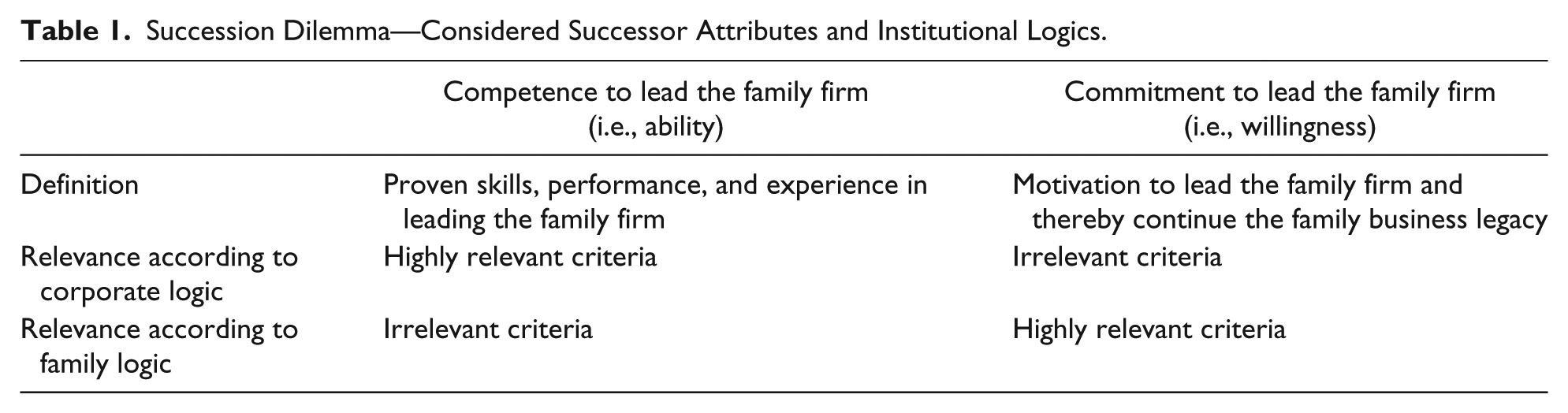
To theoretically and empirically isolate under which conditions incumbents perceive either competence or commitment as the more important characteristic among family succession candidates, we explore variations among incumbents’ preference for two stereotypical types of family successors: (1) a highly committed child who has a high level of commitment to the firm but only moderate competence and (2) a highly competent child who has a high level of competence but only moderate commitment to the firm. 2 In other words, each of the two stereotypes perfectly fulfills one of the criteria of the “ability versus willingness dilemma” and deviates from the ideal successor with regard to the other criteria, as outlined in Table 1.
Succession Dilemma—Considered Successor Attributes and Institutional Logics.
To move toward a refined understanding of how incumbents solve this decision-making dilemma and of the factors that drive their preferences, we build on institutional logics literature. Institutional logics are distinct forms of rationality that form a framework within which reasoning and decision making of individuals take place (Lounsbury, 2007). Friedland and Alford (1991) argue that fundamental institutions in society, such as the corporation and the family, engender logics through which individual role identities and goals are constructed (Thornton et al., 2012). The attention to certain role identities and goals, in turn, affects individual preferences (Coleman, 1994). As such, the institutional logics literature provides the theoretical framework to explain and predict how different contextual factors shape individuals’ attention and subsequent decision-making in the context of the willingness versus ability dilemma that might occur in family successions.
While various institutional logics exist, two salient logics that have been intensively discussed by prior literature might be particularly relevant when investigating the succession dilemma: corporate logic (Fairclough & Micelotta, 2013) and family logic (Friedland & Alford, 1991). The principles of corporate logic emphasize merit-based promotion and direct attention to firm size, growth, profit, and market position (Thornton et al., 2012). In contrast, family logic is “associated with notions of community and unconditional loyalty to family members” (Friedland & Alford, 1991, p. 248). Various scholars emphasize that family reputation (cf. Deephouse & Jaskiewicz, 2013), honor, and security (Thornton, 2004) are further essential components of family logic, which has also been said to be one of “nurturing, generativity, and loyalty to the family” (Miller et al., 2011, p. 4).
Institutional logics is an appropriate theoretical lens through which to study decision-making dilemmas, as the contradictions resulting from coexisting institutional logics (Reay & Hinings, 2009) often lead to severe challenges in organizational decision making, as evidenced by research on strategic responses to institutional complexity (Greenwood et al., 2011). While different logics can complement each other and be fruitfully combined under certain circumstances, research shows that especially the logics of the family and of the corporation are often contradictory, as “their respective systems of meaning and normative understandings, built into rituals and practices, provide inconsistent expectations” (Greenwood et al., 2011, p. 321).
An emergent yet vibrant research stream seeks answers to the question of how individuals respond to competing institutional demands (Pache & Santos, 2013). Extant studies thereby assume that individual actors are either promoters or opponents of a logic (e.g., Pache & Santos, 2010), mostly dependent on their professional experience (Almandoz, 2014; McPherson & Sauder, 2013). To understand how individuals themselves combine rival institutional logics (Binder, 2007), Thornton et al. (2012) acknowledge that individuals can have multiple, diverging role identities, such as being “family nurturer” according to family logic and “CEO” according to corporate logic. Which role identity is activated in a particular situation depends on the individual’s attention to the specific logic (Pache & Santos, 2013; Thornton et al., 2012). Attention, in turn, is shaped by the accessibility of each logic as well as by salient situational stimuli (Thornton et al., 2012; Thornton & Ocasio, 2008).
Accessibility refers to whether individuals are familiar with and identify with a particular logic (Pache & Santos, 2013) and is defined by how easily the role identities and goals associated with the respective logic come to an individual’s mind (Pache & Santos, 2013; Thornton et al., 2012). Accessibility thus depends on the degree to which individuals are embedded within an institutional logic through education, experiences, and cultural environment (Fairclough & Micelotta, 2013; Thornton et al., 2012). For instance, Zellweger, Richards, Sieger, and Patel (2015) find that the accessibility of market logic increases with higher levels of education at the individual level, which renders cues from family logic less salient. Given those arguments from prior work, we thus suggest in ours that logic accessibility, stemming from individual past experiences (Hypotheses 1 and 2), education (Hypothesis 3) (Pache & Santos, 2013), and cultural environments (Hypothesis 4; Fairclough & Micelotta, 2013) affect the incumbent’s attention to either family or corporate logic.
In addition to accessibility, salient situational stimuli have also been argued to affect the actor’s attention to certain logics and the role identities and goals therein (Thornton et al., 2012). Such salient stimuli arise if individuals find themselves in unexpected or concerning situations to which they must respond (Ocasio, 2011). Accordingly, nonroutine organizational events, such as unsatisfactory performance, constitute salient situational stimuli that trigger individuals’ attention to a certain institutional logic (Hoffman & Ocasio, 2001; Nigam & Ocasio, 2010). In our study, we argue that below-average performance (Hypothesis 5) is an important situational stimulus that enhances the salience of corporate logic and, thus, affects the outcome of the succession dilemma.
Hypotheses Development
In the following, we will first introduce how four characteristics of the incumbent and his or her environment foster logic accessibility and salience. We theorize how these four characteristics, as well as one salient situational stimulus, will focus the incumbent’s attention on either the corporate or the family logic and, in turn, increase the preference for certain successor characteristics. Our arguments are built on the premise that the high accessibility and salience of family logic should lead to a prominent concern for commitment, that is, a willingness to run the family business, and thus, a relative preference for the more committed successor. In contrast, the high accessibility and salience of corporate logic should lead to a pronounced concern for competence, that is, the ability to run the family business, and thus, a relative preference for the more competent successor. Figure 1 summarizes the theoretical framework of this study.
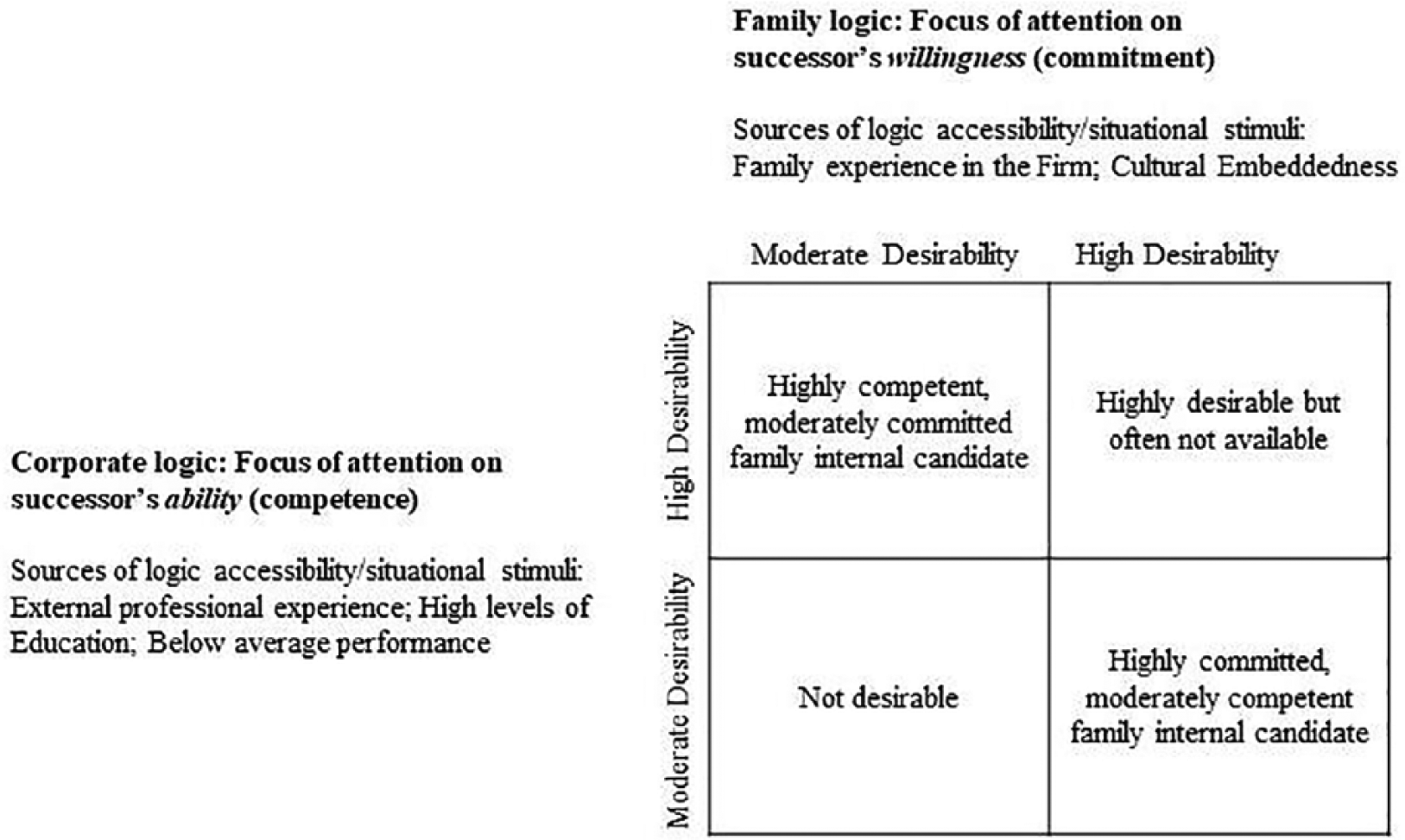
Within-family succession dilemma.
Professional and Family Experience
Family Involvement in the Firm
The accessibility of family logic is likely to depend on the incumbent’s experience with family dynamics. Past research has indicated that individuals learn about family logic through personal experience from living, working, and socializing with their family members (Berger & Luckmann, 1967; Glaser et al., 2016). We argue that the more family members are active in the management of the firm, the more family dynamics inherent in family logic (Thornton et al., 2012) will affect incumbent decision-making. If family influence in the firm is high, the legitimacy of the incumbent does not primarily derive from business growth but from fulfilling different needs of various family members (Miller et al., 2011). As such, the most important social constituents are the numerous family members (Miller et al., 2011) who are likely to demand stable incomes, long-term security, and control over the firm (Morck, Wolfenzon, & Bernard, 2005; Schulze, Lubatkin, Dino, & Buchholtz, 2001). Thus, in such situations, decision makers likely prefer a successor who is loyal to the family over a corporate-oriented succession candidate. Personal attitude, dedication, and the cultural fit between the CEO, the firm, and the family are valued higher than the individual’s sole competence because the future leader of the firm is not only required to be “CEO” in a corporate sense but, in particular, a “family nurturer” (Miller et al., 2011) who secures the well-being of the numerous family members and future generations. Given reciprocity norms prevailing in the family (Long & Mathews, 2011), the committed successor is likely to care about the various interests of family stakeholders and to preserve the family’s legacy. In contrast, the competent successor’s lack of dedication and loyalty toward the firm as an important familial asset might be seen as a threat to familial employment, demands, and harmony. The more members of the family are active in the management of the firm, the more salient and powerful is the family as a stakeholder enhancing the accessibility of family logic and leading to a stronger preference for the highly committed successor over the highly competent one. In other words,
External Professional Experience
Initial research exploring institutional logics at the individual level has emphasized that professional experience influences which logics an individual promotes. As such, individuals are regarded as carriers of certain institutional logics based on their professional experience (Almandoz, 2014; McPherson & Sauder, 2013). Moreover, other important research focusing on individuals and their decision making, such as upper echelons theory (Hambrick & Mason, 1984), has also argued that an individual’s professional experience shapes his or her sense-making and, consequently, strategic decision-making (Chattopadhyay, Glick, Miller, & Huber, 1999).
We argue that the time that a family firm incumbent has spent working outside the family firm affects which institutional logics are most accessible to him or her. If incumbents can look back on a long professional career outside their own firms, they are more inclined to identify with the corporate logic, as they are more familiar with the rules of the game in the corporate world. Working outside the family business is typically associated with passing through a (more or less) professional application procedure, being hired based on (potential) talent, and periodically being evaluated based on business-related successes (Lazear & Rosen, 1979). Accordingly, business-related aspects dominate in such contexts and are of crucial importance for promotion and compensation. The longer the incumbent has worked in such a corporate environment and had to prove her- or himself in it, the more she or he has likely adopted a merit-based mind-set (Lubatkin, Lane, Collin, & Very, 2007). With such a merit-based mind-set, an incumbent is likely to focus on the corporate premises of a successor, notably her or his competence to increase firm profits or stimulate growth and promote innovation (Thornton et al., 2012). The corporate logic predicts that this successor is to be chosen based on professional merit (Fairclough & Micelotta, 2013) instead of family criteria (Miller et al., 2011). Accordingly, incumbents with extended professional experience outside their own firms are more inclined to compartmentalize (Pache & Santos, 2013) family logic to domestic life and corporate logic to professional life and therefore try to find the successor best suited for this corporate leadership position irrespective of family aspects such as loyalty and commitment to the familial legacy. A lack of high competence would be perceived as a threat to the firm’s performance because it would impede growth. We hence argue that the longer incumbents have been shaped by corporate-focused experiences in occupations outside their own family firm, the more they prioritize a successor’s level of competence. Thus,
Incumbent’s Education
In addition to personal experience, education is expected to influence the accessibility of certain logics (DiMaggio & Powell, 1983; Pache & Santos, 2013; Thornton et al., 2012), and thus, to define which role identities and goals come to mind when forming preferences about succession candidates. We argue that the incumbent’s level of education affects the accessibility to corporate logic because his or her knowledge of corporate logic is likely to be higher at higher levels of education. Moreover, as level of education increases, incumbents likely begin to downplay family-related aspects in the context of the family firm (Zellweger et al., 2015) and begin to consciously separate the business sphere from the family sphere (Dyer & Handler, 1994; Pache & Santos, 2013). One reason for this increased accessibility of corporate logic is that the commonly taught curricula at universities and business schools still mostly focus on shareholder maximization aspects (and thus purely business-related gains), thereby downplaying the role of other stakeholders such as family members in the business context. This increased accessibility to corporate logic makes incumbents focus on firm performance measures, notably firm growth, size, and market share (Almandoz, 2012). The underlying rationale is that the more incumbents are able to understand the underlying mechanisms of competitive markets and the more they have learned about corporate logic, the more they will be aware of business-related aspects and the more likely they will be to apply them in their own family business context. Moreover, higher levels of education will also provide them with stories and examples of economically successful peers who are consequently viewed as benchmarks. Accordingly, incumbents with higher levels of education are more likely to have role models than their less educated peers (Bosma, Hessels, Schutjens, Van Praag, & Verheul, 2012), which, in turn, motivate them to further push the boundaries of their firms and make them aim to achieve even more economically ambitious goals. This line of argumentation is consistent with prior research as, for instance, DeTienne and Cardon (2012) revealed that incumbents with higher levels of education pursue more aggressive financial goals compared with their less educated peers. Increased attention to corporate logic will lead an incumbent to prefer a candidate with high levels of competence because such a successor raises the chances that the business will flourish and grow and, hence, that business-related gains will be realized. Thus,
Cultural Embeddedness in the Family Logic
Next to personal factors, notably education and experience, we argue that wider cultural embeddedness is an important source of logic accessibility, and thus, affects incumbents’ succession preferences by rendering familial goals more or less salient. Various scholars proposed to enrich the vast literature on institutional logics with comparative analyses of institutions across societies (Peng & Jiang, 2010; Zhang & Luo, 2013) in order to understand the role of the cultural context in determining the influence of institutional logics (Ansari, Wijen, & Gray, 2013; Young, Peng, Ahlstrom, Bruton, & Jiang, 2008). In particular, the role of family logic seems to vary significantly across cultural boundaries (e.g., Bhappu, 2000; Fairclough & Micelotta, 2013; Greenwood, Díaz, Li, & Lorente, 2010).
In cultures with a strong orientation toward family values, individuals show higher levels of in-group solidarity and emphasize unconditional loyalty in network-based relations 3 (e.g., Bhappu, 2000; Fairclough & Micelotta, 2013; Greenwood et al., 2010). Moreover, the reputation and status of family businesses in society vary substantially across cultures. Cultures with a low orientation toward family values often have a rather negative attitude toward family firms (Fukuyama, 1996); hence, individuals in such cultures might emphasize the value of meritocracy and advocate the equality of all individuals with regard to professional careers. Individuals in cultures with a high emphasis on family values, however, often glorify the family, including its cohesion, values, and the consequent positive emotions. In such cultures, the appointment of committed family members to attractive job positions in the family firm is not only tolerated but even welcomed by society (Fairclough & Micelotta, 2013) and is likely to constitute an important goal of the incumbent. Thus, the successor’s commitment to the family firm is particularly important because a highly committed successor is less likely to quickly quit the managerial job, leading to longer tenure in the business and an increased chance for stability and long-term success. As a negative example, the former family CEO David Sainsbury, of the British retailer Sainsbury, lacked the necessary commitment to the firm and decided to pursue a different career only a few years after his appointment. Based on the increased importance of commitment, we argue the following:
Below-Average Performance
In addition to logic accessibility, situational stimuli play an important role in directing individuals’ attention (Ocasio, 2011) to either family or corporate logic. Nonroutine organizational events are said to comprise highly salient situational stimuli that trigger attention (Hoffman & Ocasio, 2001; Nigam & Ocasio, 2010). Below-average performance of the firm comprises such a salient organizational event and various researchers have found that family business incumbents act fundamentally differently when firm performance falls below aspiration levels (Chrisman & Patel, 2012; Gomez-Mejia et al., 2014). While family logic often dominates when a firm generates above-average profits, leading to somewhat conservative investment decisions (Chrisman & Patel, 2012) focused on stable cash flows (Miller et al., 2011), corporate logic gains in importance when performance drops below aspiration levels because family business incumbents fear losing not only their financial but also their socioemotional wealth if they do not obey the rules of business (Gomez-Mejia, Patel, & Zellweger, 2018). Incumbents have a strong desire to avoid such losses, especially because they are known to be emotionally attached to their firm (Zellweger, Kellermanns, et al., 2012), and thus, care about the firm’s well-being even after their departure (Davis & Harveston, 1999; DeTienne, 2010; Kammerlander, 2016). Accordingly, family businesses were found to be more focused on enhancing the firm’s size, profits, and market shares when performance was unsatisfactory (Chrisman & Patel, 2012; Gomez-Mejia, Makri, & Kintana, 2010). Consistent with these previous findings, we argue that below-average profits raise incumbents’ awareness that they must select the most suitable candidate according to corporate criteria to secure the firm’s survival through performance improvements. During “rainy days,” the candidate’s competence is key for the incumbent because she or he needs someone who is able to lift the firm out of a crisis (Castrogiovanni, Baliga, & Kidwell, 1992). To summarize, and in line with institutional logics’ reasoning of situational stimuli, we thus suggest that below-aspiration firm performance will bring the business logic to the fore (i.e., focus on competence). In pondering over the most appropriate successor under these circumstances, we thus expect the following:
Method
To test our hypotheses, we used policy capturing. Policy capturing blends characteristics of experimental and survey designs by asking respondents how they would act in a hypothetical but realistic scenario (Connelly et al., 2016; Priem, Walters, & Li, 2011). Accordingly, we combined elements of surveys with those of between-subject, survey-based experiments (e.g., Mullins & Forlani, 2005). Survey responses were used to identify demographics of the incumbent, such as professional experience or education as well as information on family involvement in the firm and the cultural embeddedness (Christen et al., 2013).
The desirability of the succession options was captured by means of a brief case vignette (e.g., Aguinis & Bradley, 2014; Hatak & Roessl, 2015; Raaijmakers, Vermeulen, Meeus, & Zietsma, 2015) with a decision scenario placing the responding incumbent in the situation of her or his retirement from the firm and asking to indicate the desirability of different succession candidates. A case vignette allows for the manipulation of focal variables (here, performance) while retaining contextual realism (Raaijmakers et al., 2015), which ensures that findings have good internal validity and are free of retrospective biases (e.g., Finch, 1987; Hughes, 1998). Case vignettes have been found to be a particularly fruitful method for studying complex trade-off situations (Fritzsche & Becker, 1984), such as family firm successions.
We collected responses from owner-managers of small- to mid-sized Swiss family businesses with fewer than 250 employees. In a first step, we purchased the addresses of 36,699 randomly chosen CEOs of Swiss SMEs (small- and medium-sized enterprises) using the D&B database. We approached those individuals with a physical questionnaire that was prepared in German, French, or Italian, depending on the recipient’s postal code. We collected 2,362 completed surveys over a 7-week data-collection period. Before conducting our analyses, we excluded responses that met any of the following criteria: (1) respondent was not an owner-manager (e.g., an employee) and thus did not belong to the targeted group of respondents, (2) company did not qualify as an SME, (3) company did not qualify as a family firm (i.e., negative answer to the survey question whether respondents perceive their firm as a family firm), and (4) missing information on the dependent variable. After this adjustment, our sample contained 1,438 responses. Because we excluded cases with missing observations for our control and independent variables, the final regression model contains 1,060 responses.
Design
The family firm incumbents were asked to imagine their retirement from the firm and to indicate the desirability of each of the three following candidates 4 : (1) a highly committed yet moderately competent child, (2) a moderately committed yet highly competent child. For the purpose of post hoc tests we also included (3) a highly committed, highly competent family-external successor (nonfamily candidate). The first two candidates represent the two archetypal successor stereotypes that were introduced and explained in the theory part of the article. They represent the desired characteristics of the ability versus willingness dilemma (“competence” and “commitment”) to varying degrees.
To capture the effect of firm performance on the desirability of succession candidates, we applied manipulation techniques: The case vignette included one sentence describing the firm’s recent performance. One randomly chosen half of the recipients of our survey were told about superior firm performance, whereas the other half were told about inferior firm performance. We decided on a manipulation of this variable instead of asking for the actual family firm performance since the manipulation approach ensures that findings have good internal validity (e.g., Finch, 1987; Hughes, 1998). In other words, incorporating firm performance as a manipulation into the case vignette allowed us to isolate the effect of this environmental stimulus and leave it undisturbed by other, potentially confounding effects such as the entrepreneurial ability of the incumbent or industry characteristics.
We derived the other independent variables from survey responses, such as external professional experience, number of family members in management, level of education, and embeddedness in a family-oriented culture. We chose to rely on survey responses for these variables to increase the external validity of our experimental design, which is often a problem when this method is used. Manipulating personal variables such as exposure to a family-oriented culture or level of education is precarious because it is questionable whether individuals can truly remove themselves from their real characteristics and cultural surroundings and respond to the vignette in an unbiased way.
To ensure realism, we collaborated with practitioners and industry experts to carefully word the case vignette such that it seemed plausible to the incumbents, that it was related to their personal experiences and that the stereotypes were presented in the intended way (Connelly et al., 2016; Finch, 1987; Raaijmakers et al., 2015; see the appendix).
Measures
Dependent Variable
Preferences for the highly committed, moderately competent child over the moderately committed, highly competent child
Following the description of the case vignette that included the presentation of the successor stereotypes, each respondent indicated a desirability score on a 5-point scale for each of the successor stereotypes (with “0” indicating that the respondent is unlikely at all to choose this candidate and “4” indicating a high likelihood of choosing this candidate). To capture the willingness versus ability succession dilemma and run our calculations, we subsequently subtracted the score of the moderately committed yet highly competent child from the score of the highly committed yet moderately competent child. The resulting value served as the dependent variable in an ordinary least squares (OLS) regression analysis.
Independent Variables
Professional and family experience
For external professional experience, we asked respondents in the survey to indicate how many years they have worked outside their own firm. To capture family experience, we asked respondents to indicate the number of family members in top management positions working for the family firm. 5
Level of education
We asked respondents to indicate their highest achieved level of education. Potential answers were adapted to the Swiss education system and included: 0 = no school-leaving certificate; 1 = high-school diploma; 2 = apprenticeship; 3 = master craftsman; 4 = bachelor’s degree; 5 = master’s degree; 6 = PhD/doctoral degree.
Culture
We also captured the family focus of the culture in which the respondent is embedded. In Switzerland, three different cultures coexist: the Italian culture (in the Southern part of Switzerland), the French culture (in the Western part of Switzerland), and the German culture (in the Eastern part of Switzerland). Swiss cantons can be classified into one of those three cultures based on the dominant language in the respective canton. Following prior research (Fairclough & Micelotta, 2013), we assume that the Italian culture is more focused on family values compared with the German or French culture. This assumption is supported by several cross-country indices, such as the world value survey 6 and the global competitiveness report, 7 in all of which Italy scores predominantly high for family values, whereas Germany and France score relatively low. Thus, to test for the effect of being embedded in a culture oriented toward family values, we included a dummy variable indicating whether the respondent’s postal address is within the Italian part of Switzerland (1 = yes), which acts as an independent variable.
Below-average firm performance
The independent dummy variable firm performance was manipulated as part of the case vignette. We randomly assigned half of the surveys to a scenario in which firm performance was presented as “above average.” The other half was assigned to a scenario in which firm performance was presented as “below average.” Hence, we used a dummy variable (“1” for the above- and “0” for the below-average performance) as an independent variable for firm performance.
Control Variables
We controlled for several factors that might further affect respondents’ preferences, which we captured via the questionnaire. First, we included a dummy variable for respondents’ gender (“0” for female), since men and women have been argued to differ in their communal orientation, which may shift preferences in the succession dilemma (Rudman & Glick, 2001). We also controlled for respondents’ age (in years). Accounting for respondents’ age seemed particularly important in our context because older incumbents were more likely to consider and plan for their retirement from the firm compared with younger incumbents. Moreover, the number of children in the incumbent’s nuclear family seemed to be relevant in our context because the more children the incumbent has, the more prevalent and important family-related motivations might become. Next, it seemed important to account for incumbents’ personal experience, expectations, values, and beliefs because those factors might crucially influence their exit, and thus, also the desirability of different successors (DeTienne & Cardon, 2012; DeTienne, McKelvie, & Chandler, 2015). Accordingly, we included whether the respondents attribute high importance to the role of “values and norms” (“1” for yes) and “financial aspects” (“1” for yes) in the business context, and we controlled for the incumbents’ entrepreneurial experience outside the family firm (number of years working in own start-ups other than the family firm).
Because our case vignette remained scarce regarding firm-specific characteristics, we suspected that respondents might project key characteristics of their own firm onto the case vignette. We thus included firm-level variables—firm size (full-time employees), whether the firm is a founder or a later-generation family firm (“1” for founder firm), and industry (dummy variable distinguishing manufacturing [“0”] from the service sector [“1”]). We also expect that the size of the leadership team affects incumbents’ succession strategy (DeTienne et al., 2015), and thus, controlled for the size of the family firm’s top management team. Last, to capture further nuances in the cultural background of our respondents, we included another dummy variable for respondents who are embedded in the French cultural background (“1” for French cultural background).
Results
Descriptive Analysis
The correlation matrix and descriptive statistics for all variables included in our model are shown in Table 2. Overall, there are only low-to-medium correlations between the variables. On average, respondents are 53 years old and have two children. Fifty percent of the family firms in the sample are still founder-controlled and the family firms have on average a workforce of 35 employees.
Descriptives.
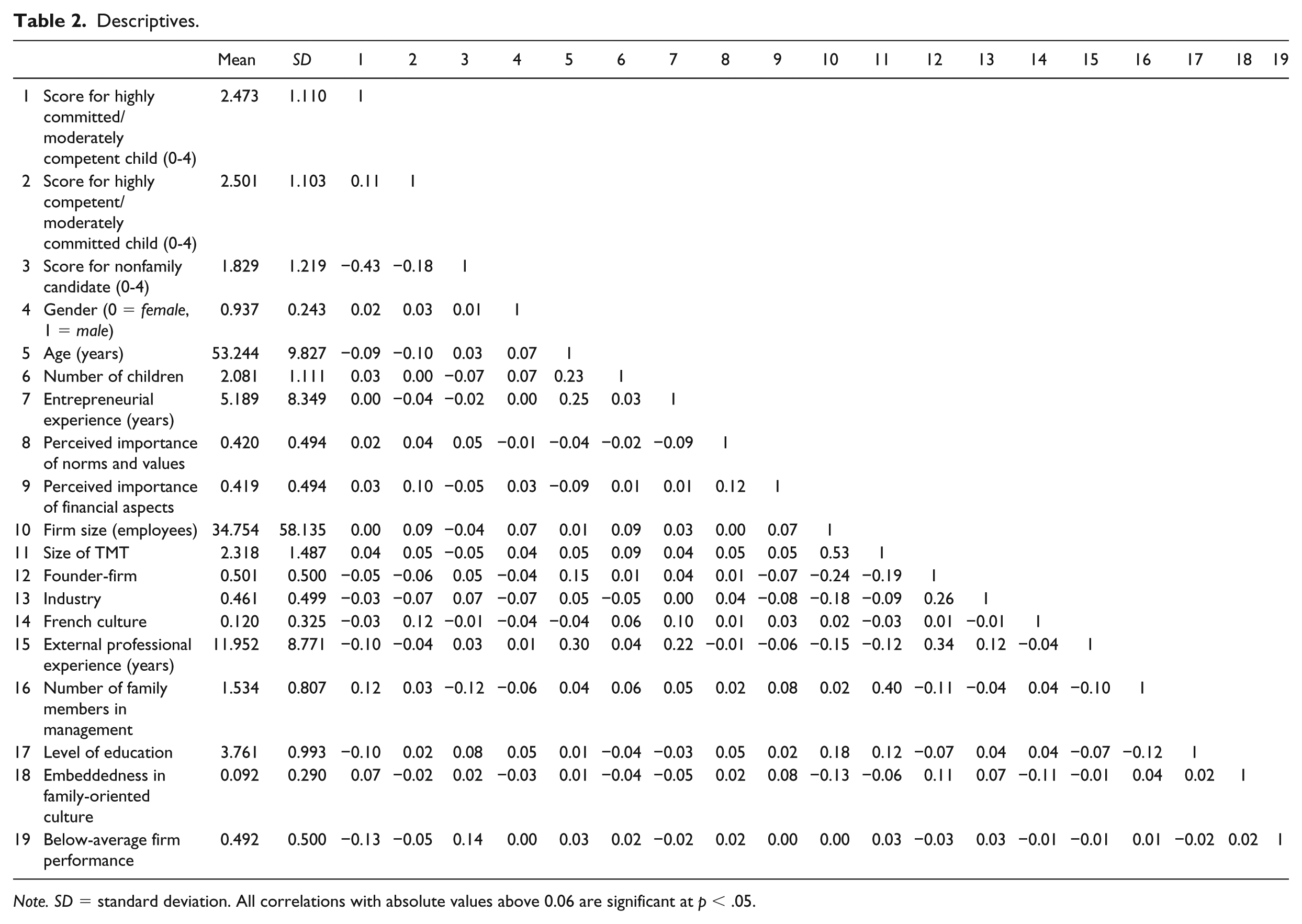
Note. SD = standard deviation. All correlations with absolute values above 0.06 are significant at p < .05.
The frequency analysis depicted in Table 3 reveals descriptive insights into the incumbents’ desirability scores. Overall, incumbents seem to find family members more desirable candidates than the nonfamily candidate, even if they lack either outstanding competence or outstanding commitment to the family firm: The mean desirability scores for both the highly committed and the highly competent child are significantly higher compared with the score for the nonfamily candidate (Table 3, Panel A). The mean difference between the desirability scores given to the family candidates, however, is not significantly different from zero, which indicates that incumbents in general do not clearly prioritize competence over commitment to the family firm or vice versa. This unclear preference supports the notion that there is a “willingness versus ability succession dilemma” and motivated us to focus on family members as candidates in our main theoretical and statistical analysis. In general, 25% of our respondents clearly favor the highly committed yet moderately competent child, 23% clearly prefer the highly competent yet moderately committed child, and 17% assign the nonfamily candidate their highest desirability score. Of our respondents, 35% are somewhat undecided and thus indicate the same desirability score for at least two of the candidates (Table 3, Panel B). Table 3 also indicates that the desirability of the nonfamily candidate increases if the firm’s profit is below average (Table 3, Panel C). We investigate the desirability of the nonfamily candidate in a post hoc test.
Frequencies of Preference Scores.
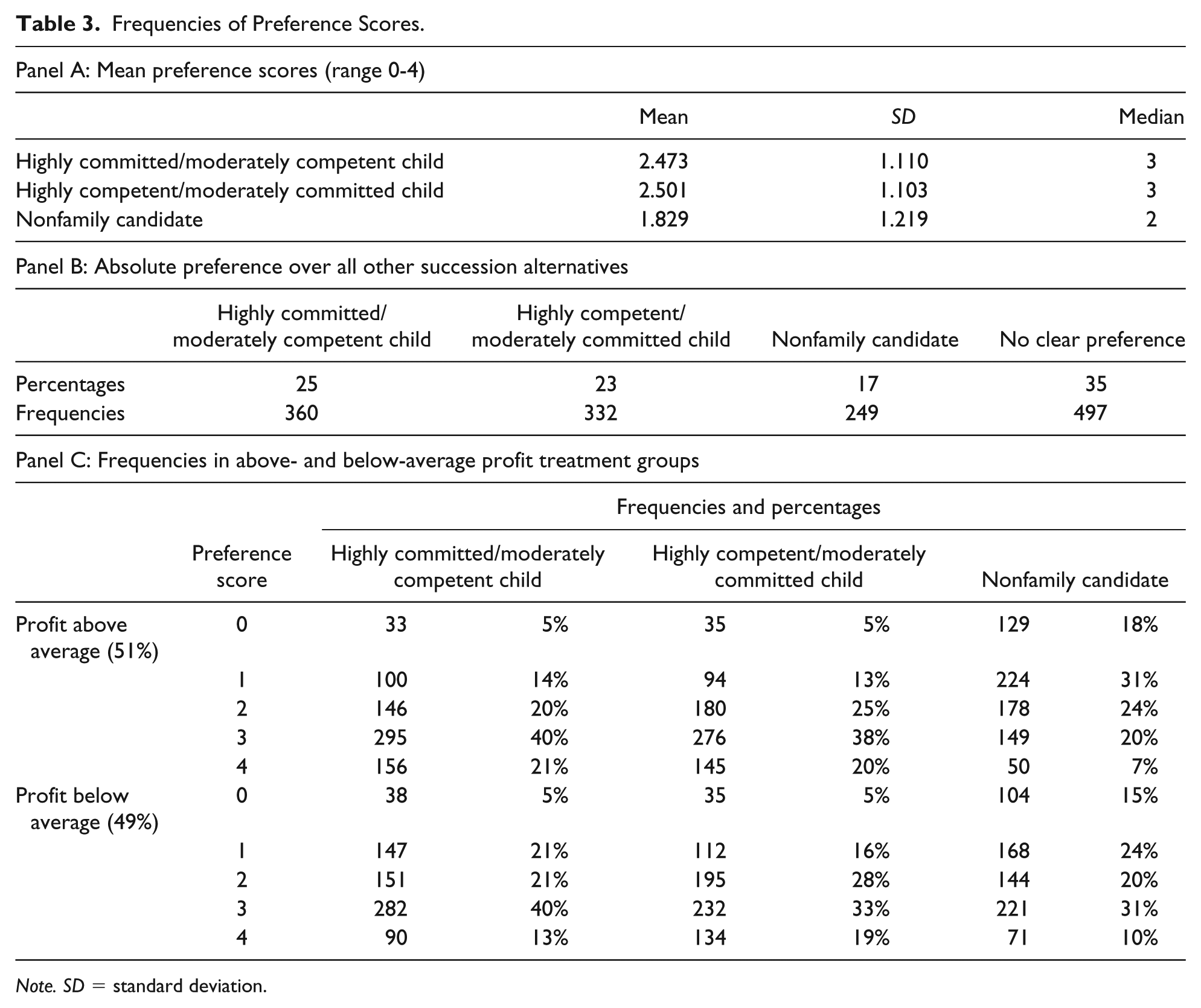
Note. SD = standard deviation.
Tests for Data Quality
To explore the possibility of nonresponse bias, we compared the data obtained from early and late respondents using analysis of variance. This test is based on the assumption that late respondents are more similar to nonrespondents than early respondents are (cf. Chrisman, Chua, & Litz, 2004; Oppenheim, 1966). No statistically significant differences were found for any of the variables analyzed in this study, which, at least partially, mitigates nonresponse concerns.
Because both our dependent and independent variables were collected from the same respondents using the same survey, one might argue that common method variance could be a concern. However, we minimized common method variance in two ways. First, for the independent variables, we relied on fact-based measures (Tourangeau, Rips, & Rasinski, 2000), for instance, the degree of education and the number of family members in management, and we avoided psychological and behavioral constructs that tend to be more strongly affected by common method variance (Chang, van Witteloostuijn, & Eden, 2010). Second, although we relied on a single survey, we separated it into two distinct sections. The clear separation between respondents’ personal- and firm-related information on one hand and the case vignette on the other hand further reduced the likelihood of common method variance because respondents could not make reasonable assumptions about the studied relationships (Podsakoff, MacKenzie, Lee, & Podsakoff, 2003).
To further scrutinize whether common method variance is a concern in our study, we completed two sets of commonly applied post hoc tests. First, a Harman’s (1967) single-factor test, as suggested by Podsakoff and Organ (1986), was conducted. The first factor explained only 15.33% of the variance, which provides initial evidence that common method bias was not a major problem because no single factor accounted for the majority of the variance. Second, we used Lindell and Whitney’s (2001) method, in which the correlation matrix is corrected by the correlations of the dependent variables and a marker variable. Those additional tests (detailed results are available from the first author) support the assumption that the data are not distorted by common method bias.
Furthermore, we addressed potential multicollinearity issues by calculating the variance inflation factor and found that the factor did not exceed 1.80. Thus, multicollinearity did not appear to be a concern (Hair, Black, Babin, Anderson, & Tatham, 2006).
Regression Results
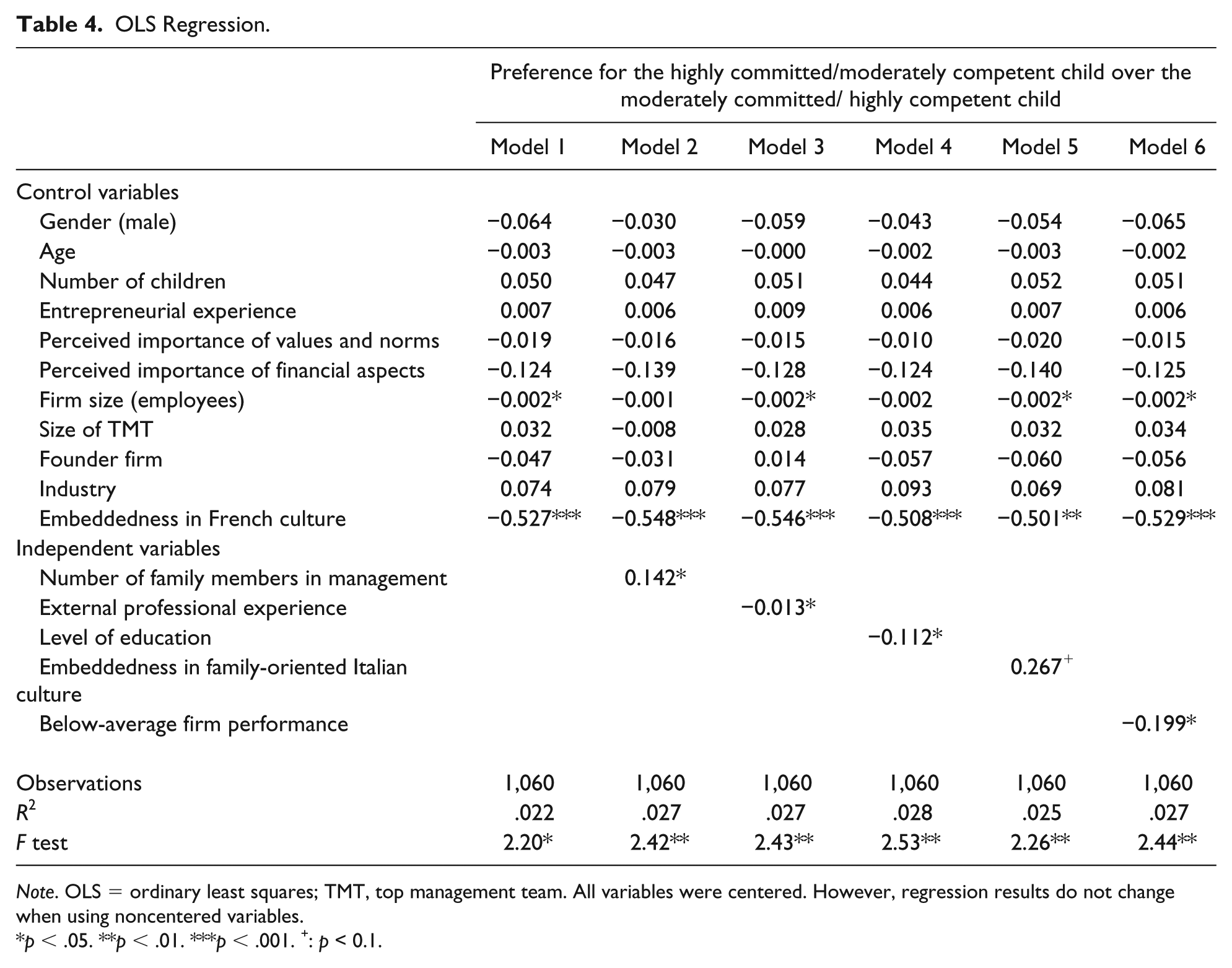
To test our hypotheses, we estimated an OLS regression with the individuals’ preferences for the highly committed child over the highly competent child as the dependent variable. Table 4 shows the regression results. Model 1 in the regression only includes control variables. Subsequently, independent variables are added in Models 2 to 6.
OLS Regression.
Note. OLS = ordinary least squares; TMT, top management team. All variables were centered. However, regression results do not change when using noncentered variables.
p < .05. **p < .01. ***p < .001. +: p < 0.1.
Model 1 reveals that firm size significantly decreases the preference for the highly committed child over the highly competent child (β = −0.002; p < .05). Moreover, embeddedness in the French speaking culture decreases the preference for the highly committed child over the highly competent child (β = −0.527; p < .001). In Model 2, in support of Hypothesis 1, the number of family members in management significantly increases incumbents’ preferences for the highly committed child over the highly competent child (β = 0.142; p < .05). Moreover, in Model 3, the professional experience of the incumbent significantly decreases the preference for the highly committed child over the highly competent child (β = −0.013; p < .05), as predicted by Hypotheses 2. Supporting Hypothesis 3, higher levels of education of the incumbent significantly decrease the preference for the highly committed child over the highly competent child (β = −0.112; p < .05; see Model 4). As predicted by Hypotheses 4, being embedded in a family-focused Italian culture increases incumbents’ preference for the highly committed child over the highly competent child, yet our findings fail to reach the commonly accepted thresholds for significance (β = 0.267; p < .1). Last, below-average performance significantly decreases incumbents’ preferences for the highly committed child over the highly competent child (β = −0.199; p < .05), supporting Hypothesis 5.
Post Hoc Test
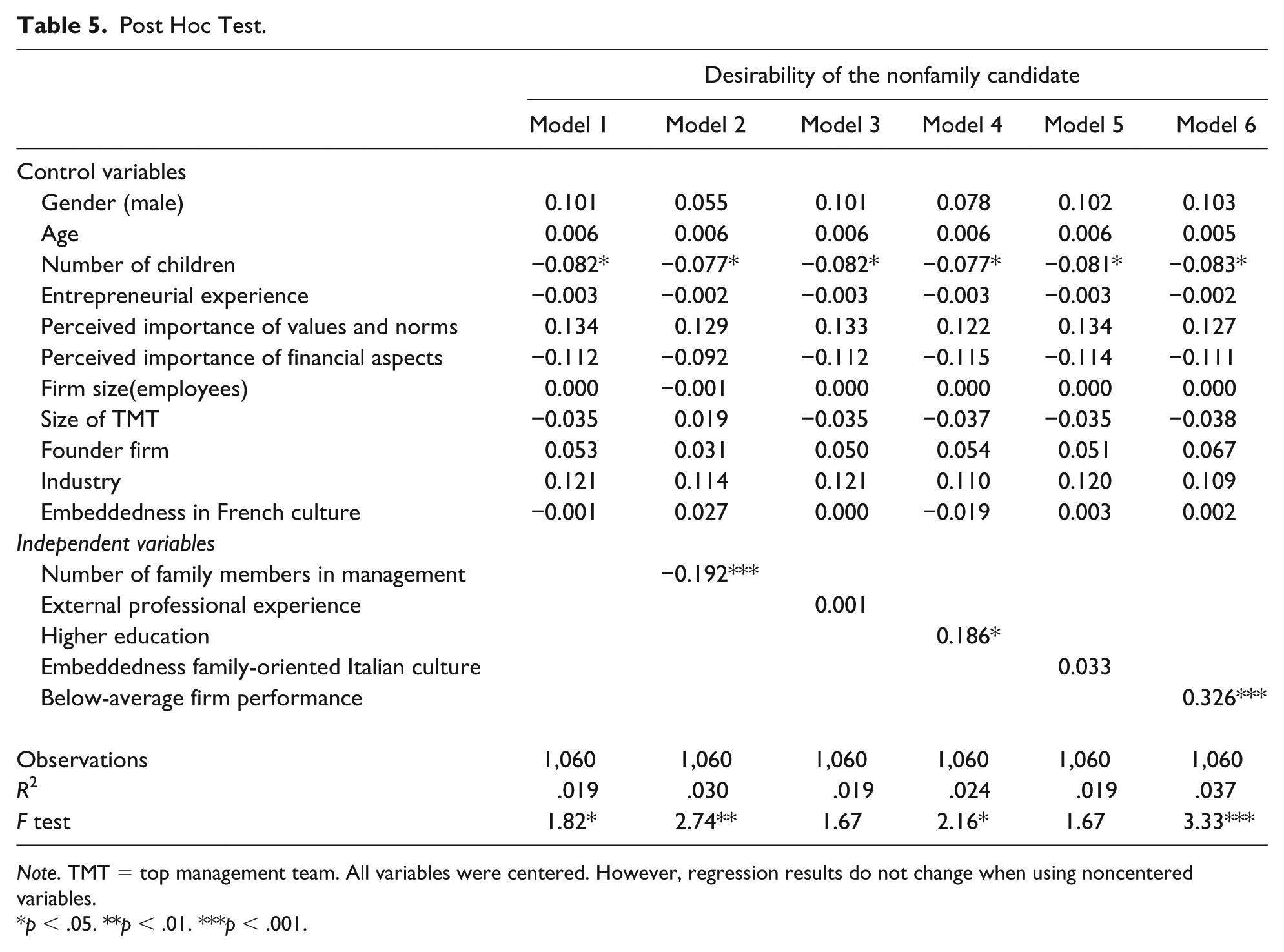
In a post hoc test, we explored how the independent variables of this study affect the desirability of the nonfamily succession candidate who is both highly willing and highly able to take over the firm. We did so by estimating an OLS regression with the desirability score that the respondents assigned to the highly committed, highly competent nonfamily candidate as dependent variable. 8 We find that the number of family members in management significantly decreases the desirability of the nonfamily candidate (β = −0.192; p < .001). We expect that this is the case because incumbents who have family exposure in their daily business life are more likely to invoke family logic, which favors family members as successors. Conversely, and in line with our core arguments, the level of education (β = 0.186; p < .05) and below-average performance (β = 0.326; p < .001) increase the desirability of the nonfamily candidate, as shown in Table 5.
Post Hoc Test.
Note. TMT = top management team. All variables were centered. However, regression results do not change when using noncentered variables.
p < .05. **p < .01. ***p < .001.
Discussion
The exit of the incumbent entrepreneur constitutes a critical incident for family firms (Wennberg, Wiklund, Hellerstedt, & Nordqvist, 2011). When exiting the firm, incumbents typically strive to keep their “baby” in the hands of the family (Cardon, Zietsma, Saparito, Matherne, & Davis, 2005; Zellweger, Kellermanns, et al., 2012). However, family successions are highly complex processes, as prior literature reveals (e.g., Nordqvist et al., 2013). Such complexity in part arises because incumbents must often compromise on successor competence or commitment. Incumbents thus face what we label a willingness versus ability succession dilemma, and thus, must choose between succession candidates who exhibit suboptimal levels of commitment or competence to run the firm. Our study explores how incumbents solve this succession dilemma.
To do so we draw from institutional logics arguments and study how sources of logic accessibility (i.e., external professional management experience, educational attainment, number of family members in management, as well as cultural embeddedness of the incumbent) and situational stimuli (such as performance shortfall at the firm level) elicit family or corporate logic (cf. Greenwood et al., 2010; Miller et al., 2011) and thus help incumbents solve the succession dilemma. In essence, we find that those sources of logic accessibility and salient situational stimuli that belong to family logic lead to a prominent concern for commitment, that is, willingness to run the family business, and thus, a relative preference for the more willing and less able successor. In contrast, sources of logic accessibility and salient situational stimuli associated with corporate logic lead to a pronounced concern for competence, that is, ability to run the family business, and thus, a relative preference for the more able and less willing successor.
Contributions to Family Business Succession Literature
Our study contributes to the family business succession and entrepreneurial exit route literatures (e.g., De Massis et al., 2008) by exploring preference formation among family succession options (e.g., Lee et al., 2003), in contrast to numerous studies that have explored family versus external succession routes (e.g., Dehlen et al., 2014; Wiklund et al., 2013; Zellweger et al., 2011). Using an institutional logics perspective (Friedland & Alford, 1991; Greenwood et al., 2011; Thornton et al., 2012), our article aims to predict incumbents’ succession preferences, which crucially offers insights into individual entrepreneurs’ rationales for choosing certain successors. Although initial research has begun to identify contextual (De Massis et al., 2008) and relational factors (Dehlen et al., 2014), the individual-level sense-making at the incumbent entrepreneur about colliding logics of “head” and “heart” in the context of successions thus far remains little understood. Even though much has been written about “willingness versus ability” dilemmas in family firms in general, related empirical work is rather limited. While much literature has emphasized the difficulties in finding the best successors, surprisingly, no study to date has investigated trade-offs between willingness and ability in successor choice. This is surprising because family business scholars have otherwise placed great emphasis on understanding the trade-offs caused by opposing corporate/economic and socioemotional demands (e.g., Chrisman & Patel, 2012; Gomez-Mejia et al., 2018).
Our results indicate that, a priori, incumbents have no clear preference for able or willing family successors. We find that to solve the succession dilemma, sources of logic accessibility and stimuli stemming from corporate logic are critical, notably the incumbents’ professional experience outside their own firms, degree of education, and below-average firm performance, which help incumbents overcome the dilemma by encouraging a preference for ability over willingness.
Our findings also provide empirical support for the importance of cultural context in succession decisions. While our results for the Italian cultural background fail to reach generally accepted significance levels, we find that in French-speaking regions a competent family successor is preferred over the committed family candidate, a result that points in the opposite direction than the one we found for incumbents with Italian backgrounds. These results are consistent with Fairclough and Micelotta’s (2013) findings on the predominance of the familial norm of unconditional loyalty within a family-oriented culture thereby forgoing eventual benefits from proficiency. We transfer those arguments to the context of successions and suggest that exploring such effects contributes to the succession as well as the institutional logics literature that so far have paid only limited attention to the role of culture (Bhappu, 2000; Fairclough & Micelotta, 2013).
We further argue and find empirical support that below-average performance constitutes a salient situational stimulus that directs attention (Ocasio, 2011; Thornton et al., 2012) to corporate principles, and thus, is an important driver of incumbents’ attitude toward family succession candidates (cf. De Massis et al., 2016; Schickinger, Leitterstorf, & Kammerlander, 2018). We theorize that a firm’s troublesome economic condition raises awareness among incumbents that they must focus on corporate rationality to remain competitive and ultimately save the firm (Chrisman & Patel, 2012; Gomez-Mejia et al., 2014; Gomez-Mejia et al., 2018). Incumbents are more inclined to choose the succession candidate with the higher ability if performance drops below aspiration levels. The results of our study indicate that firm performance not only informs the choice between liquidation and sales as predicted by prior research on entrepreneurial exits (Wennberg, Wiklund, DeTienne, & Cardon, 2010) and emotionally driven discounts to the sales price (Kammerlander, 2016) when an entrepreneurial exit takes place but also who the preferred successor is.
Our descriptive results are revealing as well. The distribution of the mean preference scores and the absolute preferences across the three succession candidates (two family, one nonfamily; Table 3, Panels A and B) must be understood in light of the cultural background in which we collected our data: Switzerland. For instance, we find that 17% of the incumbents have an absolute preference for the nonfamily candidate, 48% have an absolute preference for a family candidate (25% vs. 23% for a more committed vs. a more competent child, without significant difference), and 35% have no clear preference. By investigating incumbents’ preference formation and not actual exits, our study thus reveals that family successors are indeed preferred and not only appointed due to a lack of alternative exit options (Van Teeffelen & Uhlaner, 2013). Moreover, these descriptive results are interesting since they reveal the relative importance of various succession routes. It appears to be an interesting opportunity for future research to contrast these Swiss results with results from other countries, ideally from other cultural contexts.
Contributions to Research on Institutional Logics
Our article also contributes to the body of literature on institutional logics (Durand & Thornton, 2018; Friedland & Alford, 1991; Thornton et al., 2012). In particular, we contribute to recent conceptualizations of logics’ microfoundations (Glaser et al., 2016; Pache & Santos, 2013; Thornton et al., 2012; Zilber, 2016) by exploring which sources of logic accessibility and salience influence individual attention and decision making when individuals are caught in a trade-off situation between opposing institutional demands (Ocasio, 2011; Thornton et al., 2012). Even though the microfoundations of institutional logics are widely acknowledged and regarded as essential within this research stream, most studies do not explore microlevel sense-making and decision making or investigate which factors render logics more accessible and salient, and hence, shape individual attention and action (Glaser et al., 2016; Powell & Colyvas, 2008; Thornton & Ocasio, 2008; Zilber, 2016). Our study seeks to contribute to closing this research gap by exploring the microfoundations of family and corporate logic in a family firm succession context (cf. Zellweger et al., 2015).
Shedding light on these microfoundations is particularly important, as individual attention and responses to institutional logics are likely to shape the identity of organizations (Pache & Santos, 2013) as well as the logic constellation in institutional fields (Goodrick & Reay, 2011; Waldorff, Reay, & Goodrick, 2013). Initial research at the individual level has primarily categorized individuals as carriers of certain institutional logics based on their professional experience (Almandoz, 2014; McPherson & Sauder, 2013). We extend these initial insights by exploring the effect of various important sources of logic accessibility (i.e., professional and family experience, level of education, cultural embeddedness) as well as salient situational stimuli (i.e., below-average profits) on the incumbents’ preferences for succession options that satisfy familial or corporate demands to varying degrees. Building on the notion that logic accessibility and salient stimuli direct individuals’ attention (Thornton et al., 2012), our study is among the first to explore empirically how individuals solve the dilemmas tied to the incorporation of rival institutional logics. We do so by shedding light on an important and highly complex practical phenomenon: family firm successions. Through our conceptual model, our study, thus, enhances the applicability of the institutional logics perspective in the family business context and speaks to the emerging research stream within the institutional logics literature exploring family firms (Greenwood et al., 2010; Jaskiewicz, Heinrichs, Rau, & Reay, 2016; Miller et al., 2011; Zellweger et al., 2015).
The diverging findings reported in Table 4 (assessing the preferences between two family succession candidates) versus the results reported in Table 5 (assessing the raw desirability score for the nonfamily candidate) are revealing for institutional logics literature as well. The results from Table 5 suggest that experience with the family logic, notably the incumbents’ number of children, acts against the preference for a nonfamily candidate but does not assist in resolving the family ability versus willingness dilemma (Table 4). This finding is interesting for the institutional logics literature as it suggests that the interpretation of signals is context specific.
Last, we contribute to the growing research stream focusing on experimental methods to provide insights into institutional theory in general and institutional logics in particular (Glaser et al., 2016; Raaijmakers et al., 2015; Zucker, 1977) by adopting a policy capture design. Such experimental designs are particularly fruitful in providing microlevel insights into institutional logics which other methods are unable to explore (Glaser et al., 2016). With our policy-capturing methodology, which relies on a case vignette as well as survey information, we provide a highly promising methodological approach with which to explore the microfoundations of institutional logics.
Practical Implications
Our study helps practitioners to understand what factors influence incumbents’ decision making if there is a trade-off between ability versus willingness in the succession context. Being aware of those influencing factors (i.e., number of family members in management, external professional management experience, educational attainment, cultural embeddedness, and performance shortfall) uncovers previously subconscious biases that, if left unspoken, can lead to severe frictions among different family members. This is because, each family member will have varying experiences and levels of education that affect how they view succession candidates, leading to conflicting opinions regarding who to choose as a successor. Pointing out these differences and discussing them is essential to appointing the “right” candidate for the family business and to safeguarding family harmony.
The insights from our study are also valuable to family business advisors (e.g., Strike, Michel, & Kammerlander, 2018) who tend to focus on the succession process in their offering but provide less guidance on how to evaluate succession candidates’ suitability. Here, it is essential not to blindly stress ability above all else but to be mindful of family-specific goals, such as securing familial harmony and long-term continuity, which, depending on the individual circumstances, will be of utmost importance, rendering the willingness of the succession candidate particularly important. Our study indicates that it is not necessarily irrational to appoint a highly committed but less competent succession candidate, as many business advisors would argue but can make perfect sense if family logic is particularly prevalent. Family logic focuses attention on successors’ loyalty to the family and its assets, which drives successors’ motivation to dedicate themselves fully to the firm and thus can be a great asset to the organization. In fact, a potential successor’s competence can be built, for example, through executive coaching, training, and membership in industry associations. However, successors’ commitment to the family and the firm is much less malleable through external intervention, and therefore, more difficult to change.
Limitations and Avenues for Further Research
As with any research, this study has several limitations. First, some researchers might argue that our insights reveal succession intentions in a described scenario instead of relying on actual leadership transfers. However, we contend that this research design provides several advantages because it enables us to isolate these preferences from other, undetected contingencies, such as the unavailability of successors with certain characteristics (Connelly et al., 2016). By relying on a scenario with carefully designed successor stereotypes, we can draw direct conclusions about the importance of several successor attributes to the incumbent, which would be nearly impossible to observe and tease apart in other research set-ups. Nevertheless, further studies should focus on whether and under what circumstances these preferences become reality. From a theoretical point of view, it would be interesting to combine insights from institutional theory with arguments of socioemotional wealth to better understand decision dilemmas in family firm succession.
Second, succession is an exceedingly complex process, as prior literature reveals (e.g., Nordqvist et al., 2013). Given the limits of a single study, we were able to select only some of the potentially important determinants of incumbents’ preferences, in particular those that have been indicated by prior research on institutional logics. However, we hope that our study lays the foundation for follow-up studies that scrutinize our findings and add further potential determinants. For example, future research could focus on firm performance in more detail, as our study shows that the effect of below-average performance is particularly strong. It would be interesting to investigate whether performance is able to supersede other factors that affect the desirability of a succession candidate, changing the overall decision outcome. Moreover, future research could replace our culture measure by directly asking respondents to indicate the importance of family in their region. Although deducting the prevalence of family logic through respondents’ embeddedness in different cultures based on language zones is in line with institutional theory, we acknowledge that the content validity of this measure might not be ideal, which in turn might explain why Hypothesis 4 was not supported.
It would also be interesting to vary the characteristics of the described succession stereotypes. For instance, we expect further interesting insights from including statements about the candidates’ prior work experience in the family firm, which may tilt the preference formation inside the “willingness versus ability” dilemma. Furthermore, factors referring to primogeniture or entrepreneurial ambition might be worth including in follow-up case vignettes. Moreover, it would be interesting to study preferences for candidates with high levels of firm-specific knowledge (i.e., firm insiders such as employees) versus high levels of industry-specific knowledge (e.g., experienced firm outsiders) (Kammerlander & Holt, 2018; Parker, 2016). Probing these additional factors should further increase the explanatory power of our models and ultimately our understanding of succession decisions. Moreover, future research could explore how respondents choose differently once the gender of the successor is taken into account (Schröder, Schmitt-Rodermund, & Arnaud, 2011; Vera & Dean, 2005). Furthermore, researchers might add an additional dimension of complexity, namely, the concurrent “ownership transfer” to scrutinize our findings. We also encourage follow-up studies that build on existing goal-scales of family firms (e.g., SEWi) to study the relationship of family-derived goals and successor preferences. Given the strength of our findings for below-average performance it may be promising to look into further situational stimuli that can change more or less rapidly, whereas our other independent variables are “sources of logic accessibility” that are more static. Last, it seems promising to apply our theorizing to other than succession decisions, such as strategic management (Gomez-Mejia et al., 2018) and human resource decisions (Neckebrouck, Schulze, & Zellweger, 2018) not only in family but also nonfamily firms where similar dilemmas might occur.
Conclusion
The within-family transfer of a family business is probably the most defining attribute of family firms and at the same time the most delicate challenge faced by family firms. Our article seeks to further unpack the complexities surrounding family firm succession. In doing so we hope that our readers will gain additional insights into this phenomenon of interest and will be inspired to engage in further work on this intricate research topic, which holds wide theoretical and practical relevance.
Footnotes
Appendix
Acknowledgements
We gratefully acknowledge helpful comments from Kimberly Eddleston, Marc Gruber, Jeremy Miles, Petra Moog, Sabine Rau, Karl Wennberg, and participants of the Stockholm School of Economics research seminar, the Academy of Management Annual Meeting 2014, the 2014 German conference on family firms, and the Rencontres de St.-Gall 2014.
Authors’ note
An earlier version of this paper has been published in the Academy of Management Best Paper Proceedings 2014.
Declaration of Conflicting Interests
The author(s) declared no potential conflicts of interest with respect to the research, authorship, and/or publication of this article.
Funding
The author(s) disclosed receipt of the following financial support for the research, authorship, and/or publication of this article: Data collection for this study received financial support from Credit Suisse, Switzerland.