



Abstract
By conceptualizing similarity among firms in terms of overlapping resources, research on location choice has found that similar firms tend to locate far from one another. Yet, a resource-overlap perspective may not always align with decision-makers’ similarity classifications. In this article, we propose that new entrants also perceive firm similarities in terms of collective identities, and we examine how competition between collective identities influences entrants’ choice of location. Our arguments center on the distinction between unaffiliated traditionalists, actors who are loyal to values and practices originally associated with a label and who emphasize autonomy, and affiliated modernists, actors who reinterpret a label using different values and practices and who seek consistency. Analyzing the entry of 177 artisan bakers within the city of Lyon from 1998 to 2017, we find that new entrants locate where prior actors with similar collective identities had located previously. To differentiate through competition, however, some new entrants also tend to prefer locations closer to actors who are encroaching on their collective identity, most evident among traditionalists choosing to locate near modernists. By integrating a collective-identity perspective with location choice, we show how the sociocognitive basis of similarity classification shapes new entrants’ competitive behavior.
The cognitive turn in management in recent decades has led scholars to reconsider the origins and functioning of markets (Kaplan, 2011). A critical shift involved moving from the conception of markets as transactions to markets as relations (White, 2002). While relations in markets often operate in network terms, the recognition of collective (i.e., shared) identities among producers represents an integral part of this reasoning (Azarian, 2005). The work of Porac and colleagues (1995) is exemplary in this respect, as it enriched the markets-as-relations approach by focusing on the intersubjective basis of competitive boundaries (White, 2002).
Collective identities endow firms with a frame of comparability that acts as an attention filter, motivating producers’ behavior in ways that only partially overlap with economic prescriptions (Livengood and Reger, 2010; Sonenshein, Nault, and Obodaru, 2017; Mathias et al., 2018). Frames of comparability are useful for managers to make sense of complex decision-making landscapes (White, 1992), and such frames highlight similarities that unite group members and differences between groups (Polletta and Jasper, 2001; Lounsbury, 2007). A relational view of markets that includes collective identity analyzes competition in terms of how firms interpret their interactions with one another (Cattani et al., 2018).
This perspective is useful for describing not only the actions of incumbent firms but also those of new entrants, who face significant uncertainty and search for frames of comparability to interpret conflicting cues and expectations (Baum and Lant, 2003; Jensen, 2003). In particular, location choice is a key decision for new entrants (for a review, see McCann and Folta, 2008). Yet, research on this topic remains silent about how collective identities influence this decision (e.g., Baum and Haveman, 1997; Netz and Taylor, 2002).
In contrast to prior literature that has identified overlapping resources as an explanation for new entrants’ decisions to locate far from similar firms, we suggest that collective identities provide new entrants with an alternative, sociocognitive frame that influences their location decisions. Specifically, we suggest that under competition between collective identities, locations become a lever by which new firms express the need for assimilation into an in-group and distinctiveness from an out-group (for an overview of intergroup competition in social settings, see Leonardelli, Pickett, and Brewer, 2010; Brewer, 2003, 2010). We claim that because spatial proximity in markets entails competition, members avoid locations near other incumbent members of the same collective identity. The opposite will be true of representatives of a competing collective identity, for whom spatial proximity will provide an opportunity to reclaim distinctiveness by means of competition. This latter tendency will vary, however, with each collective identity’s need for distinctiveness.
In developing our arguments, we recognize that a source of competition between collective identities relates to producers’ conflicting versions of a market label, such as the struggle between “big” and “little” organic farmers having two opposing visions of the meaning of the organic label (Pollan, 2007; Sikavica and Pozner, 2013). Similarly, Negro and colleagues (2011) described the divergent meanings that modernist and traditionalist winegrowers in the Piedmont region of Italy applied to the Barolo and Barbaresco labels. Modernists hold values and practices that differ from those of traditionalists and only partially represent the original expectations of the label (particularly those relating to craftmanship). Traditionalists remain loyal to a label’s original values and practices that involve rejecting standardization. We build on this distinction and develop several novel predictions regarding location choices of new entrants.
We empirically analyzed the location choice of bakers in the French artisanal bread market. Our observation begins in 1998, the year in which France legally codified the market label boulangerie artisanale (artisanal bakery), thus rendering two collective artisanal identities (traditionalists and modernists) as equivalent in regulatory terms. The law provided the last seal of legitimacy for modernists, who, having reached a comparable level of quality to that of traditionalists (Kaplan, 2006), became in consumers’ view an established alternative. The key divide between the two types of bakers rests on different degrees of independence and standardization of their production. Traditionalist bakers are unaffiliated because they operate autonomously and pursue the original interpretation of an artisanal bakery, using traditional craft practices and individual know-how. Modernist bakers affiliate with large milling groups and reinterpret the original meaning of an artisanal bakery by homogenizing bread production from standardized recipes.
Due to the nature of this market and its regulation (i.e., similar size, prices, and infrastructure enforced across artisanal bakeries), both types of bakers largely overlap in resource space. Moreover, because both unaffiliated and affiliated bakers can legitimately claim the same market label, consumers consider them to be similar (Kaplan, 2006). However, profoundly different values and practices separate the two groups, motivating traditionalists’ need to defend their espoused collective identity beyond mere consumer recognition. The overlap of bakers’ inputs and the limited room for distinctiveness make this market particularly apt for exploring and empirically identifying the impact of competition between collective identities on new entrants’ location choices.
Our analysis of quantitative data on 177 market entries of artisan bakers in the city of Lyon (1998–2017) supports most of our arguments. Using additional analyses, a vignette experiment, and qualitative evidence, we worked hard to rule out several alternative explanations in terms of information, demand, location, and within-group heterogeneity. In the discussion, we also clarify the scope conditions of our reasoning. The overlay of collective identities in geographic space advances our understanding of the link between social cognition and strategic outcomes, as well as the sociocognitive foundations of markets.
Theory Development
Location Choice and Firm Similarity
The question of where and why a firm chooses to locate in relation to similar firms has been a longstanding topic of research in management, economics, retail marketing, and economic geography (McCann and Folta, 2008). By and large, co-location with similar firms prompts a trade-off between beneficial externalities and intensified competition (Hawley, 1950).
On the one hand, similar firms have an incentive to locate close to each other in geographic space to seize various externalities. Early work on agglomerations focused on how economic determinants, such as access to specialized inputs, consumer markets, or knowledge spillovers, affect the relative attractiveness of a given location and prompt similar firms to co-locate (Marshall, 1890; Hotelling, 1929). Co-location with similar firms generates knowledge spillovers (Jaffe, Trajtenberg, and Henderson, 1993; Powell, Koput, and Smith-Doerr, 1996; Shaver and Flyer, 2000) and facilitates consumer discovery and evaluation (Stahl, 1982; Ren et al., 2011; Murry and Zhou, 2020; Ren, Hu, and Cui, 2019).
On the other hand, spatial proximity to similar firms increases competition due to resource overlap (Sorenson and Audia, 2000). The best co-location strategy hinges on minimal differentiation, i.e., firms that are similar and geographically close differ in some dimension. When similar firms differentiate, spatial proximity leads to nonsubstitutable markets due to distinct product or organizational attributes (Baum and Haveman, 1997). In the absence of such differentiation, firms leverage geographic space as the differentiating factor and locate far from one another (Netz and Taylor, 2002).
According to this literature, positive externalities and competition depend on a conception of similarity based on overlapping resources, wherein the resource acquisition of one firm detracts from the resource acquisition of another, especially when firms are geographically near each other. Yet, resource overlap is an imperfect match to managers’ classifications of firms similar to their own. For example, Baum and Lant (2003) showed that only a limited number of hotel managers in Manhattan identified competitors in accordance with expectations of resource overlap (Porac and Thomas, 1990; Ingram and Yue, 2008). How a given firm perceives who is and is not a competitor depends on decision-makers’ mental representation of competition, a map that only partially reflects overlapping resources (Porac et al., 1995; Sands et al., 2021).
New entrants commonly identify competitors that deviate from those implied by a resource-overlap perspective (Baum and Lant, 2003). These entrants rely heavily on comparability judgments to make sense of the complexity and uncertainty they face (White, 2002). A shared cognitive classification of “us” versus “them” provides new entrants with informative benchmarks. Importantly, the cognitive beliefs they share with other members do not imply any direct exchange among them (Mathias et al., 2018). We build on this argument and argue that collective identities, and the competition between them, affect new entrants’ location choices in novel and underexplored ways. In particular, collective identities stimulate new entrants to seek identification with an in-group and perceive competition with an out-group (see Brewer and Gardner, 1996; Leonardelli and Brewer, 2001; Brewer, 2010).
Our reasoning emerges from two arguments. First, we recognize that identifying with a set of others on the basis of perceived similarities not only provides new entrants with some predictability and control over market events (White, 1992; Azarian, 2005) but also makes them more likely to embrace the collective identity’s norms (Mathias et al., 2018). Moreover, embracing a collective identity sustains employees’ identification with the firm (Reicher and Hopkins, 2003; van Knippenberg and Hogg, 2003) as well as the firm’s entrepreneurial claims (Navis and Glynn, 2011) and actions (Ingram and Yue, 2008; Fauchart and Gruber, 2011).
Second, identification with a collective identity influences new entrants’ assessment of similarity to others. Social psychologists have widely shown that the perception of sharing a common fate increases among in-group members (Hogg, Abrams, and Brewer, 2017), and an in-group/out-group divide becomes an important basis for evaluating others (Brewer and Gardner, 1996). In that respect, ambiguous group boundaries “arouse concern about restoring in-group boundaries and intergroup differentiation” (Brewer, 2010: 542; see also Leonardelli and Brewer, 2001; Hogg, Abrams, and Brewer, 2017). The competitive dynamics observed in food (Ingram and McEvily, 2007) and electricity markets (Liu and Wezel, 2014) provide evidence of group members’ willingness to protect their own collective identity against competitors (Mathias et al., 2018).
We build on these arguments to propose that whether a new entrant seeks spatial proximity or distance from another firm varies with the collective identity that the new entrant claims and their associated needs for affiliation with an in-group and distinctiveness from an out-group (an argument consistent with Whitean insights; see Azarian, 2005: 97). To elaborate on the specific role of competition between collective identities in location choice, we revisit the distinction between traditionalist and modernist collective identities as a commonly observed divide among producers in markets.
Similar but Different: Traditionalists and Modernists
Values, practices, and sociocognitive representations of the world anchor collective identities (Brewer and Gardner, 1996), and these identities are particularly salient when group boundaries become ambiguous (e.g., Pickett and Leonardelli, 2006). In markets, this ambiguity is likely when producers share the same market label but their interpretations of it differ (Negro, Hannan, and Rao, 2011). An us-versus-them group distinction emerges and provokes competition between producers who represent different collective identities.
Recent research has emphasized the struggle that incumbent producers face when a competing collective identity emerges and revisits the existing meaning of a market label. For instance, evidence from studies of craft beer (Verhaal, Hoskins, and Lundmark, 2017), organic farming (Sikavica and Pozner, 2013), and Islamic banks (Syakhroza, Paolella, and Munir, 2019) has described participants’ reactions to boundary-crossing attempts by representatives of an emerging, competing collective identity.
Negro and colleagues (2011), who introduced the conceptual divide between traditionalists and modernists, conducted one of the early studies on different groups of producers’ contestation of a market label. Traditionalist producers want to stay loyal to consumers’ expectations of a label by upholding and maintaining the traditional understanding of it. They seek to maintain a label’s original meaning in the face of an emerging modernist identity that challenges this interpretation by means of technological advancements, market demand, and standardization of production (Negro, Hannan, and Rao, 2011). Producers who are modernists attempt to reinterpret an existing label, in an effort to improve practices, production, or routines (Negro, Hannan, and Rao, 2011). They differentiate their collective identity from that of traditionalists a priori, blending practices, routines, and elements with minimal associations to the original market label. For example, modernist winemakers in the Piedmont region of Italy used French barriques to challenge the prevailing tradition of aging wine in big barrels, while continuing to claim the traditionalist label. Arguing that their techniques enhanced product quality and reliability, these modernists challenged traditionalists’ values and practices of craftmanship (Negro, Hannan, and Rao, 2011).
The distinction between traditionalists and modernists is insightful for two reasons. First, an interdependence exists between traditionalists and modernists whereby the latter collective identity is a spin-off of the former. Negro and colleagues (2011) mostly focused on the period preceding the establishment of modernists as a legitimate identity, but the converging effect of a market label’s regulation further threatens the traditionalists’ relative identity advantage. Second, but related, is the existence of a fully legitimate oppositional meaning of a market label, likely to appear as a symbolic challenge to a collective identity. As the opposition between craftmanship and standardization that divides traditionalists and modernists bears symbolic meanings, the convergence of both producers under the same market label challenges the perceived differences between these collective identities’ values and standards.
This convergence explains why the force underlying the need for distinctiveness may not operate symmetrically across traditionalist and modernist new entrants. While both groups seek to affirm their identity positions via affiliation with the in-group, traditionalists are more prone to emphasize distinction in response to the modernist identity challenge (Ingram and McEvily, 2007; for a similar argument see also Hornsey and Hogg, 1999). Traditionalists have a greater need for group distinctiveness due to the threat of increasing similarity between the collective identities. Conversely, modernists, whose identity is distinct from traditionalists, seek to affirm coexistence with them and exhibit less need for distinctiveness.
Location Choice and Competition Between Traditionalists and Modernists
In social psychology, identifying with a collective identity while competing on values and practices with an opposing identity (Leonardelli and Brewer, 2001; Brewer, 2010) ignites a defense of the in-group (Campbell, 1958; Hogg, Abrams, and Brewer, 2017). Assimilation into an in-group meets the need for affiliation; differentiation from an out-group addresses the need for distinctiveness (Leonardelli, Pickett, and Brewer, 2010). In market settings, the forces of group affiliation and distinctiveness have shaped actions and decisions during the emerging stages of competing identities. In that emergence, collective identities are still fluid, and boundary crossing is common among traditionalist incumbent producers (see Figure 2 in Negro, Hannan, and Rao, 2011: 1454). Modernists’ need for distinctiveness is much greater during this period, and the efforts of modernist winemakers in Piedmont to establish their new identity soon after their break from traditionalists exemplified that need (Negro, Hannan, and Rao, 2011). Nonetheless, the competitive dynamics between collective identities are far from clear under mature market conditions (Mathias et al., 2018).
We study these dynamics by focusing on the location choices of new entrants in a mature market with competing interpretations of a shared label. In particular, we claim that to ease uncertainty, new entrants will seek to identify with a traditionalist or modernist collective identity. When new entrants choose an identity, geographic space then becomes a constellation of other traditionalist or modernist producers, namely, incumbent firms that are similar or dissimilar to the collective identity that the focal new entrant claims. Choosing a location where an incumbent has left the same collective-identity imprint enables new entrants to signal their affiliation with a traditionalist or a modernist legacy. However, as geographical proximity also entails competition, new entrants will want to be far from other incumbents unless they need to affirm the distinctiveness of their espoused collective identity from the competing one. Because traditionalists have a greater need for distinctiveness, we anticipate that while traditionalist new entrants are likely to locate near modernists, modernists are not likely to locate near traditionalists. Table 1 provides a summary of our theoretical arguments and predictions.
Theoretical Predictions on Location Choice
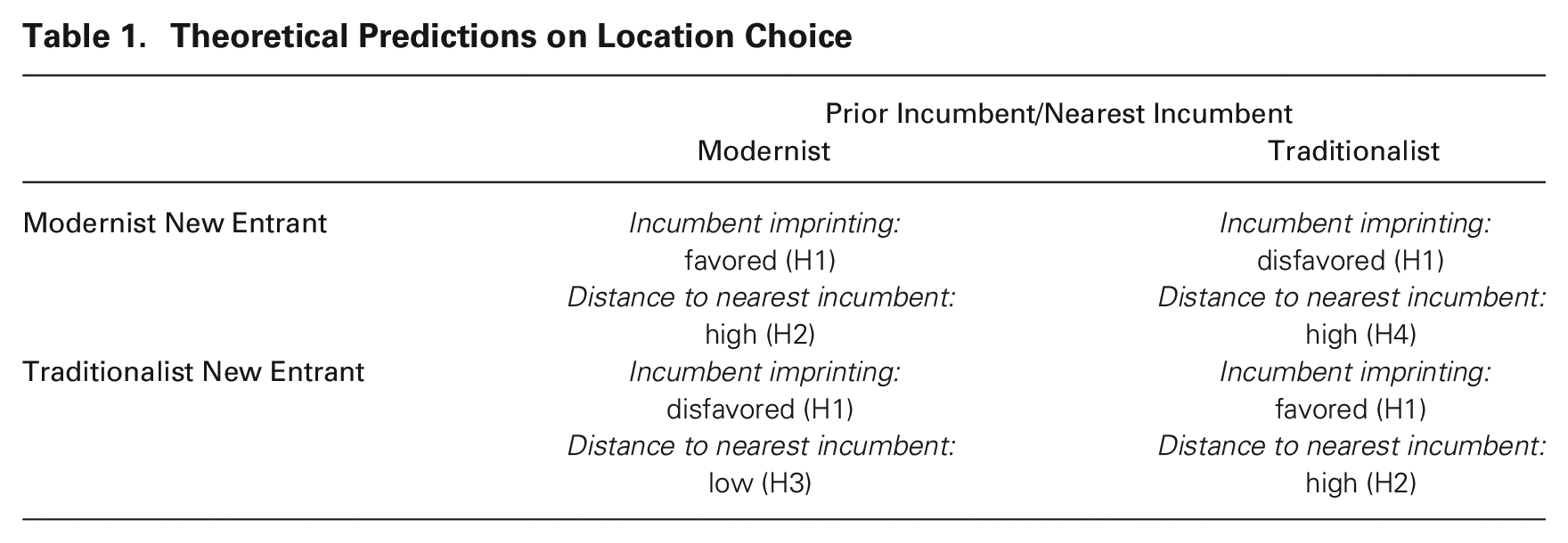
Location choice and need for assimilation into a collective identity
Competition among collective identities reinforces the need to restore in-group boundaries (for empirical evidence on incumbents, see Ingram and Inman, 1996; Ingram and McEvily, 2007). New entrants seeking assimilation to a collective identity may use location choice to signal their loyalty to an in-group and to sustain their inclusion within it.
Locations imprinted by a prior firm that claimed the same collective identity as that of a new entrant are ideally suited for new entrants to carry out such assimilation. Prior research has demonstrated the existence of imprinting in jobs within organizations (Burton and Beckman, 2007), cities (Marquis, 2003; Lounsbury, 2007), regions (Romanelli and Khessina, 2005), and communities (Marquis and Battilana, 2009; Greve and Rao, 2012). A key question in this literature relates to the forces underlying the persistence of imprints (Marquis and Tilcsik, 2013). Institutional pressures and organizational inertia represent two instances of “traditionalizing forces” (Stinchcombe, 1965: 169) that make imprinting persistent at various levels of analysis.
Recent work at the crossroads of a structuralist and a more agentic view has emphasized socialization as the moderator of persistent imprinting (Tilcsik, 2012). We follow this lead and claim that new entrants seek assimilation into a collective identity and accomplish this goal by reaffirming the imprint that a location received from a prior peer occupant. When firms exit locations, they leave local traces, which other organizations can reaffirm (Campbell, 1958). These legacies are engrained into patterns of culturally and symbolically relevant routines and practices. New entrants look at these location imprints as opportunities to affirm and signal their in-group identity to other members.
The idea that a former occupant’s identity imprint attracts a new entrant to a location is an elaboration of Tilcsik’s (2012) concept of secondhand imprinting. In fact, identity imprints represent a valuable strategy for both traditionalists and modernists to affirm membership in a chosen collective identity. Therefore, we hypothesize that traditionalists and modernists favor locations that an in-group member previously occupied over those held by heterophilous prior occupants.
While proximity to in-group members may be welcome in social settings (Novelli, Drury, and Reicher, 2010), it may yield competition in market settings (Baum and Lant, 2003). Competition with similar members threatens the assimilation of a new entrant into a collective identity. The need for that assimilation leads new entrants to favor locations not too close to others who claim the same collective identity. Conversely, choosing a location that is distant from similar others allows new entrants to comply with their peers’ expectations and demonstrate their loyalty and commitment to a given collective identity. This reasoning leads us to hypothesize that traditionalist new entrants are more likely to choose locations geographically distant from another traditionalist than locations that are closer to it. The same holds true for modernists.
Location choice and need for distinctiveness between collective identities
Actors seek not only assimilation into a collective identity but also distinctiveness from a competing identity (Leonardelli, Pickett, and Brewer, 2010). When excess similarity to the out-group challenges group distinctiveness, distinctiveness needs to be restored by group members. In social settings, this scenario can unleash a defense of the collective identity’s existence (Hogg, Abrams, and Brewer, 2017). Direct competition with out-group members represents a legitimate means of accomplishing this goal (Brewer, 2010).
Building on this argument, we propose that traditionalist (modernist) new entrants will use geographical proximity to members of a competing collective identity as a lever to express the distinctiveness of their own collective identity. The premise of our reasoning is that geographic proximity eases evaluative judgments (Tversky, 1977; Casasanto, 2008) and invites comparisons between collective identities (see Olzak, Shanahan, and McEneaney, 1996). New entrants will thus leverage geographic proximity to invite competition and restore the distinctiveness of the collective identity they espouse.
This reasoning holds true for traditionalists, who are threatened by the convergence of two identities under the same market label, making them more likely to showcase competitive behavior to reclaim their collective identity’s distinctiveness. In particular, we propose that traditionalist new entrants will perceive geographic proximity to a member of the competing collective identity as a way to stimulate competition and promote the distinctiveness of their own identity. Thus, we hypothesize that traditionalist entrants are more likely to choose locations that are geographically close to an existing modernist than locations that are distant from it.
The establishment of the modernist collective identity makes modernists less inclined to emphasize differences with traditionalists via geographic proximity. The regulatory recognition of their distinct practices and values as an integral part of the market label’s meaning diminishes their quest to reaffirm distinction of a collective identity. A desire to successfully coexist alongside traditionalists guides modernists, whose effort to minimize differences influences their proximity choices. Because geographic proximity is inherently rivalrous, locations too close to traditionalists are not ideal for this purpose. Instead, modernists will look favorably at locations that maintain geographic distance from traditionalist producers. Thus, we hypothesize that modernist entrants are more likely to choose locations that are geographically distant from an existing traditionalist than locations that are close to it.
Competing Collective Identities Among Boulangeries Artisanales: Traditionalists as Unaffiliated Entrants, Modernists as Affiliated Entrants
The coexistence of different approaches to traditional bread production in the French artisanal bakery market became competitive in 1998 when different types of bakers achieved regulatory equivalence for claiming the same market label of “artisanal bakery” (boulangerie artisanale). French legal codes L121 80–82 require bakers using the label boulangerie artisanale to mix dough, ferment it, and bake bread on the premises where it is sold to customers. Crucial for our study, the legal codes are silent on a baker’s choice to affiliate with a mill brand (e.g., Banette, Festival des Pains, Campaillette) or to remain unaffiliated. As in other product settings, such as wine (Negro, Hannan, and Rao, 2011) or electricity (Liu and Wezel, 2014), regulatory changes in the artisanal baking sector heightened differences in collective identities among market actors (see also Sikavica and Pozner, 2013).
Whether a baker affiliates with a brand or remains unaffiliated captures the divide between traditionalists and modernists in our context. This choice represents a fault line for different interpretations of the label, expressed by a divergence in values and practices. Autonomy in method and outcome is a valued component of craftsmanship, and traditionalists maintain full control of decision-making. As traditionalists, bakers who consider themselves loyal to the label enter the market unaffiliated and maintain independence over their individual craftsmanship. Affiliated bakers focus, instead, on consistency in breadmaking through routines that standardize procedures and recipes. They are modernists who value consistency and homogenization in breadmaking and, thus, enter the market through affiliation with a mill group and produce bread using replicable recipes and mixes (i.e., preassembled flour blends).
Divergence in values and practices indicates different interpretations of the label. Interviews with artisan bakers in Lyon highlighted an us-versus-them distinction. Table 2 reports a selected representative sample of qualitative evidence that we gathered. While both traditionalists and modernists emphasize distinct group identities—“two schools,”“two points of view,”“two separate worlds”—they also point to different values that emphasize their collective identities. Traditionalists see a difference in autonomy and control, and they do the “qualitative” work and “produce everything from A to Z,” unlike modernists, who are “assisted in some ways, to gain time . . . using mixes, using cheaper supplies.” Conversely, modernists point out that the difference relates to values of consistency and reinvigoration: “You have two types of bakers if you will: the ‘old way’ baker . . . and people like us who are very focused on communication and product choices.” Another modernist expanded on this value distinction by emphasizing, “If bakers continue to use mixes, it’s because they taste fine, and the product is consistent in quality.” As modernists emphasize consistency and traditionalists value autonomy, both groups underpin different label interpretations with distinct values associated with breadmaking.
Value Divergence Between Traditionalists and Modernists: Exemplary Quotes*
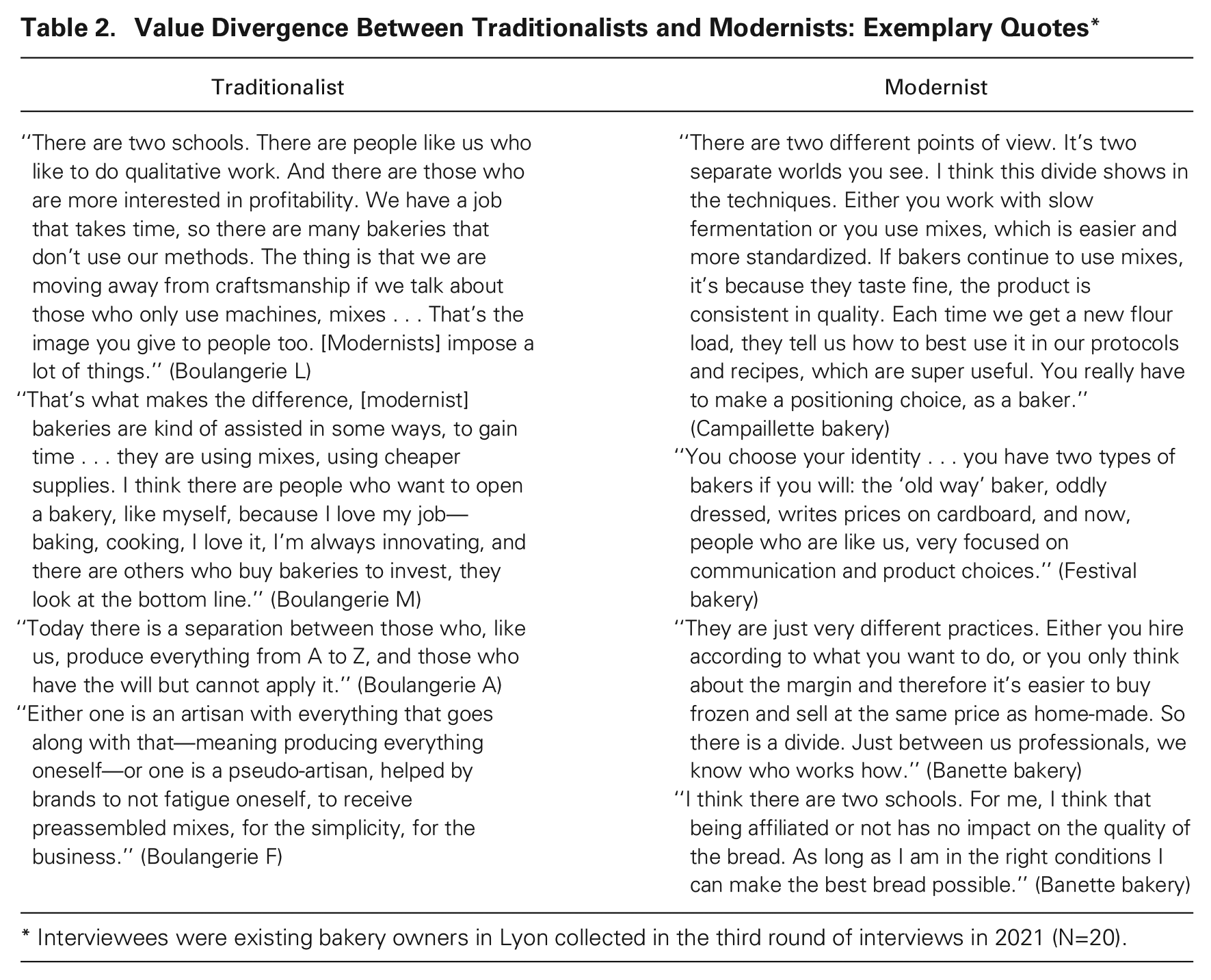
Interviewees were existing bakery owners in Lyon collected in the third round of interviews in 2021 (N=20).
Just as different values follow market label interpretation, divergent production practices between traditionalists and modernists ensue. Using a sample of bakers who have yet to open their bakeries (see the section “Experimental and Qualitative Evidence”), we asked bakers to rank the importance of different breadmaking practices on a scale of 1 to 4. We chose this sample because while the interviews with established bakers demonstrate the current divide in values between incumbent traditionalists and modernists, the difference between such collective identities hinges on new entrants’ willingness to reaffirm these identities through material practices, even before entry. Table A1 in the Online Appendix reports the mean, standard deviation, and test of differences in means between modernist and traditionalist bakers. A statistical difference is noticeable in the bakers’ appreciation of each practice, such that some practices are primarily associated with traditionalist bakers (i.e., developing their own recipes, choosing their own quality flour, using slow fermentation). Other practices resonate more with modernist bakers (i.e., using premixed flour assortments and standardized bread production). This evidence indicates an enduring divide between traditionalist and modernist practices that relates to the choice of being (un)affiliated.
In spite of divergent values and practices that emanate from different interpretations of the same label, entrant bakers who choose to be (un)affiliated are identical in several regulated aspects, such as ownership, size constraints, physical infrastructure needs, pricing, and unrestrained location choices. First, choosing to be (un)affiliated does not represent an ownership difference, as all affiliated artisanal bakeries are still independently owned. Second, the Chamber of Trade and Craft restricts the number of employees in artisanal businesses to a maximum of ten, ensuring comparable production among traditionalist and modernist bakeries. Notably, this size constraint prevents affiliated bakeries from capturing any significant economies of scale. Third, affiliated and unaffiliated bakeries have similar physical infrastructure. Fixed assets and equipment (such as ovens and machinery) do not differ between these bakeries. Fourth, bread prices are historically sticky in France because, until 1987, the state set bread prices. While bakers can now freely set their own prices, a socially accepted price range persists, applying equally to both traditionalist and modernist bakers (Kaplan, 2006). Finally, new entrants are free to locate as close to another bakery as they wish, even those affiliated with the same mill group, which is different from the restrictions placed on French establishments such as pharmacies.
Despite these structural factors that create overlaps in resource inputs and outputs between affiliated and unaffiliated entrants, the current identity divide between traditionalist and modernist collective identities reflects a relatively long history. From the Middle Ages until the 1980s, artisanal bakers could only be described as traditionalists; all bakeries were unaffiliated and cultivated signature craftsmanship using slow production techniques. The modernist collective identity was born with the establishment of the Banette brand in 1982, spearheaded by the mill group Cie Unimie. As the first mill group to attempt to restructure artisanal baking, Banette entered the market at a time when artisanal bakeries began to face mounting competitive pressure from industrial baking companies, and the quality of bread increasingly dissatisfied consumers (Kaplan, 2006). Echoing the ideals expressed in eighteenth-century bread riots that bread should not reinforce social hierarchies, modernist Banette bakers insisted that artisanal practices should homogenize bread production. By merely incorporating elements of traceability and rigor into the production process, Banette-affiliated bakeries were initially not very different from unaffiliated bakeries (Kaplan, 2006). Several renowned traditionalist bakers adopted the new brand model in the mid-1980s (a process similar to the one described in Negro, Hannan, and Rao, 2011), thereby helping modernist bakers appear to be retaining artisan values by improving the regularity of bread production.
However, with the affiliated model’s increased diffusion in the 1990s and multiple brands competing in the market (e.g., Festival des Pains, Campaillette, Baguépi), mill groups gradually replaced artisanal procedures with more industrial practices (e.g., use of mixes, standardization, fast fermentation), seeking more efficiency and market dominance (Astier, 2016). Indeed, “according to the most favorable scenario, the customer would end up asking for a ‘Banette’ instead of a baguette; the former would become a generic substitute for the latter” (Kaplan, 2006: 227). Initially advocating a push to improve bread quality (backed up by milling groups wanting greater control over the wheat–flour–bread value chain), modernist bakers increasingly edged toward “anonymous standardization that detracts from the artisan’s individuality” (Kaplan, 2006: 221).
Nevertheless, since the 1998 law legitimized both affiliated and unaffiliated bakers as artisans, customers have had difficulty recognizing quality differences between them, which had the effect of widening the gap in values and practices across the two collective identities. As a renowned historian of French bread put it, “If you buy your bread from an artisan in your neighborhood . . . it is quite possible, without you knowing it, that your baker is affiliated to one of the franchise trade names that are seen pretty much everywhere” (Kaplan, 2006: 224). The fact that consumers do not perceive quality differences between these bakeries fuels the persistence of collective identities and generates competition between them, particularly from the unaffiliated bakers. As one unaffiliated baker expressed it, “The artisan’s bread is made with love, going beyond just production. The challenge is to enter into the consciousness of consumers’ heads, to show them that their baker, their neighborhood artisanal baker, ‘se casse la tête’ [goes through a lot of trouble].” This distinction challenge stems from the fact that many of the different practices and values are indistinguishable to consumers. Without consumers perceiving any systematic quality differences, competition between collective identities unfurls strictly among producers.
Methods
Data and Sample
To test our hypotheses on the location choices of traditionalists and modernists, we collected data on artisanal bakeries from Lyon’s Chamber of Trade and Craft (Chambre de Métiers et de l’Artisanat de Lyon) dating from 1998–2017. All artisanal bakeries in the city of Lyon must register or delist with the Chamber of Trade and Craft. We chose 1998 as the start of our observation because the government introduced the label boulangerie artisanale in that year to legally distinguish industrial from artisanal bakeries, but not between affiliated and unaffiliated bakeries. During the 19 years of observation, 177 artisanal bakeries entered the market, 36 percent of which were affiliated entrants. Occupational regulations require that entrepreneurs wishing to open an artisanal bakery must have either a certificate d’aptitude professionnelle (CAP) diploma in baking or a minimum of three years of baking experience. For bakers meeting these criteria and opening a bakery, the Chamber of Trade and Craft collects information on their demographics, occupational qualifications, and state-recognized diplomas. From the bakery side, the Chamber of Trade and Craft records the year of entry, the legal form, the address, and whether the bakery is family-owned.
Before searching for a location, a baker chooses whether to be affiliated with a mill group or remain unaffiliated and autonomous. However, the Chamber of Trade and Craft did not collect information on whether a given entrant was a modernist or a traditionalist. To distinguish affiliated and unaffiliated bakeries, we solicited the regional commercial directors of each national affiliation group: Banette (the most represented modernist), Festival des Pains, Campaillette, Baguépi, La Ronde de Pains, and Le Pain Boulanger. For the observation period (1998–2017), each regional commercial director provided a list of bakeries that were contractually part of the group. Using common identification codes (i.e., SIRET), we were able to match these lists with the data the Chamber of Trade and Craft provided. Figure 1 shows the yearly share of entrants that were traditionalists or modernists.
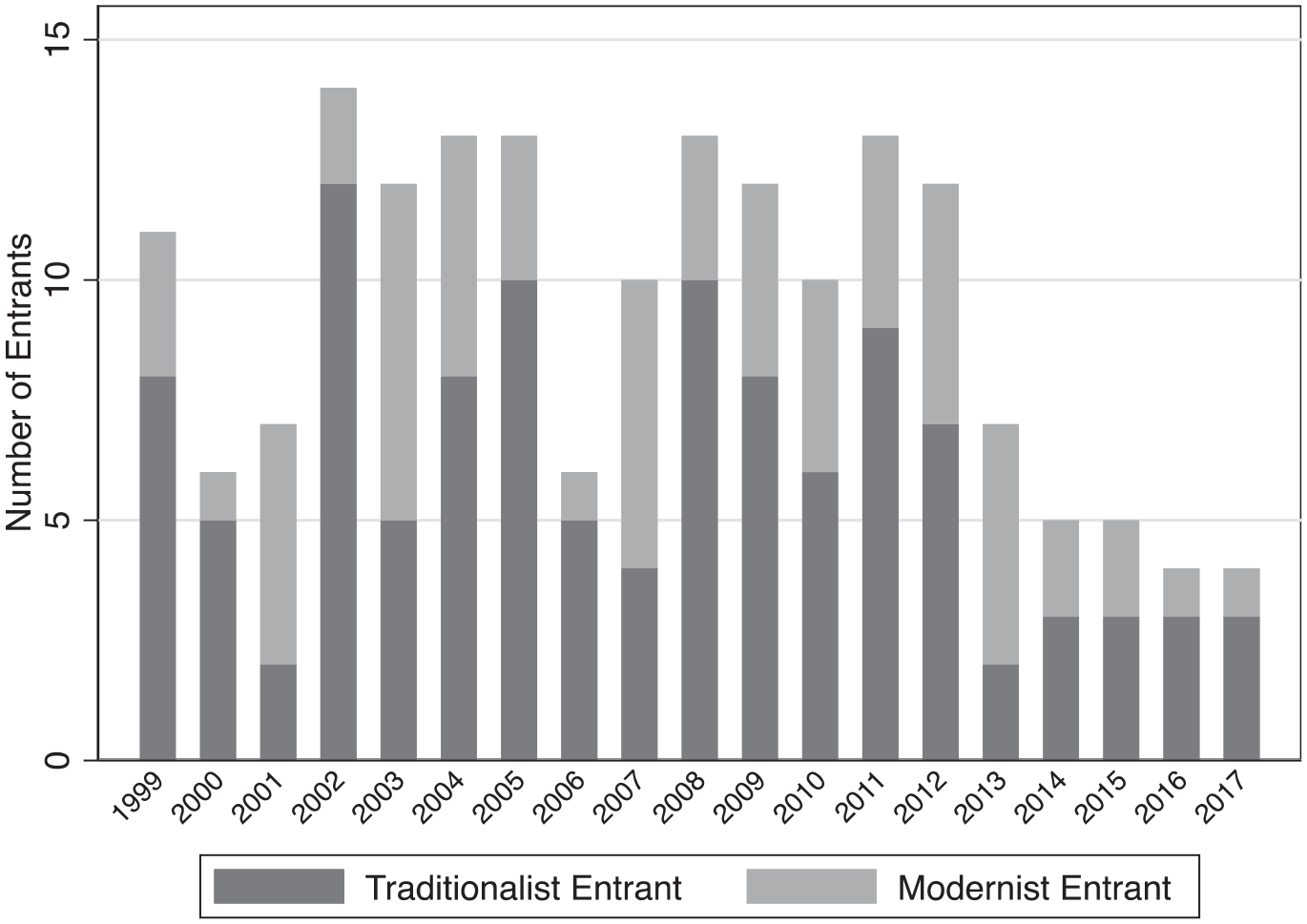
Traditionalist and Modernist Entrants
To account for market demand differences across neighborhoods in Lyon, we collected resident demographic data from the French National Statistics Institute (INSEE). Using the geographic boundaries determined by INSEE, we mapped bakery addresses onto designated neighborhoods in the city (i.e., IRIS level). These city neighborhoods, of which Lyon has 168, are the finest level of geographic census tracts in France. Recognizing the limitations of using arbitrary census borders to approximate market size, we followed recent location choice scholarship, using radius measures of demand and supply controls around a given location (Netz and Taylor, 2002; Ren et al., 2011; Ren, Hu, and Cui, 2019). For this process, we used the sf package in R to create different radii measures, based on a uniform distribution across a census tract. We ultimately chose to use control variables calculated at a 300-meter distance around a focal location, but we also ran robustness tests at 150 meters.
Analytical Strategy
Urban bakeries in France are numerous, and installing bakery equipment in a non-bakery location (like a restaurant or a café) is considerably more expensive than taking over an existing bakery. Thus, new entrants rarely choose locations where a bakery did not previously exist. 1 The risk set of available locations on the radar of new entrants is thus defined as locations (i.e., addresses) left empty by prior bakeries and not yet occupied. This type of risk set is ideal for capturing how differences in the collective identity that prior occupants claimed affect the likelihood of entry into a given location, while holding constant any associated financial investment. Once locations became vacant for more than four years, we excluded them from the risk set since the probability of a new occupant becomes increasingly rare. Robustness checks indicate no substantial difference in the main set of results discussed below when we retained in the sample locations with long vacancy times. Figure 2 illustrates the number of new entrants by type across locations that had remained vacant for four years or less. While traditionalist entrants are more numerous, the proportion of entrants remains similar across traditionalists and modernists over our window of observation, suggesting no obvious differences in the groups’ speed to mobilize resources at entry.
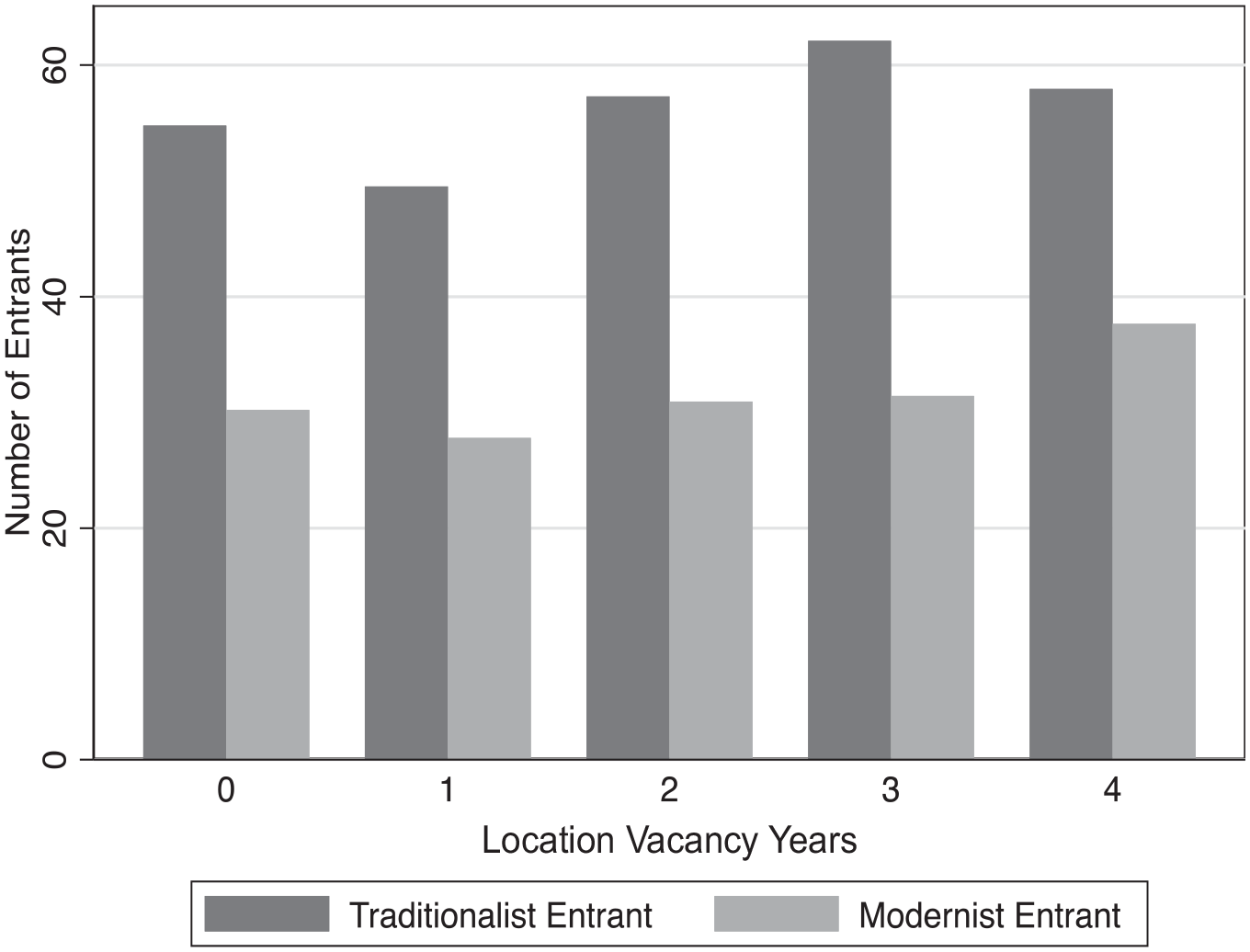
Choice of Location by Years of Vacancy
Upon determining the risk set, we (i) modeled those locations as alternatives and (ii) acknowledged differences among bakeries regarding the espoused collective identity. This risk set changes every year because locations drop out (locations chosen or remaining vacant after four years) or enter the set (locations becoming vacant). The size of the yearly risk set varies from 19 to 56 available locations. The corresponding unit of analysis in our data is the entrant-by-location dyad, and the dependent variable is coded as 1 if the focal location was chosen and 0 otherwise. Figure 3 depicts three cross-sections of our dataset, splitting new entrants by type and including incumbent neighboring bakeries.
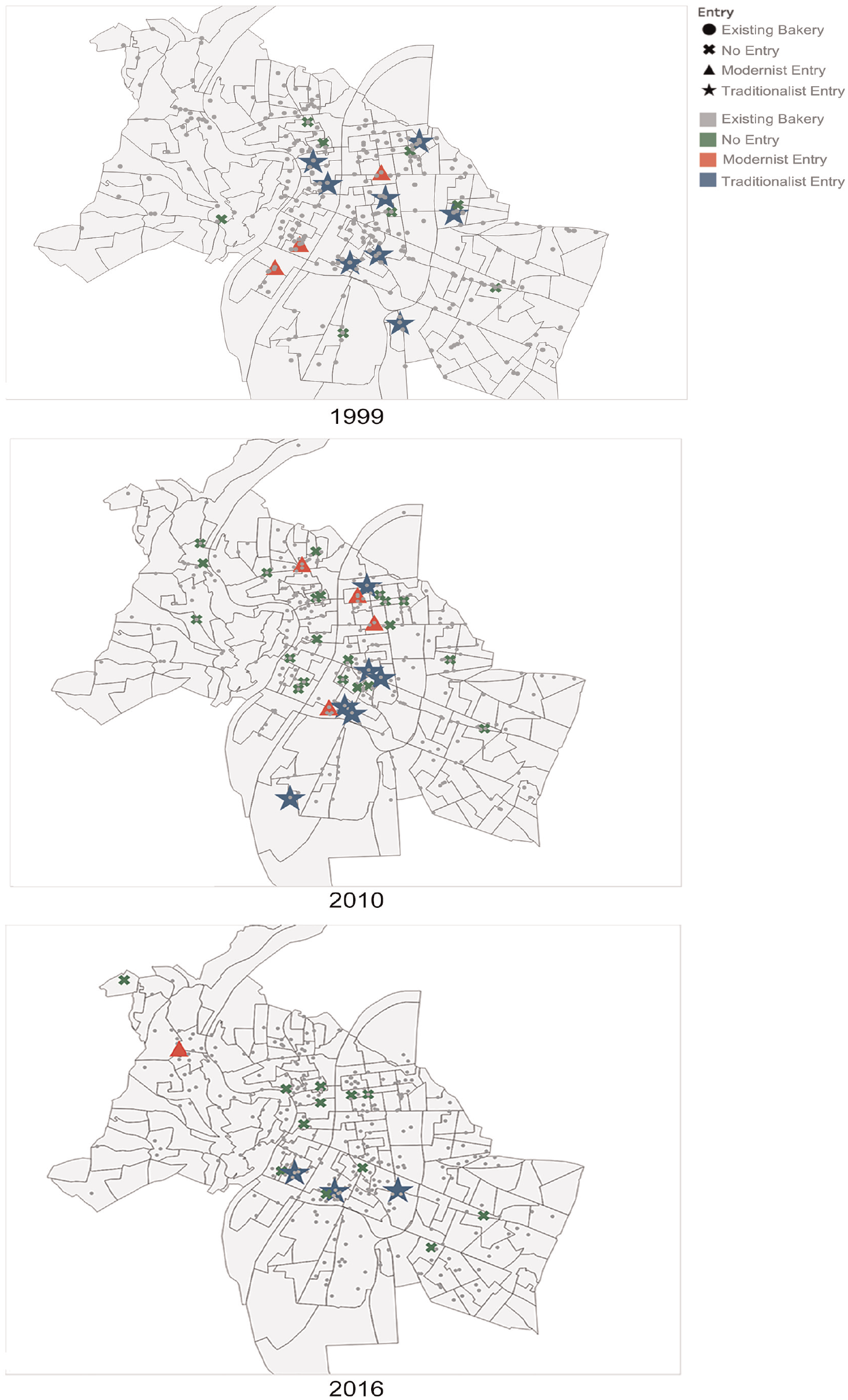
Data Structure Within the City of Lyon
As most locations appear only once in our dataset, its structure does not represent a fixed set of locations or firms-by-location commonly used in the study of new branches (Greve, 2000) or entry into foreign countries (Hernandez, 2014). Coupled with a mean of 1.13 years of vacancy, these characteristics limit the possibility of leveraging within-location over time variance and the use of location fixed effects. Furthermore, our theoretical interest in a time-invariant entrant characteristic (i.e., an entrant’s collective identity) complicates the use of new entrant-level fixed effects. These features make conditional logit a less obvious choice for modeling location choice in our context. While we ran conditional logit with entrant-level fixed effects for robustness purposes (and other specifications), we opted for logit to estimate the likelihood of an entrant choosing a given location for our main analyses. We estimated the following baseline specification:

The likelihood of entry in location i by entrant j during year t is specified as a function of the j entrant characteristic, represented by the vector
Dependent Variable
The dependent variable Entry is a binary outcome that takes the value of 1 if the focal new entrant bakery chooses a given available location, and 0 otherwise.
Independent Variables
As described in previous sections, we coded the independent variable Traditionalist entrant in relation to whether the focal entrant was an unaffiliated bakery (value of 1) or an affiliated bakery (value of 0, Modernist entrant). To capture location secondhand imprinting, we created the dichotomous variable Traditionalist prior occupant, coded as 1 when the prior occupant of a location was a traditionalist, 0 if it was a modernist. As Table A2 indicates, modernists previously occupied 19 percent of location–year observations in our dataset. We tested Hypothesis 1 by interacting the variables Traditionalist entrant and Traditionalist prior occupant.
Testing our other hypotheses required obtaining the distance between each location in the risk set and its nearest traditionalist and modernist competitor. Using Stata’s geonear command and the longitude/latitude coordinates of bakery addresses, we calculated distances at t–1. 2 We negated distances to capture geographic proximity across bakeries, as our hypotheses stated. On average, the variable Traditionalist proximity indicates that the nearest traditionalist bakeries are located 180 meters away from locations in the risk set, whereas the average distance to modernist bakeries is 300 meters (see Modernist proximity in Table A2. We used the interactions between the variables Traditionalist (modernist) entrant and Traditionalist (modernist) proximity and between Traditionalist (modernist) entrant and Modernist (traditionalist) proximity to test Hypotheses 2, 3, and 4.
Control Variables
The control variables account for other factors that affect the likelihood that an entrant would choose a specific location. We grouped controls into three sets of characteristics: (i) local-market, (ii) prior-occupant, and (iii) new entrant characteristics.
Following other models of location choice, we controlled for the demographic and wealth attributes of consumers (Kalnins and Chung, 2004; Ren et al., 2011; Ren, Hu, and Cui, 2019). In France, the market for bread is extremely local, in relation to consumers’ place of residence (Tardieu, 2018). Accordingly, to capture the number of residents around a given location, we controlled for the annual Resident population for that location. Furthermore, we distinguished the demographic composition of local residents through the size of the Immigrant population and Retired population, two groups that we expected to influence local bread demand. While older generations may be more anchored to the routine of buying bread, non-French residents may be less accustomed to buying bread daily. We also controlled for purchasing-power variation across locations by including the variable Median income, residents’ median yearly income. We employed a restrictive measurement of these demographic variables, captured at 300 meters. We lagged variables by one year and scaled them (divided by 1,000).
Identifying the effects of collective identities requires controlling for financial opportunities that an available location might offer to new entrants. In the absence of individual bakery sales data, we leveraged data on bakery sales at the level of the city. First, we obtained the estimated weights of each characteristic (e.g., City residential population, City income, City industrial bakeries) in predicting city-level bakery sales. Then, we multiplied the estimated coefficients by the characteristics (at 300 meters) of a given location, to derive a location-specific time-varying measure of Sales potential. We included, in addition to this variable controlling for differences in attractiveness/location potential, a variable that flags whether the focal location is in a tourist area, which coincides with the city center. The dichotomous variable Tourist area accounts for bakeries located in Vieux Lyon and the Presqu’île, the most central areas in the city of Lyon.
In addition to reflecting these demand factors, locations also vary by extent of competitive intensity (Baum and Mezias, 1992; Greve, 2000; Staber, 2001; Kalnins and Chung, 2004; Dahl and Sorenson, 2009; Hernandez, 2014). In our setting, competitive intensity encompasses local suppliers of bread. Therefore, we controlled for the number of Artisanal bakeries and Industrial bakeries within 300 meters of each location and lagged values by one year. 3 We also included the count variables Artisanal exits and Artisanal entries to capture the number of artisanal bakery entries and exits within a 300-meter radius at t–1. Both of these variables controlled for the extent of the market’s (un)favorability surrounding a given location (Baum and Haveman, 1997; Kalnins and Chung, 2004; Dahl and Sorenson, 2009). Moreover, we included year dummies to rule out further sources of temporal heterogeneity.
The second set of controls concerned prior occupant characteristics. The binary variable Same affiliation controls for whether the prior occupant belonged to the same brand affiliation as that of the focal entrant (e.g., a Banette entrant chooses a location where a Banette had existed prior). Even though mills do not own bakeries or make location decisions, information about potential locations might pass through affiliation members. The variable Vacancy years controls for the number of years that a location was vacant from the time the last occupant exited. Higher values of this variable indicate longer-term vacancy and, thus, unattractive locations indicative of lower quality prior occupants. Bakery tenure was coded as the number of years the previous bakery was active before exit. As Table A2 in the Online Appendix shows, the average span is 9.3 years, with a minimum of 1 (i.e., at least one year active) and a maximum of 34 years. In the absence of viable sales figures to assess a location’s commercial performance, this variable serves as a proxy for the relative success of a former venture and correlates with the price of a location. The binary variable Limited liability was coded as 1 if the prior bakery had the legal form of a company and 0 if the bakery registration was a sole proprietorship. Family, a binary variable, captures whether the prior occupant bakery was jointly run by spouses, a traditional arrangement for French bakeries. About 20 percent of artisanal bakeries in the sample are family-owned. Owner age (at exit) was coded as the age of the prior occupant at the year of exit. To control for the possibility that the prior occupant exited because of retirement, we used a quadratic specification (OwnerAge 2 ). The variable Prior experience accounts for whether the prior bakery was the owner’s first bakery (coded 0) or was at least a second bakery that the owner managed (coded 1). To rule out differences in human capital across prior owners, we created the variable High skill, equal to 0 if the Former owner had the minimum skill level or 1 if they had additional baking qualifications—i.e., a brevet professionnel (BP) or brevet de maîtrise (BM) diploma. Finally, the Immigrant variable captures whether a location’s prior owner was born in France (coded 0) or outside of France (coded 1).
The third set of control variables considers differences among new entrants. We controlled for differences in experience by measuring whether the entrant had previously owned a bakery in Lyon. Entrant prior experience thus accounts for whether an entrant had matured by accumulating such experience (coded 1) or was a first-time entrant (coded 0). Only about 10 percent of entrants had previously owned a bakery. The immigrant status of entrants affects which locations they choose (Kalnins and Chung, 2006), particularly in conjunction with immigrant resident populations (Hernandez, 2014). Therefore, Entrant immigrant captures whether the entrepreneur was born in France (coded 0) or outside of France (coded 1). Finally, the Entrant family dummy variable controls for whether an entrant was a family-run bakery. If a spouse was involved with the bakery, a separate tax file was requested upon registering the bakery. While artisanal bakeries were traditionally family-run structures (Kaplan, 2006), only 12 percent of entrants in our sample were couples.
Results
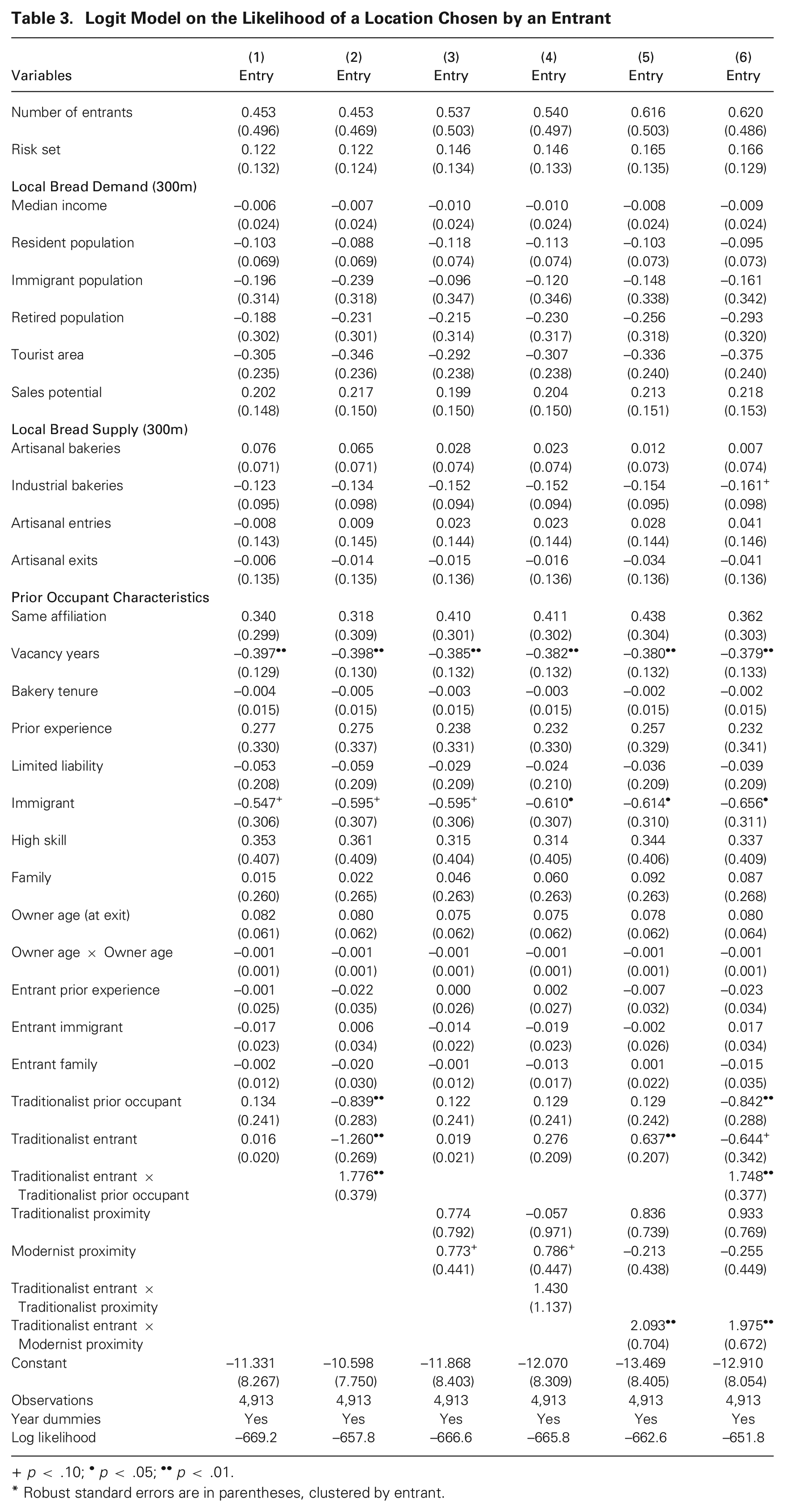
Table 3 presents the coefficient estimates of the logistic regression models. Model 1 includes only control variables. Compared to pairwise correlations, in a multivariate model specification, locations previously held by traditionalists appear to new entrants to be as attractive as those held by modernists (Traditionalist prior occupant). Moreover, traditionalist and modernist new entrants appear statistically indistinguishable in their location choices (see estimate of Traditionalist entrant). Among other characteristics associated with prior occupants, locations owned by an Immigrant were about 43 percent less likely to be selected than those held by a non-immigrant owner. 4 Each additional number of Vacancy years reduces the likelihood of choosing a location by 33 percent.
Logit Model on the Likelihood of a Location Chosen by an Entrant
p < .10; • p < .05; •• p < .01.
Robust standard errors are in parentheses, clustered by entrant.
Model 2 examines whether a traditionalist entrant is more likely to choose a location whose prior occupant was another traditionalist (see estimate of Traditionalist entrant × Traditionalist prior occupant). The positive and statistically significant estimate of the interaction coefficient aligns with this expectation. The estimate of the main effect Traditionalist prior occupant coefficient suggests that crossovers (modernist entrants’ taking over traditionalist locations) were much rarer. Figure 4 plots the marginal effects obtained via the “margins” command available in Stata 16. The trends reported in this figure were consistent with Hypothesis 1 and suggested that the probability of choosing a location previously held by a member with the same collective identity was about twice that of choosing a location held by a member of a competing identity. 5 This result is true for traditionalists and modernists, net of information advantages proxied by the Same affiliation control variable.
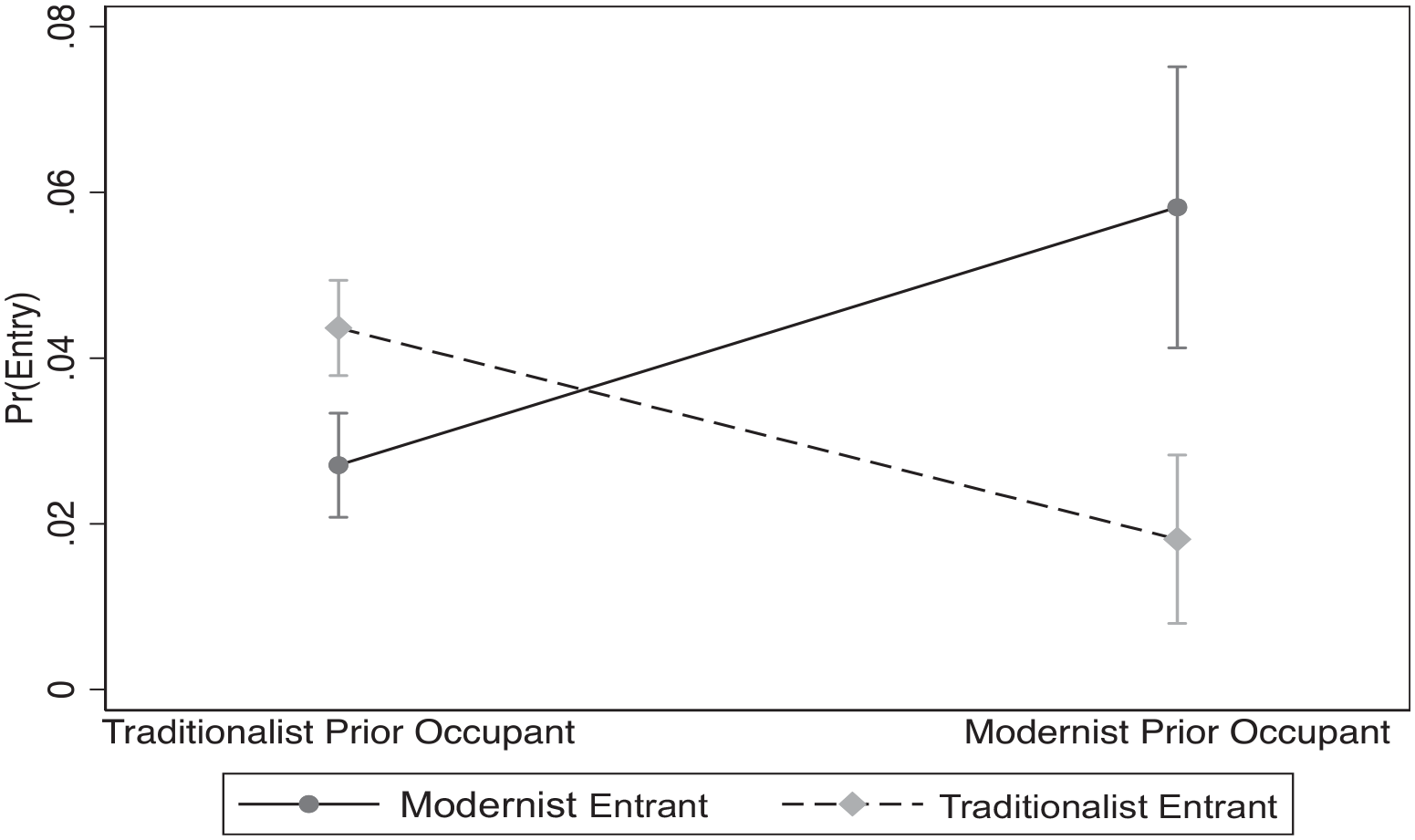
Interaction Prior Occupant
Models 3, 4, 5, and 6 introduce the proximity variables, from the focal location to both the nearest traditionalist bakery and the nearest modernist bakery. We used interactions between the traditionalist entrant and proximity variables to test the hypotheses related to collective-identity assimilation (Hypothesis 2) and distinctiveness (Hypotheses 3 and 4). The estimates of the simple distance variables that Model 3 reports are both positive, but only the one concerning proximity to modernists is statistically significant. The interaction makes it possible to separately estimate these effects by type of entrant, indicating that traditionalist entrants do not avoid proximity with another traditionalist, which is evident in the interaction between the variables Traditionalist entrant and Traditionalist proximity (see Model 4). This result provides no support for Hypothesis 2, at least regarding traditionalist entrants. The plot of the effects that Figure 5 provides, obtained by computing predictive margins in Stata, corroborates this interpretation (see right side). Additional analyses of different radii of distance (150 meters, 300 meters; see Table A4 in the Online Appendix), however, suggest that traditionalist entrants prefer locations close to another traditionalist bakery but to a limit (i.e., not at a 150m radius). Figure 5 also shows no support for Hypothesis 4 (see left side).
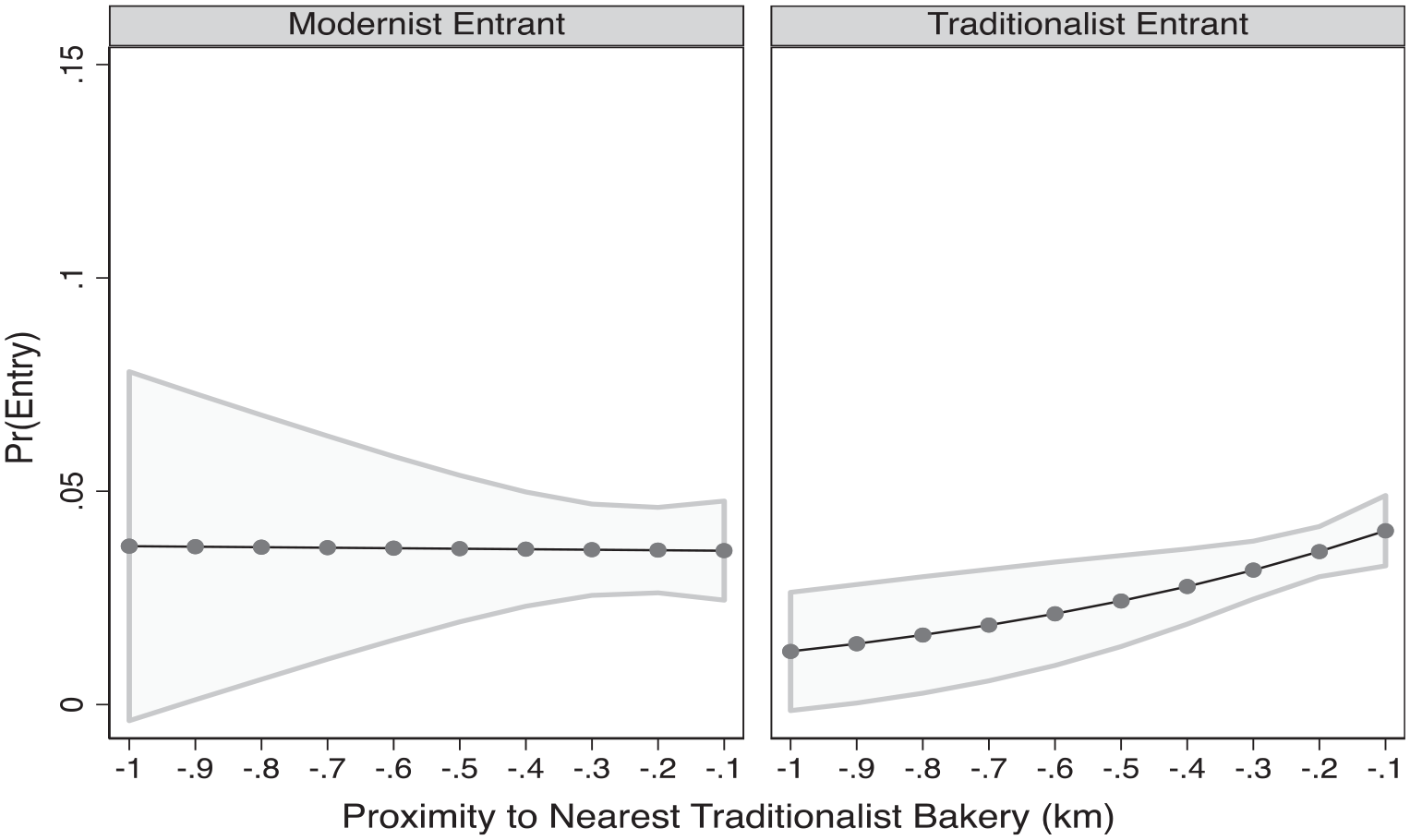
Interaction Proximity Nearest Traditionalist
Conversely, the coefficient of the interaction between the Traditionalist entrant and Modernist proximity variables that Model 5 reports suggests that traditionalist entrants look favorably at locations that are close to another modernist (see Figure 6, right side). This result appears to align with Hypothesis 3. The plot of the effects of Modernist proximity for Modernist entrants reported in Figure 6 (left side) also provides some support for Hypothesis 2, regarding modernists. Model 6 provides the full model specification that confirms the results discussed so far.
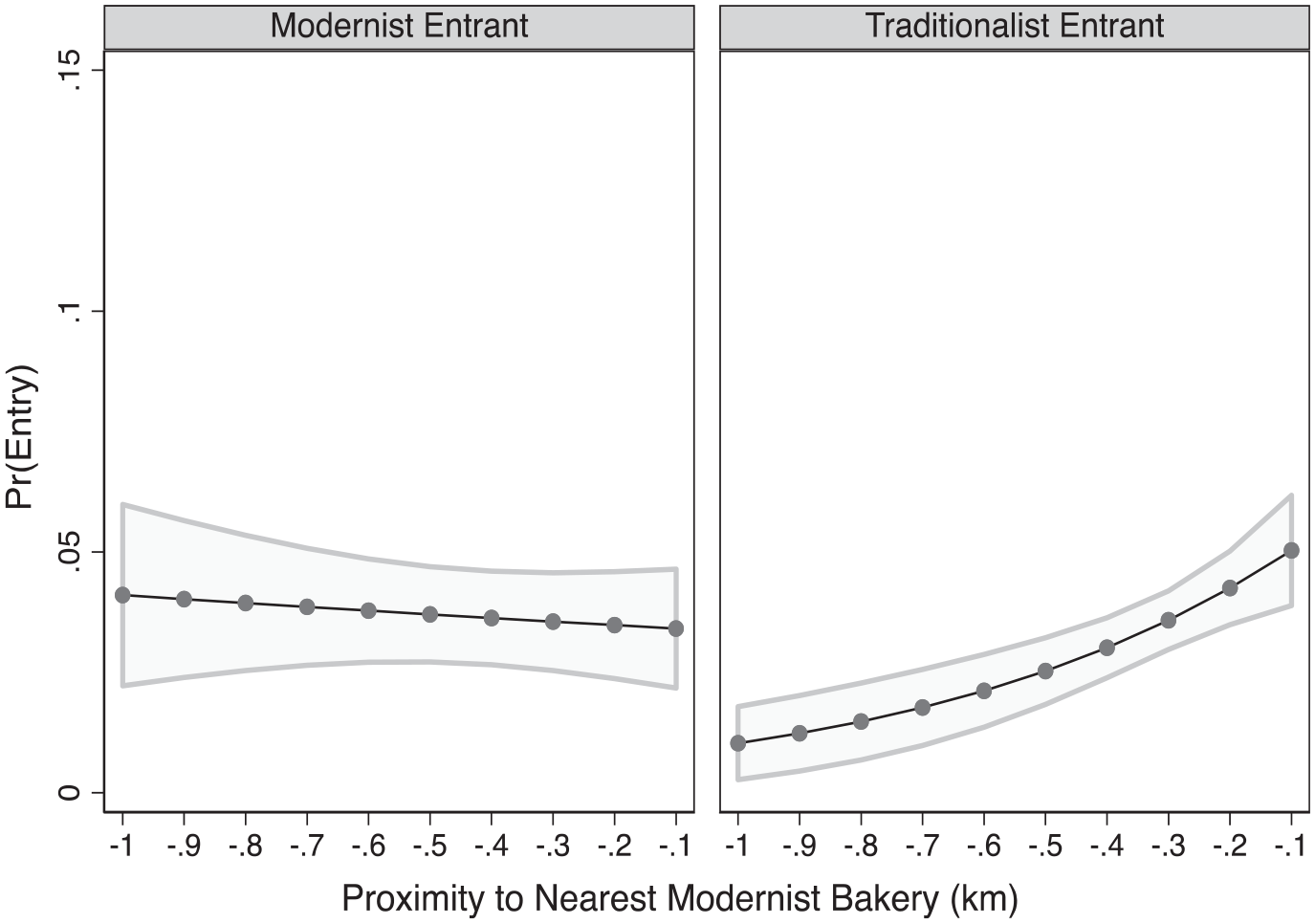
Interaction Proximity Nearest Modernist
As entrant-level time-invariant unobserved heterogeneity may have biased the estimates reported so far, Table A5 in the Online Appendix reports the models of Table 3 estimated via a model with entrant-level fixed effects conditional logit. The results obtained from this alternative estimation procedure are consistent with the main estimates.
Endogeneity
The endogenous choice of a traditionalist identity might have driven the results presented. This a hard problem to address. One imperfect yet reasonable way to deal with endogeneity is to instrument an entrant’s identity via two exogenous variables, Advanced training and Professional reorientation. Importantly, both instruments have no known direct theoretical or empirical effect on location choice. Qualitative evidence from the field leads us to expect that Advanced training and Professional reorientation positively predict a baker’s choice to be a traditionalist entrant. 6 Consistent with our expectations, the instrumental variables Advanced training and Professional reorientation positively correlate with the endogenous variable (Traditionalist entrant) at 0.13 and 0.12, respectively (p < 0.05), and appear to affect different bakers in our sample.
Advanced training indicates whether a new entrant has bakery training beyond the certificat d’aptitude professionnelle (CAP) with either a brevet professionnel (BP) or brevet de maîtrise (BM). Both the BP and BM diplomas build on the minimum requirements of the CAP apprenticeship. Individuals who choose to obtain a BP or a BM receive more-extensive training and develop a more advanced and personalized understanding of baking. Given their dedication and commitment to the trade, these individuals are less likely to become affiliated because by doing so, they would have less involvement in bakery procedures. Of the 177 entrants in the sample, 66 have advanced training.
The second instrument, Professional reorientation, captures whether an individual converted from another occupation to become a baker. While the data do not allow us to distinguish from which field the reorientation occurred, individuals who are motivated to undertake a professional change are expected to be particularly passionate about their new occupation. Given the intrinsic motivation behind the professional shift to become a baker, we expect these individuals will be more likely to remain autonomous and develop their own professional identity without a chaperoning affiliation. Of the 177 entrants in the sample, 10 underwent a professional reorientation.
We used a Cragg-Donald F-test to assess the quality of our instruments, reported at the bottom of Table A6 in the Online Appendix (Stock, Wright, and Yogo, 2002). 7 Our instruments seem to fulfill a partial monotonicity assumption, a less onerous homogeneity restriction than complete monotonicity (see Mogstad, Torgovitsky, and Walters, 2021). A formal test via the mivcausal package available in Stata provides support for this interpretation (i.e., no rejection of the null hypothesis of positive weights of the two instruments, p value 1.000; rejection of the null hypothesis of any negative one, p value 0.065).
Table A6 in the Online Appendix reports the estimates obtained from the first- and second-stage model 2SLS specifications (i.e., from ivregress2 2SLS in Stata). Once again, we report bakery-entrant-level clustered standard errors. Generally, the 2SLS estimates of the variables used to test our hypotheses appear qualitatively consistent with those reported in the main analyses (see Models 2, 4, and 5 of Table 3). The same conclusion holds when we resort to the IVPROBIT estimates (see Table A7 in the Online Appendix). 8 , 9
Within-Group Variation Among Traditionalists
Even when we correct for endogeneity, Hypothesis 4 continues to lack support in our data. Within-group heterogeneity among traditionalists may potentially explain this result. For instance, due to their independence, autonomy, and perceived identity advantage, traditionalist incumbents may vary in the consistency and maintenance of their baking standards (unlike modernist incumbents, who are tied to production codes and regular checks). This variation may make choosing a location near to traditionalist incumbents more or less attractive for entrants. When we consider this variation from the vantage point of modernist entrants, locating far from traditionalist incumbents who maintain high standards might be wise, but not necessarily so against mediocre traditionalist counterparts, which conversely, may represent an advantageous market opportunity. This variance among incumbent traditionalists may explain why modernist entrants do not distance themselves from out-group members.
We explore the effect of this potential source of traditionalist heterogeneity in relation to the characteristics of the nearest traditionalist bakery to each location at risk. While we lack precise data on the degree to which each producer maintains traditionalist baking standards, we can proxy it in two ways. First, high-standard maintenance may correlate with the age of an incumbent bakery: the older the bakery, the more likely that its consumer base steadily appreciates its output. Second, high-standard maintenance may be proxied by a higher level of training that an incumbent baker obtains. We re-estimated the main models by keeping only attractive traditional locations for modernist entrants, meaning locations where the nearest traditionalist neighbor may be relatively mediocre: (1) being young (younger than the mean of eight years observed in our sample) or (2) having minimal skills (i.e., CAP and not Advanced training 10 ). The estimates of these models are comparable to the main results (Table A10 in the Online Appendix; also confirmed by graphic inspection), suggesting that Hypothesis 4 (as well as Hypothesis 2 from the side of traditionalists) does not lack support due to differences in attractiveness across market locations. The main trend of results also continues to hold in this subsample.
Within-Group Variation Among Modernists
Rather than differences among incumbent traditionalists, heterogeneous in-group identification among modernist entrants may explain the lack of support for Hypothesis 4. Negro and colleagues (2011) have suggested that this may depend on whether members are first movers and/or early defectors versus later joiners. In turn, these differences impact the need for assimilation of new entrants. Within our empirical setting, entrants affiliating with the Banette group served as the modernist prototype. The distinction between Banette and other lesser-known affiliations is relevant, as Banette “was the first to attempt to restructure and reinvigorate artisanal baking” (Kaplan, 2006: 227), i.e., Banette was not only the initiator but also the representative leader of the modernist identity. Banette bakeries represented the most established and dominant mill group in our data, accounting for almost two-thirds (64 percent) of modernist new entrants (about 50 percent of the density of affiliated bakeries). 11
Therefore, we ran our models comparing Banette entrants to traditionalist ones (i.e., see the Only Banette Entrants columns, Table A10 in the Online Appendix). The estimates of these additional models suggest three general conclusions. First, this subsample supports Hypothesis 4. 12 Figure 7 confirms the tendency of modernist entrants toward geographic distancing from traditionalists. Especially pronounced among Banette entrants is modernists’ desire to coexist alongside traditionalists by minimizing differences with them and avoiding competition. Second, the magnitude of the imprinting effect appears slightly stronger in the models that compare Banette to unaffiliated entrants (Model 1 in Table A10 in the Online Appendix compared to Model 2 in Table 3). Third, while Hypothesis 2 fails again to achieve support, the predictions of Hypothesis 3 continue to hold and become slightly stronger (Figure 8).
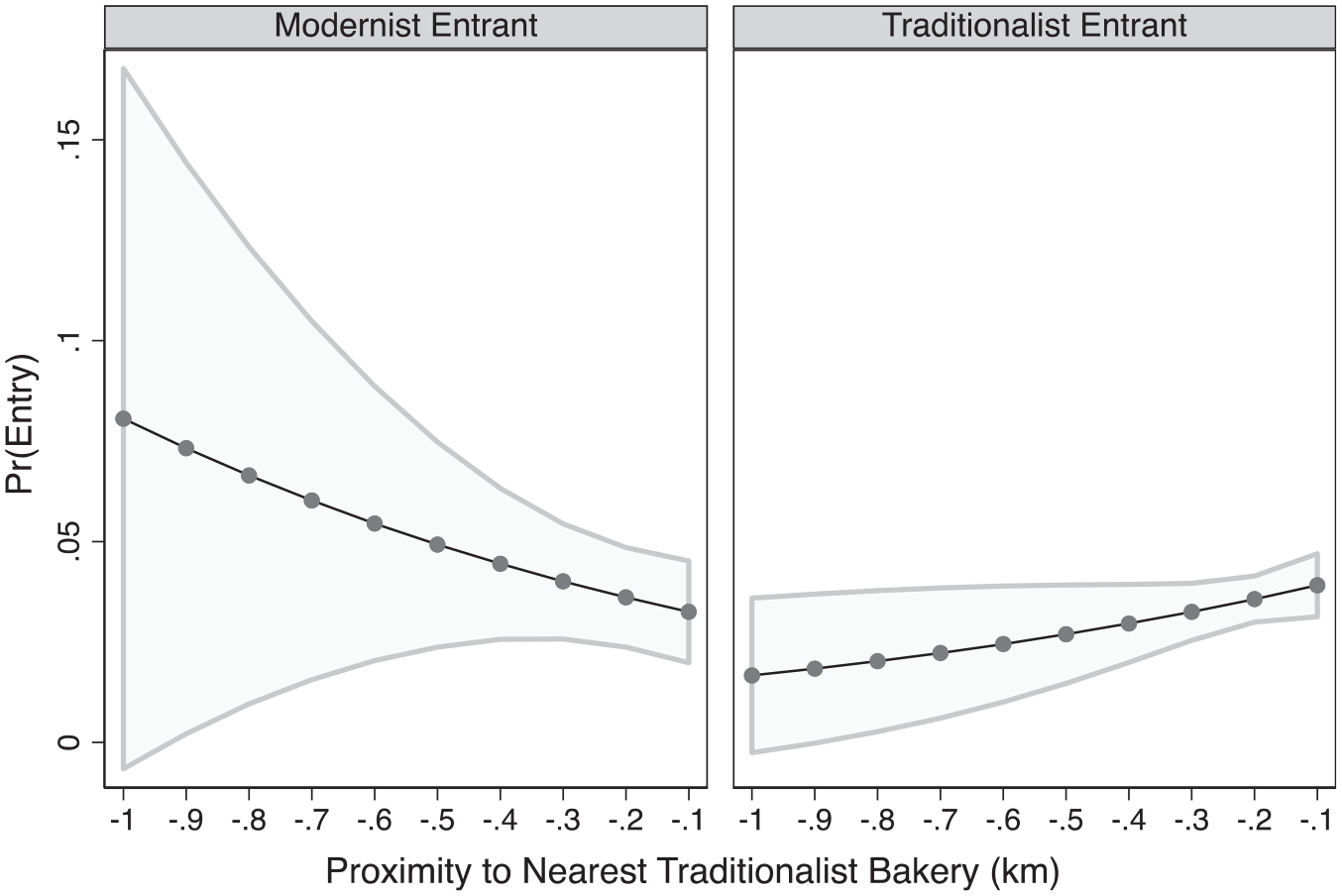
Only Banette Subsample—Interaction Proximity Nearest Traditionalist
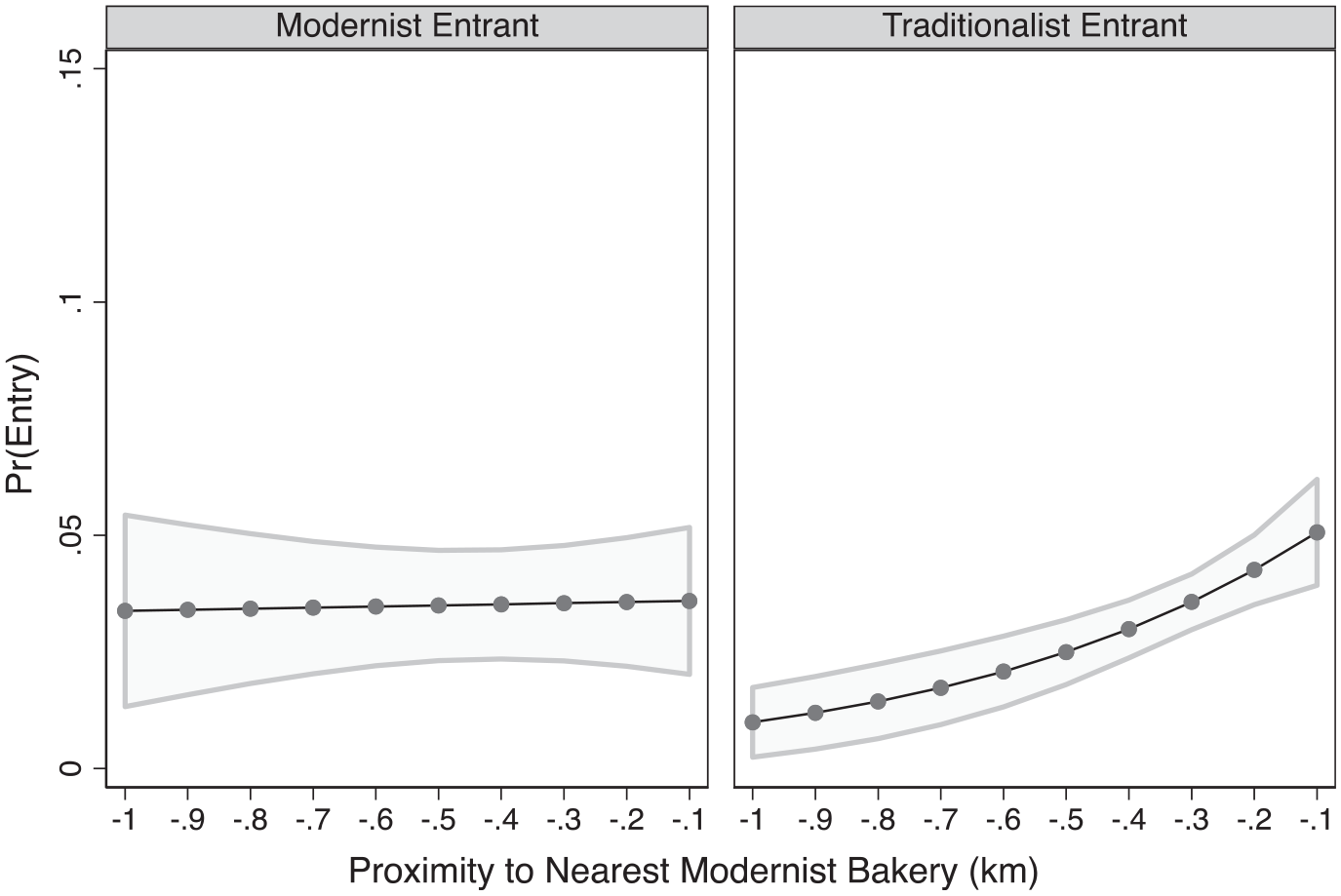
Only Banette Subsample—Interaction Proximity Nearest Modernist
Experimental and Qualitative Evidence
To corroborate our interpretation of the quantitative results, we collected additional evidence from two sources. First, we administered a vignette experiment, targeting two separate samples of bakers undergoing training and who had yet to open a bakery. Second, to better understand the location choices emerging from our analyses of archival data, we also went to the field and interviewed current bakery owners in Lyon. We contacted 62 bakers, 24 of whom (39 percent) we interviewed (9 of whom were traditionalist bakers). The two sources of data represent different yet complementary perspectives. The experimental vignette consisted of hypothetical scenarios given to bakers who had not yet chosen a location and to examine how they would behave. Interviews with bakery owners provided evidence of the lived experience of entrants as they assessed different locations, limited by their individual recollection.
To test our hypotheses, we used the experimental vignette with two different samples, one comprising mostly traditionalist and the other comprising modernist bakers. To target a traditionalist sample of bakers, the vignette was distributed to instructors at apprenticeship training centers (Centre de formation d’apprentis) across France; instructors willing to participate forwarded the vignette to other bakers enrolled in the same program. We expected this sample of bakers to lean toward a traditionalist identity (N = 62). Still, eight bakers in the sample identified as modernists and intended to open an affiliated bakery. We administered the same experiment to bakers enrolled in the Ecole Banette, the prototypical modernists, who emerged from our additional analyses as a representative subsample (N = 27). 13
The vignette is advantageous because it focuses on the supply side (i.e., collective identities) while keeping demand and information flows constant. The vignette also allowed us to investigate the effects of assimilation and distinctiveness of a collective identity, by manipulating distance from a neighbor in the most salient terms, i.e., as head-to-head competition (see below). We carefully wrote the vignette to highlight the unquestionable profitability of the proposed location and to leverage the variance that different collective identities produced. For the modernist Banette sample, we specified a Festival des Pain prior occupant/nearest neighbor to avoid confounding results with a Banette-to-Banette comparison, which could potentially bias toward reaffirmation of location imprints and competition avoidance. In both experiments, we randomly allocated the participants to different conditions.
To test our first hypothesis on location imprinting, we manipulated the prior occupant’s identity in the vignette. Upon reading the vignette, participants responded using a scale from 1 to 4 points (1 = extremely unlikely; 2 = somewhat unlikely; 3 = somewhat likely; 4 = extremely likely). The first vignette read as follows: You are looking to buy a bakery, and you have the financial means. You found a perfect bakery where all financial, location, and equipment criteria are ideal. You decide to call the owner. During this call, you learn that the owner is (
In addition to testing imprinting, a second part of the vignette varied two conditions: the identity of the nearest competitor and the extent of proximity. We designed this manipulation to test Hypotheses 2, 3, and 4. Participants responded to our questions by using the same 4-point scale.
You are looking to buy a bakery, and you have the financial means. You found a perfect bakery where all financial, location, and equipment criteria are ideal. You decide to go and visit. During this visit, you realize that the closest competitor is an artisan (
After completing the vignette, we asked participants to provide demographic information (e.g., age, highest training), whether they intend to open a bakery in the future (Bakery intention), and their intention to affiliate (Affiliation intention).
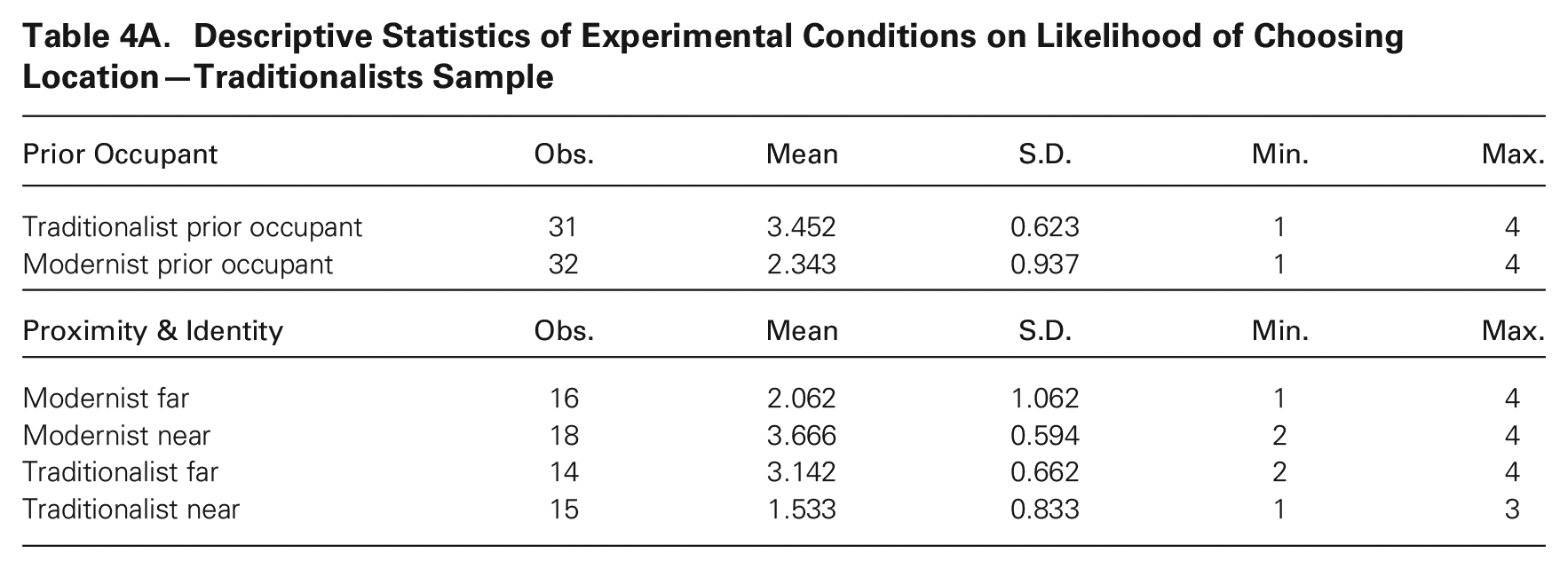
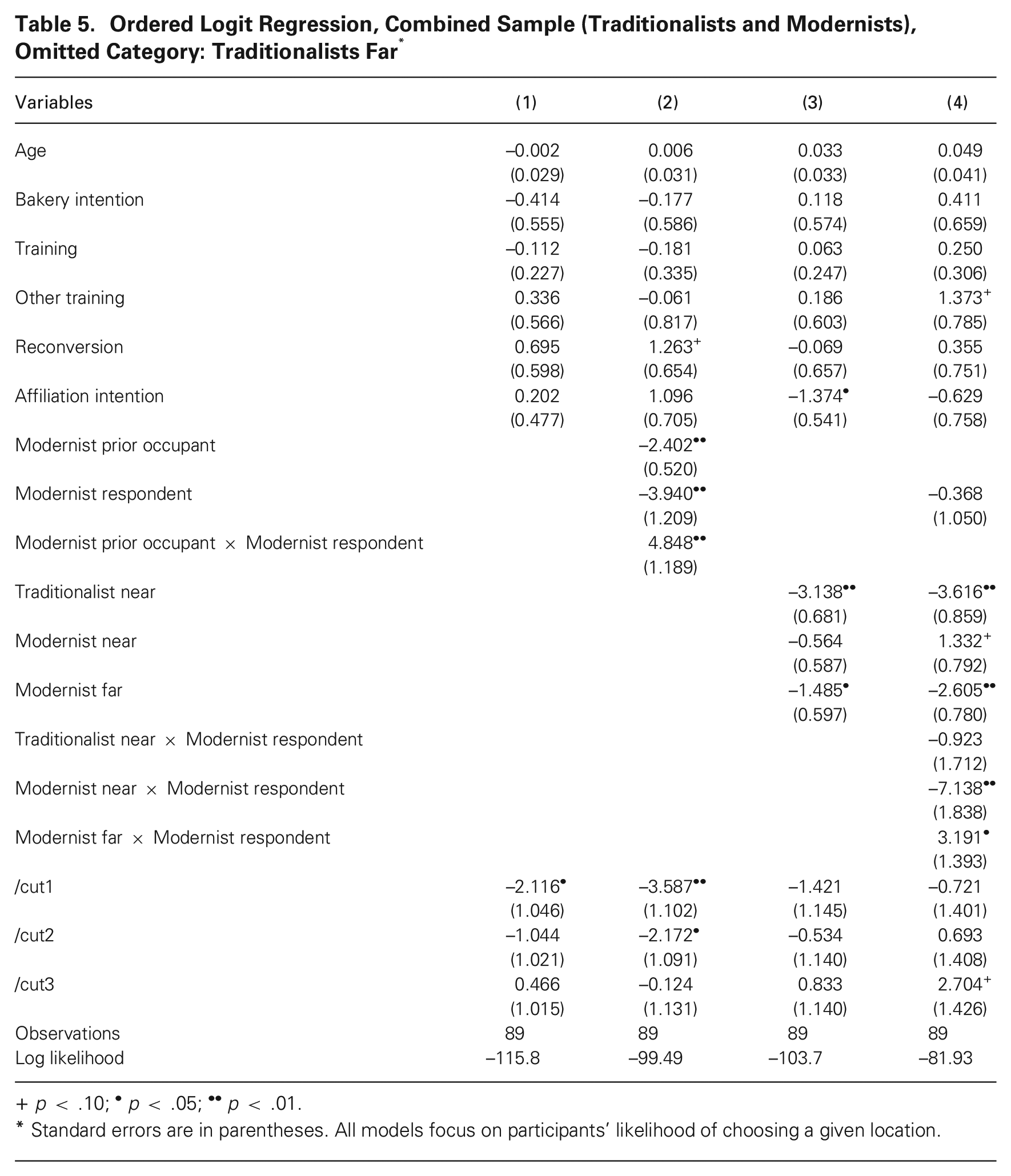
Using the information we collected, we ran an ordered logistic on the participants’ odds of choosing a given location that the vignettes described. Tables 4A and 4B present the descriptive statistics of the various conditions, and Table 5 presents the regression estimates that control for less-than-perfect randomization among conditions, due to our limited sample size. 14 The descriptive statistics already point to proximity to modernists as traditionalist bakers’ preferred location choice; locating far from other modernists and from traditionalists is the most likely scenario among modernists. Across all model specifications, the omitted category is a location far from traditionalists. Model 2 provides support for Hypothesis 1, and Model 4 shows statistically significant differences across experimental conditions in the direction advanced by Hypotheses 2 and 3, but not for 4.
Descriptive Statistics of Experimental Conditions on Likelihood of Choosing Location—Traditionalists Sample
Descriptive Statistics—Modernists Sample
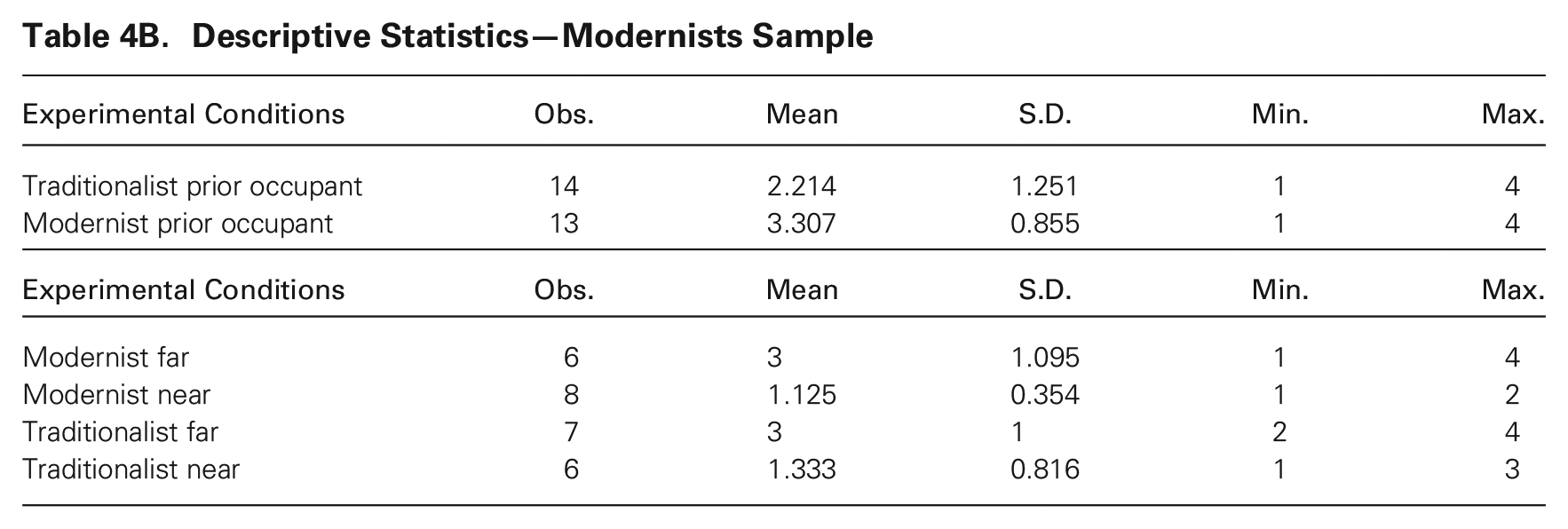
Ordered Logit Regression, Combined Sample (Traditionalists and Modernists), Omitted Category: Traditionalists Far*
p < .10; •p < .05; ••p < .01.
Standard errors are in parentheses. All models focus on participants’ likelihood of choosing a given location.
At the end of the experiment, we provided space for the bakers to explain their choices. Interviews with bakery owners regarding their lived experiences in Lyon (both traditionalists and modernists) complemented these data. Table A11 in the Online Appendix reports a selected representative sample of qualitative evidence we gathered, organized along location imprinting, proximity to the same collective identity, and proximity to the competing collective-identity considerations.
We claim that the legacy from one actor’s imprint helps a new entrant affiliate with and affirm the established practices and values of a geographic location (see Hypothesis 1). In the words of one traditionalist we interviewed, “The [prior occupant’s] method of breadmaking was aligned with mine. I liked what he did, even though I still changed some things. There was already the spirit of a good baker here” (Boulangerie H). A modernist spoke of the need for alignment, saying, “I didn’t want to buy a bakery that produced products that didn’t match my way of seeing bread.” Choosing a location affiliated with a competing collective identity posed a problem of identification for both groups. “By personal conviction, I did not want to buy a [modernist] bakery that previously produced bread that does not fit with my philosophy; I want people to know I am an artisan baker and not just a ‘cuisseur du pain’ [cooker of bread]” (Boulangerie E). This qualitative evidence appears to support Hypothesis 1.
In addition, we find that avoiding competition with bakers claiming the same collective identity and differentiating from bakers of the competing collective identity motivated the entrants’ choice of distance from an existing producer. Once again, our interviews and vignettes corroborated this interpretation. With respect to avoidance of competition with peers, a modernist vignette respondent mentioned, “I think I have a better product [than a modernist bakery] but it’s not good to have a colleague so close.” Fittingly, a traditionalist baker also summarized the avoidance of in-group proximity by using the same descriptor (“colleague”) saying, “Setting up across the street from a similarly minded competitor is not wise. My objective is not to steal clients of a colleague.” Another traditionalist implied a degree of cooperation, explaining, “Proximate competition with another artisan does not interest me.” The qualitative evidence seems to support Hypothesis 2. Moreover, the support obtained among traditionalists might relate to the specific scenario of head-to-head competition that the vignette evoked (i.e., “located across the street”).
On differentiating from bakers of competing collective identity through location, one traditionalist spoke of distinctiveness from the competing collective identity, saying, “The fact that there is [a modernist] next to us allows me to differentiate my identity” (Boulangerie H). Another traditionalist described identity distinctiveness regarding the modernist across the street: “I esteem that competing [with a modernist] highlights us” (Boulangerie L). Likewise, a traditionalist baker reacting to the vignette responded, “The fact of having [a modernist] competitor accentuates my craftsmanship and the fact of producing good bread.” Inversely, a modernist said, “When we entered the market, we recognized that [traditionalists] are to be avoided . . . they are harder to manage in terms of competition.” We interpret this qualitative evidence as providing further support for our arguments. It is worth highlighting that this evidence appears aligned with Hypotheses 3 and 4. The desire of would-be Banette owners to avoid direct competition with traditionalists additionally grounds our interpretation of data shown in Figure 7.
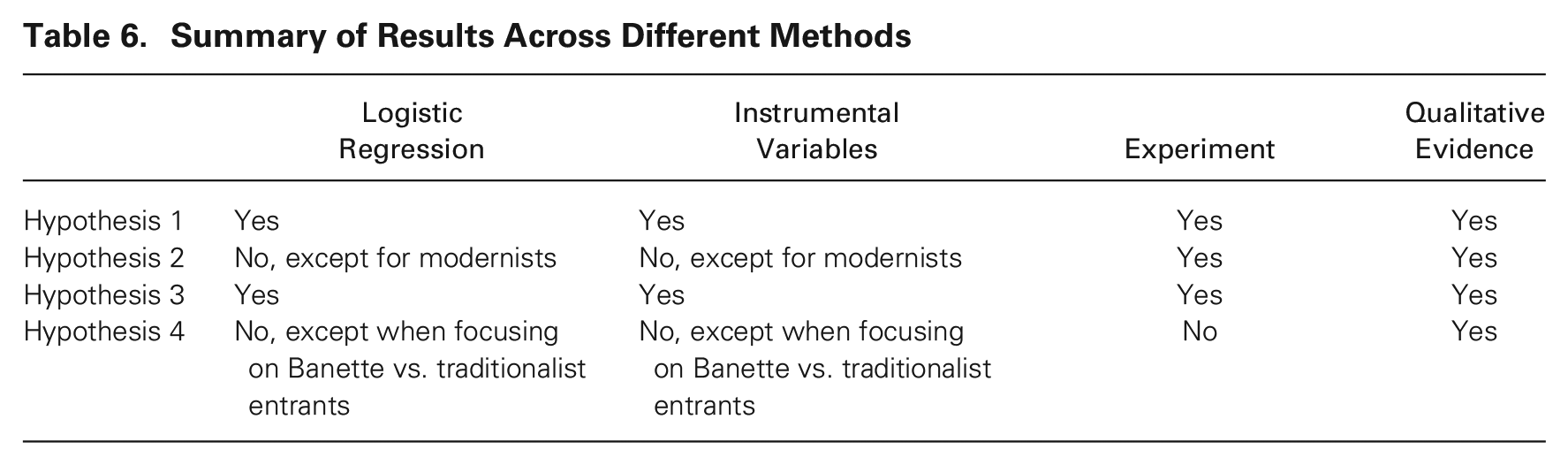
Table 6 provides a summary of our hypotheses tests across the various methodologies presented throughout the empirical section of the paper.
Summary of Results Across Different Methods
Discussion and Conclusions
A vast literature highlights the relevance of a sociocognitive perspective on markets for actors’ strategic decisions and identification of competitors (Porac, Thomas, and Baden-Fuller, 1989; Porac et al., 1995; for a review, see Kaplan, 2011). This study addresses how competition between collective identities influences new entrants’ location choice. Our findings reveal that under this condition, new entrants perceive geographic space as a constellation of incumbent firms that belong either to the same or to a competing collective identity. Location choice becomes a lever for new entrants to affiliate with a collective identity and compete with incumbent firms that encroach on this identity.
We relate this discussion to a common source of competition in markets, the divide between traditionalist and modernist producers, and test our arguments in the context of new entrant Lyonnais bakeries during 1998–2017. The 1998 law that legally established differences between artisans and industrialists/supermarkets made competition salient among artisans who share the label but apply different meanings to it. While the data support parts of our theoretical arguments, two components of our reasoning required additional investigation and reflection. Experimental evidence priming a more direct measurement of proximity (head-to-head) and post hoc analysis using modernist entrants characterized by stronger identification (i.e., Banette entrants) further suggest that collective-identity considerations filter location choices. While actors avoid locations near members with the same collective identity, they actively pursue spatial proximity to out-group members when they wish to reclaim the distinctiveness of their collective identity. We elaborate on the implications of these findings below.
Limitations and Scope Conditions
Before describing the contributions of our work to the literature, we note two limitations that we consider potential avenues for future development. First, our theoretical arguments are contingent on the type of new entrant under consideration. The entrants this research studied are entrepreneurial artisans who are prone to self-identify with their work, an attachment that may lead to specific work-related attitudes and behaviors (Ranganathan, 2017). This condition is essential for explaining the pursuit of location choice that transcends cost–benefit payoff and entails the defense of an espoused identity. A second limitation concerns the narrow space for distinctiveness among French bakeries. A natural extension of our work would be to assess whether the same pattern of location choice applies to other empirical contexts in which producers have more room for distinctiveness.
These limitations help clarify two scope conditions of our theoretical arguments. The first relates to the existence of well-marked boundaries between two collective identities for observing identification with and competition between collective identities. We capture salient and well-established group differences in terms of perceived values, practices, and standards (Brewer, 2010). An us-versus-them group distinction is quite natural among producers who claim the same label. In scenarios in which identification and competition fade (or collective identities are in a formative stage—for instance, see Negro, Hannan, and Rao, 2011), we expect the explicative potential of our reasoning to diminish. Second, while producers perceive the market label as segmented and identify with a collective group, consumers have limited awareness of this identity divide. While seeming unusual, this scenario simply requires limited activism from consumer movements (e.g., Carroll and Swaminathan, 2000) and/or lack of identity-related consumption among consumers (Phillips, Turco, and Zuckerman, 2013). This is a plausible scenario in many commodity-like markets (e.g., Liu and Wezel, 2014), which scholars have studied less, relative to research on experience goods.
Collective Identities and the Drivers of Location Choice
The results of this study have important implications for how we understand location choice. Location choice occupies the center stage in various literatures, including marketing (Thomadsen, 2007), strategic management (Kalnins and Chung, 2004; Ren, Hu, and Cui, 2019), and sociology (Sorenson and Audia, 2000). Two general trends emerge from this body of work (Kulchina, 2015). From one vantage point, the economic characteristics of a location are fundamental for seizing various economic benefits (Alcácer and Chung, 2007). Distance from similar firms has been described as a requirement for differentiation along product characteristics (Baum and Haveman, 1997) or prices (Thomadsen, 2007). In the absence of these buffers, spatial distance emerges as the differentiator.
However, another stream of research progressed in parallel and stressed the role of other determinants of location choice. Baum and Lant (2003) highlighted the limits of approaching location decisions from the perspective of resource overlap among competitors. Entrepreneurship scholars have begun to recognize that entrepreneurs’ choices extend beyond mere cost–benefit analyses (Fauchart and Gruber, 2011; Gruber and MacMillan, 2017; Wry and York, 2019). Moreover, Lounsbury and Glynn (2019) suggested an integrative approach to studying how entrepreneurial identities are relationally situated and become a means through which new ventures achieve legitimacy. In relation to location choice, Dahl and Sorenson (2009) provided evidence that entrepreneurs exhibit a disproportionate preference for founding firms in their home regions. Kulchina (2015) also illustrated the role of personal and suboptimal economic preferences in entrepreneurial location decisions.
Our research contributes to this body of work by conceptualizing new entrants as embedded in groups that transcend personal preferences and family networks but reflect collective identities. New entrants use collective identities to manage complex cues and to gain some control and predictability over market events (White, 1992). Collective identities impact new entrants’ value conceptions, rendering location choice and geographic proximity subject to in-group/out-group considerations. Therefore, collective identities represent another dimension along which new entrants construct perceived similarities and navigate geographic space when choosing a location for their firms. As location choices filtered by collective-identity considerations are the means through which new entrants claim group affiliations and distinctiveness, these choices also emerge as one of the forces underlying the persistence of imprinting in the world of organizations (Tilcsik, 2012; Marquis and Tilcsik, 2013).
Our collective-identity perspective reconciles findings concerning geographic proximity among firms that share the same resource space (Baum and Lant, 2003; Beck et al., 2019) with in-group/out-group representations of competitors (Porac et al., 1995). Focusing on collective identities as a lens for evaluating location choice highlights the attention of entrepreneurs to values and practices in their decision-making. A finer-grained focus on those values and practices helps explain the inconsistent trend of results we obtained for Hypotheses 2 and 4. For Hypothesis 2, regarding traditionalists’ distancing from other in-group members, we found support for our prediction only when we considered a proximal distance radius (i.e., 150 meters; see additional analyses) or head-to-head competition (as in the experimental design). We interpret this finding as suggesting that because autonomy and independence lie at the core of traditionalists’ identity, distance from other peers may be more tolerated than we expected. The reliance on individual recipes and craftsmanship might instill confidence that competition among traditionalists is less substitutable. Similar reasoning holds with respect to Hypothesis 4; focusing only on a subset of Banette entrants supported the distance of modernist entrants from traditionalists. Upon reflection, this finding is not very surprising. Banette entrants represent the prototypical modernist, and the perceived difference in practices and values reaches its apex when we compare these entrants with traditionalists. Thus, willingness to coexist alongside traditionalists by minimizing differences and avoiding competition is especially pronounced among Banette bakeries. These additional findings illustrate that the specific values and practices associated to each collective identity shape competition between them and play a critical role in producers’ decision-making. Our deep engagement with the empirical setting permitted us to uncover these specificities and invites scholars to consider research designs that benefit from qualitative and quantitative insights.
Fully appreciating the novelty of our argument requires comparing it to alternative approaches in entrepreneurship that center on personal (Fauchart and Gruber, 2011) or role (Wry and York, 2019) identities. We acknowledge the social component in this literature, primarily regarding the “other-oriented behavior” inherent in social entrepreneurship (see Pan, Gruber, and Binder, 2019: 213). However, collective identities relate primarily to defining themselves in terms of membership in the same social category (e.g., Turner, 1984), which may generate in-group favoritism even in the presence of negligible interactions among actors (see Mathias et al., 2018). Our producer-centered conception of collective identities differs also from the categorization processes that Hannan and colleagues (2007) described, which require the recognition of external audiences, often leading to oppositional labels that consumers recognize and use (e.g., Carroll and Swaminathan, 2000; Verhaal, Khessina, and Dobrev, 2015). Our article falls between these approaches and highlights how competition in markets involves collective identities that producers share and enact. Such identities are independent from personal, role, and categorical identities (Pan, Gruber, and Binder, 2019) and inspire competitive moves that prior research has underappreciated.
Heterogeneity Within Market Labels: Traditionalists and Modernists
Our study advances a conceptualization of competing collective identities regarding traditionalists and modernists, claiming that this divide leads to asymmetric needs for distinctiveness from the out-group. While the work of Negro and colleagues (2011) tied the distinction between traditionalists and modernists to competition, it may be traceable to any context in which firms claim the same market label but apply divergent interpretations to it, expressed through different practices and values.
Similar to the work of Negro and colleagues (2011), our study draws attention to producers rather than to audiences (e.g., Hannan, Pólos, and Carroll, 2007). However, a key conclusion of Negro and colleagues’ work is that traditionalist producers’ effort to reclaim the identity divide intensified “when the fuzziness of their category schema and the risk of being submerged by an alternative schema are greater but weakens when the schema assumptions are revised” (Negro, Hannan, and Rao, 2011: 1460). The premise of their conclusion is that both audience members and intermediaries “perceived the cultural fault lines in Barolo/Barbaresco that coincide with the ‘traditionalist/modernist’ divide” (Negro, Hannan, and Rao, 2011: 1455). Our article points to a different scenario, in which the cultural divide exists among producers, but its public awareness and recognition by the law are lacking. As we mentioned in the section on scope conditions, this scenario is more likely to be observed, for instance, in commodity-like markets than in those for experience goods. Imagining that certain schematic differences among producers may not be immediately accessible to consumers is entirely plausible. Especially when differences involve subtleties in production techniques that the law does not codify, many such differences can remain out of sight for most consumers. The implications of this consideration are potentially profound. While existing literature has extensively debated the role of identities in terms of audience–producer-shared evaluation schema, the implications of a misalignment in the schema across audiences and producers have received less attention. Our article provides an example of this that appears aligned with minimal and realistic principles of bounded rationality, and it describes the competitive dynamics observed in a wide range of markets.
Our focus on producers rather than audiences also sets this study apart from other work on oppositional identities. Within this literature, a resource partitioning approach has taken center stage. The work of Carroll and Swaminathan (2000) and Verhaal, Khessina, and Dobrev (2015) on craft beer exemplifies this. As it relates to our work on bakeries, microbreweries function similarly to traditionalists, while contract brewers are akin to modernists (i.e., mass producers of craft beer, like industrial bakeries, are too dissimilar in terms of resource overlap to induce any significant identity competition based on producer-led classification of similarity). In the case of Carroll and Swaminathan (2000), the mechanics behind the success of microbreweries pertained to consumers’ awareness of authenticity differences between classes of producers. Yet, how often do consumers have such awareness? In which markets? We believe that the activism required to unmask contract breweries requires the assumption of identity-based consumption among consumers, which is possible only in select markets.
Other scholarly work deals with cases in which audience members are partially unaware of differences between producers, pushing producers to work on product features and differences to reclaim the distinction of their collective identity. Research has emphasized incumbent producers’ struggle stemming from the emergence of a competing out-group that aims to revisit the existing meaning of a market label. As noted, evidence on craft beer (Verhaal, Hoskins, and Lundmark, 2017), organic farming (Sikavica and Pozner, 2013), and Islamic banks (Syakhroza, Paolella, and Munir, 2019) described the trade-offs that extant producers face when confronted with boundary crossing from representatives of an emerging, competing identity. Once again, most of these cases focus on a stage of emergence in the collective-identity divide. We claim that the legitimate (legal) convergence effect of a market label requires different strategies and reactions from producers. In similar markets, the persistence of collective identities and their defense is neither granted nor widely studied (for an exception, see Mathias et al., 2018). The consolidation of different collective identities under the same market label, in conjunction with their scant recognition by consumers, yields limited product differentiation opportunities for producers. These market constraints lead them to seek affiliation and distinctiveness through group membership, a dimension less tangible than the ones that existing studies highlighted. Furthermore, the needs for assimilation and distinctiveness appear in contrast with the literature’s rather objective interpretation of these forces. 15 Those needs demand additional attention to the benchmarks for competitive comparisons and optimal distinctiveness (Zhao and Glynn, 2022). 16
This insight raises the question of whether the theoretical predictions summarized in Table 1 can apply to other market decisions beyond location choice. A case in point might be the research on the sociocognitive determinants of price-setting (Ody-Brasier and Vermeulen, 2014; Ranganathan, 2017), which illustrates that categories and norm violations affect price discrimination. However, seeing those results in light of our theoretical arguments potentially indicates that a quest for affiliation with a collective identity leads to setting lower prices for peer members and higher prices for actors of a competing collective identity. The difference between the two interpretations is subtle but important; it relates to audiences’ awareness of the identity divide. A category approach would imply such an awareness (i.e., categories and identities become sociologically real only when vetted and recognized by audiences; see Hsu and Hannan, 2005), whereas our theoretical framework does not rely on a similar assumption. We look forward to research that extends our reasoning to different dependent variables and alternative means of assimilation and distinctiveness among groups of producers in markets.
Supplemental Material
sj-pdf-1-asq-10.1177_00018392231179631 – Supplemental material for Artisanal or Just Half-Baked: Competing Collective Identities and Location Choice Among French Bakeries
Supplemental material, sj-pdf-1-asq-10.1177_00018392231179631 for Artisanal or Just Half-Baked: Competing Collective Identities and Location Choice Among French Bakeries by Laura Dupin and Filippo Carlo Wezel in Administrative Science Quarterly
Footnotes
Acknowledgements
This paper benefited from the insightful guidance of Christine Beckman, Chris Marquis, and three outstanding anonymous reviewers. We would like to thank Stefan Arora-Jonsson, Joel Baum, Emanuele Bettinazzi, Anne Bowers, Raffaele Conti, Paul Gouvard, Philippe Jacquart, Lionel Paolella, Alessandro Piazza, Joe Porac, Nevena Radoynovska, Freddy Zerres, Guang Zhu, Ezra Zuckerman, and the participants in the 2019 Creative Industries Conference and seminars held at Singapore Management University, INSEAD, and STORM research center (Emlyon business school) for their constructive comments. We are grateful to Joan Friedman and Ashleigh Imus for their precious and patient support. Filippo Carlo Wezel acknowledges the support provided by the Swiss National Science Foundation. Thank you to the French baking community, in particular Jean Dupin, Patrick Ferrand, Alex Laumain, and Hugo Cuinet, for your knowledge and passion for bread.
1
Only nine entrants chose locations where a previous bakery did not exist. We chose to exclude these entries, to test the effect of location imprinting (Hypothesis 1). Restricting the risk set to this criterion reduces the number of entrants from 186 to 177.
2
In unreported analyses, we also used walking-distance measures obtained from Google API and obtained similar results.
3
We also ran a robustness check in which we included the number of supermarkets, as an alternative venue for buying bread locally. Including this control variable did not affect our results.
4
We explored whether immigrant entrepreneurs were more likely to choose locations where an immigrant existed prior. We did not find evidence of such a relationship when we interacted both variables.
5
6
Reverse causality is unlikely to be a serious concern. The Chamber of Trade and Craft records an entrant’s education when entrants register the business for the first time. Thus, in our sample, any advanced training (or reorientation) an entrant possesses occurred before a location choice.
7
We also checked for overidentification by using the Hansen J statistic. The quality of this test improves under limited correlation between the two instruments, as in our case (i.e., 0.04). Analyses not reported here indicate that the joint use of instruments does not bias the estimate of the coefficients, compared to using them singularly.
8
A possible concern is that while the main effects of the instruments are statistically significant, this is not the case when they are interacted with the moderating effects (i.e., when interacted with Traditional prior occupant, Traditionalist proximity, or Modernist proximity). To better understand this finding, we adopted an explorative empirical approach. Our intuition is that the interactions involving the moderator and the instrument failed to reach significance also because of the high correlation inherent in any interaction effect (e.g., the correlation between Advanced training and Advanced training × Traditionalist prior occupant reported in Table A6 is 0.85, justifying the main effect of the Advanced training variable absorbing most of the variance). We then treated these interactions as instruments in themselves (i.e., without the main effect, such as Advanced training × Traditionalist proximity) and assessed their predictive power on each focal instrumented interaction (e.g., Traditionalist entrant × Traditionalist proximity). Additional models not reported here indicate that most of the instrumented interactions turn statistically significant and positively predict the endogenous interactions. The tests of our hypotheses remained consistent with the main results presented.
9
Beyond endogeneity at the entrant level, location-specific differences in quality may also explain our main results. To rule out any potential selection bias in location availability, we resorted to entropy balancing (ebalance routine in Stata). We balanced “treated” traditionalist locations with “control” locations, using the following variables: Tourist location, Potential sales, Resident population, Median income, Bakeries entries and exits within 300m, Vacancy years, Bakery tenure, Family, Immigrant, Limited liability, Artisanal bakeries and owner age, and High skills. Once again, the estimates obtained from this procedure, reported in Tables A8 and A9 in the  , appear qualitatively similar to those reported in the main models.
10
Distinct from our instrumental variable captured at the entrant level, this variable reflects the nearest neighbor for locations at risk of entry (i.e., the incumbent bakery level).
11
Our reasoning is that non-Banette entrants exhibit a relatively weaker identification with the modernist collective identity than Banette entrants do. Non-Banette affiliated bakeries (i.e., Baguépi, Festival des Pains, Campaillette, and Florentin) followed Banette’s model and establishment in 1982, entering the market much later, in the late 1980s/early 1990s. Moreover, non-Banette affiliated bakeries account for a much lower market share of the modernist collective identity (i.e., by number of bakery adherents) (Kaplan, 2006).
12
In unreported 2SLS analyses, we also found support for Hypothesis 4 using the subsample of Banette Only entrants.
13
Thanks to the help and support of the Manager for Administrative Formation at the Ecole Banette.
14
Nonetheless, we conducted t-tests of control variables in the randomized conditions and did not find a statistically significant difference across means.
15
We are indebted to an anonymous reviewer for pointing out this implication.
16
Our framework is akin to research in management related to optimal distinctiveness (Zhao et al., 2017). However, unlike prior work in this field, which has focused on optimal distinctiveness and market performance (Deephouse, 1999; Zhao et al., 2017), we stress that in-group assimilation and distinctiveness from the out-group inspire location choices of new entrants.