



Abstract
Research on the creative process has focused on how an idea develops within a single focal creative project. But creators often work to develop creative portfolios featuring multiple projects that overlap and intertwine over time. Through an inductive qualitative study of creative workers in independent theater and in architecture, we explore how creators manage ideas across multiple projects when developing creative portfolios. Our emergent model shows how creators shift ideas across projects by stockpiling ideas from one creative project, transforming them into resources, and mobilizing them in their portfolios. Our analysis reveals that these practices unfold in distinct ways across two different processes for managing ideas: managing ideas strategically to build portfolios by realizing stockpiled ideas in new creative products across different opportunities, and managing ideas symbolically to balance creative outputs with new meanings constructed from unrealized ideas that represent the creator’s identity and journey. Our findings reveal the critical role of stockpiling in creative work, showing how different ways of stockpiling transform ideas into resources for developing a portfolio. Our portfolio perspective on the creative process informs our understanding of creative portfolios as they develop and evolve as well as the dynamics of creative processes as they unfold across different projects.
A hallmark of working in creative jobs and industries is the need to produce a continual stream of new products in order to keep pace with an uncertain competitive landscape and shifting audience demands (Amabile et al., 1996; Puccio and Cabra, 2012; Long Lingo and Tepper, 2013). Scholars have observed that creators working in contexts that consistently require creativity build portfolios of projects throughout their careers. This practice has been observed among designers who develop different products or product categories for clients (Hargadon and Sutton, 1997; Elsbach, 2009; Elsbach and Flynn, 2013; Sonenshein, 2014, 2016), artists who write and develop multiple films or record multiple songs (Long Lingo and O’Mahony, 2010; Stjerne and Svejenova, 2016; Berg, 2022), scientists who conduct different studies and write several papers (Wallace, 1989; Musselin, 2009), and entrepreneurs who initiate and move among ventures (Westhead and Wright, 1998; Wiklund and Shepherd, 2008; Rouse, 2016). Portfolios can sustain creative careers over time and even lead to breakthrough hits (Sternberg and Lubart, 1991, 1996; Caves, 2000; Berg, 2022).
Whereas research increasingly recognizes that creative portfolios, rather than individual ideas, represent the output that many creators work toward, we know little about the implications of developing a portfolio for the process of creativity. Existing research on the creative process focuses on the set of creative activities that occur within the boundaries of a single, discrete project as an idea journeys from conception to completion (Wallas, 1926; Amabile, 1988; Staw, 1990; Perry-Smith and Mannucci, 2017). That literature provides deep insights into the stages of the creative process and the complexities and connections between them as creators work dynamically and iteratively with ideas (Harvey and Kou, 2013; Harrison and Rouse, 2015; Amabile and Pratt, 2016). However, binding the creative process to a single project has two implications for our understanding of creativity that may not apply to the context of developing a portfolio. First, such binding implies that creators generate ideas, select and implement the best ideas in response to particular tasks or problems, and reject the remaining ideas (Fayard, Gkeredakis, and Levina, 2016; Zhou et al., 2019). Second, it suggests that once a final product is implemented, a creator moves on to their next project, and the creative process restarts with the generation, evaluation, and implementation of a fresh set of ideas that can respond to the focal problem of the new project (Amabile, 1988, 1996; Staw, 1990; West, 2002).
In contrast, in creators’ process of developing portfolios, ideas may have a life before and beyond project boundaries, as creators work on multiple creative projects and ideas (Litchfield and Gilson, 2013) that are “stopping, starting and overlapping” (Rouse, 2020: 185; see also McLeod, O’Donohoe, and Townley, 2011; Puccio and Cabra, 2012) in an ongoing stream of activity. This means that while creators develop their portfolios, ideas and opportunities may not flow in perfect harmony. Sometimes, a creator has so many ideas for a given project that they cannot capture them quickly enough and are left with a surplus; other times, a creator faces the terror of the blank page, unable to overcome a creative block to complete their work (e.g., Joyce, 2009; Catmull and Wallace, 2014). This variation produces a set of unique practical and psychological demands for creators. Practically, it requires creators to coordinate the many ideas they develop, which may not occur at the right time or place for them to be developed or implemented; psychologically, it requires creators to cope with those coordination demands, which may entail letting go of some treasured ideas or developing other ideas that they do not believe in or that do not represent them as creators. As Long Lingo and Tepper (2013: 350) noted, “Dealing with uncertainty, setbacks, and constantly shifting opportunities requires artists to have a strong personal compass—a sense of what makes them tick, what they are good at, and what network of enterprises or projects will best sustain their career.”
In our research, we therefore ask, how do creators manage ideas across projects in the process of developing their creative portfolios? To address this question, we conducted an inductive qualitative study of creative workers in independent theater and in architecture. We observed that creative workers shifted ideas across the boundaries of different projects by stockpiling ideas that they felt connected to, saving and storing them from one project and transforming them into resources, and then mobilizing those resources in new creative products and with new meanings for their creative work. Our analysis further revealed that those processes unfolded in two distinct ways: through strategic and symbolic practices. Together, those practices formed a holistic approach that emphasized a “creative life” (Gruber, 1989: 20) of continuously managing an evolving stockpile of ideas.
Our study provides a portfolio perspective on the creative process that informs our understanding of both creative portfolios and the creative process. First, it reveals that more than a set of creative outcomes (Sternberg and Lubart, 1991, 1996; Caves, 2000; Berg, 2022), portfolios are evolving collections of products and meanings through which creators live and breathe their ideas, deriving and creating value even from ideas that are not implemented. Second, it builds on and extends a process perspective of creativity (Drazin, Glynn, and Kazanjian, 1999; Mainemelis, 2010; Harvey, 2014; Amabile and Pratt, 2016; Cronin and Lowenstein, 2018) by showing how creative processes unfold beyond project boundaries. In the context of creators developing their portfolios, new products and meanings emerge as creators manage stockpiles of ideas across multiple projects—a process that is quite different from and more complex than generating and selecting ideas within a single project, which prior research has emphasized.
Managing Ideas in Creative Work
Managing Ideas Within a Single Creative Project
Research on creativity from a process perspective (e.g., Drazin, Glynn, and Kazanjian, 1999; Mainemelis, 2010; Harvey, 2014; Amabile and Pratt, 2016; Cronin and Lowenstein, 2018) has traced the way that creators manage ideas in the course of producing a single, distinct creative output in response to a specific problem or task (e.g., Amabile, 1983, 1996; Unsworth, 2001). Over time, that research has shifted attention from idea generation as the main source of creativity within that process (Shalley, Zhou, and Oldham, 2004; George, 2007) toward examining the broader “sequence of thoughts and actions” (Lubart, 2001: 295) that creators engage in as they try to move ideas from conception to completion (e.g., Amabile, 1988; Staw, 1990; Perry-Smith and Mannucci, 2017). According to those models of the creative process, creators start by interrogating the focal problem or task and generating a set of ideas in response (Campbell, 1960; Amabile, 1996). Creators then evaluate generated ideas against task- and domain-specific criteria during the response validation stage (Amabile, 1983, 1996). Ideas selected during that stage are elaborated, resourced, and moved toward implementation (Howell and Higgins, 1990; Anand, Gardner, and Morris, 2007). In those later stages, creators focus on finding an idea that best responds to the task requirements and developing it further (Zhou et al., 2019).
More-recent process research elaborates the complexities of managing ideas during longer-term creative projects—individual or collective undertakings that aim to creatively address a specific problem or opportunity and have a particular set of task boundaries (Amabile and Kramer, 2011; Harrison and Rouse, 2015; Fisher, Pillemer, and Amabile, 2018). That research shows that ideas can journey through the process in ways that are dynamic and non-linear (Amabile and Kramer, 2011; Amabile and Pratt, 2016). Creators may frame and reframe problems, questioning their earliest visions and assumptions as they progress (Hargadon and Bechky, 2006; Harrison and Rouse, 2014). Sometimes creators generate all their ideas before evaluating them, but at other times they may evaluate a small set of ideas and build on them (Harvey and Kou, 2013; Harrison and Rouse, 2015). Creators may iterate between these processes repeatedly over the course of a long-term creative project (Harvey, 2014; Amabile and Pratt, 2016), sometimes returning to square one to make significant changes to a well-developed idea (e.g., Rahman and Barley, 2017; Toivonen et al., 2022).
In most studies, however, the journey of an idea is tied to the structural and temporal boundaries of a single creative project. According to Perry-Smith and Mannucci (2017: 57), “an idea moves from a vague concept in the creator’s mind to a more developed idea that is sharable with others, unless the idea is abandoned, at which point the idea journey ceases.” If an idea is selected, its journey continues toward further development and implementation so that its value can be realized (Perry-Smith and Mannucci, 2017; Zhou et al., 2019). Scholars have typically conceptualized ideas that are not selected and implemented within a project as rejected (e.g., Dailey and Mumford, 2006; Rietzschel, Nijstad, and Stroebe, 2010, 2014; Mueller, Melwani, and Goncalo, 2012; Zhou et al., 2019) and have suggested that those ideas provide little value to creators or their contexts (Levitt, 1963; Klein and Sorra, 1996). Idea implementation is thus critical for generating value from a creative process or an idea. After one idea is implemented, a creator may start a new project, repeating the process of generating, evaluating, and implementing a fresh set of ideas that can respond to the focal problem or task of that new project (Amabile, 1988, 1996; Staw, 1990; West, 2002).
Managing Ideas Across Multiple Projects in a Creative Portfolio
The context of creative work in which the development of portfolios involves multiple creative projects calls into question the notion that ideas and creative workers’ engagement with them can be tied to a single, focal creative project (e.g., Sternberg and Lubart, 1991, 1996; Caves, 2000). Emerging insights suggest that the process of developing a creative portfolio is complex and messy, and even if audiences receive the outputs of a creator’s portfolio sequentially at timed intervals (Caves, 2000; Berg, 2022), the process involves working on multiple projects that overlap and intertwine in a messy pattern of starts, stops, gaps, and peaks (McLeod, O’Donohoe, and Townley, 2011; Puccio and Cabra, 2012; Rouse, 2020). Such patterns have been observed in several studies of creators, including designers (Hargadon and Sutton, 1997; Elsbach, 2009; Sonenshein, 2014, 2016), artists (Long Lingo and O’Mahony, 2010; Stjerne and Svejenova, 2016), researchers (Wallace, 1989; Musselin, 2009), and entrepreneurs (Westhead and Wright, 1998; Rouse, 2016). Those studies show creators working both simultaneously and sequentially on multiple projects as well as experiencing breaks within projects (Amabile et al., 2005) and gaps between projects (Throsby and Zednik, 2011).
As such, developing a portfolio of projects entails a higher degree of complexity than developing a focal idea for a single project because a creator engaged in the former process may have many ideas in development at the same time, and each may stall, be altered, or fail at different stages of their respective projects. Scholars have repeatedly noted that ideas are elusive and do not always emerge at the right time (Joyce, 2009; Catmull and Wallace, 2014). Even when creators do come up with good ideas, it is difficult to know whether any given idea will be accepted by decision makers, resourced, or used in a project (Mueller, Melwani, and Goncalo, 2012; Berg, 2016; Mueller et al., 2018). Thus, as they develop their portfolios, creators do not know whether, when, and how their ideas will be realized and, therefore, whether projects will begin or end. A creator may sometimes need to corral a surplus of unrealized ideas; other times they may suffer from a blank page. And when an idea fails to meet the needs of one project, the opportunity to implement it in a future project may exist.
Unique demands of developing a creative portfolio
These observations suggest that developing creative portfolios produces two sets of unique demands on creators as they work with ideas. First, the portfolio-development process requires creators to coordinate ideas and project opportunities. At times, creators may have many projects to work on but a dearth of creative ideas that are appropriate for fulfilling specific project briefs (Roe, 1946; Litchfield and Gilson, 2013). Under time pressure to complete their projects, creators may struggle and engage less in the exploratory behavior needed for creativity, stalling their ability to generate ideas (Baer and Oldham, 2006). At other times, creators may have many ideas that they have not been able to develop. When creators brainstorm ideas for a project, they are likely to generate many ideas (Osborn, 1963; Sutton and Hargadon, 1996). Yet they cannot select and use every idea because not all ideas will be appropriate for a particular project (Sutton and Hargadon, 1996), and creators may lack opportunities and other resources, such as time, to develop ideas not used for the focal project (Litchfield and Gilson, 2013). Finally, creators may sometimes have no current projects or may face creative blocks and be unable to finish their projects (Joyce, 2009; Catmull and Wallace, 2014). Significant gaps between projects can lead to the deterioration of skills, reduced visibility, and loss of income (Throsby and Zednik, 2011), and creators need to fill that time to avoid these consequences.
Second, the process of developing creative portfolios entails psychological demands that result when coordination fails and creators have to let go of ideas, lack any ideas, or must develop ideas they do not believe in. In the course of working on multiple projects, creators will develop many more ideas than are realized in creative outputs, and this mismatch may be particularly painful in the context of developing their portfolios. Research on psychological ownership shows that creators become deeply attached to ideas by investing in and associating strongly with them (Belk, 1988; Pierce, Kostova, and Dirks, 2001), coming to see ideas as extensions of themselves (Elsbach, 2009; Grimes, 2018). They may thus experience intense negative emotions and threats to their identity if they have to let go of ideas (Rouse, 2013, 2016; Toivonen et al., 2022). Working on multiple projects can intensify negative feelings in at least two ways. First, if several ideas are rejected at once, creators may experience feelings of futility and lack of progress, which can be highly demotivating (Amabile et al., 2005; Amabile and Kramer, 2011). Second, if a creator has to let go of an idea they are particularly attached to while moving forward with another, less treasured idea, they may experience a mismatch between their output and what they consider to be the true meaning of their work (Elsbach, 2009; Grimes, 2018). This mismatch can impact not only how creators work on the focal project but also their engagement in future creative projects.
The practical and psychological demands of developing portfolios require creators to engage with ideas in different ways. Some scholars have indicated that this may involve broader, more-complex ways of working with ideas outside project boundaries (e.g., Litchfield and Gilson, 2013; Stjerne and Svejenova, 2016; Fisher, Ananth, and Caliskan, 2021). Complementing this perspective is a small number of field studies of creative work that show creators reengaging with and revisiting ideas from prior creative projects. For example, Austin, Devine, and Sullivan (2012) found that having access to a variety of ideas from the past and revisiting them during future projects can catalyze unpredictable moments of organizational creativity; Hargadon and Sutton (1997, 2000) showed that revisiting ideas from the past is an important way through which some innovative organizations foster creativity on an ongoing basis.
Practices for managing ideas across projects
Only a handful of studies have begun to provide a window into how ideas may move between projects. One insight from those studies is that creative work can benefit from keeping ideas alive over time. For example, Hargadon and Sutton (1997, 2000) showed that some creative companies embedded ideas “in objects that designers can look at, touch, and play with” (Hargadon and Sutton, 2000: 160). Elsbach (2009) similarly observed that toy designers often kept and displayed their original designs for toys around their work spaces, and Rouse (2016) noted that entrepreneurs sometimes mentally marked nascent ideas for future pursuits by temporally bracketing or stockpiling them. These studies suggest that holding onto ideas might provide important raw material for organizational members to draw on, resurfacing ideas in different projects or using them as inspiration for future work.
However, existing research has not examined how or why creative workers hold on to and manage ideas as they accumulate. This is important to understand because, if managed incorrectly, holding on to ideas may actually intensify the challenges of creative work, as creators produce increasingly long lists of wished-for projects that generate too much work for the future. How do creators manage ever-growing lists of avenues for future pursuits? Furthermore, ideas may exist in a variety of enacted forms, not all of which can stimulate cognition equally (Menger, 2006; Hua, Harvey, and Rietzschel, 2022). How creators may be able to extract and store novel and useful elements from ideas in a timely and effective manner also remains an open question.
In addition, research has typically not distinguished between creators managing their own ideas and managing the ideas of others (e.g., Hargadon and Sutton, 1997). That approach treats stored ideas as a collective pool and includes or even prioritizes ideas that have already been realized. This fails to account for the deeply personal and emotionally charged nature of creativity (Drazin, Glynn, and Kazanjian, 1999; Amabile et al., 2005) and creators’ personal connections to ideas (Rouse, 2013; Grimes, 2018). Research on psychological ownership and creative identity suggests that when creators have personal connections to ideas, they may engage with them in different ways and value them differently (Elsbach, 2009; Baer and Brown, 2012; Ranganathan, 2018). For instance, in a study of a toy manufacturing company, Elsbach (2009) found that toy designers saw ideas that had been rejected or modified during the creative process as reflecting their true creative identities. Having a good sense of one’s identity as a creator can be critical to navigating opportunities and challenges and weathering setbacks (Long Lingo and Tepper, 2013; Stierand, Dörfler, and MacBryde, 2014). Thus, to understand how ideas are managed across projects in a portfolio, it is imperative that researchers also consider how a creator manages ideas to which they have emotional connections, including the “idealistic designs” (Elsbach, 2009: 1058) that can inform their identities. We tackle these questions to build theory on how creators manage ideas across projects in the course of developing their creative portfolios.
Methods
To address our research question, we adopted an inductive qualitative approach appropriate for exploring process-related questions (Creswell, 1998; Denzin and Lincoln, 2011) and for understanding a phenomenon “from the perspective of those living it” (Corley, 2015: 601). We followed the procedure for developing grounded theory outlined by Glaser and Strauss (1967) and developed further by Gioia and colleagues (e.g., Gioia, Corley, and Hamilton, 2013). Two key concepts are at the core of our approach: theoretical sampling and constant comparison (Suddaby, 2006). We supplemented them with other qualitative analysis techniques (e.g., Boje, 2001; Abell, 2004; Charmaz, 2006; Willig, 2017), integrating different techniques to organize and analyze the emerging data (Pratt, Sonenshein, and Feldman, 2022).
Research Contexts
Our study is set in two creative work contexts: independent theater and architecture. At the beginning of our study, we were broadly interested in exploring the experiences associated with creative work over time and sought to gather insights that could not be observed by studying singular instances of creativity (Gruber, 1989). Therefore we focused on identifying a context in which people created regularly. That led us to consider independent theater artists. We grounded ourselves in this context before recruiting participants and collecting data. The first author attended and volunteered at various industry events, including five performances, five rehearsals, and two conferences, which helped us develop an understanding of the nature of theater work through informal discussions.
The purpose of independent theater is to produce cutting-edge drama and showcase new scripts with unusual or experimental material (Simpson et al., 2015). Theater artists generate new ideas and experiment with new content instead of reproducing well-established works (Quinn, 2005). The creative process in independent theater involves generating an idea, writing a script, workshopping the script with a team, and conducting rehearsals (Brook, 1968). Final products are in the form of plays showcased in festivals and other venues (Quinn, 2005). Theater artists have autonomy for initiating their own projects—they conceive ideas, are responsible for selecting ideas to develop and pitch, and play a significant role in designing and producing the plays they showcase (Simpson et al., 2015).
During our initial investigations in theater, we noticed that creators did not merely focus on a single project or work on ideas within the boundaries of a single creative project. Returning to the literature sensitized us to the concept of a creative portfolio (e.g., Sternberg and Lubart, 1991, 1996; Caves, 2000; Berg, 2022). We turned our attention to this concept as well as the unique demands involved in developing a creative portfolio and oriented our research toward understanding how creative workers manage ideas across projects as they develop portfolios. As our analysis progressed, we wanted to probe our emerging insights in a more traditional organizational setting in which creators were more likely to face closed problems with specific deadlines rather than the more open-ended nature of writing and producing theater (cf. Unsworth, 2001). Therefore we expanded our data collection to architecture. Our goal was to broaden our understanding by capturing “shared patterns that cut across cases and derive their significance from having emerged out of heterogeneity” (Patton, 1990: 172). We used replication logic from case study design (Yin, 2003) to seek another context similar to theater in terms of key theoretical constructs: regular attempts at creating and autonomy over projects. This led us to explore architecture as a second context.
As we did for theater, we began by grounding our work in the context. The first author attended two showcases, five workshops, and one conference in architecture. The primary job of architects is to conceptualize, design, and oversee the construction of physical structures (Vough et al., 2013). Previous research has revealed that novelty is prized in architecture, and architects work hard to ensure that their designs are not mere replications (Rahman and Barley, 2017). Unique designs offer architects the opportunity to compete for awards that can improve their standing in the community (Blau and McKinley, 1979). The creative process for an architectural project includes concept design, schematic design, design development, and construction administration. Architects frequently work with civil engineers, project managers, electricians, and other contractors, particularly in the later stages of the process. But creative control remains with the architects; they choose the ideas to pitch to clients or submit to competitions and are responsible for responding to design problems and revising ideas (Cuff, 1992; Rahman and Barley, 2017).
The ongoing exploration of and experimentation with ideas make theater and architecture ideal contexts for examining complex ways of engaging with ideas. Additionally, decisions about ideas were “transparently observable” in these contexts (Pettigrew, 1990: 275), as participants made decisions about ideas repeatedly and reengaged with ideas at different points (Simpson et al., 2015; Rahman and Barley, 2017). We were thus able to observe different dynamics related to engaging with and managing ideas over time.
Sample and Data Collection
The primary data for our study come from interviews with 70 theater artists and architects, complemented by a follow-up diary study of ten participants from the sample of interviewees. We used three strategies to recruit participants. First, we contacted educational institutions, organizations, and professional bodies for theater and architecture in the United Kingdom to identify and contact potential participants. Second, we approached potential participants who attended industry events such as conferences and workshops. Third, at the end of every interview, we asked informants to put us in contact with other people in their industry who were also continuously involved in creative work and who made decisions about ideas. Since many theater artists and architects are sole practitioners or freelancers, we relied on the latter two strategies to recruit these participants, which is consistent with other studies that sampled from populations for which no centralized workplace directory exists (e.g., Fayard, Stigliani, and Bechky, 2017; Petriglieri, Ashford, and Wrzesniewski, 2019). Forty theater artists and 30 architects participated in the study. Table 1 provides descriptions of the informants.
Sample Grouped by Context
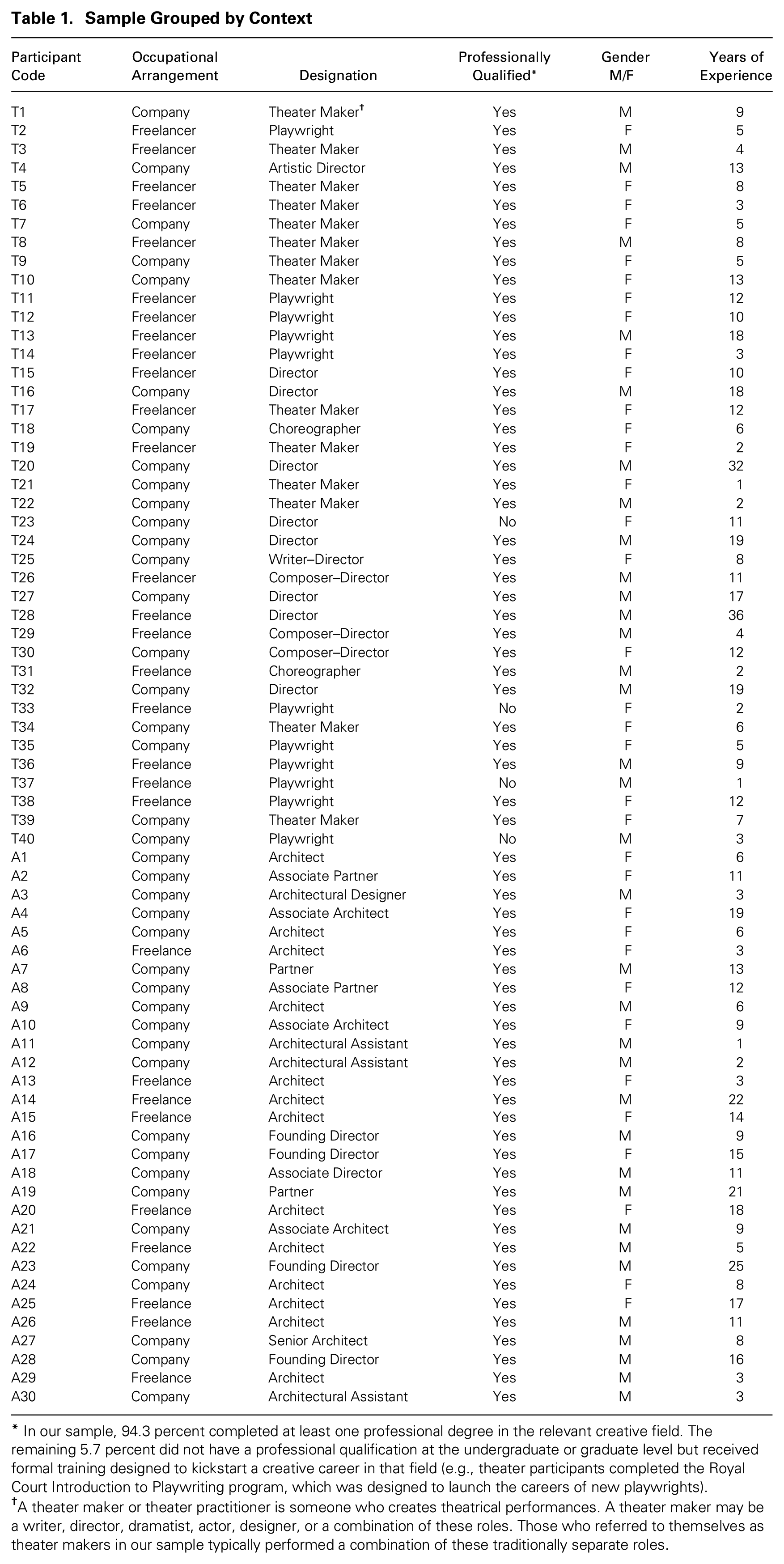
In our sample, 94.3 percent completed at least one professional degree in the relevant creative field. The remaining 5.7 percent did not have a professional qualification at the undergraduate or graduate level but received formal training designed to kickstart a creative career in that field (e.g., theater participants completed the Royal Court Introduction to Playwriting program, which was designed to launch the careers of new playwrights).
A theater maker or theater practitioner is someone who creates theatrical performances. A theater maker may be a writer, director, dramatist, actor, designer, or a combination of these roles. Those who referred to themselves as theater makers in our sample typically performed a combination of these traditionally separate roles.
Our sampling strategy moved from purposeful to theoretical as we began our analysis during data collection. We recognized that individuals directly involved in idea development—that is, generating, evaluating, and elaborating ideas (Grimes, 2018; Håkonsen Coldevin et al., 2019)—were more theoretically important to our study than individuals primarily responsible for the managerial aspects of projects and not directly involved in idea development. Therefore we continued to seek and recruit additional participants from both contexts who were involved in developing ideas. We used context-specific terms to clarify our requirements as we asked for recommendations for participants, asking to speak to “real theater artists, not puppets or imitators,” and “real architects, not contractors” who repeated the same designs or just executed what they were told. During the interviews, we asked all participants questions to confirm their experiences of generating, evaluating, and elaborating ideas and asked for specific recent examples to back up their claims. Whenever possible, we also sought additional evidence by looking at personal and company websites, social media accounts, and press releases for evidence of regular engagement in creative work.
Our sample includes both freelancers and employees at theater and architectural companies. We did not observe significant differences between participants with these two occupational roles in terms of how they engaged in creative work. Participants across both contexts tended to work relatively free of institutional constraints; those working for theater or architectural companies were often self-employed or part of small organizations. Even those who worked in larger organizations frequently worked within small project teams, in which they had high levels of autonomy as well as responsibility for creative contributions and decisions. They therefore enjoyed substantial creative freedom and suffered the lack of a “predictable future” (Petriglieri, Ashford, and Wrzesniewski, 2019: 125), as is characteristic of many jobs in creative industries.
Semi-structured interviews
The first author interviewed participants between 2016 and 2018. The interviews lasted between 45 and 90 minutes, were tape-recorded with permission, and were transcribed verbatim. In some cases, we also conducted follow-up communications by email to seek additional answers or to ask for clarification. All the interviews included questions about the nature of creative work in the industry, requests for descriptions of each person’s creative process, and questions about the times when creative workers made decisions about ideas (please see Online Appendix A for the interview protocol). We began our study with a broad objective to understand experiences associated with engaging in creative work, which is consistent with many qualitative studies. We focused more narrowly as the data collection and analysis progressed, modifying the interview protocol to address emerging themes (Spradley, 1979; Charmaz, 2006). A critical juncture in our study was around the time of our twenty-third interview, when we noticed during data analysis that several participants described holding on to ideas and revisiting them across projects instead of merely selecting or rejecting them within a focal project. This realization led us to develop a second set of questions about this practice.
During our interviews, we also asked participants to show us examples of ideas they were holding on to. The use of object elicitation—asking participants to show physical objects critical to their experiences (Willig, 2017)—allowed us to extract immediate, unrehearsed, and specific descriptions; we could also ask participants questions about specific ideas and observe differences. We began noticing variance in how participants described the different sets of ideas they had stored. For example, one architect described documenting ideas in folders and categorizing and labeling them, but he also showed us a photo on his website capturing sketches and models for an idea he had worked on. He distinguished the former and the latter by saying that the latter did not showcase the content underlying the idea; rather, it provided a snapshot of his experiences. Initially, we did not know how to interpret this distinction, but a return to the literature suggested that ideas can represent creators’ identities (e.g., Elsbach, 2009; Goncalo and Katz, 2020). This led us to explore how creative workers tap into the symbolic meanings behind ideas in the course of managing them. We further refined our interview protocol to delve into these distinctions.
Diary entries
Our interview data provided rich understanding of how creative workers managed ideas across projects. Yet, we were aware that because of a time lag between the occurrence of an event and reflection on it, the accounts provided in interviews could be colored by retrospective sensemaking (Bolger, Davis, and Rafaeli, 2003; Rouse, 2013). To offset those limitations, we triangulated interview responses with data from a 12-week diary study of six theater artists and four architects. Only creators who had participated in our interviews were recruited for the diary study, as the primary purpose was to explore in detail the practices that had emerged in our interviews. This approach is in line with previous research in which the purpose of conducting a diary study was not to uncover the core phenomenon but to reduce the time lag between the event’s occurrence and reflections on it, and to gather deeper insights (e.g., Margolis and Molinsky, 2008).
During interviews, we asked all participants if they would be interested in taking part in a more intensive continuation of the study. Those who expressed interest were contacted with details about the diary study. Six theater artists and four architects confirmed their willingness to participate. Those participants were asked to respond to a weekly diary study consisting of three open-ended, optional questions about creative activities pertaining to the past week (see Online Appendix A for details). We sent the diary questions to participants at the end of every week via an email link to an online survey, and the participants could provide responses by clicking the link at any time in the following week. All participants provided answers to at least three diaries, typically answering all three diary questions when they responded. We included all participants in our data analysis because they all described in their responses multiple instances of engaging with ideas. Fifty percent of the participants responded to at least half of the diaries, and 40 percent provided responses to ten or more diaries. We collected a total of 203 diary responses.
Analysis
The analysis of the data began in tandem with data collection. We initially conducted preliminary coding of long segments of data from interviews (Glaser and Strauss, 1967) to identify first-order codes based on terms used by participants, while maintaining the context around each piece of data (Boje, 2001). We also wrote research memos to track and explore the themes and connections that emerged (Charmaz, 2006). A key insight from the initial rounds of coding was the importance of idea stockpiling for managing ideas across projects. We used this insight as an anchor for subsequent data collection and for our coding and data analysis. We performed multiple rounds of coding, constantly moving between the data and an emerging set of conceptual categories (Glaser and Strauss, 1967). When the first-order coding efforts failed to reveal additional terms or insights of potential significance, we concluded that we had reached saturation and did not engage in further data collection.
As we progressed with our analysis, we identified similarities and differences across our first-order codes, which we used to create more-theoretical second-order themes. For example, we combined statements that represented saving and storing ideas in ways that preserved underlying content, including statements about “documenting details,”“creating filing systems,”“making ideas accessible,” and “creating shorthands,” under the second-order theme “stockpiling ideas systematically”; and we distinguished that theme from the theme “stockpiling ideas emblematically,” which represented saving and storing ideas in ways that preserved experiences associated with ideas. We also triangulated our initial findings from the interviews with the data from the diary study. We found no systematic differences between the conceptual insights that emerged from the diary and from the interview data, so we collapsed the two types of data in our analysis (e.g., Margolis and Molinsky, 2008; Rouse, 2013). Specifically, our diary data replicated the insight from our interviews that ideas stored systematically were typically used as resources for building new products, which differed from the way creators engaged with ideas that they stored emblematically. Figure 1 highlights the relationships between the final first-order concepts, second-order themes, and aggregate dimensions that emerged from our analysis using Corley and Gioia’s (2004) three-level methodology for illustrating qualitative data structures.
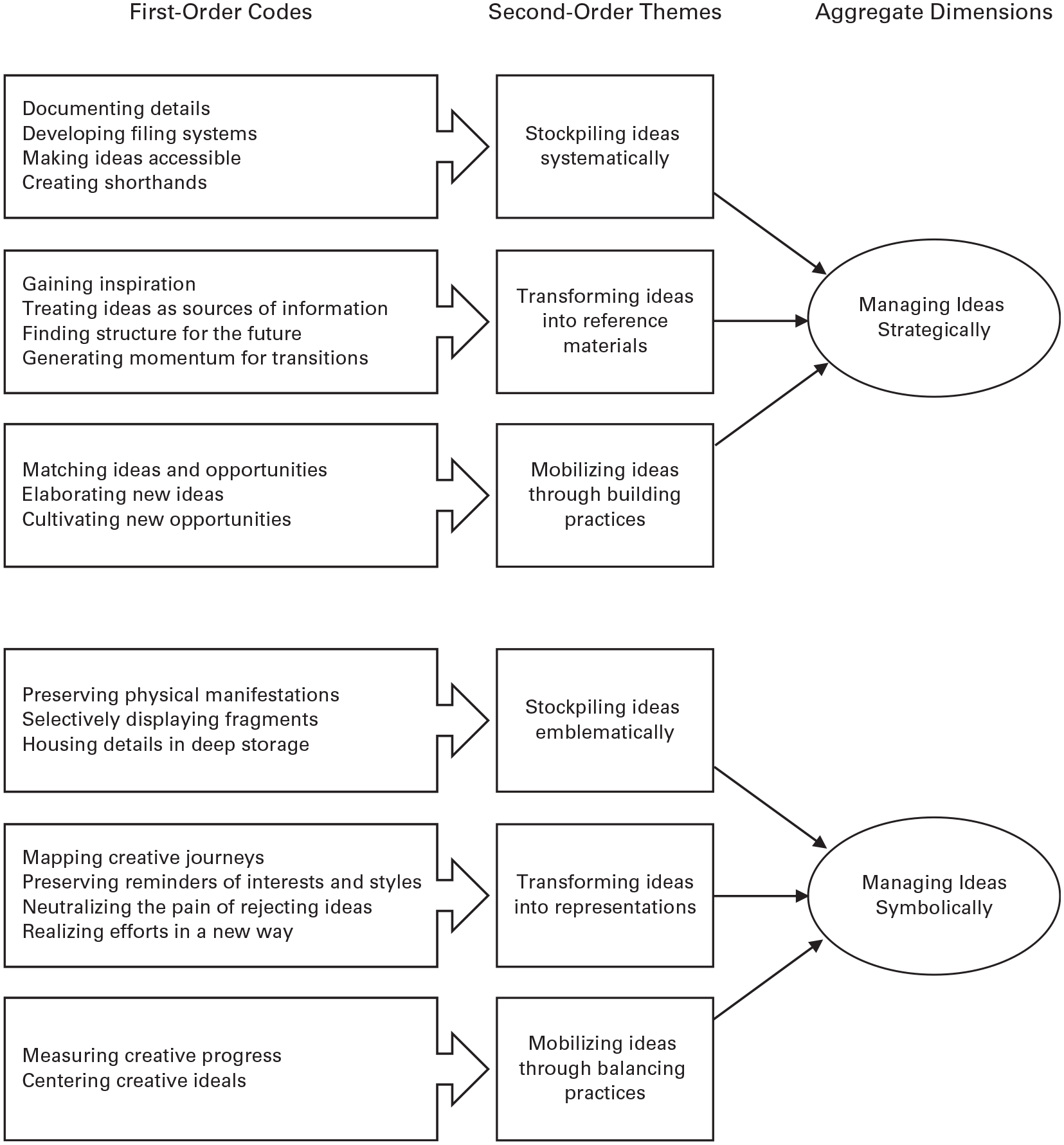
Data Structure
In the final stage of analysis, we considered how our emerging theoretical categories related to one another, to develop an overarching theoretical framework (Corley and Gioia, 2004; Charmaz, 2006). This included going back to the literature and reading extensively about creative processes, creative portfolios, and creative ideas, as well as research on resources for creativity, so that we could better understand the similarities and differences we observed in our data. We also paid special attention to the longitudinal components of our data to examine how creators managed ideas across projects. We began by searching for narrative causality in the informants’ descriptions by examining quotations within the context of longer passages (Abell, 2004) and consulting initial research memos, where we recorded early observations of themes and connections (Boje, 2001). We also examined our diary data to see whether the ideas mentioned in one diary entry were discussed again in another entry.
Examining these relationships allowed us to consider how the theoretical dimensions fit together in a conceptual framework. During that process, we developed preliminary theoretical models, which helped us to better visualize the relationships between the different categories (Pratt, Lepisto, and Dane, 2019) and pointed out inconsistencies in our conceptualizations. This led us to return to and refine our conceptual categories (Grodal, Anteby, and Holm, 2020). Through the process, we transformed our “static data structure into the dynamic inductive model” (Gioia, Corley, and Hamilton, 2013: 24) that detailed how creative workers manage ideas across projects when developing their creative portfolios.
Findings
Our examination of creative work in independent theater and architecture revealed that in the process of developing their portfolios, creators continuously shifted ideas across the structural and temporal boundaries of creative projects. Creators managed ideas by stockpiling them, or saving ideas from one creative project and storing them, transforming those ideas into resources, and mobilizing the resources to create new products and new meaning. Managing ideas in this way meant that a creator would “never really los[e] the idea” (A22) but could instead reengage with it in developing their portfolio. We further observed that creators used strategic and symbolic processes for managing ideas through stockpiling, transforming, and mobilizing. Before elaborating these processes, we situate our findings by describing how creators in theater and architecture worked on creative portfolios.
Developing Creative Portfolios in Theater and Architecture
Participants in our study described how they both worked on individual creative projects and pursued broader portfolios of projects. Their descriptions showed how they viewed the portfolio as a stream of ongoing, evolving creative activities, rather than a set of finished creative outputs. For example, theater artist T13 commented,
The main theater piece I have right now is a piece called [Play A], which has had a lot of development. . . . I also have a musical I’m working on, [a] piece about addiction. It’s like a movement play kind of thing. There’s a lot of dancing and it’s fiction, but really everything I write about is about dysfunctional families, people, and relationships. [Then there is] a web series about the Broadway community . . .
Participants reflected on how their ideas permeated their work and non-work activities: “I would go back from rehearsal in the tube and I would be in a flow state and I would just be thinking about [the idea] . . .” (T5). They had the experience of “creating on all fronts all the time” (T25) because they were deeply engaged in many projects at the same time, with fluid boundaries between them.
At the same time, channeling creativity into multiple projects required creators to coordinate ideas and opportunities to pursue them, as architect A7 suggested:
I think for all the partners in the practice, the design stage at the beginning is very intense. And it’s very difficult just to say I’ve just got five hours to design something because creativity is much more fluid. . . . So, if I was working on five projects that are in the concept design stage at the same time, that would be very difficult. So, how do you deal with creativity and trying to churn out ideas all the time?
Creators were frequently required to “churn out ideas” for projects. It was not that they could not come up with good ideas at all; rather, as theater artist T34 described, “sometimes, your most productive thoughts will happen at [a] completely separate time [than during a project].” As a result, they also sometimes found themselves with many ideas that lacked a project home. Creators also struggled to transition between projects. Theater artist T6 lamented, “every single thing starts from scratch! . . . I can get a [project], and the contract’s two weeks long. You’re so happy those two weeks, and at the end of it, it’s like, crap I’m at square one again.”
Aside from these practical demands for coordination, creators also experienced psychological demands that arose from letting go of ideas they had worked on when projects stalled or failed. This caused feelings of anger, sadness, and loss. T1 described his “frustration” that “you end up building all these ideas and working like mad . . . then you’re like ‘We don’t have the space to make this show’ . . . it’s damaging!”; similarly, A12 said, “To be honest, if I had to get rid of work done on a project, it would hurt, really!” Creators therefore felt intense negative emotions and psychological discomfort due to effort and experience that did not result in creative outputs. Acute and frequent setbacks and failure to realize ideas also caused creators to question their identities and career choices, as playwright T11 expressed: “At the moment, I don’t think that I have the right to call myself a playwright because I haven’t had anything on here for so long . . . [so] it’s just really hard to justify your right to hold that position.” Architect A11 felt like he no longer remembered what made him unique as a creator: “I remember saying to my friend I was so much better when I was in first year. I genuinely felt like I had muddied a lot of my ideas by the time I got to my third year. . . .” Creators thus lost elements of what made them unique when they failed to realize their ideas or had to substantially shift ideas away from their original visions.
Managing Ideas Across Projects When Developing a Creative Portfolio
Our analysis revealed that creators responded to the practical coordination demands and accompanying psychological experiences of developing their creative portfolios by continuously managing their ideas across projects. A key insight from our findings was that the practice of idea stockpiling was at the heart of that ongoing process. Stockpiling entailed saving ideas from one creative project and storing those ideas by maintaining them in specific locations. This meant that, contrary to our expectation that each project would end with a choice to select and implement or reject ideas, most ideas that creators in our study developed were neither selected and moved forward nor rejected and discarded; instead, ideas were maintained in a state of arrested development in a space between selection and rejection (see Table 2 for examples of ideas). Theater artist T40 provided an example of stockpiling:
In October, I did an idea a day. I had 31 ideas, and I had to start evaluating them. I would either select [an idea] or cross it out, or I would put a question mark if it was in the middle. . . . One of them is kind of an idea I’m writing now. I think out of those 31, there are six on the “maybe” list. They are still in the notebook that I have. . . . The ones that I crossed out . . . they are actually not on my laptop anymore.
Examples of Ideas Managed Across Projects
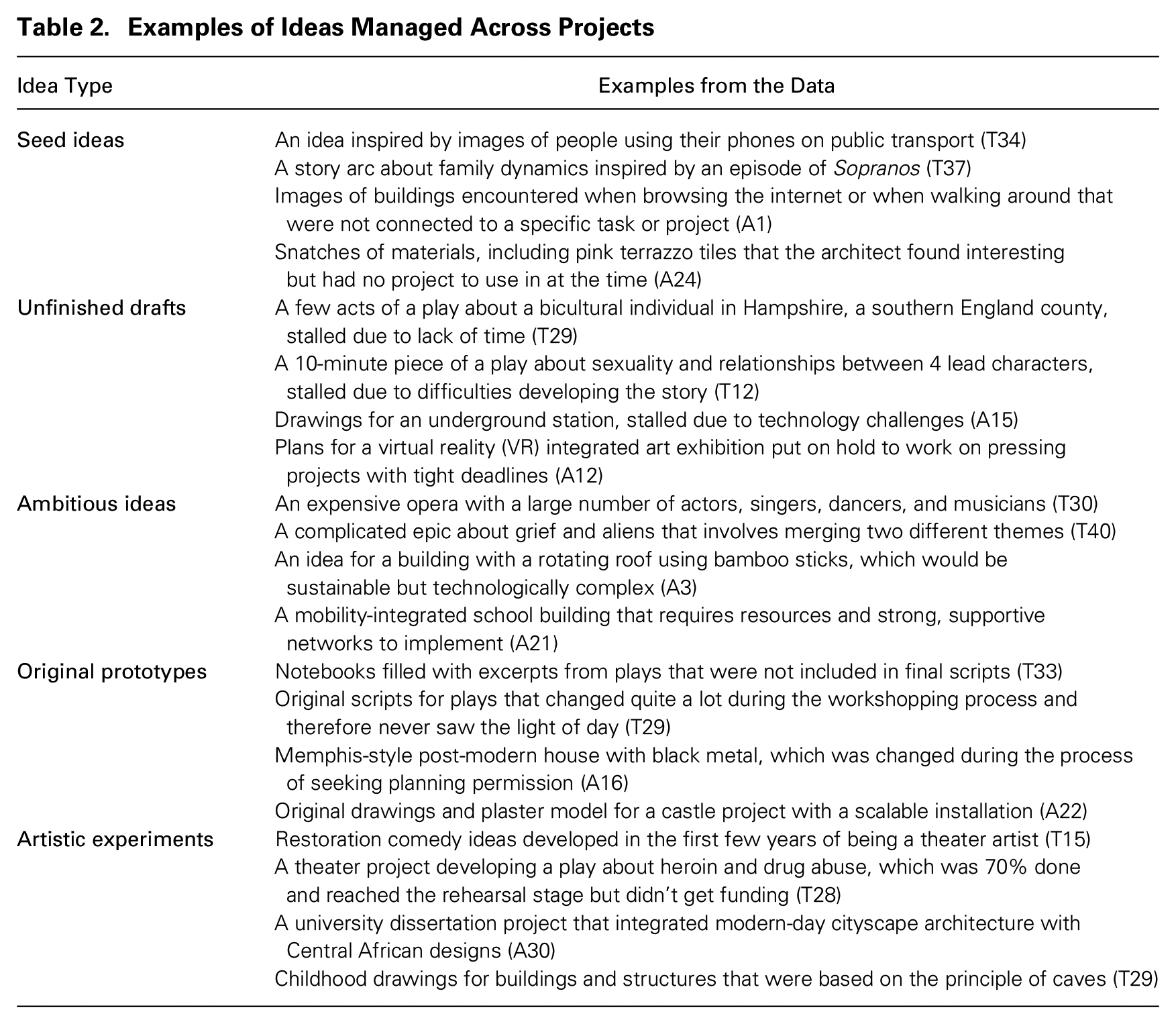
The quotation illustrates that creative processes can result in three sets of ideas: selected ideas that creators dedicate resources to developing (like the idea T40 notes he is writing now), rejected ideas that are removed from the consideration set, even for future projects (such as the ideas T40 removed from his laptop), and stockpiled ideas that are retained without being actively resourced or developed (like the six ideas T40 kept in his notebook). Idea stockpiling was extremely common in our data. Whereas only a small number of ideas could be selected to implement in any given project, we saw few instances in which creative workers rejected ideas completely. Indeed, participants struggled to talk about rejected ideas; only ten participants described rejecting ideas, of which only one provided a specific example of an idea that they had rejected.
Stockpiling meant that a creator had a set of ideas in their portfolio that they could transform into resources and mobilize. Our findings revealed two ways that stockpiling, transforming, and mobilizing unfolded, forming two distinct but interrelated ways that creators managed ideas. The first way is strategically, as creators built their portfolios by realizing stockpiled ideas in new creative products across different project opportunities. The second way is symbolically, as creators balanced their creative outputs with new meaning constructed from unrealized creative work that represented who they were as creators. Theater artist T29 described using both processes, explaining how he sometimes managed ideas strategically by stockpiling “a list of plays, I would use them” and, at other times, managed ideas symbolically by stockpiling ideas he was not “going to cannibalize” because “it is an accurate record of all the stuff I have done. Otherwise, it is an incomplete archive.” We elaborate on these two processes below, and Online Appendix B contains additional evidence of the two processes from the data.
Managing Ideas Strategically
Creative workers managed ideas across projects strategically to initiate, implement, and realize ideas in new projects over time. Theater artist T38 explained, “Sometimes, I’ve written something, but I don’t know what to do with it. . . . And one day I might just come back and borrow something from it. That’s why I keep them. . . . [Maybe] one day, when I’m on the national stage and they want to produce 20 of my plays, I need to have a few to do.” Creative workers strategically managed ideas that they anticipated investing in, like early seed ideas, incomplete drafts, and ambitious future projects (see Table 2 for examples). Seeds were brief concepts that creators found interesting but did not yet have a specific use for, as theater artist T31 described: “There’s a folder on my Mac called ‘seed ideas.’ If I have been inspired by something, I’ll put it in there,” even if “things [hadn’t] kind of aligned to do anything about that.” Others were draft ideas that creative workers had spent time developing and had several elements with potential for future investment. T29 described an opera he had written the previous year: “There was something interesting there and I really want to go back to it and find that thing.” Finally, creators strategically managed ambitious ideas that were highly novel (A21) or required substantial resources to “do justice to” (T32). For example, theater artist T35 described how she aspired to work on a costume drama but decided to “hold on to it” until her theater company’s professional standing improved “because we think it’s a really good idea, and we don’t want to waste it. . . . We could’ve put a table in the middle [of a stage] and a green sheet over it, but it would’ve looked a bit rubbish! It would have looked like a school play.”
Managing ideas strategically involved stockpiling ideas systematically, transforming ideas into reference materials, and mobilizing ideas through building practices that advanced creative projects toward implementation.
Stockpiling ideas systematically
Stockpiling ideas systematically entailed saving and storing ideas generated in a creative project so that the ideas were secure, accessible, and easily retrievable. For example, architect A24 described in a diary entry, “We have collected loads of material samples to develop our finishes boards. Not all of them were relevant for this project, but some were really good for other types of projects. We have kept those samples in our material library for future uses.” Such unused ideas were saved at one point in time and stored physically or digitally by documenting specific content or important details. Architect A12 explained, “A lot of these are quick ideas that I have at the time. So, I record it; I put it down on paper.” Likewise, theater artist T25 wrote in a diary entry about some ideas that she documented digitally in the middle of the night as soon as they occurred to her: “I had some ideas for my next theater show, which came as I was falling asleep. . . . That is when I have my most bold ideas usually. I had to get up and write them on a note pad on my laptop.”
With systematic stockpiling, creative workers focused on ensuring that the information contained in ideas would be accessible and retrievable in the future. To that end, they developed filing systems to keep track of ideas. Sometimes creators maintained ideas on a company server so that they could be retrieved from anywhere in the world (A1), or they stored them in a shared space where collaborators could access them (T39). Some creators also made efforts to ensure that ideas were identifiable by developing shorthands as mnemonic devices. As T38 noted, “It’s not like Play 1, Play 2 . . . I name everything, so I can understand what it is just by reading the name. . . . And I keep [ideas] orderly and tidy.” Although not all participants in our study were as orderly or tidy as T38, most employed some level or combination of systematic storage strategies that were personally useful to them.
These systems often evolved as creators’ stocks of ideas grew and creators had to accommodate new ideas. Creators therefore had to reorganize ideas and adjust categories. For example, as theater artist T40 started writing scripts for films as well as plays and poetry, he created different locations for storing those different categories of ideas and made specific efforts to store ideas according to the new systems. T40 described this in a diary entry: “I was on holiday this week, and not working certainly brings an abundance of ideas. . . . I only had my poetry notebook with me, so any other ideas (plays, film) that I had went straight into my phone . . . but I’ll transfer them [into my journal] as soon as possible.” In that way, creators could ensure that their systems continued to be organized and ideas could be identified and accessed with relative ease even as their stock of ideas grew and evolved.
Transforming ideas into reference materials
Through stockpiling systematically, creative workers transformed ideas from one project into reference materials for other projects that they could return to, think about, and draw from flexibly at different points in the future. In this way, creators built a “library” of reference materials, as architect A25 explained:
They will usually just be pictures with a few words about what it says. For example, a picture might be a view of this park, which is relatively private, disconnected from the road. An urban oasis. [And] I keep them for reference because it’s a library.
Similarly, architect A24 explained in a diary entry that she created a folder of reference images that contained objective information about ideas, thus “building a library of design content and inspirations that is stored.”
This collection of reference materials was valuable for creators in multiple ways. Recording individual ideas in an organized manner meant that creators could turn to these ideas quickly for information and inspiration. As architect A23 said, “It’s not something we have to remember. We can just go and look at it.” Ideas also came together to “create a kind of depository of things” (A20) that creative workers could draw from collectively―much like a library of books where one can either pick up a single book and gain information from it or read a set of books and gain integrative insights. Theater artist T25 described this process of ideas coming together through stockpiling:
And what I tend to do in my creative journal is that I collect things and start cutting and pasting them over each other. And it created sort of a weird relationship between ideas. So, this is an ongoing way for me to create instead of being in stops and starts.
Creative workers could also derive value from a collection of reference materials by using them as long-term goals to plan toward. In one diary entry, architect A16 wrote, “I have an idea of how I want to execute our portfolio of work. . . . It’s a long-term project so it will start in February next year.” Creators developed these broad agendas for their portfolios by bringing together reference materials to create “a vision that can drive you. . . . That’s why they are at the front. At the forefront of my desk. When I think about those ideas, I feel excited. . . . It’s why I wake up in the morning” (A29). This motivated creators to complete existing projects, so they could initiate new projects. Theater artist T29 elaborated on how such plans instilled a desire to transition to new projects: “I’m at the stage of the cycle where I’m like, ‘Okay, let’s get rid of some of these projects because then I can start focusing on the list.’ In some ways, it motivates me, in that it makes me think, ‘Okay, there is stuff there that I want to do.’” In a diary entry, A16 described this experience as a feeling of “suppressed excitement—like leaving your favorite food on the plate until the end! I know [the idea] will make people happy, so I’m looking forward.”
Mobilizing ideas through building practices
Our analysis further revealed that creators mobilized reference materials through building practices that advanced their portfolios by realizing unused ideas across different projects over time. Building meant using stockpiled ideas to shore up and move ongoing projects toward implementation, initiate new projects, and take advantage of opportunities that could result in new creative products. Through those practices, creators developed opportunities and aligned ideas with them so that they could advance creative projects. We observed three building practices for which creative workers drew on reference materials: matching ideas and opportunities, elaborating new ideas, and cultivating new opportunities. These practices operated relatively independently of one another, so that creators sometimes engaged in only one practice at a particular point in time. Creators tended to use more than one of these practices but not all for the same idea, as different ideas had different strategic needs (e.g., some required new skills to be realized, and some were highly marketable, whereas others were not).
The first way that creators mobilized reference materials was by matching ideas and opportunities. Creators coordinated projects by deploying stockpiled ideas to take advantage of emerging opportunities. For example, theater artist T12 explained how she captured an unexpected opportunity by simply matching a stockpiled idea to the project brief:
There was a theater that was interested in stories set on the English coast. I didn’t have the time to come up with something brand new, so I looked through my files to see what I had written. There was a short story that I had written years ago, and I formulated a play based on it. So, it was about matching their theme with a stub of something I had. . . .
During matching, creators focused on using an opportunity that could be a potential fit to explore the broad concept behind a stockpiled idea. In a diary entry, architect A24 described how she “pushed” to use a stockpiled idea in a new project that she felt would be a good fit:
I had a sample of pink terrazzo that I wanted to use for a bar front for a while, but no projects yet were quite right to design it. For the hostel, I think that it is a really good opportunity to try this; therefore, I have pushed this idea and will be presenting it.
Engaging in matching meant that creators were continually on the lookout for new opportunities; they described running emerging opportunities against lists of stockpiled ideas to find a good fit for ideas. Theater artist T10 explained, “You end up having a bloodhound nose for opportunities . . . you kind of have your little backburner list of things that might happen and then you go, ‘Oh, that opportunity is perfect for this thing on my list.’” Similarly, creators described holding on to ideas until their personal circumstances, including their skills, reputation, or network, improved because they longed to execute the ideas well.
We also observed that creators mobilized reference materials by using them to elaborate projects―resolving problems in projects that were currently in progress to move them forward. Unlike matching, which was about taking advantage of an opportunity by using an idea as a foundational concept for a project, elaborating involved using a stockpiled idea as a smaller component to resolve a problem that emerged when working on another idea for a different project. Architect A16 wrote in a diary entry about the importance of reference materials for elaborating when the creator’s group encountered problems during other projects: “[We] created some alternative designs. . . . We will keep these in our back pocket . . . in reserve for the rainy day when the spanner in the works means everyone else panics and we have the answer or way through the problem.” Sometimes resolving a “spanner in the works”—a disruptive problem—involved using reference materials indirectly to stimulate new insights on a challenging project, as T37 explained: “You can use it as stimuli. . . . If you’re writing something, and you have a little pause and don’t know where to go next, you can go through your list, and maybe it will inspire you to do something.” At other times creators directly plugged a piece of a stockpiled idea into a bigger creative idea that was already in development in order to tackle a problem, as T35 described:
One time, I wrote a load of diary entries about terrible dates that I’d been on . . . one day, I just pinched a load of those and put them in the play because this character was just so heavy and depressing, and I felt like we needed something light to counterbalance this awful character.
Finally, creators mobilized reference materials by cultivating new opportunities. Reference materials helped creators to approach new domains, build networks, and sharpen their skills. Whereas matching ideas with opportunities was a way for creators to deploy stockpiled ideas to take advantage of opportunities that emerged in their context, cultivating was a way that creators shaped the context to create spaces in which ideas could be developed. Architect A20 explained,
Let’s say I have five projects that are in my head, and I somehow have stumbled upon them because I walk about, or I hear about them. [And] I can think about them, and I can communicate to colleagues and friends like, “Look, I’d love to do this.”
As the quotation illustrates, having a wide selection of reference materials to discuss was central to eliciting or co-creating new opportunities through partnerships, as these ideas could spark or advance critical conversations with new partners that could lead to future development of these opportunities. Theater artist T29 said,
It’s very useful . . . because producers who want to work with me very frequently ask me what I would like to do, and I think they are doing the same thing that I am doing; they are trying to connect dots. “Oh [this director] is interested in this, and I’ve got a project two years down the line,” and that could be really useful.
Reference materials could also help create new opportunities by pushing people to approach new domains and acquire new skills. Creators in our sample described how having ideas that could not be materialized because of a lack of skills led them to develop new expertise. Theater artist T12 said, “I might have ideas that I would like to bring to a particular form. So, let’s say not naturalism but in a different form of theater. . . . I did a series of workshops [offered by a theater company] because I wanted to find a way to write a particular play.” Architect A26 commented that as a result of storing ideas, “you gather material, research, you go to exhibitions that remind you of [an idea], or you speak to people about it.”
The examples show that reference materials provided a foundation for building other projects through the development and realization of both ideas and opportunities. Creators emphasized that building practices were possible only because they maintained ideas in their portfolios systematically. Doing so allowed ideas to act as source materials, thus creating a steady stream of new products.
Managing Ideas Symbolically
Creative workers also managed ideas symbolically to derive deeper meaning from their body of work. During our interviews, participants often pointed to photographs, fragments from building models, or artifacts from plays that they kept in prominent locations in their work spaces. They described these as symbols of their creative experiences and explained how maintaining them helped them stay connected to their creative journey. Architect A8 explained that she held on to ideas “Because they are symbols! I see an idea that I had drawn four years ago, and I completely connect with that time. It’s very very powerful!”
We found that creative workers symbolically managed ideas that they had previously invested in. Architect A3 explained how ideas reflected that investment: “It’s not just simply drawings. It’s effort, it’s discussion. Every drawing is a part of your life. It’s 1.5 years of my job and my life. It’s not like every day you worked on a different project. It’s something that you created slowly, navigating different problems.” In particular, we found two types of ideas that creators managed symbolically: original prototypes and artistic experiments (see Table 2 for examples). Original prototypes were early versions of ideas that had later been radically modified during implementation or scrapped entirely during a project. Architect A6 described having “chunks of code or projects that are sort of there [from] projects which I did during my tinkering time. . . .” Creators often considered prototypes to be their most innovative work, unhindered by external constraint, as architect A16 explained:
This is a project, a house I designed in Islington. It’s a really cool black metal house with an angled roof. It’s all very geometric and very stark and a little bit kind of Memphis style, kind of post-modern. And it’s the first time that I’ve been able to do something that creative . . . the planning committee [forced me] to make something that looks terrible. I would not claim that house now because it’s just a dog’s dinner!
Instead, he “claimed” his original black metal designs and placed them in his portfolio to “hold on to the original design that I came up with” (A16). Creators also symbolically managed artistic experiments that were developed during times of unrivaled creative freedom, such as at university and in other periods of learning or leisure when they created for pleasure. For instance, A29 described saving childhood drawings of caves near the city where he grew up, while T15 spoke of restoration comedies she had written in theater school that lacked sophistication but were “hilarious, and stylish and rude!”
Managing ideas symbolically entailed stockpiling ideas emblematically, transforming ideas into representations, and mobilizing ideas through balancing practices that offset finished creative outputs with unrealized ideas that better represented an individual’s creative journey and identity.
Stockpiling ideas emblematically
Stockpiling emblematically involved saving and storing ideas in ways that were particularly evocative and suggestive of creators’ prior investment in ideas. This process often involved stockpiling images or physical artifacts like a “sketch on a napkin,” which “you keep . . . because it might be really precious. . . . You keep the sketch on the napkin forever” (A25). Similarly, T25 said, “I think there’s a couple of plays that I’ve written that haven’t ever really gone into production. And those ideas are physically in the top drawer.” This process tended to be less organized than systematic stockpiling; it aimed to capture strong images and to evoke memories or feelings. One theater artist equated it to “Facebook photos. I would show them to you in the same way that I would show you a photo of me in LEGOLAND . . . sentimental things” (T29).
Creators displayed emblematically stockpiled ideas in their work spaces, sometimes in ways that were very messy and impractical, as A22 described:
It’s a nightmare! . . . Ideas lie about all over the place in whatever form they are in. I’ve got a computer full of broken ideas that never happened, a studio full of broken models that never happened, and drawings I have [stopped working on] at some point.
There was symbolic value in keeping these “broken ideas” in prominent ways―it shone a spotlight on the reality of engaging in creative work and working with multiple ideas; it “communicates the creative process” (A22). However, it could also be logistically challenging, as described in the quotation above. To deal with this “nightmare,” some creators periodically moved big chunks of ideas into deep storage, away from their primary work spaces to locations they did not routinely access or encounter. This provided creators with a mental representation of stockpiled ideas, like having a garage full of experiments or prototypes that they knew existed but may never access. For example, architect A29 moved his “filled-in” sketchbooks to his parents’ home in Cyprus.
Creators coupled deep storage with the selective display of fragments of ideas. They extracted the most personally valuable or representative aspects of ideas to display, for example, on personal or company websites, in physical portfolios, or around their work spaces and studios. Architect A22 directed our attention to a photograph on his website, which was a snapshot of all the work he had done on an idea: “That’s me standing there [among] loads of plaster objects . . . to me that photograph is more important than anything else [even though] nothing in that photograph formed part of the project.” The photograph did not record all the details of the ideas developed during the project; the storage and display of the photograph thus had little strategic value in terms of idea content. But it alluded to the project and served as a valuable summary for the architect.
Transforming ideas into representations
Stockpiling ideas emblematically transformed creators’ ideas into representations of their interests, experiences, and efforts by bringing together unrealized ideas from the past and turning them into a “map” or “visual documentation” of their complete creative journeys: “I have sketchbooks from university and from my first year in architecture. And you keep them, you keep all of them because they are kind of like a visual documentation of where you were at one point and where you are now” (A30). Theater artist T14 noted that it was “a little like a body part. It’s like, ‘oh, there’s my ears, here’s my nose.’ It’s a little part of your story, your DNA, your map.”“[It] gives a decent sense of where I was at the time and what I found funny,” T29 explained.
Representations that mapped out creative journeys were valuable for creators in two ways. First, they held psychological value, giving creators a sense of security that their ideas had not been lost and neutralizing negative feelings associated with letting go of ideas. As T29 explained, “It is much, much easier to say, ‘I’m going to [keep it] and come back to it in a few years’ time,’ rather than to say, ‘Oh yeah, my baby is just a hideous mutant; I’m going to throw it out of the window.’” A3 similarly noted how much he would struggle if he had to disconnect entirely from an idea he had worked on. Sighing deeply, he said, “Personally, ooof, I would cry if I had to get rid of all the work done!” Transforming ideas into representations meant that the work done on ideas was not entirely lost; it was preserved in a different form that came to have value in itself, as A27 explained:
I used to sketch how this motorcycle could move a little bit. That, for instance, is an example of me holding on to a design that I’m never going to use. Its super personal, and it’s just a part of me. . . . [Retaining these designs] is a way of having something precious forever, until my kids sell them or put them in the bin or something.
Transforming ideas into representations thus helped replace feelings of loss with feelings of security and pride.
The second source of value for representations was that they enabled creators to effectively realize their unrealized ideas in different forms, often alternative material forms as described above, that distilled their effort and interests. A23 described how creating small booklets of his unrealized ideas helped him capture the process of working on a project:
Now, we have got a book that shows a way of dealing with a project like that. And because it’s a book and it’s in our library, it’s not just a wasted opportunity. . . . Their potential is almost realized in the book.
Likewise, A29 explained how holding on to drawings allowed him to see some of his earliest interests: “You can track archetypes. I can see [I was] really interested in things related to the city I grew up in, which is different from others. For example, I’m interested in caves. . . . I think there are spaces that really define you when you grow up.” Thus creators could reframe experiences and efforts invested into ideas in a new way.
Mobilizing ideas through balancing practices
We observed that creators mobilized representations through practices that balanced the realized ideas in their portfolios with representations that captured the reality of their experiences, interests, and efforts. This involved creating new meaning from representations that became incorporated into creators’ portfolios, providing a more complete picture of their creative work. Theater artist T29 described it as “making the map in my head a little more honest.” We observed two ways that creative workers mobilized emblematically stockpiled representations for balancing: measuring creative progress and centering creative ideals. The two practices worked in tandem, with creators shifting back and forth between them periodically, such as during major transitions. At those times, creators took stock of their creative work to make sense of what they had done and create new meaning from their creative activity.
The first way that creators mobilized representations for balancing was by measuring creative progress. Representations gave creators a perspective on their creative activity beyond idea implementation. T29 explained, “You’re going to go down the long road . . . it is about getting past this binary of saying that something is either useful or useless. It’s valuing the process by which you mess stuff up.” Thus the creators in our study used representations to track their productivity, as T26 wrote in a diary: “[I] feel very productive [looking at stockpiled ideas], as I clearly spend a lot of time playing with ideas, though often don’t have anything tangible to show for it.” This helped creators when they faced setbacks. Theater artist T12 explained that “it’s good for me to see how much I’ve invested in my career by writing so much,” and architect A18 described how,
For the [cancelled] museum project, I would definitely be happier knowing that the culmination of the year’s work was held as a body of work in some form. [A] digital report, or physical portfolio, or something. [It’s a way] to know that you are being productive and creative. . . . I use the physical output to validate my productivity.
Measuring progress also entailed taking stock of their experiments with novel and challenging ideas and turning apparent failures into sources of pride. Architect A13 explained that representations of experiments could show that “we are willing to learn, and we are willing to put ourselves in positions where not a lot of architects and designers are willing to put themselves.”
A second balancing practice we observed was centering, in which creators drew on representations to surface and reconnect with underlying interests and styles that may have been lost or forgotten over time. Theater artist T12 explained,
It also helps you center yourself. Because as you become more developed over the years, you start sometimes diluting a bit that sort of raw chaotic voice that you began with, which is all passion and no skill. And as you develop new skills, it’s a very delicate balance of maintaining your voice and making it strong enough to speak in a play rather than letting it get diluted by trying out new techniques.
Creative workers engaged in centering when they felt like they were losing track of what they should be doing, turning to their stockpiles to reconnect with their creative ideals and block out external influences that they viewed as diluting the “true self” to make way for the “told one,” as architect A29 described:
[In these old sketches] you can see your true self. It sticks out . . . you can also see the building blocks of your identity. . . . I think you can trace your signature in your sketches. . . . Going back through your sketchbooks, you can trace a real personality beyond the told one, which I think is much more important. You can see your core.
Because representations provided creators with a record of “what ideas have stayed relevant throughout time. . . . The thematics you’re interested in and the aesthetics that are recurrent” (T1) as a theater artist explained in a diary entry, creators often turned to them to “reconsider and reassess where I’m going and what it is I want to be doing and talking about as an artist” (T1). Creators also used representations to mark their creative boundaries; according to T29, “You’ll have to be Stephen Sondheim or someone who really can make a concept like that come to life,” but those ideas helped creators “work out that this is something you keep doing. You keep running into this wall at top speed. . . .” Through centering, creators could thus recognize patterns in their approach to creative work. Even highly experienced creators relied on representations for centering, explaining how modifications and revisions to ideas during implementation meant that realized creative outputs seldom captured their ideals: “A project that starts in your head might end up being completely different because of reality getting in the way of developing the initial project. . . . These idealistic ideas are the ones that really show who you are” (A20). Creators would therefore center themselves around their original “idealistic” designs. Architect A16 said,
I hold on to my original designs, so that I can [see] how have I achieved a harmony in the visuality and materiality . . . it is a reminder that it’s possible. It means that as an experienced architect, at the point when you might cave in, you can say “no, I’m not going to compromise.”
In this way creators were able to develop new meanings from their creative work, using ideas from the past to develop a more holistic sense of who they were and how much they had developed and progressed as artists.
Discussion
Our study shows that developing a portfolio transforms the process and experience of creativity. More than simply collecting outputs, developing a portfolio is itself a creative endeavor that entails practices for managing ideas across projects—practices that have not been uncovered in prior research. Our work suggests a conceptualization of creative portfolios as living entities that evolve as creators engage with them, applying their skills to generate new creative products from streams of ideas and new meaning from their creative experiences and journeys across projects. Below, we build theory to explain how creators engage in the process of building portfolios. We then describe the contributions of our emergent model.
Emergent Model
Figure 2 illustrates the emergent model through which creators shift ideas across the spatial and temporal boundaries of creative projects. The model depicts a holistic practice through which creators derive new value from their collections of ideas. In that practice, ideas are rarely rejected but, instead, live on in a space between selection and rejection, where they provide a generative resource mobilized for creating new products and meanings. The model reflects insights from creators in our study who described their creative work as larger than a “particular moment” (T31), such that all ideas were part of a “creative journey” (A22). We suggest that this process emerges when creators work on their portfolios because of the practical and psychological demands that this activity places on creators, which engage them so deeply in their work that they are constantly creating. Ideas often came easily to our participants; it was finding opportunities for those ideas in their portfolios that required creative work (Harrison et al., 2022). Our model thus picks up where idea generation leaves off, revealing this holistic practice as a new creative process for managing the many ideas produced when creators work on multiple projects simultaneously and over time.
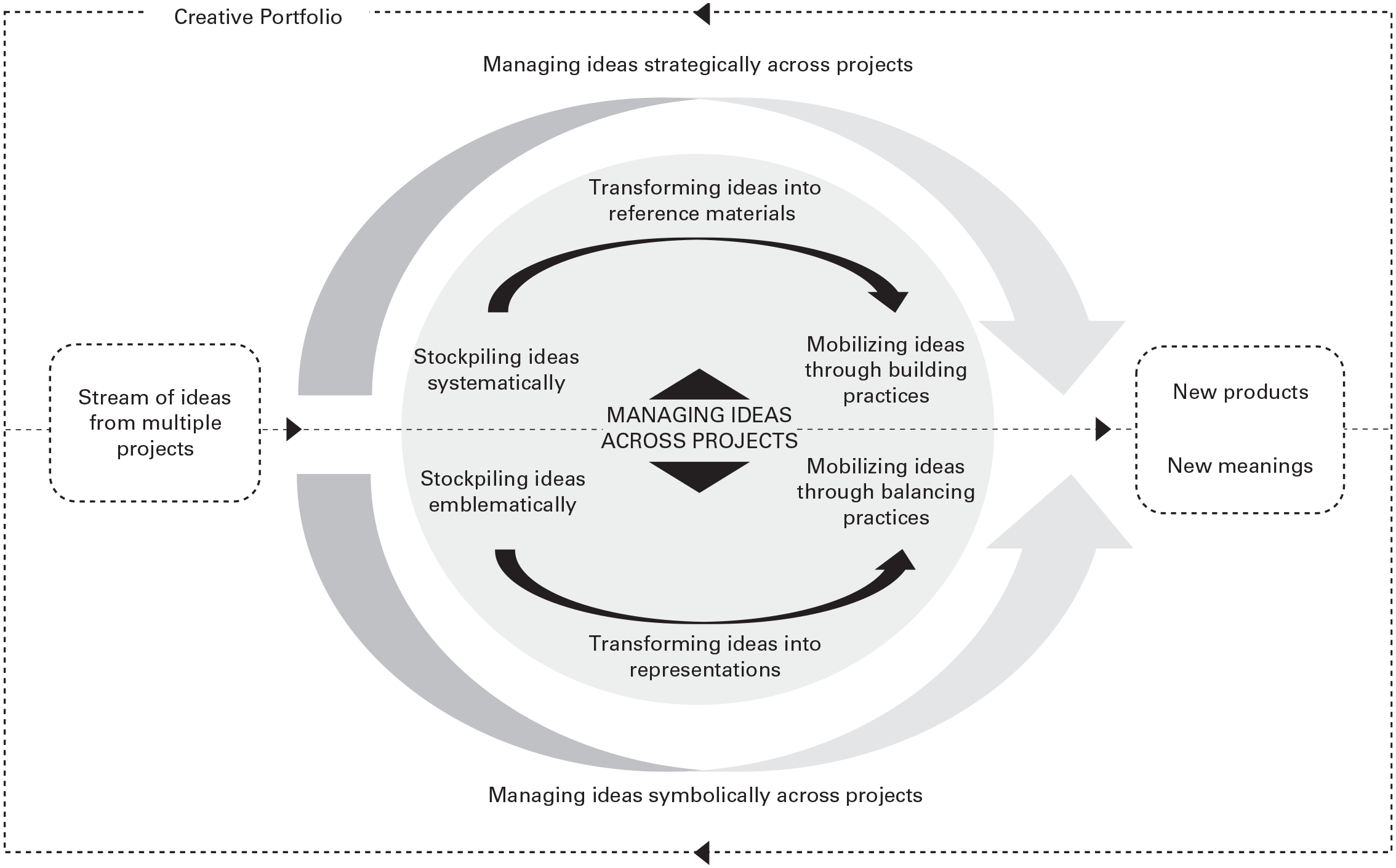
Managing Ideas Across Projects in Developing a Creative Portfolio
We suggest that the two main processes, managing ideas strategically and managing ideas symbolically, are distinct but mutually enhancing. Managing ideas strategically by stockpiling ideas systematically, transforming them into reference materials, and mobilizing them to build new projects was how the creators we studied developed new creative products (the outputs typically studied in the creativity literature; see Hua, Harvey, and Rietzschel, 2022) across projects. Managing ideas strategically was thus a form of idea work through which creators elaborated, integrated, reshaped, and evaluated ideas (Grimes, 2018; Håkonsen Coldevin et al., 2019) in response to a stream of new opportunities. Managing ideas symbolically by stockpiling them emblematically, transforming them into representations, and mobilizing them to balance outputs was how our participants generated new meaning for their creative work by making sense of what their creative experiences and efforts signify (Pratt and Ashforth, 2003; Rosso, Dekas, and Wrzesniewski, 2010). Managing ideas symbolically thus consisted of practices through which creators constructed and maintained their identities as creators (Pratt, Rockmann, and Kaufmann, 2006; Caza, Vough, and Puranik, 2018) based on their experiences, independent of their finished output. Those practices disentangled the creative process from realized ideas and, in doing so, helped creators neutralize negative feelings associated with letting go of ideas (Baer and Brown, 2012; Rouse, 2013).
Stockpiling ideas is the foundation of both processes. By allowing creators to hold on to ideas, stockpiling is an alternative response to accepting and implementing an idea or rejecting it immediately, and we propose that it is most likely to emerge in the context of developing a portfolio, when creators have the need for—and the opportunity to use—many ideas. Stockpiling entails developing a bank of ideas that provides creators with creative resources. In our model, reference materials act as strategic resources that creators use instrumentally for the cognitive and motivational work of developing ideas (Håkonsen Coldevin et al., 2019); and representations act as symbolic resources that produce meaning about the self (Zittoun, 2007) and give creators psychological comfort and resilience to continue their creative work (Zittoun et al., 2003; Sonenshein and Dholakia, 2012).
We theorize that the most generative ideas for stockpiling are those that have not been implemented in other creative processes but to which creators experience a connection. Just as people experience emotional connections to other objects, brands, and organizations (Berscheid and Walster, 1969; Schneider, 1987; Hatfield, 1988; Pratt and Dutton, 2000), creators can experience a connection to ideas (Lazar, Miron-Spektor, and Mueller, 2022). Creators in our study displayed excitement for ideas, thought about them often, and anticipated negative emotions at the prospect of losing them. Those reactions are characteristic of experiencing an emotional bond with a target (Fisher, 1998). We theorize that those bonds are critical for transforming ideas into reference materials and representations and for mobilizing them across projects; they compel creators to hunt for opportunities that will make the best of their ideas so that ideas provide strategic value, and they also enable creators to extract personal meaning that provides psychological value.
Although the model does not demand that creators engage in both processes of managing ideas, we theorize that they will benefit from balancing the two. Symbolically managing ideas could feed back into creative products by motivating creators to keep going and by shaping which projects creators focus on based on meta-themes that cut across their oeuvre of realized and unrealized projects. Managing ideas strategically could feed back into the meaning creators make from their work by providing outlets for some stockpiled ideas and shaping creators’ expectations of which projects they will develop in the future. Yet managing ideas through one process but not the other may be dysfunctional. Managing ideas symbolically but not strategically could result in many unrealized ideas and lead creators to excuse their failure to realize them; managing ideas strategically but not symbolically could result in sets of realized ideas that leave creators feeling unfulfilled or lead them to give up due to the futility and loss that accompany setbacks and rejections. The two processes therefore complement and reinforce each other in our model. However, the model does not imply that the processes are mutually exclusive; hints from our data suggest that some ideas may have elements of prior investment and future potential and may be managed both strategically and symbolically, as one creator described managing an idea “both from a practice point of view but also for personal reasons” (A3).
Contributions of the Model
Our work moves the organizational study of creativity closer to the practice of creativity by capturing the process of developing a portfolio of creative projects that start, stop, overlap, and intertwine in an ongoing stream of activity (McLeod, O’Donohoe, and Townley, 2011; Puccio and Cabra, 2012). In doing so, our emergent model contributes to research on the creative process and creative portfolios.
Contributions to research on creative processes
Our study builds on the long history of research on the creative process (e.g., Wallas, 1926; Amabile, 1988; Drazin, Glynn, and Kazanjian, 1999; Amabile and Pratt, 2016; Cronin and Lowenstein, 2018). Our model provides a new lens for interpreting what creativity fundamentally means, overturning several long-held understandings of the creative process. Our emergent model shows a holistic process of managing ideas through stockpiling, transforming, and mobilizing ideas to create new products and new meanings across projects. That holistic process places the generative processes that have dominated most prior research on organizational creativity (George, 2007; Zhou et al., 2019) at the very earliest stages of activity for creators developing their creative portfolios and replaces those generative processes with ones through which creators continually hold, track, and find outlets for their ideas. The creators in our study were more like collectors and curators of intriguing possibilities than idea generators. Our study thus suggests that the “creative life” (Gruber, 1989: 20) exists in the way that creators connect to unrealized ideas to extract strategic and symbolic value from them and manifest that value through intertwined processes to develop new creative products and new meanings.
Our study sheds light on a new activity in the creative process: idea stockpiling. Stockpiling was at the heart of our participants’ efforts to manage ideas across projects. Our examination shows that creativity involves not only generating, selecting, and implementing novel and useful ideas but also holding them in a space between these processes (Harrison et al., 2022). Our findings also reveal two different ways in which creators stockpiled ideas―systematically and emblematically―in order to navigate both the practical and psychological challenges of developing creative portfolios. In doing so, our findings conceptualize idea stockpiling as a multidimensional practice that can shape creativity in different ways. This insight calls for studies to look beyond the question of how creators can select their best ideas in response to any particular creative task or problem (e.g., Amabile, 1988; Staw, 1990; Perry-Smith and Mannucci, 2017) and to ask, instead, how do creators decide which ideas to select, reject, or stockpile during any given project and why?
Our study also shows that stockpiling enables two new forms of generative activity that occur between projects. The first involves identifying connections between ideas from one’s stockpile and an erratic flow of opportunities through building practices. Considering this as a creative process provides new insights into the way creative products are assessed and the temporal nature of creativity. Research has shown that creative ideas are often overlooked or rejected (Mueller, Melwani, and Goncalo, 2012) and that some creative outputs come to be valued only long after their production (Mueller et al., 2018). Our work raises the possibility that in some cases, those judgments may occur because of mismatches between ideas and the opportunities through which creators enact them, and the more-successful creators are better at constructing opportunities in which to develop their ideas or identifying connections between ideas and opportunities. A second generative activity in our model involves creating meaning from and finding connections between creative experiences from one’s stockpile through balancing practices that reveal novel directions for creative work and that convey a unique creative identity to the creator and sometimes others. This also hints at a way of understanding creativity not as an intentional process of generating ideas to solve a problem or complete a task but as an expression of one’s unique self.
Our emergent model also reframes how we think about other parts of the creative process. Building on research on the evaluation of ideas in situ (Elsbach and Kramer, 2003; Harvey and Kou, 2013), our study shows how evaluation takes place in the broader context of a creator’s past, present, and projected future experiences rather than as a choice among a small set of ideas generated in response to a specific task. We thus show that evaluation may be better thought of as an ongoing process that unfolds over many iterations (e.g., Mintzberg and Waters, 1990; Chia, 1994; Harvey and Mueller, 2021), instead of being a one-time decision within a project (e.g., Fuchs et al., 2019). Similarly, our study expands the meaning of iteration by suggesting that ideas can move around in space and time. Whereas prior research has described iteration in terms of shifts back to earlier stages within a project (Amabile and Pratt, 2016), our work shows how ideas are also iterated through different projects. For instance, writers may take a character from a draft to write a new play and then steal a different character from that same draft to insert into another project for comic relief. Ideas are also iterated when they take on new meaning over time. Further research may explore how a focal idea is evaluated and iterated through multiple projects.
Contributions to research on creative portfolios
Our model also extends our understanding of creative portfolios. Scholars increasingly recognize that creators develop portfolios in response to market uncertainty and demands (Sternberg and Lubart, 1991, 1996; Caves, 2000; Berg, 2022). Building on this insight, our work paints a picture of developing that portfolio from the inside, that is, from the perspective of the creator working on it. This reveals that the creative portfolio is more than a collection of outputs; it is the complete creative experience as viewed by the creator. It is deeply personal to the creator and cannot be fully observed by others, but it is still consequential for creators’ output because it shapes their choices, motivation, and ideas. The personal nature of portfolios may explain why they are an overlooked factor that has not yet been captured by most creativity research, which prioritizes observable ideas and products that can be counted and evaluated (Hua, Harvey, and Rietzschel, 2022). This personal nature may also have led researchers to dismiss or overlook practices involved in managing a portfolio as mere acts of procrastination. In contrast, our study suggests that these practices are critical for both creativity and innovation―they help creators to be generative, and they enable more ideas to be realized to implementation by easing coordination.
Our model further implies that a portfolio is not purely additive or stable; it can change even when the creator does not directly add new creative outputs to their collection if the creator develops new meaning based on ideas not realized. This occurs because ideas provide creators with a resource for creativity that can manifest in different ways. That insight enhances our understanding of the diverse ways that creativity can be resourced (Sonenshein, 2014). It further suggests that the creator constructs and reconstructs the portfolio to support their creative efforts (Sonenshein, 2014; Lawrence and Phillips, 2019). In developing this insight, our study expands the well-accepted view that social environments inherently influence creativity (Amabile, 1983; Amabile et al., 1996) and that evaluations of creativity are socially embedded (Csikszentmihalyi, 1999). Specifically, we suggest that creators themselves also actively construct and enact the environments in which their most treasured ideas can be developed and accepted. They do this both by pursuing opportunities to realize ideas and by extracting meaning from ideas that are unrealized. Opportunities for ideas thus do not necessarily exist independent of creators, from a portfolio perspective (cf. Alvarez and Barney, 2007; Suddaby, Bruton, and Si, 2015), because creators shape what happens to ideas that do not materialize directly in projects.
The view that creative portfolios continually evolve also has implications for research on creative identities. Prior research has shown how creators can come to see ideas as extensions of the self (Elsbach, 2009; Grimes, 2018) and experience negative emotions and identity threat when they face the prospect of changing or letting go of those ideas (Rouse, 2013; Toivonen et al., 2022). In the context of a creative portfolio, a creator may derive a sense of identity from the portfolio of projects they have worked on rather than from a single idea that they become attached to. This opens up new questions for further research on how creative identity is constructed across multiple projects and across both finished products and unrealized ideas. For example, past research has described how creators may experience tension between viewing themselves as independent artists and acting in a pragmatic and professional manner (Bain, 2005; Elsbach, 2009), and research suggests that they may shift toward a more professional identity as they take on feedback from others and revise their ideas (e.g., Elsbach and Flynn, 2013; Grimes, 2018). Our study reveals that when creators derive meaning from sets of ideas, they may not face such a stark tradeoff; for instance, they can adjust projects to external audience demands while retaining idealized symbols of the ideas that stop them from losing themselves along with their ideas. This opens up new possibilities for understanding creative identity and provides new insights into how creators can let go of treasured ideas (Toivonen et al., 2022).
The portfolio perspective also expands our conceptualization of the role of ideas. In this context, ideas shift from the output of the creative process (Amabile, 1996; Harvey, 2014) to resources that act as inputs to the ongoing development of a creative portfolio. This fundamentally challenges the notion of an idea’s value based on its selection and implementation (cf. Levitt, 1963; Berg, 2016). Our study shows that creators derive substantial value from ideas that are not implemented; if creators retained only selected ideas, they would have no strategic or symbolic resources for their ongoing creative work. We identify creators’ deep personal connections to ideas as the source of that value, thus building on the recent insight that creators’ attachment to ideas shapes their creativity (Lazar, Miron-Spektor, and Mueller, 2022) and challenging the view that attachment to ideas makes creators overcommit, fail to adjust to feedback, or hand off ideas to others (Baer and Brown, 2012; Grimes, 2018). The problem may, instead, occur when a creator becomes attached to a specific combination of an idea and a project and fails to sufficiently account for the fit between ideas and opportunities. This suggests the need for more research into creators’ continued engagement with ideas and raises questions about how creators assess the fit of their ideas for specific opportunities rather than the quality of an idea more generally.
Yet ideas are not only inputs in our model; they also find their way into outputs in the form of new (and often multiple new) creative projects and are combined into new meaning. This suggests that in the context of developing a portfolio, there are interdependencies between creative projects and between different ideas that may be produced for one project but used in part or whole in another. Prior research has emphasized how dependencies between a creator’s limited external outputs can constrain creativity due to internal learning or external expectations, as one successful idea leaves its mark on future creative outputs (Audia and Goncalo, 2007; Berg, 2022). In contrast, our work reveals that interdependencies can also enable flexibility by prioritizing ideas that remain unseen except to the creator. The shadow of those ideas creates flexibility because it facilitates learning from a wide range of ideas that do not develop, enlarges one’s creative identity beyond what realized outputs alone would allow, and provides a broad set of potential inputs from which many more combinations can evolve. Further research may explore the nature of interdependencies between different projects and ideas and the conditions under which they lead to constraint versus flexibility.
Limitations and Future Research Directions
Our study leaves open additional avenues for future research. First, our model was developed by exploring creative workers in contexts characterized by a continuous need to create (Quinn, 2005; Rahman and Barley, 2017). Although these contexts provided an extreme case for building theory (Bamberger and Pratt, 2010), our findings may not hold for people who create infrequently or incidentally or for creators who work on projects that span significantly longer time frames than those in our study (e.g., when a creator may work on only one or two creative projects over the course of their career). However, we would expect our findings to extend to most creative contexts and organizations (cf. Long Lingo and Tepper, 2013) in which there is a need to develop ideas for multiple creative projects.
Second, our data collection strategy has some limitations that could be addressed in future research. Our primary data source was interview data, which has particular limitations, including retrospective bias. We conducted a diary study to offset some of the limitations of interviews and to overcome common method bias. However, we distributed the diary questions only to interview participants who volunteered to participate in a subsequent study, which could have limited our data to those who were interested in practices related to managing ideas. Future research could explore ways to collect longitudinal data about managing ideas across projects from a broader group of participants.
Third, situating our study across two creative contexts strengthened our research by allowing us to probe the boundaries of our theorizing and replicate the core practices we observed. But we did not focus on differences between the contexts that could merit further consideration. Specifically, theater artists worked on tasks they defined themselves, frequently moved between teams, and experienced generalized financial constraints. These characteristics are becoming increasingly common as creators work as gig workers or freelancers (Watson et al., 2021). Architects, in contrast, were assigned problems by clients or managers, worked in more-stable teams, and faced project-specific constraints. Further research is needed to explore these contextual differences and examine their impact on practices for managing ideas across projects.
Fourth, as our study focused on understanding the processes through which creators manage ideas across projects, we did not examine the outcomes of those processes. Many of the practices we uncovered, such as matching ideas and opportunities or elaborating ideas, may improve certain forms of creativity (Harvey and Berry, 2022; Lucas and Mai, 2022). At the same time, holding on to ideas could forestall idea generation and have a negative effect on other forms of creativity. Furthermore, portfolio management skills can involve accepting and tolerating the challenges of creative work to the point that exacerbates these challenges. For example, measuring creative accomplishments can help creators cope with psychological demands, but if creators excel at that practice, they may end up hoarding ideas without feeling pressured to work on new projects, or they may primarily generate and show interest in ideas that have limited present-day value. Future research could explore when different levels of strategic and symbolic management of ideas may be more or less functional.
Finally, our work shows how a given idea can be resourced and managed in various ways. Although this flexibility presents opportunities for creative workers, it may also bring a new set of challenges, as creators must choose how best to stockpile and use ideas. If a creator stockpiles an idea only systematically, it may be difficult to use that idea symbolically, and if they stockpile the idea emblematically, it may be difficult to use it strategically. This raises the possibility that developing increasingly sophisticated techniques for dual-purpose idea management may be critical in the long run and may be a skill that differentiates highly creative individuals from those who are less creative. This possibility further provides intriguing opportunities for new research on how much creators should invest in learning these practices and when efforts to manage ideas may outweigh their benefits.
Conclusion
When asked during an interview about his creative process, the American musician Prince said, “Sometimes, ideas are coming so fast that I have to stop doing one song to get another. But I don’t forget the first one. If it works, it will always be there. It’s like the truth: it will find you and lift you up” (Pareles, 1996). This article is a first step toward developing a theory of what it means for a creator’s ideas to live on within the context of their broader creative portfolio, and how and why past ideas that creators stopped working on may “find” creators again at a different point in the future and “lift [them] up.”
Supplemental Material
sj-pdf-1-asq-10.1177_00018392231154909 – Supplemental material for Ideas in the Space Between: Stockpiling and Processes for Managing Ideas in Developing a Creative Portfolio
Supplemental material, sj-pdf-1-asq-10.1177_00018392231154909 for Ideas in the Space Between: Stockpiling and Processes for Managing Ideas in Developing a Creative Portfolio by Poornika Ananth and Sarah Harvey in Administrative Science Quarterly
Footnotes
Acknowledgements
We thank Associate Editor Michael Pratt and three anonymous reviewers for their exceptionally constructive and developmental feedback throughout the review process. We are grateful to James Berry, Colin Fisher, Chia Jung-Tsay, Davide Ravasi, Joel Gehman, and Lisa Cohen for their insights and guidance on this manuscript. We are also thankful for the feedback on earlier versions of this paper that we received from participants at the 2018 Creativity Collaboratorium and the UCL School of Management Reading Group.

Authors’ Biographies
References
Supplementary Material
Please find the following supplemental material available below.
For Open Access articles published under a Creative Commons License, all supplemental material carries the same license as the article it is associated with.
For non-Open Access articles published, all supplemental material carries a non-exclusive license, and permission requests for re-use of supplemental material or any part of supplemental material shall be sent directly to the copyright owner as specified in the copyright notice associated with the article.
