



Abstract
This article examines whether intermediaries and consumers exert similar influence on producers’ boundary-spanning efforts. I propose that boundary spanning is primarily constrained by intermediaries specialized in the market, not by consumers. Consequently, producers are more likely to obscure boundaries when intermediaries’ power weakens. To test these ideas, I exploit a natural experiment that shifted the hitmaking power of genre-specific radio stations to general consumers and thus partially democratized the market mediation structure of the U.S. commercial music industry. The results indicate that after democratization occurred in 2012, record labels were more likely to introduce crossover offerings that incorporated features from other popular genres. Through mechanism triangulation efforts, I found that strategic reorientation, or producers’ attempt to appeal to a broader spectrum of consumers across genre lines, plausibly explains the crossover effect. This study highlights democratizing changes that dilute intermediaries’ influence as a novel explanation of why constraints on producers’ boundary decisions have weakened in some markets. The findings suggest that intermediaries’ and consumers’ expectations may diverge, acting as conflicting forces that organizations must carefully manage. Many organizations closely monitor intermediaries that are deemed influential, but their influence should not be taken for granted as marketplaces empower consumers and become more democratized.
Market intermediaries organize exchanges between producers and consumers in many settings. Examples include security analysts who issue stock ratings in a sector and radio stations that pick hits in a genre (Hirsch, 1972; Spulber, 1996; Zuckerman, 1999). These third-party actors evaluate offerings and allocate resources within the boundaries of their specialized fields (Peterson, 1997; Hirsch, 2000; Fleischer, 2009; Tan and Roberts, 2010; Lena, 2012). While producers’ tendency to cross boundaries has increased profoundly over time (Rosa et al., 1999; Rao, Monin, and Durand, 2005; Leahey, Beckman, and Stanko, 2017; Whalen, 2018), whether intermediaries or the consumers they serve have primarily driven the change in boundary-spanning production remains unclear.
Intermediaries and consumers constitute distinct but interdependent audiences whose preferences influence producers’ behavior. The evidence for these two audiences’ attitudes toward boundary spanning has been mixed. Studying feature films, Hsu (2006) found that boundary spanners are devalued by both consumers and intermediaries, thus implying similar influence. Rao, Monin, and Durand’s (2005) study of boundary erosion in French gastronomy and Pontikes’s (2012) research on ambiguous labels in the software industry suggested that intermediaries may favor impure offerings that consumers commonly discount. Other studies indicate that consumers may be more receptive to offerings that blur boundaries than previously thought (Goldberg, Hannan, and Kovács, 2016; Paolella and Durand, 2016), whereas intermediaries may act as gatekeepers and sanction boundary violations for general consumers (e.g., Rossman, 2012; Leahey, Beckman, and Stanko, 2017), so intermediaries’ primary role in shaping producers’ boundary decisions appears plausible as well.
Producers pay attention to audience expectations because audiences define the value of their offerings. But different audiences, such as intermediaries and consumers, vary in their valuation power and do not influence producers equally. While the literature has rarely considered this power differential (Grodal and Kahl, 2017), it has become more relevant as technological and institutional forces reshape market structure and empower consumers. Research shows that consumers’ rising power and influence have fueled democratization trends on the production side of markets and have facilitated the creation of unconventional ideas, niche products, and nascent organizations in outdoor sport equipment and juvenile product industries (e.g., Von Hippel, 2005; Shah and Tripsas, 2007). I contend that market mediation becomes similarly democratized when the balance of power shifts from intermediaries who specialize in a market to consumers. To date, it has remained unclear how the democratization of market mediation impacts producers and markets. This article thus explores how and why the power shift from specialized intermediaries to consumers affects producers’ boundary-spanning decisions. My inquiry reveals intermediaries’ and consumers’ distinct preferences and influences over producers’. The findings are relevant to a broad range of settings in which market categories such as industries, domains, and genres signal value and are assessed by both consumers and intermediaries.
Drawing from recent work on audience heterogeneity and boundary spanning (Pontikes, 2012; Kovács and Sharkey, 2014; Goldberg, Hannan, and Kovács, 2016; Paolella and Durand, 2016; Zuckerman, 2017) and research on the strategic behavior of market intermediaries (e.g., Fleischer, 2009; Waguespack and Sorenson, 2011; Chatterji et al., 2016), I propose that, compared to general consumers, intermediaries specializing in a market represent audiences who have deeper knowledge of and attach higher value to market boundaries; thus the intermediaries impose a more stringent constraint on market boundaries and suppress producers’ boundary-spanning behavior as long as intermediaries wield significant power in the market. If intermediaries’ power shifts to consumers, I expect that the constraint on market boundaries will weaken, which in turn will alter producers’ calculus regarding boundary spanning.
Through abductive reasoning, I propose two mechanisms that further explain why the democratization of market mediation may induce boundary spanning. If intermediaries embedded in a market primarily constrain producers’ positioning choices, then after the intermediaries’ influence diminishes, producers may span boundaries to strategically reorient toward broader audiences. Intermediaries may also clarify market expectations and reduce producers’ need for learning and experimentation. In that case, after democratization, producers may use boundary spanning as a form of experimentation to learn about consumer preferences in different markets. These mechanisms lead to different expectations regarding the patterns of producers’ behavior.
The difficulty of separating consumers’ preferences from intermediaries’ influences makes it challenging to empirically ascertain intermediaries’ role in boundary-spanning production and to identify these mechanisms. Complicating the matter further, traditional measures of boundary spanning often confound what producers do and what evaluators perceive (Negro and Leung, 2013). I address these challenges through a difference-in-differences (DiD) analysis of an event that partially democratized the market mediation structure of the U.S. commercial music industry. In 2012, Billboard, a trade magazine widely recognized as the authority on market information in the music industry (Anand and Peterson, 2000; Askin and Mauskapf, 2017), abruptly shifted hitmaking power from a handful of radio stations specializing in a genre to millions of consumers.
While past research has noted that the degree of mediation varies greatly among markets (Zuckerman 1999; Rider, 2009), Billboard’s democratization experiment represents a significant within-market shift in mediation structure. This change in chart policy offers a rare opportunity to disentangle how specialized intermediaries and general consumers shape producers’ behavior differently. Departing from the research on audience heterogeneity in evaluations, I leverage this change and document the production-side implications of the power dynamics among audiences.
Specifically, I compare the features of song recordings released by labels in the country market in which consumption has redefined the chart rankings, and the features of songs in the pop market in which the chart rankings remain dictated by genre radio’s programming decisions. I capture boundary spanning with an algorithm-assigned crossover feature score, which is an estimate of a song recording’s proximity to multiple genres based on its objective features. The analysis thus tests whether an upswing of crossover production in the country market occurred after the democratizing change. To triangulate mechanisms, I further examine the directional, temporal, and organizational differences in post-democratization crossover production.
As rankings are an important mechanism of market mediation and provide valuations of new offerings, producers closely monitor and react to shifts in rankings (Peterson and Berger, 1975; Anand and Peterson, 2000; Espeland and Sauder, 2007; Askin and Bothner, 2016). In this case, a revision of the ranking methodology reveals the distinct influences and preferences of intermediaries and consumers. In the next section, I present a theoretical account of why producers are more likely to redefine the boundaries of their offerings when consumers, rather than intermediaries, determine rankings.
Theory
Intermediary and Consumer Influences on Producers’ Boundary Spanning
Scholars have observed boundary spanning, or the transfer and integration of knowledge, resources, and practices across social and technical boundaries, in many contexts (Rosenkopf and Nerkar, 2001; Lena and Peterson, 2008; Goldberg, Hannan, and Kovács, 2016). Producers see value in boundary spanning because it may lead to a larger audience and greater novelty (Kaplan and Vakili, 2015; Lo and Kennedy, 2015), even though this performance benefit has limitations (Askin and Mauskapf, 2017; Zhao et al., 2017). In particular, negative reactions from audiences affect producers’ boundary decisions (Zuckerman, 2000; Hsu, 2006; Negro, Koçak, and Hsu, 2010). Various audiences assess producers’ offerings (e.g., Hsu, 2006), but with a few notable exceptions (e.g., Pontikes, 2012; Goldberg, Hannan, and Kovács, 2016), most research has not explicitly explored the possibility that different audiences may not influence producers equally (Durand and Paolella, 2013; Glynn and Navis, 2013; Zuckerman, 2017).
For instance, it remains unclear whether intermediaries and consumers impose similar pressure on producers to conform to market boundaries. Some studies show that even though consumers may prefer clarity, intermediaries seek to obscure market boundaries (Fleischer, 2009; Pontikes, 2012). Other research implies that producers’ impure offerings face consistent pressure from both parties (e.g., Hsu, 2006), which is in line with the idea that intermediaries may be impartial and reflect consumers’ interests (Bourdieu, 1996; Khaire, 2017). Furthermore, intermediaries may discipline boundary-spanning offerings for consumers (e.g., Rossman, 2012; Ferguson and Carnabuci, 2017), although whether this gatekeeping effect reflects or is independent of consumer preferences remains an open question.
Building on recent insights into evaluation differences among audiences (Durand and Paolella, 2013; Goldberg, Hannan, and Kovács, 2016; Zuckerman, 2017), I argue that audiences’ knowledge and value differences can explain the varying constraints on producers’ boundary-spanning efforts. The extent of the constraint on boundary spanning increases with an audience’s level of boundary-related knowledge and value. Therefore, differences in boundary constraint will emerge among audiences who do not share the same knowledge and value. In particular, intermediaries who specialize in an existing market and general consumers represent two audiences with divergent knowledge and expected value of market boundaries. To the extent that this is true, intermediaries and consumers may not influence producers in the same way.
To suppress boundary-spanning objects, audiences need to have shared knowledge of where the boundaries are (Kovács and Hannan, 2010). Yet consumers vary widely in their knowledge and preferences (Bikhchandani, Hirshleifer, and Welch, 1992; Kovács and Sharkey, 2014), whereas intermediaries often demonstrate a high level of homogeneity (Greve, 1996; Rider, 2012). If intermediaries, especially those dedicated to a market, have more expertise to identify boundary conformity and violation in an offering, they should be more effective than average consumers in constraining the boundaries of production.
Constraints on boundary spanning may also stem from audiences who value the preservation of market boundaries. Audiences have different theories of the value of these boundaries (Paolella and Durand, 2016; Zuckerman, 2017). Intermediaries benefit in several ways from clarifying boundaries for markets in which they specialize. Clear boundaries help intermediaries sustain differentiation and avoid direct competition with those in other market categories (Cattani, Porac, and Thomas, 2017). For instance, radio stations in one geographical area usually operate in distinctive genres to target different demographic groups (Greve, 1996, 1998). And when market boundaries are well defined, intermediaries may improve consistency, lower costs, and reduce uncertainty in their valuation services and thus strengthen their power in the market (Zuckerman, 1999; Hsu, Roberts, and Swaminathan, 2012; Chatterji et al., 2016; Pontikes and Kim, 2017; Whalen, 2018). Conversely, boundary-spanning activities tend to obscure market distinctions and weaken a market’s coherence (Rao, Monin, and Durand, 2005; Negro, Hannan, and Rao, 2010; Georgallis, Dowell, and Durand, 2019), posing problems for intermediaries who derive value from the control of market boundaries. If we assume that consumers in general are less bound by and vested in a market than intermediaries are, then consumers should be less likely to constrain boundary-spanning behavior.
The Democratization of Market Mediation as a Dilution of Intermediary Constraints
Intermediaries often occupy a powerful position in market mediation and strongly influence producers’ behavior. In a mediated market, intermediaries affect the valuation of offerings and direct exchanges between producers and consumers (Hirsch, 1972; Peterson, 1997; Zuckerman, 1999; Fleischer, 2009). The need for market mediation arises from the coordination cost of direct market exchange; this cost tends to be high when numerous producers and consumers are present and quality signals are ambiguous (Fleischer, 2009). For instance, in cultural markets such as literature, film, and music, the valuation of offerings often lacks objective criteria and involves costly investments associated with audiences’ idiosyncratic experiences, thus necessitating intermediaries such as ranking publishers and radio stations (e.g., Hirsch, 1972; Kovács and Sharkey, 2014; Askin and Mauskapf, 2017). Producers seek to anticipate these powerful audiences’ preferences and tailor their offerings accordingly (Peterson and Ryan, 1983; Zuckerman, 2000; Lena and Peterson, 2008).
Yet intermediaries’ power should not be taken as a given. The degree of market mediation varies substantially among markets such that typical offerings are mediated in some markets but not in others (Rider, 2009). Extending this insight on the between-market variation in intermediaries’ power, I highlight that their power in a given market may deteriorate over time because technological and institutional changes have empowered consumers and amplified their influence over production. For instance, consumers may collectively evaluate new projects and nascent organizations, a type of work traditionally controlled by third-party experts (Mollick and Nanda, 2016; Sorenson et al., 2016). Similarly, consumers’ evaluations of experience goods may have diluted the influence of traditional critics, as in the case of Yelp reviews and the Michelin Guide in the restaurant industry (Silver, 2014; Favaron, Di Stefano, and Durand, 2022). Consequently, traditional intermediaries’ influence has weakened in many markets (Friedman, 1999).
I argue that this power shift from intermediaries to consumers, who are typically far greater in number and more diverse, constitutes the democratization of market mediation. This phenomenon is bounded by a mediated market structure in which intermediaries exert significant influence, as they may lack influence in some markets in which unmediated exchange is common (Rider, 2009). Due to consumers’ inherent need for third-party valuation services, democratization usually results in diminishment rather than elimination of intermediary power (i.e., disintermediation).
I propose that the democratization of market mediation may change producers’ calculus by relaxing intermediary constraints on market boundaries. I expect that after democratization, producers will be less constrained by intermediaries’ preferences and influences and will shift their focus to consumers. As noted above, much of the impediment to boundary-spanning offerings originates from intermediaries in the market, not average consumers. Therefore, the democratization of market mediation will lower the expected penalty for boundary spanning and alleviate the pressure on producers to conform to existing boundaries, allowing producers more freedom to expand the boundaries of their offerings. This reasoning leads to this study’s main proposition:
To further ascertain why the weakened constraint from intermediaries induces boundary-spanning production, I develop two mechanism-specific accounts and derive different expectations of the temporal, directional, and organizational dimensions of boundary-spanning behavior after democratization. Based on Elster’s (2007) hypothetico-deductive approach, I present an overview of the theoretical framework and mechanism-derived expectations in Figure 1.
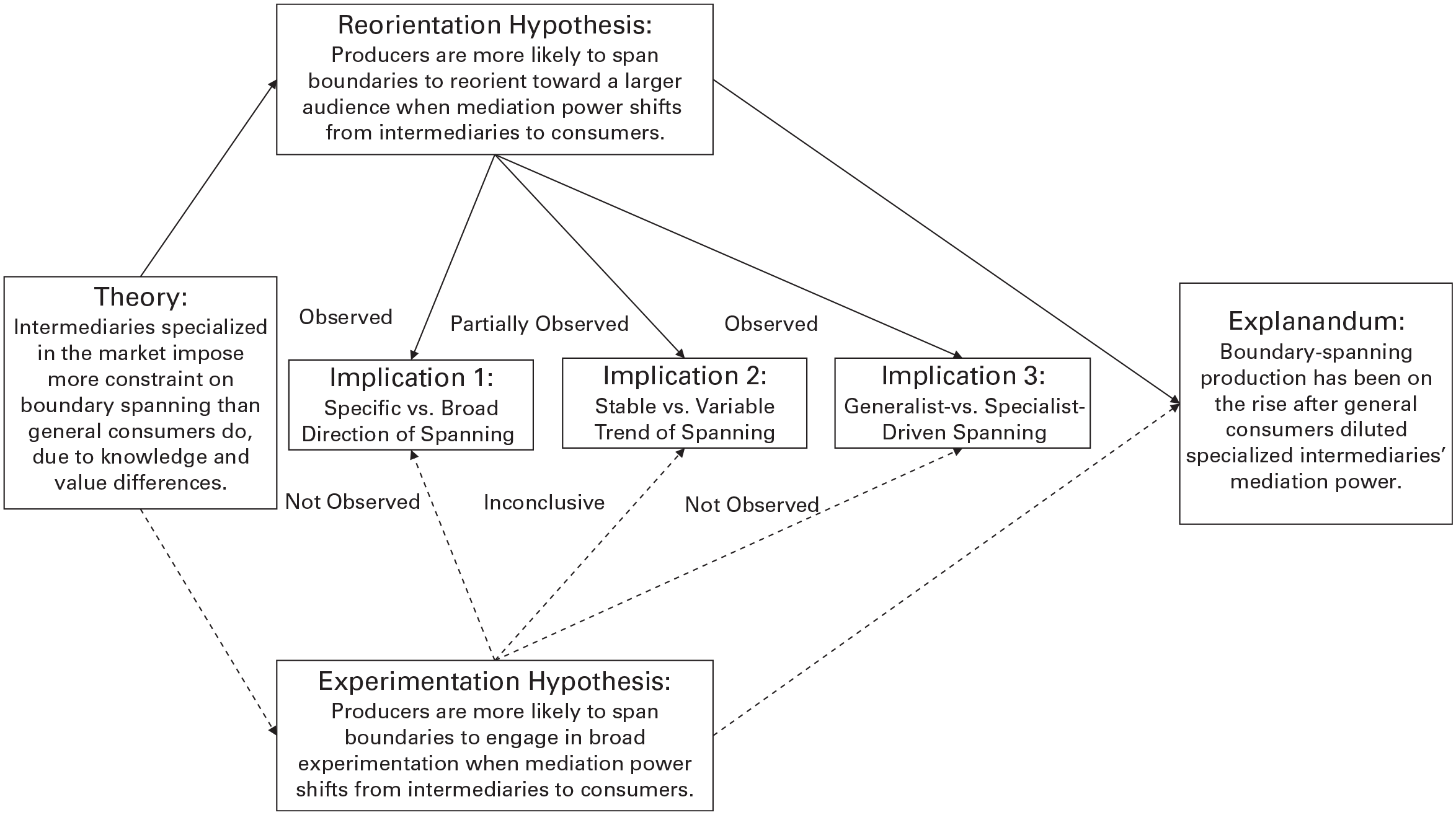
A Diagram of the Overarching Theory and Mechanism Accounts Based on Elster (2007)
First, the post-democratization increase in boundary spanning may be explained by strategic reorientation, which is producers’ strategic effort to reorient their offerings toward more audiences across market boundaries that intermediaries no longer tightly control. For instance, in the context of country music, the production of Florida Georgia Line’s 2014 crossover album Anything Goes, which was backed by UMG-owned Republic Records and country pop label Big Machine, was heavily oriented toward pop and rock (Taste of Country, 2014). As a critic noted, this production was designed with the goal of “playing to the largest possible audience” (Erlewine, 2014).
Once intermediary constraint is relaxed, producers no longer need to hold back their reorientation efforts, which may result in a constant trend of boundary spanning. With the strategic goal of audience expansion, the spanning is more likely to gravitate toward popular genres with large followings than toward smaller genres with limited potential for audience growth. Furthermore, the tendency toward and expected return on reorientation may not be equal for all organizations. Generalist organizations, which operate in multiple market categories, are knowledgeable about multiple audiences and have various resources across market boundaries. As such, generalists face fewer internal constraints on spanning and are better positioned to take advantage of broader audiences through reorientation. When generalists span boundaries, the demand for traditional offerings may be better served by specialist organizations focused on a single market. Although specialists lack access to outside markets, they may be valued for their clear, consistent identities. This strategic orientation account leads to the following expectations:
Second, the democratization of market mediation may obscure audience expectations and require more experimentation with diverse features across market boundaries. Without intermediaries setting clear expectations for a market, producers may see a greater need to experiment with product boundaries and learn about general consumers’ preferences, which become more influential after democratization. An example in my research setting is Blake Shelton’s 2013 crossover hit “Boys ‘Round Here,” the production of which appeared to incorporate experimental features. The song was released by country label Warner Bros. Nashville and features sonic elements that were uncommon in the genre, such as extensive rap segments, autotuned stutter vocal effects, “freewheeling” beats, and “sassy catcalls” by female backing vocals (McDonnell, 2013).
The process of experimentation tends to be highly variable and noisy, and the trial-and-error process likely takes time to resolve. These factors may contribute to the variability in the temporal patterns of boundary spanning. Given that the value of product elements across market boundaries is uncertain ex ante and may be revealed only after experimentation, producers may explore a wide range of directions and tap into both popular and niche markets in their spanning efforts. The need for experimentation and learning may be especially salient for those with less information on consumer preferences and demand outside the market category, such as specialist organizations whose knowledge is more constrained by market boundaries, compared to that of generalists. Given general consumers’ greater influence after democratization, specialists may be motivated to engage in experimentation and learning and thus may experience a more pronounced effect on boundary spanning. 1 Thus the experimentation account will lead to patterns of boundary-spanning production that are likely distinct from my expectations regarding the reorientation account.
Methods
Empirical Context
To provide empirical support for my theoretical account, I chose the U.S. commercial music industry as the context for the study. According to the Record Industry Association of America, the annual retail revenue of the industry exceeded $8 billion in 2017 (Friedlander, 2018). The value of typical product offerings in this industry, such as song recordings, is difficult to define or predict (Hirsch, 2000). Moreover, the relationship between market success and product features is often unclear (for a notable exception, see Askin and Mauskapf, 2017). Cultural industries are subject to “superstar effects” as a small number of producers capture a major share of the revenue (Krueger, 2005: 15). As a result, there is significant pressure on producers to reach a viable audience. Like many other sectors such as hospitality and service, product offerings are experience goods whose value is largely unknown before consumption (Hirsch, 1972). For these reasons, both consumers and producers of music are heavily influenced by the mechanisms of market mediation, such as product rankings (Anand and Peterson, 2000; Salganik, Dodd, and Watts, 2006).
These constraints on consumption and production make the role of market intermediaries, such as radio stations, especially important. Acting as “surrogate consumers” (Rossman, 2012: 14) for listeners, radio stations direct consumers’ limited attention to a small number of products in a market (Hirsch, 1972). Radio stations specialize by genre, a market classification system defined by distinctive codes and conventions and used to organize market exchange (Lena and Peterson, 2008; Lena, 2012). While the consensus on genre boundaries may have weakened in some cases, industry-based genres with considerable followings, such as pop and country, still maintain coherent expectations for various stakeholders (Lena, 2012). Audiences use genre labels to filter and evaluate songs, producers use genre affiliations to gain access to specific markets, and intermediaries claim legitimacy and control over their specialized genres. Due to intensive competition in local markets, radio stations operate in single-genre formats and target focused and stable demographic groups, for which advertisers pay a premium (Greve, 1996, 1998; Chignell, 2009).
Whereas people often assume that radio programming reflects audience demand, such decisions are at programmers’ discretion. Radio playlists may deviate from consumer preferences even when accurate metrics of consumption are available (Roland, 2016). Individual stations’ programming choices may have been further homogenized by ownership consolidation and the rise of nationally syndicated programs since the late 1990s. While the relationship dynamics between radio stations and upstream experts (e.g., critics) are difficult to capture, their preferences appear consistent in this setting. 2
It remains unclear ex ante whether the constraint on genre boundaries originates from radio stations or from primary consumers of the genre, as researchers have observed consumers’ resistance to impure product offerings in this setting and many other contexts (Peterson, 1997; Hsu, 2006; Rossman, 2012; Kovács, Carroll, and Lehman, 2014; Goldberg, Hannan, and Kovács, 2016). Traditionally, radio stations define hits in a genre, and this hitmaking power has long been recognized by record labels, which adopted controversial practices such as payola and spot buys to gain an advantage in the competition for radio airtime (Rossman, 2012).
Radio’s exclusive power over market mediation is largely attributable to its influence on authoritative product rankings in the industry. In fact, radio airplay was the sole defining metric of many genre singles charts published weekly by Billboard, a trade magazine with the stated mission of supplying accurate market information to the industry. Billboard charts track music production in various genres and are widely accepted as the industry benchmark for product performance (Anand and Peterson, 2000; Askin and Mauskapf, 2017). Even with the availability of alternative metrics, most market participants recognize the authority of Billboard charts due to their long-standing reputation for reliability, neutrality, and accuracy (Peterson and Berger, 1975; Anand and Peterson, 2000). Chart appearance certifies a song as an official hit and significantly boosts the value of producers’ offerings.
The Democratization Experiment of Billboard Genre Charts
Before October 2012, only radio airplay within the genre determined the popularity of a country song for inclusion in the genre’s singles chart, “Hot Country Songs.” The airplay-only formula essentially gave country radio power to dictate the chart. Regardless of its popularity, a country song that did not get played on the radio would be excluded from the chart. Because country radio remains dedicated to preserving genre conventions and offers a “gated-in listening” (Douglas, 1999: 348) experience, producers are under immense pressure to conform to genre boundaries even when crossing over into other genres may be commercially lucrative (Simpson, 2011). 3
One example is country artist Buck Owens, who back in the 1960s felt compelled to publicly pledge allegiance to the genre after scoring a major hit in the pop market (Simpson, 2011). Efforts to clarify genre boundaries further spill over into the music itself, as country artists sometimes use their music to cast doubt on others’ genre identity (e.g., “Gone Country” by Alan Jackson) or to affirm their own (e.g., “Can’t Say I Ain’t Country” by Florida Georgia Line). Successful artists from other genres, such as Justin Timberlake and Lady Gaga, failed to gain much traction when attempting to go country, in part due to the lack of acceptance by country radio.
On October 11, 2012, Billboard abruptly announced that it would factor consumption via digital sales and streaming platforms, as well as airplay on radio stations outside of the focal genre, into the singles charts for country and other major genres (Billboard, 2012). By diluting country radio’s relative power to define chart positions from 100 to 40 percent or lower, the new chart methodology effectively ended country radio’s decades-long monopoly and shifted hitmaking power to the general population of consumers (Trust, 2013). The only major genre chart not subjected to the revamp was the pop chart “Pop Songs,” which pop radio stations continued to control. 4 The abrupt, genre-specific nature of this chart experiment allows us to contrast radio and consumers as two audiences whose market boundary knowledge and value are vastly different. As such, this event presents an opportunity for a DiD analysis to identify the causal impact of the democratization of market mediation.
The Billboard chart experiment partially democratizes the market mediation process in country music because a handful of country radio stations no longer tightly controls the power to define genre hits. 5 Instead, as Billboard’s former editorial director Bill Werde (2012) explained, music consumers have more power “than they have ever had in the history of the recorded music business.” Nonetheless, the new consumption-based chart does not reflect or lead to a fully disintermediated market. While the tweaking of the chart-ranking formula lends more weight to consumer voices and is not dictated by any individual platform, its democratizing effect is limited by the fact that consumption decisions are not independent of the influence of curated playlists served up by terrestrial radio and digital platforms. Additionally, the chart experiment was preceded by and is distinct from digitization. As intermediaries that largely serve all genres, digital platforms shape consumption and production industry-wide (Molanphy, 2014; Datta, Knox, and Bronnenberg, 2017). In contrast, the new chart rule rebalances the influence of intermediaries and consumers in select genre markets only and does not directly change the means of production or consumption.
By expanding consumers’ influence in market mediation, the policy shock gave a significant boost to songs with genre-blending features. Due to radio’s weakened role in defining hits, the new chart allowed producers to move away from genre traditions and to succeed with little radio support. As multiple industry stakeholders noted at the time, crossover songs that were typically rejected by genre radio immediately became the biggest winners after democratization (Billboard, 2012; McKinley, 2012). Taylor Swift’s Red is one of many such crossover successes after the chart change. Described as “a glossy soft rocker with . . . back-porch twang, adult-contemporary orchestration, and Top 40-ready electronic vocal effects . . . ” (Hogan, 2012), the country–pop crossover song skyrocketed to second place after chart democratization, despite receiving little country radio airplay and no ranking on the old chart. 6
Widely felt in the industry, these shifts led labels and artists to realize that crossing genre lines, once frowned upon, might be a viable strategy for scoring hits under the new rule. “[The] boundaries are coming down . . . Fans don’t think that way about the genres,” said country artist Maren Morris, who would later dabble in electronic dance music (Reuter, 2018). As a Nashville label executive told Billboard, “if . . . your job is to get to as many people as possible, then this is certainly a clear-cut way to go there . . . ” (Aswad, 2014).
Consistent with these views, additional analyses indicate that crossovers are systematically associated with better chart performance after democratization. 7 In short, industry anecdotes, descriptive evidence, and quantitative analyses corroborate the more-favorable evaluation of boundary-spanning offerings, which serves as a critical link between democratization and the predicted production change in my theory. Still, there is little evidence of how chart democratization has broadened the direction of country music production, which I set out to systematically examine with a large and novel dataset.
Data and Method
I collected data from two crowdsourced databases: MusicBrainz and AcousticBrainz (Porter et al., 2015). MusicBrainz is an “open source encyclopedia of music information.” 8 The database is managed by the Music Technology Group of the Universitat Pompeu Fabra in Barcelona and is backed by many corporate sponsors and expert users, such as Google, Amazon, and Spotify. AcousticBrainz is a sister database that provides feature information on music recordings. More than 1.9 million online editors curate the data entries.
Using both databases, I identified songs released in the U.S. music market within the two years before and after the 2012 change in Billboard’s chart policy. My sample consists of songs designated to the country or pop genre markets during this four-year period. To identify genre designations, I first gathered all genre tags associated with the sampled songs in both databases. I identified the genre affiliation through the song’s appearance on a release, its credited artist, and the label affiliation. To identify tags associated with country or pop, I created a list of keywords for country and pop subgenres based on the genre classification schemes of three major musical information providers: iTunes, Allmusic, and Discogs. I then obtained tags that matched genre-specific keywords and used them to designate genres. 9 I excluded songs from artists born more than a century ago because they were likely reissues of older releases. I also dropped songs that were longer than 99 percent of the songs in the sample because such cases may be recordings of live performances or other nonstandard releases. 10 The final sample for the main analysis consisted of 20,014 songs released in the country or pop markets during the 2010–2014 period.
Dependent Variable
Product offerings that span market boundaries in this setting are often known as “crossovers,” a term referring to songs that cross genre boundaries (Rossman, 2012). Field work and computational research have suggested that song features vary considerably between genres (Tzanetakis and Cook, 2002; Lena, 2012) and have direct implications for market performance (Askin and Mauskapf, 2017). When a song spans genre boundaries, it may thus incorporate various features such that the song bears less resemblance to its original genre. Extensive research in the music information retrieval (MIR) field (for a review, see Fu et al., 2011) has made it possible to extract the underlying audio signals of a song recording, quantify its sonic features, and estimate how similar a song is to representative audio samples from different genres. The sonic features of a song, which are shaped by various production decisions such as composition, arrangement, and mixing, are salient to audiences and offer a novel and objective way to capture the extent of producers’ boundary spanning in this setting.
To systematically assess the crossover features of different songs, I constructed a continuous measure labeled the Crossover score, which represents the similarity of a song’s features to those of other genres. This score is an average of the estimates of two state-of-the-art machine-learning algorithms developed in the MIR field (Tzanetakis and Cook, 2002; Homburg et al., 2005). These algorithms and their associated audio collections often serve as benchmarks in the field (Fu et al., 2011); they compare a song’s key audio components, such as rhythm and pitch, to predefined audio samples and estimate the song’s genre similarity score as a probabilistic value based on feature distance. The theoretical range of the measure is between zero and one. A zero value implies that a song’s features strictly abide by genre conventions, and a value of one indicates that a song’s features bear no resemblance to its designated genre.
The choice of a feature- rather than classification-based measure of crossover has important theoretical and empirical implications. Most notably, this measure accurately reflects the theoretical concept of category spanning as feature distance between an object and category prototypes (Hannan, Pólos, and Carroll, 2007; Durand and Paolella, 2013). Traditional measures based on classifications often lack this level of precision and confound producers’ decisions with audiences’ perceptions of category memberships, which tend to be subjective and inconsistent (Fleischer, 2009; Waguespack and Sorenson, 2011; Negro and Leung, 2013).
In contrast, the algorithm-generated crossover feature score precisely isolates producer-side changes and is not contaminated by the Billboard chart experiment and other social factors. The algorithms were developed before the change and were not built specifically for the affected genres. Therefore, potential measurement errors are not expected to correlate with the treatment group in the post-period and thus should introduce noise and make the estimates more conservative. Nevertheless, the complexity of genre recognition algorithms means that the potential bias and ideal statistical properties of the measure remain open questions in real-world analyses. Thus it is important to conduct further analyses to account for the potential biases of outliers and machine-learning models. Analyses of alternative outcomes corroborate the main analysis, offering evidence that the findings are not an artifact of the specific measurement choice. 11
Difference-in-Differences Design and Model Specification
To answer the question of how democratization affects crossover production, the ideal experiment would be to observe producers’ behavior in two identical markets after intermediary constraint is lifted in one of them. To capture this effect in the real world, one needs to grapple with myriad confounding factors associated with industry-wide shifts, such as digitization and an evolving genre system. For this reason, it is critical to use a genre market in which the shock does not occur to approximate the counterfactual and to address issues that may lead to spurious findings, such as omitted variables and reverse causality. The need for a control group makes a DiD analysis the most suitable design for this study. 12
Announced abruptly and not implemented in every genre market, the above-noted change in chart policy offers a rare opportunity to account for confounders and isolate the impact of democratization. Specifically, I compared the crossover features of new offerings in a democratized market (i.e., the country market) to those in a control market (i.e., the pop market) before and after the Billboard chart experiment.
I focused on comparing the country and pop markets to ensure clean identification of the effect. Two factors justify this choice. First, for the research design to be plausible, long-standing, radio-dominant genre charts need to be present in both groups before the shock. Relatedly, several other genres, such as blues, are not suitable for the DiD design because radio programming choices either were not tracked by Billboard or did not carry as much weight due to historical reasons. 13 Second, I excluded some other affected genres due to confounding events and data constraints. For instance, hip-hop/R&B is not ideal for the setup because of a separate chart-splitting change announced on the same date. Due to the lack of reliable feature and genre identification data, I also excluded the Latin genre from the study.
To preserve the granularity of the product-level feature data, I focused the unit of analysis on the song level. Market activities in the music industry are organized around new product offerings, which are what labels and artists make decisions on, what radio stations and other intermediaries track and evaluate, and what consumers search for and listen to. In empirical terms, meaningful variations between products may be lost if those products are aggregated in the analysis, but it is possible to account for macro-level factors such as the characteristics of artists, labels, and time periods when specifying regression models on the product level.
I included a dummy for the treated market group, Country, which is set to one for songs designated in the country market. This dummy captures the baseline differences between country and pop. To distinguish between the pre-treatment and post-treatment periods, I coded a second dummy, Post democratization, which equals one if a song is released after the date of the chart methodology change (Oct. 11, 2012). The dummy captures universal crossover trends after the change. The main variable of interest is thus the interaction of the treated group and the post-period (Country × Post democratization), which provides an estimate of the impact of Billboard’s chart experiment on the country market, an average treatment effect on the treated group.
I also considered various controls associated with music production. The inclusion of controls, while not essential to the design, may help reduce noise in the estimates and help us better understand boundary spanning as a multifaceted phenomenon. If the chart change is exogenous, the omission of controls will make the estimates noisier and more conservative. On the song level, I defined Song length as the natural log of the length of the song in milliseconds, plus one. I included a quadratic term of Song length. The rationale is that a song that runs extremely long or short may be less typical in nature. The dummy First track captures whether a song appears first on the track list of a release. The choice of an album-opening song is important because a song occupying the top position is more visible and often serves as the lead single that defines the whole release. I constructed a Collaboration dummy that equals one if a song is credited to more than one performing artist, which usually occurs in the form of guest appearances.
On the artist level, I first included Artist age, defined as the number of years between the birth year of the performing artist and the year of the release. Younger artists may be more experimental, while older artists may be more traditional and less exploratory in their music production. The Group artist dummy distinguishes solo artists from artist groups (e.g., bands), as formal groups may introduce more heterogeneity into the creative process. The New artist dummy is coded as one for artists who had never released any work in the U.S. previously. Potential gender-related differences in creativity are captured by the Female artist dummy, which is set to one if the artist was identified in the database as female. In addition, “soft-shell” country songs (Peterson, 1997: 138), which target the pop market, are captured by the Country pop dummy, which is set to one if a country song was also tagged as pop.
For a song released by label i in season s of year t, I estimated the following equation:

where
Label-level fixed effects account for potential heterogeneity among record companies, which hold critical resources, significantly influence the selection and development of artists, and are instrumental in production processes. Boundary-spanning decisions are likely not independent within a label due to the pooling of resources and connections between signed artists, a label’s history and identity associated with certain musical styles, and the overall strategic directions taken by the label’s management. Standard errors are clustered on the label level to account for such interdependencies.
14
The main coefficient of interest is
The research design’s identifying assumption is thus that the chart democratization experiment is exogenous to producers in the country market such that trends in the outcome of interest, crossover score, were similar in country and pop markets before the change. To identify the effect on producers, I estimated within-organization changes in crossover production by conditioning the analysis on label fixed effects. 15
Thoughtful readers may be concerned that rather than causing crossover production, the change might have been Billboard’s reaction to the growing popularity of crossovers and the increasing fragmentation in the country market. In such cases, pre-trend tests would indicate that offerings in the country market were drifting away from genre conventions at a different rate than those in the pop market before the change. This alternative would violate the assumption of parallel trends, as the trends in the outcome should be similar in the treatment and control groups before the shock to ensure the validity of the DiD estimator. To check this assumption, I estimated quarterly trends in the country and pop markets, and Figure 2 shows that an increase in crossover score occurs in country only after the policy shock. 16 In addition, the absence of a common post-trend suggests that industry-wide shifts that influence both intermediaries and consumers, such as the changing role of the genre system, do not directly explain the findings.
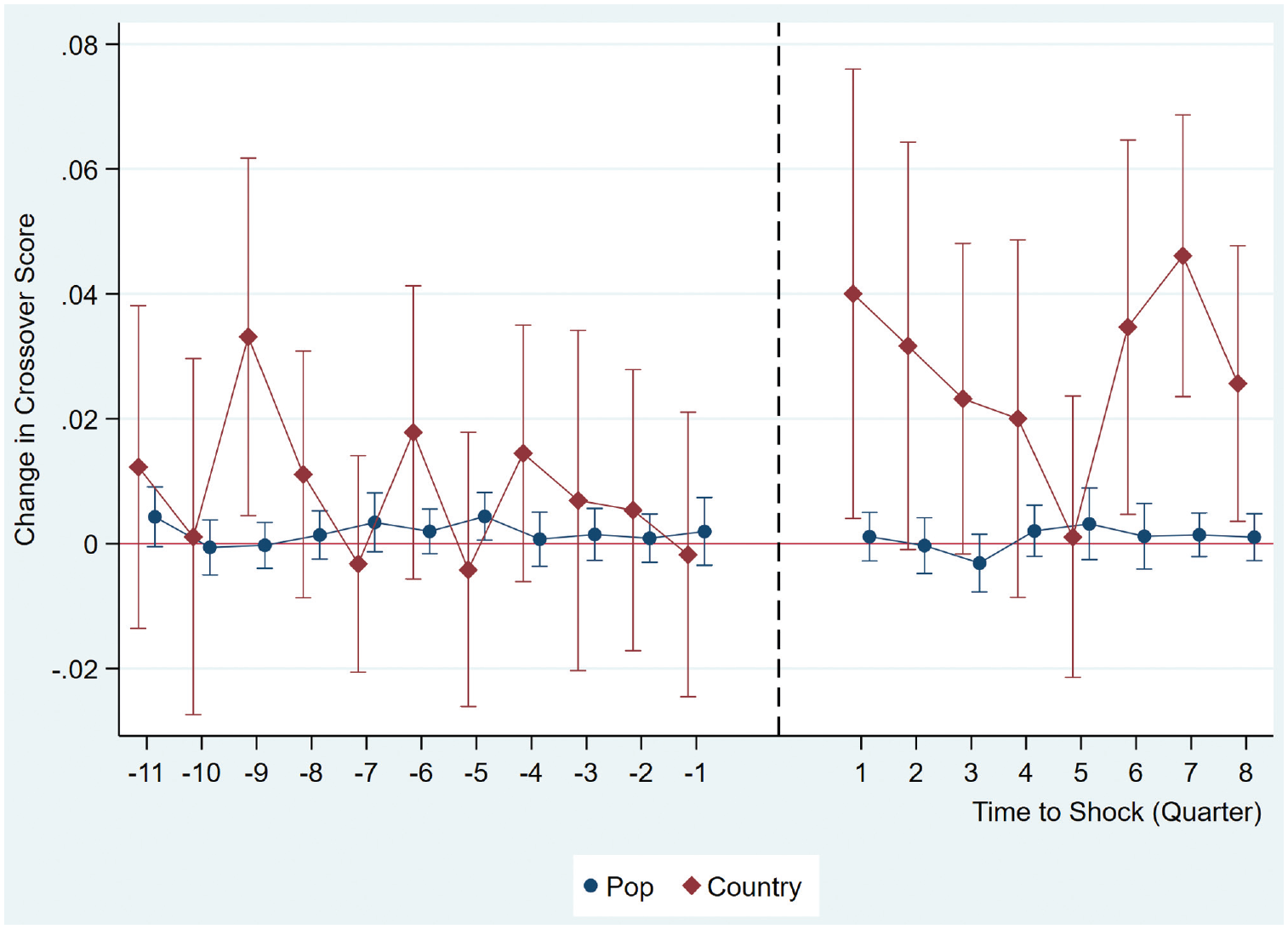
Quarterly Trend of Crossovers in Country and Pop Before and After Chart Democratization*
While I reason that the effect on crossover production is attributed to the change in the market mediation structure caused by the new chart, one may argue that events preceding this change, such as the digitization of music and a gradual shift in the valuation calculus of intermediaries and consumers, can explain away the change in the affected market. If this were true, we might find similar results in placebo tests of these alternative events (e.g., the market entry of digital platforms). Yet the results of placebo tests are not statistically significant, thus offering little support for these alternatives. 17 Furthermore, official audience surveys have indicated that the makeup of the country audience remained stable between 2008 and 2012 (National Endowment for the Arts, 2009, 2015); they do not support changing demographics as a plausible alternative explanation (Kacperczyk and Younkin, 2017). And the composition of producers is unlikely to account for the results due to the stickiness of identity claims associated with genres.
Considering that prior DiD studies have commonly observed lagged responses to external shocks (e.g., Kovács and Sharkey, 2014; Vakili and Zhang, 2018), one may wonder about the extent of the potential lag in production changes in this setting. Note that longer lags would reduce the likelihood of observing a response and thus work against the findings. Additional analyses indicate that crossover in country did not rise significantly in the first month after the shock, but the treatment effect became clear in the later period. The results are also similar when I dropped all cases in the first six months after the shock, a time period most susceptible to the concern about time lags between the shock and producer responses.
Results
Main Analysis
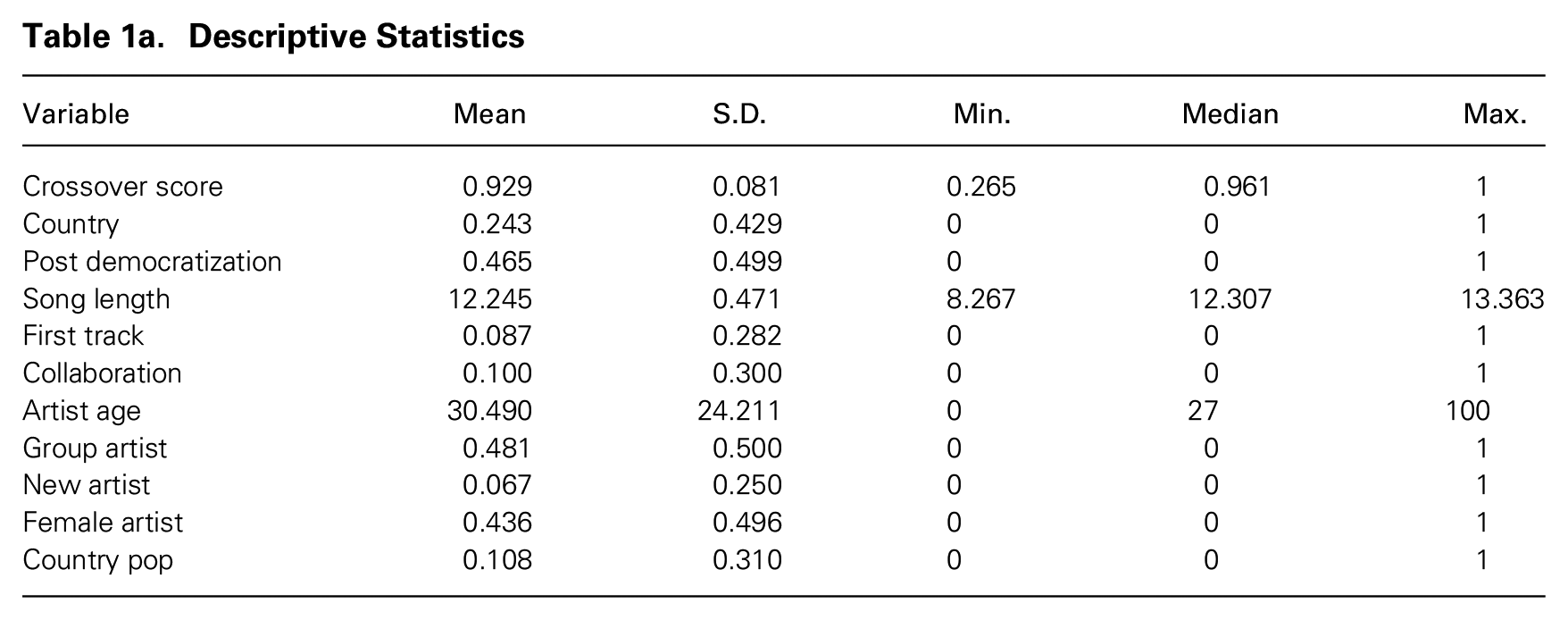
Tables 1a and 1b report the descriptive statistics of the sample and the correlation matrix. Variables such as song length and the first track dummy do not indicate apparent sampling bias. The standard deviation of the crossover score is 11 percent of its range, indicating significant variation across songs. 18
Descriptive Statistics
Correlation Matrix*
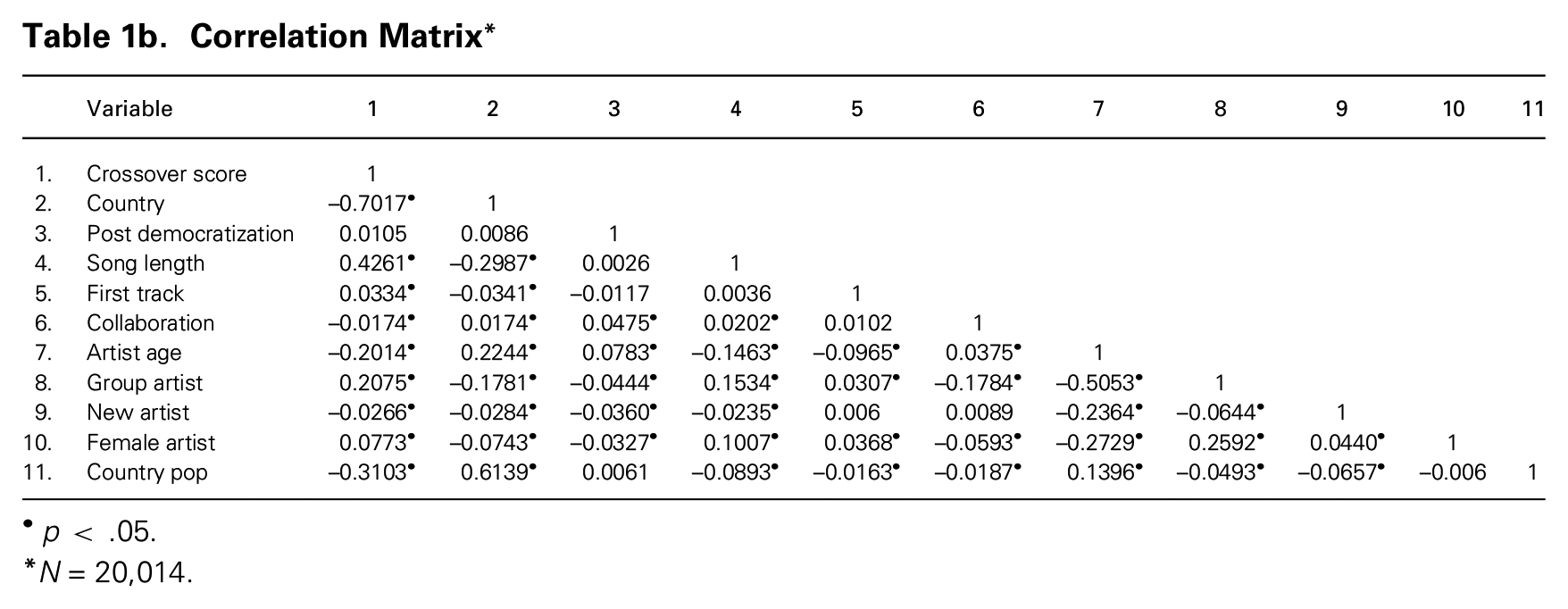
p < .05.
N = 20,014.
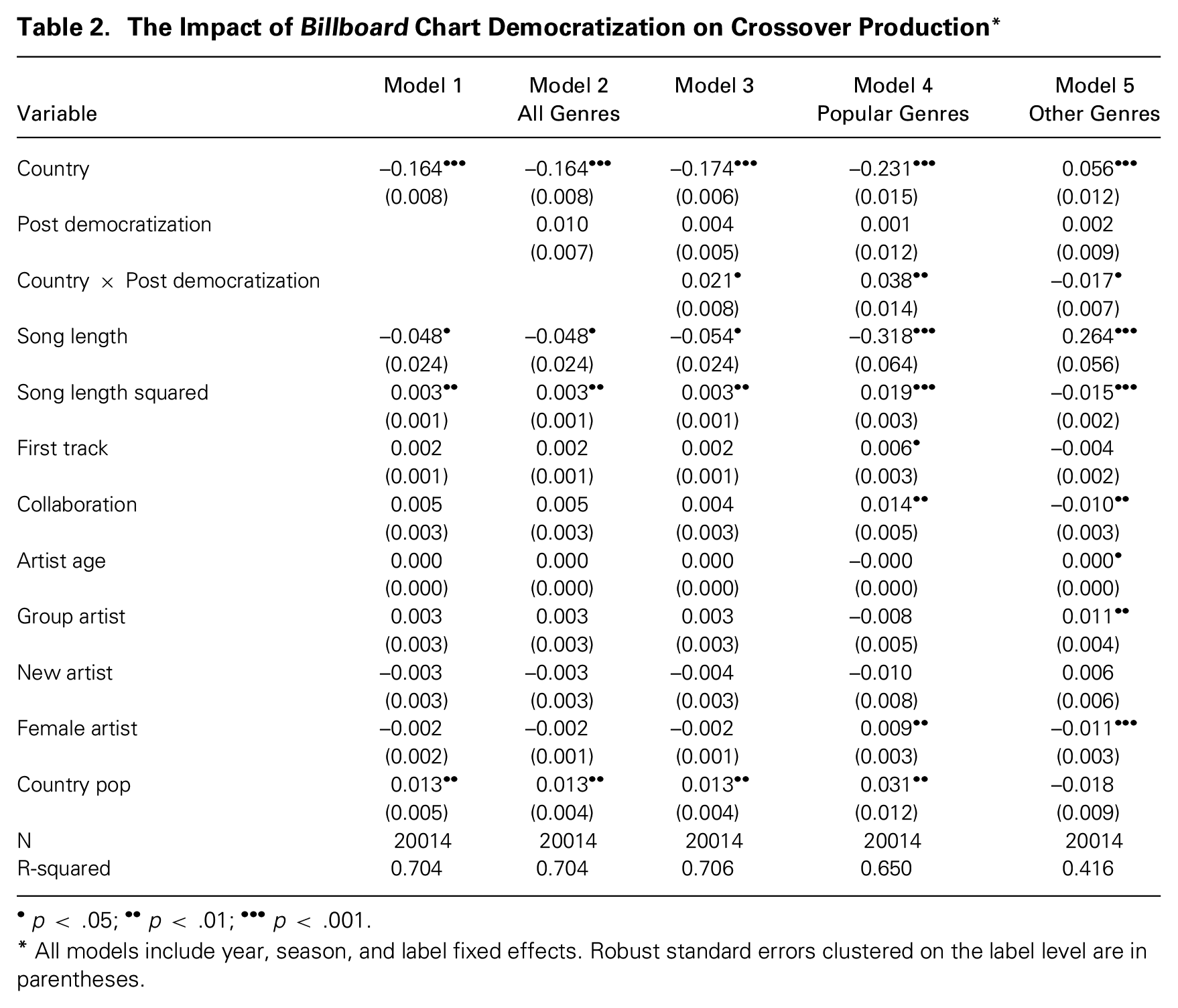
I report the main results of the DiD regressions on the crossover feature score in Models 1–3 in Table 2. These models are high-dimensional fixed-effects linear models that allow for flexible specifications and computational efficiency. The level of analysis is the song recording. Model 1 introduces the Country dummy to estimate the first difference between genres. The negative and significant coefficient estimate indicates that on average, country songs absorb fewer crossover features than pop songs do. Model 2 adds the dummy for the post-period, Post democratization, to test the second difference between the pre-period and post-period. As the post-period changes in the treatment group (country) and the control group (pop) are not separated, the estimate of this dummy is positive but not significant.
The Impact of Billboard Chart Democratization on Crossover Production*
p < .05; ••p < .01; •••p < .001.
All models include year, season, and label fixed effects. Robust standard errors clustered on the label level are in parentheses.
Because the democratization event occurred in the country market in the post-period, I test the main proposition through the interaction effect, Country × Post democratization, in Model 3 of Table 2. The positive and significant coefficient of the interaction term indicates that labels release country songs that blend more crossover elements, as defined by the acoustic proximity to non-country genres, after democratization. The significant estimates of the main effect indicate that common time trends and other song characteristics cannot account for the key empirical patterns. Additional calculations show that the magnitude of the effect on the country market is 15 percent of the baseline difference between the country and pop markets in the pre-democratization period and 26 percent of the standard deviation of the Crossover score in the sample. Furthermore, the nonsignificant estimates of the post-period dummy in all models indicate that industry-wide shifts are not directly associated with an increase in crossover production in the study period.
These findings strongly suggest that labels introduced songs with more crossover features after Billboard’s chart democratization experiment. Since the average Crossover score is lower in country than in pop, democratization narrows the gap between the two markets in crossover tendency and renders the country market less distinguishable from the pop market. 19 This result supports the idea that boundary-spanning activities erode distinctive market categories (e.g., Durand, Rao, and Monin, 2007).
Regarding controls, the negative coefficient of Song length and the positive coefficient of its squared term indicate a U-shaped relationship between the length of a song and its crossover feature score. In other words, a song of atypical length is less likely to be conventional. 20 The positive and significant coefficient of the Country pop dummy indicates that, as expected, country pop songs display more genre-blending features than pure country songs do. Other factors are not precisely estimated in the models.
Additional analyses suggest that the crossover trend in country music is associated with a decline in the use of acoustic instruments and vocal harmony, which are often seen as defining features of the genre, and results in lower acoustic and tonality feature scores after democratization. 21 I find that the treatment effect is not driven by potentially excessive and suboptimal boundary-spanning efforts, such as those leading to extremely high crossover feature scores or great resemblance to incongruent genres. This result is consistent with recent work demonstrating the limited benefit of atypical features (e.g., Askin and Mauskapf, 2017; Zhao et al., 2017).
Mechanism Tests: Reorientation or Experimentation?
The main analysis above offers an ex ante test of the theory and produces evidence of a market-level shift in production, but it does not pinpoint specific mechanisms that explain why producers embrace crossover offerings after democratization. To that end, I conducted post hoc analyses of the temporal, directional, and organizational differences in boundary spanning to adjudicate the reorientation and experimentation mechanisms ex post. Specifically, I tested whether the post-democratization crossover trend is geared toward certain genres, remains stable over time, and is organization-specific. These analyses are abductive and allow me to triangulate the most plausible mechanism. Triangulation efforts are particularly useful here, as they alleviate concerns about individual mechanism tests.
To identify the direction of boundary spanning, I split the main crossover measure, which encompasses all genres other than the focal genre of the song, into two measures based on the commercial appeal of the genre market. Crossover into popular genres is defined as the sum of the feature similarity scores of the most popular genres (pop, rock, hip-hop, electronic, and country), excluding the focal genre. 22 Crossover into other genres is measured as the sum of the scores assigned to the other smaller genres, such as classical, jazz, and blues. To discern whether the temporal trend in the product feature space is stable or variable, I disaggregated the post-period dummy into dummies for the first year (Post: first year) and later (Post: later). To test organization-level variations, I created the dummy Specialist firm to identify song recordings released by record labels that specialize in a single genre before democratization, and the dummy Generalist firm for others. 23
A breakdown of the descriptive statistics, shown in Figure 3, offers prima facie evidence for both proposed mechanisms. Consistent with the reorientation account, the crossover trend in the country market is geared toward markets with large audiences. In particular, the crossover feature score for popular genres saw an increase after democratization (pre-period mean = 0.431, post-period mean = 0.450, p < 0.001), while the mean for smaller genres experienced a drop (pre-period mean = 0.394, post-period mean = 0.385, p = 0.012) in the genre. Meanwhile, the experimentation account is consistent with the temporal fluctuations in crossover scores in the post-period. Descriptive statistics indicate that producers’ crossover efforts shifted markedly after democratization, as they further increased the infusion of popular genres in the second year (first year mean = 0.438, second year mean = 0.468, p < 0.001) and reduced the use of elements of other genres over the same period (first year mean = 0.390, second year mean = 0.376, p = 0.007). As expected, there is no observable movement in the pop market, which represents the control condition. 24
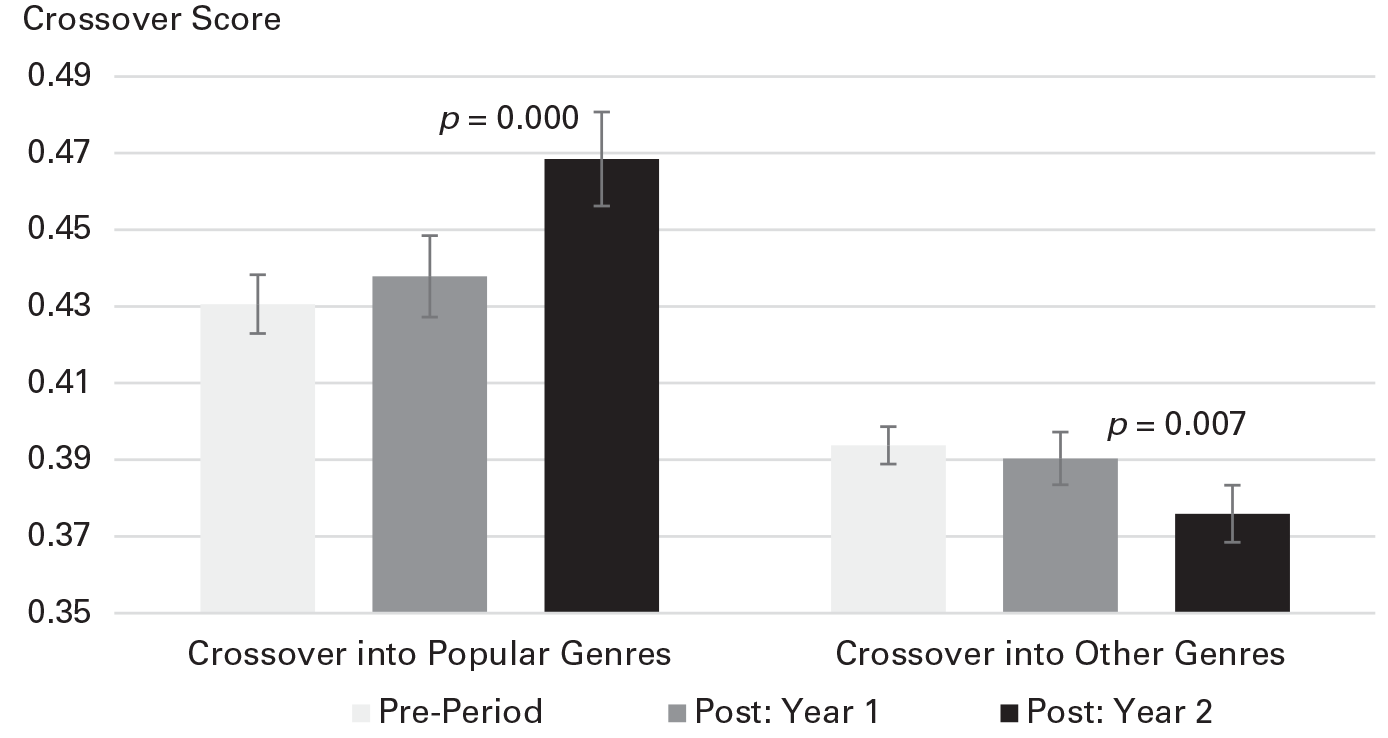
Crossover Scores by Target Genres and Time Period in the Country Market*
While these statistics lend some face validity to both mechanism accounts, DiD regression analysis may account for various confounding factors in the raw data and offer compelling support. To examine the direction of boundary spanning, I compare the findings between popular genres and others in Models 4 and 5 in Table 2. Model 4 uses the crossover score for five popular genres: pop, rock, hip-hop, electronic, and country (excluding the focal genre). Model 5 uses the score for other smaller genres (e.g., blues and classical). The positive and precise estimate of the main interaction in Model 4 suggests that the main findings are driven by increased efforts to borrow from popular genres. In contrast, the findings in Model 5 indicate that after democratization, producers refrain from tapping into genres with less popularity. Therefore, the results here are more consistent with the reorientation explanation. 25 In addition, the first track on a release is more likely to cross over into popular genres, which is probably due to its commercial importance. The results further show that female artists are more likely to cross over into lucrative genres and less likely to cross over into other genres. This may imply that female artists face heavier commercial pressure compared to their male counterparts.
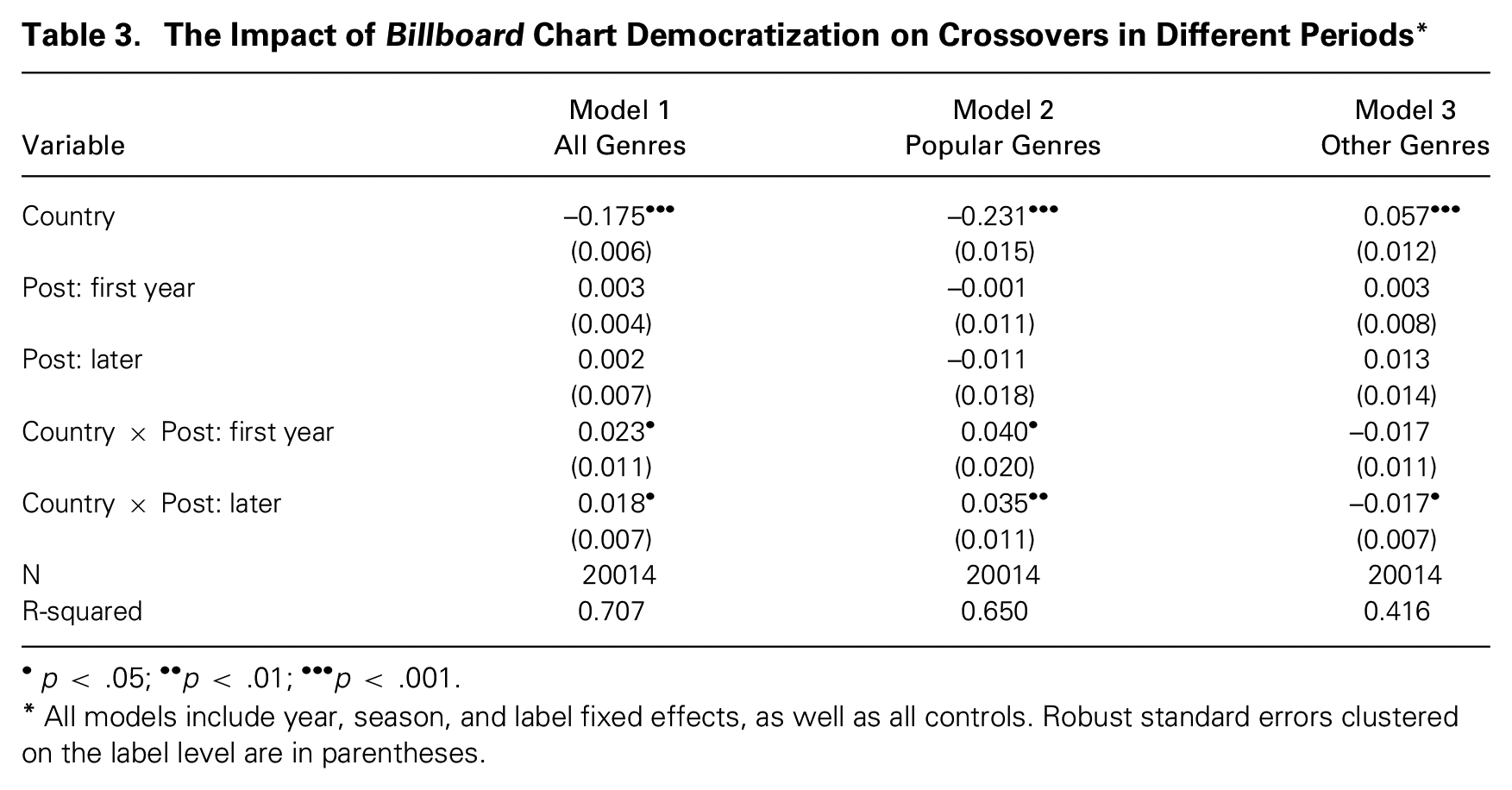
I then examine whether the democratization effects on crossover production vary over time, by separating the treatment effect by period in Table 3. 26 Model 1 examines the crossover score for all genres, and popular and other genres are examined separately in Models 2 and 3, respectively. The interaction terms between the country dummy and both period dummies are not only positive and significant but also similar in magnitude in Models 1 and 2, indicating no significant fluctuation in the use of crossover features associated with popular genres. These results are more consistent with the reorientation account. In Model 3, the interaction term between country and the dummy for the second year is significant and negative. Probably due to measurement noise, the interaction term for the first year is not precisely estimated in Model 3. But it is not significantly different from the estimate for the second year, either, thus not offering conclusive evidence for either account. Taken together, these results indicate that the boundaries of country music became more aligned with popular genres and shifted away from other markets.
The Impact of Billboard Chart Democratization on Crossovers in Different Periods*
p < .05; ••p < .01; •••p < .001.
All models include year, season, and label fixed effects, as well as all controls. Robust standard errors clustered on the label level are in parentheses.
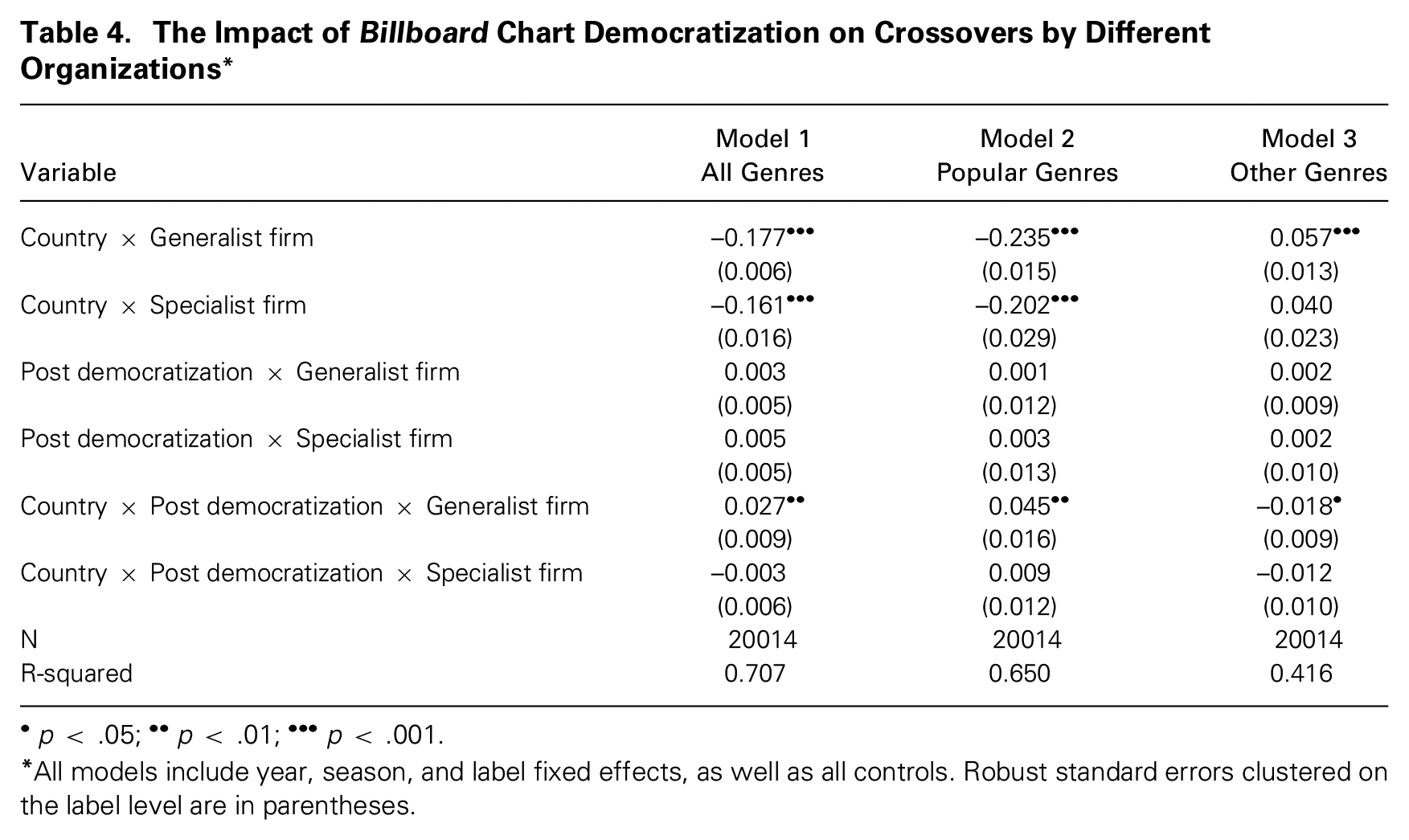
To unpack organizational differences in boundary spanning, I split the treatment effects on songs released by specialist and generalist organizations, as shown in Table 4. The three-way interactions in the DiD models Country × Post democratization × Specialist firm and Country × Post democratization × Generalist firm separate specialist organizations’ response to democratization from that of generalists. 27 I consider the crossover score for all genres in Model 1 and examine the directions of crossover in Models 2 and 3. The three-way interaction effect is positive and significant for generalists but fails to reach a conventional significance level for specialists in all models. These analyses suggest that generalists that straddle multiple markets largely drive the strategic efforts to cross over into popular genres. In contrast, specialists’ responses are muted. Additionally, neither type of organization appears to borrow more features from niche genres in the post-period, indicating a lack of support for the experimentation mechanism. These findings are in line with the reorientation mechanism, as generalist organizations benefit more from the relaxation of intermediary constraints and are better positioned to strategically expand audiences after democratization.
The Impact of Billboard Chart Democratization on Crossovers by Different Organizations*
p < .05; ••p < .01; •••p < .001.
All models include year, season, and label fixed effects, as well as all controls. Robust standard errors clustered on the label level are in parentheses.
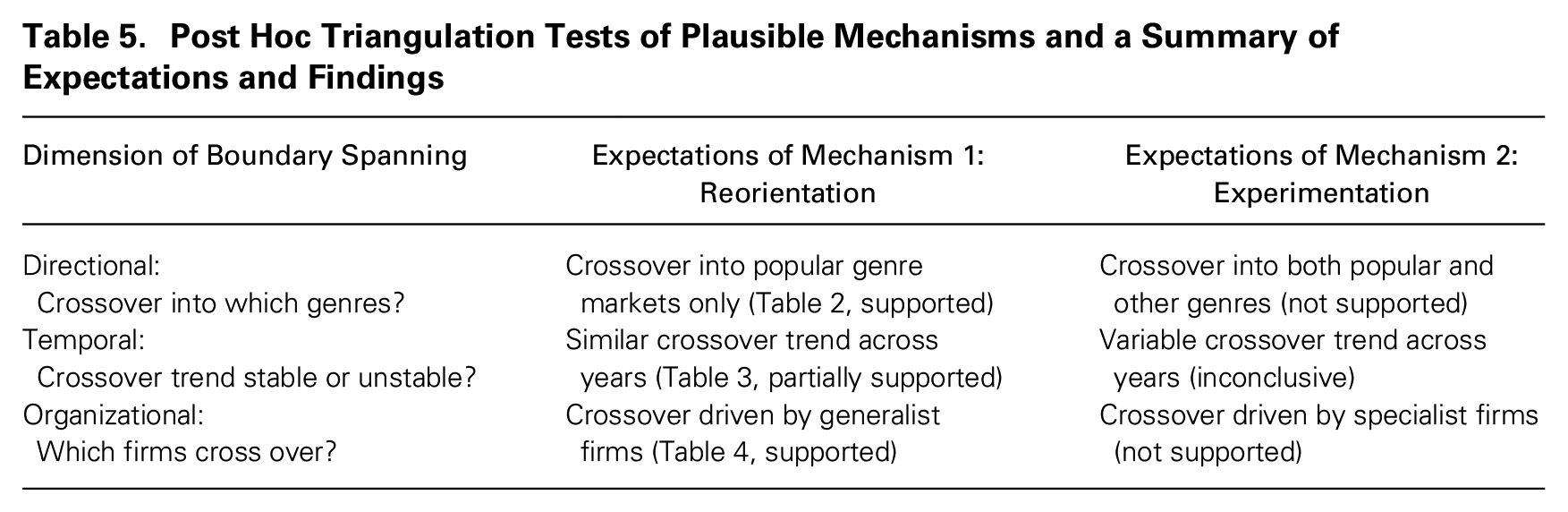
As Table 5 summarizes, I find that the rise of crossovers after democratization is likely due to generalist organizations’ sustained efforts to span popular market categories. Overall, these results lend strong support to the triangulation of the reorientation mechanism. Nevertheless, this mechanism may be contingent on specific conditions of the context. For instance, market participants share the common understanding that intermediaries have historically sanctioned boundary-crossing behavior in this setting (Douglas, 1999). Furthermore, information on market performance is timely and clear in this case, as crossover songs became hits overnight after the chart reshuffling (McKinley, 2012). I expect to observe reorientation effects in other contexts that meet these conditions. In settings where performance is difficult to compare and not defined by intermediaries’ expectations, experimentation is likely a more important consideration because the scarcity of market information often necessitates experimentation and learning (Kerr, Nanda, and Rhodes-Kropf, 2014).
Post Hoc Triangulation Tests of Plausible Mechanisms and a Summary of Expectations and Findings
Genre-related factors
Given the complex role that genres play in music production (Lena and Peterson, 2008; Lena, 2012), several genre-related alternative mechanisms should be acknowledged and explored. 28 First, the decline of the genre system over time may have contributed to the general trend of boundary crossing in music. Nevertheless, this alternative does not directly account for the key findings that are specific to country. Importantly, the analysis here does not identify a common post-trend. Related to this account, another question is whether the change in the market mediation structure has resulted in less regard for genre boundaries by both general consumers and intermediaries embedded in the genre. In contrast to this view, radio’s efforts to police genre borders and the divergence between consumer interest and radio programming seem to have persisted even after the chart change. 29
The loosening criteria of genre classification may reflect the weakening role of genres. If crossovers are more likely to be included in a genre after democratization, then this increased leniency may serve as an audience-side alternative explanation. In an analysis comparing the labeling criteria of the country genre before and after democratization, I do not find support for this explanation. 30 Nevertheless, these analyses cannot perfectly rule out all genre-related alternatives given that genres have far-reaching influences on most aspects of the music industry. Still, the main account of diluted intermediary power seems to better explain the findings.
Discussion
Implications
While both intermediaries and consumers influence producers’ actions and shape market boundaries, this study represents one of the first efforts to disentangle and contrast their influences on producers’ behavior. I have argued that the impediment to boundary-spanning production results more from intermediaries than from consumers. The empirical analysis shows that producers expand the boundaries of their offerings after the market influence shifts from intermediaries to consumers, thus indicating intermediaries’ independent and strategic role in the market.
This study highlights the relevance of market mediation for extant theories of category spanning and competitive positioning. Bridging conversations on market mediation and audience heterogeneity in the category literature, my theory offers a novel explanation of how structural changes in market mediation that alter the influence of some audiences may alleviate the pressure on producers. In particular, the rigor of the initial screening stage of the candidate–audience framework (Zuckerman, 1999) appears to hinge on the specific audience under consideration and the structure of market mediation. Moreover, producers’ repositioning efforts after the democratization of market mediation suggest that the research on competitive positioning is incomplete without explicit consideration of the role of intermediaries, who may be concerned with both producers’ positioning and their own positions in the market (Zuckerman, 2000; Bowers et al., 2014; Olson and Waguespack, 2020).
Specialization is the scope condition of the theoretical prediction and sets intermediaries apart from consumers in terms of their knowledge and value of market boundaries. This is consistent with the insight that knowledge and value differences among audiences may help reconcile the mixed evidence on audiences’ attitudes toward obscure offerings (Durand and Paolella, 2013; Zuckerman, 2017). Indeed, audiences with specialized expertise have been found to discount boundary spanning (Zuckerman, 1999; Lo and Kennedy, 2015; Boudreau et al., 2016; Whalen, 2018), whereas the positive effects of spanners have been attributed to less-specialized audiences (Paolella and Durand, 2016; Leahey, Beckman, and Stanko, 2017).
This scope condition implies that the comparison may be different in other contexts: not all intermediaries are specialized and impose strict boundaries, and some consumers may be enthusiasts who reject impure offerings. For instance, some intermediaries traverse market boundaries (Rao, Monin, and Durand, 2005), function as generalists who are valued for their impartiality (Bourdieu, 1996; Khaire, 2017), capture value from their flexibility regarding categorical boundaries (Pontikes, 2012), or navigate the pressure to expand a nascent market (Lee, Hiatt, and Lounsbury, 2017). And certain consumers may be as informed and devoted as intermediaries and seek to clarify market boundaries (Lizardo and Skiles, 2012; Goldberg, Hannan, and Kovács, 2016). In those cases, consumers’ overlap with intermediaries in knowledge and value may lead them to claim a preference for purity (Hsu, 2006; Hannan, Pólos, and Carroll, 2007). Nevertheless, it is possible to engage in consumption without expressing opinions, and the preferences implied in consumption choices often differ from consumers’ declared preferences (Lizardo, 2017).
The reorientation mechanism receives most support in the post hoc analysis and elucidates the nature of intermediaries’ influence on producers’ behavior. The stability and directionality of post-democratization boundary-spanning efforts indicate that producers likely have clear expectations of the demand opportunity associated with boundary spanning but have been oriented away from general consumers by boundary-preserving intermediaries. These patterns suggest that, at least in this case, intermediaries constrain rather than simply offer guidance for producers’ boundary decisions. Further, the crossover trend not only increases the variety of offerings in the democratized market but also blurs the distinctions between markets that were once walled off by intermediaries. In this sense, the democratization of market mediation has diversified offerings but homogenized markets.
These findings carry broad implications for organizations and researchers. The evidence here suggests that intermediary and consumer expectations may diverge and act as conflicting forces that organizations must carefully manage. While intermediaries are deemed influential and closely monitored by many organizations, their influence should not be taken for granted as marketplaces empower consumers and become more democratized. Relatedly, the research on market intermediaries may benefit from more in-depth consideration of the structure of market mediation and the stability of intermediary influence. In this study’s case, it appears that by more accurately representing the market through consumption information, product rankings have fundamentally reshaped the market. Thus it is important to explicitly distinguish primary consumption from the third-party demand in the research on evaluations.
This article also makes several contributions on the empirical front. I leverage a quasi-experimental design, objective measures, and novel datasets to clarify the causal mechanisms underlying how audiences affect producers’ behavior. This study captures a recent power shift in cultural markets and extends the conversation on the changing product variety and market structure in the music industry (Peterson and Berger, 1975; Alexander, 1996; Hirsch, 2000). Adding to ongoing inquiries into when obscure and atypical cultural products are perceived as more valuable (Phillips, 2011; Askin and Mauskapf, 2017), this study reveals that structural shifts in market mediation that dilute gatekeepers’ influence may facilitate the creation of such offerings and blur market boundaries.
Limitations and Future Research
This study can be extended in meaningful ways. Its identifying assumptions, while essential for causal inference, leave open many theoretical possibilities that are worth further exploration. For instance, I assume that the change in audience evaluation is exogenous to producers’ behavior in this setting, but the research on categories and markets has also suggested the alternative view of audience evaluation as endogenously determined by producers’ behavior (e.g., Paolella and Durand, 2016). For instance, in the equity research industry, analysts’ past record may influence external evaluations (e.g., industry awards), which in turn may shape analysts’ future behavior (e.g., Bowers and Prato, 2018; Paik et al., 2022).
Considering the coexistence of audience and producer influences, a possibility here is that producers’ boundary spanning may alter audiences’ boundary preferences, which may then inform producers’ future decisions. A process model that accounts for the recursive cycle of production and evaluation and delineates its implications for the evolution of market boundaries would be a valuable extension to the theory developed here. By relaxing the parallel trend assumption of the research design, such a theoretical model may explain why the boundaries of different markets loosen or rigidify over time.
My proposed theory and the mechanism test imply that producers may reasonably observe the evaluation change and anticipate consumer preferences, thus resulting in little need for increased experimentation after democratization. It would be interesting to relax this condition and to explore why producers fail to observe, anticipate, or conform to changing audience expectations. Future work that investigates friction and drivers in the feedback loop between producers and audiences may help identify scenarios in which the democratization of market mediation is less likely to blur product boundaries.
In the empirical context here, intermediaries exert strong influence on a market whose boundaries are well established. These conditions may not generalize to other settings in which intermediaries do not have substantial influence and market boundaries are fluid (Rider, 2009; Lee, Hiatt, and Lounsbury, 2017; Lo et al., 2020). It would be useful to compare different markets with varying degrees of mediation and investigate the potential link between the level of intermediary influence and the clarity of market boundaries. Note also that the relationship between chart democratization and boundary-spanning production is predicated on the important role of chart rankings. But using chart rankings to study evaluation shifts comes with selection and conflation issues because most songs never appear on the charts, whose rankings may reflect both methodology shifts and product differences. Future efforts that overcome these limitations and examine evaluative outcomes that are more inclusive could further solidify the support for the theory.
While the empirical analysis isolates radio’s influence on production, it does not estimate the effects of other audiences whose preferences may not align with those of consumers, such as critics (e.g., Kim and Jensen, 2011). Research that contrasts the preferences and influences of a broader range of audiences may be promising. For instance, it would be useful to directly manipulate various audiences’ knowledge and value systems on a continuous basis and test their effects on audience expectations. It would also be helpful to disentangle the role of preference from influence in audiences’ effect on producers. Furthermore, whether different intermediaries will adapt to the loss of influence by recalibrating or reaffirming their expectations remains to be seen.
Many opportunities exist on the producer side as well. For example, researchers could explore whether producers’ reactions to intermediaries’ expectations and their chance of crossover success may vary due to differing statures and experiences. In the current setting, follow-up research could examine additional product features (e.g., linguistic and visual elements) and consumer-side outcomes (e.g., appearances on multiple genre charts, the size and demographics of listenership) after democratization. Other than embracing diverse styles in production, producers likely need to innovate in promotion and distribution, which are important issues to explore. Furthermore, it may be valuable to use a regression discontinuity design to investigate in depth a subset of producers who nearly fail or succeed in entering the democratized chart, and to study the evolution of their styles and career outcomes.
The degree of democratization in market mediation is inherently limited by consumers’ reliance on third-party assessments (e.g., Rossman, 2012). For this reason, intermediary constraint may never be completely removed from the market. In fact, the progress in the diffusion of gatekeeping power may have been chipped away in the music market and beyond since the end of the study period. Anecdotal evidence suggests that owners of new technologies and platforms that contributed to democratization in the first place may seek to regain control over market mediation through investments in human curation and partnerships with content creators (e.g., Taylor, 2014; Bonini and Gandini, 2019; Eriksson et al., 2019). This possibility indicates an intriguing cycle of power diffusion and concentration. Nevertheless, the proliferation of technologies and platforms has given consumers more power and freedom, as an individual platform’s sway over rankings and consumption is limited by the availability of competing services.
This study suggests that intermediaries constrain producers’ boundary-spanning decisions, thus affirming prior literature on specialized audiences’ penalty of impure offerings (Zuckerman, 1999; Lo and Kennedy, 2015; Boudreau et al., 2016; Ferguson and Carnabuci, 2017). Nevertheless, my findings also indicate that this intermediary constraint does not reflect consumer preferences, to which producers respond with strategic, targeted spanning behavior. More broadly, this study could be the starting point for more research that unpacks the complex dynamics among intermediaries, consumers, producers, and other market constituents. Even if Billboard’s chart democratization experiment is incidental, the fundamental distinctions between consumers and intermediaries are not. As the influences and preferences of consumers and intermediaries remain intertwined and fluid, it is crucial to open up new lines of research to disentangle their differences and to articulate the nuanced implications for producers’ behavior and market boundaries.
Supplemental Material
sj-pdf-1-asq-10.1177_00018392221143779 – Supplemental material for A Change of Tune: The Democratization of Market Mediation and Crossover Production in the U.S. Commercial Music Industry
Supplemental material, sj-pdf-1-asq-10.1177_00018392221143779 for A Change of Tune: The Democratization of Market Mediation and Crossover Production in the U.S. Commercial Music Industry by Yuan Shi in Administrative Science Quarterly
Footnotes
Acknowledgements
I gratefully acknowledge the guidance of Associate Editor Chris Rider and the insightful feedback provided by three anonymous reviewers. I also thank Managing Editor Joan Friedman for her support. This paper is based on my dissertation, which benefited from the guidance of Dave Waguespack, Christine Beckman, Rachelle Sampson, Olav Sorenson, and David Sicilia. Previous versions of the article benefited from the helpful comments of audience members at the Medici Summer School, East Coast Doctoral Conference, Consortium on Competitiveness and Cooperation, the UNC-Duke Economic Sociology Conference, and Cornell Junior Macro OB Faculty Workshop. In particular, I thank Gino Cattani, J.P. Eggers, Justin Frake, Dev Jennings, David Kirsch, Jiao Luo, Jeff Macher, Dan Olson, Joanne Oxley, Damon Phillips, Bryan Stroube, Pete Younkin, and Ezra Zuckerman for their valuable feedback.
Funding
The author(s) disclosed receipt of the following financial support for the research, authorship, and/or publication of this article: Funding for this research was provided by Strategic Management Society’s Strategy Research Foundation Dissertation Research Grant. All errors or omissions remain the author‘s.
1
Alternatively, one may contend that organizations face similar levels of uncertainty in consumer preferences. In this scenario, I expect to see similar boundary-spanning efforts by specialists and generalists, which does not align with my actual findings.
2
In all but one case, the nominees and winners of the Grammy Award for Best Country Song received enough airplay to appear in Billboard’s weekly radio-based country chart during the 2008–2012 period.
3
Country is a popular genre with a mass following in the United States. According to industry surveys, more than one-third of the U.S. population across different generations and geographical regions identifies as country music consumers (National Endowment for the Arts, 2009; Country Music Association, 2021).
4
5
Billboard denies that it expanded its genre definitions when democratizing the charts and maintains that the categorization process has been consistent, although details are scant (Werde, 2012). The appearances of several crossover songs in the old genre charts, such as Taylor Swift’s “We Are Never Ever Getting Back Together” and Rihanna’s “Diamonds,” suggest that crossover songs were not explicitly excluded from the consideration of genre charts before the policy change and thus seem to support this claim.
6
Table A9 in the Online Appendix chronicles other examples of crossover successes. None of the year-end top country songs picked by country radio stations between 2007 and 2011 were popular enough outside the genre to break into the top 20 in the all-genre chart. In contrast, every year-end No. 1 single on the democratized country chart in 2013–2017 was also among the top 20 songs across genres, indicating significant crossover appeal. For brevity, additional anecdotes on the implications of this policy change for crossover production are summarized in  in the Online Appendix.
7
Specifically, I collected additional country and pop Billboard chart data from three months before to three months after the chart experiment and matched the records to the main dataset. Using these data, I ran two analyses to explore the associations between crossover feature, chart entry, and chart ranking. In the analysis of crossover and chart entry, I find that songs entering the old country chart tend to have lower crossover scores than unranked songs do. In contrast, songs entering the democratized country chart tend to exhibit more crossover features. I also find that conditioning on chart entry, the crossover feature leads to better rankings after chart democratization. More details are available upon request.
9
My estimates are more conservative if country pop songs are misclassified and should have been placed in the pop category only. The results are similar when I exclude songs identified as both country and pop. Further details on the validity of the identification procedure are described in Online Appendix I. Additional analyses in in the Online Appendix indicate that the findings are not an artifact of genre labeling criteria.
10
Specifically, I dropped song recordings with a length of ten minutes and 37 seconds or more. Including those cases does not significantly change the main findings.
11
12
Alternatively, it might be feasible to use a regression discontinuity in time (RDiT) design to conduct a before–after comparison in the treated market. However, compared to DiD analysis, RDiT analysis relies on stringent assumptions regarding time trends and is susceptible to biases when time-varying effects or covariates are misspecified (Hausman and Rapson, 2018). I used an RDiT estimator to analyze the country subsample and found some consistent results, indicating that the main findings do not depend on the specific assumptions of the DiD design. Still, the precision of RDiT estimates hinges on specific assumptions regarding the time trend, which is difficult to verify.
13
14
The results are similar when the standard errors are clustered on the artist or release level or when Huber–White robust standard errors are used.
15
Artists are not ideal for the identifying assumption in this context because crossover features could be jointly shaped by performing artists, songwriters, label executives, and other creative personnel. For this reason, the record label is considered the producer in the analysis. While I expect and find support using fixed effects for performing artists who released songs before and after the shock (Model 3, Table A6), I acknowledge that the intraorganizational dynamics of boundary spanning may not be best captured by the current design and the data, and I leave this issue as an open question for future research.
16
17
18
As the dependent variable is bounded and skewed right, I also ran logistic quantile regressions in in the Online Appendix and obtained consistent results. A potential explanation of the skewness is that computers can better discern subtle influences from multiple genres that may be difficult for human ears to detect; thus they tend to assign higher crossover scores.
19
This key finding is not specific to DiD estimates, as smaller differences between country and pop in genre mean, median, 1st quantile, and 3rd quantile are consistently observed in the raw data in the post-period. Depending on specific metrics, the crossover gap between genres has shrunk between 3.5 and 13.8 percent after democratization. This descriptive evidence is charted in Figure A2 in the Online Appendix. The finding is also consistent with anecdotal evidence (e.g., Smith, 2013).
20
These findings are robust to a controls-only model.
22
These were the largest commercial genre markets by digital track sales in 2012; the annual sales in each of these genres exceeded 52 million units in the U.S. market alone (Business Wire, 2013).
23
One may wonder whether the dichotomies of genres, organizations, or temporal periods are the most accurate. Imperfect groupings introduce noise to the estimates and may be more problematic if I do not find significant differences on those dimensions.
25
In an unreported analysis, I constructed alternative measures of experimentation based on the diversity of song features but did not find clear patterns. Nevertheless, it should be noted that we cannot perfectly rule out the experimentation mechanism here.
26
To address the concern that the experimentation process may resolve uncertainty in less than a year, I compare the first quarter to later quarters in the post-period and find results that are still in line with the reorientation account. The alternative assumption that experimentation takes longer than two years is less plausible due to the high frequency of market feedback (e.g., weekly publication of the charts).
27
While this test focuses on organization-level differences, the general expectations regarding specialization may apply to other levels, such as recordings and artists. However, the empirical identification of effects on those levels faces very significant data constraints.
28
I thank an anonymous reviewer and the associate editor for pointing out these alternatives and for their insightful suggestions on how to address them.
29
A recent example is Lil Nas X’s country–rap crossover “Old Town Road.” Despite its massive popularity among consumers, country radio stations largely ignored the song (Moss, 2019). Conversely, many of country radio’s favorites have not received much interest from consumers over the years (Roland, 2016).
Author’s Biography
References
Supplementary Material
Please find the following supplemental material available below.
For Open Access articles published under a Creative Commons License, all supplemental material carries the same license as the article it is associated with.
For non-Open Access articles published, all supplemental material carries a non-exclusive license, and permission requests for re-use of supplemental material or any part of supplemental material shall be sent directly to the copyright owner as specified in the copyright notice associated with the article.
