



Abstract
Based on a study of a postgraduate course, we show how—through the processes associated with applying a strategic tool—students developed the understandings that allowed them to span disciplinary and organizational boundaries. We reveal how the students, working in groups and acting as consultants to industry clients, developed specific boundary-spanning skills learned through observation and practice (mimesis), and reflection. Namely, (1) working with others with different disciplines to establish roles and processes to operate successfully as a group, (2) establishing productive communication with other groups of diverse disciplines as part of project processes, (3) eliciting information from other groups of diverse specialists, and (4) managing an inclusive discussion process among other groups of diverse specialists for agreement. We discuss how these insights about mimesis and reflection add to pedagogic debates about instruction for interdisciplinary and inter-organizational learning and the implications for management education and development practice.
Keywords
Calls continue for business schools to rethink their curricula by adopting approaches to teaching that can produce graduates who can “think outside [disciplinary] silos” (Bajada & Trayler, 2013, p. 386; Lyall et al., 2015; Rienties & Héliot, 2018) and who are prepared for the real-world challenges they will encounter (Gröschl & Pavie, 2020). In response, interdisciplinary learning is proposed as a necessary learning outcome (Schijf et al., 2023) wherein students develop “the capacity to integrate knowledge and modes of thinking in two or more disciplines or established areas of expertise to produce a cognitive advancement—such as explaining a phenomenon, solving a problem, or creating a product—in ways that would have been impossible or unlikely through single disciplinary means” (Boix Mansilla, 2007, p. 290 emphasis in the original).
Some authors connect the need for interdisciplinary learning to the rise of organizations and sectors that base their products and services on the combination of complex knowledge (Gunn, 2016) generated through collaboration. In that context, collaboration refers to situations “in which individuals or groups seek to work together or share learning, but have to operate across organizational or disciplinary boundaries to achieve their goals” (Hibbert et al., 2016, p. 26). For other authors, interdisciplinary understanding is needed when tackling society’s grand challenges and wicked problems (Annan-Diab & Molinari, 2017; Bierema, 2019; Power & Handley, 2019). In those cases, collaboration across organizational boundaries is the focal challenge since disciplinary expertise is distributed across multiple organizations, with no single organization having the expertise to solve such challenges alone. Overall, the calls for developing students’ interdisciplinary learning are driven by the need to engage across both organizational and disciplinary boundaries, highlighting the importance of boundary spanning.
Guidance on educating for boundary spanning is scattered across higher education scholarship on instructional design on the one hand and management scholarship on collaboration on the other hand. The former predominantly assumes a disciplinary orientation and treats that as the context in which students learn. The latter recognizes that complex problems that benefit from collaboration between disciplines often exceed a single organization’s capabilities and consequently necessitate inter-organizational collaboration (Seidl & Werle, 2018; Siedlok & Hibbert, 2014; Tushman, 1977). Spanning boundaries between disciplines or organizations “is complex and demanding” and can inhibit learning (Hibbert et al., 2016, p. 26). Furthermore, there remains “a clear lack of theorizing about pedagogy in this emerging area of learning and teaching practice” (Lyall et al., 2015, p. vii). Notwithstanding a handful of exploratory accounts of teaching interdisciplinarity that give express consideration to both disciplinary and organizational boundaries (e.g., Lyall et al., 2015; Power & Handley, 2019), it remains the case that “little is currently known about the barriers and facilitators to such, particularly related to HE [higher education] student learning (Power & Handley, 2019, p. 557). Overall, further theorizing is needed on how course designs can support interdisciplinary learning that concurrently spans disciplinary and organizational boundaries.
To address this lacuna, we ask how do students learn to span disciplinary and organizational boundaries concurrently? Our investigation centers on a course that involved mixed groups of management, computer science, and engineering students working with an industry client’s interdisciplinary team to address a strategic organizational challenge. Our analysis of observational and interview data, course evaluations, and learning documents gathered over four years shows how students developed four boundary-spanning skills vital for interdisciplinary learning. These skills were the ability to (1) work with others with different disciplines to establish roles and processes to operate successfully as a group, (2) establish productive communication with other groups of diverse disciplines as part of project processes, (3) elicit information from other groups of diverse specialists, and (4) manage an inclusive discussion process among other groups of diverse specialists to arrive at an agreement. These findings add to debates on spanning disciplinary (e.g., Rienties & Héliot, 2018) and organizational boundaries (e.g., Roberts & Beamish, 2017) in two ways. Firstly, by building on the insight that the relational component of learning to span boundaries is a socially situated achievement (Lyall et al., 2015), we identify and characterize how specific skill developments are constituted. In doing so, we suggest how interdisciplinary learning can be extended to address multiple boundaries through a boundary-spanning perspective. Secondly, we add to the literature by showing how these skills were acquired through an experiential pedagogy based on a combination of two processes, namely mimesis, that is, the interplay of observation, imitation, and rehearsal (S. Chan, 2017; see also Bourdieu, 1990; K.-Y. Chan et al., 2021; Downey, 2010) and reflection (Kröger & Schäfer, 2016). Relating mimesis and reflection to interdisciplinary learning expands the repertoire of tools management educators and instructional designers might employ to teach boundary-spanning skills.
The rest of this paper is structured as follows: first, we review literature that informs our perspective on how interdisciplinary learning involves learning to work across disciplinary and organizational boundaries. Next, we describe the empirical setting for our research question and the evolution of the course’s teaching model. We then explain our research design and methods, followed by our findings and the discussion of them, including practical advice for educators seeking to adopt and build on the principles we describe.
Conceptualizing Disciplinary and Organizational Boundary Spanning
Boundaries “are conceptual distinctions made by social actors to categorize people, practices, and even time” (Lamont & Molnár, 2002, p. 168), and the different assumptions made about them make certain distinctions more or less salient (Vakkayil, 2012). First, boundaries are multiple; in any given context, multiple boundaries will be present, for example, thinking of graduating MBA students, who may experience authority boundaries, gender boundaries (glass ceiling), and task boundaries. Secondly, boundaries are ambiguous; the processes by which they are created and recreated together with their multiplicity means that there is ambiguity about their exactness and location. As a result, researchers often talk in terms of centers and peripheries rather than clear demarcations. Thirdly, boundaries are socially constructed; they are not “pre-existing entities which need to be managed through stable arrangements, but rather . . . constructed and brought forth by organizational actors” (Vakkayil, 2012, p. 206). Thus, boundaries are inherently relational (Heracleous, 2004).
Working from these assumptions, we conceptualize organizational boundaries as occurring between different organizational units, ranging from teams (e.g., Carbonell & Rodriguez Escudero, 2023) to whole organizations (Rossi et al., 2022). From this perspective, formal rules, hierarchy, and informal norms are the salient features since these boundaries can have more or less permeable borders depending on which rules are invoked (Hsieh & Wadhwa, 2022; Santos & Eisenhardt, 2005). For example, formal rules may include the requirement for an employment contract with a particular organization and/or specific educational attainments and/or requirements for professional certification. Boundary-forming rules may also operate in different combinations in different circumstances; for example, contractual rules may not be relevant for professionals meeting at a conference, whereas certification to a common standard of professional knowledge may be. Conceptually, boundaries may be similar between different organizational units and between different organizations (Rossi et al., 2022). Consequently, Carbonell and Rodriguez Escudero (2023) focus on boundaries as the borders of teams, which may separate them from relevant connections inside or outside an organization. Thus, the rules associated with organizational boundaries provide the criteria for organizational membership and roles (of the organization as a whole and for sub-units within the organization) and establish “a community of [sub] organizations [. . .] whose participants interact more frequently and fatefully with one another than with actors outside the field” (Scott, 2001, p. 56) via coordination mechanisms (Cummings & Kiesler, 2005).
In contrast, for disciplines, the specialization of individuals arises from the disciplines’ differing knowledge bases (Kaplan et al., 2017). Here, the salient boundary features are located around shared meanings (Bechky, 2003; Carlile, 2002, 2004). Thus, the more closely disciplines are related—for example, if both are within the natural sciences with a largely common worldview—the less sharply drawn the boundaries between them are (Porter & Rafols, 2009). Meanwhile, the more distant the disciplines—for example, if one is from the natural sciences and another within the humanities—the more distinct the boundaries become since establishing shared meaning across them is relatively more difficult (Carlile, 2004).
Despite the differences presented by different types of boundaries and their salient boundary features, the associated literature tends to cohere around a common emphasis on and need for boundary spanning (Vakkayil, 2012). From this perspective, boundary spanning can be seen as a set of communication and coordination activities performed by individuals within and between boundaries to integrate activities across multiple disciplinary and organizational contexts (McClintock, 2001; Rossi et al., 2022). As higher education institutions are increasingly being expected to teach students how to span both disciplinary (Bajada & Trayler, 2013, p. 386; Lyall et al., 2015; Rienties & Héliot, 2018) and organizational boundaries (Seidl & Werle, 2018), we focus on those two boundary types, and their respective salient features in the context of interdisciplinary learning challenges.
Learning to Span Boundaries Between Disciplines
The crux of interdisciplinary learning is spanning disciplinary boundaries to solve problems by combining knowledge in ways a single discipline would be unlikely to provide (Mansilla, 2017). Boundary spanning received significant attention in Spelt et al.’s (2009) systematic review of teaching and learning in interdisciplinary higher education. Their review identified 14 studies that showed how boundary-spanning skills—including the ability to change perspectives—to synthesize knowledge of different disciplines and to cope with complexity can be achieved through a constructive alignment perspective (Biggs, 1996; Biggs & Tang, 2007). While those authors characterized the 14 studies as “limited and explorative” (Spelt et al., 2009, p. 375), they draw attention to the constructive alignment of boundary-spanning skills with the other components of the learning model, namely the student, the learning process, the learning outcomes, student interactions, and the learning environment.
Lattuca (2002) draws attention to the material circumstances for social learning as a context for thoughtful engagement. What she characterizes as the intangible aspect of interdisciplinarity is “how some faculty create spaces in which to pursue interdisciplinary thinking, research, and teaching.” (p. 712). Lyall et al.’s (2015) more recent report draws similar inferences. They conclude that well-designed interdisciplinary pedagogies require interactive methods that synthesize and integrate perspectives from different disciplines, while simultaneously requiring perspective-taking to develop the ability to look at the problem from the other discipline’s perspective. Lyall et al. (2015) also conclude that “the principles, ideas, beliefs, and epistemologies that might underpin interdisciplinary learning and teaching” are “largely missing from the literature and the empirical data,” leading them to “suggest that theory has not yet caught up with practice in this field, and there is a clear lack of theorizing about pedagogy in this emerging area of learning and teaching practice.” (p. x).
Creating situations conducive to spanning disciplinary boundaries while accounting for social learning requires additional effort from educators in designing appropriate teaching models, and research has continued in this vein (Miles & Rainbird, 2015). For instance, Rienties and Héliot’s (2018) quasi-experimental social network analysis of learning ties among students found that random group allocation did not support the development of interdisciplinary ties and social networks. They conclude that more attention should be given to relational views to recognize the role of friendships and other social dynamics, since merely providing the opportunity for interaction through deliberate interdisciplinary mixing was not effective by itself. Thus, the necessity of intertwining learning and socializing to foster integration becomes evident, as underlined by Kröger and Schäfer (2016, p. 78). They found integration was necessary at an individual and social (group) level. Individual integration occurred when “confronted with other perspectives on the topic at hand, disciplinary results were linked to other findings and put in a broader context,” producing a “better understanding between disciplines and reflection upon or even revision of prejudices regarding other disciplines.” In comparison, social integration saw individuals actively “considering the implications of their own disciplinary backgrounds and the preconceptions they have about scientific approaches and methods from other disciplines,” allowing them a greater commitment to the group. In turn, “the group was able to focus on the concrete process of integration of results, instead of having controversial debates.” Lycko and Galanakis (2021) drew similar conclusions from their study on using consultancy projects in the context of international entrepreneurship classes. Yet, they also extend Kröger and Schäfer’s (2016) insights on the role of socially situated learning, showing how, through the combination of “learning from peers, academics, and clients, and through reflection” (p. 2), students can demonstrate learning outcomes that express interdisciplinary understanding.
To span disciplinary boundaries, students also need to learn how to contend with cognitive incommensurability and related factors that align careers and identities with the maintenance of salient knowledge boundaries (McClintock, 2001). For research students, programs that support the development of three “symbiont practices”—aligning existing disciplinary expertise and methods with instruments, specializations that involve adapting instruments and students’ expertise together, and designing projects that accommodate both (Kaplan et al., 2017)—is one means of addressing those challenges. In this way, students’ development of and engagement in symbiont practices help address gaps in knowledge and understanding by simultaneously creating a shared language and methods. Carr et al. (2018) drew similar insights from their framework and case study of a doctoral program in Austria. This interdisciplinary program in Water Resource Systems, funded by the Austrian Science Fund, covered the research fields of aquatic microbiology, hydrology, hydro-climatology, hydro-geology, mathematical economics, photogrammetry, remote sensing, resource management, structural mechanics, and water quality. They concluded that four learning processes are relevant for interdisciplinary understanding:(1) learning about new disciplines, (2) learning about the differences and limitations of disciplines, (3) identifying collaborators, and (4) learning to communicate across boundaries. While the first two occur through reflecting mainly from within the context of one’s own discipline, the processes of identifying collaborators and learning to communicate across boundaries are primarily social learning processes.
Overall, the literature on the role of spanning disciplinary boundaries in developing interdisciplinary understanding is criticized for undertheorizing interdisciplinary pedagogies (Lyall et al., 2015). More attention is called for the constructive alignment of course design and learning outcomes to support boundary-spanning as part of interdisciplinary learning (Mansilla, 2017; Spelt et al., 2009). However, two general insights are agreed upon: (1) Learning to span disciplinary boundaries involves multiple socially situated processes or practices that unfold concurrently and require active engagement, and (2) multiple actors are involved in constructing an effective learning experience, such as the student, their peers, the instructor, and other participants (e.g., clients, customers, stakeholders, and perhaps instruments/technologies).
Learning to Span Boundaries Between Organizations
The situations that benefit from spanning disciplinary boundaries frequently also require working across organizational boundaries (Pavez et al., 2022; Schruijer, 2020; Seidl & Werle, 2018). Following Hibbert et al. (2016), we consider that spanning organizational boundaries can be approached from the perspective of collaboration, especially given a relational focus. Collaboration does not necessarily involve the construction of a formal network but can instead involve loose patterns of engagement between organizations (De Lima & Dâmaso, 2019), requiring “an ongoing communication process, and which relies on neither market nor hierarchical mechanisms of control” (Pavez et al., 2022, p. 556 citing Hardy et al., 2003, p. 323). Collaborations can be formed to address problems that exceed an individual organization’s capacity to resolve, and their success can be connected both to the nature of the problems to be addressed and to the specific people involved (Seidl & Werle, 2018). On the latter point, Tran (2023) argues that attitudes toward collaboration (which may be positive, negative, uncertain, or disinterested) may be particularly important, perhaps especially when attitudes on either side of an organizational boundary are mismatched. In addition, strong levels of identification with a particular organization may affect the success of collaborations (Zhong et al., 2023). Collaborators may be motivated to address the difficulties of collaboration as a response to potential organizational risks or benefits or for relational reasons at an interpersonal level (Zhang et al., 2022). Collaboration is also often structured as being project-based rather than as ongoing work. Despite the increasing prevalence of employees working on multiple projects simultaneously (K.-Y. Chan et al., 2021), much empirical research into collaboration has taken place against that backdrop. However, it is rarely noted as a particular characteristic of collaborative work.
While spanning disciplinary and inter-organizational boundaries tend to be examined separately, there are recent calls to consider their interaction (Colicev et al., 2023). When spanning involves both boundary types, learning to collaborate intensifies the pressures compared to working across a single divide. Thus, while diversity in knowledge backgrounds is desirable and brings benefits where boundary spanning is necessary, its effects on the learning load must be considered (K.-Y. Chan et al., 2021).
Consequently, in educational settings involving real-world student interactions with organizations, instructors must be mindful of disciplinary and functional diversity. For example, when spanning organizational boundaries, “the parties need to work with and capitalize on the diversities that are constituted by the organizations’ different interests, perspectives, identities, power positions, sectors, and other differences that are relevant to their jointly defined task” (Schruijer, 2020, p. 2). This aligns with the insights of Carbonell and Rodriguez Escudero (2023), who note that boundary spanning in teams involves actions to make connections and interact with relevant individuals inside and outside the organization. When it is effective, boundary spanning leads to greater team effectiveness, especially when there is a high degree of functional diversity. These positive effects are derived from better coordination across boundaries and improved access to knowledge and resources.
Spanning organizational boundaries also calls for different mechanisms of control. Formal mechanisms that bridge boundaries may be absent or ineffective, and where that is the case, informal processes that blur them may be mobilized instead (Rossi et al., 2022). In the context of informal arrangements, trust between people becomes important in maintaining the effectiveness of collaborative arrangements (Martínez Orbegozo et al., 2022; Pavez et al., 2022; Worley et al., 2022). Thus, Hsieh and Wadhwa (2022) emphasize that developing trust, especially a climate of generalized trust, is important for enabling informal rules that support communication across boundaries. Similarly, paraphrasing Hibbert et al. (2016), building trust is crucial to fostering collaborative dialogue. Such dialogue supports trust by enabling collaborators to understand each organization’s particularities and ways of operating (Hibbert & Huxham, 2005; Huxham & Vangen, 2013). Thus, when spanning the boundaries between organizations, salient boundary features include the formal rules and hierarchy within organizations and the informal rules that develop between them, since understanding both is important for developing trust.
The formation and need for trust also implies that some risk is present, either from personal reliance on another or from a mutual interest in the outcome of a shared endeavor. Thus, Worley’s et al. (2022) study of inter-organizational learning in an educational setting found that action-learning cycles were particularly effective in engendering behaviors that developed trust. They also found, as did Martínez Orbegozo et al. (2022, p. 627), that giving the inter-organizational groups real-world problems to address “helped teams to take focused, learning-oriented actions.” Similarly, Roth (2022) established that informal knowledge-sharing interactions, which may be an end in themselves and planned or accidental, can also facilitate wider boundary spanning.
Connecting the Barriers to Interdisciplinary Learning
Overall, learning to span disciplinary and organizational boundaries extends beyond the normal expectations of purely interdisciplinary work, as typified by Carr et al. (2018). It includes a need for attention to salient meaning-related boundary features that are typical of disciplines, as well as attention to salient formal and informal rule-related boundary features that are typical of organizations and the connections between them. It also requires students to learn to communicate in meaningful ways that engender trust and connect with each other’s (or mutual) interests to develop collaborative organizational arrangements. Yet, how these two kinds of learning challenges interact has not received significant attention in the management education literature and leads us to ask: how do students learn to span disciplinary and organizational boundaries concurrently?
Research Design and Methods
The Research Context
The empirical context of our study is an interdisciplinary, for-credit postgraduate-level course colloquially called Extenda. Although delivered as a single course, each of the three faculties numbered and titled the course differently. The course was part of a broader initiative by The University of Auckland to help hi-tech organizations by giving them the “opportunity to improve their research capabilities, planning methodologies and to enhance their products, thereby fostering innovation and productivity” (The University of Auckland, 2009). Extenda was offered once a calendar year and ran in a 12-week semester. Because hi-tech organizations face concurrent technological, managerial, and strategic issues, Extenda was designed to educate students from the management, software engineering, and computer science disciplines, bringing them together with client organizations to work on their issues. In addition, each group was assigned a mentor who provided advice, feedback, and support.
Originally, the course followed a lecture format with multiple topic-based disciplinary lectures on different models for technology strategy alongside traditional written assignments and examinations. In conjunction with this, students undertook a project with a client organization where they would apply what they had learned. Subsequently, the course shifted to center on a single strategic tool, the T-plan Roadmapping (TRM) framework (Farrukh et al., 2003; Phaal et al., 2003), and the demonstration by faculty of facilitating TRM workshops with an additional client organization live in-class (in-the-round). The six phases in the TRM framework, including four facilitated workshops, became the vehicle for student learning, with student teams undertaking the facilitation of paying clients through the TRM process (see Table 1 for an overview of the roadmapping process, its core activities, outcomes, and participants in each of the six phases).
An Overview of the T-Plan Roadmapping (TRM) Process Used in Extenda.
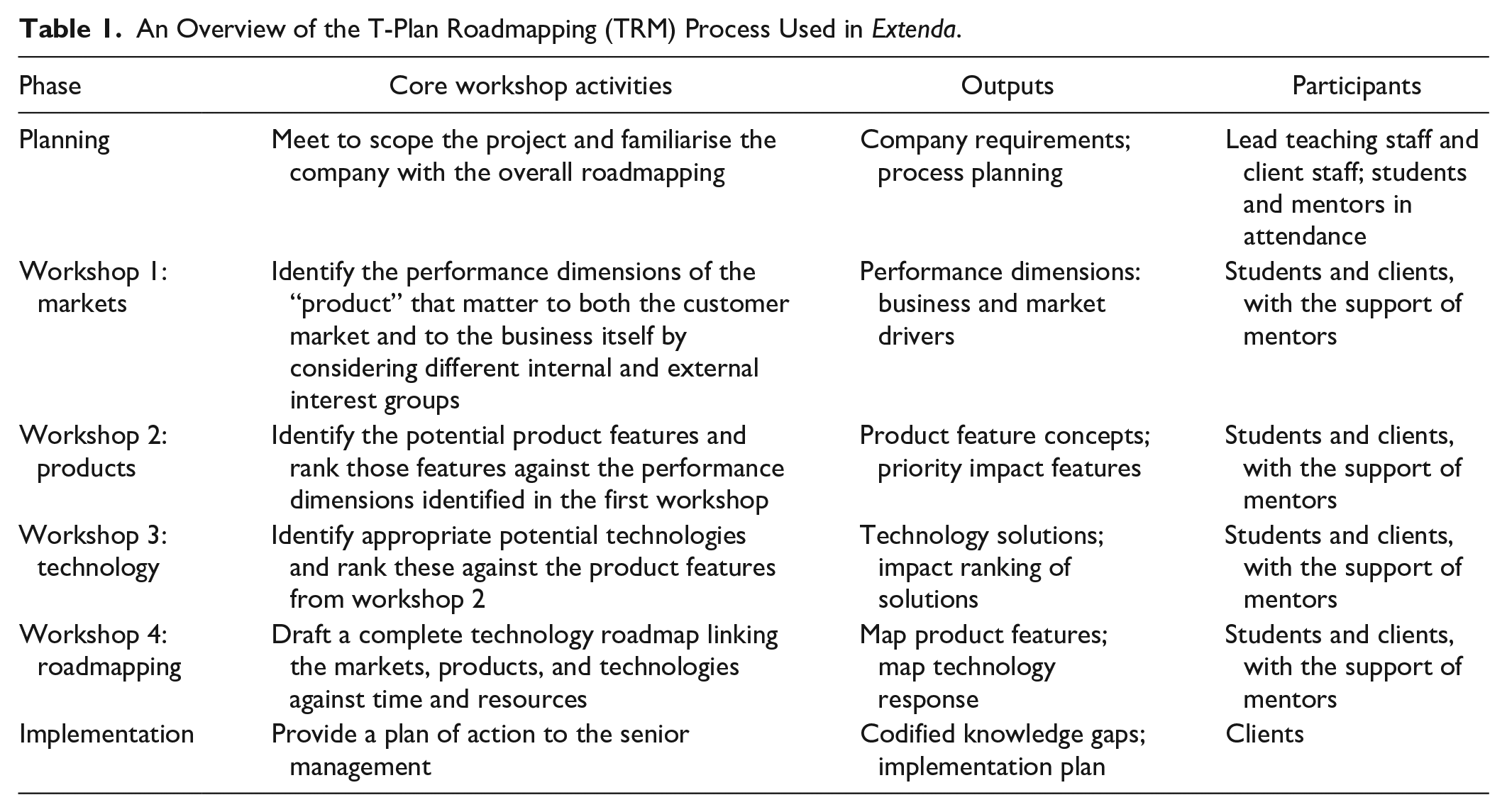
Following the roadmapping process, students completed four individual and collective reflection cycles. Before each in-the-round session, a faculty member facilitated a class discussion of the relevant theory. After that, they wrote individual reflections on their learnings from experience. Next, based on their individual reflections, the teams collectively planned how to facilitate the equivalent workshop with their client. The plan was discussed with their mentor and revised before conducting the workshop. Post-delivery, teams collectively debriefed the workshop with their mentor to see what they learned from the experience. Finally, each student wrote an individual reflection on their overall learning from the course and then collectively wrote a review of the project. The clients and mentors also completed debriefs at the end of the course. Feedback from these reflections and debriefing sessions indicated that the course successfully met its objectives. The interdisciplinary groups working with external client teams suggested itself as a useful site for investigating our research topic.
Data Collection
We used several data sources to inform our understanding of how students can develop interdisciplinary understanding to span organizational and disciplinary boundaries concurrently. A large corpus of secondary data and primary data from student interviews were used. The secondary data included the students’ reflective assignments, course surveys, and course review reports, which followed standardized templates at the institution, plus the minutes from the teaching team’s meetings and all online course announcements from the university’s learning management system and the wiki pages that student groups used to document what was occurring throughout the course. For this study, we re-read secondary materials to sensitize us to the broader situation vis-à-vis the students’ learning, and this informed the semi-structured interview schedule the first author designed for interviews with students and client organizations to explore their experiences of the course and ask follow-up questions when necessary (Denzin & Lincoln, 2004).
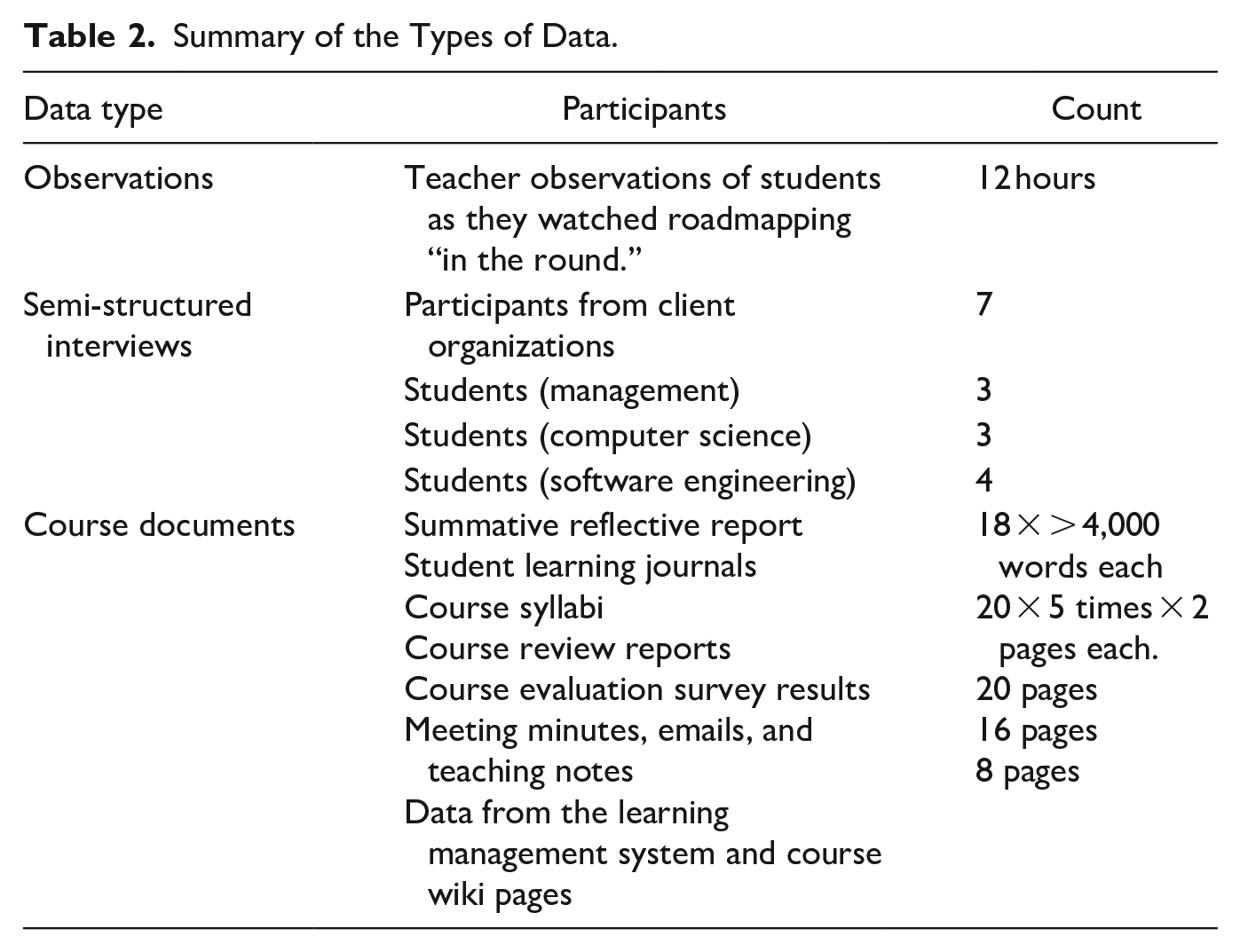
We conducted 17 interviews, comprising 10 students and 7 with staff from the client organizations, as shown in Table 2, representing about 50% of the students and client organizations in that cohort. Each interview took about 30 minutes and was recorded for later transcription. Each participant gave informed consent in writing. The evaluation of potential risks to participants and processes for informed consent were managed under the approval of the university ethics committee (approval number 2008/C/006). No significant risks to participants were noted. In addition, the educational program itself (including its experiential approach) was scrutinized through the university’s formal curriculum approval processes. Nevertheless, the mitigation of any risks arising was provided through: the engaged participation of mentors who provided support during the educational programme; the ability of study participants to withdraw from the research study at any time; and the provision of contact details for the principal investigator on the participant information sheet, to provide a route to address any concerns. No concerns were raised by study participants or noted by mentors.
Summary of the Types of Data.
Data Analysis
Following an interpretivist tradition (O’Donoghue, 2018), we analyzed our qualitative material by identifying correspondence and patterns (Stake, 1995) through the abductive approach of Dubois and Gadde (2002; cf Sætre & Van de Ven, 2021). This saw us “constantly going ‘back and forth’ from one type of research activity to another and between empirical observations and theory” (Dubois & Gadde, 2002). In practice, we began by understanding the data through close reading, re-reading, and sensitizing ourselves to themes or patterns associated with the boundary-spanning learning experiences. In doing so, we constantly “move ‘between asking questions, generating hypotheses, and making comparisons’” (Sætre & Van de Ven, 2021, p. 556). As with any research, there is always the question of, “Why should a reader of an inquiry believe what is said there?” (Lincoln & Guba, 1985, p. 11). To increase the trustworthiness of our explanations (Lincoln & Guba, 2007), we maintained ongoing contact with some of the mentors who worked with student groups, testing our ideas on them and checking them on each other. Also, we tried to use a variety of insider/outsider experiences (Dwyer & Buckle, 2009) in our authorial team to enhance our initial insights. One of us was the primary facilitator for the live roadmapping case, and one began as a student in the course and became a mentor for a later student group. Two of us not involved with teaching Extenda used our outsider points-of-view to explore “taken for granted” data. In practice, this involved the following steps: the integration of the data by those closest to Extenda, rounds of interrogation and review by those who were progressively more removed from Extenda, and further expansion and review of secondary data. These last two steps were repeated until disagreements were resolved through rounds of discussion.
Our initial insights revealed the differences in “learning about” versus “the doing of” roadmapping facilitation. We coded different types of learning that we recognized in the data, loosely guided by the extant literature on interdisciplinary and inter-organizational learning and boundary spanning. Thus, the process of identifying themes in the data was connected to literature but had a degree of openness to emergent insights.
Findings
We present four participative processes by which students showed they learned “how to do” collaboration. The first two processes relate to spanning disciplinary boundaries, and the second two relate to spanning organizational boundaries. The processes overlap in some ways; however, we present the four of them separately by focusing on the features of the data analysis indicated as being important. Then, we collectively consider the four participative processes to answer our question concerning how students learn to span disciplinary and organizational boundaries concurrently.
Working With Other Disciplines
This interdisciplinary process involves working with others with different specializations to establish roles and processes to operate successfully as a group. It was summed up by a group mentor saying, “It’s hard to combine students with different backgrounds, but this class was a good example of how it could be successful.” Working with group members with different disciplinary backgrounds was challenging and rewarding from the students’ perspective. Somewhat unsurprisingly, given the extant interdisciplinary learning we outlined earlier in our interviews, the challenging aspects were described in terms of developing ways to work with people who talk and think differently to them and who appear to have different values about how effort is made toward project goals. Likewise, students reported that the rewarding aspect of their learning occurred from working to overcome those challenges. Our closer exploration revealed that students came to recognize the expertise and knowledge within the group that came forward in the different roles the individuals played. In working out how to facilitate TRM for their clients, the students realized they could learn disciplinary terminology, models, and ways of approaching situations from their team members. The following excerpts show students’ realization that peer learning can help individuals develop a sufficient understanding of disciplinary knowledge so that the team can do its work:
Miller [a Management student] was very good in guiding the client and asking the right questions (S1, software engineering student). I learned a lot of business stuff when the management students talked about it. The whole roadmapping process would also not have worked if there were only software engineering students because they are often not familiar with management terminology. The same is true vice versa (S2, software engineering student). Meeting some people from outside computer science, which was pretty good. So, it was good to be around people who think slightly differently from me. And see how other people think and stuff, which is probably pretty important (S3, Computer Science student).
Furthermore, all excerpts reveal the importance of hearing team members use disciplinary vocabulary and practicing the use of that vocabulary in an authentic setting of the client project. Moreover, those interactions and practice opportunities occurred over several interactions, remembering that the students met for three hours every week for 12 weeks and were facilitating for their clients in five of those sessions.
The importance of opportunities to develop a vocabulary for communicating with other disciplines and practicing using it became apparent as students reflected on their role in the broader TRM process and realized how their confidence to participate shifted. As the next two excerpts show, there are common experiences when the students lack the disciplinary knowledge to participate in different workshops. The students with software engineering and computer science disciplinary training reported feeling more confident about the conversations with their clients in the early TRM workshop when the topics pertained to technology. In contrast, the students with a management disciplinary background reported feeling more comfortable addressing client queries related to the market/business topic, which came in the latter TRM workshops. Course reports indicated that the mentors and lecturers shared those impressions (Course Review Report 2009, 2010).
It was very good to work with someone from the Business School because, in software engineering, business terminology is not very common. Hence, it can be difficult to always follow [what is happening in the workshop]. Fred [a student] from the Business School was very good at guiding the client and asking the right [business] questions (S1, software engineering student). We are going there [to the clients], and all our computer science students are like, “What is all of this stuff all about?” “What’s he talking about?” But by the end, everyone kind of knew a little bit more about the other specialties (S3, Computer Science student). They [the clients] were talking about cloud computing, and I just had a big question mark on my face. And then our software engineering and computer science student—my group members—they were like, “Oh yeah, it’s this and that and blah.” [There was] another business student in my group, and we were just looking at each other. I was quite frustrated during that workshop, but towards the end, I got an idea of what this was all about (S4, Management student).
In addition to vocabulary development and practices, trust formation appeared to be a crucial aspect of the management students’ understanding of the technical issues and the computer science and software engineering students’ developing an understanding of the business. Forming trust with team members as the “domain experts” developed through a socialized sense, helped make sense of “what this stuff is all about” (S3) and “Oh yeah, it’s this” (S4), and what are the “right questions” to ask at that moment (S5). Through the TRM workshops and the preparation before and debriefing after each session, the students had to use the knowledge of other team members because they could not learn the different knowledge domains to facilitate alone. Furthermore, the students came to trust that what they were learning from their peers was sufficient for them to talk sensibly about the issues around business and technology with each other and the client.
The experiences not only taught students about business and business issues with peer learning but also provided them with opportunities to practice using the vocabulary from other disciplines. Thus, it sensitized them to the importance of other fields of practice, when and how they could use their disciplinary training toward a broader interdisciplinary goal, and when and how they needed to learn from others. Appreciation that concepts or models and ways of thinking from other disciplines can be valuable was often revealed in how students adopted the terms from other disciplines into communications. For instance, in the following, a computer science student adopted the concept of product-market fit, which the TRM processes introduced, as he reflected on what he found most valuable learning from the TRM process:
I can see the advantage of looking at different markets . . . [for example, maybe] there is one feature that helps us in multiple markets and another feature that only helps us in one market. And so, we might choose the feature that appeals to several markets instead of the other one. Things like that. I can see how that would help a product company that has a range of products, especially a software company where you can choose a feature you want and develop it (S7, Software Engineering student).
Establishing Productive Communications With Other Disciplines
This second interdisciplinary process concerns establishing productive communication with other groups of diverse specialists as part of project processes. In the context of this course, the specialists that the students could leverage were the course facilitators from the Management and Engineering departments, an industry mentor who volunteered time to work with a team, and the other student teams in the course. Our analysis revealed four elements that helped students establish communication with these different specialists in ways that supported the students’ goals of facilitating TRM with their client.
First, as groups recognized the value of different perspectives and ways of thinking, they sought feedback from different specialists and the benefits they could gain by interacting with specialists outside of the formal lecture hours. One student described his realization that the TRM process requires some aspects to be facilitated well, and others can be omitted.
Classes try to do a great deal in a short amount of time. Maybe less is more might be better. I’m really thinking about the TRM with the outside company. It’s not a full-on consulting thing, just an experiment to learn, which is fine. It took me a while to realize this (S8, Computer Science student).
Another example came as students recognized the value of drafting workshop plans and reviewing them with the mentor for further adjustment. The mentors asked questions to encourage groups to recognize individuals’ different contributions and to adjust their workshop plans to leverage those strengths (Course Review report, 2009, 2010). Furthermore, eliciting feedback from mentors and talking through the planned facilitation gave students further opportunities to practice using their growing interdisciplinary vocabularies, as well as learning from the group-mentor interactions, thus expanding their field of practice. Individual written reflections and the collective debriefs provided a third point where individuals and groups could share their insights and use those to inform the subsequent phases. These structured steps asked groups to stop and check that members were working from similar assumptions.
Second, when groups realized members were talking at cross purposes, or that some members did not understand concepts, there were steps in the process, such as the planning step, meeting with mentor step, and individual and collective reflection steps where they could clarify among each other. Furthermore, since the steps were repeated four times (mirroring the four workshops in the T-plan roadmapping process), the groups could learn from the previous iteration to adjust and improve their group communication. Students from all disciplines reported that establishing productive communication was important to “see how other people think” (S3, computer science student).
Third, establishing productive communication concerned meeting milestones within tight timeframes. Students realized that to facilitate workshops for their clients, they had to draft, review with their mentor, and adjust their plans. Concurrently, the group needed to communicate with the client and its representatives so they were prepared for workshops. The steps in the course design encouraged students to develop intra-group communication that enabled them to coordinate related tasks and project an outward image of orderliness even when individuals were challenged to integrate multiple streams of information:
I learned how an organization works on its multiple layers and that a business is very complex. Managers are needed because they are the ones coordinating things. Facilitation is essential in order not to drift off and go into too much detail about an issue (S9, Software Engineering student).
Fourth, some students recognized the value of reflection early in the process. They used the mentoring session to reflect on the value of the roadmapping method and their assumptions about their roles. For example, one student wrote in the reflective feedback about session two:
But, thinking about it now, the workshop session was a brainstorming session. It is supposed to be free-form and allow people to think and reflect on the subject. On thinking about this, I realized that reflection is not that common in the culture of Silicon Valley, and that is a problem. I remembered a newspaper article I read about a very hot Silicon Valley company that had spectacularly failed. The CEO was quoted as saying something like, “In hindsight, we didn’t fail because we didn’t work hard enough, but maybe because we worked too hard. There were too many meetings on Sunday evenings about what to do the following week and not enough time out to do long-term thinking.” In other words, not enough reflection.
About the same session, another student wrote:
I can get a little too focused on simply the next step, and that is why I was getting bored during the workshop session. One of the things I realized from talking to Peter [one of the teaching team] after the session was the importance of the reflection process for me. It can be done at the end of the day, but I must also remember to do it when I do realize I am getting bored, to ask questions about what is going on here and what might I be missing to learn.
Eliciting Information From Other Groups
Where processes one and two concern the spanning of disciplinary boundaries in which meaning was the salient boundary feature, processes three and four focus mainly on crossing organizational boundaries. The process of eliciting information from other groups of diverse specialists refers to the students learning to span from their group as “an organization” to their client and, more specifically, the group of people participating in the TRM workshops on behalf of the client. Our analysis revealed that developing facilitation skills was crucial to spanning these organizational boundaries. Moreover, data from the mentors and students alike recognized practicing facilitation skills over several TRM workshops was a crucial part of the students’ learning:
Students got a chance to facilitate. Some were better facilitators than others. . .. It is a difficult skill and only comes with experience (M1, Mentor). Students need to have some facilitating skills rather than knowledge in order to elicit the different points of view and the motivations of the CEO or see how the sales team works and the environment they operate in (S3, Computer Science student).
Such facilitation skills are important when the salient boundary features are differences in formal rules or ways of going about things and emerging informal rules as collaboration develops. Our participants reported two aspects crucial to developing facilitation skills for spanning organizational boundaries. The first was the students learning by watching the live case in the round and workshop delivery. By watching the live case, students could observe how experienced facilitators used different techniques to elicit information. These techniques included inviting quieter participants into conversations, paraphrasing to ensure that ideas are represented accurately, and consensus checking before moving to different topics (Extenda review notes). While lectures and course readings can explain such techniques, watching the live case demonstrated how students could use these in situ.
The second crucial step was the workshop planning and delivery. The students could practice some of the techniques they had observed and then planned and discussed with their mentors. The workshop planning step meant that the groups discussed if and how certain techniques could be helpful among themselves and with their mentor. Yet, several students reported that using techniques in situ was crucial to learning about when to use them and how to adjust in response to the participants’ reactions:
It would be hard for students to facilitate a workshop in an organizational environment. It looked easy when John and Peter [the course facilitators] did it, but in fact, it is quite hard (S10, Computer Science student).
Supporting the elicitation of information from other groups requires facilitation that maintains a free-flowing discussion while generating the key outputs sought for the workshop’s purpose. Hence, the students had to practice using the vocabulary they were developing from other disciplines. At the same time, they realized that facilitators didn’t need to know everything about the client, the client’s business, or even roadmapping. One of the management students commented:
The facilitator, according to theory, doesn’t have to know everything; he has the purpose of facilitating the meeting. So, this actually comes into play as facilitating skill rather than knowledge of the technology roadmap.
Managing Inclusive Discussion Process Among Groups
The final inter-organizational process concerns managing inclusive discussion process among groups. In the context of TRM facilitation, this process involved managing an inclusive discussion process among other groups of diverse specialists to arrive at an agreement, and those discussions occurred during the TRM workshops.
The students had to employ the interdisciplinary vocabulary they practiced through the other processes alongside their facilitation skills to help their clients develop a common understanding of the respective business problem to be addressed, which was codified as a technology roadmap. Since no one student had the interdisciplinary knowledge and vocabulary or the facilitation skills at the start of the TRM process, they had to draw on processes #1 and #2 and develop trust and productive communication and to facilitate together. For the students, learning to use terms to build a common understanding meant first learning the meaning for themselves and then working out how to use them appropriately in the context of TRM facilitation. Using terminology and visual models appropriately was crucial because the students struggled to help the participants from the client organization form a common understanding. The challenging nature of learning to span disciplinary and interdisciplinary boundaries concurrently required reflection on their part. As one mentor noted, in the free-flowing discussion with clients, the topics shifted quickly, and being the facilitators “made the students understand things that they maybe would not have understood beforehand” (S1, Software Engineering student). At the same time, the information that visual models capture is also temporary and subject to change. Like all models, TRM is a simplified version of a constructed reality and its content shifts with the participants’ understandings. Some students came to realize this and recognized that the depiction of the TRM map did not mean that participants had come to a common understanding, as this interview excerpt shows:
It’s not about how you will draw up the map. It’s more about to sit together, to think together, to develop some ideas and thoughts together. Knowledge is unevenly distributed inside organizations, and if you collaborate, you can hear the thoughts of others and take into account their motives and decisions (S11, Management student).
The surfacing of motives and decisions reveals something of the salient formal and informal rules and structures that are at play. The importance of practicing facilitation skills to bring diverse groups to a common view that was attentive to these salient features was revealed in several ways. While some student groups managed to surface views, information, and expertise that client groups were not aware of (as a whole), which is an important part of coming to a common understanding—“the process enabled the members of the firm to not only listen to each other but actually hear each other. The CEO was astonished that, e.g., other employees had knowledge about certain things he was not aware of” (S12)—others struggled to develop the facilitation skills to bring participants to a common understanding. On reflection, one student told us that “even when you are a good public speaker . . .. it could be difficult to respond on the spot and handle situations where maybe not all participants agree with each other” (S13, software engineering student). Similarly, clients rarely explained how things “work” to a facilitator, and some students struggled when their facilitator role did not afford them the explanations they received when they were students in the university setting. When clients did offer any explanations, the explanations were often from participants in functional areas, for example, an R&D engineer might explain to a salesperson why a particular feature was “too difficult to implement.” Thus, the students learned to become conscious of the differences in levels of structure and function within the client’s organization and, at the same time, their different roles as facilitators for the client and student in the course, as these two excerpts show:
It seems as if the course is preparing you for a position that is up here [a consulting role], but we are down here [at the bottom of the organization]. And then, by the time we do get here [a consulting role], it’s like, “Oh, what was that all about?” (S3, Computer Science student). It was interesting to sit with the main decision-makers at one table. We got to see the different points of view and the motivations of the CEO or see how the sales team works and the environment they operate in (S1, Software Engineering student).
Discussion: Supporting Interdisciplinary Learning
This section presents our theoretical contributions and practical implications that extend the body of research on pedagogies for interdisciplinary learning with a boundary-spanning perspective, specifically the spanning of organizational and disciplinary boundaries. Extant knowledge about interdisciplinary learning indicates that the learning benefits are greater when students can “do” interdisciplinary work, not just learn “about” it. Experiential, interdisciplinary learning is shown to create positive attitudinal changes toward collaborating with people from different disciplines, reduces stereotypical assumptions (Lüthje & Prügl, 2006), and increases confidence in using methods reflexively (Chitakunye & Takhar-Lail, 2015). Likewise, the literature on spanning organizational boundaries (e.g., Roberts & Beamish, 2017) suggests why learning “know what”—or procedural knowledge—by itself may be insufficient (Hibbert & Huxham, 2005). Furthermore, both streams indicate a relational component to learning to span boundaries as a socially situated achievement (Lattuca, 2002; Lattuca & Creamer, 2005; Lyall et al., 2015) and call for greater attention to the role of social dynamics for such outcomes (Rienties & Héliot, 2018). We respond to this call by conceptualizing interdisciplinary and inter-organizational learning as matters of boundary spanning. Furthermore, we offer an example of instructional design that demonstrates how students can learn to span both types of boundaries concurrently, as explained below.
Theoretical Implications
Boundary spanning is a socially complex activity involving multiple people that requires a high level of social interaction and communication, needs the coordination of others (Cummings & Kiesler, 2005), involves negotiating roles and responsibilities, and entails navigating complex social dynamics (Miles & Rainbird, 2015). Such complex dynamics are underpinned by trust both in a general way (Hibbert & Huxham, 2005; Huxham & Vangen, 2013) and in relation to the underpinning of specific processes such as communication and dialogue (Hibbert et al., 2016; Hsieh & Wadhwa, 2022). The participative processes that we identified confirm that working with others to achieve a common goal and to make decisions and solve problems as a group in a learning context involves all this complexity. However, we further unpack the relational, socially situated learning process and add to the literature by showing how learning is constituted through four participative processes for spanning disciplinary and organizational boundaries. These processes are (1) working with other disciplines, (2) establishing productive communications with them, (3) eliciting information from other groups, and (4) managing inclusive discussion processes among groups.
Taken as a whole, these processes balance the consideration of disciplinary and organizational boundaries. Attention to a collective task provides an opportunity to focus on spanning disciplinary boundaries where the salient feature is “meaning” (i.e., through working with other disciplines, eliciting information from other groups) and builds cross-disciplinary understanding. This is balanced with a focus on the constitution of relationships (i.e., through establishing productive communications with other disciplines and managing inclusive discussion processes among groups), where the salient boundary features are formal rules and structures and informal rules. Supporting this balance forms the heart of an experiential pedagogy for learning to span disciplinary and organizational boundaries.
The characterization of this pedagogy addresses the calls voiced by Lyall et al. (2015) and Power and Handley (2019) while helping to prepare students for real-world challenges, a need that Gröschl and Pavie (2020) have highlighted. As illustrated through our findings, in achieving this task-relationship balanced pedagogy, constructive alignment between the student, the learning environment, the learning process, and the learning outcomes are essential (Biggs, 1996; Biggs & Tang, 2007) to enable an interdisciplinary curriculum (Lycko & Galanakis, 2021; Mansilla, 2017; Öberg, 2009; Spelt et al., 2009). Our findings suggest that this is true for learning that can span disciplinary and organizational boundaries. Generally, our characterization of interrelated processes is consistent with models of acquiring professional skills (Dall’Alba & Sandberg, 2006) and fostering integrative thinking (Welsh & Dehler, 2013). Extending this thinking, we provide additional clarity on how attention to a collective task and the constitution of relationships may involve processes of mimesis and reflection, as explained below.
Mimesis is the interplay of observation, imitation, and rehearsal (S. Chan, 2017). Billett (2014) has argued that in professional learning contexts, like management education, providing situationally authentic circumstances is crucial to providing contexts for action in which individuals can place themselves in the safe position of observed actors to generate, model, and reproduce desired behaviors, bodily actions as a means of mimetic learning. What our characterization shows is the mimetic quality of all four processes. The boundary-spanning processes of working with other disciplines and establishing productive communications with other disciplines support the crossing of disciplinary boundaries through embodied knowledge as the adopting, practicing, and using vocabularies from other disciplines are learned through observations and practice (as illustrated previously by S3’s reference to “the whole dominant logic thing,” a well-known management concept that is not known to S3 through his computer science training). Likewise, mimetic learning is apparent as students establish relationships with the industry mentors and course facilitators who assist them as they practice using the vocabulary from different disciplines in appropriate ways, as well as how they develop the bodily skills to facilitate. Downey (2010, p. S22) points out that facilitation “requires more than “knowledge,” [it involves] changes in physiology, perception, comportment, and behavior patterns in unsystematic, diverse modes.” The processes of developing, eliciting information from other groups, and managing inclusive discussion processes among groups show this too as students learn that facilitation requires different skills to public speaking (as S13, software engineering student recalled) and as students realize they are treated differently when they are treated as facilitators, not students (S3, computer science student). Overall, the mimetic underpinnings of the instructional approach allow individuals to acquire new knowledge and behaviors in authentic ways, which helps students develop key processes for spanning boundaries of a disciplinary and organizational nature.
The second specific process that underpins the four boundary-spanning processes is that of reflection. In particular, reflection supports attention to the salient features of the different boundaries encountered in interdisciplinary learning. As numerous student quotations show, they became aware of the salient meaning-related features of the boundaries between disciplines and the salient rule and hierarchy-related features of the boundaries between organizations, and these reflections were key points that complemented the mimetic aspects of the learning processes. Reflection was also involved in translating local process learning (how to work with the particular collaborators in the class context) into transferable process learning, allowing them to work with different collaborators in the future (Hibbert & Huxham, 2005). Thus, reflection was an important complement to mimesis in enabling learning and in bringing learning to the foreground of experience in order to make it visible and useful.
Overall, we expand the literature about interdisciplinary learning by connecting to discussions of mimetic learning and reflection as processes that support students’ boundary-spanning efforts in relation to the different salient features of boundaries related to disciplines and organizations. We have also shown how, and in contrast with Bourdieu’s (1990) perspective, for some complex skills, mimesis can be aligned with parallel engagement in reflection. Thus, we offer tentative extensions to debates about the nature and limits of mimesis.
Practical Implications
Much management education has been criticized for teaching students about management rather than “doing” management, leaving management theory irrelevant to learners and unhelpful to industry (Raelin, 2007, 2009; Rienties & Héliot, 2018). Our experience of teaching boundary spanning shows that course design grounded in mimesis and reflection provides a way to offer relevant learning experiences where students can acquire new field-specific practices needed for spanning both disciplinary and (Carr et al., 2018) and organizational boundaries (Martínez Orbegozo et al., 2022). Likewise, teaching management concepts to students from other disciplinary backgrounds requires contemporary teaching and learning techniques (Rambocas & Sastry, 2017). While we are not the first to propose such a mimetic model for management education (S. Chan, 2017), we echo calls that management educators might consider the value of mimetic learning more closely for professional and workplace learning (Billett, 2014). In particular, management education and development scholarship around consultancy practices and project-based learning often imply the development of some understanding through their public rehearsals where combinations of mimesis and reflection might offer fresh instructional design possibilities. Likewise, current debates about AI-based learning often call for students and educators to “practice writing prompts” and use AI as a tool (Mollick & Mollick, 2023). Such calls signal mimetic approaches to learning.
Limitations and Implications for Future Research
This study has two limitations, which provide opportunities for future research, bear noting. First, the students and the clients involved were disposed to being participative and aligning their interests to help the projects succeed. We relate this to the course being seen as a learning process or “experiment” rather than simply a commercialized contracting arrangement. Secondly, the research design was such that issues related to disciplinary boundaries could be perceived more clearly than those related to organizational boundaries. As a result of both limitations, despite the literature suggesting that competing interests and power dynamics could occur in the context of organizational boundary crossing, our findings did not provide insights in these areas. Consequently, future research could study interdisciplinary contexts where the organizational boundary issues would be clearer (that is, where the commercial focus was stronger). Such opportunities could employ methods that would detect power dynamics more effectively (e.g., observational studies of the inter-organizational meetings) and focus on more contentious projects, for example, Sustainable Development Goals (Annan-Diab & Molinari, 2017). In such cases, to illuminate the power dynamics involved more clearly, it may be fruitful to apply a theoretical lens focused on symbolic boundaries (Lamont et al., 2015).
Conclusion
Our motivation for the paper was to understand how students can develop interdisciplinary understanding to span organizational and disciplinary boundaries concurrently. The empirical context for the study was our first-hand experiences of teaching a postgraduate course whose re-design involved interdisciplinary student groups facilitating roadmapping for paying industry clients under the guidance of teachers and mentors. Through a combination of mimesis and reflection, we showed that students learn to span boundaries concurrently by (1) working with others with different disciplines to establish roles and processes to operate successfully as a group, (2) establishing productive communication with other groups of diverse disciplines as part of project processes, (3) eliciting information from other groups of diverse specialists, and (4) managing an inclusive discussion process among other groups of diverse specialists to arrive at an agreement.
Footnotes
Declaration of Conflicting Interests
The author(s) declared no potential conflicts of interest with respect to the research, authorship, and/or publication of this article.
Funding
The author(s) received no financial support for the research, authorship, and/or publication of this article.
