



Abstract
This multi-method study of managers in a grocery chain identifies a novel mechanism by which threats of gender stereotypes undermine women’s ability to be effective managers. I find that women managers face a task bind, a dilemma that managers experience as they try to disprove a negative group stereotype by doubling down on one set of tasks at the expense of other essential tasks. My analysis of interview, observational, and archival data reveals that, compared to men, women do more tasks in front of subordinates—in this setting, supervisory tasks “on the floor” of the store—in order to showcase their qualifications as managers. In doing so, they forgo attention to other tasks that are less public but no less important to being effective managers—in this setting, planning tasks in the office of the store. Neglecting office tasks ultimately undermines the profitability of women managers’ departments. This study’s identification of the task bind has implications for theory and practice related to stereotype threat and women leaders, showing how the threat of negative gender stereotypes, prompted here by concern about subordinates’ perceptions, can affect managers’ behaviors in ways that detract from the performance of managers themselves and that of their organizations.
Keywords
As women enter management, they face obstacles that threaten to undermine their performance and stymie progression into senior management. One especially insidious obstacle is the prevalence of negative gender stereotypes (Ridgeway, 2001; Eagly and Karau, 2002; Ridgeway and Correll, 2004b). Ample research has shown that negative stereotypes influence others’ perceptions and evaluations of women (Heilman, 2001; Eagly and Karau, 2002); a smaller body of work has shown that negative stereotypes can also influence women’s perceptions of themselves (Davies, Spencer, and Steele, 2005; Coffman, 2014). Casting women leaders as less competent, committed, and influential than men (Heilman and Haynes, 2005), such stereotypes threaten to undermine women’s confidence (Stangor, Carr, and Kiang, 1998), performance (Spencer, Steele, and Quinn, 1999), and even aspirations (Correll, 2004; Davies, Spencer, and Steele, 2005).
This study begins from the premise that stereotype threat—being at risk of confirming a negative stereotype about one’s social group (Steele and Aronson, 1995)—could lead women to experience and then do the same jobs in different ways from men. As managers often have discretion over their activities, how they go about their work matters (Mintzberg, 1973; Stewart, 1982; Bloom et al., 2019; Ranganathan and Shivaram, 2021) not only for their own performance but also for the behaviors and performance of their subordinates (House, 1971). The performance consequences of managers’ activities make it critical to understand how stereotype threat plays out in women managers’ day-to-day work and may ultimately pose a barrier as they enter into leadership positions. Thus I ask: how does stereotype threat influence how women (compared to men) take up and perform in managerial roles?
In a multi-method study of managers in a grocery chain, I find that stereotype threat shapes women managers’ selection and completion of on-the-job tasks. Confronted with negative stereotypes threatening to undermine their authority as managers, women face what I call a task bind: as they select tasks, they see negative consequences from all possible decisions. To defy negative stereotypes about their commitment and competence, women double down on tasks carried out in front of an audience, particularly an audience of their subordinates. However, prioritizing tasks that subordinates can observe comes at the expense of equally important tasks that cannot be turned into public displays. Facing this task bind, women managers in this setting focus on those tasks they can do in public spaces, thereby engaging less than men in tasks done in private settings that are nonetheless vital to the job. In turn, due to these behaviors, women’s performance—and the performance of their departments—suffers.
With these findings, I make three contributions to research on stereotype threat. First, advancing beyond cognitive mechanisms identified in past research (for an overview, see Schmader, Johns, and Forbes, 2008), I identify a behavioral mechanism—the task bind—by which stereotype threat can undermine women managers’ performance. Specifically, I find that stereotype threat disproportionately constrains the behaviors of women managers, as they believe, unlike men, that they must make tradeoffs in how they attend to their work.
Second, I integrate research on stereotype threat with research on impression management to generate theoretical insight into the behavioral mechanism by which stereotype threat can undermine performance. In essence, women managers experiencing stereotype threat attempt to manage their subordinates’ impressions of them as leaders; they believe they must disprove negative stereotypes in front of their subordinates in order to exercise their formal authority. A large body of research has shown that individuals tailor their behaviors to influence powerful decision makers, often those with higher organizational status (Bolino, Long, and Turnley, 2016). Less research has considered such behaviors directed downward to shape subordinates’ perceptions of their managers (Kacmar, Wayne, and Wright, 1996; Sauer, 2011). I find that the latter behaviors are gendered. Unlike men managers, women managers express the need to prove themselves to the people they oversee and are especially attuned to stereotypes that they believe their subordinates hold. This finding also illuminates the persistence of stereotype threat: even having attained leadership roles and formal authority, women managers still believe they must overcome their subordinates’ negative stereotypes.
Third, exposing the task bind highlights how profound and far-reaching stereotype threat, and gender stereotyping more broadly, can be by revealing its consequences for organizational performance. A large body of research has shown how stereotypes can influence others’ evaluations of and behaviors toward women (Eagly and Carli, 2007; Manzi and Heilman, 2021), women’s own experiences and behaviors (Davies, Spencer, and Steele, 2005; Cheryan et al., 2009), and in turn—as shown by research on stereotype threat—women’s own cognitive performance (Spencer, Steele, and Quinn, 1999; Walton and Spencer, 2009). My research goes even further: stereotype threat, as it plays out through managers’ behaviors and the tasks they do, can shape not just women’s performance but also that of their organizations.
I develop and test my theory with a mixed-methods field study of a grocery chain. Qualitative data, used to generate hypotheses, include interviews with store and department managers and observations in 25 stores. Quantitative data, used to test hypotheses, include longitudinal archival records from company databases. Triangulating across these sources reveals subjective experiences guiding how men and women prioritize and complete tasks, differences in the tasks they complete, and the performance consequences of these differences.
Gender and Stereotype Threat in Managerial Roles
For women, being perceived as competent is often an uphill battle (Deaux and Emswiller, 1974), and managerial roles in particular can conflict with beliefs about women’s capabilities (Heilman et al., 1989; Powell, Butterfield, and Parent, 2002). Pervasive stereotypes generally tie men—and not women—to images of competence, leadership, and success (Ridgeway, 1997, 2011; Cuddy et al., 2015). Stereotypically masculine qualities such as aggression, individualism, and decisiveness (Collinson and Hearn, 1994)—at odds with stereotypically feminine qualities such as communality and warmth (Eagly and Karau, 1991, 2002; Eagly, 2007)—tend to be used to describe the prototypical leader and manager (Schein, 1973, 1975). Stereotypes about men’s qualifications and women’s deficiencies are a persistent factor in women’s disadvantage, relative to men, at critical points of evaluation within organizations (see, for example, Phelan and Rudman, 2010; Correll et al., 2020).
Awareness of these negative gender stereotypes and of the fact that evaluators hold them might contribute to differences in how men and women carry out managerial roles. Because such roles afford considerable autonomy and discretion (Mintzberg, 1973; Kotter, 1982; Stewart, 1982) and interface with many different stakeholders (Hill, 2003), men and women could vary widely in the activities they do and the relationships they cultivate. Understanding such potential differences is important because, despite stereotypes that men are better suited than women to management, women today occupy more than one-third of managerial roles in the United States (BLS, 2021). Unpacking the determinants of women managers’ behaviors therefore has implications not just for them but also for their organizations. For these reasons, I turn to the literature on stereotype threat for clues about how gender stereotypes could affect women managers’ on-the-job experiences and behaviors.
Stereotype Threat Facing Women Managers
People are often aware of others’ stereotypes about them (Vorauer, Main, and O’Connell, 1998; Vorauer et al., 2000). Those facing negative stereotypes, like women at managerial levels (Schein, 1973; Schein et al., 1996; Hoyt and Murphy, 2016), may be particularly cognizant of stereotypes about their group (Cohen and Swim, 1995; Sekaquaptewa and Thompson, 2003) and therefore feel added pressure to perform well (Steele and Aronson, 1995; Spencer, Steele, and Quinn, 1999).
With this pressure, stereotype threat can undermine performance. Research has shown that the primary way stereotype threat can undermine performance is by affecting executive functioning (Beilock, Rydell, and McConnell, 2007; Schmader, Johns, and Forbes, 2008; Grand, 2017). For instance, in a study of men and women test takers, Schmader and Johns (2003) found that priming gender stereotypes reduced women’s working memory and, in turn, their math test performance. However, such research—focused largely on disruptions to internal and unconscious cognitive processes and conducted primarily among students or workers relatively early in their careers (Walton, Murphy, and Ryan, 2015; Liu et al., 2021)—offers limited insight into how stereotype threat might affect the behaviors or performance of women managers.
Field studies have shown that women often navigate stereotypes that call into question their competence by striving to prove their abilities. Even before stereotype threat theory was developed, Kanter (1977) saw that token women, facing gender stereotypes, experienced strong performance pressures, which they countered by overachieving. Other organizational researchers have since observed that women, concerned that stereotypes will undercut their competence, may work harder to develop technical skills in white-collar occupations (Roth, 2006; Ibarra and Petriglieri, 2017) or to exhibit physical strength and “toughness” in blue-collar ones (Padavic, 1991: 288). Past field research has shown that women in well-defined roles with discrete sets of tasks, some of which are clearly gender-typed, may double down on male-typed tasks: those that are widely perceived to be the provenance of men. Padavic (1991: 286–287) recounted that, working in a coal mine, she made extra efforts to act “macho” in response to doubt or scrutiny: she took off her dust mask, hesitated to ask for help, and overfilled her shovel.
Experimental research has shown that people are more likely to double down on a stereotype-threatened task (such as a woman shoveling coal) when they identify with (Pronin, Steele, and Ross, 2004) or believe themselves to be capable in (Heilman and Alcott, 2001) the task or domain. Because those who have risen to management are likely to identify with and be skilled in their work, they might work harder when encountering threatening stereotypes relating to their abilities.
Although extra effort might seem to be beneficial, it can undermine performance. For instance, Bergeron (2007) theorized that time spent on organizational citizenship behaviors in organizations with outcome-based reward systems would weaken individuals’ performance by detracting from time spent on behaviors related to core job requirements—a tradeoff that a subsequent study found worked against salary increases and career advancement (Bergeron et al., 2013). Thus it is conceivable that if a manager expends more effort on certain tasks in response to stereotype threat, her performance might suffer due to a relative neglect of other important tasks.
While prior studies lend insight into the effects of stereotype threat at work, specifically studying managers, as I do here, provides additional theoretical purchase due to at least three distinct characteristics of managerial work. First, managers tend to have wide-ranging responsibilities and discretion over how and where they allocate their time (Mintzberg, 1973; Kotter, 1982; Stewart, 1982). This freedom exposes a novel route—that is, how managers allocate time and attention—by which stereotype threat could influence behavior. Second, managerial jobs are relational, requiring managers to develop a wide range of relationships, manage impressions of and influence those around them, and navigate interactions that span organizational hierarchies in order to get things done (Hill, 2003). Studying managers could thus reveal new and potentially different concerns arising for men and women about doing their jobs, depending on the stakeholders with whom they interact. Third, what managers do is often more consequential than the same actions carried out by rank-and-file workers. Managers’ behaviors affect not just their own performance but also the behaviors and performance of the people they oversee and the performance of the organizations they serve (Simon, 1947; March and Olsen, 1976; Ocasio, 1997). This means that both the mechanism of stereotype threat and its consequences may be particularly potent within managerial contexts.
I therefore investigated the ways in which stereotype threat shapes how women managers go about their day-to-day work. I conducted this research in the field, interviewing men and women managers to learn about their subjective experiences, observing their activities, and then using archival data to compare their activities and performance outcomes.
Setting and Research Design
Setting
My research question required a work setting in which managers’ activities are discretionary, differences in their activities are measurable, and—to control for unobserved heterogeneity—it is possible to compare managers at similar levels and in positions with similar responsibilities. A chain of bricks-and-mortar retail grocery stores, hereafter “FOODCO,” fits these requirements. 1
Accounting for store openings and closures, FOODCO had 80 stores over the study period of two years and employed more than 8,000 people in total at any given time. Organizational structure was mostly standardized. Each store typically had (a) a single store manager and two assistant store managers, who oversaw store operations; (b) a front-end manager, who oversaw cashiers at checkout counters; (c) around five department managers (DMs), 2 who each ran one of five revenue-generating departments 3 (meat/seafood, deli, bakery, grocery, produce) and supervised employees; and (d) employees, who stocked shelves and served customers. Stores were clustered into geographical divisions of about 15 to 20 stores. Within divisions, department managers across stores met by department (e.g., all meat department managers) for training sessions and regularly interacted with these peer managers to share staff, exchange products when they had over- or under-ordered, and discuss regional business trends. Figure 1 depicts the organizational hierarchy.
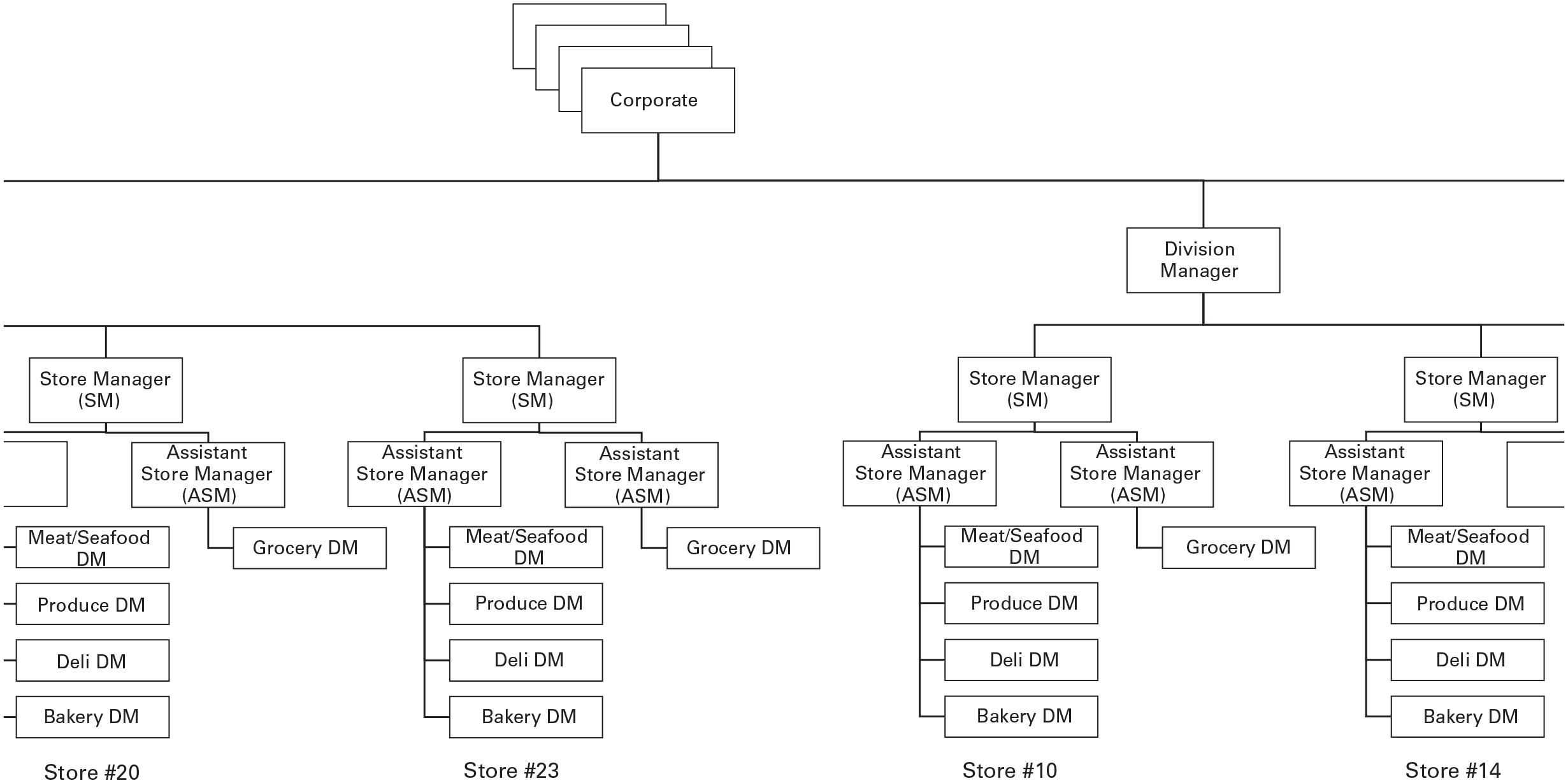
Partial Illustration of FOODCO Organizational Structure*
As in the broader industry (Skaggs, 2008), fewer than 15 percent of FOODCO stores had women store managers. Gender representation among managers was more balanced at the department level—overall, 38 percent women and 62 percent men—but highly segregated by product category. The majority of bakery (91 percent) and deli (78 percent) DMs and their subordinates (87 and 65 percent, respectively) were women. The majority of grocery (90 percent), meat (89 percent), and produce (90 percent) DMs and their subordinates (77, 90, and 64 percent, respectively) were men. Closely mapping to the distribution of men and women within them, the departments themselves were also gender-typed: women were seen as better suited to the female-typed departments of bakery and deli, men to the male-typed departments of grocery, meat, and produce. 4 DMs diverging from the gender stereotypes for their departments—for instance, a woman meat DM—not only were rare and therefore highly visible but also countered normative expectations about who was good at what.
Research Design
My research at FOODCO combined qualitative and quantitative data in complementary mixed-methods analyses (Small, 2011). Collecting multiple sources of data in sequence enabled me to examine reasons for, differences in, and performance implications of DMs’ activities (Creswell et al., 2003). I present findings in two sections—qualitative then quantitative.
My findings are drawn from data collected in three phases. I began with background interviews with store leadership—store managers (SMs) and assistant store managers (ASMs)—which familiarized me with the setting, provided information that guided subsequent data collection, and helped me operationalize constructs. I then collected and analyzed qualitative and quantitative data. Qualitative data consisted of interviews with DMs and observations conducted in stores; I used these data to begin to address my research question and to generate hypotheses. Quantitative data consisted of archival data from FOODCO’s administrative databases, allowing me to measure relationships among the gender, tasks, numerical representation, and performance of DMs and their departments. I used these data to test the hypotheses developed from my qualitative findings. See Online Appendix A for an overview of the research process.
Qualitative Analysis: Uncovering the Task Bind
Data Collection and Sample
Interviews
I partnered with FOODCO’s human resources (HR) leadership to identify and recruit interview participants. An HR executive emailed all SMs and ASMs to alert them to the research, explaining that I was studying how people made decisions about their work given the wide range of information resources (online and in-person) available to them.
I then emailed a sample of store employees—first SMs and ASMs, then DMs. Two criteria informed my sampling strategy. First, as I was interested in gender dynamics among managers, I oversampled on women, who were underrepresented in these positions. Second, since I was interested in how managers went about their jobs, I sampled on store size; bigger stores often had more-complex operations, allowing me to capture the full range of possible managerial activities. After hearing back from and scheduling interviews with a subset of those contacted, I made phone calls to other SMs, ASMs, and DMs working in or near the stores I was already scheduled to visit.
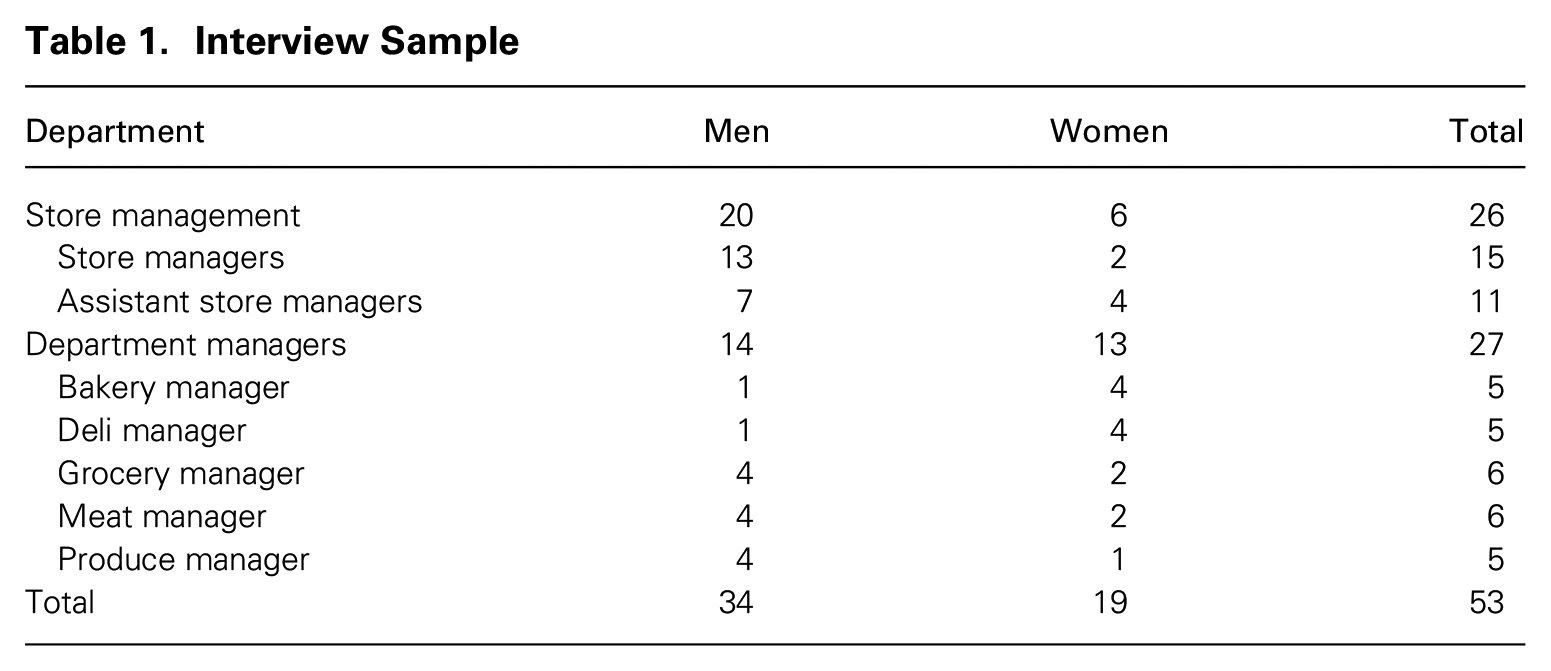
I conducted two waves of interviews. Between November 2016 and January 2017, I interviewed 26 SMs and ASMs across 17 stores. 5 Between August 2017 and January 2018, using a revised protocol, I interviewed 27 DMs across 10 stores. 6 Table 1 summarizes the interview sample by gender, position, and department.
Interview Sample
All interviews were semi-structured, lasting from 45 to 120 minutes. In the tradition of inductive qualitative research (Glaser and Strauss, 1967; Strauss and Corbin, 1990), I adapted interview questions as new themes emerged. So that I could compare interviews, I covered a set of central questions with each participant (see Online Appendices B and C). These conversations gave me site-specific knowledge that I used in two ways: first, I generated hypotheses about differences in how men and women carried out managerial roles and the potential performance implications of these differences; second, I mapped company data to constructs in my hypotheses.
Observations
I complemented these interviews with more than 50 hours of observations. Company training sessions (24 hours)—for onboarding new hires, on food safety, and on FOODCO culture—gave me a sense of FOODCO’s aims for employees and the strategy it sought to execute on the front lines. Shadowing DMs in store offices (12 hours) and on the floor (15 hours) familiarized me with their daily routines and how they went about their tasks.
Analysis
I interviewed two distinct populations, store leadership (SMs and ASMs) and departmental leadership (DMs), and treated these sets of interviews differently in my analysis. Interviews with store leadership served as background, granting insight into the context and the site-specific constructs about which I would ultimately formulate and test hypotheses. These constructs included distinct store spaces (the floor versus the office) and activities; gender stereotypes within FOODCO; key performance outcomes; and the focal group for subsequent data collection and analysis (DMs). Interviews with DMs then allowed me to address my research question as I explored how these managers experienced gender, thought and made decisions about their work, and navigated difficult situations.
My analysis of DMs’ interviews involved four steps. First, I read transcripts and noted themes that emerged across participants. Patterns emerged in the following topics: gender stereotypes held at FOODCO and in the grocery industry, tasks DMs reported doing daily, and feelings of tension regarding work done in different parts of the store.
Second, I reread all DMs’ transcripts with the aid of a research assistant to conduct “focused coding” to understand gender differences (Charmaz, 2006: 57). Separately, we grouped text by topic and wrote memos about each interview. We then met to discuss our memos and the patterns within and between interviews. As we progressed, we made explicit comparisons between participants, grouping and discussing memos by gender and department (Glaser, 1965). Our analyses surfaced key differences between men and women: how they experienced stereotypes, how they thought about their tasks, and how and why they prioritized some tasks over others.
Third, I consulted the literature to develop theoretical codes for my data (Glaser and Strauss, 1967). For example, I labeled participants’ descriptions of women as “gossipy” or “dramatic” (by which they often meant that women were distracted and unfocused at work) as “lacking commitment,” since this is how scholars have characterized one negative stereotype about women (e.g., Williams, 2000; Ridgeway and Correll, 2004a; Correll, Benard, and Paik, 2007). I coded cases of managers expressing fear that others viewed them in accordance with this stereotype as “commitment threat.” (See my coding scheme and additional quotations in Online Appendix D.)
Last, I coded the transcripts one more time, using the qualitative software NVivo to apply theoretical codes to the text. Reorganizing the data informed my theorizing by exposing new patterns across participants and relationships among constructs.
Managers’ Tasks in a Grocery Chain
Initial conversations with store leadership teams (SMs and ASMs) informed my understanding of the setting, my subsequent data collection, and the operationalization of variables in quantitative analyses. Through these conversations I learned that DMs’ core tasks occurred in two main store spaces: on the floor or in the office (see Figure 2). Work in both spaces involved tasks that were, paradoxically, both necessary and discretionary—essential to managers’ jobs but without one obvious best way to do them. DMs completed work in both spaces, while subordinates (those below manager levels) worked on the floor.
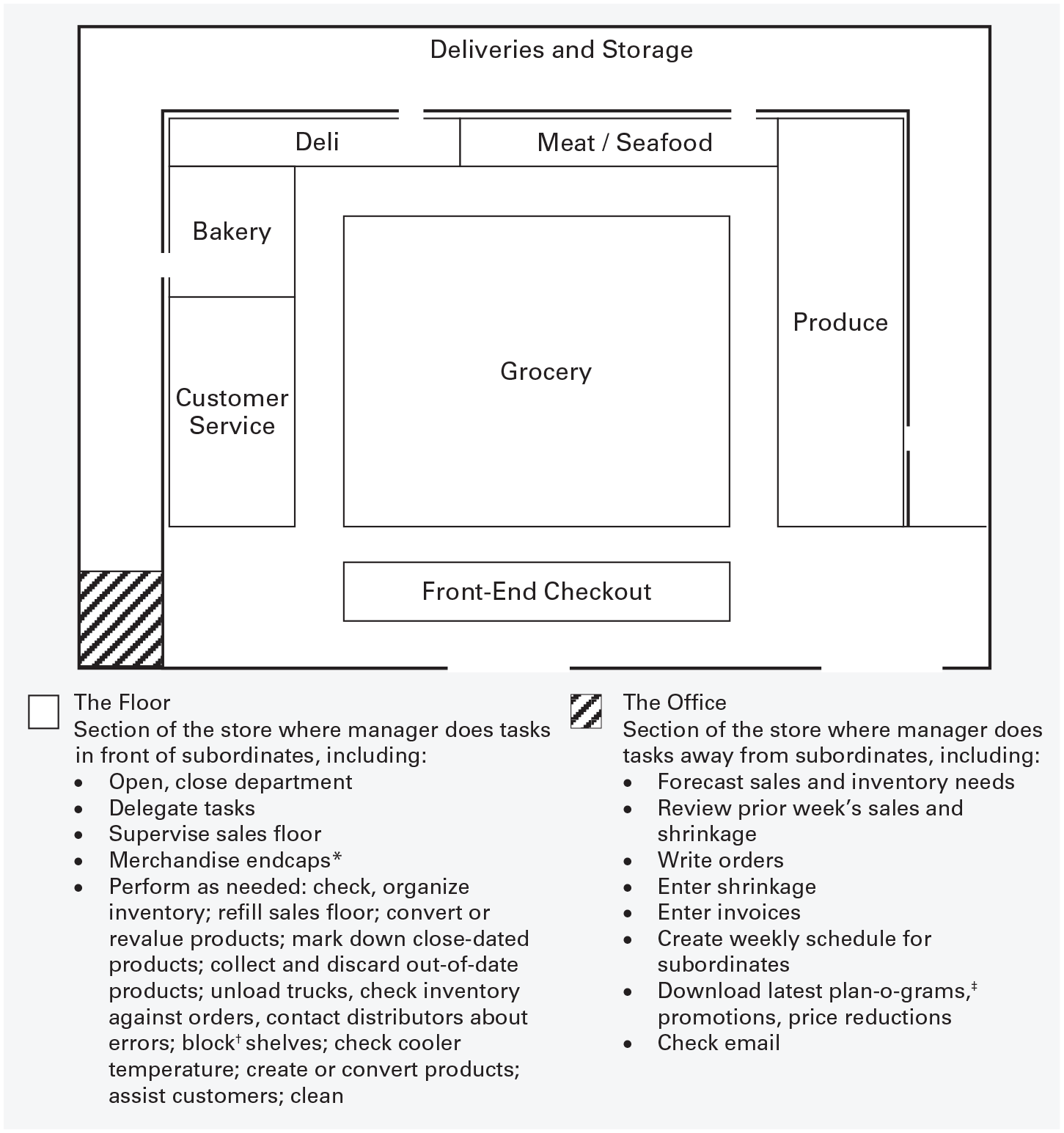
Sample Layout of Floor and Office Areas in FOODCO Store and Managers’ Activities in Each Space
Floor tasks were work that positioned DMs within the physical in-store space of their departments, alongside subordinates and in front of customers. DMs not only directed subordinates on the floor but also unloaded trucks, stocked shelves, cleaned spills, checked dates, merchandised endcaps (displays at ends of aisles), and served customers. Office tasks were planning tasks—relatively asocial, analytical labor. When DMs attended to office tasks, they relinquished supervision of the floor and were not visible to subordinates or customers. Offices were mostly small rooms with one or two chairs, a desk, file cabinets, and a desktop computer; thus they tended not to be social spaces, and I seldom observed more than one DM in the office at a time.
DMs were assigned unique IDs to log into office computers and used the office to access company intranet and email; enter data; analyze reports in order to budget, order, and forecast; keep up with alerts from the corporate office; and schedule subordinates’ shifts. Reporting, done through the intranet, was too cumbersome to be done on other devices such as a smartphone, and FOODCO discouraged DMs from using personal devices to check company email. Figure 2 lists the main floor and office tasks.
When not in the office, managers were on the floor. Slack time, when managers were not engaged in either floor or office work, was unusual. I did not observe managers having idle time; more often than not they were understaffed and conscious of the expense that overtime would incur if they did not maximize every minute on the clock. DMs claimed to avoid overtime, and corporate employees confirmed this claim, estimating that overtime accounted for less than 1 percent of total hours worked.
Interview Findings and Hypothesis Development: The Task Bind and Its Performance Consequences
Analyses of DMs’ interviews showed three patterns that informed my hypotheses. First, gender stereotypes were widespread. Women DMs, facing the threat of negative stereotypes, described their experience of and approach to tasks differently than men DMs did. Second, unlike the men, women DMs frequently referred to subordinates as an important audience. Third, as women DMs wrestled with competing performance pressures grounded in negative gender stereotypes, they described floor and office tasks as distinct and mutually exclusive. Whereas this distinction was fundamental in women DMs’ accounts, it simply did not exist for men. Men did not describe floor and office tasks as separate. Women thus perceived a damned-if-you-do, damned-if-you-don’t situation that left them feeling frustrated and under pressure to make tradeoffs between floor and office tasks: a task bind.
Women managers’ experience of stereotype threat at FOODCO
Negative stereotypes about women took three forms. First, leadership at FOODCO was male-dominated and male-typed. Most store leadership teams (SMs and ASMs) were composed of men. One SM said, “People envision a store manager is like a White male, walking around with a cup of coffee . . . that’s always been the stereotype of just how people envision a store manager of a grocery store” (SM-39). The store leader with the most formal authority, the SM, was assumed to be a man, not a woman.
A second set of stereotypes had to do with women’s commitment to and seriousness about work. Workers—and DMs in particular—were expected to do their jobs efficiently and to have a strong “work ethic” (DM-61). Yet DMs often described women as prone to “complaining” about working conditions (DM-52, DM-65) or easily distracted by gossip and socializing. As one woman DM had come to believe,
[Men don’t] gossip. They don’t care. They’re just here to work. . . . A lot of women . . . they don’t know how to keep their home life or drama to themselves. . . . When you come to work, that’s what they tend to talk about is what’s going on at home. . . . If you’re having problems at home with your husband or something, leave it at home. (DM-48)
Equating men’s lack of “gossip” or “drama” to their work ethic implied the inverse for women: women, who did“gossip” or talk about what was “going on at home,” were not there “just to work.” Instead, the belief went, women got distracted and were not as serious as men.
A third set of negative stereotypes applied to specific floor tasks seen as masculine. Lifting boxes, cutting large quarters of meat, and inventorying coolers and freezers required strength and fortitude. Beliefs about gender differences in physical strength called into question women’s competence in such tasks. One DM expressed his view that women were not up to the tasks required in his department, but men were:
[Females] don’t have the . . . physical drive. . . . I have had a lot more success out of having males than I have females, as far as we have to be able to lift 55, 60 pounds all the time, and so it is more physically demanding. . . . It’s just a lot of the time they have you lifting and constant running around the store, pulling and pushing stuff. It’s easier with males. (DM-42)
DMs distinguished genders most clearly when referring to tasks requiring brawn and durability. But even when the job did not require heavy lifting, DMs described women as fragile in other ways. Both men and women DMs recalled women who “complained about being cold” (DM-60) or did “not want to deal with blood” (DM-65). Casting differences between men and women in terms of biological sex, all DMs discussed these differences without reservation.
Women DMs who perceived these threatening stereotypes described the consequent appeal of floor work, which let others see them working. For one DM in bakery, the floor offered an opportunity to “prove” that she worked hard (DM-62). Another DM in deli recalled working throughout her pregnancy, up until the day her water broke—a clear demonstration of her resolve that “if I can do it, I’ll do it” (DM-48). For these women, being out on the floor demonstrated their commitment, work ethic, and devotion to the job.
Women often expressed the need to prove themselves in settings in which they were stereotyped as incapable, as was the case in meat, grocery, and produce, where they were almost always a clear numeric minority in the managerial ranks. One DM in produce, who had long faced stereotypes about her abilities, believed that she had succeeded by doubling down on manual labor:
When I first became a produce manager . . . being a woman . . . I had to work twice as hard . . . to show that I could do this job. As far as the lifting, as far as maintaining the department, as far as cleaning. You know, that big heavy mop, or whatever—the garden hose . . . you know I wasn’t afraid of dirt; I wasn’t afraid to get my hands dirty. [I] wasn’t going to use that [excuse]: “Uh, can a man lift this for me?” . . . You couldn’t do that. I had to physically prove that I could do this job. And the sad part is, even in this day and age, you still have men looking at you going, “I don’t know how you got this job.” (DM-66)
A woman DM in meat recounted,
When I first started, all I did was work with men. The only other woman that was working was like the wrapper, and they don’t even have those anymore. Yeah, but I mean there’s been many times I went to a store to help out. And there’s been like six of us on the cut boards because that store was so busy, and I would be the only woman on the board with them. And you know you kind of have to buck up and learn to take it because they’re pretty rough on you sometimes. I mean just rough on you. Like, “Ah, you’re doing like a woman” or, you know, things like that. You know, “this is a man’s world.” (DM-51)
Lifting, cleaning, and cutting were performed on the floor, where women felt their competence threatened most acutely in male-dominated and, relatedly, male-typed departments.
Subordinates as salient organizational stakeholders for women managers
If women’s focus on floor work was, in part, a public display, then whom was it for? A range of people could be on the floor at any given time: customers, ASMs, SMs, other DMs, and even visitors from the corporate office. Yet interviews suggested that floor tasks offered women something that men rarely reported as a concern: the opportunity to do their work in front of subordinates. SMs had pointed to the effective management of subordinates as a critical competency. After all, subordinates’ labor moved the pallets and stocked the shelves; their reliable attendance minimized overtime costs; and their skill reduced shrinkage. 7 The ability to lead and motivate subordinates was critical to all departments and to all DMs, irrespective of gender, but only women linked where they did their work—floor or office—to how subordinates viewed them.
Women described added pressure of ensuring they earned their subordinates’ respect. They believed that their own behaviors on the floor would engender subordinates’ compliance, commitment, and consistency, particularly in an industry notorious for absenteeism. One woman DM said,
If I don’t work hard and set an example of “I’m willing to do this as well—I don’t ask anybody to do anything I wouldn’t do,” then they wouldn’t do that [work hard] for me. I don’t feel like I’m above everybody back there. I don’t treat anybody like I’m better than anybody or I can do a better job. We all just work hard. And I have to set a good example for that. Otherwise, they won’t come in for me when I need ’em. (DM-58)
Women’s accounts suggested that they believed that being on the floor would allow them to defy threatening stereotypes about their commitment and competence. Visibly demonstrating these qualities in front of their subordinates could, in turn, grant them legitimacy and authority.
With only one exception, men DMs spoke of being on the floor as a means of monitoring subordinates—to “watch” subordinates and ensure their compliance (DM-59)—rather than as a means by which they themselves might be evaluated by subordinates. 8
The task bind. Disproving a negative stereotype by doubling down on certain tasks meant devoting less energy to other tasks. Accommodating competing demands is essential to any managerial role (Kotter, 1982; Stewart, 1982), but those facing negative stereotypes (i.e., women managers) experienced yet one more demand—the pressure to display their capabilities—which was absent for those not facing negative stereotypes (i.e., men managers). Gender stereotypes thus created an uncomfortable bind, a task bind, about which tasks to do.
Women managers discussed time in the office versus on the floor in terms of what was being given up by being in one place or the other. One DM explained that when she did get into the office she would think, “Oh gosh, I’m on this computer, there’s so much other stuff I need to be doing” (DM-46). Another, illustrating the chasm she felt between the two spaces, noted the time consumed by making a “trip” to the office:
But when you have to come up here [to the office] to put in your invoices, and you have to put in, you know, stuff that you’ve purchased and you’ve ordered . . . that does take a little bit longer, so it turns into a 30- to 35-minute trip. And that’s roughly two hours a week that could be spent back there [on the floor]. (DM-47)
Making tradeoffs between tasks was exhausting. Women frequently described feeling “squeezed” for time (DM-43). They often came in on days when they were supposed to be off or rearranged work hours to accommodate the most pressing demands. One DM reflected,
I do feel like sometimes, you know, you feel like it’s all on your shoulders, and you’re proud . . . but, I mean, I leave here and I’ll be thinking on the way home, knowing that tomorrow is my day off but I’m probably going to have to come in here. (DM-51)
Women’s frustration was evident as they described feeling that they did not have enough time to do their jobs during standard work hours. One DM explained that floor tasks usually took precedence over office tasks she knew were necessary for planning her orders:
Even if I just have one or two days where I could walk away for a couple of hours to do my paperwork, to watch my numbers, to do things, I would be more informed of what goes out on the floor. Sometimes I’m just guessing because I haven’t [had] a chance to check. (DM-57)
Descriptions of such tradeoffs were notably absent from men’s accounts. They did not describe tasks as mutually exclusive or zero-sum; instead, they often made explicit connections between floor and office tasks, discussing them as mutually reinforcing. For instance, one DM linked his ordering, sales, and shrinkage:
I actually sit there [in the office] and map out how many [cases] do you believe you’re going to sell until your next delivery. . . . To make an actual order and put thought into it should take you at least an hour. . . . If you just hurry through because you’re telling yourself “I don’t have time for this” (and, there’s a lot of people that do), then you wind up two days later and you’re like, “Man, I got all this chicken down here [on the floor], and what am I going to do with it?” (DM-40)
To “put thought” into an order required gathering and viewing data in the office and using analyses to predict demand on the floor. Rushed ordering could result in excess inventory that would increase shrinkage, thereby lowering gross margins. Linking planning and line work, men’s accounts reflected the view that floor and office tasks were inseparable.
Women frequently expressed the desire to devote more time to their office tasks, noting how important they were. But, facing negative stereotypes, women also described how completing office tasks, off of the floor, created risk that they would be perceived as avoiding floor work. In this way, office tasks did not just take away time that could be spent disconfirming negative stereotypes but also threatened to confirm those stereotypes. One DM explained her concern:
I feel like they [my subordinates] are losing respect for me . . . because I’m having to do more office work. They don’t understand what I’m doing so they think I’m not doing anything . . . just hanging out in the office staring at my computer doing nothing. (DM-64)
She believed that visits to the office—doing tasks neither understood nor observed by subordinates—could open her up to criticisms for leaving the floor and being seen as not working hard, thereby fulfilling a negative stereotype about women’s work ethic. Consistent with past research on stereotype threat (Ståhl, Van Laar, and Ellemers, 2012), women DMs approached tasks with a defensive mentality. Deprioritizing office work could therefore help establish legitimacy with subordinates in two ways: it freed DMs to spend more time defying negative stereotypes about their capabilities (via floor tasks) and less time confirming negative stereotypes (via office tasks).
Yet deprioritizing one task due to the threat of a stereotype in another task may have been costly in other ways. As DMs allocated their attention across a portfolio of possible tasks, the time they had to complete tasks was itself a limited resource. Because managers’ time is fixed and attention limited (e.g., Mintzberg, 1973), time spent on doing tasks in front of subordinates—a salient group of organizational stakeholders for those at managerial levels—would detract from time spent on other tasks (here, office tasks). My interview findings suggest that women DMs will focus more than men DMs do on tasks that disconfirm stereotypes in front of subordinates and less than men DMs do on tasks done out of subordinates’ sight. 9 I therefore hypothesized,
Negative gender stereotypes should be more pronounced in settings in which men are seen as prototypical—numerically dominant and, relatedly, well suited to the job (Kanter, 1977). Situational cues, like gender imbalance in masculine domains, can aggravate the stereotype threat that women but not men experience (Sekaquaptewa and Thompson, 2003; Murphy, Steele, and Gross, 2007). By this same token, as women’s representation increases among key reference groups (e.g., peers, competitors, colleagues in their direct work environments), women’s experience of stereotype threat has been shown to decrease (Van Veelen, Derks, and Endedijk, 2019).
One way that DMs calibrated how well they fit within their roles was by comparing themselves to other DMs in the same department across stores—a key reference group. For instance, produce DMs would be more likely to compare themselves and their performance to produce DMs in different stores (typically in the same division) than to meat DMs within the same store. One produce DM described benchmarking his department’s performance against that of other produce departments in his division: “we want to see what we rank between with everyone else. We can look up on the computer and see exactly how we’re doing based on last year or last week . . . we can break it down just in our division” (DM-54). When talking about the representation of women in comparable roles, DMs also looked to other DMs in nearby stores. One deli DM said she knew that deli DMs skewed female because, at a recent divisional meeting, “all the deli managers from the division came in, and there were only three male deli managers, and the rest of us are all women” (DM-50). In this way, DMs across stores in the same department and division were key comparators informing how managers understood departmental prototypes.
To the extent that stereotype threat is shaped by the demographic composition of those in comparable roles, the presence of more women in comparable roles should alleviate women DMs’ experience of stereotype threat and, in turn, influence the tasks they complete. This would mean that as women’s representation among DMs in comparable roles increased, women DMs would experience less stereotype threat and therefore feel less pressure to defy negative stereotypes in front of subordinates (here, doing floor tasks) and be more likely to focus on tasks done away from subordinates (here, doing office tasks). I therefore hypothesized,
Fieldwork also suggested that the task bind, by shifting the balance of women managers’ attention as they sought to combat negative stereotypes, could undermine their departments’ performance. While office tasks were less visible to salient stakeholders, they were no less important to the department’s overall performance.
A critical measure of performance was financial: departments’ profitability. One SM explained to me that, to be successful, DMs needed to know “the numbers, P&L statements, each department’s profitability, [they] have to have the knowledge to make that happen. There’s more to it than putting stuff out. It is balancing it all and knowing the numbers” (SM-14). Though DMs had no control over the cost of the products they purchased, careful planning and analysis—using historical data delivered via email and in company databases—could influence three drivers of profitability: sales (through merchandising), shrinkage (by calibrating orders to meet demand), and product mix (by maximizing sales of high-margin products).
Performing well along financial measures thus required managers not only to supervise well on the floor but also—and perhaps even more important—to plan well in the office. Yet if they focused more on tasks done in front of subordinates (floor tasks) than tasks done away from subordinates (office tasks), women DMs’ performance would suffer on outcomes (such as financial performance) linked to the latter. I therefore hypothesized,
Figure 3 maps these hypotheses to a theoretical model of the task bind.
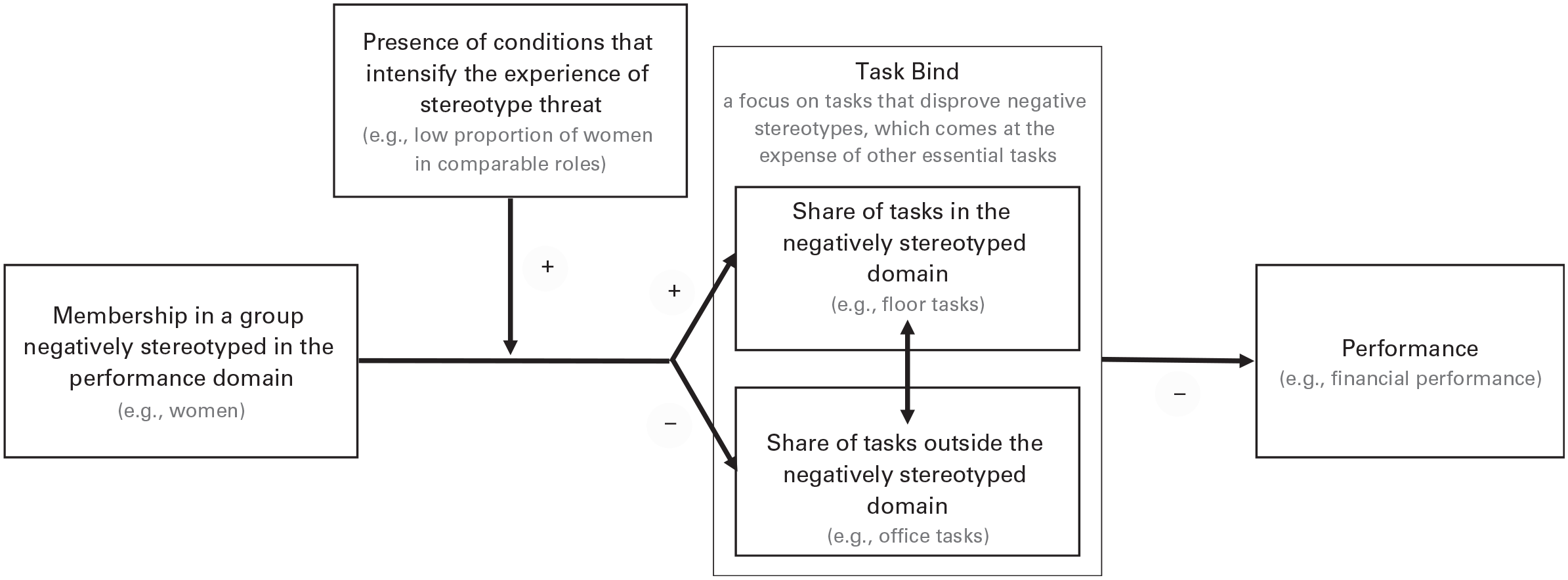
Theoretical Model of the Task Bind
Quantitative Analysis: Testing Hypotheses About the Task Bind and Its Performance Consequences
Qualitative data shed light on gender stereotypes at FOODCO, how women managers experienced them, and how they might have influenced women managers’ task prioritization. I next turned to quantitative data from company databases, to examine gender differences in the tasks managers actually did and their subsequent performance outcomes.
Archival Data
I obtained and merged records from three company databases to run my main models. The first, containing demographic information for all store employees, included a unique employee identifying code tracking an individual’s employment at FOODCO—transfers, promotions, terminations, and so on—over three years. The second database, over the same three-year window, contained date- and time-stamped information about all managers’ use of store computers. The third database stored two years of weekly financial metrics from all departments. I merged this database with the first two to create a dataset that tied DMs’ tasks to their departments’ financial performance, which ultimately yielded an unbalanced panel of 27,537 department–week observations from 368 departments. 10 See Online Appendix E for further detail on the merging process.
Variables
Dependent variables
Logins in Store Office, a time-varying logged count variable capturing a DM’s store computer logins, measures managers’ completion of office tasks and serves as a dependent variable (H1, H2) and mediator variable (H3). Logins were recorded by date and time for all managerial positions across departments and stores. As computers were located only in store offices, not on the floor, logins represent DMs’ tasks done away from subordinates.
Through several steps, I consolidated date- and time-stamped records of logins to a weekly level. First, I aggregated logins to 20-minute intervals beginning at the top of every hour (0:00–0:19, 0:20–0:39, and 0:40–0:59). 11 For example, if a DM logged into the store computer at 11:20 a.m., 11:23 a.m., and 11:50 a.m., I would assign “2” to the login count. Combining logins this way approximated DMs’ unique trips to the office, as opposed to logins that may have resulted from logging back in after being interrupted by floor tasks. Then, for each week, I summed whether the manager had logged into store computers in each 20-minute interval within that week, to account for the fact that DMs may have worked different days and shifts; 12 this yielded a measure of logins—a task done away from subordinates—for each manager in department j of store k at time t.
Because DMs’ office tasks could influence financial performance, I operationalized the dependent variable in H3 with Product Gross Margins—the difference between revenue and cost of goods sold, divided by revenue—a core retail measurement of product profitability. 13 Cost of goods included the costs of products and of shrinkage. 14 Since managers’ everyday decisions and behaviors were informed by regularly viewing financial performance (most did so daily), I constructed the time-varying weekly measure of financial performance for each department j of store k at time t as

Independent variable
Manager Is Woman is a dummy variable from HR records capturing manager gender (1 = woman) in department j of store k at time t. I dropped periods in which a DM’s gender changed within a given week due to turnover (e.g., a woman worked three days, then a man four).
Moderator variable
My theory suggests that women will do fewer tasks away from subordinates under conditions that enhance stereotype threat—that is, when there are fewer women in comparable roles; conversely, they will do more tasks away from subordinates under conditions that attenuate stereotype threat—that is, when there are more women in comparable roles. Interviews revealed that departmental peers within the same division occupied comparable roles and were a salient reference group, as DMs stayed in close contact with these peers. As they managed the same product assortment, faced the same demands, and completed the same tasks, DMs benchmarked their activities and performance against these peers. A woman DM was therefore likely to experience herself as more counter-stereotypical, the fewer women peers she had and, in turn, would be more likely to experience stereotype threat. Thus, to test moderation hypotheses that managers’ behaviors depended on the gender composition of managers in comparable roles, I measured the representation of women DMs in the focal DM’s department across stores in that manager’s division. 15
I operationalized the gender composition of peer DMs as a proportion variable, Proportion Women Peer Managers, to capture the representation of women DMs in the same department as department j of store k, aggregated across division m at time t. Higher values would indicate that a DM had more women working in comparable roles in the same division.
Control variables
Controls include DM characteristics potentially related to login behaviors. As a DM’s race may have raised concerns about negative stereotypes and thus influenced their behaviors, Manager Is Person of Color is a dummy variable measuring the DM’s race in department j of store k at time t (1 = person of color, which includes American Indian, Asian, Black, Hawaiian/Pacific Islander, Hispanic, Multiple, and Not Specified; 0 = White). Three measures of a DM’s experience help control for differences in skill or experience that may have been correlated with the tendency to use a computer: Manager Age (in years), Manager Tenure at FOODCO (in years), and Manager Grade (internal company ranking of employee level reflecting role complexity and compensation) of the manager in department j of store k at time t.
Additional controls account for department-level factors possibly associated with DMs’ behaviors. Dept. Total Subordinates is a continuous variable measuring the number of full- and part-time subordinates in department j of store k at time t, since DMs may have been more comfortable visiting the office if subordinates were available on the floor to serve customers. Dept. % Women assumes a value between 0 and 1, capturing the proportion of women subordinates in department j of store k at time t and therefore any impact subordinates’ gender may have had on managers’ office use. Dept. Mean Age (in years), Dept. Mean Tenure at FOODCO (in years), and Dept. Mean Grade are continuous variables approximating subordinates’ mean experience level in department j of store k at time t, since DMs may have been more willing to leave seasoned employees unsupervised.
I also included store-level controls. Proportion Women Other Managers in Same Store assumes a value between 0 and 1 to measure the proportion of women DMs in store k at time t (outside the focal department j). A time-varying logged count variable, Logins of Other Managers in Same Store, measures other DMs’ logins across different departments in store k at time t, since logins of other managers working in different departments in the same store may have affected the focal manager’s office use.
Analyses
I conducted separate regression analyses to test each hypothesis and examine results. To test H1 and H2, I used OLS regressions to estimate the association between DM gender (1 = woman) and logins in store offices (tasks done away from subordinates). Since departments and stores vary in numerous ways, an ideal analysis would use department–store (e.g., bakery in Store #1) fixed effects to control for time-invariant unobservable characteristics unique to that department–store. But, as my main variable of interest (gender) was time-invariant, including department–store fixed effects would have accounted for only those logins associated with changes in manager gender. For this reason, I instead included department fixed effects (thus accounting for differences in dependent variables that could be due to the work associated with different products but not to manager gender) and store fixed effects. To account for multiple observations over time for each department–store, I used robust variance estimates clustered at the department–store level. To examine my moderation results but capture within-department variation, I then ran a post-hoc analysis of regressions on samples split by male- and female-typed departments and plotted results on separate graphs. To test H3, I conducted mediation analysis using generalized structural equation models with robust variance estimates clustered at the department–store level. 16 For this mediation analysis, I relied on the product-of-coefficients method to estimate the indirect effect of DM gender via logins on financial performance (Baron and Kenny, 1986; MacKinnon, Fairchild, and Fritz, 2007).
I then ran two supplemental analyses to test my theory. First, to determine whether the indirect effect of manager gender on weekly office work varied by the moderator, Proportion Women Peer Managers, I conducted a test of moderated mediation. 17 Since this moderator was continuous, I quantified the association between the indirect effect and Proportion Women Peer Managers with the “index of moderated mediation” from Hayes (2015). An index significantly different from zero provides evidence that “any two conditional indirect effects defined by different values of the moderator are statistically different” (Hayes, 2015: 15). I then ran follow-up tests to probe conditional indirect effects at different levels of this moderator (Aiken and West, 1991; Hayes, 2013). Second, I ran my main analyses using an additional measure of performance, which captured a time-varying measure of departments’ customer service quality. Last, I ran robustness checks to rule out confounding variables and address alternative explanations arising from my main analyses; all are reported in Online Appendix F to conserve space.
Results
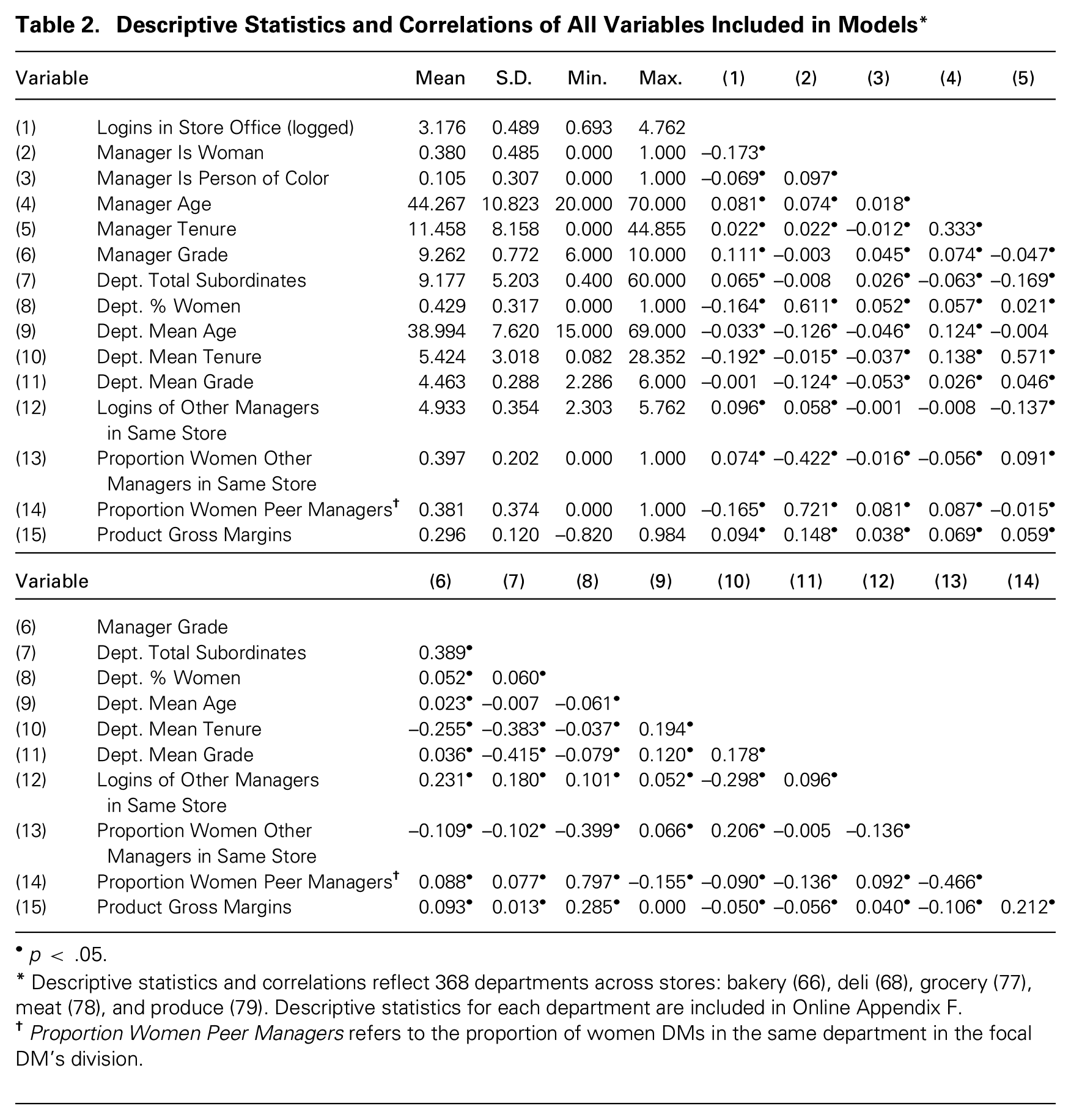
Merged datasets show that DMs were, on average, in their mid-40s, had worked at FOODCO for nearly a decade, and supervised departments with 6 to 14 subordinates (see Online Appendix F for descriptive statistics by department). Product gross margins were, on average, .296. Table 2 shows means, standard deviations, and correlations of variables across all departments.
Descriptive Statistics and Correlations of All Variables Included in Models*
p < .05.
Descriptive statistics and correlations reflect 368 departments across stores: bakery (66), deli (68), grocery (77), meat (78), and produce (79). Descriptive statistics for each department are included in Online Appendix F.
Proportion Women Peer Managers refers to the proportion of women DMs in the same department in the focal DM’s division.
On average, DMs logged into office computers about 26 times per week; however, their time spent on activities like ordering or recording shrinkage differed by department, which contributed to departmental differences in office use. For instance, grocery DMs’ low login rates (
Descriptive statistics also reveal that values of the moderator, Proportion Women Peer Managers, mapped almost perfectly to different departments. High values (>.5) correspond with bakery and deli (female-typed), while low values (<.45) correspond with grocery, meat, and produce (male-typed). 18 This is unsurprising, as gender representation and gender typing in any given setting should be closely related (Chatman et al., 1998).
Main effects: Managers’ gender and tasks
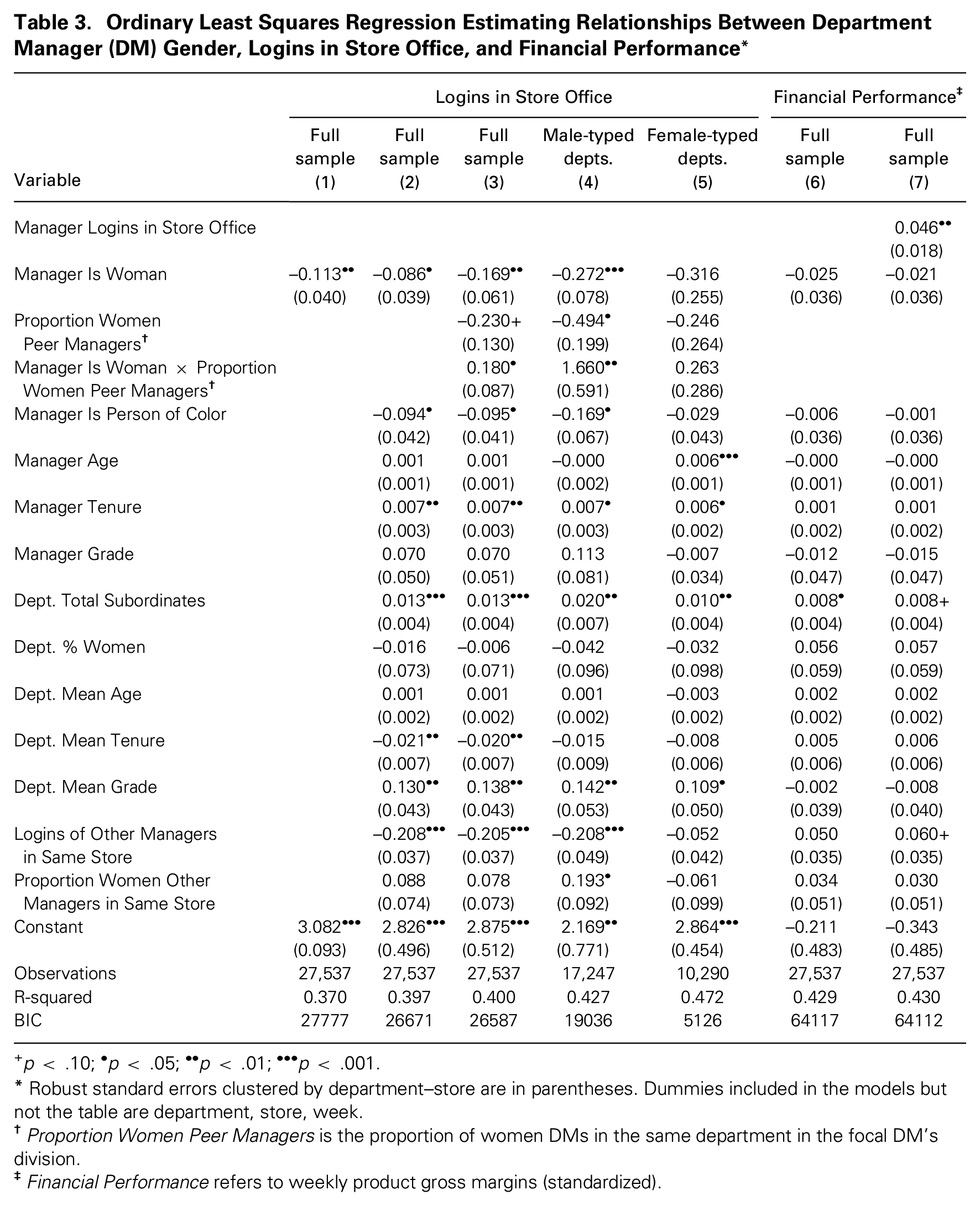
H1 predicted that women managers would do fewer tasks away from subordinates than men managers would do. A negative, statistically significant coefficient on Manager Is Woman, in Model 1 of Table 3 (p = .004), shows that women DMs logged in to store computers less often than men DMs did. Since the floor was the only other space DMs occupied when on shift, this means that women DMs were on the floor, doing tasks in front of subordinates, more than men DMs were. The association between Manager Is Woman and Logins in Store Office is robust to the inclusion of DM-, department-, and store-level controls in Model 2 (p = .027). 19
Ordinary Least Squares Regression Estimating Relationships Between Department Manager (DM) Gender, Logins in Store Office, and Financial Performance*
p < .10; •p < .05; ••p < .01; •••p < .001.
Robust standard errors clustered by department–store are in parentheses. Dummies included in the models but not the table are department, store, week.
Proportion Women Peer Managers is the proportion of women DMs in the same department in the focal DM’s division.
Financial Performance refers to weekly product gross margins (standardized).
Moderation: Managers’ gender, peers’ gender, and tasks
H2 predicted that working in settings with more women peers would moderate the tasks that women managers did. I tested this prediction by interacting the measure Proportion Women Peer Managers with Manager Is Woman. Decreasing Bayesian information criterion values between Models 2 and 3 in Table 3 show that the inclusion of the interaction Manager Is Woman × Proportion Women Peer Managers improves the models’ explanatory power. The coefficient Manager Is Woman × Proportion Women Peer Managers in Model 3 is positive and statistically significant (p = .040).
In light of the close relationship between the proportion of women managers and gender-typed departments, I next sought a more nuanced understanding of this two-way interaction (Manager Is Woman × Proportion Women Peer Managers) by conducting a post-hoc analysis to probe the relationship between the interaction term and the dependent variable. Descriptive statistics suggested that simply setting a threshold for the moderator such as one standard deviation above or below the moderator’s mean value across the full sample would not have been informative, given the range of the moderator’s distribution within department gender types. (Recall that values of the moderator, Proportion Women Peer Managers, in male- and female-typed departments never overlapped: .5 was the minimum value in female-typed departments, and .45 was the maximum value in male-typed departments, as depicted in Online Appendix G.) In effect, comparing logins of Proportion Women Peer Managers at one standard deviation above and below the mean of all possible values of the moderator (that is, from 0 to 1) would be akin to comparing logins in bakery and deli (female-typed departments) with those in grocery, meat, and produce (male-typed departments). But because departmental demands influenced baseline login rates, making such between-department comparisons would be inappropriate.
Given the non-overlapping ranges of the moderator between gender-typed departments, for my post-hoc analysis of moderation results I ran regressions on samples split by male- and female-typed departments (see Models 4 and 5). Splitting the sample into male- and female-typed departments reveals that, in settings in which women were generally underrepresented (i.e., male-typed departments), the more women peers that women DMs had, the more that women DMs went to the office. Model 4 shows that this relationship is positive and statistically significant in male-typed departments (p = .005), while Model 5 shows that it is positive but not statistically significant in female-typed departments (p = .359). 20 Splitting the sample thus shows that working in settings with more women peers moderated the tasks women managers did only in male-typed departments; that is, the more women there were in comparable roles (i.e., peers in the same department across stores within the same division), the more that women DMs within male-typed departments went to the office—doing more tasks away from subordinates—relative to men within male-typed departments. This finding deepens our understanding of past research on the gendered nature of work, as we see that the proportion of women peer managers mattered most for women DMs’ behaviors when women DMs encountered especially strong stereotype threat (i.e., in male-typed departments).
To make further within-department gender-type comparisons, I then calculated predicted values from the post-hoc split sample analysis. These calculations reveal that in male-typed departments, the difference between men’s and women’s office tasks measured by computer logins varies depending on the proportion of women peers in comparable roles. For instance, when there are high proportions of women peers (i.e., one standard deviation above the mean of Proportion Women Peer Managers in male-typed departments, or .198), the difference between men and women managers’ weekly logins is negligible and not statistically significant (SE = 2.329; p = .525; CI = [−3.084, 6.046]): on average, in male-typed departments women managers logged in to computers 27.155 times per week, whereas men logged in to computers 25.674 times per week. However, when there were low proportions of women peers (i.e., one standard deviation below the mean of Proportion Women Peer Managers in male-typed departments, or .01), the difference between men and women is substantively meaningful and statistically significant (SE = 1.681; p < .001; CI = [−9.656, –3.066]): on average, in male-typed departments women logged in to computers 21.809 times per week, whereas men logged in to computers 28.170 times per week. In contrast, in female-typed departments, the difference in men’s and women’s office tasks is not responsive to the proportion of women peers in comparable roles. 21 Figure 4 plots predicted values from the split sample regression models (Table 3, Models 4 and 5).
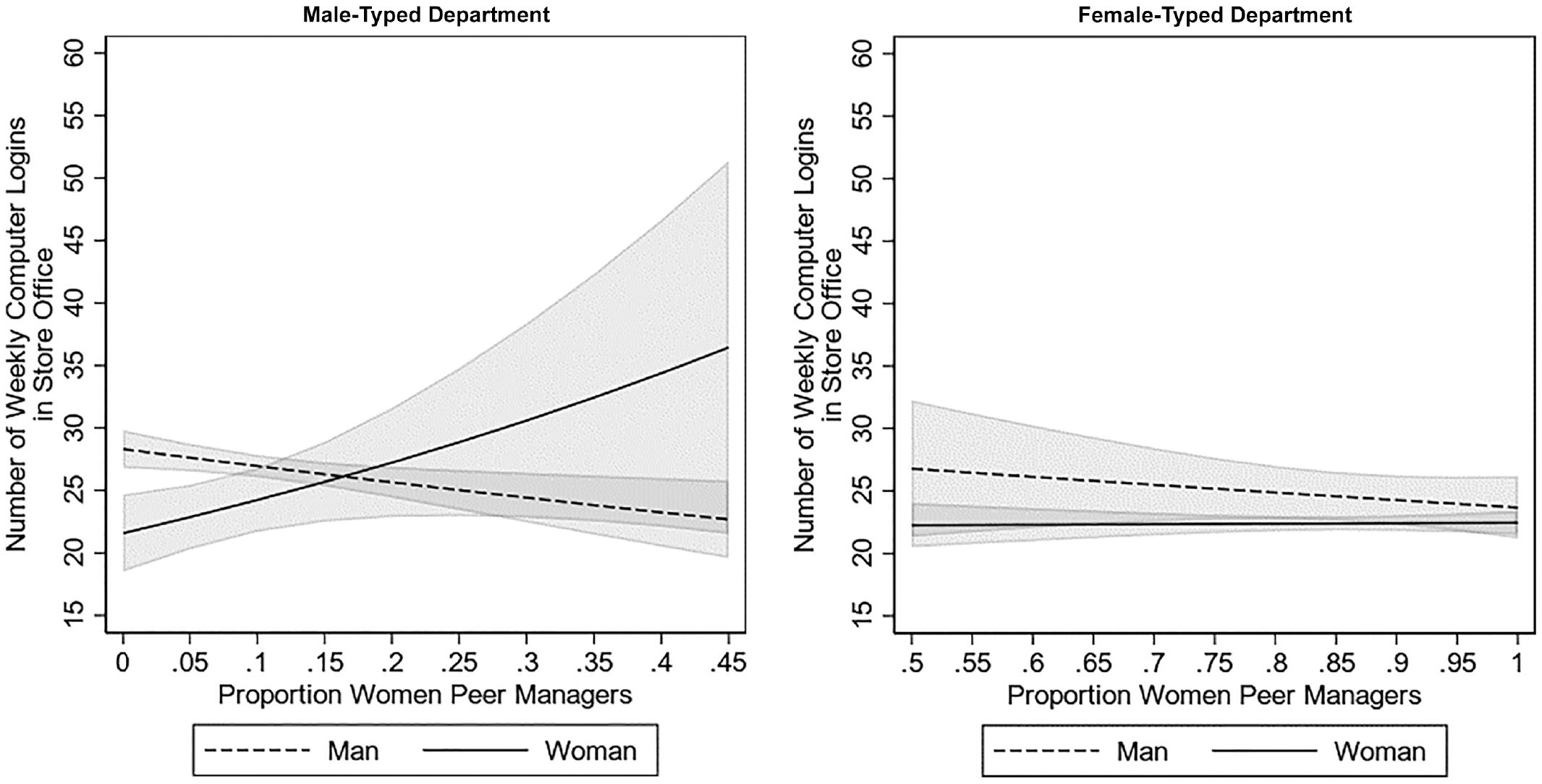
Predicted Values of Weekly Office Tasks (via Logins) by Department Manager (DM) and Proportion Women Peer Managers in Male-Typed Versus Female-Typed Departments*
Mediation: Managers’ gender, tasks, and performance
Having found links between a DM’s gender and tasks done away from subordinates (logins in the office), I next considered whether the association between gender and performance is mediated by where DMs do their tasks (H3). To do so, I examined relationships among Manager Is Woman (the independent variable), Logins in Store Office (the mediator variable), and Product Gross Margins (the dependent variable).
I began this examination by considering relationships among the key variables used in the mediation model. Model 6 in Table 3 shows a negative but not statistically significant association between Manager Is Woman and Product Gross Margins, indicating that departments run by men and women DMs did not differ significantly in financial performance. 22 Model 7 shows a positive and statistically significant association (p = .009) between Logins in Store Office and Product Gross Margins, meaning that doing more office tasks was related to better financial performance. Combining this result with that of Model 2, that Manager Is Woman is negatively associated with Logins in Store Office, suggests that office tasks may offer a link between gender and financial performance.
As regression models in Table 3 established relationships between variables in the mediation path, I next tested formally for mediation. I used the product-of-coefficients method (Baron and Kenny, 1986; MacKinnon, Fairchild, and Fritz, 2007) to examine whether the indirect effect of Manager Is Woman via Logins in Store Office on Product Gross Margins is significantly different from zero. Bootstrapped standard errors (clustered at the department–store level) with 95-percent bias-corrected confidence intervals (5,000 replications) do not include zero (b = –.004; CI = [−.012, –.0004]), offering evidence of mediation: doing fewer tasks away from subordinates (office tasks) than men did detracted from women managers’ performance along financial measures.
Supplemental analyses 1: Exploring moderated mediation
I ran supplemental analyses as a further test of my theory. Specifically, the theory suggests that as women managers face heightened stereotype threat (i.e., as they work in male-typed settings with fewer women peers), they will focus on floor activities that allow them to do work in front of their subordinates, which in turn will undermine their performance. Given the moderation result in male-typed departments, I used structural equation models to calculate the index of moderated mediation for first-stage moderated mediation (Hayes, 2015) to investigate whether the indirect effect of Manager Is Woman via Logins in Store Office on performance varies as a function of Proportion Women Peer Managers in male-typed departments (see Online Appendix H for regression models).
I ran two formal tests for moderated mediation. First, I calculated the index of moderated mediation (see Hayes, 2015), using the continuous moderator variable Proportion Women Peer Managers, to assess whether the indirect effect of Manager Is Woman via Logins in Store Office on Product Gross Margins varies as a function of the moderator in male-typed departments. Bootstrapped standard errors clustered at the department–store level with 95-percent bias-corrected confidence intervals (5,000 replications) find the index of moderated mediation to be statistically significant (b = .099; 95% CI = [.015, .323]). In other words, the indirect negative effect of manager gender on financial performance via office tasks was attenuated as women managers had more women peers in their divisions in male-typed departments. 23
Second, I probed these results by examining values one standard deviation below (low) and above (high) the mean value of the moderator, Proportion Women Peer Managers, in male-typed departments. Comparing women with men in male-typed departments at low levels of Proportion Women Peer Managers shows that the indirect effect of Manager Is Woman via Logins in Store Office on Product Gross Margins is negative and statistically significant (b = –.015; 95% CI = [−.038, –.004]): these women did fewer office tasks than men managers did, which in turn contributed to lower financial performance. In contrast, comparing women with men in male-typed departments at high levels of Proportion Women Peer Managers shows that the indirect effect of Manager Is Woman via Logins in Store Office on Product Gross Margins is not statistically significant (b = .003; 95% CI = [−.008, .029]). Together, these results serve as further evidence in support of my theory: as women managers face even greater stereotype threat (that is, as they work in male-typed settings with fewer women peers), they do even fewer tasks away from subordinates, which in turn detracts from their financial performance.
Supplemental analyses 2: Service performance
I tested the robustness of my findings by conducting supplemental analyses using a second dependent variable, which measured customer service quality. Store staff were expected to engage in affective behaviors in their interactions with customers that reflected company service standards, such as being friendly and telling stories. Though DMs’ planning efforts had less of a direct impact on departments’ customer service than they did on their financial performance, they nonetheless still mattered for service performance. For instance, by scheduling subordinates efficiently or ordering to meet demand, DMs could ensure that tasks such as preparing or converting products would not interfere with assisting customers.
I operationalized service performance with one year of monthly department mystery-shop scores, a common retail tool for assessing customer service whereby retailers hire mystery shoppers to pose as customers and evaluate departments along company service standards (Latham, Ford, and Tzabbar, 2012). Merging DM demographic, login, and mystery-shop score data allowed me to tie DMs’ tasks to departments’ service performance. Online Appendix I details all supplemental data, analyses, and results for service performance.
Results of these supplemental analyses, shown in Table I2, are generally consistent with those of the main analyses. For the period during which service performance was measured, managers’ gender is negatively and significantly associated with office tasks, and office tasks are positively and significantly associated with service performance. The moderation analysis shows a positive but not statistically significant association between Manager Is Woman × Proportion Women Peer Managers and office tasks. 24 Since all variables along the mediation pathway are significantly associated with one another, I proceeded to test for mediation formally; overall, results offer evidence that doing fewer tasks away from subordinates (office tasks) than men did detracted from women managers’ service performance.
Discussion of Quantitative Results
My quantitative analyses reveal three core findings. First, men and women managers differed in how much of each set of tasks they did. In my setting, women managers did fewer office tasks—tasks completed away from their subordinates—than men managers did. Second, the tasks that women managers attended to depended on the gender composition and gender typicality of the work setting. Gender differences in office tasks carried out decreased as women managers worked with more women in comparable roles in male-typed settings. Third, managers’ completion of office tasks was positively associated with their departments’ financial performance (and, in supplementary analyses, service performance). As women tended to do fewer office tasks than men, they were less likely to reap performance benefits stemming from planning activities. Further, women’s financial underperformance (measured as product gross margins, arguably managers’ most important metric) attributable to the neglect of office tasks was more pronounced when they worked in male-typed departments with fewer women in comparable roles—that is, when negative gender stereotypes were more likely to be salient.
My results reveal a pattern consistent with findings from past stereotype threat research (Sekaquaptewa and Thompson, 2003; Murphy, Steele, and Gross, 2007): gender representation influences women’s behavior in contexts in which negative gender stereotypes are especially salient. Indeed, the inclusion of a three-way interaction term (Manager Is Woman × Proportion Women Peer Managers × Male-Typed Department) yields a positive and statistically significant coefficient. This means that the proportion of women peers in comparable roles is more strongly associated with increasing logins in male-typed than in female-typed departments. Though not hypothesized, this finding provides additional evidence supporting extant theory: where stereotype threat should be strongest (i.e., male-typed settings) is also where we might expect more women peers to have greater impact.
This finding illuminates how the gender typing of work and gender representation, together, influence women’s experiences of stereotype threat and their subsequent behaviors. Specifically, women meat managers (those doing male-typed work) should be much more likely than women bakery managers (those doing female-typed work) to experience stereotype threat. Such gender typing should shape how women experience changes in gender representation (i.e., increasing women’s representation in meat should shape the experience of women meat managers in ways that it does not for women bakery managers) and how they behave (i.e., logins) in line with these experiences. The same should apply in other settings. For instance, women police officers (those doing male-typed work) should be more likely than women librarians (those doing female-typed work) to experience stereotype threat. The threat that women police officers experience should be exacerbated (or attenuated) as they have fewer (or more) women colleagues, as should any changes in their behaviors due to this threat.
It is important to put the sizes of the indirect effects in the mediation models into context. Mediation analyses show that, holding constant all other variables, the decrease in office tasks resulting from a change in manager gender (from man to woman) would be associated with an approximately .05-percent decline in product gross margins. Even such small deviations in percentages are consequential in retail (a common aphorism among retailers is “retail is detail”), especially in low-margin categories such as food. Spread across many departments and stores, even a modest change at the department level can yield meaningful savings for a retailer. Furthermore, if it were possible to identify all managerial behaviors affected by responses to stereotype threats, the accumulation of those effects could have a substantial impact on organizations’ bottom lines.
In addition, even with rich computer login data from FOODCO and a setting well suited to answering my research question and testing my hypotheses, I was nevertheless constrained by data availability. From managers’ accounts of time use in interviews and my observations of their behaviors in store offices, I discovered that their logins did reflect time in the office. However, I could not directly measure time spent in the office. Thus while logins offered a reasonable approximation of time doing office tasks, future studies might identify more-exact measures of time use. Likewise, I had no direct measure of managers’ floor tasks; I had to infer it. That I did not observe managers having slack time, however, bolsters my confidence in the measure of floor tasks being the inverse of office tasks. Yet future studies might take advantage of other archival data to measure tasks performed in front of subordinates.
Similarly, the empirical context presented challenges in my moderation analyses, since departments at FOODCO are gender-skewed and their tasks, while similar in kind, are not identical. It is therefore impossible to completely disentangle differences in women managers’ representation within departments from differences in work across departments. Many work settings are gendered (or racialized), so this issue is not unique to my setting; see Zhang (2017: 621) for an analogous discussion about race. Although a grocery chain provides an excellent context, with managers in the same company occupying jobs with the same responsibilities and comparable tasks, the ideal setting would be one in which managers’ tasks are identical and there is variability in gender representation. Future research should use experimental designs to establish a baseline for groups that is not conflated with gender.
Last, note that men’s logins did change—going down—as they had more women peers in male-typed departments. 25 While research has shown that men’s and women’s experiences of the gender composition of their workplaces diverge (e.g., Williams, 1992), some research suggests that women’s increasing representation in a job could be a threat to men (Kuchynka et al., 2018; Kricheli-Katz, 2019). I have no evidence from my qualitative data, however, that men managers in male-typed settings felt threatened by having more women as peers. Future research should continue to investigate the extent to which men’s behaviors may be influenced by having women peers.
General Discussion
This mixed-methods investigation of a retail grocery chain addressed how stereotype threat influences how women (compared to men) take up and perform in managerial roles. I found that women managers face a task bind: perceiving threatening stereotypes, they allocate disproportionate attention to tasks that would disprove these stereotypes. Yet doing so ultimately comes at the expense of other tasks that are no less important to being effective managers. My findings showed far-reaching consequences of stereotypes, which shape not only the experiences, behaviors, and performance of women managers but also the performance of their organizations.
I arrived at these findings by using both qualitative field and quantitative archival data. Qualitative analyses revealed that women managers’ experiences of negative stereotypes contributed to their concerns about how their subordinates viewed them, which in turn influenced how they went about their work. Recognizing the value of being seen as legitimate by those they managed, women sought to showcase their competence and commitment in front of subordinates. Yet they found themselves pulled in opposite directions by, on the one hand, tasks that would help them to disprove stereotypes and gain influence over subordinates and, on the other hand, tasks that would improve their departments’ planning and operations. This conundrum exemplifies the task bind: no matter what tasks women managers did, they saw ways these tasks could impede their ability to be effective managers. Uncovering the task bind helped me devise hypotheses about how stereotype threat could influence women managers’ activities and performance.
I turned to archival data to test these hypotheses. First, I examined whether men and women managers did different tasks. As predicted, I found that women were less likely than men to conduct tasks in private settings, away from their subordinates. This relationship was even more pronounced for women under greater threat of negative stereotypes; that is, gender differences in tasks done away from subordinates were greater when women worked in divisions with fewer women peer managers and where these women were more counter-stereotypical (in male-typed departments) and thus more threatened. Second, quantitative data shed light on the performance consequences of men and women managers’ task allocation. Doing fewer tasks in the office—that is, planning and analysis—undermined women managers’ performance, relative to men’s, on an outcome closely tied to such tasks: profitability.
Contributions to the Stereotype Threat Literature
I build on past stereotype threat research by examining how stereotype threat affects the experiences and performance of women managers working in an organizational setting. A key finding has been that individuals’ experience of threatening stereotypes can harm their performance, but much of this research has been conducted in laboratory settings (Kray and Shirako, 2011; Walton, Murphy, and Ryan, 2015; Liu et al., 2021). Of research done in the field, the vast majority has occurred in schools. These field studies typically examine stereotype threat’s effects on a single, bounded event completed independently (such as taking a test) and its consequences at the individual level (such as one’s grade on the test). Yet the work of managing is discretionary, ambiguous, and varied (Mintzberg, 1973; Kotter, 1982; Stewart, 1982); managers do interdependent work and are themselves deeply embedded in organizational relationship networks, interacting with others over time (Hill, 2003); and managers’ performance has not only individual- but also organizational-level consequences (Simon, 1947; March and Olsen, 1976; Ocasio, 1997). Moreover, while stereotype threat research has focused on the experience of students or employees relatively early in their careers—in attempts to understand why they do not pursue STEM fields (Davies et al., 2002) or leadership roles (Davies, Spencer, and Steele, 2005), for example—my study reveals that even after having moved up organizational hierarchies and presumably demonstrated their competence, women are still affected by stereotype threat.
Offering insights into managers’ experiences, behaviors, and outcomes, I advance theory and research on stereotype threat in three ways. First, bringing research on the negative effects of stereotype threat into real managerial contexts, this study considers consequences of stereotype threat when managers encounter negative stereotypes and believe they must defend against them to maintain their status and legitimacy as managers. Research has shown that stereotype threat can deplete coping and cognitive resources to undermine performance (Schmader and Johns, 2003; Beilock, Rydell, and McConnell, 2007; Schmader, Johns, and Forbes, 2008). I contribute to this literature by finding that women managers experiencing stereotype threat face a task bind. They attend more to tasks that help them disprove negative gender stereotypes and less to tasks for which negative stereotypes are less salient, and these behaviors result in worse performance outcomes. Showing how gender stereotypes can undermine women managers’ performance by pressuring them to prove their worth with public displays of competence, I expose tensions they experience about how to do their work and the tradeoffs they make as they go about doing it. These tradeoffs offer a behavioral explanation for how stereotype threat can affect performance—the task bind—whereas past research offers a cognitive explanation.
My second contribution to the stereotype threat literature is to highlight the importance of a specific audience for managers experiencing threat, thereby putting research on stereotype threat in conversation with research on impression management. Linking these literatures broadens understanding of how and why stereotype threat can undermine performance in organizations. With the task bind, I discover that relational considerations—in this case, women managers’ felt need to bolster their legitimacy—affect individuals’ choice of tasks, leading them to prioritize tasks done in front of salient stakeholders, in this case subordinates. But this choice comes at the expense of other tasks, which ultimately undermines performance.
Such considerations draw attention to the larger point that managers are situated within organizations. So are the threats they perceive. In any organization, managers must navigate webs of relationships that shape their experiences and their efficacy (Hill, 2003). Though in another organizational setting peers or supervisors could well come into focus, I discovered from my fieldwork that women defied stereotypes partly to manage the impressions of subordinates (Goffman, 1959). This makes sense. Influencing, motivating, and coordinating subordinates’ work is essential to any managerial role (Fayol, 1916; Mintzberg, 1973). How subordinates view their manager can influence the extent to which they comply with that manager’s directives (Yukl and Falbe, 1991), go above and beyond expectations in their jobs (Sparrowe, Soetjipto, and Kraimer, 2006; Grant and Sumanth, 2009), or evaluate the manager positively (O’Driscoll, Humphries, and Larsen, 1991; Kacmar, Wayne, and Wright, 1996).
Moreover, that women managers tailor their tasks to disprove what they believe are their subordinates’ stereotypes about them (consistent with research on meta-stereotypes, e.g., Sigelman and Tuch, 1997; Vorauer et al., 2000; Klein and Azzi, 2001) reveals stereotype threat’s persistence in the lives of women seeking to achieve in male sex-typed roles. Being imbued with formal authority is not enough to overcome stereotype threat. Instead, women managers feel they must prove themselves to exercise authority over the people they manage.
Note that impression management is not necessarily the only motive for women managers’ prioritization of floor tasks. Spending time on the floor enables them to build relationships with subordinates—something that, in itself, may help overcome stereotypes (Tajfel and Turner, 1986; Kalev, 2009). In this sense, my data rule in impression management as a factor shaping women managers’ work-allocation choices but do not rule out functional considerations such as building relationships.
Third, through the task bind, I show the profound and far-reaching implications of stereotype threat. Studies have shown that it can be detrimental to individuals’ performance on tests (Steele and Aronson, 1995; Croizet et al., 2004), in tasks (Carr and Steele, 2009; Grand, 2017), and in evaluations (Kusterer, Lindholm, and Montgomery, 2013), as well as to their persistence (Murphy, Steele, and Gross, 2007; Lewis et al., 2017). As I study managers within an organization, the threat I uncover transcends individuals’ own performance to influence that of their departments. In this respect, I extend past research to show how stereotype threat can detract from not only individual but also organizational performance.
Beyond proximate outcomes like financial performance, the differences I observed in men and women managers’ behaviors may also have downstream consequences for their own skill development and learning. Defending against negative stereotypes, women spent less time in the office doing the kind of analytical work required at higher organizational levels (where women were most underrepresented). Because company-wide communications occurred via email and information about all departments was available via the intranet, office work also enabled managers to keep abreast of the company beyond their own stores. If doing more office work allowed men managers to be more widely informed and connected than women managers, that would be another pathway by which threatening stereotypes could lead to greater gender disparities higher up the managerial ranks. Such disparities would not only have a bearing on the careers of individual men and women but also squander organizational talent.
Generalizing and Extending the Task Bind
At least three conditions must be in place for a task bind to arise. First, an individual must perceive a negative stereotype about their ability to complete a task in which they are invested. In this sense, the task bind should apply to anyone experiencing threatening stereotypes or beliefs that call into question such abilities. Second, the portfolio of tasks from which the individual can choose must contain tasks of roughly equal importance, so that there is ambiguity in how tasks should be prioritized. If one task were essential or clearly more important than another, the pull of a threatening stereotype might not be sufficient to pose the dilemma observed in this study. Third, the individual must have control over the tasks they complete.
Although this study emphasized managers’ tasks done physically in front of coworkers, the task bind could shape managers’ allocation of attention across other tasks in other contexts. Indeed, impression management varies with the field. For instance, women engineering managers, concerned that subordinate engineers question their technical skills, might spend more time showing they understand complex architectures and checking the accuracy of their teams’ work than devising budgets for future projects, to the detriment of their project pipeline. Women managing directors in investment banking, stereotyped as affirmative action hires, might focus on demonstrating their financial modeling and technical abilities to clients and colleagues, but at the expense of cultivating close social relationships essential for winning business and doing deals. Women scientists leading research labs might be more likely to focus on demonstrating their scientific acumen to their students and staff than on writing grants or building relationships with prospective donors, potentially limiting the resources they can obtain and, eventually, undermining their research productivity. In essence, the task bind reflects how people’s concerns about being associated with negative stereotypes can shape their allocation of attention across activities, and it could apply to various contexts and roles requiring different tasks.
The task bind calls attention to gender—an important aspect of social identity—as a key factor in how people experience their jobs and, critically, how they go about doing their jobs. But members of other groups experiencing a negative stereotype may also feel the task bind. Future studies might therefore examine how the bind manifests differently depending on the specific social identity under threat. Understanding the tradeoffs inherent in the bind should grant insight into why and how stereotype threat might undermine workers’ performance.
While this study explored a relatively bounded context with two discrete bundles of tasks, in other settings tasks could be more varied, cut across workplaces, or even straddle work and home. To this end, what happens when a given role has a wider range of tasks than the roles that I observed at FOODCO? Women or others experiencing stereotype threat might experience even greater time constraints, raising the question of what is prioritized and neglected. How do they make decisions in these contexts? Is there a hierarchy of threatening stereotypes guiding time allocation? Is stress exacerbated as attention becomes more divided? For those working multiple jobs, like gig and contract workers, does the bind occur across tasks and undermine performance in some jobs but not others? Relatedly, do personal and professional tasks get mixed as people work from home, such that the bind straddles tasks in both work and home domains? Examining how people navigate the bind as a result of many different kinds of tasks, as well as audiences, should paint a more complete picture of how workers go about their jobs every day and why they do what they do.
Practical Implications
Equally as important as uncovering the task bind and its consequences is ascertaining how organizations can alleviate it. A range of interventions has emerged from stereotype threat research; its deleterious performance effects can be reduced by teaching vulnerable individuals about it (Johns, Schmader, and Martens, 2005), having them reframe their experience of anxiety or providing an explicit strategy to cope with it (Miyake et al., 2010; Weger et al., 2012), or providing stories of others who have successfully navigated stereotypes in their roles (Cohen and Garcia, 2005; Walton and Cohen, 2011). Such interventions suggest that organizations could emphasize managers’ competence in threatened tasks and the risks of neglecting other tasks, all while explaining how gender stereotypes can influence behaviors.
This study points to two levels of hierarchy that organizations could target to address the bind. First, to the extent that women managers’ concerns that subordinates’ negative stereotypes will undermine their authority are well founded, interventions targeting subordinates’ beliefs about managers’ capabilities could help. For instance, companies could have women lead the training sessions for new hires on tasks in which women face negative stereotypes (like floor work) to help change beliefs about women’s competence in these tasks. Second, organizations can also consider the influence of workers’ peer groups. My findings show that having other women as peers in male-typed domains can reduce threat and thus the pressure to prove one’s competence in front of other organizational stakeholders. This, combined with past research showing that women’s peer groups matter for their experience of stereotype threat (Cherney and Campbell, 2011; Picho and Stephens, 2012), suggests that finding ways to connect women managers at peer levels could be one way for organizations to combat the performance effects of negative stereotypes.
This research focuses on an understudied but critically important group of workers. Much management research focuses on professional workers, resulting in a dearth of research on the population I studied. But given the essential roles of workers like those at the front lines of grocery stores in the global economy, understanding their work experiences and behaviors should be of particular interest to scholars, practitioners, and policymakers alike.
Although this study is specific to a single bricks-and-mortar retail company, its findings should generalize to many others in retail and beyond. The U.S. retail grocery industry employed more than 4 million workers in 2019 (BLS, 2020), and the retail trades employed more than 15 percent of the country’s working population in 2018 (PricewaterhouseCoopers, 2020). Even more striking, in 2021, 40.9 percent of managers in the U.S. were women (BLS, 2021). Given women’s increasing representation in managerial ranks and the linkages I show between tasks and performance, understanding gender differences in managers’ daily practices has far-reaching consequences.
The task bind is a novel way to think about pervasive interpersonal dynamics within organizations. Introducing the task bind, I show how managers experience and navigate competing work pressures arising from their social identities—pressures operating in addition to those posed by bona fide job requirements. Awareness of these pressures should help improve not only the experiences and performance outcomes of managers sorely underrepresented in the upper echelons of organizations but also the performance of those organizations.
Supplemental Material
sj-pdf-1-asq-10.1177_00018392221124607 – Supplemental material for The Task Bind: Explaining Gender Differences in Managerial Tasks and Performance
Supplemental material, sj-pdf-1-asq-10.1177_00018392221124607 for The Task Bind: Explaining Gender Differences in Managerial Tasks and Performance by Alexandra C. Feldberg in Administrative Science Quarterly
Footnotes
Acknowledgements
For feedback on earlier drafts of this manuscript, I am immensely grateful to Kathleen McGinn, Robin Ely, Frank Dobbin, Mike Tushman, Peter Marsden, Teresa Amabile, Mary Brinton, Glenn Carroll, Edward Chang, Linda Hill, Jon Jachimowicz, Rosalyn Jill, Tami Kim, Barbara Kiviat, Barbara Lawrence, Jay Lorsch, Sanaz Mobasseri, Leslie Perlow, Jeff Polzer, Lakshmi Ramarajan, Emily Truelove, Nate Wilmers, Alix Winter, LT Zhang, and Ting Zhang. Kelly Harrington and Deb Rowcroft provided invaluable research assistance, and Xiang Ao imparted critical methodological advice. This research was generously supported by Harvard Business School’s Division of Research and Faculty Development and Doctoral Programs Office, the Weatherhead Initiative on Gender Inequality, and the Eric M. Mindich Research Fund for the Foundations of Human Behavior. Associate Editor John Wagner and three anonymous reviewers shared extremely developmental guidance throughout the review process, and Joan Friedman and Ashleigh Imus provided excellent copyediting. Last, this study would not have been possible without the participation of employees at FOODCO—I thank them and am indebted to them for sharing their time, experiences, and insights.
1
While FOODCO’s stores and departments do carry different products, there are enough similarities in managers’ core tasks to make work across stores and departments comparable.
2
Departments occasionally had more than one manager.
3
Hereafter, I refer to “meat/seafood” as “meat.” Several stores had combined deli and bakery departments; I exclude these departments from analyses, but their inclusion does not yield substantively different results.
4
See Chatman et al. (2008) and  for discussions of gender representation and gender typicality. Though highly correlated in practice, these concepts are theoretically distinct: a setting could be numerically dominated by women but male-typed (e.g., a majority-women police force).
5
I contacted 63 SMs and ASMs in November 2016. Nineteen declined the invitation, most due to scheduling constraints, and I did not hear back from 18 of those initially contacted.
6
I contacted 68 DMs in August 2017. Nine declined the invitation, most due to scheduling constraints. I did not hear back from 28 DMs, and four DMs had to cancel the original interview date and were unable to find a make-up time.
7
Shrinkage refers to inventory lost due to spoilage, damage, theft, or financial/accounting errors.
8
The exception was DM-56, a Black man, who also shared concern with what subordinates thought of him.
9
A key boundary condition is that tasks are of equal importance. I return to this point in the General Discussion.
10
After accounting for store openings and closures, this drops observations for periods in which (a) more than one person occupied the role or (b) the DM was absent due to vacancy or vacation. Additionally, to be consistent with my theorizing, analyses exclude observations for departments without subordinates due to vacancy (1 percent of the sample). Results are robust to the inclusion of these observations. See for further detail on the merging process and dataset construction.
11
Results remained consistent with aggregations at 40- and 60-minute intervals.
12
Without overtime (which they avoided), DMs worked 40 hours per week.
13
For interpretability, I standardized this variable in regression analyses.
14
Carrying shelf-stable and highly assorted products (e.g., cereal, baking supplies, condiments, pet food, etc.), grocery departments did not report shrinkage on a weekly basis. For this reason, my measure of product gross margins for grocery departments does not incorporate a measure of shrinkage.
15
A reasonable question would be, how did managers think about other DMs in the same store? While other DMs in the same store, operationalized as Same Store managers, were members of a peer group and important sources of knowledge, departmental differences (e.g., in sales, headcount, products) meant that DMs were more likely to make comparisons between themselves and other DMs in their division in the same department but across stores, operationalized as Proportion Women Peer Managers. An analogous example to this would be among professors at neighboring universities. A woman English professor at Columbia University would be less likely to compare herself to a Chemistry professor at Columbia University than she would another English professor at New York University.
16
I implemented these analyses using the STATA command gsem. Estimation results from gsem are nearly identical to those using OLS and are available upon request.
17
18
19
Across all models, results of main variables were not sensitive to the inclusion of controls. All substantive patterns remain the same with and without control variables.
20
In line with this analysis, the inclusion of the three-way interaction term (Manager Is Woman × Proportion Women Peer Managers × Male-Typed Department) also yielded a positive and statistically significant coefficient (p = .014); see Table F3 for these results. Post-hoc comparisons also show that only women are responsive to department gender type: the effect of Proportion Women Peer Managers on women DMs differs significantly across the two gender-typed departments (p = .045); in contrast, the effect of Proportion Women Peer Managers on men DMs does not differ significantly across the two gender-typed departments (p = .455).
21
When there are more women peers (i.e., one standard deviation above the mean of Proportion Women Peer Managers in female-typed departments, or .972), the difference between men and women managers’ weekly logins is not statistically significant (SE = 1.276; p = .273; CI = [−3.898, 1.102]): on average, women managers logged in to computers 22.445 times per week, whereas men logged in to computers 23.843 times per week. When there were fewer women peers (i.e., one standard deviation below the mean of Proportion Women Peer Managers in female-typed departments, or .718), the difference between men and women is not statistically significant (SE = 1.602; p = .059; CI = [−6.170, .110]): on average women logged in to computers 22.349 times per week, whereas men logged in to computers 25.379 times per week.
22
Although a significant indirect effect—that is, a pathway between DM gender, logins, and performance—is widely interpreted as sufficient evidence for mediation today (MacKinnon, Krull, and Lockwood, 2000; Zhao, Lynch Jr., and Chen, 2010; Rucker et al., 2011; Aguinis, Edwards, and Bradley, 2017), confirming mediation traditionally required evidence of a statistically significant direct effect, that is, the association between DM gender and gross margins (Baron and Kenny, 1986). In this case, the lack of evidence for a direct effect may mean that (a) managers’ gender is not associated with performance, consistent with findings from past research (e.g., Powell, 1993), or (b) another variable could be suppressing a significant relationship between DMs’ gender and performance, as many factors are undoubtedly associated with financial performance. In either case, and irrespective of a direct effect, the presence of an indirect effect indicates that DMs’ gender is associated with their tasks and, because they do fewer tasks that benefit performance, women DMs see lesser performance gains from their tasks than men DMs do. For this reason, I proceed with mediation analyses.
23
Consistent with moderation results, conducting the same analysis reveals that the indirect effect for female-typed departments is not statistically significant (b = .0001; 95% CI = [−.031, .033]).
24
Note, this may have been due to limited data availability and thus a relatively small sample size used in analyses.
25
Only in male-typed departments did men’s login behavior differ significantly from 0.
Supplementary Material
Find the Online Appendix at .
Author’s Biography
References
Supplementary Material
Please find the following supplemental material available below.
For Open Access articles published under a Creative Commons License, all supplemental material carries the same license as the article it is associated with.
For non-Open Access articles published, all supplemental material carries a non-exclusive license, and permission requests for re-use of supplemental material or any part of supplemental material shall be sent directly to the copyright owner as specified in the copyright notice associated with the article.
