




Abstract
This article attempts to understand the impression management strategies used by women in Indian organizations. The extant research on gender differences in impression management, primarily conducted in Western cultures, has been inconclusive. This may be a result of attempting to generalize across cultures and/or the lack of research on moderating variables in the choice of impression management strategies by women. India provides an interesting context with high power distance culture, low social status of women as well as an emerging women’s movement. These factors set the context for the choice of impression management strategies by women in Indian organizations. This article proposes relevant moderators that could contribute towards a better understanding of the impression management strategies of women in Indian organizations. The nature of the job role and the attitude towards gender stereotypes provide a conceptual framework to understand the impression management strategies of women in Indian organizations. The proposed framework is explained and relevant propositions are suggested. The opportunities for future research are also indicated.
Introduction
Impression management (IM) is defined as the attempts of an individual for “determining the impressions others form of them regarding their behavior, motivation, morality, and other characteristics such as their intelligence and future potential” (Lopes & Fletcher, 2004, pp. 747–748). Research on impression management in organizational contexts has been largely focused on selection interviews, performance appraisals and career success (Bolino, Kacmar, Turnley & Gilstrap, 2008; Leary & Kowalski, 1990). In spite of a rich history of research on impression management, a recent review finds that “the work in this area is somewhat broad, but not very deep” (Bolino et al., 2008, p. 1094). Impression management remains a relevant area of research (Bozzolan, Cho & Michelon, 2015; Johnson, Griffith & Buckley, 2016).
Researchers have found differences in the impression management strategies used by women as compared to men (Guadagno & Cialdini, 2007). However, there is a dearth of research on women’s impression management strategies, particularly in Asian countries such as India. Overall there have been some recent research contributions from Asian countries; however these have been primarily from Hong Kong, China and Singapore with research contributions missing from countries such as India (Barkema, Chen, George, Luo & Tsui, 2015). Women in Western context use lesser impression management strategies than men (Bolino & Turnley, 2003b). However, this article presents theoretical arguments to suggest that this may not be true in the Indian context. It specifically highlights how the confluence of high power distance culture and gender inequalities influences impression management strategies used by women.
Second, research shows that Indians tend to use soft impression management strategies (Ralston et al., 2001). This research does not clarify gender differences in impression management strategies used by Indian men and women. However, different research streams highlight possible conditions when women would tend to display certain impression management strategies. There is a lack of research focusing on the impression management strategies used by women in India. This remains an important area of exploration for researchers. This article contributes towards addressing this gap by suggesting possible explanations for impression management strategies used by Indian women.
Third, a recent review of the impression management (IM) literature emphasizes that “it is important to develop new theoretical models that address aspects of IM that are not as well understood” (Bolino et al., 2008, p. 1099). This article contributes towards theoretical development in impression management research by providing theoretical explanation based on the social role theory and suggesting relevant propositions to extend this literature.
Fourth, there is a need to identify new antecedents of impression management. This is underscored by the argument that “the use of IM by individuals and organizations is likely to be shaped by a number of different factors” (Bolino et al., 2008, p. 1099). This article identifies different type of job roles and attitude towards gender stereotypes as relevant antecedents of impression management behaviours.
Fifth, the lack of conclusive research findings across studies highlights the need to identify relevant limiting conditions. The identification of appropriate moderators would clarify the specific conditions under which the particular phenomenon would or would not occur, providing more robust research findings. This article identifies relevant limiting conditions (i.e., accepting and challenging attitude towards gender stereotypes) for predicting impression management strategies used by women in India. This would also contribute towards extending the impression management literature and responding to the call for “need to take a step back and consider the bigger impression management picture rather than test a few specific relationships” (Bolino et al., 2008, p. 1099).
The following sections highlight the peculiarities differentiating the Indian context, the types of impression management strategies and introduce the social role theory. Social role theory is leveraged to propose job roles and attitude towards gender stereotypes (ATGS) as antecedents of impression management strategies. This is followed by explaining the proposed conceptual model, describing the contributions of this article and highlighting the future research possibilities.
Conceptual Framework and Propositions
Some of the constructs closely related to impression management are self-monitoring, self-presentation and influence tactics (or impression management behaviours). Self-monitoring refers to the process of generating awareness about how one is perceived by relevant others (Roberts, 2005). This is a crucial determinant and informational input process for impression management. Self-presentation refers to the behaviours constrained by the awareness of the effect that our behaviour might have on others (Bromley, 1993). Impressions are a result of specific efforts towards influencing the target audience. Influence tactics or impression management strategies refer to these impression management efforts.
Women in Western context use lesser impression management strategies than men (Bolino & Turnley, 2003b). However, India provides a different context and this influences the choice of impression management strategies by Indian women.
Indian Context: High Gender Inequalities Coupled with High Power Distance
The Indian context is unique and relevant for gender related studies “because the presence of an active women’s movement within a traditionally gender inegalitarian culture, has created interesting cross-currents of progress and apathy” (Rajadhyaksha & Velgach, 2009, p. 5). Culture is an important contributor to gender inequalities (Yeganeh & May, 2011). The cultural dimension most relevant for studying inequality is power distance, because it refers to the acceptance of status hierarchies and power inequalities (Aycan et al., 2000). Power distance is defined as “the extent to which a society accepts the fact that power in institutions and organizations is distributed unequally” (Hofstede, 1980, p. 45). India is considered to be among the high power distance countries of the world (Khatri, 2009). Therefore, hierarchy and inequalities are well accepted and reinforced strongly. India has a culture of high power distance coupled with heightened gender inequality in the Indian society (Bhalla & Kaur, 2010; Chaudhri & Jha, 2013; Mukherjee, 2013).
Another dimension of relevance is individualism–collectivism, which has been found to influence variation in important organizational outcomes (Earley, 1993). Individualism “implies a loosely knit social framework in which people are supposed to take care of themselves and of their immediate families only, while collectivism is characterized by a tight social framework in which people distinguish between in-groups and out-groups” (Hofstede, 1980, p. 45). In highly collectivistic societies like India, people perform lower when they are in out-group roles as compared to in-group roles. Thus, the performance pressure seems to differ across cultures based on the degree of individualism–collectivism. Hence, this provides an important contextual variable influencing workplace behaviours in Indian organizations.
The intensification of gender inequalities with increased education of women in India is enhanced due to cultural biases reflected in low labour participation rates of women, prevalence of dowry payments and lack of women’s property rights (Mukherjee, 2013). The textbooks for school children in India reinforce gender inequalities (Javaid, Jabeen & Omer, 2012). There is a significant difference in the allocation of resources to the girl child in Indian households (Motiram & Osberg, 2010; Zimmermann, 2012). The socially accepted land rights of Indian women are lower than Ghana and Ecuador (Deere, Oduro, Swaminathan & Doss, 2013). This exacerbates the treatment of women in everyday life who are socially considered as lower in status as compared to men. Indian managers consider male managers to be better than female managers (Bhatnagar & Swamy, 1995; Tung & Haq, 2012). Further, women empowerment leads to lower job satisfaction in high power distance countries like India (Khatri, 2009; Robert, Probst, Martocchio, Drasgow & Lawler, 2000), resulting in failure of attempts to empower women. The combination of these factors influences the choice of impression management behaviours by Indian women.
Women are treated as having lower status than men verbally as well as nonverbally (Giacalone & Rosenfeld, 1989). In countries having high power distance such as India, these status differences are more strongly reflected in everyday activities (Khatri, 2009). More impression management behaviours would be displayed when the actor is in a weaker position relative to the target audience (Larwood, 1991). Giacalone and Rosenfeld (1989) found that people engage in more impression management behaviours for a high status audience as compared to a low status audience. Women are perceived to be in a weaker position than men in organizations (Giacalone & Rosenfeld, 1989). Therefore, Indian women would be expected to use more impression management strategies as compared to men.
Proposition 1: Indian women use more impression management behaviours than men.
Types of Impression Management Strategies
Researchers have differentiated soft impression management strategies from hard impression management strategies (Falbe & Yukl, 1992; van Knippenberg & Steensma, 2003). Hard impression management strategies include direct and aggressive impression management strategies such as assertiveness, sanctions, upward appeal, blocking, self-promotion and intimidation. Soft impression management strategies include indirect and subtle impression management strategies such as ingratiation, coalition, exemplification and supplication. Particular combinations of impression management strategies lead to specific outcomes (Falbe & Yukl, 1992). However, a specific impression management strategy cannot be used with similar results across situations (Bromley, 1993). Therefore, actors would be expected to actively choose impression management strategies in each situation.
Appropriateness of the influence tactic is an important dimension for the choice of impression management strategies (Bhatnagar, 1993). Indians avoid hard impression management strategies as compared to Dutch and Americans (Ralston et al., 2001). Assertive and task oriented impression management strategies were perceived as more effective by American and Swiss managers as compared to Chinese managers (Yukl, Fu & McDonald, 2003). Thus, hard impression management strategies may be perceived as more effective by low power distance cultures as compared to high power distance cultures.
Women displaying authoritarian behaviours face perceptions of lesser effectiveness than their male counterparts (Atwater, Carey & Waldman, 2001). Women use charm, appearance, ingratiation and compliments as impression management strategies (Kaul, Ansari & Rai, 2003), which are soft impression management strategies. Women are perceived as more effective when displaying behaviours which are considered appropriate based on gender stereotypes (Carli, 1990; Castro, Douglas, Hochwarter, Ferris & Frink, 2003). Therefore, from an effectiveness perspective, women would tend to choose soft impression management strategies over hard impression management strategies.
The above discussion highlights that men and women use different impression management strategies (Guadagno & Cialdini, 2007); women tend to choose soft impression management strategies (Carli, 1990; Castro et al., 2003) and Indians in general prefer soft impression management strategies (Ralston et al., 2001). However, this heightens the lack of clarity regarding the differences in impression management strategies used by Indian women as compared to men. This necessitates the identification of necessary intervening processes and variables that may influence the impression management strategies used by Indian women.
Social Role Theory
According to social role theory (Guadagno & Cialdini, 2007), the behavioural expectations from women and men differ based on their social roles of homemaker and employee respectively (Eagly & Kite, 1987). Gender stereotypes are beliefs about the gender differences between men and women (Gardner, Peluchette & Clinebell, 1994; Prentice & Carranza, 2002). Women are assumed to be “communal” (i.e., submissive and concerned for other’s welfare) while men are assumed to be “agentic” (i.e., assertive and controlling) (Eagly & Kite, 1987; Guadagno & Cialdini, 2007; Rudman & Glick, 2001). Gender stereotypes contribute towards gender discrimination (Rudman & Glick, 2001). Men and women are expected to comply with these gender stereotypes.
Individuals would try to enhance the parts of the stereotypes that are advantageous and try to dissociate themselves from the parts which are disadvantageous (Larwood, 1991). Therefore, women tend to use indirect and subtle impression management strategies while men tend to use more direct and assertive impression management strategies. These are in line with the respective gender stereotypes and would represent acceptable social behaviours.
Masculine and Feminine Job Roles
In line with the social role theory, job roles in organizations are characterized as masculine or feminine, resulting in glass ceiling for women and reverse ceiling for men (Atwater, 1997; Kottis, 1996; Oakley, 2000). Feminine job roles are considered suitable for women and masculine job roles are considered suitable for men (Atwater, 1997). For example, the role of a leader is considered to be a masculine role which precludes women from leadership positions (Becker, Ayman & Korabik, 2002).
Influence of job roles on impression management may be explained through self-monitoring (or impression management ability). Self-monitoring has been found to be positively related to the use of impression management tactics (Bolino & Turnley, 2003a). Impression management ability is also found to be more strongly related to the display of hard impression management strategies when the role is non-traditional (i.e., woman in masculine role) to their gender (Anderson & Thacker, 1985). Therefore, while women tend to choose soft impression management strategies (Carli, 1990; Castro et al., 2003), women in masculine roles would be expected to display hard impression management strategies. Based on this discussion, the following propositions are suggested:
Proposition 2: Feminine job roles are positively associated with display of soft impression management strategies by Indian women.
Proposition 3: Masculine job roles are positively associated with display of hard impression management strategies by Indian women.
Attitude towards Gender Stereotypes (ATGS)
Ajzen and Fishbein (2005) argue that “general attitudes can have a strong impact on behavior” (p. 178). Attitudes are strong predictors of behaviour and would be relevant for predicting impression management behaviours. Therefore, the attitude of women towards the gender stereotypes (ATGS; Larwood, 1991) would be expected to influence the choice of impression management strategies by Indian women. Women may have accepting or challenging attitudes towards gender stereotypes (Larwood, 1991). The Indian context “allows for the possibility of both men and women having either traditional or egalitarian attitudes—something that is very likely to occur in a transitional society” (Rajadhyaksha & Velgach, 2009, p. 5). The presence of the challenging ATGS among Indian women is reflected in the study of gender stereotypes held by Indian working women:
Women managers associated success with men managers as much as they did with women managers. They saw men and women as equally likely to possess characteristics necessary for managerial success. Women managers thought of women managers as more intelligent, competent and persistent. (Basu, 2008, p. 181)
The same study also documents the presence of accepting ATGS among Indian working women:
The other stereotypes they held of men managers had some shades of negative in them (like devious, less grateful, less reserved, etc.). Unfortunately, these same characteristics were also rated as necessary for success in the Indian workplace. (Basu, 2008, pp. 181–182)
The variation in ATGS found in Indian women managers (Basu, 2008) may provide a fertile ground to explain the process underlying the choice of impression management strategies by women in Indian organisations. Accepting attitude would be reflected in agreeing with the gender stereotypes and therefore displaying appropriate behaviours. Challenging attitude would be reflected in disagreeing with the gender stereotypes and defying the pressures to display appropriate behaviours. Therefore, women with an accepting attitude towards gender stereotypes would be expected to display more subtle and soft impression management strategies as compared to women with a challenging attitude towards gender stereotypes. Based on this discussion, the following propositions are suggested:
Proposition 4: Accepting ATGS is positively associated with display of soft impression management strategies by Indian women.
Proposition 5: Challenging ATGS is positively associated with display of hard impression management strategies by Indian women.
Interaction of Job Role with ATGS
Wicker (1969) argues that “Intrapersonal variables become important as predictors when their interactions with situational factors are considered” (p. 69). The attitude of women towards the gender stereotypes (ATGS) is an individual variable, whereas masculinity–femininity of job role is a situational variable. These factors are expected to co-exist in any organizational situation. Therefore, in addition to their independent effects on impression management strategies of Indian women, it is important to consider their interactive effects.
Feminine job role and ATGS
Feminine job roles are considered suitable for women (Atwater, 1997). Appropriateness of the influence tactic is an important dimension for the choice of impression management strategies (Bhatnagar, 1993). Individuals would try to enhance the parts of the stereotypes that are advantageous and dissociate themselves from the parts which are disadvantageous (Larwood, 1991). Therefore, a woman in a feminine role would be expected to display soft impression management strategies.
A woman with an accepting attitude towards gender stereotypes will tend to display soft impression management strategies (Larwood, 1991). Women are perceived as more effective when displaying behaviours which are considered appropriate based on gender stereotypes (Carli, 1990; Castro et al., 2003). A feminine job role will further reinforce the tendency for using soft impression management strategies. Therefore, women in feminine job roles and accepting gender stereotypes would find it appropriate to use impression management strategies supported by the stereotype (i.e., soft impression management strategies).
On the other hand, a woman with a challenging attitude towards gender stereotypes will tend to display behaviours which are more agentic and less communal (Larwood, 1991; Rudman, 1998; Rudman & Glick, 2001). Hence, she will be motivated to use hard impression management strategies. At the same time, the feminine job role will raise her expectations of using soft impression management strategies. A woman with a challenging attitude towards gender stereotypes will need to maintain her self-image through appropriate behaviours (Stets & Burke, 2003; Swann Jr., 2012) and therefore will react to feminine job role expectations with stronger display of hard influence strategies, which will distinguish her from the feminine stereotype. In this manner, a feminine job role will further strengthen the tendency for using hard impression management strategies in this particular situation. The woman with a challenging attitude towards gender stereotypes presents a limiting condition for proposition 2 (i.e., use of soft impression management strategies). Therefore, women in feminine job roles with challenging the gender stereotype would be motivated to use hard impression management strategies. The following proposition is based on this discussion.
Proposition 6: The positive relationship of feminine job role with display of soft impression management strategies by Indian women will be stronger for accepting ATGS as compared to challenging ATGS.
This reflects that ATGS would moderate the influence of feminine job role on impression management strategies.
Masculine job role and ATGS
Masculine job roles are considered suitable for men rather than women (Atwater, 1997). Impression management ability is found to be more strongly related to display of hard impression management strategies when the role is non-traditional (i.e., woman in masculine role) to their gender (Anderson & Thacker, 1985). Therefore, a woman in a masculine role would be expected to display hard impression management strategies. Also, a woman with challenging attitude towards gender stereotypes will tend to display hard impression management strategies (Larwood, 1991; Rudman, 1998; Rudman & Glick, 2001). This would further strengthen the influence of masculine job role in motivating her to display hard impression management strategies. Therefore, women in masculine job roles challenging the gender stereotypes would tend to project themselves as different from the feminine stereotype, thereby avoiding the use of soft impression management strategies. The masculine job role would also tend to raise expectations for the use of hard impression management strategies. They would therefore tend to use hard impression management strategies rather than soft impression management strategies.
However, women with an accepting attitude towards gender stereotypes will be motivated to display soft impression management strategies (Larwood, 1991). Women are perceived as more effective when displaying behaviours which are considered appropriate based on gender stereotypes (Carli, 1990; Castro et al., 2003). This will encourage the use of soft impression management strategies.
Appropriateness of the influence tactic is an important dimension for the choice of impression management strategies (Bhatnagar, 1993). The observers tend to focus on the personal characteristics such as gender of the actor, while the actor generally pays attention to the contextual variables, such as the femininity–masculinity of job role (Becker et al., 2002). Therefore, women in masculine job roles with accepting gender stereotypes would be in a position to use soft impression management strategies supportive of the gender stereotype, while also using hard impression management strategies supportive of the masculine aspects where the job requirements justify the use of hard impression management strategies. Thus, they may use a mix of soft impression management strategies as well as hard impression management strategies. The following proposition is based on this discussion.
Proposition 7: The positive relationship of masculine job role with display of hard impression management strategies by Indian women will be stronger for challenging ATGS as compared to accepting ATGS.
This reflects that ATGS would moderate the influence of masculine job role on impression management strategies.
Proposed Conceptual Model
Figure 1 represents the framework proposed in this article for impression management strategies used by Indian women.
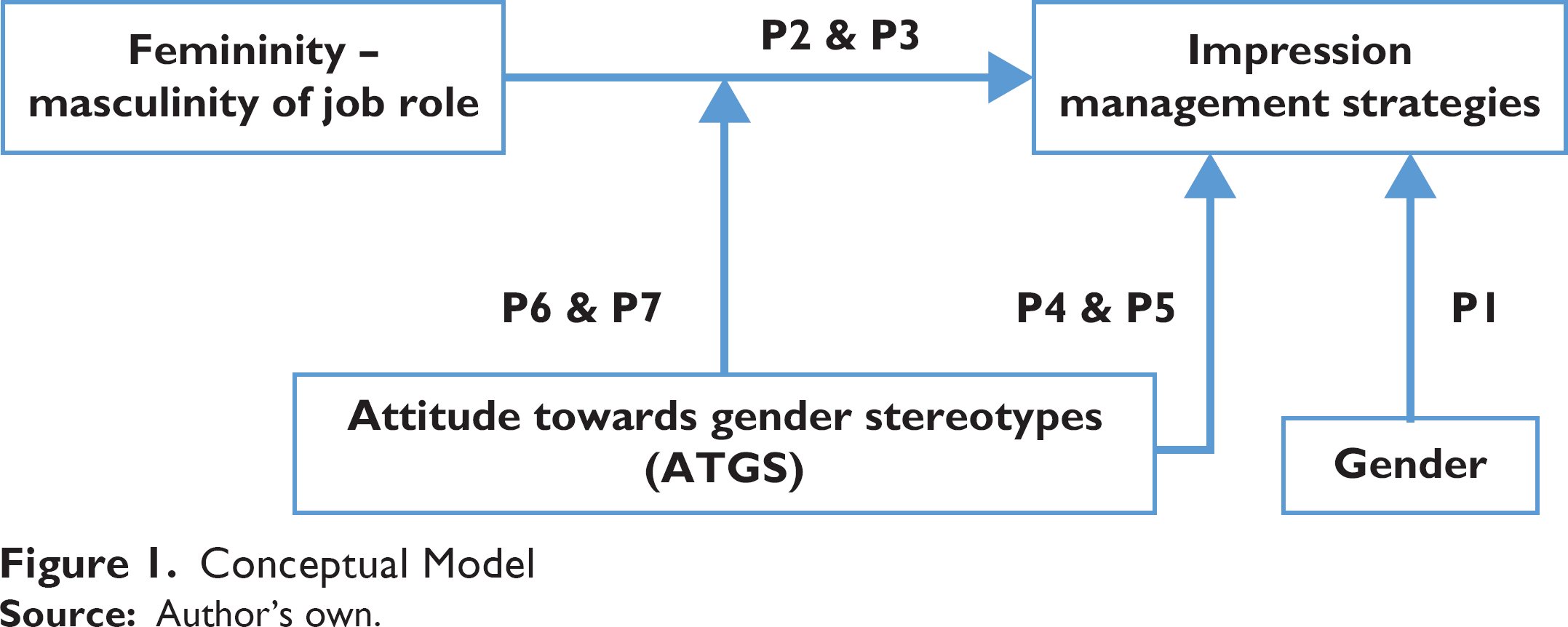
Gender influences the impression management strategies in the Indian context (i.e., proposition 1). The femininity–masculinity of job role influences the impression management strategies used by Indian women in organizations (i.e., propositions 2 and 3). The attitude towards gender stereotypes (ATGS) influences the impression management strategies used by Indian women in organizations (i.e., propositions 4 and 5). The ATGS also moderates the relationship of femininity–masculinity of job role with the impression management strategies used by Indian women in organizations (i.e., propositions 6 and 7).
Theoretical and Practitioner Contributions
This article makes five important theoretical contributions. There is a dearth of studies focusing on impression management strategies used by women in the Asian context. This article extends the research on impression management strategies used by women, particularly in the non-Western (i.e., Indian) context. Second, this article highlights the cultural aspects of power distance and gender inequality as relevant factors in influencing the impression management behaviours of women. Third, this article leverages individual attitudes towards gender stereotypes (ATGS) and social role theory to develop relevant theoretical explanations for impression management by women in India. Fourth, impression management is argued to be influenced by multiple factors, many of which remain unidentified in extant research. This article contributes by identifying the type of job role and attitude towards gender stereotypes as relevant antecedents of impression management strategies used by Indian women. Fifth, the appropriate empirical validation of antecedents is facilitated by simultaneous specification of moderating variables (Edwards & Lambert, 2007). This article highlights relevant limiting conditions (i.e., attitude towards gender stereotypes) for predicting the impression management strategies used by Indian women. This would facilitate the validation of relevant antecedents as well as moderators in future research.
In addition to theoretical contributions, this article also makes useful contributions for practitioners. First, organizational practitioners would benefit by developing awareness about relevant attitudes towards gender stereotypes (accepting versus challenging) among women managers and their consequences. Second, organizations explicitly or implicitly encourage or discourage the use of hard or soft impression management strategies. In organizations where use of hard impression management strategies are not considered acceptable, Indian women with challenging attitude towards gender stereotypes (ATGS) in masculine job roles will find it difficult to function. She would be inclined to use hard impression management strategies but expected to use soft impression management strategies. Similarly, Indian women with accepting attitude towards gender stereotypes (ATGS) in feminine job roles will face challenges in organizations where use of hard impression management strategies is appreciated. These are aspects that need to be considered by organizational practitioners during decisions including policy-making regarding acceptable organizational behaviours, selection based on person-organization ATGS fit, job placement of employees based on person ATGS—job role type fit as well as training employees for use of appropriate impression management strategies. Therefore, this article would be useful for organizational practitioners concerned with impression management practices.
Future Research
This article highlights the dearth of research about impression management strategies of women in India. This accentuates the need to explore the influence of various antecedents and moderating factors for understanding the use of impression management strategies by women. To address this lacuna, a conceptual framework suggesting the requisite conditions for women in Indian organizations to display different impression management strategies is proposed. Future researchers should test these propositions empirically for validation and further theory development.
Also, there is a need to identify other limiting conditions such as the gender of the actor and the target of the impression management. This is particularly important as difference in gender of actor and target would prime the gender identities and hence enhance the influence of gender stereotypes. Development of recent scales measuring agentic and communal forms of impression management (Blasberg, Rogers & Paulhus, 2013) as well as gender stereotypes (Mills, Culbertson, Huffman & Connell, 2012) may be useful for encouraging further research in this area. Future researchers may explore these possibilities to develop a better understanding of women’s impression management strategies.
Conclusion
Gender inequality is a global problem, which is more acute in India (Bhalla & Kaur, 2010; Harrison, Mayer, Leslie, Kravitz & Lev-Arey, 2006; Pringle, Konrad & Greene, 2009). The high power distance culture in India amplifies the effect of these inequalities on everyday life (Aycan et al., 2000; Khatri, 2009). These social inequalities and high power distance influence the impression management strategies of women in Indian organizations. The gender stereotypes (Gardner et al., 1994; Prentice & Carranza, 2002), femininity–masculinity of the job role (Atwater, 1997; Kottis, 1996; Oakley, 2000) and the attitude towards gender stereotypes (Larwood, 1991) are other factors influencing the choice of impression management strategies. In spite of various theoretical explanations, empirical research into gender differences in the use of impression management strategies is inconclusive (Vecchio & Sussmann, 1991). The lack of research on moderators seems to have contributed to this confusion.
This article proposes a conceptual framework based on women’s attitude towards gender stereotypes (Larwood, 1991) as a possible moderator for the choice of impression management strategies by women in Indian organizations. This conceptual framework explains the influence of the nature of job role and woman’s attitude towards gender stereotypes to explicate the choice of impression management strategies by women in Indian organizations. While relevant theoretical support and empirical research evidence have been drawn from related areas, empirical validation of this framework would contribute towards progress in this field of research.
Future researchers also need to identify other limiting factors influencing the impression management strategies used by women. This would help researchers enhance their understanding of the process of impression management. It will also benefit practitioners in making the right decisions to reduce the negative influence of gender inequalities in organizations. This would contribute towards the goal of establishing an egalitarian society.
Footnotes
Acknowledgements
I am thankful to Prof. (Dr) Pavithra Kailasapathy, Suneetha Saggurthi and two anonymous reviewers for their insightful inputs and constructive feedback which helped me improve this article.