



Abstract
How do women navigate and make space for themselves in workspaces where they are not perceived to fit? Women in male-dominated careers often face perceptions of role misfit, leading them to engage in impression management. Using a mixed-methods design, we investigate if women stand-up comedians present as female gendered at work in two settings – one dominated by male performers (N = 257) and one featuring more gender diverse performers (N = 843). Women, as compared with men, presented more gendered in the more gender diverse performer setting and less gendered in the male-performer dominated setting. Using Lorber’s taxonomy of feminisms as a lens, assessment of how women presented their gender further implied greater constraint on women in the male-dominated, compared with the diverse, setting. Our findings support Roberts’ theory of social identity-based impression management (SIM) in the novel context of stand-up comedy, refine the theory by presenting a fifth SIM strategy, and demonstrate how women are able to adapt their feminism to the characteristics of the situation, thus helping secure their position in settings where they may be unwelcomed. These findings have theoretical implications for impression management and feminism, and practical implications for workplace equality initiatives.
Occupational gender segregation is an enduring characteristic of the labor market (Torre, 2017). Despite greater numbers of women gaining access to male-dominated job roles, high attrition rates ensure a largely stable gender ratio in these roles and that entrenched, rather narrow, conceptions of the characteristics of a successful job incumbent persist (England, 2010; Tassabehji et al., 2021; Torre, 2017). Thus, women in male-dominated occupations experience perceptions of misfit and a consequent motivation to manage the image they present at work (Banks and Milestone, 2011; Faulkner, 2009; Kenny and Donnelly, 2020).
Owing to its association with social acceptance and career success, presenting a viable professional image is a key occupational concern (Banks and Milestone, 2011; Bourgoin and Harvey, 2018; Roberts, 2005). Consequently, individuals invest a great deal of energy into managing impressions, and those from marginalized groups – including women in male-dominated professions – face additional pressure to manage social as well as personal characteristics (Bennett et al., 2019; He and Kang; 2019; Heizmann and Liu, 2022; Roberts, 2005).
Investigation into women’s impression management in male-dominated professions is necessary for understanding how women can function effectively and potentially challenge constraints imposed upon them in spaces where they may be unwelcomed or subjugated (Ahmed, 2017; Roberts, 2005). Furthermore, investigation of women’s impression management is helpful for better understanding the state of gender equality. Indeed, the descriptive metrics (e.g., gender ratios, attrition rates, board level representation, pay gaps) and investigation of women’s lived experiences (e.g., discrimination, harassment, barriers to entry and advancement) at work (e.g., Berdahl, 2007; England, 2010; Torre, 2017) commonly used as markers of gender equality arguably have little meaning, if not considered alongside an assessment of women’s impression management within these contexts. Improved metrics and the reduction of negative experiences may be achieved precisely because women do manage their behavior (Mavin, 2008; Mavin and Grandy, 2012; Wright, 2016). Thus, investigation into women’s impression management is needed to understand how women can navigate male power structures, and to gain a more comprehensive picture of the state of gender equality.
Consequently, a rapidly growing literature has explored the ways in which women in male-dominated roles present themselves at work. However, there are some methodological shortcomings within this research that preclude firm conclusions and knowledge gaps to address. With one or two exceptions (e.g., Heizmann and Liu, 2022), studies have utilized self-report methodologies. Yet, while self-report may uncover intention, since self-presentation constitutes a performance for the observer (Roberts, 2005), we contend that direct observation is required to confirm how individuals present. In addition, few studies (e.g., He and Kang, 2019) have assessed women’s presentation in male-dominated roles across situations with differing levels of male domination, which is helpful for confirming the relationship between women’s presentation and male domination. Furthermore, studies have focused overwhelmingly on STEM and professional careers (e.g., Kenny and Donnelly, 2020; Koch et al., 2014; Mavin and Grandy, 2012) and less is known about women’s presentation in male-dominated careers outside these arenas. Roberts (2005) calls for studies of impression management in a range of populations and professions.
Using a mixed-methods design, we undertake observation of women stand-up comedians’ gendered presentation in two settings, one dominated by male performers and one with a more gender diverse performer profile to enable comparison of gender presentation under these varying levels of male domination. We focus on this sample not only because of Roberts’ call for investigation of unresearched professions and dearth of empirical study of women in this and the wider arts (e.g., Bennett et al., 2019), but also because we argue that the performance arts represent an important area for study. Indeed, presenting a role-fitting image requires performance skill. Therefore, study of those most likely to have mastered this skill to the level of an art form should best enable assessment of its subtleties and extremes thus allowing for more comprehensive assessment of existing theory and better understanding of the strategies employed by women.
Furthermore, image cultivation is a long-standing, pervasive and reportedly inevitable phenomenon in the performance arts, to the extent that some successful women report challenges to their sense of authenticity and publicly reject their contrived images (e.g., Cameron, cited in Sherman, 2021). Thus, this arena should provide a fertile ground to further study the extremes. More importantly, if we accept Bertolt Brecht’s assertion that art serves to shape reality, studying performance art can generate understanding of probable ways in which women’s impression management may develop in other careers.
Stand-up comedy represents an appropriate corner of the performance arts for such study. With the growth of stand-up, the late 1980s saw greater numbers of women entering the profession. However, women still only represent 27.4% of UK comedy circuit comedians and work against a backdrop of male norms and widespread belief that women are innately unfunny (Chortle, 2020; Shouse and Opplinger, 2014). Hence, it would be expected that presenting a viable professional image is a key concern for these women, particularly given the precarious nature of many comedians’ employment (Butler and Stoyanova Russell, 2018). In addition, the public nature of comedians’ work across a range of performance settings makes the profession amenable for study in differing situations.
To investigate women comedians’ gendered presentation, we explore if these women present gender differently in male dominated and diverse settings. To gain in-depth understanding, we investigate both the levels and nature of gendered presentation that underlies these levels. We ask:
R1: To what extent do women stand-up comedians present as female gendered 1 in a male-performer dominated versus a more gender-balanced setting?
R2: How do women present their gender in the male-performer dominated versus the more gender-balanced setting?
We find quantitative and qualitative differences in women’s presentation in the male-performer dominated compared with the more diverse setting and discover that by adjusting their feminist stance in line with characteristics of the situation, women can adapt their feminism to secure their position in male-dominated professions (Lorber, 2005; Roberts, 2005). Thus, a key contribution to the body of knowledge is that feminism is not monolithic: we find individual practices of feminism can and, in order to achieve a desired goal, may necessarily be situation dependent. We also extend Roberts’ (2005) theory of social identity-based impression management (SIM). By observing the public enactment of SIM by practiced performers we not only demonstrate the applicability of the theory to a previously unresearched group, but also provide a deeper assessment of the theory resulting in identification of an impression management strategy that is not discussed in the SIM literature. In what follows, we describe the literature that supports our research, present the tripartite study methods and findings, and discuss the contributions of our work.
Professional image construction
In an attempt to improve perceived fit, professional image construction research indicates that individuals act to shape others’ perceptions of them at work (Giacalone and Rosenfeld, 1991; He and Kang; 2019; Roberts, 2005). Broadly, the process involves impression monitoring (assessment of alignment between how one believes they are viewed and the perceived ideal), motivation (drive to increase alignment) and impression construction (constraining their behavior to manage perceived misalignment and present a ‘desirable’ image; Leary and Kowalski, 1990; Roberts, 2005). Traditionally, professional image construction scholars have focused on the management of personal attribute characteristics (Little et al., 2015). Roberts’ (2005) broadening of the framework to include SIM acknowledges the stigmatization that marginalized groups, including women in male-dominated roles, face at work as a result of unfavorable, although reportedly improving, stereotypes and narrow conceptions of the ideal (e.g., Koch et al., 2014). To avoid unhelpful categorization, individuals constrain their behavior and present themselves such that they manage others’ perceptions of their social identities in line with the perceived characteristics of a competent job incumbent (Roberts, 2005).
SIM may be undertaken through either downplaying or maintaining the salience of group affiliation, using four strategies (Roberts, 2005). Downplaying may involve de-emphasizing one’s social identity and attempting to associate with a more accepted group, for example through adopting the mannerisms or discussing topics of concern to the target group (assimilation strategy). Alternatively, individuals who acknowledge their social identities personally may avoid disclosing them to others, for example by avoiding personal topics in conversations or using pseudonyms (decategorization strategy). Maintaining salience is generally aimed at restoring positive distinction to the maligned group and, by extension, the individual (Roberts, 2005). To this end, strategies include emphasizing the positive characteristics of one’s group (integration strategy), for example by discussing these openly with other others and capitalizing on accepted stereotypes (confirmation strategy). Among women, confirmation may involve enacting a mothering or flirtatious style. Thus, individuals could seek to dissociate from their group memberships and blend in or present these and stand out (Lynch and Rodell, 2018; Roberts, 2005).
Characteristics of a given situation impact an individual’s likelihood of engaging in SIM and, if they do so, of downplaying or presenting their social identities. In situations with no clear ideal or ‘norm’, individuals have little need to engage in impression management, unless there is reward for doing so (Roberts, 2005). Thus, in gender diverse settings, women’s behavior is less likely to be constrained by SIM concerns. However, when maleness is the usual or the ideal, women’s behavior may be guided by their SIM strategy. In other words, they may find themselves ‘doing’ gender differently to meet role expectations (Mavin and Grandy, 2012). In such situations, the key determinants of whether women will downplay or present their gender appears to be high demographic homogeneity, particularly among those in power, and perception that divergence from the norm is unwelcomed, with women more likely to disassociate in these conditions (Ely, 1995; Kaiser and Miller, 2001).
Thus, the literature provides examples of women both downplaying and presenting gender. Indeed, Heizmann and Liu (2022) found that entrepreneurs presented idealized feminine identities by leveraging the intersections of their privileged identities, while Harris and Giuffre (2010) found chefs with understanding managers to be open about their responsibilities as mothers; Kenny and Donnelly (2020) reported women using their agency to assert notions of femininity into their IT careers. Yet, dissociation is most often reported. Similar to members of maligned, invisible social identity groups, this may involve choosing not to present as women when possible (Clair et al., 2005; Lynch and Rodell, 2018). For example, by avoiding disclosure of revealing information (e.g., incongruent experiences and forenames) and fabricating a male identity (e.g., use of pseudonym) in written communication (Bennett et al., 2019; He and Kang, 2019).
In face-to-face interactions, disassociation generally involves adopting stereotypically male patterns of behavior and in-group distancing. Indeed, women seeking employment and those who work in male-dominated roles tend to present themselves as equally or more masculine compared with men and display patterns of behavior generally perceived as ‘male’ as a strategy to navigate conflicting sex-role expectations (Mavin, 2008; Sasson-Levy, 2003). Furthermore, internalized gender hierarchies, lead some women who operate within male-dominated power structures to avoid interactions with women colleagues (Mavin, 2008; Mavin and Grandy, 2018; Wright, 2016). Engaging in behaviors that can be seen as feminist is one means that women may employ to reassert their power in situations where they experience such behavioral constraint (Ahmed, 2017; Lorber, 1994).
Toward further increasing understanding of the ways in which women manage their behavior in male-dominated settings, we investigate whether women comedians’ gendered presentation differs across comedy settings. Across three studies, we assess the extent to which women present as female gendered and how they present their gender in a male-dominated versus a more gender-diverse setting. Given the male norm implicit in male-dominated settings, we expect women’s presentation to be more constrained, more managed in the male performer-dominated, compared with the more gender-diverse setting.
Methodology
Context
Comedy originated in burlesque houses and working men’s clubs, which did not provide an accepting audience for women comedy performers and hence were dominated by men (Bore, 2010; Sochen, 1991). Today, shows in dedicated comedy clubs and live performance venues are the main source of employment for most live comedians (Chortle, 2020). Such performances are dominated by men and often promote a male-performer ideal. Indeed, comedy clubs have been described as ‘unnecessarily androcentric’, requiring a more aggressive style than is often associated with women’s behavioral preferences (Shouse and Opplinger, 2014; Weisberg et al., 2011). Correspondingly, comedy centered on women’s personal experience is criticized as not having broad enough appeal in these settings (Dickinson et al., 2013). However, there is evidence that these environments are becoming less male centric. At least two UK comedy clubs have instituted policies ensuring that a minimum of one woman is included on every bill (Healy, 2020) and research in a UK comedy club found that a less aggressive style of comedy was associated with effective comedic performance (Irwing et al., 2020).
Comedians also perform live in alternative settings, including festivals and solo theatre shows, which are less centered around a male ideal and have greater gender diversity among performers (Chortle, 2020; EdFringe, 2019). Indeed, festivals celebrating women’s comedy are being promoted in major cities (Healy, 2020), while arts festivals and theatres provide opportunity for women to perform comedy in situations that are not male dominated. At the former, comedy often takes place alongside other performance art forms meaning that, while festival comedians are majority male, there is greater gender diversity among performers as a whole (Chortle, 2020; EdFringe, 2019). In these settings, women have performed female-gendered comedy to great acclaim. For example, comedians Iliza Shlesinger and Sarah Millican explicitly present a female identity and often deliver their comedy from a feminist perspective.
Design
Toward increasing understanding of the ways in which women present their gender in male-dominated settings, we undertake observation of women comedians’ gendered presentation in a male performer-dominated setting and compare this with women’s behavior in a more gender diverse performance setting. To gain the fullest picture of women’s presentation, our strategy was first to establish the descriptive metrics by quantifying the genderedness of their presentation in the two settings, and then to investigate the nuanced impression management behaviors that underlay the levels of gendered presentation observed. To this end, we undertook three studies. Studies one and two establish the extent to which women present as female gendered in a comedy setting with approximately equal numbers of men and women performers (Study one) versus a setting dominated by men performers (Study two). Next, Study three, assessed and compared how women presented their gender in the two settings, using qualitative methods.
The settings, an arts festival and a comedy club, were selected because while they differ with regard to the level of gender diversity among performers, with diversity being higher at the festival (Chortle, 2019; EdFringe, 2019), they are similar in other important respects, facilitating comparison. Both attract comedians of varying expertise and offer career enhancement opportunities; the festival is attended by industry scouts and critics while the club provides performance footage that comedians can use for self-promotion and has an unmatched online presence.
To assess the extent to which women present as female gendered, Study one compared women’s gendered presentation in their published show descriptions and Study two compared their gendered presentation in comedy club performances with the industry norm (male comedians). However, the different media used in each study necessitated varied methods for quantifying this presentation. The show descriptions, over 99% of which were in the third person, provide a brief show overview, were word limited and abided by standard grammatical rules. Consequently, they were most amenable to frequency counts. Conversely, the comedy performances represent a comedian’s nuanced exploration of themselves and topics of interest to them, were delivered in the first person, grammatically complex, varied in length and challenging to parse into their component parts. Therefore, they required more holistic assessment.
In line with our focus on gender, irrespective of identity content (Becker and Wagner, 2009), both studies employed content neutral measures of gendered presentation. Specifically, we applied He and Kang’s (2019) findings, which identified two types of content neutral, gender revealing communication – self-describing language and gender-specific topics (experiences, hobbies and interests) – used in employment seeking situations. In Study one, raters recorded gendered self-describing language and gender-specific comedy topics. However, given the wide range of topics considered acceptable for discussion in comedy compared with the traditional workplace, the gender-specific topics recorded in Study one were not restricted to experiences, hobbies and interests but also included such topics as politics and social observations. In Study two, raters assessed gendered presentation using an adapted psychometric scale through consideration of the topics covered, how comedians self-described or, given the reduced need for self-description in face-to-face situations, how the rater would describe the comedian’s onstage persona.
To investigate how women presented their gender in the two settings, media from Studies one and two were qualitatively investigated (Study three). To facilitate methodological integration, one rater with both quantitative and qualitative expertise took part in all three studies (Bryman, 2007). The overviews below provide details of the methods and results of each study. The quantitative data that support the findings of this study are openly available in OSF at https://osf.io/s6uby/?view_only=ef5356beab4c4455b1008faf6d602342. The quantitative analyses were conducted in R 4.0.2 (R Development core team, 2008).
Study one
In Study one, we focused our investigation at the 2019 Edinburgh Fringe Festival. The Fringe usually runs annually for three weeks in August offering comedy, dance, theater and music shows. Performers from any of these areas can book to perform at the Fringe, without requiring an invitation to do so. While Fringe comedy is dominated by male comedians, approximately equal proportions of men and women perform at the Fringe, across performance categories (EdFringe, 2019).
Procedure
Edinburgh Fringe performers are invited to provide a show description of up to 250 words to the Festival’s official bookings website – edfringe.com. Show descriptions follow a reasonably uniform format of introducing the comedian, outlining their comedy topics and, sometimes, presenting previous reviews. The show descriptions depict how performers choose to present themselves and, given the word limit, arguably what they consider the defining, marketable characteristics of themselves and their show. We searched the 2019 Edinburgh Fringe Festival website for single performer comedy shows and identified 843 comedians’ descriptions of their show for inclusion in Study one.
Gender was recorded by two raters based on the use of gendered language referring to the comedian, registered name and profile photograph within each show listing. There was no instance where any of these criteria were contradictory within a single show description. Gender ratings were verified by consulting Chortle.com, the comedy industry’s most comprehensive database of comedians, which listed 43.3% of those in our sample, exceeding Tractenberg et al.’s (2010) verification criteria. Raters achieved 100% agreement on gender across the descriptions and 100% agreement with Chortle.com. To assess gendered presentation, two raters worked independently to record gendered self-description and gender-specific topics within the show descriptions.
Sample
There were 242 descriptions that featured comedians who we identified as women (coded as 0) and 601 comedians who we identified as men (coded as 1). This represents a very slight overrepresentation of women (28.7%) comedians compared with industry figures at the time (27.4%; Chortle, 2019).
Measures
Gendered self-description
The number of same-sex gendered nouns and pronouns used to refer to the comedian were recorded. Inter-rater reliability was calculated via Krippendorff’s alpha with a 1000 bootstraps (Hayes and Krippendorff, 2007). The measures showed good reliabilities for gendered nouns (α = .750) and pronouns (α = .933).
Gender-specific topics
Gender-specific topics were defined as those that related to the experience of a particular gender that would unlikely be experienced by individuals outside of that gender and hence revealed gender. The number of same-sex gendered topics previewed in each show description was recorded. For example, experiencing male-pattern baldness was coded as same-sex gendered for men, while experiencing cervical screening was coded as same-sex gendered for women. Inter-rater reliability was good for coding of same gender topics (α = .767).
Analytical strategy
We rely on ordinal association measures for most of our analyses as most values were constrained between 0 and 6 (Somers’ D) (Siegel and Castellan, 1988; Somers, 1962). Somers’ D can range between -1 and 1, like Pearson r. We plot our data where relevant via treemap figures (Wilke, 2019).
Results
Gender differences in self-description: The use of gendered nouns and pronouns
Men were less inclined to use gendered nouns to refer to themselves than were women (Somers’ D = -.148, 95% confidence interval (CI): -.212 to -.084; Figure 1). However, there was no meaningful association between gender and use of gendered pronouns (Somers’ D = -.034, 95% CI: -.074 to .006).
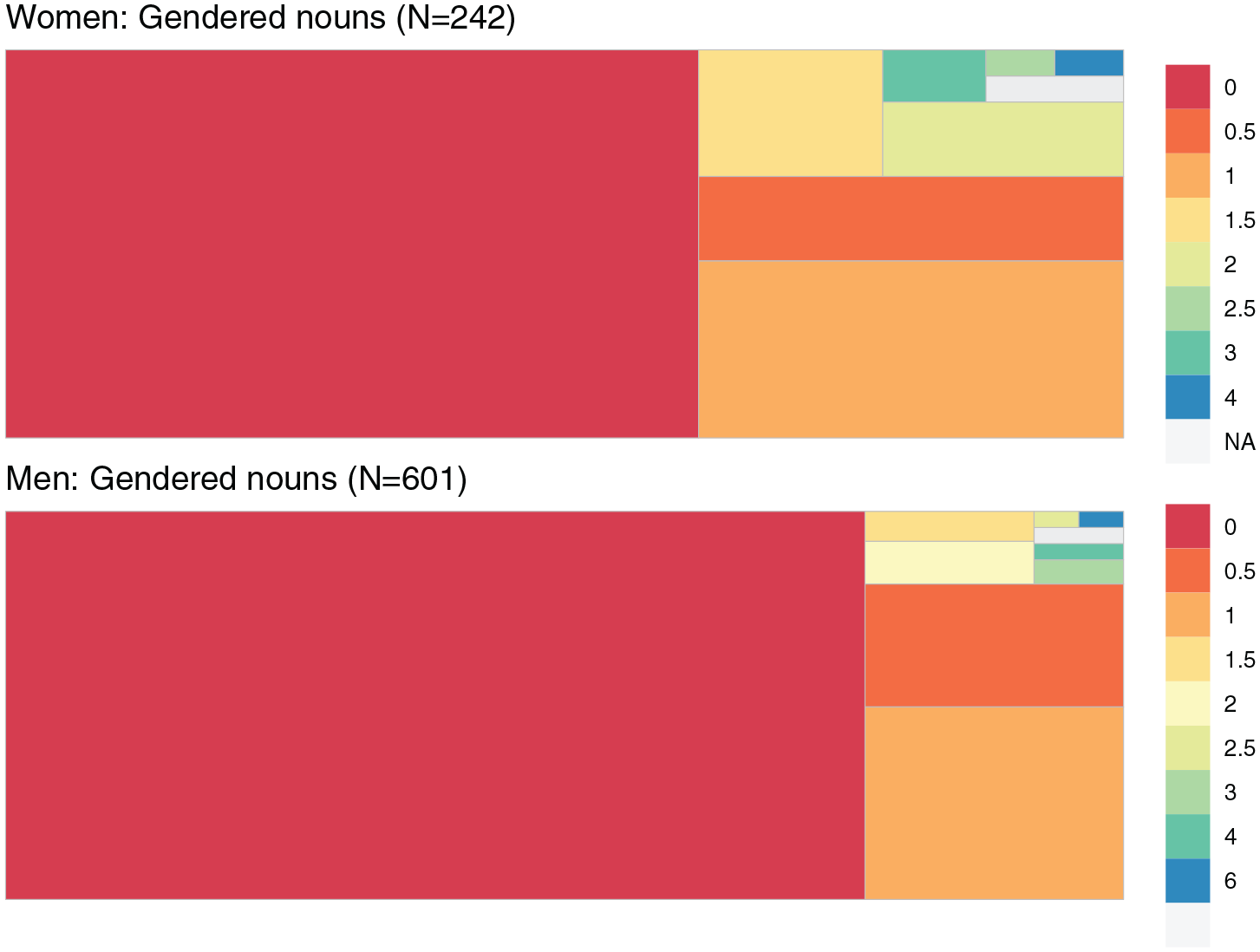
The relationship between gender and using gendered nouns to refer to oneself. The surface area corresponds to the frequency of a category.
Gendered topics: The discussion of same gender topics
Men were less inclined to discuss same gendered topics than women (Somers’ D = -.357, 95% CI: -.260 to -.454; Figure 2).
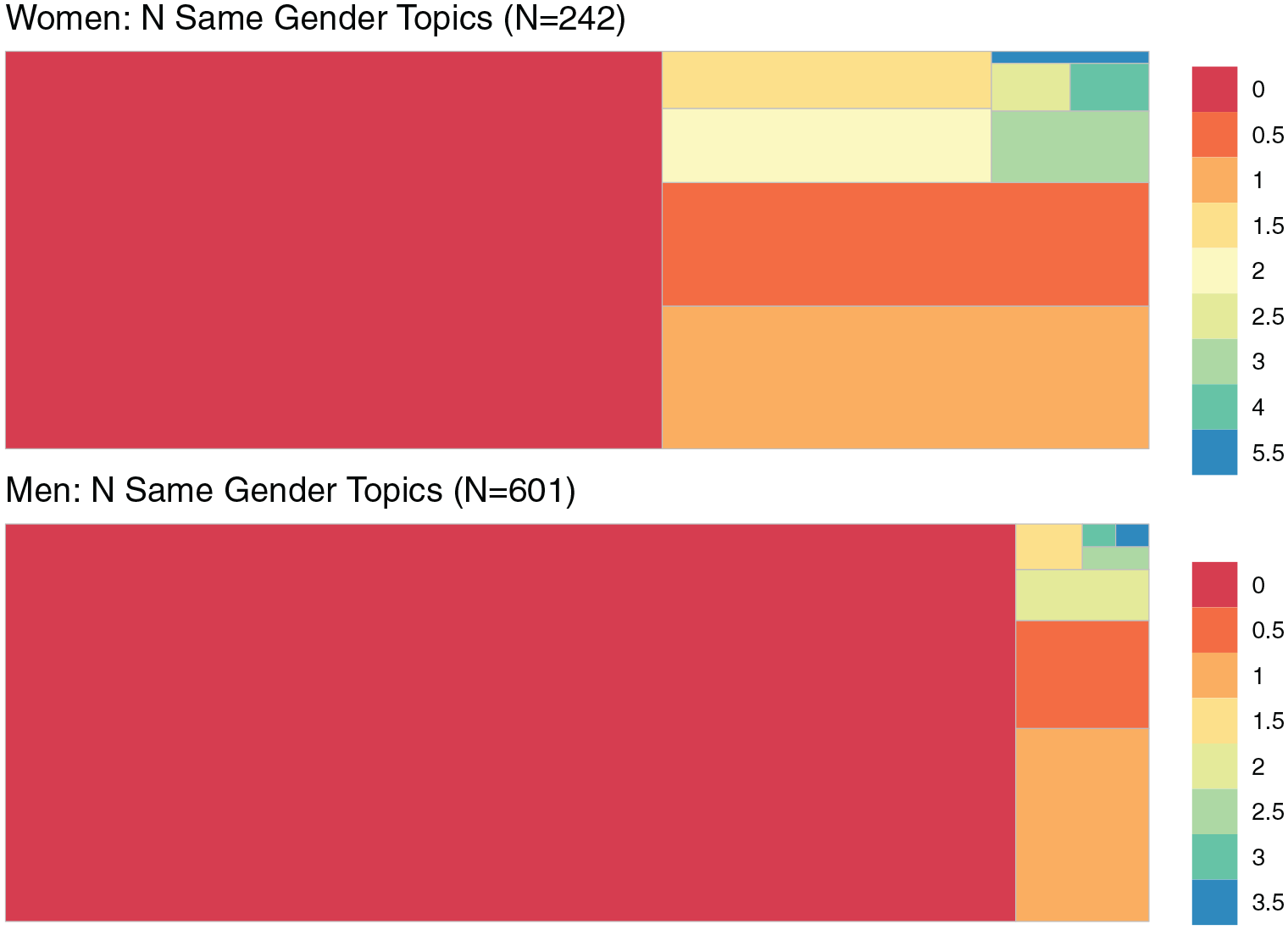
The relationship between gender and same gender topics. The surface area corresponds to the frequency of a category.
Discussion Study one
Overall, women presented as more female gendered than men did male gendered at the 2019 Edinburgh Fringe Festival, thus indicating comparatively high levels of gendered presentation among this group of women. One explanation for this, consistent with the SIM model, is that owing to the greater gender diversity among performers, women were not constrained by a male-biased role ideal or norm in this setting. The increased level of gendered presentation among women, compared with men, is somewhat surprising and may imply reward for increased female genderedness (Roberts, 2005). Rewards might be psychological such as reactance related relief (Brehm, 1966). Alternatively, given the commitment of television executives – who use the Fringe as a recruitment ground – to increasing representation of women on television, rewards may be more tangible (Thorpe, 2014). It is possible, then, that women may use their show descriptions, and likely subsequent shows, to advertise their womanhood in the hopes of attracting media interest.
Study two
Within Study two, we focused our investigation in one of the UK’s most successful comedy clubs and most prolific producer of weekly shows and online content. The comedy club is open five nights a week, running multiple shows at the weekend. Typical of most UK comedy clubs and reflective of the gender split in comedy, most performers are male.
Procedure
We identified 257 unedited recordings of comedians performing in front of a live audience between 2018 and 2020 posted by the comedy club on their YouTube channel for inclusion in our sample. Although publicly available, we sought permission from the club to view the recordings for research purposes and confirmation that the footage had not been altered or edited, which the club confirmed.
Two raters recorded gender based on the use of gendered language referring to the comedian, registered name and appearance. There was no instance where any of these criteria were contradictory within a single recording. Gender ratings were also verified by consulting Chortle.com, which listed 48.6% of those in our sample, exceeding Tractenberg et al.’s (2010) verification criteria. Raters achieved 100% agreement on gender identity across the recordings and 100% agreement with Chortle.com. These two raters also viewed the recordings and assessed gendered presentation within the performances.
Sample
There were 80 recordings that featured comedians who we identified as women (coded as 0) and 177 featured comedians who we identified as men (coded as 1). The length of the recordings for men and women (mean lengths were 9.20 and 8.99 minutes respectively) were not significantly different (t(256) = -.454, p = .650).
Measures
Gendered presentation
As we were not able to identify an existing identity content neutral measure (Becker and Wagner, 2009), we adapted the Traditional Masculinity-Femininity (TMF; Kachel et al., 2016) scale to assess the genderedness of comedians’ presentation as revealed through their comedy topics, self-description and persona. The TMF comprises six items with a seven-point response scale (1 = very masculine, 7 = very feminine), demonstrates high internal consistency (α = .94) and a clear factor structure (Kachel et al., 2016). We made minor alterations to the items to make the scale suitable for observer rating. In addition, the response scale anchors were replaced with ‘very female’ and ‘very male’, thus enabling gendered but non-traditionally feminine/masculine presentation (e.g., discussion of women’s intimate health issues, feminism, being a ‘new age’ man) to be rated toward the extreme ends of the rating scale. In the current study, the internal consistency was high (both raters: α = .98). Inter-rater reliability was excellent, Krippendorff’s alpha = .97. Since both raters were women, which could impact subjective ratings of genderedness, as a means of ratification a man who is an industry expert (not involved in any other aspect of the study) undertook the ratings of 25 men and 25 women comedians (Tractenberg et al., 2010). Inter-reliability among the three raters was excellent, Krippendorff’s alpha = .98. Prior to analysis, ratings of the men comedians on the adapted TMF were recoded so that a high score denoted high levels of same-sex gendered presentation for both men and women. We plot our data where relevant via a box violin plot (Wilke, 2019).
Results
Men comedians were rated as presenting themselves as male gendered (M = 5.69, SD = .48, one sample t-test: t(175) = 46.79, p < .0001) and women comedians as female gendered (M = 5.40, SD = 0.55, one sample t-test: t(79) = 22.79, p < .0001). Men comedians were rated as presenting themselves more gendered than women comedians (Figure 3; t(135.61) = 4.043, p < .0001, Cohen’s d = 0.58).
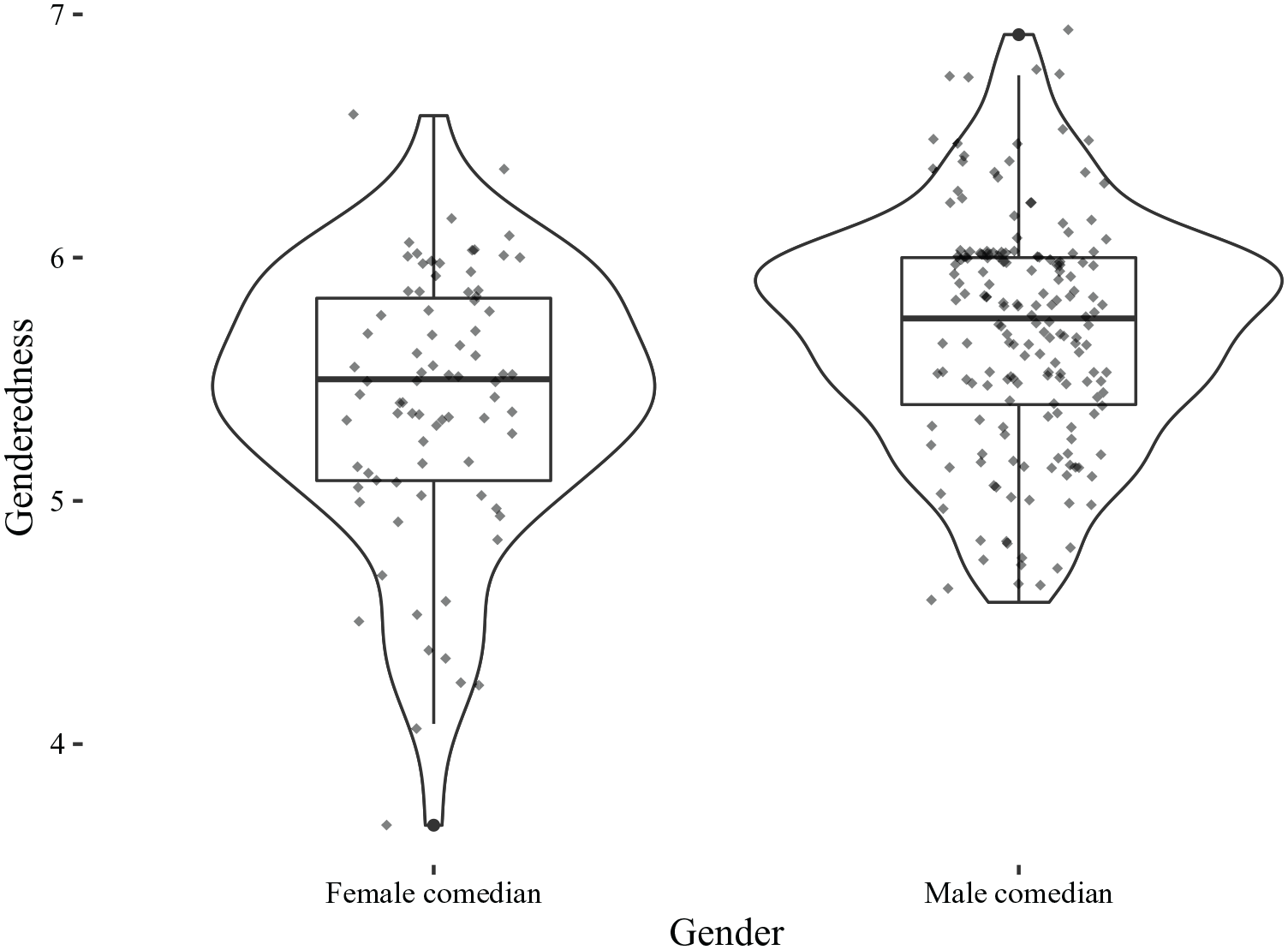
Box violin plot comparing men and women comedians on genderedness of self-presentation. This plot combines a box plot with a distribution.
Discussion Study two
Women presented themselves as female gendered on stage. However, in contrast to Study one, they were significantly less female gendered in their presentation than men were male gendered indicating comparatively low levels of female gendered presentation. One explanation for this, consistent with the SIM model, is that the boundaries of the ideal and norm may not allow for very high levels of female gendered presentation, requiring women to engage in impression management and thus constrain their behavior (Roberts, 2005). This explanation is in line with previous assertions that comedy clubs can be androcentric and less accepting of female-driven comedy (Dickinson et al., 2013; Shouse and Opplinger, 2014).
Study three
The qualitative portion for this project, Study three, proceeded after the quantitative analyses identified difference in the extent to which women comedians presented as gendered, compared with men, across the Fringe catalog entries and comedy club sets and sought to identify how women presented as female gendered. We applied an abductive post-coding strategy (Augustine, 2014) to tease out interpretation of patterns, as opposed to the identification and verification of patterns sought with the quantitative portion of this project. The purpose of abductive qualitative work is not to find ‘the’ answer; rather, it is an ongoing process in search of mystery (Alvesson and Kärreman, 2007) that allows for multiple possible interpretations. Our interpretation was that context, tone and exposition (Roulston, 2001) of the performed sets were crucial to understanding how women present gender. The common thread of how, was a clear feminist intent in the delivery of the material.
With this realization, two members of the project team analyzed the entire data set for Study three using Alvesson and Kärreman’s (2007) method of mystery construction. This approach uses existing theory as an analytic lens, analyzes empirical material through that lens, and applies researcher experience as interpretive tool. Thus, the theoretical lens we applied is Judith Lorber’s (1997) categories of the gendered social order feminisms.
There is no monolithic definition for feminism and there are many schools of feminist thought (Mackay, 2015). Nevertheless, the unifying thread tying these schools together is a recognition of a gender-unequal society with a broad commitment toward a society based on gender equality (Lorber, 1997/2010; Mackay, 2015). To provide analytic structure to this diverse theoretical landscape, Lorber (1997/2010) clusters feminisms by their assumptions about inequality (their theories of gender inequality) and their propositions to pursue equality (their politics). Lorber (1994: 6) argues that ‘[t]he social reproduction of gender in individuals reproduces the gendered societal structure; as individuals act out gender norms and expectations in face-to-face interaction, they are constructing gendered systems of dominance and power’. Feminism, she contends, deconstructs these gendered systems. Because Lorber’s classification system provides a framing structure for understanding how various feminist theories operate, it is particularly useful as an exploratory analytic lens for the individual presentations of women comedians. As a result, the qualitative component of our study pinpoints the multiplicity of feminisms and how gender is presented.
Lorber offers three categories of feminisms: gender reform, gender resistant and gender rebellion. Gender reform feminisms capture ideas of equality and individual rights promoted in first- and second-wave feminisms and include liberal, socialist and postcolonial feminisms (Lorber, 1997/2010). These approaches to feminism generally accept gendered social orders but seek to rid them of discrimination. They hold that men and women should have equal freedom to live their lives as they choose with equal recognition and reward. Gender resistance feminisms (such as standpoint) began to emerge in the 1980s and reject the balancing and mainstreaming of reform feminisms. Resistant feminists expose and disrupt patriarchy and contend that women’s voices and perspectives should be privileged. Gender rebellion feminisms – such as postmodern, intersectional or social construction feminism – critique and dismantle structures of domination by rebelling against unequal systems. Rebel feminists deconstruct gender binaries and challenge the complicity of ‘doing gender’ in re-creating systems of oppression.
Our analysis process was to have the two qualitative experts on the team independently review samples from Study one and Study two to interpret the show descriptions and comedy sets with respect to Lorber’s three categories of the gendered social order feminisms. Before beginning the assessment, they reviewed how Lorber interpreted each category of feminism to ensure they understood the theoretical framing in the same way. After assessing each description and comedy set according to gender reform, resistance or rebellion, the researchers talked through their analyses to reach a common interpretation of the empirical material on the few data points where their independent evaluations differed (less than 10% of the sample). Although counter-intuitive to epistemological foundations of qualitative research, we did quantify our analyses to help provide a bridging mechanism to the quantitative portions of our study.
Sample
We initially drew on women who appeared in the top quartile of ratings from Study one and Study two. For Study one, we ordered the 242 women by the number of female gendered topics included in their show description and alphabetically when the number of topics was equal; the top 25% was N = 60. However, this did not represent a natural cut-off since 34 descriptions included more than one topic and 37 included one topic. One of those descriptions was no longer available for analysis. To achieve the natural cut-off, we opted to include 10 additional show descriptions in the sample for an updated total of 28.9% (N = 70). For Study two, we ordered the 80 women according to the adapted TMF scores and analyzed the top 25% (N = 20) comedy sets.
Findings
Performed presentation
In the comedy club sets, all of the women in our sample presented as feminist. However, they did not incorporate the full range of feminisms. Gender reform feminism was most common with 18 of the 20 employing this presentation strategy. Three women took a gender resistant approach (including one woman who employed both gender reform and gender resistant strategies in her performance), and no women used a gender rebellion approach. In this section, we present data from two of the comedians to highlight how gender reform and gender resistant strategies manifest in the comedy club. To capture the tone and nuance of the sets, we employ transcript conventions from conversation analysis (Roulston, 2001; see Appendix).
Gender resistance
Two of the three women who incorporated gender resistance used their ethnic or religious heritage as a foil to highlight gendered inequities such as comments about wearing a hijab or assumptions made about countries of origin. Two used interactions with their children and the experiences of motherhood as a source for encounters with micro-aggressions (Sue, 2010). All three highlighted media presentations of women. One used such representations as the centerpiece of her set, critiquing the way women artists are represented as strong and empowered when the lyrics of their songs and the clothing they wear objectify them. She suggested there was more exploitation than empowerment of women in the media.
In this performance, the comedian exposes and disrupts hegemonic norms about women and sexuality; she directly challenges assumptions of what constitutes empowerment for women. She begins the gender resistant portion of her set by reflecting on watching music videos with her 11-year-old daughter and the challenge it presents:
There’s a lot of arse in music videos. A
In this portion of the set, the comedian is setting up the hegemony of sexuality in entertainment and its influence on young girls.
She thought to counter this hegemonic effect, she would make an effort to show her daughter some women artists because ‘they’ll be empowered’. Her chosen artist was the group Little Mix; however, she questions their actual empowerment and the extent to which they have any voice in their artistic production. She continues:
‘[Vigorously gestures making a ‘V’ below her waist and looking downward]
After describing the inherent practical problems of several of the groups’ costumes, she says, ‘I
She lowers her voice register, shakes her body, and raises a fist:
We got the
She quotes the lyrics of the song to make her point and then says:
That’s like the whole fuckin’, it’s this (.), it’s this
This is her peak resistant moment where she disrupts patriarchal constructions that women’s power is manifested through appearance and sex. Here, this comedian integrates (Roberts, 2005) by appealing to the masculine audience by discussing sex, but resists assimilation by simultaneously critiquing the way women are framed as sex objects.
Gender reform
The remaining videos, all of which incorporated a gender reform approach, had a wide variety of topics. The gendered topics in their sets included sex and sex acts, relationships, marriage and divorce, motherhood, menopause, genitalia, giving birth, body hair, age, wage gaps, and more. The common thread in these sets was women unapologetically asserting their individual rights to say what they wanted to say and how they wanted to say it. This is the essence of gender reform theories of feminism. Included in this group of comedians were women whose sets included raunchy sex jokes, as if they were attempting to be accepted as ‘one of the boys’ to fit into the male-dominated scene. There was no critique of the context, culture or system with these sets; there simply appeared to be an attempt to be ‘interchangeable’ with the type of ‘shock’ content many men delivered.
In one such set, the comedian challenges our ideas about women and sexuality, but she does so in a manner to simply claim the right to talk about her sexuality. Asserting the equal right to talk about topics typically reserved for men is a classic gender reform strategy. Here, the comedian sets herself up as a motherly middle-aged figure – wearing a blouse with a pussy-bow and saying she is retired and presenting the set on behalf of her son. Her presenting style is blasé, with the occasional chuckle herself when a joke ‘hits’ with the audience. Despite having opened the set with a description of a failed sex role play encounter with her husband of 26 years, she sets up plausible deniability that it was her decision to build a set around sex-talk by saying, ‘Now my son likes to talk about sex on stage.’ Nevertheless, she uses sex and her own experiences with sex as the crux for her set.
She talked about how she was better at using sex for attracting a partner than she was at employing other ‘traditionally female’ strategies. She said:
Now I [hhh-], I think another reason I didn’t have sex when I was a teenager was because my mother said to me, um [-hhh], [changes tone of voice to represent an instructive tone] the way to a man’s ↑heart (.) [eyes widen, looks directly at audience] is through his stomach [shakes hand affirmingly] (.) [squints eyes and looks down] [hhh-] and I’m not too good in the ↓kit::chen. [looks up] ↑But eventually I found out if you go [looks down and points toward floor] down about, uh, (.) six (.) inches [very serious face]. (1.0) It’s a lot quick:er. (2.0) [shrugs] More effective, (.) and, uh [hhh-], you don’t have to stand ↑up for so long. [looks down] (3.0).
With her ‘son’s’ notebook in hand, she opens the notebook looks down and says [reading]:
Now, um [hhh-], (.) uh, it says here [hhh-], [questioning tone] ↓B::J [hhh-]. And, um, (2.0) when I [hhh-], when I first saw that and heard my son, I [hhh-], I thought it was going to be about (.) Bor::is John::son or (.) or bun::gee jumping [hhh-] (.) and I was (.) I was disappointed on both counts. (.) [-hhh] um, ↑Now, my husband, Roger, he (.) he does like the
She then does a short bit in which she ‘misinterprets’ her son’s annotations about the next topic of ‘anal’, followed by her closing joke:
And, um [looks at watch], oh my goodness, yes, it’s ten past ten. I think Roger’s finished cleaning the oven by now. (2.) ↑Thank you very much, you’ve been ↑lovely [bows and nods] . . .
The strength and tone of her voice in her closing ‘thank you’ to the audience reveals that the soft, demure tone she used throughout the set was an act, likely designed to provide more shock effect that a ‘nice older woman’ was so direct in talking about sex. She distances herself from assumptions about the way (older) women should behave by shocking the audience with her frankness that would be expected of a man (like her son); yet, the way she framed women was as stereotypical within a ‘gendered’ order – demure and helping (her son), obliging (her husband) or manipulating (her early sexual partners and her husband) men. Thus, we categorized her as engaging in gender reform feminism. We see this as Roberts’ (2005) assimilation because she adopts typically masculine orientation to topics while still fulfilling other gendered expectations of women; she tests the waters of recategorizing herself.
Written presentation
The majority (N = 171) of the 242 show descriptions written by women for the 2019 Edinburgh Fringe Festival were topically gender neutral. Of the 70 show descriptions women wrote that were analyzed in Study three (all of which included a gendered topic), 66 covered the full range of Lorber’s feminisms. Some explicitly incorporated more than one type of feminism in their descriptions. We identified 46 comedians who employed gender reform feminisms for their show descriptions; 15 who incorporated gender resistant feminism; and seven used gender rebellion feminism. Four of the women’s descriptions were feminine, but there was no discernible feminism.
An example of a feminine, but not feminist, show description would be: Risette Adamson
2
presents [show name], a romp into femininity, idiocy, foxes and omelettes. Risette Adamson is a Canadian-bred, [UK]-based comic who's winning hearts across the country with her unique style of offbeat observations, and surreal storytelling. Adamson is accessibly odd, memorable and not one to miss. [Award] New Comedian finalist. [Award] regional finalist. ‘Hugely watchable’ (Review). ‘Brilliantly offbeat’ (Review).
This comedian and others who adopted a simply feminine approach conform to stereotypes of being a woman, leveraging ‘femininity’ to appeal to gendered expectations of women (Roberts, 2005). This is consistent with the positive distinction strategy of impression management associated with confirmation.
Another comedian employed a gender resistant approach. In this description, the comedian raises the problem of verbal micro-aggressions against women’s appearance: Absolute powershed and regular host of [a popular podcast], Olivia Findley explores her big strong strength. Have you ever watched a feminist try and take ‘Buff’ as a compliment? It’s like watching a snake eat but funny. In preview, Buff was nominated for [Best Show Award]. You've seen Liv in BBC sitcoms . . . and [an] Award-winning drama . . . . She's also in forthcoming feature films . . . . She writes for [a popular television show]. ‘Consistently hilarious’ (Review). ‘Smarts on her sleeve, great’ (Review).
Gender resistant comedians like this did not shy away from their identities as women and feminists. This comedian raises her feminism as a strength with a rather gruesome, and masculine, analogy of a snake eating. This juxtaposition of feminine and masculine with an educative orientation aligns well with Roberts’ (2005) positive distinction strategy of integration.
Gender reform, the most common strategy employed, is exemplified in the following show description: Anne used to be fun. By fun, she means drunk. She’s been sober for 16 years but still misses the buzz of getting rat-arsed, slaughtered and shit-faced. Is it even possible for an uptight British woman to have fun without being drunk? Obsessed with High Spirits is a frank and funny show about anxiety, sex and booze – and nearly vomiting over Noddy Holder. In 2018, Anne reached the final of the semi-prestigious national competition of [an award]. ‘Comedy gold. . . She holds the room in the palm of her hand’ ***** (Review).
Like many other women performing gender reform feminism, this comedian uses a shock strategy approach by projecting a more stereotypically masculine delivery. This distances her from societal expectations of how a woman should behave, consistent with the recategorization strategy of assimilation (Roberts, 2005).
The 171 women whose show description content was not incorporated into the qualitative study are also important to highlight here. Their invisibility sheds light into the way that feminisms inform the operationalization of impression management. By submitting a show description devoid of topics that referenced their stigmatized social group, these women decategorized their gender (Roberts, 2005). Their shows were essentially genderless and, therefore, could potentially provide insights into how to avoid reproducing gender binaries.
Gender rebellion strategies were employed only in the Fringe descriptions. There were only six comedians who used this strategy. Those who employed this strategy were clear in taking on the underlying power structures that reinforced patriarchal privileges. In her Fringe show description, one comedian said: Person of interest on [three popular comedy television shows] squats and delivers a show about the extreme sport of womanhood. Birthing her vision of the future before your eyes, how she hopes it will be . . . free from class war, poverty and consent issues. Also dragging the overdue spectre of what it is more likely to be: t-shirt feminism, Jordan Peterson and corporate wokeness from her loins. All without an epidural. ‘It's jaw-droppingly remarkable how much ground she covers, how funny she is, how intelligent her attacks are’ ***** (Review).
The women who took a gender rebellion approach engaged in impression management by challenging the patriarchal systems, which define the ideal – namely men. Indeed, they defied the ideal and refused to accept categorization as a stigmatized ‘other’. This approach to impression management was distinctly different than the strategies offered by Roberts (2005), which are dependent upon individuals acknowledging the boundaries of their marginalized categories and managing them. Through their defiance, these women rejected the categorization premise upon which SIM is based; they demanded to be what we call uncategorized.
Performed and written presentations
Because our findings suggest that context plays a role in the ways women choose to present gender in their comedy performances, we looked to see if there were women who performed both at the Fringe and at the comedy club. There were 15 women comedians who appeared in both of our samples and 12 of the 15 used different feminist performance strategies across the two contexts. Once again, all four forms of feminism (none, gender reform, gender resistant and gender rebellion) appeared among the 15 women’s Fringe Festival written presentations and only two forms appeared among the club sets (gender reform and gender resistant). Of the 15, all of whom performed feminist comedy at the comedy club, 10 had no discernible feminism in their blurbs for Fringe Fest. This included the three women who used gender resistant feminism at the comedy club. Only two of the 15 showed more ‘radical’ forms of feminism in the written blurb than they performed at the comedy club.
That all forms of feminism were observed within our sample of 15 at the Fringe but only two forms were apparent in their club sets indicates some constraints on women at the comedy club, compared with at the Fringe, resulting in a narrowing of how they present gender (to two out of four categories). This is in line with our contention that the greater range of performers at the Fringe offers women the opportunity to perform and present without fear of impunity. However, the male-performer domination in the comedy club appears to trigger impression management resulting in a narrowed approach to how gender is presented.
Summary
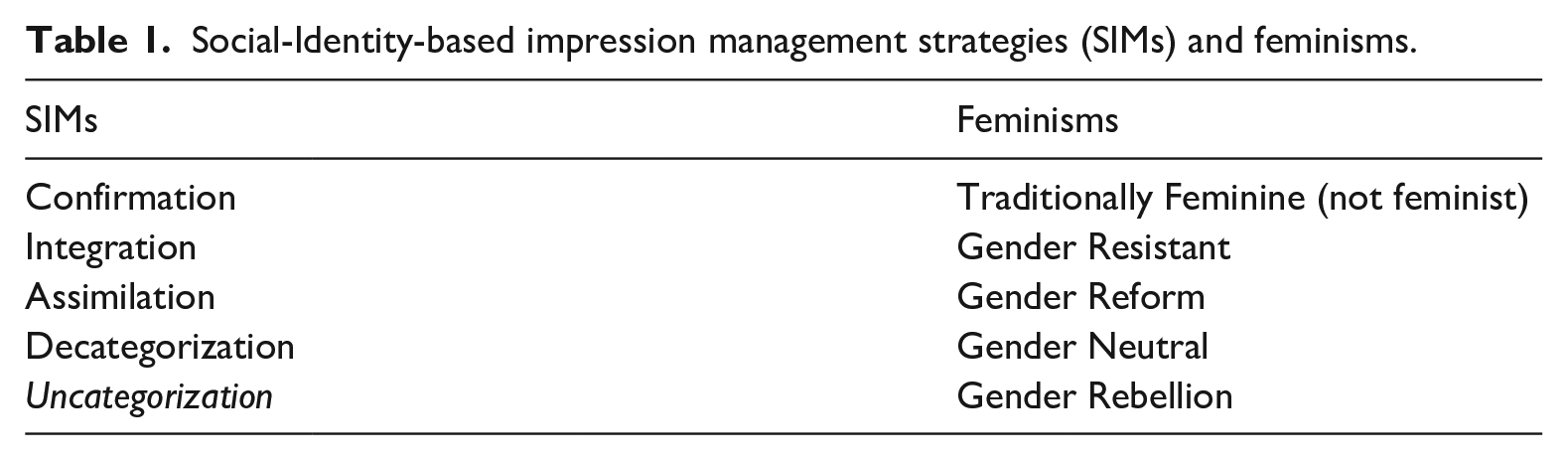
Our qualitative analysis revealed that the mystery worthy of exploration was the way feminisms were (or were not) employed in operationalizing how women presented. In presenting as gendered, or not, women comedians engaged in a full range of impression management strategies as defined by Roberts (2005). These impression management strategies were consistent with the forms of feminisms the women employed. As depicted in Table 1, the comedians exhibited a form of impression management. When these comedians’ impression management was viewed through a lens of feminisms, however, the women exhibited a form of impression management not previously identified by Roberts (2005).
Social-Identity-based impression management strategies (SIMs) and feminisms.
General discussion
Our findings indicate that women comedians present as female gendered during the course of their work and that they do so by enacting different forms of feminism. However, the extent of their gendered presentation and the feminist form it takes appears to vary in line with the male-performer domination in the situation. Thus, our approach of comparing two settings with differing levels of male domination serves to confirm findings from single setting research that a male norm impacts women’s presentation (e.g., Kenny and Donnelly, 2020; Koch et al., 2014; Mavin and Grandy, 2012). We find that constraint, likely stemming from attempts to manage impressions, is key to understanding women’s behavior in male-dominated settings. Women’s behavior appeared more constrained, more managed, in the male-performer dominated setting both in terms of the (lesser) extent to which they presented as female gendered and the (narrower) range of feminisms enacted, compared with the more gender diverse performer setting. Our findings therefore support Roberts’ (2005) model, indicating a broader norm and likely similarly broad ideal, or lack of one, allows for less managed and hence greater freedom of behavior, while a narrow norm and likely ideal requires individuals to engage in impression management, which can constrain them.
Indeed, both the lower levels of gendered presentation and the categories of feminism displayed in the comedy club are indicative of impression management attempts. Specifically, presenting as less female gendered and performance of gender reform and resistant feminism that involve behavior that may be considered masculinized (Madison et al., 2014) appear well suited when there is male-biased ideal. By contrast, a feminine performance in the absence of feminism could indicate an acceptance of women’s lower status (van Breen et al., 2017) in environments where being a man is considered the ideal, likely resulting in the comedian failing to assert their right to perform and hence undermining their control over the room. Conversely, rebellion feminism would likely be seen as too threatening in a male-normed setting (Dickinson et al., 2013; Shouse and Opplinger, 2014) and thus serve as an obstacle to effective job performance.
These findings have implications for both feminist and SIM theory. They indicate that neither feminism nor social identify based professional image are monolithic. Rather, we find feminism can and, in order to achieve a desired goal (in this case securing a woman’s position in a male-dominated setting), may necessarily be situation dependent. Similarly, our findings indicate that professional image may require adaptability across situations. Indeed, consideration of the women who performed in both settings indicates they adapted their feminist style in line with what would be ‘allowable’.
In addition, the parallel between our quantitative and qualitative findings, that constriction of both social identity (gender) and the primary associated political identity (feminism), occurs under the same conditions suggests that gender organizes behavior along broader lines than just gender identity itself. Indeed, to gain a fuller picture of women’s professional image construction, our findings suggest that management of social identity should be considered alongside that of the associated political identity. Given the apparent appropriateness of the types of feminism used, particularly in the comedy club, this indicates the importance of political activism for ensuring maligned groups can function effectively in challenging situations.
Further, by using a feminist lens to interpret how comedians present their gender, our findings refine Roberts’ (2005) theory by uncovering a fifth strategy for managing social identity – uncategorization. With this strategy, the women simply refused to accept the patriarchal system that established gendered binary categories and the impression management driven by societal norms that attach to gendered binaries; they defied categories. As they dealt ‘with norms that tighten the more we [women] fail to inhabit them’ (Ahmed, 2017: 245), these women presented themselves as what Ahmed called ‘feminist killjoys’. This new strategy is important for how we understand impression management because it highlights a way that marginalized groups can simply reject the categorization constraints that other forms of SIM demand.
Limitations and future research
Our mixed-methods approach offers significant analytic strength by providing a fuller picture of women’s presentation that would not be observable through a single method design. The quantitative metrics provide the extent to which women’s presentation is gendered while the qualitative approach provides nuance to the nature of that presentation that is not captured by descriptive metrics alone.
We consider comedians in two situations; however, the crossover of comedians in the two and differences between the stimuli observed meant that a more robust longitudinal design was not possible with the quantitative data. Future research could attempt to investigate the extent to which women adapt their presentation across multiple situations over time. In addition, the show descriptions (Study one) encapsulate comedians’ marketing strategy rather than their onstage behavior. Therefore, though the comparison of women to the benchmark group of men allows us to deduce women’s relative level of gender related impression management compared with the comedy majority group, we cannot be certain that the level of disparity observed is similar to that displayed on stage at the Fringe. Further research is needed to answer this question. Yet, we consider that the disparity observed in the show descriptions is informative of how women present in its own right.
We also focused our research on the way women perform comedy in feminist ways as they present their gender. Our findings suggest that women engage in a unique form of impression management as they apply gender rebellion feminist strategies in their comedy. However, men can perform in feminist ways as well; our present study did not explore how this manifests among men comedians. We do suspect that men’s performance of feminism would likely be qualitatively different. Because the gendered societal structure is different for men, the way feminism is presented would be different and toward different aims, such as being an ally. We suggest this is a fruitful area for further exploration.
As is typical of observational studies, we rely on the available data. Therefore, since we could only include comedians who had a recording or show description available in our sample, selection bias may limit the generalizability of our research somewhat. That the proportions of men and women comedians in both studies roughly approximated the industry gender split implies that gender is less likely to impact inclusion in the sample and therefore makes the impact of selection bias less concerning, given our focus. However, we did not identify any nonbinary comedians in our sample, despite our knowledge of comedians who identify as such working in the UK. This lack of available data reproduced the structure of the gender binaries within our research. Yet, the comedians who employed what we have termed decategorization essentially challenged the gender binary. Future studies might seek to investigate how nonbinary performers represent gender and links between SIM and nonbinary identification. Other non-random factors, such as caring responsibilities and economic stability, may impact the likelihood that individuals who live further from the settings we studied would feature in our sample. Also, comedians' satisfaction with their performance could have impacted their willingness for it to appear on YouTube.
In addition, our observational method is limited in that it does not allow us to directly question the reasons women make the presentation choices we have observed. Future, interview-based, research might seek to investigate this question. Also, since gender was the only identity that was verifiable in large enough proportions to study, and we could not question those studied, we were neither able to provide further demographic details on the sample or investigate the intersectional identities that are likely to shape the way individuals present (Heizmann and Liu, 2022). Future research might investigate the role of intersectional identities in shaping performance.
Conclusion
Our research in the novel context of women in stand-up comedy answers Roberts’ (2005) call for investigation of SIM in unresearched professions and contributes to both the body of knowledge associated with social identity-based impression management, women in male-dominated careers and feminism. This research provides a deeper understanding of the ways in which women working in a novel public, male-dominated career present at work, in line with varying male dominance. Our findings are explainable in line with Roberts’ (2005) assertion that social identity may be managed in line with an ‘ideal’ or norm. However, our findings also extend the theory by demonstrating that professional image may be situation dependent and by identifying a SIM strategy not currently included in Roberts’ model. We also uncover that social and associated political identities may be linked within impression management strategies with the latter being expressed to gain acceptance for the former and that by enacting a feminist stance suited to the situation, women can leverage their feminism to secure their position in male-dominated professions (Lorber, 2005; Roberts, 2005).
The result of our study is a feminist interpretation of Roberts’ (2005) theory of social-identity impression management (SIM) as it is operationalized in a novel, male-dominated context. We hope that the findings from this study will inform future research that examines how women manage their gender identities in different organizational and social contexts, how feminism can be instrumental in securing women’s position in situations where they may be unwelcomed and raise awareness of how SIM is a relational process influenced by dynamics of power.
Footnotes
Appendix
Transcription conventions used:
(.) small untimed pause
(2.0) pause timed in seconds
Th::en prolonged sound
Heh heh laughter
-hhh in breath
hhh- out breath
↑yes rising intonation
↓gone lowering intonation
Acknowledgements
Clare Cook and Jamie L Callahan are first authors, with equal contribution; Thomas V Pollet and Carole Elliott are second authors, with equal contribution.
We would like to thank the associate editor, Ajnesh Prasad, and our anonymous reviewers for their helpful and constructive comments.
Funding
The author(s) received no financial support for the research, authorship, and/or publication of this article.
