




Abstract
Social investment has become a buzzword among social policy-makers and welfare state scholars alike. Social investments seem to be the natural social policy response to the emergence of the skill-focused knowledge economy. Proponents advocate social investment as simultaneously addressing social and economic goals. At the same time, the social investment approach has also been criticized for multiple reasons: Some claim that social investments often create Matthew Effects that increase rather than decrease inequality; others fear that social investment undermines social compensatory policies and is used to retrench the welfare state. This short comment argues that while these discussions are interesting and important, most of these can be easily resolved. We see as the key problem of the ongoing debate that scholars and politicians refer to social investment as if it was one single type of policy, whereas there are quite different variants of this paradigm when looking at the concrete policies and social investment “in action.” At the heart of these debates thus seems to be a conceptual unclarity and ambiguity of the meaning of social investment. In order to advance the debate, we propose to distinguish different types of social investment: we distinguish social investments with the three different distributive profiles (inclusive, stratified, and targeted) and three different functions (skill creation, skill preservation, and skill mobilization). By distinguishing these nine types of social investment, we can analytically unpack the different social, economic, and political causes and consequences of social investments. This typology helps to normalize the analysis of social investments and helps to understand how social investments work “in action.”
Social investment has become a buzzword among social policy-makers and welfare state scholars alike. Proponents advocate social investment as simultaneously addressing social and economic goals (Esping-Andersen, 2002; Hemerijck, 2013, 2017; Morel et al., 2012). Social investment policies range from early childhood education and care to training and lifelong learning, including work–like balance policies as well as support for young people. Many policy-makers, advisors, and social policy scholars recommend “more social investment” as the panacea to a range of different problems, including rising inequality, sluggish economic growth, structural youth unemployment, or challenges to social cohesion. Given that countries around the globe increasingly shift towards skill-focused knowledge economies, social investment seems to be the “natural” social policy response and a new leading welfare paradigm (Hall, 2021; Morel et al., 2012).
At the same time, the social investment approach has been criticized for multiple reasons: Critics argue that social investment often particularly benefits the middle class rather than the most disadvantaged, creating the so-called Matthew effects, which increase rather than decrease inequality (Cantillon, 2011; Cantillon and van Lancker, 2013). Moreover, social investment is criticized as an “economization” and “recommodification” of social policy; the focus on “activation” and the “productive” potential of social investment possibly undermines social protection as “unproductive,” providing a “cloak” for retrenchment in compensatory social policies such as pension or unemployment insurances (Nolan, 2013). Moreover, gender scholars argued that by highlighting (female) labor force participation as an ultimate goal, social investment devalues and delegitimizes care and household work, putting women into an even tougher position (Saraceno, 2017).
In a nutshell, scholarly and political discussions are ongoing about the usefulness and desirability of social investment, questioning whether social investment solves or creates new problems, and ultimately whether it is and should be the new leading welfare paradigm.
We argue that while these discussions are interesting and important, most of these can be easily resolved. We see as the key problem of the ongoing debate that scholars and politicians refer to social investment as if it was one single type of policy, whereas there are quite different variants of this paradigm when looking at the concrete policies and social investment “in action,” as the different contributions in this special issue also illustrate. At the heart of these debates thus seems to be a conceptual unclarity and ambiguity of the meaning of social investment. Different people are talking about different kinds and aspects of social investments. In a nutshell, the literature is comparing apples and oranges.
We propose as a remedy to distinguish different kinds of social investments. More specifically, we argue that we should distinguish social investments with three different distributive profiles (just like we do for compensatory social policies, cf. e.g. Esping-Andersen's, 1990 classic): social investments can take an inclusive, stratified, or targeted form. Inclusive social investments are designed in a way that they (can) benefit all citizens; stratified social investments are designed in a way that makes them more likely to be used by the middle class and already better-off; and targeted social investments are designed in a way that tailors them to the most disadvantaged, for example the poorest or least educated (cf. also Garritzmann et al., 2022a, 2022b).
To give an example of how this works concretely, consider childcare. The inclusive social investment approach makes sure that all children of pre-school age have indeed a place in childcare. In contrast, in a stratified approach, childcare provision is not made universal; the number of seats is just increased, with unclear criteria for access, or criteria that favor working parents, leading to a competition for the seats, which favors the upper middle class at the detriment of poorer ones. A targeted version, finally, would partly subsidize childcare for the poorest, thereby addressing those most at risk. Another example would be access to training, which is either provided for all along their entire career (inclusive), or mostly accessible to the already skilled ones (stratified), or targeted at specific groups, such as the long-term unemployed or young people at particularly high risk of structural unemployment.
By introducing this simple typology, we argue that we can reconcile many of the literature's contradictory findings, since most critics of social investment usually focus on stratified social investments or on targeted benefits that only go to those accepting activation policies, at the expense of basic social assistance, whereas most proponents of social investment have the inclusive version in mind. While inclusive (and some of the forms of targeted) social investments usually decrease inequality, stratified social investments usually increase inequality (Matthew effects). Thus, both the proponents (like Hemerijck) and the critics (like Cantillon and Nolan) are simultaneously right—but they are talking about different phenomena.
By differentiating these distinct types, we contribute to the mainstreaming of the analysis of social investments and try to move the debate forward. While it is established knowledge that there are different kinds and logics, dynamics, and effects of policies when it comes to compensatory social policies, these distinctions have long been overlooked in the area of social investment. Nobody working on compensatory social policy would discuss whether these policies are good or bad in general, as everyone knows that we need to distinguish different kinds of social policy with distinct logics. Social investments, in contrast, are usually still treated as one big box and as one supposedly coherent policy approach, which defies the complexity of reality and renders discussions unproductive. We need to acknowledge that social investments come in various forms, distinguishing three types of social investments with different distributive profiles: targeted, stratified, and inclusive social investments. We need to study the different forms of social investment “in action.”
Going further, we can make things even more realistic (but also more complex) by not only looking at the distributive profiles but also at the functions of social investments. We argue that social investments pursue three main functions: They create, preserve, and/or mobilize human skills and capabilities (Garritzmann et al., 2017; Morel et al., 2012). Thus, some social investments focus more on skill creation, others more on skill preservation, and still others more on skill mobilization. From here, it is only a small step to see that we should not expect all social investments to have the same socio-economic effects. A social investment policy focused on skill creation, for example, might affect economic growth, inequality, and patterns of employment—but probably with a very long time horizon, as investments in (children's) skills might only materialize 15–20 years later. In contrast, a skill preservation policy like a generous parental leave scheme might not increase the stock of a country's human capital, but might ease people's transition in and out of the labor market, thereby potentially also contributing to gender equality and income equality.
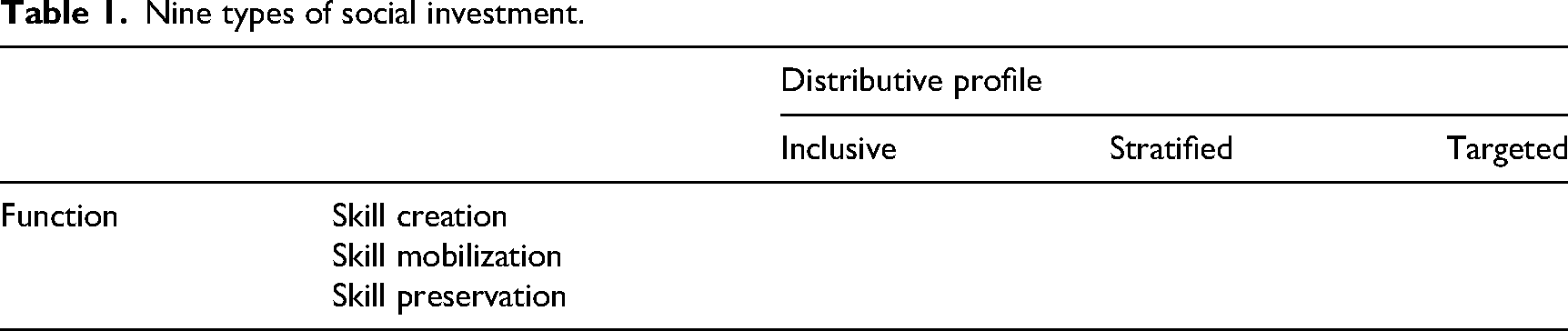
Putting these two dimensions (distributive profiles and functions) together, we can distinguish nine types of social investments (cf. Table 1) and argue that each type has its own dynamics, its own political logic, its own causes, and its own effects. To illustrate why this is relevant to understanding how social investment practically works “in action,” consider three different countries: Policy-makers in Country A might focus entirely on inclusive skill creation, but disregard the other social investment functions. As a result, the general population would be well-skilled (if done for many years in sufficient quality), but the country would lack skill mobilization and skill preservation policies. This would make it harder for people to leave and re-enter the labor market, for example, for parents. Given that de facto the majority of care work is still done by women in most countries, the country is quite likely to have high degrees of gender inequality—despite its inclusive approach to skill creation.
Nine types of social investment.
Consider, as a second example, a fictitious Country B that completely focused on stratified skill mobilization (e.g. through skill-oriented active labor market policies focused on those with already good skills), disregarding skill creation and skill preservation. Here, especially the (educated) middle class would be supported and, as a result, would find it relatively easy to make use of their skills on the labor market. This policy approach would, however, be very likely to increase wage inequality and educational inequality, as the most disadvantaged would hardly be supported through social investments.
Consider, finally, Country C, which combined inclusive skill creation, inclusive skill mobilization, and inclusive skill preservation policies. In this country, several kinds of inequalities would be simultaneously be addressed, and there would be ample support also for society's weakest. In this scenario, though, a main issue would be the costs of the social investment approach—obviously, an inclusive and encompassing approach is more costly for the public purse than leaner variants. Political dynamics and socio-economic debates thus probably focus on the affordability and sustainability of this approach.
We could easily extend the list of examples, but we hope that these examples suffice in illustrating why we need to distinguish different kinds of social investments. In line with the topic of this special issue, we need to study the specific forms that social investment takes “in action.” We strongly believe that the literature—and political debate—could move much forward by acknowledging that there is no such things as one social investment; rather, there are different kinds of social investments. We urge scholars to always clarify what type they mean when analyzing and discussing social investments.
Footnotes

Funding
The author(s) disclosed receipt of the following financial support for the research, authorship, and/or publication of this article: The authors acknowledge support from their respective institutions. Aside from this, the authors received no third party financial support for the research, authorship, and/or publication of this article.