



Abstract
European welfare states have experienced a binary transformation characterized by recalibration of traditional social protection programs and expansion of employment-oriented social policies, favoring the emergence of dual-earner families. This article sheds a new light on the pathways leading to these transformations in continental Europe. Theoretically, we characterize continental European welfare states as a configuration of complementary and interacting labor market and social policy provisions. We conjecture that such welfare state types are prone to evolve through a sequential process of institutional change where new social policy provisions emerge to correct and enhance the effectiveness of previously implemented labor market policies in pursuit of novel policy objectives. The timing and pace of this sequence is mediated by governments’ cognitive orientations and their responsiveness toward domestic societal interests. Through a qualitative comparative process analysis, we find evidence of our theorized three-pronged sequence of institutional change in the Netherlands, Germany, and Italy.
Keywords
European welfare states have experienced a groundswell of reforms since the 1980s in response to pressures arising from intensified global competition, deepening European integration, accelerating population aging and postindustrial family change. 1 Since the new millennium, the notion of “social investment” has gained purchase as a postindustrial welfare reform compass to address structural change in an integrated fashion, aligning active labor market policies, vocational education and training, early childhood education and care, work-life balance arrangements, active aging, and long-term care provision. 2 Emanuele Ferragina shows that the spending trends of advanced OECD welfare states have undergone a so-called double movement over the past forty years. 3 This double movement consists of a long-term binary transformation of recalibrating traditional social protection benefits while expanding employment-enhancing social policies such as parental leave schemes and child care provisions, with the latter becoming especially prominent since the late 1990s. According to Ferragina, the convergent “double movement” has considerably watered down typical welfare state differences between liberal-conservative Anglo-Saxon, social democratic Scandinavian, and Bismarckian continental welfare states. 4 Similarly, Anton Hemerijck's long-term qualitative institutional analysis of changing welfare states signals a trend of “contingent convergence” across European welfare states. 5
The “revealed preference” for momentous welfare state redirection exposed, among others, by Ferragina and Hemerijck stands in sharp contrast to the change-resistant inference of the “new politics of the welfare state” that prevailed in comparative welfare state research during the 1990s and the first decade of the new millennium. 6 In this respect, in his famous Three Worlds of Welfare Capitalism, Esping-Andersen conjectured three divergent trajectories for the development of welfare state systems challenged by ongoing socioeconomic structural transformations. 7 With the shift to postindustrialism, Esping-Andersen suggested that the Nordic regime would face fiscal limits to welfare generosity, the Anglo-Saxon regime would produce deepening inequality, and the Bismarckian regime would be confronted with the unsettling conundrum of “welfare without work.” Under the spell of historical institutionalism, various comparative welfare scholars focused on institutional reproduction driving resilient national diversity of welfare systems, aptly captured by the metaphor of “frozen Fordism.” 8 In this article, we engage with these debates by shedding light on the sequenced trajectory that has led Bismarckian welfare states to gradually move from a male-breadwinner model toward a dual-earner model via the expansion of family policies. In particular, we focus on family-related employment-enhancing policies, namely, those family policies aiming to activate women in the labor market by putting in place social provisions that reduce women's care and family duties.
In existing literature, the expansion of work-family policies is largely explained on the basis of changing normative beliefs and the interests of electoral groups in relation to changing occupational structures. 9 This suggests that the cause of the expansion of family policy needs to be understood in relation to the creation of new jobs in the service sector. To understand this process more fully, we rely on the work of historical institutionalists that looks at how reforms in one policy area spill over into neighboring policy spheres. 10 In this article, we reconcile these two strands of literature, showing how the expansion of family policies can be understood as a process of layering that builds on and enhances previous labor market reforms, concerning a more deliberate strategic redirection and conversion of the welfare system to different uses, goals, functions, and purposes, mediated by the political sensitivities of different governments.
More specifically, we theorize a three-tiered sequence of recalibration whose logic is rooted in the very institutional structures of the Bismarckian welfare regimes, where labor market and social policies are deeply entrenched. Our theorization is based on a conceptualization of the welfare state as a configuration of complementary policy provisions that is critically influenced by levels of employment, serving to ensure the financial sustainability of the welfare system. Building on the insight that governments not only act in response to electoral pressures but are also driven by a sense of institutional responsibility, 11 we expect governments—whatever their political color—to act on the need to maintain high levels of employment that ensure the preservation and financial sustainability of the welfare state. As responsibility and responsiveness are intricately linked, governments are very aware that maintaining financial sustainability is necessary for ensuring the future financing of popular benefits and services.
Given that Bismarckian welfare regimes are characterized by policy complementarities, we expect welfare recalibration to happen in different stages, from one policy problem to the next. Stage 1 consists of the recognition by governments of their countries’ welfare-without-work syndrome. Based on this recognition, in stage 2, governments engage in social benefit retrenchment and labor market dualization to facilitate the expansion of novel and less expensive service sector jobs. While these two stages of change of existing institutions have already been identified by historical institutionalists, 12 the novelty of our argument consists of the identification of a third stage in this gradual process of change where, to make the previous reforms garner staying power, governments embark on further institutional change through layering and introduce complementary social services, mostly in the form of parental leave and child care provisions. These pressures are both functional and political: functional because such social services are needed for workers to manage their work-care responsibilities as women have entered the labor market en masse, and political because the growing availability of (part-time) jobs in the service sector creates the demand for improved work-life balance policies among electorates. 13
Through a qualitative comparative reform-tracing analysis, we find evidence of this particular sequence in three different countries that share the Bismarckian welfare regime policy legacy, namely, the Netherlands, Germany, and Italy. Once the welfare-without-work syndrome was recognized as a policy failure with governing elites, this opened up a window for the more path-deviating reform sequence. To be sure, as we observe below, the precise timing and pace of the subsequent stages varies considerably, but the sequence is similar for each country. Timing and sequencing variation, we argue, is linked to the political sensitivities of the various governments with regard to how they should fulfill their institutional duties and their social policy commitments within the bounds of the available fiscal space. Despite these political factors, the logic of the sequenced reform remains intact in the three countries. Even in Italy, a country long characterized by conservative family values, since 2012 there has been a gradual expansion of leave policies and child care provision. From this perspective, it is no surprise that social investment reforms feature strongly in the Italian Recovery Fund. 14 Overall, in all three cases we discern a stepwise recalibration of repurposing existing social security policies layered, with some delay, by more employment-oriented family policies. Thus, akin to the contribution by Thelen and Palier, 15 we too find that the particular links across various institutional dimensions in the political economy (the labor market and the welfare state) can function as drivers for change—as opposed to those theoretical accounts that suggested that institutional complementarities support stability and institutional reproduction. 16
The remainder of this article is organized in four sections. We begin by reviewing the literature on family policy expansion in Bismarckian welfare states and introduce the novelty of our contribution. We then develop our theorization of a sequenced recalibration logic that is mediated by national political factors. Subsequently, we trace the welfare recalibration trajectories of the Netherlands, Germany, and Italy, highlighting the three-pronged sequence characterized by (1) the manifestation of the welfare-without-work policy failure, (2) the intrusive liberalization and retrenchment “price policy” reform corrective, and (3) the final employment-oriented social investment “volume policy” reforms. In the conclusion, we reflect on the social, economic, and political conditions under which social investment policy priorities gain long-term staying power in continental welfare states.
Stability and Change in Bismarckian Welfare States
Within the welfare state literature, until and around the turn of the century Bismarckian welfare states used to be depicted as rigid welfare arrangements, highly resistant to change owing to the institutionalization of powerful veto points, the consensus-based governance of the welfare state, and the legitimacy and popularity enjoyed by social programs. 17 However, at the same time, by virtue of their financing mode based on social contributions, these continental welfare states were those facing the greatest difficulties linked to deindustrialization and the tertiarization and internalization of national economies. 18 Skepticism about the possibility of reforming these “immobile” systems was such that Esping-Andersen famously spoke of “essentially ‘frozen’ continental European welfare states.” 19 Other authors like Giuliano Bonoli argued that welfare recalibration was unlikely in continental European countries. 20 This was due to the timing of their deindustrialization because, unlike Scandinavian and Anglo-Saxon countries, recalibration happened in these systems at a time when demographic aging intensified, and rising pension commitments narrowed the fiscal space for new social investment policies.
Yet change rather than stability appears to have been the norm among countries with Bismarckian welfare states over the last three decades. 21 After a first experimentation by governments adopting “labor shedding” strategies after the 1970s oil shocks, and attempts at welfare state retrenchment during the 1990s, the 2000s ushered in a multidimensional process of change. Change touched upon various dimensions of the Bismarckian welfare state, 22 from the financing mode (lower social contributions and more taxes) to new modes of management (diminished involvement of social partners and increased state or market) and new social programs catering to new social risks and social groups. Perhaps most interestingly, and of interest for our purposes, is the unexpected expansion of family policies. Between the 1990s and the 2010s, countries with Bismarckian systems witnessed a remarkable growth of family-related employment-enhancing social policies. The expansion of parental leave and child care provisions have in fact played an important role in enhancing female labor market participation and promoting a dual- rather than single-breadwinner family in hitherto highly conservative models. 23
In general terms, two sets of arguments have been advanced by scholars of the welfare state to account for these momentous shifts. These conform to ideational and interest-based explanations. Among the former, some scholars have attributed the recalibration of Bismarckian welfare states to changes in normative beliefs about women's role in the family and in the labor market, with consequent changes in voters’ behavior. Thus, for example, in comparing Germany and Italy, Agnes Blome argues that, unlike Italy's stalemate, the expansion of work-family policies in Germany was driven by a shift in the population's normative beliefs in favor of mothers’ entry into the labor market. 24
Interest-based explanations come mostly in two variants. On the one hand, public opinion scholars put emphasis on the interests and related preferences for different types of social policies held by groups of voters within postindustrial societies. The groundbreaking article by Gingrich and Häusermann, 25 for instance, highlighted a cleavage in social policy preferences between working-class voters favoring social consumption and the sociocultural professionals favoring social investment policies. Thus, from this perspective, social policy change is driven by the need for office-seeking parties to implement policies that reflect secular changes in the electoral preferences of their core constituencies or that reflect the increasing political importance of women's preferences. 26 For example, Kimberly Morgan attributes the expansion of work-family policies in Germany, the Netherlands, and the United Kingdom to the need for party leaders to attract new voters from disenfranchised constituencies, like women, in the face of growing electoral instability. 27 Comparative politics scholars, instead, place greater emphasis on partisanship (i.e., party composition and/or programmatic agendas) and electoral competition. In this vein, for instance, in a large-N study Takeshi Hieda found that economically left and culturally liberal parties are more likely than others to expand spending for child care policies when in government. 28 Others, instead, attribute the expansion of work-family policies to the growing importance of women within parties’ organization and politics more generally. 29
These diverse accounts emphasize important dimensions and drivers of change within welfare states. However, both ideational and interest-based explanations seem only partially able to account for the common trajectory of change observed in the Netherlands, Germany, and Italy. For instance, despite very different normative beliefs about women's role in society, all three countries have experienced a steady expansion of employment-enhancing work-family policies. As we document below, this expansion has occurred—and is under way—also in Italy, a country highlighted by the literature as having conservative preferences on women's role in society. 30 Moreover, and crucially, such reforms in Italy have been most prominently championed by—unelected—technocratic governments (Mario Monti's and Mario Draghi's governments) openly interested in economic growth and the welfare state's sustainability rather than winning out in electoral competition.
Thus, we contribute to extant scholarship by proposing a novel account of change within Bismarckian welfare states. Our argument is rooted in the tradition of actor-centered institutionalism, 31 where institutions are conceptualized as a context that partially—but not fully—determine the direction of governments’ action. Our contribution highlights two key aspects, namely, the institutional logic and sequencing of change within Bismarckian welfare states that have hitherto been neglected in the literature. More precisely, we conjecture that the institutional characteristics of Bismarckian welfare states induce governments to embark on a specific sequence of reforms, but that the timing and pace with which governments do so depends on their political, ideational, and cognitive orientation. Hence, we conjecture that over the long term the Bismarckian welfare states of different countries follow a similar reform trajectory that differs only in the timing and pace. Borrowing the insight from the party-politics literature that democratic governments need to combine institutional responsibility with political responsiveness, 32 we explain the difference in timing and pace by the economic ideas that each individual government has about the long-term sustainability of the welfare state and how a government integrates its institutional responsibility with responsiveness toward political demands. We expect that institutional responsibility for a Bismarckian welfare state makes governments from different countries embark on a similar trajectory of change. The individual political characteristics of each government, and more precisely how they integrate responsibility with responsiveness, may accelerate or slow down the sequence of change.
Policy Complementarities and Time-Sequenced Change in the Bismarckian Turn toward Social Investment
The institutionalist side of our argument builds on the work of Palier and Thelen, who study welfare state change by looking at spillovers in the institutional and policy complementarities between the labor market and the welfare state. 33 We argue that this analytical approach is particularly well suited for Bismarckian welfare states because, different from other types of welfare state, in social-contributions-based Bismarckian models, labor market and social policy are intrinsically related and the performance of one institutional/policy dimension necessarily affects the other. Indeed, as shown by the literature, because of high and expensive social contributions to fund the welfare state, Bismarckian models increasingly faced an employment crisis during the transition toward mature service-based economies in the 1980s and 1990s. 34 Thus, to boost service sector jobs, the response was a dualization of the labor market with the creation of atypical jobs lacking full-fledged social-contributions-based social policies. In other words, policy problems in the labor market spilled over into the welfare state, triggering related institutional change. To fully capture the logic of change within Bismarckian systems we must therefore analyze the interrelation between these two institutional dimensions.
The welfare state literature has highlighted the importance of sequencing in explaining regime change. Hemerijck and Schludi's work has illustrated how institutional change takes shape through intimately related sequences, whereby in cumulative fashion novel solutions are layered onto existing policy portfolios such that gradual but transformative change eventually alters the substantive logic and structure of the welfare regime. 35 Following from this reasoning, the important work by Palier and Thelen has identified a two-step sequence of change within Bismarckian systems: a first phase revolved around the challenges to the financial viability of these systems due to deindustrialization and stagnating employment levels, and a second phase of labor market dualization aimed at enhancing employment through the activation of idle prospective workers into less-protected service sector jobs. 36 Complementing and extending these accounts, this article's key intuition is that, to raise employment and make the Bismarckian welfare state sustainable, governments have had to put in place social investment policies (especially work-family policies) necessary to relieve women from their household and care duties. The expansion of employment-enhancing work-family policies can thus be understood as a third phase of this transformational sequence whereby governments have introduced new welfare policies with an eye to fine-tuning and improving the effectiveness of previously implemented labor market policies.
Previous scholars working in the tradition of historical institutionalism had suggested that linkages across related institutional realms in the economy operate as a hindrance to change since policymakers planning change in one dimension must consider the costs of “collateral damage” in adjacent institutions. 37 However, Palier and Thelen have instead shown how policy problems emerging in one dimension (e.g., in the industrial relations arena) ultimately triggered gradual institutional change in the labor market and social policy provisions. 38 Welfare states can evolve through five different mechanisms of incremental change: displacement, layering, drift, conversion, and exhaustion. 39 Of interest for our purposes in this article, layering refers to the creation of new institutions or policy bundles on the edges of existing ones, which gradually alter the old logic and structure of the overall institutional configuration.
We conjecture that Bismarckian welfare systems have undergone a three-tiered sequence of change, where new institutions and policies are gradually put in place to fine-tune the mutual interaction between labor markets and social policies and correct spillovers and feedback effects from one dimension of the political economy to the other. The gradual process of change through layering from one phase to the other finally results in the conversion of the overall welfare state configuration toward social investment, namely, an intended recalibration of the hitherto male-breadwinner model in favor of a dual-earner model, which is more financially sustainable given higher employment rates among the inactive female population and lower compensatory social expenditures.
Within Bismarckian regimes, the institutional and policy interactions between labor market and social policy are particularly key precisely because Bismarckian welfare states are predominantly funded by social contributions. In other words, their financial survival hinges inexorably on the capacity of the labor market to generate and sustain high employment levels. The transition from the industrial to the service economy entailed a decline of the industrial workforce and thus the need for governments to generate jobs in the service sector and knowledge economy. However, because of the institutional structure and mode of funding of the welfare state, these countries were unable to generate high employment levels in the service sector because, unlike the American liberal model of welfare, high social contributions drove up labor costs, making it unprofitable for employers to hire workers in the low-productivity jobs of the service sector. What characterized these economies was a high tax wedge needed to fund their social insurance–based welfare states while discouraging employment creation in the service sector. 40 As a first challenge to these systems (stage 1 in the sequence of change), the shift away from manufacturing employment and the consequent shrinking of overall employment levels meant that for continental European countries it became ever more difficult to maintain earnings equality and fiscal sustainability. 41 Scholars famously started to speak of a syndrome of welfare without work within these continental systems. 42
Under pressure with already high budget deficits and/or public debts, the continental way out of this conundrum (stage 2 in the sequence of change) was—virtually everywhere—the dualization of the labor market by institutionalizing new forms of less secure and more flexible jobs in the low-end services, often disenfranchised from the social security system and with lower taxes and social security contributions, which made labor costs lower for employers. 43 Dualization has thus occurred in the labor market via layering, with the introduction of deregulated temporary contracts and atypical employment. 44 But layering has also occurred in the mode of welfare state financing, with core workers still subject to the core social insurance system and workers at the margins exposed to new means-tested assistance. 45 Labor market dualization was the fiercest in Europe where unemployment was the highest. 46 The dualization of the labor market aimed at activating workers into the service economy and thereby making the Bismarckian welfare state financially sustainable thanks to lower social expenditures for the hitherto unemployed and greater tax revenues from the newly activated workers.
While this is known in the literature, 47 what has not been adequately appreciated is that, beyond dualization as the initial response, a third step in the sequencing of change has occurred whereby to effectively raise employment levels among the inactive population, governments are under pressure to put in place complementary social policy provisions (stage 3) that enable inactive people to enter the labor market. In male-breadwinner-based welfare states, the female population constituted the biggest reserve pool to be integrated into the labor market. In fact, the social groups targeted by labor market dualization were mostly the young cohorts and women, who are more likely to end up in atypical jobs and, as outsiders, remain therefore exposed to the new risks associated with atypical and precarious employment. 48
The male-breadwinner postwar Bismarckian welfare regime principally revolved around social insurance and income protection. Thus, the introduction of new social investment–oriented policies holds the promise of activating people while enhancing opportunities and capabilities to ease work-life balance “flow” across life-course and labor-market transitions. This contributes to ensure higher levels of employment necessary to sustain the financing of income protection and social security schemes. 49 Early childhood education and care policies and paid parental leave schemes critically influence female labor market participation in the postindustrial economy. 50 They therefore constitute the most likely social policy complementary to the employment-enhancing labor market reforms. Hence, for stage 2 of recalibration (i.e., labor market liberalization) to display its full effects and ensure high employment levels, a critical complementary innovation was going to be the provision of services that facilitate women's entry into the labor market and allow families to combine domestic care tasks with formal employment.
In our account, the process of gradual but transformative change is driven primarily by responsible governments who not only operate in response to electoral pressures but are also inevitably driven by a sense of institutional responsibility. 51 Evolving social norms about women's role in society may facilitate change. But they are not necessary for change to occur—as the Italian case demonstrates with expanding family policies in the context of a relatively conservative society. 52 Rather, we expect governments to proactively respond to the need to maintain high levels of employment to ensure the financial sustainability of the welfare state. As responsibility and responsiveness are closely interwoven, governments are aware that maintaining financial sustainability is necessary to ensure the future financing of popular social services. Governments of different political composition, though, may have different sensitivities regarding how to integrate criteria of financial responsibility with criteria of democratic responsiveness, influenced also by the political pressures of organized interests and external economic constraints. 53 Hence, we expect our theorized three-tiered sequence to follow a different timing and pace in different countries. We expect the timing of stages 2 and 3 to be, on the one hand, contingent on the cognitive orientations of government authorities—namely, recognition of the need for reform to ensure financial sustainability of the welfare state—and on the other, dependent on the interaction with social partners. In particular, we expect that the process of expanding work-family policies will accelerate when employers become consenters to these social policy reforms on grounds of enlarging the pool of available workers in the political economy. The logic behind this expectation is that, traditionally, employers are among the antagonists of the expansion of social provisions. At the same time, they cannot ignore demographic challenges and may therefore support employment-enhancing social policies. The extent to which they do so is likely to vary per country.
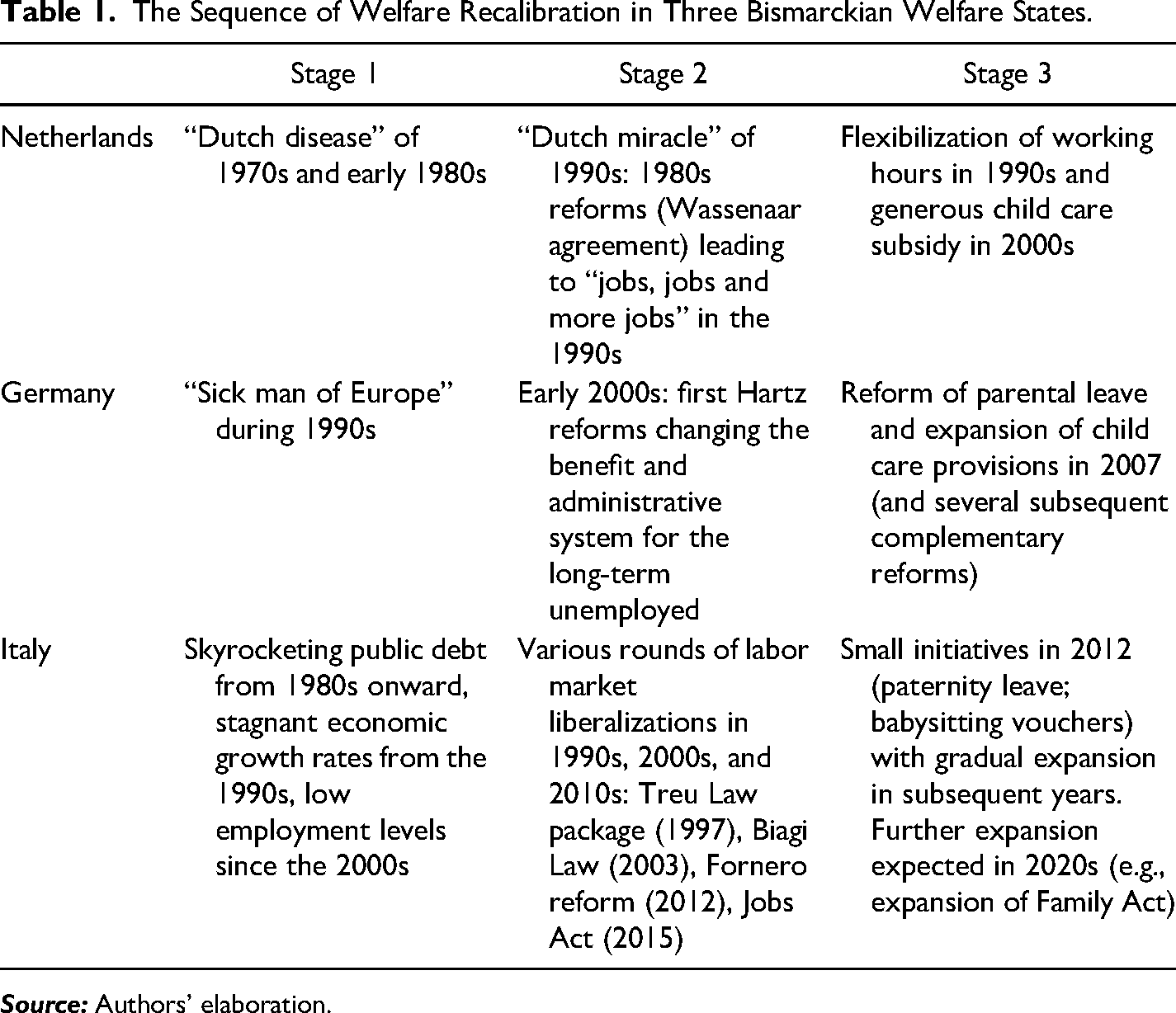
Table 1 provides a visualization of the three-step trajectory of change in the three countries. The next three sections provide a stylized reconstruction of the sequences in each country.
The Sequence of Welfare Recalibration in Three Bismarckian Welfare States.
Sequenced Recalibration in the Netherlands
The Netherlands was the first continental European country to effectively acknowledge and address the syndrome of welfare without work. 54 At the beginning of the 1980s, the Netherlands was featuring negative growth rates (−1 percent of GDP), high inflation (6–7 percent), low employment rates (69 percent of the male population and 34 percent of the female population), and a public deficit of around −5 percent of GDP. Efforts of the Van Agt cabinet (1977–81) to resolve this negative spiral came up against the immobile corporatism typical of those years, featuring persistent disagreements between employers and trade unions. The subsequent Lubbers cabinet, featuring a coalition between Christian democrats and liberals, was determined to break the deadlock and warned social partners that labor market reform would happen with or without them, to reduce the budget deficits, lower interest rates and inflation, improve business profitability, and fight unemployment. 55 This urgency triggered employers to start a dialogue with the central government and to give concessions to trade unions in order to ensure centralized wage coordination. This resulted in the famous Wassenaar agreement, a major tripartite social pact that ensured, on the one hand, a policy of wage restraint and, on the other, the expansion of flexible, part-time service sector jobs.
Based on this pact, between the 1980s and 1990s, the Netherlands reversed its negative economic situation through a job growth strategy. The redistribution of employment to involve more people was a key element of this strategy. 56 Besides the reform of the labor market, another priority under the leadership of Christian democrats, the Lubbers I and II governments, was the retrenchment of existing welfare programs. All mainstream parties, including Labor, recognized that this was an economic necessity. 57 The Wassenaar agreement of 1982 thus represents the beginning of stage 2 of our theorized sequence. Its kickoff was facilitated by the predisposition of social partners to engage in tripartite negotiations to overcome the situation of economic stagnation. The implementation of the policy objectives set out in the Wassenaar agreement took more than a decade.
The “part-time” nature of the new jobs was a particularly favorable condition for the entry of women into the labor force. 58 In parallel, the social security reforms of the Conservative governments (1982–89)—which were mainly intended to bring greater austerity and conform to European legislation—ended the formal discrimination of married women in three major schemes, namely, disability (1980), national old-age pensions (1985), and extended unemployment benefits (1987). Despite the increasing numbers of women entering the labor market, child care provisions remained largely informal, organized through family relations. The inheritance of the Christian-democratic welfare state, which was designed to preserve traditional familyhood, was certainly not a facilitator for change in this policy area. 59 As a consequence, day care centers for children remained in short supply until the end of the 1990s. In the absence of day care centers, part-time work was the best coping strategy for women and at the same time it created a strong demand for commercial family-orientated services. 60
Demand for child care grew steadily, but it took until 1987 before unions, under pressure from female members, began to negotiate child care facilities in collective agreements. 61 As a first step, the 1990 tax reform reduced the basic tax allowance for breadwinners and integrated social security charges, thus reducing disincentives for second earners to take up more hours. 62 In subsequent years, employer organizations also became favorable to allowing more generous parental leave and child care schemes. The interviews carried out by de Bruijn and Bleijenbergh document how Dutch employers fully appreciated the added value of female labor market participation to the Dutch growth strategy, and recognized that in order to keep women employed, social provisions were needed that allowed them to combine work and care. 63
Under this new consensus, the center-left Labor–Christian Democrat government (1989–93) introduced the right to unpaid parental leave (thirteen weeks full-time, or six months part-time) in 1991. In the framework of our reform sequence, this introduction represents a slow beginning to stage 3, which was completed through various incremental steps only in 2005. A Labor-Liberal coalition took over in 1994 and in its second term in 1998 the government decided to double day care places to 150,000, but a shortage of staff prevented rapid expansion. A new bill, guaranteeing ten days of paid leave per year in order to meet emergencies or provide care, was introduced to parliament in 2001. 64 In the meantime, the Kok I and II governments (1994–2002), featuring a coalition of Social Democrats and Liberals, continued the strategy of job creation in the service sector, introducing better employment protection for workers in flexible jobs in exchange for adjustments in dismissal protection for employees on permanent contracts. 65 In 2000, the Working Hours Act was introduced, granting part-time workers an explicit right to equal treatment in all areas negotiated by the social partners, such as wages, basic social security, training and education, subsidized care provision, holiday pay, and second-tier pensions. 66 The 2002 Work and Care bill provided for short-term paid care leave and paid adoption leave.
The breakthrough for increasing child care provisions was the Childcare Act (Wet Kinderopvang), approved in August 2004 and in force since January 2005. Under the new scheme, the state, parents, and employers together pay the costs of child care when the child is cared for outside the home during parents’ working hours. As a result, between the 2000s and 2010s, the rate of children under three years old enrolled in formal child care programs grew substantially, and the Netherlands became one of the best performers among advanced industrial countries in this regard.
67
In its financial document for 2005, the Dutch government justified investments in child care as follows: The desired structural strengthening of the economy can be achieved particularly through greater participation in the labor process. The number of people employed as a percentage of the population in our country is not low from an international perspective, but the number of hours worked per capita is. The average number of hours worked per employee is in no OECD country as low as in the Netherlands. Employees in our country work on average only 1,340 hours per year, compared to an average of 1,615 hours in the EU and an average of 1,815 hours in the US. The working time in the Netherlands is therefore relatively short. This is because a relatively large number of employees work part-time and because the working hours of employees with a full-time job are relatively low. People who want to work longer may encounter obstacles. For example, capacity problems in childcare can be an obstacle for part-time workers to work longer.
68
Despite these policy imperfections, the Childcare Act and related policy interventions sustained the persistent and steady growth of female employment. According to OECD data, between 1995 and 2015 the female employment rate grew from 64 to 74 percent. From 2006 it became fiscally more attractive for families to have two earners, particularly when the second earner was employed part-time. 70 While until 2005 dual-earner families had a considerably higher share of their salaries being taxed compared to single-earner families, the average tax wedge for dual part-time earner families declined substantially. Since 2011, dual part-time earner families have a lower tax wedge than single-earner families. In 2009, the Dutch government extended unpaid parental leave (from thirteen to twenty-six weeks for each parent). Families in high-income brackets were no longer to be entitled to child support. The Netherlands increased child care allowances again in 2015, especially for single parents, and devoted a larger budget to child care between 2017 and 2020 to increase the quality and accessibility of early-years services. 71 In sum, from the 1990s onward, the provision of services for dual-earner families has become an important aspect of the Dutch welfare state.
Sequenced Recalibration in Germany
In the late 1990s and early 2000s, Germany was often referred to as “the sick man of Europe” because of slow growth and high unemployment rates. 72 Economists identified the cost of hiring and firing in the German labor market as one of the key structural problems. Between the 1980s and 1990s, deindustrialization had been causing rising numbers of unemployed, and the rigidity of the labor market was preventing the generation of new employment. As the welfare state was largely financed by payroll taxes, welfare costs went up. Concomitantly, until the mid-2000s Germany was also struggling to meet the budgetary requirements of the European Stability and Growth Pact.
The characterization as “sick man of Europe” is thus illustrative of how, until the early 2000s, Germany was at stage 1 of our theorized sequence. The realization of the employment problem within the government, however, was slow in coming. On September 2, 1998, in presenting the last budget of the fifth Kohl cabinet to the German parliament, the Christian-democratic finance minister Theodor Waigel celebrated an upswing in the German economy, which was characterized by German industries’ growing exports. Interestingly, his speech celebrated the declining levels of unemployment and the declining levels of short-time workers. Thus, a reflection on the overall employment levels seemed not to be at the core of the economic policy agenda of this cabinet. On September 12, 2000, under the first Schroeder cabinet, the budget speech of the social-democratic finance minister Hans Eichel had a decisively different tone, particularly with regard to the issue of (un)employment. As exemplified by the following passage, the finance minister highlighted the importance of raising the number of employed and not being misled by numbers of declining unemployment: This year and next we have the highest employment growth since the reunification of Germany: 170,000 new, additional jobs this year, 270,000—according to the Federal Labor Office—next year. That means . . . the reduction in unemployment is not mainly because many more older people are leaving than young people are starting, but first and foremost because we have an increase in employment. (Hans Eichel, German Bundestag, September 12, 2000)
Shortly after the Hartz reforms, the government took action to facilitate the combination of work and family life. Interestingly, the course for family policy remained largely unvaried between the Schroeder II (2002–5) and Merkel I (2005–9) governments, which featured only a partial partisan alternation in government as the Social Democrats remained in power in both cabinets. 73 In 2005, the continuation of this policy course produced an Act that extended child day care (Tagesbetreuungsausbaugesetz), explicitly aimed at boosting child care capacity. Two years later, on January 1, 2007, a new leave benefit came into effect. It constituted a radical change from the previous flat-rate sum and introduced an income-related benefit of 67 percent of previous net income with a cap of €1,800 per month, paid for a total of fourteen months after the birth of a child (Elterngeld). The scheme contained specific provisions aimed at stimulating fathers to make use of the benefit too, so that mothers would not take excessively long leave from their jobs. These provisions were initially heavily criticized by parts of the governing parties, especially among the Christian Democrats. Nonetheless, the cabinet maintained the determination to reform, driven and legitimated by the commitment to address the country's demographic decline and the related future prospects of low employment numbers. As observed by German social policy experts, by the mid-2000s “policy-makers across the political spectrum have tentatively embraced the notion that a more equal division of labor and a more active state role in the provision of early care services are crucial for the economic sustainability of an ageing society.” 74
While in the early 2000s Germany was still in stage 1 of our sequence, by 2007 it had already completed stage 2 and was fully embarking on stage 3. During the 2010s, employment-friendly family policies were further expanded. In 2013, children's legal right of access to day care facilities entered into force. In 2015, a further extension of the existing parental leave scheme was introduced (Elterngeld Plus) increasing the number of months by which parents could take up part-time parental leave, and that could be used in addition to the original scheme (Elterngeld). Between 2019 and 2022, with the Gute-KiTa Gesetz (Good Child Day Care Act) the German government invested more than €5 billion in the further development of quality and participation in child day care. With these interventions, Germany became one of continental Europe's frontrunners in social investment. 75
The timing of both stage 2 and stage 3 reforms in Germany coincides with two important factors. First, the entry into government of the Social Democrats in 1998, under the leadership of Gerhard Schroeder, meant that the German government was being run by a reform-oriented political force. The second factor was the reform-friendly attitude that the main German employer associations had begun to adopt since the 1990s. 76 When looking also at the policy ideas underlying the reforms, 77 the convergence between the cognitive orientation of government leadership and employers’ preferences seems to have helped to overcome the opposition to labor market liberalization of the trade unions and the more leftist voices within the governing majority.
A crucial aspect to highlight is that employers’ support for reform was not only expressed in terms of labor market liberalization but, especially from the early 2000s onward, also in relation to the expansion of employment-friendly family policies. The rationale behind employers’ support for more investments in child care and parental leave was essentially an economic one: “The economy required more women in employment and more children to ensure sufficient labor supply in the future.” 78 This economic rationale behind the expansion of family policies was, in turn, also important for ensuring policy continuity between the Schroeder II and Merkel I governments. Parts of the Christian Democratic party subscribed to this argument, particularly Ursula von der Leyen (CDU) who as minister of family affairs oversaw implementation of the plans for reforms in family policies. 79
The Merkel I justifications for its reforms to family policies clearly manifest a cognitive orientation that sees social policy as a productive factor for achieving employment objectives. To illustrate this orientation, we report the following statement from a position paper of the government, with regard to a publicly financed study on the situation of families in Germany over their life course: A change of perspective was made to a sustainable family policy, the new objective of which is also justified with demographic and economic arguments. Family policy occupies a central position in the policy of the federal government. Family policy is consistently geared towards supporting families, promoting the compatibility of family and work and helping to realize life plans with children. Families need three things above all: time, a supportive infrastructure and income. In addition to this, the social alliance with local alliances should also be continued. The Federal Government has also introduced a paradigm shift and is increasingly gearing its family policy towards the expansion of an effective infrastructure for education and care that supports families and children, as well as measures to integrate women into the labor market and to achieve a better balance between family and working life.
80
Sequenced Recalibration in Italy
The syndrome of an expensive welfare state and low employment rate has been plaguing Italy since the 1980s and is to a large extent still plaguing it today. 82 By the mid-1990s, Italy was confronted with high public debt and demographic aging. In fiscal terms, it struggled to improve its deficit and debt figures in order to ensure its entry into the European monetary union. In addition, it featured low employment rates, bringing the carrying capacity of the welfare state into a dangerous disequilibrium. Thus, from the 1990s onward, Italian governments were fully immersed in stage 1 and were economically under pressure to increase labor participation. Recognition of the economic impasse within governing elites was however disturbed by the political earthquakes of the early 1990s, with the collapse of the existing party system through a series of corruption scandals. Consequently, despite the gravity of the welfare-without-work syndrome, the liberalization of the labor market took place in various steps, separated by lengthy periods of inaction. 83 As shown in Figure 1, OECD indicators on the rigidity of regulation regarding temporary employment contracts show that, while the Netherlands already had relatively low levels of regulation in the mid-1980s, Germany and Italy started deregulating in the second half of the 1990s. Unlike Germany, however, in Italy the deregulation process was slower, and the labor market remained relatively stricter compared to Germany and the Netherlands for the observed period. Nonetheless, the intrusiveness of Italy's stage 2 reforms should not be downplayed.
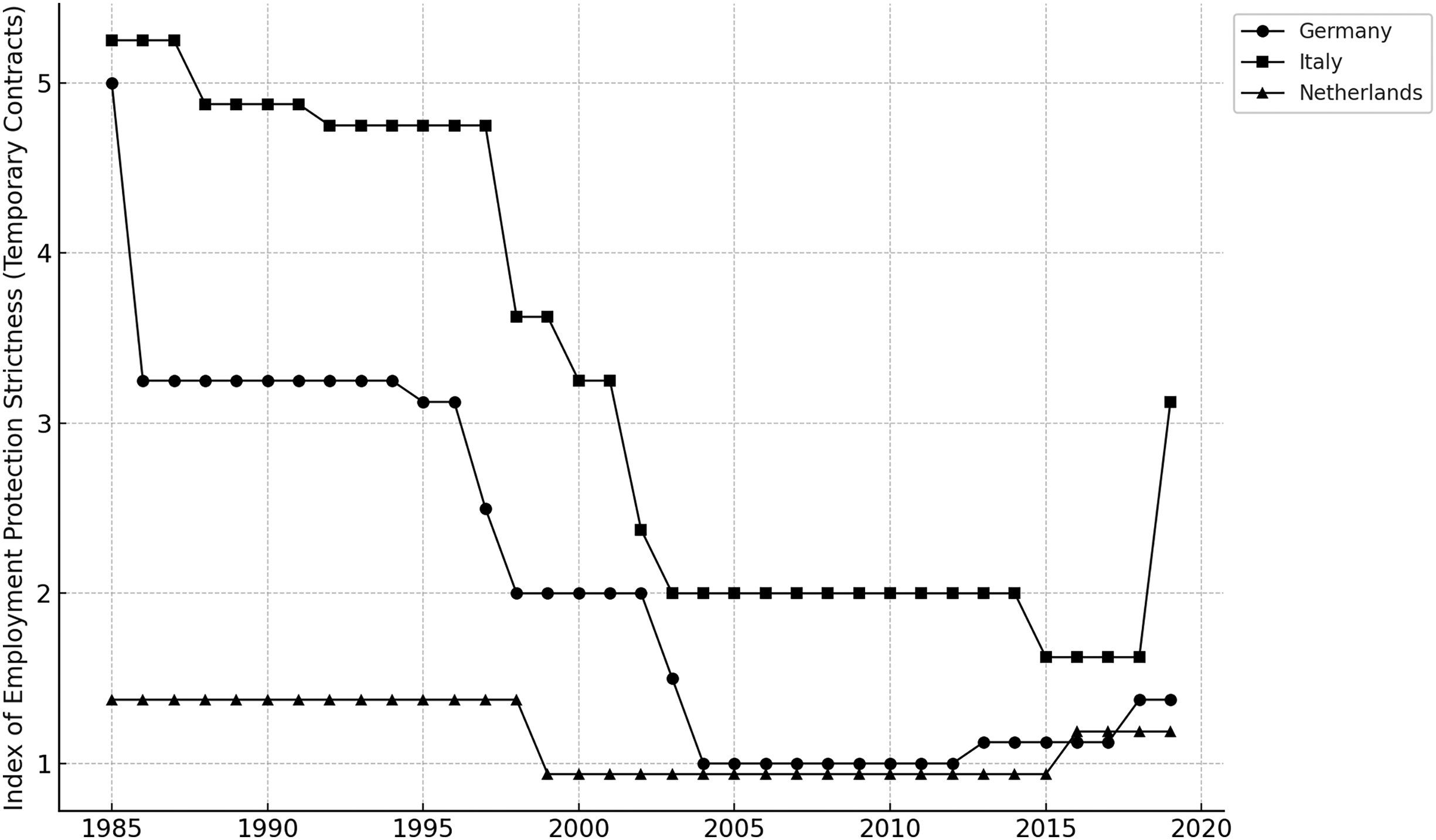
Strictness of employment protection in temporary contracts in Germany, Italy, and the Netherlands, 1985–2019.
The need for reform was acknowledged in the context of the accession requirements to the European Economic and Monetary Union. The tripartite agreement Accordo per il lavoro of 1996 can be seen as the slow transition from stage 1 into stage 2. The agreement underscored the importance of complying with the Maastricht treaty objectives, and the main trade unions agreed to the introduction of temporary agency work and the promotion of part-time work. The subsequent Treu Law package (1997) introduced temporary agencies and fixed-term contracts. This process was continued with the Biagi Law of 2003, which increased the variety of atypical contractual typologies. These reforms reduced the rigidity of the Italian labor market substantially. Nonetheless, during the 2000s, hiring and firing was comparatively more difficult in Italy than in Germany and the Netherlands (Figure 1). The rest of the 2000s were characterized by reform stagnation in the field of the labor market, on the one hand because of the short duration of the center-left cabinet between 2006 and 2008, and on the other, owing to the conflictual relationship between trade unions and the government. 84
A new wave of liberalization started only in the 2010s. First, under the Monti government, the Fornero reform of 2012 liberalized the use of vouchers to hire casual workers, revised the right of reinstatement for workers with permanent contracts unlawfully dismissed, and removed the need for “a lawful cause” to hire a worker with a fixed-term contract. The reform also introduced small welfare provisions for atypical workers. The reform capacity of the Monti government was to a large extent related to its strong institutional mandate, which allowed it to act without the mediation from social partners and civil society organizations. 85 Subsequently, under the Renzi government, the Jobs Act of 2015 introduced an open-ended contract restricting the layoff protection for permanent workers and maintained the variety of fixed-term contracts introduced over the previous two decades. It increased the possibility to make use of atypical contracts and promoted activation policies. Parts of the regulations contained in the Jobs Act were however reversed in 2018 by the Conte I government, composed of the Movimento Cinque Stelle and the Lega. 86 Thus, in the Italian case, the substantial alternation of governing forces over time has at least partially acted as a brake on the pace of stage 2 reforms.
The stepwise labor market liberalizations that took effect in the late 1990s and early 2000s did not help to substantially improve employment rates, and Italian women still today have one of the lowest labor force participation rates among European countries. According to a report from the OECD, a main reason for women's low labor force participation and low self-employment income is the lack of access to good quality and affordable child care, combined with the lack of adequate parental leave schemes. 87 During the 2010s, only one quarter of children (aged 0–2 years) in Italy were in formal child care. At the same time, the OECD report acknowledges that since 2012 Italian governments have been making efforts to support families, albeit with limited impact, most likely also because of the difficult situation of Italian public finances, which—in the context of the sovereign debt crisis—did not allow for large new expenditure programs. Strikingly, it was a technocratic and not a political government that initiated the process of incremental change in this area.
Until the early 2010s, in Italy fathers had no entitlements to paternity leave, and parental leave would cover only 30 percent of earnings for a maximum of six months. As part of its labor market reforms, the technocratic Monti government (2011–13) introduced for the first time in Italy one day of compulsory paternity leave. Despite criticism that the one-day leave risked being futile, 88 it was extended to two days in 2016, to four days in 2018, to five days in 2019, and to seven days in 2020. In addition, in 2012 the Monti government introduced babysitting vouchers for working mothers. These vouchers were designed as a contribution to working mothers to buy babysitting services to be used in the eleven months following maternity leave and for a maximum period of six months. The Monti government also tried to stimulate female employment through tax incentives for second earners. Thus, while still immersed in the endeavor to complete stage 2 reforms, the Monti government also initiated the stage 3 reforms of our theorized sequence. The fact that, in the Italian case, stage 3 of the reform process was initiated by a technocratic government strengthens our conjecture that institutional responsibility plays a key role in the expansion of employment-enhancing family policies in continental Europe. Political responsiveness toward particular societal interests, by contrast, seems to have acted as a brake.
The key factors determining the slow start of stage 3 are to be found on the one hand in the lack of support from Italian employers, and on the other in the cognitive orientation of successive governments. Over the period under observation, Italian employers have paid scarce attention to the issue of family policy expansion and, in the instances when they expressed support, they emphasized the importance of the condition that it should not increase labor costs. 89 In parallel, during the 2000s, which were mostly governed by the Berlusconi-led center-right coalition, governments’ annual economic programmatic documents (today known as Documento di Economia e Finanza) reflected a conservative social worldview, typical of political forces that respond to traditional family values. Women were hardly ever mentioned in the government's official economic and financial programs, and certainly not as active socioeconomic actors. If mentioned at all, it was in the context of security policies, highlighting for example the importance of protecting women from criminals. Even in the economic and financial programs of the center-left governments of the 1996–2001 period, the issue of facilitating women's entry to the labor market was mentioned only in specifically dedicated sections toward the end of the annual fiscal document of over one hundred pages long and more in the context of the cultural importance of increasing female labor market participation. The decade-long lack of adequate employment-enhancing family policies in Italy was based on an encompassing consensus among the mainstream political class that women perform a very important role in society by taking charge of the domestic sphere. 90 Only under the short-lived center-left Prodi government of the 2006–8 period was there one Documento di Economia e Finanza that called for a more active role for women in society. After that, under the subsequent Berlusconi government (2008–11), female employment was again absent from the economic policy agenda.
With the Monti government, instead, we observe an important cognitive change, with female employment receiving a central place in the overall economic strategy. As illustrated in the following excerpt, the importance of female labor market participation is emphasized on page 1 of the 2012 economic and financial program: Let's try to imagine that in 2020, 69 per cent of people aged between 24 and 65 have a job, almost 10 per cent more than today. Let's try to think that for a woman reconciling family and work is not an obstacle course, because there is modern parental leave, childcare facilities for children or care for the elderly are widespread and accessible.
91
Since the second half of the 2010s, the thinking across the political spectrum of the Italian governing class about these issues has largely changed. In 2022, the right-wing party Fratelli d’Italia won the elections with a manifesto that, in its first programmatic point, featured the pledge to invest in child care. 92 With a cross-partisan consensus on the need to invest in families, in relative terms, Italian governments today seem to be cognitively more oriented toward social investment than they were during the 2000s. It is however important to highlight that in terms of welfare state transformation, important subnational differences continued to emerge throughout the 2010s, with northern regions enhancing in-kind components designed to foster employment and inclusive long-term economic growth, while the social programs of southern regions lean more heavily toward compensatory monetary benefits. 93
At the national level, the Italian welfare state today features the important novelty of the Family Act, which was formally adopted in spring 2021 under the Draghi government, but the legislative process had already started in 2018. The main novelty is the provision of generous child benefits to be paid until the child reaches eighteen years. Furthermore, the framework of the Family Act includes a plan (not yet implemented) to introduce a new parental leave scheme. 94 Together with new plans to substantively improve and expand child care services, the extension of the Family Act is also one of the flagship policies highlighted by the Italian government in its application to the European Recovery Fund. 95 Through the use of the funds, there is thus a chance that Italy too will complete stage 3 of our theorized sequence.
Conclusion: The Bismarckian Road toward Social Investment
Our analysis sheds new light on the expansion of work-family policies observed in most advanced industrial countries during the past thirty years. 96 More precisely, we focused on the reform trajectory of male-breadwinner continental welfare states to understand the institutional logics driving responsible governments to embark on a three-step sequence of recalibration toward social investment and a dual-earner model.
In recent scholarship, the expansion of family policies has mainly been explained in light of governments’ responsiveness toward changing electoral demands and changing normative beliefs about women's role in the economy. Yet, in line with historical institutionalism scholarship, we provide a complementary account, highlighting the importance of macrolevel institutional structures providing incentives and constraints to national governments in need of reconciling responsiveness to electorates with their institutional responsibility to ensure the welfare state's financial sustainability. Building on the work of Palier and Thelen, 97 we have followed an understanding of the welfare state as a configurational system of complementary policy provisions, where processes and outcomes of change in one dimension (i.e., the labor market) inevitably affect the functioning of adjacent institutions and policy provisions (i.e., the social policy programs of the welfare state), and vice versa through feedback effects in a temporarily ordered sequence. Such an approach is key to understand the institutional logics of change in Bismarckian systems that are financed through social contributions and therefore crucially depend on employment outcomes for their financial sustainability, and where labor market outcomes are affected by the financing structure of social contributions.
Our findings indicate that institutional responsibility toward maintaining the long-term sustainability of popular welfare provisions carried significant weight throughout all three stages of the sequence, including the last stage of family policy expansion. The postindustrial transition from an industrial to a service-based economy (stage 1) ushered in a process of labor market dualization (stage 2), necessary to expand service sector employment for the inactive segments of the labor force. For welfare states presiding over a single male breadwinner, the third stage has entailed expanding female labor market participation. As a result, for Bismarckian welfare states, the postindustrial transition from a single- to a dual-breadwinner welfare model took root, more indirectly, through three interrelated reform stages, in which the first involved a cognitive recognition for intrusive retrenchment reforms; the second pertained to reducing the costs of job creation through segmented labor market deregulation; and the third stage, launching and then expanding social services to facilitate female employment growth.
The three-pronged reform process was certainly not apolitical. Each twist and turn in the sequence followed from—often difficult—political decisions. However, we also expose how the impetus for path-shifting welfare recalibration was largely driven by the design of extant policy portfolios and the policy problems that ensued from these institutional constructs. Policy failures are often intricately linked to shifts in electoral demands and preferences, precisely because such design failures affect citizens’ material life chances. Stage 2 of the reform process, namely, the liberalization of the labor market, is a response to the blatant “diminishing return” predicament of the welfare-without-work syndrome jeopardizing the financial sustainability of the welfare state. Reform was imperative to secure the carrying capacity of the welfare state. Only when employment growth turned positive were governments of very different colors willing to progressively expand and upgrade work-life balance reconciliation policies. Facing a fiscal conundrum of “permanent austerity,” 98 the new responsiveness would perhaps not have taken off had there not been a cognitive shift in understanding within governments that such investments would effectively make the welfare state financially more sustainable. Hence, welfare recalibration is contingent to a significant extent on governments’ changing understandings of the workings of policy complementarities, and of how social policy can positively contribute to both institutional responsibility and responsiveness toward societal interests.
In the Netherlands, the government's cognitive reorientation started taking place under the Van Agt cabinet (1977–81) and in the early 1980s, under the first Lubbers government. When social partners agreed to negotiate an encompassing reform of the labor market, this led to organized wage restraint and the normalization of part-time work that was at the heart of the jobs’ miracle witnessed in the Netherlands in subsequent years. During the 1990s and 2000s, governments and social partners were broadly aligned on the need to provide complementary social services to sustain the growth of female employment.
In Germany, the sequence started toward the end of the 1990s. The reform agenda of the Schroeder I government constituted a substantial cognitive reorientation in German social policy toward a stronger focus on facilitating citizens’ employability. The reform agenda of the Schroeder government forced the Christian Democrats to rethink their electoral appeal, in particular to (re)win the support of female workers. In parallel, the administrative continuity between the Schroeder II and Merkel I governments ensured the continuation of the sequence in the second half of the 2000s.
In Italy, the sequence is arguably under way, and continues to feature important subnational differences, particularly between northern and southern regions. In the context of accessing the European common currency, in the 1990s Italy started liberalizing its labor market. Over the longer term, however, Italian labor markets remained relatively more inflexible in comparison to Germany and the Netherlands. The stop-and-go nature of the Italian reform sequence is also attributable to the country's polarization within the party system, generating government turnover from one election to the next, exacerbating already strong ideological differences among political parties and social partners, with ample risks of policy reversal. 99 Yet female labor market participation continues to grow even in Italy, but overall remains low, because parental leave and child care provisions were not adequately expanded. 100 It eventually took a technocratic executive to continue the process of labor market liberalization on the one hand and, on the other, to lay the foundations of family policy expansion. Under the Monti government (2011–13), female employment was presented for the first time as a key strategic objective in the Italian economy. The narrow fiscal space that tormented Italy, especially in the years of the eurozone crisis, together with opposition of Italian employers to costly social investments, implied that successive political and technocratic governments could pursue the objective of increasing female employment only through small incremental steps. Hence, path-deviating welfare and labor market reforms after 2012 only had limited effects. In terms of policy redirection, the recent reforms are nonetheless significant, as they presented a policy change that is finally earning staying power, with the current Meloni government, one of the most conservative governments in postwar Italian history, embracing the expansion of child care centers as one of its important promises. Furthermore, in the context of the European Recovery and Resilience Facility, Italy is already committed to assertively shift to stage 3 of our theorized causal sequence. 101 Interestingly, the new European funds are also likely to shift employers' preferences in favor of social investment.
To conclude, our analysis shows welfare state conversion toward social investment is possible in Bismarckian welfare states, which were previously thought to be unlikely candidates for social investment reform. This layered conversion, taking root in a temporally ordered reform sequence, with successive governments shifting political attention from one policy area to the next, triggers reform across adjacent policy areas in a cumulative transformative fashion, adding up to a potentially transformative welfare recalibration. Similarly to Thelen and Palier, 102 our findings suggest that linkages across various institutional dimensions in the political economy can trigger change rather than foster institutional reproduction. 103
Of course, the story of an evolving welfare state does not end here for the three countries. While the expansion of work-family policy constitutes an important step toward ensuring greater gender equity within these welfare systems, limitations persist. On the one hand, women remain “unequal” participants in the labor market, exposed to greater risks of atypical employment and poverty, especially among single mothers. On the other, if all three countries have or are trying to bid farewell to male-breadwinner welfare provision, a truly new welfare equilibrium requires more than women-friendly family policies. It needs to promote the principle of equal parenting as well as incentives and policies for men to share the responsibility for family duties and child rearing more equally.
Footnotes
Acknowledgments
An earlier version of this manuscript was presented at the 2022 General Conference of the Society for the Advancement of Socio-Economics at the University of Amsterdam in July 2022. We would like to thank the panel participants for the fruitful comments. We also would like to thank the many colleagues who have informally read and commented on evolving versions of this manuscript. Finally, the manuscript also benefited from the insightful comments of the editorial board.
Declaration of Conflicting Interests
The authors declared no potential conflicts of interest with respect to the research, authorship, and/or publication of this article.
Funding
The authors disclosed receipt of the following financial support for the research, authorship, and/or publication of this article: This work has received funding from the European Research Council (ERC) under the European Union's Horizon 2020 research and innovation program (grant agreement no. 882276).