



Abstract
Conflicting and competing groups are a key element of social structure but how do we define groups? Most definitions centre upon identity and/or social ties. Both are important but our understanding of their intersection is underdeveloped. In this article, I address this deficit by engaging with two research traditions which each tackle one side of the equation: social identity theory (SIT) and social network analysis (SNA). These traditions are typically understood as competing but I argue in the paper that they are complementary. Each explores one aspect of group life and we achieve a better, more comprehensive understanding by bringing them into dialogue. The paper reflects upon and rebuts criticisms which SIT advocates make of approaches to groups centred upon ‘relations’ and unpacks the interplay of identities and networks involved in the widely reported phenomenon of homophily.
Keywords
Group formation is a key and often very visible aspect of social structure. Actors divide and cluster along multiple lines: for example, social class, ethnicity, gender, sexuality, generation, nationality, religion, neighbourhood and consumer preferences. These groups matter because they influence the actions, both individual and collective, of those who belong to them and these actions shape society. But what constitutes a group, distinguishing it from a mere aggregate or category of actors and lending it the capacity to make an impact? Though a great deal has been written about specific groups, such as social classes, surprisingly little has been written in sociology about the generic properties which make them groups.
Where the issue has been addressed groups are typically defined by reference to a collective identity shared by their members and/or relations between those members. Bourdieu's (1985, 1987) account of the transformation of ‘classes on paper’ (a theoretical group) into ‘effective classes’ (an empirical group), for example, involves actors entering into relations with one another, forming a network and forging a shared identity. Likewise, White's (1965/2008) understanding of groups as ‘catnets’ entails actors sharing a categorical identity (‘cat’) and enjoying social ties (‘net’). Tilly (1978) uses the catnet concept in his early work, arguing that the combination of networks and categorical identities is a strong enabler of collective action. He drops the term ‘catnet’ in later work but retains a key interest in the role of both networks and identities in collective action and group life (e.g. Tilly, 2005).
This is important work but the insights into groups that it yields are not sufficiently elaborated. Bourdieu's comments are scant and, beyond the texts cited above, he makes little mention of groups, identities and networks. Moreover, when he does he is often dismissive of the latter two. Identity and networks are consistent themes in White's work, by contrast, even though he doesn’t return to the catnet concept, and they are central to his major sociological contribution, Identity and Control (White, 1992, 2008). There is much value in this work. However, its claims are notoriously vague, even in the revised version which White wrote in response to feedback, and he offers little in the way of rigorous argument or empirical evidence to support them. More importantly, White doesn’t return to group formation here or elsewhere and whilst those whom he has inspired have done much to elaborate upon the interplay between culture and networks, the issue remains underdeveloped in their work to date too (Fuhse, 2021; Mische, 2003; Mohr and White, 2008; Pachucki and Breiger, 2010).
In this paper, which is sympathetic to the work of White and his colleagues, I seek to fill this gap, reflecting upon the role of ‘cats’, ‘nets’ and their interplay in the process of group formation. I do this by bringing key insights from social network analysis (SNA), the tradition to which White belongs, into critical engagement with social identity theory (SIT), a sociologically-informed research tradition from social psychology. In contrast to other approaches, SIT and SNA each posit a clear, analytically useful definition of social groups, and each has stimulated empirical research which has shed important light on processes of group formation. However, their approaches contrast starkly. SIT focuses upon categorisation, self-identification and their behavioural consequences, largely ignoring patterns of connection between social actors. Indeed some advocates define the approach in opposition to relations-based approaches (Abrams and Hogg, 2010; Brown, 2020). SNA, by contrast, focuses upon patterns of relations and their effects, generally ignoring social identities and categories (Emirbayer and Goodwin, 1994). A recent ‘cultural turn’ in SNA has begun to correct this omission but it is yet to address group formation (Crossley and Widdop, 2025; McLean, 2017). In this paper, extending the cultural turn, I do.
The narrowness of SIT and SNA, respectively, is a shared weakness and motivates my attempt to bring them into dialogue. White's (1965/2008) intuition regarding catnets, that many social groups comprise both identities and ties, is a good one, and Tilly's (1978) exploration of the impact of this combination upon collective action highlights its sociological importance (see also Gould, 1991, 1995). The narrowness of the approaches is equally a strength for present purposes, however, because it enables each to isolate distinct sets of mechanisms involved in group formation. SIT affords a rigorous, empirically-supported perspective upon ‘cats’ and their importance. SNA does the same for ‘nets’. Each offers distinct insights and concepts for the analysis of group formation and each is sufficiently persuasive that we can admit, as White does, that a small proportion of groups might be best considered either cats or nets. However, such groups are limit cases. Most of the social groups of interest to sociologists are catnets, formed through a combination of both sets of mechanisms and therefore requiring analytical insights from both SIT and SNA for their proper understanding. It is this combination that I focus upon here.
In arguing my case I will suggest that culture too is a defining characteristic of many groups and, drawing upon the work of symbolic interactionists, I will suggest that group cultures are emergent products of interaction between group members, particularly when that interaction is embedded in relatively closed networks. These claims are consistent with both SIT and SNA. Indeed, they are tacitly assumed by both to some extent. However, it is necessary to make them more explicit and tackle strands in both approaches which obscure them.
SIT acknowledges culture both in its emphasis upon group norms and its recognition that social identities are often drawn from collectively shared categorical repertoires. Indeed, SIT makes a concerted effort to bring culture into social psychology. However, the experimental work that underlies many of its claims typically involves artificially constructed (‘minimal’) groups which have no culture, with the consequence that culture drops out of consideration. In addition, SIT tends to take social categories and norms as given, failing, perhaps because of its opposition to relations-based approaches, to explore the interactions and networks which generate them. This needs to be addressed.
In the case of SNA, much early work recognised that the interactions and relations which concatenate to form networks are culturally mediated; that culture is formed within interactions, relations and networks; and that network cohesion helps to stabilise cultural forms within a group (e.g. Bott, 1957; Milroy, 1991; Mitchell, 1969). Such considerations were largely bracketed out and forgotten in subsequent work, however, in some part due to the influence of rational action approaches (see below) and a shift from ethnographic to questionnaire-based methods, which often fail to capture cultural detail. Tides are turning again, however, and this paper is intended as a contribution to the recent revival of interest in culture within SNA (see Crossley and Widdop, 2025; Fuhse, 2021; McLean, 2017).
I begin the paper with a brief outline of each approach. The two sections which follow this discuss SIT's contention that a focus upon relations (a) fails to capture the emergent properties of groups and (b) restricts analysis to small groups. I challenge these claims, drawing upon SNA, bringing it into dialogue with SIT and exploring various ways in which identities and networks interact in group formation. Finally, I discuss the interplay of identities, networks and culture in homophily.
Social identity theory (SIT)
SIT and its later offshoot, self-categorisation theory (both ‘SIT’ hereafter), originated in the sociologically-informed social psychology of Tajfel (1974, 1982) and Turner (1987; Tajfel and Turner, 1985). Tajfel and Turner define society as ‘a multi-group social system in which there is a constant struggle between groups … to strengthen their own power and position’ (Turner, 2005: 17). They define a group as a ‘collection of individuals who perceive themselves to be members of the same social category’ (Tajfel and Turner, 1985: 15), adding that group members ‘define, describe and evaluate themselves in terms of the social category and apply the ingroup's norms to themselves’ (Turner, 1987: 101). These norms are often available to group members by way of ‘prototypes’; that is, members who serve as models to others (Turner, 1987). Group behaviour, from this perspective, ‘can be understood as individuals acting in terms of a shared identity’ (Turner, 1991: 155).
Actors often act as individuals, orienting to their personal identity, according to SIT, but when conditions are salient they switch into one of a number of social identities which are available to them (e.g. gender, social class or ethnicity) (Onorato and Turner, 2004; Turner and Oakes, 1986). This reframes their cognition and behaviour. They act as a representative of the group, as they understand it, pursuing collective ends and embodying group norms both in what they do and how they do it. Even ways of speaking have been shown to change as social actors switch into a different social identity (Hogg and Abrams, 1988: 186–205). At the collective level ‘mutually perceived similarity between self and in-group others produced by the formation and salience of shared category memberships’ generates cohesion and encourages cooperation by transforming ‘competitive personal self-interests into collective self-interests defined by shared self-identity’ (Turner, 1991: 160–1). Neither personal nor social identities are deemed more basic or fundamental in this schema. Both are formed in social interaction.
Social identities derive from a tendency to categorise as a means of simplifying and mastering one's environment according to SIT (Tajfel, 1974). In an effort to render the world more familiar and predictable, actors group objects which are similar in a relevant respect, including fellow social actors, differentiating them from other objects. Some categorical schemata are idiosyncratic but many belong to shared repertoires forged and diffused across time and space through social interaction. They are cultural and akin to Durkheim's (1974) ‘collective representations’.
Categories differentiate within sets. ‘Gender’, for example, comprises a set of categories which partition actors on the basis of (largely) agreed-upon criteria, though criteria can be contested, as contemporary trans-gender debates illustrate. The early experiments of Tajfel (1981) suggest that categorisation encourages accentuation of perceived similarities and differences within and between groups. Reflecting the place of body size within gender categorisation, for example, experimental subjects typically over-estimate male height and under-estimate female height (Tajfel, 1981).
Where categories involve people they implicate self (see Turner, 1987). Gender and racial categories apply not only to others, for example, but to the categoriser too. In categorising others we implicitly deem them either the same or different to ourselves, thereby distinguishing in-groups to which we belong and out-groups to which we do not. This impacts upon accentuation because, to invoke another key SIT claim, actors desire esteem and therefore emphasise differences which cast in-groups in a positive light at the expense of out-groups (Hogg and Abrams, 1988).
Because they desire esteem actors experience membership of subordinate groups negatively. Research in the SIT tradition suggests three responses to this (Hogg and Abrams, 1988). If group boundaries are deemed permeable actors seek, individually, to move into higher groups (‘social mobility’). Members of dominant groups encourage belief in permeability, the argument continues, but where mobility is perceived to be too high they close boundaries to reduce it. Where boundaries are perceived as impermeable but intergroup relations appear insecure and vulnerable subordinate groups will often collectively challenge dominant groups (‘social competition’). Where that appears unlikely to work they often opt for ‘social creativity’; that is, they seek to raise their own perceived value by, for example, (a) finding a different outgroup to compare themselves against; (b) identifying criteria against which they compare favourably with the dominant group; or (c) diminishing the value of the differences which mark the dominant group out. Note that the latter two strategies, social competition and social creativity, entail collective action. This necessitates coordination on behalf of a group and therefore interaction and relations between its members.
Identity categories are not fixed across historical time. In a discussion of power and conflict Turner (2005) emphasises the fluidity of group formations. New identities emerge and existing identities, along with the norms which attach to them, are prone to change as an effect of social interaction. This, Turner argues, may precipitate collective action. New self-understandings can encourage actors to mobilise.
Actors belong to multiple groups and have many corresponding identities; for example, gender, ethnic, class and regional identities. Which of these identities is active in any situation depends upon its salience in that situation, as the actor defines both salience and situation. What makes an identity salient is too big an issue to tackle here (see Turner, 1987: 117–41). It must suffice to note the implication that identities and groups are latent much of the time, awaiting activation. Moreover, Turner (1987) notes that levels of group identification vary. What is a key identity to one actor may be peripheral to another and the importance an actor attaches to any one identity may change over time.
In a series of ‘minimal group experiments’ Tajfel (1982) found that actors accentuate differences to the advantage of their in-group even when (a) identities are nominal, (b) subjects are knowingly allocated to them on a random basis, and (c) no reward is at stake. Moreover, when experiments involved rewards actors typically maximised the difference between in and out-group outcomes even if doing so reduced in-group rewards overall. Relative advantage proved more important than absolute gain. Turner (1975) dubs competition triggered by the sheer existence of groups, where stakes are entirely symbolic, ‘social competition’, arguing that this challenges the idea that rivalry is always reducible to conflicts of material interest.
This is not to deny the importance of competition over goods and resources. The pioneers of SIT sought to understand real-world conflicts and recognised that such conflicts could not be reduced to the psychological variables they were exploring. Real-world conflicts often crystallise around material interests and the social identities mobilised within them are shaped by historical circumstances and events. For example, Hogg and Abrams (1988) note that certain racial identities were forged in the West in the context of colonialism, where they served to justify subjugation. However, this does not mean that psychological mechanisms play no part in socio-historical processes. Rather, they nest within sociological and historical processes. SIT experiments allow us isolate them for analytical purposes.
SIT's (albeit not exclusive) use of experimental methods is likely to attract criticism. Experiments are often deemed artificial and insensitive to context. We should be mindful of such criticisms but SIT's findings cannot be dismissed on this basis. As Bhaskar (1975) notes, all experiments are artificial. The ‘constant conjunctures’ of natural science are only observed in the ‘closed system’ of the laboratory, where the confounding variables of the outside world are controlled. However, experiments are all the more important for this because they bring to light mechanisms whose effect can be difficult to identify in open systems. SIT experiments are artificial but they isolate mechanisms which shape cognition and behaviour outside of the laboratory.
Importantly, SIT experiments bracket out both social networks and group cultures by bringing unacquainted individuals together for one-shot interactions. The mechanisms they isolate by these means undoubtedly interact with network and cultural mechanisms outside of the laboratory but they are irreducible to them. Bracketing thus allows us to distinguish identity- from network-mechanisms, demonstrating their efficacy and thereby contributing both to explanation and analytical clarity. Whatever its flaws, SIT makes an important contribution to our understanding of group formation, providing insights and concepts which we can combine with those of SNA in sociological analysis.
Before turning to SNA I want to note an ambiguity in the treatment of ‘relations’ in SIT. Its definition of groups makes no reference to relations and it was formulated, in some part, in opposition to approaches such as sociometry (a precursor of SNA) and social exchange theory, which focus upon interaction and relations between actors (Hogg and Abrams, 1988; Turner, 1987). Tajfel, for example, notes that a group, as he defines it, ‘must be distinguished from … an objective … relationship between a number of people’ (1974: 69). Such claims are motivated by a desire to distinguish collective and intragroup from merely interpersonal behaviour. SIT claims that identifying with a group is different from relating to its members as individuals. Moreover, as I discuss below, it claims that a focus upon dyadic relations both prevents analysis from capturing the emergent reality and properties of groups and restricts its focus to small, interpersonal groups. This, it is argued, precludes consideration of social classes, ethnic groups etc. (Hogg and Abrams, 1988: Turner, 1987).
However, SITs make extensive indirect reference to interaction and relations both in their formulation of key concepts (e.g. social categories) and their discussion of social processes (e.g. social influence and collective action). The categories involved in social identities derive from social interaction, as do the norms and wider subcultural trappings associated with these categories. Norms, categories and other elements of group culture take shape in iterated interactions between actors embedded in networks. And they are maintained, diffused across a population and applied to individual actors in the same way. Group cultures are, by definition, shared and this can only come about by way of interaction between their members. Likewise social influence and collective action; they necessarily entail interaction and relationships. The import of this is twofold. Firstly, SIT cannot and in practice does not bracket relations as some of its advocates propose. Secondly, the attempt to bracket relations leaves a significant explanatory gap in our understanding of groups. SNA fills that gap.
SNA
SNA is a theoretically informed methodology for analysing the structure of social networks (Borgatti et al., 2013; Scott, 2000). Building upon and operationalising insights regarding structures of social relations (that is, networks) in the work of Simmel (e.g. 1902, 1955) and Durkheim (e.g. 1974), amongst others, it offers means of capturing such networks and measuring their properties and effects. Networks have two key elements from this perspective: (a) a set of nodes, which may have variable attributes (categorical and/or continuous); (b) a set of ties which connect various pairs of those nodes, giving rise to a more complex structure. For present purposes nodes are human social actors and a tie is any type of relationship which might connect two actors. Ties might have varying strengths. They can be symmetric or, as in the case of relations of advice-giving, potentially asymmetric: for example, i advises j but j does not advise i. Moreover, a single network might involve multiple sets of different types of ties. To maximise clarity I restrict my focus in what follows to networks with a single set of symmetrical ties with no variation in strength.
Network structure can be analysed at three different levels. Firstly, we can focus upon nodes, which take on measurable properties within a network. For example, nodes can be more or less central to a network in one of a number of different ways. Secondly, a network can be analysed as a whole. For example, networks vary in density and levels of centralisation and clustering. Finally, different subgroups can be identified within a network, their relations to one another explored and their properties compared.
This subgroup level is most important for present purposes as it allows for the existence of multiple, potentially competing or conflicting groups. Subgroups within networks are sometimes defined by reference to exogenous properties, such as node attributes. We might distinguish ethnic groups, for example, and compare the ‘density’ of connections within and between them; that is, the number of ties we observe, expressed as a proportion of the total number we would observe if all pairs of nodes were connected. Alternatively, groups can be defined endogenously by reference either to their cohesion or to the equivalence of their members’ positions in a network (Scott, 2000). In the case of ‘cohesive subgroups’, which are the most relevant for our purposes, this means identifying subsets of nodes which are particularly densely connected according to the above definition of density, irrespective of any attributes, exogenous to the network, which their members may share. Using SNA we can identify different ‘cohesive subgroups’ within a network, exploring relations within and between them.
This conception does not restrict nodes to a single group membership. Following Simmel (1955), many network analysts argue that individual actors intersect multiple social groups. For example, they belong to families, neighbourhoods, work and leisure organisations, friendship groups, etc. The degree of separation between these groups is empirically variable in ways which SNA allows us to capture. Figure 1 illustrates a hypothetical example of high separation. Actor A belongs to five groups which are otherwise completely unconnected.
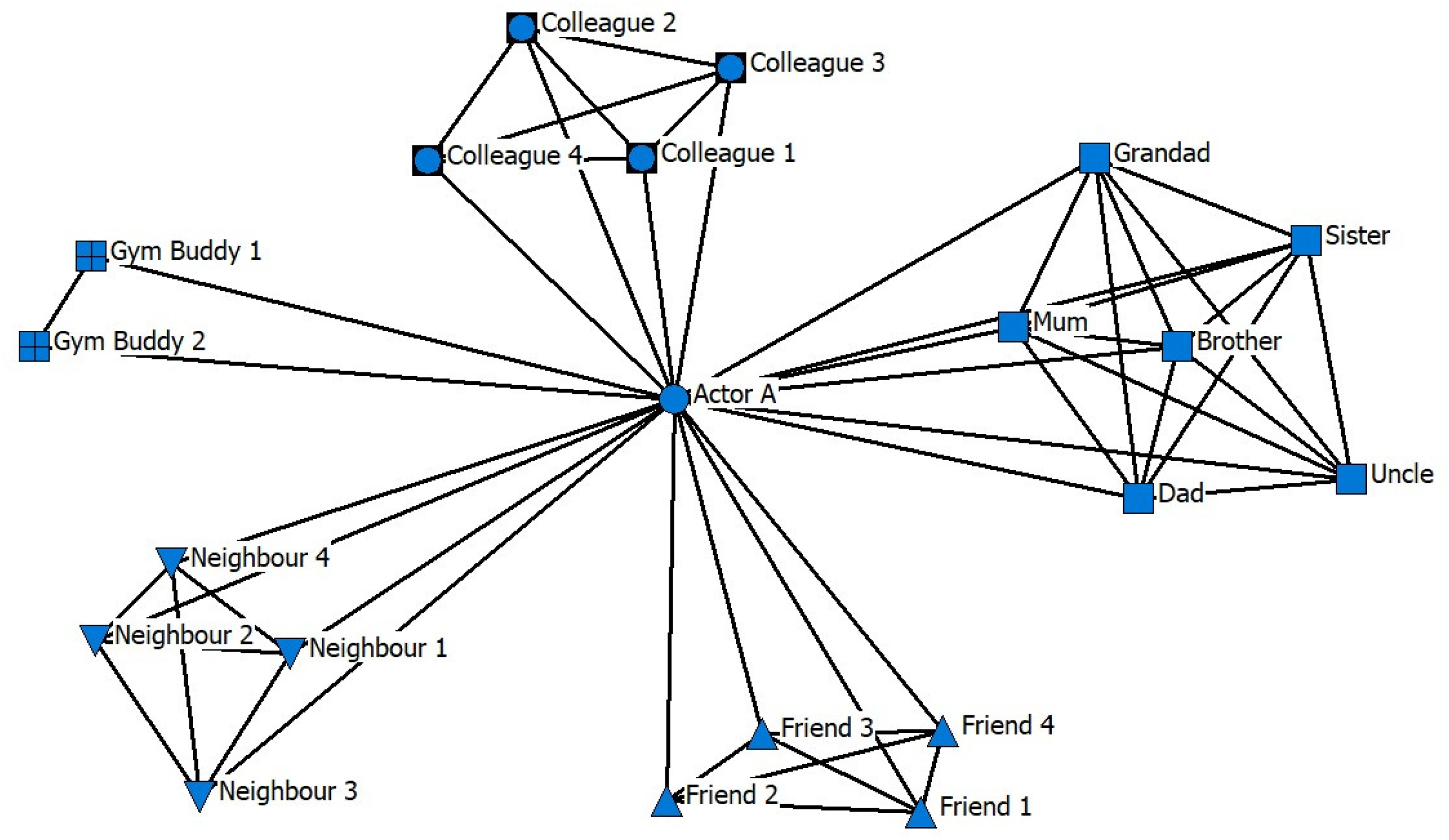
Intersecting different (otherwise segregated) groups.
The assumption behind SNA, born out by many studies, is that patterns of connection create both constraints and opportunities for those embedded within them, on individual and collective levels, and that they impact upon social processes such as the diffusion of information, culture and other goods (e.g. Burt, 2005; Coleman, 1988, 1990; Gould, 1991; Valente, 1995). By these means they shape action. However, SNA is not a theory of social action and must import one if it is to do sociological work. Various theories have been imported over the years but two are particularly relevant for present purposes.
Many network analysts adopt a form of rational action theory (RAT). This is counter-intuitive as SNA challenges the ontological and methodological individualism that RAT typically advocates. SNA demonstrates that societies cannot be reduced to aggregates of individual actors because relations make a difference. Moreover, as a methodology it captures not only individuals but also relations between them and the wider configurations these relations form. Network analysts such as Burt (1992, 2005) and Coleman (1988, 1990) square this circle by focusing upon strategic interaction within relationships. Actors are always-already embedded in relations, they note, some of which (e.g. family relations) are not of their choosing, but interaction always has a strategic dimension which RAT, embellished by exchange and game theories, allows us to explore (see also Hedström, 2005).
Departing from a further key assumption of RAT, Coleman (1976, 1990) adds that rational actors need not pursue individual gain. Drawing upon Mead (1967), Coleman distinguishes between ‘the acting self’ (Mead's ‘I’) and the concept this actor has of themselves, which he dubs ‘the object self’ (Mead's ‘me’). The acting self orients to ‘the perceived consequences of events for the object self’ when acting, he argues, but ‘this separation of selves allows the acting self to have psychic investment not only in its own object self but also in the object selves of other persons’ (Coleman, 1976: 83). In other words, the actor always pursues the interests of a self in their action but not necessarily their own self. It is only a small step from this position to argue, as SIT does, that actors sometimes pursue the interests of a collective self; ‘us’ rather than or as well as ‘me’. Moreover, Coleman's claim suggests that even where they pursue individual interests, the self or identity to which an actor orients is always a product of social interaction, a position entirely consistent with SIT.
Mead (1967) is also relevant to the second theory of action that has been combined with SNA: symbolic interactionism (Crossley, 2010; Fine and Kleinman, 1979, 1983; McLean, 2007; Mische, 2003). Like Coleman, interactionists deem human action purposive, with actors pursuing goals and interests. What the approach adds, however, is a focus upon the communicative aspect of social interaction and the role of what Mead calls ‘significant symbols’; that is, gestures and objects which have an agreed, conventional meaning within a particular population. Furthermore, interactionist-inspired network analysts emphasise the cultural nature of social relations (see also Fuhse, 2021; McLean, 2017; White, 1965/2008, 1992). Following Goffman (1974), it is argued that actors establish a footing for interaction by categorising their relationship and orienting to category-dependent norms. For example, ‘friends’ interact differently to ‘colleagues’ or ‘lovers’. This involves negotiation but also reference to established cultural repertoires. Note that it also assigns role-identities to participants (e.g. ‘colleague’). Relations involve identities.
Actors manage their relations by way of categories and identities on this account. In this respect the interactionist camp within SNA again aligns with SIT. However, there are important differences which create a need for further dialogue and synthesis. For example, the discussion above centres upon individual identities rather than social identities. SIT still has something to add to in this respect. Conversely, SNA maps the paths through which culture must pass to diffuse through a group, a consideration overlooked by SIT, and interactionism corrects the tendency in SIT to take norms, categories and other aspects of group culture as given, arguing rather that they are products of interaction. As networks of interaction, groups generate their own ‘micro-cultures’, drawing both upon existing elements of the wider cultures in which they are embedded and events in their own shared history (Eliasoph and Lichterman, 2003; Fine, 2015). Furthermore, as I discuss below, ‘closure’ in networks cultivates both cultural homogeneity within groups and differences across them.
Groups as emergent wholes
The above discussion identifies various intersections between SIT and SNA. Social identities presuppose social relations and social relations presuppose identities. As noted above, however, SIT is critical of relationship-focused approaches, arguing that they both reduce groups to bundles of interpersonal dyads, preventing analysis from grasping them as emergent wholes, and restrict our analytic focus to small groups (Hogg and Abrams, 1988; Turner, 1987). I disagree and over the next two sections explain why.
SNA demonstrates that and how the concatenation of dyadic ties gives rise to emergent properties at the group level. Many properties of networks, including even most forms of node-centrality, derive from relations across a network as a whole and cannot be reduced to either individual nodes or dyads. They capture aspects of the structure of the network taken as a whole and, in the case of node centrality, the position of the node within that structure.
Moreover, these emergent structural properties enable and constrain actors, shaping their behaviour. ‘Closure’ is a good example of this. Following Simmel (1902), Coleman (1990) argues that a relationship between two actors, i and j, is transformed when j has a further relationship to a third actor, k, generating an ‘open triad’ (see Figure 2). This reduces j's dependence upon i, shifting the balance of power between them, and allows j to benefit as a broker, controlling the flow of resources between i and k. In addition, j might play i and k off against one another. The situation is changed again, however, if i and k forge a tie, ‘closing’ the triad (Figure 2). In a closed triad i's relationship with k influences j's relationship with each. If j wrongs i, for example, word may get back to k, who may be less keen on continuing their relationship with j. This incentivises j to act honourably towards i, strengthening their relationship. In other words, the properties of the relationship i↔j depend upon the existence (or not) of the relationships i↔k and j↔k.
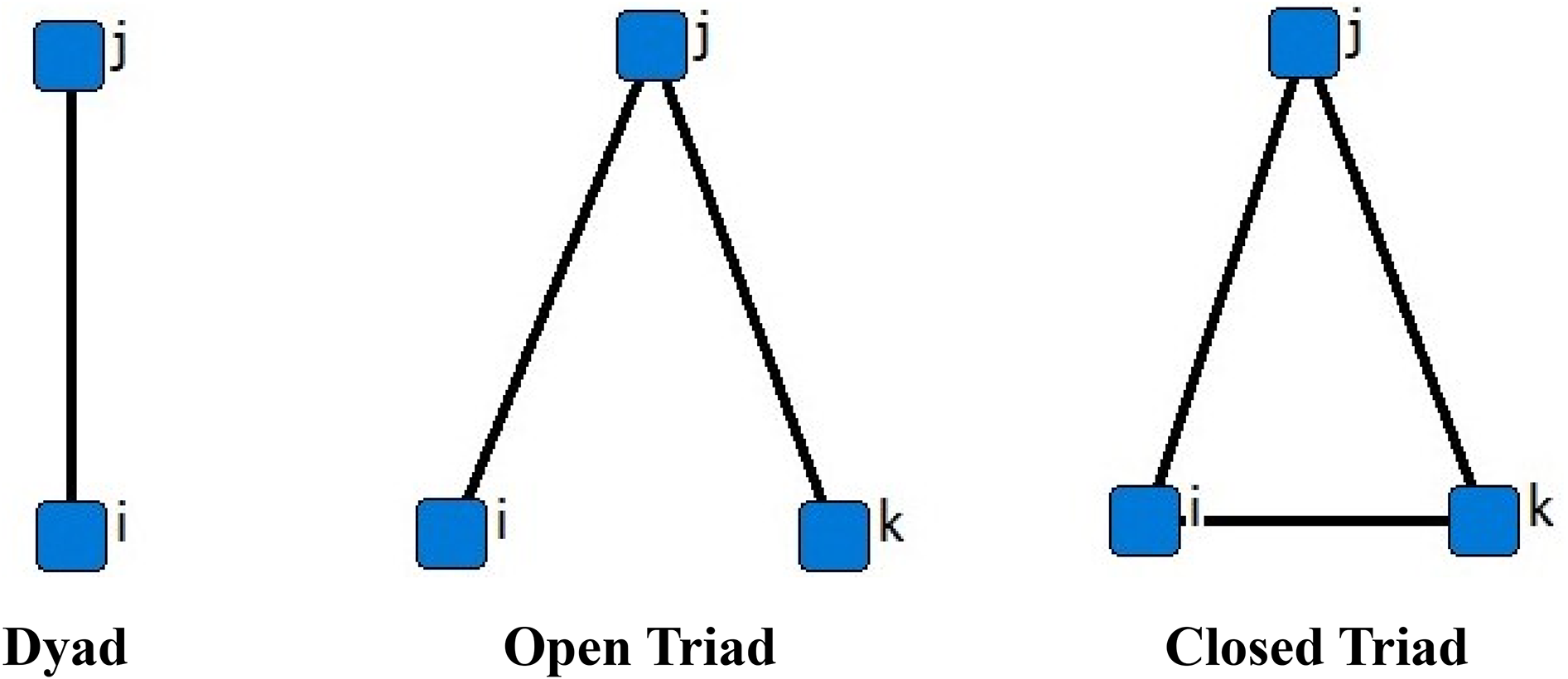
Closure.
This can be scaled up. In a discussion of the diamond trade Coleman (1990) notes that sellers often allow prospective buyers to take away expensive gems for valuation without taking a deposit or receipt. Traders trust one another, he argues, because they form a dense and closed network (most traders know one another) wherein reputation is paramount. News of dishonesty would quickly spread, destroying a trader's reputation and prompting other traders to refuse to do business with them, thereby excluding them from a highly profitable activity. Anticipation of this, he continues, is a social control mechanism which keeps traders honest. What matters here, to reiterate, is the total pattern of ties. Trust between any two traders is a function of the density and closure of the network within which their tie is embedded. Individual ties are impacted by the structures to which they belong and cohesion effects are emergent. Importantly, moreover, SNA offers means of measuring closure and density, and also algorithms for identifying closed/dense subgroups of nodes within a network.
Of course, individual diamond traders have many more identities than ‘diamond trader’, many more social relations than those with fellow diamond traders, and they don’t lend precious gems to just anyone. Coleman tacitly invokes social identity when putting boundaries around his network of diamond traders, and social identity is integral to the trust that he describes. Traders trust one another as traders. SITs might argue that a shared identity is all that matters here. It is commonly claimed in SIT that trust is an emergent property of in-group formation (Hogg and Abrams, 1988). It is my contention, however, that closure is important too. Trust is only maintained in a group over time when its members prove trustworthy, adhering to norms, and as both Durkheim (1974) and Parsons (1951) argue, internalisation of norms is often insufficient to guarantee their observance. Sanctions (positive and negative) and the network closure which allows sanctions to work effectively are necessary. Closure and social identity operate in tandem in the diamond trade and we can best understand this trade by combining the analytical tools of SIT and SNA.
A similar synergy is evident in relation to the formation of norms and categories of the sort SIT describes and, indeed, group cultures more widely. Shared norms and categories rest upon agreement, in behaviour if not opinions, and such agreement comes about because common contacts expose actors to the same influences. Everybody in a closed network cluster influences and is influenced by everybody else, cultivating homogeneity. This might serve to institute new subcultural patterns or to preserve older ones in the face of wider changes. This point requires brief elaboration.
To an extent Coleman's argument is cultural. He argues that closure allows for the generation and maintenance of norms of trust, cooperation and support. However, there are further, more obviously cultural examples we might consider. The key argument of Bott's (1957) classic study of family life, for example, is that the density of working-class networks insulates their members from wider changes in gender norms, preserving traditional, segregated patterns of leisure. Similarly, Milroy (1991) found that traditional speech patterns were preserved in dense network pockets in North-East England, whilst they were disappearing elsewhere. Traditional patterns were reinforced because those who used them were interacting predominantly with one another, creating an ‘echo chamber’ (on echo chambers see Burt, 2005). And in relation to innovation, network cohesion contributed to the cultivation of deviant stylistic norms in early UK punk (Crossley, 2015). Closure allowed proto-punks to become a key reference group for and influence upon one another whilst simultaneously insulating them from the influence of outsiders who sought to ‘correct’ their deviance.
As with Coleman's diamond traders, social identity was in play here. Proto-punks interacted with many different types of people who may have influenced particular aspects of their behaviour but their identification with the emerging punk network and desire to belong to it was such that the example of their fellow post-punks took on a special significance and had a particular impact. As Turner (1991) notes from a SIT perspective, identification facilitates positive influence between in-group members, inhibiting the influence of out-group members or rendering it negative. Networks remain important, however, because they are the channel through which influence passes and they form an incentive structure affecting adoption. Achieving recognition and esteem within a closed network which has become central to one's life creates a strong incentive for adopting the emerging norms of that network.
We find a similar interchange between networks and identities in collective action, including the ‘social competition’ and ‘social creativity’ described in SIT (see above). There is a substantial body of literature pointing to the importance of identities in relation to collective action (e.g. Gould, 1995; Tilly, 2005). However, there is an equally substantial literature, drawing upon SNA, which demonstrates the importance of networks (e.g. Gould, 1991; McAdam and Paulsen, 1993; Snow et al., 1980; Tilly, 1978, 2005). These studies suggest that identification with a group is typically insufficient to bring about mobilisation or sustain it over time because actors tend to ‘free ride’ and require additional incentivisation. Coleman (1988, 1990) is relevant again here. He argues that closed networks discourage free-riding and incentivise participation and self-sacrifice in collective action in much the same way that they encourage trustworthiness in the diamond trade. In addition, collective action requires coordination between its participants, which in turn presupposes communication networks (Marwell and Oliver, 1993). Beyond this, studies suggest that networks play a crucial role in recruitment, mobilisation of resources and provision of emotional support. Whilst identities figure in collective action in various ways then, they are not sufficient to bring it about and must operate in conjunction with networks.
In this section I have argued that a focus upon networks and relations, contra SIT, allows us to capture the emergent properties of groups and, in doing so, helps us to understand how identities, norms and wider aspects of group culture take shape. However, I have also shown both that identities are sometimes presupposed in SNA and that a focus upon identity affords a better understanding of certain processes, notably social influence, occurring within networks. Networks and identities intersect in processes of group formation and we need the insights of both SIT and SNA to best analyse those processes. I turn now to SIT's second criticism of relations-based approaches; that they limit analysis to small groups.
Scaling up
Relations-based conceptions only work for small groups according to SIT (Hogg and Abrams, 1988; Turner, 1987). Individuals can only be meaningfully connected to a limited number of others (in unrelated work Dunbar (1992) famously suggests 150). This is much smaller than the social groups (e.g. social classes and ethnic groups) that SIT is focused upon and SIT argues that membership of larger groups must be based upon something other than dyadic ties; namely, identification with a shared category.
This begs the question of how members of big groups come to share categories and associated norms and culture, if not by means of communicative channels, which is to say relations which connect them? Actors do not arrive at a group identity, less still a group culture, by plucking it from the ether. Group identities are acquired, shaped and reproduced by way of interaction in networks. More to the point, to say that a group is a network is not to say that every member is connected to each of the others. Many nodes in a network are only indirectly connected via the mediation of third (fourth, fifth, etc.) parties. However, research suggests that these paths of indirect connection are short enough to facilitate quick and effective diffusion of social categories and group cultures. In what follows I elaborate upon this.
Milgram's (1967) ‘small world’ studies provide a good way in (see also Korte and Milgram, 1970; Schnettler, 2009a, 2009b; Travers and Milgram, 1969). In an effort to map the social structure of US society, Milgram devised a chain-letter method of network elicitation. A set of ‘starter’ individuals were given a package and the details of a target in another state to whom the package was to be delivered. However, starters could only pass the package to somebody they knew on a first-name basis, who would receive the same instruction and so on until the package finally reached the target. Tracking the packages, Milgram found that each traversed six relationships on average before reaching its target. This led him to the now popular claim that any two individuals picked at random from the US population are at an average ‘six degrees of separation’. Networks where many millions of nodes are linked by such small average distances are ‘small world networks’ (Newman et al., 2006; Watts, 1999; see Schnettler, 2009a, 2009b for a discussion of the contemporary evidence).
Complexity scientists have replicated and developed Milgram's findings in relation to a variety of networks (Barabási and Albert, 1999; Newman et al., 2006; Watts, 1999). Complex systems often involve many millions of nodes and scientists had assumed this would result in path lengths too long to facilitate coordination. Milgram's work has persuaded them otherwise (Barabási and Albert, 1999; Newman et al., 2006; Watts, 1999). This is relevant to our discussion because it suggests, contra SIT, that a focus upon networks need not preclude big groups. A social class or ethnic group can be conceptualised as a network because the average geodesic distance 1 between its members is likely short enough to facilitate both collective action and quick and effective subcultural diffusion. Coordination between actors is possible as it is in other complex systems.
Complexity theory suggests two mathematical models to explain how small world networks are possible (Barabási and Albert, 1999; Crossley, 2008; Watts, 1999). Watts’ (1999) model, which comprises multiple dense and closed clusters linked by ‘open’ bridging ties, is particularly interesting because the structure it suggests was anticipated by Fine and Kleinman (1979) in an important account of the diffusion of subcultural identities and norms. Subcultures typically form in relatively closed and dense geographically concentrated network clusters, Fine and Kleinman observe, but they diffuse to other geographically concentrated clusters via more ‘open’ bridging ties.
The diffusion of roots reggae from Kingston, Jamaica, to inner-city pockets in the UK during the 1970s illustrates this. Friendship ties, stretched across space by migration, served as channels of subcultural influence, allowing innovations in musical and sartorial style, as well as political and religious discourses taking shape in Kingston ghettoes, to diffuse to Jamaican diasporic communities in the UK (Bradley, 2000). Networks and identities worked in parallel in this process. Ties between actors in the two countries created a channel through which culture could flow. Shared identities cemented those ties and encouraged flow by lending subcultural content relevance and resonance. Youths in the UK were (more) influenced by their Jamaican contemporaries because they identified with them as fellow Jamaicans. The latter were, to use SIT terminology, prototypes for the former.
The combination of SNA and SIT also allows us to tease out an important nuance in group formation here. SIT predicts that the existence of a single category, such as ‘rasta man’, will encourage individuals across different contexts to identify as members of a single, trans-local group. There is evidence to support this in the case of reggae (Bradley, 2000). However, SNA would predict that a lack of closure around the bridging ties which connect localities would allow subcultural variations to emerge, which closure within localities would reinforce. Each local cluster enforces its own version of a subculture but there is less enforcement across clusters allowing them to vary (Experimental work on online networks by Centola [2010] suggests that ‘costly’ behaviours are less likely to diffuse in the absence of closure for much the same reason). Again the reggae example supports this (Centola, 2010). A trans-local group with a unified identity contained different local clusters with distinctive variants of the general subculture (Bradley, 2000).
Network, identity, homophily
I have suggested that networks and identities interact within processes of group formation. In this final section, I consider how they might directly shape one another. Milgram is again a useful starting point (see esp. Korte and Milgram, 1970). Whilst his packages traversed geographical space easily and quickly, moving between distant towns and cities, Milgram found that social space and ethnic divides in particular proved more problematic. When a package needed to cross from one ethnic group to another it often stalled for a time. Subjects typically had friends in distant towns but they less often had friends in different ethnic groups to their own, even within the same town.
What Milgram's packages were hitting up against was ‘status homophily’; that is, the widely observed tendency, which SNA allows us to measure and model statistically, for social actors to be disproportionately connected to others with whom they share a salient social identity (Lazarsfeld and Merton, 1964; McPherson et al., 2001). Status homophily and its counterpart, value homophily, which entails an elevated probability of connection between actors who share beliefs, values, attitudes and/or tastes (Lazarsfeld and Merton, 1964; McPherson et al., 2001), are important because they point to a convergence of network ties and social identities. Actors who share a social identity are also more likely to be connected. This suggests either that sharing an identity encourages tie formation, a process termed ‘selection’; that ties give rise to shared identities through a process of ‘influence’; or, more likely, both. I begin by considering the former.
Identity drives selection at two levels: structural and psychological. Structurally, tie-formation depends upon the likelihood of actors coming into contact, which in turn depends upon a variety of factors, some of which are identity-related. Feld (1981), for example, describes the role of ‘foci’ in generating homophilous networks. A ‘focus’ is a place or event which attracts actors with a shared identity, drawing them into a common orbit and thereby increasingly the likelihood that they will meet. It would not be surprising if adherents of the same religious faith in a town knew one another, for example, because they would meet at church. Churches are foci which bring devotees of a particular faith into contact. Likewise, gigs bring jazz fans together and tennis clubs bring tennis enthusiasts together.
At a psychological level selection is driven by actors’ preferences for in-group interaction. This may reflect cost/benefit ratios: common ground makes interaction easier and shared interests often make it more rewarding. It may also reflect the ease with which actors are able to empathise with other another. Shibutani (1964) argues that mutual role-taking is integral to the formation of social bonds. This is easier when actors share an identity. In addition, however, SIT experiments show that accentuation of positive in-group and negative out-group characteristics transfers to individual members of those groups, affecting attractiveness (Hogg and Abrams, 1988; Hogg and Turner, 1985; Turner, 1987). We are more likely to bond with fellow in-group members because we attribute positive group traits to them and therefore find them more attractive. This does not mean that actors only ever engage with one another as representatives of social groups. Hogg and Abrams (1988) note that personal qualities become more salient as actors become better acquainted. However, social identities shape first impressions, which inform decisions regarding continuation of a relationship and thereby indirectly influence even close relations.
In addition to selection, homophily may be an effect of influence: actors may adopt one another's interests and identities, becoming more alike. Influence is another topic of interest shared by SIT and SNA, where their accounts are different but complementary. I do not have space to elaborate at length here but SNA is primarily focused upon the channels (ties) along which influence passes and their structure, whilst SIT is focused upon the role of identification in the process of influence (Burt, 1987; Turner, 1991; Valente, 1995).
Selection and influence are not mutually exclusive and there is good reason to suppose that they often work in parallel. Selection brings together actors who share an identity and keeps those who do not apart. Influence then amplifies in-group homogeneity. Shibutani (1955) and McPherson (2004) both employ versions of this argument to explain group cultures. Sociologists are prone to attribute differences in group cultures to specific features of groups, such as lack of resources, they argue, but this is essentialist and fails to explain why, over time, the same group can adopt very different cultural practices whilst the same cultural practices migrate between very different groups. Influence within (and between) homophilous network clusters is a more plausible explanation. Distinctive class, ethnic and regional cultures are a product of in-group interaction, from this perspective, and of the fact that actors primarily socialise within their in-groups, enjoying little out-group contact. Different groups are not completely disconnected, however, such that there is a diffusion of culture between them over time.
Identity is presupposed in the above account but identities themselves can be both transformed and forged anew in the processes described. SIT's minimal group experiments suggest that arbitrarily partitioning a set of social actors can suffice to trigger social identity formation and group behaviour (see above). Outside of the laboratory processes of network formation have a similar partitioning effect. Network foci draw certain actors together and away from others. Where the resulting network clusters are relatively closed this generates a degree of internal subcultural homogeneity which encourages identity formation and in/out-group differentiation.
Furthermore, interaction within network clusters contributes to group identification in important ways which SIT overlooks. Mead (1967), for example, argues that repeated interaction engenders empathic identification between those involved and an internalised feel for the group (qua ‘generalised other’) (see also Shibutani, 1964). Blumer (1969) argues that intense interaction gives rise to an esprit de corps which is subsequently rendered intelligible and embellished in collective narratives. Collins (2004) explores the transformation of positive group feelings into group symbols (see also Schutz, 1962). And in social psychology, ‘identity fusion’ theorists have amassed evidence demonstrating the significance of sensuous ritual interaction for identity formation (Kavanagh et al., 2018; Swann et al., 2012). Social identities have an embodied and affective aspect which is difficult to explain without reference to (embodied and affective) interaction between members of a group.
These are strong claims which require further elaboration and empirical investigation but I will conclude with a brief illustration: the emergence of punk in the UK in the mid-1970s. Punk took shape as both an identity and a subculture within a relatively dense and cohesive network (Crossley, 2015). The network formed around two key foci: a boutique on London's King's Road and the gigs of a band, the Sex Pistols, formed at that boutique. Identity played a role in this process. The boutique had a reputation for outré fashions, attracting punters who wanted ‘to be different’, and the early gigs were in art colleges and venues on the ‘pub rock’ circuit, in both cases attracting audiences who identified with music from outside of the mainstream. There were no punks, however, because ‘punk’ did not exist. Moreover, participants were drawn from different social groups. Though mostly young and white they had no shared identity and came from a variety of backgrounds.
Regular audience members at the early gigs report a sense of excitement at belonging to something new and special (Savage, 2009; Robb, 2006). Many quickly identified with the emerging network to which they were connected. However, this network had no name initially. The category ‘punk’ only emerged later, originating in the writing of UK music journalists, who borrowed it from US music journalists and fanzine writers. These (UK) journalists, who in most cases belonged to the network themselves and were excited by what was happening, attached the label ‘punk’ to it and this label was fairly quickly adopted by others within the network; notably, when naming the 100 Club Punk Festival of September 1976. A sense of belonging born of interaction in a dense network thereby acquired a name, giving rise to a categorical identity.
Furthermore, interaction within the network generated norms and a wider group culture which attached to that emergent identity. Hair length provides an example. In contrast to the hippies, a disparaged outgroup who preceded them, punks typically had short hair. Some, such as Captain Sensible of the Damned, embraced this as a condition and symbol of their new punk identity: ‘I had to cut my hair off; that was part of it’ (in Robb, 2006: 136). Others, such as Mick Jones of the Clash, took more persuading: ‘Bernie nearly threw a party when Mick got his hair cut … everyone was saying it. Get your fucking hair cut’ (Mickey Foote in Gilbert, 2005: 147). In all cases, however, the norm was clear. Furthermore, when the Sex Pistols first came to the attention of alternative music fans in Manchester, via a magazine gig review with an accompanying photograph, some readers were struck by (lead singer) Johnny Rotten's short hair and puzzled by the mismatch between this style and reports that the Pistols covered songs by one of their favourite bands, the Stooges. Martin Bramah, later of the Fall, recalls: ‘I was wondering what these ‘skinheads’ were doing covering Stooges’ songs’ (cited in Ford, 2003: 16). When the Pistols first played Manchester Bramah ‘went along thinking I could heckle or something’ (Ford, 2003). In the event he didn’t heckle and had his own hair cut short soon afterwards. Rotten had become a punk prototype and short hair a new norm and marker of punk identity.
Conclusion
The punk example encapsulates the two key claims of this paper. Firstly, the early punks, as a social group, both formed a cohesive network (or a dense subgroup with the wider network of their society) and shared a social identity. It was this combination that allowed them to make a difference to their society. I would like to generalise that to social groups more generally. Social identities and cohesive network subgroups might sometimes exist independently of one another. Indeed, as noted above, the punks were a network without an identity in the early history of their formation. However, as White (1965/2008) hinted in his early work on catnets and Tilly (1978, 2005) further demonstrated in relation to social movements, it is where these two properties (cohesive networks and social identities) coincide that social groups in a more developed sense come into being.
Secondly, the emergence and activity of the punks is best understood by reference to a combination of network mechanisms, as described in SNA, and identity mechanisms, as described in SIT. These mechanisms operate at different levels, sociological and psychological, and are therefore irreducible to one another. But each contributes to group formation and they interact. For example, the punk identity initially formed around a pre-existing cohesive network subgroup. The existence of a network triggered a process of identity formation. However, once formed that identity influenced the process by which subsequent ties were formed; punks linked to other punks, distancing themselves from non-punks. The existence of an identity impacted upon a process of network formation. Such interaction is true of other mechanisms and, importantly, of other social groups. To understand social groups we must understand network mechanisms, identity mechanisms and their interaction.
Both SIT and SNA identify mechanisms which shape human behaviour and societies. My contention is that we will explain more and better by bringing them together and considering the interaction between the mechanisms they each identify. This interaction is perhaps easiest to observe in historical and ethnographic studies which track interaction over time, noting both who interacts with whom (networks) and the categories employed and oriented to by participants (identities). It is in these studies that the payoff of my argument will be most keenly felt. However, the identification of mechanisms and robust testing of their credibility as mechanisms may take different forms and will probably be conducted separately. SIT has tended to rely upon experimental methods to isolate identity mechanisms, although there is no reason to suppose that other methods might not prove useful moving forward. SNA has well-developed methods for data processing and analysis, which allow us to identify and test network mechanisms, but these admit of a wide variety of forms of data gathering. What is most important, however, is that we do not allow these separate bodies of research to remain separate when the opportunity to study their concatenation arises. Real social groups involve an interaction between both and our research should endeavour to capture that.
Further exploration of the interaction between network and identity mechanisms is a key element of the research agenda I propose but bringing networks and identity together raises further questions which also belong to that agenda. For example, more research is needed on both intersectionality and identity ‘switching’ (Mische and White, 1998; White, 1995). The typical social actor has multiple social identities and it is not obvious how this impacts upon network formation. Do actors compartmentalise their ties according to different identities, as in Figure 1, for example, switching between different identity groups within their personal network or do they only forge ties with others occupying the same hybrid intersections as themselves? These are important questions. Whilst the concept of groups argued for here fills a gap in our understanding, therefore, it also serves to open up fruitful avenues for further research.
Footnotes

Funding
The author received no financial support for the research, authorship, and/or publication of this article.
Declaration of conflicting interests
The author declared no potential conflicts of interest with respect to the research, authorship, and/or publication of this article.