




Abstract
Research on co-offending has become increasingly popular across the last two decades of criminological research. In this paper, we focus on three key variables and their relationship with co-offending. First, we examine age and sex homophily effects. Second, we examine the differential effects of prior solo offending and prior group offending on the future arrest rate (overall and separately for different crime categories). Third, we examine whether there are age and sex effects and age/sex homophily effects on arrest rates (overall and across crime categories) and on propensities to be arrested again in future. Results suggest that individuals who committed group crimes in the past are more versatile in future criminal activities. Market crimes appear to require the highest level of specialisation among the four types of crimes in the sense that those who committed market crimes in the past commit market crimes in future and tend not to commit subsequent novel types of crimes. Individuals who committed crimes other than market crimes in the past tend not to engage in market crimes in the future. When co-offending groups are more heterogeneous with respect to age or sex, the effect of past arrest on propensity for future arrest is stronger. We draw implications for policy and practice based on the results of the study.
Introduction
Research on co-offending has become increasingly popular over the last two decades (e.g., Bouchard & Konarski, 2014; Brantingham et al., 2011; Bright et al., 2023, 2024; Faust & Tita, 2019; Iwanski & Frank, 2014; McGloin et al., 2008; Morselli et al., 2015; Sarnecki, 2001). Co-offending refers to offending events that involve two or more individuals and is associated with different characteristics and impacts compared with solo offending. For example, compared with solo offending, co-offending is associated with increased overall interactions with the justice system (Andresen & Felson, 2012; McGloin & Piquero, 2009), may lead to an escalation in offending (quantum and seriousness), and results in a greater magnitude of social and economic harms to victims and society in general (Carrington, 2002; Felson, 2003). Research suggests that individuals who engage in co-offending, as compared with those who only engage in solo offending, commit a larger number of offences and offences that are more serious (Felson, 2003; Hindelang, 1976; Sarnecki, 2001; Warr, 2002; Zimring, 1981). Recent research has shown that co-offending is associated with greater criminal versatility compared with solo offending (Bright et al., 2024). Research on co-offending, as an adjunct to more traditional criminological research focused on individuals, has significant potential to improve our understanding of offending pathways and improve policies and practices aimed at crime prevention. The current paper extends previous research on sex and age effects in crime, by incorporating a distinction between sex and age affects in solo offending and co-offending. The paper also extends research on co-offending by employing innovative models that address some of the methodological limitations of previous research.
The current paper has three key foci. First, we examine age and sex homophily effects (overall and separately for different crime categories). Of course, homophily effects are relevant only for crime events that involve co-offending. Second, we examine the differential effects of prior solo offending compared with prior co-offending on future propensity to commit crime (overall and separately for different crime types). Third, we examine whether age and sex effects and age/sex homophily effects on crime rates (overall and across crime categories) and on propensities to commit additional offences. In doing so, the paper extends previous research on offending and re-offending by comparing results for co-offending with results for solo offending, especially in relation to the effects of age and sex including age and sex homophily. By applying an innovative type of social network modelling, relational hyperevent models (RHEM), we effectively combine co-offending network analysis with analyses comparing co-offending and solo offending. This study is the first to use RHEM to examine age and sex homophily in co-offending. Further, the current paper extends previous research on co-offending networks, including research that has previously used social network approaches. For example, one prior study on crime versatility in co-offending (Bright et al., 2024) did not specifically examine criminal activity because the model utilised in that study was conditioned on the actors involved in a crime event. Therefore, this previous study was limited as it took for granted that a given group of actors engaged in criminal activity at a given point in time and then explained their “choice” or “selection” of crime categories. In this paper we complement the study by Bright et al. (2024) by explaining criminal activity. That is, we analyse which factors explain whether a group of actors co-offends or does not co-offend at a given point in time. It is important to note that in this study we have used police data on arrests across a five-year time period (more details are provided in the next section of the paper). We employ arrest data as a proxy for offending, co-offending and re-offending. This has important implications for the interpretation of our results.
The current paper applies innovative network modelling to three key areas that have been germane to criminological thinking from the discipline's infancy: the extent to which age, sex, and prior offending are related to future offending. By using these new social network models, we incorporate comparisons between solo offending and co-offending in novel ways that overcome some of the methodological limitations of previous studies (e.g., the use of two-mode to one-mode social network transpositions; for more detail of the methodological advances of RHEM compared with more traditional approaches, see Bright et al., 2023). The key innovation of the paper is that we use new methods to examine the effects of age and sex, and the influence of age / sex homophily dynamics on re-offending. For the first time, this paper investigates offending at the individual level, while also incorporating co-offending network methodologies and analysis that allow us to additionally examine these issues from a relational perspective. An additional innovation is the disaggregation of (co-) offending across several crime categories (i.e., property, violent, market and other crime) to determine whether specific network effects are evident for some crime types compared with other crime types. Examining offending and co-offending using this type of network or relational lens overcomes a primary limitation of more traditional statistical enquiry. Inferential statistical approaches assume independence of observations in any dataset (e.g., a dataset of arrests). In the case of arrest data, for example, this means that researchers assume the independence of actors who are arrested for crimes in a particular geographic area. This assumption is violated by any type of relational tie between two or more individuals in a dataset (e.g., co-offending ties). The assumption of independence between observation is contradicted by some criminological theories that highlight relational dynamics in crime and offending (e.g., differential association, social learning).
The paper proceeds as follows. First, we provide an overview of relevant theory and empirical results on co-offending, including age / sex homophily and risk of reoffending. Second, we present our research questions and outline the novel contribution of this study. Third, we give an overview of our data and methods. Fourth, we present our results, organised with respect to age and sex homophily and propensity for committing future crime. Fifth, we turn to our discussion of results. We conclude the paper by discussing the implications of our results for criminal justice policy and practice.
Co-offending and co-offending networks
A range of theoretical accounts have been advanced to explain how and why co-offending occurs. For example, one influential framework (Weerman, 2003) focuses on social exchange mechanisms to explain the dynamics of co-offending, including the exchange of material resources (e.g., weapons, drugs) and non-material resources (e.g., skills, knowledge). In contrast, Conway and McCord (2002) emphasise the role of social learning processes in the dynamics of co-offending such as cases in which an individual is instructed on how to commit specific crimes by more experienced peers (see Bright et al., 2024 for an empirical account of these dynamics). More recently, Tillyer and Tillyer (2015) identified three primary motivations for co-offending as distinct from solo offending. First, the decision to co-offend may be the result of social learning dynamics that occur through processes of differential association or peer pressure (McCluskey & Wardle, 1999; Shaw & McKay, 1931; Sutherland, 1947; Warr, 1996). Second, underlying pro-criminal personality traits such as low self-control may see some individuals self-select into groups that share particular attributes (a type of homophily effect). Third, and from a more rational perspective, individuals may expect co-offending – as compared with solo offending – to involve less effort and less risk (Weerman, 2003). Of course, these three motivational categories are not mutually exclusive and decisions to co-offend may be the result of combinations of these as well as other motivations.
Representing co-offending within a particular population or sample as a network has the advantage of facilitating analyses across a cohort of co-offenders within a specific geographic area and who may share co-offending partners over time. Such patterns would not be observed using methodologies that focus only on individual offenders or only on small groups of co-offenders without consideration of the wider co-offending network. Indeed, individual level analyses of crime may obscure this relational aspect of crime and are usually based on assumptions that individual criminal actors behave independently of other criminal actors. Furthermore, analyses of co-offending networks can be used to interrogate theoretical assumptions that predict that relational ties between actors can provide a richer snapshot of crime patterns compared with traditional quantitative analyses that assume independence of criminal actors within a particular geographic area of study (Sarnecki, 2001).
Co-offending and different types of crime
Co-offending, as compared with solo offending, is more prevalent for some types of crime than others. Previous research suggests that the crime category that most commonly involves co-offending are property crimes (Andresen & Felson, 2012; Morselli et al., 2015; Ouellet et al., 2013). Other crime types that typically involve co-offending include robbery, arson, burglary, and motor vehicle theft (Reiss & Farrington, 1991; van Mastrigt & Farrington, 2009), financial offences, and market offences (Andresen & Felson, 2012; Morselli et al., 2015). Market offences are offences that occur in the context of illicit markets such as drug trafficking. In contrast, sexual offences and fraud are less likely to involve co-offending (Reiss & Farrington, 1991; van Mastrigt & Farrington, 2009). Previous research has found that criminal versatility across crime categories can be facilitated through engagement in co-offending compared with solo offending, perhaps due to processes of mentoring and social learning (see Bright et al., 2024) in which actors learn the knowledge and skills required for novel criminal activities.
We now move to a discussion of two key literatures relevant to the current study: (1) research on homophily in co-offending and (2) the relationship between co-offending and propensity for reoffending. As mentioned previously, the focus of the paper is on age and sex homophily effects in co-offending, and on the effects of co-offending and age/sex homophily on the propensity for engaging in new offences.
Co-offending and homophily
Homophily refers to the tendency of actors to form relational ties with similar others (e.g., Blau, 1977) such as those who share characteristics such as attitudes and interests, or those who share demographic characteristics such as age and sex. The effects of age and sex homophily have received much attention in a range of fields including co-offending. For example, research has found that age differences between co-offenders tend to be small (e.g., Budd et al., 2005; Reiss & Farrington, 1991). Further, males and females appear to choose co-offenders of the same sex in the majority of cases, although sex homophily appears to be driven primarily by male co-offending (Pettersson, 2003; Reiss & Farrington, 1991; Warr, 2002). There is also a small body of research on women's co-offending that has found that women engage in more serious offending activities when offending with a male partner compared with when they commit solo offences (e.g., Koons-Witt & Schram, 2003; Mullins & Wright, 2003). Some studies suggest that deviant peers are more criminogenic for women (Park et al., 2010), while other studies suggest the converse (Crosnoe et al., 2002; Wall et al., 1993). Homophily effects in co-offending may also exhibit different patterns across types of crime. For example, Bright et al. (2020) found that co-offenders tend to co-offend with others of the same gender in crime types other than market-based offences; in this latter category of crime mixed-gender groups tended to commit offences.
The current study extends existing literature by examining whether some types of crimes may be more likely to show evidence of sex and/or age homophily (e.g., property crime vs. violent crime). Indeed, some crime types may be marked by a tendency towards heterophily. For example, some crimes may require a division of labour that benefits from heterophily rather than homophily. In particular, some crime types may be characterised by co-offending involving a range of age groups with varying levels of criminal experience, facilitating mentoring and social learning. For example, complex (or “organised”) crimes that involve multiple interlocking activities are characterised by division of labour across groups of individuals (e.g., see Bright & Delaney, 2013; Morselli & Roy, 2008) and often include aspects of mentoring and social learning (e.g., Morselli et al., 2006; Ouellet et al., 2022). The differential effects of age and sex homophily across crime types have not been investigated previously and represent an important contribution of the current paper.
Co-offending, age/sex homophily and propensity for re-offending
Few studies to date have examined the relationship between co-offending (as compared with solo offending) and the probability of arrest. We now review this work in concert with relevant theoretical frameworks.
The “group hazard hypothesis” predicts that co-offenders are more likely than solo offenders to be detected and arrested for criminal activities. Some scholars have argued that co-offending is inherently more risky than solo offending, especially given the prospect of betrayal by one's co-offenders (e.g., McCarthy et al., 1998). On the other hand, some researchers have disputed the “group hazard hypothesis”, instead suggesting that offenders who engage in co-offending may benefit from being insulated from detection due to structural features of the overall co-offending network (see, for example, Baker & Faulkner, 1993; Krebs, 2002; Williams, 2001). Some research has found support for the group hazard effect (e.g., Erickson, 1973), while other research has found no support (e.g., Feyerherm, 1980). Among the interpretations of these mixed findings is that offending is a complex phenomenon that requires more nuanced analysis, such as the disaggregation of crime into discrete crime types. For example, some scholars suggest that some types of crime may be riskier than others in terms of potential detection and prosecution, and that the relationship between co-offending and risk of arrest may be mediated by crime type. For example, violent crimes have an increased likelihood of arrest (see Lantz, 2020) compared with non-violent crimes. The risk of betrayal by collaborators may also be higher for some crimes compared with others (e.g., those that would result in heavier punishments, thus incentivising betrayal to avoid such penalties). Finally, the relationship between co-offending and arrest may vary according to personal characteristics such as gender, age, and race. For example, age is negatively associated with offending (Lantz & Ruback, 2017), and females are more likely to co-offend than males (e.g., van Mastrigt & Farrington, 2009).
There is some evidence that co-offending groups involving younger offenders may be subject to a greater group hazard than older co-offending groups (Lantz, 2020). This may be related to a propensity for older offenders to commit crime alone rather than to co-offend, and to manage risks to reduce the probability of arrest, for example by co-offending in smaller groups compared with younger offenders (e.g., Eriksson, 1971). Consistent with these predictions, Lantz (2020) found a general group hazard for male co-offending groups, but this result varied by offence type. For example, for robbery offences male groups had the largest group hazard effect.
Previous research converges on the finding that co-offending groups involving more male than female offenders may show evidence of a greater group hazard effect than other groups (e.g., all-female groups; Fergusson et al., 2002; Lantz & Wenger, 2020; Morash, 1984). In addition, co-offending may be more criminogenic for women compared with men (see Berg & Cobbina, 2017; McCarthy & Hagan, 1995; McNeeley, 2019; Schwartz & Steffensmeier, 2017). In contrast, McNeeley (2021) found that for women (but not for men) rearrest and reconviction were lower among those who co-offended and those with larger co-offending groups.
Notwithstanding the group hazard hypothesis, some scholars have argued that co-offenders are actually more likely to commit subsequent offences, especially where previous co-offending has involved violence (e.g., Andersen, 2019; Carrington, 2009; Conway & McCord, 2002; Lantz & Hutchison, 2015; Warr, 2002). A number of potential dynamics have been posited to explain the relationship between co-offending and re-offending. For example, co-offending may increase accumulated social criminal capital (see McCarthy & Hagan, 1995, 2001; Sutherland, 1947) making future offending more likely for such individuals. Another suggestion is that co-offenders who are embedded in criminal networks may be more likely, compared with solo offenders, to be recruited by members of their extended criminal network for future criminal activity (see McNeeley, 2021). Consistent with social learning theories, Ouellet et al. (2013) suggest that co-offenders learn from co-offending partners, and that this learning could make co-offenders better at controlling or mitigating the risks of detection for future criminal activity. Alternatively, being part of a co-offending group may increase the risk of detection and arrest given the possibility that an accomplice might betray other members of the group to police (Ouellet et al., 2013).
Empirical evidence on co-offending and reoffending is somewhat mixed. Some studies have found that subsequent offending behaviour is more likely among those who co-offend compared with individuals who only engage in solo offending, and that those who co-offend have longer criminal careers (e.g., Andersen, 2019; Carrington, 2009; Conway & McCord, 2002; Lantz & Hutchison, 2015; McCord & Conway, 2002; McGloin & Piquero, 2009; Ouellet et al., 2013). In contrast, a study that focused only on violent offending, Lantz (2020) found that co-offending was significantly negatively associated with the probability of future arrest. Similarly, McNeeley (2021) found a negative association between co-offending and reoffending. Yet other research has uncovered a more nuanced relationship between co-offending and recidivism. For example, Ouellet et al. (2013) found that rearrest was less likely when the prior offence was committed in a group, but that those with more co-offenders in their criminal networks were more likely to be re-arrested in future. Co-offending may be associated with a lower risk of reoffending where social processes influence someone with a low overall propensity to commit a crime with co-offenders (e.g., McGloin & Piquero, 2009; Warr, 2002). This person may be highly unlikely to commit any future crime. Taken together, the disparate results of these studies suggest that further research is needed to illuminate the relationship between co-offending and reoffending. We note here that offending and/or reoffending may or may not result in detection by police. In the current paper, we use arrest (i.e., detected offending) as a proxy for offending and reoffending.
The overarching aims of this research is to examine co-offending across different crime types to explore the extent of age and sex homophily effects, and to examine the extent to which co-offending, as compared with solo offending, predicts any future offending (i.e., arrest), also incorporating age and sex homophily effects. The current study seeks to answer the following three research questions: (1) Is co-offending, in general and across crime categories, characterised by age and /or sex homophily? (2) Does co-offending (compared with solo offending) increase the probability of repeat offending and are there differences in these probabilities across crime categories? (3) To what extent is repeat offending characterised by age and /or sex homophily?
Method
Data
De-identified data were collected for all arrests made and recorded by the New South Wales (NSW) Police across a five-year period (2011–2015) for the Sydney metropolitan area. 1 The population of metropolitan Sydney was almost five million people across this period. The data included all recorded charges and all persons associated with each charge across the Sydney metropolitan area. The data were collected from the NSW Police Computerised Operational Policing System (COPS). The dataset included relevant personal information on all persons charged (i.e., issued with a Court Attendance Notice). We note that these are “charges” only and that being charged with an offence does not mean that the individual has been convicted for the offence. In this way, arrest or charge data represent a conservative measure of offending and co-offending. Nonetheless, arrest data have been used extensively in previous research on co-offending (e.g., Bright et al., 2023, 2022a, 2022b; Bouchard et al., 2016; Grund & Morselli, 2017; Morselli et al., 2015; Ouellet et al., 2013; Sarnecki, 2001). As mentioned previously, when we refer to “offences”, we are referring to detected offences in the form of the arrest of individuals by police.
For each individual recorded as part of the crime event, information on their date of birth and sex is provided. For each event, information on the offence-type, date, and location is provided. Data were included where the charge date, the event start or end date, or event reported date was within the period 2011 and 2015, and where the record is classified as involving an “Event”. 2 The dataset provided by NSW Police was for the period 2011–2015. All arrests / offences included in the dataset were those recorded in that period. Arrests with dates that were outside of that period were removed by the researchers as they were outside the scope of the study and may have been included in error. COPS generates unique reference numbers for data for records classified as involving an Event or an “Incident”, that is, whether it is part of a broader course of conduct involving the same person or a group of persons. COPS also generates a unique reference number for each individual within the system. These reference numbers link unique individuals to unique Events, and where there is more than one unique individual connected to a crime event, we assume these individuals are co-offenders. The project received ethics approval from the University of New South Wales Ethics Panel. 3
Coding and analysis
We conducted three primary data cleaning activities to prepare the data for analyses. First, we retained event data for the period 2011–2015 and removed any events that occurred outside this period. Second, for unique offenders who had more than one date of birth on record, we retained only the individual's lower year of birth. Third, we removed the following crimes from the dataset: public order offences, traffic and vehicle regulatory offences, and offences against government procedures. We removed public order offences because they often involved large groups of offenders arrested in the same event, but given their nature (e.g., large protests) we could not be confident the offenders were actually collaborating in the offence. Traffic offences account for a high volume and are typically solo offences, so these were removed. Offences against government procedures accounted for a very small number of offences and were therefore also excluded.
Once the data was cleaned per the above, we employed the Australia and New Zealand Standard Offence Classification system, a uniform national framework for classifying offences, to allocate all crimes to one of four crime discrete and non-overlapping crime categories.: (1) Violent crimes: crimes against the person (e.g., assault, sexual assault, murder, attempted murder); (2) Property crimes: crimes against property (e.g., malicious damage, break and enter, theft, robbery 4 ); (3) Market crimes: crimes committed within illicit markets (e.g., drug trafficking, importation of illicit drugs); (4) All other crimes: crimes that did not fit within the above three categories (e.g., breaches of criminal justice orders, offences against justice procedures, noise pollution offences, drug possession, forgery and fraud). These four crime categories have been used in previous research on co-offending including research on co-offending networks (Morselli et al., 2015). Our primary focus was on the three main categories: violent, property and market crime. While the “other crime” category represents a “catch all” category including a diverse range of crimes, we have included this category in our models to ensure a comprehensive treatment of all crime types in the analyses rather than removing this category from our analyses.
We employ RHEM to model offending and co-offending as “hyperevents”. That is, one crime event is considered to be a single observation even if that event involves more than one offender. Moreover, each event can involve any combination of the crime categories Violent (V), Market (M), Property (P), and Other (O) (between one and four categories). Thus, an observed crime event has the form
While the empirical data is identical to the one analysed by Bright et al. (2024), our models are complementary to theirs. Bright et al. (2024) conditioned the model on the observed group of co-offenders
Most of the effects included in our models explain the crime rate, or relative risk of committing a future crime, at time t by the prior criminal activity of the group members
As is typical in Cox regression, the relative crime rate, or relative risk, is specified in log-linear form
Results
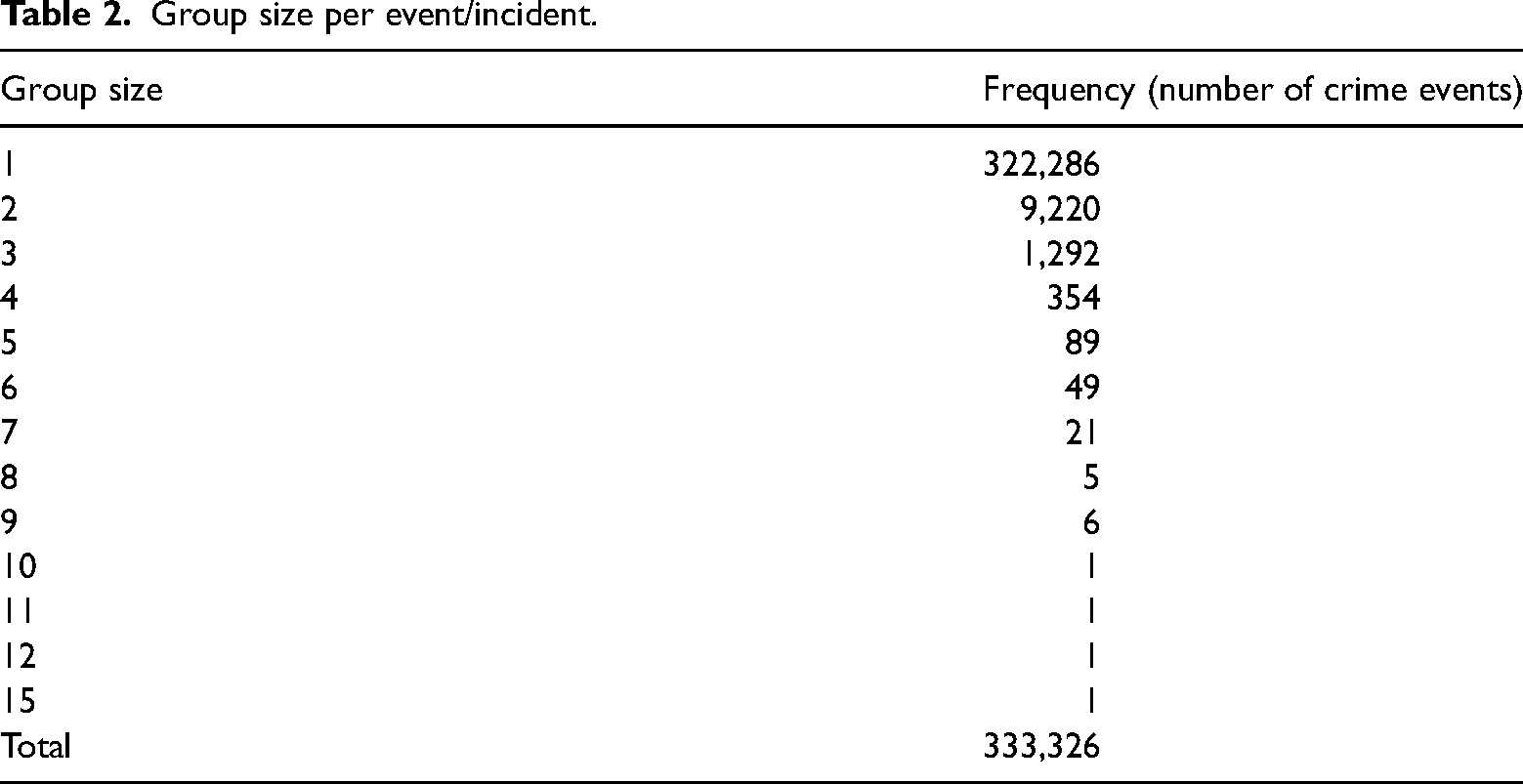
Of a total of 333,326 crime events, 12,598 (3.78%) involved market crimes, 84,607 (25.38%) involved property crime, 115,159 (34.55%) involved violent crimes, and 160,120 (48.04%) involved other types of crimes not covered by the main three categories. Note that a single crime event can involve multiple crime categories, so the total number of crime categories is higher than the aggregate number of events. Of 333,326 crime events, 322,286 (96.69%) were solo offences and 11,040 (3.32%) involved co-offending.
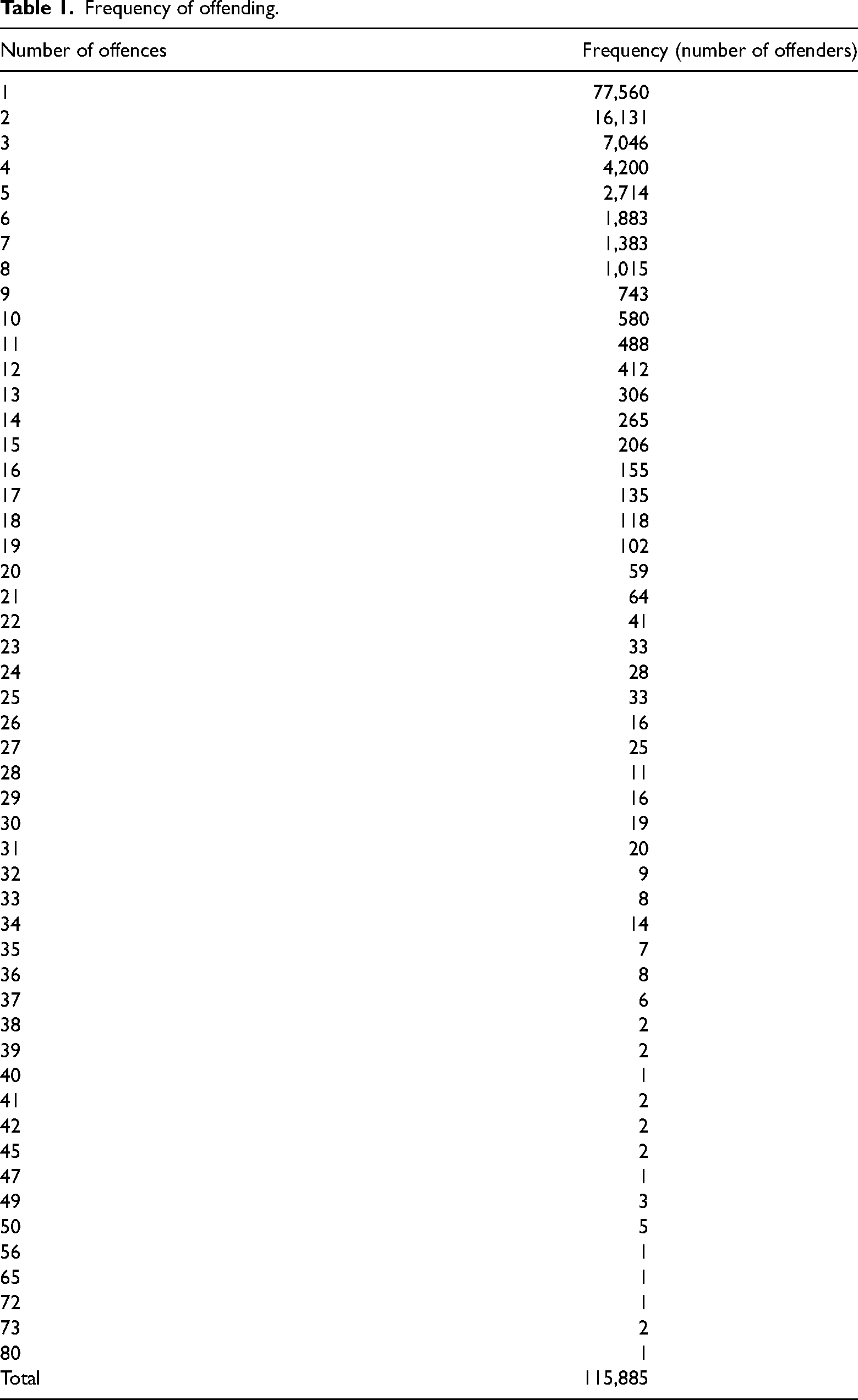
At the individual level, frequency of offending is displayed in Table 1, showing that while 77,560 offenders committed a single offence, 16,131 offenders committed two offences and one offender committed 80 offences over the time period. The mean number of offences committed by individuals was 2.11 (SD = 2.80127). From the table we can calculate that a total of 38,325 offenders committed more than two offences. 96.69% of crime events were conducted by a sole actor, while 2.76% of crime events were conducted by a pair of actors. Table 2 displays the number of offenders involved across crime events. The average number of offenders arrested per crime event was 1.04 (SD = 0.25). We now present our results for each of the three research questions in turn. RQ1: To what extent is co-offending characterised by age and /or sex homophily and are there differences in homophily across crime categories?
Frequency of offending.
Group size per event/incident.
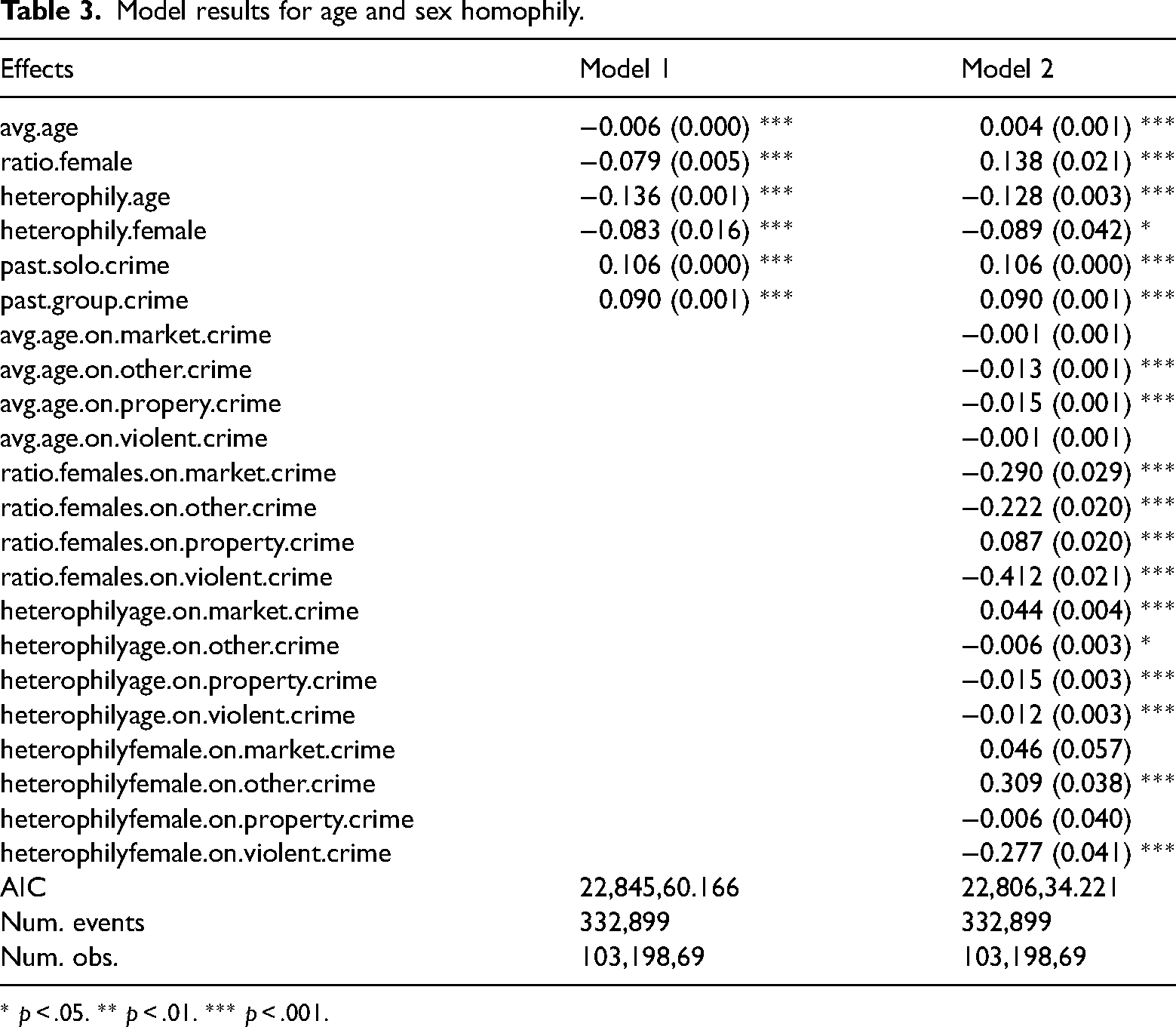
These effects are tested via the variables “heterophily.age” (the average age difference among all pairs of co-offenders) and “heterophily.female” (the ratio of pairs of co-offenders who are male and female). Note that both variables indicate heterophily. Specifically, the higher the values, the more different the actors are on the respective variable. Age and sex heterophily variables were also interacted with the four dummy variables indicating whether the current event involves the respective crime categories. Solo activity, measuring the number of past solo offences, and group activity, measuring the number of past group offences, are included as control variables. For a crime category X (where X could be M for market crimes, V for violent crimes, P for property crimes, or O for crimes in any other crime category), the variable on.X (e.g., “on.market.crime”) is a binary indicator variable that takes the value one if the current event, whose incidence is explained by the model involves crime category X. We note that these four indicator variables are not mutually exclusive as a crime event may involve several of them. Results are displayed in Table 3 below.
Model results for age and sex homophily.
* p < .05. ** p < .01. *** p < .001.
As we might expect based on previous research, older people offended less compared with younger people, and females offended less than males. According to the results of Model 1 there is evidence of sex-homophily within co-offending groups (negative parameter of “heterophily.female”). That is, co-offending groups tended to be predominantly male or predominantly female, while more balanced groups of male and female co-offenders were more unlikely. Likewise, we find evidence for age-homophily within co-offending groups (negative parameter of heterophily.age). That is, the age variation (or age differences) within groups of co-offending actors is lower than what we would expect if group members were selected randomly.
Model 2 reveals that for market crimes, age homophily is weaker (positive parameter of “heterophily. age.on.market.crime”), that is, co-offending groups engaging in market crimes have a higher age variation than co-offending groups not engaging in market crimes. For the other three types of crimes age homophily is stronger, that is, the age distribution shows less variation. For the category of “other” crimes there is a tendency for sex heterophily (groups that co-offend in other crimes are more mixed than co-offending groups in general, it can be seen from the positive parameter of “heterophilyfemale.on.other.crime”). In contrast, in the case of violent crime, sex homophily is stronger (negative parameter of “heterophilyfemale.on.violent.crime”). That is, co-offending groups in violent crimes tend to be same-sex groups, most likely groups composed of males. The baseline effects of sex (“ratio.female”) across crime categories reveals that compared with males, females are more active in property crime (positive parameter of “ratio.female.on.property.crime”; keeping in mind that females have a lower overall crime rate) and are less active in the other types of crimes, in particular in violence. RQ2 Does co-offending (compared with solo offending) increase the probability of repeat offending and are there any differences in this probability across crime categories?
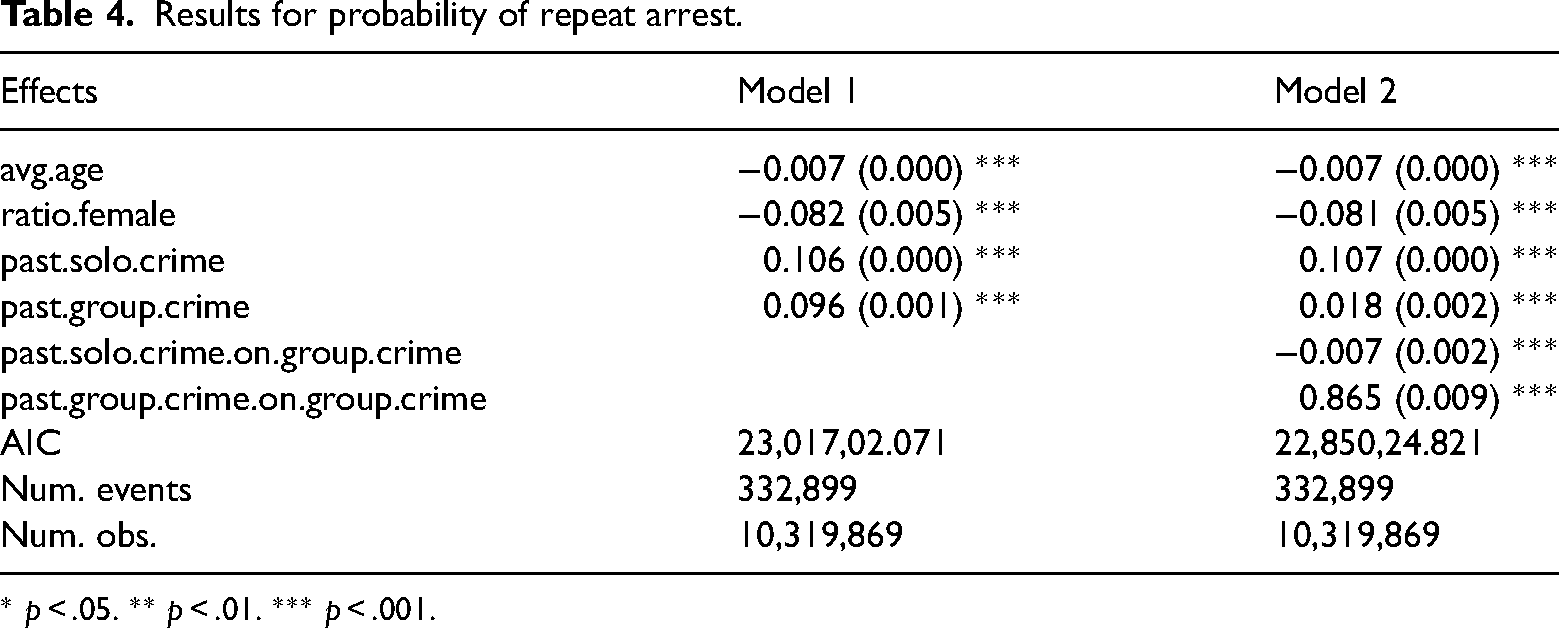
In the models below (Table 4), the term “past.solo.crime” is the average number of past solo crime events that involved members of the current hyperedge (i.e., co-offending group). The term “past.group.crime” is the average number of past group events that involved members of the current hyperedge. The dummy variable “group.crime” is a magnitude of one if the current crime event is a group or co-offending event and zero if it is a solo event.
Results for probability of repeat arrest.
* p < .05. ** p < .01. *** p < .001.
Table 4 below displays results with respect to the impact of past solo activity and past group crime activity on the current crime rate (i.e., the impact of previous solo and group offending on re-offending). The second model differentiates the impact of past (solo and group) crime activity on the propensity to participate in a subsequent crime event involving co-offending. All models control for the baseline effects of age and sex.
We find that both past solo criminal activity and past group criminal activity (i.e., co-offending), increase the current crime rate (positive parameters of past.solo.crime and past.group.crime). In the second model we find that past group crime activity strongly increases the propensity to participate in current group crime events (adding the parameters of past.group.crime, and “past.group.crime.on.group.crime”) and past group activity has a weakly positive effect on the propensity to participate in current solo crime events (parameter of past.group.crime). On the other hand, past solo crime tends to increase the current solo crime rate (parameters of past.solo.crime) but has a slightly weaker inflating effect on the propensity to engage in group crimes (adding the parameters of past.solo.crime, and “past.solo.crime.on.group.crime”). Taken together, the findings suggest a partitioning of criminal actors into those who preferably participate in group crime events and those who mostly commit solo crime events.
Results for discrete crime categories
The variables “past.[CRIMECATEGORY]” (e.g., “past.market.crime”, “past.property.crime”) count the number of past crime events (solo or group) of a given crime type (i.e., market, property, violence and other). We interact these variables pairwise with the dummy variables (“on.[CRIMECATEGORY]”) indicating whether the current crime event involves any of the same four crime categories.
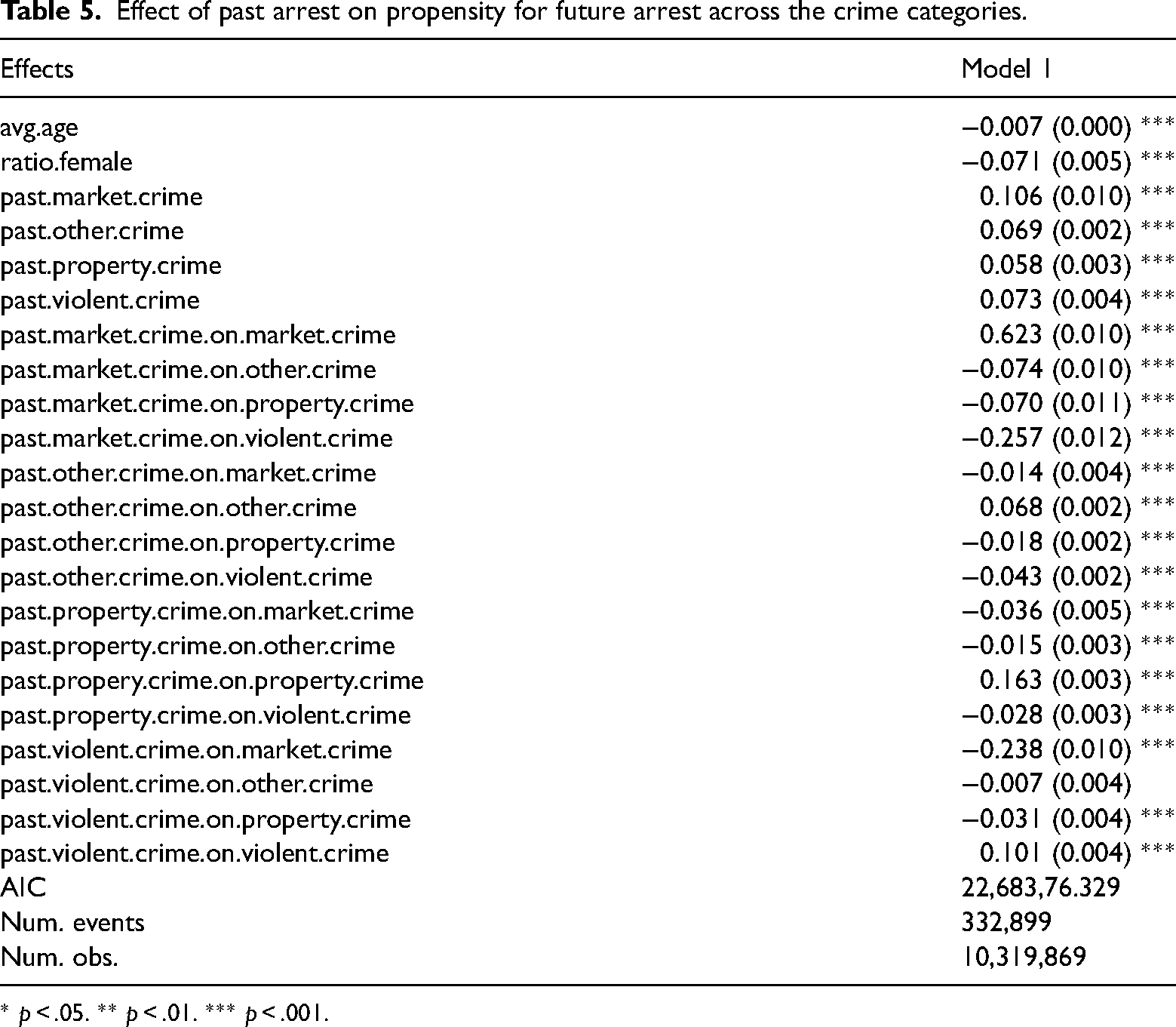
Table 5 below examines the impact of past crime activity in any of the four crime categories on the propensity to engage in a future crime involving any of the four crime categories. We note that this model does not distinguish between solo crime and group crime, but we do examine this further below.
Effect of past arrest on propensity for future arrest across the crime categories.
* p < .05. ** p < .01. *** p < .001.
The model results can be framed as a 4 × 4 matrix in which rows are labelled by past activity in crimes in the four crime categories (market, property, violence and other) and columns are labelled by future participation in crimes involving the same four crime categories (see Table 6). For instance, a positive entry in row M and column M means that the more an actor has participated in market crimes in the past, the more they participate in market crimes in the future. A negative entry in row M and column V means that actors committing more market crimes in the past are less likely to commit violent crimes in the future (all other things being equal).
Effect of past arrest on propensity for future arrest across the crime categories
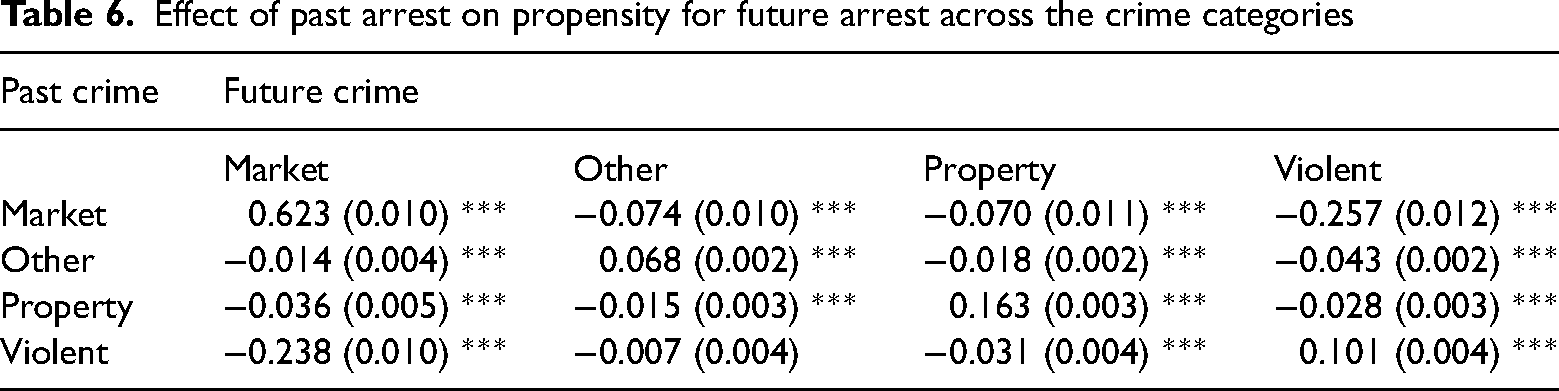
The findings are consistent across the crime categories: more past activity in crime category X implies more future activity in category X, but less activity in the other crime categories, controlling for the baseline effect that any past activity increases future crime activity. The only exception to this consistent result is that the effect of past violence on future other crimes is not significant. Thus, when committing future crimes, actors tend to stick to the types of crimes with which they have previous experience.
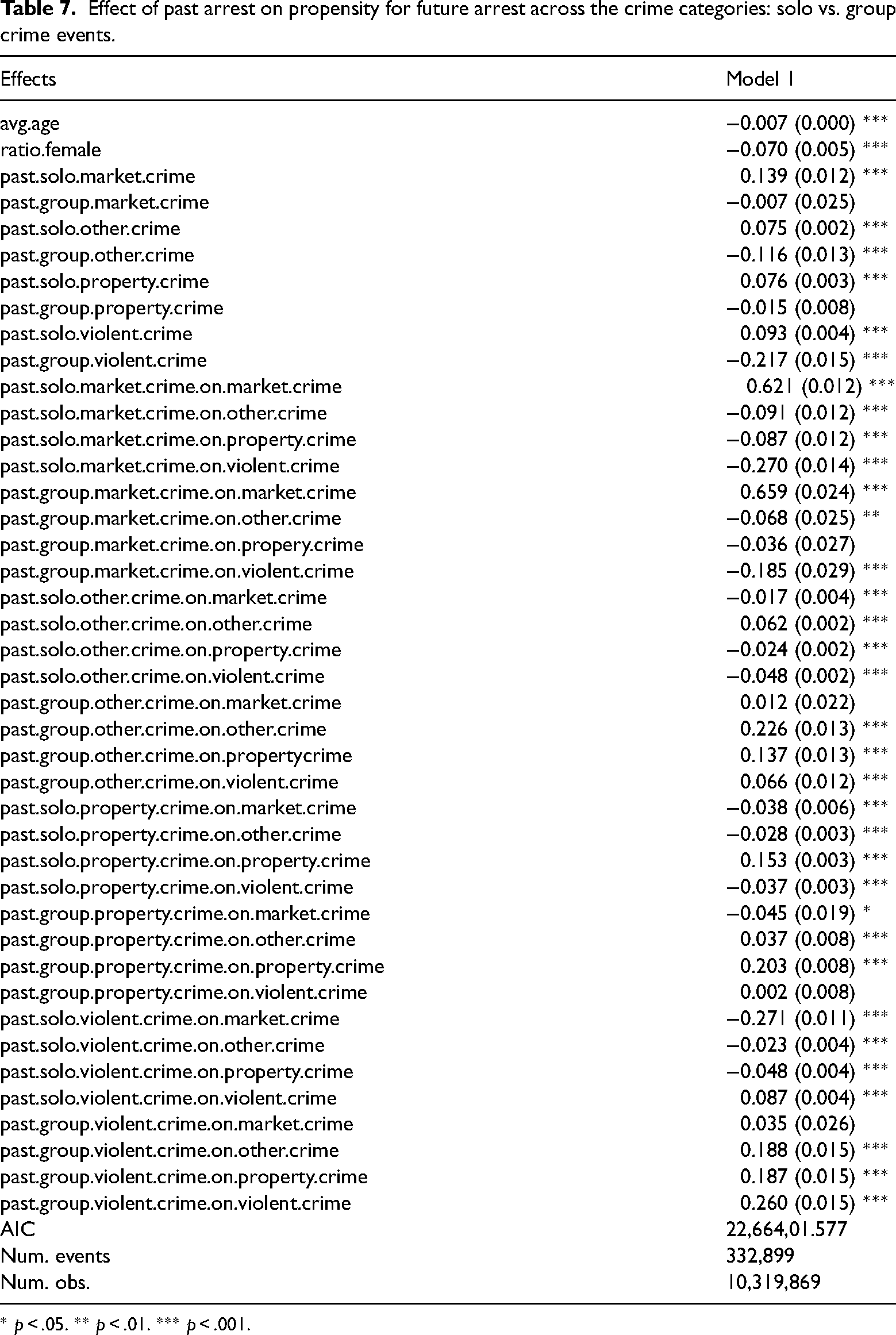
Now we refine the above model by further distinguishing whether the past activity in crime category X involved solo crime events or group crime events (see Table 7). This introduces additional complexity to the models and results. For each of the eight conditions we test for a preference to engage in each of the four types of crimes (which gives an 8 × 4 matrix; see Table 8 below).
Effect of past arrest on propensity for future arrest across the crime categories: solo vs. group crime events.
* p < .05. ** p < .01. *** p < .001.
Effect of past arrest on propensity for future arrest across the crime categories: solo vs. group crime events.
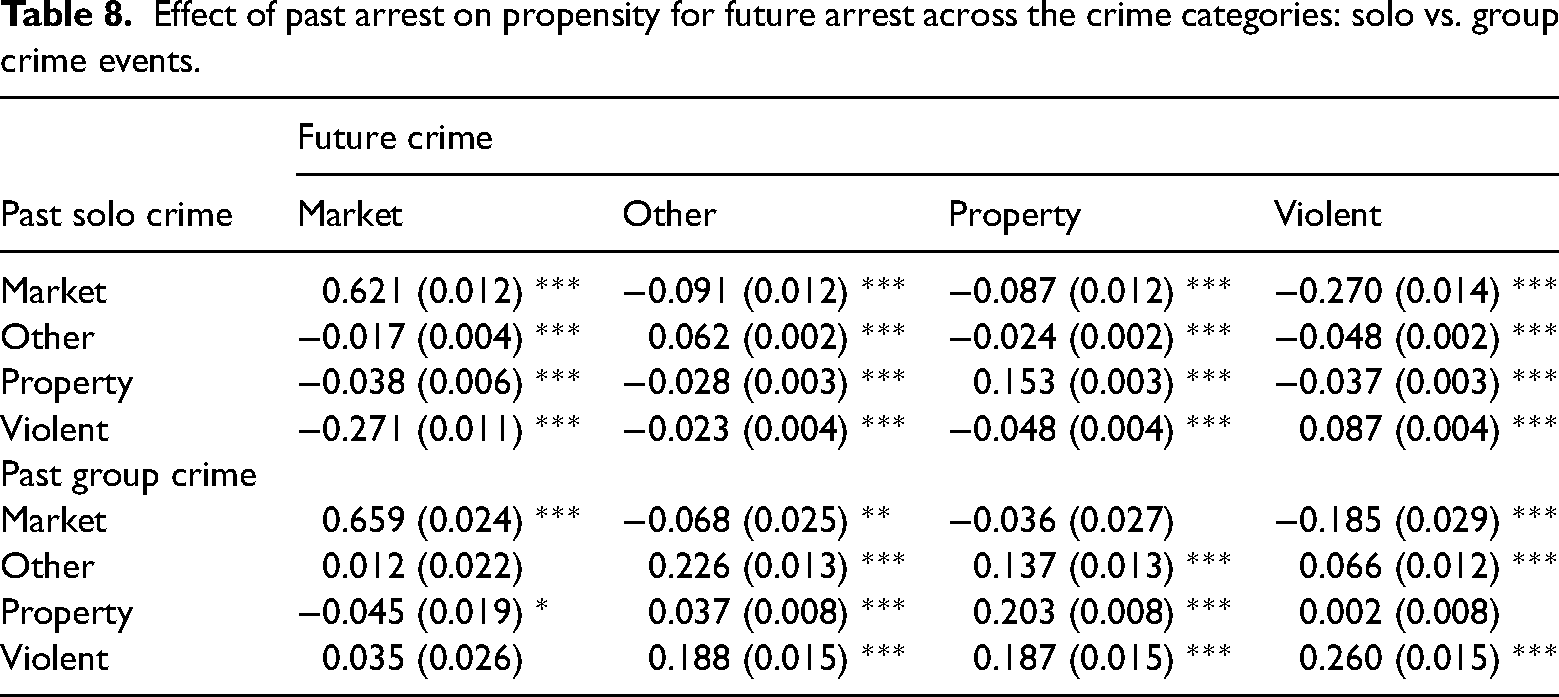
From the results in Table 7 we can first replicate the findings from Table 5, finding that past solo activity in crime category X increases future crime activity in crime category X but decreases future crime activity in all other crime categories. Similarly, past group activity in crime category X increases future crime activity in category X. However, in contrast to solo activity, past group activity in category X does not always decrease future crime activity in category Y (i.e., where Y is different from X). In particular, past group activity in market crimes increases future activity only in market crimes but decreases future activity in violent crimes and other crimes (market to property is not significant). Past group activity in property crimes increases future activity in other and property crimes and decreases future activity in market crimes (property to violence is not significant). Past group activity in violent crimes increases future activity in other, property and violence (violence to market is not significant). And finally, past group activity in other crimes increases future activity in other crime, property crime and violent crime, while the effect for market crime is not significant. RQ3: To what extent is repeat offending characterised by age and /or sex homophily and are there differences in homophily across crime categories?
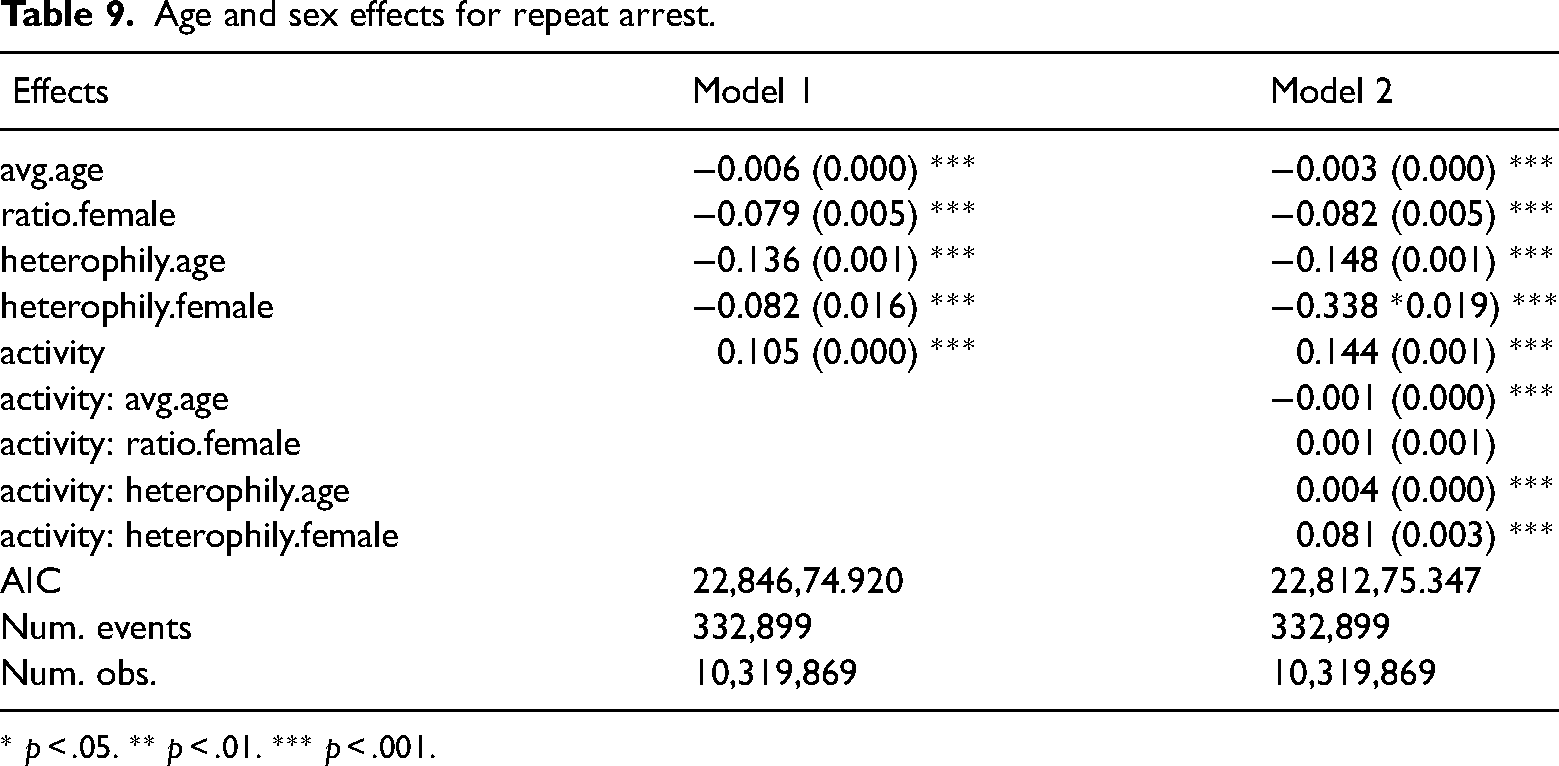
We now turn to age/sex effects including age/sex homophily effects for repeat offending. Results are displayed in Table 9 below.
Age and sex effects for repeat arrest.
* p < .05. ** p < .01. *** p < .001.
From Table 9 we can see that for more heterogeneous co-offending groups (in terms of both age and sex), the effect of past criminal activity on the future crime rate is stronger (positive effect of “activity”) than for more homogeneous groups with respect to age and sex. We also find that for younger actors the effect of past criminal activity on the future crime rate is slightly stronger compared with older actors (negative interaction effect of “activity:age”).
In summary, results suggest the following patterns of results for re-offending versus solo offending across crime types: (1) Individuals who engaged in co-offending in the past were more versatile in future criminal activities (i.e., they may commit novel types of crime) compared with those who committed past solo crimes and who tend to more consistently commit the same crime types. (2) Market crimes seem to require the highest level of specialisation among the four types of crimes in the sense that those who committed market crimes in the past (whether as solo offenders or as a group) re-offend by committing new market crimes but do not tend to commit subsequent novel types of crimes. Likewise, individuals who committed crimes other than market crimes in the past (whether as solo offenders or as a group) do not tend to engage in market crimes in the future. (3) When co-offending groups are more heterogeneous with respect to age or sex, the effect of past criminal activity on the propensity for committing crime in future is stronger.
Discussion
This discussion section proceeds as follows: first we discuss the results with respect to age and sex homophily and co-offending (RQ1), then we discuss the results for co-offending and re-offending (RQ2), while finally turning to a discussion of age and sex homophily and re-offending (RQ3).
Age and sex homophily in co-offending
Overall and consistent with previous research (e.g., Britt, 2019; Fagan & Western, 2005; Stolzenberg & D’Alessio, 2008), younger offenders committed more crime overall compared with older offenders. With respect to co-offending, we detected a sex homophily effect whereby co-offending groups (where co-offending “groups” are composed of two or more co-offenders) tended to be composed only of males or only of females. We also found evidence for age homophily in co-offending. The variation in age for members of co-offending groups was lower than we would have expected based on chance alone. When we examined co-offending across crime categories, we found that age homophily was weaker for the market crime category in comparison with the other three categories of crime (violence, property and other crime). This age differential in co-offending for market crimes may reflect the operation of a mentoring dynamic among co-offenders, whereby older, possibly more experienced offenders transmit skills, knowledge and attitudes to younger offenders in a relational process akin to social learning (see Akers & Jennings, 2015; Conway & McCord, 2002). In the “other crime” category, we found a tendency for sex heterophily whereas for violent crimes there was a stronger effect for sex homophily. The sex heterophily found in the other crime category may reflect the heterogeneous nature of the crimes included in this category and/or that females were more likely to be co-offenders in these crimes (e.g., fraud and forgery) compared with violent, property and market crimes. The strong sex homophily effect for violent crimes is presumably driven primarily by male offending given that makes were more likely to engage in violent crime compared with females. Our results extend previous research on sex and age homophily by examining the effects disaggregated by crime types and demonstrating variation that can be explained via social influence and social exchange processes.
Co-offending and re-offending
Overall, offenders who were previously arrested for any crime, either solo crime or co-offending, were more likely to be arrested for future crimes, a result that supports a consistent and longstanding finding in criminology (e.g., see Farrington, 1987). Our results also identified two distinct groups of offenders, a bifurcation that has not emerged in previous research: those who tended to be arrested for mostly solo offences and those who tended to be arrested for mostly co-offences. Our results show that past arrest for co-offending strongly increased the propensity for individuals to be arrested for future co-offending but exerted only a weak increase in the propensity to be arrested for future solo offending. Similarly, past arrest for solo offending had only a weak predictive effect on the risk of arrest for future co-offending but was strongly predictive of the risk of arrest for future solo crime. This partition across offenders may have significant potential for identifying those who have potential to cause more significant social and economic harms given that co-offending (as distinct from solo offending) has been associated with increased overall justice system involvement (Andresen & Felson, 2012), escalation in offending (e.g., Felson, 2003; Sarnecki, 2001), and inflated social and economic harms (Carrington, 2002; Felson, 2003).
Across crime categories, we observed a consistent pattern of results for re-offending over time where we use arrest as a proxy for re-offending. That is, being arrested for prior crimes in one crime category increased the risk of arrest for future crimes within that same category but reduced the probability of arrest for future crimes in the other crime categories. This appears to indicate that individuals tend to specialise in one category of crime over time, rather than showing versatility across a range of crime categories. This may indicate that knowledge, skills, and attitudes that facilitate one category of crime (e.g., property crimes) do not transfer easily to other crime categories (e.g., violent crimes).
We also observed different patterns of results for re-offending when we compared solo offending and co-offending. Being arrested for a past solo crime in one crime category increased the probability of being arrested for a future crime in that category but reduced the share of future arrest for any of the other categories. However, in contrast to past solo crime, past arrest for co-offending in one category did not consistently lead to decreases in the risk of arrest for the other crime categories. In summary we found that: (1) a previous arrest for co-offending in market crime increased the probability of being arrested for a future market crime and decreased the probability of being arrested for a future crime in the violent and other categories; (2) a previous arrest for co-offending in property crime increased the probability of being arrested for a future crime in the other and property categories, but decreased the probability of being arrested for a future crime in the market category; (3) a previous arrest for co-offending in violent crimes increased the probability of being arrested for a future crime in the other, property or violence categories; and (4) a previous arrest for co-offending in other crime increased the probability of being arrested for a future crime in the other, property or violent crime categories. Overall, past arrest for co-offending in market crimes decreased the probability of being arrested for violent and other crimes in future, while past co-offending in property crimes decreased the probability of being arrested for market crimes in the future. Overall, these novel results suggest that offenders who tend to engage in market crime may be more specialised in this particular crime category making it less likely that they will commit crimes in the other categories. Indeed, market crimes such as drug dealing may require a specific skill and knowledge set (e.g., Bright & Delaney, 2013; Chiu et al., 2011), that can be acquired via repeat offending and learning from other (co-)offenders. The findings support the role that co-offending plays in facilitating social exchange mechanisms that assist with access to resources and skills required for criminal behaviour (e.g., weapons, knowledge, behavioural repertoires; see Weerman, 2003), and suggests a potential relational mechanism for social learning processes as described by Conway and McCord (2002). Importantly, our results suggest that these social exchange and social learning mechanisms may play a more central role in some crimes (e.g., market crimes) compared with others.
Our results suggest that the “group hazard” effect may operate in different ways for different types of crimes. Some types of crime may involve more risks than others (e.g., higher risks of detection for more serious violent offences). For example, some types of crime may be characterised by an increased risk that one co-offending partner will betray another. Market crimes such as illicit drug trafficking may be one such category of crime in which risks of betrayal are inflated, given the level of coordination, collaboration and secrecy required often over long time periods. Indeed, much scholarly work has focused on issues of trust and betrayal in market type crimes (see, for example, Gambetta, 2009; Von Lampe & Ole Johansen, 2004). Some crime types relative to others may also facilitate the emergence of criminal opportunities via social networks. Again, these network facilitation effects may operate particularly strongly for market type crimes like illicit drug trafficking, which are often embedded in formal organised criminal groups (see Bouchard & Konarski, 2014; Bright & Whelan, 2020). Our results suggest that the group hazard hypothesis should be explored further in future research on co-offending.
Age and sex homophily and re-offending
We found no significant effects of the sex of offenders on patterns of re-offending. In contrast, and as expected based on prior research (e.g., Britt, 2019; Stolzenberg & D’Alessio, 2008) we found that the effect of past crime on future crime was stronger for younger offenders compared with older offenders, a finding that is consistent with much prior research on age and crime (for a recent review see Britt, 2019). Further, the effect of past co-offending on the probability of being arrested for committing a crime in the future was stronger where the prior co-offending event involved a more heterogeneous group in terms of either age or sex. The pattern of results for age suggests once again the operation of age-related mentoring relationships whereby older (and presumably more experienced) offenders provide training in skills and knowledge related to crime to younger offenders. This result should be interpreted in the context of previous research which has found that age variation in co-offending groups tends to be small (e.g., Budd et al., 2005; Reiss & Farrington, 1991). Our results suggest that when groups are comprised of offenders who show high variability in age, the operation of mentoring and social learning processes may be more germane to drivers of offending and re-offending. Of course, we did not test these dynamics explicitly, so future research should explore the extent to which social learning mechanisms are at play where there is high variability in the age of co-offenders. The pattern of results for sex homophily supports previous research that implies the criminogenic influence of male offenders on female offenders when males and females co-offend (e.g., Koons-Witt & Schram, 2003; Mullins & Wright, 2003).
Results overall suggest that offenders may be more specialists than generalists when it comes to engagement in specific crime types and with respect to co-offending versus solo offending. Overall, results suggest that offenders tend to consistently engage in same types of crime over time rather than committing a range of crime types (at least within short time windows such as that utilised in this study) and tend to engage in either solo offending or co-offending and do not tend to switch between the two. Alternatively, the results could simply indicate that the police are more successful at making arrests based on the identification of suspects who have a history of committing specific crime types. Those who were arrested for co-offences in the past were more likely to be arrested for solo offences in future, and those who were arrested for solo offences in the past were more likely to be arrested for co-offences in future.
Implications for policy/policing practice
Our results have three key implications for criminal justice policy and policing practice. First, our results lend support for convergent evidence across studies that co-offending is key to more deeply understanding crime patterns and for planning effective crime prevention strategies. Accurate estimations of the incidence of crime and its impact should include consideration of co-offending, especially given that some offenders will specialise in co-offending over time. Second, given that younger co-offenders tend to re-offend and to commit more serious offences when they do re-offend, resources for crime prevention and rehabilitation should be prioritised for younger co-offenders. Third, police agencies should collect data on co-offending to enhance their analytical approach to crime patterns including solo crime and co-offending. Finally, crime prevention and desistance programs and strategies within prisons and in the community should incorporate the growing knowledge base on co-offending including opportunities for capitalising on the potential pro-criminal influences of co-offending partners (e.g., Halsey & Mizzi, 2023). The power of peer influence might offer opportunities for prevention and rehabilitation programs that incorporate pro-social influences and support.
Limitations
The study was impacted by some limitations with respect to the data and analyses. First, as noted throughout the paper, police arrest data includes only those offences (and offenders) detected by police. Therefore, as with all criminal justice data, our data underestimates crime, co-offending and re-offending. The data only includes arrests or charges and is not indicative of convictions once the charges are tested in the courts. Furthermore, the data includes only those co-offenders who were detected by police. There are likely to be other co-offenders who were never arrested, and these individuals were not included in our data such that our results may underestimate offending. Second, arrests may reflect the focus of police investigations such that particular individuals are more (or less) likely to be arrested which would potentially mean that some individuals are over-represented in the data by virtue of being targeted police, for example, because they have been arrested for similar crimes previously (see Bouchard, 2020; Bright et al., 2022a; Burcher & Whelan, 2018). Third, as with most studies on co-offending, we operationalised co-offending as criminal collaborations. However, although being arrested at the same crime event usually indicates criminal collaboration, it may also capture individuals who are not collaborating and who may even be antagonists (e.g., two people involved in a violent confrontation). Finally, our data did not permit us to calculate “time at risk” for individuals in the dataset. That is, we were not able to incorporate periods of time that individuals were not able to re-offend (e.g., because they had been incarcerated or had died).
Future research
We argue that future research on co-offending networks should utilise RHEM as the optimal analytical approach for examining co-offending because it overcomes some of the key limitations of alternate approaches to such data (e.g., two-mode to one-mode transposition; see Bright et al., 2023). More research is needed on co-offending across contexts and jurisdictions to examine the generalisability of our findings, including with respect to age, sex and re-offending (and incorporating calculations of time at risk). Further research is also needed on the escalation of offending trajectories for co-offenders (see Farrington, 2015) and related financial costs (see Allard et al., 2014; Fagan & Western, 2005). Future research should also utilise other crime categories (e.g., more fine-grained crime categories; see for example Bright et al., 2022a) to examine whether similar results are revealed with a different or broader range of crime categories. Future research should also explicitly explore potential explanatory dynamics related to co-offending such as the group hazard hypothesis and social learning mechanisms.
Footnotes
Declaration of conflicting interests
The authors declared no potential conflicts of interest with respect to the research, authorship, and/or publication of this article.
Funding
The authors disclosed receipt of the following financial support for the research, authorship, and/or publication of this article: Data collection for the project was supported by a Criminology Research Grant (CRG 49/16-17).
