




Abstract
This article examines Sweden's COVID-19 strategy from the perspective of the global epistemic field. We propose that the policy choices of national governments are conditioned by the global epistemic field that constitutes the problem, the range of potential techniques to handle it, and relevant viewpoints used in assessing their advantages and risks. New, innovative techniques can emerge, and choices can vary, but they are debated and justified in terms of the evolving global set of discourses premised on the fundaments of the epistemic field. In this article, we examine to what extent deviant policies are part of the global set of discourses that evolved at the outset of the pandemic. To address this question, we take Sweden's COVID-19 strategy as an example and study how it was constructed and justified in the national public in 2020. The results of our empirical analysis show that the argument of epistemic field also applies to deviant policies. Even though Sweden's corona strategy deviated much from other countries, including its neighboring countries, the grounds of justification used in debating the strategy were consistent with the global epistemic field.
Keywords
Introduction
Ample research on national responses to the COVID-19 pandemic is divided into roughly two groups. One group of scholars emphasizes homogeneity, whereas others concentrate on differences. The ones who point out that governments have copied the same models to fight the pandemic have explained it as yet another example of institutional theory's old finding that in times of uncertainty organizations tend to mimic the practices of other organizations (DiMaggio and Powell, 1983; Milliken, 1987). In this case, the argument goes, uncertainty caused by the pandemic has made governments emulate the COVID-19 policies of other countries, in particular their geographic neighbors and linguistic and political peers (Alfano et al., 2022; Givens and Mistur, 2021; Mistur et al., 2022; Rausis and Hoffmeyer-Zlotnik, 2021; Sebhatu et al., 2020; Yan et al., 2020).
Scholars conducting cross-national comparative research have shown that institutional differences and policy regimes affect countries’ responses (Engler et al., 2021; Toshkov et al., 2022; Yan et al., 2020). Democracies typically cherish the wellbeing of their citizens, whereas less democratic countries are able to act more quickly on restrictions because they do not have to rely on elections for legitimacy (Mistur et al., 2022). The Chinese government's swift reactions amidst the pandemic that strongly curbed individuals’ movement have been attributed to such cultural differences (Givens and Mistur, 2021; Yan et al., 2020).
These two perspectives on national pandemic mitigation policies are not contradictory, although they opt for different explanations for differences and similarities. Institutional theory scholars focus on transnational spread of ideas, whereas cross-national comparative researchers emphasize structural factors.
In this article, we focus on the case of Swedish pandemic policy from an institutionalist, diffusion research perspective. Yet, our point is not to measure how similar or different the Swedish strategy was in compared to other countries or what kind of measures were implemented in Sweden. Instead, the aim of our case study is to contribute to scholarship on the global travel of ideas. As proof of the existence of isomorphic world culture, diffusion researchers have shown that several governments have copied policy measures from those of other countries, which is fine. The point made in this article, though, is that such similarities stem from a “deeper” level of isomorphism: an epistemic field in which actors throughout the world share the same reference points employed in deciding about and justifying national policies. The Swedish pandemic strategy is a good example; the pandemic triggered reactions in Sweden as in other countries ravaged by it. Yet, the strategy chosen by Sweden dealing with the pandemic seems sufficiently different from other countries that its fundamental similarity cannot be proven by looking at the models it adopted. In this article, we argue that in making sense of the strategy used in Sweden, we must look at the arguments used in the context of justifying the strategy and the congruence in their premises. The findings made in our empirical analysis show that although the measures taken deviated considerably from Sweden's neighbors, the reference points and arguments used in justifying the strategy were the same as in any other country.
As said, diffusion researchers have paid much attention to states emulating others in their COVID-19 policies. Research argues that signs of policy mimicry were even found in countries where there was no immediate need for corona interventions. For example, Bulgaria and Hungary introduced restrictions on cross-border movement already before they had identified cases of COVID-19 infections (Rausis and Hoffmeyer-Zlotnik, 2021: 289). Lundgren et al.’s (2020: 317) study shows that several nation-states declared state of emergency before the COVID-19 virus started to spread locally. According to the literature, such practices can be due to anticipatory planning or institutional pressure created by the pandemic. Policymakers do not want to be labelled as dawdlers, which is why they learn lessons from others in a front-end-weighted fashion. Moreover, adoption of measures in one institution, jurisdiction or country may create pressures for taking similar measures elsewhere under fear of being accused of negligence (Ioannidis, 2020: 2).
Although the diffusion literature focuses on demonstrating policy mimicry caused by the pandemic and factors explaining it, it also notes that no country adopted an identical mix of COVID-19 measures circulating globally. Instead, national governments have modulated their policy interventions depending on the policy measures available and the outcomes of policies adopted in other countries (Alfano et al., 2022: 23). Yet the COVID-19 strategies adopted by neighboring or culturally proximate countries appear to be highly isomorphic. For example, Sebhatu et al.’s study (2020) on the policy responses in the OECD area revealed that almost 80% of the member countries adopted the same COVID-19 policies within two weeks. 1
The diffusion literature concludes that national COVID-19 strategies are guided by globally shared ways of interpreting the novel pandemic and measures available. When information on the pandemic and its mitigation was limited (or non-existent), governments glanced at other countries, particularly their neighbors, in their attempts to find cues for how to mitigate the pandemic in a rational and efficient way. Consequently, a policy field with rational COVID-19 responses occurred, informing national corona strategies. This line of reasoning works well when considering countries that adopted similar policy measures in slightly differing combinations, but it is lacking when we try to account for countries whose policies seem to differ considerably from those of other countries.
Sweden is a case in point. Although the novel corona virus landed in Sweden nearly at the same time as in its neighboring countries and the number of national COVID-19 deaths was high, Sweden opted for a corona strategy that involved fewer and looser restrictions than, for example, the ones adopted by the neighboring Nordic countries. Whereas other Nordic countries started to introduce fast and restrictive measures already from mid-March 2020 onward, in Sweden public life remained less interrupted. Schools stayed open, although in March distance learning was introduced for older teenagers and university students. A national ban on visiting elderly people in residential care was implemented on 1 April 2020. As regards other gatherings, only large events were prohibited. As the pandemic situation improved during the summer months, life became ever more relaxed, and in August all schools opened normally for the new school year. In the autumn, the second wave of the pandemic landed in Sweden with no substantial changes in national pandemic policies. During the pandemic, Sweden did not declare state of emergency. All in all, research argues, the Swedish strategy focused on recommendations and individual responsibility—on the idea that the individuals will modify their behavior voluntarily to fight the pandemic. 2 (For a review, see e.g. Brusselaers et al., 2022; Hanson et al., 2021; Yan et al., 2020.)
Research on the Swedish strategy argues that the “official aim of the initial Swedish strategy was to reduce the spread of the coronavirus in order not to strain the Swedish health care system beyond its capacity, while at the same time protecting the chronically ill and the elderly. The strategy also included aims to reduce the impact on functions of importance in society, to reduce consequences for members of the public and companies, to reduce anxiety and to implement the right measures at the right time” (Lindström, 2021: 1). In their official rhetoric, Swedish authorities denied the intention that the Swedish strategy aimed at achieving natural herd immunity. Then again, in its official communication, the Public Health Agency (PHA), the body chiefly responsible for designing the national strategy, stressed that there are no tools by which to stop the pandemic and that the spread of the virus is an inescapable fact. In May, the former state epidemiologist and a consultant to the PHA, Johan Giesecke published a commentary in the medical journal Lancet, in which he argued that “(e)veryone will be exposed to severe acute respiratory syndrome coronavirus 2, and most people will become infected” (Giesecke, 2020: e98). In the same text, he assured that most individuals will only have mild symptoms or no symptoms at all, which is why total suppression of the pandemic is not a desired policy solution (Giesecke, 2020: e98).
Although Swedish health authorities’ official rhetoric did not highlight herd immunity as a goal, literature on the Swedish strategy argues that achieving herd immunity was the main principle guiding Sweden's early corona measures. In an email exchange with Finland's PHA in March 2020, state epidemiologist Anders Tegnell ventured that as children are unlikely to have severe symptoms “one point would be to keep schools open to reach herd immunity faster” (Vogel, 2020: 162). Although the Swedish strategy drew some criticism already during the Spring 2020, especially so from the national scientific community 3 , the public health authorities did not back off from their views. Instead, they affirmed that Sweden follows the right tactic. As a result, literature argues, Sweden adopted a pandemic policy that was strikingly different from those of other countries allegedly in the hope that allowing the virus spread freely, the country could achieve “herd immunity” and defeat the pandemic (Vogel, 2020: 162).
The strategy adopted by Sweden has attracted much attention both in the academia and in the public. Much of this discussion revolves around explaining why Sweden adopted a different strategy and who the true architects of the strategy were. The literature particularly emphasizes the role of the PHA, and its independence compared with similar institutes in other countries. It is alleged that during the COVID-19 pandemic, PHA and the state epidemiologist Tegnell even took on the role of a politician and dictated what measures Sweden should (or should not) take to tackle the pandemic (Andersson and Aylott, 2020; Pierre, 2020). Other key factors explaining the strategy as listed in the research include the Swedes’ strong belief in core institutions such as decision making and the media, and that Swedes have a strong belief in individuals’ self-responsibility–a feature that is claimed to have also defined Sweden's liberal infection control legislation (Andersson and Aylott, 2020; Askim and Bergström, 2022; Brusselaers et al., 2022; Hanson et al., 2021; Lindström, 2021; Yan et al., 2020; Vogel, 2020).
Although the Swedish strategy is typically considered unique, claims have also been made that the policy adopted by Sweden has given inspiration to other countries. In fact, previous research shows that during the first months of the pandemic, communication between Sweden's key authorities and those of other Nordic countries and the Great Britain was very active. Some authorities were also inclined to think that aiming at herd immunity is a feasible policy objective until the idea got rejected (Brusselaers et al., 2022; Falkheimer and Raknes, 2022; Vogel, 2020). Claims have also been made that in designing its strategy, Sweden, too, took cues from other countries (Kampmark, 2021).
Like the diffusion studies referenced above, scholarly discussion on the Swedish case is guided by the premise that national policies are designed by keeping an eye on models adopted by other countries (for a discussion, see e.g. Givens and Mistur, 2021; Yan et al., 2020). Consequently, the resulting policies are assumed to be mixtures of globally circulating policy models. From this perspective, however, the explanations for the Swedish choices have remained vague. In our study we adopt a different approach to the globalization of policies that draws on the epistemic governance perspective. We propose that national policies are outcomes of a negotiation in which different parties interested in domestic policies work on others’ understandings of what the state of the affairs is and what should be the desired policy measures. To persuade others of their views, debaters utilize and manipulate common conceptions of the world and the situation at hand by drawing on a shared set of discourses that make sense for the target audiences in question (Alasuutari and Qadir, 2014a, 2019). What we aim at could be likened to Foucault's theorizing in his book The Order of Things (Foucault, 1970), although in that study he dealt with historic changes and ruptures in the premises that constituted the human sciences. According to him, in any era and culture we can discern an “episteme” (1970: xxiii) consisting of its fundamental codes that govern “its language, its schemas of perception, its exchanges, its techniques, its values, the hierarchy of its practices” (1970: xxii). Similarly, regarding the COVID-19 pandemic, we suggest that the policy choices of national governments are conditioned by the global epistemic field that constitutes the problem, the range of potential techniques to handle it, and relevant viewpoints used in assessing their advantages and risks. New, innovative techniques can emerge, and choices can vary, but they are debated and justified in terms of the evolving global set of discourses premised on the fundaments of the epistemic field. In this article, we examine to what extent deviant policies are part of the global set of discourses that evolved at the outset of the pandemic. To address this question, we take Sweden's COVID-19 strategy as an example and study how it was constructed and justified in the national public in 2020. With our case study on the Swedish pandemic strategy debate we also seek to add to the existing theories on policy diffusion and interdependent policymaking. We argue that interdependence of policies should not be conceived of as ready-made policies diffusing in modern world society. Instead, we propose that such interdependence currently evident in national COVID-19 policies is an outcome of a global discussion that evolves as nation-states vindicate their respective policies, giving birth to ever-new policy models that become part of the global set of discourses. The results of our empirical analysis show that this argument also applies to deviant policies. Even though Sweden's corona strategy deviated much from other countries, including its neighboring countries, the grounds of justification used in debating the strategy were consistent with the global epistemic field.
The rest of the article proceeds as follows. We start by introducing the theoretical framework informing our inquiry. After that, the data and methods used in the study are discussed. In the findings section, we present our empirical observations. First, we discuss the key viewpoints or moral objectives referenced as debaters in Sweden discussed the national COVID-19 strategy. After that, we show how these viewpoints or objectives were creatively used in justifying the strategy adopted. In the discussion, we summarize our findings and discuss the theoretical contributions of our study.
Discourse diffusion and epistemic governance
Inspired by sociological institutionalism (Meyer and Rowan, 1977), organization theorists have noted that under times of uncertainty and imperfect information, decision makers may imitate or copy the strategic responses of others (DiMaggio and Powell, 1983; Milliken, 1987; North, 1990). Many institutionalist scholars, however, see conformism as a larger phenomenon than just a reaction to special circumstances. The seminal article in this research tradition by John Meyer and Brian Rowan (1977) suggests that organizations commonly incorporate externally legitimated formal structures, which leads to ceremonial behavior motivated by conformism. Actors comply with externally defined doctrines and models, even if they fit poorly with the organizations’ actual practices and objectives. In other words, Meyer and Rowan conclude, by ceremonial behavior organizations try to make a good impression in their environment by conforming to widely held beliefs about efficient and professional conduct.
In empirical research, the conformism hypothesis has been tested by analyzing which variables best explain the global diffusion of a particular model. When considering models diffusing among national states, abundant research shows that, indeed, rather than a country's developmental stage or functional necessity, enacting a model can be best explained by the density of its ties to world society, measured by memberships in international governmental and non-governmental organizations (Frank et al., 2000; Hafner-Burton et al., 2008; Longhofer et al., 2016; Schofer and Meyer, 2005).
These studies lead to important insights into organizational behavior. They point out, for example, how and why formal rules and principles, instigated by an organization to look legitimate amongst peer organizations, lead to suboptimal results and to the formation of informal practices that decouple from the formal ones (Bromley and Powell, 2012). On the other hand, focusing on the spread of single models does not help us understand why some “models” spread and others don't and why countries conform to global fads in varying degrees or seem to deviate from them altogether. Furthermore, to identify the worldwide spread of a particular model, researchers have been forced to focus on simple cases such as countries ratifying international treaties or establishing an organ by a particular name. Case studies of the global travel of policy ideas show that in typical cases it is difficult to determine whether a policy has been transferred from a donor to a recipient country, because policies are often constructed by combining elements from several sources and adapted to local conditions (Dolowitz and Marsh, 2000; Evans, 2009). Accordingly, it has been argued that instead of talking about policies as packages sent and received, the global circulation of policy ideas should be conceptualized as a process of translation, indigenization, domestication (Alasuutari and Qadir, 2014b; Callon, 1986; Czarniawska and Sevon, 1996; Friedman, 2004), or synchronization of national policies (Alasuutari, 2016).
To better explain how ideas circulate in world society, in this article we suggest that we must go beyond single policies or elements within them and ask why it is that political actors in national contexts promote their views and interests by endorsing models, practices or principles discussed by certain others. We suggest that the short answer is legitimation. As is discussed in the epistemic governance framework (Alasuutari and Qadir, 2019), to influence the conduct of others, in proposing what should be done in a particular situation actors allude to reference points that they assume to be perceived relevant within their target audience. It can be said that these reference points form an epistemic field or world culture—the culture of world society that constitutes its actors (Boli and Thomas, 1999; Lechner and Boli, 2005). In other words, to formulate an argument that is considered sensible and understandable, the epistemic field and the discursive field drawing on it need to be taken into consideration in world society at a given time. It does not mean that when formulating one's opinion, one needs to agree on others’ views of what conclusions must be drawn from those reference points, but they lay the foundations for legitimate arguments. When talking about a complex issue such as the COVID-19 pandemic, there are several interlinked discourses that form the discursive field, composed of all the valid points evoked in the public discussions and practices related to the issue.
As is the case with practically all policymaking and political argumentation in the modern world, actors commonly resort to scientific evidence and the authority of science to find solutions and to back up their arguments about what should be done (Qadir and Syväterä, 2017; Syväterä et al., 2023; Zapp, 2020). Therefore, depending on the issue at hand, science institutions, scientists, and other experts in relevant fields of research gain deference: these institutions and their works are referenced as epistemic authorities (Alasuutari, 2018). Actors also appeal to widely honored principles like human rights, established by moral authorities such as the United Nations (UN) treaties (Vento, 2024). Moreover, national actors commonly allude to policies enacted in other countries and to knowledge about their successfulness. These policy decisions, particularly those taken in a country's reference group, are used in the public discussion as examples or referred to as specific models (Alasuutari et al., 2019; Pi Ferrer et al., 2019). It must also be noted that all manner of international organizations, think tanks, and advocacy networks take part in the worldwide discussion, producing knowledge and publishing recommendations about good practices (e.g. McGann and Whelan, 2020; Rautalin et al., 2023; Rich, 2004; Stone, 2002). And although policymaking in the contemporary world relies heavily on the authority of science, points raised by populist, anti-science and pseudo-science movements are also part of the discussion (Collins et al., 2019; Eslen-Ziya, 2022; Harambam and Aupers, 2021; Prutsch, 2020).
When a major phenomenon such as the COVID-19 pandemic rises on the agenda, a global discursive field soon evolves, containing all the thinkable reference points and forms of argumentation related to each of them. In terms of the field, actors are involved in epistemic governance (Alasuutari and Qadir, 2019): they seek to influence others’ views and conduct by formulating arguments that juggle with various combinations of those reference points. By appealing to facts, principles, and identity constructions that they assume will resonate with the target audiences, actors justify their views and moves or criticize those of others.
Data and methods
To mine the elements of the global COVID-19 discussion as evinced in the Swedish pandemic strategy debate, we analyzed the media coverage of the national COVID-19 strategy. Media texts are interesting research material from the perspective of epistemic persuasion work. Although policies can be prepared and debated behind the scenes, decision makers need to justify them to the public at some point. This legitimation work is often done in the national media. The significance of the media texts is due to their function as a public forum in which topical events such as pandemics and related policy decisions are taken up and in which they are justified in ways that are deemed morally acceptable and convincing. This comes close to how Hajer (2009) describes political processes as public performances. According to him, political processes can be considered as a “sequence of staged performances” (2009: 66) in which actors strive to construct political issues in ways that affect opinion formation and decision making. That is done by employing storylines and metaphors, defining the protagonists and antagonists, and providing cues for appropriate behavior. All these discourses appearing in the national public also have a bearing on how policies are debated in the forums in which the final policy decisions are made. That is, in their policy decisions, decision makers need to consider the notions shared among the public and make decisions that are, at least to some extent, in line with the framing within which the great majority discusses topical events and domestic policies. This said, it does not mean that an interpretation or way of framing the event cannot achieve prominence in the national public, hence influencing national policy decisions. On the contrary, research on Swedish pandemic strategy has shown how especially in the early stages of the pandemic, the discussion about Sweden's strategy was strongly dominated by the PHA, to which the Government already early on delegated full responsibility in national pandemic mitigation and communication concerning it (Hanson et al., 2021). The PHA, particularly the head of the agency's Department of Public Health Analysis and Data Managements and Sweden's chief epidemiologist, Anders Tegnell, was very active in organizing press conferences and giving interviews to the national media (Andersson and Aylott, 2020; Brusselaers et al., 2022). Yet, this discussion did not take place in a vacuum. Rather, the accounts offered were taken up by the national media triggering further discussion about the Swedish COVID-19 strategy and its appropriateness.
As we were interested in the debate surrounding the strategy, the alleged aim of which was to reach national herd immunity, in our data collection we only focused on stories referencing “immunity” (“immunitet” in Swedish) in the context of discussing the national corona strategy. We collected these stories from two biggest Swedish dailies, Dagens Nyheter (DN) and Svenska Dagbladet (SD) from the first year of the pandemic (1 January 2020–31 December 2020). The year 2020 is commonly considered as the time frame during which uncertainty about the measures regarding the pandemic was biggest and when countries were most eager to mimic other countries’ policies (Hanson et al., 2021). In Sweden, the first COVID-19 infection was verified on 31 January 2020 (Krisinformation, 2020). On the same day, the WHO declared the Virus a Public Health Emergency of International Concern (PHEIC).
We cleaned our sample from all texts that had no link to the Swedish strategy (e.g. texts consisting purely of statistical artefacts such as daily infection rates in Sweden and texts that merely discussed the pandemic situation in other countries with no reference to Sweden's strategy and its justifications). This created a total sample of 290 texts (195 texts from DN, 95 texts from SD). From this corpus, we extracted a smaller group of texts (97 texts in total) for detailed close reading by using systematic sampling. From texts collected from Dagens Nyheter we selected every fourth text (49 texts in total) and from those collected from Svenska Dagbladet every second text (48 texts in total). With this kind of sampling, we ensured that our final corpus includes almost the same number of texts from both dailies.
In our empirical analysis, we used a mixed methods approach (Flick, 2018; Tashakkori and Teddlie, 2010). First, from the texts we coded all viewpoints debaters considered important regarding Sweden designing its strategy. These viewpoints or moral objectives referenced were not mutually exclusive. Rather, a text was assigned to several categories if it contained references to several viewpoints. After that, the texts were subjected to rhetorical analysis, in which we analyzed how debaters used these viewpoints to legitimize (or delegitimize) the desired strategy. In this context, we were particularly interested in the distinct rhetorical tactics deployed by speakers as they sought to convince their target audience of the arguments made.
The global isomorphism of reference points used in discussing the Swedish strategy
When we look at the media coverage of the ways in which the authorities responsible for the measures taken in Sweden justified their choices and how journalists described the Swedish policy, the list of viewpoints covered seem to be comprehensive and no different from the points of reference taken up in the global discussion. As documented in comparisons of COVID-19 pandemic policies (Alfano et al., 2022; Hale et al., 2021), governments around the world shared the same set of principles: balance the protection of citizens’ health with an easing of restrictions to favor spending and avoid excessive damage to economies and social spheres (Alfano et al., 2022: 23). In that sense the Swedish discussion did not differ from that of other countries, although the selection and application of policy measures deviated from most other countries. The choices made by the state authorities were also justified by those same principles. The difference stems from a somewhat different balance between weighing those viewpoints.
Considering the rhetoric surrounding the Swedish COVID-19 strategy, we could identify five goals or moral objectives that were considered fundamental in the Swedish strategy. These viewpoints or objectives were (a) to take care of the sick, (b) to control the spread of the virus, (c) to minimize the death rate and health effects, (d) to honor the rights of the individual, and (e) to minimize the harmful effects of corona measures. As Figure 1 shows, there is no big difference between the two dailies in how frequently these viewpoints were taken up. The only significant difference can be seen in references to harmful effects of corona measures, which were more frequent in Dagens Nyheter than in Svenska Dagbladet. Whereas in Svenska Dagbladet references to harmful effects focused predominantly on effects on economy, in Dagens Nyheter harmful effects were discussed more broadly. Besides debating the alleged economic effects, Dagens Nyheter took notice of distinct health and societal effects caused by the strategy. For example, texts highlighted anxiety and mental health problems caused by the pandemic. Texts also pointed at the fact that measures aiming to protect the risk groups are inadequate and should be revised. Also, the poor accessibility to official corona information and the effects of the strategy on the country image were highlighted.
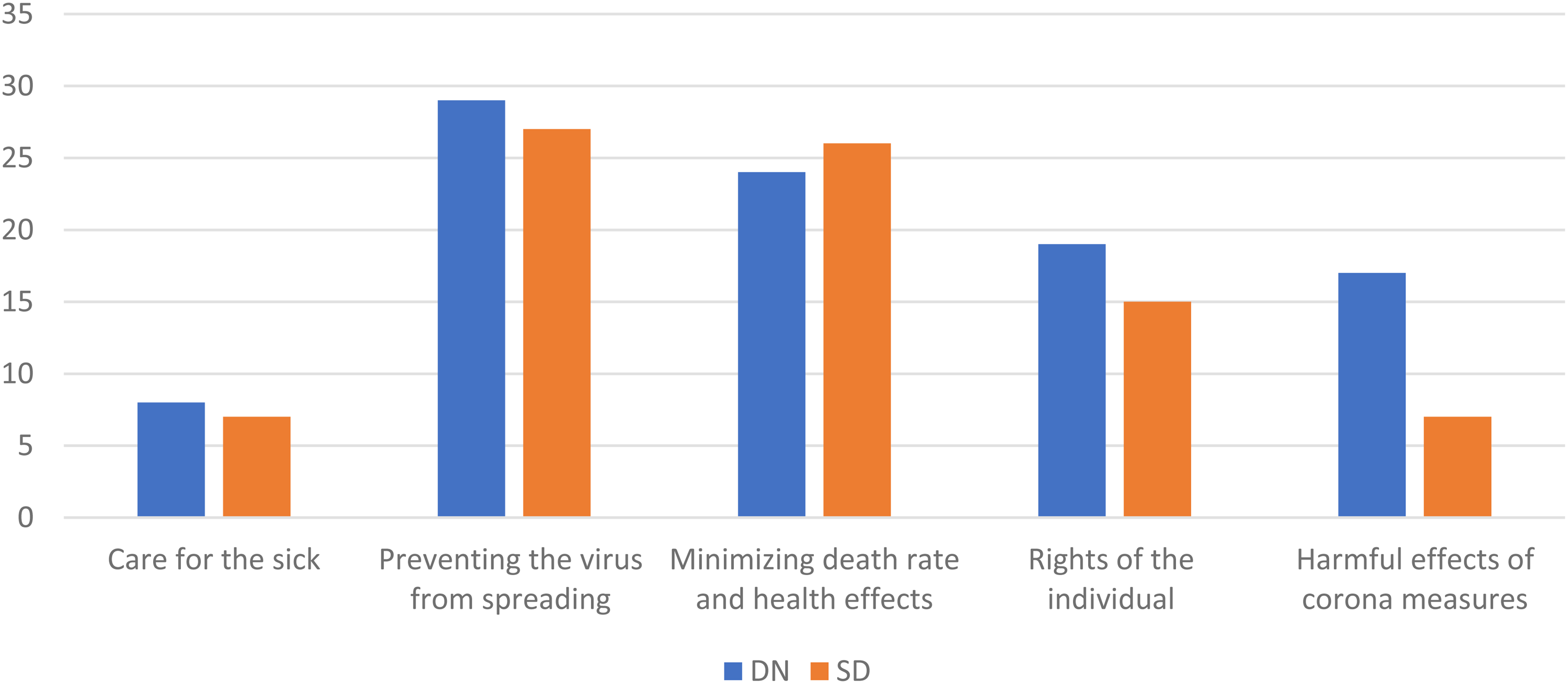
Viewpoints evoked in discussing the Swedish COVID-19 strategy per newspaper (raw quantity).
The slight difference between the two dailies can also be seen in the prevalence of references to actors or facts employed as epistemic authorities. As can be seen from Figure 2, in Dagens Nyheter there are also more references to measures taken by other countries, international organizations’ analyses and recommendations, and to Sweden's international image. In all, it appears that Dagens Nyheter gave more publicity to critical views of the Swedish policy.
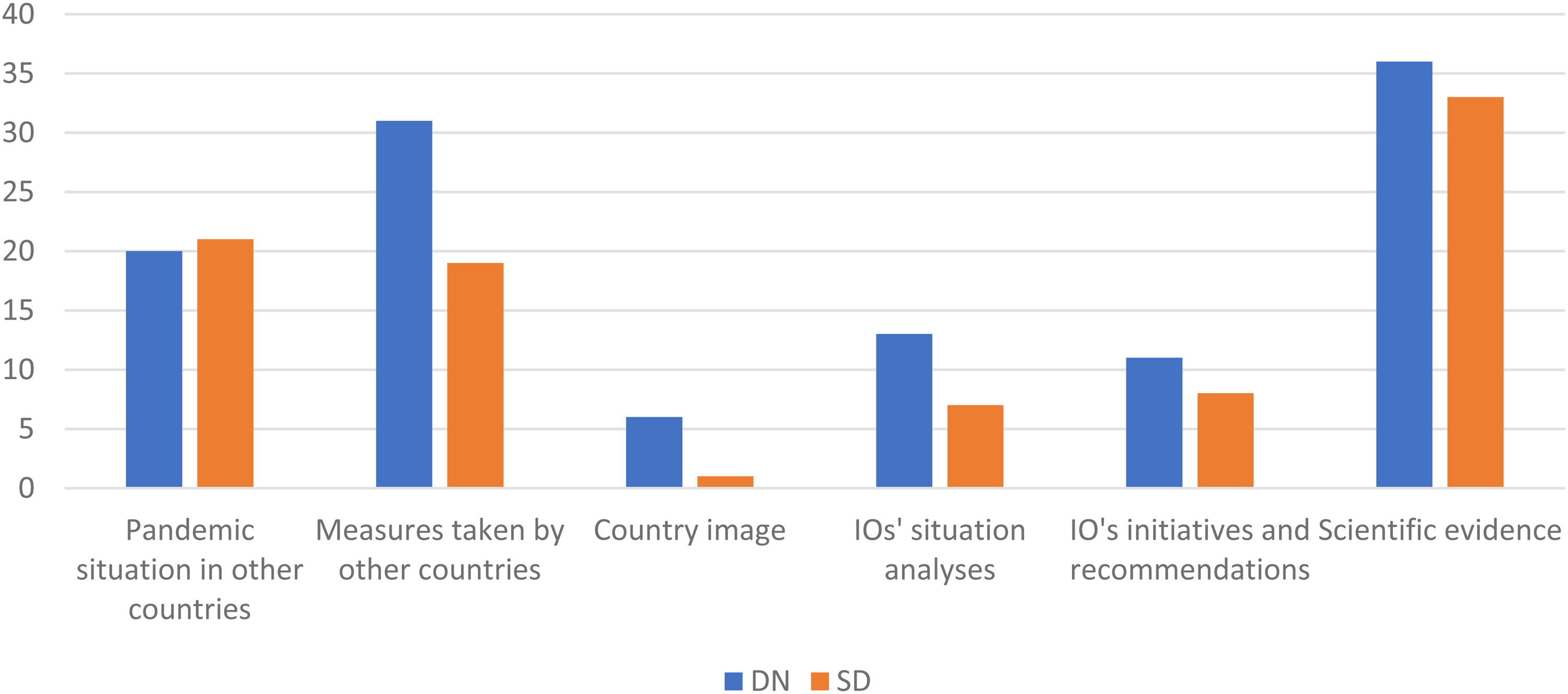
Appeals to authority regarding pandemic measures per newspaper (raw quantity).
In any case, it can be said that the media coverage of the Swedish pandemic strategy does not really deviate from those found in other countries regarding the goals and objectives considered legitimate. As emphasized earlier, governments around the world appear to have shared the same policy objectives, such as balancing the protection of citizens’ health with an easing of restrictions to avoid excessive damage to economy and people's everyday life, albeit in each national context these objectives have been discussed differently, leading to slightly different policy outcomes.
Justifications for the Swedish strategy
The relative difference between the Swedish strategy and those of other countries cannot be found in honoring principles unique to Sweden but rather, the relative weight given to the same, globally shared reference points. Furthermore, the goals and principles evoked were used in such a purposeful manner that they leant public support for the Swedish strategy. Altogether, we identify three ways in which the strategy was justified. First, the architects of the policy measures put extra weight on freedom rights as compared with the obligation of society to protect citizens from the contagion. Second, actors stressed that the Swedish strategy is evidence-based. Third, the authorities and experts maintained that Swedish strategy would prove right in the long run.
The primacy of freedom rights
The core feature that differentiated the Swedish corona strategy from most other countries was that the government avoided imposing orders that would restrict individuals’ behavior. While several countries introduced lockdowns, the Swedish society stayed mostly open. While the experts concluded that the virus will in any case spread throughout the population, the conclusion was that a lockdown will only prolong the pandemic. Keeping the society as open as possible served the strategy of the population's controlled exposure to the virus, and this policy was justified by emphasizing individuals’ freedom rights, coupled with the emphasis that the authorities will do their best to protect those for whom the contagion can be dangerous. The editorial text below is an example of this kind of rhetorical persuasion work. Herd immunity is the goal. The question is how it is achieved. It will either be through vaccines, or through the population becoming infected. The first line requires suppressing the virus until there is a vaccine. The second line only requires that the infection be limited enough so that the healthcare system is not overloaded, otherwise you can let it affect the stronger part of the population. Sweden operates, or is perceived to operate, as a lone boat on channel two–hence the attention. Convincing arguments are put forward as to why it is sustainable. (Svenska Dagbladet, Editorial, 30 April 2020)
Although the public discussion centered heavily on individual responsibility and freedom rights, measures to restrict them were also discussed. In the news text below from March 2020, state epidemiologist Tegnell reports on the Government's decision to restrict public gatherings from 500 persons to 50 persons. According to Tegnell, the planned restriction is necessary as Sweden seeks to level out infection peaks to secure the capacity of public health care. At the end of his argument, state epidemiologist stresses, however, the importance of voluntary measures such as self-isolation and protecting the health of the elderly. The idea is that restrictive measures may be useful momentarily. More comprehensive benefits can be gained at the individual level—when everyone recognizes his or her responsibility in protecting one's own and others’ health. Effects of the new measures that the government decided on Friday—a 50-person limit for the public gatherings—can, according to Anders Tegnell, be seen in few weeks. The PHA has requested the measure with the hope that it will be able to slow down spreading. — 500 people is quite a lot, and it could very well be reduced without it having particularly negative effects. It also has the potential to depress the spread somewhat. But the most important ones are measures such as staying at home if you are sick and protecting the old ones. (Dagens Nyheter, Domestic News, 27 March 2020)
The news text below from December is an example of the same rhetoric. In it, Swedish physician and virologist debates the role of the elderly in the pandemic. According to the speaker, the elderly have hardly enhanced the spread of the virus. Nevertheless, the speaker appeals to old people and urges them to continue self-isolation until vaccine coverage is sufficient. As the earlier examples, this recommendation, too, is justified by individuals’ self-responsibility and the obligation to take care of one's own and others’ health. “The elderly have not much at all contributed to the spread of infection so far. However, if we start living more normally among people and eight per cent of us are missing protection despite vaccination, there is clearly a risk that there will be more cases among us and the other risk groups that are first in turn. In addition, after all, we can infect others. It's important to keep this in mind,” says Annika Linde. (Svenska Dagbladet, Domestic news, 5 December 2020)
Although the health effects of the pandemic turned out to be bigger than the authorities suspected and the criticism—both domestic and international—against the Swedish strategy grew, the rhetoric emphasizing voluntariness and individual responsibility hardly diminished. Instead, advocates of the strategy emphasized that restrictive measures are ineffective and that they may even worsen the pandemic when the virus starts to spread again. However, an alteration in the rhetoric occurred when the second wave of the pandemic hit the country. Then, parties who were earlier in favor of the liberal approach, admitted that Sweden may need to tighten its strategy. National health authorities were, however, reluctant to admit that the original strategy relying on personal responsibility was not correct. Instead, the authorities argued that the strategy worked well with the first variant albeit handling the new one may require different measures. The argument is premised on the idea that each virus variant behaves differently and that policy measures must be designed according to prevailing variants. The epidemic in Sweden will take a different course autumn than it has done so far, with local outbreaks rather than an even community spread. It is the assessment on which The Public Health Agency is now basing its new package of measures. State epidemiologist Anders Tegnell describes the new management as a clear system for restrictions at the local level, with testing and infection tracking as a basis. This system is suitable for autumn but would not have been suitable during the outbreak of the spring, he says. (…) — (…) Face masks may become relevant as a measure during these local outbreaks. (…) Yet, he also defends the authorities’ earlier decision not to advocate the use of face masks. — I find it difficult to see where it would have been placed before. We believe that face masks can have an effect if you can direct the action to one specific location for a shorter period. But having a face mask that functions for a long time does not seem to work well anywhere. (Dagens Nyheter, Domestic News, 1 September 2020)
Sweden's strategy is evidence-based
Another core argument used in legitimating Sweden's policy was to stress that all measures taken are based on scientific evidence of their efficiency. The idea of this argument was to address particularly the criticism according to which the Swedish strategy is arbitrary or that it disregards research that does not support the Swedish approach. The claim that the Swedish strategy is based on best evidence available was also used as an asset in criticizing the policies adopted in other polities. The key argument built in this context was that other countries are adopting policies in a rush without knowing if any of these have an effect. For example, it was argued that the decision to close schools and day-care centers—policy widely used in the Nordic countries–is an irrational policy decision because in the light of existing research, children will only have mild symptoms or no symptoms at all. Also, the decision not to recommend face masks, to stay at home if asymptomatic or to avoid traveling were justified by arguing that there is no evidence available indicating that these measures will alleviate the pandemic. In the text extract below, former state epidemiologist Johan Giesecke uses scientific evidence, or the lack of it, in criticizing the lockdown measures adopted by New Zealand and Finland.
So you think Sweden is on the right track? — Yes, we are in the best location in the whole world. Take New Zealand as example. There, the authorities say that they are in the process of eliminating the virus from the islands. But how do they do it? It means that everyone entering New Zealand must stay for 14 days in quarantine at Auckland airport. Nothing good will come out of it (…). According to Johan Giesecke, it is basically impossible to protect yourself from the infection. — Everyone will be infected, we will get this disease sooner or later. It is unstoppable and will kill roughly the same number of people per capita in each country. (…) Johan Giesecke compares other countries’ policies with a thermostat (…). As it is turned up, it decreases the number of infections, when it is turned down they increase. — And Finland will have to do this for at least a year. The countries that have had a hard “lockdown” with few deaths are coming to get them this fall, this winter and next year depending on how quickly you turn down the thermostat. (Dagens Nyheter, Domestic news, 8 May 2020)
Although parties advocating the strategy were active in making the argument that Sweden's strategy is informed by the best knowledge available, the argument was also made that Sweden will monitor the pandemic situation globally and is ready to modify its strategy as new information is presented. Yet, the argument often built in these contexts was that the knowledge we have from other countries is not directly applicable to Sweden. The rhetoric starts from the premise that in each national setting there are slightly different measures in use which also have a bearing on how the virus spreads locally. As this is the case, findings that stem from country-specific are not directly generalizable.
In the text below, state epidemiologist comments on a Spanish study according to which it is unlikely that past illness will produce antibodies against the virus, in that way fostering immunity against the disease in the population. According to Tegnell, the finding must be treated with care as the virus spreads differently in each national setting. Instead, Tegnell calls for more research on different local sites. State epidemiologist Anders Tegnell commented yesterday the Spanish study for TT, and said that, based on it, you can’t draw conclusions about how the situation might look in Sweden. Pedro Duque also does not want to say anything about whether the results can yield indications of what the situation looks like in other parts of Europe. — This type of study is needed in all places, otherwise there is a risk that you end up navigating blindly. The pandemic is evolving which is why we need serological studies also in Sweden. (Dagens Nyheter, Foreign news, 15 May 2020)
Besides criticizing other countries and their policies, the authority of science was also used as an asset in explaining why Sweden does not follow the recommendations put forward by international organizations. As in the context of discussing other countries’ policies, also here the argument often put forward was that the situation analyses and recommendations provided by international organizations are based on inadequate evidence or no evidence at all. In the text below, state epidemiologist criticizes the WHO's claim about the immunity created by the corona disease or the lack of it. Tegnell suspects that the WHO's analysis contains miscalculation, which is why it cannot be trusted. Tegnell fortifies his argument by referencing other studies which according to him validate that immunity created by the corona disease is real. The idea of this statement is to convey that the Swedish strategy has a solid scientific basis and is hence, optimal. Most studies show that people who have recovered from COVID-19 have antibodies in the blood, but some have very low levels. According to the WHO, this indicates that another part of the body's immune system—cell-mediated immunity—can be crucial to recovery. State epidemiologist Anders Tegnell believes that the problem lies in the fact that the antibody tests do not maintain a sufficiently high level of security to determine whether a person is fully immune or not. — They may have difficulty separating antibodies against this particular coronavirus and other coronaviruses. But at the same time, he believes that–based on what we know about other infectious diseases—one is immune if one has specific antibodies. — You can sometimes still get sick but then you usually get less sick. It would be strange if that wasn’t the case with this virus. He claims that a lot speaks for the probability of falling ill a short time afterwards is very small. — I have not seen any reports of verified cases where a person has had the disease twice but of course it is not impossible for such to exist. (Dagens Nyheter, Foreign news, 25 April 2020)
Interestingly, as the parties defending the strategy hailed the point that Sweden's strategy is not arbitrary but evidence-based, the argument was also made that there is no evidence available demonstrating which strategy is the correct one. Consequently, the interpretation was made that the strategy selected by Sweden is as good as any strategy adopted globally: While we’ve learned a lot about the new virus during the pandemic, we still don’t know which strategy is best in the long run. No one has done everything right and no one has done everything wrong. Sweden has had a tragic number of deaths, a large proportion of them in nursing homes. But even in countries that have had lockdowns, many deaths have occurred in nursing homes. Besides, the pandemic is not over. What worked in the spring may not work in the fall. Some of the countries highlighted as successful examples against the virus are now experiencing setbacks. We probably do best to avoid pointing out winners and losers, this is not a tragic contest. The new coronavirus is here to stay, now all countries need to find methods that prevent the spread of infection and with as little impact on the economy and the individual citizen as possible. (Dagens Nyheter, Domestic news, 9 September 2020)
Toward the end of 2020, the media did engage in self-criticism regarding the successfulness of the Swedish measures, but in this discussion the finger was pointed at the inability to sufficiently protect the elderly fragile people from infection and the ability to provide them adequate healthcare when they fall ill. The guilt for that failure was mainly laid on regional autonomy and individual care institutions themselves. Today we can point out the Achilles heel of the Swedish control system in this crisis, namely the municipal and regional autonomy. It was the municipalities’ and regions’ interest organizations that acted early in this crisis to stop the employees’ demands for protective equipment. It was the regions that this spring actively acted to slow down the implementation of mass testing. (Dagens Nyheter, DN Debate, 30 November 2020)
Confidence that Sweden's strategy will prove right
Although there were also critical voices toward the Swedish strategy, overall, the media discussion related favorably to it, and the chief architect, state epidemiologist Anders Tegnell was hailed almost like a national hero. As is typically the case, during times of crisis and uncertainty, people unite behind their leaders and put their trust in them. In Sweden this meant that despite contradictory information, there was relatively little criticism toward the herd immunity strategy, because there was little information available about the pandemic and the best policy solutions, and a considerable number of individuals believed that key authorities base their decisions on best knowledge available. This confidence in decision makers was reflected in the way the media and individual journalists covered the strategy. For example, the rightness and sustainability of the chosen strategy was justified by expecting that the differences between countries will level out in the future and that harsh restrictions will prove a wrong choice. People will get tired of other countries’ harsh restrictions. They will end up in a worse position when they let them go. (Svenska Dagbladet, Editorial, 30 April 2020)
In the spring 2020 when contagion numbers showed a downturn and the situation was becoming more stabilized, there was much confidence in the Swedish strategy, and Tegnell assumed that herd immunity is picking up. His key message was, however, that people's support and their willingness to follow the recommendations is the best proof that the strategy works: TT: Do you see the stabilization as a sign that Sweden's strategy is working? — You must be very careful when discussing which strategies work and don’t work. But this gives hope that we will be able to look forward to a period when things are calmer in healthcare and in society, says Anders Tegnell. In one way, however, the strategy has succeeded: the Public Health Agency recommendations have had a major impact during the pandemic. — It is very positive and shows that the Swedes have collectively made a big effort in isolating themselves and staying at home when they were sick. We can hope that it lasts, he says. (Svenska Dagbladet, Domestic News 10 May 2020)
Toward the autumn, the pandemic situation got much worse, and the assumption that herd immunity could be reached at a low level turned out to be wishful thinking. Furthermore, figures from other countries were commonly interpreted to prove that the liberal policy followed in Sweden had resulted in higher death rates than those in many other countries, for example Sweden's neighbors. However, also in that situation Sweden's strategy was justified by its sustainability in the long run: Anders Tegnell gets a question about the current situation regarding the herd immunity and whether we have lost it. — There is no reason to believe that we have lost it. There are extremely few cases in the world where it has been identified that someone has been infected twice. Instead, existing knowledge supports the understanding that the immunity lasts. Yesterday, the government announced that it wants to ban alcohol sales after 10 pm, and that the decision was made in consultation with the Public Health Agency. (Svenska Dagbladet, Foreign news, 12 November 2020)
As there were also critical views of Sweden's policy measures, in June 2020 the Government of Sweden established a National Commission to examine the handling of the COVID-19 pandemic. This independent evaluation used the same modes of argumentation and reasoning as those found in the public discourse surrounding the national pandemic strategy. Considering the notable health effects of the pandemic, the commission's final report stated that Sweden should have opted for more rigorous and intrusive disease prevention and control measures during the first wave of the pandemic and that the PHA should have also consulted experts with a dissenting opinion of the national strategy (Ludvigsson, 2023). Yet the commission also raised up freedom rights as an important principle, stating that “the choice of path in terms of disease prevention and control, focusing on advice and recommendations which people were expected to follow voluntarily, was fundamentally correct. It meant that citizens retained more of their personal freedom than in many other countries” (Coronacommissionen, 2022: 3).
Discussion
By approaching global differences and similarities in national policies from an institutionalist perspective, in this article we argued that to properly understand the global travel of ideas, we need to go beyond the standard diffusion research literature, which conceives of isomorphism between countries as resulting from the global diffusion of a limited number of policy models. Instead, global isomorphism must be conceived at a deeper level. Rather than result of a diffusion of tightly packaged policy models, instrumental world culture can be conceptualized as a globally shared set of discourses that form a discursive field, consisting of reference points that constitute sensible and legitimate ways to devise and justify policies. Typically, such an evolving discursive field generates a set of policies that then spread the world over, but even seemingly deviant cases that refuse to enact standard solutions can be accounted for in terms of that set of discourses.
From this viewpoint, Sweden's COVID-19 strategy is a good example. Although there is a seemingly stark contrast between the policy measures adopted by Sweden vis-à-vis those adopted in its neighboring countries, in this study we could show that the policies drew from the global discourses that evolved at the outset of the COVID-19 pandemic. The viewpoints in terms of which the situation and the national strategy were discussed in the Swedish media did not differ from those raised up elsewhere in the world. Instead, the architects of the strategy and the journalists commenting on it appealed to the same policy goals and principles that were employed in other countries. These principles were only used in ways that gave support to the choices made in Sweden. Specifically, the rhetoric emphasized the freedom rights in the measures adopted, the argument that all actions adopted are based on best knowledge available and that the national strategy will prove right in the long run. This is not to say that the same kind of persuasion work would have been successful in all nation-states struggling with the global health crisis. Rather, as emphasized by the epistemic governance framework, actors seeking to influence existing policies need to appeal to authorities or authoritative views they assume to be shared within their target audience.
As emphasized earlier, Sweden is traditionally considered a country in which individuals have a strong sense of self-responsibility and in which key institutions including decision makers and experts are trusted (Kampmark, 2021; Yan et al., 2020). Consequently, rhetoric emphasizing individual responsibility and the point that all decisions are based on the best evidence available worked ideally in attempts to convince the public that the strategy planned is an ideal one.
Yet it is important to stress that the values foregrounded in the Swedish media coverage on the pandemic are also part of a global epistemic field, evident for example in the UN human rights principles and other conventions ratified by UN member states. Those principles, such as liberty rights, are ratified and ceremonially embraced also by autocratic regimes, but how they are interpreted and how much weight different principles are given, varies considerably (see e.g. Hafner-Burton and Tsutsui, 2005; Hafner-Burton et al., 2008). As moral philosopher Alasdair MacIntyre (1981) has pointed out, shared virtuous principles are in tension with each other and never form coherent guidelines for action.
Future research could examine what kind of discourses global events such as various military, climate, energy and economic crises generate and how these discourses figure in epistemic persuasion work when different interested parties from international organizations to national legislators campaign for their preferred policy choices.
Footnotes
Acknowledgments
Earlier versions of this article were presented in the First International World Society Theory Symposium organized at Tampere University in December 2022 and the European Sociological Association Research Network 15’s Second Mid-Term Conference at Università Cattolica del Sacro Cuore in Milan, May 2023. The authors are grateful for insightful comments they received from the participants of these events.
Funding
The authors disclosed receipt of the following financial support for the research, authorship, and/or publication of this article: This work was supported by the Academy of Finland (decision numbers 292353 and 354429).
