



Abstract
When studying attitudes toward the welfare state or evaluations of welfare reforms, research has tended to focus on what people think rather than how they think about specific issues. Moreover, the effects of the mobilizing efforts of political parties on attitudes and belief systems are often theorized separately from the normative institutional feedback effects common to the welfare state literature. In this paper, I propose that elite political rhetoric and institutional norms may exert dual pressures leading to partisan differences in the propensity to think ideologically among the mass public, defined as a positive relationship between holding internally consistent attitudes and taking a partisan issue position. Drawing on the case of welfare service privatization in Sweden, I point out how the rhetoric of the right – emphasizing choice and private property – frequently contradicts norms about universality long espoused by the Swedish welfare state, while the rhetoric of the left – emphasizing equality of access and outcomes – is better aligned with such institutional norms. The analysis of survey data demonstrated that centre-right sympathizers, the prime receivers of conflicting elite versus institutional messages, frequently took a middling position, being neither positive nor negative, to the consequences of welfare service privatization, and that, unlike centre-right politicians and sympathizers and politicians of left parties, this position did not differ according to attitude consistency. Furthermore, political interest enhanced this relationship among right sympathizers but was of little consequence to left sympathizers, implying that in the case of a conflict between institutional norms and political rhetoric, only the most attentive sympathizers are likely to engage in ideological thinking on the basis of partisanship.
Introduction
In many European countries, services such as healthcare, childcare, schooling, and eldercare make up a substantial portion of the overall welfare effort (e.g. Jensen, 2008). However, a rapid increase in the privatization of these services over the last three or so decades has led scholars of welfare reform to talk about the transformation of welfare states into welfare markets (e.g. Blix and Jordahl, 2021; Gingrich, 2011), invoking questions about the role of public opinion in the democratic politics of such reforms. While, for a long time, attitudes toward the public–private divide were primarily conceptualized as normative preferences for the role of government in providing social welfare (e.g. Jaeger, 2006), researchers have of late begun to take a particular interest in perceived consequences of welfare services. What we know from this burgeoning literature on attitudes toward, and perceived consequences of, welfare service privatization is that political ideology and partisanship function as determinants of attitudes (e.g. Johansson Sevä and Öun, 2023) while also being important moderators of the link between enacted policies and subsequent attitudes and evaluations (Bendz, 2015; Bendz and Oskarson, 2020; Hardell et al., 2020). Nevertheless – and in contrast to the observed relationship between left–right parliamentary composition and privatization (e.g. Gingrich, 2011; Lindh and Johansson Sevä, 2018; Obinger et al., 2014; Schneider and Häge, 2008; Zehavi, 2012) – left–right polarization does not seem to be particularly characteristic of the (mostly negative) public opinion on welfare service privatization (e.g. Johansson Sevä and Öun, 2023; Lindh, 2015).
Even as the literature on welfare state reform has questioned the role of public opinion as a driver of privatization (e.g. Lindh, 2015), the lack of positive perceptions of welfare service privatization among the public is nevertheless puzzling when considered from the viewpoint that public opinion should take on the flavour of the political elites for salient issues such as privatization, which affect many people and lie at the heart of left–right conflict over the role of the state versus private property (e.g. Zaller, 1992). If, however, one instead views mass opinion as being steadily moulded by the immersive experience of being situated within a particular institutional setting (e.g. Brooks and Manza, 2006, 2007; Svallfors, 2007), then negative views of privatization may well correspond to norms about universalism embedded in the framework of the welfare system and everyday experiences, rather than fast-paced elite rhetoric. Moreover, most work on attitudes toward the welfare state has so far neglected to study how attitudes are structured within the individual or how this cognitive structure in turn relates to overarching principles of ideology and partisanship (Ares et al., 2019), with perceived consequences of welfare service privatization being no exception. I argue that this is an important omission, as prior research on attitude constraint – the ability to figure out ‘what goes with what’ – has demonstrated that politicians espouse more organized preferences than does the public (e.g. Converse, 1964, 2000; Jennings, 1992; Kalmoe, 2020; Krosnick, 1990) and that only structured policy preferences are of any significance to political behaviour (e.g. Ansolabehere et al., 2008).
In this paper, I combine insights from the literature on political belief systems (Converse, 1964; Sniderman, 2017) with the sociological theory of embedded preferences (Brooks and Manza, 2006, 2007) to propose that elite political rhetoric and institutional norms may exert dual pressures leading to partisan differences in the propensity to think ideologically among the mass public, which I define as a positive relationship between holding consistent attitudes and taking a partisan issue position. Empirically, I draw on the case of welfare service privatization in Sweden for two reasons. Firstly, while Sweden is otherwise held as a typical case of ‘representation from above’ (Holmberg, 2012), the issue of welfare service privatization demonstrates a marked incongruence between polarized perceptions among politicians versus a much denser public opinion (Johansson Sevä and Öun, 2023; Nilsson, 2014, 2017). Especially ordinary centre-right sympathizers perceive welfare service privatization more negatively than do centre-right politicians, which begs the question: are there differences between centre-right politicians and sympathizers in their propensity to think ideologically about welfare service privatization? And how does this compare with politicians and sympathizers of the left, who seem to be more congruent? Secondly, while the Swedish welfare state is built on strong norms of universalism (Blomqvist and Palme, 2020), there are clear differences where the political rhetoric of the right – emphasizing choice and private property – frequently contradicts such norms about universality, while the rhetoric of the left – emphasizing equality of access and outcomes – is better aligned with these norms (e.g. Fredriksson et al., 2013; Jönson, 2016; Meagher and Szebehely, 2019; Sunnercrantz, 2021; Svallfors and Tyllström, 2019).
Using two surveys, fielded during the election year of 2014 and covering a representative sample of the adult Swedish population (n = 1668) as well as local politicians serving the 2010–2014 term (n = 7057), I analysed partisan differences in attitude consistency – measured as the proportion of similar answers (e.g. Weissberg, 1976) – using questions about perceived consequences across three domains: (a) overall societal consequences of privatizing healthcare, childcare, eldercare, and basic education; (b) perceived benefits for quality and governance; and (c) perceived benefits for social justice. In contrast to much of the previous work on normative attitudes concerning private versus public provision, gauging the perceived consequences of privatization has the benefit of being closer to the actual arguments used by left and right political elites concerning why they support or oppose privatization (Johansson Sevä and Öun, 2023).
Previous research and theoretical framework
The main objective of this paper is to give a theoretical explanation, anchored in empirical analysis, concerning why centre-right sympathizers and politicians in Sweden hold incongruent attitudes regarding welfare service privatization, while left politicians and sympathizers do not (Johansson Sevä and Öun, 2023; Nilsson, 2014, 2017). The main argument is that centre-right sympathizers think less ideologically around such matters. What has been made clear in the emerging literature on perceived consequences of (e.g. Johansson Sevä and Öun, 2023) and preferences toward (Nilsson, 2014, 2017, 2020) welfare services is that individual political ideology and partisanship structure people's attitudes toward the privatization of welfare services. Political ideology also intervenes in the relationship between enacted policies and attitudes toward further welfare service privatization, with thermostatic effects of privatization reforms being more marked (negative) among right-wing supporters compared to the consistently more negative left sympathizers (Bendz, 2015). Similarly, survey experiments in Sweden have demonstrated that the negative effect of policy information on preferences for further privatization was only evident among left sympathizers (Bendz and Oskarson, 2020), while multilevel analysis has shown that differences in the individual-level evaluation of welfare service performance related to the municipal level of privatization varied according to left–right ideology, although such ideologically driven evaluations were considerably more pronounced among local politicians than among the public (Hardell et al., 2020).
However, beyond linking policy preferences to ideology and partisanship, this literature has so far not expanded on the nature of the cognitive organization of attitudes toward welfare service privatization, whether it be for the deemed consequences of or preferences for increased privatization. This may be an important omission, as one of the main findings in the literature on political belief systems is that politicians espouse more organized preferences than does members of the public (e.g. Converse, 1964, 2000; Jennings, 1992; Kalmoe, 2020; Krosnick, 1990). Furthermore, in a rare study having some implications for the issue of consistency, Battaglio (2009) found that individuals who expressed greater interest in politics were also more certain in their preferences for private versus public provision of services (for electricity, banking, and hospital services). This means that one possible explanation for incongruency is that the public thinks about welfare service privatizations in less ideological terms than politicians do.
Within political science, there are broadly speaking two main traditions looking at whether attitudes are ideologically consistent, the first being rooted in Converse's (1964) seminal essay on political belief systems, which stresses the necessity of individuals’ own extensive knowledge about abstract principles of political ideology (e.g. Converse, 1964, 2000; Jennings, 1992; Kalmoe, 2020; Krosnick, 1990). According to Converse (1964), a defining trait of ideological belief systems is a high degree of attitudinal constraint. Constraint has in turn later been conceptualized as having a horizontal and a vertical dimension (Hurwitz and Peffley, 1987), with horizontal constraint meaning that policy preferences on the same level of abstraction are consistent and coherent. For example, an individual with constrained attitudes who perceives the privatization of schools to have negative consequences will likely perceive the privatization of healthcare, childcare, and eldercare to have negative consequences as well (Converse, 1964). The second dimension, vertical constraint, means that attitudes are guided by an overarching principle at a higher level of abstraction, such as left–right ideology (Hurwitz and Peffley, 1987). The dimension of horizontal constraint has been measured using a variety of survey techniques, including group correlations and specially designed scales (reviews in Gallina, 2023; Kalmoe, 2020), but for opinion research lacking such preconceived instruments, the proportion of similar answers has also been used to give an individual score of attitude consistency (e.g. Weissberg, 1976). The vertical dimension has instead often been measured through comparing answers on a more abstract liberal–conservative or left–right scale with specific policy preferences (review in Gallina, 2023; Kalmoe, 2020; see also Federico and Hunt, 2013; Jennings, 1992).
The second tradition, which is best illustrated by Sniderman's (2017) ecological theory of ideological consistency, departs from the requirements of extensive knowledge about abstract political principles and instead emphasizes the mobilizing and communicative efforts of political parties, relaxing the prerequisites for forming coherent belief systems to having a preferred party, and being able to distinguish this party from surrounding parties (e.g. Gallina, 2023; Sniderman, 2017). This tradition draws heavily on the works of Zaller (1992) for elaborating on the link between public opinion and elite political rhetoric. While individual receptiveness to political messages is related to interest and social identification – inasmuch as social identities, including especially partisanship, tend to direct a person's attention and receptiveness to communication – actual belief structures are thus related to the attitude-packages and ideological ques communicated by elite political operators (e.g. Sniderman, 2017; Zaller, 1992). Since political parties play a key role in public opinion formation (for an analysis of such ‘representation from above’ in Sweden, see Holmberg, 2012), it is reasonable to expect that citizens develop a coherent set of ideas when they are familiar with (and conform to) the discourse of parties (Gallina, 2023: 3). Later works on cognitive constraint have thus proposed and demonstrated that people can be conceived of as having constrained attitudes to the extent that their preferences mimic those of their preferred political party (Gallina, 2023).
In partial contrast to top-down theories concerned with elite political rhetoric or individuals understanding of abstract political principles, individual-level ideology can also be theorized as built from the bottom-up and reflecting more deeply held values and worldviews (e.g. Jost et al., 2009). While the structuring effects of social policy can induce short-term self-interest (e.g. Pierson, 1996), policy configurations also have a socializing effect through structuring life patterns and conveying norms concerning solidarity, reciprocity, social justice, and responsibility, that is, a normative feedback effect that shapes attitudes beyond self- or class-based interests (e.g. Mettler and Soss, 2004; Rothstein, 1998; Rothstein and Steinmo, 2002; Soss and Schram, 2007; Svallfors, 2007). According to the embedded preferences approach (Brooks and Manza, 2006, 2007), such long-term feedback effects from social policy configurations contribute to stabilizing the social institutions, such as cleavages and discursive communities, in which attitudes are formed, contributing to a continuity of socializing experiences and frames of references, leading more universal welfare states to demonstrate a higher level of legitimacy among their members than more targeted welfare states (see also Albrekt Larsen, 2006). Not least, the embedded preferences approach is influenced by the scholarly works on collective memories, inasmuch as powerful and emotional narratives – bound up with the identity of major groups within a nation – concerning the success or failure of a previous welfare state effort are thought to influence ‘citizens’ level of preference for public versus private social provision’ (Brooks and Manza, 2007: 31). As an empirical example, Lindh (2015), in a comparison of 17 OECD countries, was able to demonstrate that attitudes toward market provision of welfare services were related to existing policy design so that attitudes were more positive where there was more market provision, indicating ‘normative feedback effects flowing from existing welfare policy arrangements’ (p. 887).
In this paper, I draw on the approaches above to conceptualize what I term ‘ideological thinking’ (e.g. Jennings, 1992), by which I mean a positive relationship between holding consistent attitudes (horizontal constraint) and taking a partisan issue position (vertical constraint). As such, this concept draws both on Converse's (1964) conceptualization of constraint as holding policy preferences that are internally consistent (see also Weissberg, 1976) and later theorizations of vertical constraint (e.g. Federico and Hunt, 2013; Hurwitz and Peffley, 1987), where I am particularly inspired by the ecological approach (Sniderman, 2017) to conceptualize constraint as similarity between own policy preferences and the position of a preferred political party. In particular, I view the mobilizing and communicative efforts of political parties as a pressure from above that organizes both the horizontal (what goes with what) and vertical (similarity to position of the party) dimensions of belief systems. However, drawing on the embedded preferences approach, I argue that such mobilizing and communicative efforts of political elites can either align with or contradict more deep-seated, normative feedback processes (pressures from below) and that such varying alignment with the core values espoused by the welfare state can either boost or diminish the success of political parties’ mobilizing efforts to structure the beliefs of their sympathizers. As a final postulation, I argue that, if the above is correct, then political messages that are contradictory to the core values of the welfare state should require a high degree of political interest and exposure in order to be successfully received (e.g. Zaller, 1992), while such political attentiveness should be of relatively little consequence where political message and institutional values align.
Rhetoric and practice in Sweden's privatizations of welfare services
During its formative phase in the early- to mid-20th century, the Swedish welfare state was explicitly set up to guarantee universal access to standardized welfare services on the basis of social rights, thus ensuring relevance in people's lives and legitimacy among broad layers of the population (Myrdal, 1960). As such, public provision was a key feature of a universalistic system that has continued to enjoy a high level of support among Swedes, both left and right, for decades (Goossen et al., in press; Nilsson, 2020; Svallfors, 2011). However, over the past three decades, the renowned Swedish ‘service state’ has undergone dramatic transformations. Today, the domination of the public sector has been broken up, and geographic planning and local political priority-setting have been replaced by a more fragmented, market-oriented, consumer choice system, including tax money vouchers (e.g. Blix and Jordahl, 2021; Blomqvist and Palme, 2020). Blix and Jordahl (2021) give a conservative estimate that 17% of welfare services were provided by private actors in 2017.
In Swedish party politics, the welfare state is often invoked as a source of national identity and pride in attempts to bind parties closer to this shared cultural memory (Sunnermark, 2014). However, there are important distinctions in the rhetoric between the two main champions of the traditional left (Social Democrats) and right (Moderates) in how they have managed this and framed their own role in the conception and future trajectory of the welfare state. While up until the election of 2006, the Moderate Party used to be highly critical of the welfare state, they later (and very successfully) embraced aspects of what they coined the ‘welfare society’, claiming that the Swedish welfare state was an economic rather than an ideological project and that they alone were pragmatic enough to ensure its stability during uncertain times. In contrast, the Social Democratic Party, who frequently draws on their image as the ideological architects of the welfare state, has for some time walked a tight rope in both asserting that they have managed to steer the welfare state largely intact through severe crises and pointing to how fundamental changes of marketization and privatization threaten the welfare state as a vehicle for equality (but without recognizing their own part in this development) (Sunnermark, 2014).
The actual shift toward the contemporary Swedish welfare mix can be traced to the 1980s and a successfully mounted discursive offensive by a newly formed coalition of centre-right parties (including parties previously positive to aspects of universal welfare), business interests, and right-wing think tanks such as Timbro, inspired in turn by prior market-oriented reforms in the USA and the UK under the Thatcher and Reagan administrations (e.g. Blomqvist, 2004; Meagher and Szebehely, 2019; Svallfors and Tyllström, 2019). The critique by the political right (broadly conceptualized as parties and other political elites, including business interests) was mainly centred on issues of state control, bureaucratic inflexibility, and long waiting lists for basic welfare services, formulated against the backdrop of fiscal pressures due to the aftershocks of the oil crisis in the 1970s (e.g. Blomqvist, 2004; Meagher and Szebehely, 2019; Svallfors and Tyllström, 2019). Several scholars have argued that the political left (broadly conceptualized to include parties, politicians, trade unions, public figures, and journalists) lost the public debate over welfare privatizations to the formation of a neo-liberal hegemony and that the discourse from the late 1980s and up until after the election of 2010 gradually shifted toward implementation and quality control, rather than tensions between the values and principles of universalism and equality versus consumerism and choice (e.g. Blomqvist, 2004; Fredriksson et al., 2013; Jönson, 2016; Meagher and Szebehely, 2019; Sunnercrantz, 2021; Svallfors and Tyllström, 2019).
Fearing the loss of broad public legitimacy and owing to internal differences, the Social Democratic Party thus gradually came to embrace welfare quasi-markets as a means to democratize the public sector and empower service users, not least due to the efforts of the neo-classically trained minister of finance Kjell-Olof Feldt (later chairman of the national association of independent schools) (Blomqvist, 2004; Meagher and Szebehely, 2019). Although ambivalent to large-scale privatization, and with some attempts at limiting and backtracking, the Social Democratic governments of the 1980s nevertheless laid the groundwork for the privatizations to come. However, privatization remained a rather marginal phenomenon until the Conservative (Moderate)-led government of 1991–1994 initiated their ‘choice revolution’, which was further expanded – with extensive tax cuts – by the two centre-right governments of 2006–2014 (Blomqvist, 2004; Svallfors and Tyllström, 2019). In practical terms, the ‘choice revolution’ meant the large-scale establishment of private, almost exclusively for-profit, actors in the areas of social services, healthcare, eldercare, childcare, and education (Blix and Jordahl, 2021; Blomqvist, 2004; Meagher and Szebehely, 2019; Svallfors and Tyllström, 2019).
Despite the rapid transformations, privatization was not a major topic of public debate until after the introduction of two reforms – the Law of Public Procurement (2007) and the Law of Free Choice System (2008) – which altered large parts of the public–private model from a procurer–provider logic to a consumer choice system (Meagher and Szebehely, 2019). After the 2010 election (won by the centre-right coalition) and accompanied by several highly medialized scandals involving maltreatment in for-profit care for the elderly and the bankruptcy of a large, private equity-owned school corporation, there was however a surge in public interest and news reporting, and for-profit welfare became increasingly polarized along left–right lines (Jönson, 2016; Svallfors and Tyllström, 2019). The Left Party had already begun pushing the issue of abolishing for-profit welfare in the 2010 election, and in 2012 the largest trade union assembly for blue-collar workers (LO) voted to forbid for-profit welfare service. In 2013, the Social Democrats revised their party programme to limit private profits in the welfare sector.
The renewed ideological difference between the political left, also including the Green Party, versus the centre-right, is perhaps best illustrated through the debate surrounding the introduction of the primary care choice reform, where an analysis has demonstrated that both government and opposition avoided commenting on the trade-offs between choice and equity, in favour of presenting ideological arguments (Fredriksson et al., 2013). Together, the opposition argued that the government bill (the Law of Free Choice System) would threaten equal access and lead to unequal health outcomes, as economic incentives would lead to a clustering of private primary care facilities in densely populated areas with a high socioeconomic standing, and that the consumer demand principle would burden public resources through catering to personal preferences and easily dealt with patient visits rather than medical need (Fredriksson et al., 2013). Elsewhere the left has also typically voiced concern over quality of services and transparency issues following privatization (e.g. Hartman, 2011; Svallfors and Tyllström, 2019). The right has in turn argued that greater diversity of providers and freedom of choice is able to better accommodate individual needs and that economic competition will guarantee quality through eliminating poor service provision (Fredriksson et al., 2013; Hartman, 2011; Svallfors and Tyllström, 2019).
Hypotheses
To recapitulate, I take ‘ideological thinking’ to be a positive relationship between holding consistent attitudes and displaying partisan-typical preferences, and it is my chief expectation that, given contradictions between rightist political rhetoric and the value of universalism long embodied by the Swedish welfare state, centre-right sympathizers will engage less in ideological thinking around welfare service privatization compared to centre-right politicians and left sympathizers and politicians.
The reason for expecting the partisan position to be positive among right politicians and negative among left politicians is, first, that such positions align with the official positions taken by these large party families leading up to the 2014 election (the year of data collection for this study), where the issue of welfare service privatization and its consequences were politicized in the public debate, and, second, that previous research has pointed to a large left–right polarization among, not least, local politicians in Sweden regarding how they view welfare service privatization (e.g. Öun and Johansson Sevä, 2023). The reason then for expecting attitude consistency to increase the propensity of adopting such partisan positions in how the consequences of welfare service privatization are viewed is connected with the basic postulates of the theoretical framework, where ‘ideological thinking’ is the positive relationship between holding consistent attitudes (horizontal constraint) and displaying partisan-typical preferences (vertical constraint), with previous research indicating that ideological coherence among political representatives is generally high (e.g. Kalmoe, 2020).
The reason for expecting consistent (horizontally constrained) attitudes to increase the propensity of adopting a partisan issue position among left sympathizers is that the long-standing normative pressures of universalism embedded in the framework of the Swedish welfare state itself (e.g. Blomqvist and Palme, 2020) are concomitant with the negative position toward welfare service privatization adopted by the political left leading up to the 2014 election. While particularly the Social Democrats have at times in practice been ambivalent to welfare service privatization in the past, they have never openly pushed for more privatization, while at the same time, other political parties (such as the Left Party) and other leftist elites, such as journalists and think-tanks, have continuously been critical toward privatization (e.g. Meagher and Szebehely, 2019). Conversely, there is an evident mismatch between the pro-privatization stance continuously emitted by the political right, and the normative pressures of the welfare state, leading to the expectation that having consistent (horizontally constrained) attitudes among centre-right sympathizers should rather be associated with taking a middling position on privatization. It is here that political interest becomes a central variable, as it can be expected, given the previously demonstrated role of political interest in the process of acquiring political messages from the political elite (Sniderman, 2017; Zaller, 1992), that among the centre-right sympathizers, only those with a strong political interest should be affected by political rhetoric, as opposed to the conflicting normative messages embedded in the Swedish welfare state, and thus also be the only ones likely to take a right partisan (positive) position in how they view the consequences of welfare service privatization. I thus formulate the following three hypotheses:
H1: Politicians, who are expected to be knowledgeable about politics, will display a strong correlation between attitude consistency and taking the expected partisan issue position. The more consistent their attitudes, the more left politicians will be negative, and right politicians positive, toward the consequences of welfare service privatizations. H2: Left sympathizers are expected to display a strong correlation between attitude consistency and taking the expected partisan issue position, being negative toward the consequences of welfare service privatization. I expect this to be true regardless of the level of interest in politics. H3a: Most right sympathizers are expected to display a weak or no correlation between attitude consistency and taking the expected partisan issue position, being positive toward the consequences of welfare service privatization. H3b: Among right sympathizers who are interested in politics, I expect a strong correlation between attitude consistency and taking the expected partisan issue position, being positive toward the consequences of welfare service privatization.
Method
Data
The data for this study comes from two surveys sent out and returned during 2014 as part of the research project ‘Welfare service provision in transition’, hosted by the Department of Sociology at Umeå University and funded by the Swedish Research Council for Health, Working Life and Welfare (grant number 2012-1733). One survey went out to local politicians serving in municipalities and regions during 2010–2014 (n = 7545 | response rate = 56%), and one went out to a representative sample of the adult Swedish population (n = 1993 | response rate = 34.5%).
The election year in 2014 was the first election where welfare service privatizations became a key, and hotly contested, campaign issue, with clear ideological alternatives between the left, who wanted to limit for-profit privatization, and the right, who wanted to expand it (Meagher and Szebehely, 2019). The four centre-right parties, the Conservative (Moderaterna), Center, Liberal (Folkpartiet), and Christian Democratic parties, who made up the governments of 2006–2010 and 2010–2014, campaigned as a united bloc (the Alliance). In the previous election of 2010, the Social Democrats, Left Party, and Green Party offered a united bloc, but in 2014 they ran independent campaigns. Nevertheless, they were widely conceived of as a leftist bloc, as, for example, most all polling compared these parties jointly to the centre-right bloc. The neo-nationalist Sweden Democrats, whose position concerning privatization can be described as ambiguous, were firmly kept outside the left–right bloc politics at that time (Johansson Sevä and Öun, 2023). Thus, I used a subsample containing only the seven parties with a clear partisan left–right alignment. The achieved subsample was n = 7057 for politicians and n = 1688 for the public.
Attitudes toward welfare service privatization
The focus of this study is on attitudes toward welfare state privatization across three dimensions: (a) perceived overall societal consequences of increasing privatization in healthcare, childcare, eldercare, and primary education; (b) perceived benefits from privatization for quality and governance; and (c) perceived benefits from privatization for social justice. The first dimension is more normative in character, as consequences are only judged as ‘positive’ or ‘negative’ according to the respondent's own views, while the latter two are more evaluative in character as respondents agree or disagree with statements about the proposed benefits of privatization for a series of concrete outcomes. While much of the previous research has focused on normative attitudes (e.g. Svallfors, 2011), perceptions about specific consequences have the benefit of being closer to the arguments given by the left and right as reasons for supporting or opposing privatization (Johansson Sevä and Öun, 2023).
Attitudes toward overall societal consequences of welfare service privatization were measured using four questions (pooled Chronbach's α = 0.961): ‘Indicate for each of the following changes whether you think that they would have positive or negative consequences for society at large [….] (a) More of the healthcare is privately run […] (c) More of the childcare is privately run [….] (e) More schools are privately run [….] (g) More of the eldercare is privately run’. Response scale (with the recoded variable values given within parentheses): Very positive consequences for society at large (1), Somewhat positive consequences for society at large (0.50), Neither positive nor negative consequences for society at large (0), Somewhat negative consequences for society at large (−0.50), and Very negative consequences for society at large (−1). The questions were loaded onto a single factor among all groups of politicians and public respondents of either right or left orientation.
Attitudes toward quality and democratic governance were measured using five questions (pooled Chronbach's α = 0.878): ‘Competition from private companies within healthcare/schools/care… […] (a) …increases the economic efficiency, (c) …increases the risk for corruption, (d) …increases the quality of service, (h) …leads to less administration, (j) …reduces the possibilities of transparency/quality control’. Response scale (with the recoded variable values given within parentheses): Strongly agree (1), Agree (0.50), Disagree (−0.50), and Strongly disagree (−1). Items c and j were reverse coded. The questions were loaded onto a single factor among centre-right politicians and sympathizers. Among left politicians and sympathizers, a two-factor solution was supported with questions of corruption and transparency loading moderately onto the first factor (together with all other questions) while also loading strongly onto a separate, second factor (with small negative loadings for the other questions). In order to simplify and harmonize the analysis, a mean index using all questions was ultimately chosen for further analysis (see the analysis plan below).
Attitudes toward social justice were measured using five questions (pooled Chronbach's α = 0.919): ‘Competition from private companies within healthcare/schools/care… […] (b) …leads to welfare services that are better adapted to the needs of the individual citizen, (e) …leads to increased inequality in the availability of services of good quality, (f) …leads to a strengthening of democracy, (g) …leads to widening gaps between different groups in society, (i) …leads to better working conditions for employees in welfare services’. Response scale (with the recoded variable value given within parentheses): Strongly agree (1), Agree (0.50), Disagree (−0.50), and Strongly disagree (−1). Items e and g were reverse coded. The questions were loaded onto a single factor among all groups of politicians and public respondents of either right or left orientation.
Analysis plan
In order to detect patterns of ideological thinking, defined as the positive relationship between attitude consistency and taking a partisan position (either left/negative or right/positive), I used ordinary least squares (OLS) regressions to analyse relationships between attitude consistency, as independent variable, and perceived consequences of welfare service privatization, as dependent variable, with the bulk of the analysis being centred around potential differences in slopes between these two set of variables, depending on whether the respondent was a politician or a member of the public, sympathizing with left or right parties, and whether the respondent was high or low in political interest and exposure.
To facilitate the analysis, the sample was first sorted into partisan groups: Left (sympathizers or politicians belonging to the Social Democrats, Left Party, or Green Party) and Right (sympathizers or politicians belonging to the Moderate, Center, Christian Democratic, or Liberal parties). For politicians, this was the party that they represented, and for members of the public, it was the answer to the question, ‘What party do sympathize with the most?’. Second, public respondents were also stratified according to their level of political interest and exposure, conceptualized as having a high and regular consumption of political news and being subjected to frequent talks about politics among friends and family. The top quartile was coded 1, and others 0. 1
Third, following Weissberg (1976), attitude consistency was calculated as the proportion of similar answers to the questions related to the three attitude domains: (a) overall consequences; (b) quality and governance; and (c) social justice. Each attitude domain comprised either four questions answered using a five-point Likert scale or five questions answered using a four-point Likert scale. The possible similar answers thus ranged 0–4 or 1–5, depending on attitude dimension, but were harmonized to denote a proportion ranging from 0 to 1. The lowest number of possible similar answers was coded as 0. If all questions were answered in the exact same way, the respondent received a value of 1 (pooled x̄ = 0.59). This resulted in three measures of attitude consistency, with a fourth measure being additionally computed by taking the average of the other three to construct a global measure of attitude consistency. These measures were completely neutral with regard to content, and high attitude consistency could be achieved if the respondent was consistently positive, neutral, or negative. In line with theoretical expectations, those individuals who were low in attitude consistency gravitated toward the middle of the attitude indices, while those who were high in attitude consistency mainly gravitated toward either of the poles (i.e., either being more negative or more positive in viewing the consequences of privatization). 2 With regard to some traditional correlates of attitude constraint, among public respondents, attitude consistency for the global measure was higher among the educated (+4.8% to +7.3% sig. < 0.01) and those highly interested in politics (+5.6% sig. < 0.001) (full results available from the author upon reasonable request).
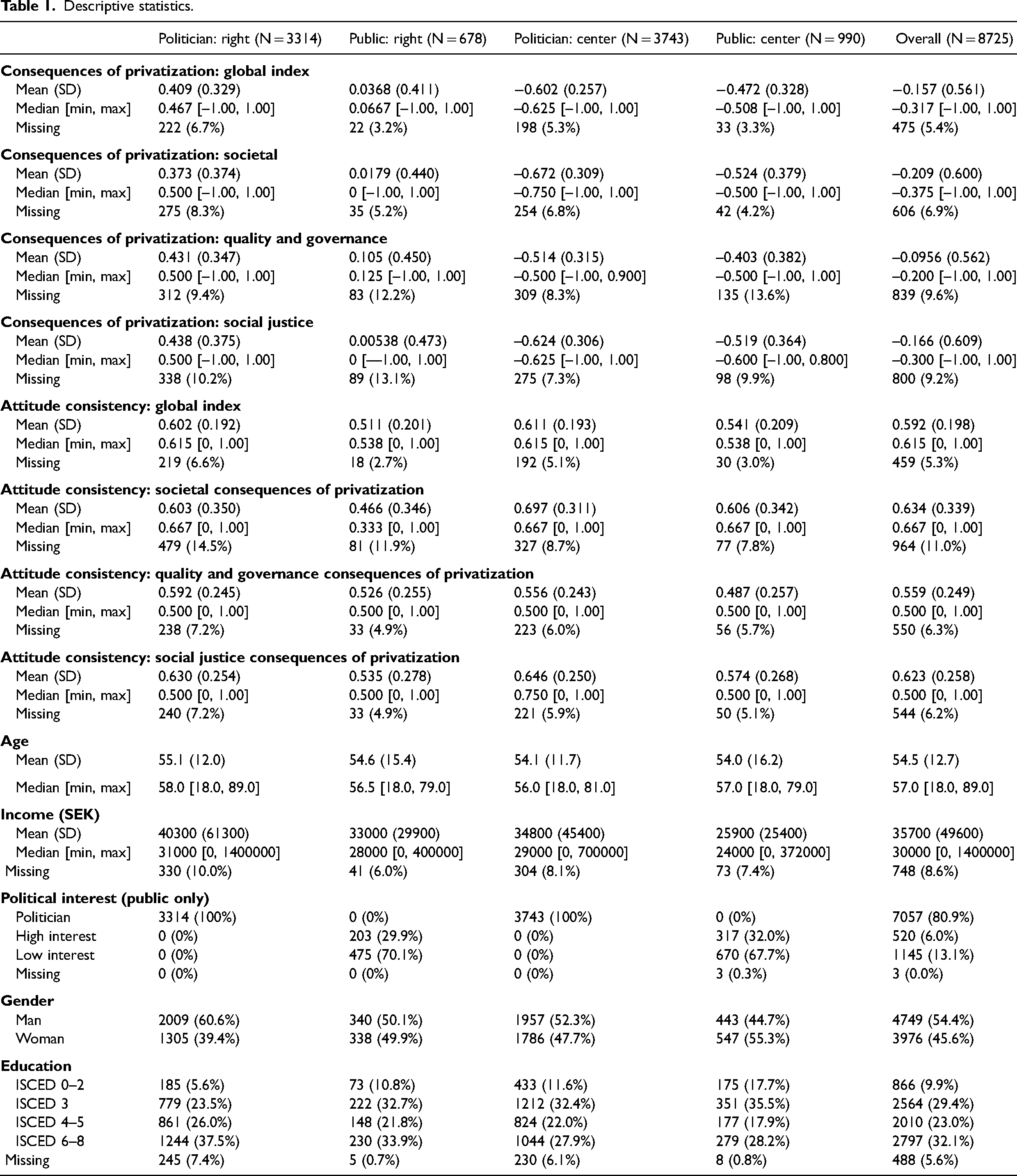
Fourth, the same questions were then also used to construct mean indices indicating each respondent's overall negative (−1) or positive (+1) view about welfare service privatization. This resulted in three indices of attitudes toward welfare service privatization, with a fourth being computed by taking the average of the other three to construct a global index (pooled Chronbach's α = 0.959). As control variables, I used gender (woman/man), education (International Standard Classification of Education levels 0–2, 3, 4–5, and 6–8), age (standardized), and income (standardized). I used complete case analysis to deal with missing information, although a comparison with multiply imputed data yielded similar overall results (available from the author upon reasonable request). For central tendencies, dispersion, and missingness, see Table 1. For correlations among measures, see Table 2.
Descriptive statistics.
Correlations among attitude indices (perceived consequences of welfare service privatization) and attitude consistency.
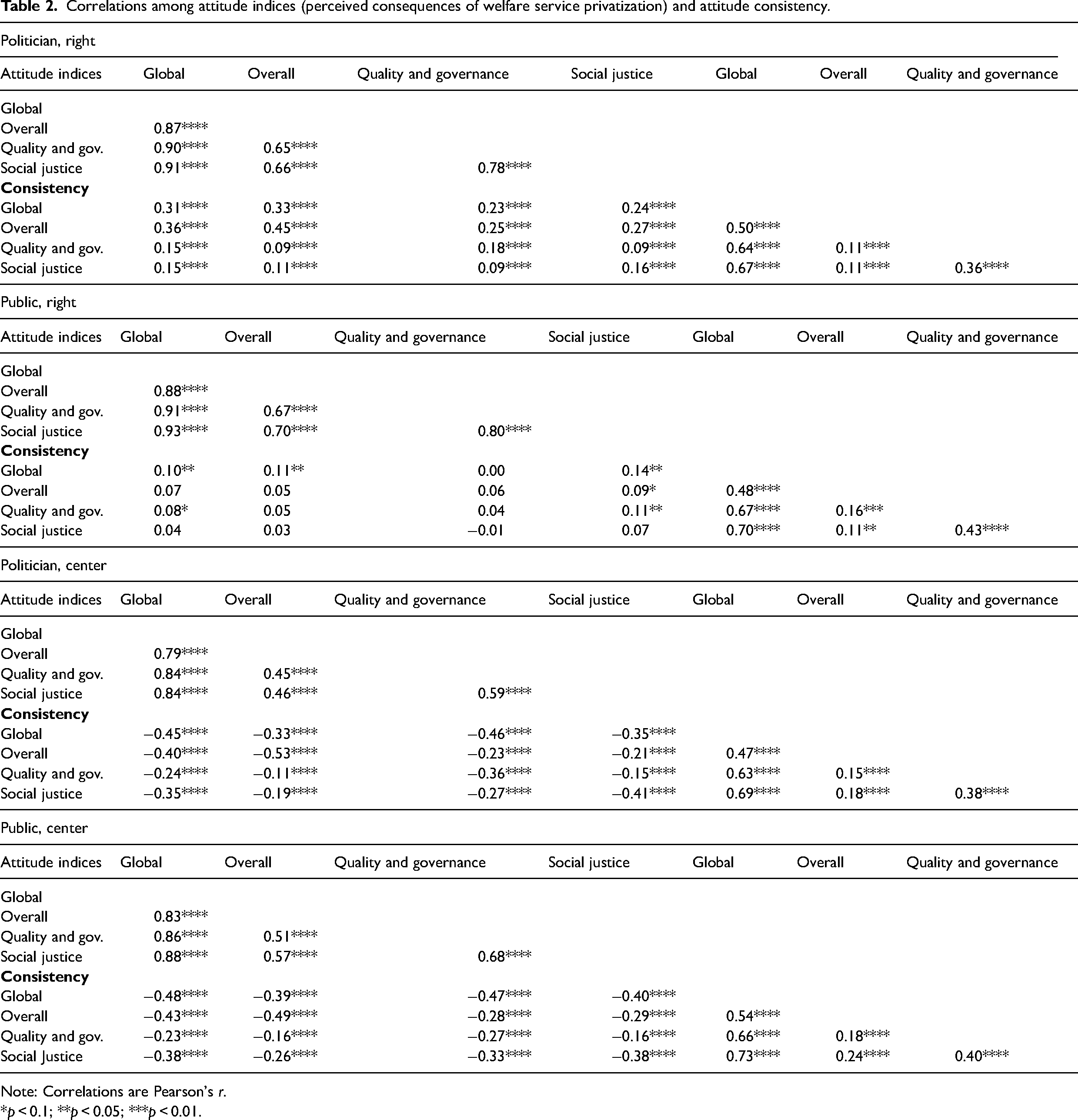
Note: Correlations are Pearson's r.
*p < 0.1; **p < 0.05; ***p < 0.01.
Results
Throughout the analysis, the results for all types of attitudes, both normative (societal consequences) and evaluative (benefits for quality and governance and for social justice), closely mimicked the results for the global index derived from all three attitude domains. In order to simplify the reading, only results pertaining to the global index are discussed in text, while results pertaining to any specific subset of attitudes are available in Figures 3 and 4, and the Online Appendices A and B. Throughout, I first compare politicians to members of the public, and partisans left to right, before nuancing the analysis through stratifying the public respondents according to their degree of political interest and exposure.
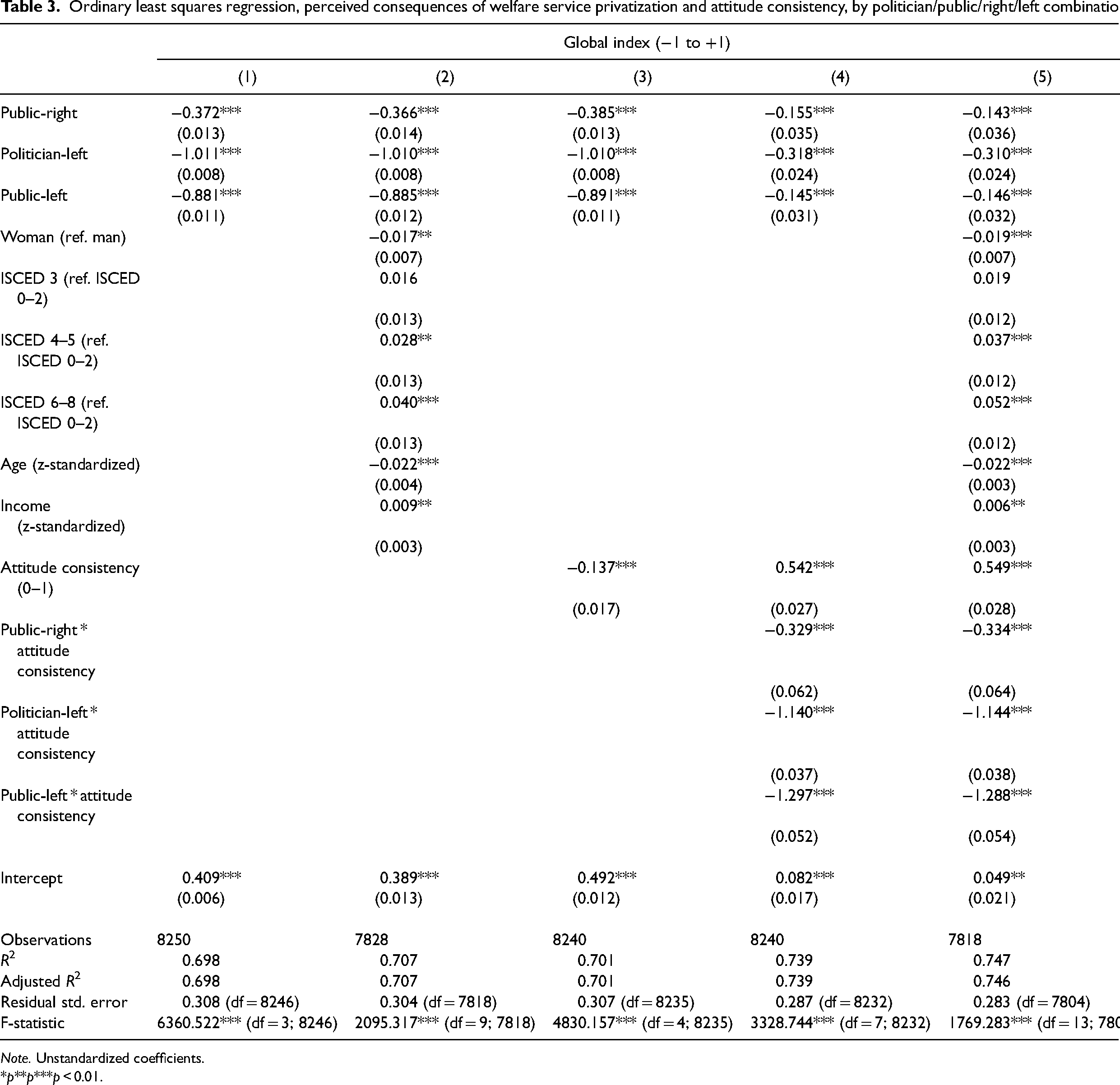
Ordinary least squares regression, perceived consequences of welfare service privatization and attitude consistency, by politician/public/right/left combinations.
Note. Unstandardized coefficients.
*p**p***p < 0.01.
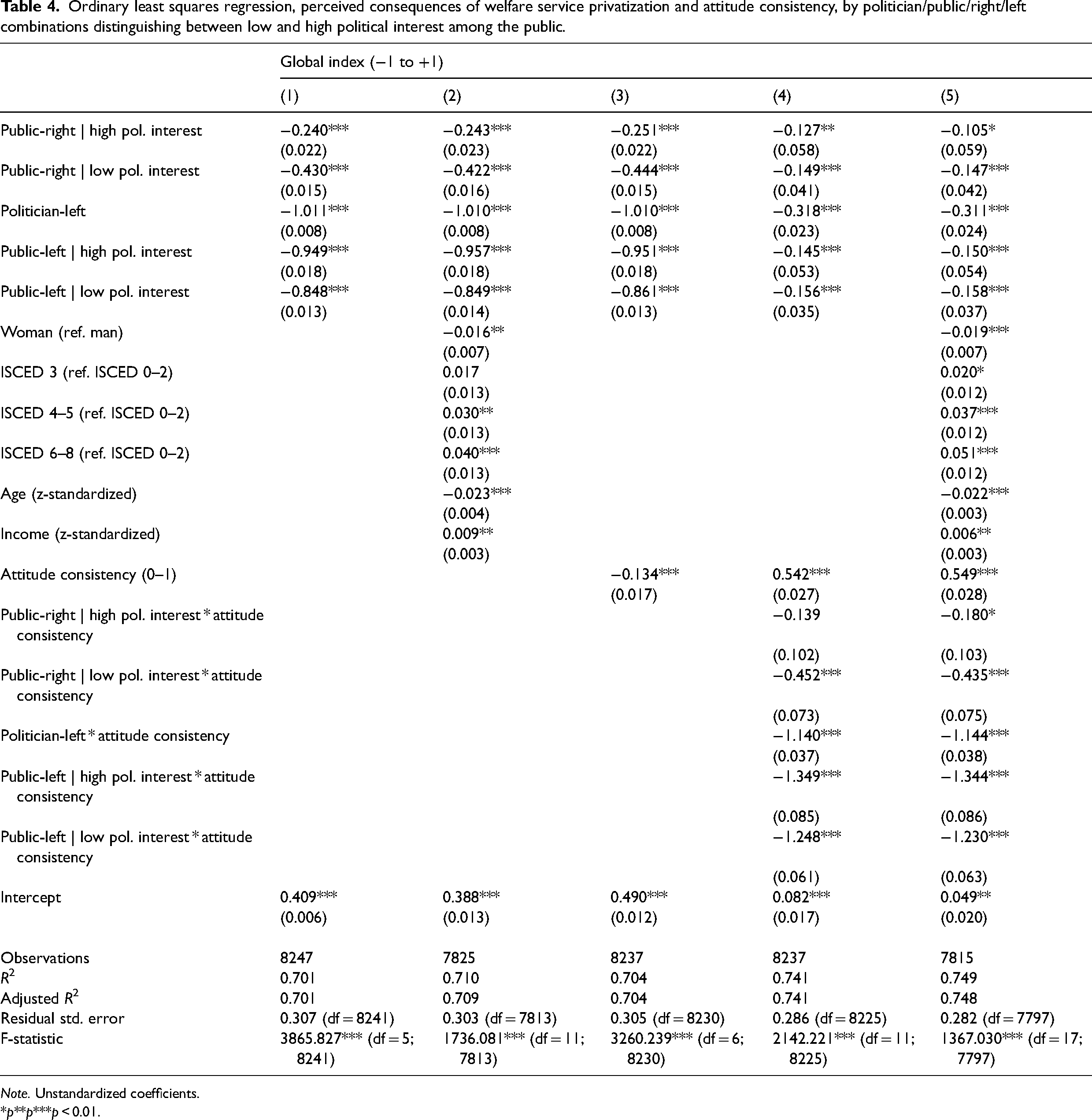
Ordinary least squares regression, perceived consequences of welfare service privatization and attitude consistency, by politician/public/right/left combinations distinguishing between low and high political interest among the public.
Note. Unstandardized coefficients.
*p**p***p < 0.01.
Descriptive analysis
We begin with a brief descriptive analysis. In Table 1, we see that right politicians were the most positive about the consequences of welfare service privatization (politician-right x̄ = 0.41), followed by right sympathizers (public-right x̄ = 0.04), left sympathizers (public-left x̄ = −0.47), and left politicians (politician-left x̄ = −0.60). The differences are illustrated with box plots in Figure 1. Furthermore, the public-right had more spread-out attitudes toward the consequences of privatization (SD = 0.41) compared to the politician-right (SD = 0.33), as well as sympathizers and politicians to the left (SD = 0.26 | SD = 0.33). When stratifying public respondents according to political interest and exposure (Figure 2), we see the same general pattern as recounted above, but with the added nuance that public respondents with high political interest more closely resembled politicians than did those with low political interest. These similarities were especially marked for the right concerning the direction of attitudes and for the left concerning attitude consistency.
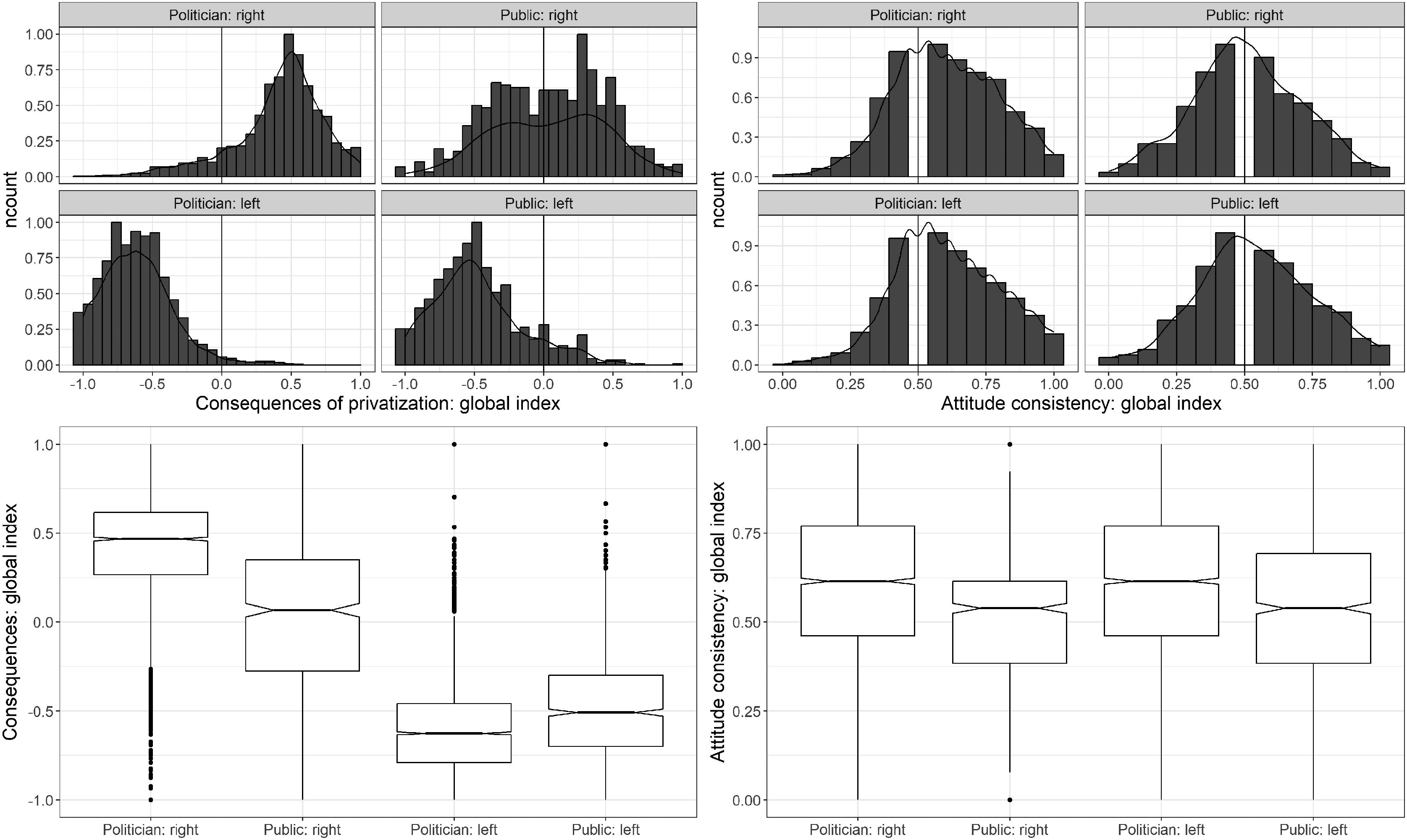
Graphic illustration of central tendencies and dispersion, using histograms and boxplots, for perceived consequences of welfare service privatization (global index) and attitude consistency, by politician/public/right/left combinations.
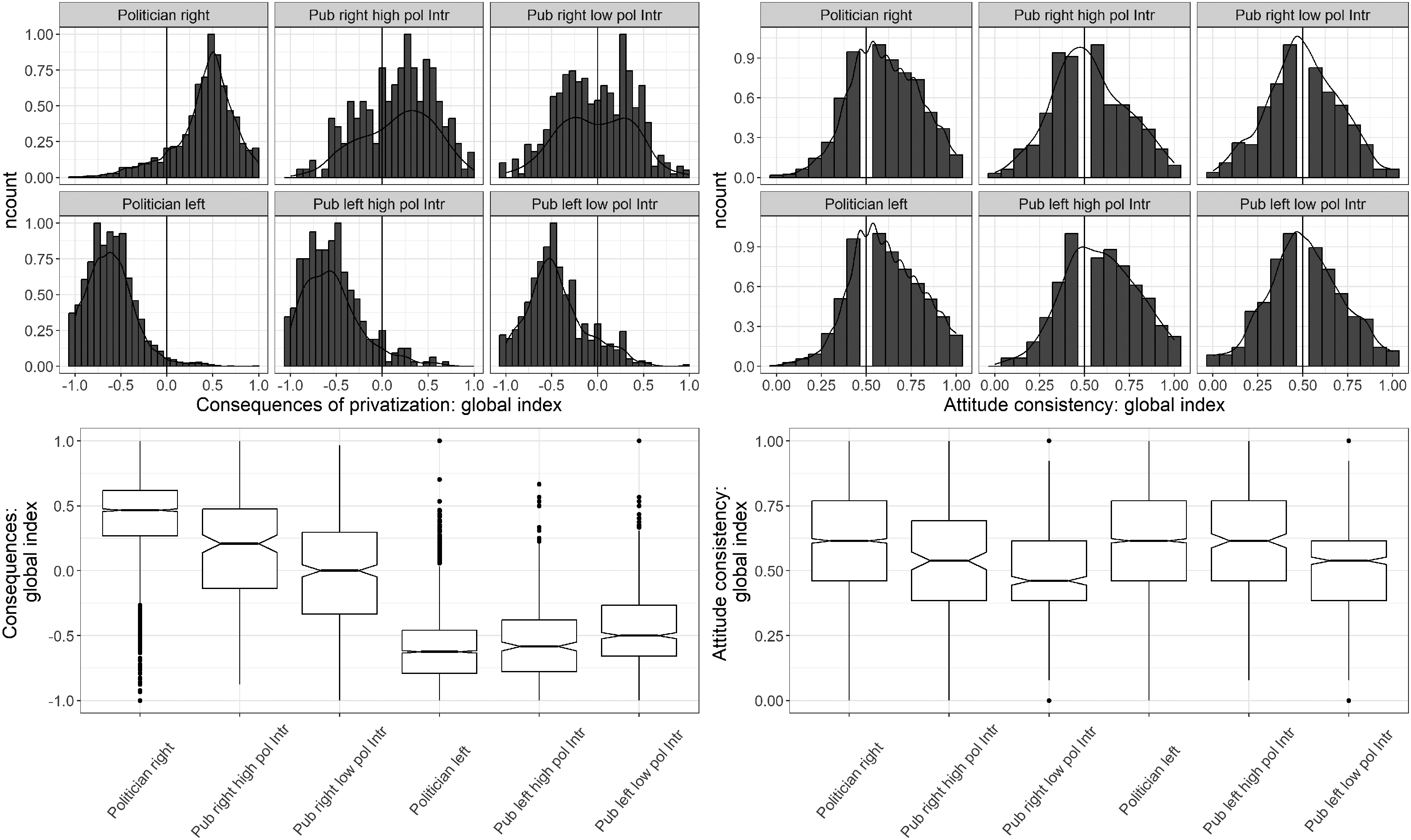
Graphic illustration of central tendencies and dispersion, using histograms and boxplots, for perceived consequences of welfare service privatization (global index) and attitude consistency, by politician/public/right/left combinations distinguishing between low/high political interest among the public.
Attitude consistency and perceived consequences of welfare service privatization
Next, the regression analysis. Here, the dependent variable was the global index measuring attitudes toward consequences of welfare service privatization, while attitude consistency was the main independent variable. 3 The analysis was centred around to what extent the relationship between attitude consistency and the direction of attitudes varied according to whether the respondent was a politician or member of the public, with left or right sympathies. Table 3 was set up as follows. Model 1 contained a factor denoting whether the respondent was a politician or member of the public, as well as whether she/he was a left or right partisan, with the category of right politicians used as the reference category. Model 2 controlled for compositional effects. Model 3 contained, in addition to the politician/public-right/left factor, the independent variable of attitude consistency, while Model 4 added an interaction term between these two variables. Model 5 was the same as Model 4, but with sociodemographic controls.
Comparing the results reported in Model 3 to those in Model 1, we see that the differences in perceived consequences of welfare service privatization between categories of right and left sympathizers and politicians were not reduced when controlling for attitude consistency. As differences in the level of attitude consistency were not able to explain why, in particular, centre-right politicians and centre-right sympathizers differed in how positively they viewed welfare service privatization, we study Model 4, which reports on the relationship between attitude consistency and perceived consequences of welfare service privatization separately for the four politician/public-right/left categories. For the reference category of politician-right, this relationship is denoted simply by the regression coefficient for attitude consistency (β = 0.542. sig. < 0.001). Thus, for the politician-right, moving from no (0) to maximum (1) attitude consistency meant a positive increase in attitudes toward welfare service privatization by 0.54 points (equalling about 25% of the scale that ranges from −1 to +1). Among the public-right, there was also a positive relationship between attitude consistency and perceived consequences of welfare service privatization, but compared to the politician-right, it was much weaker (public-right * attitude consistency β = −0.329 sig. < 0.001). 4 Among left sympathizers and politicians, attitude consistency was instead related to negative perceptions about the consequences of privatization (β = −1.297 sig. < 0.001 | β = −1.140 sig. < 0.001). These differences in the relationship between attitude consistency and perceived consequences of privatization are illustrated in Figure 3. Here we can especially see that the difference between public-right respondents with low attitude consistency (left on the x-axis) and public-right respondents with high attitude consistency (right on the x-axis) is mainly that of taking an ambivalent centrist position, where different positive and negative answers to the questions of privatization may cancel each other out (thus scoring near zero on the y-axis), versus taking a consistent centrist position by consistently viewing the consequences of privatization as neither positive nor negative. The observed pattern also held when controlling for the sociodemographic variables in Model 5. Thus, Hypothesis 1, stating that attitude consistency is linked with negative views among left politicians and positive views among right politicians, was supported by the analysis.
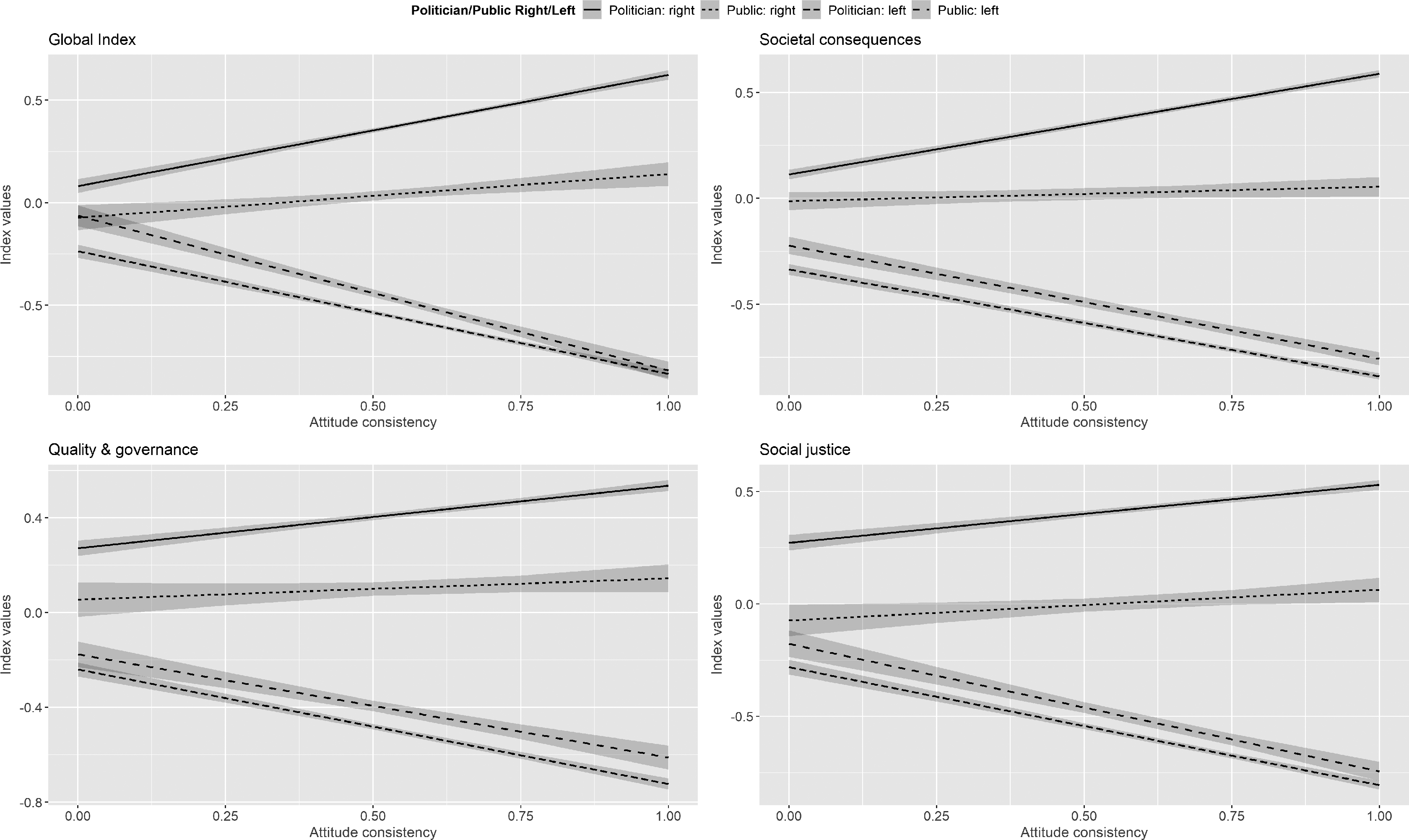
Interaction plot. Perceived consequences of welfare service privatization and attitude consistency, separate slopes for politician/public/right/left combinations.
Political interest among the public
In order to test Hypotheses H2 and H3a-b, the rest of the analysis is centred on differences in political interest and exposure among the public. Table 4 was setup similar to Table 3, but with the addition that the factor that distinguished politicians from the public, and left from right, now also stratified the public respondents according to whether they were high or low in political interest. In general, we see the same patterns as found in Table 3. However, in Model 1 of Table 4, we additionally note that the public-right with high political interest was less different from politician-right than were the public-right with low political interest (β = –0.240 sig. < 0.001 | β = −0.430 sig. < 0.001). Conversely, the public-left with high political interest (β = –0.949 sig. < 0.001) were more different from politician-right (and more similar to politician-left) (β = –1.011 sig. < 0.001), than were the public-left with low political interest (β = –0.848 sig. < 0.001). Controlling for levels of attitude consistency did not alter this pattern (reported in Model 3).
Looking at the interaction terms in Model 4, there is no evidence that political interest mattered for the relationship between attitude consistency and perceived consequences of privatization among left sympathizers. Indeed, we see that the negative slopes for each category (politician-left, public-left with high political interest, and public-left with low political interest) were virtually indistinguishable (illustrated in Figure 4). Thus, Hypothesis 2 is supported by the analysis. Concerning the right, the relationship between attitude consistency and perceived consequences of privatization was so similar for politician-right and public-right with high political interest that they were in fact hard to meaningfully separate (β = –0.139 sig. > 0.05). However, the same was not true for the public-right with low political interest, who displayed a markedly different relationship between attitude consistency and privatization beliefs compared to politician-right (β = –0.452 sig. < 0.001). In terms of slopes, as is illustrated in Figure 4, the public-right with high political interest had a positive slope mimicking that of politician-right, although starting from lower levels and not being quite as steep. In contrast, those with low political interest displayed no relationship between attitude consistency and perceived consequences of privatization. This observed pattern held also when controlling for the sociodemographic variables in Model 5. Thus, Hypotheses 3a and 3b were supported by the analysis.
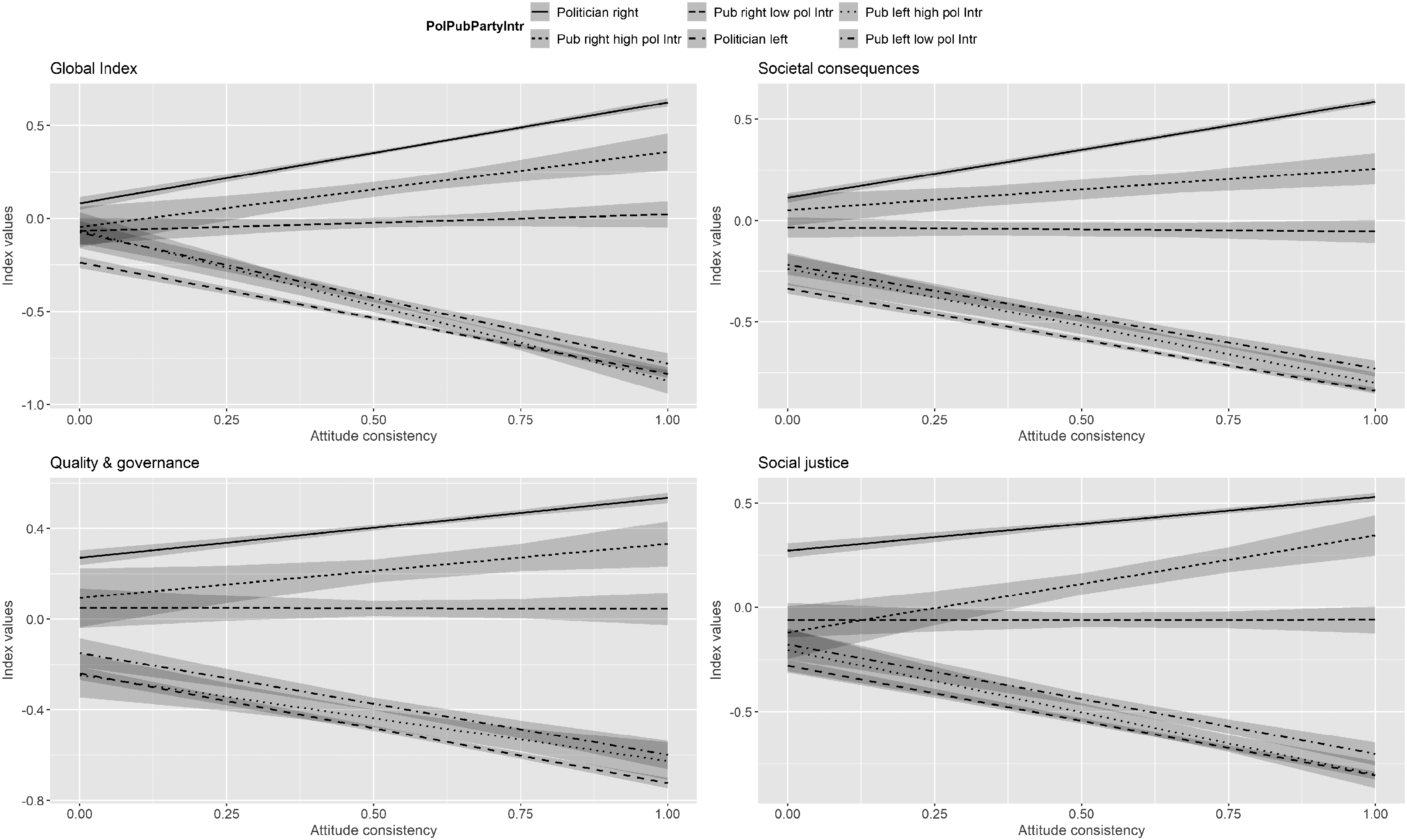
Interaction plot. Perceived consequences of welfare service privatization and attitude consistency, separate slopes for politician/public/right/left and political interest (high/low) combinations.
Concluding discussion
In this paper, I have studied the cognitive organization of preferences toward welfare service privatization in Sweden, with a particular focus on providing a theoretical explanation as to why centre-right politicians and centre-right sympathizers display such incongruent attitudes. Drawing on the literature on political belief systems (Converse, 1964; Hurwitz and Peffley, 1987; Sniderman, 2017), I termed the positive relationship between holding consistent attitudes (horizontal constraint) and displaying partisan-typical preferences (vertical constraint) as ‘ideological thinking’, and it was my expectation that, given contradictions between right political rhetoric emphasizing choice and private property (e.g. Blomqvist, 2004; Fredriksson et al., 2013; Hartman, 2011; Meager and Szebehely, 2019: Sunnercrantz, 2021; Sunnermark, 2014; Svallfors and Tyllström, 2019) and the core value of universalism long embodied by the Swedish welfare state (e.g. Blomqvist and Palme, 2020), centre-right sympathizers would engage less in ideological thinking when compared to centre-right politicians as well as to left sympathizers and politicians. This was indeed the case.
First, I found that the analysis was little affected by focusing on either normative or evaluative dimensions of welfare service privatizations. The observed patterns were in principle the same for perceived overall consequences to society, beliefs about benefits to quality and governance, social justice, and the broader global index summarizing all of these dimensions. Second, among local politicians, attitude consistency was systematically linked with taking a partisan position; left politicians being more negative and centre-right politicians being more positive to the consequences of welfare privatization, the more consistent their attitudes. Third, I found that left sympathizers displayed the same pattern of ideological thinking as their political representatives, meaning (for them) that attitude consistency was linked to viewing welfare privatization negatively, regardless of how interested left sympathizers were in politics. Fourth, and contrasting the above, the bulk of centre-right sympathizers did not show any systematic relationship between attitude consistency and taking a partisan (positive) position toward welfare service privatization. Only the top one-third of the politically interested centre-right sympathizers displayed such a relationship indicative of ideological thinking.
What is interesting to highlight is that centre-right sympathizers did not differ very much from centre-right politicians in terms of their respective levels of attitude consistency – the horizontal, or what-goes-with-what, dimension of attitude constraint (e.g. Converse, 1964; Hurwitz and Peffley, 1987) – and, furthermore, that the inclusion of attitude consistency in the regression models did not alter their respective views about the consequences of privatization. The similarity in attitude consistency between politicians and ordinary citizens is contrary to several previous findings within the research on political belief systems (e.g. Jennings, 1992; Kalmoe, 2020), although it does align somewhat with the literature that emphasizes parties’ structuring of the ideological space over individuals’ knowledge about abstract ideological principles (e.g. Gallina, 2023; Jost et al., 2009; Sniderman, 2017). Yet, contrary to even this literature, while able to ‘correctly’ deduce the related nature of privatization across different sectors and for different types of consequences, it was the non-takeup (for the most part) of a partisan position that sets centre-right sympathizers apart. Thus, while displaying constrained attitudes on the horizontal dimension, the organization of preferences was not influenced by partisan considerations (vertical constraint) (e.g. Hurwitz and Peffley, 1987).
I thus take the empirical findings to imply that the mobilizing and communicative efforts of political elites (Sniderman, 2017; Zaller, 1992) and the collective memories and normative messages so shaped by the design of the welfare state itself (Brooks and Manza, 2006, 2007) exert dual pressures on preferences for welfare service privatization, so that in the case of conflicting messages between institutional norms (pressure from below) and elite political rhetoric (pressure from above), only the most attentive party sympathizers are likely to engage in ideological thinking on the basis of partisanship and thus adhere to the political message of their preferred party. On the contrary, the uniformity of left political messages, emphasizing equality in access and outcome, with the institutional values of universalism and collective memories of previous welfare state effort, arguably makes political interest superfluous with respect to ideological thinking among the left. However, in order to fully validate these general theoretical claims, they need to be further tested in a cross-country setting with variability in both the institutional design of welfare service provision and in the saliency of left-right political conflict over privatization. It is obviously a drawback of the case study approach that neither variability in the political conflict over privatization nor in institutional design was specifically operationalized in the statistical models. Thus, the empirical evidence in this paper cannot claim them as mechanisms to the findings, but rather as plausible theoretical explanations. Nevertheless, the results were precisely as predicted from a close reading of theory and the Swedish case. In particular, the evidence concerning the differentiated role of political interest among right versus left sympathizers does give cause to believe that variability in alignment or contradiction between political rhetoric and institutional norms matters to ideological thinking around politicized issues among mass publics.
On a final note, I argue that this novel piece of evidence of partisan differences in the propensity to think ideologically around welfare service privatization can perhaps offer a partial explanation as to how welfare service privatization reforms in Sweden have been able to coexist with the overall negative public opinion toward such reforms (e.g. Edlund and Johansson Sevä, 2013). As previous multi-country studies have demonstrated that public opinion is not a likely cause of welfare service privatization reforms (e.g. Lindh, 2015), these insights may have broader implications as well. Arguably, future studies of the role of public opinion in the democratic politics of welfare reform should pay closer attention not only to what people think but also to how they think.
Supplemental Material
sj-docx-1-asj-10.1177_00016993241277118 - Supplemental material for Who thinks ideologically about welfare state reform? Partisanship and attitude consistency in politicians’ and mass public perceptions about the consequences of welfare service privatization in Sweden
Supplemental material, sj-docx-1-asj-10.1177_00016993241277118 for Who thinks ideologically about welfare state reform? Partisanship and attitude consistency in politicians’ and mass public perceptions about the consequences of welfare service privatization in Sweden by Mikael Goossen in Acta Sociologica
Supplemental Material
sj-docx-2-asj-10.1177_00016993241277118 - Supplemental material for Who thinks ideologically about welfare state reform? Partisanship and attitude consistency in politicians’ and mass public perceptions about the consequences of welfare service privatization in Sweden
Supplemental material, sj-docx-2-asj-10.1177_00016993241277118 for Who thinks ideologically about welfare state reform? Partisanship and attitude consistency in politicians’ and mass public perceptions about the consequences of welfare service privatization in Sweden by Mikael Goossen in Acta Sociologica
Footnotes
Funding
The author disclosed receipt of the following financial support for the research, authorship, and/or publication of this article: This work was supported by the Forskningsrådet om Hälsa, Arbetsliv och Välfärd (grant number 2012-1733).

Supplemental material
Supplemental material for this article is available online
Notes
Author biography
References
Supplementary Material
Please find the following supplemental material available below.
For Open Access articles published under a Creative Commons License, all supplemental material carries the same license as the article it is associated with.
For non-Open Access articles published, all supplemental material carries a non-exclusive license, and permission requests for re-use of supplemental material or any part of supplemental material shall be sent directly to the copyright owner as specified in the copyright notice associated with the article.
