




Abstract
In view of increased support for a rightwing populist (RWP) party and marketization of the Swedish welfare state, here we study local politicians’ and voters’ perceptions of welfare service privatization. We specifically ask whether such perceptions form coherent attitudinal profiles, linked to partisanship and left-right ideology. Using survey data focusing on the views of local politicians and voters in Sweden, we analyze perceptions of potential consequences of privatization and apply cluster analysis to examine whether and how such perceptions are interlinked. The results show that two distinct and contrasting latent profiles can be identified based on the underlying pattern across eight indicators. A large majority displays these profiles, which are closely connected to partisanship and ideology. Moreover, an ambivalent profile is identified. Contrary to expectations, views expressed by RWP politicians and voters are mainly aligned with the coherent profile associated with social democrats but also to a lesser extent the ambivalent profile. Thus, there appears to be a duality in RWP politicians’ and voters’ perceptions of welfare service privatization, suggesting that the potential impact of increased support for an RWP party on the future development of welfare service delivery in Sweden is not clear-cut.
Keywords
Introduction
Since the late 1990s, the Swedish welfare state has gradually shifted from the ideal-typical social-democratic model of tax-financed and publicly organized welfare services toward a model with extensive involvement of private actors in the provision of welfare services (Blomqvist, 2004; Gingrich, 2011; Jordahl, 2013). While services such as childcare, elderly care, and schooling were predominantly provided by public (municipal) actors a few decades ago, about 20% of tax-financed welfare services are currently provided by private actors (Blix and Jordahl, 2021). Local politicians are therefore central actors in municipal decisions about welfare service privatization. Despite the institutional transformation of the Swedish welfare state, this development has received surprisingly little scholarly attention (Svallfors and Tyllström, 2019). While there is some knowledge of the structural forces driving the welfare service privatization trend in Sweden (e.g., Blix and Jordahl, 2021), we know less about local politicians’ perceptions of the current privatization trend. Such knowledge of local politicians’ perceptions regarding economic, social, and democratic aspects of welfare service provision is vital, as local politicians in Sweden enjoy a great deal of self-determination in the future organization of municipal welfare service delivery.
While Swedish politics in general have revolved around the left-right socioeconomic dimension and the welfare state, sociocultural issues—not least related to immigration—have become increasingly salient in the public debate (e.g., Oskarson and Demker, 2015). In this context, the rise of the rightwing populist (RWP) party, namely, the Sweden Democrats (SD), has undoubtedly changed the political landscape. While the political orientations associated with rightwing populism are well-known in terms of sociocultural issues, such as immigration and crime, there is uncertainty about associated attitudes toward the welfare state. One reason for this uncertainty is probably the divided voter base of Western European RWP parties, which typically includes elements of both the working class and small-business owners (Ivarsflaten, 2005; Röth et al., 2018). Scholars have argued that RWP parties in Europe therefore intentionally “blur” their positions on many issues related to the welfare state and socioeconomic politics generally (Rovny, 2013) or use such issues instrumentally to attract voters and/or attack political opponents (Mudde, 2007). Accordingly, Rathgeb and Busemeyer (2022) argue that the rise of RWP parties in Western Europe could have profound implications for the future of the welfare state, but the direction is unclear. The relationship between rightwing populism and the welfare state is becoming increasingly important as RWP parties are evolving, increasing their vote shares and nowadays often engage in government building (Afonso and Rennwald, 2018; Enggist and Pinggera, 2022). In Sweden, while the RWP party (the Sweden Democrats) positions itself as a socioculturally authoritarian party, it tends to adopt a rather centrist position on socioeconomic issues (Jungar and Jupskås, 2014).
In this study, we aim to enhance knowledge of local politicians’ and their constituencies’ perceptions of whether welfare service privatization affects economic, social, and democratic aspects of service provision. More specifically, we first study the relationship between partisanship and such perceptions then examine the degree to which perceptions of potential consequences of welfare service privatization are interlinked and constitute coherent attitudinal “privatization profiles,” particularly among Sweden Democrat politicians and voters. For these purposes, we apply two analytical strategies. First, we compare perceptions of Sweden Democrat politicians with those of politicians from the two major left- and right-wing mainstream parties with traditionally strong (but opposing) stances regarding welfare state issues (the Social Democrats and Moderates, respectively). Second, we analyze the extent to which potential “privatization profiles” are connected to political left-right ideology or to other political welfare state issues, such as distrust and performance evaluations.
To engage with the literature on vote-seeking strategies (e.g., Röth et al., 2018) and democratic aspects of welfare service privatization, we compare the perceptions of local politicians with those of their respective voters. This is a central issue not only for substantive representation but also in relation to the development of the welfare state since the prospects to influence the future organization of welfare services should (at least partly) depend on whether politicians’ perceptions about privatization correspond to those of their voters. This part of the analysis is of particular interest in relation to RWP politicians and voters as their perceptions of privatization might be less clear-cut than those of politicians of the two major left- and right-wing parties and their voters.
Privatization of welfare services in Sweden
The Swedish welfare state is characterized by a large service-intensive public sector, which delivers healthcare, elderly care, childcare, and education. Public authorities have traditionally provided most of these services and because of the size of the sector scholars have labeled the Swedish welfare model a “service state”. Most welfare services, such as childcare, education, and elderly care, are provided at the local level by municipalities (although healthcare is organized at the regional level), which enjoy a significant degree of independence in their organization of services, through a constitutional right of municipal self-governance. Welfare service delivery by private actors was previously discouraged by national legislation and even prohibited in some areas (Stolt and Winblad, 2009). However, in recent decades, a rapid increase in privatization of core welfare services has resulted in a gradual transition of the Swedish welfare sector toward a welfare market, according to some scholars (Blix and Jordahl, 2021; Hartman, 2011). The municipal self-governance has probably affected the recent developments in the Swedish welfare service sector, in which there is increasing variation across municipalities in terms of the degree of privatization, as described in detail by Hardell et al. (2020) and Blix and Jordahl (2021). In this context, privatization refers to a transition toward the organization and provision of welfare services by private firms (or other non-public actors), rather than services being primarily financed privately rather than collectively.
Welfare service privatization: attitudes, perceptions, and ideology
Despite the marketization trend, previous research on public attitudes toward the privatization of welfare services has shown that the Swedish public generally has weak support for non-public service providers. For example, Nilsson (2020) and Svallfors (2011) found that most Swedes believe that public authorities are best suited to deliver welfare services such as childcare, elderly care, and education. Moreover, it has been found that individuals’ support for welfare service privatization tends to be strongly intertwined with ideological orientations, especially in Sweden where welfare state issues have been at the core of politics (Oscarsson, 1998; Svallfors, 2011). Other studies have, however, found that support for a mixed welfare model, i.e., collectively financed services delivered by private firms, has increased in Sweden over time, particularly in local contexts where there are already high degrees of welfare service privatization (Edlund and Johansson Sevä, 2013).
Regarding politicians’ preferences, previous research has mapped the privatization positions of mainstream left- and right-leaning politicians and concluded that such positions are strongly linked to partisanship (e.g., Guo and Willner, 2017; Lindh and Johansson Sevä, 2018). This partisan cleavage is particularly pronounced among local politicians, who tend to be guided by ideological concerns when forming their attitudes toward welfare service privatization (Lindh and Johansson Sevä, 2018), as well as when assessing service quality in local contexts with varying degrees of privatization (Hardell et al., 2020). For example, Guo and Willner (2017) found distinct partisan differences in privatization preferences regarding the provision of elderly care between mainstream left- and right-wing local politicians. Similarly, Lindh and Johansson Sevä (2018) found that partisanship is strongly connected to attitudes toward welfare service privatization among local politicians, regardless of the actual municipal degree of privatization. Thus, local politicians’ views on privatization seem to be strongly connected to mainstream left- and right-wing party affiliation. Nevertheless, despite the strong connection between privatization attitudes and partisanship, evidence from various contexts, not least municipal contexts, indicates that this partisan divide does not always translate into espoused policies (Gingrich, 2011).
RWP parties, voters, and attitudes toward the welfare state
As stated above, it is well known that RWP parties mainly mobilize around socio-cultural political issues (Ivarsflaten, 2005), while their economic stances are less clear. Previous research has depicted the welfare policy positions of RWP parties and voters as inconclusive and not easily reconcilable with the traditional socioeconomic left-right dimension (de Koster et al., 2013; Rathgeb and Busemeyer, 2021). Other scholars conclude that these parties may adopt a moderate or centrist position, but there is high variation both across time and among countries (Afonso and Rennwald, 2018), as well as in redistributive or deregulatory policies (Röth et al., 2018). Additionally, Rovny (2013) highlights a low salience of issues related to economic policy or even an intentional blurring of their positions to appeal to a broad category of voters both to the left and right of the political spectrum. Thus, welfare state deregulation or privatization can be expected to be more easily supported by RWP politicians as opposed to welfare state retrenchments and most likely constitute welfare state issues that are more compatible with RWP parties’ “position blurring” (cf. Röth et al., 2018).
Scholars have noted a tendency for RWP parties to focus, instead, on their core themes of immigration, law and order, and value-driven policies also when addressing socioeconomic issues. For example, previous studies on party platforms and welfare policy preferences of RWP parties and voters have linked them to distinct attitudes toward immigration and the welfare state. These include the sentiment (described using concepts such as welfare chauvinism and welfare nationalism) that immigrants have contributed less than natives to the welfare state (de Koster et al., 2013; Ennser-Jedenastik, 2018; Keskinen, 2016) and thus should have less entitlement to social insurances and services (Norocel, 2016). A related concept in this literature is deservingness, referring to the extent to which people think immigrants should be entitled to the same welfare provisions and services as natives (Chueri, 2022).
Regarding RWP supporters’ opinions on welfare state issues, Busemeyer et al. (2022) found, in a study based on data from eight Western European countries, that another central concept is workfare. These findings fit well with studies on RWP party platforms demonstrating that nationalism constitutes the core trait of RWP parties’ political rhetoric in Western Europe (Eger and Valdez, 2015). Correspondingly, studies on public attitudes have shown that nationalist attitudes are considerably more prevalent among RWP voters than among any other voter groups (Kulin et al., 2021). Accordingly, RWP voters generally favor pro-redistributive consumption policies for groups that they regard as deserving, e.g., pensions for retired natives, but have more skeptical views of social investment policies (e.g., education and active labor market policies) generally (Busemeyer et al., 2022; Enggist and Pinggera, 2022). This has been described as a promotion of a dualistic welfare state, “…with a neoliberal vision for the ‘undeserving’ and a protectionist one for the ‘deserving’” (Chueri, 2022: 386). In sum, while previous research suggests that there is no straightforward relationship between rightwing populism and views regarding the welfare state's organization, RWP parties seem to be increasingly focusing on socioeconomic issues, from a nationalistic welfare standpoint (Afonso and Rennwald, 2018).
In accordance with this general description of trends in RWP parties’ policies, manifestoes of the Sweden Democrat party indicate that it adopts centrist positions on socioeconomic issues and authoritarian positions on sociocultural issues (Jungar and Jupskås, 2014). An exception is a stark standpoint concerning issues about immigrants’ entitlement to welfare provisions (e.g., Bell et al., 2022). A study based on Swedish data of political documents shows that the rhetoric of the Sweden Democrats includes a welfare chauvinist discourse, but does not necessarily express opposition toward an encompassing welfare state (Norocel, 2016). Regarding welfare service privatization, however, their stances are probably less distinct than the positions of mainstream parties. Thus, we formulate our first research question as follows:
Based on the above discussion about the divided voter base and blurred welfare positioning (at least regarding social investment policies) of RWP parties, we expect to find that SD politicians (and voters) adopt a vague or centrist position on welfare service privatization.
To what extent are perceptions of the consequences of welfare service privatization interlinked and connected to political ideology?
While we know that general attitudes toward welfare service privatization are linked to traditional left-right partisanship, we know less about the extent to which perceptions of potential consequences associated with welfare service privatization constitute coherent “privatization profiles.” In other words, this means the degree to which local politicians’ and voters’ perceptions of the likely consequences of welfare service privatization are interconnected. In the political debate, mainstream left- and right-wing politicians generally rest on different arguments about the potential consequences of welfare service privatization (Svallfors and Tyllström, 2019). Such arguments typically concern sharply contrasting expectations of the outcomes (positive or negative) regarding economic, social, and democratic aspects of the organization of welfare services.
Conservative politicians tend to argue that privatization leads to greater diversity and freedom of choice for citizens, which in turn results in better accommodation of individual needs and (most importantly) improvements in the overall quality of services and economic efficiency, due to competition between public and private service providers. In contrast, leftwing politicians more critically argue that privatization threatens equality of access to welfare policies and erodes the quality of services due to a loss of control and transparency in the organization of welfare services when private actors become increasingly involved in their provision (Fredriksson et al., 2010; Fredriksson et al., 2013; Hartman, 2011; Sørensen and Bay, 2002). In contrast to politicians of mainstream left- and right-wing parties, RWP politicians in Sweden can be expected to have less coherent (and less ideologically driven) preferences regarding the welfare state's organization. Indeed, while their political rhetoric has to a large extent focused on issues regarding immigration and crime, their views on welfare service privatization (and other welfare state issues), have remained quite elusive. Following this line of reasoning, we formulate our second and third research questions as follows:
In sum, we expect to discern a clear pattern in perceptions of the consequences of privatization, linked to mainstream left- and right-wing partisanship. In contrast, Sweden Democrats are expected to have a looser connection to these attitudinal profiles due to their focus on other political issues.
Finally, regarding potential differences between local politicians and the general population, previous findings suggest that politicians, both of the left and right, tend to have more distinct attitudes toward welfare service privatization than their respective voters (Elinder and Jordahl, 2013), in positive or negative directions. Further, previous research has also found that local politicians generally tend to have more ideologically distinct attitudes than their fellow national-level politicians (Brothén and Holmberg, 2010; Gilljam et al., 2010; May, 1973). Moreover, findings suggest that voters on both the left and the right tend to be more skeptical about privatization than elected representatives in the national parliament (Nilsson, 2017). Thus, our fourth research question is as follows:
There is reason here to believe that local politicians’ views regarding the organization of welfare services generally differ from those of their respective voters. However, although we lack knowledge of potential differences between RWP politicians and voters, we expect such differences to be less apparent because of the non-salience and vagueness of welfare privatization in RWP rhetoric.
Data and method
The data on local politicians’ perceptions come from a survey of local politicians’ values, perceptions, and attitudes concerning the welfare state, based on a questionnaire sent out in 2014 by regular mail and e-mail to 13,147 regular council members in Swedish municipalities. The response rate was 56%, resulting in a final sample of 7109 local politicians. A similar questionnaire was distributed to a representative sample of the general Swedish public consisting of 6000 individuals, with a response rate of 34.5%, resulting in a final sample of 1993 respondents. In the study presented here, we use subsamples derived from these two surveys including politicians and voters of the two largest mainstream parties—the Conservative party (Moderaterna) and Social democratic party (Socialdemokraterna), as well as the RWP party the Sweden Democrat party (Sverigedemokraterna). These subsamples included 4158 and 1125 respondents, respectively, with distributions by party presented in Table A1.
In our analysis of the acquired data, we start by examining politicians’ and voters’ general support for welfare service privatization. For this, we use an additive index capturing the respondents’ overall attitudes toward privatization in four areas: healthcare, preschool/childcare, primary and secondary education, and elderly care. For each area, the respondents were asked whether they believe that increasing welfare service privatization will have positive or negative consequences for society at large (response categories: “very negative consequences for society at large,” “rather negative consequences for society at large,” “neither positive nor negative consequences for society at large,” “rather positive consequences for society at large,” and “very positive consequences for society at large”). The index ranges from 0 to 100 with higher scores indicating more positive views of welfare service privatization at large (a = 0.938).
We also use responses to eight items asking the respondents to report the extent to which they agree or disagree with statements about potential consequences of welfare service privatization in terms of its positive or negative impact on economic, social, and democratic dimensions of welfare service delivery. These include the following statements about whether welfare service privatization (a) increases economic efficiency, (b) promotes better adaptation of services to individual needs, (c) increases the quality of services, (d) improves working conditions for employees, (e) increases risks of corruption, (f) increases inequality in access to services, (g) increases general inequality in society, and (h) decreases transparency/quality control. Response categories for all these items were “strongly disagree,” “disagree,” “agree,” and “strongly agree.” We use dichotomized versions of these indicators, focusing on the probability of respondents of various groups agreeing or strongly agreeing with each statement.
We then explore the response structure of these eight indicators using latent class analysis (LCA). This enables us to identify “privatization profiles,” i.e., non-linear and qualitatively different configurations of respondents’ perceptions of potential positive and negative consequences of privatization. A key notion in LCA is local independence: it examines whether relationships within a set of observed indicators are explained by latent clusters (Hagenaars and McCutcheon, 2002). It distinguishes dominant patterns in the data, and all respondents sharing similar configurations of perceptions are allocated to a specific cluster. Thus, the objective here is to identify groups of individuals who share similar profiles in terms of perceptions of the consequences of welfare service privatization. For example, if two main patterns of respondents’ perceptions are identified, a two-cluster model will fit the data best, but if the sample can be divided into three main patterns of perceptions, a three-cluster model will be selected and so on. The optimal number of main clusters is determined using model fit statistics, such as the Bayesian information criterion (BIC) and L2 reduction. LCA can also calculate the probability of each respondent belonging to each latent cluster, thus enabling the examination of distributions of politicians and voters of the three considered political parties in the identified clusters. In the analysis presented here, we use pooled data from politicians and the public and include covariates to ensure that composition does not affect the clusters’ characteristics.
Further, we examine the extent to which the “privatization profiles” derived from LCA are connected to political ideology or rather to views about other political welfare state issues. Here, a major focus is on the connections between “privatization profiles” and political left-right ideology, i.e., the respondents’ self-placement on a left-right ideological scale ranging between 0 and 10 (the furthest possible to the left and right, respectively). This relationship is contrasted to the connections between the profiles and distrust in the public welfare sector, distrust in private firms, and dissatisfaction with welfare services. We measured distrust in the public welfare sector with an additive index based on two survey items: “To what extent do you think the public sector in general actually does the following?” (a) uses tax funds in an efficient manner or (b) provides services to all who need them in an equal manner. The response categories were to a very large extent, to a quite large extent, to a quite small extent, and to a very small extent (range 0–100, a = 0.788). Distrust in private companies is measured by an index based on two items: To what extent do you think private companies in general actually do the following? (a) offer reasonable prices for goods and services or (b) act honestly toward people like you. The response categories were to a very large extent, to a quite large extent, to a quite small extent, and to a very small extent (range 0–100, a = 0.834). Dissatisfaction with welfare services is measured with a composite index based on four items: What do you think of the service in your municipality in the following areas? (a) preschool, (b) elementary school, (c) upper secondary school, or (d) elderly care. The response categories were very satisfied, quite satisfied, neither satisfied nor dissatisfied, quite dissatisfied, and very dissatisfied (range 0–100, a = 0.826).
Results
The mean scores of politicians and voters for the index measuring general support for welfare service privatization, i.e., the extent to which increased privatization is perceived to have positive or negative consequences for society at large, are shown in the first column (a) of Table 1. High scores indicate that respondents perceive that privatization of health care, childcare, primary and secondary education, and elderly care provision has generally positive consequences. As expected, the results for local politicians show that Conservatives have substantially more positive views generally toward welfare service privatization than Social Democrats (with mean scores of 74 and 16 on the 0–100 index, respectively). We also find that Sweden Democrat politicians have an intermediate standpoint, with a mean score of 40.
Politicians’ and voters’ perceptions of the consequences of welfare service privatization. The mean scores for a general privatization index (a) and percentages of respondents that agreed/strongly agreed with eight indicative statements of perceptions of consequences of privatization (b–i) by partisanship.
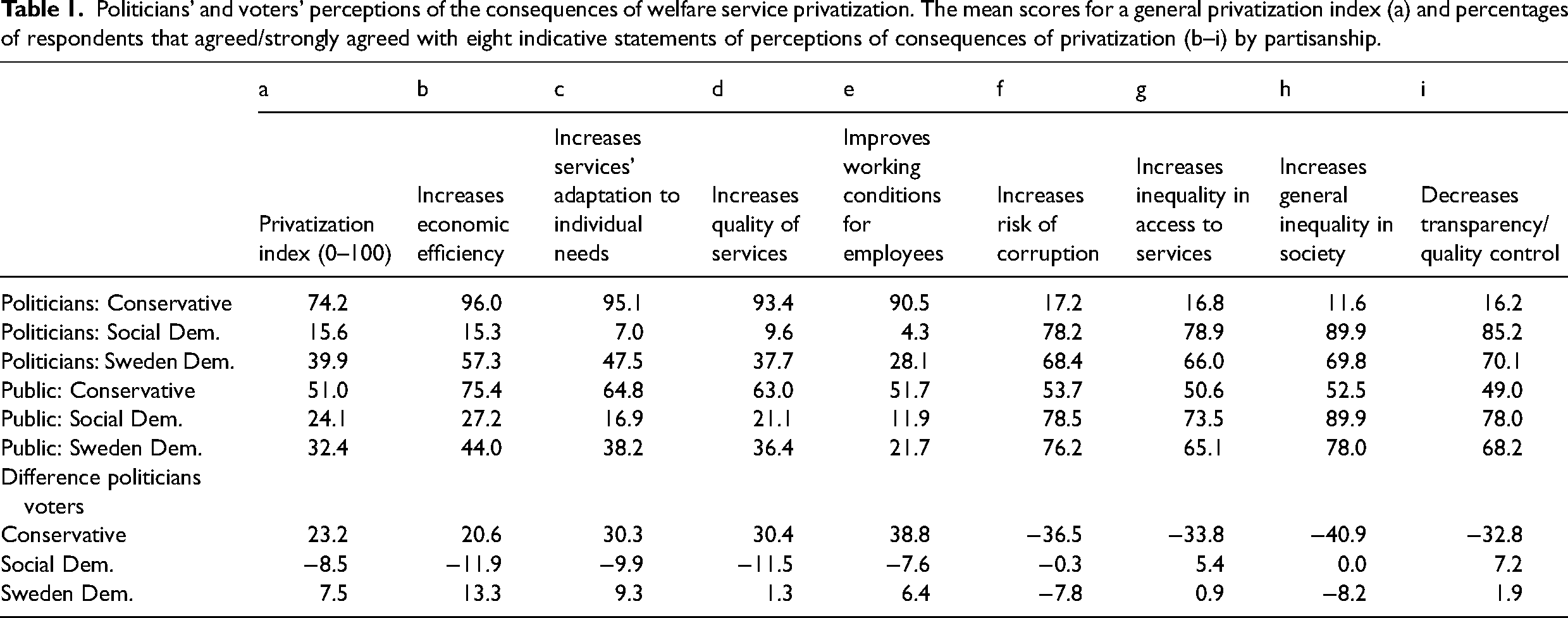
Turning to the public, the results show that the between-party differences tend to be smaller (Table 1, column a). For Conservative politicians and their voters, the mean scores were 74 and 51, respectively. Conversely, Social Democrat voters tend to have less negative views of welfare service privatization than the politicians (mean score: 24). Finally, we find that RWP voters view privatization slightly less favorably than their representatives (mean scores of 32 and 40, respectively). Thus, welfare service privatization appears to be a politically polarized issue in Sweden with a distinct left-right dimension, but Sweden Democrats tend to have an intermediate position in terms of their general support for welfare service privatization. Further, local politicians tend to have more distinct views of the societal benefits of privatization than their respective voters.
Next, we examine how local politicians and voters perceive eight potentially positive or negative consequences of welfare service privatization (Table 1, columns b–i) in terms of important dimensions in the public debate about the welfare state and service privatization. These include economic efficiency, equality in access to services, quality of services and transparency, and users’ freedom of choice. Starting with the Conservative party, we can observe that a very high percentage of politicians have positive views about the potential consequences of welfare service privatization. Very large shares (90–96%) think that privatization leads to higher economic efficiency, is better adapted to individual needs, leads to higher quality of services, and will improve working conditions in the welfare sector. Conservative politicians are also confident that privatization of welfare services does not have many negative consequences, in either equality of access to services or inequality in society more generally. They also do not believe that privatization will increase corruption or lead to less transparency/control.
In stark contrast, very small shares of Social Democrat politicians have a positive overall perception of privatization's potential consequences. Only 4–15% think that privatization leads to higher economic efficiency, is better adapted to individual users’ needs, leads to higher quality of services, or better working conditions for employees in the welfare sector. Further, far higher percentages of Social Democrat politicians (79–90%) than Conservatives think that privatization has negative consequences for overall equality in society and increases inequality in access to welfare services. Similarly, a large majority (78–85%) believe that privatization leads to corruption and a loss of transparency/control. According to Social Democrat politicians, privatization of welfare services does not lead to greater economic efficiency or better individually adapted services (<10%). In addition, they do not think that privatization improves the quality of services or working conditions of employees in the welfare sector.
Among Sweden Democrat politicians, a less distinct picture emerges. Concerning potentially positive consequences of privatization, 57% and 48%, respectively, think that privatization leads to higher economic efficiency and better adaption to individual users’ needs. Slightly fewer, 38% and 28%, respectively, perceive that privatization improves the quality of services and leads to better working conditions. Regarding negative consequences, the perceptions of Sweden Democrat politicians in many ways resemble those of Social Democrat politicians but are less clear-cut. About 70% believe that privatization has negative consequences for overall equality in society, increases inequality in access to welfare services, increases the risk of corruption, and leads to a loss of transparency/control.
When contrasting politicians’ perceptions with those of their voters, Table 1 shows that far lower percentages of Conservative voters than Conservative politicians perceive that privatization has positive consequences, and does not raise risks of adverse consequences (with 20–40% point differences in scores for each indicator). This pattern to a certain degree also exists among Social Democrat voters as they have less pronounced perceptions compared to Social Democrat politicians. This is especially the case regarding the four potentially positive consequences of privatization where Social Democrat voters are more positive than the politicians (about a 10% point difference). For two of the indicators of negative consequences, Social Democrat voters expressed slightly less negative views, and for another two, their views resembled those of Social Democrat politicians. Regarding the perceptions of Sweden Democrat voters, they seem to have more favorable views of the potentially positive consequences of welfare service privatization generally but also a somewhat more critical position of its negative consequences, than RWP politicians.
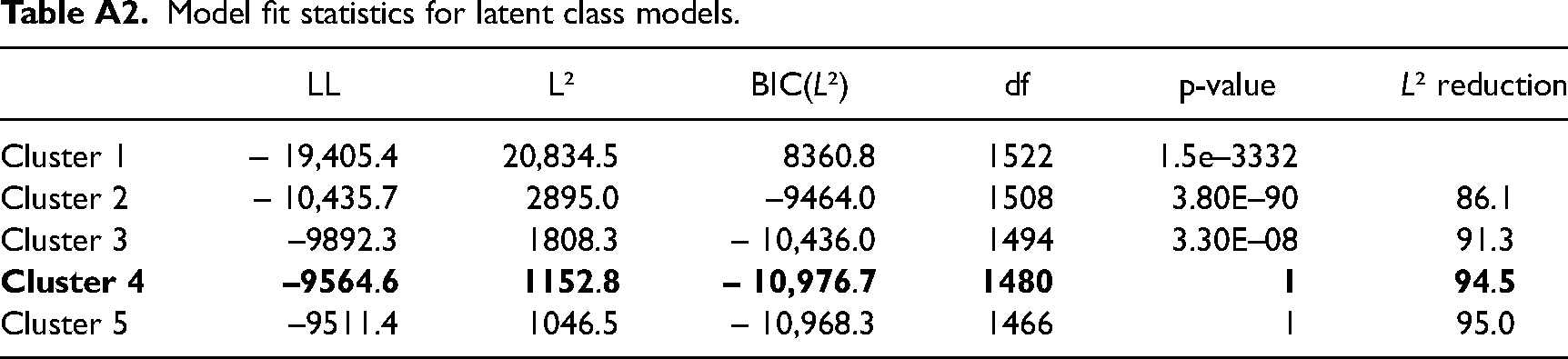
We proceed by using LCA to identify potential “privatization profiles” of local politicians and voters, based on our eight indicators. The purpose here is to examine possible associations between views of various positive and negative consequences of privatization in the respondents’ minds. We report the model fit indices for five latent class models in Appendix Table A2 and conclude that a four-cluster model appears to fit the data most satisfactorily. To consider the fact that we analyze partisanship as well as local politicians and the public, we include these variables as covariates in the LCA.
Characteristics of the four-cluster model are reported in Table 2. The cell entries indicate the probabilities of cluster members agreeing or disagreeing with the eight privatization indicators. The table also reports the overall size of each cluster and its party composition. The model assigns about 55% of the respondents to the “privatization profile” represented by Cluster 1, which thus is the largest cluster identified. This profile is characterized by low probabilities of agreement with the four statements that welfare privatization has positive consequences in terms of economic efficiency, adaptation to individual users’ needs, quality, and working environments. It is further characterized by high probabilities of agreement regarding the four statements that welfare service privatization tends to increase corruption, inequality, and lack of transparency. Overall, Cluster 1 clearly constitutes a consistently negative and ideologically coherent privatization profile.
Cluster characteristics (regarding perceived consequences of the privatization of welfare services) and membership probabilities for the four-cluster model.
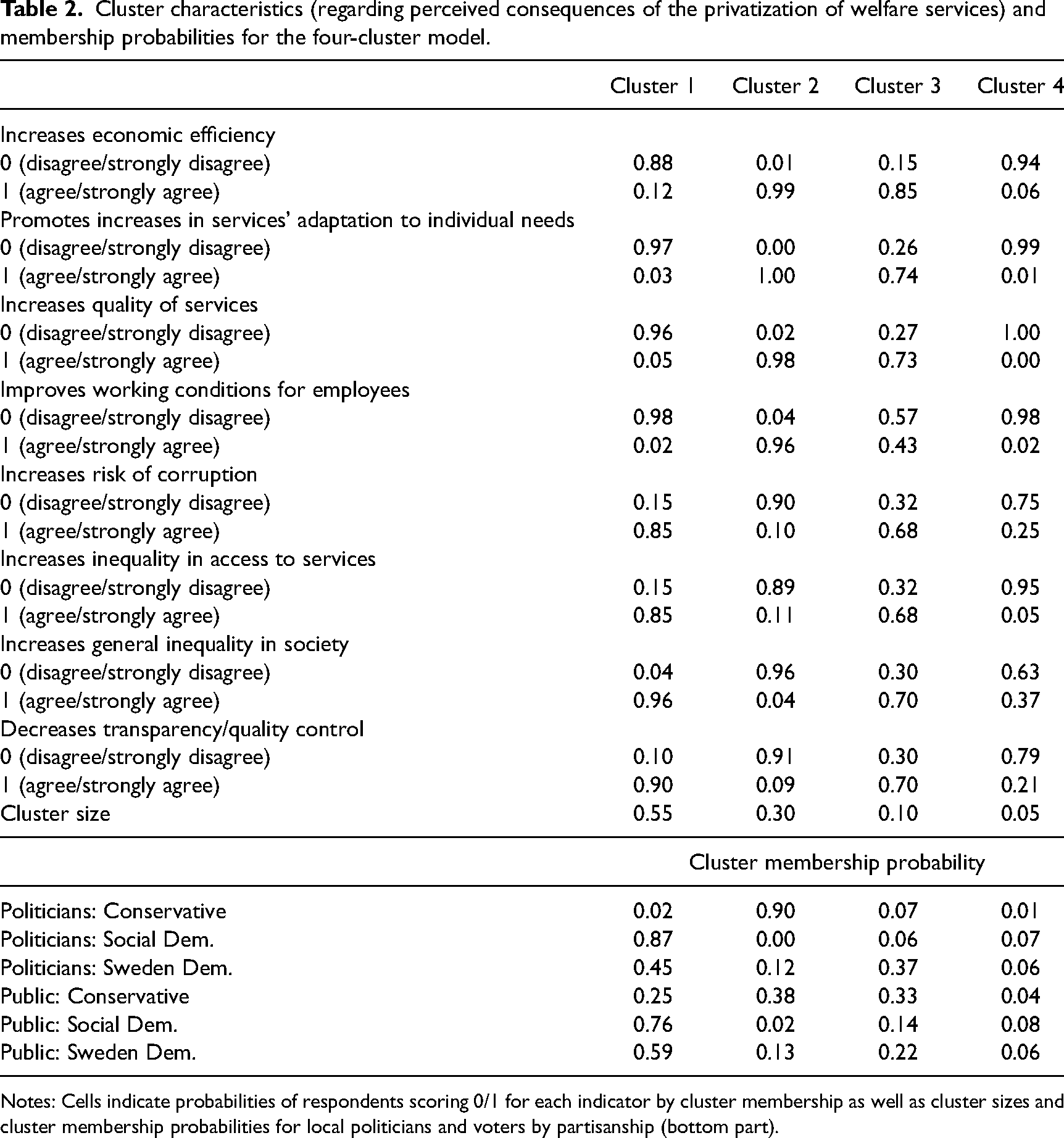
Notes: Cells indicate probabilities of respondents scoring 0/1 for each indicator by cluster membership as well as cluster sizes and cluster membership probabilities for local politicians and voters by partisanship (bottom part).
The model assigns about 30% of the respondents to the second largest cluster, characterized by distinctly different perceptions of the consequences of welfare service privatization. The members of this cluster have very high probabilities of agreeing with the four statements that welfare service privatization has positive consequences in terms of economic efficiency, adaptation to individual users’ needs, quality, and working environments, combined with low probabilities of agreeing that it has the considered negative consequences. The profile associated with Cluster 2 thus constitutes a mirror image of Cluster 1 regarding perceptions of its consequences.
The profiles associated with the remaining, considerably smaller, Clusters 3 and 4 are more ambivalent. The respondents allocated to Cluster 3 (about 10% of the total sample), have relatively high probabilities of agreeing with most of the indicative statements (especially a–c, Table 1) and thus have both an intermediate and ambivalent view of the consequences of the privatization of welfare service delivery. They clearly think that welfare service privatization has both positive and negative consequences. Finally, the smallest cluster (Cluster 4) includes about 5% of the respondents, who appear to lack distinct viewpoints regarding the potential consequences of privatization of welfare service delivery. Overall, the findings reported in Table 2 show that about 85% of the sample representing local politicians and voters (Clusters 1 and 2) have distinct and coherent patterns in perceptions of the consequences of welfare service privatization. These findings strongly support the notion that welfare service privatization is a salient and polarized issue for a large majority of politicians and voters in Sweden.
We also examine associations between partisanship/party sympathy and local politicians’ and voters’ assignments to the four clusters. In the bottom part of Table 2, we report the cluster membership probabilities for each of the six categories of politicians and voters. As expected, we find that local Social Democrat politicians have the highest probability of assignment to the profile associated with Cluster 1 and conversely that Conservative politicians have a high probability of assignment to the privatization-favoring profile of Cluster 2. In addition, Social Democrat voters’ perceptions of privatization tend to be very consistent with those of their politicians, but Conservative voters’ views are markedly less consistent than those of their politicians, as they are spread across Clusters 1–3, although they have the highest probability of assignment to the privatization-favoring profile of Cluster 2. Thus, Conservative voters have substantially more ambivalent perceptions of welfare service privatization than their local politicians, as also shown by the data presented in Table 1.
Turning to Sweden Democrat politicians and voters, we find that both groups are mainly assigned to Cluster 1, similar to Social Democrat politicians and voters, but also relatively often assigned to Cluster 3. For example, the probability of Sweden Democrat politicians to display the profile of Cluster 1 is 0.45, while the corresponding probability in the public is as high as 0.59. The probability of Sweden Democrat politicians and voters displaying the ambivalent profile of Cluster 3 is 0.37 and 0.22, respectively. In sum, these results suggest that a large share of Sweden Democrats have coherent and negative perceptions of the consequences of welfare service privatization. Hence, despite their allegedly rightwing position, Sweden Democrat politicians and voters have markedly low probabilities of endorsing the privatization-favoring views associated with Cluster 2. Sweden Democrats (particularly voters) appear to have substantially more in common with the mainstream left (Social Democrats) than the mainstream right (Conservatives), in their negative perceptions of the potential consequences of welfare service privatization.
Finally, we analyze the extent to which the “privatization profiles” are connected to political ideologies or other political welfare state issues, such as distrust and performance evaluations. For this, we assess the relationships between the “privatization profiles” and political left-right ideology, distrust in the public welfare sector, distrust in private firms, and dissatisfaction with welfare services. First, however, we provide descriptive statistics regarding these political variables for the six categories of politicians and voters. As expected, average scores are high (8.2) and low (2.1) on the left-right scale for Conservative and Social Democrat politicians, respectively, as shown in Table 3. With a score of 6.1, Sweden Democrat politicians are also rather right-leaning. The average scores of the voters of all parties are similar to those of their respective representatives.
Politicians’ and voters’ left-right ideology, distrust in the public welfare sector and private companies, and dissatisfaction with services by partisanship. Means and standard deviations of scores.
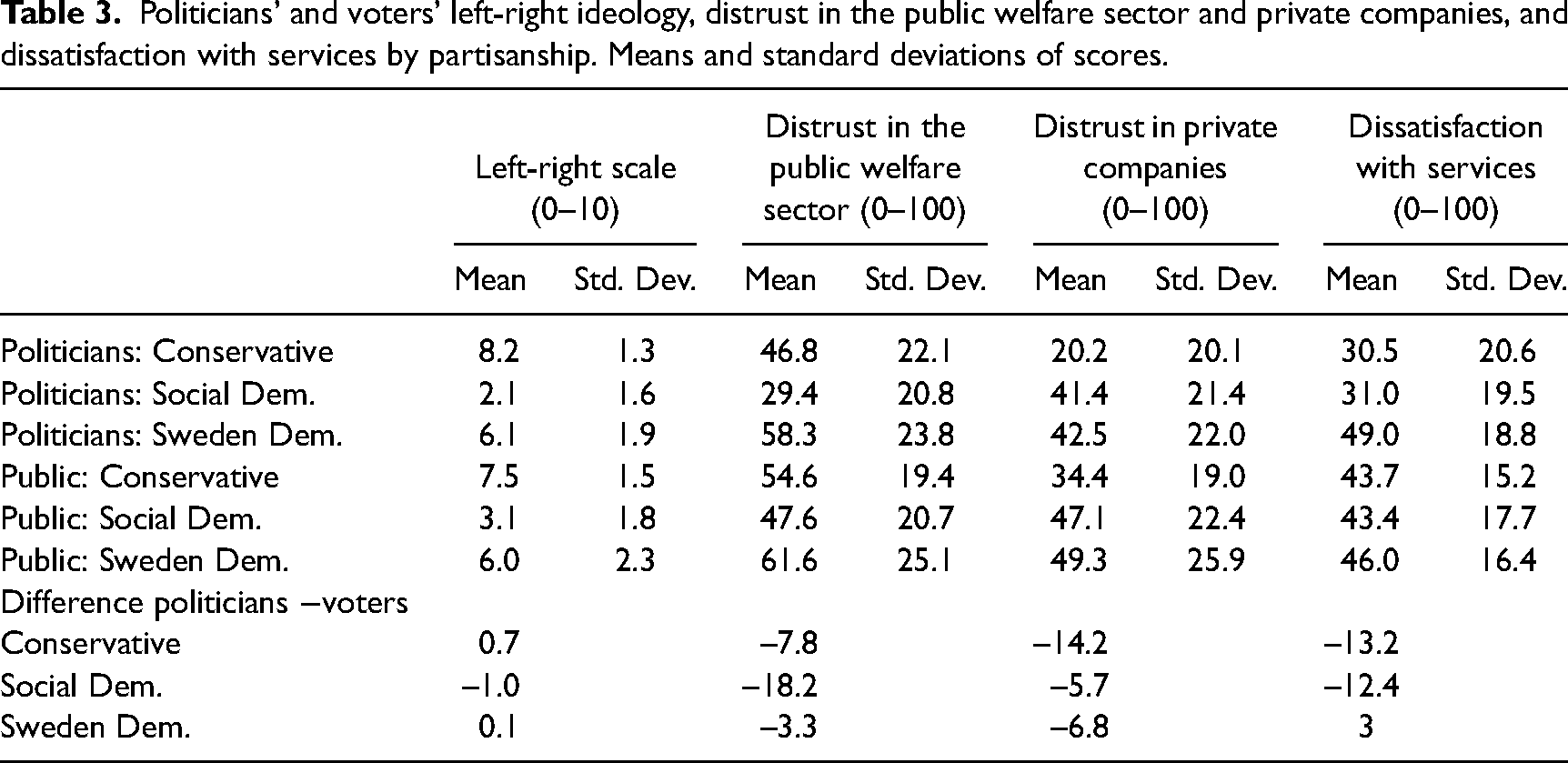
Regarding distrust and performance evaluations, we find a general tendency for Conservative politicians to distrust the public welfare sector more than private companies and the opposite pattern for Social Democrat politicians. For dissatisfaction with services, Conservative and Social Democrat politicians have similar average scores, around 31. Turning to Sweden Democrat politicians, we find that they have higher levels of distrust in both the public sector and private companies, together with higher dissatisfaction with welfare services (mean scores: 58.3, 42.5, and 49.0, respectively) than representatives of the other parties. However, we also find that voters of all parties generally have higher levels of distrust and dissatisfaction than their respective representatives.
In Table 4, we report the correlations of the “privatization profiles” with political ideologies, distrust, and performance evaluations. The profiles associated with Clusters 1 and 2 are strongly correlated to political left-right ideology, but as expected, in opposite directions (r=–0.731 and r = 0.768, respectively). That is, the more to the left on the left-right scale, the higher the probability of displaying the profile of Cluster 1, and vice versa for Cluster 2. Given the characteristics of the associated “privatization profiles” and their strong representation in politicians and voters of the Conservatives and Social Democrats, respectively, these results are consistent with expectations. In contrast, the correlation between the ambivalent profile associated with Cluster 3 and political left-right ideology is very weak (r = 0.104), showing that a substantial share of Sweden Democrat respondents do not have distinct, ideologically based views of privatization (at least in the traditional left-right socioeconomic sense). However, another large share of Sweden Democrat politicians, and particularly voters, are assigned to Cluster 1 with a strong connection to ideology, indicating that many of them do hold clearly negative and ideologically consistent perceptions of welfare service privatization.
Correlations (Pearson's r) between left-right ideology, distrust in the public welfare sector and private companies, dissatisfaction with services, and cluster membership probabilities.
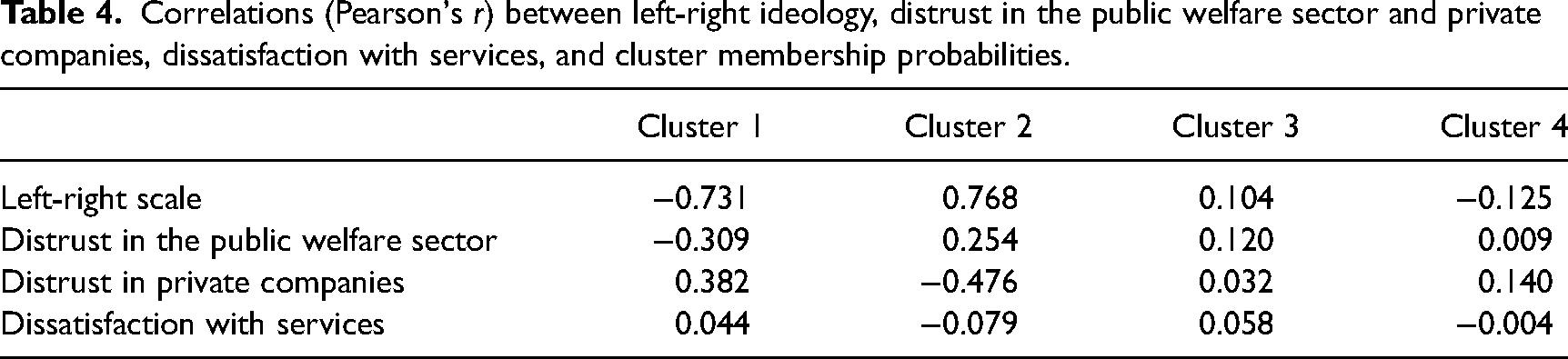
Table 4 also shows that the “privatization profiles” associated with the clusters are only moderately or weakly correlated to distrust and dissatisfaction with public welfare services. For example, distrust in private companies and the public welfare sector is correlated with Cluster 1 and 2 membership probabilities in the expected directions, while dissatisfaction with services is not significantly correlated with cluster membership. Thus, we find that political ideology is strongly associated with the “privatization profiles” of Clusters 1 and 2, but not with the ambivalent profile of Cluster 3. In contrast, distrust and dissatisfaction with public welfare services, which could be underlying factors affecting perceptions of welfare service privatization, are only moderately or weakly connected to the “privatization profiles.”
Discussion
In this study, we analyzed perceptions of economic, social, and democratic consequences of welfare service privatization in relation to partisanship and political ideology, particularly perceptions of RWP politicians and voters. First, we compared the perceptions of Swedish RWP politicians with those of politicians of the two major Swedish left- and right-wing parties with traditionally strong but opposing positions on welfare state issues. The results show that politicians of the mainstream parties express expected patterns of general support for, or antipathy to, welfare service privatization. However, despite their rightwing label, in line with previous research (e.g., Afonso and Rennwald, 2018), RWP politicians in Sweden clearly have an intermediate position. Regarding perceptions of specific consequences of welfare service privatization, a similar pattern emerges for the mainstream parties and a less distinct pattern for RWP politicians. To some extent, they resemble Conservatives in expressing positive perceptions of privatization, but they also express concern that privatization has negative consequences for overall equality in society and increases inequality in access to welfare services. Moreover, a majority of RWP politicians view corruption and loss of transparency and control as a risk associated with welfare service privatization, which is more in line with the social democratic view.
Next, we analyzed whether perceptions of specific consequences of welfare service privatization are interlinked and constitute coherent “privatization profiles.” The findings of LCA showed that two distinct attitudinal profiles can be detected based on the underlying patterns across eight indicators. Distinct and coherent profiles were identified for about 85% of the total sample (local politicians and the public), representing typical Conservative (Cluster 2) and Social Democrat (Cluster 1) privatization positions. Interestingly, we found that sizeable shares of Sweden Democrat politicians and voters have profiles resembling the typical Social Democrat profile, but not the typical Conservative profile. This finding clearly conflicts with some of the arguments about a divided RWP voter base consisting of both the working class and small-business owners (Kitschelt and McGann, 1997) and associated concepts of blurring and centrist positioning among RWP proponents (cf. Afonso and Rennwald, 2018; Rovny, 2013). Instead, the third largest cluster (10%) represents such an ambivalent standpoint regarding the consequences of welfare service privatization. This profile is largely represented by Conservative voters but also to a relatively large extent by RWP politicians and voters, who appear to adopt an intermediate standpoint, perceiving both positive and negative consequences associated with welfare service privatization, in line with expectations.
Regarding differences between local politicians and voters, we found in line with previous studies (Nilsson, 2017; Elinder and Jordahl, 2013) that politicians of the mainstream parties generally have more distinct views than their respective voters regarding specific consequences of welfare service privatization. This is particularly true for Conservative politicians, who express markedly different and more positive perceptions of welfare service privatization across all eight indicators than their voters. For Sweden Democrat politicians and voters, the results show that voters tend to have slightly less favorable views of privatization than their elected representatives, but similarly to Social Democrats, the differences are smaller than those detected between Conservative politicians and voters. This tendency is corroborated by the LCA, which shows that probabilities of assignment to the coherent “privatization profiles” of Clusters 1 and 2 are generally higher for local politicians than for the public, in line with expectations. The difference between politicians and voters is again particularly noticeable among Conservatives: the probability of displaying the coherent and “privatization-friendly” profile of Cluster 2 is 0.90 for Conservative politicians compared to 0.38 for their voters. For Sweden Democrat politicians and voters, there is a low probability of members of either group being assigned to this profile.
Next, we sought to improve understanding of potential connections between privatization perceptions and general views of socioeconomic issues and ideological orientations, or other political welfare state issues, such as dissatisfaction and distrust. For this, we analyzed the extent to which the “privatization profiles” are connected to political left-right ideology and other issues. The findings showed that there is not only a strong connection between ideologies and perceptions for politicians and voters of the two mainstream parties but also for surprisingly large shares of Sweden Democrat politicians and voters (allocated to Cluster 1). In fact, a majority of RWP voters in our sample were assigned to the ideologically based “privatization profile” associated primarily with Social Democrats. The correlations between the profiles and views of other political issues were only moderate or weak.
The findings suggest that the potential influence of rightwing populism on the welfare state is ambiguous, as there seem to be two main categories of RWP local politicians and voters. In line with previous research, one category adopts an intermediate position, displaying ambivalence regarding the potential consequences of welfare service privatization. The other category, more surprisingly, displays an ideologically based and coherent negative standpoint toward privatization, which is typically characteristic of Social Democrats. In fact, this is by far the most common profile of RWP voters (with a 59% share). Hence, while the growing support for an RWP party could potentially influence the future trajectory of the Swedish welfare state significantly (cf. Blix and Jordahl, 2021), our results suggest that it could well be in defense of the traditional Swedish service model, since many RWP politicians and (particularly) voters in Sweden perceive that welfare service privatization has negative outcomes. These findings concerning politicians’ and voters’ privatization views add to previous research on party manifestos and rhetoric of the Nordic RWP parties (Jungar and Jupskås, 2014), further indicating that market liberal views are not central elements of Nordic RWP ideology. This may be an expression of the specific Nordic political context and prevailing normative influence of the social democratic welfare state. Regarding the ambivalent category (Cluster 3), however, the weak ideological base and ambiguous standpoint on the consequences of privatization might render this group susceptible to arguments from both the left and right regarding welfare service privatization, which could potentially shift their position in either direction.
Regarding limitations and directions for future research, our focus on a single country limits the possibility of drawing more general conclusions about the relationships between partisanship, ideology, and privatization perceptions outside Sweden. Future research should therefore address the issues from a comparative perspective and examine if, and if so how, these relationships are affected by contextual factors. However, given the similarities in terms of welfare state contexts and characteristics of RWP parties in Nordic countries (Jungar and Jupskås, 2014), we believe that patterns will be similar in all of these countries. A comparative analysis of variations of perceptions within Sweden, considering possible links to municipal variation in actual levels of privatization, could also be fruitful since actual conditions and experiences associated with privatization may influence perceptions of welfare services (Hardell et al., 2020). Future research could examine the potential relationships between key RWP characteristics (e.g., anti-elitism, political distrust, and nativism/nationalism) and attitudes toward welfare service privatization. Nevertheless, our central finding of duality in RWP views of welfare service privatization suggests that increases in popular support for an RWP party in an advanced welfare state such as Sweden will not necessarily provide foundations for increasing welfare service privatization.
Footnotes
Funding
The author(s) disclosed receipt of the following financial support for the research, authorship, and/or publication of this article: This research was funded by the Swedish Research Council for Health, Working Life and Welfare (FORTE) (grant number 2012-1733).
Ethics approval statement
This research was approved by the Swedish Central Ethical Review Board, decision number Ö 25-2014.

Author biographies
Appendix
Model fit statistics for latent class models.
| LL | L² | BIC(L²) | df | p-value | L² reduction | |
|---|---|---|---|---|---|---|
| Cluster 1 | − 19,405.4 | 20,834.5 | 8360.8 | 1522 | 1.5e–3332 | |
| Cluster 2 | – 10,435.7 | 2895.0 | –9464.0 | 1508 | 3.80E–90 | 86.1 |
| Cluster 3 | –9892.3 | 1808.3 | – 10,436.0 | 1494 | 3.30E–08 | 91.3 |
|
|
|
|
||||
| Cluster 5 | –9511.4 | 1046.5 | – 10,968.3 | 1466 | 1 | 95.0 |