



Abstract
After Russia's invasion of Ukraine, Sweden changed its historic position of non-alignment and applied for membership in the NATO military alliance. This decision coincided with a shift in public opinion in favor of NATO membership, in what has been described as the largest and fastest shift in public opinion that has ever been measured in Swedish history. We examine two aspects of this “rally around the flag effect” to explain this change, the effect of the crisis event itself and the effect of political elite influence by analyzing within-individual changes of a Swedish university student population at three different time points. We find that after the Russian invasion but before the decision was made to join NATO, public opinion was still split with roughly 40% still opposed. However, after the decision was made to apply for membership to the alliance many people changed their position (32%), either making up their minds or switching position entirely. We show that these changes were likely in response to the decision to join, and that they were moderated by individuals’ previously established political preferences.
Introduction
After the Russian invasion of Ukraine on February 24th, 2022, the question of NATO membership re-emerged as a politically salient issue in the few European countries not already part of the military alliance, including Sweden. In this paper, we analyze changes in public opinion in Sweden, a country that long prided itself as militarily non-aligned (Forsberg and Vaahtoranta, 2001). Consistent with her party's long-held stance, in the initial period after the invasion, Swedish Prime Minister and Social Democrat, Magdelena Andersson rejected calls by opposition parties to consider joining the NATO alliance (Reuters, 2022). By late April, however, there was a sudden change in position and, together with Finland, Sweden announced its intention to apply for membership into the alliance. This decision ostensibly coincided with a massive shift in public opinion toward joining NATO, which the Swedish Public Opinion Research Institute (the SOM-institute) called “the largest and fastest shift in public opinion that has ever been measured in Swedish history” (Bjerleld and Oscarsson, 2023). However, this recorded shift in public opinion is based on cross-sectional data, meaning that the changes that took place within individuals over time, and what events correspond to those changes, remain uninvestigated. In this research, we evaluate evidence consistent with the rally-around-the-flag theory involving the necessary and sufficient conditions of a crisis event and the influence of political elites, specifically assessing whether the shift in public opinion was mostly driven by (a) the invasion itself, by way of creating a crisis in which people responded by rallying around the issue of NATO membership, or (b) whether the decision made by elites to formally apply for membership influenced political opinion, and if so, for whom.
We analyze three waves of data from a panel of university students at a large university in Sweden. We make use of the political timeline before and after the fielding of the survey to draw descriptive inference about when people changed their views on Swedish membership in NATO and why those attitude changes occurred. Our results show that by March 2022, after the invasion but before the official decision to join, respondents were still split on whether they would vote to join the alliance—including a substantial proportion that had not decided. Then after the official announcement to join the alliance was made, many more changed their position to be either for or against. These shifts were less dramatic after the autumn of 2022 and into the spring of 2023. These results implicate the importance of political elites’ decisions in generating support for foreign policy positions and highlight the importance of studying within-individual changes over time in response to political crises like the Russian invasion of Ukraine.
Explaining support for Swedish NATO membership
Since World War II, Sweden's foreign policy of non-alignment has enjoyed widespread popular support from the Swedish population. Consistent with the image of Sweden as a “force for good” in the world (Aggestam and Hyde-Price, 2015), non-alignment has been an important, positive source of Swedish national identity (Agius, 2006). This does not necessarily mean that Swedes were, on average, anti-NATO. During the cold war, Sweden's neutrality was a realist solution, given the country was situated between two war powers (Ydén et al., 2019). In the post-Cold War era, Sweden moved closer to NATO, but did not join. As such, neutrality took on an increasingly ideas-based logic, imbuing neutrality “with positive meanings emphasizing international law, solidarity, decolonialization, foreign aid and conflict resolution” (Ydén et al., 2019: 15). According to the SOM-institute, which has tracked support for NATO membership since 1994, a plurality has consistently opposed joining—with the exception of a brief burst of support between 2014 and 2015 after Russia invaded Ukrainian Crimea. A plurality once again opposed NATO membership by 2017, although levels of opposition did not return to pre-invasion levels. When Russia invaded Ukraine in 2022, negative attitudes about joining NATO seemed to reverse overnight (Bjerleld and Oscarsson, 2023). After such a long history of opposition, which included previous invasions by Russia and the Soviet Union into other countries, what explains this sudden surge in support for joining NATO? This historic shift in public opinion can be attributed to a so-called “rally around the flag effect,” which is dependent on both a crisis, and the mobilization of the crisis by national elites to shape public opinion.
The crisis event
Traditionally, the rally around the flag effect has been used to describe sudden and temporary shifts in support for American presidents that occur in response to major international events with implications for domestic foreign policy (Lee, 1977; Mueller, 1970). Among events that are relevant predictors for attitude changes are an outbreak of wars or military crises that involve the use, or potential use, of the country's military as well as new initiatives in foreign policy which receive wide public attention. 1 Beyond approval for a specific head of state (Hetherington and Nelson, 2003), this concept has been expanded to include political trust during the COVID-19 pandemic (Andersson and Aylott, 2023; Hegewald and Schraff, 2022) as well as attitudes toward the European Union after Russia's invasion of Ukraine (Steiner et al., 2023) among others. This part of the rally around the flag thesis places the importance on the crisis event as the primary driver of public opinion change. It also implies that after an initial surge of support for political leaders and/or governmental policies, support will wane (Johansson et al., 2021). The analysis of panel data should provide evidence of two shifts in attitudes within individuals over time: one peak in support followed by a decline (e.g. Johansson et al., 2021).
The elite influence thesis
Augmenting the explanation for the increase in support for NATO membership is the elite influence thesis, or the notion that public opinion follows elite opinion or their expressed positions on a political issue (Converse, 2006). According to this account, public opinion is affected by political elites’ articulation of their support or opposition for a societal issue or social policy (Bohman, 2011). Elites may influence public opinion through framing (Zaller, 1992) and linking issues to historical precedents or lessons (Powlick and Katz, 1998). Typically, elite influence plays out over time and through public debate among political elites (Page, 1996) and involves a suite of several policies and issues. However, the dramatic shift in support for Sweden joining NATO is an outlier in both regards. Swedish political parties did not debate the issue, arriving instead at almost spontaneous consensus. Furthermore, it was the ruling party, the Social Democrats (S), that reversed its long-standing opposition to NATO membership (Nyheter, 2022). This means that the Social Democrats did not exploit the crisis to advance a pre-existing foreign policy objective but instead changed its own position.
In relation to the “rally effect,” how people react to a crisis event is not easily distinguishable from the way that people are influenced by political elites’ reaction to the crisis. This is because, as Feinstein (2022: 46) notes, the “rally effect” is strongly tied to feelings of national prestige. When elites frame a crisis in terms of an international struggle against a tyrannical regime, as was the case after Russia's invasion of Ukraine, it invokes a “recognition of the nation's moral superiority and unique leadership position,” which is embedded in the call. Adding to this, the fact that Finland had also decided to join the NATO alliance meant that not joining NATO would have damaged the Swedish population's perceived position in the world. In summary, the crisis event is a necessary but not sufficient condition for the rally effect to mobilize political opinion, elites must capitalize on the crisis.
The sequence of these events in Sweden offers an excellent and rare opportunity for examining the interplay between a crisis that triggers shifts in the positions of political elites and peoples’ assessment of an issue. This point is expressly made by Kinder (2007): “An exploitable natural experiment requires a decisive shift in the deployment of frames in some real-world setting taking place in such a way that the putative effects on public opinion—if such effects there be—are fortuitously captured.” The shift of position of Sweden's largest (and at the time ruling) party represents such an opportunity.
Still, we should not expect the effect of shifting policy position of elites to elicit a consistent reaction across all people. Political partisans of different stripes, for example, are likely to interpret the shift differently and either solidify their previously held position or push them to take a position if they were previously undecided on the issue. In the Swedish context, given the political alignment around the issue of NATO, this should be especially evident among supporters of the Left Party (V) who, at the time of the decision had given passive support to the Social Democratic Party ruling government but did not officially change their opposition to NATO membership. The supporters of the Moderate Party (M), in contrast, who were in the opposition at the time and supported membership in the NATO alliance, likely saw the move of the ruling government party as a vindication of their own currently held beliefs and therefore their positions should remain stable.
Data
To map patterns of change and adjudicate between the different explanations, we use data from a panel of university students at a large university in Sweden. The panel was first launched in autumn 2020 and comprises a web-based survey that is administered to the participants once every semester (i.e. twice per year for a total of eight waves). Students were recruited into the panel via email. 2 In the survey students are asked about a wide range of topics, including questions about society, social issues, and current events with the goal of investigating attitudinal change. In spring 2022, which was the fourth wave of the survey, we introduced a question about Swedish membership in NATO: “If there were a referendum tomorrow on the question of Sweden becoming a member of NATO, would you vote for or against membership?.” Answer categories are: “Vote for membership,” “Vote against membership,” “Undecided,” and “Would not vote.” The same question was asked in consecutive rounds of the survey. In our analysis, we removed those that responded “Would not vote” due to the difficulty in interpreting the respondents’ position on the question. 3 To measure political party support, we asked respondents to select the party they like most, and allowed them to select between the largest 8 political parties with additional categories that included “none,” “I do not know,” and “I do not want to answer.” These non-party categories were then combined into a “Undecided” category in our analysis.
To our knowledge, this is the only true panel data set that includes opinions about NATO in Sweden, meaning these data offer an important and unique opportunity to examine within-individual change in support for NATO membership. However, we unfortunately missed the time before the crisis inducing event (the Russian invasion of Ukraine), and therefore are only able to capture what the rally around the flag effect would predict as being the high mark of support for NATO membership, before the eventual decline that should be observed in later time points (Table 1). Nevertheless, if the crisis is the primary explainer of support for NATO membership, we would expect to see a decline in support over time or, as the war is ongoing, some stability over time.
Timeline of key events and dates of data collection.

To carry out the analyses, we rely on three waves of the panel (T1–T3), collected in 2022 and 2023. The first of these was administered March/April 2022, after the invasion but before the policy shift. The next wave was administered in October 2022, after the policy shift. The third wave we analyze was administered in March/April 2023, over 1 year after the invasion (see Table 1). In total, 437 students participated in both T1 and T2 and 299 students participated in T1, T2, and T3. The sample is largely representative of the university student population but, consequently, also less representative with regard to the Swedish population at large. While differences in age, education and political preferences limit our study in its ability to assess general levels of NATO support in Sweden, it can still provide important insight into patterns of attitudinal change, including what spurred the shift in public opinion. Moreover, the overrepresentation of Left party supporters in the student group enables a closer examination of Social Democratic and Left Party supporters’ response to the political shift.
Results
Within-individual change
Analyses of our data show that T1 in spring of 2022 support for joining the NATO alliance was still mixed. The largest proportion was opposed, responding that they would vote against membership (39.1%) and the smallest group, while still a substantial proportion, were those that would vote for joining the alliance (29.4%). While we cannot tell if being undecided reflects long-standing indifference or new uncertainty about membership, almost a third of respondents (31.4%) had not made up their mind about how they would vote in a referendum on the issue. This pattern changes by T2, after the government had announced its decision that Sweden would join NATO. At this point, the largest proportion favors NATO membership, overtaking the position of those that would vote against (35.8%), and reducing the proportion of undecided to 26.8%.
Despite having missed the pre-invasion observation window in our survey, as a baseline pre-invasion measurement, we can reference the SOM-institute data that documented the rapid change in public opinion about NATO mentioned in the previous section. Their survey item differed both in formulation and in the number of answer categories making a direct comparison difficult. However, the descriptive information from SOM in 2020 show that 27.3% of respondents reported that the proposal that “Sweden should apply for NATO membership” was a “very good or rather good proposal,” 40% report “neither good nor bad proposal,” and 31.9% report “rather bad or very bad proposal.” Even with the differences in the survey items, these proportions are relatively similar to our initial proportions, and include a large proportion of people opposed to NATO membership. 4
While these cross-sectional results are in line with the shift in public opinion observed in the SOM data, the aggregates simultaneously hide the degree of actual within-person attitudinal change. Our own analysis shows that 32% of the respondents shifted position between spring and autumn of 2022 (T1–T2). Figure 1 reveals the various patterns of these transitions.
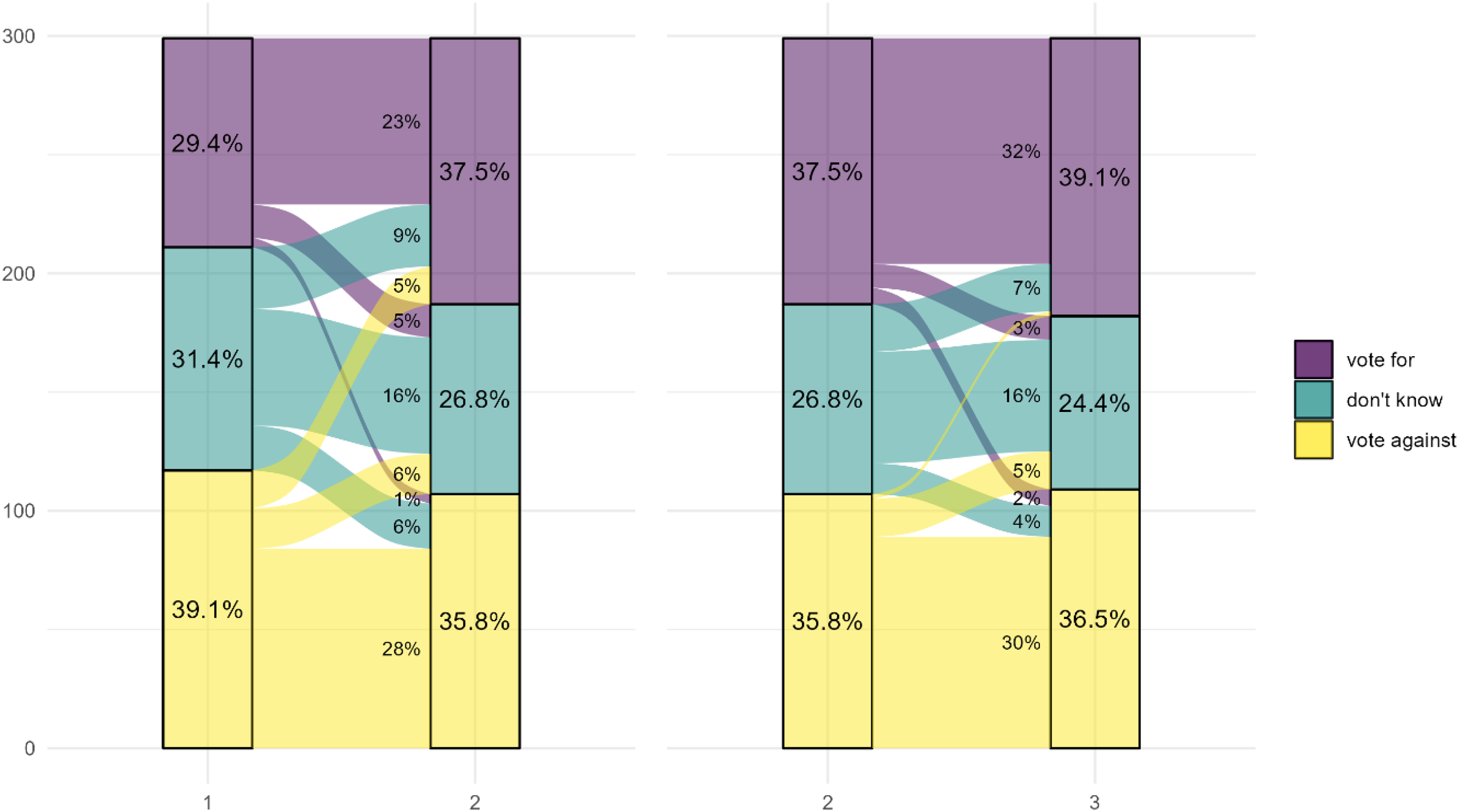
Sankey diagram of within-individual attitudinal changes between T1–T2 and T2–T3.
Twenty-three percent of the people in our sample supported NATO membership both before (T1) and after (T2) the formal decision to apply for membership. The growing share of people in favor of joining at T2 primarily came from the undecided group at T1 (9%), but also—to some degree—from the group that initially declared they would vote against membership (5%). Conversely, some respondents in T2 had switched from being undecided to opposing NATO membership (6%), but almost none from being in favor at T1 to opposing membership at T2 (1%). This means that while many in the undecided category at the first measurement point had formed an opinion by T2 (9 + 6%), others also backed away from their previously stated opinions (6 + 5%).
By spring 2023 (T3), all three groups appear to be relatively stable in the aggregate (39.1% for, 36.5% against, and 24.4% undecided). There also is less within-individual change when comparing with T2. 21% of the respondents reported a change between T2 and T3, as compared to 32% between T1 and T2. The largest flow ran between being undecided at T2 to supporting NATO membership at T3 (7%). 5% moved from voting against to undecided. About as many shifted in the opposite direction (4%), while some also moved from voting for membership at T2 to a more ambiguous or negative position (3 + 2%).
Who changed?
Figure 1 demonstrated that a considerable number of individuals changed their positions from T1 to T2 and also, albeit less so, from T2 to T3. However, relevant to the sequence of events is also the question of who changed their position, especially considering the policy change that initiated the decision for Sweden to join NATO was made exclusively by the Social Democratic Party. 5 Table 2 describes the sample by party preference at T1, and the proportion within each party that changed their position between T1 and T2. The table makes evident the overrepresentation of supporters for parties on the left and center-left in our sample. In total, 51.4% of the respondents stated that their party preference was for one of these parties (V, S or MP). The corresponding figure in the official statistics is 42%. Figure 2 further illustrates how respondents changed from T1 to T2, separated by political party and type of change. In the figure, we have merged the supporters of parties that have had continuously positive positions on Swedish NATO membership (C, M, and L) into one Pro-NATO group. As shown by Table 2, these parties represent a relatively small share of our sample individually, and we also do not expect any differences based on party membership within this group.
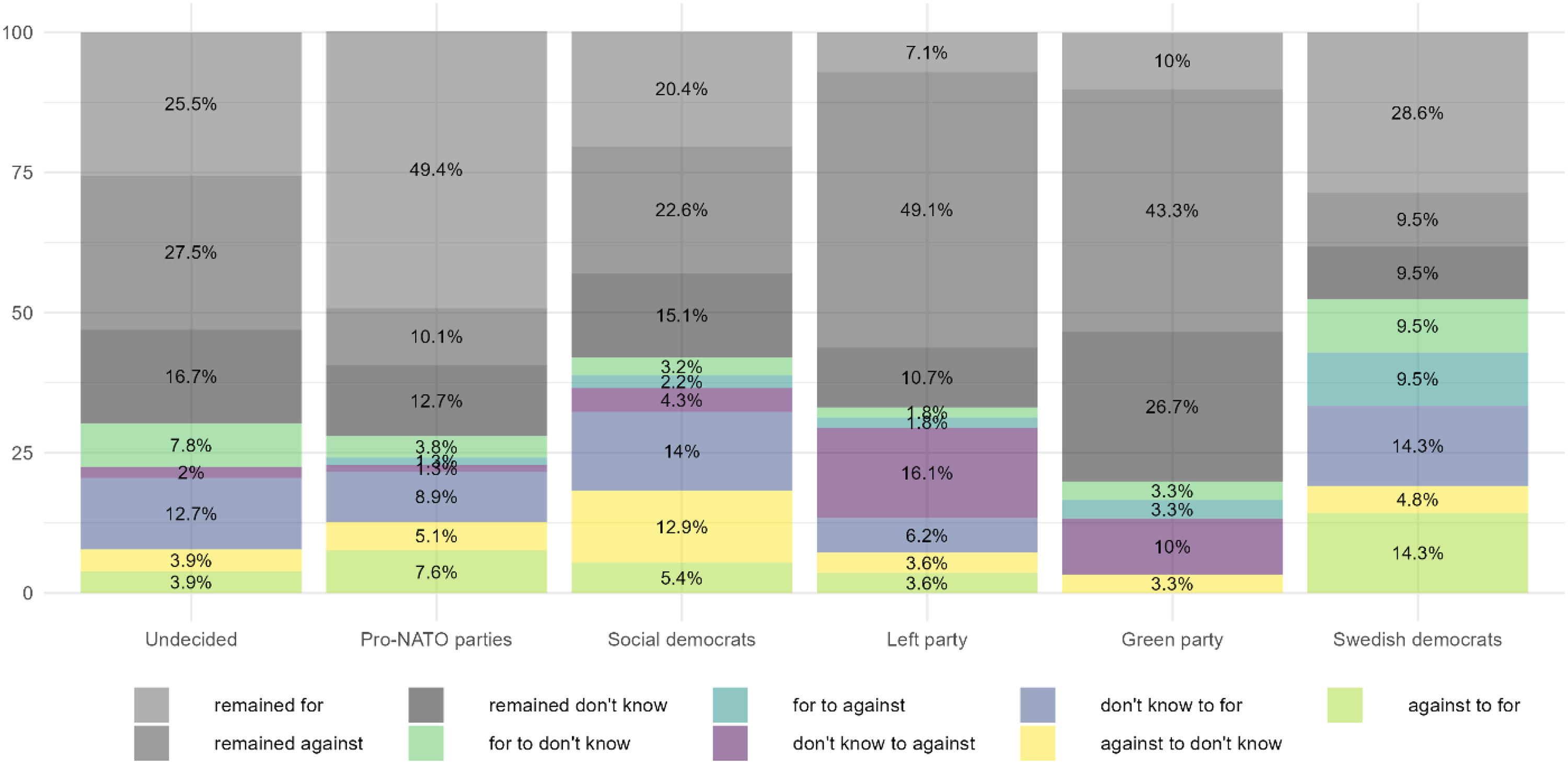
Attitudinal change between T1 and T2, by party support.
Overview of political party positions and attitudinal change.
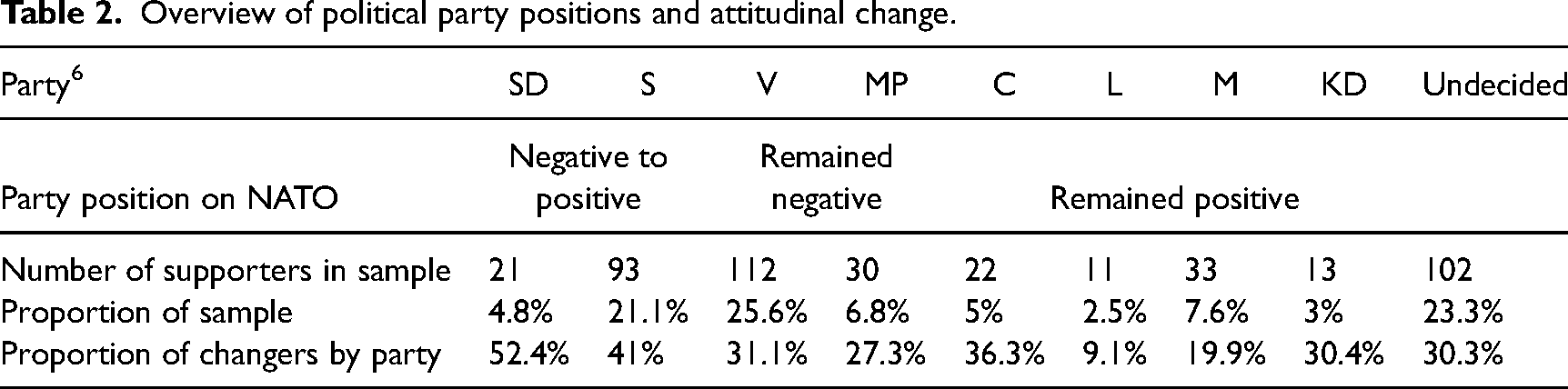
The analysis shows that the Social Democratic Party had a large proportion of their voters switch position from T1 to T2. Forty-one percent of those who supported the Social Democrats at T1 switched their position on NATO membership by T2. As further shown in Figure 2, this includes 18.3% that were opposed to Swedish membership before their party changed position but still after Russia invaded Ukraine. A majority of these changed to “don’t know” (12.9%) at T2, but 5.4% switched into a pro-NATO position. Adding to the general increase in NATO support, 14% of the Social Democratic supporters that still had no position after the initial invasion responded that they would vote to join NATO after their party voiced support for it, while 15.1% remained undecided across the two measure points.
Our sample also includes a high number of Left Party supporters. Unlike the Social Democrats, the Left Party, did not shift its position on NATO and remained against Swedish membership throughout this time period. Still, our analysis shows that a significant share of the Left Party (V) supporters changed their position from T1 to T2 (31.1%), albeit still a smaller share than among Social Democratic supporters. However, the direction of the changes among this group is markedly different. As illustrated in Figure 2, the largest shift among Left Party supporters were those that switched from being undecided in T1 to against Swedish NATO membership in T2 (16.1%). This suggests the saliency of the issue and change in national policy likely pushed many to take a position, and among those that identify with the Left Party, many chose to oppose membership in line with the official party position against NATO.
Finally, 30.3% of those that were undecided about their political party support changed their position on NATO between T1 and T2, and this group represented a substantial proportion of the sample (23%). Among this group many maintained their position between T1 and T2 of either support (25.5%), opposition (27.5%), or not taking a position (16%). Among those that changed, the largest group shifted from “don’t know” to favoring membership (12.7%) with a less substantial group questioning their previously held support for membership, transitioning from support to “don’t know.”
Discussion
To explain the dramatic shift in public opinion in support of NATO membership among the Swedish population in the aftermath of the Russian invasion of Ukraine, we draw on two complimentary theoretical aspects of the rally around the flag effect. First, the significance of the crisis event means that national leaders should experience a short-term surge in popularity during periods of international crisis or war, as the populace tends to unite behind them in a display of patriotism and support. Second, the elite influence thesis argues that political elites shape public opinion by communicating specific positions to people. Moreover, people may or may not take cues from this articulation dependent on their own partisanship. Elite influence is a popular account within political science and sociology, but isolating its impact in analyses of real-world events in connection to the rally around the flag effect has historically been difficult.
We analyzed the longitudinal support for NATO for one year over three time points in a Swedish student population to examine the rally around the flag effect. We draw three conclusions from our descriptive study. First, we find little support that our population drastically increased their support for Sweden joining NATO in relation to the Russian invasion of Ukraine. Undoubtably, some people changed their opinion between the unobserved pre-invasion time point and when we administered our survey, but our results show that there was still a substantial amount of change in opinion between Russia's invasion of Ukraine and the Swedish government's decision to pursue NATO membership. This calls into question the power of the crisis event, by itself, to fully explain the rally around the flag affect. Second, we provide strong descriptive evidence that the decision made by political elites to join NATO had a profound effect on many people as the support for NATO increased drastically after the incumbent party articulated their intention to join NATO. Because patterns of support for membership largely followed political partisanship, we interpret this as support for the elite influence thesis. Third, the direction of that effect is mediated by the political partisanship of the respondent at T1. For many, the Social Democratic Party's decision to apply for Swedish NATO membership helped them take a position, for others it called into question their previously held opposition to NATO, turning them from opponents to undecided. This is in line with Groeling and Baum (2008) who claim the effectiveness of elite messages depends on the relationship between sender and receiver, highlighting the importance of alignment between party affiliation of citizens and political elites.
Our study has three shortcomings. First, referencing the SOM-institute data as the baseline measurement of NATO support is not perfect since it is derived from a comparison with random sample rather than from our university panel. The wording of the question-and-answer categories also differs between the SOM-institute and university panel surveys. Second, it is possible that the breakdown in levels of support and opposition look similar to our first measurement point because of the political composition of the university population who are younger, more educated, and most importantly more left/center left than the Swedish population. The largest implication of this would be that the power of the crisis event, by itself, to change public opinion is strongest for people who identified with a pro-NATO party but were skeptical of or opposed to NATO until Russia's invasion of Ukraine. This is a question we cannot answer with our panel. Nevertheless, for those people that supported a party that was previously officially opposed to NATO, around half of the Swedish population, the baseline measurement of pre-invasion public opinion gives some credence to the lack of big shift between what would be T-1 and our first measurement (T1). Second, our analysis examines another part of the claim of the rally around the flag effect–that it should be temporary. We find little evidence of this, since not many people switched their position from voting for, to either against or undecided from T2 to T3 (one year after the invasion). This could be due to the brief time frame considered, the sustained relevance of the issue throughout the year, or the profound impact of the crisis on Swedish sentiment, which potentially led to a lasting change in viewpoint rather than a temporary surge in support. Looking forward, now that Sweden has become a full member state, we expect attitudes to remain stable in the short term, partly because of the elite consensus on the issue and partly because of the damage to national prestige that would likely come if Sweden were to leave the alliance. Third, our article analyzes how actions by political elites impact public opinion, yet how leaders frame crises is undoubtedly another a component to opinion changes post-crisis. This includes (1) how political leaders frame and communicate the issue (2) who is communicating such issues and (3) the party affiliation of the people receiving these frames. This is clearly an area for future research.
In sum, we find scant evidence of a rally around the flag effect driven by the invasion alone, absent from the influence of political elites through their abrupt change in policy on the issue. In other words, the crisis inducing event is a necessary but not sufficient condition for rallying people to the flag, but in combination with a change in elites’ policy positions, large swings in public opinion can nevertheless be the result. These results corroborate previous research in highlighting the importance of political responses to exogenous shocks, while also contributing to a better understanding of a timely geo-political phenomenon.
Supplemental Material
sj-docx-1-asj-10.1177_00016993241268185 - Supplemental material for Rally around the flag? Explaining changes in Swedish public opinion toward NATO membership after Russia's invasion of Ukraine
Supplemental material, sj-docx-1-asj-10.1177_00016993241268185 for Rally around the flag? Explaining changes in Swedish public opinion toward NATO membership after Russia's invasion of Ukraine by Jeffrey Mitchell, Andrea Bohman, Maureen A. Eger and Mikael Hjerm in Acta Sociologica
Footnotes
Author contributions
Survey design was performed by AB, ME, MH, JM; data collection was done by AB, ME, MH, JM; research question, analytical strategy, and empirical analyses were done by JM; AB, ME, MH, and JM were responsible for text.
Data availability
Data are from an ongoing research project. Data that support the findings of this study are available from the corresponding author, [JM], upon reasonable request. The full dataset will be made publicly available after the data collection is completed, via the creation of a repository with the Swedish National Data Service (SND). The R code to produce these figures and tables is published at  .
.
Funding
The authors disclosed receipt of the following financial support for the research, authorship, and/or publication of this article: This work was supported by the Vetenskapsrådet (grant number 2019-02996). This research was funded by the Swedish Research Council (VR) Grant no: 2019-02996.
Supplemental material
Supplemental material for this article is available online.
Notes
Author biographies
References
Supplementary Material
Please find the following supplemental material available below.
For Open Access articles published under a Creative Commons License, all supplemental material carries the same license as the article it is associated with.
For non-Open Access articles published, all supplemental material carries a non-exclusive license, and permission requests for re-use of supplemental material or any part of supplemental material shall be sent directly to the copyright owner as specified in the copyright notice associated with the article.
