




Abstract
This article uses a novel method—the Imitation Game—to search for lasting ethnic biculturalism. I address the case of Finland-Swedes and the Finnish-speaking majority in Finland. While it is known that most Finland-Swedes are fluent in two languages, Swedish and Finnish, the question remains whether they are fluent in two respective cultures. The Imitation Game investigates biculturalism and alternative acculturation paths as a function of cultural competences. As part of a mixed-methods analysis, I introduce the Group Relations Graph as a comparative framework to pinpoint acculturation paths based on whether members of the minority can exhibit competence in minority and majority culture. The findings display acculturation as a dynamic process of multiple concurrent acculturation paths: the studied groups are assimilated with respect to values and experiences, and separated in terms of knowledge and linguistic style. Finland-Swedes are a powerful minority group with both the resources and the intention to maintain a unique Finland-Swedish culture, yet in terms of cultural competences they appear indistinguishable from the Finnish-speaking majority—except for within the context of an ethnic enclave institution. Ultimately, the article posits a pessimistic assessment for the possibility of lasting biculturalism and, by extension, a multicultural society.
Keywords
Introduction
Biculturalism refers to people's capacity to internalize and become competent in more than one culture (Nguyen and Benet-Martinez, 2013). On a collective level, biculturalism enables a multicultural society—that is, the lasting and peaceful co-existence of several cultures in one society—making it a key concept for both research and policy (Phinney et al., 2001). Yet, the possibility of lasting biculturalism is a debated claim in the field of ethnic relations (Brubaker, 2001). Fishman (1980), an early sceptic of lasting biculturalism, argued that without strong institutional support and separation of social domains, biculturalism—just like bilingualism—is mostly a transitive phase leading towards assimilation, usually within three generations. This study searches for lasting biculturalism among a group of Finland-Swedes in the Helsinki region. While the Swedish language in Finland is stable, and most Finland-Swedes are fluent in both Swedish and Finnish, the question remains whether they are fluent in two respective cultures. Using Fishman's (1980) terminology, bilingualism and diglossia do not entail biculturalism and di-ethnia (societal multiculturalism). To pursue this question, I employ the Imitation Game (IG), a new method for acculturation research that explores differences in cultural competences between groups (Collins et al., 2017). As part of a mixed methods analysis, I introduce the Group Relations Graph as a tool for determining the acculturation profile of minorities in a systematic and comparative way. In what follows, I briefly introduce the two-dimensional acculturation theory. Thereafter, I define cultural competences and present the IG, as well as the mixed methods framework used. Finally, I present the results and conclude the article with a discussion.
Two-dimensional acculturation theory
Acculturation is understood here as the process of cultural change that takes place as a result of contact between two or more cultural groups (Berry, 2015). The widely acknowledged two-dimensional acculturation theory posits two factors that determine the direction of cultural change: cultural maintenance and social contact (Berry, 1997). The first concerns whether the minority maintains a distinct culture; the second is about the degree of contact with the dominant group. Based on these factors, four possible acculturation paths are delineated: assimilation, segregation, marginalization, and integration. Assimilation refers to the minority adopting the cultural features of the majority and in the process shedding its own cultural ways. Segregation entails both cultural retention and social distance between the groups. Marginalization involves minority members shedding their cultural heritage while also being separated from broader society. Integration, also known as biculturalism, occurs when the minority maintains a unique culture while still having close relations with the majority. According to research, biculturalism is the most beneficial acculturation profile in terms of psychological and sociocultural adjustment (Nguyen and Benet-Martinez, 2013).
Culture as competence
Acculturation involves many cultural dimensions: language proficiency, social affiliation, habits, customs, communication styles, cultural knowledge, beliefs and values, cultural identity, perceived discrimination, and family socialization (Zane and Mak, 2003). This study approaches culture as a competence. 1 Inspired by ethnomethodological conversation analysis (EMCA), I define cultural competence broadly as “the competences that ordinary speakers use and rely on in participating in intelligible, socially organized interaction” (Atkinson and Heritage, 1984: 1). For ethnomethodology, social life is structured into the smallest details, meaning that orderly and fluent interaction requires that members share cultural scripts and procedures (i.e. cultural competences) that allow them to achieve shared meaning (Heritage, 1984). Therefore, cultural competences allow for mutual understanding and co-operation between people, and ultimately they form the socio-cognitive underpinning of social order.
Inversely, cultural competences are central for maintaining social divisions, as people use cultural competences to recognize and manage group membership. Studying a group of “Hotrodders,” Harvey Sacks (1979: 11) observed how people “will recognize whether somebody is a member of one or another category, and what that membership takes, and they can do the sanctioning.” According to Sacks (1979), cultural fluency involves not only the ability to “pass” as a member but also the ability to recognize the social identity of another. By extension, bicultural fluency involves the ability to exhibit and evaluate competence in two distinct cultures.
Similar notions of bicultural competences have been studied as a cognitive or linguistic ability, as “frame switching” in cognitive and cultural psychology (Hong et al., 2000), as “code-switching” in sociolinguistics (Auer, 1998), and, most commonly, as proficiency in two or more languages. This article introduces a new method for acculturation research that allows for studying cultural fluency as a sociocultural ability, namely, the ability to “pass” as a member of a cultural group as well as recognize the group membership of others.
The imitation game
In its origins, the IG was used as a research method to investigate people's capacity to gain fluency in the social world of another group through interaction (Collins and Evans, 2014). 2 It is essentially a role-playing game between two groups. Participants assign themselves to either group—in this case, the “Majority Finn” group or “Finland-Swede” group—according to self-identification. The game takes place in a classroom equipped with computers, and the players interact anonymously through typed conversation. Each participant plays three roles: (1) Judge, (2) Non-pretender, and (3) Pretender. The Judge and the Non-pretender are members of the same “target group,” and the Pretender is not. The Judge is instructed to identify the respondents through a series of self-made questions. The Non-pretender answers truthfully, while the Pretender answers as they think a member of the target group would answer. The software displays the answers simultaneously to the Judge. The Judge then selects which answer comes from the Pretender and types the reason for their choice, as well as their certainty on a scale of 1 to 4. Each participant asks as many questions as they need (a minimum of three) to identify the respondents and finishes the game with a “final assessment” of all the question-answer assessment sequences. Figure 1 illustrates the allocation of roles in the experiments concerning this article.
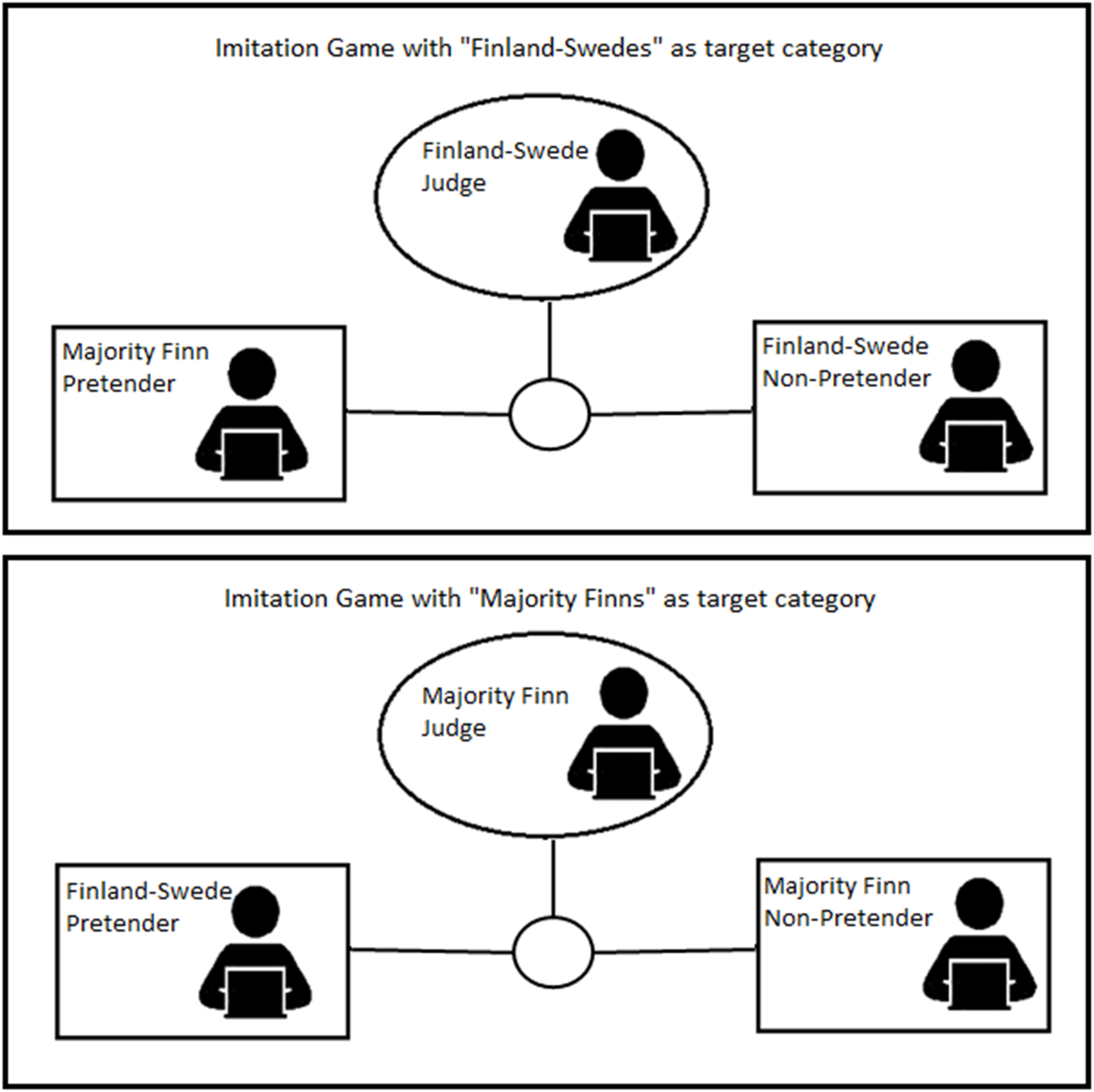
Allocation of roles.
The IG goes beyond both audial and visual markers of identity (such as skin color, accent, and dress) to examine how participants exhibit and evaluate membership, drawing on knowledge and skills through typed communication. Through the task of imitation, participants are compelled to demonstrate whether they are competent in a culture, opening up people's ability to alternate between cultures according to the situation, rather than whether they live in alignment or identify with that culture. Furthermore, participants can ask about anything they think will reveal the identity of the respondents and evaluate the answers according to their own criteria, meaning that the IG not only tests the respondents’ cultural competence according to the criteria established by the group members themselves, but it also opens up how participants evaluate competence and recognize group memberships (Segersven et al., 2020). While the IG has been developed as a method for both qualitative and quantitative research on a number of different topics during the last decade (see Evans et al., 2019a, for a review), one of the remaining challenges has been to engage the method with theories about the nature of social groups, culture, and identity (Collins et al., 2019). This paper's methodological goal is to overcome this challenge.
Determining acculturation profile with identification accuracy
The IG allows for investigating acculturation based on how, and how accurately, participants can draw boundaries, that is, distinguish between group members and pretending non-members. Based on previous research (Arminen and Simonen, 2015; Arminen et al., 2019; Collins and Evans, 2014; Segersven et al., 2020), it is known that accurate judging (i.e. a group's ability to correctly draw boundaries on the basis of a series of questions) requires: (a) a uniform culture shared among members of the target group, and (b) that the culture is unknown to the pretending group. Simply put, members of the target group need to have something in common that is unavailable to Pretenders. The former requirement is related to groupness (Brubaker, 2004); where a group is socially active among members, the more cultural commonalities they have at their disposal to make relevant questions and to evaluate the competence of the respondents. When a group is “latent” (Arminen et al., 2019) or “minimal” (Tajfel et al., 1971), they have very little or no shared competences to gauge and evaluate group membership. The latter requirement relates to social participation; the more members of the pretending group have access and participate in the social world of the target group, the more they will be competent in that culture, making it a greater challenge to distinguish them from target group members (Collins and Evans, 2014).
According to these premises, the IG can be used to measure the two variables that determine the acculturation profile of minority groups. The greater the cultural maintenance among members of the minority, the more accurately they can distinguish group members from pretending majority members. The greater the degree of social contact they have with the majority, the more successful they will be at imitating members of the majority, resulting in low accuracy among majority Judges. I summarize the two variables that posit four possible acculturation profiles as follows.
In Table 1, integration means that members of the minority have maintained a distinct culture, along with full immersion in the mainstream society, to gain bicultural competence. In the IG, bicultural competences allow the minority to accurately differentiate group members from the majority Pretenders as well as provide competent answers when imitating the majority, so that the majority Judges are unable to tell Non-Pretenders and Pretenders apart. Segregation occurs when both the minority and majority maintain distinct cultural ways, with limited contact across ethnic boundaries. In the IG, segregation is observed when both groups can distinguish between members and pretenders. Marginalization involves a lack of shared culture among members of the minority, along with social exclusion from the majority. In the IG, a marginalized group is neither able to distinguish between members and pretenders nor “pass” as a member of the majority. Assimilation is observed when neither group is able to identify the respondents due to an absence of difference between the groups. This can be due to classical assimilation, defined as the minority replacing their cultural heritage with the dominant culture (Berry, 1997). However, an absence of distinctions can be the outcome of many processes, such as a two-way cultural convergence where the majority adopts features of the minority and vice versa. Further, a lack of distinctions need not be due to homogeneity across the groups but also individual diversity and a lack of groupness among them. As such, the framework captures a broader definition of assimilation defined in neo-assimilation theory as “the attenuation of distinctions based on ethnic origin” (Alba and Nee, 2003: 38).
Acculturation profiles in the Imitation Game.
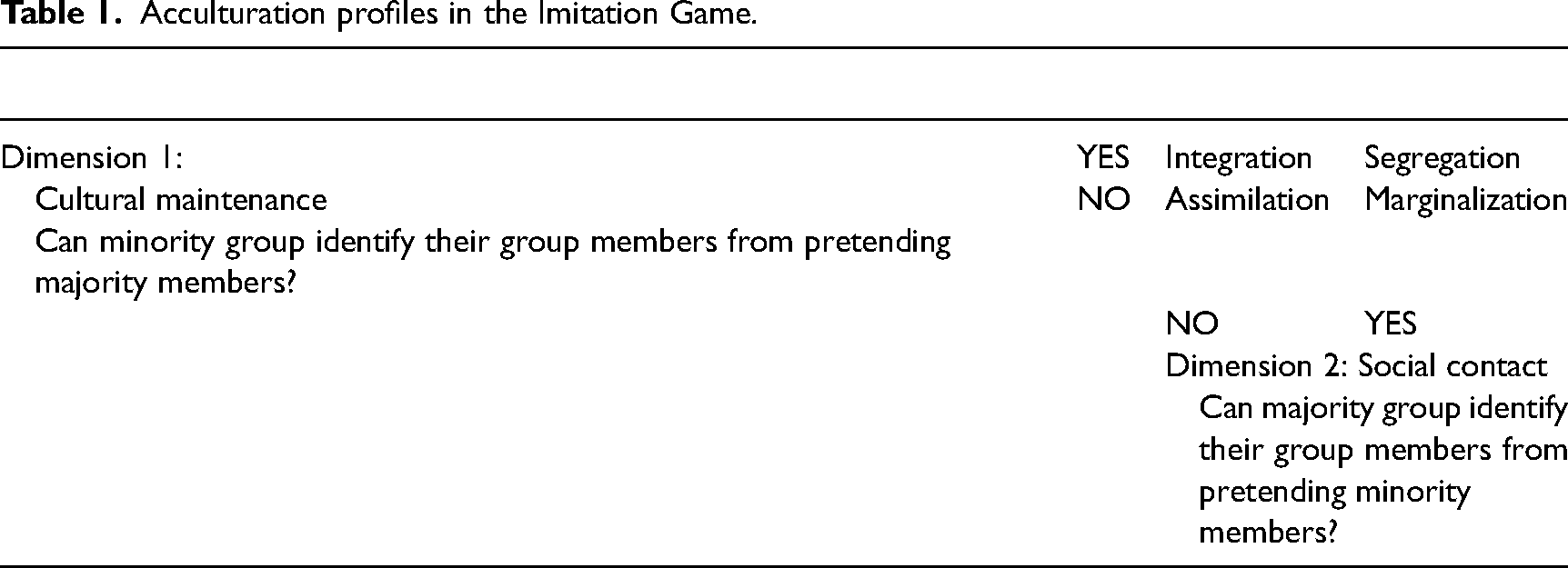
Table 1 posits the two dimensions as dichotomous yes/no variables. It is also possible to treat the identification accuracy as matters of degree, allowing for a more granular description and comparison between scores. In Figure 2, I present the Group Relations Graph, which I use as a map to navigate the quantitative results of the study. I will further explain the graph by using it in practice while presenting the results.
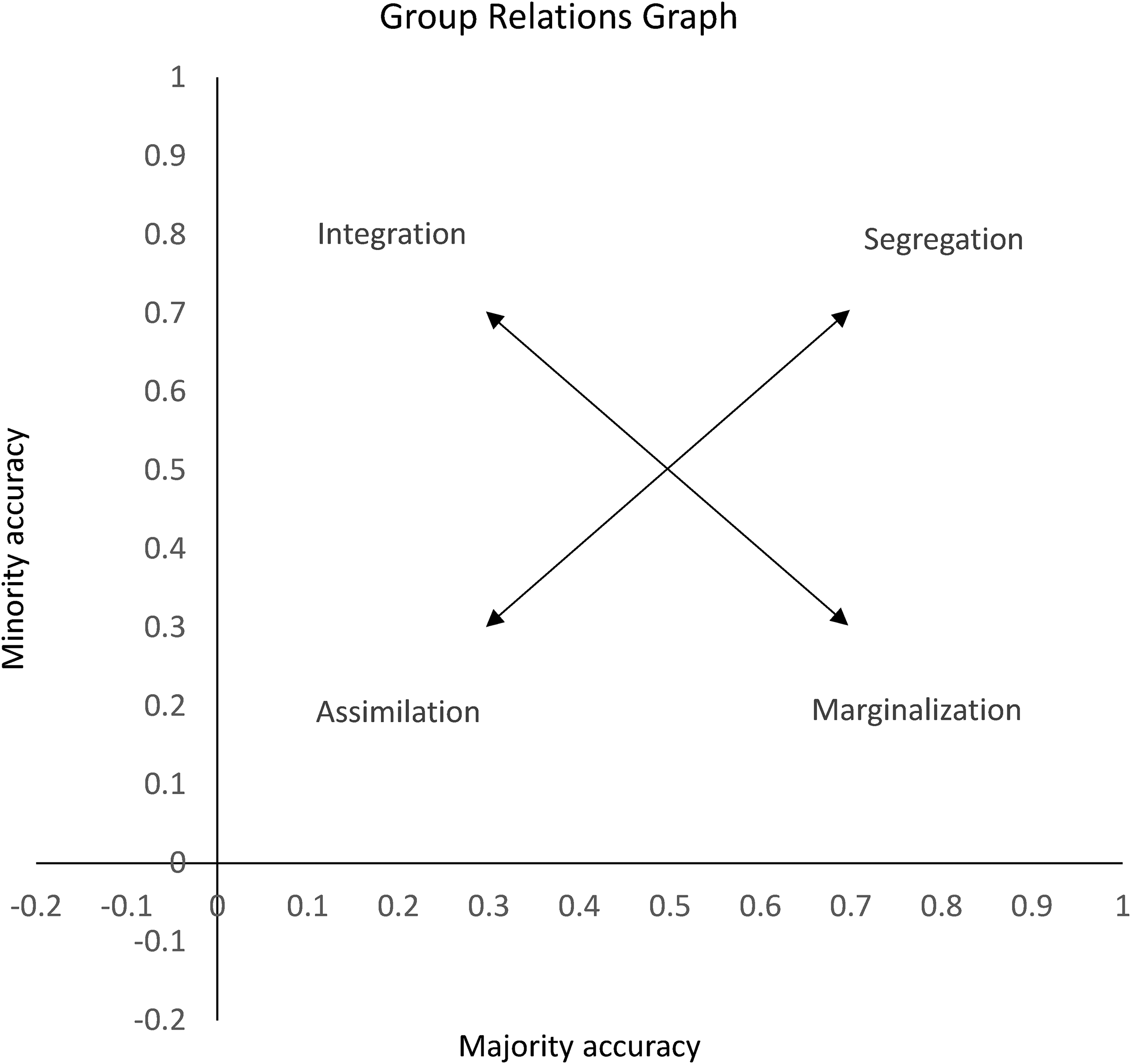
Group relations graph.
Having analyzed the identification accuracies, I then analyze the qualitative data (questions, answers, assessments), which informs us about the type of competences participants employ in their evaluation process (Segersven et al., 2020). I will also link the qualitative analysis with the identification accuracies, allowing us to explore the acculturation profile of the minority with domain specificity. Before turning to the analysis, I present the case considered.
Swedish in Finland
About 5% of the population in Finland speak Swedish as their mother tongue (Official Statistics Finland, 2021). Although formally a language minority, Finland-Swedes exhibit the four criteria of an ethnic group posited by Allardt and Starck (1981): self-identification, common ancestry, distinct culture, and a social organization of interaction among members and non-members.
Finland-Swedes and majority Finns have a shared history and genesis. Finland and Sweden were ruled by the Swedish crown for about 700 years, during which Swedish was the language among the ruling class—albeit not exclusively. After the Russian Empire annexed Finland in 1809, Swedish remained the main administrative language until Finnish independence: in 1917, it was constitutionally declared that Finland has two national languages, Finnish and Swedish. Since then, Swedish has enjoyed the same constitutional status as Finnish, which means that the state must meet the social and cultural needs of both Finnish- and Swedish-speakers on equal grounds. The most important institutional arrangement of this policy is the parallel public school system, with either Finnish or Swedish as the main language of instruction (Allardt and Starck, 1981).
Finland-Swedes are known for their abundant social capital (Hyyppä and Mäki, 2001); about 70% of the Finland-Swedish vote goes to the Swedish People's party of Finland (Kepsu and Majander, 2021); they enjoy a wealthy network of funds and associations that support culture and research in and about Swedish in Finland (Saaristo, 2020); and they have a rich Swedish-language media landscape (Moring and Husband, 2007). The state and private institutions, political organization, and cultural funds and associations constitute an institutional network that is unique in its fullness for such a small minority.
Nonetheless, Finland-Swedes are assimilating in many ways. Their population has diminished in relative size from 12.9% of the total population in 1900 to 5.2% today (Official Statistics Finland, 2021). They participate in the mainstream economy with no enclave economy to speak of; they live spread out along the coast, and apart from a few regional concentrations, most Finland-Swedes live in regions where Finnish is the dominant language (Allardt and Starck, 1981). Marriages across the language boundary are common and today almost half of those who are under 18 were born in bilingual families (Saarela, 2021). Today the population has stabilized, as an increasing number of parents from mixed households register their children as Swedish-speakers and place them in Swedish-speaking schools. In fact, the continued existence of Swedish in Finland now hangs in the balance of a growing bilingual population (Tandefelt and Finnäs, 2007).
The participants in this study reside in the Helsinki region, where 5.3% are registered as Swedish- and 78% as Finnish-speakers (Greater Helsinki Open Statistical Databases, 2021). Finland-Swedes in Helsinki are a strong candidate for finding lasting biculturalism. Although the language situation is in constant flux, bilingualism seems to endure as an integral facet of Finland-Swedish life in Helsinki. Finland-Swedes have strong institutional support for maintaining a distinct culture, and they are immersed regionally, economically, and socially in Finnish-speaking society. Importantly, however, Finland-Swedes are known as a particularly heterogeneous group (Liebkind et al., 2007), and whether there is a homogeneous majority Finnish culture to gain fluency in can also not be assumed. In fact, due to the proximity between and diversity within the groups, scholars have questioned whether Finland-Swedes and majority Finns from otherwise similar backgrounds differ culturally in any way except for language (Allardt and Starck, 1981). The objective of this study is to answer this question in a novel way.
Recruitment, data, and analysis
The IG experiments were organized at the University of Helsinki in 2018. There were 40 participants in total, half of whom identified as “Finland-Swedes” and the other half as “majority Finns.” I recruited the participants through social media platforms, local newspapers, university email, and personal contacts. The samples have similar socioeconomic backgrounds: about half are students and the rest are employed with a higher-education degree. Most resided in the metropolitan area during the time of the experiment. Because the language of the experiment was Finnish, the sample excludes monolingual Swedish-speakers. Together these factors shaped the cohorts to represent specific segments of the population: mostly highly educated majority Finns and bilingual Finland-Swedes living in the metropolitan area. 3
The IG generates qualitative and quantitative data. The qualitative data includes written “sequences”: the Judge's question, the Pretender's and Non-pretender's answers, and the Judge's assessment. The quantitative data include information on whom the Judge identified as a Pretender and whether the identification was correct, as well as the Judge's confidence (ranging from 1 = “I am pretty unsure” to 4 = “I am pretty sure”). Data from two players were lost due to technical problems. The remaining data includes 38 games with a total of 172 question-answer evaluation sequences (79 by Finland-Swedes and 93 by majority Finns) and 38 final assessments.
The mixed methods analysis proceeds in four phases. First, I attend to the quantitative data and measure how accurately each group identified the respondents. Here, I determine the acculturation profile of the minority using the Group Relations Graph. Second, I examine the qualitative data and explore how the participants identified the respondents. Third, I analyze if there are differences in accuracy depending on how they identified the respondents, in order to explore their acculturation with domain specificity. Lastly, I analyze qualitatively the case-specific context and circumstances underlying the participants’ ability to evaluate and exhibit group membership.
Identification ratios: assimilation
To find out how accurately each group identified the respondents, I use the Identification Ratio (IR), which measures the accuracy of final assessments (Collins and Evans, 2014). I derive the IR by first coding all the assessments in which Judges gave a confidence rating of 1 (“I am pretty unsure”) as “Undecided.”
4
Then, the number of excess right assessments (right assessments minus wrong assessments) is divided by the total number of assessments (right + wrong + undecided), giving a value between zero and one. A value of one means that each Judge identified the respondents correctly. Zero indicates that the number of correct and incorrect guesses is equal, meaning that collectively the Judges’ assessments were no more accurate than random chance. Anything below zero reflects an odd game, where the Judges identified the imitating non-members more often as members than their target group members. The expectation is that bicultural competence among Finland-Swedes will allow them to pass as fluent members of the majority, as well as accurately identify group members from majority Pretenders. More specifically, bicultural competence is observable in the IG as an IR:
No different from zero among majority Finns Significantly higher than zero among Finland-Swedes
Table 2 lists the number and percentage of correct, incorrect, and undecided final and sequential assessments, as well as the IRs. The IRs show that the Finland-Swedes’ accuracy was equal to zero, and although the majority Finns were slightly more accurate, their accuracy was also minimal. A one-sample t-test, comparing the IRs with chance conditions (IR=0), shows that neither IR differs significantly from zero.
5
The results show that while Finland-Swedes were able to “pass” as competent members of the majority, they were unable to recognize their group members from pretending majority Finns.
Accuracy in identifying group members.
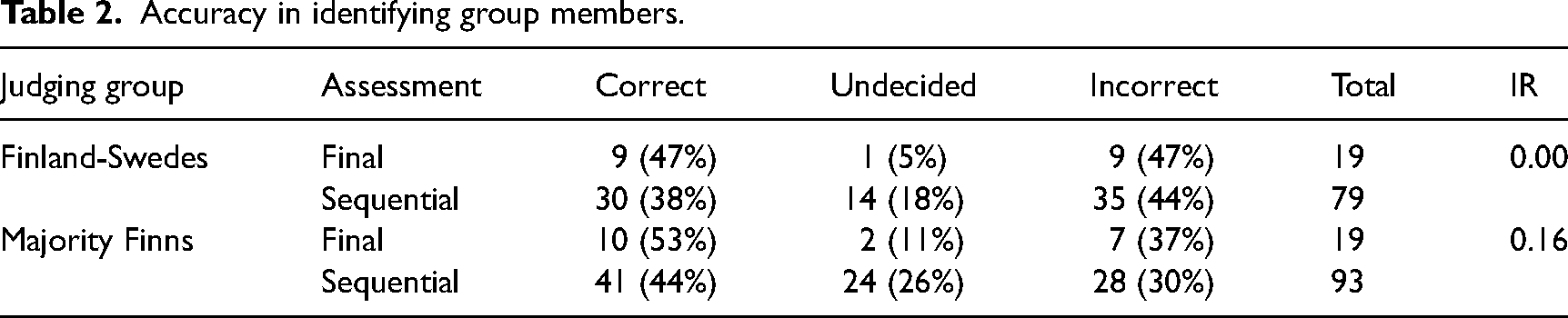
The IRs indicate that the Finland-Swedes lack bicultural competence, which should enable the minority to not only provide competent answers while imitating members of the majority but also accurately distinguish between their members and non-fluent majority Pretenders. While it was expected that bilingual Finland-Swedes, due to their life-long immersion in the mainstream, could provide competent answers and “pass” as members of the majority, it is less clear how majority Finns, many of whom have little or no contact with Finland-Swedes, could pass as fluent Finland-Swedes. To open up these results further, I place them in the Group Relations Graph. The dot in Figure 3 represents the IRs. The coordinate is determined by the minority IR on the vertical axis and the majority IR on the horizontal axis. As we can see, the dot is located in the southwestern corner of the graph, indicating assimilation (see Figure 2 for reference).
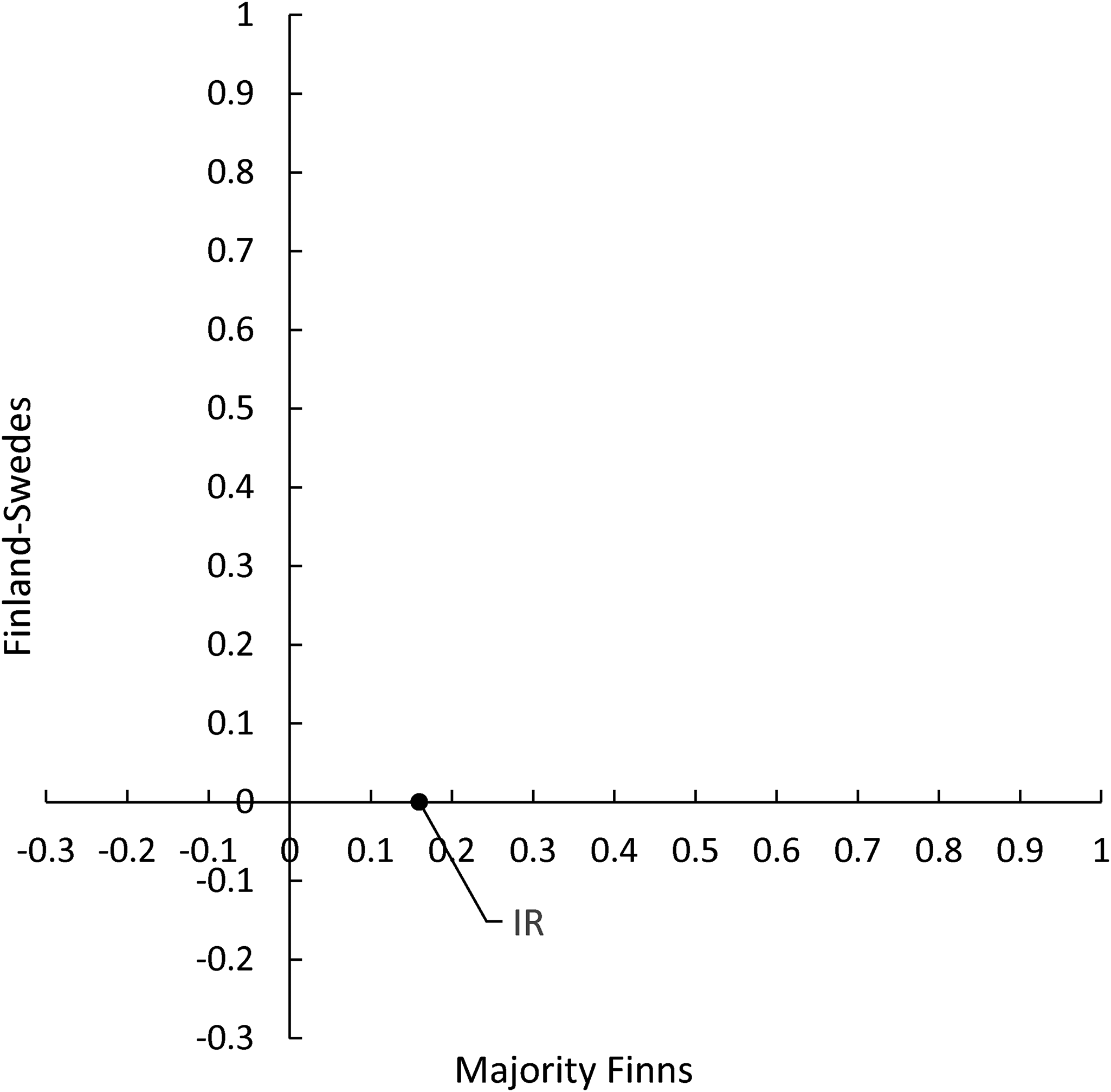
Identification ratios on group relations graph.
While the IR provides evidence of assimilation, it can occur in many ways, and the scores can conceal important domain-specific differences. To explore further, I attend to how Judges identified the respondents.
Distribution of identification strategies: similar perceptions of cultural difference
To analyze the participants’ identification practices, I draw on previous research (Segersven et al., 2020), according to which people use four distinct strategies to identify the respondents in the IG (Table 3).
Types of identification strategies.
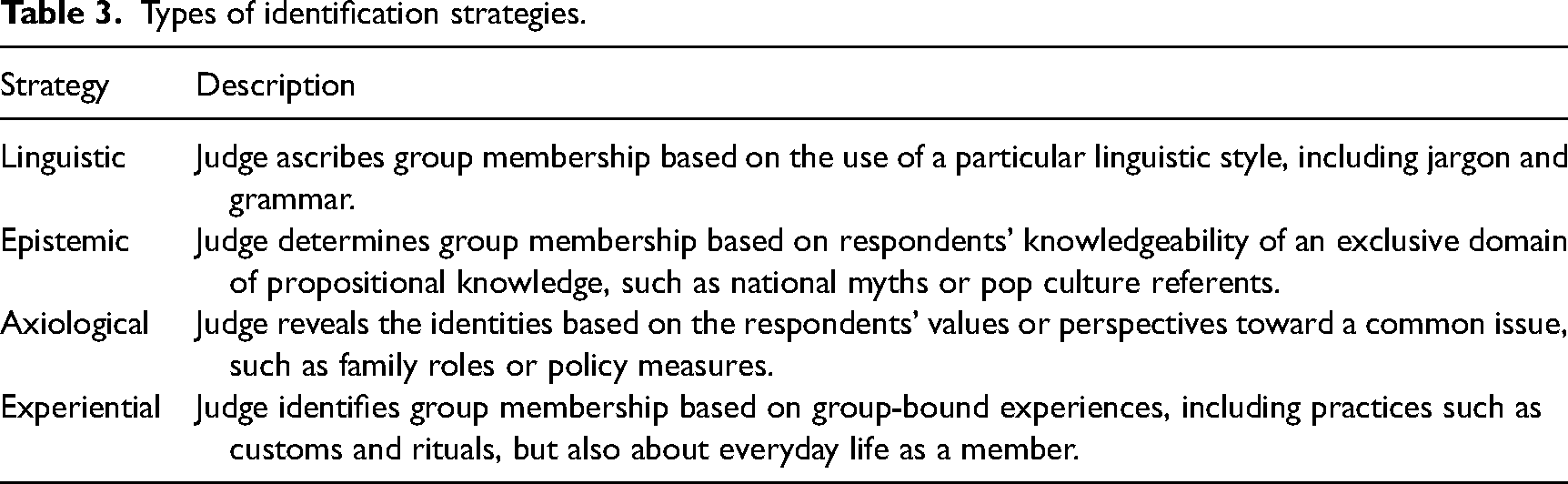
The identification strategies evolved from EMCA (Atkinson and Heritage, 1984) of IG data, which means that each strategy captures the participants’ own orientation towards the interaction as methods for assessing the identity of the respondents and constructing the group (Arminen and Simonen, 2015; Arminen et al., 2019). I have tabulated each question-answer assessment sequence as a case of linguistic, epistemic, axiological, or experiential identification, outlining the distribution of identification strategies, which opens up in what ways participants perceive themselves to be internally similar to and externally different from the other group, providing an initial glimpse into the sociocultural foundation of the groups. 6 Table 4 displays the amount and percentage of use of each strategy per group.
Distribution of identification strategies.

The results show a similar distribution of identification strategies. Both groups employed experiential identification in over half of the sequences, and the rest (linguistic, epistemic, and axiological) were sparsely used, with between 8% and 15% each. The frequent use of experiential identification in relation to the other strategies indicates that both Finland-Swedes and majority Finns perceive group differences primarily in terms of experiences. The similar distribution indicates that both groups understand and assess ethno-cultural differences in similar terms, perhaps reflecting further evidence of similarity between the groups.
The distribution of identification strategies primarily sheds light on perceived cultural commonality and difference. That is, the distribution does not tell us whether the strategies were accurate, which would reveal a gap in cultural competences between the groups, or inaccurate, which would expose a lack of distinctions. To examine whether the perceived differences correspond with actual differences in cultural competences between the groups, I measure the accuracy of each strategy.
Accuracy of identification strategies: domain-specific acculturation
I have linked each strategy with their corresponding shares of correct, incorrect, and undecided outcomes and derived the Sequential Identification Ratio (SIR) of each. The SIR is derived in the same way as the IR, the only difference being that it measures the accuracy of individual question-answer assessment sequences rather than final assessments (Segersven et al. 2020). Table 5 summarizes the accuracy of each strategy per group.
Accuracy of identification strategies.

The total SIR are similar to the IR (Table 2). Both groups score close to zero and the minority has a lower total SIR than the majority. Axiological and experiential identification were most inaccurate in both groups, yet more so among the Finland-Swedish cohort, who had the puzzling minus SIR. The most striking result is that, in spite of the lack of distinctions evidenced by the low IR and total SIR, both groups can distinguish between members and Pretenders with similar and relatively high accuracy using linguistic and epistemic identification. The accuracy of linguistic identification is not surprising, given the fact that language is the primary marker of cultural difference between the groups. Although these strategies have a low impact on the total SIR due to their relatively rare use, they reveal domains of internal commonality and external exclusivity otherwise hidden in the total scores. To connect these results with acculturation, I locate them on the Group Relations Graph.
The graph (Figure 4) displays two contrasting coordinates: experiential and axiological identification are clustered in the south-west, close to or below zero. In relation to these, linguistic and epistemic are located to the north-east. The results suggest that the acculturation between the groups is domain-specific, being divided into an assimilated experiential and axiological domain and a relatively segregated linguistic and epistemic domain. In total, the findings reveal a dynamic process of multiple concurrent acculturation paths. However, as the analysis disaggregates, the numbers become too few for statistical testing and the quantitative findings alone should be read with caution. To elaborate on the results further, I proceed to the qualitative phase of the analysis and observe how participants’ identification strategies manifest in practice.
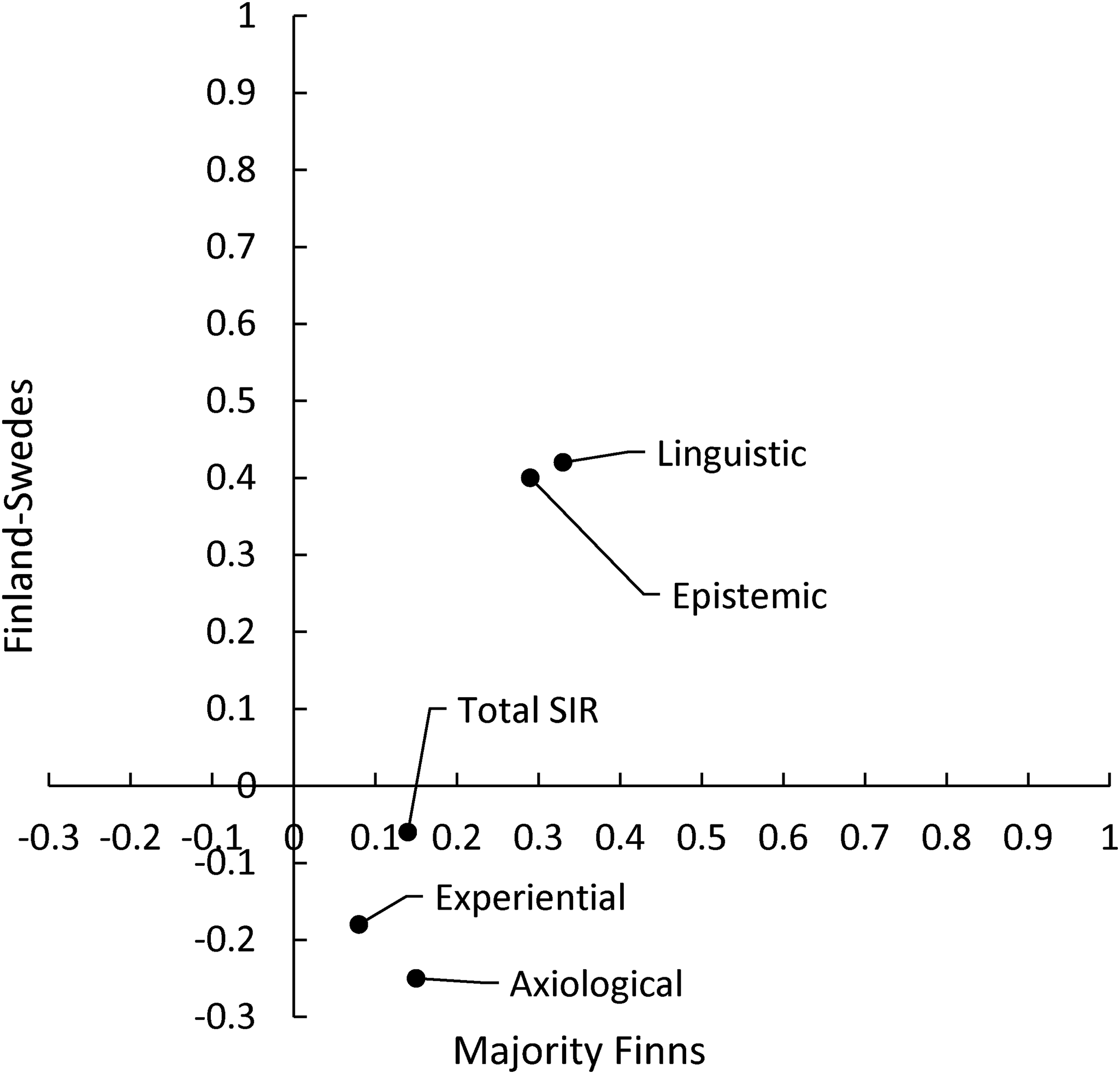
Identification strategies on group relations graph.
Diversity, stereotyping, and ethnic enclave institutions
Accurate identification requires that members of the target group share competences that are unavailable to the pretending group, which in turn signal conditions of cultural maintenance and social enclosure among members. In what follows, I will present three sequences and focus on the absence and fulfilment of these conditions as Finland-Swedes evaluate the identity of their interlocutors. First, an example of experiential identification, in which diversity hinders the identification of the respondents. Then, a sequence of axiological identification, where stereotyping impedes membership identification. Last, I attend to epistemic identification and show how an ethnic enclave institution forms the necessary basis for Finland-Swedes to identify group members. By ethnic enclave institution, I refer to institutions that are run by and serve mainly one identifiable minority.
Discrimination and coping strategies: experiential diversity
Experiential diversity is one of the reasons Finland-Swedes were unable to distinguish between members and non-members. This is demonstrated in the first example, where a Finland-Swedish Judge asks the respondents about their experiences of discrimination when speaking Swedish in public. I present the answers as they are seen in the game by the Judge (i.e. without revealing who is the Pretender and who is the Non-Pretender). For the readers interested in the identity of the respondents, I suggest first having a go at identifying the respondents, reflecting on their own membership and competence in relation to the categories, and considering how this may affect their task. After that, they can look for the actual identity in the endnotes. 7
Example 1. Finland-Swede Judge. Uid: 14034
you feel self-aware if you speak Swedish in public transportation, for example? still criticized and harassed. Typically I avoid speaking Swedish in public spaces. speaking Swedish. I do not really feel self-aware when speaking Swedish in a public space. This is probably because I live and move primarily in the metropolitan area and I feel that here there is no problem speaking Swedish or any other language. slightly exaggerates the problem. I myself behave more like response 2, although I have also gotten “In Finland you speak Finnish” type of comments. I experience my position to be so safe that they don’t scare me.
Respondent 1 states that they have not really been threatened, but they affirm having been reproached and bullied, and they typically avoid “coming out” in public spaces (lines 4–6). In contrast, Respondent 2 has not been threatened and has not really had problems, or they really feel self-conscious when speaking Swedish, specifying that it might be because people in the metropolitan area are more tolerant than elsewhere (lines 7–11). In spite of the contrast, the Judge states that both answers could be correct (line 12), which indicates that both respondents provided the credible answers of an experienced group member. The sequence exposes foremost how identifying the respondents is challenged by experiential diversity, manifested as a wide range of possible correct answers. Indeed, reports indicate that although discrimination is a common experience among Finland-Swedes, there are considerable differences in the experiences and coping strategies between individuals (Herberts and Suominen, 2019).
Previous research has also noted that making personal questions is a poor strategy, especially when the target group is heterogeneous (Evans et al., 2019b). Eventually the Judge deems Respondent 1 as a Pretender for exaggerating (lines 12–13), and aligns more with the behavior of Respondent 2 (lines 13–15). The Judge thus concludes their identification by considering how, rather than whether, they live under potential discrimination. Yet again, considering the individual variety not only in whether but also in how Finland-Swedes cope with discrimination (Herberts and Suominen, 2019), the accuracy of the assessment is equally subject to experiential diversity among them.
Enforced Swedish: axiological stereotyping
Stereotypes were commonly used in each role by participants from both groups. Usually, Judges assessed a stereotypical answer as the mark of a Pretender. The following example shows how Judges also use stereotypes as signs of a Non-Pretender. The Judge asks the respondents about their views on Pakkoruotsi (enforced Swedish). Enforced Swedish is a charged political term for the educational policy in Finland under which all school children have to learn a second domestic language. For Finland-Swedes, it entails learning Finnish and for majority Finns, Swedish.
Example 2: Finland-Swede Judge. Uid:14028
languages more easily—for example, pronunciation is easier. like the others. On the other hand I can understand if you get an “enforced” feeling from it. But where does the experience of being forced upon stem from? Do majority Finns still feel that Finland-Swedes are in a stronger position of power still today? We must think critically about where the token “enforced Swedish” comes from. Does the use of the word signal that there are undealt with issues in our common past? Do we ever get to that point where everyone would think it is useful to study Swedish in school simply because of the reason that in school it is good to learn new things? Is this even desirable? Or is Finland becoming even more multilingual, by which the position of Swedish as a subject changes? I have more questions than Answers. feel that the person I presume is Finnish-speaking is more critical and considers different perspectives, whereas the person I assume to be a Finland-Swede relates (according to stereotypes) positively to the matter. The one I assume to be a Finn uses words such as “stems,” and the language is rich, so that's why I believe him/her to be a Finn. Yet s/he is also cryptic and does not give a direct answer to the question, but speculates on different perspectives, so I still need to have more information for my evaluation.
Respondent 1 takes a unilaterally positive stance towards the issue. Respondent 2 gives a more critical and reflective account. In the assessment, the Judge makes a dual axiological identification of Respondent 1 as a Finland-Swede and Respondent 2 as a member of the majority. First, the Judge expresses overall misalignment with the historical reflection and granularity of Respondent 2's account and considers the critical and reflective stance as signs of a Finnish-speaker (lines 17–19). Second, the positive stance expressed by Respondent 1 fits with the Judge's view of a stereotypical Finland-Swede (lines 19–21). The Judge supports the axiological assessment with linguistic identification; the sophisticated Finnish language use of Respondent 2 reveals them as a majority Finn (lines 21–22). I coded the sequence as axiological identification, which forms the main criterion in the Judge's choice (see endnote 6).
Here, the Judge recognized the positive stance elaborated by Respondent 1 as a stereotype, yet deemed it as given by a Finland-Swede rather than by a Pretender. Thus not only can stereotypical beliefs be assessed as a prejudicial response of a pretender but as a genuine account of a typical member of one's group. In addition, by recognizing a Finland-Swede on the basis of a stereotype rather than personal alignment, the Judge constructs an internal rift among Finland-Swedes between stereotypical and non-stereotypical members. Indeed, stereotypes as generalized beliefs about members of a category can be accurate, and IG experiments are likely to include members (Judges and Non-Pretenders) who either represent or deviate from the stereotype. Therefore, not only can Judges choose both ways, but either choice could also be correct or incorrect, as the stereotype is per definition common knowledge likely to be known across the groups, and it is fallible given the relative accuracy of the stereotype in relation to the diversity among Finland-Swedes. Thus, the use of stereotypes for membership identification is a hopeless strategy, and reliance upon them can be seen as evidence of how individuals lack an internally uniform and externally exclusive domain to draw upon.
Taking stereotypes as signs of a group member can also be an indication of internalized stereotyping among Finland-Swedes, that is, of seeing oneself through the perspective of the dominant discourse. Internalized stereotyping can shed light on the negative SIR scores. It is possible that Pretenders are more likely to draw on common stereotypes in their answers than Non-Pretenders, who in their authentic accounts are “tied” to their own biographies that can deviate from the stereotype. In this case, Judges who have internalized stereotypes as part of their self-understanding end up choosing Pretenders more often as group members than Non-Pretenders. In assimilation literature, stereotyping is known to endure as a way of understanding and maintaining difference in relations where there is an increasing lack of distinctions between groups (Alba, 2014). As such, Finland-Swedes’ and majority Finns’ reliance on stereotypes can also be read as a mark of advanced assimilation between the groups.
Ethnic enclave institution: epistemic segregation
Scholars have questioned whether Finland-Swedes and majority Finns differ culturally in any way except for language (Allardt and Starck, 1981). The IR and total SIR (Tables 2 and 4) support this, showing that neither group was able to identify the respondents with significant accuracy, indicating an absence of difference along ethnic lines. However, the total scores overshadow the relative accuracy of epistemic and linguistic identification. As has been noted, accurate identification requires that members of the target group have something in common that is unknown to the pretending group, which in turn indicates cultural maintenance and social enclosure among the target group. The following example shows how an ethnic enclave institution provides such conditions.
Example 3: Finland-Swede Judge. Uid 14032
Stadium?
8
among children and the young, in my understanding even at a time before people woke up to the question of a lack of exercise among children and the young and, for example, obesity. The event has increased a sense of unity. My own school did not participate at the time, so I have experienced this tradition only as an adult through my children. I myself am not so excited about the event, and I do not see that it would have all the benefits that are usually connected with it. And she also thought that Finnish-Swedish Heritage Day is in spring. OMG. LOL.
The Judge asks about an annual school event (lines 1–2), providing limited information, expecting that only insiders will have the necessary background knowledge to know what they refer to. Respondent 1 answers briefly that it is the Finnish-Swedish Heritage Day (line 3). Respondent 2 does not write the name of the event but provides details on its initial purpose and role in the community, and they share their own experiences and opinion towards it (lines 4–11). The Judge makes an epistemic identification by evaluating Respondent 2 as knowing and the other not (line 12). The Judge and Respondent 2 reach an epistemic congruence based on an event known as the Stafett Karnevalen, an annual relay race competition between Swedish-speaking schools. It is usually organized in the Helsinki Olympic Stadium and brings together Finland-Swede schoolchildren across the country as either competitors or spectators. Finnish-Swedish Heritage day, on the other hand, is celebrated in autumn on the 6th of November to commemorate Finland-Swedish culture and bilingualism in Finland. As it is only the Swedish side of the parallel school system that organizes the Stafett Karnevalen, the event not only maintains a shared tradition among members but also represents an exclusive event separate from the majority. The sequence highlights the role of an ethnic enclave institution—in this case, the school—in maintaining a common domain that is not only internally uniform but also externally distinct. Within ethnic enclave institutions, members construct and circulate commonalities that are exclusive to the outside—creating the cultural knowledge gap necessary for accurate boundary maintenance in the IG.
Discussion
Given the widespread bilingualism and institutional strength among Finland-Swedes in Helsinki, this paper posits a pessimistic assessment for the possibility of lasting biculturalism and, by extension, a lasting multicultural society. The findings show that Finland-Swedes and majority Finns are largely assimilated, except for within the context of an ethnic enclave institution. As such, the results support Fishman's (1980) claim that assimilation occurs unless social life is institutionally compartmentalized along ethnic lines. Importantly, their assimilation is characterized by experiential diversity and axiological similarity across the groups. As such, they represent the broader definition of assimilation—the absence of distinctions along ethnic lines (Alba and Nee, 2003)—rather than the classical definition of the minority replacing its heritage with the dominant culture (Berry, 1997).
There are several caveats, however. Potential differences in language proficiency represent a weakness not only in this study but the IG method in general. Although the Finland-Swedes in this study are bilingual, with most coming from a bilingual family background, unlike the majority they have attended school with instruction in the Swedish language, and their Finnish language proficiency is potentially less than that of the majority. Although linguistic identification captures sequences where participants explicitly detect differences in language proficiency, as exemplified in Example 2, making subtle group distinctions through typed communication can require sophisticated language use, putting those with lower written language proficiency at a disadvantage in terms of showing and evaluating cultural fluency in the experimental context. Moreover, cultural competences may be bound to language, making it harder to demonstrate and evaluate cultural competences rooted in one language in another language.
The way this study defined and operationalized biculturalism—the ability to exhibit and evaluate competence in two distinct cultures—is rather “strict,” as it entails two internally uniform and externally distinct cultures shared by members. For instance, “lighter” definitions of biculturalism, including identifying with or orientating towards more than one culture or acculturation strategy (Zane and Mak, 2003), permit more diversity, as people can have a common identity without sharing uniform ways of realizing their identity. In addition, this research has not measured whether groups live by given norms, but whether they are competent (i.e. can understand and reproduce those norms). Furthermore, bilingualism in itself is often taken as an example and measure of bicultural competences. If the participants were free to choose their language, the findings would certainly indicate widespread bicultural competences among the Finland-Swedish cohort. The political philosophy of whether a strict version of multiculturalism is desirable, or referred to in multicultural discourse, is outside the scope of this article, but the empirically informed framework presented here can at least open up a new angle on the multiple meanings of multiculturalism.
Moreover, whilst much of the existing acculturation research is based on the experiences of immigrants and their descendants, Finland-Swedes do not have a recent history of migration from one cultural context to another. Instead, as an ethnic and political entity, Finland-Swedes have emerged and co-evolved together with majority Finns within the same national context. Thus, the question of lasting biculturalism addressed here is not necessarily the persistence of an initial cultural difference but the potential emergence and reproduction of cultural similarity and difference along ethnic and linguistic lines. Furthermore, Finland-Swedes are known for being a heterogeneous group (Liebkind et al., 2007). This brings us to the fact that this is among the first published IG research on ethnic relations, and the question remains whether such heterogeneity (and the findings of this article) is unique to Finland-Swedes or a general feature of lasting ethnic relations in modernity. Only further IG studies can shed light on this important issue.
For such an endeavor, I developed the Group Relations Graph as a tool which enables a comparative and systematic analysis of minorities’ acculturation on the basis of IG data. I purposefully overlaid the graph (Figure 2) with arrows, indicating directions instead of specific thresholds for what coordinates count as which acculturation profile. There are no given parameters regarding when a given coordinate is counted as segregation, for example, but it is clear that the further northeast from any given point (e.g. epistemic and linguistic identification compared to total SIR), the more segregated it is compared to that point. Yet, without further comparative study, it is hard to tell what counts as a “high” or a “low” score. Hopefully, future research, particularly among ethnic groups, will calibrate the tool further. Until then, a blunter instrument for determining the acculturation profile in a standardized way, also used in this article, is the square field (see Table 1), together with statistical measures comparing IRs with zero.
Beyond frame-switching (Hong et al., 2000), code-switching (Auer, 1998) and bilingualism, there is some vagueness in the literature about what bicultural competences actually are. The IG allows for exploring cultural competences from the perspective of members themselves, as they try to exhibit and evaluate the fluency of others. The identification strategies are one way of delineating cultural competences as consisting of four distinct domains that can acculturate dynamically in distinct ways and at different rates. However, the identification strategies are only one way of analyzing participants’ identification practices, and future IG research with alternative analyses can further contribute to our understanding of what cultural competences are.
Footnotes
Funding
The author disclosed receipt of the following financial support for the research, authorship, and/or publication of this article: This work was supported by the Svenska Litteratursällskapet i Finland.
