



Abstract
This article contributes to the knowledge of interest groups’ political power. It examines how interest groups shape political debates and decision-making, and what strategies are most successful to this end, through an in-depth case study analysis of the Norwegian transposition of the revised EU policy on public procurement. The case is unique as it illustrates a policy process that changed direction at the eleventh hour, embodies an ideational fight between different views of a good society, and—surprisingly—concludes in favour of non-profit interests. Based on hearing statements, media items, transcripts from the final parliamentary debate on the matter, and interviews with leaders of interest groups, the article demonstrates that the ability to coordinate action and frame and control the public and political debate was a vital power resource for non-profit interests, who did so using a broad range of both direct and indirect strategies. The political ideas advanced through these two strategies were nearly identical; however, the indirect strategy was more personified and strongly emphasised normative conflict.
Introduction
How do organised interests act when their raison d’être is suddenly threatened by what they consider inadequate legal competence and an absence of political will among national decision-makers to serve fundamental societal values?
In 2016, the Norwegian right-wing minority government presented a bill on public procurement (Prop.51 L [2015–2016]), advocating a pure liberal market approach and ignoring the former preferential treatment of non-profit health and service providers. However, in Parliament, the final decision was far more friendly towards the non-profit sector than anticipated. It allowed market-correcting initiatives and embraced the EU directive's full potential for promoting non-profit service provision. This case illustrates an unusual policy process in which the efforts of interest groups resulted in last-minute policy changes. Moreover, it embodies an ideational fight between different views of what it means to be a ‘good’ society. Compared to similar legal transposition processes in other countries, the Norwegian case stands out regarding its intense debate and policymaking process and strong mobilisation of non-profit interest groups (Segaard et al., 2020).
Several approaches may be used to understand this case, but political ideas and political actors’ way of communicating played a clear role in its outcome. Even if the study of political ideas is well-established, the concept is—nevertheless—multilateral. Therefore, the process through which ideas impact policymaking may be challenging to seize (Campbell, 2002). Following Campbell (2002), this article overcomes these challenges by focusing on the actors—welfare providers and their political allies—who actively interacted in the process. In particular, the study investigates the interplay between the ideas and strategies used by identifiable actors in a concrete case of policymaking. It narrows the focus and treats interest groups as strategic actors that aim to perform in accordance with their interests within the limitations of bounded rationality defined by the institutional context, accessible resources and the actions of other organisations (Binderkrantz and Krøyer, 2012; Campbell, 2002; Klüver et al., 2015; Pedersen et al., 2014). The self-interests may interplay with and be framed by actors’ political ideas—programmatic and normative claims—and communicated to policymakers through different direct and indirect strategies (Alaja and Sorsa, 2020; Binderkrantz, 2005; Campbell, 2002; Klüver et al., 2015; Schmidt, 2002). So far, we know little about whether interest groups tend to use the same ideas and frames in different communication modes.
In this way, the article speaks to two major topics in the research field (Campbell, 2002): the interplay between ideas and strategies and the significance of actors as causal mechanisms between ideas and political outcomes. These lead to the following research questions: 1) Are ideas framed differently, depending on whether political decision-makers are addressed directly or indirectly? 2) To what extent are the framing efforts of interest groups reflected in the overall policy debate?
These research questions are answered by an in-depth case study of the Norwegian transposition of the revised EU policy on public procurement 1 with a particular focus on the actors representing the interests of health and social service providers. Based on analyses of a rich amount of data—hearing statements, media items covering the process and interviews with leaders of interest groups—the article identifies the strategies used by the interest organisations. It explains ‘the intention, the reasoning capabilities, and the information-processing procedures of the actors’ (Gerring, 2007: 45). Also, analysing these data clarifies political ideas and how these are framed differently depending on strategy and channel of influence. Data on the final parliamentary debate on this issue is used in the discussion section to demonstrate whether the political ideas of the interest groups, as they are framed in the hearing statements and through the media, are reflected in the final political debate and decision. The article thus addresses a stated research gap by linking micro- and macro-level framing: ‘What is still missing is an analysis that links the framing efforts of interest groups to the macro-level of policy debate’ (De Bruycker, 2017: 780). Furthermore, the article contributes to knowledge of how framing and strategically using political ideas and arguments may be an important power resource (Carstensen and Schmidt, 2016; Klüver et al., 2015). Indeed, the study shows how influence on policy processes may occur through legislative and media channels and their interplay.
Framework: Strategies and political ideas of interest groups
Previous research on interest organisations’ involvement in legislative processes has identified several possible access points and channels at both formal and informal levels (e.g. Binderkrantz, 2005; Binderkrantz et al., 2015; Pedersen et al., 2014). These access points and channels constitute the institutional arrangements that serve as reference points for the organisations’ decisions on strategy. Two main types of strategy are conceptualised in the literature (Binderkrantz, 2005):
Direct strategies, which address public decision-makers at the political or administrative level. These include parliamentary, cabinet and administrative strategies. Direct strategies are directed at coordinative arenas, which are institutionalised either through formal procedures, such as consultative hearings, or through more informal methods, such as meetings with politicians, party organisations or civic servants in the central administration. Indirect strategies, which aim to get the attention of policymakers by means that address the media or the general public—media strategy and mobilisation strategy, respectively.
Previous research has shed light on such strategies of influence and documented that, for example, the numbers of members, staff, contacts, meetings, committee seats as well as responses to consultations and media activities are crucial resources for interest organisations to succeed (e.g. Binderkrantz et al., 2015; Binderkrantz et al., 2016; Rommetvedt, 2005; Vesa et al., 2018). However, the communicative content—political ideas and the framing of these—that the organisations aim to pass on to decision-makers has received relatively less attention in this literature (Starke, 2006). Research has nevertheless shown how interest groups use and strategically frame and select ideas and arguments (De Bruycker, 2017). Consequently, the choice of strategy and channel of influence may be related to the goal (Binderkrantz and Krøyer, 2012) and the arguments of concern for the organisation (Uhre and Rommetvedt, 2019).
In particular, research on framing and political ideas has documented that policymaking processes related to welfare production often provoke a ‘political struggle over ideas’, prompting substantial arguments and disagreement (Béland, 2005: 5, 8–9; Béland, 2007: 23; Hall, 1993; Taylor-Gooby, 2005). In this regard, it is relevant to distinguish between two types of ideas (Alaja and Sorsa, 2020; Campbell, 2002):
Programmatic ideas, such as economically, technically and legally anchored statements, specify concrete policy alternatives and cause-and-effect through ‘precise guidelines about how already-existing institutions and instruments should be used in specific situations’ (Campbell, 2002: 28) with the aim to solve particular policy problems. Normative ideas express more general ideas, norms and values of the good society (Schmidt, 2002: 170) and are about ‘moral and social appropriateness’ as they are related to actors’ principled beliefs and identities (Campbell, 2002: 24).
The study treats these programmatic and normative dimensions of claims-making as potentially linked and argues that such links make the discourse more influential. That is to say, rational programmatic arguments that target a concrete political issue may be framed within a more generalised and normative perspective through connecting ‘a proposal to a positive idea or value that is widely available in the population’ (Chong and Druckman, 2007: 116). Following this, influence in policy processes implies the ability to define the agenda, the problem, and the best solution (Carstensen and Schmidt, 2016). Indeed, that is what framing is about: ‘select some aspects of a perceived reality and make them more salient in a communicating text, in such a way as to promote a particular problem definition, causal interpretation, moral evaluation, and/or treatment recommendation’ (Entman, 1993: 52). Consequently, and because ‘clear policy programs provide powerful weapons in public policy struggles’ (Campbell, 2002: 29), framing and selecting ideas play a significant role in public policy (Klüver et al., 2015). In this regard, programmatic and normative ideas can be used as shortcuts to form opinions (Campbell, 2002), for instance, through controlling ‘the production of meaning and the diffusion of information via the mass media’ (Carstensen and Schmidt, 2016: 326). In particular, the strategic framing of ideas is considered to be ‘used by political entrepreneurs to coordinate individuals around particular interpretations of their problems’ (Chong and Druckman, 2007: 118).
The Norwegian context, the ideational outset and expectations
Defined within the Nordic corporatist model, Norway is characterised by a multi-actor system and long traditions of including interest organisations in political processes through the formal consultative system, informal communicative channels and active lobbyism (Binderkrantz et al., 2015; Christensen, 2017; Rommetvedt, 2005). The influence of interest groups seems to be particularly significant with minority governments, as was the case during the policymaking process in question. With regards to the interests of non-profit and for-profit service providers, they are included in the group of actors with privileged access to the coordinative arenas of ‘routine corporatism’ (Vesa et al., 2018).
The broader context for these interests of welfare providers is that public welfare production in Norway is—still—mainly based on public provision and that public tenders play only a marginal role in the governance of publicly funded health and social services. However, in the last decade, the sector has experienced more competitive pressure in favour of for-profit service providers due to ‘increasing use of market-emulating tools of governance, such as open tenders and short-term contracts’ (Sivesind, 2017: 58). Even so, it should be noted that non-profit providers have, for years, been given preferential treatment through regulations ensuring reserved contracts and a collaboration agreement for publicly funded welfare services (Ministry of Trade, Industry and Fisheries, 2015b). However, at the outset of the EU directives’ implementation, an independent legal report ordered by the government raised questions about the ongoing basis for this preferential treatment (Seiersted, 2014). The conclusion of the report—that preferential treatment was not legally possible—is in line with the observation in the research literature that European financial and economic policy has traditionally been characterised by power over ideas, in that liberal market-friendly ideas dominate across Europe (Carstensen and Schmidt, 2016: 328). This is also the case for public procurement regulation, which is mainly considered a means to converge EU internal open markets stressing economic liberal ideas such as equal treatment and free-market competition (Council of the European Union, 2014). However, such economic ambitions are met by other European considerations that contradict market-friendly ideas. This is particularly the case within the health and social areas due to a widespread acceptance of the principle of subsidiarity and national cultural traditions, which means that nation-states have extensive legal leeway in designing health and social policies (European Union, 2018a, 2018b). The leeway of the EU directives on public procurement implies a possibility to treating non-profit providers differently than for-profit providers.
Consequently, we can expect debates on policymaking within the field of welfare production to be dichotomised between a market-liberal paradigm and a market-sceptical paradigm. This expectation reflects the dialogical nature of policy ideas, which means that ‘each of them exists only in opposition to other policy ideas’ (Béland, 2005: 9; Schmidt, 2002: 171). The Norwegian case indeed shows such a tension between two well-known ideologies in the Nordic welfare policy and political landscape: the market-sceptical ideas stressing active market regulation and the liberal idea of markets stressing free-market competition, no discrimination and no preferential treatment of market actors (Gualmini and Schmidt, 2013). Moreover, this ideological tension reflects one of the historical cleavages in Norwegian politics (Lipset and Rokkan, 1967)—the owner-worker cleavage—which may lead to normative discussions in Parliament and the media, rather than only policy-focused debates.
Research design and data 2
Defined by the timeline for the formal process of implementation of the EU directives into Norwegian legislation, with a primary focus on the period from when the government bill was published to the day the final decision was taken in Parliament (January to June 2016), four sets of complementary data were collected, as presented below:
Hearing statements and presentations of interest groups at the open hearing in the Standing Committee on 14 April 2016. Selected interest groups were invited to participate in an open oral hearing. Each of the 33 participating groups was allocated five minutes of speaking time to present their opinions on the bill laid before the Standing Committee on Business and Industry. The presentations, which were also delivered in written form, are not publicly accessible, but the author received access to them through a formal application to Parliament. Transcripts from the final parliamentary debate held on 9 June 2016. Parliament debated the report of the Standing Committee (Innst 358 L [2015–2016]) and the bill on 9 June 2016. Parliament concluded the formal process without any remarks on 13 June, and the new Norwegian law on public procurement was thus decided.
3
The minutes of the parliamentary debate are available from the webpage of the national Parliament (Stortinget). Media items—the coverage and debate in the national media during the main period of focus. To examine the debate in the media, national printed and online newspapers were retrieved from the Norwegian database Retriever using the search words EU, anskaffelse(r) [procurement(s)] and tjeneste(r) [service(s)]. The database provides access to media items in full text. Forty-one media items (repeated items excluded) were identified from nine offline and five online news media sources (see Table 2 for details). These media cover both issues of general interest and more specialised topics and include news coverage and opinion sections. Semi-structured interviews with leaders and staff of key interest groups. Based on the media items and content analysis of the open hearing in the committee and all 139 consultative statements in the formal process of consultation in 2015
4
, the study identified four key umbrella organisations that had promoted statements and arguments related to welfare production. Semi-structured interviews were conducted with leaders and staff of these organisations on their use of and motivations for different kinds of strategies—direct and indirect—in the policymaking process (Table 1 sums up the main findings). Unfortunately, the key organisation representing for-profit interests (NHO—Norwegian Federation of Service Industries and Retail Trade) did not follow up on several agreements for interviews. As discussed in the article's conclusion, this shortcoming may be related to the specific issue and process in focus: the for-profit interests ‘lost’ and have later modified their view in favour of the non-profit sector. However, information about the strategies and arguments of the for-profit interests is gathered from other sources, such as hearing statements and media items. Consequently, only organisations speaking for non-profit providers’ interests were interviewed: Non-Profit Network, Virke (Enterprise Federation of Norway) and Frivillighet Norge (The Association of NGOs in Norway). Information about the individual informants has been anonymised due to formal rules of privacy and the research code of ethics.
The direct and indirect strategies used by umbrella organisations representing non-profit service providers’ interests: Virke, Non-Profit Network, and Frivillighet Norge.
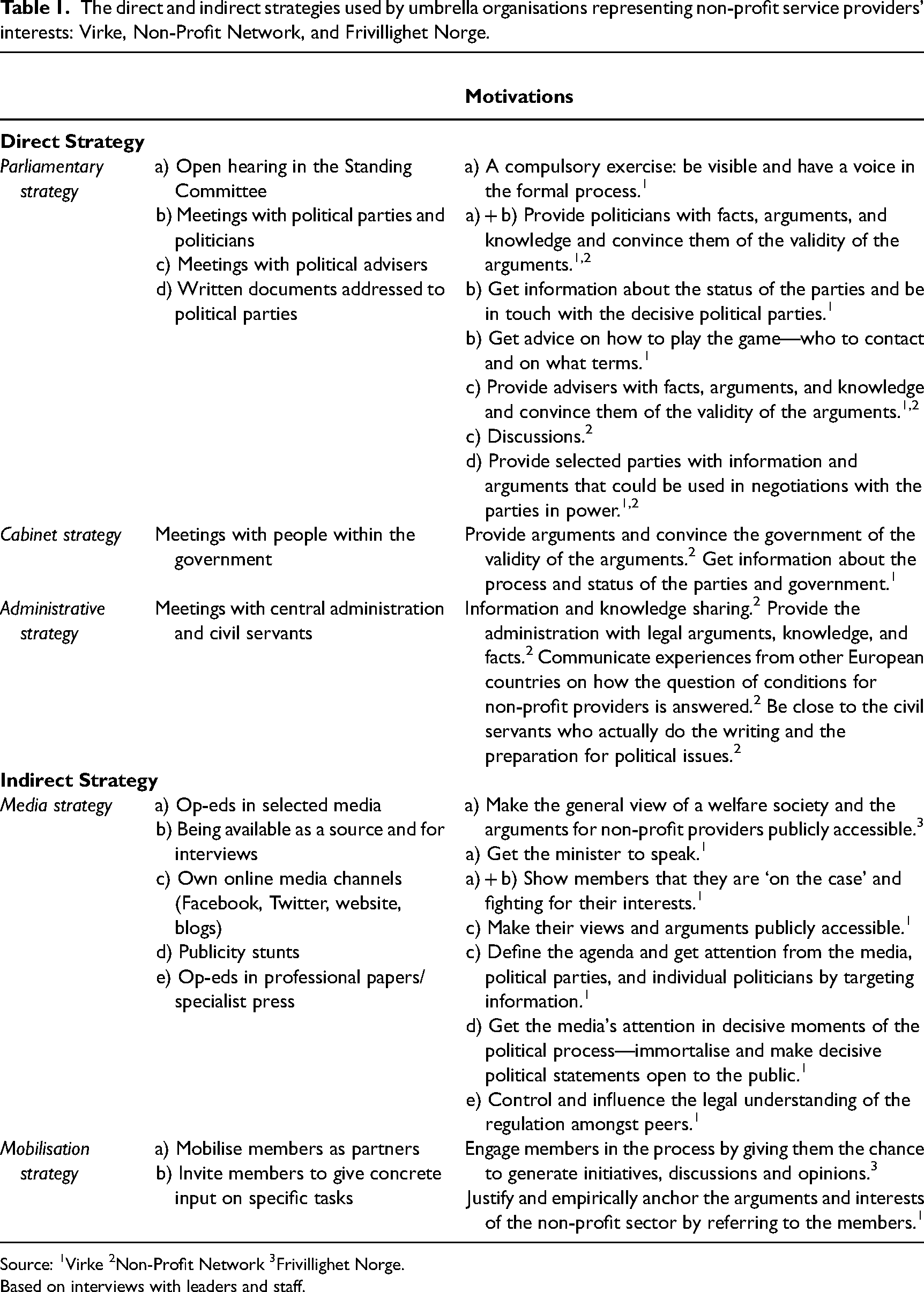
Source: 1Virke 2Non-Profit Network 3Frivillighet Norge.
Based on interviews with leaders and staff.
Together, these data create a unique base for exploring and sampling the political ideas and strategies used by the actors who promoted the interests of health and social service providers in the policymaking process. The study employs an analytic approach to consultative statements, parliamentary debates, and media items using mixed-methods. As a preliminary step (documented in the supplementary material), we used quantitative content analysis to identify the extent to which the political and media debate on the national implementation refers to the health and social sector. Doing this, we also systematically categorised the arguments along a dimension that indicates whether they reflect the market, non-profit sector, or public-sector friendly ideas. In this way, the quantitative content analysis functioned as a basis for identifying items in the consultative statements, the speeches and the media for the qualitative content analysis. The qualitative in-depth content analysis includes items that explicitly refer to the health and social sector and comment on the production of welfare services. The main aim is to cast light on arguments related to interpreting the EU directives when contracting out public health and social services, with special attention on the framing and types of arguments representing either programmatic or normative political ideas.
Based on the theoretical framework described above, we operationalise programmatic ideas as concrete policy initiatives that specify solutions to particular policy problems. In our case, it may be how legal and organisational means can be used to include particular welfare providers in the production of public welfare. Normative political ideas are operationalised as principled beliefs and attitudes that guide actors to ‘decide which policies are the most appropriate’ (Campbell, 2002: 24). For our analysis, such ideas may express a general belief in the added value of the non-profit sector for society or the belief in the free market.
One researcher primarily coded data; however, the coding scheme, doubts of interpretation, and contradictory data were discussed amongst the research team as part of our methodological quality control. Due to the broad competencies of the team—representing different scientific fields, methodological skills, and nationalities—this was a constructive way of handling methodological challenges.
Analysis: Strategies, political ideas and arguments
The following sections take a closer look at the strategies and political ideas of the interest groups of welfare providers in the final period of the policymaking process. Direct and indirect strategies used by umbrella organisations and the motivations behind these strategies are explored, as displayed in Table 1. This analysis is based on interviews with leaders and staff. Furthermore, the political ideas and how the actors frame these through direct and indirect strategies are analysed in-depth. This part is based on the statements and presentations in the open hearing and media coverage, respectively. Lastly, the study discusses how the framing efforts of the interest groups are reflected in the overall policy debate as it appeared in the final parliamentary debate; that is, the link between the micro- and macro-framing.
Direct strategies
Providing information, knowledge, and arguments—particularly those not present in the bill—was a primary intention of all the identified direct strategies (see Table 1). This was the case regardless of whether the specific actions addressed Parliament (parliamentary strategy), the cabinet (cabinet strategy), or the administrative level (administrative strategy) through direct channels such as consultative statements; formal and informal meetings with political parties, advisers, and people in government—particularly ministers; and writing letters to political parties that were involved in negotiations with the government. Informal meetings with politicians and advisers were also motivated by the need to get information about the political game's status, seek advice for further action and contact points, and be close to the decisive political parties.
All the organisations interacted informally with national politicians. Virke, in particular, stated in the research interview that they exerted significant efforts in political networking, which was partly based on the leader's ‘personal acquaintances and former networks’ (Virke-interview). Whereas Non-Profit Network (interview) ‘gave priority to an administrative strategy directed at the central administration and civil servants’. On its own initiative, this actor had prepared a legal judgment on the national leeway for showing consideration for non-profit service providers. The motive was to be close to the civil servants ‘who would actually do the writing and preparation of the political issues; it is their limitations and way of thinking that restrict the opportunities’ (Non-Profit Network-interview). More specifically, the organisation aimed to provide the administration with programmatic legal arguments and knowledge about the practice of public procurement regulations in other European countries. On the one hand, access to parliamentary bodies—the cabinet and the central administration—reflects the privileged status of the organisations in the policymaking process and, on the other hand, the small scale of Norwegian politics and the close ties between the sectors at both the organisational and individual levels.
The open hearing in the Standing Parliamentary Committee on Business and Industry was the only formal arena for the participation of interest groups in the final period. As stated by Virke (interview), they all considered participation as ‘a compulsory exercise for showing engagement and as an important opportunity, as the committee could de facto influence the policymaking process by its report and amendments to the government bill’. Therefore, providing the committee with facts and programmatic arguments not present in the bill was considered necessary if they were to be considered. The arguments and ideas with which this was done are analysed in the next section.
The framing and political ideas of direct strategy—analyses of the open hearing statements
As part of their parliamentary strategy, eight of the organisations 5 that delivered written versions of their oral presentations to the Standing Committee mentioned the theme of welfare production. All of them had a primary focus on the conditions for non-profit service provision. Without exception, they mentioned the normative claim about the social added value of the non-profit sector at the same time as expressing concerns for the future of the sector due to the threat represented by the government bill and the widespread, but, according to them, misleading perception of the EU regulation on public procurement. The overall approach of all eight organisations reflected the market-sceptical paradigm, and they promoted programmatic arguments for public regulation of the free market and preferential treatment for non-profit service providers. The reason was a view of the central administration, the government and the bill as being ‘locked to a market-liberal paradigm’ (Non-Profit Network-interview) and an ‘uncritical’ commitment to the full regulation of public procurement (Virke-interview).
It appears that all the interest organisations used the same template for the selection and communication of political ideas and arguments: At the beginning, they briefly presented a normative claim that stressed the sector's historical significance for the Norwegian welfare society and its contribution to a diverse range of services. The normative argument was then associated with programmatic arguments that supported the understanding of social added value: the sector is inclusive and flexible in its structure; operates on non-commercial terms; and gives priority to values, service quality, and the individual client, as opposed to a focus on profit and money. The programmatic claims were partly documented by research, as demonstrated in Frivillighet Norge's presentation for the committee. It was then claimed, on this occasion, that this added-value contribution was threatened, and the problem was clearly defined as being caused by a lack of understanding of the EU regulations and the non-profit sector's features. Finally, the actors presented solutions to the problem based on several mechanisms that they considered valid within the legal framework. The validation of the suggested mechanisms was anchored in programmatic—mainly legal—arguments that, for example, referred to practices in other countries and the EU: To maintain and strengthen the position of non-profit organisations as partners in the field of health and welfare service therefore presupposes that other models of collaborations, which are accepted by the EU, are implemented in Norway. —In addition to competitive tendering. Among these are:
• Operating agreements within the rules of ‘in-house’ (after the Danish model).
• Non-profit/public collaboration/partnership based on public grant to health and social services of general interest
Non-Profit Network-presentation
The quality of health and social services was a particular concern for several of the consultative actors in the open hearing: To ensure quality of service, these actors stressed programmatic ideas showing how the national government and Parliament, as a legislator, should emphasise the option for public contractors to take into account national, cultural and social conditions and distinctive characteristics when health and social services are at issue (Non-Profit Network, Virke). Programmatic arguments for the national leeway were repeated by several other actors (LHL, LO). In their presentation, the Non-Profit Network asked policymakers ‘to take into account the existence of a wide political and legal scope of action for public procurement of health and social services’, in which competition is arranged so that the societal contribution of non-profit organisations is valued and demanded. Several actors also stated that public authorities, within the scope of the regulation, indeed had broad opportunities to formulate selection criteria that favour non-profit providers (statements by LHL, LO, Virke, RIO).
Furthermore, it was explicitly stated by several of the actors that the regulation should make it possible to reserve health and social contracts to non-profit actors or, in other ways, exclude such contracts from the regulations on public procurement (statements by NUMGE, LHL, Frivillighet Norge, Non-Profit Network). The programmatic arguments related to such an exclusion from the regulation were mainly based on references to practices in other countries, judicial decisions from the Court of Justice of the European Union, and the legal report commissioned by Non-Profit Network. According to the interest organisations, ‘preferential treatment could also be justified by the object clause of the regulation itself’ (Virke-presentation, see also NUMGE, Frivillighet Norge), as promoting non-profit service provision would ‘contribute to the realisation of the overall goals for the public health and social sectors in respect of both the common good and economic efficiency’ (LHL-presentation). With reference to a legal report, Virke, Frivillighet Norge, and Non-Profit Network further recommended developing separate regulations for health and social services procurement. The conditions for contracts exclusively aimed at the non-profit sector were specified.
Indirect strategies
The indirect strategies of the umbrella organisations consisted of media strategies and mobilisation strategies, as displayed in Table 1. As for the media strategy, it was partly directed towards gaining the attention of the general public, member organisations and specific politicians and partly towards defining the political agenda and controlling the perceptions of reality by promoting normative storytelling. Here, online media—Twitter, Facebook, blogs, home pages—controlled by the organisations themselves were considered especially useful. Media strategies also included publishing op-eds, being available as sources, giving interviews, conducting publicity stunts, and using social media.
Overall, the media strategies were anchored with the aim of making programmatic arguments ‘open to the public’ and, in the case of publicity stunts, ‘immortalising political statements and nailing them [political parties] together to the mast’ (Virke-interview). Moreover, and as the media activities were concentrated around key occasions in the process and directed at key actors representing particular interests, the coverage also reflected how media could be used strategically by interest groups and politicians in three ways: as a platform for communicating their political ideas, interests and arguments; as a platform for dialogue with fellow partisans and opponents; and as a platform for agenda setting.
When writing op-eds or being interviewed, the organisations were conscious of ‘selecting appropriate media channels that would reach the members and decisive political parties and their voters and had profiles as advocates for non-profit interests’ (Virke-interview). The specialist legal press was also used by Virke, with the aim of ‘controlling and influencing the legal understanding of the new public procurement regulation amongst peers’. Virke had, during the process, recruited legal experts and improved its internal competence in EU law and public procurement regulations: this was considered important, as the policy implementation was ‘amongst certain political interest groups, considered more as a legal than a political issue’ (Virke-interview).
The media were used to show the drivers of the organisations and thereby contribute to their legitimacy in representing member interests. In addition, the organisations also carried out a mobilisation strategy where the members were invited to participate in a standing member forum for non-profit health and social providers (Frivillighet Norge-interview), to give empirical input to letters directed at political parties and ‘to make phone calls directly to selected MPs to convince them to promote non-profit interests’ (Virke-interview). In all cases, the intention behind the mobilisation strategy was to ‘influence the policymakers by empirically justifying the arguments and ideas that were promoted’ (Virke-interview).
The following section takes a closer look at the political ideas addressed indirectly at the political and administrative level, as these were expressed in the media coverage.
The framing and political ideas of indirect strategy—analyses of the media coverage
Assessing the media coverage through the headlines of the media items illustrates the main political ideas expressed by the involved actors and how the debate was framed normatively and programmatically. Table 2 presents the headlines, sources, and timelines of the media items.
Headlines in national, printed, and online news media addressing the public procurement of welfare services and the timeline of the process, 22.01–13.06.2016. Retrieved from Retriever.
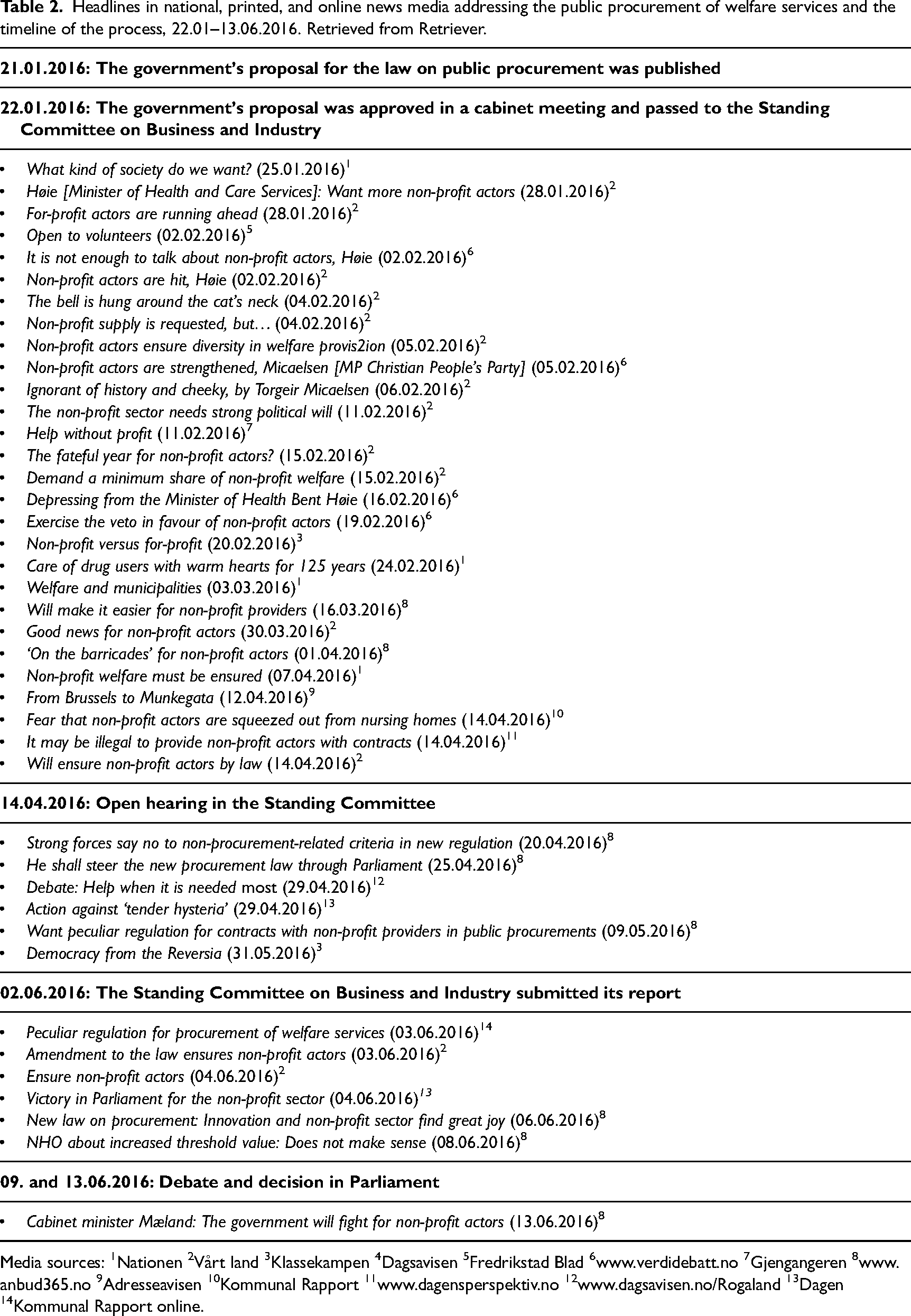
Media sources: 1Nationen 2Vårt land 3Klassekampen 4Dagsavisen 5Fredrikstad Blad 6www.verdidebatt.no 7Gjengangeren 8www.anbud365.no 9Adresseavisen 10Kommunal Rapport 11www.dagensperspektiv.no 12www.dagsavisen.no/Rogaland 13Dagen 14Kommunal Rapport online.
As shown in Table 2, more than half of the headlines include the word ‘non-profit’ and, if not neutrally formulated, expressed a normative bias favouring the non-profit welfare providers in a way that provoked sympathy with the sector. The frames and political ideas of the non-profit interest groups and their political allies indeed dominated the debate. By reading the headlines, it is possible—from a non-profit interest perspective—to identify milestones, problems, suggested solutions, and the process results.
The headlines constitute an almost identical communicative template to that identified in the consultative statements: a normative starting point, ‘What kind of society do we want?’, followed up by programmatic claims about the benefits of the non-profit sector, ‘Non-profit actors ensure diversity in welfare provision.’ However, there is a snake in the grass— ‘For-profit actors are running ahead’ —and the non-profit service sector is being hurt, as indicated, for instance, by the headlines ‘Non-profit actors are hit, Høie’ and ‘Fear that non-profit actors are squeezed out from nursing homes.’
As shown by the headline ‘The fateful year for non-profit actors?’, the non-profit sector's role in public service provision was at a part of ways where the sector needed help to solve its problems: ‘The non-profit sector needs strong political will.’ It is clear—according to the headlines—that the non-profit welfare sector would encounter problems, and for-profit providers would benefit if the government bill were passed.
The main defining feature of the headlines was thus concerned with the challenges facing the non-profit sector. The central problem for non-profit service providers could, according to a headline, be defined as ‘tender hysteria’, and the desired solution was ‘…peculiar regulation for contracts with non-profit providers in public procurements.’ The appeal for help is shown in the headlines addressed directly to named politicians, e.g.: ‘It is not enough to talk about non-profit actors, Høie’. Moreover, the headlines clearly state that some actors were ready to fight for non-profit interests: ‘On the barricades for non-profit actors’ and ‘Exercise the veto in favour of non-profit actors.’
The headlines presented the fight as a normative struggle between non-profit and for-profit values. Politicians and the law were considered to hold the key to solving the conflict: ‘Non-profit versus for-profit’ and ‘Will ensure non-profit actors by law.’ The framing favouring non-profit interests seemed effective: the politicians met those expectations, and the non-profit interests won. The victory was clearly expressed in the headlines after the Standing Committee submitted its report: ‘Amendment to the law ensures non-profit actors,’ ‘Victory in parliament for the non-profit sector’ and the decisive conclusion of the minister was highlighted in this headline: ‘Cabinet Minister Mæland: The government will fight for non-profit actors.’ The losing for-profit interests were not very visible in the headlines, and when they were—here represented by NHO—it was only to make programmatic claims: ‘NHO about increased threshold value: Does not make sense.’
Summing up, the storyline of the headlines supported the normative praise of the non-profit actors’ contribution to society. It signalled the necessity of promoting a programmatic policy that supports this value for society, which is not to say that the for-profit perspective was absent. Still, it was not as explicit, widespread, or normative compared to the non-profit perspective. Indeed, the headlines introduced the for-profit service sector as a contrast to the non-profit sector and its opponent in a struggle. That is also to say, the media coverage and agenda were framed from the perspective of the non-profit service providers.
Looking into the main text of the media items reveals that the arguments put forward by the actors are indeed repetitions of the ideas presented in the open hearing statements. Moreover, the content confirms what is illustrated by the headlines. The main definition of the problem came from actors representing non-profit interests. Rather than blaming the EU directive, these actors defined the issue as dealing with the need for political leadership that utilises the possibilities within the directives to protect the non-profit sector. The problem, approached in this way, was a programmatic issue that Norwegian policymakers could solve if they so desired.
Moreover, the non-profit interests emphasised the widespread use of tenders in Norway. They stressed that the non-profit sector had a major disadvantage in this regard, as they were much smaller than their commercial counterparts and had other obligations when it came to pension schemes. They argued programmatically that this means that the non-profit sector would never win tenders based purely on the pricing of services. The consequences were described in a normative framework as losing the sector's added value and thereby good values in society.
The non-profit interest groups and their supporters in party politics inserted a coherent framing of their contributions into the public debate. They pointed to clear programmatic definitions of the problems—e.g. inadequate legal competence on EU policy among national policymakers—with their normative implications, causes (the current regime regarding tenders), and solutions within the new regulatory framework. The programmatic claim was that using political leeway and means for market-correcting regulation would be the solution.
Discussion—influence through strategies and framing of ideas
The ability to communicate and argue in decisive phases of the policymaking process was an important resource for the actors representing non-profit interests. They did so using a broad range of both direct and indirect strategies. The content—political ideas and claims—of these strategies was almost identical. However, the framing was in some aspects different and adapted to the channel of influence. The indirect strategy employed a more personified and normative conflict approach than the direct strategy.
The non-profit interests and their political allies aimed to frame the debate as a question of the common good and values. They did this by strategically selecting channels of influence and introducing the media debate with the generalised question ‘[w]hat kind of society do we want?’ (Table 2). Indeed, they managed to control the production of meaning to a certain degree; they had the power of ideas (Carstensen and Schmidt, 2016). From this perspective, framing is—among other factors—an explanation of their influence (De Bruycker, 2017: 781).
As a strategy to influence the final policymaking process, the non-profit interests succeeded with their normative storytelling and framing of reality, linking their agenda to overall national values and generalised interest. Indeed, the speech of this MP during the final parliamentary debate
6
mirrors the normative ideas of the non-profit interests: I want to talk about the important and valuable tasks of non-profit health and social service providers. The non-profit sector represents a culture in our society, a long history based on solidarity and responsibility for fellow human beings. Non-profit actors existed before the welfare state. We may state that the non-profit sector represents the best of our society.
MP, the Labour Party
One objection to the study might be that it has not proven the decisive significance of interest groups’ strategies and framing efforts for political outcomes. As we saw, the Norwegian regulation on public procurement became far more non-profit friendly than the initial bill. To answer this objection, one might ask contra-factually: What would the outcome have been if interest organisations representing non-profit service interests were absent from the process? The answer is, it is implausible that the outcome would have been as it was. The non-profit interests experienced they had a lot to lose if the bill passed in Parliament without changes, and they—both alone and together—mobilised all their resources, networks and competencies. Indeed, they played the political game given the particular context: the parties in power constituted a minority government. It was thus possible to influence the law-making process by appealing to general interests, by both political and media-oriented means, to build broader coalitions in Parliament. At the final stage of the law-making process, the non-profit interests became decisive suppliers of terms and programmatic knowledge, as they had laid down the conditions for the political agenda and final debate in Parliament. That is, the frames and ideas of non-profit interests dominated the political debate and the media debate. In that way, they completed the link between micro- and macro-level framing (De Bruycker, 2017: 780) by using ‘political rhetoric to shape a legislative debate in their favour’ (Klüver et al., 2015: 495). In fact, the final debate in Parliament was a virtual copy of the one in the media, as it primarily focused on conditions for non-profit providers. All but one of the 26 main contributions mentioned public procurement of health and social services, and none of the speakers discussed it without mentioning the non-profit sector. What is even more remarkable is that all speakers, independent of political affiliation, praised the non-profit sector for their contributions to society through value-based and non-commercial service provision. The focus on the non-profits and the agreement across political parties reflects the work of the Standing Committee: The case that has probably received the most attention in the work of the committee is the relationship to the non-profit sector. I am glad that we, through the work of the committee, have ensured that the elderly, and also persons in need of care in the future, will receive good and safe health services provided by non-profit actors. A unified committee concludes that the conditions for this should be maintained.
Spokesman of the Committee on Business and Industry,
the Labour Party (the parliamentary debate)
This quotation not only demonstrates the turn-around in the process from the bill to the final decision in favour of non-profit interests, but also the overall significance of parliamentary committees and the ability to mobilise support through coalition building and alliances when votes indeed decide.
Concluding remarks
In the end, all parliamentary decision-makers seemed convinced that the non-profit welfare provision is of great value for society. With references to practices in other EU countries, research, legal reports and the EU directives themselves, the non-profit interests used programmatic claims to convince policymakers that EU regulations permitted flexibility in ensuring non-profit service provision. The non-profit interests did this through direct and indirect strategies when there was the possibility of influence. However, the behaviour of the actors should not just be understood as individual strategies but also take into account that these actors related their strategies to each other and constituted alliances.
Through the interviews with the umbrella organisations, it became clear that they cooperated in recognition that ‘double the work may not have double the value, and that the organisations had different competencies and strengths’ (Frivillighet Norge). The presence of such close collaboration was, for instance, a decisive reason why Non-Profit Network decided ‘not to employ its own media strategy’ (interview). Due to limited competence in media communication, it was reasonable for them to entrust media activities to Virke, in particular. There was a collaboration between interest groups; they identified allies and adjusted their strategies to one another's behaviour and resources, implying, in part, that they ‘played different but complementary roles in the process’ (Frivillighet Norge-interview). They also developed an alliance strategy in which they framed a joint message, agreed on the division of work and strategies, and used each other as partners—sharing competence, knowledge, and information (Frivillighet Norge, Non-Profit Network, Virke). Whereas much research refers mainly to strategies of single organisations (e.g. Pedersen et al., 2014), this article argues that it is not sufficient to investigate the resources of individual organisations. Instead, one must also consider joint strategies and the ability to coordinate common political ideas of like-minded organisations. Moreover, such an alliance strategy seems to promote a focus on generalised interests instead of narrow self-interest (Rommetvedt, 2005: 237).
The interest groups used their participation in the media as a strategy to communicate their political ideas—the normative and programmatic claims—in an almost identical way as they did in the consultative statements. This repetition implies that the ideas and arguments were very much the same, independent of either indirect or direct strategy. Priority was given to present programmatic ideas—legal and technical arguments—in a narrative that was anchored in normative ideas about how the Norwegian welfare society historically had been and should be organised. The generalised framing of ideas was not decoupled from—but interplayed with—programmatic claims. In this way, the study confirms newer research: interest groups use framing strategically and appeal to generalised interests to influence policy processes (Uhre and Rommetvedt, 2019; Klüver et al., 2015). However, the study also shows an important difference, as indirect communication through the media adopted a more personified and conflictual approach than direct strategies.
The absence of market-friendly ideas in the open hearing and, to some extent, in the media coverage can be considered unexpected in light of for-profit interest groups’ resources and dominant presence elsewhere in the Norwegian public and political spheres. However, the passivity of these interests may illustrate that they were taken by surprise. They might not have been prepared for the struggle over ideas as they might have taken for granted the ability of the right-wing government to pass the bill that advocated a pure liberal market approach based primarily on programmatic—technical and legal arguments. Indeed, the study cannot definitively verify the reasons for the passivity of the for-profit interests since they were not interviewed. That is a shortcoming, but it also illustrates the picture given in this study: the behaviour of the for-profit interests was passive. In any case, it raises the question for further research of why some interest groups may choose not to engage in policymaking processes. Existing research has given much attention to the proactive behaviour of interest groups, less to the passivity of organisations.
Supplemental Material
sj-docx-1-asj-10.1177_00016993221088785 - Supplemental material for Political changemakers in Norway: The strategies and political ideas of welfare providers
Supplemental material, sj-docx-1-asj-10.1177_00016993221088785 for Political changemakers in Norway: The strategies and political ideas of welfare providers by Signe Bock Segaard in Acta Sociologica
Supplemental Material
sj-pdf-1-asj-10.1177_00016993221088785 - Supplemental material for Political changemakers in Norway: The strategies and political ideas of welfare providers
Supplemental material, sj-pdf-1-asj-10.1177_00016993221088785 for Political changemakers in Norway: The strategies and political ideas of welfare providers by Signe Bock Segaard in Acta Sociologica
Footnotes
Acknowledgements
The article is based on a research project funded by The Research Council of Norway (grant number 248189). An earlier version was presented at the 13th International Society for Third-Sector Research Conference, Amsterdam, 10–13 July 2018, and at a seminar at the Institute for Social Research, Oslo, 8 June 2018. I would like to thank the seminar participants for valuable comments, with particular thanks to Karl Henrik Sivesind for his input into the research design and participation in two of the interviews with the interest organisations; to Audun Beyer for his contribution to the analysis of the media items; and to Kari Steen-Johnsen, Anne Lise Ellingsæter, and Jo Saglie, for their comments on earlier versions of the article.
Declaration of Conflicting Interests
The author(s) declared no potential conflicts of interest with respect to the research, authorship, and/or publication of this article.
Funding
The author(s) disclosed receipt of the following financial support for the research, authorship, and/or publication of this article: This work was supported by the The Research Council of Norway, (grant number 248189).

Supplemental material
Supplemental material for this article is available online.
Notes
Author biographies
References
Supplementary Material
Please find the following supplemental material available below.
For Open Access articles published under a Creative Commons License, all supplemental material carries the same license as the article it is associated with.
For non-Open Access articles published, all supplemental material carries a non-exclusive license, and permission requests for re-use of supplemental material or any part of supplemental material shall be sent directly to the copyright owner as specified in the copyright notice associated with the article.
