



Abstract
The purpose of this study is to analyze doctoral students’ career plans and research productivity, as well as key factors affecting both, based on relevant findings from a 2017 national survey of doctoral students at Japanese universities. The main findings of this study are as follows. First, Japanese doctoral students tend to have diverse post-graduation career plans. They not only consider becoming academics but also expect to be hired in industry and business. This expectation is particularly strong among students from engineering, while more of those studying humanities and social sciences want to become academics. Second, the survey revealed that Japanese doctoral students’ host universities, age, gender, and their marital status, had no significant influence on their research productivity.
Introduction
Since the 1990s, with the advancement of the knowledge-based society and increased international competition in higher education worldwide, there has been a growing necessity to enhance the quality of Japan’s doctoral education and hire new faculty with foreign doctoral degrees in Japanese top-level universities. Although Japan started its doctoral education system as early as the 19th century, in the present day it faces numerous challenges, to be discussed in this article. These challenges include the relationship between a general decline in research productivity and Japan’s doctoral education and training system, and the low rate of doctoral graduates’ employment, issues that urgently need to be addressed. However, partly due to the much smaller scale of the doctoral education system in Japan relative to the US and China, and partly because of the lack of attention being paid to these issues in Japan, with the exception of a small body of prior research (Huang, 2018; Yamazaki, 2007), and several national surveys of doctoral students and other key persons published by the National Institute of Science and Technology Policy (
Therefore, the purpose of this study is to contribute such a perspective, by presenting analysis of doctoral students’ career plans and research productivity, as well as key factors affecting both, based on relevant findings from a 2017 national survey of doctoral students at Japanese universities. This paper opens with an introduction to the research background. Subsequently, we describe the research methodology and analytical framework. We then present the analysis and the main findings from the survey, before concluding with implications for policy and practice.
Characteristics of, and Issues Facing, Japanese Doctoral Education
From an international and comparative perspective, the basic characteristics of Japanese doctoral education could be summarized as follows. First, doctoral courses were initially established before the World War
Institutionalization of doctoral training in Japan

Institutionalization of doctoral training in Japan
Second, while importing the US model in the postwar time, Japan introduced various patterns of doctoral training from the US, though teaching reform has not been realized effectively because of the strong and persistent influence of the German model and research orientation. Reflecting this circumstance, faculties in the sciences, such as technology, agriculture and medicine, were successful in introducing the US model of katei hakase (course work and schooling based doctoral degree). On the other hand, faculties in the humanities and social sciences still encourage and promote the traditional educational model of ronbun hakase (dissertation based doctoral degree).
Third, a functional mixture of prewar German-type and postwar US-type has become institutionalized in Japanese doctoral education. A mixture type of two systems has been in place for more than 70 years, since 1945 until the present day. However, it does appear that the American system is gradually prevailing, as shown in the case of the prevalence of the department system after the abolition of the chair system in 2007.
In light of this development, the main challenges facing the Japanese doctoral education and training system include the following. First, although the total number of doctoral degree grantees increased gradually from 1971 to 2006, this decreased by as much as 10.9 % in recent years, from 17,860 in 2006 to 15,911 in 2015. These trends are evident across all the academic fields. Second, while the number of doctoral graduates entering employment increased from 2,740 in 1968 to 16,801 in 2007, it began to decline after the global financial crisis in 2008 (
When seeking to prepare the next generation for their academic careers, doctoral education is critical for junior academics and researchers if they are to develop their competencies and become socialized in academia (Austin, 2002). Consequently, many countries have attempted to carry out reforms of doctoral education with policy interventions (Bao, Khem, & Ma, 2018). However, previous studies have mainly focused on academics who achieve a doctoral degree and enter academia as faculty members (Clark, 1984; Teichler, Arimoto, & Cummings, 2013), as doctoral students are sometimes not considered to be independent researchers but students. Recently, there have been a number of studies that have explored doctoral education, but those in a Japanese context are quite limited, and mainly focus on the influence of Western education (McCarty & Hirata, 2010; Nakayama, 1989), the impacts and outcomes of national policies on doctoral education (Kobayashi, 2004), and recent changes in and challenges facing Japan’s doctoral education (Huang, 2019). Moreover, the challenges of doctoral education in Japan suggested by Ushiogi (1993) still persist. This suggests that the issues that Japanese students continue to face should be thoroughly investigated, as there is currently low participation in postgraduate degrees, and a decreasing number of students. For example, the number of doctoral students declined from 75,365 in 2006 to 73,909 in 2017 (
According to a study by Jones (2013), which involved the bibliometric analyses of 995 papers about doctoral studies between 1971 and 2012, the ratio of papers based on the themes of employment and career (13%) and writing and research (14%) is much lower than papers which relate to doctoral program design (29%) and doctoral student experience (26%). In other words, previous studies mainly focused on the doctoral program itself and experiences during the program. However, the current trend in
As there is also a global trend of emphasizing the research productivity of universities, doctoral students are under pressure to publish academic articles before they finish their doctoral programs as one of their graduation requirements (Huang, 2010). Students in the fields of engineering and natural sciences have internalized that the number of articles that they have published in highly reputed international journals will benefit their future career. However, humanities and social science students now face the challenge of publishing their research in English in international indexed journals, in contrast to the past, when papers were published in domestic journals with a regional social context. In addition, most academic publications are closely linked to the individual characteristics of the researcher (e.g., gender, family, discipline, time allocation), as well as the characteristics of the institution to which they are affiliated (Bellas & Toutkoushian, 1999; Clemente, 1973; Dundar & Lewis, 1998; Fox, 2005; Sax et al., 2004). Moreover, in terms of the productivity and future career plans of doctoral students, it is difficult to avoid the influence of their relationship with their supervisor, and that is why some studies have concentrated on the effect of mentoring (Green & Bauer, 1995; Paglis, Green, & Bauer, 2006). Other studies have approached more directly the relationship between supervisors and doctoral students and its effect on productivity (Brewer et al., 1999). In connection with this area of research, it is worth noting that it is almost impossible for doctoral students in Japan to publish papers without supervision or collaboration with their supervisors.
Based on the analysis of the changes in Japanese doctoral education revealed in this literature review, this study addresses the following main research questions:
How did Japanese doctoral students consider their career plans after graduation?
What factors affected their career plans?
How did Japanese doctoral students report their research productivity?
What factors affected their research productivity?
Research Method and Analytical Framework
As part of the international project focused in doctoral education in East Asian countries and societies, the research team at the Research Institute for Higher Education of Hiroshima University, Japan, implemented a national survey of doctoral students at Japanese universities in 2017, utilizing the same research instrument as other national research teams. In the survey, 20 universities were selected by founder or administration, institution type, and number of faculty, and 6,380 faculty from these universities were selected at random. In October 2017, 8,800 paper questionnaires were sent out to these faculty. The faculty at research universities were asked by the research team to assign the questionnaires to their doctoral students, while doctoral students at non-research universities were not required to answer them. A total of 591 valid responses were received from doctoral students. The main descriptive characteristics of these respondents are shown in Table 1. Overall, 74.4% of respondents were male, a slightly larger proportion than that in the population of all doctoral students in Japan (66.6%). The percentage of our sample studying in each discipline was as follows: Humanities and Social sciences was 19.3%, Natural sciences was 39.2%, Engineering was 16.1%, and Medical sciences was 25.4%. The number of doctoral students in Natural sciences (39.2%) was larger and the number of those in Medical sciences (25.4%) was smaller than in the general population of all doctoral students in Japan (8.3% and 49.9%). The number of doctoral students by age was as follows. The number of doctoral students at 27 years old or younger was 54.5%, 28 years old or older and younger than 32 years old was 25.8%, and 33 years old or older was 19.7%. The number of those at 27 years old or younger was larger, and 33 years old or older was smaller, than in the general population of all doctoral students in Japan (30.2% and 42.8%). The distribution of doctoral students by subject was unbalanced. That is, there were more doctoral students at 27 years old or younger who responded to the survey than the number of doctoral students in that age group in the national statistics.

Note: The data for all doctoral students is obtained from
According to the research purpose, the study addresses two broad research themes. One is about Japanese doctoral students’ career plans and the other is concerned with their research productivity. In terms of their career plans, although there were nine questions for them to answer regarding their plans after having earned their doctoral degree, factor analysis was conducted with six questions. The six questions are concerned with being employed in a business sector of my field, being employed in a public research institute, being employed in a private research institute (e.g., research institute in a corporate firm), taking a post-doctoral position, being employed in university as a tenured academic, and being employed in university as a non-tenured academic. According to the results of analysis based on these six questions, two factors about career plans could be statistically confirmed: To be employed as an academic researcher, and to be employed in the business sector. Typically, two career plans are categorized in many previous studies: to become academics, or to work outside academia. Therefore, the study used two similar dependent variables: “To be employed in university as a tenured academic” and “To be employed in a business sector of my field”, which roughly corresponds to working outside academia.
As for research productivity, the number of domestic journal papers and Science Citation Index (
Descriptions of dependent and independent variables

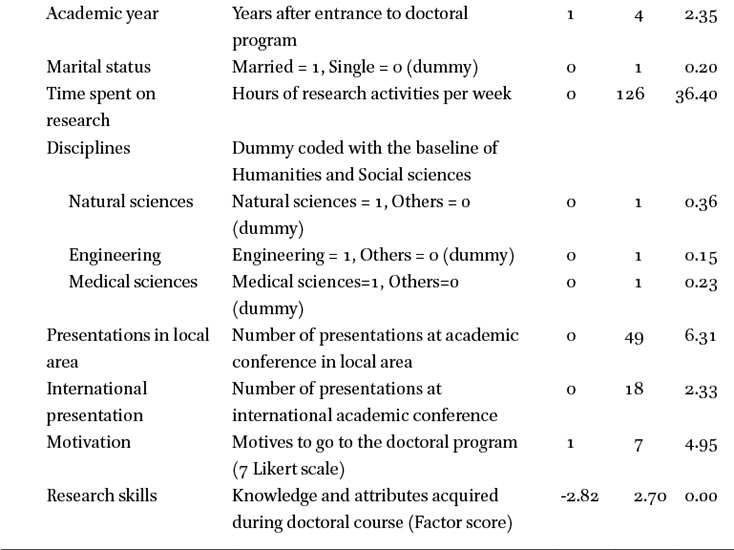
Given our chosen methodology and relevant dependent and independent variables, as well as the research questions above, the study is based on the analytical framework in Figure 2, upon which we engage with the research questions of the study.
Analytical framework


Note: *** p < 0.001, ** p < 0.01, * p <0.05
First, the study investigated the main factors which influenced the career plans of Japanese doctoral students. Their expectations of being employed in academia and the business sector were used as dependent variables to analyze their career plans. According to the results of regression analysis shown in Table 3, no significant differences in participants’ career expectations could be identified according to the characteristics of their host universities and their supervisors. However, among the characteristics of the students themselves, discipline and motivation of students were statistically significant factors associated with their career plans in both academic and business sectors. Related to the discipline, clear differences between doctoral students who are studying in Science and Engineering comparing to those in Humanities/Social sciences were identified. Particularly concerning their career plans for being employed in the business sector, doctoral students studying in Science and Engineering were more likely to expect to be employed in the business sector than students in Humanities/Social sciences. Moreover, doctoral students who were highly motivated to become academics tended to expect to remain in employment in universities, and were less likely to expect to be employed in the business sector.
With respect to their research productivity, in terms of the characteristics of their host universities, those doctoral students who belonged to national universities seemed to expect to publish more
Regarding the characteristics of the students, in terms of disciplines, there are clear differences between students studying Science, Engineering and Medical sciences, and those studying Humanities/Social sciences, in relation to their expectations regarding publishing in
Conclusions and Discussion
In light of the analysis above, the key findings of this study include the points below. First, those who expected to become academics or researchers after graduation had already determined to work in university at the time they went to doctoral courses. Although a full analysis is not made in this study, this means that their educational, working experiences, or other factors prior to their going to doctoral education, may have influenced their expectations of career plans. Further, those who expect to work in business after graduation tended to stay in Natural sciences and Engineering. This is not a surprising finding for many previous studies have already mentioned this point. For example, despite only analyzing the data from a survey of doctoral students in the University of Hong Kong with a similar questionnaire, Hugo’s research (2018) suggests that doctoral students from
The population of students enrolled in doctoral courses increased from 7,813 in 1990 to 18,232 in 2003, an increase of approximately 10,000 during this period. By 1993, among all doctoral graduates, 4,349 of them were employed in specialized technical workplaces while only 1,575 of them became university faculty members. By 2006, 8,530 of doctoral graduates worked in industry and business and only 2,108 of them were hired as university faculty members. Therefore, the number of doctoral graduate graduates who found jobs in industry and business increased by approximately 4,000 during this period (
Second, the doctoral course students who produced more
Third, as it is quite normal for doctoral students’ supervisors in Natural sciences, Engineering, and Health sciences to publish articles
Turning to the implications of this study, firstly, as the diversification of doctoral students’ expectation of employment has also emerged in Japan, it is necessary for both national governments and individual universities in which doctoral education is provided to consider more diverse programs for doctoral students, and to support the pursuit of diverse career paths for doctoral students. Second, as suggested in the study, appointing supervisors who are highly productive and can obtain considerable amounts of research funding may help doctoral students to be more productive academically. Finally, it is necessary to undertake closer collaboration and partnerships between universities and industry and business, and it may be especially important for those graduate schools of science, engineering, and health science to work with industry and business when training their doctoral students.
Doubtless there are several limitations to this study. First, despite having conducted a national survey of doctoral students, the number of valid respondents is relatively low and there are unbalanced distributions of respondents by gender and discipline. Therefore, the study is only concerned with very few doctoral students’ perceptions of their expectation of future employment and their research productivity. Second, the main findings of the study are based on the respondents’ self-reported data; a comprehensive and in-depth analysis or discussion of reasons behind some findings from statistical analysis is still lacking. For example, why do the characteristics of host universities not have a significant impact on their career plans? What is the correlation between their supervisors and their decision to become academics or going into business? Perhaps qualitative research methods like interviews or case studies need to be employed in future research. Finally, although national contexts are described, little discussion is made about the extent to which contextual factors have influenced doctoral students’ career plans and their research productivity.
Footnotes
Acknowledgement
We are very grateful to Thomas Brotherhood from the University of Oxford, UK, for proofreading the article. Of course, the authors of this study take full responsibility for all the data analysis, conclusions, and potential problems.