



Abstract
In recent years general education in Chinese universities has gone through rapid growth, which has led scholars to reflect on the motivations which underpin its current and future development. This paper establishes a framework based on the size of the universities together with whether the motivation is idealism or empiricism. This framework forms three typologies of general education in China, particularly from the perspective of curriculum design and student involvement. Three cases that each represent one of the three typologies are analyzed to depict the detailed characteristics. The main conclusion of the paper is that general education in its essence is an idealistic pursuit of a permanent goal, while in reality it is resource-dependent and rooted in historical conditions. China’s case studies provide a vivid example that general education reform starts with practical approaches of offering selective courses or building pilot zones and then by moderately increasing its scale and coverage, moving towards idealism across the spectrum. The key principals during the long journey are to avoid conformism, encourage innovations and maintain diversity.
The past few years have marked a turning point in Chinese university general education reform. Jointly proposed by philosophers and scholars at the beginning of this century, the ideal of general education was first put into practice in unique ways by top-tier universities such as Peking University, Fudan University, Wuhan University and Sun Yat-Sen University. At present, almost all of China’s top universities have established general education programs for undergraduate students, and an increasing number of colleges, institutions and even vocational schools have embarked on general education reform. Generally speaking, through, over the past decade parts of Chinese higher education have gradually integrated the most preliminary concept of general education—not merely professional education. On one hand, top universities in China “have” general education—a series of courses that are not oriented to professional education. On the other hand, there is still a long way to go to realize the ideal general education system that is able to perfect students’ personalities and characters. The question thus arises: What is the best general education for China’s universities? What is the appropriate mission and motivation for its further development? In this article we will establish a framework based on the size of the university together with ideal or empirical motivations, and then discuss concrete examples to answer the question.
The original motivation for general education in China could be analyzed into two factors: the curriculum of residential colleges and course construction, both of which are essential and difficult tasks. Has the difficulty of these tasks ultimately caused the general education reform, which started more than a decade ago, to lose its momentum? As far as we are concerned, the crux is the course construction—if the university is satisfied with merely introducing a limited number of non-professional-oriented elective courses. In the second half of 2014, Tsinghua University announced the establishment of “Xinya College”, with the establishment of four challenging general education courses as its core. 1 In April 2015, just before celebrating the tenth year of implementing its first round general education reform, Fudan University launched a second round of general education reforms in its core curriculum after two years of preparation. 2 What are the appropriate criteria to view and evaluate each school’s unique method? How should we analyze the pros and cons of their approaches?
Scale and Ideal: Two Factors that Influence the Reform Path
General education in the west, against the background of the massification of higher education, is rooted in liberal education during the age of elite higher education. In contrast, in China it was after the massification of higher education that general education was advocated in Chinese universities. Though this modernized conception of education echoes classical Chinese educational ideas, it has rarely been practiced in modern universities before. In other words, due to a historical lack of pedagogical experience and culture usually found in small-sized elite colleges, the general education model currently being promoted requires China to start from the very beginning to discover a way to implement it. On the other hand, like other courses, general education courses are confronted with the pressure of a sharp increase in attendance, which is a trend that China’s general education reform has exhibited for more than a decade.
Thus, the original educational ideal and resources before the massification of higher education as well the number of students after higher education massification constitute two decisive factors that must be considered in analyzing the causes of general education reform. What is more important is that these two factors are intertwined, providing room for different universities to choose different routes.
Dimension Y: The Number of Students Involved in the Reform
Chinese universities began their enrollment expansion in 1999, with 1.6 million students admitted, an increase of 47.4% over the previous year. In 2000, the rate of increase was 38.2%, and the following years witnessed an increase of about 20%. 3 At present, except for a few universities like Peking University, Tsinghua University and Fudan University, who maintain their enrollment numbers at around 3,000 each year, most universities enroll more than 5,000 new first-year students annually, and some even exceed 10,000 students, including the top universities in project 985. For example, Jilin University enrolls more than 10,000 first-year students, Sun Yat-Sen and Wuhan University around 8,000, and Zhejiang University around 6,000.
What does a large student population mean for the general education campaign? Imagine four kinds of universities whose enrollment numbers are 10,000, 8,000, 6,000 and 3,000 for each year. And imagine four kinds of course requirements: three in which every student is required to take 2, 4 or 6 general education courses, which are the only general education courses offered, and one in which students choose 6 courses out of the 8 offered. And also imagine three categories of class size: a seminar of 20 students, a class of 50 students and a lecture of 100 students. Chart 1 indicates the numbers of the courses that the four kinds of university need to offer each year for the corresponding course requirement and class size.
As we can see, for universities that enroll over 10,000 students each year, 400 general courses of a class size of 50 students need to be offered each year if every student is required to take two general courses in 4 years, and the students do not have the opportunity to choose their courses. For these universities, at least 1,000 courses of 50 students should be offered to allow every student to choose 4 to 6 courses—a requirement which is nearly impossible. As for universities that enroll 3,000 students each year, only 400 courses need to be offered in the same circumstance, a rather ideal situation in comparison, while the same number of courses only marks the initial stage of general education for the former kind of universities. One could imagine that for universities of different sizes, the levels of difficulty vary dramatically in order to implement general education—a process from the selection of teachers and courses to the management and improvement of the quality of the courses.
Of course, the general education campaign is far more sophisticated than the issue of quantity. Quality is the true essence of the reform. When those universities who enroll more than 10,000 students each year find it hard to provide general education for every student, many of them adopt, like China’s economic reform, the “pilot zone” method. Pilot zones may ease the demand on overall resources, gradually increasing and transforming the core of the university’s teaching and learning by avoiding challenging existing interests so as to ultimately spread the reform to a wider area. This is a wise strategy used by Chinese general education reformers, and is also a reflection of the realities of Chinese universities. Thus, whether all students are involved in the general education reform or only some of them provides a perspective from which we can analyze different universities.
Simulation of the numbers of the courses that the four scales of university should offer for each course requirement and class size.

Dimension X: Oriented towards Empiricism or Idealism
After 1952, influenced by political factors, all of China’s universities completely imitated the
Against this backdrop, the general education reform that began in early 2000 in various universities can be divided into two types according to their ideals. The first type of reform aimed to solve the existing challenges of education. Initiatives were carried out to solve real-world problems before a clear consensus as to the ideal goals. This type emphasizes empiricism. The second type of reform that university leaders proposed was a set of pioneering educational ideals often advocating an existing “advanced” ideal consciously, (which is often mentioned in the Harvard University’s General Education in a Free Society). This top-down reform has features of idealism.
In order to further demonstrate the idealistic and empirical routes of general education reform, especially the construction of the courses, the following table provides a conceptual comparison of the features of these two approaches. This framework was developed based on the observation of 20 Chinese universities
Two types of ideals in the construction of the general education curriculum


The idealistic approach entails a set of education programs and a curriculum system established by spontaneous general education ideals transmitted from top to bottom. The leader thinks like a philosopher, designing a blueprint that is closest to the ideal state. This requires the leader’s authority and contemplation of the ideals of general education. Meanwhile, the adoption of this route depends on whether liberal education, which is not confined to any profession, is in the spiritual tradition of the whole university. General education should be supported by sufficient educational resources, namely a sufficient number and type of courses. These conditions are hard to find, and only a few universities have adopted this idealistic-oriented route. Below we discuss concrete examples of the ideal approach.
The empiricism route entails transformation, expansion and integration from bottom to top based on existing non-professional educational resources, so as to gradually conform to the standards and requirements of general education. The leader acts like a politician, deliberating on the faculty and the existing courses. He will not exclude them when they are flawed, on the contrary, he tries to take the fullest advantage of the current conditions and construct the system in a devious but resistant way. The empiricism route starts from reality, even though the ideas at the beginning of the reform come from the outside. The undertaking will not be hampered as long as ambition and resolution remain. In recent years most universities have adopted this empiricism approach when the idea of general education sways across China’s universities.
The two idealized routes seem to be completely different. However, we cannot separate them so distinctively in the actual reforms. As for the cause of general education, on one hand, it must aim high to the most ideal liberal goals. On the other hand, the current resources and aptitudes of Chinese universities should also be considered. The former should be kept in mind continuously and the latter should be evaluated. The tension between ideal and reality always exists, and different focuses have differentiated two tendencies concerning the general education practice.
Typology and Cases
Now that we have established two dimensions: scale and ideal, three ideal types can be concluded (see chart 2). Moreover, three cases are found to illustrate and analyze these three ideal types and their pros and cons.
The first ideal type is the empirical reform that involves all students. Examples include cultural quality education and public elective courses, which are ultimately the precursors to general education reform.
The second ideal type is the idealistic reform that involves all students. Most Chinese universities select qualified courses for general education. The case of Fudan University is comparatively more idealistic. We will use it as an example.The third ideal type is the idealistic reform in a pilot zone. Since the scale is small, this kind of reform is often more realistic than the previous two modes. Examples include Beihang University and the Xinya College of Tsinghua University.
Three ideal types of general education curriculum building.
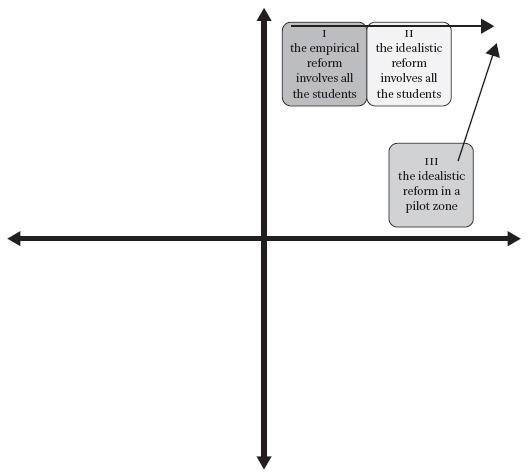
The yellow arrow in chart 2 indicates the long-term goal of the general education reform or the ideal in the whole school.
Case i : The Empirical Reform Involves All Students: Public Elective Courses and Cultural Quality Education Courses
Strictly speaking, although public elective courses and cultural quality education courses started before general education, these practices were used to correct the trend in over-specialization in the cultivation of talents and personnel, making a direct contribution to laying a foundation for the subsequent establishment of general education courses. So in a broader sense, they are included in our framework as the preludes to empiricism-oriented approaches.
At the end of the 20th century, the Ministry of Education began to advocate the idea of “cultural quality education,” 4 including a series of educational goals that could not be provided by professional education, serving as a reflection on over-specialization, a rectification rather than a guidance. 5 The idea of “cultural quality education” was interpreted officially after several years of practice as follows:
The cultural quality education program we have been working on is mainly about liberal arts education. Through more emphasis on literature, history, philosophy and arts education for all students, and natural science education for arts students, the cultural and aesthetic taste, humanity attainment and science attainment of all the university students will be raised. 6
This definition points out the space and orientation of the concept. However, it failed to extract an exact goal, philosophical ideas or regulatory measures. As an empirical idea, it aims to solve real practical problems; however it lacks concise and precise thinking theories and a far-sighted goal.
Meanwhile, Chinese universities have introduced a public elective system under the credit system. In most universities, this is the operable practice of the idea of “cultural quality education” (wenhua sushi jiaoyu 文化素质教育), offering free elective courses for broadening students’ interest and horizon besides professional courses. It is not difficult to find that there is no threshold for public elective courses since all students can choose which ones to take. Since most universities have minimal resources for non-professional courses, let alone to provide a balanced and complete curriculum system, public elective courses can maximize students’ involvement, thus it is the most feasible strategy for Chinese universities. Elective courses provide a chance for the professors to convey their expertise to students of other majors. It opens a window for students to observe the world and life in different perspectives, and is better than nothing.
Since 1999, the ministry of education has approved 93 national cultural quality education programs for university students in 157 higher education institutions. 7 Nearly all these universities began to offer cultural quality education courses and lectures, using this name. In a chronological view, cultural quality education and free elective courses are the precursors to undergraduate general education in Chinese universities. However, since there is no guidance for a far-sighted educational goal, those elective courses are only superficial introductory courses. Students are exposed to many specious views and second or third-hand interpretations even ease students’ natural anxiety and sensitivity to major issues. It could be assumed that these free elective courses cannot inspire and enlighten the students’ intelligence and mind. And the idea of “cultural quality education” is being eroded in practice, viewed by most teachers and students as less important than professional education. At present, the general education reform in many universities begins under the name of “cultural quality education” and a reconstruction of the existing ignored elective courses.
One of the potential dangers of empiricism is that the ideal of general education may be trapped in a passive and confined state after faculty are satisfied by an easily-reached initial consensus. General education does not have an academic community like professional education, so it is easily abandoned and becomes unable to improve in quality. In contrast, exterior or administrative assessment and management of general education can provide an assessment of basic eligibility. As we can see, a general education curriculum that starts from empirical practices may easily lose its momentum after being established. To reach this qualification is enough. If a deeper understanding of general education did not occur in practice, the general education of that university may be unable to excel, without the consideration of idealism and a resolve to reform that governs the overall situation.
Case ii . The Idealistic Reform that Involves All Students: Qualified Courses Selection and “Basic Curriculum Units” of Fudan
The main problem of the idealism route is that it is not directly feasible for most Chinese universities. First and foremost, does the idea of general education require a relatively balanced distribution of disciplines? Second, does the faculty identify with the ideal of general education and have the ability to put that ideal into their teaching? Third, against the backdrop of the massification of higher education, how much do the educational visions of universities and the development goals of the students match to each other? At least these three prerequisites should be considered before the adoption of the idealism-oriented route. Strictly speaking, all the actual reforms have the elements of empiricism and only some cases have more of a tendency towards idealism. The reform that completely breaks away from empiricism is an unrealistic ideal.
We find that many universities gradually collect and select courses that meet the standards of general education from non-professional elective courses, cultural quality education courses and introductory professional courses (such as Math and English). This is a compromise made between low-quality free electives and slowly progressing idealized-design courses. Through the selective mechanism of professors and specialists, qualified courses are granted and awarded so as to promote more elective courses to meet the standards of general education. This selection of qualified courses epitomizes the transition period from empiricism to idealism in the cause of general education reform. Those selected courses are called common core courses (Sun Yat-sen University), general education compulsory courses (Wuhan University) or type A general education courses (Beijing Normal University), and the rest are called public elective courses or general courses. This selective approach drives the curriculum reform of the whole university forcefully, providing enough general education courses for all students to choose from to meet their credit requirement. (11 credits in Renmin University of China, 12 in Beijing Normal University, 12 in Wuhan University, 16 in Sun Yat-sen University). 8 However, if the quality of these courses is scrutinized, problems will be found since both Wuhan University and Sun Yat-sen University enroll around 8,000 students every year. Sun Yat-sen University even has several different campuses in different cities, thus the population and the segmentation of the campus pose great threats to providing general education courses on the scale of the whole university. The faculty in charge of general education often have to motivate the teacher to create more courses.
From a comprehensive perspective, Fudan University boasts comparatively more idealized features in the universities that launched general education on a whole-school scale. Early on, Fudan put forward a core curriculum structure of general education that is composed of six modules: classics in literature and history and cultural heritage, philosophical wisdom and critical thinking, global perspective and modernization, technological progress and scientific spirit, ecological environment and the care of beings, artistic creation and aesthetics. September of 2006 witnessed the launch of fifty general education core courses, most of which were selected from the public electives. 9 It could be said that the design of these six modules was idealism-oriented, nevertheless, empiricism-oriented approaches were adopted in the selection of the qualified courses and the teachers. Students of Fudan were required to take at least one course in each module (12 credits in total) so that students would acquire some knowledge of the whole general education body that the school offered.
After years of practice, the reformers of Fudan began to reflect upon the problems that had emerged in the implementation of the general education core curriculum. Essentially Fudan’s actual curriculum systems overlap with each other since the relationship between the ideal vision and the goals of each module are not clear. Since the design of the courses depends on the teachers, the quality of the courses also varied. These problems may also be faced by other universities who adopt the “qualified courses selection” method, and they are the impetus for Fudan to propel a further reform with more idealistic features.
In April 2015, Fudan put forward a new round of general education reform with an emphasis on the construction of the “curriculum divisions” after two years of preparation. This time, the vision was to further establish the ideal aim, combining the relationship of the ideal aim, the curriculum system and even the specific courses, and streamline the structure so as to refine its implementation. The most significant change is that the courses in each module of the core curriculum are no longer unrelated with each other since a set of systematic “curriculum divisions” are to be established. 50 curriculum divisions will be established to replace the 200 uncorrelated core courses in large categories. For example, in the first module of classics in literature and history and cultural heritage, six curriculum divisions will be created (namely: pre-Qin philosophers, Confucian classics and their studies, classics in Chinese history, classical poetries and essays, vernacular Chinese classics, modern works). Parallel courses that share the same syllabus or correlated course groups will be generated under the curriculum divisions. With the curriculum divisions serving as a bridge connecting modules and specific courses, the general education core curriculum in Fudan is more like a “map” than a “menu.”
What is more advanced than the passive “qualified courses selection” method is that the reform at Fudan, by establishing curriculum divisions, attempts to systemize the courses from different departments through a common general education goal. Through the preparation of collective courses and interdisciplinary research on teaching, the curriculum divisions enjoy additional resources and the right to manage the general education courses, so that a faculty community of general education can be established and thereby facilitate autonomy. Faculty groups form course units where they prepare lessons together and design related syllabi and course titles. In every course unit there is a convener who is required to submit a common course syllabus that is achieved after discussion with the university commission. Thus, the general education courses and the teachers will be more cohesive in spirit, neither the faculty members will be constrained nor the ideals and teaching requirements will fade through the insidious professional confinement of the teachers themselves. The quality of the courses will be balanced and checked through the interaction between the teachers.
For students, this new round of reform emphasizes recognizing the whole through learning part of the knowledge in the organic system of the general education curriculum. Even if students have different choices for the courses, all of them will be immersed in the same knowledge system that the university offers, and a well-structured curriculum system itself demonstrates the value of general education. Only in this way, the dazzling general education curriculum will not be suspended from the student’s existing knowledge structure, not merely a bundle of courses “about general education.” But since the new round of Fudan’s reform has just been initiated, the implementation of the idealistic design needs to be further evaluated.
Cases iii . The Idealistic Reform in a Pilot Zone: The Experimental Class of Beihang University and Xinya College of Tsinghua University
Beihang University (Beijing University of Aeronautics and Astronautics) is a scientific and technological university of a high level, thus the limited faculty members of the arts could hardly provide rich and comprehensive general courses for the whole university. In 2000, Beihang founded the “Zhixing experimental class of arts,” enrolling 30 students each year, pioneers to explore a new mode of general education. With the addition of a social science experimental class in 2012, the new “Zhixing” Academy started to offer general education to 300 students every year, 10 about 10% of total enrollment. Since arts education was previously rarely seen in this university, Beihang started its general education curriculum from scratch by introducing new disciplines, especially in the humanities, and experimental classes besides the existing curriculum system. They also invited famous professors from Peking University, Tsinghua University and Renmin University of China to complement the courses. Since 2013, the general education of the arts and social science experimental class has been gradually promoted to the whole university.
In September 2014, Tsinghua University launched the project of Xinya College in the form of a pilot zone, enrolling more than 200 students each year from majors like life science, mechanics, city architecture planning and law. Four general education courses of exceptional quality were designed specifically for this project (namely: Close Reading of The Historical Records, Early Chinese Civilization, Law and Literature, the Enlightenment of Arts). 11 Students at Xinya College choose one general education course each semester. These four courses adhere to the highest quality standards, imposing many more challenges than the cultural quality education courses and public elective courses. With extensive reading and writing required in large quantities, these courses emphasize the real impact that humanities courses could make in the thinking and life experience of science students. What is similar to the approach of Beihang is that Tsinghua also needed to invite teachers from other universities since Tsinghua lacked sufficient qualified instructors to teach these specidally-designed courses on a larger scale.
As far as our earlier framework, the projects of Beihang and Tsinghua are more idealistic than that of Fudan, but the scale is much smaller. High-idealistic course design can be achieved in a small pilot zone, but students’ choices are limited because only a few courses are offered, let alone the construction of a whole curriculum system. We have discovered that scientific and technological universities can blaze a new trail of this small-scale experimental class mode so as to directly establish general education courses with little hindrance. It is wise to start with this utilitarian and selective strategy, however, this alone is not sufficient to ensure success of the reform. Eventually the education reform should target all of the students. For universities like Beihang and Tsinghua, the greater challenge lies in the unprecedented obstacles that may be faced during the popularization of a quality general education and in the recognition of its importance, for these universities are renowned for their overwhelming technological professional education and strong scientific atmosphere. These scientific and technological universities are those who need general education the most. This may be the biggest challenge in the general education reform in Chinese universities.
Conclusion
We have summarized and put forward several concepts regarding the implementation of general education in Chinese universities, including pilot zone mode and whole-scale mode as well as “empiricism” and “idealism.” We also analyzed three ideal types based on this framework. This way of classification does not seek to label and solidify each case. On the contrary, we locate the positions of each type in the analytical framework, so as to further promote their development. The question thus remains: is a mode shift necessary?
The priority is for general education to find its own position and direction so as to be self-motivated in terms of relative advantages and disadvantages. In real practice, no reform is feasible without the consideration of the realities and the guide of ideals. We cannot clearly separate idealism and empiricism since in reality they range across a broad spectrum that cannot be clearly separated into two separate parts. The empiricism-oriented route is closer to the real world, with less hindrance and obstacles at the initial stage. This is why it is adopted by most Chinese universities. But if a whole educational ideal is lost from beginning to end, general education may lose its momentum under a mediocre goal, offering bites of “dessert” besides the professional “main course.” The idealism route is closer to the ideal state and its prerequisites may be difficult to find. The educational ideal of cultivating a modern whole person who is rooted in Chinese tradition should be pursued. Moreover, the effective and continuous implementations of the empirical practitioners are also necessary, preventing general education from being too idealistic and unrealistic.
We have also found that small-scale pilot zone methods may pave the road for a more idealistic reform for those universities with insufficient resources, especially scientific and technological universities with limited resources in the humanities. This method bypasses the main obstacles, enabling the reform ideals to be implemented to a larger extent. When successful, the experience can be used to persuade those who are more conservative. However, launching general education for only part of the student body is different in nature from implementing it in the entire university. Moreover, those selected students in the pilot zone tend to have better overall capacities and higher grades. They tend to be volunteers who identify more closely with the ideals of general education or their majors are related to the humanities. Some of the approaches used in the pilot zone may not be promoted to the whole university, and even if the pilot zone is a success, it does not mean that the crux has already been solved.
General education is idealistic in nature, with a vision so far-sighted that every university that pursues it will need to make long-term efforts. As a matter of fact, no university in the world can say that it has reached the goal. When the problem of mode shifting is encountered, wise decision-makers adjust their orientations in certain phases according to the existing resources by absorbing the advantages of both routes. The key is to avoid conformism. Some Chinese universities start with empirical approaches, and by moderately integrating idealism they advance continuously to the general education ideal. Others draw near to the goal by promoting the methods of the pilot zones to the whole university. Thus, we have depicted a roadmap of general education reform in Chinese universities. At present, some pioneers have begun to reflect upon this, transforming and constructing a new framework based on their increasing awareness.
Footnotes

3 Ministry of Education, China Education Development Report [Zhongguo jiaoyu fazhan baogao], 2014.
6 Ministry of Education General Office, “Ministry of Education General Office Notification on the Increasing National College Student Cultural Quality Education Bases in Higher Education Institutions” [Jiaoyubu bangongting guanyu zaigaodeng xuexiao zengshe guojia daxuesheng wenhua suzhi jidi de tongzhi], (2005) No. 5.
7 Ibid.
8 This is according to the undergraduate training plan of Renmin University of China, Beijing Normal University, Wuhan University and Sun Yat-sen University.
10 Beihang University Committee of General Education Curriculum Construction, “Beihang University General Education White Book” [Beijing hangkong hangtian daxue tongshi jiaoyu baipishu], 2013.