



Abstract
In service to wider national strategies, the Plan for Educating and Training Outstanding Engineers (
* An earlier version of this paper was presented at the 2014 World Engineering Education Forum, Dubai, December 3-6 2014. This paper offers an extended discussion and updated statistics released in 2015.
Introduction
Present State and Challenges in Chinese Engineering Education
Engineering education is tasked with training engineers and facilitating engineering technological innovations. Finding itself at the intersection of engineering and education, engineering education is significant to human resources development for sharing some of the common characteristics of general education. Meanwhile, engineering education is prominently characterized by engineering, serving as an important approach to popularizing engineering knowledge, promoting engineering technology, and supporting social and economic development.
In the past 60 years, China has cultivated 40 million engineers and technicians who directly support the formation and development of the national industrial system and helped drastically boost nearly 30 years of rapid economic development of the country. Engineering education is playing an indispensable role in quickening the pace of modernization of China. Engineering education is now a genuine power, given its large scale and high proportion in the Chinese higher education system, with current engineering students and teachers representing over one-third of all students and teachers in higher education institutions. As of 2013, China has 1,077 universities and colleges offering science or engineering programs, or 92% of all higher education institutions. Among them, 572 universities can grant engineering master’s degrees, and 269 universities can grant engineering doctoral degrees. In 2013, the engineering undergraduate students totaled 4.95 million, and total graduates reached 2.87 million in the same year. The number of engineering teachers in Chinese regular institutions of higher learning registers 0.4 million. 1 Nowadays in China, the engineering educational system is tending to be reasonable in adjusting its structure, stabilizing its scale, and gradually improving its quality.
However, there are still many internal and external challenges in engineering education. Regarding internal challenges on university campuses, the biggest problem is a lack of engineering practice and creativity. 2 Many universities are not fully clear on the differences between engineering education, technology education and science education, which often results in training engineering students in the way of science education. 3 In addition, many universities are facing prominent problems such as a lack of engineering background among engineering teachers, limited engineering practice opportunities for teachers and students, and a lack of practical and innovative abilities among engineering students. 4 For the external challenges, there exist prominent problems such as industry-university disconnects. Industrial enterprises have little passion and inadequate participation in the personnel training process since there are few effective polices and economic incentives to support such efforts. The big gap between universities and industries directly results in a so-called structural imbalance in Chinese engineering education. The graduate attributes and performance of engineering students often fail to meet the requirements of industrial enterprises. A large number of college graduates fail to find jobs, while numerous enterprises have difficulty finding the right employees. 5 In addition, the recognition system between engineering education and qualification of engineers has not been set up in most industry professions. In China, engineers have a universally low social status as in many other countries. 6 The diminishing interest of brilliant school-age youths in engineering majors has become worrisome. All these problems severely influence the quality of engineering education.
In all the above challenges, the industry-university disconnect has been the hardest obstacle to promoting quality reforms in the engineering education system. This long-lasting gap in part results from a broader political, economic, and educational background and legacy. Under the former planned economy environment in China, the industry ministries directly steered engineering talent cultivation. In the bureaucratic system of the time, the central government set up ministries for each respective industry to make industry development plans and make guiding decisions in that sector, including the level and type of personnel training they required. As well, these ministries provided resources to universities and colleges, conducted the training process, and directed the assignment of graduates directly into industrial enterprises. In this self-sufficient system, industry ministries established universities and colleges to train engineers and technicians according to their own industrial development plans. Universities and colleges cultivated talents available to the industrial demands. This administrative and financial system closely affiliated the universities and colleges with the industries. During this period, the relationship between government, industry and universities was very close.
With the development of market economy, the closed and self-sufficient personnel system within industries was too rigid to respond to an opening labor market. Along with the restructuring of State Council in 1998, many industry ministries were removed or merged. Meanwhile, a majority of the industrial colleges, except for a few placed under the Ministry of Education, were decentralized to provincial governments. As an alternative, various industrial associations were set up after the reform. These industrial associations have less power and mainly function as advisory bodies, communicating and coordinating institutions within their own industrial fields. They have neither executive powers of government ministries, nor industrial financial resources and responsibilities to drive talent cultivation more directly. The linkage between industries and universities has therefore become weaker and weaker.
For reshaping the connection between university, industry, and government in engineering education, it is highly desirable to consider a new mechanism in the market economy environment to start a systematic transaction in engineering education to serve the new industrial revolution and substantial development in the 21th century locally and globally. The Plan for Educating and Training Outstanding Engineers (
petoe Overview
Launched on June 23, 2010,
The fields of
Multi-Sector Collaboration Mechanism in petoe
For linking stakeholders,
Meanwhile,
The highlight of
Mechanism of Multi-Sector Coordination
Coordination or leadership plays a critical role in
An effective and well-established organizational framework is also indispensable for coordination in
The leadership group: Working together with the relevant ministries of the State Council, the Ministry of Education set up a
The coordination group: The Ministry of Education and relevant industry ministries jointly set up a coordination group. It is mainly comprised of heads of department or division of Ministry of Education and the industry ministries. With its head selected from industry ministries, the group is mainly responsible for coordinating the industrial participants; planning, implementing and evaluating the
The expert groups: Together with industry ministries, the Ministry of Education invited distinguished industrial and educational experts to join the expert groups that are led by industrial experts. The industrial experts are commonly in-service or recently retired senior engineers and technicians; the educational experts should generally have senior professional titles and a wealth of teaching experiences. The groups are responsible for directing
The operational system: In the
Mechanism of Industrial Guidance
For quality assurance of training, industry directs the general standards of
Engineering professional ethics, spirit of pursuing excellence, patriotism, dedication and hard-work, social responsibility and humanistic quality;
Engineering-related knowledge of mathematics, natural science, economic management and the other humanities and social sciences;
Deep concern about quality, safety, efficiency, environment, occupational health and social services;
Fundamental engineering knowledge and fundamental theories in specific fields for solid works; a good understanding of producing processes, equipment and manufacturing systems; and a good understanding of professional development status and trends;
Understanding of the technology standards, policies, laws and regulations in the specific and relevant industry;
Learning abilities to access information and continue professional development;
Integrated abilities to utilize scientific theories, analysis and problem-solving methods and technical means to solve practical problems; with an ability to participate in the design of production and operational systems, and with an ability to operate and maintain these systems;
Sense of innovation and product development and initial capacity of design, technology and innovation;
Skills to manage, communicate, and collaborate in a team and abilities to adapt to the work environments;
Initial capacity of response to crisis and emergencies;
Global perspective and skill of communication, competition, and cooperation under the international and cross-cultural setting.
Except for the general standards, several industry sectors have already formulated subject-specific standards to guide university training plans. Both industrial and educational ministries jointly issued the industrial training standards. The expert groups are made up of industry ministries, associations, and educational institutions. Firstly, they need to develop the specific professional standards, and identify the critical and related fields and subjects for engineering professional development. Secondly, these groups are obliged to draft the training standards of specific subjects based on
Some industry associations are also considering making close connections between education and profession qualification. For instance, the Association for Mechanical Engineering has developed the Mechanical Engineers Training standards in
Industry ministries and associations also participate in quality assessment of
Mechanism of Joint Training by University-Enterprise Union
University-enterprise union is a key approach for success in
The joint training relies on the Practice Center for Engineering Education, the integrated training platform established in enterprises. These centers expanded their functions based on those previous practice bases. The main tasks of these centers include drafting training proposals together with cooperative universities, constructing the curriculum system especially focused on enterprise learning and practice, and arranging the one-year practice learning placements for students. Now a batch of such centers has already been formed.
Supportive Policies
In order to support and ensure
Preferential policy of enrollment: Supporting more quota allocation of colleges to develop professional degree programs, especially at the master’s level; ensuring the quality of students joining the
Policy of faculty recruitment and performance assessment: Supporting colleges and universities to reform the rules, standards and approaches of engineering teacher recruitment, assessment and training; and considering an engineering teacher’s performance and promotion from various perspectives such as project design, patents, industry-university collaboration, and technical services instead of thinking only research and publications.
Priority policy to the program applications in the field of emerging strategic industries.
Priority policy for international exchange for students and teachers in
Priority policy for
Priority policy of
Additionally, some industry ministries and associations have developed specific policies such as related to part-time teacher incentives, and student incident insurance in order to encourage the enterprises to join
The Progress and Challenges of petoe
The student enrolment of petoe programs (2010.6-2014.12)
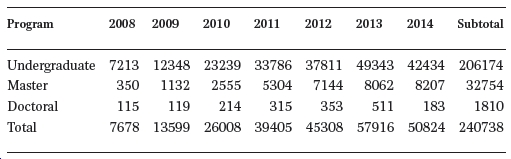
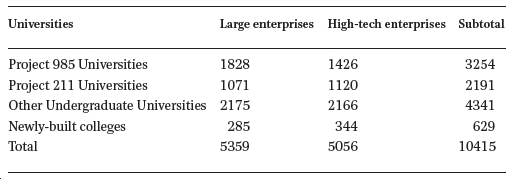
By the end of 2014, 10,415 enterprises joined
The enterprises contracted with petoe (2010.6-2014.12)
In addition, in 2010-2014, 11,487 part-time faculties from enterprises have participated in teaching in the
The industry-university exchange of full-time and part-time teachers in petoe (2010.6-2014.12)
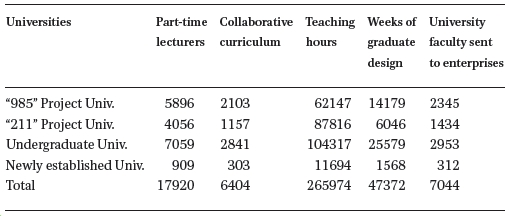
Although
As mentioned above, the problems of Chinese engineering education, and especially the big gap between university and industry, resulted from a variety of political, economic, and educational reasons. It is impossible to solve these problems only by efforts from a single side. The government, industry enterprises, and universities are indispensable driving forces to the reform of engineering education. Especially given the background of China, in order to maintain and enhance the partnership and multi-sector collaboration
Conclusion
As a mission-oriented educational plan in the new century,
Footnotes
1 The Education Committee of the Chinese Academy of Engineering, “Zunxun guoji tongyong zhunze, dazao zhuoyue gongcheng jiaoyu [Adhering to International Standards, building up outstanding engineering education],” in 2013 Zhongguo gongcheng jiaoyu fazhan baogao [The 2013 annual report on development of China’s engineering education], edited by the Education Committee of the Chinese Academy of Engineering (Beijing: Gaodeng jiaoyu chubanshe, 2014), 3-17.
2 Binglin Gu, “Dali peiyang gongchengxing chuangxinxing rencai [Developing Innovative Engineering Talents],” Qinghua daxue jiaoyu yanjiu [Tsinghua Journal of Education], no. 4 (2014): 1.
3 Gaofeng Zhu, “Zhongguo gongcheng jiaoyu: chengji, wenti, he duice [Engineering Education in China: Achievements, Problems, and Countermeasures],” Gaodeng gongcheng jiaoyu yanjiu [Research in Higher Education of Engineering], no. 4 (2007): 3.
4 Qidi Wu, “Zhongguo gongcheng jiaoyu de wenti tiaozhan yu gongcheng jiaoyu yanjiu [Problems and Challenges of Engineering Education and Research in Engineering Education in China],” Qinghua daxue jiaoyu yanjiu [Tsinghua Journal of Education], 30, no. 2 (2009): 6-7.
5 Gaofeng Zhu, “Zhongguo gongcheng jiaoyu de xianzhuang he zhanwang (Chinese Engineering Education: Present and Future],” Qinghua daxue jiaoyu yanjiu [Tsinghua Journal of Education], no. 1 (2015): 16-17.
6 Shouwen Yu, “Gongcheng jiaoyu yu xiandai gongchengshi peiyang [Engineering Education and Training Modern Engineers],” Gaodeng gongcheng jiaoyu yanjiu [Research in Higher Education of Engineering], no. 4 (2004): 1. See also Wu, ( ): 7-8.
10 The relevant industry ministries of the State Council include the Ministry of Industry and Information Technology, the Ministry of Human Resources and Social Security, the Ministry of Housing and Urban-Rural Development, the Ministry of Transport, the State-owned Assets Supervision and Administration, the State Administration of Taxation, the State Administration of Work Safety, the Civil Aviation Administration of China, the State Bureau of Surveying and Mapping Geographic Information, the State Oceanic Administration, the Chinese Academy of Engineering, and so on.
11 The Ministry of Education, “Zhuoyue gongchengshi jiaoyu peiyang jihua tongyong biaozhun [The General Standards for the . See also Jian Lin, “Zhuoyue gongchengshi jiaoyu peiyang jihua tongyong biaozhun quanshi [The Interpretation of the General Standards for ‘The Plan for Educating and Training Outstanding Engineers’],” Gaodeng gongcheng jiaoyu yanjiu [Research in Higher Education of Engineering], no. 1 (2014): 12-23.
12 See note 9.
13 Some enterprises are both large and high-tech enterprises.