



Abstract
Former Portuguese colony and now a Special Administrative Region of China, Macau had progressed from following its colonizer and its neighbouring cities, like Hong Kong and Taiwan, to establishing its own education system and being the first in the Greater China region to deliver 15-year free education. The objective of this study was to examine the perceived impacts of this policy on the affordability, accessibility, accountability of early childhood education in Macau. A multiple case study, using quantitative (surveys) and qualitative (interviews) measures, was conducted in four private kindergartens in Macau to understand how the 4 principals, 24 teachers and 119 parents viewed the policy impacts. The results indicated that: (1) across roles, parents were the most supportive of the policy and consistently gave the highest grading amongst the three stakeholders. Principals were the most knowledgeable of the policy, but graded the policy lowest and regarded the government’s financial subsidy as the most insufficient. Teachers were the least optimistic and positive about the impacts of the policy. They felt that teacher qualification and the quality of teaching resources should be further enhanced; (2) Across school types, kindergartens which joined the free education network graded the policy higher and perceived its impacts more positively than the one which did not join; (3) Extra subsidies were suggested by the respondents to cover children’s extra-curricular activities, support from childcare and special education professionals, and school-based curriculum development.
A Multiple Case Study on the Perceived Impacts of the 15-year Free Education Policy in Macau
Macau had been a Portuguese colony for more than four centuries before becoming a special administrative region of China in 1999. Previously, the colonial government adopted a noninterventionist attitude towards its education sector, from providing little financial aid to schools to exerting little or virtually no interference to school administration and operation.
1
After returning to China, however, the educational authorities of Macau have been trying with all means to reform the education system. In 2006, a paradigm shift in education policy occurred when the government launched a 15-year free education system to all permanent Macau residents. This revolutionary move has brought a massive change to the early childhood system in Macau and sparked educational insights for the governments of the cities in the Greater China region. This study was dedicated to understanding the perceived impacts principals, teachers and parents had on the 15-year free education policy with reference to the affordability, accessibility, and accountability of the early childhood education (
Education in Macau
Although living under Portugal’s control, Macau never experienced much strong colonial rule from Portugal. And since, historically, education was viewed as a private good, the government felt little obligation to provide its people with public education and exerted very little political interference in the development of its education sector. Perceiving the receiving of education as purely voluntary, this laissez-faire policy on education did not succeed in providing high quality schooling, 2 led to the absence of a unified sanctioned compulsory education system, and gave freedom to schools in Macau to adopt whatever curriculum and education systems they deemed as fit. 3
Preschool institutions in Macau were all privately-run and mainly operated by religious bodies, business enterprises, non-government organizations, and individuals. Schools followed educational models and examination systems imported from Portugal and other Asian cities, such as Hong Kong and Taipei. They devised their own curricula, and hired their own staff according to the terms they formulated. 4 Given the constraints of Macau’s small territory, size, and population, the post-colonial government has been experiencing a “ceiling of educational provision” 5 and an exceptional difficulty in constructing a robust and comprehensive education sector. Macau therefore, turned to other regions for inspirations in educational development, policy formulation, and curriculum guidance; e.g., the use of Hong Kong textbooks in many preschools in Macau, the introduction of quality assurance reviews carried out by the education authorities, and the hiring of consultants in course development at the University of Macau.
To improve the quality of the population and to enhance the city’s long-term regional and global competitiveness, the quality of education must be improved.
6
In recent years, the Macau government has made powerful strides to the development of education. In 1991, the first official law on education—Macao Education System Bill, was issued by the Macau government which outlined the aspects and long-term objectives of education, including government involvement in education and meeting the needs of students.
7
In the hope to improve the quality of non-tertiary education and to make education accessible to the majority, the Macau Government Education and Youth Affairs Bureau (
The 15-year Free Education Policy in Macau
Guided by the directions of “Improving Macau through education” and “Strengthening Macau with talents”, the Macau government implemented the Fundamental Law of Non-Tertiary Education in 2006 10 which states that compulsory universal education applies to all permanent Macau residents aged between 5 and 15. The eligible ones can enjoy free formal education at public schools and private schools which have joined the free education system. 11 While history has documented Macau as a follower of other regions’ footsteps in education and policy development, in the context of free mandatory education and provision of financial assistance to stakeholders of the education sector, Macau has taken the lead to be the first region in Greater China to implement a 15-year free education system—3 years of kindergarten education, 6 years of primary education, 3 years of junior secondary education, and 3 years of senior secondary education or vocational technical education, or an altogether 15 years of special education.
Launched in the academic year 2007-2008, the 15-year free education system aimed to improve the educational welfare and benefits of Macau residents. The free education system comprises public schools and subsidized private schools which are members of the free education network following the local curriculum. Although private schools which do not follow the local curriculum are not eligible to apply for entry into the free education network, their students can enjoy free education subsidy to cover their tuition fee and other additional service charges associated with enrollment, schooling, and the issuing of certificates. In the academic year 2013-2014, the free education subsidy for each student studying at private schools not part of the free education network is
The Greater China region has been fused with heated debates as school operators, educational authorities, policy-makers, and the public are examining the possibility of introducing a 15-year free education system, just as what Macau did. The present study set out to investigate how the three major stakeholders—principals, teachers, and parents—perceived the impacts of the free education policy in Macau with specific reference to the affordability, accessibility, and accountability factors of
What are the perceived impacts of the free education policy on the 3As—affordability, accessibility, and accountability, of
What are the commonalities and distinctions in the respondents’ views of the free education policy across their roles (principals, teachers, and parents) and school types (in or out of the free education system)?
What could be improved in the 15-year free education in the respondents’ views?
Method
Sample
A total of 56 private kindergartens were registered with the
Instrument
To adequately examine each stakeholder’s views towards the free education policy of Macau, self-administered questionnaires were developed based on the blueprint of the questionnaires previously developed to investigate the impact of the Hong Kong’s Pre-primary Education Voucher Scheme (
Procedure
A packet of one Principal Questionnaire, six Teacher Questionnaires, and ten Parent Questionnaires was mailed to the corresponding kindergartens for the selected respondents to complete. Follow-up telephone calls were made to the participating kindergartens to ensure the completion of questionnaires as well as to schedule for interviews with the stakeholders. Completed questionnaires were later collected by members of the research team in June 2013 during which scheduled interviews were conducted.
In May 2013, telephone calls were made to the four kindergartens to schedule for interviews with the school principal, teachers (one from each grade), and parents (one from each grade) in the following month. Upon the interviewees’ approval, video- or audio-recording was conducted during the interviews for accuracy of the subsequent data analyses. Open-ended questions used in the interviews were designed and developed in an attempt to gather more in-depth opinions and views on the free education system in Macau in terms of the policy details, changes before and after its implementation, as well as its impacts on aspects such as curriculum development, resource allocation, and schools’ autonomy. A total of three principals, seven teachers, and eleven parents were interviewed. All the responses were entered as raw data and treated using an inductive data analysis approach via Strauss and Corbin’s methods for open coding (Strauss and Corbin 1988). Themes and categories were identified from the database of transcripts, and a summary of descriptive data was generated.
Results
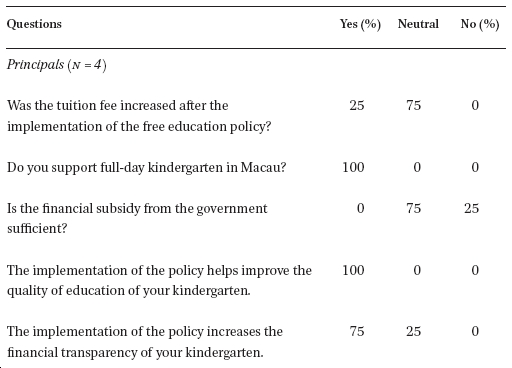
To analyze how well respondents understood the free education policy of Macau, preliminary analyses were conducted on the first question that is common across all the questionnaires—“Are you familiar with the free education policy?” A total of 23 respondents (2 teachers and 21 parents) answered “unclear” or “very unclear”, 69 answered “clear” or “very clear”, while 52 respondents (2 principals, 15 teachers and 35 parents) answered “neutral” for this question. This indicates that the 23 “unclear” or “very unclear” respondents could be lacking sufficient knowledge about the policy to give informative comments about the free education policy. Using two-tailed Spearman’s correlations, respondent’s familiarity with the policy was found to have significant positive correlations with their grading of the policy, and with their views about the effectiveness and impacts of the policy (reducing families’ childcare burden, improving the teaching quality, and having more confidence in school operation), Rs > .22, ps < .01. The extent to which familiar and unfamiliar respondents differed in their policy grading and views were further statistically analyzed. Various statistical analyses were conducted to answer the three research questions: (1) descriptive analyses were conducted (see Table 1) to study how respondents perceived the 3A’s of the free education policy of Macau; (2) descriptive analyses and
Perceived Impacts on the Free Education Policy
Affordability of Early Childhood Education. The majority of parents (92%) stated that the free education policy helped reduce their financial burden on childcare. Only 13% of the parents and one principal reported an increase in the school tuition fees after the implementation of the policy, while the remaining principals rated “neutral” for this question. Altogether 65% of the parents claimed that the policy left them with more money to spend on their child’s extra-curricular activities (
Accessibility to Quality Early Childhood Education. All principals, alongside 58% of the teachers and 44% of the parents agreed that the implementation of the policy would improve the quality of education in their kindergarten. Half of the principals and 58% of the teachers reported an increase in resources, funding and development opportunities as a result of the policy, and 46% of the teachers claimed that the policy facilitated an improvement in teacher qualification. In a similar vein, 58% of the teachers perceived the changes brought about by the policy to be positive and half of them claimed that their kindergarten had been adapting to the changes well. A high proportion (69%) of parents believed that the policy embraced fairness and equality in the light of the various stakeholders and the education sector in Macau. A very high 88% of the parents found that the school’s vision, religious background, curriculum, pedagogical approaches, and teacher qualification aligned with their beliefs and expectations.
Accountability of Early Childhood Education. Three out of the four principals believed that their school had been more financially transparent, but only 35% of the parents agreed with that. Besides, 75% of the principals and 63% of the teachers believed that the quality review procedure required by the policy had increased their job-related stress. With regard to whether their salaries were justified, only 9% of the teachers, and no principal, answered “yes”, while three principals and 65% of the teachers rated “neutral” for this question. Two principals believed that the policy had reduced their administrative autonomy, but not their autonomy in curriculum planning and teaching. 75% of the principals and 64% of the parents were confident with school operation after the implementation of the policy but only 29% of teachers regarded as such.
Noted changes after the implementation of the free education policy


Views of the Policy across Roles
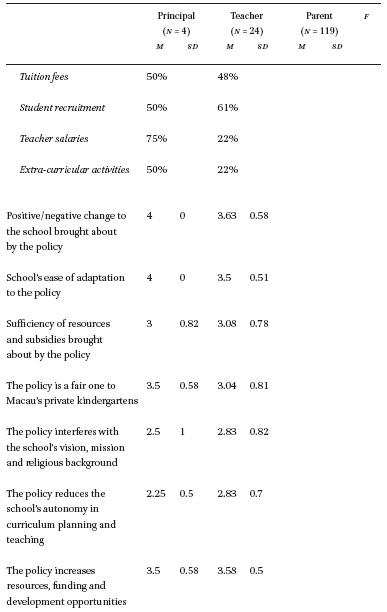
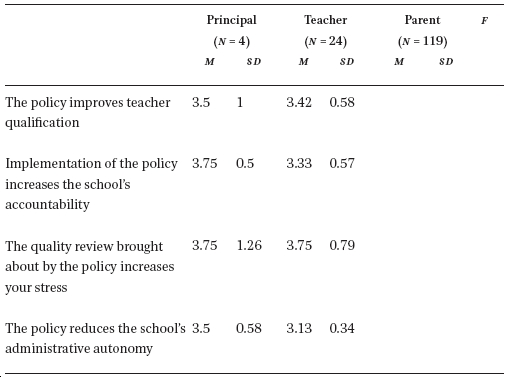
As seen from Table 2, of all the stakeholders, the principals were the ones who were most familiar with the policy and supportive of the full-day kindergarten programme. They believed most strongly in the policy’s effectiveness in reducing the financial burden of parents on childcare expenses, and regarded most strongly that the financial subsidy from the government was insufficient. In contrast, teachers were the least familiar with the policy, and only 26% and 17% of them believed that the policy could improve teacher qualification and the quality of the school curriculum respectively. Parents gave the highest grading to the policy, but their rating for whether the policy could improve the quality of education was the lowest amongst the stakeholders.
All stakeholders believed that the policy was effective in reducing the financial burden of parents on childcare, with the mean grades ranging from 4.21 (teachers) to 4.75 (principals). The roles of the respondents significantly affected their grading of the policy, with principals giving the lowest grading (72.5) and parents giving the highest grading (83.09), F (2,136) = 4.38, p < .05; how they perceived about a potential increase in the tuition fee after the policy, with parents negatively reported a mean grade of 2.74 and principals being slightly positive with a mean grade of 3.25, F (2,134) = 3.58, p < .05; as well as the amount of confidence they had for school operation, with 75% of the principals, 64% of the parents, and only 29% of the teachers reported to be confident, F (2,136) = 6.17, p < .01.
Comparison of views on macau’s free education policy across respondent’s roles (n = 147)


* p < .05.
** p < .01.
Views of the Policy across School Types
As Table 3 shows, the respondents from both types of kindergartens had a similar familiarity level of the policy and perceived the policy as effective in reducing the parents’ financial burden on childcare and in improving resources and facilities. However, they did not perceive an increase in tuition fees after the implementation of the policy, and were somewhat neutral about the policy’s ability to improve the quality of education and increase the school’s financial transparency.
The kindergartens which were part of the free education network were more positive towards the policy, with a mean grade of 82.13 compared to a mean grade of 79.7 given by the kindergarten which did not join the network, and were more supportive of full-day kindergartens in Macau. Besides, they were “neutral” about the sufficiency of the government subsidy, and reported changes in pedagogies (33%), student recruitment (14%) and teacher-student relationship (10%) as a result of the implementation of the policy.
The position of the kindergartens in the free education system was found to significantly affect how the kindergartens perceived the sufficiency of the government subsidy and how confident they were in school operation after the implementation of the policy, F (2, 141) ≥ 4.45, p < .05. The kindergartens which did not join the network perceived the subsidy as insufficient and less than half (44%) of them showed confidence in school operation after the implementation of the policy compared to the 63% of the within-network kindergartens which expressed confidence in this regard.
Comparison of views on macau’s free education policy across school types (n = 147)


* p < .05.
Needed Policy Improvement and Perceived Policy Impact
The open-ended questions in the questionnaires gathered the respondents’ opinions about any needed refinement to the policy. The suggestions most commonly made by the respondents were: (1) expanding the coverage of the government subsidy to cover extra-curricular activities, meals, uniforms, and other miscellaneous items (15%); (2) increasing resources and government assistance given to kindergartens on curriculum guidance and specialists support (10%); and (3) monitoring the financial management and operation of kindergartens (7%).
As service users, parents were concerned about the effectiveness of using public treasury and hoped for a genuine zero-cost education in all public and private kindergartens in Macau. As service providers, principals and teachers regarded teacher professional development opportunities and active government support as vital to the provision of quality
Interview Comments about the Policy
Face-to-face interviews with the stakeholders revealed that authentic free education was only applicable to children studying at local public kindergartens. Principals and teachers of kindergartens which were part of the free education system confessed that only the school tuition fee was exempted and parents still had to pay for a variety of “optional” fees, including meals, uniform, tutorials, school bus, daycare services, etc., and since many were working parents, most parents had no choice but to pay for them. Principals and teachers of both types of kindergartens revealed the fact that while joining the network would diminish the school’s administrative autonomy and power, some schools were joining for survival reasons, for instance, when their student admittance rate was too low and their income could no longer sustain their operational expenditure. Kindergartens which joined the network were subject to periodic quality reviews, but the public had no access to the performance reports. Parents, in particular, expressed a desire to have access to such documents and believed that the kindergartens should disclose them. While public kindergartens offered genuine free education, parents had no intention to enroll their children at public kindergartens where, as commonly believed by parents, the student population was dominated by ethnic minority children and those deemed as unsuitable to attend mainstream kindergartens due to such reasons as special educational needs and learning disabilities. Unless financially incapable, parents would generally opt for private kindergartens, which charge for tuition and other additional services.
Discussion
This study served as a preliminary attempt to investigate how the stakeholders of the
Perceived Impacts of the Free Education Policy on the 3A’s
The results of this study showed that respondents perceived some positive impacts of the free education policy on the affordability of and accessibility to quality
First, the vast majority of the respondents, regardless of their roles and school types, regarded that the policy could successfully reduce the financial burden and the stress that families had on child-rearing. Paying less on tuition fees allowed parents more money to spend on their children’s
Parental choice of either public or private kindergartens was found to be unaffected by the policy. Proximity of the kindergarten to their homes, the kindergarten’s traditional educational reputation, the potential transitions to the affiliated primary and secondary schools, student profile, and whether the kindergarten’s curriculum, pedagogies, and vision, for instance, aligned with their expectations were the most commonly cited concerns in parents’ selection of kindergartens. In other words, whether their children could receive an authentic free kindergarten education was not the primary concern in the selection of kindergartens. The majority of stakeholders were “neutral” about the sufficiency of government subsidy and the reason for their “indecisiveness” could be reflected in their concern about the government’s limited scope of financial support, which excluded subsidies for children’s
Second, positive impacts on the accessibility to quality
To compensate for the low salary of teachers and to encourage teacher participation in self-learning, teacher training, and research, the
With regard to the accountability of schools, however, a lack of all-round convincing evidence was found. Although quality reviews were carried out on the subsidized schools by the
In terms of how principals and teachers considered their salaries, the majority of them opted for neutrality. While the teacher professional development subsidy had relieved their financial burden, teachers claimed that more subsidies were needed to compensate for the increasing inflation and rising prices of necessities. Like some of the Asian and western cities where teachers receive year-end bonuses as a reward to their excellent work, kindergartens in Macau could introduce a similar reward or bonus system to boost staff morale and work efficiency.
Stakeholders’ Comments of the Policy across Roles and School Types
Significant differences were found in the respondents’ views regarding their perception of the policy impacts across roles and school types. How confident respondents felt about school operation after the implementation of the free education policy was significantly affected by their roles and school types. Familiarity with the policy was found to be positively associated with the respondents’ confidence in school operation, their grading of the policy, and their perception of whether the policy could improve the kindergarten’s teaching quality, r s ≤ .3, p < .01. The more knowledgeable the respondents were, the more informed responses and views they could make.
Among the three stakeholder parties, principals were the most familiar with the policy, but gave the policy the lowest grading. Although the free education policy had brought about changes to the nature and management of the kindergartens, resources and facilities, teacher qualification, and salaries, it did not significantly change the school’s pedagogies, home-school and teacher-student relationships, and tuition fees. As the gatekeeper to a business enterprise, more active support from the government, as well as an increase in and expansion of the financial subsidy to cover such expenses as the support from childcare professionals and the kindergarten’s rent could help gain acknowledgement from the principals.
It is also noteworthy that parents gave the policy the highest grading. They generally showed greater approval to the free education policy and perceived the impacts more positively than the principals and teachers. Taking into account that the primary objective of the free education policy is to provide free or affordable education to all permanent Macau residents, it is understandable why the policy appeared to be more appealing to parents. The contentment of the Macau parents could be stemmed from the consideration that the Macau government had already satisfied their other basic needs, such as housing, travelling, and food expenditure, and had been offering them residential bonuses on a periodical basis, the current amount of the educational subsidy would therefore appear to be reasonable. Their positive perception towards the comprehensiveness of the policy and the financial support provided by the Macau government could also explain why they regarded the change in tuition fee as minimal after the implementation of the policy.
The teachers, on the other hand, were the least optimistic about the policy impacts and showed the least overall support to the policy amongst the three stakeholder parties. Although the government had been providing them with a monthly professional development subsidy, their monthly income was still of an unsatisfactory level and the recent quality reviews had inevitably increased their stress level. As with the principals, more subsidies, support, and resources were seen as necessary to the development and provision of quality education.
School types were found to significantly influence the stakeholders’ perceived impacts of the free education policy. Kindergartens which joined the free education scheme graded the policy higher, perceived a more positive view towards the sufficiency of the subsidy, and were more confident about school operation than the one which did not join the scheme. This could be a demonstration of the self-fulfilling prophecy as the kindergartens which joined the free education system anticipate positive outcomes to accompany the introduction of the policy. For perceptual or behavioural changes to occur, restructuring the circumstances, which involves observable changes in societal structures, norms, and laws, is warranted. 19 The free education policy has brought about alterations to the education system, and as the root of the perception towards the situation and the concurrent belief system lie in the in-group social structure (i.e. the within-network kindergartens), the behaviour of the out-group (i.e. the out-of-network kindergarten) plays no effect in the process. 20 The sheer participation in the network means no “turning back” for the kindergartens and may have caused them to be less aware of or skeptical about the inadequacies of the system. As a consequence, with the support of the policy, they felt more confident about the management and operation of the kindergarten, and also about the adequacies of the government subsidy and support.
In contrast, the out-of-network kindergarten graded the policy lower, regarded the subsidy as insufficient, and less than half of the stakeholders showed confidence in school operation after the commencement of the policy. Kindergartens must experience a reduction in school autonomy as a tradeoff to receiving subsidies from the government. Given the absence of immediate extinction danger posed by insufficient head counts, the sufficient resources kindergartens enjoy, and the fear of losing school autonomy, some kindergartens perceived no urgent need to join the free education network.
Finally, all stakeholders expressed their wish for the government to introduce a more extensive subsidy and support system which would include subsidizing children’s education-related
Moreover, recalling that the interviewed parents were worried about the educational climate and the quality of education at public kindergartens. They believed that public kindergartens in Macau comprised mostly of children with learning disabilities, special educational needs or those who were found unfitted to study at mainstream kindergartens for various reasons. As a result, unless financially incapable, parents would not opt for public kindergartens even with the promise of an absolute zero-cost free education. While efforts should be made to embrace all qualified Macau children to enjoy authentic free kindergarten education, the government should also look for ways to improve the images of public kindergartens and ensure that their quality of education are in line with the standards of private kindergartens, as well as those of the public. While less financially capable children would be enrolled at public or within-network kindergartens, financially capable parents would enroll their children at the traditionally renowned independent private kindergartens, as driven by the free market mechanism. Social stratification of children from different socio-economic backgrounds could therefore be shown in kindergarten selection and student enrollment.
Given the small sample size of the present study, the data collected could not be generalized to the rest of the population in Macau. Nonetheless, the information gathered could serve as a rough estimate for the Macau government to realize how stakeholders from part of its education sector perceive the free education policy and the areas within the policy which may need refinement. While the thriving gambling industry makes a lucrative revenue source for the Macau government and the sustainability of the 15-year free education system is undoubtedly secure, having tackled the problems of affordability and accessibility, the free kindergarten education system in Macau, however, still needs to improve its accountability. Free education should never mean lower quality and no accountability.
Footnotes
1 Bill K.P., Chou. “The Paradox of Educational Quality and Education Policy in Hong Kong and Macau.” Chinese Education & Society 45, no. 2 (2012): 96-110.
2 Joan Fun Hei, Tang and Keith Morrison. “When marketisation does not improve schooling: the case of Macau.” Compare 28, no. 3 (1998): 245-262.
3 Bray, Mark, ed. The economics and financing of education: Hong Kong and comparative perspectives. Vol. 20. Hong Kong: Faculty of Education, University of Hong Kong, 1993.
4 Ibid.
5 Colin Brock and David Smawfield. “Education and development: the issue of small states.” Educational Review 40, no. 2 (1988): 227-239.
6 Chou. “Educational Quality and Education Policy”
7 Louise D. Rosario, “Education Reformer.” Macao Magazine, April 2012, 11: 14-20.
8 Rosario. “Education Reformer”

12
15 Li, Wong, and Wang. “Affordability, accessibility, and accountability”
16 Cohen Louis, Manion Lawrence, and Morrison Keith. “Research methods in education.” (4th Ed.) Routledge, London,
20 William E. Wilkins, “The concept of a self-fulfilling prophecy.” Sociology of Education (1976): 175-183.