



Abstract
The objective of this research is to understand the preconditions and difficulties for implementing free early childhood education in rural China. A case study of City D was conducted in Shandong province. City D announced the 3-year free kindergarten education policy in 2009, but only District H had successfully launched it in public kindergartens in the rural areas by 2012. Although the policy was welcomed by families in rural area, the implementation was difficult to both the district governments and the local kindergartens. The major difficulties encountered in the process of implementing this policy included the lack of funding support, the absence of supporting policy and assurance measures, and the discrimination against migrant children from rural areas. To solve the problems, this study suggests a multiple-stage method for developing a practical and continuous model and the funding responsibility moving from district and county government to those of the upper levels.
Free Kindergarten Education in City D: A Case Study in Shandong
The accessibility and affordability of early childhood education in China have become a statewide concern since the turn of the millennium. Insufficient public funding and unfair allocation have further worsened the problems. As a consequence, the central government has started to pay more attention and input into early childhood education. So did the People’s Congress (
Against this background, some scholars proposed the launch of free kindergarten education in China, especially in the rural areas. 3 At the same time, some politicians and scholars urged the local governments to increase the investment in early childhood education and proposed to pilot free kindergarten education in economically developed regions. 4 Accordingly, the Li clan of Changjiang—an autonomous county in Hainan Province, for instance, launched 1-year free kindergarten classes in 2009, which were set up in primary schools in towns and counties. Several counties and districts in Shaanxi, Shandong and Guangxi provinces also have launched their free kindergarten education policies since 2010.
The joint advocacy of scholars, politicians, and governmental officials has made the free kindergarten education a timely and topical issue in China, as well as a strong desire of the public. However, is it feasible to implement free kindergarten education of reasonable quality with the current economic and societal development of China? If feasible, what are the preconditions and workable ways for implementing the free kindergarten education? This study was dedicated to addressing these two questions with a case study on City D in Shandong province, which launched the free kindergarten education policy in 2012.
Method
Instrumental case study design was deployed in this research, with an objective to examine the preconditions and workable strategies for implementing free kindergarten education in City D of Shandong Province. Through which, we attempted to provide insights into the free kindergarten education policy and facilitate the understanding of its preconditions and solutions.
The Case
Shandong Province is located in the eastern part of China. It features a prosperous agricultural industry, a self-contained industrial system, ample resources and energy, as well as a large population. Its economic development is ranked first in the country. In 2012, its provincial fiscal revenue was
City D is located in the north of Shandong province, with 2 districts (including District H) and 3 counties (including County G). It is an important resource-dependent coastal city, and its economic development is ranked at middle level in the province. The public fiscal revenue of the whole city in 2012 was
District H included early childhood education in the annual social welfare projects in 2011 and 2012.
County G is located in the south of City D and is also an economically developed county. Ranked first in the city in 2012, its annual fiscal revenue was
Data Collection
Content Analyses. We collected all the policy documents on kindergarten education issued by City D and District H, and analyzed the institutional design on free kindergarten education.
Interviews. We interviewed three educational officials from City D, District H, and County G, as well as two principals from two public kindergartens in two towns, in order to collect data on the basic information of the policy, the implementation, and the difficulties they encountered. Ten parents from rural families in District H were also interviewed to tap into their views towards the free policy.
Results
The Policy on Free Kindergarten Education
We analyzed the policy documents to understand its design and purpose. Normally, policies should set out clear goals, workable solutions and implementation plans, in alignment with each other. Otherwise, the policy could not achieve the target and a policy failure would be resulted. In this regard, inconsistency was found in this study.
The Conflicting Goals between the City and the District. Two policy documents were issued by City D and two by District H regarding free kindergarten education (see Table 1). Conflicts were found in the document analyses, both within and between different governmental levels. First, the policy milestones and the actual extent of goal fulfillment were different. The document issued in 2008 proposed to start preliminarily implementing the 3-year free kindergarten education in the rural areas by 2012, whereas the document issued in 2009 proposed to activate the 3-year free kindergarten education system in 2012 but not to implement it until 2020. The discrepancies between 2012 and 2020, as well as between “preliminary implementation” and “activation” of the free education policy, are thus very problematic.
Second, the targeted children of the two policies were different. The policy document issued by the City D government only stated that the 3-year free kindergarten education should be implemented in 2012, without indicating any criteria for the eligibility of children. It could therefore, be interpreted that the policy should cover all eligible children in both urban and rural areas. However, the Implementation Plan issued by District H was only applicable to children enrolled in the public kindergartens in the rural areas. In this regard, the target coverage was gradually narrowed down in the policy documents from city level to district level.
Comparison of the policy goals of free kindergarten education between City D and District H

The City’s Policy Did Not Offer Workable Solutions. The two policy documents issued by City D put forward the goal of the 3-year free kindergarten education, without suggesting any workable solutions and measures. The City D Government highlighted in the policy document that the long-term mechanism of public financing for kindergarten education would be improved to ensure the implementation of 3-year free kindergarten education. However, it only stressed that the financial funding for kindergarten education should be included into and supported by the revenue budget as a reward rather than a subsidy at the same governmental level. Therefore, the financial responsibility of the free kindergarten education would be left to the district government and/or below.
In China, kindergarten education is managed and sponsored by varying levels of local governments, the district and county governments are in fact responsible for funding and implementing the free kindergarten education policy issued by the upper level governments. Therefore, there is the problem of autonomy as well as difficulties for the district and county governments to achieve the policy goals set by the city government. But it was also the autonomy that gave the district and county governments more room to narrow down the coverage, lower the goal, and postpone the deadline.
Conflicting Documents Issued by the District H. District H has followed the City’s policy to develop the 3-year free kindergarten education in the rural areas. Equity and equality have been the basic values which govern the orientation of the national kindergarten education policies since 2010. Both the Outline of China’s National Plan for Medium and Long-term Education Reform and Development (2010-2020) 6 and the Proposals on Development of Early Childhood Education 7 proposed to develop public and universally free kindergarten education, especially in the rural areas. The policy goal of District H was in line with the two principles: equity and equality.
However, several restrictions were also set by District H on the targeted group. These restrictions, in our perspectives, are really needed to reinforce the management of the policy and to reduce false reporting. But the part of concrete stipulation about the eligibility for the free education policy has obviously violated the principle of equity. First, the policy only targeted at children with residence registered in public kindergartens in District H. Such limitation on the eligibility has excluded the children registered in private kindergartens and those who have residence in the county in District H but has enrolled in other public kindergartens in this district. This has further narrowed down the coverage of the policy.
Impacts of the Policy
There are two districts and three counties under the jurisdiction of City D. Until now, most of the counties and districts have not taken any measures to implement the policy issued by the city government, except District H.
The ultimate goal of the policy in District H is to provide basic and universal kindergarten education to improve the enrollment rate especially in the rural areas, and to improve the affordability of kindergarten education for rural families. Therefore, the enrollment rates in rural areas and families are important indicators for reflecting the impacts of the policy.
According to the governmental statistics of District H, the 3-year kindergarten enrollment rate rose from 93% to 97.6%, and the rates in rural areas rose from 90% to 93%. Therefore, the free kindergarten education policy has made little influence on the increment of the enrollment rate in the rural areas. The ten farmer parents we interviewed expressed their satisfaction towards this policy, which has reduced their financial burden to a certain extent. The average family income per capita was
Difficulties Encountered During Policy Implementation
Insufficient Financial Funding. The kindergartens were found to be underfunded by the governments. Before implementing the free kindergarten education policy, the government of District H only funded the personnel in public kindergartens in rural areas, and there was no recurrent appropriation on the basic construction and running expenditures. As to the personnel funds, the district only funded the salary of teachers who held permanent contracts with the government. The kindergartens had to apply to the government for expenditure on construction through projects—slim chance, yet time-consuming. Therefore, they relied on the fees they charged parents to cover all of the running expenses, the salaries of teachers without permanent contracts with the government, the expenditure on construction and rebuilding of infrastructure, facilities, and play materials for young children. The fees collected from parents were the main source of income for the kindergartens. Parents paid
With the implementation of the policy, the governments at the district and town levels jointly fund the salary of teachers without permanent contract. Discounting this expenditure, the running cost was about
The District Government Could not Continuously Fund the Free Kindergarten Education. Now District H should provide
If the number of eligible children in rural areas of District H was estimated to be 2090 (2100 in 2012, and 2080 in 2013), and the government would fund at the standard cost per student in reality and add
County G was ranked the highest in City D in terms of financial income, but it had the largest population of eligible children in rural areas. If the County G funds according to the standard of
The income and expenditure were not balanced in districts and counties of City D when implementing the free kindergarten education policy, with budgetary expenditure exceeding budgetary income by 1 to 2 times (see table 2). In addition, the increment of educational expenditure was the biggest. The current percentage of educational expenditure had gone far beyond the financial capacity of each district and county. If there is no additional financial input, they will have no capacity to continue funding at the current level, not to mention increasing the funding.
Lack of Supporting Policies and Measures. The educational officials complained that the lack of supporting policies and measures was another important difficulty hindering the implementation of free kindergarten education policy.
Financial income and expenditure of districts and counties in City D in 2011
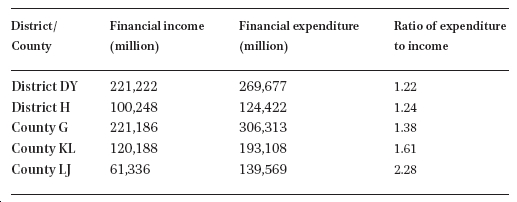
Source: Yearbook of Finance in District D in 2012, City D Municipal Bureau of Finance.
On one hand, the policies from the central and provincial governments did not specifically require the local government to implement free kindergarten education, and the governments at the district and county levels were thus very passive to carry out the free policy set by the city government. China was a typical centralization system in politics, but decentralization in administration. 9 The central and local governments play coordination game on the allocation of profits, responsibilities and power. Especially after the tax reform, the central government had the real control on finance and played the leading role during the coordination, but the allocation of the power of finance did not match with the responsibility for public affairs. The phenomenon whereby the local government bargained with the government at an upper level has long existed. In this context, it was easy to understand that the district and county governments did not have any incentives to push forward the policy imposed by city government.
On the other hand, there was no effective long-term mechanism to guarantee the funding and the construction of teaching teams. The expenditures of kindergartens were mainly used on basic construction, personnel and daily operation. But within the current policy framework, the district government only funded the running expense and teacher salary at a very lower standard. There was no financial guarantee for the construction of infrastructure and facilities, the purchase of teaching materials and books, and the in-service training of teachers. As a result, the kindergartens only provide basic free kindergarten education at a low quality level.
As one principal said, “the government bought the piano, toy shelves indoor, and large gross-motor facilities outdoor at the beginning stage of constructing this kindergarten. Computers and all-in-one printers were bought during the standardization construction project in 2010. There was no other financial funding from the government. The kindergarten could only survive and guarantee daily operation. A couple years ago, teachers taught young children Pinyin. Today, they are doing the same thing and cannot organize play in learning centers, since we did not have enough play materials, for example, building blocks, because they have no money.”
Exclusion of Migrant Children from Free Kindergarten Education. As the policy of District H only targeted at the children with residence who are enrolled in public kindergartens in the rural areas, the migrant children were excluded. For example, a kindergarten principal interviewed reported that there were 128 eligible children within her kindergarten’s coverage. They enrolled 107 children, and 9 children were from other places out of District H. Therefore, about 30 children in this area moved to other places with their parents, accounting for 23% of the enrollment. Half of these children went to cities with their parents, and the remaining half who are enrolled in rural kindergartens live with their grandparents. Under the current policy framework, these children with residence in the rural areas, who move within and between regions, had no access to the free kindergarten education.
Discussion
The 3-year free kindergarten education policy in District H of City D was applauded by the rural families, but was complained by the district government and kindergartens. The difficulties encountered during the policy implementation reflected the problems in the path of rolling out free kindergarten education and the conditional factors in Chinese context.
Developing a Rational Developmental Path
District H narrowed down the coverage of free kindergarten education from all eligible children defined by City D to merely those from public kindergartens in rural areas, which was a feasible and pragmatic move. But the funding to the 3-year free kindergarten education has added great pressure to the financial capacity. As a result, District H had funded in kindergarten education with a very high percentage of expenditure of kindergarten education in total educational expenditure, but the kindergartens were still seriously lacking adequate funds and could only provide universal and free education at a low level of quality. Therefore, it was not a rational and feasible path to develop the 3-year free kindergarten education in the first instance.
Implementing free kindergarten education needs tremendous financial, human, and physical resources. Therefore, it could not be totally fulfilled until the economic development reaches a certain level. The development of 9-year compulsory education in mainland China has also followed the path of first compulsory, then universal, and eventually, free. The history of policy and practice in those counties that had administered a kind of free kindergarten education reveals that most of them developed free kindergarten education according to the sequence of first free of charge for the one-year kindergarten education for 5-years-olds, before moving to younger children; and first disadvantaged children and then gradually extending to all children; and first tuition fee (education fee) and then expanding to include textbook fee (material fee). It was a universal practice to gradually broaden the range of beneficiary children, and progressively add fees category free of charge and increase the public funding step by step. 10 Based on the real conditions of economic development and the large population of young children, it would be a rational and sustaining path to advance the free kindergarten education, first kindergarten education in rural areas in advanced regions and then in the cities; and first one-year kindergarten education and then three years, instead of offering 3-year kindergarten education for all children.
Designing a Scientific Funding Mechanism
It was essentially the problem of funding that lied behind the phenomenon of narrowing the coverage of free kindergarten education, the lack of funding and supporting policies and measures, as well as the exclusion of migrant children involved in the design and implementation of policy in District H. Funding is the fundamental and essential guaranteed condition to launch free kindergarten education. At the moment, the funding responsibilities for free kindergarten education mainly rest upon the government of district in City D, and the standard for funding was referred to that of the running expenditure per student for primary school in the 9-year compulsory education system. Therefore, the problems of the funding body with weak financial capacity and the low funding standard level lead in inadequate funding.
First, setting a rational standard for financial funding for free kindergarten education. Because of the age and developmental characteristics of young children, the class size, classroom configuration, physical facilities, materials, the allocation of teachers, and so on, were different from those in primary schools, the operating costs of kindergartens were thus much higher than those of primary schools. It was not adequate for kindergartens to ensure the daily teaching activity if they are funded according to the standard for primary schools. There is no way they could provide high-quality care and education. Therefore, the local government needs to scientifically design the standard of running a kindergarten to ensure the basic quality according to the rules and characteristics of child development and kindergarten education, and accordingly, to calculate the operating costs of kindergartens and set a rational standard for financial funding.
Second, moving the funding responsibility to the upper-level governments. According to the Proposals on Strengthening Early Childhood Education 11 and the Proposals on Reform and Development of Early Childhood Education, 12 the governments at district and county levels are responsible for setting up public kindergartens, and the government at town level for the town central kindergartens. After the tax reform in 1994, the power of revenue was centralized, and thus the coefficient of the financial self-sufficiency of the local government decreased from 1.06 before the reform to 0.6, and to only 0.54 in 2002. 13 Especially after the complete cancellation of rural tax and fee, the county government exerted tighter control on the finance of town government and the non-budgetary funds were gradually reduced, which made the finance of the town government worse than that of the county government. 14 But the limited finance of the government at the county and town levels was mostly invested in the 9-year compulsory education. As a result, there were many difficulties to fund kindergarten education, which was defined as one of public welfare. And it was hard to guarantee the public funding in kindergarten education, if the management and funding system still adheres to the practice whereby the county government sets public kindergartens and the town government develops kindergarten education in the rural areas, given that the county and town governments could not improve their financial capacity in the foreseeable future. Therefore, the central and provincial governments with stronger financial capacities should take more responsibility for funding kindergarten education and shared with the local government at a rational ratio. They should also set up special funds for the development of kindergarten education in rural areas.
Third, raising funding through both government, market and voluntary mechanism. Since 2010 the early childhood education has gained more and more attention in mainland China. And the Three-Year Action Plan within the range of county has greatly pushed forward the development of early childhood education. But the developing mode mostly is the government directly building new public kindergartens and rebuilding or expanding old public kindergartens, which is not afforded by the government revenue capacity. In the context of insufficient financial input, the high goal and rapid speed of development inevitably resulted in either aborting the ambitious goal or giving up the educational quality. The cause of early childhood education is quasi-public goods, whose provision does not necessarily totally rely on government. The property of early childhood education and the real stage of social economic development in mainland China require the government to mobilize administrative supply, market supply and voluntary supply in order to raise sufficient funding for early childhood education, instead of exclusively by government’s public funding.
Including the Migrant Young Children
The policy in District H excluded the children with residence in rural areas from enrolling in kindergartens within the specified range. About a quarter of the eligible children interviewed moved to other places with their parents, and the rights to access free kindergarten education were denied under the current policy framework. According to the sixth census in 2010, the urbanization of population in City D had sped up since 2000. The speed of population converging to the central district and county with advanced economic development and moving within regions had also accelerated, whereas the population in rural areas had reduced gradually. 15 In China, the pace of urbanization also has quickened, and “the migrant people obviously tended to reside in cities, especially in big cities”. 16 In particular, the new generation of migrant peasants who moved from rural areas to cities had stronger wills to live in cities, and younger children were more likely to move with their parents than those of school age. The governments should consider how to protect migrant children’s rights and profits when designing and implementing free kindergarten education.
The implementation of free compulsory education in mainland China also encountered same problems of migrant children. Though the government has taken a series of measures, the problems were not properly solved until now. To avoid excluding migrant children from free kindergarten education, both in rural areas and in cities, the free kindergarten education in cities should be managed according to the population with long-term residence or dwellings and include the migrant children living in the local places into the service range, thus building an effective long-term mechanism to provide free kindergarten education for all the children who move with parents.
Footnotes
Acknowledgements
We are very grateful to the officials in the departments of early childhood education in City D, District H, and County G, as well as the principals and parents from the two town central kindergartens, for their valuable contribution to this study.
1 Xiaoxia, Feng 冯晓霞, Lingyan, Wang 王艳丽, Shujuan, Xiao 肖树娟, Xiamin Tang 汤霞敏 and Huairong, Zhang 张怀荣. “Ju Jiao Guo Jia Zhong Chang Qi Jiao Yu Gai Ge He Fa Zhan Gui Hua Gang Yao Dui Xue Qian Jiao Yu Jian Yan De Fen Xi 聚焦《国家中长期教育改革和发展规划纲要》 [Focusing on the State Medium and Long Term Program on Education Reform and Development about Preschool Education].” Studies in Preschool Education 6 (2009): 3-9.
2 State Council. “Guo Jia Zhong Chang Qi Jiao Yu Gai Ge he Fa Zhan Gui Hua Gang Yao 国家中长期教育改革和发展规划纲要 [Outline of China’s National Plan for Medium- and Long-term Education Reform and Development (2010-2020)].” People’s Republic of China: State Council, 2010.
3 People Education. “Experts’ view: Tendency to include early childhood education into compulsory education system and proposal to administer free early childhood education” (in Chinese). April 10, 2009, accessed October 31, 2013.
4 Xin Bai, 白昕 and Chuyang Zhou 周初阳. “Liaoning Sheng Zheng Xie Jian Yi Shi Shi Mian Fei Xue Qian Jiao Yu 辽宁省政协建议实施免费学前教育 [Liaoning provincial people’s political consultative conference proposed to administer free kindergarten education].” In Shenyang Wan Bao 沈阳晚报 [Shenyang Evening New]. June 27, 2013, accessed October 31, 2013,  .
.
Gao Song, Pan, 潘高耸 and Yu Xiang, Huang, 黄宇翔. “Hui zhou shi ren da dai biao jian yi: gu li fa da di qu shi xing mian fei xue qian jiao yu 惠州市人大代表建议: 鼓励发达地区试行免费学前教育 [Huizhou deputy of municipal people’s congress proposed to pilot free kindergarten education in advanced regions]” 人民日报 [The People’s Daily], August 10, 2011, accessed October 31, 2013, .
Jingshui, Guo, 郭景水. Sheng Ren Da Dai Biao Huang Cong Jian Yi: Er Tong Xiang Shou Gong Ban Mian Fei Xue Qian Jiao Yu 省人大代表黄聪建议: 儿童享受公办免费学前教育 [Hainan provincial deputy of people’s congress suggested to carry out free public kindergarten education].” In Nanguo Dushibao 南国都市报 [Nanguo City Daily], January 30, 2013, accessed October 31, 2013, .
Yueqin, Zhou, 周月琴. “Jiang Su Sheng Zheng Xie Tao Lun Jian Yi You Tiao Jian Di Qu Mian Fei Xue Qian Jiao Yu 江苏省政协讨论 ‘建议有条件地区免费学前教育’ [Jiangsu provincial people’s political consultative conference discussed proposal on implementing free kindergarten education in advanced regions].” In Yang Zi Wan Bao [Yangzi Evening News], February 12, 2012, accessed October 31, 2013, .
5 Haizheng, Wei, 魏海政. “Shan Dong Ti Qian San Nian Wan Cheng Xue Qian Jiao Yu You Er Ru Yuan Gui Hua Mu Biao 山东提前三年完成学前教育幼儿入园率规划目标 [Province S has fulfilled the planned goals of early childhood education three years ahead of the schedule].” China Education Newspaper, January 25, 2013, accessed October 31, 2013, .
6 State Council. “Guo Wu Yuan Guan Yu Dang Qian Fa Zhan Xue Qian Jiao Yu de Ruo Gan Yi Jian 国务院与当前发展学前教育的若干意见 [Proposals on development of early childhood education].” People’s Republic of China: State Council, 2010.
7 State Council. “Guo Jia Zhong Chang Qi Jiao Yu Gai Ge he Fa Zhan Gui Hua Gang Yao 国家中长期教育改革和发展规划纲要 [Outline of China’s National Plan for Medium- and Long-term Education Reform and Development (2010-2020)].” People’s Republic of China: State Council, 2010.
8 People Education, 人民网教育频道 “wo guo jiao yu jing fei jin 1.3% tou ru you jiao yuan di yu guo ji ping jun zhi 我国教育经费仅 1.3% 投入幼教 远低于国际平均值 [1.3% of the educational expenditure was invested in early childhood education, which was far lower than international average percentage]” April 10, 2009, accessed October 31, 2013, .
9 Zheng Han, Cao, 曹正汉 and Jie Zhou 周杰. “She Hui Feng Xian Yu Di Fang Fen Quan— Zhong Guo Shi Pin An Quan Jian Guan Shi Xing Di Fang Fen Ji Guan Li De Yuan Yin 社会风险与地方分权—中国食品安全监管实行地方分级管理的原因 [Social risks and decentralization of governance: Reasons for hierarchical management system in food safety supervision in mainland China].” Sociological Studies 1 (): 182-205.
10 Lijuan, Pang, 庞丽娟, Jing, Xia 夏婧 and Xia, Zhang 张霞. “Shi Jie Zhu Yao Guo Jia He Di Qu Xue Qian Jiao Yu Mian Fei Zheng Ce Te Dian Ji Qi Shi 世界主要国家和地区学前教育免费政策: 特点及启示 [Free early childhood education policies of main countries and regions in the world: Features and inspirations].” Comparative Education Review, 10 (2010): 1.
11 National Education Committee and Other Seven Ministries 国家教委等部门. “Guan Yu Jia Qiang You Er Jiao Yu Gong Zuo Yi Jian De Tong Zhi 关于加强幼儿教育工作意见的通知 [“Proposals on strengthening early childhood education].” People’s Republic of China: State Council, 1988.
12 Ministry of Education and Other Nine Ministries 教育部及九部门. “Guan Yu You Er Jiao Yu Gai Ge Yu Fa Zhan Zhi Dao Yi Jian De Tong Zhi 关于幼儿教育改革与发展指导意见的通知 [Proposals on reform and development of early childhood education].” People’s Republic of China: State Council, 2003.
13 Xiao, Zhao, 赵晓. “Cong Hong Guan Tiao Kong Kan Zhong Yang Di Fang Guan Xi Bian Ge 从宏观调控看中央地方关系变革 [Change of relationship between central and local governments from the view of macro control].” China Development Observation, 3 (2007): 56.
15 Cao and Zhou “She Hui Feng Xian Yu Di Fang Fen Quan—Zhong Guo Shi Pin An Quan Jian Guan Shi Xing Di Fang Fen Ji Guan Li De Yuan Yin”.
16 Cheng Rong, Duan 段成荣, Li Dan, Lv, 吕利丹 and, Xiang Jiang, Zou, 邹湘江 “Dang qian wo guo liu dong ren kou mian lin de wen ti he dui ce 当前我国流动人口面临的主要问题和对策: 基于 2010 年第六次全国人口普查数据的分析 [Problems and solutions in migrant population in mainland China: Based on sixth national census in 2010]”. Digest of Sociology 社会学文摘 3 (): 11.