




Abstract
Adolescent problems in Hong Kong have brought questions about their moral development and mental health to light. Moral education for preschool children will be strategically important to address these issues because applying early educational interventions to preschool children will effectively enhance their personal development. This article highlights the inadequacy of the Hong Kong preschool curriculum guides in the promotion of moral development in children. The lack of a consensus about the values and character that preschool children should develop is a fundamental problem of implementing preschool moral education in Hong Kong. If moral education is regarded as a school curriculum, either formal or informal, the objectives, content and assessment should be closely adhered to one another. In addition, the learning and teaching activities should also be in line with student’s developmental characteristics and experiences. The O-C-A model is then proposed for moral education in the preschool settings of Hong Kong. Advice has also been made for the promotion of moral education in Hong Kong’s early childhood settings.
Introduction
Adolescent problems such as the lack of self-managing abilities, bullying and committing suicides in recent years have alarmed the community of Hong Kong (Cheung, 2016). There has also been a decline in the age of children who committed suicide (Headline Daily, 2017). The problem of child suicide gives us a signal of the frailty of Hong Kong’s young people in handling problems, pressure and frustrations. Peer bullying such as threatening, insults, violence as well as cyber humiliation occur even among primary school pupils (Wu, 2015). According to a survey of a non-government organization, it was found that students with special educational needs were often beaten, kicked and even sexually harassed by their schoolmates (Hong Kong Daily News, 2015). Assaults do not only occur on peers but also on animals because children were found destroying plants in a park, catching turtles from a pool, throwing them into water and shooting at them with stones (Sing Tao Daily, 2015). The plurality of ethnic groups in Hong Kong schools has also brought about conflicts and bullying among students. These problems might be a result of a lack of positive attitudes in children towards life and a deficiency in respect for themselves and others. These problems and heartbroken consequences bring questions about the children’s mental health and their moral/character development to light. It is believed that moral education can help children become responsible members of their society (Johansson et al., 2011; Lovat and Toomey, 2007). Pala (2011) also maintains that character education can help in dealing with these problems: We want our children to be honest. We want them to respect those different from themselves. We want them to make responsible decisions in their lives. We want them to care about their families, communities and themselves. These things do not happen on their own . . . Character education helps students to develop important qualities such as justice, diligence, compassion, respect, and courage, and to understand why it is important to live by them. (pp. 24–26)
Therefore, moral/character education at early years shows potential to help children deal with their personal and social problems in a more appropriate way.
Moral education for preschool children will be of strategic importance in the provision of education to young people. It is because early educational interventions to preschool children will enhance their personal development (Reynolds et al., 2001). However, Hong Kong government’s support provided to preschool education had not been on par with that provided to primary, secondary and higher education. Early childhood education in Hong Kong had been ‘operated outside the boundaries of formal government policy’ (Pearson and Rao, 2006: 363) until the urge for quality school education in the 2000s. At the beginning of the 2000s, it was pointed out that preschool education should aim to ‘help children cultivate a positive learning attitude towards learning and good living habits in an inspiring and enjoyable environment’ (Education Commission, 2000: 30) in the reform proposal for the Hong Kong education system. But deeply influenced by the Confucian heritage culture and keen competition for a place in Hong Kong’s publicly funded universities, parents in Hong Kong generally hold high expectations for their children’s education (Curriculum Development Council, 2017; Xiang and Chiu, 2018). It makes Hong Kong parents and kindergartens put emphasis on children’s subject knowledge acquisition and cognitive development (Education Bureau, 2012, 2016). Preschool education is expected to prepare children for the formality of primary education rather than their all-round development (Pearson and Rao, 2006). Kindergartens were found assigning seven pieces of homework to children at weekends (Sky Post, 2014). The concern for helping their children to get a head-start in academic work has been rooted in the minds of Hong Kong parents. Children’s moral development has not been addressed as important as their cognitive development although whole-person development in children has been stipulated in Hong Kong education policy papers. As research on moral education in Hong Kong preschools is very limited, this article examines the preschool curriculum guides of Hong Kong from the perspective of moral development, and makes suggestions on facilitating moral education in Hong Kong’s preschool education.
A number of terminologies have been used by the Education Bureau of Hong Kong to enunciate the cultivation of values and social responsibilities in students. These terminologies include moral education, character education, civics education, national education, values education and life education. The most frequently used terminology is moral education. Moral education and character education are always regarded as synonyms. In the Hong Kong curriculum guides for pre-primary education, ‘moral education’ instead of ‘character education’ is used to depict the development of positive and pro-social youth. The Education Bureau (2018) asserts that schools in Hong Kong should promote moral education through nurturing in students the seven priority values and attitudes: ‘perseverance’, ‘respect for others’, ‘responsibility’, ‘national identity’, ‘commitment’, ‘integrity’ and ‘care for others’. Taking the cultivation of positive values and attitudes as the direction, schools should enhance the connection among various cross-curricular domains in values education in order to provide students with all-round learning experience conducive to their whole-person development. These domains include moral and ethical education, civic education, ‘Basic Law’ education, human rights education, national education, anti-drug education, life education, sex education and education for sustainable development (Education Bureau, 2018). Although moral education and character education are always regarded as synonyms, moral education tends to be ‘theory-based’ as the term has been associated with constructivist perspective that it attempts to promote the development of justice reasoning and cognitive structure (Althof and Berkowitz, 2006; Kohlberg, 1978). Character education, on the contrary, is ‘atheoretical’ as compared with moral education. Character education puts emphasis more on the achievement of desirable behavioural outcomes. It is behaviour-orientated and focuses on the inculcation of desirable habits. Lickona et al. (2002) maintain that ‘character is broadly conceived to encompass the cognitive, emotional, and behavioral aspects of the moral life’ (p. 1). Althof and Berkowitz (2006) also deem that character education ‘includes a very wide range of outcome goals, pedagogical strategies and philosophical orientations, but there is substantial overlap between the character education and moral education “camps”’ (p. 498). This article follows Hong Kong’s conventional practice that ‘moral education’ is used for the development of values and characters in students. The illustration below will focus on how moral education has been advocated in Hong Kong’s preschool curriculum guides, and on the suggestions of promoting moral education in the preschool settings of Hong Kong.
Methodology and the review of curriculum guides
As the curriculum guides for early childhood education are the main sources of data, content analysis is used in this study because it is a flexible and versatile approach to analysing textual, visual and audio data (Hsieh and Shannon, 2005; Stemler, 2015). Among the approaches to content analysis, summative analysis approach is adopted in order to understand the contextual use of words and the content in the curriculum guides (Hsieh and Shannon, 2005; Morse and Field, 1995). This study begins with searches for the contents which are related to moral and character education in the preschool curriculum guides, and then look into how moral education is advocated in the guides. A curriculum model for the implementation of moral education in preschool settings is also recommended in this study.
Up to 2018, there have been five curriculum guides for Hong Kong’s preschool education, namely, Guide to the Kindergarten Curriculum (1984), Guide to the Kindergarten Curriculum (1993), Guide to the Pre-primary Curriculum (1996), Guide to the Pre-primary Curriculum (2006) and Kindergarten Education Curriculum Guide (2017). Guide to the Kindergarten Curriculum (1984), which is the first formal curriculum document on early childhood education, aimed to (1) provide materials which are in line with children’s abilities and daily experience for thematic teaching, (2) suggest activities and play associated with the themes so that children can experience active learning and (3) make learning practical and interesting so that children can develop their basic learning skills (The Curriculum Development Committee Hong Kong, 1984). Even though the curriculum guide stated that moral, intellectual, physical, social and aesthetic development should be embedded in pre-primary education, emphasis was put on the development in the domains of language, early mathematics, general knowledge, music and art. The development of character in children was not a major concern in the document. The need of developing social abilities in children was indicated in only two short paragraphs, out of the 105 pages in the curriculum guide.
In the second curriculum guide for kindergarten education – Guide to the Kindergarten Curriculum (1993), the Hong Kong Curriculum Development Council 1 agreed that preschool children ‘not only learn fast and experience rapid development in both mind and body, their character also begins to take shape’ (Curriculum Development Council, 1993: 1). In this curriculum guide, the characteristics of 3- to 5-year-old children in the domains of motor skills, concepts, language, emotional and social development were clearly defined. Again, Curriculum Development Council (1993) presented to the public that the curriculum guide ‘aimed at enlarging children’s view of the world from their family to that of their school . . . [the guide] should help to produce the well-balanced development of children in the moral, intellectual, physical, social and aesthetic spheres of life’ (p. 3). The curriculum guide also stated that ‘pedagogical programmes should foster in children a positive attitude towards those aspects of cognitive, emotional and kinaesthetic learning which are important to the success of their future education’ (p. 3). The objectives of social and moral development stated in the curriculum guide are the following: (1) developing social skills, (2) cultivating children’s sense of responsibility, (3) enjoying social contact with others and (4) knowing the social environment. In the section, about the development of characters in children, the curriculum guide uses the wording ‘emotional and social development’ for character and moral development (p. 12). The objectives of emotional and social development in preschool children are as follows (p. 13):
To help children learn how to do things in an orderly manner;
To encourage children to build up self-confidence;
To train children to be cooperative, to exercise control and observe discipline;
To help children look after themselves;
To cultivate a sense of responsibility.
Comparing with the specific aims related to intellectual development, communicative development, personal and physical development and aesthetic development, the aims of social development, that is, objectives 3 and 5, had not been adequately elaborated. They look vague in terms of the achievable behavioural outcomes of moral development. In the meantime, the approach suggested in the guide for pursuing these aims is to set rules in classroom and help children observe the rules.
As a considerable number of recommendations on pre-primary education were made by the Board of Education in 1994, the third curriculum guide for preschool education – Guide to the Pre-primary Curriculum (1996) – was issued in 1996. This curriculum guide reiterated that pre-schooling should ‘help to foster children’s balanced development in their physical, intellectual, language, social and emotional aspects. Apart from the acquisition of academic knowledge, children should also equip themselves with other life skills, such as self-care skills, communicative skills, social skills and so on, so as to enable them to adapt to society’ (Curriculum Development Council, 1996: 1). The guide explains the general principles and approaches in the planning and implementation of the curriculum but with little stipulation to address the issue of moral development in children. Two additional aspects were stated in the 1996 curriculum guide, namely (1) to assist children to establish good interpersonal relationships, as well as to accept basic social values and norms, and (2) to cultivate in children an inclination to interact with and love their environment, apart from the aims of developing in children a sense of responsibility and positive attitudes towards work and people (Curriculum Development Council, 1996). Even though the guide states that one of the learning objectives is ‘to help children cultivate good character and good behaviour, as well as to teach them how to accept and appreciate themselves and other people’, it does not provide specific behavioural outcomes for character development in preschool children.
Following the education reforms in the late 1990s and the publication of policy paper – Learning for Life, Learning through Life: Reform Proposals for the Education System in Hong Kong in 2000 and the curriculum reform paper – Learning to Learn: The Way Forward in Curriculum Development in 2001, the curriculum of preschool education was also reviewed to cater for the demand for quality school education. The Curriculum Development Council (2006) of Hong Kong then published its fourth curriculum guide for pre-primary education – Guide to the Pre-primary Education in 2006, and highlighted that ‘the pre-primary curriculum should provide children with high quality and integrated pre-primary education and care service’ (p. 7). The four developmental objectives for young children, namely, Physical Development, Cognitive and Language Development, Affective and Social Development and Aesthetic Development become the core of this curriculum framework. Parents’ role in child development was also stressed because ‘parents are children’s first teachers as well as school’s crucial partners for nurturing children’ (Curriculum Development Council, 2006: 9).
The 2006 curriculum guide again maintains that preschools should assist ‘children to attain a balance between their personal interests and those of the community, to learn to establish good interpersonal relationships through negotiation and co-operation, and to accept basic social values and behaviourial norms’ (Curriculum Development Council, 2006: 19). For the basic social values and behaviourial norms which students should develop, an appendix of a set of values and attitudes was attached in the curriculum guide for kindergartens’ reference. The set of values and attitudes in the curriculum guide was just the ‘Proposed Set of Values and Attitudes for Incorporation into the School Curriculum’ in the 2001 curriculum reform paper – Learning to Learn: The Way Forward in Curriculum Development (Curriculum Development Council, 2001). These values and attitudes were not tailored for children of preschool age but are just general values and attitudes which apply to all levels of school education. For example, the core personal values proposed in the guide are as follows: sanctity of life, truth, aesthetics, honesty, human dignity, rationality, creativity, courage, liberty, affectivity and individuality (Curriculum Development Council, 2006: 104). Actually, some of these values such as sanctity of life, rationality, liberty and individuality can hardly be understood by children at their preschool age.
A total of 10 years after the publication of the Guide to the Pre-primary Education (2006), the Curriculum Development Council of Hong Kong reviewed the guide in response to societal changes and the introduction of free kindergarten education policy in Hong Kong. The Curriculum Development Council then published its fifth curriculum guide for preschool education, that is, Kindergarten Education Curriculum Guide in 2017. This curriculum guide highlights the ‘continuity among the kindergarten, primary and secondary education curricula, forming a coherent and co-ordinated education system to achieve the goal of whole-person education’ (Curriculum Development Council, 2017: 6) in the context that free education is provided to all pre-primary, primary and secondary school students. Kindergarten, primary and secondary education should constitute a coherent and complementary education system. Pre-schooling should lay foundation for children’s future study and development, and promote a balancing moral, intellectual, physical, social and aesthetic development for the achievement of whole-person education. This curriculum guide follows the rationale of Guide to the Pre-primary Education (2006) with child-centeredness as the core value, and adheres to the principle of ‘understanding and respecting the unique developmental patterns of every child’ (Curriculum Development Council, 2017: 9). Besides, due to changes in education policy (e.g. Free Quality Kindergarten Education Scheme), social values (e.g. getting a head-start for children) and demographic structure (e.g. non-Chinese speaking children), the key emphases of the pre-primary curriculum review are the following (Curriculum Development Council, 2017: 13):
Focusing on nurturing in children a balanced development;
Strengthening the promotion of moral education;
Providing elaboration on the learning objectives of each learning area;
Reinforcing catering for learner diversity and promoting an inclusive culture;
Promoting the use of real-life themes to connect each learning area;
Promoting learning through play and strengthening the element of free exploration in play;
Enhancing the interface between kindergarten and primary education.
Kindergarten Education Curriculum Guide (2017) asserted that preschool curriculum should adopt the principle of promoting a comprehensive and balanced development in children covering five developmental objectives viz. Moral Development, Cognitive and Language Development, Physical Development, Affective and Social Development and Aesthetic Development with a view to actualising the development in the five domains of ethics, intellect, physique, social skills and aesthetics respectively. (Curriculum Development Council, 2017: 18)
The objectives of moral development in pre-primary education are as follows (p. 23):
To develop an initial understanding of the basic concept of right and wrong and nurture positive values in children;
To help children establish a positive self-image as well as optimistic and positive attitudes towards life;
To foster in children positive attitudes towards people and help them learn to respect and care for people around them;
To develop a basic understanding of their roles and responsibilities in family, school, society, country, the world and other aspects in life.
Kindergarten Education Curriculum Guide (2017), similar to Guide to the Pre-primary Education (2006), does not provide a comprehensive illustration about the character and behaviour that children should develop, and approaches for the achievement of these outcomes. Philosophically, moral and character education must hold some important and generally shared core ethical values, for example, integrity, fairness, responsibility, caring, respect for self and others (Lickona et al., 2002) which serve as a cornerstone of good character and behaviour. Helping children develop these core ethical values and positive attitudes towards themselves, others and the community is the fundamental aim of moral and character education. The Curriculum Development Council agrees with this view so that a set of values and attitudes has been included as an appendix in the Guide to the Pre-primary Education (2006) and Kindergarten Education Curriculum Guide (2017).
In the proposed list of values and attitudes, there are 11 core personal values: sanctity of life, truth, aesthetics, honesty, human dignity, rationality, creativity, courage, liberty, affectivity, individuality; 14 sustaining personal values: self-esteem, self-reflection, self-discipline, self-cultivation, principled, self-determination, openness, independence, enterprise, integrity, simplicity, sensitivity, modesty, perseverance; 13 core social values: equality, kindness, benevolence, love, freedom, common good, mutuality, justice, trust, interdependence, sustainability, betterment of human kind, national identity; and 13 sustaining social values: plurality, due process of law, democracy, freedom and liberty, common will, patriotism, tolerance, equal opportunities, culture and civilization heritage, human rights and responsibilities, rationality, sense of belonging, solidarity. For attitude, there are 17 items: optimistic, participatory, critical, creative, appreciative, empathetic, caring and concerned, positive, confident, cooperative, responsible, adaptable to changes, open-minded, with a respect for, with a desire to learn, diligent, committed to core and sustaining values. For the attitude of ‘with a respect for’, it is further divided into 9 areas: self; others; life; quality and excellence; evidence; fair play; rule of law; different ways of life, beliefs and opinions; and the environment (Curriculum Development Council, 2017).
Again, this set of values and attitudes is not for pre-primary education specifically but for all levels of education. The lists of values and attitudes attached to the two pre-school curriculum guides – Guide to the Pre-primary Education (2006) and Kindergarten Education Curriculum Guide (2017) – are the same as that proposed by the Curriculum Development Council for primary and secondary school curricular (Curriculum Development Council, 2001). It indicates that the specific characteristics of preschool children had not been taken into account for their character and moral development when the curriculum guides were formulated. In the meantime, it is not easy for kindergarten principals and teachers to grasp a clear and concise understanding about what are the qualities that should be developed in preschool children. In fact, some of the values and attitudes such as human dignity, rationality, simplicity, enterprise, the betterment of human kind, human rights and responsibilities are difficult to be cultivated in the children of preschool age. The lengthy list of qualities and the lack of coherence to the developmental characteristics of children will confuse preschools in setting curriculum objectives for their moral education. It will also bring about problems to schools in organizing teaching and learning activities for their students. In fact, because of the traditional Confucian cultural heritage, many parents urge kindergartens to help their children gain a good grasp of subject knowledge so that they can gain a head start in academic work. Curriculum Development Council (2017) found that ‘some parents push for learning performance to meet their own high expectations, which exerts pressure on the physical and psychological development of their children’ (p. 13). The reports of Education Bureau’s (2012, 2016) Quality Review 2 also reveal that kindergartens always put emphasis on cognitive development in students. This indicates that kindergartens tend to please their parents at the expense of an all-round development in children for ensuring student enrolment.
The above review reflects that there is a lack of a comprehensive framework in terms of curriculum objectives, contents and assessment for moral development in preschool education, although there are general objectives of moral development, and desired values and attitudes in the curriculum guides. In addition, the pre-primary curriculum of Hong Kong appear to focus largely on children’s cognitive development even though the curriculum guide states that ‘it is of prime importance for children to have a comprehensive and balanced development at the kindergarten stage’ (Curriculum Development Council, 2017: 19).
Discussion and recommendations
Upon examining the pre-primary curriculum guides from the aspect of moral education, this section will depict recommendations to help kindergartens excel themselves in the promotion of moral development in children. Perhaps moral development in children is affected by a number of factors. For example, Bronfenbrenner’s ecology theory suggests that there is a broad range of variables that can affect children’s development. These variables can be categorized into four nested systems: microsystem, mesosystem, exosystem and macrosystem. Microsystem refers to the immediate setting(s) such as the family and classroom in which the child is a regular participant. Mesosystem refers to the cross relationship between microsystems, for example, the interaction between parents and teachers. Exosystem refers to the administrative and policy issues such as the management of staff members in a school, school curriculum and educational policies. Macrosystem refers to the values and attitudes, cultural and economic conditions of society (Bronfenbrenner, 1976, 1979; Leonard, 2011; Odom et al., 2004). Since this article mainly focuses on reviewing the preschool curriculum guides, only microsystem-, mesosystem- and exosystem-related recommendations will be included in the following discussion.
First, it has been revealed that the fundamental drawback of the pre-primary education curriculum guides in terms of moral development is the lack of a clearly defined list of values and good characters for preschool children. The Kindergarten Education Curriculum Guide (2017) claims that it aims ‘to instill in children positive values and attitude’ (p. 19), and children are expected to be able ‘to understand themselves, respect and care for others, have passion for life and exhibit good behaviour’ (p. 20). But what is ‘good behaviour’ and what are the ‘good values’ that preschool children should exhibit? The guides have no further elaboration on the values and desirable behavioural outcomes that preschool children need to achieve. The ‘Proposed Set of Values and Attitudes for Incorporation into the School Curriculum’ in the 2006 and 2017 curriculum guides has just listed the values and attitudes which are generally applicable to all levels of education, and there are totally 63 items of values and attitudes. The lack of a consensus for and a clear perception of the ‘good values’ and ‘good behaviour’ of preschool children puts forward an absence of a signpost for kindergartens in the implementation of moral education. This is the first and most important issue that needs to be addressed for promoting moral development in preschool children. As Hong Kong and Taiwan are Chinese societies, the experiences from the implementation of character education in Taiwan might provide good references to Hong Kong. The Tainan Municipal Education Department proposed only 17 core values for preschool children, namely, integrity, filial piety, gratitude, respect, care, responsibility, self-confidence, self-discipline, righteousness, justice, friendliness, trust, forgiveness, cooperation, courage, simplicity and diligence, and respect for life. In the meantime, studies on character development indicates that parents in Taiwan believe that the most important qualities that preschool children should possess are responsibility, respect, gratitude, filial piety, caring, honesty, self-confidence, self-discipline, diligence and respect for life (Wong, 2013). The list of values and characters for preschool children is much more concise than that of Hong Kong. In light of Taiwan’s character education, the Curriculum Development Council and Education Bureau of Hong Kong might need to work out a set of values and desired characters/behavioural outcomes specifically for preschool children in collaboration with academics, front-line early years education workers and parents. The list of values and good behaviour must be concise so that schools, teachers and parents know clearly the behavioural outcomes/moral virtues which need to be achieved in cultivating their children’s moral development.
Second, after defining the values and desirable behavioural outcomes for preschool children, kindergartens should adopt a curriculum perspective in the planning and implemention of moral education. A holistic curriculum view which takes account of objectives, contents and assessment, and a close inter-connectedness of these three domains can better help schools achieve the curriculum objectives (Winch, 2013). Lickona et al. (2002) also believe that a good moral education programme should cover the cognitive, affective and behavioural aspects of moral life. In light of Chan’s (2017) framework for the life education of Hong Kong, the model (O-C-A model) shown in Figure 1 which takes account of the Objective, Content and Assessment dimensions might be useful to help kindergartens gain a more effective planning of their moral education.
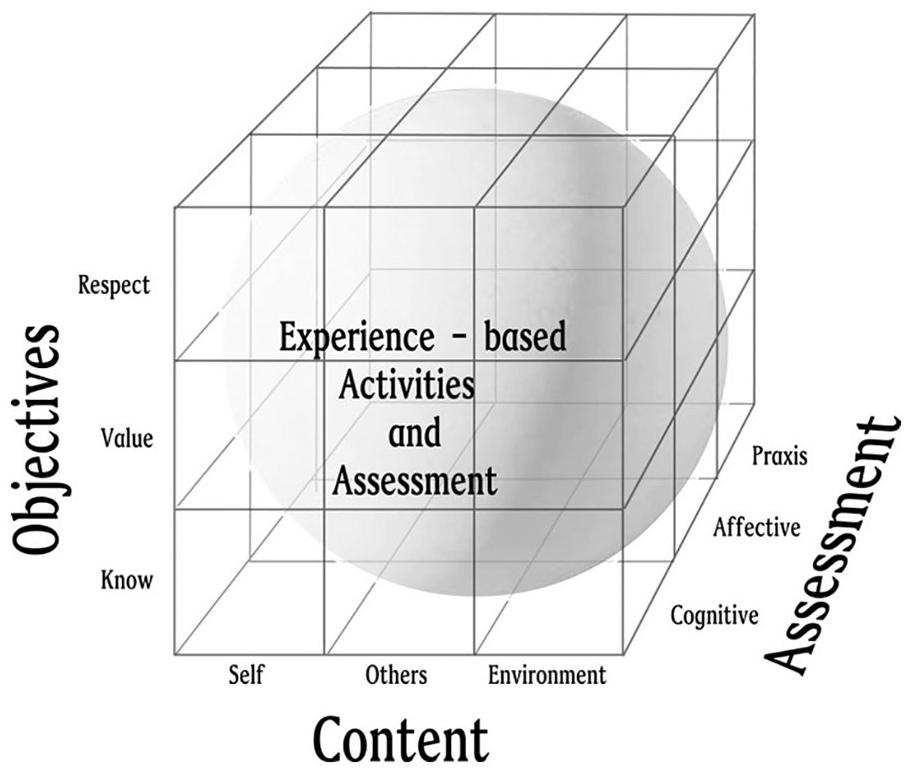
The O-C-A model of moral education.
The content dimension measures the categories of content matters about moral development in children. It includes the understanding of ‘self’, ‘others’ and ‘environment’. The objective dimension measures the different levels of awareness that preschool children need to attain in their moral/values development. The three levels of awareness to be achieved are the following: ‘know’, ‘value’ and ‘respect’. At the ‘value’ level, children do not just know but also show their acceptance of the values and characters. At the ‘respect’ level, children will not only accept but also embrace what they have accepted. The assessment dimension measures preschool children’s values development in terms of cognitive, affective and praxis achievement. Cognitive achievement refers to the scenario that children can recall what they have learnt. Affective achievement refers to the scenario that children agree with the values and desirable behaviour. Praxis achievement refers to putting the understanding of values/characters into children’s everyday practices. As tests and pencil-paper assessment is not and also should not be advocated in early years education, children’s achievement particularly their affective development and praxis achievement can be done through the prevailing assessment approaches such as teacher’s observation and student learning portfolio (Newell, 2003; Simon and Forgette-Giroux, 2000; Sunal and Haas, 2005; Weeden et al., 2002). This curriculum model will ensure a balanced and systematic organization of curriculum content and activities and therefore better help schools achieve a comprehensive moral/character development in children. Besides, as the curriculum for moral education should be closely linked to children’s experiences and development (Johansson et al., 2011; Lickona et al., 2002), students’ experiences of moral education in school need to be in line with their real life experiences and developmental stages. The O-C-A model calls for adopting an experience-based approach for the organization of activities and assessment in the delivery of moral education. In addition to the three dimensions of moral education, Figure 1 highlights the importance of using the approaches/activities which are relevant to children’s everyday experiences in the advancement of moral education in preschool children.
Third, in the promotion of moral education, there are two broadly accepted approaches, that is, values clarification approach and constructivist approach (Carr, 2008; Hildebrandt and Zan, 2008; Leming, 1981; Raths et al., 1996). Values clarification approach advocates that core ethical values have to be clarified in order to develop values in children while the constructivist approach maintains that the development of values emerges from action and reflection as ethical behaviour is based on children’s moral reasoning (Hildebrandt and Zan, 2008; Leming, 1981; Piaget, 1965). Although many studies indicate that young children are not entirely heteronomous in their moral judgements (Hildebrandt and Zan, 2008), Leming (1981) pointed out that values clarification approach can better help primary school students develop a positive attitude and understanding of relevant ethical issues, and the constructivist developmental approach can exert a significant impact only on students of the fourth grade and above. Children’s ability to make moral judgements is of course associated with their developmental characteristics, and it is also believed that children learn to be self-disciplined from the understanding of rules and shift from heteronomy to autonomy (Piaget, 1965). Schools and early years teachers can take this into account in organizing activities leading to character development in young children. In addition, other characteristics of children such as children’s special educational needs will also exert significant impact on their development (Odom et al., 2004). An organic integration of the values clarification and constructivist approaches which takes account of children’s characteristics is important to the promotion of moral education in preschools.
Fourth, another principle which schools can adopt in carrying out moral education is to make students’ educational experiences of values development be compatible with the social norms of respective values. As the interaction between teachers and parents is a mesosystem variable (Bronfenbrenner, 1976, 1979) and family is an important agency of socialization (Ballantine et al., 2017), parents should work in partnership with schools to ensure an effective moral development in children. Children should experience almost the same in their school and family in terms of moral and character development (Nucci, 1981, 1982). According to Ho’s (2008) research on home-school cooperation in Hong Kong, cooperation between home and school is very important to the cultivation of a caring atmosphere. The more cooperation between home and school and the more in assisting parents to guide their children, the more positive impact will be on the development of a caring atmosphere. The Hong Kong Education Bureau, therefore, should provide resources to kindergartens so that home-school cooperation can be enhanced, parents’ mind-set of out-competing others can be alleviated, and the core moral values and characters can be more consistently practised at home.
Fifth, apart from family, school is another important agency for the transmission of values. A good understanding of moral virtues and moral education at preschool stage in teachers and school leaders is crucial to the success of moral education. In reality, kindergarten teachers might not be very familiar with what young children should do in school. The dip in the practice of play-based approach is a good example to illustrate this kind of problem. Play-based learning has been advocated for a long period of time. Play-based approach was recommended to kindergartens in the Guide to the Pre-primary Curriculum (1996) and Guide to the Pre-primary Education (2006). However, the Curriculum Development Council of Hong Kong again emphasizes in the Kindergarten Education Curriculum Guide (2017) that play-based approach to learning should be practised in kindergartens. It is also found that teachers often fail to fully grasp the spirit of play-based approach. Play in kindergartens was always found to be teacher-directed, and children were often merely following teacher’s instructions in play activities (Cheng, 2001; Cheng et al., 2008, cited in Wong et al., 2011; Lau, 2006). Actually, classroom is a microsystem factor of moral development (Bronfenbrenner, 1976, 1979), and free/child-directed play is believed to be good at developing children’s self-regulation skills, and social and emotional competencies (Frost et al., 2007). In the light of this scenario, strengthening kindergarten teachers’ understanding and awareness of moral education and their abilities in using different approaches such as play, picture books and drama will better facilitate moral development in young children.
Sixth, according to Bronfenbrenner (1976, 1979), school management and policy are exosystem variables in school children’s moral development. School leaders will contribute to the success of moral education. Studies show that principals play a critical role in school performance and improvement (Cheng, 1994; Hallinger and Heck, 2003; Leithwood and Montgomery, 1985). Starratt (1991) believes that school administrators need to consider their responsibility to promote an ethical environment in their schools. Apart from being an ethical leader in school, kindergarten principals can set a road map and time schedule for their school’s own moral education no matter if the core ethical values for preschool children have been fixed by the education authority. Kindergarten leaders can formulate their school-based curriculum objectives of moral education in response to their unique contexts. In the course of school developmental planning, they might deliberately create a climate conducive to moral education. Continuous teacher development activities should also be organized to enhance teachers’ competence and awareness in designing meaningful life-experience-oriented activities for their children. It is because moral education should be a meaningful and challenging curriculum which covers cognition, affection and moral behaviour (Lickona et al., 2002). Otherwise teachers might put stress on students’ intellectual development leaving the affective and moral development being overlooked. For example, teachers might emphasize the use of analytical mind such as what the third little pig has done in using the picture book ‘The Three Little Pigs’. But if teachers are fully aware of the core values and behavioural outcomes of their school-based moral education, they can help students understand how to show respect for other’s view, to show care to others and to help others who are in need when using the picture book. Teachers will also demonstrate respect for children’s ideas and fully affirm these values and behaviour during the process of everyday classroom learning and teaching. School leaders should also provide support such as workload relief, resources support and training to teachers in order to facilitate the cooperation between school and parents in developing moral virtues in young children.
Conclusion, limitations and suggestions
In a nutshell, the Hong Kong curriculum guides for pre-primary education are inadequate in terms of defining core values for preschool children and guides for implementing a successful moral education in kindergartens as well. As the teaching and transmission of values are crucial responsibilities of a government (Cragg, 1979; Lovat and Toomey, 2007) and early intervention in children will benefit their learning and future development (Reynolds et al., 2001), the development of a list of positive moral values and good behaviour for children is crucial to the moral education at preschool stage. As cultural influence will impact moral development in terms of moral stages and orientations as well as moral reasoning (Baek, 2002; Walker, 1989; Walker and Moran, 1991), the education authority of Hong Kong, the early years education workers and academics are recommended to work out a set of core values and characters which are in line with preschool children’s cognitive, personal and social developmental as well as the social norms and societal culture of Hong Kong. These core values and characters should be well understood by school heads, teachers and parents so that they can work together deliberately and actively to plan activities in order to motivate children to experience, embrace and practise these values.
The illustration in this article is based on the content analysis of the pre-primary curriculum guides. It does not address how good/bad moral education is being implemented in the Hong Kong preschool settings. As studies on moral education were often without empirical evidence (Lee and Taylor, 2013), empirical studies about moral education in Hong Kong kindergartens are suggested in order to grasp the existing landscape of character and moral development in preschool children, and to provide baseline data for assessing the effectiveness of moral education in preschool settings. On the contrary, as values and attitudes are culturally situated, studies on the accepted values at preschool level in other societal contexts are also recommended.
Footnotes
Funding
The author(s) received no financial support for the research, authorship and/or publication of this article.
