






Abstract
Organizations often use cross‐functional teams to make key Operations and Supply Chain Management decisions, but doing so risks instigating conflict between team members since cross‐functional delegates often have opposing functional goals. While previous work has explored the effect of functional goals (i.e., external motivation) in cross‐functional team performance, we extend research in this area to incorporate individual team members' psychological needs (i.e., internal motivation). Specifically, we consider how the interplay of these motivational mechanisms can lead to status conflict within the team, and the ensuing implications on team performance. We conduct an experiment of 136 ad hoc team‐based sourcing decisions, complemented with a sequential qualitative study involving interviews with 37 practicing managers. The results show that functional goal misalignment leads to status conflict, as expected. Yet, counterintuitively, this effect can be mitigated with the team's composition in individual psychological needs for dominance, specifically with heterogeneously dominant individuals. Our study contributes to the behavioral operations management literature on sourcing teams and to the team motivation literature. We provide guidance on how managers can compose cross‐functional teams to improve decision outcomes considering the interplay of external and internal motivational mechanisms.
Introduction
Strategic sourcing decisions significantly affect a firm's competitiveness and success in its market environment (Barney 2012, Kotabe and Murray 2004). Accordingly, firms often employ teams of individuals representing different functional perspectives to make high‐impact sourcing decisions (Riedl et al. 2013). These cross‐functional teams make more holistic and effective choices when they achieve internal integration (Flynn et al. 2010, Leuschner et al. 2013, Swink and Schoenherr 2015). However, functional representatives often find themselves in competition with their peers resulting from goal misalignment among the vertical organizational pillars (Bidwell 2010, Moses and Åhlström 2008). Functional goals, which represent the primary objectives of the respective functional areas (e.g., product quality for research and development, or supplier flexibility for purchasing), are often tied to managers' compensation schemes and naturally influence their behavior (Wiseman and Gomez‐Mejia 1998).
Several studies have explored the impact of functional goals on team performance (e.g., Hirunyawipada et al. 2010, Linderman et al. 2006), particularly from the perspective of Operations and Supply Chain Management (OSCM), where many strategic decisions fall. For example, studies address decisions regarding firms' value chain structure (e.g., supplier selection) or governance (e.g., make‐or‐buy) (Pinto et al. 1993, Turkulainen and Ketokivi 2012). Recent sourcing team research has suggested that misaligned goals can trigger rational conflicts, heated emotional debates, and political self‐serving behavior to bypass competing functional preferences (Franke and Foerstl 2020, Franke et al. 2021). While this literature has focused predominantly on the external motivations (i.e., functional goals) of managers, there is scant attention applied to the internal motivations of the individuals composing the team, with few notable exceptions (e.g., Riccobono et al. 2016). Our study extends the scope of this literature by developing the concept of psychological needs of team members as applied to critical team decision‐making tasks.
We ground our work in motivational theory, which suggests that the origins of behavior lie not only outside the individual (i.e., job requirements) but also from individual needs and personality traits (Kanfer and Chen 2016). Therefore, we complement the existing literature on external motivational forces in OSCM teams and contribute to this discourse through the complementary lens of internal motivational mechanisms in teams. Psychological needs describe acquired or learned desires of individuals for achievement, affiliation, and dominance (McClelland 1965, 1975, 1987). Among other need types discussed in earlier literature (e.g., Murray 1938), these three types pertain most to business contexts and have been described as the “three fundamental needs” (Chun and Choi 2014). It is not uncommon for team members to have different psychological needs and different need strengths. Based on the theory of motive acquisition (McClelland 1965, Murray 1938), our study investigates how a team's internal composition (i.e., heterogeneity) with respect to these psychological needs interacts with functional goal (mis)alignment to affect conflict. Whereas previous literature primarily focuses on three commonly observed conflict types (i.e., task, relationship, and process conflict) based on the classification by Jehn (1997) (e.g., Boone and Hendriks 2009), we depart from this established literature to explore the relatively new concept of status conflict. Status conflict is defined as “disputes over people's relative status positions in their group's social hierarchy” (Bendersky and Hays 2012, p. 323), and is structural in nature, thereby speaking directly to the composition of teams and how that composition impacts struggles over resources and power (Bendersky and Hays 2012). Thus, our study emphasizes the connection between individual‐level differences in motivational factors among team members and status conflict. This is critical as status conflict can be detrimental to decision‐making (Lee et al. 2018), and therefore potentially harms the overall team performance. As such, we ask the following research question: How do heterogeneous internal (i.e., psychological needs) motivations interact with external (i.e., functional goals) motivations to drive status conflict in temporary cross‐functional teams, and what are the implications of status conflict on team performance?
We develop unique hypotheses surrounding the impact of internal motivations and their interaction with external motivation on status conflict, and empirically test these hypotheses using data collected via a team‐based quasi‐experiment positioned in the context of sourcing teams. We define a sourcing team as temporal collection of individuals from different functional units who have a common purpose of making a particular supplier selection (adapted from Mohsen and Eng 2016). Sourcing teams provide a ubiquitous example of cross‐functional, interdependent, and temporary decision‐making teams responsible for key strategic tasks in the organization (Riedl et al. 2013). Our study focuses on strategic sourcing—a non‐routine task—that requires an ad hoc assembly of cross‐functional experts that otherwise work in different functional areas. Members of such cross‐functional teams co‐act as representatives of their functional “home organization” and do not form a common identity (Denison et al. 1996). In addition, team members do not necessarily share the same understanding of what constitutes a good supplier choice due to possible goal misalignment (Driedonks et al. 2010, Moses and Åhlström 2008).
Our research makes meaningful theoretical and empirical contributions to the work motivation literature, which has seldom considered individual needs at the team level (Chen and Kanfer 2006). Specifically, we find that status conflict reduces performance, yet interestingly, status conflicts can be reduced with a joint effect of goal misalignment and heterogeneity in the psychological need for dominance among team members. This is a particularly compelling finding, as goal misalignment and need for dominance independently have been shown as detrimental in teams. We discuss these findings in light of an evolutionary model of team functioning (Tuckman 1965) and thereby contribute to resolving existing contradictory findings on the effect between status conflict and team performance. We complement our quantitative results with sequential explanatory qualitative interviews conducted with professional managers (Creswell and Clark 2017) and provide a rich discussion of dominance in sourcing teams as blessing or curse depending on the available time to select new suppliers. Finally, we provide practical guidance to managers on how to compose teams in terms of members' individual motivational predispositions to decrease status conflict within the team and thereby achieve the best possible team outcomes. We conclude with suggestions of several avenues for future research.
Literature Review and Theoretical Foundations
Motivation describes the underlying decision processes that inspire individuals to select and strive toward objectives (Vancouver 2005). Human motivation at work can be subdivided into external and internal influences. External influences describe work relations, culture, or job demands, whereas internal influences describe the needs, traits, or affective processes of the individual (Kanfer and Chen 2016). In our research, we conceptualize external motivation as the functional goals that managers are rewarded based on the behavioral agency models of compensation (Wiseman and Gomez‐Mejia 1998), and internal motivation as psychological needs based on the theory of motive acquisition (McClelland 1965).
Functional Goals
Functional goals are a key form of external motivation. Studies view goals as requirements that can be set within team or project boundaries (e.g., Hong et al. 2011, Scott‐Young and Samson 2008) or as top‐down guidelines that managers use to direct functionally homogeneous team efforts (e.g., Linderman et al. 2006, Pagell and LePine 2002). In cross‐functional settings, goal congruence is a major factor driving team knowledge processing (Hirunyawipada et al. 2010), and failure to align goals may lead to conflicts, politics, and poor decisions in OSCM teams (Moses and Åhlström 2008, Stanczyk et al. 2015). The sourcing literature has shown that functional goal misalignment can trigger conflicts regarding the sourcing task and heated emotional debates that may tempt functions to influence the decision via politics, especially when some functions have superior knowledge levels (Franke and Foerstl 2020, Franke et al. 2021). However, formal work demands are not the sole determinant of individual behavior (Kanfer and Chen 2016). Behavior is also driven by the internal motives of team members, specifically the previously underscored psychological needs (McClelland 1965, Murray 1938).
Psychological Needs
The idea of psychological needs arises from theories of motivation in cognitive psychology. Needs are distinct from personality characteristics, where the latter captures an individual's general attitudinal tendencies (Goldberg 1990), and psychological needs address specific desires that drive the behaviors to satisfy them. McClelland et al. (1989) distinguish between implicit needs and self‐attributed needs. Implicit needs explain subconscious behavioral trends spanning time. For example, a high implicit need for achievement is useful for predicting managerial success over a career. However, self‐attributed needs have predictive power in choice situations that require conscious information processing, for example choices made in a well‐defined task situation such as the Prisoner's Dilemma (Ajzen and Fishbein 1970, McClelland et al. 1989). Following this literature, we focus exclusively on self‐attributed needs, given their theoretical predictive value in our context of cross‐functional sourcing team meetings. Notably, the closely related self‐determination theory (Deci and Ryan 2000, Ryan 1995) conceptualizes needs as innate and uniform in strength for every human (Deci and Ryan 2000, p. 250). Therefore, the theory based on McClelland is a more suitable theory for our study that focuses on acquired individual motivational differences.
Theoretical development on psychological needs identifies three commonly observed needs: achievement, affiliation, and dominance (also referred to as need for power). Each need serves as an independent precursor to individuals' behavior and allows for different need strengths (Murray 1938, Van den Broeck et al. 2016). Following this literature, we define the self‐attributed need for achievement (nAch) as “the desire for competence, accomplishment, and superior performance,” the self‐attributed need for affiliation (nAff) as “the desire for positive interpersonal relationships and communion,” and the self‐attributed need for dominance (nDom) as “the desire to control and influence other individuals and important social resources” (Chun and Choi 2014, p. 437).
Extant literature on psychological needs has observed their effects predominantly at the individual level; research evaluating the influence of individuals' needs on team interactions and performance is still nascent (Chen and Kanfer 2006, Kanfer and Chen 2016). In one relevant example, Misumi and Seki (1971) show how teams at different levels of need for achievement respond differentially to leadership styles, focusing exclusively on the overall level of needs exhibited by the team. A more nuanced perspective would take into consideration the potential heterogeneity of needs between team members. This viewpoint is instructional because such differences constitute key drivers of misunderstanding and conflict (Horwitz and Horwitz 2007, Peeters et al. 2006). Chun and Choi (2014) provide one of the few examinations of need heterogeneity in teams, wherein they observe the effect of open communication on the link between psychological needs and team conflict. Our study advances this literature by developing theory surrounding heterogeneity of needs in team composition, and specifically the interplay of external and internal motivational forces on status conflict.
Status Conflict
Status within groups is defined as a member's relative social standing based on attributes such as role, expertise, social ties, or contributions (Kilduff et al. 2016, Thomas‐Hunt et al. 2003), and status hierarchies arise from the ranking of members on their status (Bales 1958). Status conflict occurs when differences manifest between group members' understanding regarding their relative hierarchical “place” in the group (Bendersky and Hays 2012, Gould 2003). These discrepancies may arise due to differences in knowledge, skills, or abilities (Spoelma and Ellis 2017) or due to controlling personalities on the team (Kilduff et al. 2016). Chun and Choi (2014) conduct an examination into the propensity of psychological needs to lead to conflict. They find that teams with high overall need for dominance are more likely to engage in status conflict and that heterogeneity in need for dominance among team members serves to lessen status conflict within teams. While Chun and Choi's research makes important headway in the link between motivation and status conflict, their examination did not fully explore the impact of all three previously identified psychological needs, did not consider the interplay of needs with the external motivational factor of functional goals, and did not account for the effects of status conflict on team outcomes.
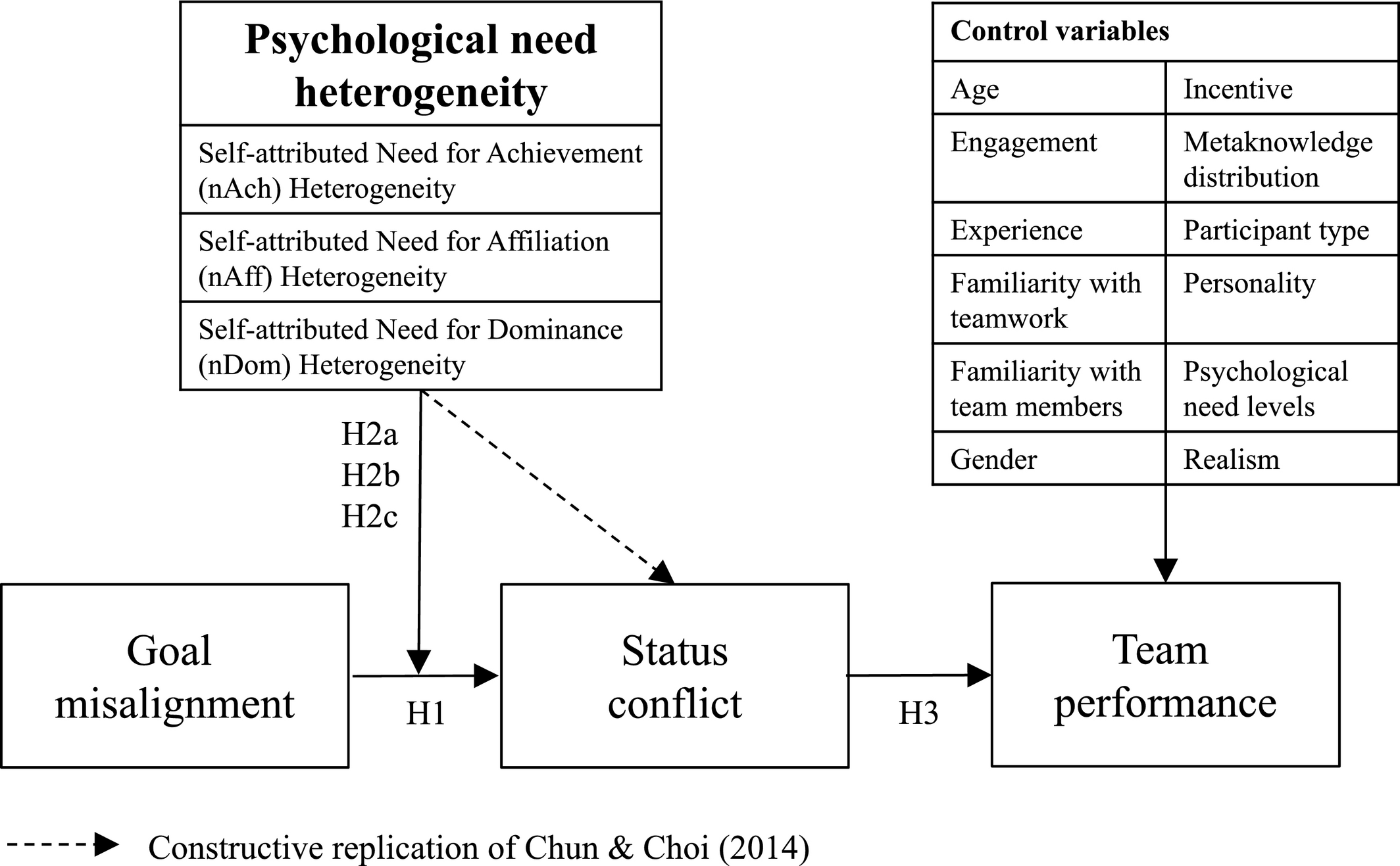
We continue this line of research by theorizing on the effects of teams' heterogeneity in terms of nAch, nAff, and nDom on status conflict in the presence of goal misalignment. Moreover, we look into the outcomes of status conflict, to help resolve some of the ambiguity around the studies that find functional (Bendersky and Hays 2017), dysfunctional (Bendersky and Hays 2012), or no effects (Su 2019) of these conflicts. Specifically, we observe the outcome of team performance, defined as the team's ability to collect and use information as necessary to form correct expectations about the given decision alternatives (Dean and Sharfman 1993). Thereby, we take a process‐oriented approach at team performance, complementing earlier sourcing team literature drawing on this perspective (Riedl et al. 2013, Stanczyk et al. 2015). Figure 1 summarizes the conceptual model that we develop in the following section.
Research Model
Hypothesis Development
Goal (Mis)Alignment and Status Conflict
Individuals in cross‐functional teams commonly operate under different functional goals and incentive structures (Pinto et al. 1993, Shaw et al. 2003). However, functions also tend to be reciprocally interdependent, meaning that they rely on other functions' cooperation and contribution to make good decisions for the organization (Schoenherr et al. 2017, Thompson 1967). Behavioral problems derive from the tensions of this goal interdependence, where one function's goals can only be achieved at the expense of another function's goal (Deutsch 1949, Somech et al. 2009, Tjosvold 1998). Consistently, observational studies show that functional goal misalignment creates difficulties, such as conflict (Ehie 2010, Oliva and Watson 2011, Shaw et al. 2003). When all team members' acceptable outcomes overlap and the team operates under pure goal alignment, teams can engage in cooperative discussions and knowledge exchange (Hirunyawipada et al. 2010), thereby focusing on the task itself as opposed to individuals' relative positions. All team members strive toward the commonly acceptable outcome and do not actively employ status‐building behavior to achieve their idiosyncratic goals. On the contrary, when functional managers operate under misaligned goals, this leads to a competitive situation, where one function's goal can only be achieved at the expense of another's goal (Deutsch 1949). Here, asserting superior legitimacy, attempts by individuals to assume control, and devaluation of others' work become tools to achieve unshared goals. The competitive social situation is expected to magnify potential status conflict, as team members strive for a superior position that enables them to take charge of which goals receive priority in the sourcing decision. Thus, we posit:
Misaligned functional goals lead to more status conflict among the members of the cross‐functional sourcing team.
Interactive Effects of Heterogeneity of Needs and Goal (Mis)Alignment
Due to their inherent need for accomplishment, high nAch members tend to seek an implicit leadership role, find creative solutions to problems, and vociferously and persistently assert their ideas (Chun and Choi 2014). On the contrary, low nAch members are less likely overall to engage with ideas and assertions (Harris 2004). In fact, low nAch members in a heterogeneous team environment are free to benefit from the accomplishments of high nAch members, without themselves contributing to the team decision‐making process; that is, they may “free‐ride.” High achievers thus may contribute to a greater proportion of the overall work, which is shown to increase their individual status within teams (Hardy and Van Vugt 2006, Kilduff et al. 2016, Willer 2009).
When functional goals are misaligned, all team members, including the low nAch free‐riders, must overcome their lack of individual motivation to achieve their respective functional goals, since the other team members' goals are entirely or partly orthogonal (Deutsch 1949). Thus, only their own contribution and persistence in the negotiation process will shape team outcomes toward their externally motivated, desired outcome. We argue that the individual goal‐setting can motivate low nAch individuals who would remain idle without such specific incentives (Steers 1975). Consistently, previous studies have determined that even low nAch individuals respond to increasing job demands with more intensive activity (Loon and Casimir 2008). Thus, we expect that differing external functional goals can motivate free‐riders to engage in competitive negotiations to safeguard their individual position aligned with their own functional area despite their tendency to avoid striving for achievement. Consequently, we hypothesize:
Increased nAch heterogeneity in a sourcing team amplifies the negative relationship between goal misalignment and status conflict in the cross‐functional sourcing team.
A high nAff is characterized by the desire to create and maintain harmonious relationships with others (Greenhalgh and Gilkey 1993) and feelings of punishment when facing negative emotional responses (Hill 1991). Conversely, those possessing a low nAff are generally more tolerant of tension and less concerned about the approval of others (Mason and Blankenship 1987). In teams characterized by high nAff heterogeneity among team members, we expect that team members high in nAff will tend to avoid questioning others' decision authority and avoid disapproval by not defending their own position in the team. Therefore, the high nAff “yes‐men” create an environment in which individuals who are less motivated to maintain warm and rewarding relationships (i.e., individuals low in nAff) can freely impose their status striving to the group.
Although previous studies characterize high nAff individuals as less likely to voice their own requests and doubts (Wiesenfeld et al. 2001), under goal misalignment, even affiliation‐seeking yes‐men realize that their individual rewards and recognition depend on their ability to represent the importance of their functional goals against contradictory goals of other team members. As such, we expect that the motivational drivers of the functional area, where team members work for the majority of their time, are stronger than their need for good relations within the temporary sourcing team. This is in line with the idea that cross‐functional team members often coact instead of truly collaborating and retain a strong connection to their functional “home organization” (Denison et al. 1996). The relatively weak ties to other functions and fear of rejection by their peers—an important element of nAff—should compel high nAff individuals to speak up for their decision authority and status under goal misalignment. This rationale is also consistent with Langens (2010) who suggests that individuals high in nAff can still indirectly satisfy their affiliation need even during controversial discussions by focusing on elements of the situation that are in line with their high nAff, such as getting to know their discussion partner. Thus, we expect that high nAff individuals will use such indirect need satisfaction and more likely engage in status conflict to avoid rejection by their peers:
Increased nAff heterogeneity in a sourcing team amplifies the negative relationship between goal misalignment and status conflict in the cross‐functional sourcing team.
Individuals possessing a high nDom tend to proactively seek control of others and key resources (Keltner et al. 2003), whereas individuals with a low nDom tend to exhibit submissive and passive relationships with others (Kristof‐Brown et al. 2005). In sourcing teams with nDom heterogeneity, the high nDom individuals are likely to strive to take an explicit leadership role among the team. Consequently, those dominating can engage in constructing a social hierarchy in their favor, and may engage in competitive behaviors such as forming coalitions or identifying passive “bystanders” (i.e., low nDom members) who are accepting of the dominance of others (Bendersky and Hays 2012). The resulting team setting can be described as complementary in terms of dominance (Tiedens et al. 2007), since few strive for status while others take the role of bystanders and behave indifferent to the emerging hierarchy (Bendersky and Hays 2012, Chun and Choi 2014).
When functional goals are misaligned, we would also expect that bystanders experience higher motivation to take control of goal achievement via status building, as argued previously for the needs for achievement and affiliation. However, the competitive behaviors that describe status conflict mirror those behaviors characterized by a high need for dominance—deployment of tactics such as coalition forming, competition for influence, and outright power plays (Bidwell 2010, Kipnis et al. 1980, Moses and Åhlström 2008, Stanczyk et al. 2015). Furthermore, the competitive setting under misaligned and competitively interdependent goals gives dominators an additional element over which to exert dominance. Dominators can control the decision process in any case and can extend their dominance to determining which of the misaligned objectives will be achieved. In this situation, highly dominant individuals have an even stronger incentive to fight for their position and leadership within the group, and individuals low in dominance are more strongly pushed into bystander roles within the team regardless of their own striving. Thus, we posit:
Increased nDom heterogeneity in a sourcing team attenuates the negative relationship between goal misalignment and status conflict in the cross‐functional sourcing team.
The Effect of Status Conflict on Team Performance
We define sourcing team performance as the team's ability to collect and use information as necessary to form correct expectations about the given decision alternatives (Dean and Sharfman 1993). We thereby put emphasis on the process that leads to a good supplier selection (i.e., performance) following Silver (2004) and earlier sourcing team literature (Riedl et al. 2013, Stanczyk et al. 2015). Thus, performance is the outcome of a process that strives for an agreement among several, possibly competing, functional viewpoints (Bruccoleri et al. 2019, Rapert et al. 2002). This process involves active information exchange, verification of chosen assumptions, and a general focus on the team task. Consistently, successful teams are able to coordinate their diverse expertise (Faraj and Sproull 2000) and develop cooperative approaches to conflict (Tjosvold 1998).
When teams face status conflict, however, members tend to challenge the contributions of other team members instead of cooperatively integrating each other's perspectives (Bendersky and Hays 2012). Consequently, team members tend to abandon agreement seeking and focus on managing social dynamics, such as the team hierarchy, within the team when non‐task‐related conflict emerges (Knight et al. 1999). This leads to individuals reducing their task‐focused contributions when facing status struggles in their work group, which in turn reduces the team's ability to use information as necessary to find the best supply option. Status struggles in groups can even motivate individuals to turn their contributions into resistance behavior (Ridgeway and Correll 2006). Thus, team members facing status conflict will not seek mutual information exchange and integration but actively try to provide information that counters other's opinions (Bendersky and Hays 2012). However, in the context of teams tasked with a strategic and high‐impact sourcing decision, a thorough coordination process is necessary to find a common solution to the complex requirements of cross‐functional teams members (Driedonks et al. 2010, Meschnig and Kaufmann 2015). Thus, we posit:
Higher status conflict leads to lower performance of the sourcing team.
Methodology
Study Design
We follow a mixed methods approach of sequential explanatory design as described in the study by Creswell and Clark (2017). This design entails that the researchers first collect a comparatively large amount of quantitative data to test predictions and later complement the quantitative results with a smaller sample of in‐depth qualitative data (e.g., see Kapoor and Klueter 2015). Commonly, as in our case, the initial quantitative data collection defines the primary research method. The qualitative work then serves to further refine, explain, and interpret the quantitative results. In our case, we tested our predictions in a quantitative experimental design with 408 participants and gathered qualitative evidence via in‐depth interviews. As the stream on status conflicts is emerging (Bendersky and Hays 2012), ex ante power analysis was not feasible (we ran power analysis ex post) and we added interviews until we reached theoretical saturation, culminating in 37 interviews. Similar studies have highlighted the benefits of the sequential explanatory design (Ashok et al. 2018, Johansson and Osterman 2017, Kapoor and Klueter 2015, Piscicelli et al. 2015). For our research, the sequential design is particularly useful to complement the internally valid but externally limited laboratory‐based experimental design with interview commentary from managers actively working in cross‐functional sourcing teams. Creswell and Clark (2017) recommend using the sequential explanatory approach to further enhance experimental studies; our interviews helped us gain a greater understanding of the external validity of our evidence and uncover boundary conditions of our experimental findings.
To quantitatively test our hypotheses, we conducted an in‐person, team‐based quasi‐experiment. To assure a proper experimental approach, we adapted our design from that of the well‐established “hidden profile” task (Lam and Schaubroeck 2000, Lightle et al. 2009, Mell et al. 2014, Stasser and Titus 1985, van Ginkel and van Knippenberg 2009). Similar to the Mell et al. (2014) design, our experiment involved teams of three people engaged in a “decision‐making task in which the information required to find the optimal solution is distributed among individuals” (p. 1160). As in the study by Mell et al. (2014), we approximate team performance by its ability to sort out the interdependencies of the distributed information (see section 4.2.5 for more details). Our experimental design is grounded in a scenario depicting a cross‐functional sourcing team and decision, and is implemented using real, consequential interactions and negotiations as recommended in the study by Eckerd et al. (2020). We build on the same vignette material used in earlier studies (Franke and Foerstl 2020, Franke et al. 2021) and therefore add the distribution of metaknowledge as additional control variable (see Franke et al. 2021). Functional goal (mis)alignment is manipulated and each team is randomly assigned to a goal treatment. The psychological need profile of each team member is a measured variable in the experiment, thereby making our study a quasi‐experiment (Vargas et al. 2017).
Experiment
Procedure
The baseline scenario describes a multinational motorcycle manufacturing firm. Participants are randomly assigned a position in marketing, purchasing, or research and development (R&D), and teams of three are randomly formed with one representative from each functional area. Our study focuses on the motivational mechanism of goal misalignment—a particularly common feature of cross‐functional sourcing teams (Moses and Åhlström 2008)—and not on cross‐functionality itself or function‐specific concepts that derive from it, such as functional identity (e.g., Randel and Jaussi 2003). In the baseline setting, the firm needs to select a new supplier for a strategically important sourcing item. The scenario controls for several factors that are known to influence strategic decisions such as industry, sourcing item, and decision importance (Dean and Sharfman 1993).
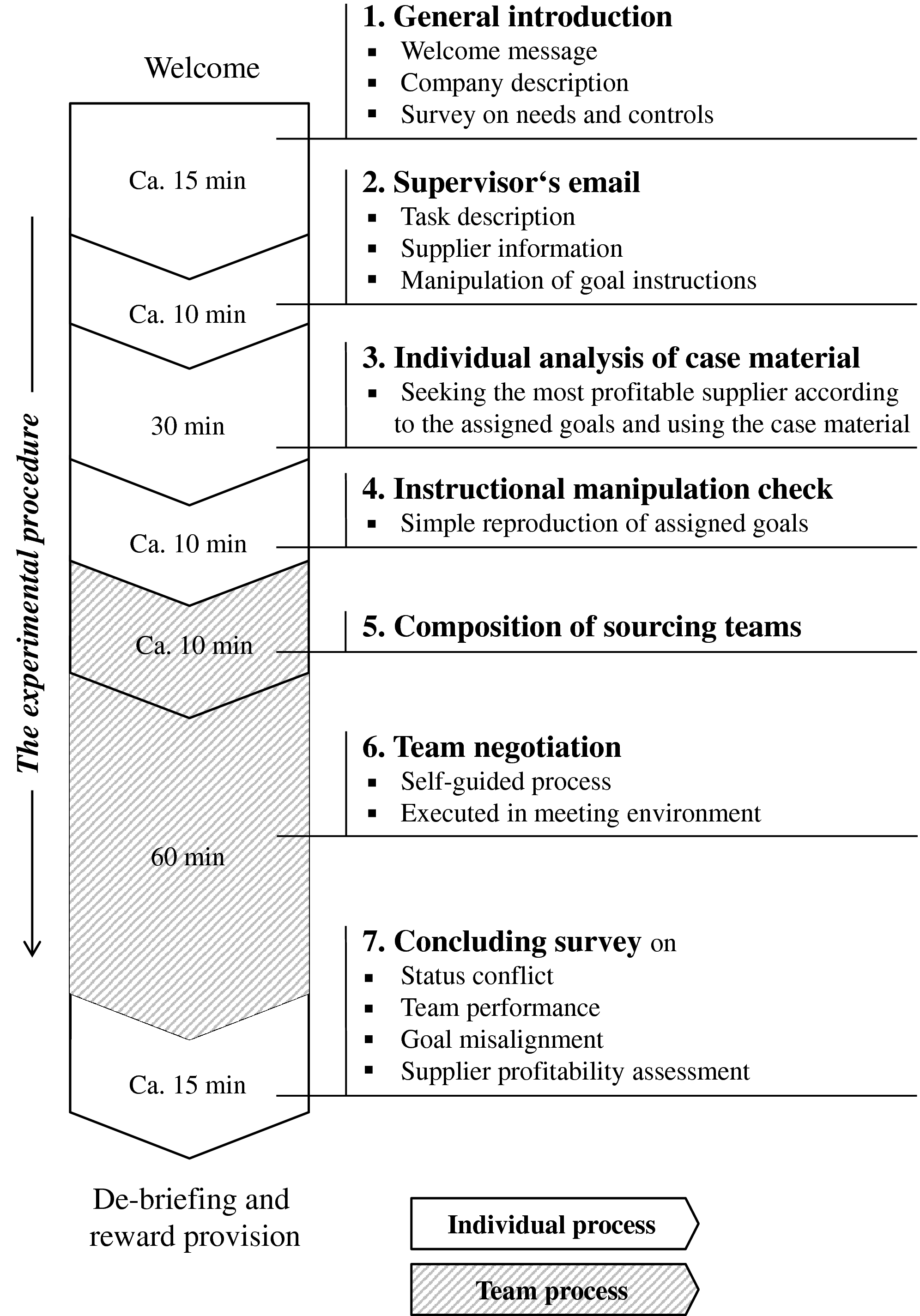
We invited participant cohorts to a short presentation on the experimental procedure, the study's rules, anonymity, and rewards and instructed them to bring laptops or tablets. All participants then received an introductory email (Figure 2, step 1; Online Appendix 1). We asked participants to report on control variables and latent independent variables (i.e., psychological needs) using an online survey. After completing the brief survey, participants were emailed personalized instructions for the upcoming sourcing team meeting that also frames participants for their randomly assigned functional area (Figure 2, step 2). The instructions consisted of two parts. First, it contained function‐specific information on four possible supply options (Online Appendix 2). Each function received its own information to establish interdependence as per the hidden profile task (Mell et al. 2014). The assignment of information to functions remained the same in all conditions. Second, the instructions included the manipulation—that is information on what explicit goals their function pursues in the supplier selection process (Online Appendix 3). Specifically, in goal misalignment cases, the design assigned specific goals to each function to establish misalignment. In goal alignment cases, the design assigned all available goals universally to all functions. To minimize demand effects, participants were not made aware of the (mis)alignment of their goals and the detailed design specifics ex ante (Eckerd et al. 2020). All participants were given 30 minutes to individually assess their material and analyze the supplier information with respect to each supplier's profitability based on their respective functional goals (Figure 2, step 3).
Quasi‐Experimental Procedure
After participants' individual analyses, we conducted an instructional manipulation check by asking participants to identify their goals (Figure 2, step 4). Finally, we introduced the members of each team and located them in separated rooms to simulate a realistic meeting setting (Figure 2, step 5). The sourcing committees had 60 minutes to engage in a discussion about sourcing options and arrive at a supplier choice for submission (Figure 2, step 6). Consistent with the hidden profile task, participants' task was to exchange information in order to obtain a complete picture of each supply option's profitability. Lastly, each participant independently completed an exit survey on our latent and observed variables (Figure 2, step 7). As part of this, respondents individually reported the final profitability levels obtained for the four supply options. Participants received incentive payouts as applicable (section 4.2.3), and were dismissed from the experiment after a de‐briefing session (Eckerd et al. 2020). The entire procedure including the de‐briefing lasted around three hours per cohort.
The design includes three functions and four supply options. It entails that each function, given perfectly transparent information, has one unique Pareto‐optimal correct supplier choice under goal misalignment while the fourth supply option is optimal for all functions under goal alignment. To achieve this symmetry, we assigned each function two unique goal indicators under goal misalignment (i.e., quality and innovativeness for R&D, price and supplier flexibility for purchasing, and image and customer satisfaction for marketing) and a holistic set of all six goal indicators under goal alignment (see Online Appendices 2 and 3). Participants' task was to find the correct solution (i.e., true supplier profitability levels) according to the assigned goals via exchanges of information among the team members, which reflects a complex and interdependent team task (cf. Lightle et al. 2009, Mell et al. 2014). The supplier profitability assessments reported at the conclusion of the experiment allow us to compute a variable for statistical estimations of performance (section 4.2.5).
Sample
We recruited students enrolled in part‐time and full‐time OSCM courses at the Bachelor and Master levels as well as from MBA classes. The 189 participants from part‐time programs were full‐time employed professionals working primarily in manufacturing, service, retail trade, and finance‐related industries, and on average were 26.7 years old with 4.2 years of work experience (see Table 1). The 219 full‐time graduate and undergraduate students were on average 23 years old and had 2.1 years of work experience. Both subgroups (part‐time and full‐time students, respectively) reported familiarity with team tasks on a 7‐point Likert‐type scale (5.7 and 5.6) and reported to be engaged in the experimental task (5.4 and 5.6). We executed the experiments in each subgroup separately in several sessions. The research team conducted these experiments as guests at other universities in Germany, the United Kingdom, Italy, Sweden, and Finland in 2018. Our sample includes 136 teams (408 participants). Our second experimental sample is slightly larger since we miss data on status conflict for 20 teams (Franke et al. 2021). Following the study by Newman (2014), we apply maximum likelihood estimation for our “missing completely at random” (p. 373) data at the construct level but would not be able to use the recommended bootstrapping method without dropping the 20 observations (Malhotra et al. 2014). We offer a replication of the coefficients using the complete sample in Online Appendix 10.
Sample Demographics
Notes
*in years, †on a 7‐point Likert scale. SIC, Standard Industrial Classification.
Our study leverages managers who enrolled in MBA classes, as in previous team‐level research in operations management (Riccobono et al. 2016). In addition, we drew a sample of full‐time students. Student samples have become common in behavioral OSCM research (e.g., De Vries et al. 2016, Eckerd et al. 2013), as many of the theoretical domains are also applicable to student samples (Thomas 2011). Our research investigates inherent psychological needs, a concept that is universalistic (Stevens 2011). We also evaluate functional goals, which students in business programs have a fundamental understanding of. We further provide explicit functional decision‐making criteria to the participants, alleviating the need for any particularistic conceptualization of the functional areas themselves (Stevens 2011). Furthermore, students seldom have significant coworking history, which is also the case for employees who are delegated into ad hoc strategic sourcing committees from different areas of the organization. We control for any personal familiarity that may still exist. Finally, we seek to avoid any preconceived hierarchical assumptions in the quasi‐experiment, and the relatively inexperienced samples we draw from allow for this, as does the random assignment of participants to functional roles. Furthermore, our sequential qualitative inquiry serves to complement internal with external validity and thereby alleviates some of the methodological trade‐offs inherent to experimental design (Eckerd et al. 2020).
Incentives
We incentivized participants with fixed and performance‐based rewards directly tied to the functional goals to mirror the reality of managerial bonus payments (Wiseman and Gomez‐Mejia 1998). We used course credit (up to 10%) where possible and gave out cash (up to 10€) where course credit was infeasible. Overall, 106 teams received course credit incentives while 30 received cash. We recognize that incentives can be viewed as both a strength and weakness in experimental designs. One common concern is that incentives might “crowd out” intrinsic motivations (Cerasoli et al. 2014). However, research also finds that incentives targeting performance are generally less harmful than ones targeting completion or engagement (Deci et al. 1999) and the indirectly salient incentive in our study (i.e., not 1:1 linked to rewards like a sales commission) reduces the crowding out effect (Cerasoli et al. 2014). Pertinent to our context, McClelland et al. (1989) note that self‐attributed needs are “activated by explicit, often social, incentives such as rewards” (p. 693), providing justification for our use of incentives. Moreover, the experimental design we employ is set within a business context with monetary implications and a clear profit‐maximizing choice (Eckerd et al. 2020). Thus, we decided to use incentives in the experiment to mirror the choice made by a manager who has to balance motivational forces among staff who are ideally internally motivated, but most are compensated for their efforts.
Manipulation Check
We manipulate functional goal misalignment at two levels, misalignment or alignment, by providing participants with either a different set of individual goals or a uniform set of indicators for all functional representatives, respectively. We verify the individual understanding of the assigned goal indicators in an instructional manipulation check that asks each participant what their focus is according to their instructions (Abbey and Meloy 2017). Thirty‐one teams included individuals who provided incorrect responses (partly or entirely) and were excluded from further analysis. This practice is in line with Nichols et al. (2019) who also removed respondents who were not able to adequately reproduce central information in their design.
Variables and Measures
Our independent variables include self‐attributed psychological needs and goal misalignment. We assess psychological needs with items published in the manifest needs questionnaire in the study by Steers and Braunstein (1976), which is used by the majority of extant research on psychological needs (e.g., Chun and Choi 2014, Liu et al. 2010, Treadway et al. 2005). Reporting on one's own motivation (introspection) is appropriate for self‐attributed needs as they, different than implicit needs, are motivational concepts that individuals actively reflect on (McClelland et al. 1989). Moreover, motivational scientists have encouraged more intensive use of introspection (Locke and Latham 2004). We extract factors for the three psychological needs for each participant individually. To assess the heterogeneity of needs within a team (nAch heterogeneity, nAff heterogeneity, and nDom heterogeneity), we created team‐internal standard deviations among the individuals' factor scores. Notably, the teams' overall need levels (i.e., mean scores) are among our control variables. Finally, we use the reversed instrument on goal similarity from the study by Jehn (1995) to assess goal misalignment. Thus, we not only made sure that participants understood their functional goals ex ante (manipulation check) but we were able to capture manipulation persistence at the end of the procedure (Figure 2), which is particularly important in long experimental procedures such as ours (Perdue and Summers 1986). One‐way analysis of variance shows that the assignment of goals has a significant effect on the measure for goal misalignment at the 1% significance level, indicating manipulation effectiveness (see Table 2).
Manipulation Effectiveness
Our dependent variables are status conflict, based on the established measure in the study by Bendersky and Hays (2012), and an observed metric that represents team performance, as recommended in the study by Bachrach and Bendoly (2011). Recall that we asked all team members to individually report their final assessment of suppliers' profitability at the end of the team negotiation (see section 4.2.1 and Figure 2, step 7). The performance measure computes the deviations of participants' final assessment of suppliers' profitability from the respective true supplier profitability level. It represents the error that team members made during their negotiation. We calculate an average for the team (sum would be equivalent) and reverse this measure to arrive at an accuracy rather than an error measure. The measure reflects our definition of team performance as the team's ability to collect and use the information necessary to form correct expectations about the given decision alternatives (Dean and Sharfman 1993). The performance measure is standardized in all analyses for easier interpretation and comparison with the standardized factor scores of the other substantive variables. We use the square root of the original score for our estimations to meet the distributional assumptions of the estimator.
In addition, we capture control variables for participants' gender, age, years of work experience, realism, and familiarity with teamwork in general. We assessed team member familiarity, as interpersonal experiences have been shown to influence groups (Huckman and Staats 2011, Huckman et al. 2009, Staats 2012). We controlled for task engagement, consistent with the study by Rich et al. (2010), to capture the effort level participants dedicated to the task, since the task was intensive and individual effort may vary. Finally, we include controls for personality (“Big Five,” Donnellan et al. 2006) and nationality to capture behavioral tendencies of general validity (not context‐specific self‐attributed needs) and possible influence of diverse national backgrounds as a Blau index (Blau 1977). Finally, we also capture a team's overall need level as a mean of individual scores following earlier research in the area (Chun and Choi 2014). Details on our psychometric instruments are displayed in Online Appendix 4 and correlations among our substantive variables in Table 3. Please find the full correlation table in Online Appendix 5.
Correlations among Substantive Variables
Note
**p < 0.01; *p < 0.05; diagonal displays sqrt(AVE) in italics where applicable.
Validity Assessment and Bias Treatment
Before beginning any analysis, we aggregate individual responses to the team level for the latent status conflict and goal misalignment variables. We extract team‐level factor scores as described in the study by Meschnig et al. (2017). To ensure that aggregate factors are meaningful for our case, we compute inter‐rater agreement scores rw(g) for each team as recommended and applied in earlier research (e.g., Boyer and Verma 2000, Kong et al. 2017). Studies have suggested that teams should at least reach 0.7 in their inter‐rater agreement (Klein and Kozlowski 2000). All teams in our sample pass the threshold as the lowest detected rw( g ) is 0.724 for goal misalignment and 0.728 for status conflict. The mean rw( g ) across all teams was 0.947 and 0.946, respectively. Consequently, we conclude that aggregation is feasible for our case.
We use confirmatory factor analysis (CFA) in AMOS 24 to test for convergent validity. Given the good CFA model fit (χ2 = 1080.2; χ2/df = 1.38; CFI = 0.907; RMSEA = 0.053), we conclude that the data fit the model well. Additionally, we assess construct reliability based on the greatest lower bound (GLB) assuming a congeneric measurement model (Peters 2014, Ten Berge and Sočan 2004). Cronbach's alpha does not allow for unequal factor loadings (i.e., requires tau‐equivalence) and is therefore not applicable. However, due to the lack of standards for assessing GLB, we apply alpha thresholds. The latent control variables of engagement (0.96) and team familiarity (0.93) show good construct reliability. We also find good GLBs for goal misalignment (0.92), nDom (0.83), and status conflict (0.96) and find acceptable reliability of nAch (0.68) and nAff (0.63), consistent with that of prior research in the area (Kong et al. 2017, Steers and Braunstein 1976, Turban and Keon 1993). Since the stream intersecting team motivation and status conflict is still emerging, we apply the threshold of 0.5 recommended for nascent fields of inquiry (Nunnally and Bernstein 1967). To confirm the measurement model structure, we perform several CFA model comparisons based on chi‐square difference tests, with no alternative measurement model fitting the data better than the model structure suggested by theory. Please find a summary of the tests in Table 4.
Chi‐square Measurement Model Comparisons
Notes
CFA, confirmatory factor analysis; CFI, comparative fit index; RMSEA, root mean square error of approximation.
We follow the design recommendations of Podsakoff et al. (2003) to limit common method bias (CMB) in this study. We also assess the potential for CMB with the procedure recommended in the study by Williams et al. (2010). Using four marker items for ingratiation behavior adapted from the study by Kipnis et al. (1980), we find that modeling additional loadings of the marker onto all other substantive indicators does not improve model fit (see Table 5). The chi‐square comparison test shows an insignificant result (Δχ2 = 0.15, Δdf = 1, χ2critical = 3.84). Therefore, we conclude that CMB did not constitute a significant bias to our estimations.
Common Method Bias Tests
Notes
CFA, confirmatory factor analysis; CFI, comparative fit index.
We tested for between‐group equivalence among the subgroups of the different student samples (full‐time vs. part‐time with work experience) and cash vs. credit incentives (Bensaou et al. 1999, Knoppen et al. 2015). We ran two grouped CFA models for each between‐group difference and find that the respective indicators were still significantly correlated with their underlying factors across the respective subgroups. Moreover, chi‐square test model comparisons in Table 6 do not indicate that models with fixed factor loadings across groups fit the data any worse than estimating them freely in a basic grouped CFA. Thus, the equivalence tests following Knoppen et al. (2015) indicate that pooling across groups is feasible. In addition, we examined the interaction of both group markers and found no between‐subjects effects for status conflict (F = 1.551, p = 0.215) and team performance (F = 2.301, p = 0.132).
Subgroup Equivalence Tests
Notes
The estimator could not reach convergence in the relatively small cash subsample with the full model. We omit the personality constructs as they are universally conceptualized for any human and their exclusion thus, if at all, increases the likelihood of detecting a between‐group difference.
CFA, confirmatory factor analysis.
Finally, we took several measures to reduce demand effects guided by the discussion in the study by Eckerd et al. (2020). We assured that our administration of the experiment would not systematically affect the responses by reducing power distance between us and the participants by acting as guest lecturers. We also highlighted that the administered scale instruments should freely reflect their own feelings and were not tied to the incentives. The only difference in the vignettes that could have potentially affected participant behavior besides our manipulation is the functional role assignments. Therefore, we compared the means of status conflict among the functions in t‐tests (psychological needs were measured before the functional assignment; Figure 2). We found no differences and conclude that demand effects are not a serious concern in our study, as in most experiments (De Quidt et al. 2018, Mummolo and Peterson 2019).
Sequential Interviewing
To complement our experimental design with further qualitative evidence, we conducted interviews with 37 managers, senior managers, and executives across functional areas of seven different organizations. Interviewees possessed 6–34 years of work experience in internationally diverse firms headquartered in Western Europe. We conducted three pretests to refine our questionnaire (see Online Appendix 6 for the final interview guideline). Six interviews were conducted in personal meetings and all others were executed via phone. Interviews lasted 35–123 minutes (mean 47 minutes) and filled 503 pages of transcripts in total. Table 7 gives an overview of the participating organizations and Online Appendix 7 provides further information about the interviewees. A detailed overview of quotes reflecting our central concepts is provided in Online Appendix 8, whereas Online Appendix 9 provides quotes that reflect the central relations in our study. The following results section presents both quantitative and qualitative evidence together, following the example in the study by Kapoor and Klueter (2015).
Overview of Interviews and Firms
Notes
*In million EUR, †Rounded.
Results
Hypothesis Testing and Qualitative Explanation
We test our hypotheses in a structural equation model (SEM) using SPSS AMOS 24 and maximum likelihood estimation. Table 8 summarizes the estimation and shows unstandardized β‐coefficients as recommended in the study by Malhotra et al. (2014). We model controls on performance as in the study by Riedl et al. (2013) to avoid inflating model fit. The model in Table 8 reaches R2 values of 41.9% for status conflict (39.2% adjusted) and 36.3% for team performance (20.4% adjusted). We find a significant relationship between goal misalignment and status conflict (β = 0.900, p < 0.01), in support of Hypothesis 1. This finding was also reflected in our interviews, with informants indicating that misaligned goals often trigger status conflicts as team members try to take control in order to push their own agendas. “It starts when the agenda for a meeting is presented and the colleague says ‘hold on, hold on! This agenda is nice but first another point’. They try to claim the whole meeting for themselves and to push their particular interests.” (Interview #26; Online Appendix 9, panel A1).
Structural Estimation Results
Notes
n = 136; **p < 0.01; *p < 0.05; SE: standard error; Ø: teams' average need level; Model fit: χ2 = 46.235, χ2/df = 1.712, CFI = 0.987, RMSEA = 0.073.
Our results indicate that the heterogeneity of nDom significantly interacts with goal misalignment in support of Hypothesis 2c (β = −0.501, p < 0.01). Our interviews provided further evidence in line with Hypothesis 2c, validating our theoretical arguments around the interplay of goal misalignment and heterogeneity in need for dominance on conflict. “Clearly, there are dominant personalities that are less ready to coordinate decisions with other parties before the actual meetings. They push their own ideas and often get into conflicts with other departments (Interview #23). More specifically, Interviewee #6 reported that a “status incentive” (i.e., need for dominance) paired with different opinions at the task level (i.e., goals) motivate conflict. “You have this difference based on the striving for control. Power struggles are an outcome based on one having this status‐incentive in addition to the purely task‐focused level. Those will represent their position with a considerably stronger energy compared to that one who says ‘I think it would be better this way, but, well, at some point I give up’. So that's a lot of what I have experienced with logistics and quality, they pull back at some point” (Interview #6; Online Appendix 9, panel D3). The quote illustrates that the more dominant individuals suppress conflict in a goal‐misaligned sourcing decision, since others that do not pursue the “status incentive” tend to give in.
Additionally, we find that heterogeneity within the team in nDom (β = −0.543, p < 0.01) negatively affects status conflict. While not hypothesized, it does provide an important replication of Chun and Choi (2014) and evidence of nomological validity of our measurement (Pagell 2021). Several interviewees also corroborated this effect. One interviewee reported that a dominant leader can give the team direction and avoid conflicts: “I think the dominance behavior is created in that moment, where a group wants to gain orientation and align with someone. […] And that will be noticed by the, let's say, more dominant persons in the group. […] He [the dominator] then propagates one opinion and drives the group in this direction.” (Interview #28; Online Appendix 9, panel D2).
Our results show that nAch heterogeneity does not significantly interact with goal misalignment to impact status conflict (β = 0.070, p = 0.707), thus failing to support Hypothesis 2a. Our interviews indicated some influence of the need for achievement in sourcing teams, yet the evidence there suggests that nAch heterogeneity may reduce types of conflict other than status. Particularly, interviewees address that individuals who create facts (not hierarchy) are silently accepted and, thus, no task conflict emerges (Interview #2, Online Appendix 9, panel B1). Others speak of a lack of motivation to take position against people who are ready to engage in relationship conflict (Interview #16, Online Appendix 9, panel B2). Interviewee #23 elaborated that different needs for achievement intensity avoided process conflict, particularly on how sourcing for a large promotion account should be executed (Online Appendix 9, panel B4). Finally, interviewee #25 was especially clear that a relatively low need for achievement did not obstruct the interviewee in “decelerating” the emergent leadership of a team member that has a high need for achievement, leading to repeated incidences of mild status conflict (Online Appendix 9, panel B3).
The results do indicate that different individual levels of need for achievement exist in purchasing organizations (see Online Appendix 8). Yet, individuals with high need for achievement tend to self‐select and thus qualify to be functional representatives in sourcing teams of strategic significance: “I assume that [freeriding] probably exists, yet I don't see that very often because I only participate in the highest sourcing boards. I think, at this level, people are intrinsically motivated; otherwise they wouldn't be in this position” (Interview #12). In addition to the self‐selection mechanism that brings high achievers into positions with sourcing responsibility, we also noticed that some interviewees tended to struggle with differentiating the needs for achievement and dominance in sourcing teams, such as in the following quote: “Why are the purchasers and developers more eager to represent their interests? I believe they are more driven by success. They are not dominant to be dominating things but they act dominant since this type of person is required or especially in purchasing, I believe they are looking for this type of person.” (Interview #6). Thus, self‐selection mechanisms and conceptual ambiguity may be possible explanations as to why our study does not detect the expected effects.
Hypothesis 2b also did not receive support since the interaction between nAff heterogeneity and goal misalignment on status conflict was not found significant in our estimations (β = 0.077, p = 0.631). Our interviewees indicated that functional representatives in cross‐functional sourcing teams may have a significant need for affiliation with their colleagues (see Online Appendix 8). However, we found that sourcing team members differentiate between their functional colleagues and the ones they meet in cross‐functional encounters. Consequently, their need for affiliation with relatively distant cross‐functional colleagues may be lower and allow more conflict. “So with my direct colleagues, I put a lot of emphasis on maintaining a good relation, such that we can go out after work some time and so on. […] With colleagues from other departments, it is nice to have a solid relation with them, yet I also learnt over time that it is ok when that is not the case” (Interview #25, Online Appendix 8). The quote demonstrates that the need for affiliation may be strong in an individual but has a diluted impact on conflict when the relationship is cross‐functional, potentially explaining the absence of measurable effects in our experiment.
The interviews proved further valuable in that we learned a heterogeneous need for affiliation can reduce conflict on the task as opposed to the team's hierarchy. One interviewee observed that affiliation‐seeking coworkers stop representing their opinion on the sourcing task in a cross‐functional encounter: “So some people are being overwhelmed and agree. […] I believe some shy away from conflicts and don't push to represent their opinion since doing so will trigger a larger discussion” (Interview #34; Online Appendix 9, panel C2). When status is at stake, however, affiliation seekers tend to search for backup among their peers or supervisors, according to our interviews. They leverage other individuals to assist them in the conflict while avoiding some of the emotional strain caused by the fight. “I believe that many shy away from conflicts. […] They just don't want it [conflicts]. […] And if there is a conflict, they can only deal with the situation with backup from their supervisors.” (Interview #11; Online Appendix 9, panel C3).
Finally, Hypothesis 3 received support due to the significant effect of status conflict on team performance (β = −0.209, p < 0.01). Our interviews provide some nuance to these findings. According to Interview #28, teams that experience struggles for status, power, and dominance are less able to come up with an effective solution. “There is friction and both parties notice rather quickly that this is going nowhere. […] So mostly these conflicts are, those that are fought between two personalities in the room, they have no result that is implemented afterward. Instead, it is pure dominance, how shall I say?” (Interview #28; Online Appendix 9, panel E1). Informants further indicated that low status conflict teams that are in “strong hands” (Interview #6; Online Appendix 9, panel E2) or have an implicit leader (Interview #14; Online Appendix 13, panel E3) will more likely reach agreement. Yet, reports were ambiguous on whether this would also lead to performance (Online Appendix 9, panel G2). However, achieving an agreement among functional areas was identified as an important driver of achieving targets: “So in order to get the [big success], the purchaser also needs to be able to create consensus. He needs to achieve that others buy into the decision and carry his suggestion.” (Interview #12; Online Appendix 9, panel G1). Thus, we were able to qualitatively substantiate our quantitative findings, but also learned from practitioners' responses (i.e., Online Appendix 9, panels E2 and G2) that making entirely conflict‐free decisions can lead to bias that may not be captured in the process centering around status conflict. This is consistent with the findings of De Wit et al. (2012), showing that task conflict drives team performance in strategic/higher management contexts and research showing that quick agreement can bias collective decisions (Bruccoleri et al. 2019). The ideal situation of an unbiased team process requires intensive “thinking not only of another but for another,” which is relatively rarely the case according to interviewee #10 (see Online Appendix 9, panel G3).
Post‐hoc Analyses
In addition to these main results, we used bootstrapping to compute confidence intervals and p‐values of indirect (mediated) effects as recommended in the study by Malhotra et al. (2014). We find a marginally significant indirect effect of goal misalignment through status conflict on team performance (β = −0.188, p = 0.057). Furthermore, we find that the interaction effect of heterogeneous levels of nDom and goal misalignment (Hypothesis 2c) affects performance via status conflict (β = 0.105, p = 0.063) and that the replicated effect of need for dominance heterogeneity also has a significant indirect effect on team performance (β = 0.113, p = 0.061), yet both only at the p < 0.1 level. In addition, we examined whether psychological need heterogeneity would also affect other team‐level behavioral problems, such as other types of conflict. We show several alternative models in Online Appendix 12 along the lines of earlier published work (Chun and Choi 2014, Su 2019). Finally, although we included well over 50 team‐level observations per treatment cell (Simmons et al. 2013), we also conducted a statistical post‐hoc power analysis. For the effect of goal misalignment on status conflict (β = 0.900), we reach 100% power at 5% alpha given our sample size of 136. Even for comparably small effect sizes, such as for the interaction term in H2
Discussion
Contribution to Theory
Our study makes three unique contributions: (i) we extend the theoretical discussion surrounding the relationship between psychological needs and status conflict in teams; (ii) we integrate the established perspective of external motivation in OSCM teams (i.e., functional goals) with theory regarding individuals' internal motivation (i.e., psychological needs); and (iii) we evaluate the impact of status conflicts on the performance of teams.
Our study extends the literature on team composition and team members' internal traits in operations management (e.g., Aggarwal and Woolley 2019, Riccobono et al. 2016, Wu et al. 2014). Specifically, we examined the relationship of heterogeneity of internal motivation mechanisms and status conflict. We developed theory on the full range of psychological needs—including nAch, nAff, and nDom—and their interplay with externally motivated functional goals on status conflict. Our results show the value of combining the internal motivational perspective of psychological needs and the established perspective of external functional goals to better understand conflicts in OSCM teams. In particular, our research provides nuance to the negative view of individuals' nDom and earlier unsuccessful attempts to trace its desirable effects (e.g., Kunz and Linder 2015, Liu et al. 2010), as well as the literature suggesting goal misalignment as the root cause of several problems in OSCM teams (Moses and Åhlström 2008, Stanczyk et al. 2015). Extending the latter OSCM literature, our study confirms that goal misalignment contributes to status conflict, which subsequently reduces team performance (see Table 8). However, our study also shows that a goal misaligned team that is composed of a team highly heterogeneous in need for dominance will experience less status conflict and hence reach higher performance. In this situation, goal misalignment takes an ambivalent role and concepts associated with negative implications—goal misalignment and need for dominance—in fact show positive implications when combined in OSCM teams. Where previous team leadership (Morgeson et al. 2010, Zaccaro et al. 2001) and OSCM literature (Rauniar et al. 2008) identifies a positive role for dominant figures in teams in their ability to define team goals, make role assignments, or carry out operational strategies, our research extends this positive lens to the mitigation of status conflict in teams. With these findings, we also continue the OSCM discussion on misalignment in teams that take project‐based decisions (Songhori and Nasiry 2020), complement earlier studies that have interpreted functional dominance as outnumbering others (Malhotra et al. 2017), and add to the discussion on how to ameliorate the effects of status conflict via group diversity (Lee et al. 2018).
This study is among the first to relate the relatively new concept of status conflict to the observed outcomes of teams. Earlier research has predominantly used third‐party performance ratings, such as grades (Bendersky and Hays 2017, Kilduff et al. 2016) or subjective self‐report team performance measures (Chun and Choi 2014, Kilduff et al. 2016). Our study shows that status conflict occurring in cross‐functional OSCM teams will reduce objective team performance. With that, our study runs contrary to recent longitudinal research by Bendersky and Hays (2017), in which they found status conflict positively related to team outcomes when there is little ex ante agreement on team members' relative status. Similar to their study, our design randomly combined participants into teams that had no preestablished hierarchy, as they worked in different organizations or participated in OSCM classes as equally empowered students (note we also controlled for team member familiarity in the study with no significance found on this variable). An intriguing explanation to the inconsistency of our study relative to the study by Bendersky and Hays (2017) lies in the duration of the team interaction.
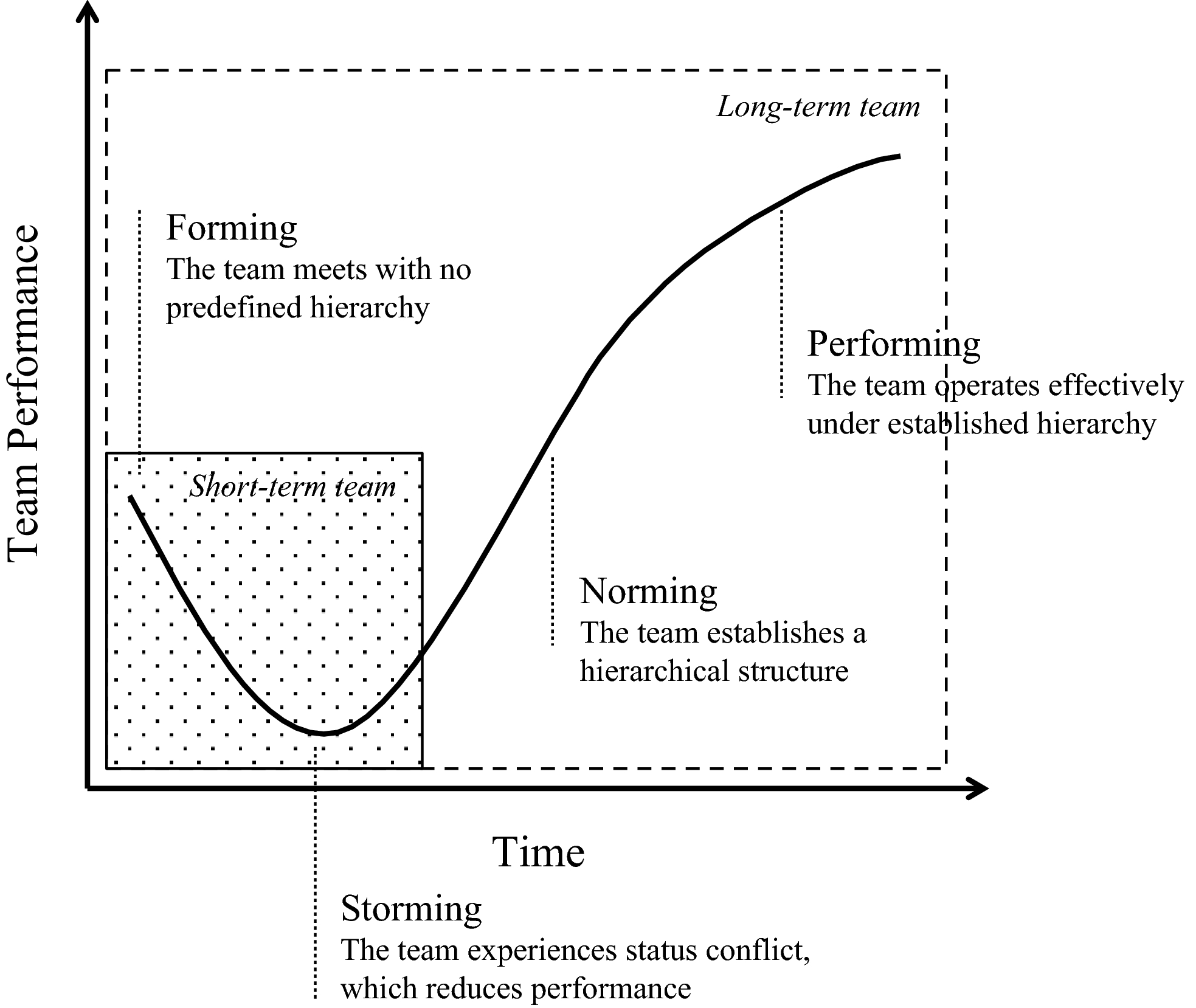
Bendersky and Hays (2017) tested manifest performance outcomes with two samples of students over a 6‐month period and one sample of students over an academic quarter, while our study simulated a significantly shorter duration team meeting. The discrepancy of findings across our study and theirs may speak to the relevance of the different temporal conditions in which cross‐functional tasks and decisions can be executed (Foerstl et al. 2015, Germain et al. 1994). Teams operating under a limited time may not allow for the “norming” of the status hierarchy to occur, and instead forces the team to operate in “storming” mode with a hierarchical structure that remains in flux (see Figure 3).
Stages of Group Development (adapted from Tuckman 1965)
Conversely, cross‐functional teams operating under longer time periods may eventually be able to overcome the status disputes (“norming”) and reach the “performing” stage of group development. Consequently, future research can work to substantiate the short‐term negative effects of status conflict that we find and the possible long‐term payoff indicated in the study by Bendersky and Hays (2017).
Managerial Implications
Our study has implications for executives in charge of composing temporary cross‐functional decision‐making teams. First, managers should not fear heterogeneity of team members' psychological needs (i.e., individuals' needs for achievement, affiliation, or dominance). In fact, teams' heterogeneity in dominance (nDom) increases dominators' chance to emerge into implicit leadership roles, which in turn avoids detrimental disputes over members' relative hierarchical position in the team (status conflict). Our analyses show that when teams' heterogeneity of nDom is increased by one third (i.e., through recomposition), they achieve a 2.4% performance increase attributed to reduced status conflict. Second, functional goal misalignment, previously known to be a trigger to conflict in teams, may further attenuate status conflicts under conditions of high nDom heterogeneity. Consequently, the performance gain is 3.8% in this situation. Our research suggests that when functional goals are misaligned, executives should actively seek to delegate few individuals who are strongly dominance‐seeking to the team to reduce status disputes in the short run and ensure a better team decision. When the team decision is under no time pressure, however, previous studies have also indicated that building a hierarchy via conflict can have long‐term functional effects (Bendersky and Hays 2017). Thus, the time available to make team decisions seems to play an important role in this research context.
One of the main managerial questions posed by our work is how one learns about employee's psychological needs in the first place. Managers have limited ability and time to measure employee's psychological needs formally, as we did for this research. However, our qualitative interviewing with practicing managers shows that they were acutely aware of their colleagues' internal motivation mechanisms, even without the formal testing outcomes. To help support more casual assessments, Brafford and Ryan (2020) provide an up‐to‐date guide on how managers can be receptive to the inherent needs of their workforce. Although grounded in the adjacent theory of self‐determination, their article pinpoints effective ways of understanding the needs of others at work, and can enable managers to compose more successful cross‐functional sourcing teams in accordance with our findings. In sum, our study points to the relevance of internal motivational traits and their interplay with external motivational forces and seeks to provide more holistic management guidance.
Future Research Directions
Several interesting aspects for future research emerged in our study. First, the time period given to execute sourcing projects mattered. Consistent with our conceptual discussion of the Tuckman model above, Interviewee #6 indicated that “the more time you have, the more the less dominant have time to think. […] The shorter the time, the more strongly will the dominant one be able to take control” (#6). However, interviews also indicated that too much available time can have detrimental effects when sourcing teams members feel like no immediate decisions needs to be taken (see Online Appendix 11). Future research may further explore effects around the available time to execute sourcing decisions.
Second, our informants reported two contrary dynamics around the sourcing project's visibility in the organization, an aspect that was not considered in our experiment. Interviewee #10 described that standard sourcing tasks promote thinking in frames of functional belonging (“line activities”) and tend to turn into stages to carry out cross‐functional fights for status and resources (Online Appendix 11). However, tasks of strategic importance, such as innovative flagship projects, were able to unite functions by giving them a common “purpose” or psychological ownership (Bendoly et al. 2010). On the contrary, other interviews indicated the exact opposite. Interviewee #12 elaborated that “during strategic purchasing decisions, [there is] the chance for some people to show off.” Instead, regular sourcing tasks tended to be decided purely based on facts in this organization. Future research exploring this inconsistency may find paradox lenses useful (Smith and Lewis 2011), which have demonstrated increasing applicability with OSCM problems lately (e.g., Xiao et al. 2019).
Third, the interviews revealed that conflicts are also either anticipated before or managed after team meetings using sociopolitical tactics. Specifically, reports illustrate that actors form coalitions before expectedly status conflict‐laden meetings, preferably with powerful superiors. By getting the “bosses on board,” functions had gained momentum leading to unquestioned decision‐making authority during the meeting. Furthermore, we found indications of ex post conflict management through ingratiation behavior and coalitioning using what Interviewee #4 called “coffee machine diplomacy.” These observations provide a possible starting point for future research to further extend the growing literature on political influence in OSCM (Franke et al. 2021, Thornton et al. 2016). We provide more detail on the possible avenues for future research along with possible research questions, theoretical lenses, and corresponding quotes from our interviews in Online Appendix 11.
Limitations
Our study is executed using a quasi‐experiment, and is thus subject to numerous limitations associated with experimental research. Our design and administration adhered to best practices (Eckerd et al. 2020, Rungtusanatham et al. 2011) and previously published exemplars (Lightle et al. 2009, Mell et al. 2014); however, future studies may use alternative data visualization techniques to enhance realism (Bendoly 2016) and expand the contexts to which these findings may be generalizable. Specifically, our study applies an observed performance measure as recommended in the study by Bachrach and Bendoly (2011) but thereby also accepts that performance is operationalized using design specifics (section 4.2.5). Other studies may complement our findings by qualitatively coding team performance (e.g., Mell et al. 2014) or by using perceptual scales that are more universally applicable. Furthermore, our quasi‐experimental study is controlled and internally valid, yet analyzes a situation that is weakened in its external validity, especially concerning the sample. Our use of experienced MBA students is justified given our theoretical lens (Stevens 2011), but future work may still triangulate our findings using different methods (Boyer and Swink 2008), such as field experiments or designs that consider multiple repeated sourcing decisions for increasing the external validity of the findings. In an attempt to start such a research program, we complement the experiment finding with qualitative interview data deriving several avenues of future research that may spark additional research on the behavioral challenges of cross‐functional integration.
Conclusion
This study recognizes that the existing OSCM literature has deemed cross‐functional integration important, yet is incomplete in efforts toward understanding the role of motivational mechanisms in explaining managers' behavior in decision‐making teams. We develop and test theory in the sourcing team context focusing on the heterogeneity of team members' self‐attributed psychological needs for achievement, affiliation, and dominance needs, their interplay with external motivations (i.e., functional goals), and the effect on status conflict in teams. Our experimental study of 136 teams finds that sourcing teams composed of individuals who are heterogeneous in their need for dominance suffer from fewer disputes over their internal hierarchy (status conflict), and functional goal misalignment strengthens this effect. These lower levels of status conflict, in turn, improve team performance. This is an intriguing finding as both goal misalignment and dominance are concepts usually considered detrimental in teamwork, yet their interaction can reduce status conflicts and ultimately improve performance. We discuss the lifecycle of the team as a possible boundary condition of this finding using the Tuckman Model (Tuckman 1965). We further explore our results using in‐depth interviews among 37 experienced managers and suggest several unique avenues for future research. Our findings contribute to our knowledge of motivational mechanisms on team conflict and hopefully inspire future research at the intersection of sourcing team motivation and status conflict between functional areas.
Footnotes
Acknowledgments
The authors acknowledge helpful feedback and support from colleagues at the German Graduate School of Management and Law, Germany, and the Kelley School of Business—Indianapolis, at Indiana University, USA. We would further like to extend our gratitude to the department and associate editors as well as the two anonymous reviewers for their valuable support and feedback, which has significantly improved our manuscript. Open Access Funding provided by Eidgenossische Technische Hochschule Zurich.
