






Abstract
Using laboratory experiments, we study how communication media affect cooperation in a supply chain when the buyer has private information about the end‐customer demand. We show that coordinating contracts (quantity discount) combined with efficient means to electronically share private information (one‐way, pre‐defined text message) result in almost efficient outcomes, but only if verbal communication takes place before the actual contracting stage. Content analysis shows that verbal communication is especially effective in establishing trust and trustworthiness when players talk about reciprocal strategies and it is more so when the buyer clearly expresses guilt from lying. Furthermore, the clarification of the mutual benefits of information sharing moves the buyer to truthfulness. Finally, we show that our results are not due to a reputation building mechanism of repeated interaction.
Introduction
The flow of Information is one of the most important challenges for supply chain management. To share information, many firms have recently experimented with advanced planning systems (APS), or collaborative planning, forecasting and replenishment (CPFR) initiatives. For example, Walmart and Sara Lee Branded Apparel successfully implemented a CPFR pilot. The parties involved reported an increase in sales of 32% after 24 weeks of implementation (Kurtuluş 2017). Nevertheless, while there is no doubt about the potential benefits of information sharing, many firms are reluctant to share demand information with their suppliers (Gümüş 2017). Stein (1998) reports that managers often fear that information sharing may turn into a competitive disadvantage, given the strategic supply chain environment. Similarly, Verity (1996) notes managers’ concerns with regard to increases in prices when forecast information is shared. Fraser (2003) surveys 120 firms and finds that 42% of the respondents perceive a lack of trust as one of the largest obstacles hindering firms’ adoption of information sharing systems.
In this study, we analyze how pre‐game communication affects the impact of simple and efficient means of sharing private information (i.e., simple one‐way text messages) on an operative basis (e.g., weekly or monthly) in a supply chain contracting context. Previous research shows that such simple messages are somewhat effective since truthful messages meet trusting recipients, and yet efficient outcomes are generally not achieved (Hyndman et al. 2013, Özer et al. 2011, 2014, Spiliotopoulou et al. 2016). We show that the efficiency enhancing effects of information sharing can be boosted by any form of verbal communication taking place prior to actually sharing the private demand information via simple one‐way messages. To this end, this study guides managers as to which communication media to use (textual vs. verbal, anonymous vs. identification) and which topics to address at the very beginning of an information sharing initiative that may be plagued by strategic incentives to misrepresent demand information. For the sake of clarity, we use the term “information sharing” for the simple one‐way text message that shares the private demand information and the term “communication” for any other information that is shared prior to the actual contracting stage.
We compare different means to communicate in a dyadic distribution channel with a single supplier and a single buyer where the buyer has private demand information. The typical, yet stylized, supply chain bargaining situation is characterized by (a) sequential moves, that is, a contract offer by the supplier and an order quantity or a rejection by the buyer, (b) non‐linear quantity discount schemes that reduce informational rents and efficiency losses from double marginalization (Kolay et al. 2004), and (c) efficiency losses when information is used strategically.
In line with previous research on communication media in social dilemmas (see literature review), we rely on controlled laboratory experiments with a student subject pool. This method makes it possible to establish the root‐cause effects of different communication media in the pre‐phase of an information sharing initiative while ensuring internal validity. Although we believe that research on communication media can benefit from other empirical approaches (e.g., interview studies), we see one key advantage in using experiments: the critical aspects of underlying economic incentives and information availability can be tightly controlled. At the same time, it seems difficult to discern whether analytical forecasts (e.g., from an ERP system) are misrepresented by practitioners due to good will (e.g., factoring in expert knowledge) or strategic considerations.
We first replicate the finding of prior research that information sharing via simple one‐way messages improves supply chain efficiency by comparing a baseline treatment without information sharing to a reference treatment with information sharing (i.e., subjects are allowed to share private demand information, that is, “low demand” or “high demand”). We then move forward by comparing different forms of pre‐phase communication, that is, chats, verbal but anonymous, and videoconferences, to this reference treatment. In the pre‐phase, the supply chain members may, for example, discuss how they are planning to share and process information and/or how to divide the bargaining pie.
We find that any form of verbal communication supports cooperative play in the supply chain. Content analysis reveals that this form and timing of communication is especially effective in establishing trust and trustworthiness when players talk about reciprocal strategies and this is more so when the buyer clearly expresses guilt from lying. The clarification of the mutual benefits of information sharing moves the buyer to truthfulness. The positive performance effect of verbal pre‐phase communication can be further strengthened by training that thoroughly explains the strategic issues and coordination potential when sharing information. Our main experiments consider a finite, repeated interaction (partner design). Assuming sequential rationality, the standard game‐theoretic benchmarks collapse to the one‐shot game. Yet, in order to be closer to the one‐shot benchmark from a behavioral perspective, we replicate our main results in a one‐shot interaction with a round‐robin matching procedure (stranger design).
This study is organized as follows. Section 2 reviews the related literature, while Section 3 outlines the results from the game‐theoretic model. Section 4 introduces our experimental design and hypotheses. Section 5 summarizes the experimental protocol, with the results being presented in Section 6. Section 7 describes the design and results from our communication content analysis. Section 8 presents the design and the results from the experiments with the one‐shot round‐robin matching procedure. Finally, we provide a summary of the results and conclude the study in Section 10.
Literature Review
We consider a situation in which the supplier negotiates the contract terms with a buyer who holds private information about price‐sensitive and deterministic end‐customer demand. There is a large body of literature that considers problems that are similar in the underlying incentive conflict but either vary in the operational setup, e.g., stochastic demand, or in the specific form of the private information, e.g., marginal production cost or holding cost (see, e.g., Corbett and Groote 2000, Corbett et al. 2004, Kolay et al. 2004).
The analytical supply chain (or channel) coordination literature shows that quantity discounts can fully coordinate the supply chain if private information is shared truthfully by the buyer and trusted by the supplier (leading to a full information scenario), see, for example, Corbett et al. (2004). Yet, the rational and profit‐maximizing buyer has an incentive to misrepresent private information in order to obtain profits that are above her minimum acceptable level (i.e. outside option). In this case, it is in the supplier's best interest to offer a menu of contracts (e.g. quantity discount) that trades off the informational rents paid to the buyer and the inefficiencies resulting from suboptimally low (inefficient) order sizes. A quite general result across this literature is that the inefficient type (in our case: low demand, in other cases: high marginal cost or high holding cost) chooses an inefficiently low order size (i.e., an order size that is lower than in a full information scenario) while the efficient type chooses an efficient order size (“no distortion at the top”). (Laffont and Martimort 2009).
Several recent laboratory studies test the effectiveness of nonlinear contracts, such as quantity discounts, to coordinate the supply chain under both full information (Ho and Zhang 2008, Kong et al. 2018, Lim and Ho 2007) and asymmetric information (Inderfurth et al. 2013, Johnsen et al. 2019, Kalkanci et al. 2011, 2014, Sadrieh and Voigt 2017). A general pattern in all of these experiments is that non‐linear contracts reduce efficiency losses, but not to the extent theoretically expected. A substantial amount of performance loss is due to the buyer's contract rejections (Pavlov and Katok 2011). Behavioral biases such as bounded rationality (Kalkanci et al. 2011, Wu and Chen 2014) and social preferences (Johnsen et al. 2019, Katok and Pavlov 2013, Loch and Wu 2008) have been identified as two decisive factors.
Another stream of behavioral research investigates the information sharing process in supply chains under asymmetric information. One stream tested whether information sharing is, despite the game‐theoretic benchmark, effective in supply chains operating under (exogenous) wholesale price contracts (Hyndman et al. 2013, Özer et al. 2011, 2014, 2018, Spiliotopoulou et al. 2016) and nonlinear contracting schemes (Inderfurth et al. 2013, Sadrieh and Voigt 2017, Scheele et al. 2017). All of these studies show that the cheap‐talk benchmark (shared information is uninformative and therefore ignored) is too pessimistic, but not obsolete. On average, allowing supply chain parties to share private information enhances performance. Yet, efficiency losses prevail since there is a significant amount of deception and mistrust.
All of these laboratory studies on information sharing use relatively simple forms of information sharing devices, that is, one‐way or two‐way restricted textual signals such as a demand forecast (high/low) or a cost position (high/low). We extend this line of research by still sticking to restricted textual signals in the actual information sharing process while investigating whether, how, and which forms of, pre‐game communication (face‐to‐face/telephone/e‐mail) affects trust and trustworthiness in a supply chain bargaining environment that relies on simple information sharing devices (i.e., one‐way restricted text messages).
While the communication media effects of pre‐game communication have not been investigated in supply chain contexts, it has received some attention in the economic literature on social dilemmas.
Some experimental papers show the positive effects of pre‐game face‐to‐face communication on subjects’ propensity to cooperate in a social dilemma games (see the seminal papers of Dawes et al. 1977, Isaac and Walker 1988, Isaac et al. 1985, and, for a review, Bordia 1997). Other studies investigate the role of textual pre‐game communication (Duffy and Feltovich 2002). Few authors compare the effects of different communication forms.
Brosig et al. (2003) decompose the cooperation‐enhancing effect of communication. They observe that face‐to‐face communication significantly increases subjects’ cooperative play compared to a no‐communication baseline treatment. By contrast, they observe only slightly more cooperation in the audio‐conference, while visual identification showed no systematic effect. Furthermore, they investigate the effect of a video‐lecture that explained the standard public good game, characterizing both the subgame‐perfect equilibrium (zero investment in the public good) and the outcome that maximizes group payments. They do not find any significant effect of the lecture. In line with our findings, Bos et al. (2002) and Bochet et al. (2006) observe that text‐based communication induces less cooperative play than an audio‐ or videoconference or a face‐to‐face meeting.
The main difference between the economic literature and our supply chain setting is that our model comprises information sharing of private information, a bargaining stage, and efficiency gains arising from cooperation.
Outline of the Model
Assumptions
Using the setting of all‐units discounts extensively studied by Kolay et al. (2004), we consider a supply chain that consists of a supplier (male pronouns, s) and a buyer (female pronouns, b). The supplier produces a product at marginal cost
Full Information
We will compare our experimental results to the first‐best benchmark that assumes that all information is common knowledge. In this benchmark, the optimal end‐customer price is 



Asymmetric Information
The supplier's quantity discount contract is a menu of contracts consisting of pairs of per unit prices 
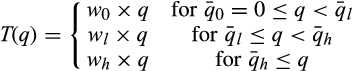


Kolay et al. (2004) show that the supplier can induce the low‐demand type buyer to order 





The participation constraints (4) ensure that both buyer types accept the contract. The incentive constraints (3) guarantee that buyer type 

It is conventional wisdom that under the optimal menu of contracts: (i) the low‐demand type buyer earns zero surplus; (ii) the high‐demand type buyer earns an informational rent; (iii) the threshold quantity 


In the optimal menu of contract, the participation constraint binds for the low‐demand type buyer. It follows that for any 

Informational rents are a result of an incentive compatible contract requiring that the high‐demand type earns at least as much when ordering at the per unit price
Formally, the trade‐off between efficiency and informational rent can be depicted by expressing the high‐demand type buyer's informational rent as a function of 



There are two scenarios. First, the high‐demand type buyer orders at the threshold when selecting 





The supplier faces an efficiency‐informational rent trade‐off. If the likelihood of trading with a low‐demand type is high, that is, 


Analytical results are provided in the Online Appendix EC.4.
The buyer's expected profit is



Example
Table 1 presents the theoretical optimal all‐unit quantity discount contract based on our parameter choices in the experiments, that is, 




Supplier's and Buyer's Profits under the Menu of Contracts

Experimental Design and Hypotheses
Decision Support
The design of menus of contracts with quantity price breaks has been reported to be very challenging for subjects (Kalkanci et al. 2011, 2014). Subjects have difficulties in setting the price breaks effectively to separate different buyer types. This hampers them from reaping the benefits of non‐linear contracts. Kalkanci et al. (2011) suggest: “a decision support tool that would help suppliers set their discount schemes effectively would be especially beneficial” (Kalkanci et al. 2011, p. 698). We take account of this complexity issue and adopt the decision support tool introduced by Inderfurth et al. (2013). The tool asks the supplier for the likelihood that the buyer is of type 
To provide the supplier with more leeway to allocate profits, we give the supplier the option to lower the per unit prices 

Sequence of Events
Figure 1 summarizes the sequence of events. In the first stage, the buyer obtains her private information
In the second stage, the supplier designs his menu of contracts by (a) stating the subjective probability (i.e., the a posteriori belief after receiving signal 


In the third stage, the buyer only chooses the per unit price 
In the last stage, the following results are summarized: the contract offer from the supplier, the buyer's contract choice with the resulting per unit price
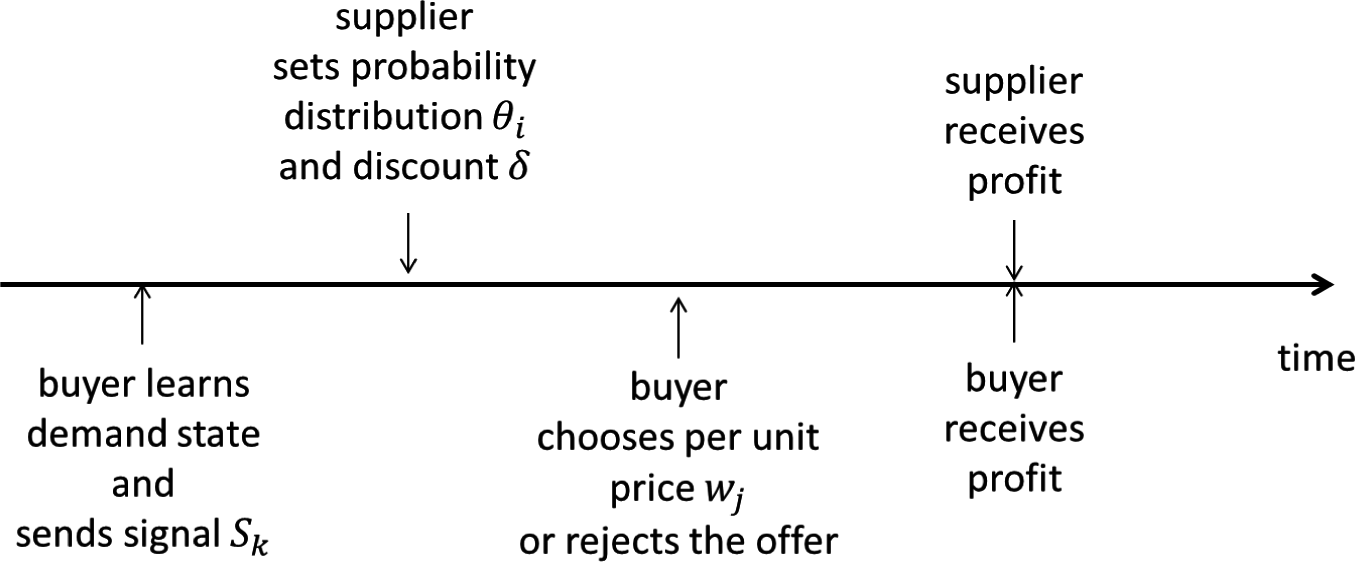
Sequence of Events in the Game
Information Sharing
We consider both a one‐shot game and a finitely repeated game in our experiments. In both scenarios, the equilibrium strategy for (sequentially) rational and profit‐maximizing supply chain parties provides our first hypothesis (Fudenberg and Tirole 1991). We consider the finitely repeated game in our main experiments and run another set of experiments with round‐robin matching procedure to establish the robustness of our results in a set‐up that is one‐shot. Note that we hold the interaction mode constant across treatments, so it cannot explain treatment differences.
Standard game‐theoretic expectations
In order to isolate the behavioral effect of information sharing from other behavioral factors, such as bounded rationality or fairness preferences, we compare a
Treatment Overview
Notes
In the first column, the numbers in parentheses indicate the number of independent observations. The second column indicates whether information exchange through a restricted message is allowed between supplier and buyer. The third column indicates the medium of the pre‐game communication. The fourth column indicates whether the interaction is anonymous. The fifth column shows whether additional training was given to the subjects.
One source of inefficiency results if a low‐demand type buyer chooses the downward distorted order size, 


Another source of inefficiency results if the buyer does not choose the profit‐maximizing contract (i.e., she does not self‐select into the contract that was designed for her). Reasons for this contract choice behavior are reported to be bounded rationality and fairness preferences (see Johnsen et al. 2019). These behavioral factors may also be present in our baseline treatment. Johnsen et al. (2019) show that the adverse effects of this contract choice behavior can be effectively mitigated by increasing the profit differences between the contract alternatives. As highlighted above, this can easily be done in our experiments by increasing
Information sharing

Face‐to‐Face Communication
We expect that the potency of this information sharing system can be substantially enhanced when subjects are allowed to communicate face‐to‐face before offering a contract. Face‐to‐face communication possesses several features that may be essential to foster cooperation (i.e., information is shared truthfully and trusted, the buyer self‐selects into her contract, and the resulting efficiency gains are allocated between the parties).
Under face‐to‐face communication, players communicate through verbal and visual channels and can, therefore,
In order to establish the effects of face‐to‐face communication, we compare a
Face‐to‐face communication
Profit‐allocation: The supplier's price adjustments are stronger,
A series of experiments have shown that face‐to‐face communication on the relevant dimensions of the dilemma is much more likely to arouse cooperation than a discussion on dilemma irrelevant issues (Bouas and Komorita 1996, Dawes et al. 1977). Since our supply chain model comprises bargaining and information sharing aspects, it is relatively complex, making it likely that participants do not address all relevant aspects of the dilemma. We therefore hypothesize that the effect of face‐to‐face communication on cooperation rates can be enhanced when subjects get an additional training on the relevant game dynamics.
In order to investigate the effects of training, we compare the
Training (analogue to Hypothesis 3 while replacing “face‐to‐face communication” by “training”).
Root‐Cause Effects
In order to disentangle the reasons why face‐to‐face communication fosters cooperation, we systematically decompose the elements of face‐to‐face communication. We omit to provide hypotheses for this explorative part of the study.
In the
In the
In the
Experimental Protocol
The experimental software was implemented with the toolbox z‐Tree (Fischbacher 2007). Participants were recruited using the software
All subjects played 20 payoff‐relevant rounds of the game explained in section 4.2. Before entering the payoff‐relevant rounds, the subjects played six non‐incentivized rounds of the game. In this training phase, each subject played with a computerized counterpart. The subjects knew that the decisions of the computer followed a preprogrammed and randomly determined algorithm. In particular, the messages sent by the computerized buyer, the contract offers from the computerized supplier, and the contract choices from the computerized buyer were randomly determined beforehand.
Parameters
We set the choke‐off prices at
Incentives
In addition to a 3.00 euro show‐up fee, subjects were paid proportionally to the sum of their profits in their experiments (measured in “thalers”) in all rounds in cash immediately after the experiment. The exchange rate was set at 0.025 euro/thaler, that is, subjects received 2.50 euros for 100 thalers. In our experiments, participants earned 14.87 euros on average (suppliers: 15.35 euros, buyers: 14.40 euros). Each experimental session lasted approximately 70 minutes.
Results
We test the differences between all the treatment combinations in all further analyses with two‐sided Mann–Whitney U (MWU) tests if not indicated otherwise. We account for the problem of multiple testing by using Bonferroni‐corrected
We perform the analysis on the buyer's decisions with pooled data of both buyer types and the analysis on the supplier's decision on pooled data of all signal types. We note that we do not find any qualitative differences if we disaggregate the analysis by buyer type or signal.
Table 3 presents the summary statistics for the buyer's truthfulness and self‐selection rate, the supplier's trust and price adjustments across treatments. The supplier's and the buyer's profits, and the supply chain efficiency are summarized in Table 4. We present the results according to the sequence of events in the game. In section 6.1, we discuss the buyer's trustworthiness, in section 6.2, the supplier's trust, in section 6.3 the supplier's price adjustments, in section 6.4 the buyer's contract choices; in section 6.5 the implication for the supply chain performance, in section 6.6 the supplier's and the buyer's profits, in section 6.7 time trends, and in section 6.8, we summarize the main results.
Summary Statistics
Notes
“Truthful signals” describes the percentage of all cases in which the buyer types send a truthful signal. We set the game‐theoretic expectations such that a low‐demand type is always truthful while the high‐demand type always lies while noting that any other randomization strategy is conceivable in the babbling‐equilibrium. “Self‐selection” describes the percentage of all cases in which the buyer chooses the self‐selection contract. “Trust” describes the supplier's average adjustment of the posteriori probability to the buyer's signal. We set this to zero if the buyer sent no signal. The numbers in parentheses are the standard errors. The stars indicate significant differences from the reference treatment based on Bonferroni corrected
Summary Statistics of Profits
Notes
“Supplier” and “buyer” describe the average monetary profits of the supplier and the buyer over all rounds. “Efficiency” describes the ratio of the average channel profits to the first‐best profits. [m.u.] stands for monetary units. The numbers in parentheses are the standard errors. The stars indicate significant differences from the reference treatment based on Bonferroni corrected
Buyer's Trustworthiness
We measure the buyer's trustworthiness by her willingness to share her private information truthfully, that is, the percentage of cases in which the buyer sends a truthful signal to the supplier. The second column in Table 3 summarizes the results for all treatments, e.g., in the reference treatment, the signals of the high‐demand type buyers were truthful in 61% of all cases, while in the remaining 39% of all cases a deceptive signal or no signal were sent.
We first test for a positive correlation between the buyer's signal and her demand realization in the reference treatment, and observe a significant correlation coefficient of 0.38 (
The results show that face‐to‐face communication has a strong impact on the buyer's trustworthiness as we find that the rates of truthful signals are significantly higher in the video treatment compared to the reference treatment (
We test the differences between all the pre‐game treatment combinations and summarize the results in the Online Appendix (see Table 1 in EC.1). The results show that verbal communication has a significant and certainly the largest impact on the buyer's trustworthiness as we find that the rates of truthful signals are significantly higher in the audio, video, and consulting treatment compared to the reference treatment,
Supplier's Trust
We measure the supplier's trust by his willingness to adjust the subjective probability towards the signal from the buyer. For each supplier in each period, we calculate the supplier's adjustment using 

The supplier's probability adjustments
In a comparison of the pre‐game communication media, the MWU tests (see Table 2 in EC.1 in the Online Appendix) show that it is verbal communication that has the strongest effect on the supplier's trust, since we observe that the effect of verbal communication (audio treatment) is similar (
We finally note that we do not find any systematic differences if we consider the probabilities
Supplier's Price Adjustment
The sixth column in Table 3 summarizes the supplier's price adjustments
The MWU tests (see Table 5 in EC.1 in the Online Appendix) show that the supplier's price adjustments are significantly higher in the video treatment than in the reference treatment (
Furthermore, we do not find support for Hypothesis 4c as the training tutorial does not increase the price adjustments (consulting vs. video treatments,
Buyer's Contract Choice Behavior
The third column in Table 3 presents the buyer's average self‐selection rate per treatment. To recap, self‐selection describes that a buyer of type
We observe a mean frequency of self‐selection of 62% in the baseline treatment, which is significantly lower than the theoretical benchmark of a rate of 100% (
In our findings, we note that information sharing slightly increases the self‐selection rates to 72%. This effect points in the predicted direction (Hypothesis 2d), but is not significant (
Comparing the pre‐game communication treatments to the reference treatment (see Table 6 in EC.1 in the Online Appendix for
A comparison of the consulting treatment with the video treatment indicates that the training tutorial in the consulting treatment has a positive effect on the buyer's self‐selection frequency (
Supply Chain Performance
Table 4 summarizes the supply chain efficiency per treatment. We calculate the supply chain efficiency using 

In comparison to the game‐theoretical expectation, we observe that the efficiency of the supply chains without information sharing (baseline treatment) is far below the second‐best benchmark (
We find that face‐to‐face communication has a significant positive effect on the supply chain performance. The average supply chain efficiency in the video treatment reaches 97% and is significantly higher than that in the reference treatment (
No significant differences can be found between the second‐best benchmark and the performances of the supply chains using text‐chat communication (
Supplier's and Buyer's Profits
Table 4 summarize the supplier's and the buyer's average profits, respectively (see Tables 8 and 9 in EC.1 in the Online Appendix for
The results show that in all treatments, the supplier's average profits are significantly below the game‐theoretic expectation (
Furthermore, the results show that the condition lifting the anonymity as such has no significant effect on both the supplier's and the buyer's profits (
Time Trends
In this section, we investigate whether the subjects’ behavior changes over time. We run the following four random effects regressions with respect to the four dependent variables: buyer's truthfulness, buyer's self‐selection, supplier's trust, and supplier's price adjustment:



The subscript 
We use a general linear model to estimate
The results are presented in Table 5. The coefficient of
Regression Results
Notes
We use a logit random effect model for the regression of the binary dependent variables
Overall Comparisons
In Table 6, we summarize the main effects of the four communication treatments in comparison to our reference treatment and the effect of consulting in comparison to the video treatment.
Summary of the Main Effects
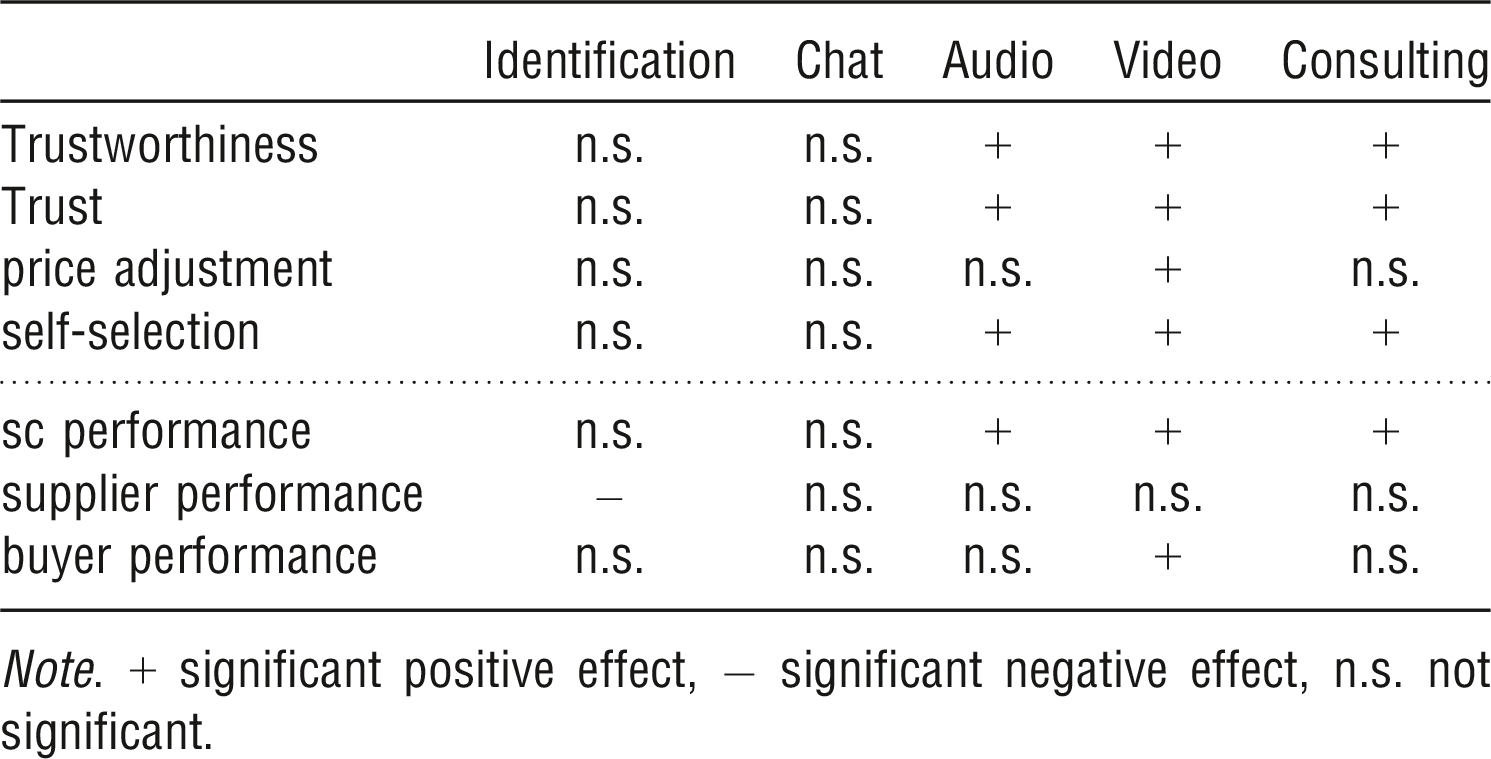
Our observation is that communication is very helpful for players when coordinating the supply chain. This contradicts the game‐theoretic prediction. Communication is especially successful when a verbal communication channel is available. In contrast, text‐based communication shows positive effects, but these effects are much weaker. Lifting the anonymity by using identification does not seem to have any relevant effects.
Communication Content Analysis
We observed that communication has a strong effect on supply chain coordination and more so when a verbal communication medium is used (audio/video conference). But what makes verbal communication more effective than text‐based communication? And why do some groups of subjects cooperate while others do not? In this section, we first discuss a potential behavioral explanation for the impact of communication on trust and cooperation and afterwards we use content analysis to identify what promotes cooperation.
Theory and Rationale
We provide five explanations for why communication media affects trust and cooperation: comprehension of the game, reciprocity, the salience of the mutual benefits, the psychological cost of lying, and inequity aversion.
Method
In light of the potential explanations discussed above, we will focus on the following content analysis variables:
To measure the variables, two independent raters assessed the communication contents and answered a coding scheme with 21 questions referring to one of the variables introduced above (see Online Appendix EC.2) For each question, the raters filled out two scales: a 5‐point Likert scale and a yes–no scale. On the yes–no scale (yes: 1, no: 0) the coders assessed whether the aspects are present in the communication phase. On the 5‐point Likert scale, the coders provided their personal assessment to capture more subtle aspects in the message meaning. With this strategy, we attempted to measure both the manifested aspects as well as the latent aspects in the content. The Likert scale ranges from
For the sake of brevity, in the following, we will only present an analysis based on the data from the Likert scale. The same analysis on the yes‐no scale is to be found in the Online Appendix EC.2. If not mentioned otherwise, the presented results remain qualitatively the same for the yes‐no scale.
We assessed the inter‐rater reliability for the 5‐point Likert scale with an intraclass correlation (ICC) statistic based on the random‐effect, consistency, average‐measure variant (McGraw and Wong 1996). The resulting ICC was in a fair to excellent range for 14 questions, whereas seven questions gained a poor ICC of less than 0.4 (Cicchetti 1994). We therefore removed these seven questions from further analysis. Among them were also the two questions concerning inequity aversion. The coders’ ratings on the yes‐no scale revealed that these aspects were hardly explicitly expressed in the communication phase, which presumably made the judgement less clear. It seems that aspects of inequity aversion were, if at all, only a minor topic in subjects’ conversation. We show that our results are robust to the exclusion of these questionnaire items, see Online Appendix EC.2 for details. We form one scale for each variable by averaging the raters’ scores over the related questions (e.g., the variable
Results
Table 7 compares the mean of the coders’ ratings across treatments. The analysis shows that the raters attributed higher psychological cost of lying to the subjects in the videoconference treatment than in the chat treatment, since we find the coders’ ratings to be significantly higher in the video treatment than in the chat treatment (
Summary Statistics of Coder's Ratings
Notes
The numbers present the mean of the coders’ ratings on the 5‐point Likert scale (strongly disagree (−2), disagree (−1), neutral (0), agree (+1), strongly agree (+2) over all questionnaire items referring to the same variable. The stars indicate significant differences from the ratings of the chat treatment with **
To gain more insights, we next investigate the effects of the communication content on the subjects’ individual decisions. We use four linear regressions regarding the dependent variables: the buyer's trustworthiness, the supplier's trust, the supplier's price adjustment, and the buyer's self‐selection rate. We include the coders rating with respect to the four variables (lying aversion, reciprocity, mutual benefits, and comprehension) and treatment dummies in the models. We use the data from the communication treatments (chat, audio, video, and consulting) and treat each subject's average decision over the 20 playing rounds as one independent observation.
The results presented in Table 8 confirm a strong correlation between the raters’ perception of the players’ psychological cost from lying and both the buyer's trustworthiness and the supplier's trust. Furthermore, reciprocity has a significant positive effect on the buyer's trustworthiness, the supplier's trust and price adjustment, which indicates that players effectively used reciprocal strategies to establish cooperation. We find that the salience of mutual benefits has a significant effect on the buyer's truthfulness. The comprehension of the game has a slight positive effect on the supplier's trust and there is also a positive effect from the consulting treatment on supplier's trust. This implies that a deep understanding of the game dynamics fosters the building of trust. Furthermore, there is a strong negative effect from the chat treatment dummy on the supplier's trust. We conjecture that there are also non‐content related factors attributed to the communication forms that affect the supplier's trust, e.g., the use of nonverbal communication such as tone of voice, body language or dress may also affect the building of trust (Kiesler et al. 1985). Lastly, we do not find any significant effects on the buyer's self‐selection rates. 5
Regression Results from the Content Analysis
Note
***
In sum, the analysis reveals that communication is especially effective in establishing trust and trustworthiness when players use reciprocal strategies and is more so when the buyer clearly expresses guilt from lying. Furthermore, the clarification of the mutual benefits of information sharing moves the buyer to truthfulness.
One‐Shot Interactions
We used a partner matching design in all our experiments. Since the experiment had a finite end, sequential rationality predicts that outcomes are identical to the one‐shot game. Furthermore, we held the interaction mode constant across treatments; as such the interaction mode cannot explain the treatment differences. We test if our results are robust in one‐shot interactions, since behavioral research shows that partner matching likely increases cooperative play (Cooper et al. 1996, Croson et al. 2003, Kamecke 1997).
We replicated the experiments of our main study in a round‐robin matching procedure, that is, subjects played only once with each other possible partner. We ran three experiments to replicate our main insights, with the only exception being the round‐robin (rr_) procedure: rr_baseline, rr_reference, and rr_video treatment. We chose to use the videoconference communication medium in the pre‐game communication phase, because this medium showed the strongest effect in fostering cooperation. 6
Given the round‐robin matching, we restricted the number of rounds to five due to limited availability of ten sound‐proof cabins. We ran six sessions for the rr_video and rr_reference treatments each and five sessions for the rr_baseline treatment each with 10 subjects. We used session averages as one independent observation for the statistical analysis and an exchange rate of 0.1 in all treatments. The subjects’ average earnings were 14.50 euros and the experiments lasted for about 50 minutes. The rest of the protocol was identical to that in our main experiment.
Results
Tables 9 and 10 summarizes the statistics. We find no significant differences between the rr_baseline and rr_reference treatments for the overall performances, that is, the supplier's, the buyer's, and the supply chain profits.
Summary Statistics
Note
The stars indicate significant differences from the rr_reference treatment with **
Summary Statistics of Profits
Note
The stars indicate significant differences from the rr_reference treatment with **
We find that the buyer's trustworthiness, supplier's trust and buyer's self‐selection frequency are significantly higher in the rr_video treatment than in the rr_reference treatment. Furthermore, the supply chain performance, the supplier's profits, and the buyer's is significantly higher in the rr_video than in the rr_reference treatment. Overall, the results of the one‐shot interaction experiments replicate the insights of the main experiments. Thus, the strong effect of the video communication on the supply chain coordination remains significant under one‐shot interactions.
Discussion
In laboratory experiments with a student subject pool, we find that (a) information sharing with simple one‐way text messages improves supply chain performance and that (b) this is even more so if the supply chain parties communicate verbally before the demand data is exchanged.
Our stylized supply chain setup considers central aspects of bargaining in supply chains (sequential moves, quantity discounts, efficiency losses) while abstracting from others that set bounds on the generalizability, which we discuss below.
First, we used a student subject pool for our experiments. This is well in line with other studies that analyze information sharing in supply chains (Hyndman et al. 2013, Özer et al. 2011, 2014, Spiliotopoulou et al. 2016). Yet, a cautionary note that decision makers in practice might have a different set of skills, experience, and beliefs that render communication less effective is warranted. As an example, the study from Özer et al. (2014) shows that the extent of trust and trustworthiness varies with the social distance of the supply chain members. We further note that all of the students were at least fluent in German. It is certainly an interesting avenue for future research to analyze how personal traits and social background interact with the effectiveness of communication media on a tactical level.
Second, we made the payoff consequences of contract design and contract choices via a decision support tool very transparent at all stages of the game. Carpenter (2002) shows in the best shot game, a version of a sequential move public good game, that this information provision has a strong effect on the fairness of the final profit allocation. In line with Carpenter (2002), we observed much fairer profit allocations than theoretically predicted, particularly in our verbal communication treatments. As such, the information provision of payoff consequences may be an important antecedent and therefore a limitation on verbal communication being effective. A rigorous assessment is left for future research.
Third, we restricted our setting to supply chains with deterministic supply and demand. In this situation, quantity discounts are among the most widely used contract forms in practice (Munson and Rosenblatt 1998) and are also theoretically effective in coordinating a supply chain with asymmetric information and stochastic demand (Burnetas et al. 2007). It is an interesting avenue for future research to analyze whether communication regarding contract terms on a tactical planning level can also boost supply chain performance when supply and demand are uncertain. While doing so, other contract formats that allow for risk sharing (buy‐back or revenue sharing, see Katok and Wu 2009 for laboratory experiments or Arya and Mittendorf 2004 for asymmetric information and buy‐back contracts) might also be considered.
Fourth, we assumed that there are two buyer types, that is, low‐demand and high‐demand. While there are most likely more types prevalent in practice, one might certainly consider quantity discounts with more price breaks. However, Kalkanci et al. (2011) show in a laboratory supply chain experiment that, due to decision biases, an increase in contract complexity does not necessarily lead to an increase in the supplier's profit and simpler contracts can thus be sufficient for a supplier.
Fifth, we provided a decision support tool that eases many of the complexity issues when designing nonlinear contracts (how to set price breaks and corresponding prices). Our results may be sensitive to the availability of such a support tool, but at the same time strengthen the insight that training may help coordinate the supply chain.
Conclusion
We have revisited one of the fundamental topics in supply chains: information sharing. We have considered a typical supply chain environment in which strategic incentives for misrepresentation of private information are prevalent, the supply chain parties operate on a basis offering a take‐it‐or‐leave‐it contract, and efficiency gains from a win–win cooperation can be achieved.
We have replicated, in a different setting, the findings from previous laboratory experiments that the simplest form of information sharing, that is, one‐way messages, enhances supply chain performance; however, efficiency losses prevail (Hyndman et al. 2013, Özer et al. 2011, 2014, Spiliotopoulou et al. 2016). We find that these efficiency losses can be significantly and almost fully reduced if the supply chain parties verbally communicate before the actual demand information is exchanged while simple one‐way messages are still used on an operative basis (i.e., when contracts are negotiated and information is actually shared). Our results therefore indicate that management can use simple and efficient means to electronically share private information; however, the critical strategic issues should be discussed beforehand.
Communication content analysis reveals that communication is especially effective in establishing trust and trustworthiness when players use reciprocal strategies and more so when the buyer clearly expresses guilt from lying. The clarification of the mutual benefits of information sharing moves the buyer to truthfulness. We have shown that our results are robust against subjects interacting repeatedly or once.
Footnotes
Acknowledgment
We are grateful to three anonymous referees, the senior editor, and the department editor for the constructive comments that they provided during the revisions of this manuscript. We are grateful to Rouven Weimann who supported the project administratively. We gratefully acknowledge the financial support of the Deutsche Forschungsgemeinschaft through the DFG‐research project “Supply chain coordination in case of asymmetric information” (GZ:VO 1596/2‐1) and its members for useful comments.
1
If subjects reached the 10‐minute limit, they were asked to finish the communication phase by a blinking text message. The phase did not terminate automatically.
2

3
Note, the 50% benchmark results when the buyer always sends the signal “demand is low.” Alternatively, the buyer may randomize between the signal alternatives (e.g., “demand is low,” demand is high” or “no signal”) and a benchmark of 1/3 results. If the buyer always chooses the “no signal” option, a benchmark of zero results.
4
Note that the pairwise comparison of the video and audio treatments with the reference treatment results in a
5
There are also no significant treatment effects for self‐selection. Note, this is in line with the MWU test as we found strong treatment differences between the reference and the communication treatments but not between the communication treatments.
6
Note, since subjects engage in videoconferences, social concerns about reputation (e.g., participants may not wish be identified as selfish) may not be ruled out. However, this design rules out any effects arising from the expectations about future interactions (e.g., participants may cooperate in the expectation of higher profits in future periods).