






Abstract
To delineate the differences in clinical characteristics and evaluate the outcome between primary and secondary cough headache, 83 consecutive patients (59M/ 24F, mean age 61.5 ± 17.7 years) with cough headache (1.2%) out of 7100 patients in a headache clinic were studied. All of them received brain imaging studies. Most did not have relevant brain lesions (n = 74, 89.2%, primary group) except for nine patients (10.8%, the secondary group). Most of the intracranial lesions were located in the posterior fossa (n = 6, 67%), including only two patients with Chiari malformation. The primary group had a higher response rate to indomethacin than the secondary group (72.7% vs. 37.5 %, P = 0.046). Mild to moderate headache intensity and age onset < 50 years predicted a favourable response. At a mean follow-up of 51.4 months, 83.9% of patients with primary cough headache completely remitted. Inconsistent with the proposed International Classification of Headache Disorders, 2nd edn criteria, 10.8% of patients with primary cough headache had headache duration of > 30 min. Clinical features, neurological examinations and drug response could not safely differentiate primary from secondary cough headache. Neuroimaging studies are required in each patient.
Introduction
It is a clinical doctrine that headache provoked by cough is suggestive of intracranial lesions. In 1956, Symonds described 21 patients with cough headache who did not have organic disorders (1), indicating that cough headache could be a benign symptom. Nevertheless, the ensuing studies related to cough headache showed variable results of secondary aetiologies ranging from 10 to 58.8% (1–5). In addition, because of the development of modern radiological techniques, the Chiari malformation type I became the major aetiology in two large series reported by Pascual et al. (4, 5).
The International Classification of Headache Disorders, 2nd edn (ICHD-II) (6) changed ‘benign cough headache’ to ‘primary cough headache’ (PCH) and proposed diagnostic criteria (Table 1). Generally, PCH is considered a male predominant headache syndrome, onset usually in men > 40 years old, bilateral location, few associated symptoms, reaching peak intensity in seconds and duration < 30 min (6). However, the studies on PCH post-ICHD-II era are few and the proposed criteria have not been field tested.
ICHD-II proposed diagnostic criteria of primary cough headache
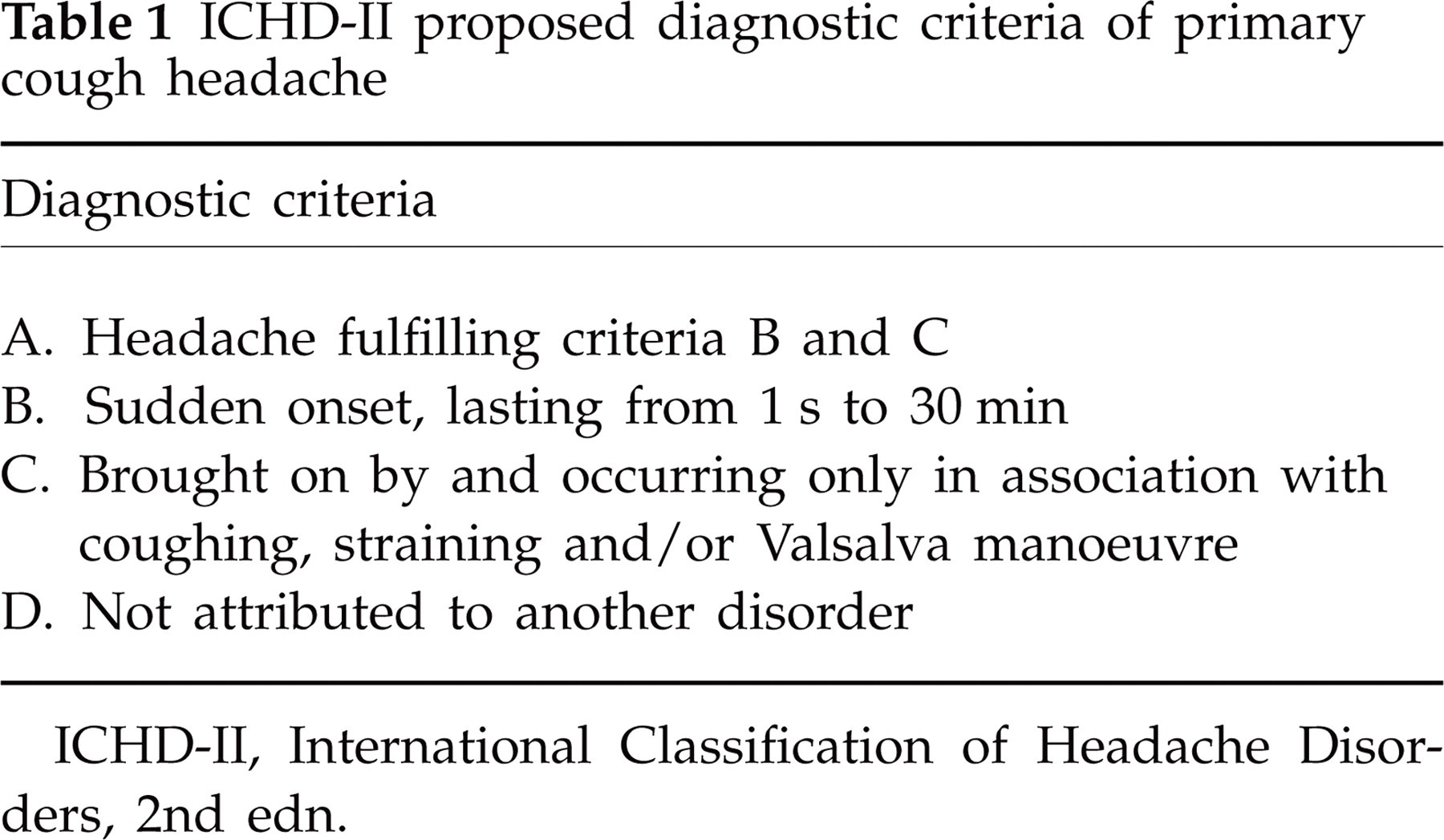
ICHD-II, International Classification of Headache Disorders, 2nd edn.
Indomethacin plays an important role in the treatment of PCH (7–10); however, its efficacy for secondary cough headache is not known. In addition, only one systematic follow-up study has been done in patients with cough headache (5). In this study, we consecutively evaluated 83 patients with cough headache with goals to (i) delineate the differences in headache profiles between primary and secondary cough headache, and (ii) evaluate the efficacy of indomethacin and the predictors for treatment response and prognosis.
Methods
We enrolled consecutive patients with cough headache who visited the headache clinic of Taipei Veterans General Hospital (VGH) from 1 April 1999 to 31 November 2007. Patients were recruited if they complained of headache induced by cough.
Taipei VGH is a 2198-bed medical centre serving both veterans and non-veteran citizens. The headache clinic has been operating since 1997. In Taiwan, the government-run, single-payer insurance system is supported by the National Health Insurance Programme launched in 1995. The population coverage rate is > 96%. Taiwan does not have a structured or formal system of medical referral. Patients have the right to choose any hospital or physician they wish, regardless of the severity of their illness. Fewer than 4% of patients to our headache clinic were referred.
All patients with cough headache filled out a structured questionnaire designed for cough headache. Information included demographics, self-reported medical illnesses, and headache profiles: age at headache onset; relationship between cough and headache; disease duration before visiting our clinic; headache location; quality; intensity; other triggers; and headache duration and accompanying symptoms. In addition, all patients underwent a neurological examination by our physicians.
All patients received neuroimaging studies, either brain computed tomography (CT) or magnetic resonance imaging (MRI) to investigate the possibility of intracranial lesions. Based on the imaging findings, patients were classified into two groups, primary and secondary cough headache. One physician (P-K.C.) reviewed all questionnaires and medical records. In February 2008, the same physician followed up these patients via a telephone interview, focusing on any relapse after treatment.
In our headache clinic, the physicians treat patients with cough headache with indomethacin (25 mg twice or three times a day) if not contraindicated. In this study, the response to treatment was recoded as complete remission, partial response (headache frequency and intensity both improved > 50%), and poor response after 2 weeks' indomethacin use. The response rate was defined as the percentage of patients with at least partial response to indomethacin.
In this study, we also field tested the ICHD-II criteria for our patients with PCH. This study protocol was approved by the Institutional Review Board of the hospital. Participants had to sign informed consent before participating.
Statistics
Results
Participants
During the study period, 83 out of 7100 patients (4867 female, 2233 male) (1.2%) presented at our headache clinic with the chief complaint of cough-induced headache (59M/24F, mean age 61.5 ± 17.7 years, range 22–88). Eighty patients underwent MRI of the brain and three underwent CT of the brain. Seventy-six of them (91.6%) received contrast enhancement for either CT (N = 2) or MRI (N = 74) studies.
According to the results of neuroimaging studies, 74 (54M/20F) patients (89.2%) had PCH (primary group), whereas nine (5M/4F) (10.8%) had secondary cough headache (secondary group). One patient with a meningioma of 1 cm in diameter over the frontal region was classified into the primary group. Age, gender, age of onset and duration of illness did not differ between the two groups (Table 2).
The demographics and headache profile in patients with primary and secondary cough headache

The self-reported medical illnesses, in the primary group, included hypertension (32.4%), chronic obstructive pulmonary disease (16.2%), diabetes mellitus (8.1%), coronary artery disease (6.8%) and hyperlipidaemia (4.1%). In the secondary group self-reported illnesses included hypertension (33.3%), hyperlipidaemia (22.2%) and diabetes mellitus (11.1%).
Twenty-four patients had hypertension in the primary group. Their antihypertensive medications used within 1 month prior to the onset of cough headache were recorded. Eight patients were under combination therapy, 11 under monotherapy, and five were not on regular treatment. Among those being treated, three received angiotensin-converting enzyme inhibitors (ACEI). After discontinuation of ACEI, one patient reported improvement of cough headache because the frequency of cough was markedly reduced; however, the other two patients did not improve.
In the primary group, none of the patients had positive neurological findings, whereas in the secondary group three patients had ataxic gait with or without dysmetria in the finger–nose test (Table 3, nos 1, 2 and 6). The causes of secondary cough headache are listed in Table 3. Six of them (66.7%) had a posterior fossa lesion (four with obstructive hydrocephalus and two with Chiari malformation type I). Of the other three patients, one had subdural hematoma, one multiple brain metastasis and one acute sphenoid sinusitis.
The underlying causes of secondary cough headache

Headache profile (Table 2)
In the primary group, the duration of headache ranged from 1 s to 2 h (median 30 s). Most patients (89.2%) had headaches for < 30 min, but eight patients (10.8%) had headaches that lasted > 30 min. In the secondary group, the duration of headache ranged from 10 s to 30 min (median 150 s), which was not different from that in the primary group. In addition, the majority of the two groups rated severe intensity of their headaches (primary/secondary: 67.6/55.5%)
In the primary group, 16 patients (25.7%) had two or more different headache patterns during cough, but all nine patients with secondary cough headache had only one headache pattern. However, the frequencies of headache patterns did not differ between the two groups with an explosive headache type as the most common followed by dull pain. Most patients had bilateral headache in both groups (primary/secondary: 67.7%/88.9%) with similar location distribution. Notably, the associated features, such as nausea, vomiting, photophobia and phonophobia, were uncommon and did not differ between the two groups.
In addition to cough, most patients had more than one trigger for their headache (primary/ secondary 72.6%/77.8%), including straining at stool as the most common trigger in the primary group, whereas in the secondary group exertion was the most common, followed by stool straining and heavy lifting (Table 4).
Comparison of the frequencies (%) of the other triggers related to cough headache between primary and secondary patients

Indomethacin treatment
Fifty-five patients with PCH and eight with secondary headache were treated with indomethacin (25 mg twice or three times per day). For those not treated with indomethacin, the reasons were: refusal in two patients, contraindications in six and usage of other painkillers or medications in 12 patients. Ten patients in the primary group underwent cerebrospinal fluid (CSF) drainage for both diagnosis and treatment. Eight patients (80%) reported much improvement or complete remission after CSF drainage. Indomethacin was given to the four patients without complete remission after CSF drainage, only one of whom was responsive. In the primary group, 24 patients (43.6%) had complete remission and 16 (29.1%) had a partial response. In the secondary group, only one patient (12.5%) had complete remission and two (25.0%) a partial response. The primary group had a higher response rate than the secondary group (72.7% vs. 37.5 %, P = 0.046).
In the primary group, patients with PCH onset before age 50 years had a higher treatment response rate than their counterparts (100% vs. 62.5%, P = 0.005). Patients with mild to moderate headache intensity had a higher response rate than those with severe intensity (94.5% vs. 62.2%, P = 0.012). The response was not related to gender, headache duration, location, characteristics, associated features or length of the interval before treatment.
Follow up
All patients were followed up by telephone in February 2008 with mean follow-up duration of 51.4 ± 32.6 months (range 3–106).
Primary group
Four patients died before follow-up. Fifty-six patients finished telephone follow-up (response rate 80.0%). The reasons for non-participation were loss to follow-up (n = 8) and refusal (n = 6). Among the 56 followed-up patients, 47 (83.9%) were disease free and nine (16.1%) were still suffering from cough headache.
Of the 12 followed-up patients with poor response to initial indomethacin treatment, five (41.7%) still suffered from cough headache and seven remitted spontaneously in 6 months to 2 years. In the 36 followed-up patients with initial response to treatment, 34 were pain free within 6 months without recurrence of cough headache, but three reported relapse 0.5–1 year later and had intermittent cough headache during follow-up. Poor response to the initial treatment predicted a poor outcome at follow-up for patients with PCH (P = 0.01).
Secondary group
Two patients died of cancer with brain metastasis, and one patient was lost to follow-up. In the remaining six followed-up patients (respondent rate 85.7%), four had complete remission after treatment of the underlying diseases, but the other two patients with Chiari malformation type I, who did not receive surgical interventions, still suffered from intermittent cough headache.
ICHD-II criteria
About 89% of patients in the primary group fulfilled the ICHD-II criteria for PCH because of the criterion of headache duration ≤ 30 min. Eight patients had longer duration of headache, but their other headache profiles, prognosis and treatment response did not differ from those with headache duration of ≤ 30 min.
Discussion
Our study found cough headache was uncommon (1.2%), but about 10.8% of patients with cough headache had intracranial lesions. The posterior fossa lesions were the most common aetiologies for secondary cough headache (66.7%). However, headache profile could not help differentiate primary and secondary cough headache, which supports the clinical rule, i.e. secondary causes should be highly suspect in each patient with cough headache.
The frequency of secondary cough headache in our study (10.8%) was similar to two earlier series reported by Symond et al. (22%) (1) and Rooke et al. (10%) (2), but much lower than the two series reported by Pascual et al. (57 and 58.8%, respectively) (4, 5). In the studies of Symond et al. (1) and Rooke et al. (2), the underlying lesions were quite variable, as in our study, whereas in the two series of Pascual et al. (4, 5) the most common secondary cause was Chiari malformation type I (100 and 80%, respectively). Only 33.3% of patients (n = 3) in the secondary group in our study showed posterior fossa signs, in contrast to 82.3% (14 of 17 patients) compared with 82.5% (33 of 40 patients) in Pascual et al.'s studies (4, 5). The unavailability of modern neuroimaging techniques may explain the low diagnostic rates of Chiari malformation type I in the two earlier studies (1, 2). However, the cause of this discrepancy between our study and those of Pascual et al. (4, 5) is unknown, because almost all of our patients (96.4%) had MRI studies. The posterior fossa symptoms or signs might appear after an interval of 1–5 years in Pascula et al.'s studies (4). We had also followed up these patients at a mean interval of 4.5 years, so it is unlikely that the low frequency of posterior fossa symptoms and signs is due to the short follow-up interval. An ethnic factor should be considered, because in Western society Chiari malformation type I and Paget's disease-related basilar impression are important aetiologies of secondary cough headache (1, 2, 4, 5). In contrast, Paget's disease-related basilar impression has been relatively rare in Asians (11, 12). The prevalence of Chiari malformation type I was 0.77% in the USA (13), but the prevalence in Asians has never been reported to our knowledge. One recent report has shown the the position of the cerebellar tonsillar tip was higher in Chinese compared with American adolescents (mean 2.9 mm above vs. 0.4 mm below the foramen magnum) (14, 15). In addition, none of 53 healthy Chinese adolescents had a position of tonsillar tip caudal to the foramen magnum (16). We postulate that the prevalence of Chiari malformation type I is lower in Asians than in Westerners, which may explain the low frequencies of secondary headache as well as Chiari malformation type I in patients with cough headache.
The response to indomethacin was higher in the primary than in the secondary group (72.7% vs. 37.5%). This is in contrast to the second series of Pascual et al. (5), where none of the patients with secondary cough headache responded to indomethacin. The reason for this discrepancy is unknown. Nevertheless, treatment response to indomethacin should not be used to differentiate between these two groups (17, 18). Notably, the response rate to indomethacin therapy might have been underestimated, because the dosage in our study did not exceed 75 mg/day (7–10). Furthermore, CSF drainage was also effective in some of our patients with PCH. Because it is an invasive procedure and the response to medication treatment was good, we suggest CSF drainage as the second-line treatment.
In the most recent study of Pascual et al., ACEI, as a precipitating factor, accounted for 25% of their observed PCH (5). These patients improved after discontinuing ACEI. In contrast, only one patient's cough headache in our study could be attributed to ACEI because the symptoms improved greatly after ceasing ACEI. This discrepancy might be due to the low usage of ACEI in patients with hypertension in Taiwan because of the high incidence of cough (18–49%) (19, 20).
The pathophysiology of cough headache is still unclear. Most research to date has focused on patients with Chiari malformation type I or PCH and has provided some hypotheses (21–26). Transient increase of intracranial pressure is the most popular hypothesis. In fact, previous studies have shown the baseline (before coughing) intracranial pressure was normal in patients with Chiari malformation type I (23) and PCH (2, 26). Nevertheless, the degree of tonsillar descent and the crowdedness of posterior fossa were related to the presence of cough headache (24, 27). So the peak of intracranial pressure during coughing should play a role in patients with cough headache. On the other hand, baseline intracranial pressure is usually higher in patients with intracranial lesions. The efficacy of indomethacin (7–9), acetazolamide (26) and CSF drainage (9, 28) was considered to be related to a decrease in the intracranial pressure, but these treatments might not be potent enough for patients with a high baseline intracranial pressure. The high baseline intracranial pressure followed by sudden increase during cough may reach a higher peak pressure than in PCH patients. This might explain why more patients with secondary cough headache had a poor response to indomethacin. Some triggers with a lower intensity of Valsalva manoeuvre but with a longer duration, such as exertion and heavy lifting, were more common in the secondary group. These triggers can increase the higher baseline intracranial pressure to reach the threshold of headache. In contrast, the increase of intracranial pressure was not enough in the primary group due to lower baseline pressure.
In the primary group, the disease was generally self-limited. In most patients (83.6%), whether responsive to indomethacin or not, the cough headaches subsided within 6 months to 2 years. The recurrence rate was only 8.3% in 6 months to 1 year. In the Symonds report (1), 71.4% of patients recovered or improved in 18 months to 2 years. In the studies of Pascaul et al. (4, 5), PCH lasted from 1 to 42 months. Therefore, PCH usually ran a benign course.
Differing from the ICHD-II criteria (6), eight patients (10.8%) had headache durations of > 30 min. This finding has also been reported by another study (10). The longest duration was 2 h in our study. Nevertheless, there was no difference in clinical headache profiles, prognosis or treatment response between patients with duration ≤ 30 min and > 30 min. We suggest modifications of the ICHD-II criteria for PCH to broaden the time limitation up to 2 h in patients with PCH.
The strengths of this study are its large sample size, application of ICHD-II criteria and neuroimaging studies in all patients. However, some limitations are noted. First, all headache profiles were self-reported and based on recollection. Bias of subjective recall is assumed. However, this study presented data from actual clinical practice, which may be more relevant to practitioners. Second, interpretation and generalization of our results should be cautious, because the study was conducted in a headache clinic rather than in the general population, even though the referral rate was low in our headache clinic.
Footnotes
Acknowledgements
This study was supported in part by a grant from the National Science Council (95-2314-B-010-005-).