






Abstract
The aim of this study was to explore the description of the migraine attack of Pontius Pilate (a character in the novel The Master and Margarita by M. A. Bulgakov). Some of its features are analysed in light of current migraine literature. It is hypothesized that, at least in part, this description is based on the personal experience of the novel's author. We studied and analysed the text of the novel, other works by Bulgakov, his biography, including his medical training and practice, and the recently published diaries of Bulgakov and his wife E. S. Bulgakova. The novel contains a comprehensive description of a migraine attack. It includes a prodrome/aura of osmophobia. Olfactory perception during or shortly before the migraine attack is altered to the point where neutral or even pleasant odours become unbearable. Bulgakov's extensive history of migraines is seen in his diary, the diary of his wife, letters and other literary works. This is one of the most detailed and extensive depictions of a migraine attack in literature, with osmophobia described with great emphasis. It is likely that Pilate's migraine is described based on the personal history of the novel's author.
Since the beginning of Neurology as a specialty, neurologists have been interested in artistic reflections of brain pathology, e.g locked-in syndrome in Alexander Dumas' Le Comte de Monte-Cristo and the possible manifestations of migraine aura in De Chirico's paintings (1). It is even more fascinating to find interesting descriptions of neurological pathology in literary works of physicians turned writers. Obviously, this kind of analysis is open to all kinds of uncertainty and conjecture.
We would like to describe an example of a migrainous event in the novel of the famous Russian writer, Mikhail Afanasievich Bulgakov, while also addressing the question whether his character's symptoms are based on the author's personal or professional experience.
The biography
Mikhail Afanasievich Bulgakov was born in Kiev, Ukraine in 1891 into a professorial family. He received a medical degree from Kiev University in 1916 (2, 3) and started work as a military physician in the same year. Bulgakov was sent as a general practitioner to the village of Nikolskoie in September 1916. In 1918 he opened a venerology private practice in Kiev. During the turmoil of the Civil War of 1917 he was drafted by various armies participating in the conflict. After the end of hostilities, following a bout of typhus, Bulgakov found himself penniless and barely alive in Vladikavkaz. He was working as a lecturer, newspaper writer and a playwright for a local theatre. Later on he destroyed his early plays. Bulgakov decided to make a clean break with medicine, never to return to it. He started publishing short humorous stories in various journals and newspapers in 1919, after moving to Moscow. (Interestingly, another Russian physician turned writer, Anton Chekhov, started his literary career in the same genre.)
Bulgakov was extremely productive in the 1920s to early 1930s. He wrote A Country Doctor's Notebook, White Guard, Diaboliada, The Heart of a Dog and The Fatal Eggs.
Yet there was an almost uniformly negative response from the reviewers. Those critics loyal to the new regime clearly felt the well-hidden (and sometimes less than well-hidden) animosity of the writer towards the new Proletariat State. Some critics and reviewers adopted a tone of vicious personal attack.
Dangerous labels of ‘class enemy’ and ‘previous regime sympathizer’ were scattered generously in their publications. These critics were more interested in class sympathies than in the literary value of Bulgakov's works. He lost his job in MKhAT (Moskovskii Khudozhestvenyi Akademicheskii Teatr or Moscow Art Theater).
For the rest of his life until his death in 1940, Bulgakov was blacklisted and prevented from publishing and staging his work in the Soviet Union. His play The Days of the Turbins is a peculiar exception to this rule. It was well known that Stalin was personally involved in the fate of the writer. Bulgakov's letter to Stalin and Stalin's personal phone call to Bulgakov are documented in the diary of E. S. Bulgakova (4). According to MKhAT logs, Stalin attended The Days of the Turbins 15 times. There is also a lukewarm positive opinion about Bulkakov's play Flight in Stalin's letter to Bel-Belotserkovny.
It is rather obvious to Bulgakov's biographers that this nod of the Dictator prevented further destruction of the writer. However, it is also unclear whether he was personally involved in blocking the publication and staging of Bulgakov's prose and plays. Bulgakov was allowed to hold a job of librettist at the Bolshoi Theater until his death in 1940. Serious literary criticism, memoirs and biographies started to appear in Russia only in the 1980s and 1990s.
Since translations in other languages have appeared, so have numerous articles in the medical literature about Bulgakov's biography and his early works (5–15).
The novel
The fate of the novel The Master and Margarita (16) is as tragic as the times in which it was created. It was written and rewritten in a period of about 12 years, between 1928 and 1940. Bulgakov did not even consider publishing it. Luck or fate allowed the novel to survive to be published in a drastically censored and abridged version in 1966. A complete version was published only in 1973. Various versions were published in the former Soviet Union and in the West between these dates. It was an immediate and, as is frequently the case, unofficial success few other novels in modern Russian literature have achieved.
An entire generation of Russian readers drew a major part of their quotations and vocabulary from this work. Interestingly, it had an unexpected influence on Western pop culture. According to Marianne Faithful's autobiography (17), in 1968 she provided the musician Mick Jagger with a copy of The Master and Margarita. After finishing the book in one night, Mick Jagger wrote the song Sympathy for the Devil (hence the title of this article). The lyrics contain references to Russian history and to the Devil, as well as almost direct quotations from the novel.
Behind the light and captivating story, there is an incredibly complex multilinear structure. There are several plot lines: the satirical and magical story of the Devil visiting Moscow to celebrate his Spring Ball; the lyrical and tragic story of two lovers crushed by the unfortunate circumstances of their time; a young poet blindly following the atheistic line of Soviet ideology; and yet another retells the biblical story of Jesus.
Text of the novel with comments
One of the most colourful and extended descriptions of a migraine attack in literature can be found in (16). Pontius Pilate is interrogating Jesus (named Yeshua Ha-Nozri) while experiencing a horrendous migraine (Fig. 1).
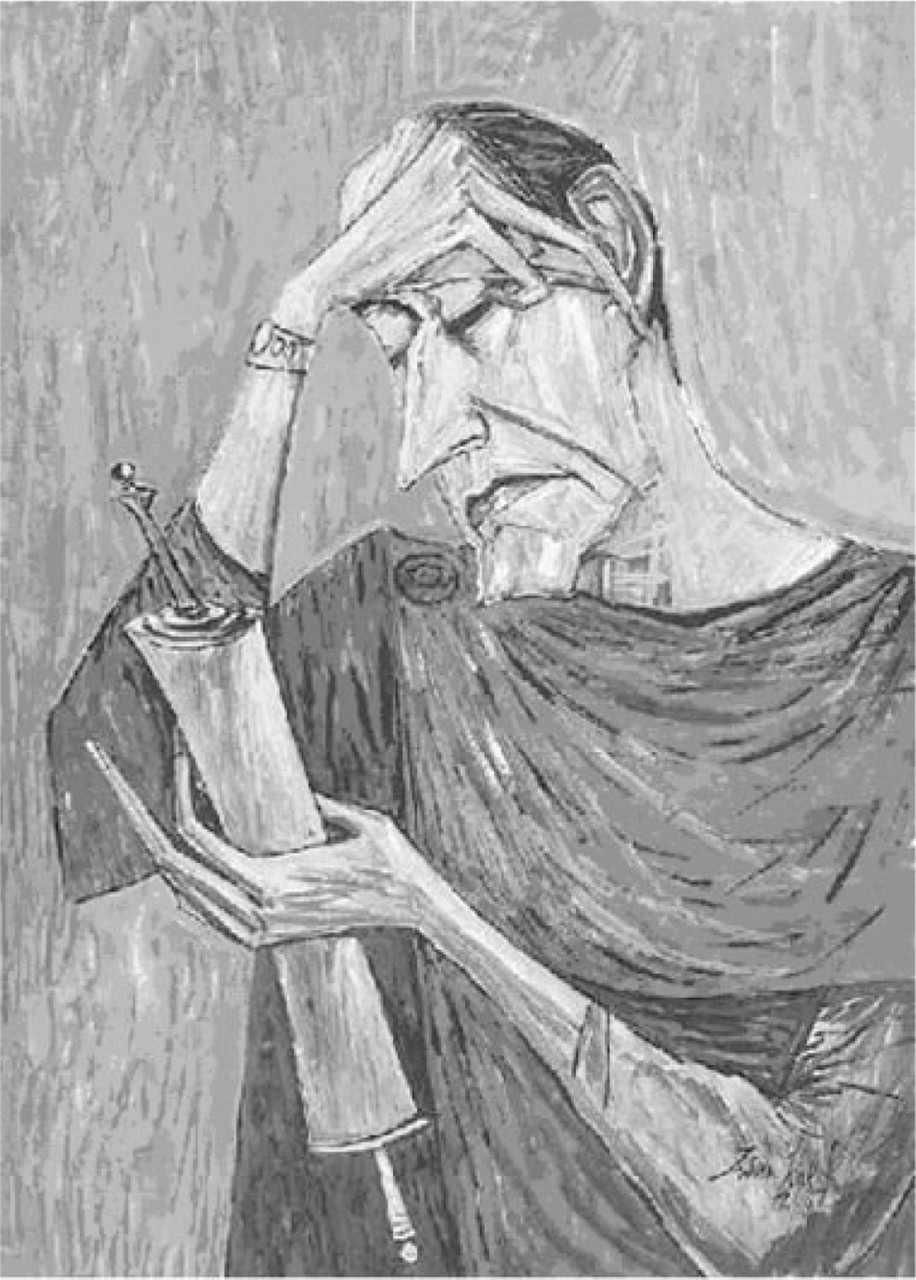
Iwan Kulik, The Procurator's Hemicrania, from a series of paintings inspired by The Master and Margarita, with artist's permission.
‘More than anything in the world the procurator hated the smell of rose oil, and now everything foreboded a bad day, because this smell had been pursuing the procurator since dawn.
‘It seemed to the procurator that a rosy smell exuded from the cypresses and palms in the garden, that the smell of leather trappings and sweat from the convoy was mingled with the cursed rosy flux’ (16).
Unlike visual disturbances, olfactory symptoms are uncommon as a migrainous prodrome or aura. The time course of this symptom is not specified, making it difficult to distinguish between the aura and the prodrome. Parenthetically, the Oxford Latin Dictionary 1968 provides ‘odour, fragrance, aroma’ as one of the less common meanings of the word aura. More common meanings are ‘light breeze, puff, breathe of air’. Since there is a mention of the rose bushes in the Procurator's garden several pages after the description of the Procurator's hemicrania (‘The bush laden with roses’, ‘marble stairway between walls of roses that exuded a stupefying aroma’) (16), this symptom could be interpreted more correctly as osmophobia immediately preceding the attack. Another interpretation is an olfactory stimulus triggering an attack, which we comment on below.
Osmophobia as a symptom associated with headaches is described as early as the 2nd century AD by Aretaeus di Cappadocia: ‘his sense of smell is disturbed. A pleasant smell does not cheer him up; however, he also turns his nose to dirty odours’ (18).
A headache sufferer himself, Bernardino Ramazzini writes in De Morbis artificum diatriba (1700) about olfactory triggers in occupational illnesses, including headaches in pharmacists: ‘In spring when they prepare infusions of roses … some complain of headaches’ (19, 20).
There is also a quotation from Pierre Adolphe Piorry in Edward Liveing's On Megrim and Sick Headaches: ‘… the most grateful odours are with difficulty endured by the sufferers [from migraine]’. He also quotes a long list of olfactory triggers, including the ‘essence of roses’ from Labarraque (1837) (21).
Current International Headache Society (IHS) criteria for migraines are quite specific about photo- and phonophobia. Recently, it has been proposed by the Headache Classification Subcommittee of the IHS to include osmophobia in migraine criteria (22–24).
The Procurator thinks:
… ‘Oh, gods, gods, why do you punish me? … Yes, no doubt, this is it, this is it again, the invincible, terrible illness … hemicrania, when half of the head aches … there's no remedy for it, no escape … I'll try not to move my head …
… ‘Unable to suppress a painful grimace, the procurator ran a cursory, sidelong glance over the writing …
… ‘The procurator was as if made of stone because he was afraid to move his head, aflame with infernal pain….
… ‘A swollen eyelid rose, an eye clouded with suffering fixed the arrested man. The other eye remained shut.’ … (16).
The Procurator is wishing to
… ‘order the room darkened, collapse on the bed, send for cold water, call in a plaintive voice for his dog Banga, and complain to him about the hemicrania. And the thought of poison suddenly flashed temptingly in the procurator's sick head….
… ‘And here the procurator thought: “Oh, my gods! I'm asking him about something unnecessary at a trial … my reason no longer serves me …” And again he pictured a cup of dark liquid. “Poison, bring me poison” The responding voice seemed to stab at Pilate's temple, was inexpressibly painful' … (16).
Here Bulgakov is describing the photophobia and phonophobia of migraine attack. The Procurator thinks:
… ‘my mind does not serve me any more …
… ‘The procurator would have liked to get up and let the water run over his temple, and stay so, motionless. But he knew that even this will not help’ …
The suffering Procurator is reaching for his aching head:
… ‘Pilate … touched his temple with his hand….
… ‘… the procurator rose from his chair, clutched his head with his hands, and his yellowish, shaven face expressed dread.’ …
It has been shown in a study of 400 primary headache sufferers that instinctive self-administered manoeuvres are quite common (25). In patients with migraine without aura the application of cold featured in 38% of the manoeuvres; compression was reported in 36%, used mainly on the forehead and temples.
Later on, in Chapter 24, the Devil himself (named Woland) briefly complains: ‘those idiotic bears and tigers in the bar almost gave me a migraine with their roaring …’ (16).
The diaries and memoirs
Bulgakov kept a diary in 1921–1923 and 1925. It was confiscated by the OGPU (the predecessor of KGB, both were feared secret internal police organizations) during the search of the writer's apartment in 1926; several manuscripts were also seized. His third wife, Elena Sergeievna Bulgakova, kept a diary from 1933 to 1940. According to the editor of Diary of The Master and Margarita (4), V. I. Losev, Bulgakov's diary was announced as a ‘discovery’ in the KGB archives in 1989 (quotation marks of V. I. Losev). Bulgakov himself does not mention his headaches in his diary. However, E. S. Bulgakova's (E.S.B.) diary refers frequently to her husband's afflictions. They are referred to as either ‘headaches’ or as ‘migraines’ (quotations are from [4;] translation is by V.Z.).
Some are mentioned briefly, others in a more detailed way. For example:
‘Devilish migraines’.
‘M.A. returned with a wild migraine (probably, as always, Annushka made him skip a meal); he lay down with a water bottle on his head’.
‘Today M.A. has a migraine. We could not go to the opening night in The Theatre of Satire’.
K. S. Stanislavski, who is less sympathetic than Bulgakov's family, utters:
‘Perhaps, he [Bulgakov] has neuralgia because the play has to be re-written’.
‘He was brought from the theater in a car. With a headache’.
There is a letter to V. P. Soloviev-Sedoi on 16 November 1937. Bulgakov apologizes for not reviewing a script:
‘… I will review this in 2–3 days after my headaches go away, I hope’.
‘M.A. went to Arendt for advice tonight. He cannot stand the headaches’.
‘M.A. arrived with migraine’.
‘Wild migraine; all from going to bed early in the morning’.
[E.S.B. is using here, as elsewhere, the same Russian adjective  (wild) as did the character of the novel Theatrical Novel, see below.]
‘He spent the whole day in the darkened apartment. The light bothers him’.
There are cancelled appointments, rehearsals cut short, and days of not being able to write.
In the last year of his life, Bulgakov suffered from severe hypertension and ‘arteriosclerosis of kidneys’ that eventually led to his early death. He was again complaining of severe headaches and nausea. These symptoms were probably different from the primary headache disorder that afflicted him when he was younger. (One of his physicians was Dr A. A. Arendt, whose ancestor Dr N. F. Arendt was a physician to Alexander Sergeievich Pushkin during his last week of life in Saint Petersburg in 1830 (4).)
Other works of M. A. Bulgakov
Bulgakov's other works frequently mention ‘headaches’ and ‘migraine’. There are descriptions of throbbing headaches in White Guard, Notes of a Young Doctor and Notes on the Cuffs. However, all of these were associated with a fever of various causes. The hero of a short story, Morphine, describes a ‘hysterical letter, enough to give the recipient a migraine. There, it was starting: the nerve on my temple was starting to twitch; I would wake up in the morning to find that the tension in that nerve had moved to the crown of my head, half of my head would feel clamped in a vice, and I would take pyramidon with caffeine’ (26). Migraines are mentioned in Theatrical Novel and Diaboliada: an actor in Theatrical Novel is complaining of ‘wild migraines’.
Most revealing is one brief passage in the unfinished novel, To a Secret Friend (27), written in the 1920s, using the first-person narrative and the first name ‘Mikhail’. He complains to the editor named July: ‘You know, July, I am having frequent migraines’ (translated by V.Z.). The circumstances of this short story parallel Bulgakov's literary perturbations at the beginning of his writing career. The autobiographical nature of this piece is palpable.
Conclusion
The analysis of the diaries available reveals that the author of this novel had a significant headache history. Therefore, it is likely that the masterful description of migraine triggered off by a specific smell or preceded by osmophobia in The Master and Margarita is based on both the professional and personal experiences of M. A. Bulgakov.
Acknowledgements
Parts of this article were presented as an oral presentation (28) and as a poster (29). The authors thank Pamela Perkins PhD and Irina Mirsky-Zayas PhD for editorial help.