






Abstract
The aim of this study was to revise some topics in the chapter ‘Headache attributed to infections’ in the last International Headache Society (IHS) classification. The authors searched for original studies and reviews about headache associated with infections. A checklist was submitted to 15 neurologists to quantify the relevance, comprehensibility and coherence between definitions, criteria and comments for each paragraph. The following paragraphs were fully discussed: (1) headache attributed to lymphocytic meningitis. This topic, being rather heterogeneous, should be divided into different subgroups; (2) headache attributed to HIV/AIDS. Distinctive features are not specified and diagnostic criteria are rather confusing; and (3) chronic post-infection headache. Diagnostic criteria should be reconsidered as the symptom ‘pain’ is not the main diagnostic criterion. The authors propose the revision of three paragraphs of the new IHS classification to better define the most likely headache profile in specific CNS infections. The authors also underline the need to plan further ad hoc prospective studies.
Keywords
Introduction
The development of satisfactory criteria for classifying headaches attributed to infections is a difficult undertaking due to the broad range of pathologies that fall within this ambit. As a result of the aetiopathogenic, prognostic and therapeutic differences between the various forms, the first International Headache Society (IHS) classification chose to deal with headaches associated with intracranial infections and headaches associated with systemic infections in two separate chapters, namely ‘7. Headache associated with nonvascular intracranial disorder’ and ‘9. Headache associated with noncephalic infection’. This choice was justified by the different pathogenic mechanisms involved in the two situations: in the first, there is a close anatomical–functional (lesion–symptom) correlation, whereas in the second this correlation is indirect and thus much less clear. The new classification (ICDH-II), on the other hand, by dealing with these two areas in a single chapter, Headache attributed to infection (Table 1), underlines their indisputable affinity and the clinical setting in which both converge: the field of neurological complications of infectious diseases.
Headaches related to infectious diseases in the new International Headache Society classification

The two main objectives of this study were to provide: (i) a critical reappraisal of each item of the classification taking into account the opinion of a panel of neurologists based on the results of a specific check list; (ii) suggestions that may be useful in the planning of prospective studies on the relationship between headache and selectedinfectious diseases, to better translate the theoretical model into clinical practice.
Methods
We conducted a baseline literature search of the period 1980–2005, employing both electronic [Medline (National Library of Medicine) and Embase (Elsevier Publisher)] and handsearch strategies (1–4). The papers which had to be processed were independently chosen by two expert neurologists on the basis of the titles and, when available, of the abstracts. Disagreements were resolved by discussion. Table 2 shows the criteria adopted for the search. In order to select the paragraphs from the classification which had to be submitted to critical analysis, we asked 15 neurologists, each with over 10 years' experience, to complete a 6-item check list (Table 3), attributing a judgement of quality according to an ordinal scale (1, no; 2, quite enough; 3, absolutely) to each item. We decided then to discuss in depth as ‘specific comments and suggestions’ all the paragraphs in which the score 1 has been chosen >50% of the time.
Results of the bibliographic research

Works in which the headache features are a marginal aspect of the research.
Respecting the classification criterion of Medline (publication types).
EBV, Epstein–Barr virus; HSV, herpes simplex virus.
Check list

1, No; 2, quite enough; 3, absolutely.
Results and discussion
Results of the bibliographic search are illustrated in Table 2.
With regard to 9.1 Headache attributed to intracranial infection, we found both original articles and reviews; in contrast, in the case of 9.2 Headache attributed to systemic infection, we had to base our investigation on qualitative reviews and book chapters, as there was no other available bibliographic material.
All paragraphs have been a matter of discussion, but the following ones were commented on in depth, as they were scored as 1 in the questionnaire in >50% of the cases (Fig. 1): (i) 9.1.2 Headache attributed to lymphocytic meningitis; (ii) 9.3 Headache attributed to HIV/AIDS; (iii) 9.4 Chronic post infection headache (Table 1).

The percentage of questionnaire scores ‘1’, ‘2’ and ‘3’ for each single paragraph of ‘chapter headache attributed to infections diseases’ in the new IHS classification.
9.1 Headache attributed to intracranial infection
Description
The old classification deals with the problem in a highly schematic and concise manner, putting together in a single paragraph (7.3) meningitis, encephalitis, brain abscess and subdural empyema. The new classification, on the other hand, breaks this area down into much greater detail, coding nearly all the different situations on the basis of an essentially organ-specific criterion that also takes into account the various physiopathogenic mechanisms. Hence, each condition is accorded a separate nosological status. The pathogenic mechanism giving rise to the headache is different in all these situations: irritation of algogenic structures in cases of meningitis, diffuse oedema in the case of encephalitis, intracranial hypertension and mass effect in brain abscesses, and a combination of factors (irritation and intracranial hypertension) in subdural empyema.
Comments
It is purely for academic purposes that the new classification draws a clear distinction between meningitis-related and encephalitis-related headache, given that these two syndromes are rarely clinically distinguishable. Indeed, even though different infective agents may display a particular tropism for the meninges or for the brain, most of the conditions, in the full-blown stage, are mixed pictures showing involvement of both structures. It is clear that in these common situations, headache will present features of intracranial hypertension, meningeal irritation and hyperthermia.
9.1.2 Headache attributed to lymphocytic meningitis
Questionnaire score: Mean 9.75; 95% CI upper limit 11.8.
The term ‘lymphocytic meningitis’ embraces all situations characterized by the presence in the cerebrospinal fluid (CSF) of prevalently lymphomonocytic pleocytosis. Thus, this is a highly heterogeneous group that includes central nervous system infections of variable and sometimes unidentifiable pathogenesis, ranging from so-called benign lymphocytic meningitis, which can be observed in various conditions (5), to the very severe herpes simplex meningitis (6). Point A of the diagnostic criteria (Table 4) lists three criteria of which at least one must be present (1, acute onset; 2, severe intensity; 3, associated with nuchal rigidity, fever, nausea, photophobia and/or phonophobia). In fact, these characteristics are neither typically correlated with the whole of lymphocytic meningites nor with every specific form mentioned in the notes: ‘virus, borrelia, listeria, fungus, tuberculosis’. It is known that these agents give rise to very diverse conditions, in terms both of the symptoms of the headache and of the mode of onset. As an example, we might contrast tuberculous meningitis, the classic paradigm of the subacute, chronic or chronic-relapsing forms, with most of the viral forms of meningitis. The former generally manifests itself in an insidious and progressively worsening way, with diffuse headache, sometimes of mild intensity, associated with sensory alterations or organic psychosyndrome of varying severity (7, 8). Viral meningites, on the other hand, in their first stage constitute a medical emergency in which the clinical picture, regardless of the virus responsible, is often dominated by violent headache (9, 10). The CSF profiles are also rather different, given that the alterations typically found in tuberculous meningitis (7) (extremely severe blood–brain barrier damage and hypoglycorrachia) are generally lacking in viral meningitis. There also exist forms of lymphocytic meningitis characterized by a protracted and ‘benign’ pattern, but with a tendency to relapse, in which the aetiological agent is not always identifiable. These are rather unusual variants, like Mollaret's syndrome (4, 11), in which the headache has its own peculiar characteristics and the general clinical situation differs considerably from that seen in acute meningitis and chronic postinfection headache. It thus emerges that lymphocytic pleocytosis is just one element common to many situations that vary greatly in other fundamental aspects, such as type of headache.
Headache attributed to lymphocytic meningitis (9.1.2)

Virus, borrelia, listeria, fungus, tubercolosis or other infective agent(s) may be identified by appropriate methods.
Headaches usually resolve within 1 week.
Headache, fever, photophobia and nuchal rigidity are the main symptoms of lymphocytic or non-bacterial meningitis and headache may remain as the main symptom throughout the course of the disease. Headache can appear with intracranial infection but also in systemic inflammation. Since the signs of systemic inflammation associated with headache do not necessarily mean meningitis or encephalitis, diagnosis of lymphocytic meningitis must be confirmed by cerebrospinal fluid (CSF) examination. Enteroviruses account for most viral causes. Herpes simplex, adenovirus, mumps and others may also be responsible.
Paragraph 9.1.2, Headache attributed to lymphocytic meningitis, could therefore be reviewed with the specific aim of distinguishing between ‘Headache associated with chronic meningitis’ (‘tuberculous meningitis and allied conditions’ and ‘benign’ chronic/relapsing meningitis') and ‘Headache associated with acute viral meningitis’.
9.2 Headache attributed to systemic infection
Description
Both the old and the new classifications adopt substantially the same approach to the problem of headache in systemic infections. In both cases, a distinction is drawn between viral and bacterial infections and, within these, between forms affecting single organs and disseminated forms. The new classification, very opportunely, justifies this choice, remarking that ‘some infective microorganisms may influence brainstem nuclei which release substances to cause headache, or endotoxins may activate inducible NOS causing production of nitric oxide (NO). The exact nature of these mechanisms remains to be investigated’. It has to be pointed out that whereas these mechanisms have, in part, been documented in the case of bacteria, the same cannot be said of viruses.
Comments
Only the new classification considers the role of fever as a factor potentially implicated, regardless of the agent responsible for the infection, in headache pathogenesis. The inclusion of a code for ‘headache attributed to hyperthermia’ could prove to be practical and useful for identifying those frequent situations (12) in which the pattern of the headache directly parallels changes in body temperature.
9.3 Headache attributed to HIV/AIDS
Questionnaire score: Mean 10.35; 95% CI upper limit 11.5.
Description
This paragraph is the most important new aspect of the revised classification of headache attributed to infection (Table 5). It makes it possible to signal the onset of a ‘dull and bilateral’ headache, which is considered as an isolated neurological symptom, during every stage of the HIV infection, unrelated to the other complications typical of this condition (opportunistic infections, neoplasms, aseptic meningitis).
Headache attributed to HIV and AIDS
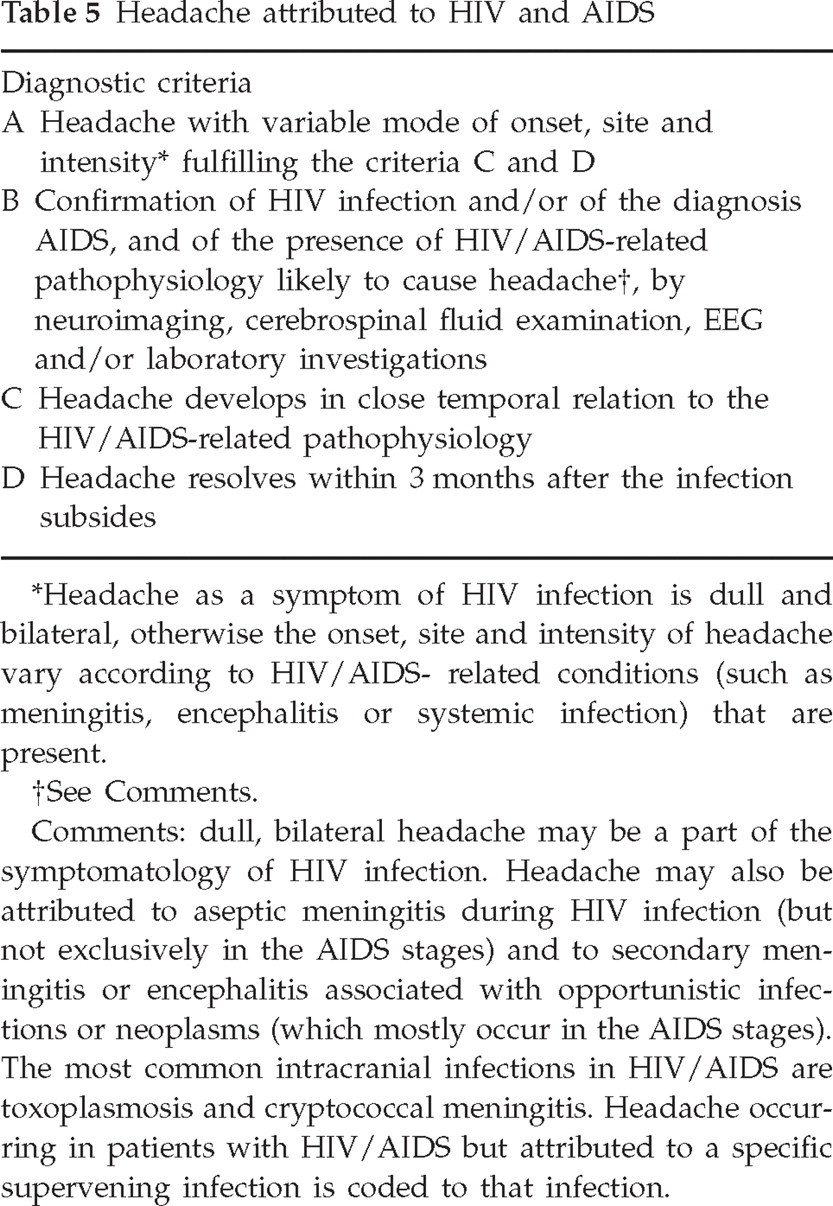
Headache as a symptom of HIV infection is dull and bilateral, otherwise the onset, site and intensity of headache vary according to HIV/AIDS- related conditions (such as meningitis, encephalitis or systemic infection) that are present.
See Comments.
Comments: dull, bilateral headache may be a part of the symptomatology of HIV infection. Headache may also be attributed to aseptic meningitis during HIV infection (but not exclusively in the AIDS stages) and to secondary meningitis or encephalitis associated with opportunistic infections or neoplasms (which mostly occur in the AIDS stages). The most common intracranial infections in HIV/AIDS are toxoplasmosis and cryptococcal meningitis. Headache occurring in patients with HIV/AIDS but attributed to a specific supervening infection is coded to that infection.
Specific comments
The existence of headache in HIV infection seems to be confirmed by a series of prospective and retrospective studies (13–16). However, current knowledge is not sufficient to provide useful indications regarding the peculiar characteristics of this headache type. In the most recent classification, the description of the symptoms is aspecific and does not include characteristics that enable it to be distinguished from other forms of headache not directly linked to the disease. Furthermore, point B refers to ‘confirmation of the presence of HIV/AIDS-related pathophysiology likely to cause headache, by neuroimaging, CSF examination, EEG and laboratory investigations’, and point C describes a close temporal relationship between the onset of the symptom and the previously described HIV/AIDS-related pathophysiology. However, it is not disclosed what these findings are and how they allow adequate diagnostic discrimination. Thus, this chapter could be reassessed, specifying that HIV-related headache is a diagnosis of exclusion, which cannot be confirmed by specific biological markers and instrumental findings. In clinical practice we can observe three headache patterns, of which only the first is a direct expression of AIDS or of HIV infection; the other two are dependent on the presence of different conditions, linked to the HIV infection, determining the characteristics of the headache:
a dull, quite continuous headache not clearly defined in clinical terms (duration, site, response to non-steroidal anti-inflammatory drugs) which could be directly related to HIV infection;
a headache attributed to aseptic meningitis, which can appear during the different stages of the disease, including the seroconversion stage;
headache associated with the various opportunistic infections. The characteristics of this headache are obviously determined by the peculiarities of the infective agent and the most common effects of the infection at the encephalic level (intracranial hypertension, meningism, chemical irritation of the algogenic structures, hydrocephalus).
Finally the literature has reported headache as a side-effect of antiretroviral drugs (17, 18), but the classification criteria fail to consider this possible confounding effect.
9.4 Chronic postinfection headache (9.4.1 Chronic postbacterial meningitis headache)
Questionnaire score: Mean 10.55; 95% CI upper limit 11.5.
Description
This is a new category that has been added to the new classification and confirmed by several reports in the literature (1, 2, 19). It is restricted to postbacterial infection forms (see Table 6), even though a chronic headache attributed to non-bacterial infections is cited in the appendix (A9.4.2) and draws attention to the need for more research in this area.
9.4 Chronic postinfectious headache

A reported 32% of survivors of bacterial meningitis suffer from persistent headache.
There is no evidence for persistent headache following other infections, but criteria for A9.4.2 Chronic post bacterial infection headache are in the appendix. More research is needed.
Specific comments
Analysis of point 9.4.1 seems to reveal that ‘diffuse continuous pain’ is not a typical characteristic of this form of headache, but an optional feature, included as a possible alternative to ‘dizziness’ and ‘difficulty in concentrating and/or loss of memory’. At this point, we might legitimately ask what the ‘basal’ characteristics are that denote the headache pain described in point 9.4.1, with which at least one of the symptoms listed in points 1, 2 and 3 should be associated. In the belief that we are correctly interpreting the intentions of the authors, we suggest that point A could be modified as follows:
Headache with diffuse continuous pain, associated with at least one of the following characteristics and fulfilling criteria C and D:
dizziness;
difficulty in concentrating and/or loss of memory.
Ancillary issues
Aseptic meningitis The meaning of the term ‘aseptic meningitis’ is controversial. The new IHS classification includes ‘aseptic meningitis’ in paragraph 7.3.2 (Headache attributed to noninfectious inflammatory disease), specifying in point C that the headache associated with aseptic meningitis is drug-induced. In both authoritative sources (2, 4) and in clinical practice, this term is frequently used to include the conditions characterized by: acute meningitis with benign course, lymphomonocytoid pleocytosis, probable but not demonstrated viral aetiology and exclusion of bacterial agents in the CSF (4). Thus, the term ‘aseptic meningitis’, limited to non-infectious and drug-induced processes, could generate further confusion and might therefore be reconsidered.
Acute disseminated encephalomyelitis The association of headache with post/para-infectious encephalomyelitis, better known as acute disseminated encephalomyelitis (ADEM), is widely demonstrated in the literature (20–22). This form of headache, whose symptoms are indistinguishable from those observed in meningoencephalitis, is classified as in the past, among the non-infectious inflammatory diseases (7.3.3). Its aetiopathogenesis is still debated; indeed, in some texts the disease is considered among the infectious diseases (4) and in others among the autoimmune demyelinating diseases (2). In any case, ADEM (in its most frequently observed form) is preceded by or associated with an infection and mimics meningoencephalitis due to a direct microbial infection. Its real pathogenesis is still debated. From a practical point of view, given the clearly post/parainfectious clinical context, the ‘meningoencephalitic’ expression of the headache and the absence of firm evidence supporting an autoimmune pathogenesis, we believe that this headache form would be more appropriately included in chapter 9, as: ‘Headache in encephalitis of infectious/vaccinal aetiology with a probable autoimmune pathogenesis’.
Conclusions
Analysis of the literature has revealed that there exist two main methodological problems hindering the development of a systematic classification of headache attributed to infection: a shortage of ad hoc studies and a lack of prospective studies. The few exceptions concern studies of new daily persistent headache (NDPH) (23), chronic fatigue syndrome (CFS) (24) and headache in HIV infection (13–16). However, the last topic, despite some encouraging evidences in the literature, continues to be poorly defined both clinically and epidemiologically.
Our proposals are the following: (i) to improve the definition of headache attributed to ‘lymphocytic meningitis’, separating forms with a viral aetiology from the typically granulomatous forms. This is a complex area that includes conditions too heterogeneous to be coded in the same way; (ii) to reappraise the concept of ‘aseptic meningitis’ according to the usual meaning which the literature commonly attributes to it; (iii) to add headaches associated to post/parainfectious central nervous system diseases; and (iv) to encourage the planning of ad hoc prospective studies on the relationship between headache and chronic infectious diseases such as tuberculosis and AIDS.