






Abstract


Introduction:
Laparoscopic adrenalectomy is the gold standard for benign diseases of the adrenal gland since the 1990’s. 1 However, laparoscopic right adrenalectomies may be complicated by obesity and hepatomegaly. In addition, retroperitoneal anatomical variants may require additional maneuvers to avoid complications. This video describes some technical considerations for obese patients undergoing right adrenalectomies.
Methods:
The first patient is a 77-year-old male with intermittent uncontrolled hypertension on four anti-hypertensive medications with central obesity, post-traumatic stress disorder (PTSD), and hyperlipidemia. He developed LLQ pain and underwent a CT scan that discerned a 3 cm right adrenal lesion. Urine and plasma catecholamines were elevated. A laparoscopic right adrenalectomy was planned after 4 weeks of alpha blockade. The patient was placed in left lateral decubitus position at 90 degrees, so the abdominal contents were retracted medially by gravity. After establishing a pneumoperitoneum, the ports are placed along the right costal margin more caudal to their normal placement along the ribs. The dissection proceeded by exposing the inferior and superior border of the adrenal gland. Due to the visceral fat, the adrenal vein was exposed and divided later in the procedure to avoid injury to the vein and IVC. The liver retraction was dynamic as opposed to stationary due to the overhanging inferior edge of the liver.
The second patient is a 31-year-old male with a history of hypertension and hypokalemia. He required four antihypertensive medications and 40 mg potassium daily. A CT was obtained and documented a 1 cm lesion in the right adrenal suspicious for an aldosteronoma. An adrenal venous sampling was performed and lateralized to the right adrenal gland. After positioning and abdominal entry, the gland was circumferentially dissected, and the adrenal vein was secured between clips. After dividing the vein, a tubular structure was ascertained that originated dorsal to the IVC. The tubular structure was at the L1 level and correlated with the cisternae chylae. The structure was doubly clipped and divided along the adrenal gland. The adrenalectomy was completed successfully.
Results:
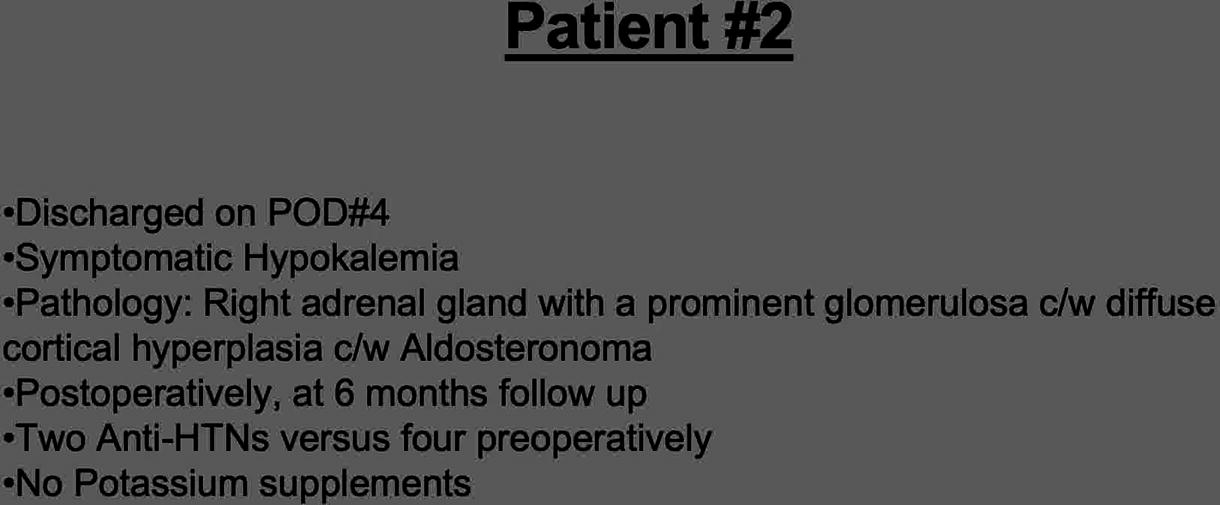
Both adrenalectomies were successfully completed. The first patient was discharged on POD#2. The final diagnosis was consistent with a pheochromocytoma. At 6 months follow-up, the patient’s hypertension was well controlled on two anti-hypertensive medications and his anxiety was significantly improved. The second patient was admitted postoperatively for 4 days due to fluctuating potassium levels. The pathology showed cortical hyperplasia that was consistent with an aldosteronoma. At 6 months follow-up, the patient’s potassium levels are normal without potassium supplements. He remains on two antihypertensive medications.
Conclusions:
These two cases illustrate various techniques for a laparoscopic right adrenalectomy in obese patients. The ports should be placed more caudal to avoid injury to the liver with the option to provide dynamic retraction. The adrenal vein may not be readily apparent so the inferior and superior borders of the gland may need to be exposed initially to safely identify and ligate the vein. Due to the location of the right adrenal gland and the retroperitoneal origin of the cisternae chylae, several lymphatic branches may need to be secured to avoid a chyle leak perioperatively. Finally, addition ports may be added to assist with retraction and dissection.
Patient Consent Statement:
Consent was obtained from the patients.
Source of work or study and conflicts of interest or obligations:
The source is the Washington DC VAMC and there is no conflict of interest.
Author Disclosure Statement:
The authors have nothing to disclosure with regards to financial or other conflicts of interest regarding the content of the video.
Authors have received and archived patient consent for video recording/publication in advance of video recording of procedure.
Runtime of video: 8 min 51 sec.
Get full access to this article
View all access options for this article.