






Abstract
Introduction:
Embryologically, pheochromocytomas (PCCs), neuroblastomas, ganglioneuroblastomas (GNBs), and ganglioneuromas (GNs) share a common origin from neural crest cells. 1,2 The concurrent presence of several pathologies within one PCC, so-called composite PCC, however, is exceptionally rare. 3,4 In our video we present the impact of indocyanine green (ICG) fluorescent guidance during adrenal sparing laparoscopic resection of a recurrent PCC with a concurrent GN (composite PCC-GN) in a 13-year-old girl with von Hippel–Lindau (VHL) disease.
Case Presentation:
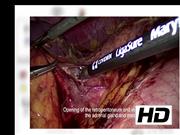
In 2007, a 3-year-old girl underwent open resection of a PCC in the right adrenal gland (5 cm in diameter). Postoperative genetic screening for syndromic forms of PCC detected VHL disease and continuous oncologic follow-up was scheduled. At the age of 13 years, a second PCC emerged in the contralateral gland (1.5 × 1.4 × 1.4 cm). In a right lateral position, laparoscopic adrenal sparing resection was performed using four trocars (5–10 mm). Intravenous injection of ICG (20 mg Verdye® 5 mg/mL, Diagnostic Green GmbH, Aschheim-Dornach, Germany) at the beginning of the surgical procedure and diagnostic laparoscopy in ICG mode (NIR/ICG Visualization Mode; IMAGE1 S™ RUBINA Imaging Technology, Karl Storz, Germany) allowed discrimination between the fluorescent adrenal tissue and the tumor. Complete laparoscopic resection was achieved using Ligasure® device. The postoperative course was uneventful and adrenal function was preserved. Histology report confirmed the PCC and additionally revealed a 3 mm GN making this a composite PCC-GN. Follow-up investigations confirmed endocrine and oncologic success.
Conclusion:
Laparoscopic surgery of pediatric adrenal tumors faces many fascinating challenges such as oncologic heterogeneity, endocrine complications, and technical advancements to improve surgical safety. For pediatric PCC, complete resection remains the cornerstone of treatment. 2 In syndromic cases such as VHL, which carry the genetic lifelong risk for recurrence, primary organ preservation must be attempted to avoid later adrenal insufficiency. 5 Technical advancements such as ICG fluorescent laparoscopy may assist identifying the border between healthy and tumor tissue. 6,7 In our case, ICG enhanced the normal adrenal gland and allowed obvious delineation. Thus, adrenal sparing resection achieved endocrinologic and oncologic success at the same time. Histologic examination of the specimen confirmed the PCC and revealed a small GN as a concurrent tumor, classifying this tumor as a composite PCC-GN. Composite PCC are extremely rare even in adulthood and account for only 3% of all PCCs. 3,4 Less than 10 cases have been reported in children up to date, all consisting of immature neuroblastic forms (GNBs) and none of them describing a PCC-GN in a girl with VHL. 8 Pathologically, this finding seems remarkable since the first PCC of our patient carried no concurrent GN. Thus, the answer of the unclear embryologic origin of the composite PCC could be hidden in a conserved pluripotent ability of the neural crest cells to differentiate into different entities facilitated by the presence of a genetic alteration such as VHL. 1 In summary, ICG-guided laparoscopy provided oncologic and endocrine safety for a girl with VHL disease by guiding adrenal sparing resection of a recurrent PCC with a concurrent GN (composite PCC-GN).
No competing financial interests exist
.
Runtime of video: 5 mins 24 secs


Get full access to this article
View all access options for this article.